Some years ago, former Cranbrook Archivist, Robbie Terman, posted a short blog post on one of the Titanic’s sister ships, RMS Olympic. In recent years, Cranbrook Archives has responded to numerous requests for images of the Olympic which are preserved in the first volume of Harry Scripps Booth’s Pleasures of Life albums.
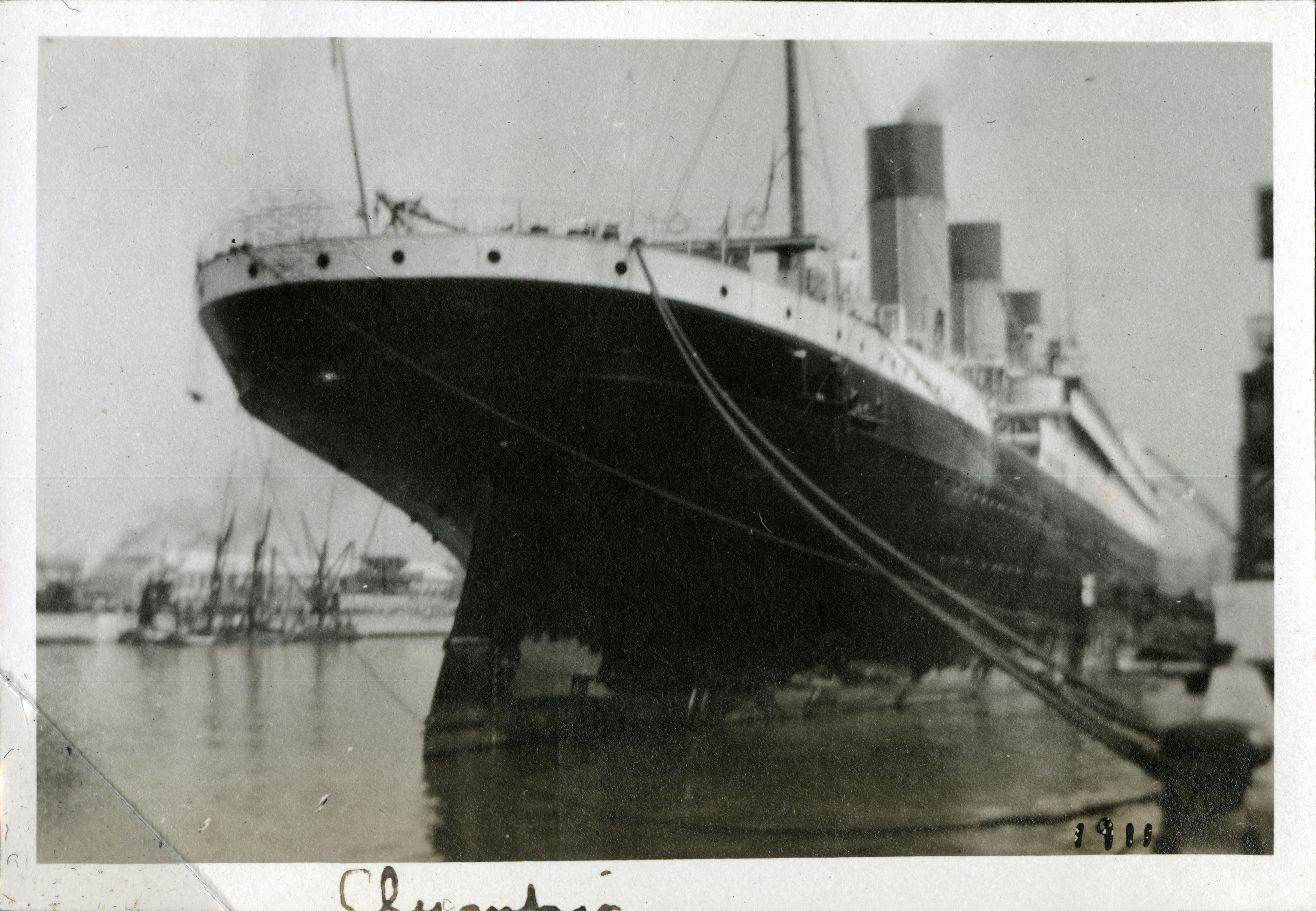
View of RMS Olympic before its first eastward crossing, June 28, 1911. [POL1.14.5]. Courtesy of Cranbrook Archives, Cranbrook Center for Collections and Research.
On June 28, 1911, the Booth family took the first eastward crossing of RMS Olympic from New York to Southampton, England. The family at that time was George and Ellen Booth; James Scripps and Jean McLaughlin Booth who had married the previous year; Grace, Warren, Henry, and Florence. They were joined by their Grand Rapids cousin, Esther Booth.
As I come from a maritime nation, these requests are particularly intriguing to me. I have wondered what other archives we have at Cranbrook to tell the story of transatlantic crossing and explain some of the images. George Gough Booth kept a record of the expenses in planning for the trip. These records tell us that he booked the steamship tickets with the Christian Leidich Travel Bureau in Detroit and he purchased Motor Union badges for himself and James.
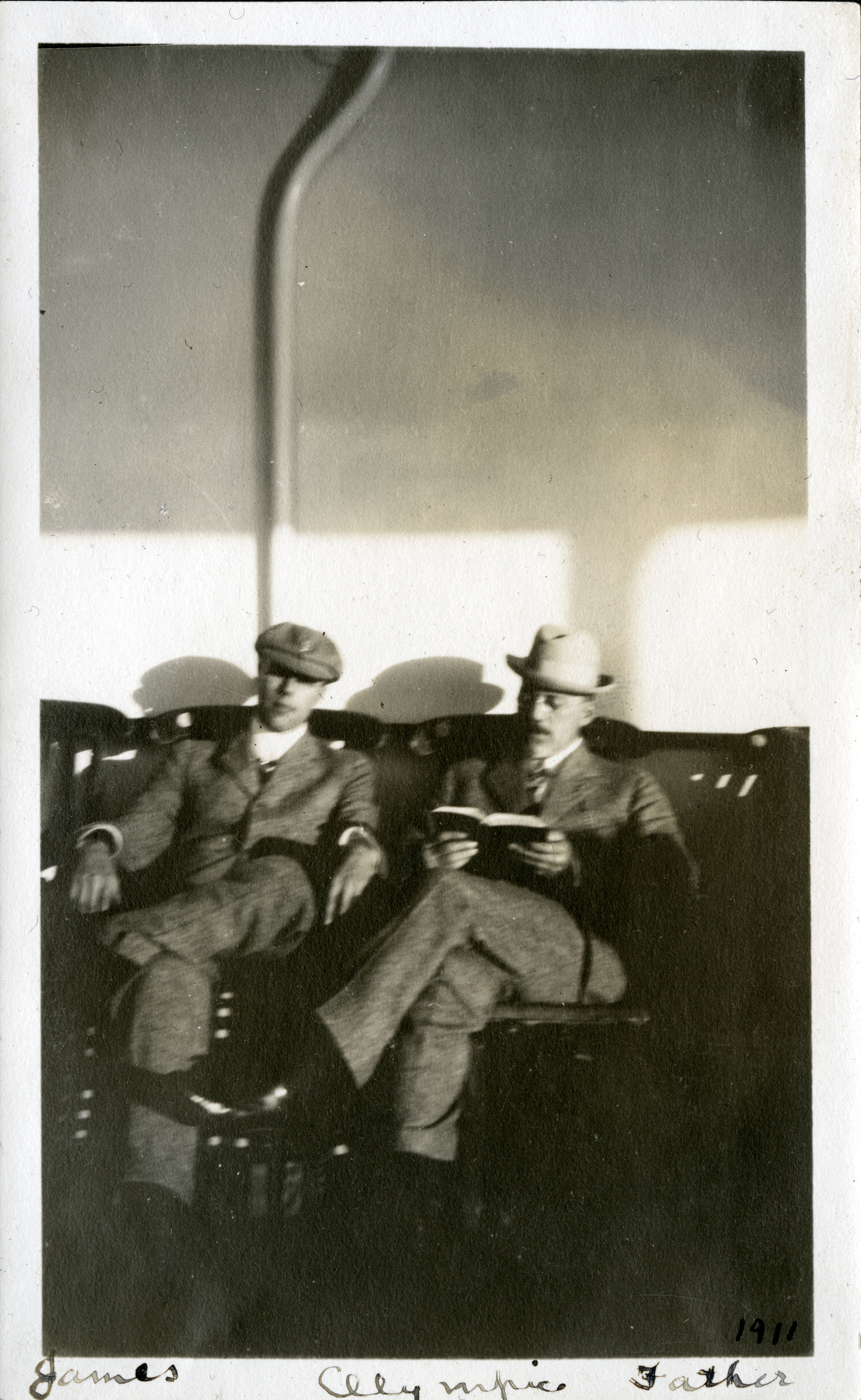
James Scripps Booth and George Gough Booth on the RMS Olympic, July 1911.[POL1.10.2] Courtesy of Cranbrook Archives, Cranbrook Center for Collections and Research.
As Henry recalls in his memoir after listing the family members who sailed,
“That wasn’t enough. Parks, the chauffeur, went; also The Pierce-Arrow, a 7-passenger touring car, and a Lozier Briarcliff, which accommodated four plus one in an airy seat on the left running board, designed for the chauffeur when the “master” took the wheel. That seat was a thrill for the young at heart.”
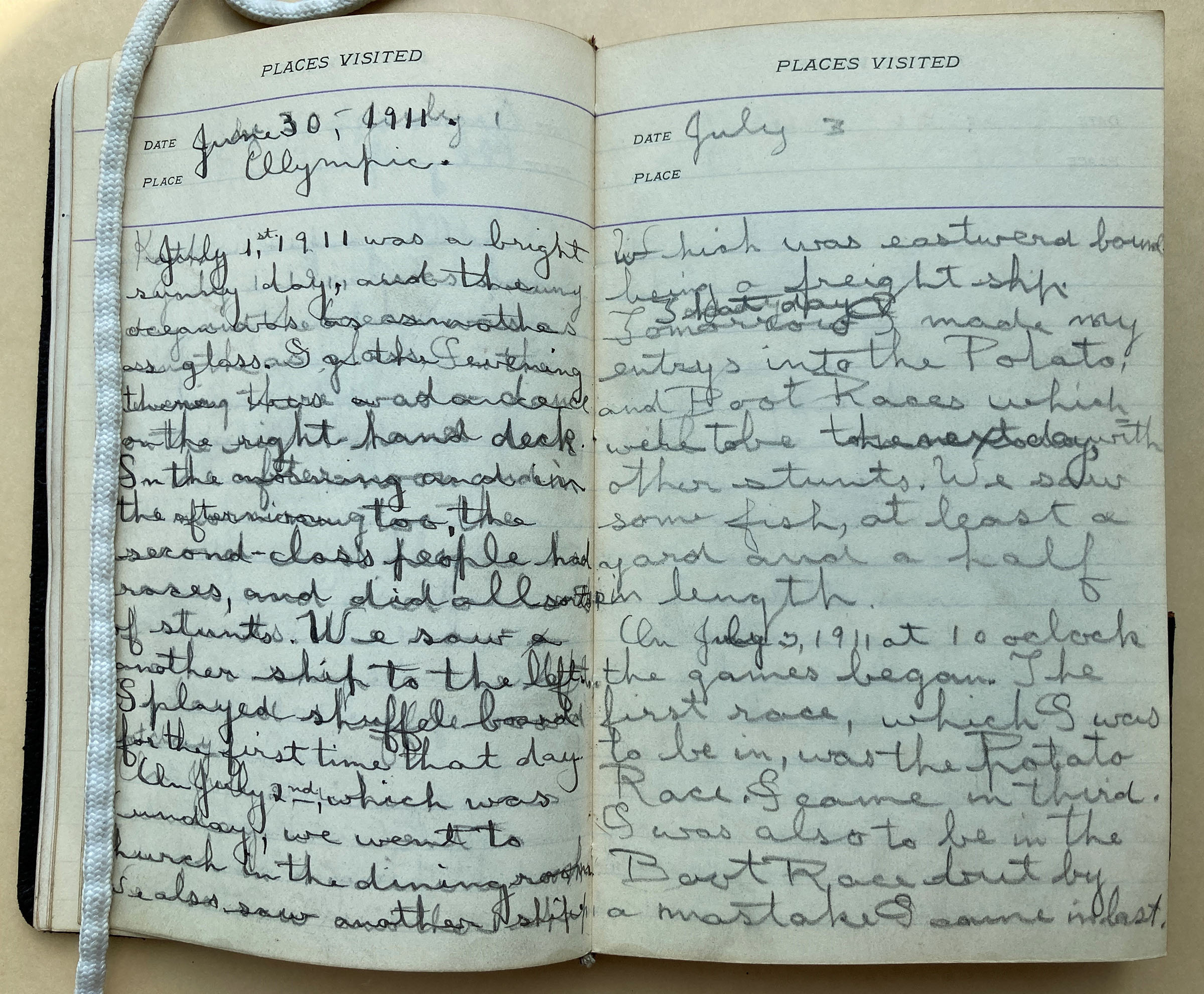
Then I came upon something quite wonderful—Henry’s journal of the sea crossing! He began the trip when he was just 14 years old, celebrating his 15th birthday in August during the vacation. As I read the entries, the images in the Pleasures of Life came alive. Here follows some moments from the journey in Henry’s words.
“Stayed at the Plaza. Esther’s trunk was lost. We found it later. On June 28, we went abord [sic] the great ship, “Olympic.” Henry Scripps Booth, June 27, 1911
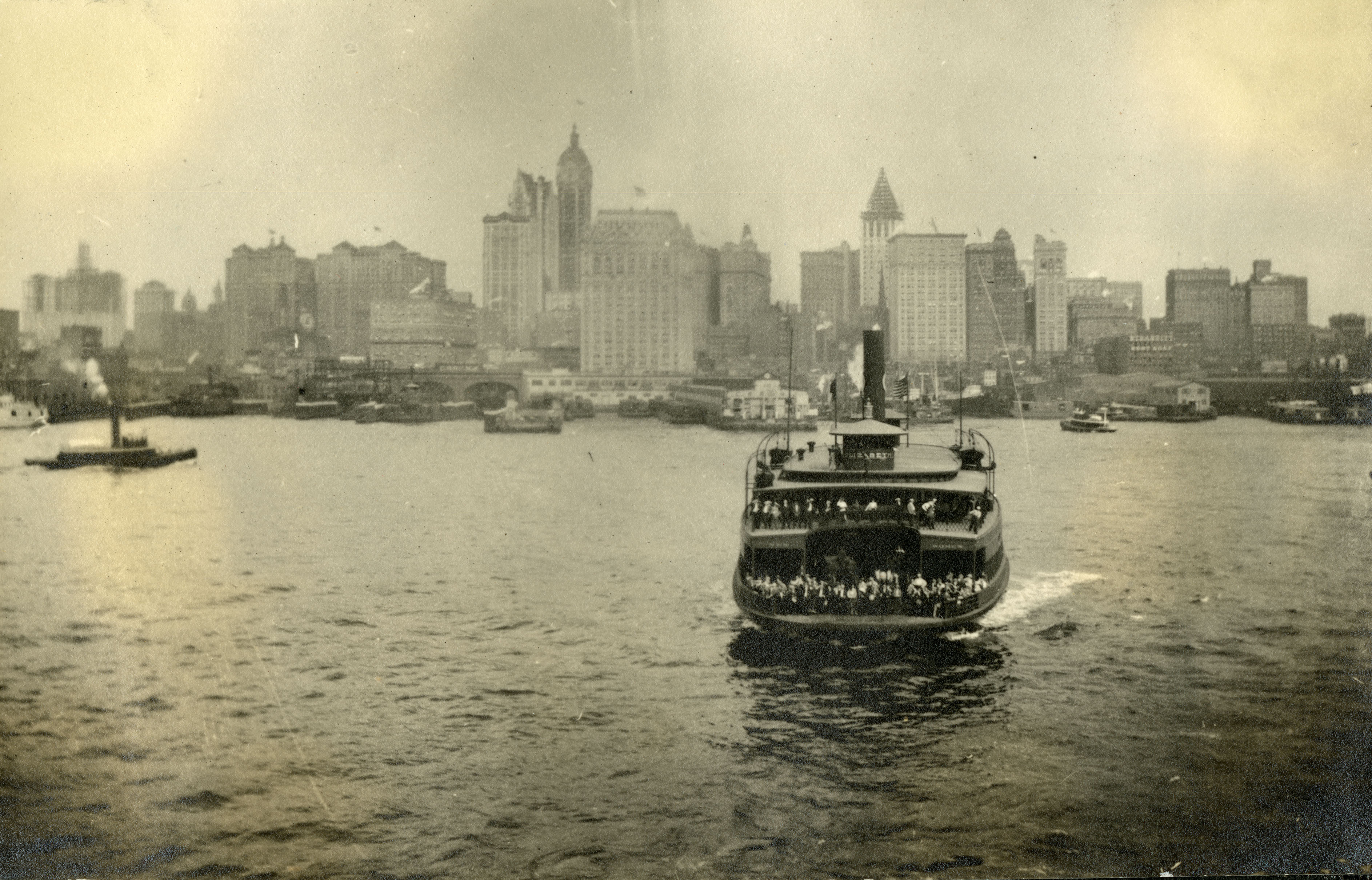
Leaving New York, June 28, 1911. Courtesy of Cranbrook Archives, Cranbrook Center for Collections and Research.
“On June 28, we went abord [sic] the great ship, “Olympic”. The Olympic is a fine ship. Florence was sick first night and day. It was somewhat rough on June 29th. I met a new friend but did not remember his name. In the morning, I could hardly stand, because of the new sensation. I was somewhat sick, but ate lots and I felt fine.” Henry Scripps Booth, June 28, 1911
“On June 30th the Campania was in view. I got acquainted with two girls, Constance Peabody and Katherine somebody.” Henry Scripps Booth, June 30th, 1911
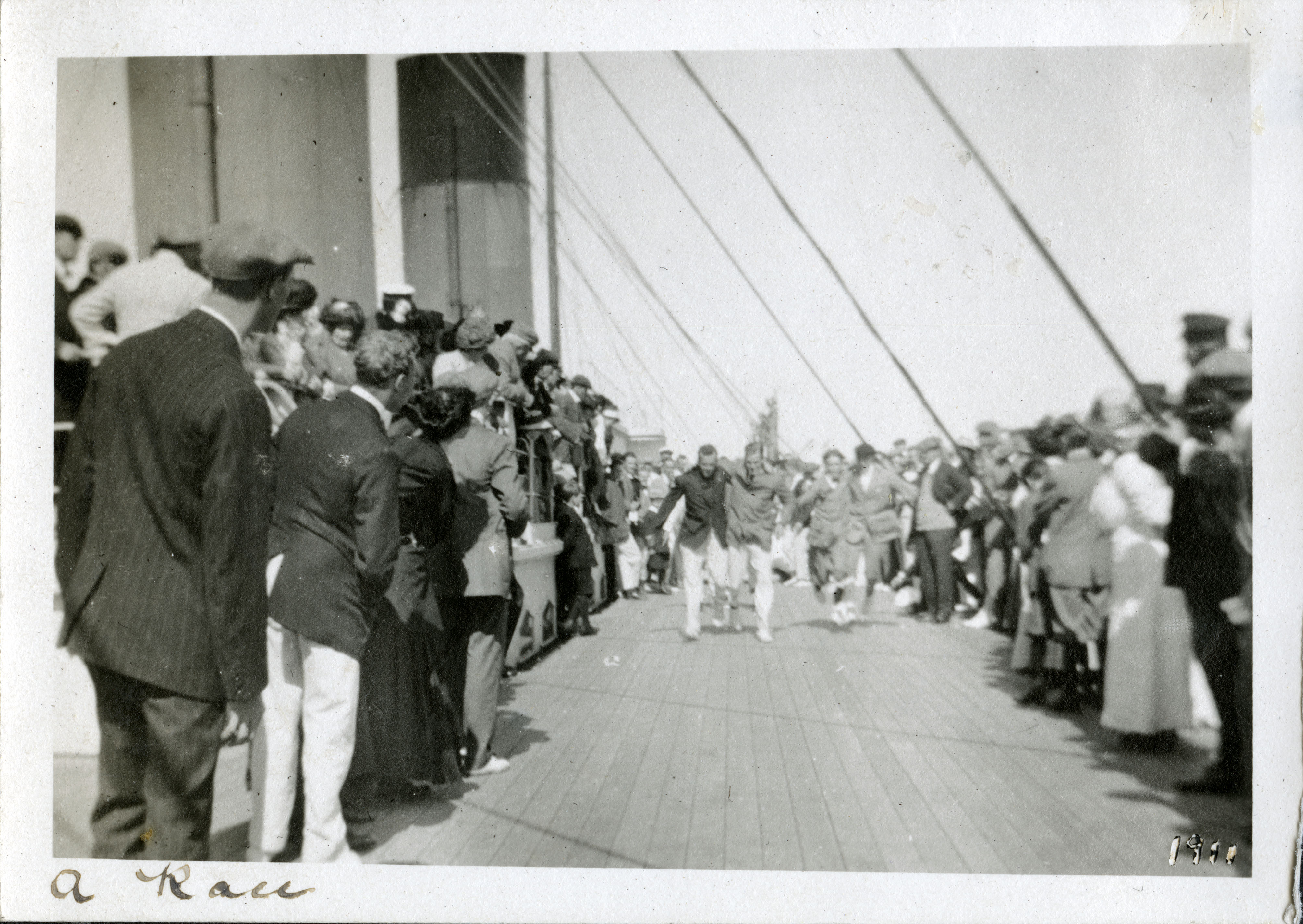
A race aboard the RMS Olympic on its first eastward crossing from New York to Southampton, July 1911. [POL1.11.4]. Courtesy of Cranbrook Archives, Cranbrook Center for Collections and Research.
“July 1st, 1911, was a bright sunny day, and the ocean was as smooth as glass. In the evening, there was a dance on the right hand deck. In the morning and in the afternoon too, the second-class people had races, and did all sorts of stunts. We saw another ship to the left. I played shuffleboard for the first time that day. On July 2nd, which was Sunday, we went to church in the dining room. We also saw another ship [July 3] which was eastwerd [sic] bound being a freight ship.” Henry Scripps Booth, July 1, 1911
A race aboard the RMS Olympic on its first eastward crossing from New York to Southampton, July 1911. [POL1.12.5]. Courtesy of Cranbrook Archives, Cranbrook Center for Collections and Research.
“Tomorrow That day, I made my entrys [sic] into the Potato and Boot Races which were to be the next day with other stunts. We saw some fish, at least a yard and a half in length.
On July 3, 1911, at 10 o’clock the games began. The first race, which I was to be in, was the Potato Race. I came in third. I was also to be in the Boot Race but by a mistake, I came in last.
After other races came the Standing Broad Jump in which James sliped [sic].” Henry Scripps Booth, July 3, 1911
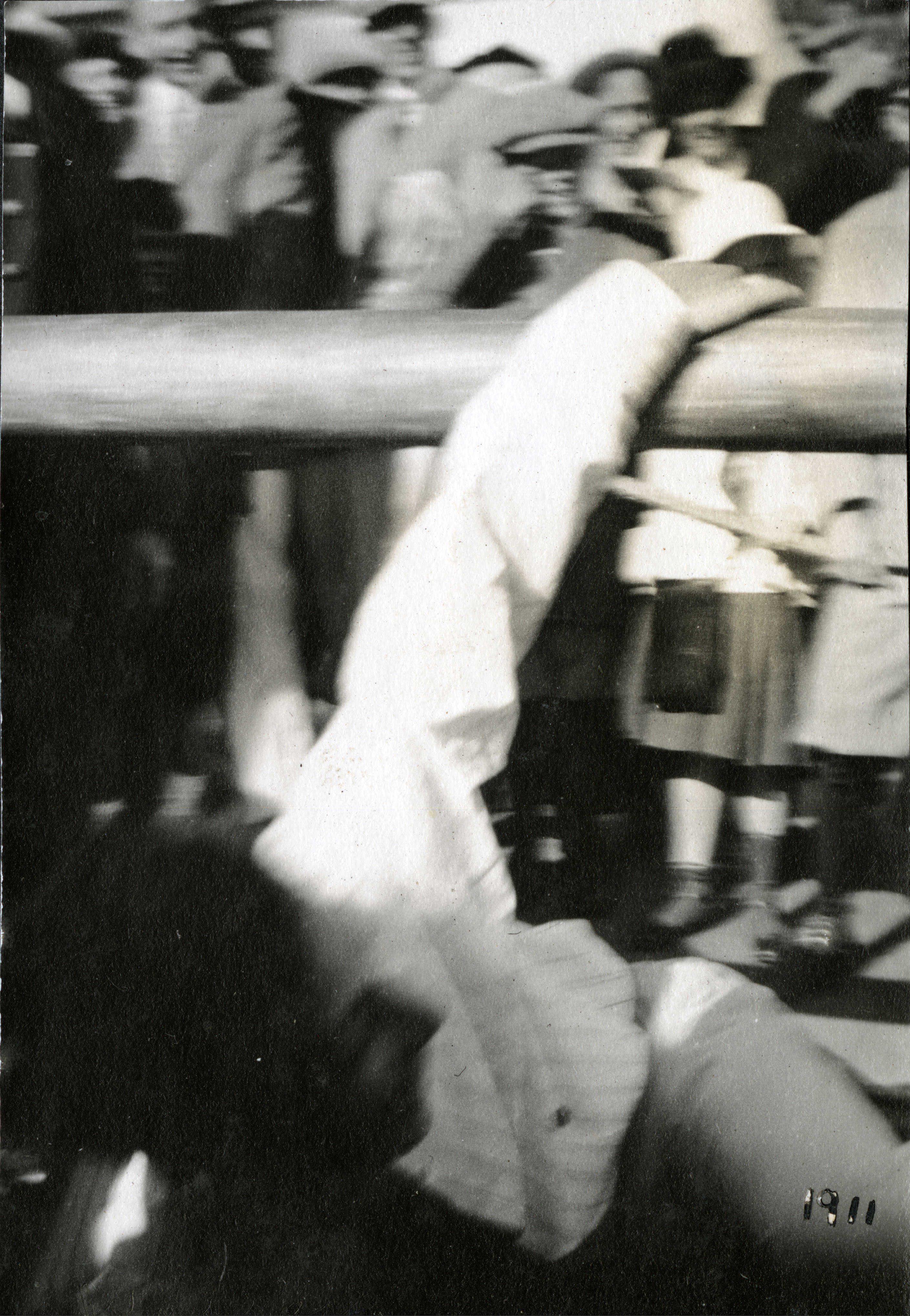
Warren Scripps Booth during a Spar Pillow Fight aboard the Steamship RMS Olympic, July 1911. [POL1.12.4]. Courtesy of Cranbrook Archives, Cranbrook Center for Collections and Research.
“James and Warren were both in the Spar Pillow Fight. In Warren’s case both fell off the bar at first but Warren was nocked [sic] off a second time. Warren did not win. James stayed on a number of times but was forced to give up. After dinner in the Reception Room the prizes were awarded. Also a dance on deck was given.” Henry Scripps Booth, July 3, 1911
Disembarking the RMS Olympic, July 5, 1911. [POL1.14.1]. Courtesy of Cranbrook Archives, Cranbrook Center for Collections and Research.
“Breakfast was served in the usual manner. After breakfast in the hall on the Sun Deck the band played the national cirs. Every body stood up. In the afternoon, at 4 o’clock we entered Plymouth Harbor. The mailtender got the mail and other boats got passengers off to land. We then started across the channel.” Henry Scripps Booth, July 4, 1911
“After getting off the steamer and having the officers make sure that we had no cigars or liquors with us, we took a cab to the hotel.” Henry Scripps Booth, July 5, 1911
Unloading the cars in France, August 1911. Courtesy of Cranbrook Archives, Cranbrook Center for Collections and Research.
As always, it is a great delight to share with scholars, colleagues, and those who are simply curious, these stories from the Archives. What is preserved in Cranbrook Archives help us to understand and enjoy not just Cranbrook, but any number of historic events from new perspectives.
There are more stories to tell about the family’s sojourn through England and France in 1911, which are both heartwarming and educational. But those tales must wait for another blog post–or for you to schedule a visit and come into the Archives Reading Room!
— Laura MacNewman, Associate Archivist, Cranbrook Archives, Cranbrook Center for Collections and Research
Nothing at Cranbrook is just one thing. Every tree, garden, rock, and railing has a story–and often times, a name.
In 2022, with the help of an anonymous donor and our friends at RE-TREE, a Camperdown elm (Ulmus glabra ‘Camperdownii’) was transplanted from a local garden to the Meadow in Cranbrook House Gardens, where it joined another established Camperdown elm. Since RE-TREE names all of the trees they relocate, I decided our Camperdown elms needed names, too. I started to refer to the larger tree as Thistle and the smaller tree as Smike to honor the two youngest Booth children, who grew up primarily on the Cranbrook Estate.
Thistle and Smike, the Camperdown elms below the West Terrace, in the Meadow, in Cranbrook House Gardens. Photographed by Leslie Mio, July 2024.
In 1908, George and Ellen Booth and their children, James, Grace, Warren, Harry, and Florence, moved from their home on Trumbull Avenue in Detroit to their new home Cranbrook, in the “wilds” of Bloomfield Township. At the time of the move, James was twenty, only two years away from marriage; Grace was eighteen; and Warren, fourteen, was already in boarding school. Youngest siblings Harry (eleven) and Florence (six) pretty much had the run of the grounds, exploring every nook and cranny (pun intended).
As the family explored and improved their country estate, they also took to naming significant features: every pond, hill, tree, and drive would be christened with its own name. Some names stuck (Angley Woods), others changed (Glassenbury Lake became Kingswood Lake), and others have been forgotten.
From the beginning of Cranbrook’s history in 1904, place names at Cranbrook have evolved and changed. Once the Booths turned the original mill pond into a lake,…
Harry and Florence were no exception; they had pet names for each other. Harry, known as Thistle, received his nickname during an illness. He did not shave for days, and someone said kissing his cheek was like kissing a thistle. We don’t have a record of the origin of Florence’s nickname, but friends and family called her Smike her whole life.
Harry (Thistle) and Florence (Smike) Booth with Spot in 1912. Courtesy Cranbrook Archives, Cranbrook Center for Collections and Research.
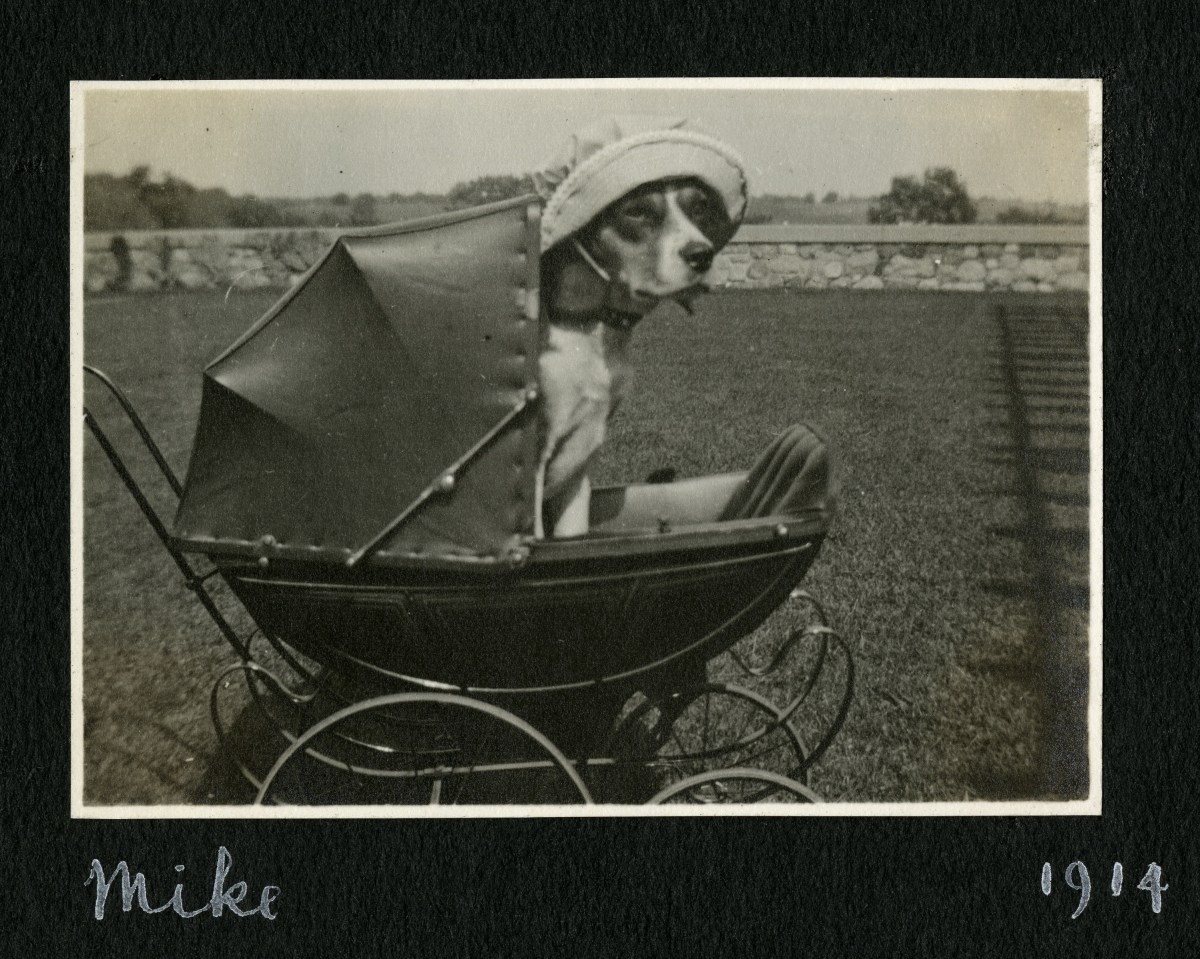
The Camperdown elms’ location below the West Terrace are also significant to Smike’s story. The Booths (especially Florence) loved animals. Family dogs Bud, Sandy, Spot, Prince, Larkspur, and Craig were well cared for and loved. The family beagle Mike was so beloved as to be made to wear a bonnet as he travelled around in a baby carriage!
The biggest canine event at Cranbrook came in 1914. As Harry Booth later wrote, “On June 20, 1914, the Booth family celebrated the 70th anniversary of the family’s landing on North America from England. After a picnic, everyone attended a dog show Florence Booth organized on the new West Terrace.”
The Bloomfield Hills Dog Show, June 20, 1914, on the West Terrace at Cranbrook House. Courtesy Cranbrook Archives, Cranbrook Center for Collections and Research.
Invitation to the Bloomfield Hills Dog Show, June 20, 1914, on the West Terrace at Cranbrook House. Courtesy Cranbrook Archives, Cranbrook Center for Collections and Research.
So, when I look at the two Camperdown elms below the West Terrace–one slightly bigger than the other–I think of all the stories the grounds of Cranbrook hold, and of the happy days Thistle and Smike spent growing, adventuring, and imagining around campus.
Perhaps you’ll agree with my names for the trees, and next time you are strolling in the Meadow at Cranbrook House Gardens, just below the West Terrace, say hello to Thistle and Smike.
– Leslie Mio, Associate Registrar, Cranbrook Center for Collections and Research
Ed. note: Special thanks to Paul Nelson, one of the arborists for Cranbrook House and Gardens Auxiliary. He has been a champion for Thistle and Smike, making sure they are trimmed, watered, fertilized, and kept looking their best.
With Laura MacNewman’s Kitchen Sink blog entry of May 2019 serving as an excellent guide to the Women’s Window of Christ Church, Cranbrook, it seems worthwhile to take a more detailed look at the individual panels.
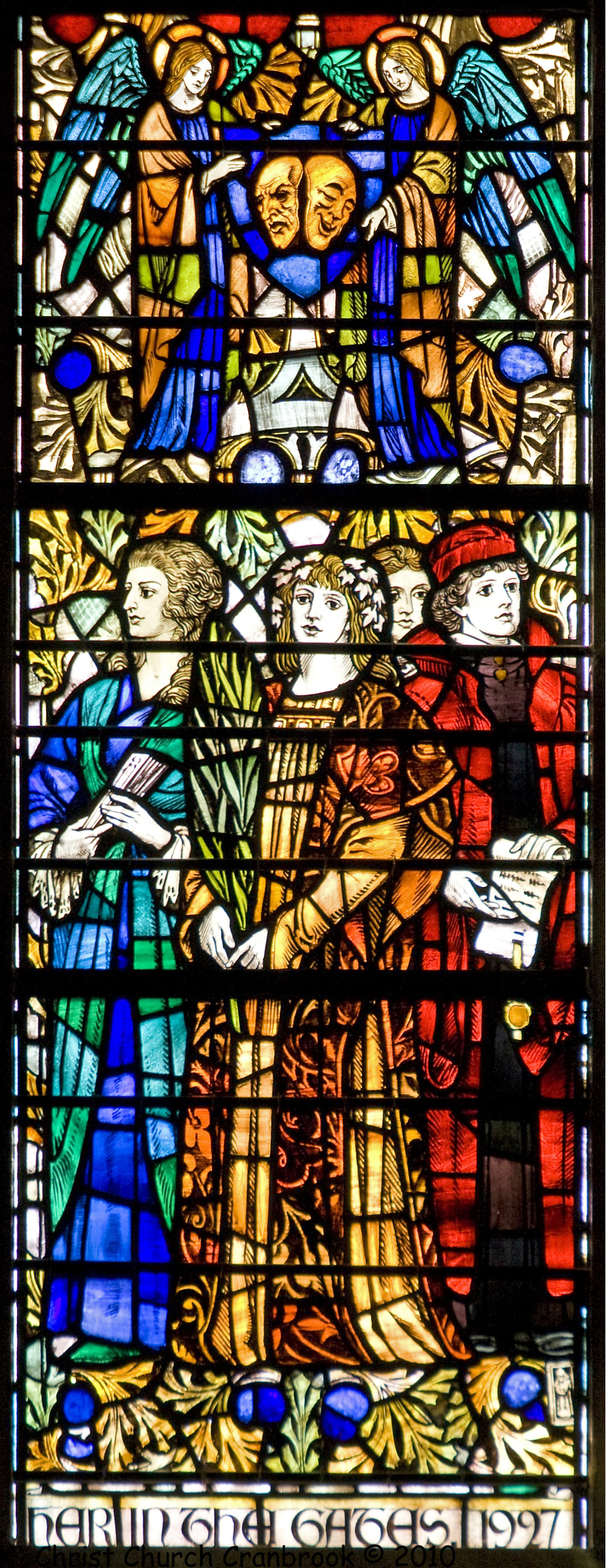
Panel 16, Actresses: Sarah Siddons (English, 1755-1831); Sarah Bernhardt (French, 1845-1923); Mary Anderson (American, 1859-1940); Ellen Terry (English, 1848-1928). Tom Booth, photographer. Copyright Christ Church Cranbrook 2010.
Though the window was the gift of Florence Booth Beresford and her husband James, the choice of women to be included was made by the Reverend Samuel S. Marquis, the first rector of the church. What is intriguing is how or why the Rev. Marquis chose the women who appear. Since no documentation has yet come to light, we can only look at who the women are as well as how they are depicted. Marquis aimed to cover mostly western culture through the ages up to his present day, the 1920s, and clearly was choosing exemplary members of the categories. Thus, we find that the actresses under study here, except for one, are well-known to this day in the French and English-speaking world.
The profession of actress almost until the present has had a bad reputation. A woman was not supposed to put herself on display or seek approval. Odd then that the quotation from Proverbs 31:28, 31 enters the window as the dedication to women: Her children rise up and call her blessed … and her works praise her in the gates. These works would not include appearing on stage or screen.
Shakespeare’s women were played by young men who aged out of the roles into male leads if they were lucky. The comedic role where the young female lead must disguise herself as a man then becomes an interesting part to watch, especially if the young actor, appearing as a young woman, must pretend to be man playing a woman as in As You Like It.
The first woman to appear on the English stage in her own right was reputedly Margaret Hughes in the role of Desdemona in 1660 after the restoration of Charles II. Our window’s first actress (from the left) is the Welsh actress Sarah Siddons, born 1755, older sister of the great John Kemble and aunt of also great Fanny Kemble. Siddons was a tragic actress, scorning comedy as buffoonery beneath her talents. Her great roles were Lady Macbeth and Volumnia from Coriolanus. These are two of Shakespeare’s nastiest ladies, beloved of actresses everywhere. As critic William Hazlitt said of Siddons, “Passion emanated from her breast.”
Stuart, Gilbert; Sarah Siddons, nee Kemble; National Portrait Gallery, London.
She was possibly the first actress superstar of the modern world, so famous she was painted by all the great portraitists including Gainsborough and our own Gilbert Stuart. All the paintings, even the stained-glass version, show off her famous Kemble nose.
The next actress is Sarah Bernhardt born in 1844 in Paris to the Dutch mistress of an aristocratic lover who sent young Sarah off to the Paris Conservatoire, then a partly government-sponsored school of acting. Bernhardt graduated into becoming a member of the Comédie-Française, where she found the techniques old-fashioned. Always a tearaway, she was dismissed for slapping a senior actress.
Bernhardt did not need the national theater to become one of the most famous actresses of all time. She was an exceptional self-promoter and entertained all the society men of her age, numbering the future Edward VII of England and Victor Hugo amongst her lovers. She had a mass of wild hair, big blue eyes, perfect teeth, and with her good looks and purity of diction and a voice variously described as silvery or golden she attracted enormous crowds to any theater. She made Victor Hugo cry in a performance of one of his own plays.
Sarah Bernhardt as Hamlet, June 1899, by James Lafayette, Library of Congress Prints and Photographs Division Washington, D.C.
Her roles were again mostly tragic playing Cordelia in Le Roi Lear, Hamlet, Desdemona, Joan of Arc, Racine’s Phèdre. Her offstage behavior was just as spirited; she slept in a coffin to prepare for roles and abandoned the corset.
She founded her own theaters, toured the United States nine times, toured the world, built and worked in a hospital in World War I, played a young man of twenty when she was fifty-five, took on all the great tragic roles, faced, fought and surmounted anti-Semitic slurs all her life, appeared in silent films and melodramas. She lost a lung, a kidney, a leg but still trod the boards.
Bernhardt incarnated the French wife of an English artist in Detroit in the play The False Model on November 25, 1916, but there is no record of any Booths attending.
Next is English actress Ellen Terry, born in 1847, contemporaneous with Sarah Bernhardt, but not the quite the world player. Beautiful Terry, teenage actress and the artist’s model, married pre-Raphaelite painter G.F. Watts but went off to live with architect-designer Edward William Godwin where she caught the eye of renowned actor Henry Irving. Irving sought luxurious stage settings and a beautiful actress to complement his own great talent. In addition to appearing in all the great female roles of Shakespeare and more humble parts, Terry entered into a lively correspondence with George Bernard Shaw who cast her in roles he had written for her.
The unrivaled team of Irving and Terry lasted 24 years. Even today, to be able to say that your great-great grand relatives had seen them onstage together is still impressive. Terry and Irving appeared in Detroit 25 through 27 January 1900. We find in Ellen Scripps Booth’s diary for Friday, January 26: “I went to see Irving and Terry tonight in Robespierre.” Mrs. Booth makes no comment on Terry’s performance of loving wife Clarisse, but the Detroit Free Press of the next day praised Terry for her “characteristic grace” and “personal charm” in a not very demanding role. There were many curtain calls.
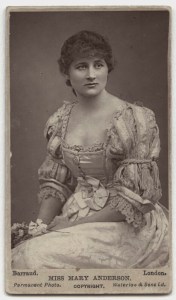
The “half” actress who owns the little face inserted between Bernhardt and Terry is Mary Anderson, born 1859, the American tragedian here, who also took on comedic roles. Her claim to fame was playing two parts (Perdita and Hermione) in Shakespeare’s The Winter’s Tale which bought her great acclaim. Audiences raved over her, while critics appreciated her beauty but found her lacking in feeling. By contrast with the others her star burned for a much shorter time. She toured extensively but withdrew from the public eye in 1889 due to exhaustion and the offer of marriage and a home in England.
Stained-glass artist James Hogan’s pre-Raphaelite influence can be seen in the depictions in the window, but he is not copying from any standard image. Siddons appears in one of her classical roles, Bernhardt as Phèdre, and Terry in her signature red lawyer’s robes as Portia from the Merchant of Venice playing a man.
What unites these women is their ability to stand up and be counted as women of talent at a time when they were more regarded as curiosities. Of the three greats, not one of them had a happy love life. Two of them famously had children out of wedlock and all three were regarded as unworthy by the men who should have revered them. All three nineteenth-century actresses played the roles of men. Considering their unconventional lives, it is surprising perhaps that Rector Marquis chose them, but then all the women in the window were unusual because they stood out as pioneers in some way. Who was the most famous? From the 1870s on there were two well-known women: Queen Victoria and Sarah Bernhardt, in no particular order.
– Lynette Mayman, Collections Interpreter, Cranbrook Center for Collections and Research
September 24 is the birthday of Cranbrook’s co-founder George Gough Booth. Trying to decide how best to commemorate his 157th birthday, I landed on the idea of sharing the story of the day he came into the world.
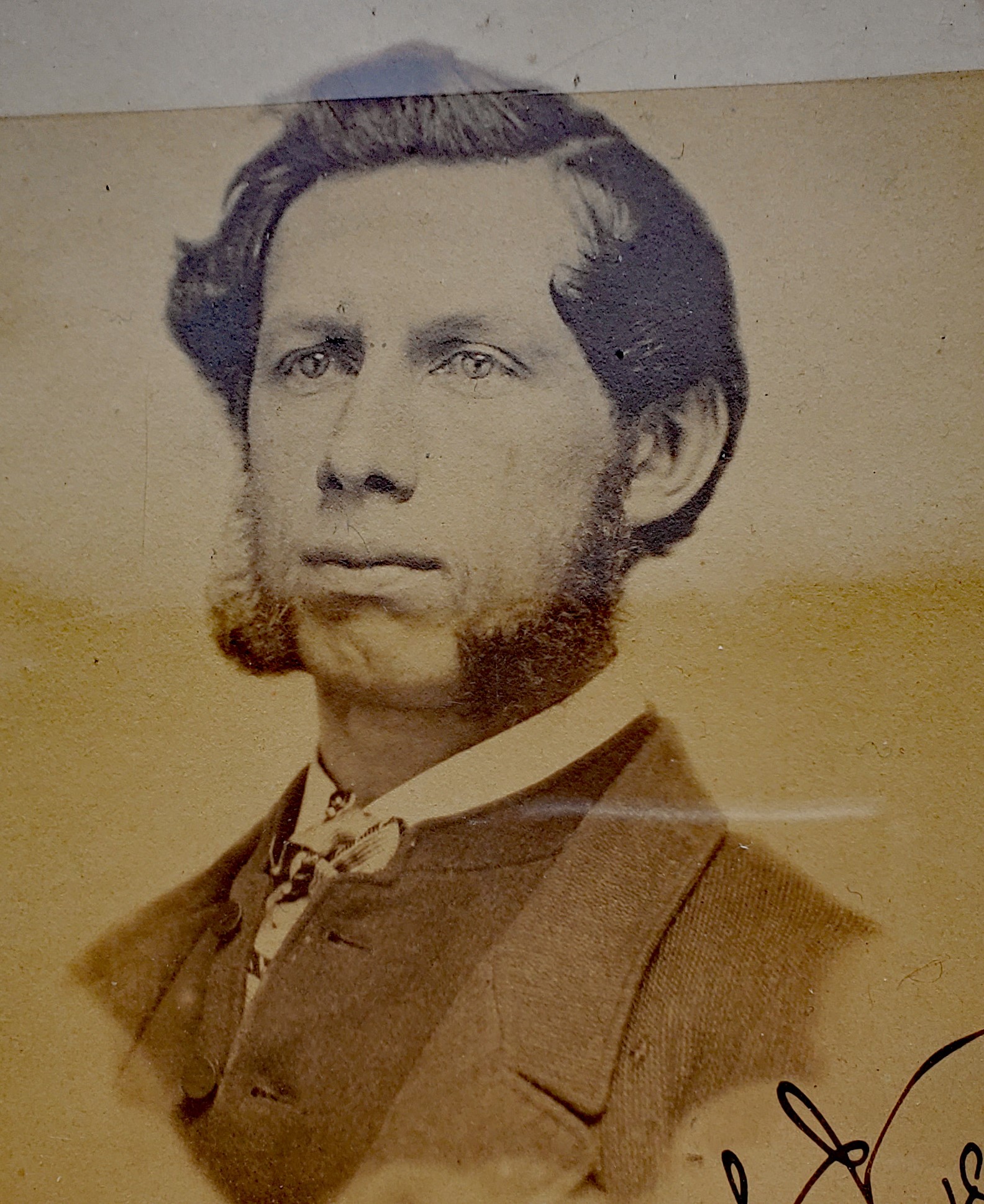
Portrait of George when he was around twelve years old. Photographer W. E. Lindop, Elgin Gallery, St. Thomas, Ontario. Courtesy of Cranbrook Archives, Cranbrook Center for Collections and Research.
In 1864, Henry Wood Booth and Clara Louise Irene Gagnier Booth were living in Canada. Clara had already given birth to three children: Charles, Alice, and Grace. Baby Grace had, unfortunately, died at seven months. Clara would go on to have six more children—Edmund, Theodora, Adelaide, Ralph, Roland, and Bertha—for a total of nine children to live past infancy.
Clara Louise Irene Gagnier Booth in 1857. Courtesy of Cranbrook Archives, Cranbrook Center for Collections and Research.
Henry Wood Booth in 1862. Courtesy of Cranbrook Archives, Cranbrook Center for Collections and Research.
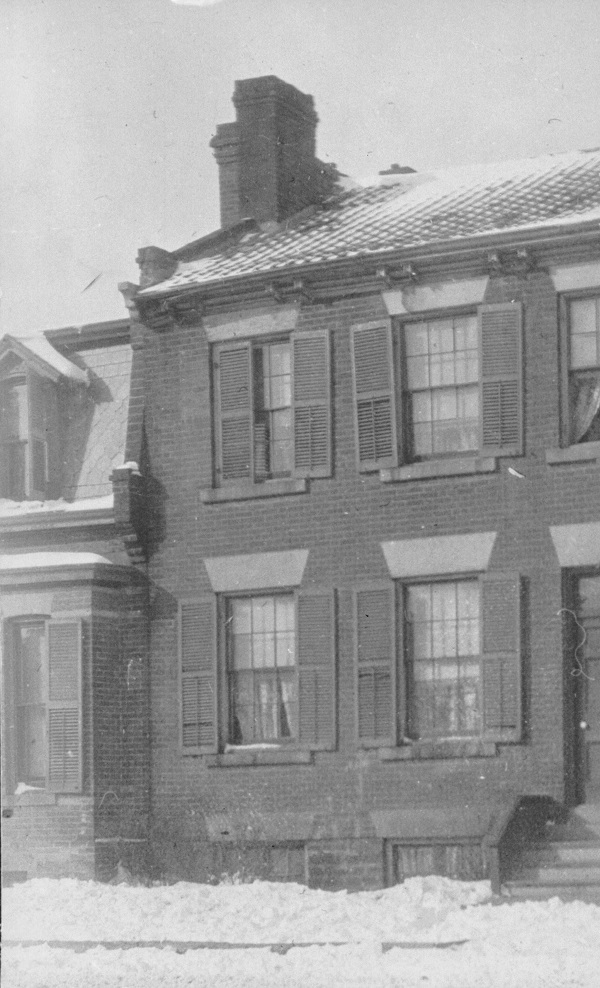
George Gough Booth arrived on September 24, 1864, at 8 Magill (now McGill) Street in Toronto, Ontario, Canada. Henry Wood Booth recalled that George was, “Born in the house at the East end of row on the South side of Magill St. about the middle of the block from Younge St. at 11.30 p.m. on Saturday, Sept. 24, 1864.”
The terrace house at No. 8 Magill Street, the birthplace of George G. Booth in Toronto, Ontario, Canada, as it looked in 1902. Courtesy of Cranbrook Archives, Cranbrook Center for Collections and Research
In a missive written much later about the night of George’s birth, Henry recalled “the time when, on opening the front door, I heard your sonorous voice for the first time, while your grandmother, coming down the stairs, assured me ‘it’s a fine boy.’”
But why was Henry out so late on the night George was born? Shouldn’t he have been home with Clara?
Henry Wood Booth’s recollection of the birth of George Gough Booth in 1864. George Gough Booth (1864-1949) Papers (1981-01), Box 1 Folder 1, Cranbrook Archives.
Distraught during Clara’s labor—”The warning came at about 10 p.m.” Henry recalled—the father-to-be was ushered out of the house to get help. His first stop was the home of Mrs. Cavie, across Magill Street, “who was in bed but promised to ‘dress and go over at once,’ which she did.” Henry then ran to Mother Gagnier’s house. She lived a mile away. “She also promised to go at once, and did.”
His final stop was the home of Dr. James Ross, who lived almost three miles away. Dr. Ross, however, took his time, dressing while a nervous Henry waited. He regretted waiting for the doctor, “I should have hurried home and told them there that the doctor was coming.”
George, “being a lively one,” commented Henry, “and his mother equal to the task,” had already made his entrance into the world, with the assistance of the experienced Grandmother Gagnier, before the doctor and Henry had reached the house.
George Gough got his first name from his great-grandfather as well as his uncle, both named George Booth. Gough came from two sources. Henry’s grandmother Elizabeth Dann Gough Booth had been a member of the influential Gough family back in England, and Henry’s father’s name was Henry Gough Booth.
In addition, Henry and Clara enjoyed the work of the famous temperance orator John Gough. Henry had once heard Gough lecture in 1849, where Henry signed “the pledge” to stop drinking, and became a champion of temperance. The Booths sought to dedicate George to “the sacred cause of temperance” and thought the strong middle name would help.
George Gough Booth did maintain a temperate life, so Henry and Clara’s goal was achieved.
Another thing Henry and Clara passed on to their son George: a tradition of honoring the family ancestry through names:
George’s second son’s name was Warren, his wife Ellen Scripps Booth’s middle name
His first daughter was named Grace Ellen, after his sister who died in infancy and his wife
His youngest son was named Henry after his father, grandfather, and a long line of Henrys before him
His youngest daughter Florence’s middle name was Louise, his mother’s middle name
All three of his sons’ middle names were Scripps, his wife’s maiden name
Ellen Scripps Booth and George Gough Booth with their children on their 50th wedding anniversary in 1937. The Booths are, from front row, from left: James Scripps, Henry Scripps, Warren Scripps. Second row from left: Ellen Scripps, George Gough, Grace Ellen, Florence Louise. Courtesy of Cranbrook Archives, Cranbrook Center for Collections and Research
And George and Ellen’s home, estate, and community they founded was, of course, named for the town in Kent, England, where Henry Wood Booth was born: Cranbrook.
And with that, I’d like to wish a very Happy Birthday, Mr. Booth!
—Leslie S. Mio, Associate Registrar, Cranbrook Center for Collections and Research
Memorial Day Weekend marks the beginning of summer, and in Michigan, what better way to celebrate than with a typical summer activity: boating.
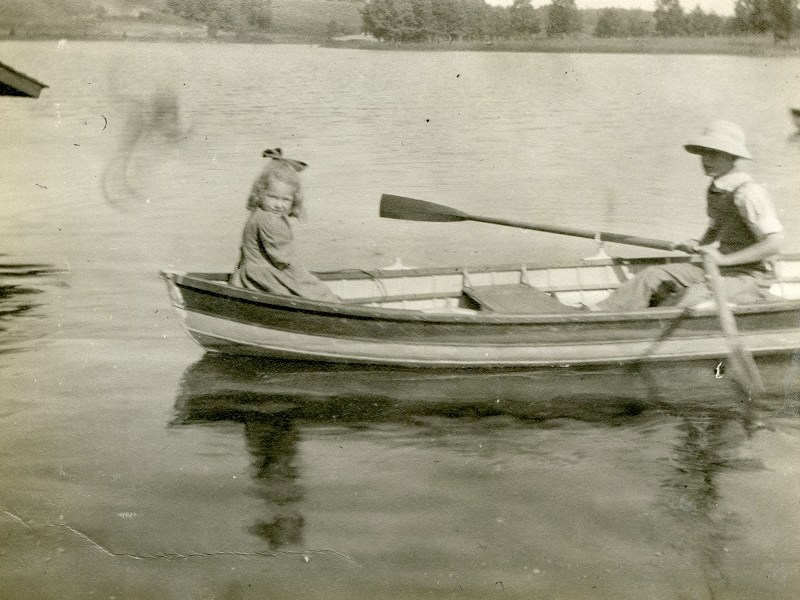
Florence Louise Booth and Warren Scripps Booth rowing on Glastonbury Lake (now Kingswood Lake) in 1906. Courtesy of Cranbrook Archives.
Florence and Warren are pictured in a rowboat at what was known as the Booth family’s summer retreat, two years before the building of Cranbrook House. In 1906, Henry Wood Booth recalled, “The millpond was enlarged and made into a lake by deepening and extending to the old millrace at the north-west end.” The lake was called Glastonbury Lake, after a pond near the village of Cranbrook, Kent, England (Henry Wood Booth’s birthplace). It has since been renamed Kingswood Lake.
Warren Scripps Booth sits in a boat near the original frame boathouse on Glastonbury Lake (now Kingswood Lake) in 1906. Courtesy of Cranbrook Archives.
So, as summer begins, remember to be safe while boating. Although Florence (4) and Warren (12) may be missing their life jackets 115 years ago, a new Federal Law now requires children under 13 years of age to wear one when a vessel is underway.
– Leslie S. Mio, Associate Registrar, Cranbrook Center for Collections and Research










 Cranbrook Kitchen Sink