Clifford West Papers Come to Cranbrook

Cranbrook Archives is excited to announce the acquisition of the Clifford B. West and Joy Griffin West Papers. Since the boxes arrived this past summer, I have been inventorying their contents in preparation for making them accessible to the public for research. Completing this work involves continually unravelling the many interesting facets of Clifford and Joy’s stories to be brought to light through the collection. Among many other things, are their experiences at Cranbrook in the mid-twentieth century.

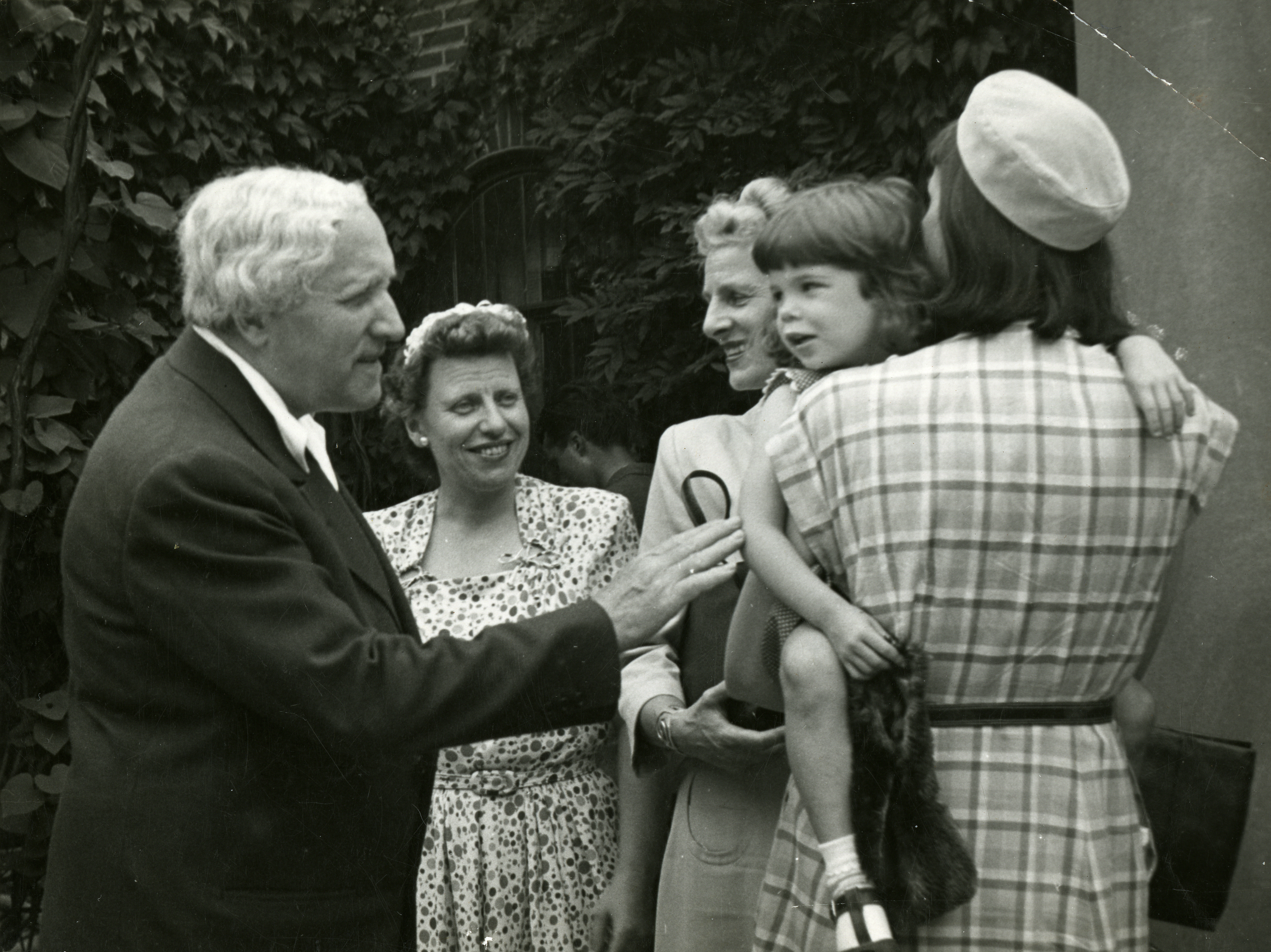
Joy Griffin and Clifford West in front of Carl Milles’ sculpture on the north wall of the Academy of Art library, 1941. Harvey Croze, photographer. Courtesy of Cranbrook Archives.

Clifford and Joy attended the Academy of Art at the tail end of its golden age, meeting and marrying in 1941. At that time, Carl Milles, Eliel Saarinen, Loja Saarinen, and Eero Saarinen taught and worked on campus. Clifford earned his MFA in painting under Zoltan Sepeshy and Joy took ceramics classes from Maija Grotell. Fellow students included Lily Swann Saarinen and Harry Bertoia, among others.

Bertoia and West: Three Decades

It was with Harry Bertoia, sculptor and designer, that Clifford enjoyed a lifelong friendship, serving as best man at his 1943 wedding to Brigitta Valentiner (fellow Academy student and daughter of Wilhelm Valentiner, Director of the Detroit Institute of Arts). While living in different parts of the country after graduation (or different countries all together), the two artists maintained close ties, both personally and professionally, evidenced by correspondence and other materials found in the Wests’ papers. Of particular note is the original 16mm film Clifford made in 1965, titled Harry Bertoia’s Sculpture, featuring a soundtrack by Bertoia.

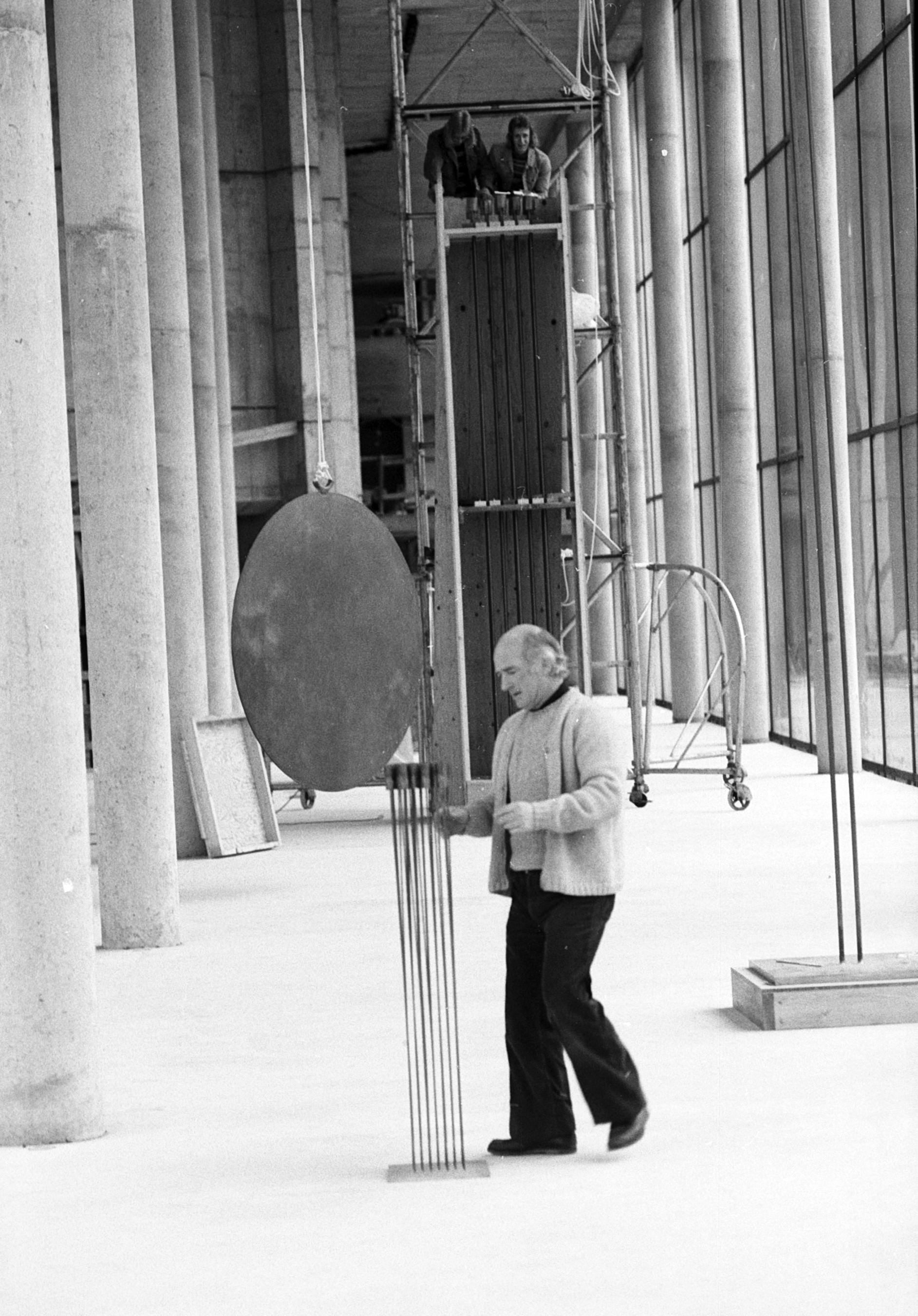
Harry Bertoia in his studio, circa 1976. Clifford West, photographer. Courtesy of Cranbrook Archives.

Another fascinating connection is Clifford’s involvement with a few 1976-1977 exhibitions of Bertoia’s sculptures in Norway. Bertoia’s work, including his sound sculptures, had been introduced to the Norwegian art scene in the late 1960s through Bente Torjusen, an educator at the Munch Museum who assisted Clifford on his 1968 film about artist Edvard Munch and later became his third wife. An accomplished filmmaker and photographer by the late 1970s, Clifford photographed the Bertoia exhibitions and designed the accompanying catalogs. In true Cranbrook fashion, Clifford’s artistic talents were not limited to just one medium.

Poster for The Sculpture of Harry Bertoia exhibition at the Grieg Music Festival, Bergen, Norway, 1976. Clifford West, photographer and designer. Courtesy of Cranbrook Archives.

The exhibitions would be the last collaborations between Clifford West and Harry Bertoia, as Bertoia would succumb to lung cancer one year later. Fifty years on, Cranbrook Art Museum will celebrate Harry Bertoia in an upcoming exhibition, opening summer of 2027. Bertoia’s work was last featured at Cranbrook in the 2015 exhibition, Bent, Cast, and Forged: The Jewelry of Harry Bertoia, which marked the centennial of his birth and the first exhibition devoted to his jewelry designs (see the full catalog here).

I look forward to uncovering and sharing more about Clifford and Joy’s remarkable lives. Stay tuned!

Deborah Rice, Head Archivist, Cranbrook Center for Collections and Research

Related announcement from the Harry Bertoia Foundation:

The Harry Bertoia Catalogue Raisonné is announcing a call for works from the Cranbrook community to more fully develop the publication’s coverage of the artist’s early jewelry practice, a currently under-described area of the artist’s oeuvre.

Present owners of jewelry believed to be by Bertoia are invited to contact the Harry Bertoia Foundation and Harry Bertoia Catalogue Raisonné by sending an email to: catalogue@harrybertoia.org, and submitting an owner questionnaire, available on our website. Museums, art galleries, and other institutions that are in possession of works by the artist are also invited to submit relevant data and photographic documentation. All information will be treated with discretion and held in strictest confidence.

Christmas Greetings for Marianne Strengell

Correspondence, including special occasion cards, are not uncommon in archival collections, but sometimes you find remarkable standouts such as the panoramic handmade masterpiece in the Marianne Strengell Papers. Measuring 5 x 24 inches, I invite you to click on the image below and zoom in to see all of the amazing details.

Titled, “This Way to the Strengell-Hammarstrom Gallery,” the card depicts a wall of portraits of Strengell family members, each complete with a short anecdote.

First portrait in the gallery. Courtesy of Cranbrook Archives.

At the end of the gallery is an abstract portrait of “Marianne Strengell Hammarstrom ‘Our Birthday Gal’” (curious, since she was born in May!). The card is signed, “love from your Weavers.”

Portrait and greeting detail. Courtesy of Cranbrook Archives.

Since no real names are used and the card is not dated, the origins and meaning behind the drawings and greeting remain as yet unknown. So far, research has not yielded any definitive answers. What we do know, however, is that Strengell enjoyed a wonderful relationship with her students and developed many deep friendships with both students and colleagues such as Wallace Mitchell and Zoltan Sepeshy. The wry, irreverent humor that imbues the card certainly suggests the close-knit, sociable atmosphere Marianne experienced at the Academy. “In all a very happy studio and many wonderful, now famous students. For me, 25 marvelous years.” (Marianne Strengell, 1989)

Last portrait in the gallery. Courtesy of Cranbrook Archives.

Strengell’s students included Nelly Mehta Sethna, Ed Rossbach, Robert Sailors and Jack Lenor Larsen, but she also had students from other departments study with her. These ‘Minors’ as Strengell dubbed them included Charles Eames, Benjamin Baldwin, Harry Bertoia, and Harry Weese.

Letter to Mark Coir, Archives Director, 1995. Courtesy of Cranbrook Archives.

Strengell, in fact, highly encouraged interaction between the departments, establishing Open House Days in the weaving studio, as well as Weavers Parties, which were very popular.

Revelers at a Weavers Party, 1959. Harvey Croze, photographer. Courtesy of Cranbrook Archives.

Marianne Strengell was a weaving instructor (1937-1942) and head of the Department of Weaving and Textile Design (1942-1961) at the Academy of Art. She often worked closely with her second husband, Olav Hammarstrom, architect and furniture designer, whom she married in 1948.

Farewell dinner for Marianne Strengell in the weaving studio, 1961. Strengell is shown middle left. Harvey Croze, photographer. Courtesy of Cranbrook Archives.

There are several other examples of holiday greetings in the Archives’ collections from Strengell’s contemporaries, but, in my opinion, none as witty as the one created by her Academy admirers.

May your holiday season be as merry and bright!

Deborah Rice, Head Archivist, Cranbrook Center for Collections and Research

Remembering Svea Kline: Artist and Teacher

As we continue to celebrate the women of Cranbrook during Women’s History Month, our Friday post is dedicated to sculptor and teacher, Svea Kline (1902-1989). Born in Karlskrona, Sweden, Kline came to Chicago in 1928 with her twin sister. Following her mother’s advice to find a “practical profession,” Kline studied physiotherapy at Northwestern University for two years and practiced with a physician. She also took art classes at the Art Institute of Chicago during this time.

In 1940, Kline came to Cranbrook Academy of Art to attend the summer session, which she also did the following year. In 1942 she received a scholarship award that provided her residence at the Academy during the academic year during which she won first prize in a student competition. From 1942-46 she studied sculpture with Carl Milles and ceramics with Maija Grotell. She became a lifelong friend of Milles, and often lectured about the sculptor and his work.

1990-21190

Carl Milles, Svea Kline, Mabel Deardon, and Mary Woolf (holding Dinah Mitchell) in Millesgarden, ca 1944. Cranbrook Archives.

In 1943, Kline started the Sculpture Department at the Flint Institute of Arts, and began teaching there part-time. From 1950 she taught there full-time and also at the Saginaw Museum of Art. Kline also taught at what was then the Bloomfield Art Association and Haystack School for the Arts in Maine, worked as Milles’ assistant from 1949-50, and was one of the founders of the Sculptors Guild of Michigan. Founded in 1952 as the Terra Cotta Sculptors, the group “provided an umbrella for women to prove their validity as artists to the community and to provide support and inspiration to each other.” (Men were invited to join in 1977.)

S1944_35

Fountain Piece, 1944. Cranbrook Art Museum.

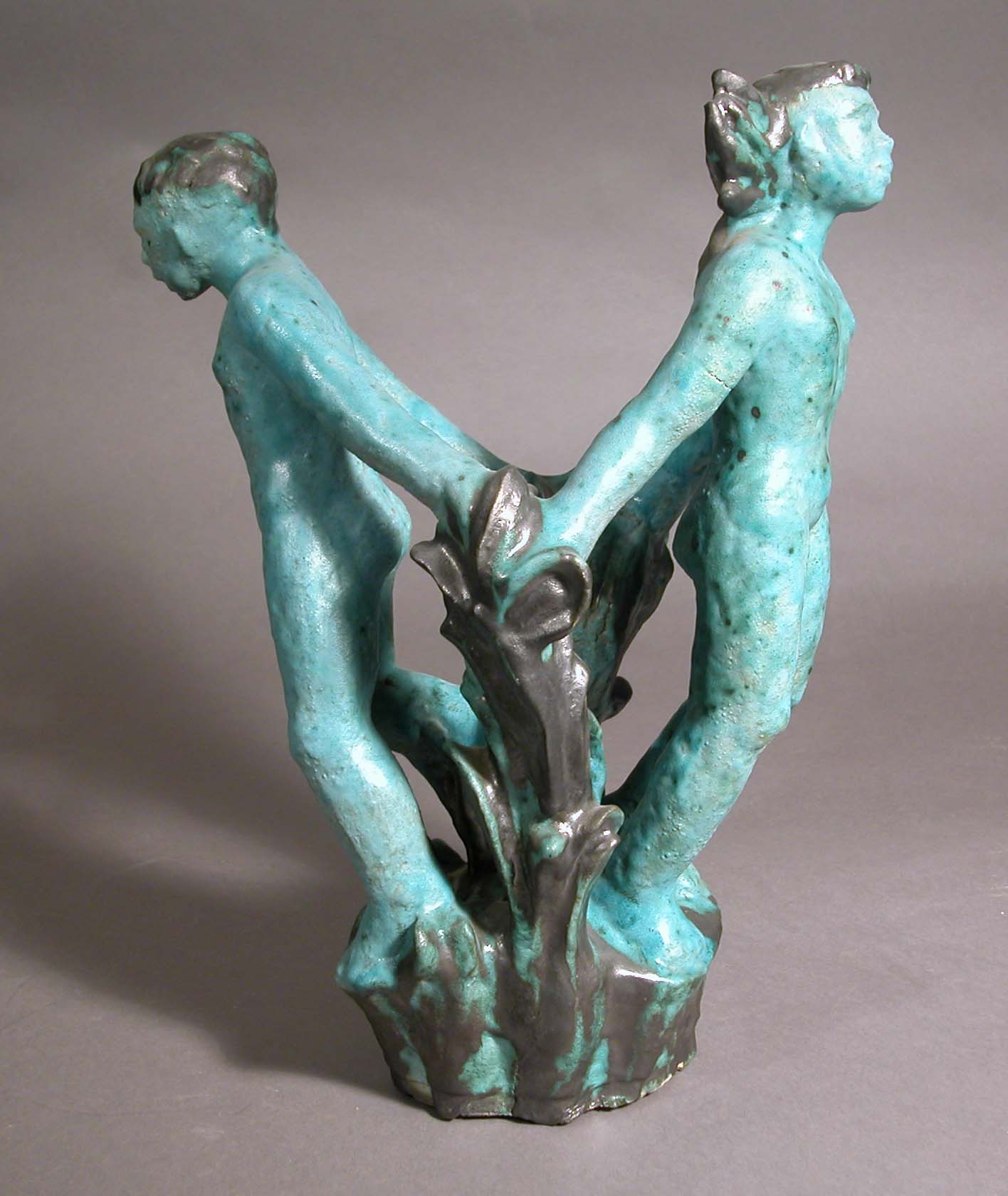
As a sculptor, Kline worked in metal, bronze, wood, ceramic and glass. Her innovative work with glass was considered “ahead of her time.” She molded glass, fused glass, painted on glass, and embedded pieces of colored glass into a background layer of glass—a process she called “gemaux.” In Michigan her works are displayed at the Berkley Public Library, Flint Public Library, Genesee Merchants Bank and Trust, Detroit Broach Company, Koebel Diamond Tool Company, Michigan Credit Union League, and the First Baptist Church of Royal Oak.

In a December 1983 interview in the Birmingham Eccentric, Kline fondly remembered her days at Cranbrook. “I thought it was just heaven on earth—so well-kept, so many interesting people from all over the world. There was a marvelous spirit.” She also recalled with pleasure the great artists with whom she was associated—Eliel Saarinen, Carl Milles, Maija Grotell, and Harry Bertoia. Coincidentally, we have an image (displayed below) of Kline wearing a brooch designed by Harry Bertoia. In honor of the Cranbrook Art Museum’s exhibition of Harry Bertoia’s jewelry (which opens tonight), we are featuring a photograph of Kline wearing a Bertoia brooch.

AA-87

Svea Kline, Marguerite Kimball, Lillian Holm, and Joy Griffin West at the opening night of the student exhibition, May 1944. Cranbrook Archives.

Gina Tecos, Archivist

Currently off-site doing research at the Archives of American Art in Washington, DC, Cranbrook Art Museum’s Jeanne and Ralph Graham Collections Fellow Shelley Selim has been making her way through the Harry Bertoia papers there. She stumbled upon this delightful tidbit today:

A September, 1942, letter from artist and designer Bertoia to his fiance Brigitta Valentiner captures the awkwardness of eating on Cranbrook’s campus as an instructor at the Academy of Art: “We still go over to the boys’ school to eat. Excellent food is served with an overdose of etiquette which for me is hard to swallow.”

Harry Bertoia, 1942. Richard Askew/Cranbrook Archives.

Harry Bertoia, who began studying at the Cranbrook Academy of Art in 1937 and was enlisted as the head of the Metalsmithing Department by 1938, might have felt an extra level of discomfort at the dining experience at Cranbrook School—only 24 years old when he began his tenure as an instructor, he likely looked the same age as many of the high school students.

The formality captured in Bertoia’s letter is not overstated, however. Film footage of Cranbrook School in the 1930s shows a formalized dining experience that would be unrecognizable to today’s students, with uniformed maids delivering hot dishes to the young boys who line up at their tables in coats and ties, waiting to sit in unison.  The film is featured in the Center’s current exhibition Cranbrook Goes to the Movies, on view now at Cranbrook Art Museum.

Shelley’s Bertoia research, meanwhile, has proven productive, feeding into an exciting project that Cranbrook Art Museum is cooking up in honor of the 100th anniversary of Harry Bertoia’s birth in 2015. We can’t say more right now, but watch the CAM website as this project develops over the new few months. And, just because we love it, enjoy a photo of Harry Bertoia and Brigitta Valentiner at Cranbrook Academy of Art’s themed “Come as a Song” party in 1942! We featured it as a Photo Friday a while ago, but it is just too good to not post again.

"Come as a Song" party, 1942.  Cranbrook Archives.

“Come as a Song” party; Harry Bertoia and fiance Brigitta Valentiner speak with an unidentified man in a playing card costume, 1942. Cranbrook Archives.

Shoshana Resnikoff, Collections Fellow, and Shelley Selim, Jeanne and Ralph Graham Collections Fellow, Cranbrook Art Museum

Photo Friday: Come as a Song Party

It has been a crazy few weeks at the Cranbrook Center for Collections and Research  – we mounted our two exhibitions at the Cranbrook Art Museum and helped CAM celebrate the opening of the summer museum season with the blockbuster Michigan Modern show.   What that means now is that we’ve all got celebratory parties and vacation on the brain, and what better way to celebrate a museum success than with evidence of the parties of the past?

"Come as a Song" party, 1942.  Cranbrook Archives.

“Come as a Song” party, 1942. Cranbrook Archives.

This photo, taken in March of 1942, captures Harry Bertoia (far right) and Brigitta Valentiner (middle) with an unidentified student (left, and conveniently marked by a Joker card costume).   These three costumed young people are attending the “Come as a Song” party, one of the many themed get-togethers hosted at the Academy in the mid-century period.

Harry Bertoia, of course, went on to become a sculptor and furniture designer.  Two years after this photo was taken, Harry and Brigitta Valentiner, dressed here as a young maid, married.  A Detroit native and a published author, Valentiner was the daughter of Wilhelm Valentiner, the Detroit Institute of Art’s legendary director from 1924 to 1945.

Create a website or blog at WordPress.com