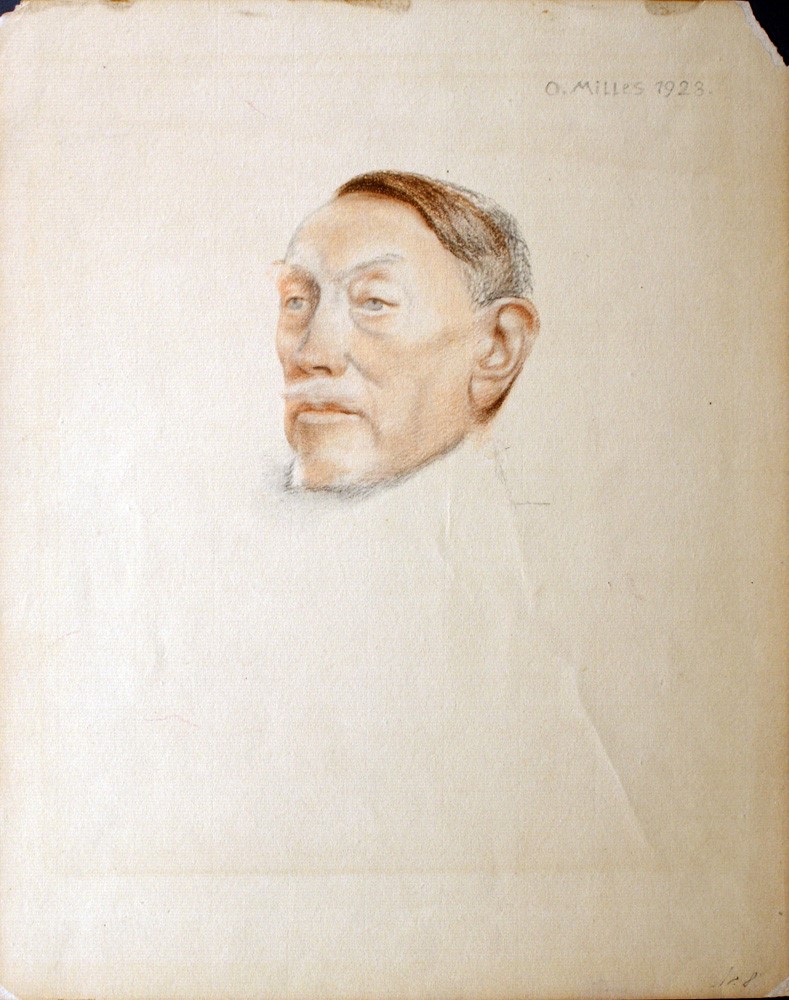
Happy Birthday Milles!

Any chance you have a trip planned to Europe this summer? If so, your itinerary really must include Stockholm. Not only is it a beautiful city—one of my favorites—but it also was home to one of Cranbrook’s most celebrated artists, Carl Milles. Long before he took up residence at Cranbrook, the Swedish sculptor started to plan and build his home and studio, Millesgården. Built high on a cliff overlooking Stockholm’s harbor, Millesgården now is a magical museum and sculpture park and the site of this year’s summer-long birthday party, The Sculptor Carl Milles at 150. Yes, if Carl Milles had lived to be the world’s oldest man, he would have turned 150 this Monday, June 23.

Carl Milles working in his Cranbrook Academy of Art studio, circa 1950. Margueritte Kimball, photographer. Courtesy of Cranbrook Archives.

While anyone taking the time to read this blog no doubt has an image in mind of one of Milles’s works at Cranbrook (there are no fewer than 45 outdoors on our campus and another 52 in the Art Museum or other buildings), my guess is that the story of the twenty years he spent working in America are a little foggy (unless, of course, you attended our 2021 virtual fundraiser, A Global House Party at Cranbrook and Millesgården, and watched the film, Carl Milles: Beauty in Bronze, we produced for the occasion). As a refresher course, or even a primer, I thought I would take you on a journey, one that starts in America and ends, twenty-two years later, back in Sweden (and Italy, as the case may be).

Milles arrived in the United States for the first time in October 1929. With the stated purpose of attending the opening of his second group exhibition in New York City, he took advantage of the trip to sell work to collectors, negotiate a commission in Chicago for his Diana Fountain, present the concept for the monumental doors he would create for the Pennsylvania State Capitol, and meet with Tage Palm, the President of the Chicago-based Swedish Arts and Crafts Company who would become his business manager. Most important for this next chapter of his career, he also traveled by train to Michigan where he met with George Booth who asked him to teach at the art school he was building north of Detroit, Cranbrook Academy of Art.
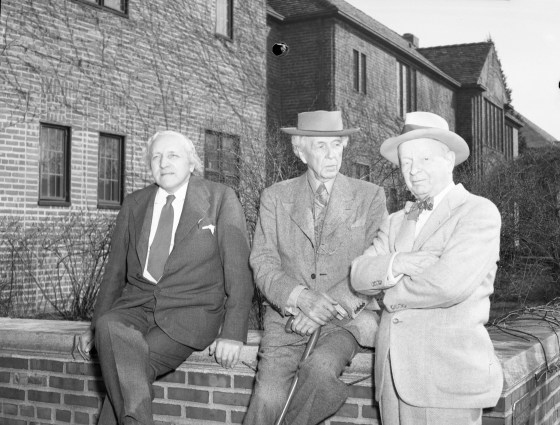
Carl Milles, Frank Lloyd Wright, and Eliel Saarinen (l to r) outside Saarinen House, March 1945. Harvey Croze, photographer. Courtesy of Cranbrook Archives.

George Booth and his wife Ellen Scripps Booth, as most Cranbrook Kitchen Sink blog readers know, were wealthy newspaper publishers and philanthropists. Although their flagship paper, the Detroit News, was based in Detroit, their home was in the countryside of Bloomfield Hills. By the late 1920s, they had begun to work with the Finnish architect Eliel Saarinen to transform their private estate into an educational community that eventually included an Episcopal church, boys and girls schools, an art academy and museum, and an institute of science (and, even later, a center for collections and research). Although the archival record is a little murky, Saarinen and Milles were at least acquaintances long before the sculptor met with his future patron at Cranbrook.

As Milles contemplated moving to Cranbrook to direct the Academy’s Sculpture Department, there was one small problem: he had no desire to teach. Two years and many conversations later, Booth and Milles came to an agreement: the sculptor would not need to “teach” but simply “mentor” students in his studio. (Not a bad deal!)
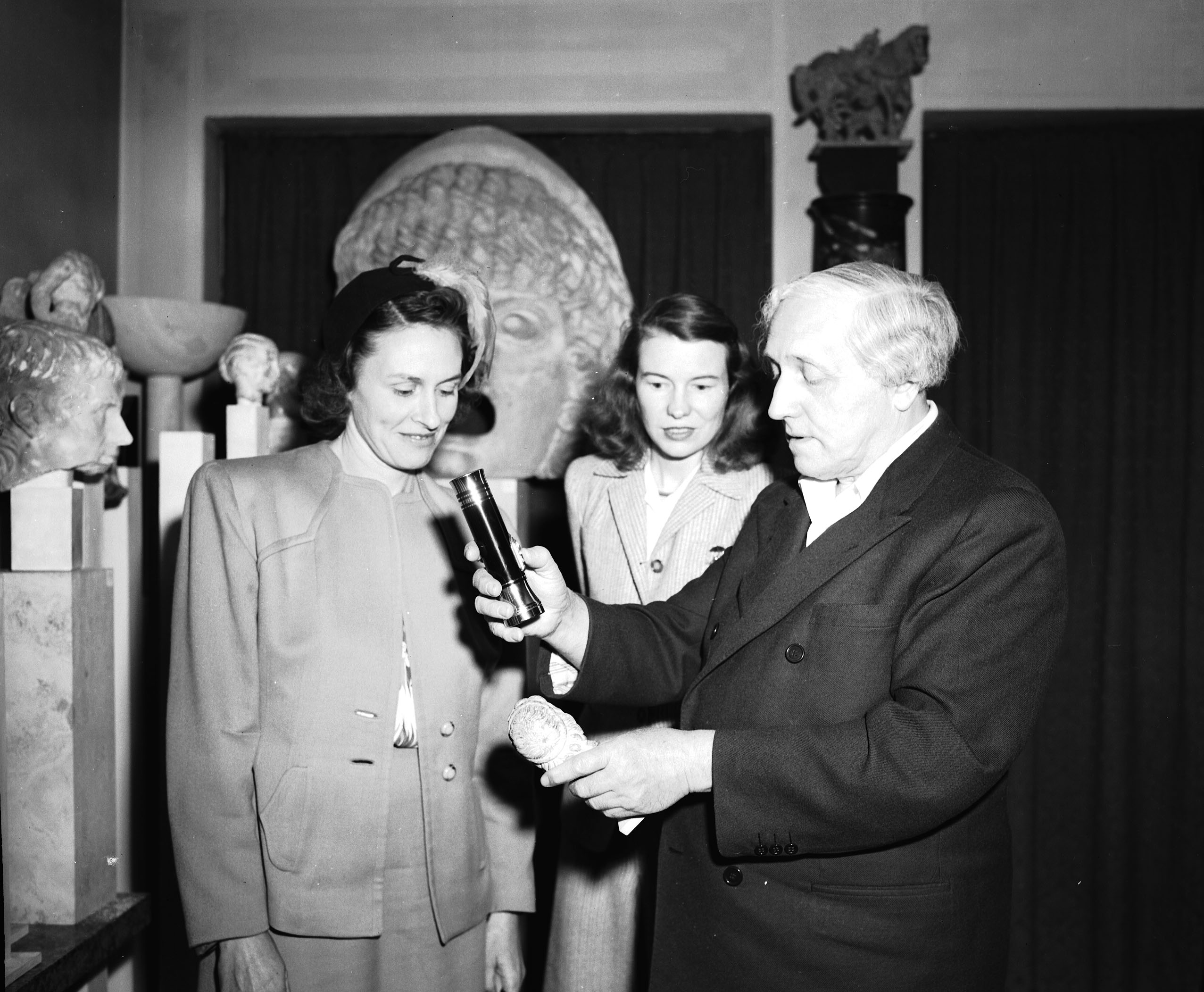
Carl Milles discusses details of a sculpture during an open house, 10 May 1947. Courtesy of Cranbrook Archives.

In January 1931, Carl and his wife Olga Milles arrived at Cranbrook where they lived for the next twenty years. Their home, where they displayed Milles’s collection of ancient sculpture, was designed by Saarinen, as were his three studios—including the grand thirty-foot-tall studio Milles used for his largest commissions such as the Orpheus Fountain for the National Concert Hall in Stockholm.

Carl Milles in his studio at Cranbrook Academy of Art, sculpting the figure of Orpheus for the Orpheus Fountain, 1934. Richard G. Askew, photographer. Courtesy of Cranbrook Archives.

But Milles was not satisfied. He wanted to be surrounded by his sculpture just as he was at Millesgården. The four works Booth had acquired—including the only work Milles made at Cranbrook for Cranbrook, the playful Jonah Fountain—were not enough. In 1934, in the middle of the Great Depression, Booth agreed to pay Milles a princely sum—$120,000 and change—for sixty-three of his sculptures. This purchase not only included most of the works that had been part of a traveling exhibition that opened in St. Louis in 1931, but also casts of the eight figures from the Orpheus Fountain and his monumental Europa and the Bull from the fountain in Halmstad.

Milles’s Triton Pools, looking north towards Europa and the Bull, and beyond that, the future site of Cranbrook Art Museum, circa 1934. Richard G. Askew, photographer. Courtesy of Cranbrook Archives.

The decision, one that would come to define Cranbrook’s campus, was supported by Milles’s fellow Scandinavian and friend Eliel Saarinen, who Booth had named the President of Cranbrook Academy of Art in 1932. Indeed, there was a feeling of mutual respect between the architect and the sculptor, with Saarinen realizing that Milles’s work would enhance the buildings and Milles realizing that Saarinen’s architecture provided the perfect context.

Continue reading
Carl Milles Gems from the Cutting Room Floor

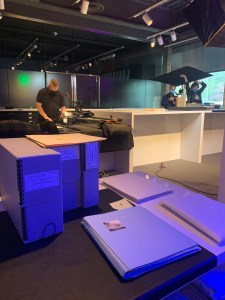
Cameras started rolling Monday for the Center’s new film celebrating Swedish American sculptor Carl Milles, premiering May 22nd at A Global House Party at Cranbrook and Millesgården. Centering on materials in the Archives, the day’s shoot featured handwritten correspondence, photographs, sketches, scrapbooks, and oral history recordings that help illuminate the story of the man behind the many iconic sculptures dotting Cranbrook’s campus.

The film production crew captures closeups of materials featured in the film.

In preparation for the day, I mined several collections in the Archives that document Milles’ twenty years as artist-in-residence at Cranbrook and his work in America during that time. In the process, I made a few delightful discoveries. While most of these treasures were expertly captured by the film production crew (Elkhorn Entertainment), there were a few that just could not be accommodated in Associate Curator Kevin Adkisson’s masterful, but already dense script.

One of these items is a notebook from the Nancy Leitch Papers. A student of Milles’ in the early 1940s, Leitch, like many of Milles’ students, became friends with both him and his wife Olga while at Cranbrook. The brief diary-like entries in Leitch’s pocket-sized book date from 1945, and are an intimate glimpse of daily activities, remembrances, and artist philosophies recounted from shared experiences and conversations with Carl and Olga. A loose paper tucked inside and titled “Carl” is a bonus, containing hasty notes recording his birthday, recommendations of where to visit in Italy (Café Greco in Rome, the cathedral in Orvieto), and words of wisdom, such as, “It is better to be an artist even though you are poor.”

Part of an entry made by Nancy Leitch in her notebook. Courtesy of Cranbrook Archives.
Continue reading

De Profundis: Olga Milles’ Drawings of the Soul

Olga Milles lived in the very depths. In her art, almost exclusively devoted to portrait painting, she sought to draw out the character from the depths of her models and to find the soul behind the façade. Using a variety of techniques including charcoal, crayon, pastel, watercolor, tempera, and oil in her work, Olga was considered an artistic prodigy and developed her talent from a young age, yet her art is largely unknown. In 1988, twenty-one years after her death, Cranbrook Art Museum hosted an exhibition in collaboration with Millesgården, Olga Milles Emerges, to exhibit examples of her art from both museums’ collections.

In the foreword to the exhibition catalog, Staffan Carlén, former Director of Millesgården, describes her as having an intuitive talent that produced factual character studies of extreme precision, with an “overwhelmingly melancholic” tone. In reading Inger Wahlöö’s account of Olga’s life, based on correspondence at Millesgården, Carlen’s interpretation of Olga’s artwork can almost be read as a profile of Olga herself:

“Sparseness of shadowed areas and stretched areas disrobe the faces and make them appear in a serious, introverted nakedness. Her efforts are primarily directed towards interpreting the character of the soul. This she did with great coloristic refinement, and with tenderness in the form. In her drawings, there is consistently a sensitive enlargement of the mouth, sometimes in interaction with the dreaming mood of the eyes, sometimes as a tension-filled contrast of unconscious sensuality.”

Staffan Carlen, Olga Milles Emerges
Print of Drawing of Carl Milles by Olga Milles, 1917. Courtesy of Cranbrook Archives.

Born Olga Granner in 1874 in Leibniz, Austria, she had two brothers and two sisters. She had a deep loyalty to her family, whom she visited for several months every year, except during World War II. Having been born and raised in the Catholic church, she initially aspired to become an art teacher in a convent. However, in early adulthood, Olga questioned what it meant to be disobedient to the church and broke away, while cultivating an increasingly ascetic life.

Continue reading

Swedish Sculptors-in-Arms: Soderlind and Milles

The Nona Bymark Soderlind archival collection consists solely of one scrapbook, yet its contents provide an intriguing glimpse of the woman to which it is dedicated. In doing so, it also illuminates a brief but prolific period in the history of the Academy of Art and reveals a personal side to one of Cranbrook’s most celebrated Artists-in-Residence, the sculptor Carl Milles.

Nona Bymark Soderlind, circa February 1936. Courtesy of Cranbrook Archives.

Born Eleanora Maria Bymark on July 16, 1900 in a small Swedish immigrant community just outside of Minneapolis, Minnesota, Nona attended the Minneapolis School of Art (1920-1922) on a full scholarship, where she studied sculpture under Charles S. Wells. She later attended the University of Minnesota where she studied under the painter Samuel Chatwood Burton. In 1927 Nona returned for a semester at the School of Art, around the time she had her first child with husband Dr. Ragnar Soderlind. The Soderlinds had three young boys (two, eight, and nine years of age) when in 1936 Nona boarded a train to Detroit to study under Carl Milles.

Nona Bymark Soderlind works on a sculpture in Carl Milles Studio, 1936. Courtesy of Cranbrook Archives.

A February 13th letter from Richard Raseman, Academy of Art Executive Secretary, confirms Soderlind’s visit to campus and includes details of associated tuition and living costs required for the minimum period of study with Milles. Cross-referenced with items in her Academy student file, it is evident she had been invited by Milles to study for a month and arrived on the 18th. Perhaps it was Milles’ 1936 commission for Vision of Peace, in St. Paul, Minnesota that had first brought them in touch with each other?

Continue reading

Create a website or blog at WordPress.com