Classical music, wandering musicians, ballet, cabaret, white paper lanterns, illuminated boats on the lake, Hawaiian torches, Italian tree lights, champagne, dinner, and dancing on a night with a fair-sized moon—these were some of the possibilities that Henry Scripps Booth recorded in December 1964 notes for a music gala called Night of Delight, a fundraiser for the Cranbrook Music Guild of which he was a founding member.
Patrons in line to attend Cranbrook Music Guild concert and ballet performance, July 10, 1960. Harvey Croze, photographer. Courtesy of Cranbrook Archives.
The Guild is one of the most eminent accomplishments in Cranbrook’s legacy of music and it endures to this day (the Archives holds records for the organization through 2007). Born of the inspiration of Christ Church Cranbrook Music Director, Maurice Garabrandt, and Betty (Mrs. Benjamin) Brewster, the Guild was established in 1951 to utilize Cranbrook’s setting as a wonderful place to appreciate music.
During the first decade alone, the Guild sponsored performances by distinguished artists, including violinists Zino Francescatti and Mischa Mischakoff, pianists such as Mischa Kottler, Phillipe Entremont, Jean Casadesus, and Leon Fleischer, cellist George Miquelle, the Severo ballet, jazz musicians such as Dave Brubeck and Don Shirley, classical guitarist Richard Dyer-Bennet, and soprano Eileen Farrell.
Program for Jean Casadesus performance, November 16, 1960. Courtesy of Cranbrook Archives.
The objectives of the Guild were not only to provide high quality programming, support the creation of new music, and the development of high caliber performers, but also to share knowledge about the appreciation of music through lectures, demonstrations, recitals, and exhibitions. The programs for the concerts thus shared brief contextual comments on the history of the piece and the composer.
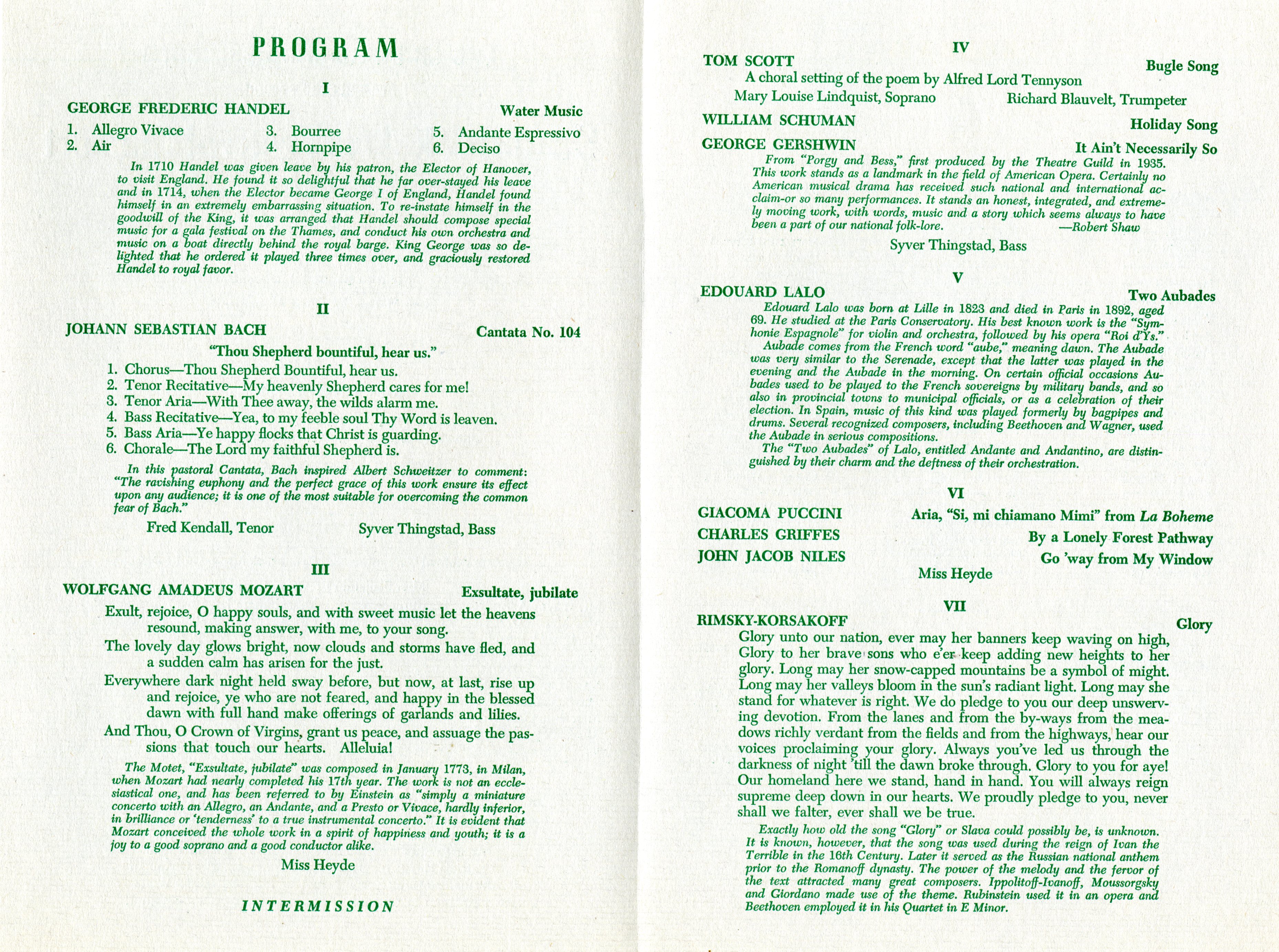
In the program for the Second Cranbrook Arts Festival Concert, which was performed at the Greek Theatre on June 1, 1952, I noticed a comment that is playfully instructive but also particularly salient to later developments in the Guild programming. The second concert program included Johann Sebastian Bach’s Cantata 104, “Thou Bountiful Shepherd, Hear Us,” and it was noted that it had inspired Albert Schweitzer to comment:
“The ravishing euphony and the perfect grace of this work ensure its effect upon any audience; it is one of the most suitable for overcoming the common fear of Bach.”
Program for Second Cranbrook Arts Festival Concert, June 1, 1952. Courtesy of Cranbrook Archives.
The Cantata must have worked its magic, because in 1966, the idea of a Bach at Cranbrook festival was introduced. It would be a satellite festival chaired by James L. Schneider and hosted by Christ Church Cranbrook with the aim to perform Bach’s music as he intended—with a small chorus and orchestra in a church setting. At a special meeting on February 23, 1966, the Cranbrook Music Guild agreed to sponsor the Bach at Cranbrook festival.
At a regular meeting a few days later, Henry expressed concern regarding the conflict of dates. The Bach festival was set for May 14 and his Night of Delight was being planned for the 21st. The Board responded that it was impossible to sponsor two big events that would appeal to same group of people, and that there was no choice but to sponsor the Bach festival, to which they had already committed, and postpone the gala to another year.
Program cover from the first Bach at Cranbrook festival, May 14, 1966. Courtesy of Cranbrook Archives.
Thus, the first Bach at Cranbrook festival took place on May 14, 1966 at Christ Church with 25 members of the Detroit Symphony Orchestra and the 40-voice Kenneth Jewell Chorale. It was a stellar success with an audience of over 1,200 people. The following year, the festival grew into a two-day, three-day concert event. After being renamed the Cranbrook Festival with a broader scope of classical and baroque composers, the festival was dissolved in 1979.
A scene from the Bach at Cranbrook festival, May 14, 1966. Harvey Croze, photographer. Courtesy of Cranbrook Archives.
The gala, Night of Delight, would never take place beyond Henry’s musings. For those with a romantic imagination, his words invite one to feel the warm summer evening, the fragrance of fresh flowers, strains of music across the courtyard filled with joyful chatter, elegance, and conviviality beneath the light of the moon. If your senses require something more tangible, fear not, for the Center for Collections and Research is celebrating the legacy of music at Cranbrook at our House Party on May 18th. Join us for live music, dinner, dancing, paper lanterns, and even a fair-sized moon! It will truly be a Night of Delight!
For this May’s upcoming A House Party at Cranbrook: Celebrating the Legacy of Music, we are celebrating the music and spirit of the 1950s. Naturally, that means digging into our closets for our best mid-century modern outfits, and more importantly, our dancing shoes. Seventy-five years ago, guests invited to a Cranbrook party could head down to Hudson’s department store on Woodward Avenue for a full evening’s attire. That is, unless they, like Loja Saarinen, preferred to design and sew their own clothes! This year, we may be deprived of Hudson’s and its record-breaking 705 changing rooms, but we do not lack sources of inspiration for a fifties night at Cranbrook.
Cranbrook Academy of Art: Packard Motor Competition, 1950. Cranbrook Archives, Cranbrook Center for Collections and Research.
Eliel and Loja Saarinen at the front entrance of Saarinen House, Cranbrook Academy of Art, circa 1950. Cranbrook Archives, Cranbrook Center for Collections and Research.
The 1950s was an exciting time for snappy dressers, even those not as artistically gifted as Loja Saarinen. While Cranbrook-trained designers like Ruth Adler Schnee and Florence Knoll were transforming the look of the modern American interior, American clothing was undergoing a revolution of its own. The 1950s can be seen as the dawn of the modern fashion era, defined by an extraordinarily diverse range of stylish modes of dress, and a new emphasis on comfort and adaptability. The introduction of novel synthetic fabrics like orlon and spandex, and a new prominence for sports and lounge wear anticipated the rise of current athleisure apparel. The cocktail dress reached its zenith in this decade, as did the requisite accessories: shoes, handbag, and a trunkful of costume jewelry.
Handbag, used by Elizabeth Parke Firestone. From the Collections of The Henry Ford. Gift of Elizabeth Willis Leatherman.
Christian Dior Dress, Worn by Elizabeth Parke Firestone, circa 1956. From the Collections of The Henry Ford. Gift of Elizabeth Willis Leatherman.
Many designers, including Christian Dior himself, continued to embrace the sloping shoulders and hourglass shapes of the “New Look,” inaugurated in the late forties. However, no single silhouette dominated the womenswear scene. Waistlines and hemlines rose and fell according to the whims of individual designers, dresses and coats billowed outward or narrowed to follow the line of the body, and the range of possibilities for fashionable dressers expanded rapidly in all directions.
Claire McCardell, “Popover” Dress, circa 1956. RISD Museum.
Cristóbal Balenciaga, Chemise dress, circa 1957. RISD Museum.
The one common and consistent demand for women’s clothing then was elegance; truly casual clothing was not yet a part of the upper or middle-class woman’s wardrobe. Whether in a cocktail dress, playsuit, full-skirted evening gown, or daring slacks, women were still expected to present a polished exterior. Menswear, on the other hand, trended towards greater informality and comfort across the decade.
Attendees at a Cranbrook Academy of Art weavers’ party, 1959. Cranbrook Archives, Cranbrook Center for Collections and Research.
The structure of the modern suit gradually loosened, while ties, worn short and wide at the start of the decade, narrowed and lengthened, and soft knit ties became an accepted part of a business wardrobe. Boxy, straight cut and swing jackets, for men and women alike, allowed for complete freedom of movement, and leant a jaunty sway to an outfit’s profile. A new pop of color enlivened men’s suits, in the form of a bright shirt, tie, belt, or a contrasting waistcoat. For the more daring, a colorful velvet smoking jacket might be just the thing for an evening party.
Youth culture drove much of the sartorial transformation, particularly in casual dress; Elvis Presley, Marlon Brando, and James Dean modelled the classic white t-shirt and jeans for the first time on the big screen in this decade, and James Dean’s short career in Hollywood left a lasting fashion legacy in the form of his distinctive red nylon golf jacket, in Rebel Without a Cause.
Theatrical poster for Rebel Without a Cause, 1955. Warner Brothers Pictures Distributing Corporation. Image via Wikimedia Commons.
In fact, it would be hard to find better – or more entertaining – fashion inspiration than in the films of the 1950s. Throughout the decade, star actresses like Audrey Hepburn, Grace Kelly, and Dorothy Dandridge modelled iconic looks, both onscreen and off.
Dorothy Dandridge photographed for LIFE Magazine in 1955. Image via Harper’s Bazaar.
Eight-time Oscar-winning costume designer Edith Head (the inspiration for superhero costumier Edna “E” Mode in The Incredibles (2004)), created some of the 1950’s most iconic looks, for men and women alike. Her designs reflect the breadth of possibilities for glamorous women’s dress in the period, from Grace Kelly’s full tulle skirts, inspired by ballet tutus, to Kim Novak’s sleekly severe suits in Vertigo (1958). True couture also made appearances on screen, as Hepburn was dressed by M. Hubert de Givenchy himself for Sabrina (1954) and Funny Face (1957), the latter a cinematic send-up of the fashion industry itself.
Audrey Hepburn alights from a TWA plane in Los Angeles on September 5, 1953. Los Angeles Herald Examiner Photo Collection, Los Angeles Public Library.
Publicity photo of Audrey Hepburn and William Holden in the motion picture Sabrina, 1954. Paramount Pictures, Inc. Billy Rose Theatre Collection, Los Angeles Public Library.
Menswear in these classic films receives less attention on Pinterest boards today, but it too evinced a witty, modern spirit and a widening range of options. There’s a new, comfort driven sensibility behind Gregory Peck’s lightweight, loosely-cut suits in Roman Holiday, joy and humor in Fred Astaire’s dance number in Funny Face, in which his white duster coat’s scarlet lining transforms it into a matador’s cape, and there is nothing uptight or understated about Cary Grant’s polka-dotted scarf and striped sweater in To Catch a Thief.
The glamorous costumes of the big screen set a high bar for fifties fashion, but even Audrey Hepburn had a more ordinary go-to look: the capris, sweater, and ballet flats ensemble that she was photographed in time and time again. The ease with which the stars of the fifties wore their exquisite clothes reminds us, in our own era, not to take our own wardrobe too seriously. Not even for A House Party at Cranbrook!
Join the Center in your 1950s-inspired finery on May 18 to help us celebrate the legacy of music at Cranbrook with a garden gala at Thornlea House and enjoy musical stylings from the era. Head to our website to learn more and purchase your tickets to A House Party at Cranbrook: Celebrating the Legacy of Music!
– Mariam Hale, 2023-2025 Collections Fellow, Cranbrook Center for Collections and Research
Following on the heels of Leonard Bernstein, Don Shirley, and Dave Brubeck, yet another famous musician came to Cranbrook: Harry Belafonte. While his trip to campus, unfortunately, did not involve a performance, it is well-recorded in the Archives: in news items, photographs, and a Society page headline in the Wednesday, November 23, 1960, Birmingham Eccentric.
Being a relatively new recording star on the RCA record label, the 1960 visit included Belafonte’s third Detroit performance. After his debut in 1956 in a show called “Sing, Man, Sing!” Belefonte played the newly converted live venue, the Grand Riviera Theater the following year in support of his record album, “An Evening With Belafonte.”
Portrait of Harry Belafonte, singer and actor. Courtesy of E. Azalia Hackley Collection, Detroit Public Library.
At this point, the actor and singer was pretty much a household name, having starred in the 1954 film Carmen Jones, and riding the wave of his 1956 breakthrough hit album, Calypso, the first million-selling LP by a single artist. Who doesn’t know the song “Day-O (The Banana Boat Song)?”
When Belafonte returned to the Riviera in 1960, his show was again billed as “An Evening With Belafonte” but now featuring an opening performance by South African singer Miriam Makeba, sponsored by the Junior Women’s Association for the Detroit Symphony Orchestra. And this time, in the audience were Henry Scripps Booth (son of Cranbrook founders George and Ellen Booth), his wife Carolyn, and their son Stephen with his wife Betty.
It’s not surprising that Henry (known to family and friends as Harry) was in attendance. An avid music aficionado, he was a charter member of the Cranbrook Music Guild, founded in 1951, and had been floating the idea of a creative music center on Cranbrook campus for at least that long. In fact, earlier in 1960, he had even proposed in a letter to Eero Saarinen the building of a music shell on the west lawn of Cranbrook House. Alas, the music center (and Saarinen music shell) never came to be.
In any case, Henry must have been visibly enjoying Belafonte’s concert. According to another Eccentric columnist, “Cheers went up at Harry Booth’s impromptu performance. Mr. Belafonte took his mike down to Mr. Booth’s ringside seat and induced him to give forth on a chorus of ‘Matilda‘ (it was all unrehearsed – we checked).”
Harry Belafonte with Academy students in the Painting Department, including Annie Sanders (Fiber ’62) and Dan Radin (Painting ’62). Harvey Croze, photographer. Courtesy of Cranbrook Archives.
A few days later, Belafonte made the trip from Detroit, at Henry’s invitation, to dine at the Booth’s home, Thornlea, with the family. Afterwards, he was given a brief tour of Cranbrook where he stopped at the Academy of Art to meet students and view work in their studios.
Join the Center on May 18 to help us celebrate the legacy of music at Cranbrook—dine at Thornlea and enjoy musical stylings from the era of Harry Belafonte’s visit. Head to our website to learn more and purchase your tickets to A House Party at Cranbrook!
—Deborah Rice, Head Archivist, Cranbrook Center for Collections and Research
In addition to working as an Associate Archivist at Cranbrook, I am also a fledgling volunteer docent at Christ Church Cranbrook. Recently, I gave a tour of the Chancel to test my skills with my teachers. As I prepared, I found there was very little written about the history of the pipe organ at the church. So, where to turn for more information? Cranbrook Archives, of course.
In August of 1925, George Booth and Oscar Murray (of Bertram G. Goodhue Associates, the church architect), started in earnest to finalize their thoughts and feelings about the choice of organ for the church. While the organ itself was installed in January 1928, plans for its ducts and conduits had to be decided early, before the concrete floors were poured.
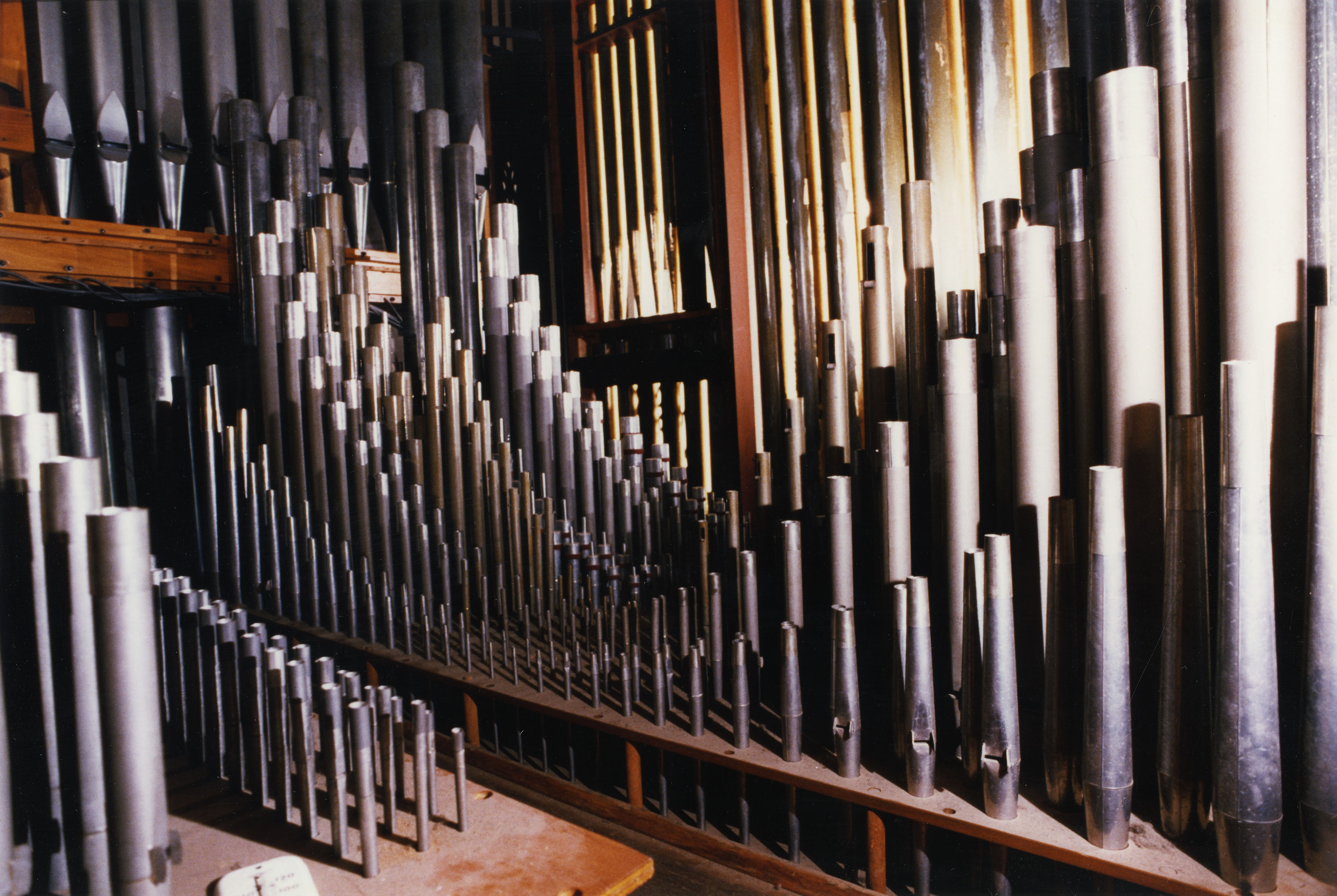
Christ Church Cranbrook organ pipes prior to the 1997 restoration. Jack Kausch, photographer. Courtesy of Cranbrook Archives.
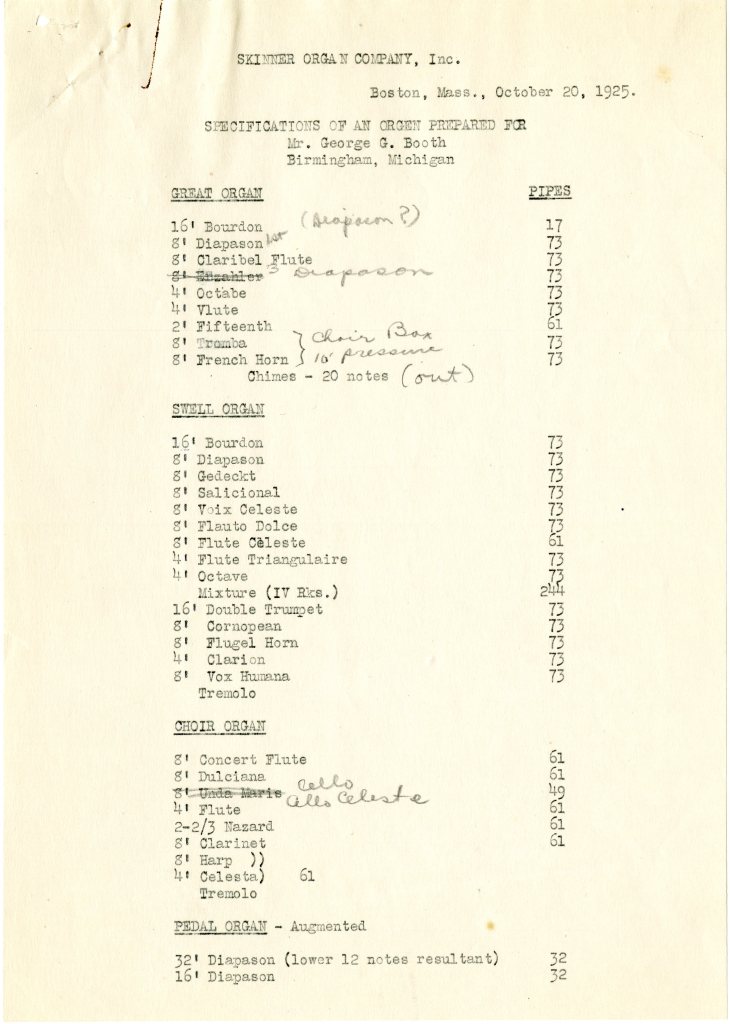
The correspondence suggests that the E.M. Skinner Organ Company was the only company considered. The Boston-based firm was considered America’s finest and most technologically advanced organ builder. Skinner’s specifications for the organ, console, and bench were submitted in October 1925.
George Booth inquired of his colleague Cyril Player to provide comments on the specifications, and Player begins his commentary saying,
“I think I would emphasize gently to them that you want gravity, dignity and softness—the three prime essentials of any church organ, large or small… [gravity] is secured by an adequate and properly-balanced pedal department; dignity by volume of foundation tone in the basic divisions of the instrument; and softness and refinement by skillful voicing with a copious wind stream at a moderate pressure.”
Cyril Player to George G. Booth, November 1925
In passing along the comments to Murray, Booth remarks that, “the desired qualities, viz; gravity, dignity and softness; seems to me peculiarly to express my own feelings and desire.”
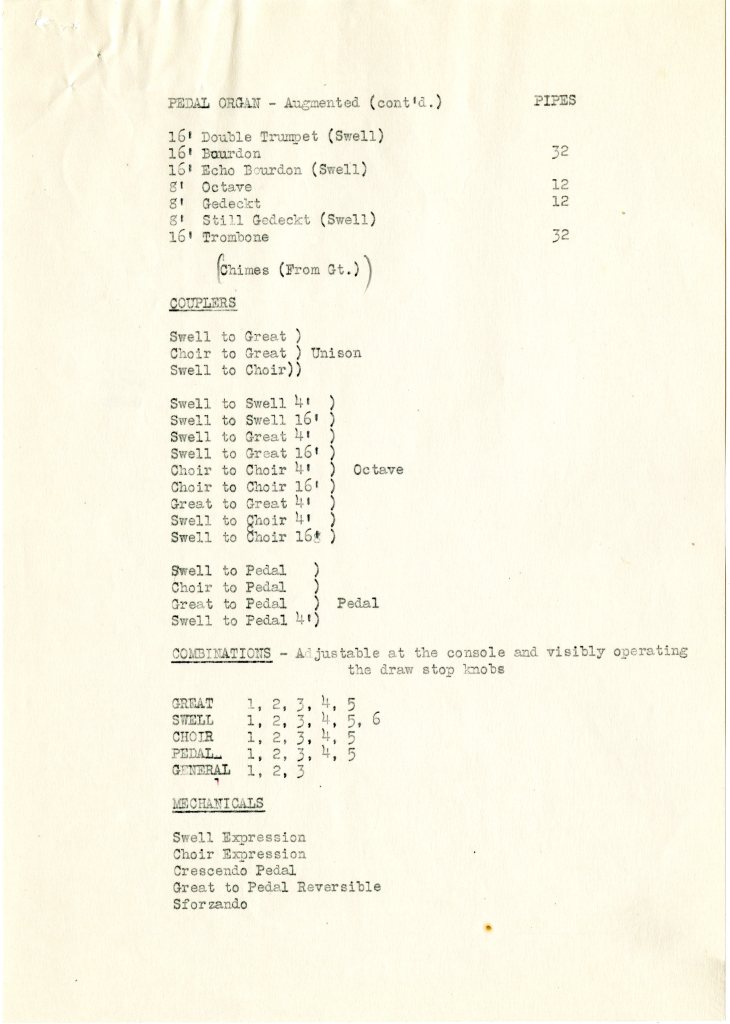
Skinner Organ Company Specifications for Christ Church Cranbrook Organ, October 1925. Courtesy of Cranbrook Archives.
William Zeuch of Skinner Organ Company revised the specifications following some of Player’s suggestions, while some revisions were the suggestion of Henry Willis, the great English organ builder who was a consultant to the firm. The contract for the organ (including the Great, Swell, Choir, and Pedal pipe divisions) was duly signed in December 1925 and work proceeded.
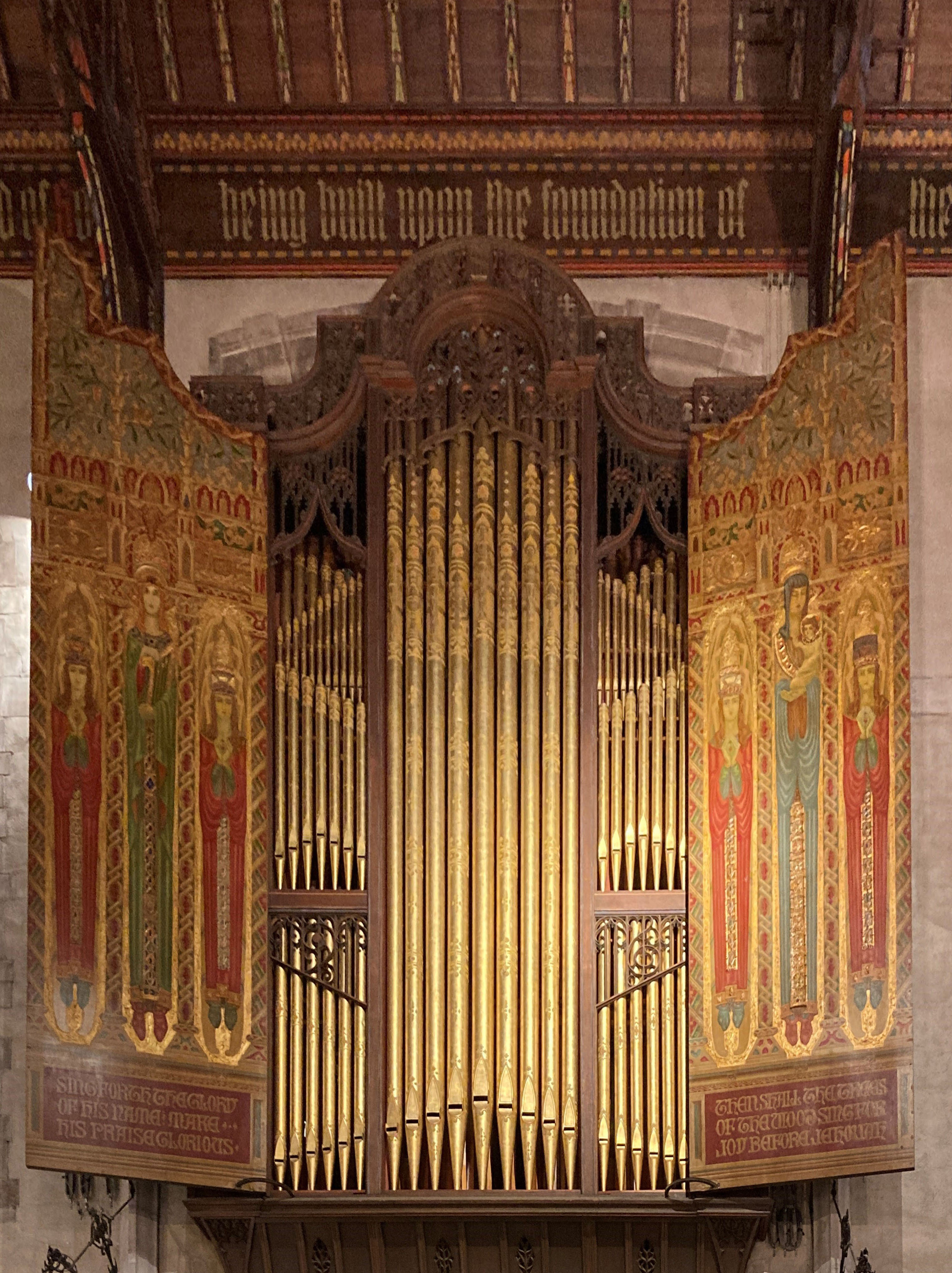
At the same time, a separate contract was made with Alfred Floegel to decorate the organ case doors. Booth wished to confine the oak finish to the exterior of the doors while having the rest richly decorated with color. Booth imagined the opening of the organ doors to represent the opening of the mind. He also envisioned the organ case to read as a triptych (a picture or altarpiece on three hinged panels) when open.
Organ case doors, woodwork by Irving and Casson, decoration by Alfred Floegel. Gift of James Scripps Booth. Laura MacNewman, photographer.
In July 1927, work on the organ console began. The console is where the organist sits to play the instrument, distinguished by its multiple hand keyboards (called manuals), pedalboard, and other controls. Rev. Dr. Marquis requested a change from a 3-manual (Great, Swell, and Choir pipe divisions) to a 4-manual, by adding the Solo division. Zeuch responded positively as it was not too late to build a 4-manual console; however, having already instructed the architect to reduce the dimensions of the organ chamber, which had been too large and would have interfered with the proper effect of the sound in the church, the architect would now need to find space for the Solo division. Room was found above the Sacristy.
This year the Center is celebrating the life and work of Loja Saarinen for our House Party fundraiser. Lynette Mayman’s post on 1930s fashion offered an excellent guide to dressing à la mode for this historically themed evening event, while highlighting Loja’s freedom and creativity in celebrating her own authentic style. Being curious about the events to which such attire might be worn, I looked to the Kingswood School records to explore its history of music and dance events during that era.
Kingswood School Annual Dance Book, 1932. Courtesy of Cranbrook Archives.
From the abundance of programs and ephemera, it was clear that music and dance were a valued part of the curriculum and school life, and its purpose was elucidated by the educational philosophy in the school catalogs for the 1930s:
“Music and Dance, two of the greatest social forces, and most closely related in essential nature, are organized in the curriculum under the direction of one department for concurrent purposes… The program of work is such as to encourage the fullest and freest development of individual personality which is the basis for true dramatic and musical expression.”
Kingswood School Catalogs, Kingswood School Records (1980-01)
Formal classes in music theory and social dancing (taught in physical education classes under the direction of Luella Hauser) were augmented by extracurricular activities. These included the Glee Club and various kinds of themed and annual dances, which offered students a variety of ways in which they could learn through participation, as well as recitals by visiting performers, which offered learning through observation and listening.
Program for the Mothers’ Day Tea, May 1937. Courtesy of Cranbrook Archives.
The Glee Club for girls was formed in 1932 for those interested in singing. They performed one concert per year, the first being held on March 11, 1932. The Club would also perform at other events throughout the year, such as the Mothers’ Day Tea and the ‘Carnival,’ which was an informal jamboree of themed gaiety and fun. The first Carnival, on December 10, 1932, was described as one of “grand vaudeville,” including a fashion show that embraced lovely old fashions and lively modern ones.
The 1937 Carnival was a Masque that traced the development of dance from the fourteenth century to the present time, including the Carole, Pavane, Sarabande, Minuet, Gavotte, Waltz, Schottische, Tango, and Fox Trot. The Glee Club sang songs typical of each period, while three jolly spirits, Dance, Play, and Song, presented the dancers.
Invitation to the Ypsilanti Madrigal Club performance, December 1931. Courtesy of Cranbrook Archives.
The first visiting performance was held on December 11, 1931, when the Madrigal Club, a choir of men and women from State Normal College, Ypsilanti, under the direction of Mr. Frederic Alexander, performed as a Christmas gift from Mr. Alexander to Mr. George Booth. The concert of unaccompanied songs and compositions on harpsichord was described as “unusual in character and delightful in content,” and became an annual event at the school.
Other annual visitors included Mildred Dilling, the internationally known harpist, and Cameron McLean, the Canadian baritone who was accompanied by various local pianists, including Detroiter Gizi Szanto. There were also one-time visits by performers such as pianists Stanley Fletcher and Samuel Sorin, singer Marion Anderson, baritone Earle Spicer, and opera singer Alexander Kipnis.
Program of Music printed by Cranbrook Press, April 1932.
Kingswood School Records. Courtesy of Cranbrook Archives.
Celebrated teachers of modern dance were invited to give dance recitals including Ted Shawn, Ronny Johansson, and Martha Graham. Visiting in March 1936, Graham gave a comprehensive recital of her work, leaving us with an autographed program—an archival treasure!
Program for Dance Recital autographed by Martha Graham, March 1936. Courtesy of Cranbrook Archives.
While Graham’s dance was reported in the Kingswood Newssheet as casting aside, “all old standards of beauty and grace,” through her use of angles and quick movements rather than the legato rhythm of conventional dancing, her philosophy of the dancer speaks poetically to the purpose of the 1930s Kingswood curriculum for music and dance—drawing out the essence of the individual through social artforms:
“You traverse, you come to the light, you work, you make it right… you embody within yourself as much curiosity, use that curiosity and avidity for life … and the body becomes a sacred garment – it’s your first and your last garment, and as such it should be treated with honor, and with joy, and with fear too, but always with blessing.”
As we celebrate the life and work of Loja Saarinen this year, we celebrate her as immigrant, entrepreneur, designer, and fashionista. Please join us for the Virtual Film Premiere as we support and acknowledge the work of the Center at our House Party, May 21, 2022.
– Laura MacNewman, Associate Archivist, Center for Collections and Research
How many high schools can lay claim to hosting a performance of the legendary Detroit band, the MC5? In 1967, Cranbrook School joined a handful of Metro Detroit high schools as a venue for arguably one of the most influential rock bands of all time.
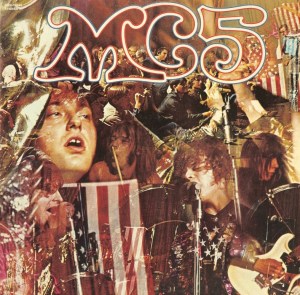
Cover of the MC5’s debut album, recorded live at Grande Ballroom in Detroit, 1969. Courtesy of private collection.
Known the world over today for their groundbreaking music, and as progenitors of the subsequent 1970s punk rock movement, the MC5 (Motor City Five) were relatively unknown outside the Detroit area when they played the Cranbrook School Little Gym on April 28, 1967.
Rob Tyner, lead singer of the MC5, performing for the Cranbrook audience. The Brook, 1968. Courtesy of Cranbrook Archives.
Billed as a Jazz Psychedelic, the concert featured fellow Detroit musicians, the Charles Moore Octet and the Joseph Jarman Quartet, both avant-garde jazz groups. Trumpeter Charles Moore’s band had already played earlier that year at Cranbrook (their musical repertoire including poetry by John Sinclair) and had developed a following among students and faculty. Accompanying the music at the April concert was a light show by the Magic Veil, which consisted of several sheets placed around the gym, a large number of lenses, watercolors, and an overhead projector. Open to Cranbrook and Kingswood students, faculty, and the area’s interested general public, tickets cost $3.25.
Charles Moore Octet at Cranbrook. The Crane, January 20, 1967. Courtesy of Cranbrook Archives.
The event was sponsored by the revamped Jazz Society, a student club formed in 1966 with a goal of exposing students to different forms of jazz (including a trip to the Masonic Temple in Detroit to see Count Basie). Under their new name, REAL (Revolutionary Enjoyment Authenticity and Love), they continued to arrange musical experiences both on and off campus, providing tickets and transportation to venues such as the Fisher Theater, Meadowbrook, and the Grande Ballroom. A trip to this last venue, “home base,” if you will, of the MC5, included a concert by the Eric Clapton band, Cream.
Did you know that Cranbrook Art Museum’s educational partnerships with surrounding communities date back over sixty years? Long before the current museum trend of interactive educational programs for youth audiences, the Academy of Art and theJunior League of Birmingham had an idea: the Young People’s Art Center (YPAC).
Young People’s Art Center logo, from the 1962 enrollment form. Courtesy of Cranbrook Archives.
The year was 1958, and the Museum had recently changed names to the Academy of Art Galleries, shifting focus to feature more contemporary art practices. With that, came the desire to encourage young visitors to express their own artistic voices—participatory education, rather than simply art appreciation. Documenting the program’s first year, a June 1959 Detroit News Pictorial Magazine feature noted that YPAC “is fast gaining a national reputation for its lively approach to art education.”
In particular, it was Henry Booth (Academy Board of Trustees Chairman), Wallace Mitchell (Head of Galleries), and Zoltan Sepeshy (Academy Director) that approached the Junior League with a plan. In a 1957 report by Mitchell during the Center’s development phase, he states, “ The personnel of the Cranbrook Academy of Art has become increasingly aware of the growing country-wide interest in the visual arts and has long wished to more directly participate in the fostering and guiding of this interest as expressed in our community.” Seeking support from the Junior League, this “unique opportunity to bring to the children of Oakland County an integrated program in art education which concerns itself with the totality of the art experience” was green-lighted for the following year.
Children watch a judo demonstrator as part of a class exercise. Erik Strylander, photographer. From the article “Sketching to Jazz and Judo,” Detroit News Pictorial Magazine, June 28, 1959.
A perfect partnership was formed. The Academy would provide leadership, through the support of its trustees, director, and faculty; the Junior League would provide the necessary finances. Naturally, with so many talented artists on campus, there was no lack of creativity or helping hands! Junior League members were also heavily involved, providing volunteer docents to conduct gallery tours and assist with classes, both of which were located on the ground level of the Museum below the Academy Library.
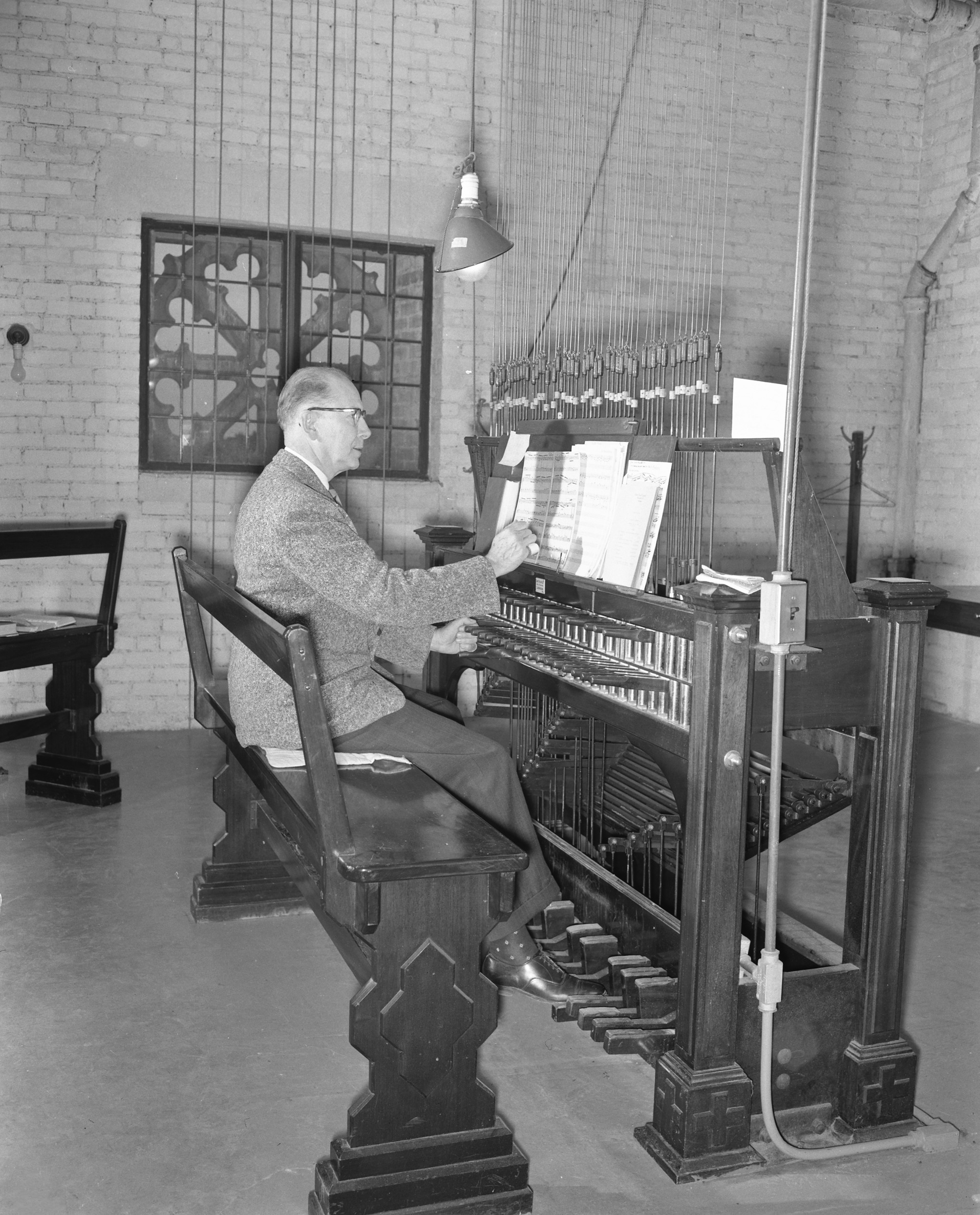
What you might think at first look is simply a bell tower at Christ Church Cranbrook is actually much, much more. The tower holds a carillon, a musical instrument consisting of cast bronze bells in fixed suspension, tuned in half steps (chromatic order). It is played from a clavier (keyboard) containing wooden leavers and pedals wired to clappers.
South view of Christ Church Cranbrook, 1932. Photo by Max Habrecht. Courtesy of Cranbrook Archives, Cranbrook Center for Collections and Research.
The Christ Church Cranbrook carillon is known as the “Booth-Wallace Carillon” as the instrument was a gift to the church from Grace Booth Wallace, her husband Harold Lindsey Wallace, and their five children, Elizabeth, Ellen, Richard, Shirley, and Catherine. It originally consisted of forty-six bells made by the Taylor Bell Foundry in Loughborough, England.
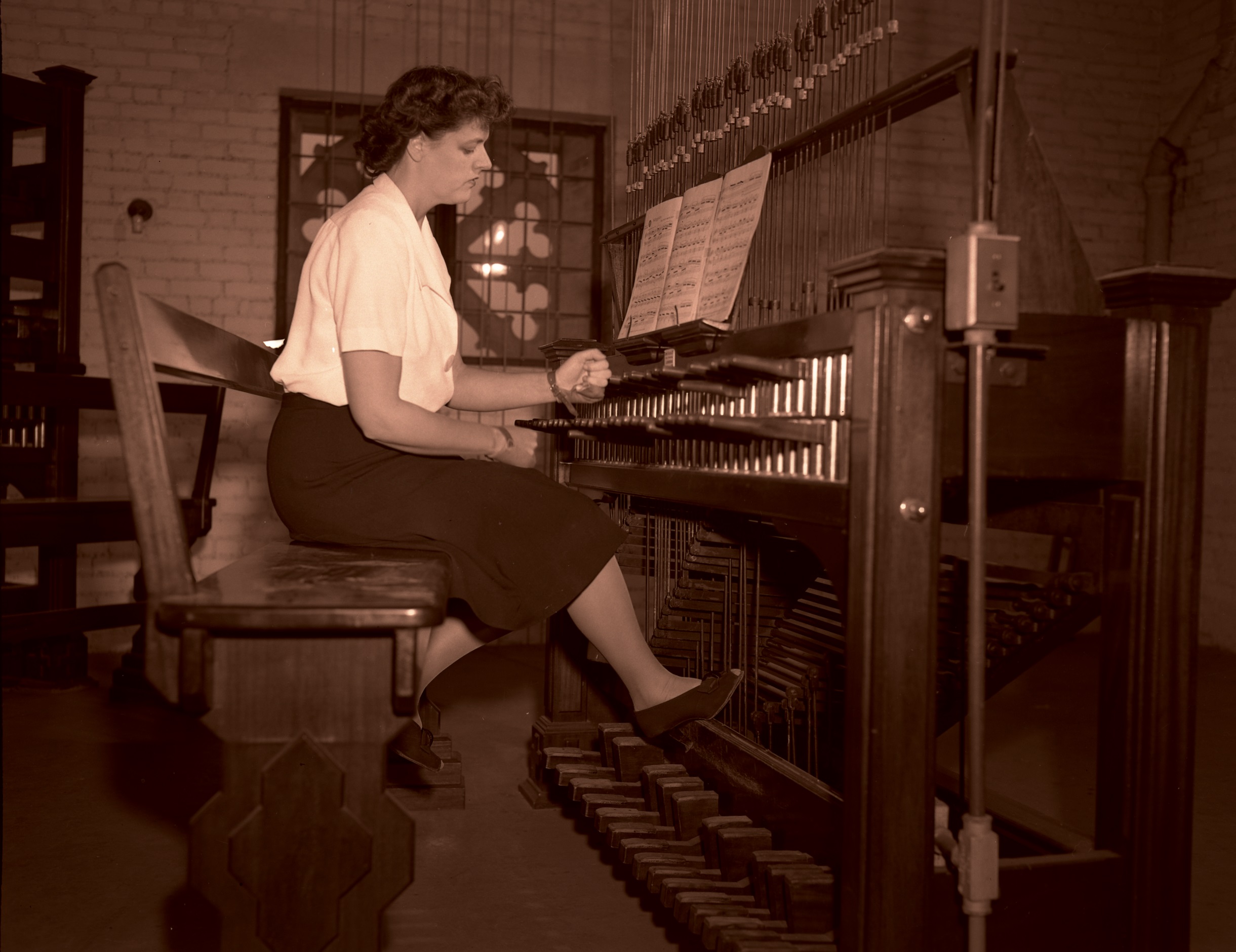
The largest bell (bourdon) is 6,700 pounds, five-feet eight-inches in diameter, and rings a low B-flat. The carillon was later expanded in 1978 with smaller treble bells to its current total of fifty bells, or four complete octaves. The carillon is in concert pitch, meaning it sounds the notes implied by the keyboard arrangement. To play the large instrument, the clavier is struck with fists and feet. The carillon requires physical exertion as the clappers can weigh several hundred pounds–however, the instrument is balanced for ease of use.
Nellie Beveridge at the clavier of the Booth-Wallace Carillon in May 1946. Note the use of her fists to play the instrument. Beveridge also served as nurse and companion to George and Ellen Booth. Courtesy of Cranbrook Archives, Cranbrook Center for Collections and Research.
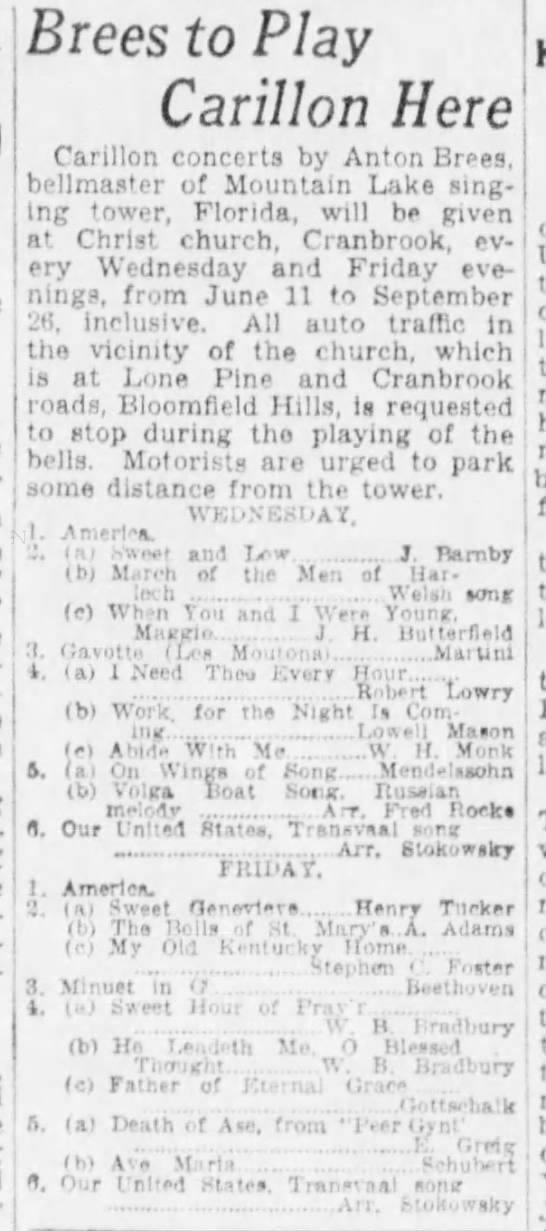
The Booth-Wallace Carillon was dedicated on Sunday, September 30, 1928. The first carillonneur to play the instrument was Anton Brees, at the time one of the world’s leading carillonneurs and famously the carillonneur of the Singing Tower at Bok Tower Gardens in Lake Wales, Florida. He would return to Christ Church for several summers to play, beginning what is now called the Summer Carillon Series.
Article from the June 8, 1930 the Detroit Free Press regarding Brees and the Christ Church Summer Carillon Series.
The 2020 Summer Carillon Series at Christ Church Cranbrook has already begun. You can listen to the July 5th concert below and go to the church’s Facebook page to learn more about future concerts.
Christ Church Cranbrook has had a number of carillonneurs or carillonists throughout its history.
Carillonist Beverly Buchanan preparing the instrument to play, February 1970. Courtesy of Cranbrook Archives, Cranbrook Center for Collections and Research.
Beverley B. Buchanan played the carillon at Christ Church from 1964-1988. Beverly was a graduate of the University of Michigan, School of Music where she majored in organ and carillon. She was a long time member of the American Guild of Organists and the Guild of Carillonneurs in North America. She concertized on the carillon throughout North America, Europe, and Australia.
Dr. Maurice Garabrant playing the carillon, September 1956. Courtesy of Cranbrook Archives, Cranbrook Center for Collections and Research.
Other carillonneurs of Christ Church include Dr. Maurice Garabrant (1949-1959), Dr. Don Cook (1988-1991), and Dr. Phillip Burgess (1991-mid 1990s). The current carillonist at Christ Church is Jenny L. King, who has been at Christ Church since the mid-1990s..
We hope that you will be able to enjoy more of the Christ Church Cranbrook Booth-Wallace Carillon this summer, whether in person or online. I think sitting on the wide lawn in front of the church enjoying a concert sounds like the perfect socially distant activity! For the complete program for the Summer Carillon Series, click here.
– Leslie S. Mio, Associate Registrar, Cranbrook Center for Collections and Research









 Cranbrook Kitchen Sink
