The Little Brown House

Twenty-five miles northeast of Cranbrook lies Lakeville Lake, which was once the site of Cranbrook Institute of Science Botanist, Cecil Billington’s summer cottage, the Little Brown House. Documented in Billington’s Papers, which were recently donated to the Archives, the story of the house provides a fascinating glimpse of one of Cranbrook’s earliest supporters and staff members.

Detail of a Cecil Billington’s property on Lakeville Lake, Oakland County, Michigan. Courtesy of Cranbrook Archives

Cecil Billington was an integral part of early Cranbrook history, serving on almost all the founding institutions’ governing boards, as well as the Cranbrook Foundation Board of Trustees (now Cranbrook Educational Community Board of Trustees). He was also a long-time business associate of Cranbrook Founder, George G. Booth, working for him at the Detroit News from 1897-1947 and serving as Secretary of the Evening News Association for twenty-eight years.
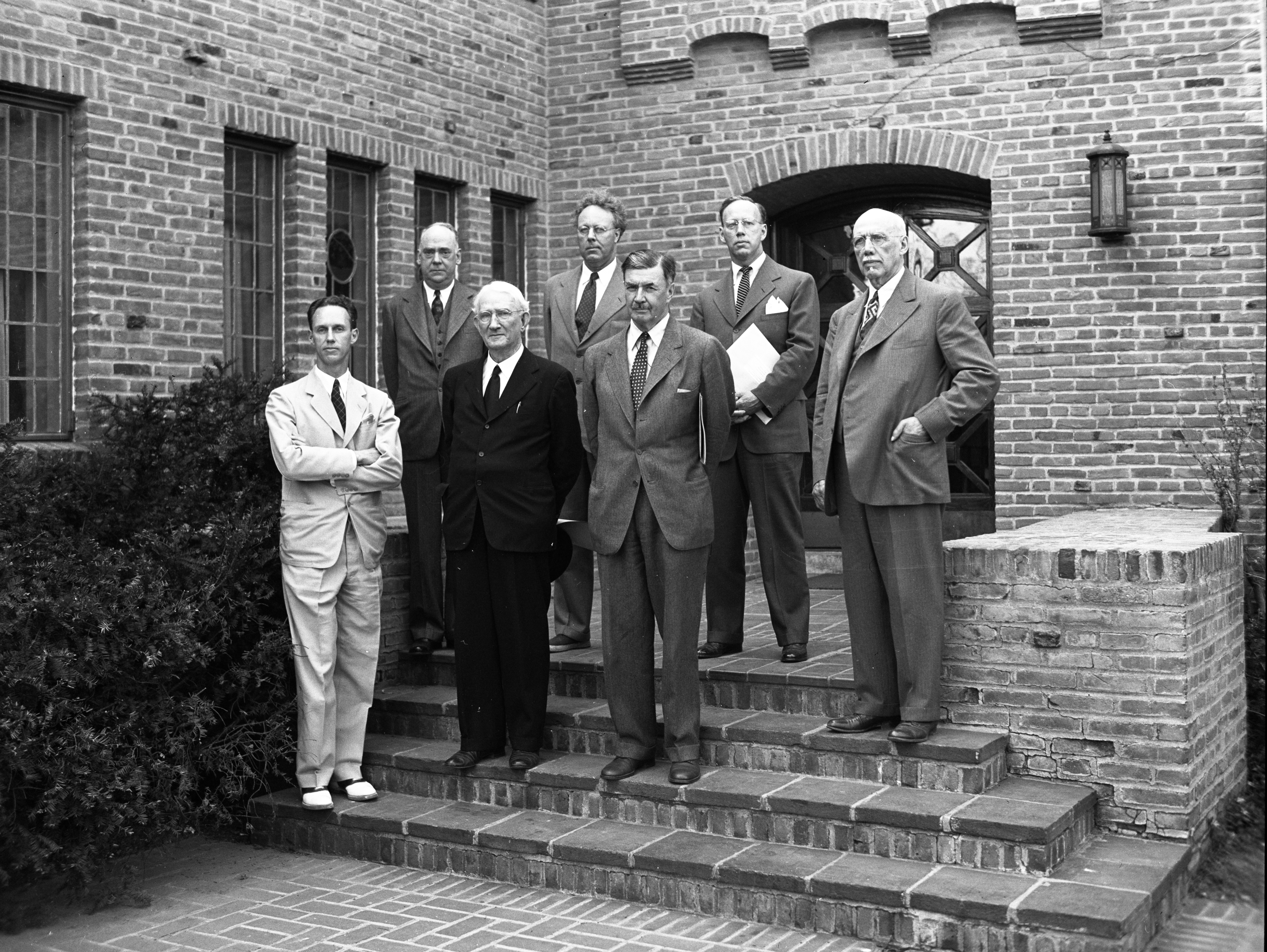
Cranbrook Foundation Board of Trustees, May 1942. Cecil Billington second from left. Courtesy of Cranbrook Archives.

Most affiliated with the Institute of Science, in both an administrative and scientific capacity, Cecil Billington headed up the Institute’s first department of botany. As an amateur botanist, he focused particularly on Oakland County, including his Lakeville property. The Institute published both of his books, Ferns of Michigan and Shrubs of Michigan, and was also the recipient of Billington’s principal collection of plant specimens.

Similar to the papers of Institute Director, Robert T. Hatt, Billington’s papers include field notebooks and other items used in gathering specimens and conducting research that are invaluable for understanding the focus of the Institute in its earliest decades. But it is one book in particular that illuminates the man behind the research and particularly captures my attention and imagination.

West view of the Little Brown House, circa 1930s. Courtesy of Cranbrook Archives.

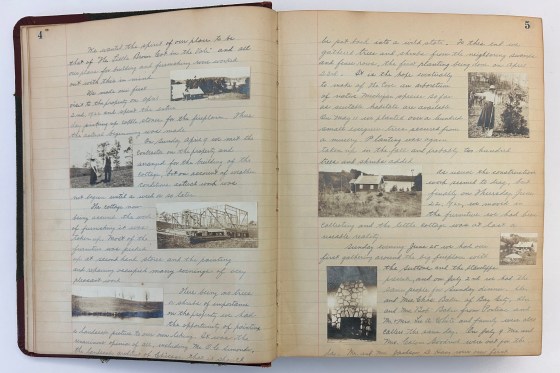
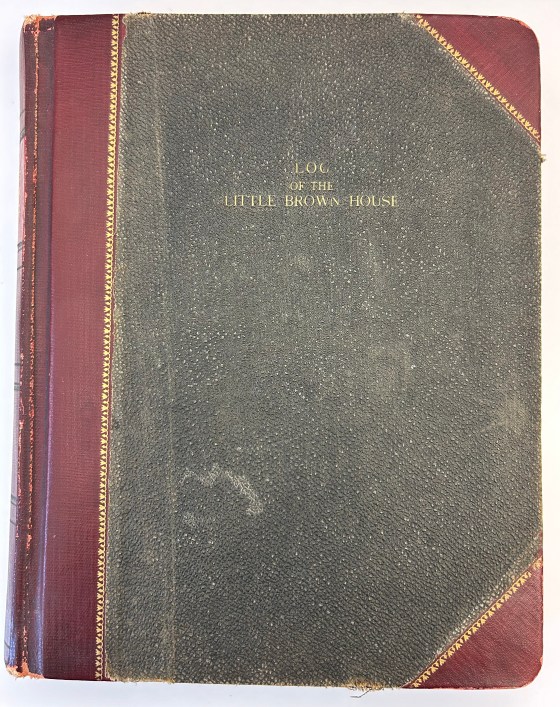
Log of the Little Brown House is part diary and part guest book, documenting sixteen years at The Cove, Cecil and wife Nina’s Lakeville property where they built their cottage. In it, Cecil records reminiscences of each year from 1922, the first year of ownership, to 1938 when the property was sold. His entries document land development and use, scientific study, and leisure activity. Interspersed with the diary entries are the signatures of the couple’s many visitors. Not surprisingly, quite a few of these are Cranbrook names: Lee A. White, Sanford Allen, Carl and Olga Milles, Robert and Marcelle Hatt, and various members of the Booth family, among others.
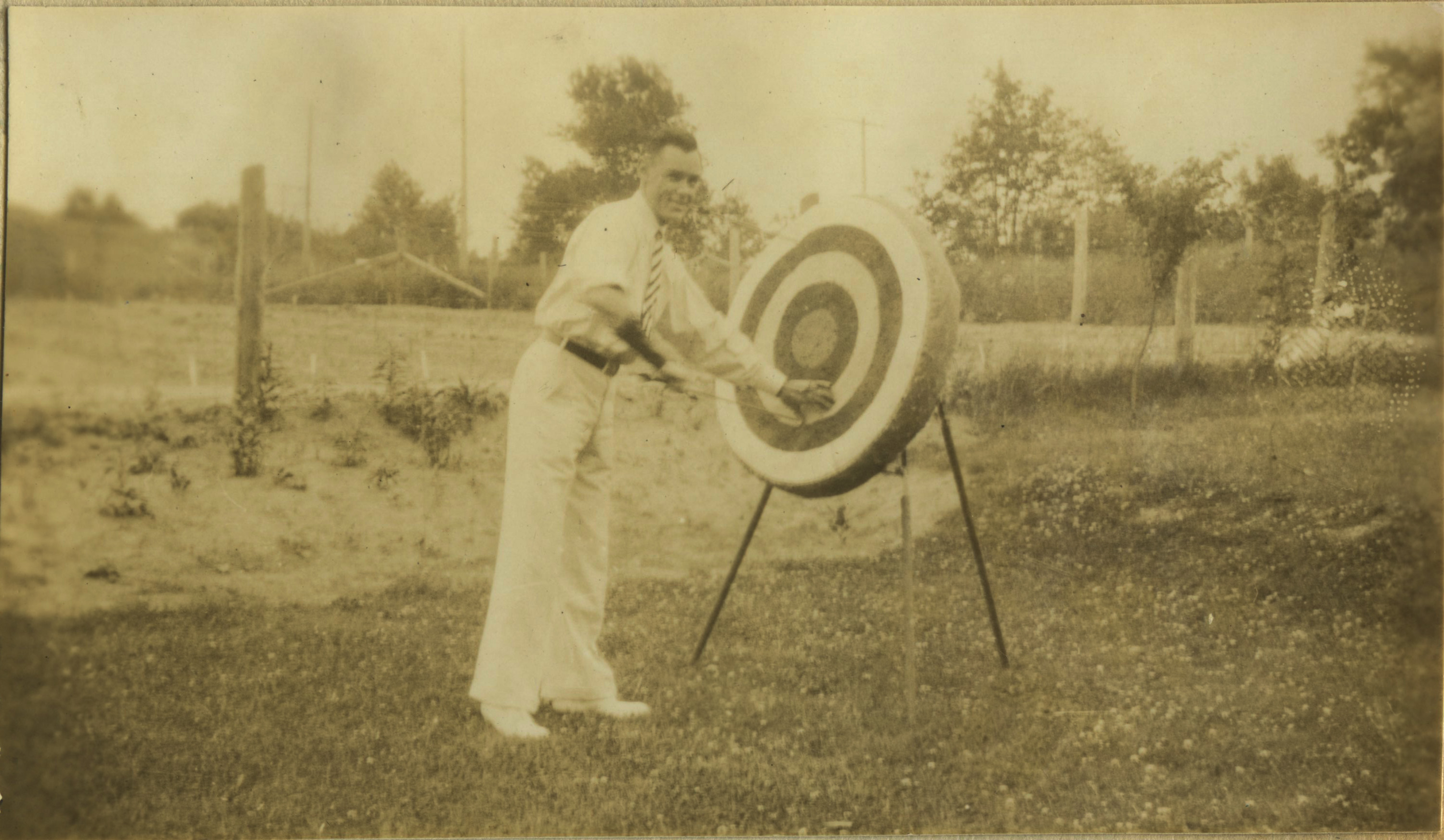
Little Brown House guest using the archery field. Courtesy of Cranbrook Archives.

The Billington’s desire to create a lake idyll that they could freely share with family and friends is recorded in the first pages of the logbook. In addition to building the cottage, over the years they created playfields consisting of archery, bowling on the green, croquet, horseshoes, an outdoor dining room, and a golf course! An entry by Lee A. White in October 1923 hints at the playfulness and freedom enjoyed by visitors: ““They that live by the sword shall perish by the sword.” In memory of the grievous wounding of our host in competition at archery.”  
The written entries are illustrated throughout with photographs of the people, place, and things at the Little Brown House: a presentation of a trophy to the 1928 golf champion; the sunflowers planted for the chickadees and other birds; the building of an addition on the cottage.  Framing them all at the front and back of the book are several musings on the Little Brown House, published in the Detroit News and written by columnist Mrs. J. E. Leslie. It seems fitting to end this post with one such entry that may particularly resonate at this time of year:

Crimson woodbine along the line fence; woods brown and green burning with splashes of scarlet and yellow; farm gardens dry and bare—autumn and a drive to Little Brown House. Reaching out to enfold those of its world, is the great, lovely spirit of hospitality and friendship and sincerity that reaches the hearts of those who enter its door. That is the Little Brown House that is reached by a drive through the golden, mellow loveliness of an early autumn day.

Deborah Rice, Head Archivist, Cranbrook Center for Collections and Research

Frank Lloyd Wright’s Landscapes

While George Booth may have had carved “Nature I loved, and, next to Nature, Art” above the fireplace in his library, I’m not sure anyone adored nature as much as the inimitable Frank Lloyd Wright. Known for his organic architecture, his buildings are sited to be viewed as one with nature. Wright went so far as to say “I believe in God, only I spell it Nature.

In the Fall of 1941, Richard Raseman (the Academy of Art’s Executive Secretary from 1932 to 1943) traveled to Wright’s winter home and studio, Taliesin West, in Scottsdale, Arizona. In beautiful photographs he captured the balance Wright achieved between the desert landscape and architecture. In Raseman’s many photographs, foregrounds of cacti and sand with backdrops of mountains and sky form a nest for the rambling estate. Water also plays a part in these compositions, as it often did in Wright’s work.

raseman002

View of Taliesin West, Fall 1941. Richard P. Raseman, Photographer. Courtesy of Cranbrook Archives.

No Wright project is as associated with water as the Kaufmann House, “Fallingwater“, of 1936 in Mill Run, Pennsylvania. Last week, I had the honor to meet with the head Horticulturalist from Fallingwater, Ann Talarek. She was in town on the invitation of our friends at Lawrence Technological University, to speak to architecture students there and assist in ideas for the historic landscape of Frank Lloyd Wright’s Affleck House, owned by LTU. (A mere mile north of Cranbrook’s Woodward Avenue entrance, the Affleck House was completed in 1941 and Affleck’s son, Gregor Affleck, studied Painting, Design and Modeling at Cranbrook from 1944-45.)

Affleck House

View of Affleck House, c. 1945. Harvy Croze, Cranbrook Staff Photographer. Courtesy of Cranbrook Archives.

More than most historic house museums, for a Wright project the intimate association between site and structure means that maintaining the landscape is just as important as maintaining the building. When working on the landscape, you have to study both historic images and what you can see on the ground today. Ann let us know that one of the most important things you can do with a Wright landscape is to edit: “Keep the view sheds Wright would have been working with, editing out trees that may be pretty but block important views. It may be counter intuitive, but add by reducing.”

Today, the Cranbrook Center for Collections and Research serves as the educational steward of Frank Lloyd Wright’s 1950 Smith House, just a mile west of our campus. Ann also visited the Smith House, where she was impressed (as most visitors are) by the majestic canopy of oak trees surrounding the house and the dappled light they produce. Whereas the Affleck House has lost some of its view sheds, the Smith House still retains its open views toward the pond dredged by Melvyn Maxwell Smith. She also noted how architectural the landscape was: its perfectly placed pond, trees, and the arc of shrubs along the western end of the house.
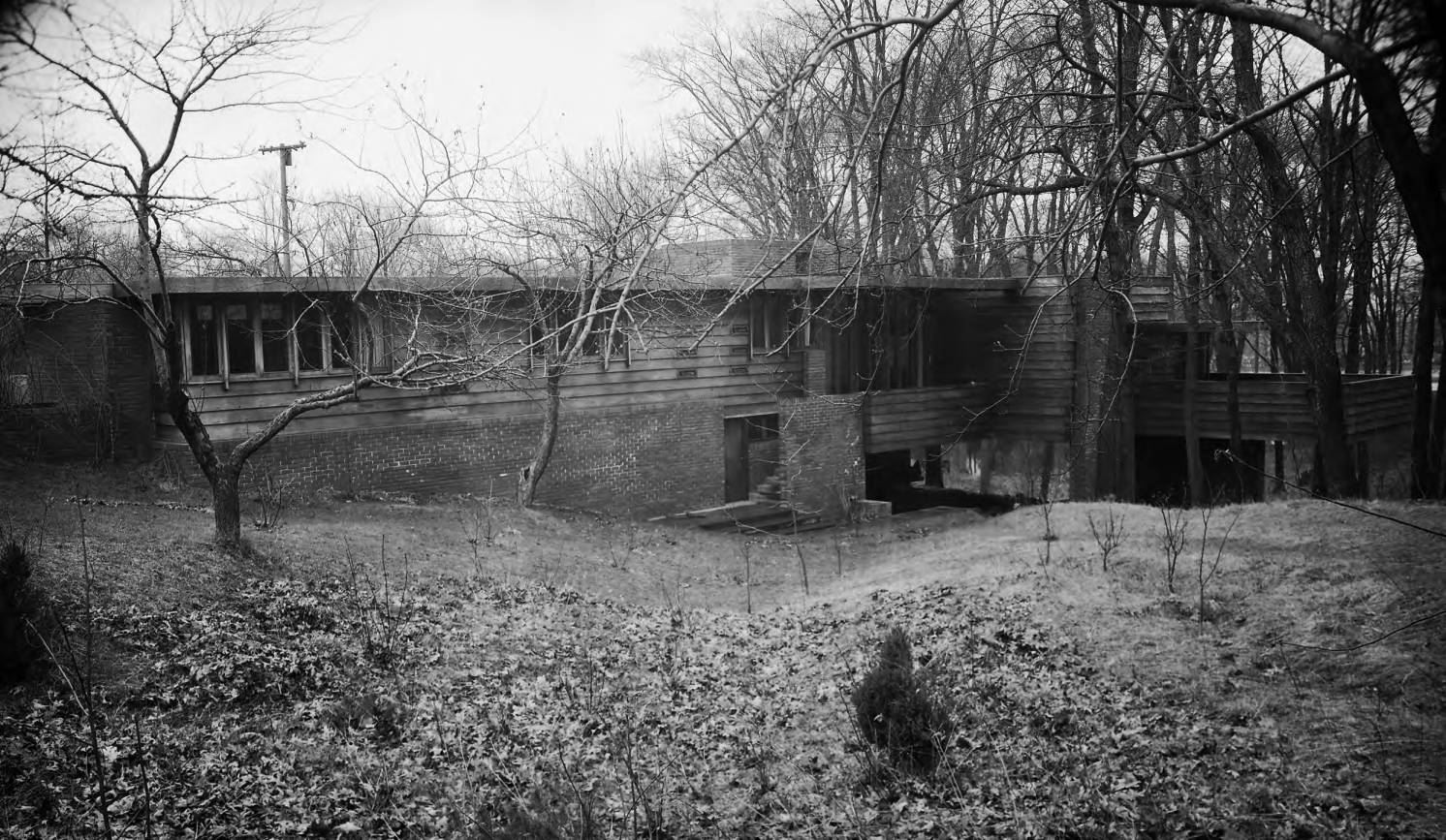
Smith House with Farmland

Smith House, c. 1952. Courtesy of Melvyn Maxwell and Sara Stein Smith Family Albums.

What’s impressive about the Smith House is the stuff inside: the fine and decorative art collection of things acquired and displayed by Mr. and Mrs. Smith, much of it from Cranbrook Academy alumni. After meeting with Ann and then looking through family photo albums of the house’s landscape, I realized that the grounds too were a project of the Smiths: he was constantly adding, cutting back, and reshaping the landscape. It’s most famous iteration may be an impromptu plan developed by the landscape architecture celebrity Thomas Church (for that story, sign up for a Smith House Tour!), yet like any site, the landscape has changed over the years.

Smith House later

Smith House, c. 1975, with landscape attributed to Thomas Church. Courtesy of Melvyn Maxwell and Sara Stein Smith Family Albums.

Ann talked at the Affleck House about how they might eliminate certain invasive species (as she has done at Fallingwater) or how trees might be cut back. At Smith House, she helpfully noted some trees nearing the end of life, but suggested the historic photographs be studied to figure out what the Smith’s wanted. “Unlike Fallingwater or the Affleck House, the Smith House is ultimately suburban. What we now call invasive species would have been considered fashionable in the 1950s and 60s, and in a place as personal as the Smith House, you have to consider what Mr. Smith would have done as much as what Wright would have planned.” It’s an interesting idea. I think the most important goal is to make the architectural, landscape, and personal stories of the Smith House dynamic, relevant, and beautiful for visitors. That, and, as Ann said, “Don’t let anyone plant anything that’s going to overrun Bloomfield Hills.”

– Kevin Adkisson, Collections Fellow, Cranbrook Center for Collections and Research
Lions and Tigers and Mastodons, oh MI!

Don’t worry (or sorry!) if you thought this post was going to be about sports teams in the Detroit area. Today’s post is purely about scientific discovery and serendipity right here in Southeast Michigan! Last month local news services reported that the remains of a wooly mammoth had been discovered in Lima Township (Washtenaw County). This prompted me to do some research about these super-cool prehistoric elephant ancestors. According to the University of Michigan Museum of Paleontology, mammoths and mastodons disappeared from this area about 11,700 years ago. Since that time, the remains of about 300 mastodons and 30 mammoths have been found in Michigan.

In 1934, a WPA project was underway when workers discovered bones while using a steam shovel in Bloomfield Hills. The remains, believed to be dinosaur bones by the workers, were brought to Cranbrook Institute of Science for identification. The bones were determined to be those of a mastodon – now known as “The Bloomfield Hills Mastodon.”

Excavation site of the Bloomfield Hills Mastodon, 1934. Cranbrook Archives.

Excavation site of the Bloomfield Hills mastodon, 1934. Cranbrook Archives.

Only the skull with a few vertebrae and ribs were recovered during the excavation of a small pond, which was deepened to form an artificial lake. The bones were uncovered in a residential district about a quarter of a mile east of Woodward Avenue near Charing Cross Road.

Jaw bone from Bloomfield Hills mastodon, 1934. Cranbrook Archives.

Jaw bone from Bloomfield Hills mastodon, 1934. Cranbrook Archives.

In 1972 a large bone was discovered by a Cranbrook grounds crewman during the process of cleaning up a dump. Warren Wittry, anthropologist and then-CIS director, identified the bone as the central portion of the right scapula of an adult Ice Age mastodon. A”dig” crew was gathered to search for additional bones, but alas only a few additional fragments were found.

Late in 1977, the Institute received an early Christmas present when a partial skull and section of tusk from a young mastodon were discovered by two high school students near Seymour Lake Road in Brandon Township in northern Oakland County. The Institute was very excited about the donation of the bones, which were in an excellent state of preservation. There have been several more mastodon discoveries in Michigan since the 1970s. Personally, I find these stories more interesting to follow than the local sports scene.

Gina Tecos, Archivist

Photo Friday: Before Booths

Did you know that Bloomfield is one of the oldest townships in Michigan?  Originally part of a larger piece of land known as Oakland, in 1820 the southern portion was designated as Bloomfield. Long before George and Ellen Booth purchased the property known as Cranbrook, Amasa Bagley was already on the scene.  Arriving to the area in 1819 (when Woodward Avenue was still known as an Indian passage called Saginaw Trail!), Bagley quickly became a community leader. A farmer by trade, he was appointed the first judge of Oakland County, and helped to establish the area’s first bank. Perhaps his most significant contribution of the time – opening the town tavern! Built in 1833, the Bagley Inn was used not only to quench the thirst of locals, but also as a public house for political gatherings. Located at the corner of Long Lake and Woodward, the building still exists today.

~Robbie Terman, archivist

Portrait of Amasa Bagley. Cranbrook Archives.

Portrait of Amasa Bagley. Cranbrook Archives.

Create a website or blog at WordPress.com