Photo Friday: Cranbrook’s World Cup

Cranbrook student John Vining Ogden (left) competes for the ball in a match against the opposing team from Nichols, a rival school, 1960. Cranbrook Archives/Harvey Croze.

Cranbrook student John Vining Ogden (left) competes for the ball in a match against the opposing team from Nichols, a rival school, 1960. Cranbrook Archives/Harvey Croze.

As we prepare for the final round of World Cup soccer (Germany vs. Argentina, this Sunday), we’re looking back on Cranbrook’s own soccer history. Here, Cranbrook student John Vining Ogden tries to get one step ahead of a rival player as they vie for control of the ball. We’re especially taken with the Nichols’ players’ uniforms: with their striped jerseys, they look like a team made up entirely of referees!

Photo Friday: Pleasures of Life

Close-up of page 104 of Pleasures of Life, Volume 2. Cranbrook Archives.

Close-up of page 104 of Pleasures of Life, volume 2. Cranbrook Archives.

For this week’s Photo Friday, we’re showcasing an image from Henry Scripps Booth’s epic photographic undertaking, Pleasures of Life. A series of photographic albums documenting his life from 1911 to 1940, Pleasures of Life follows Booth through experiences at Cranbrook, boarding school in Asheville, NC, and travels domestic and international.

This photograph, found on page 104of Pleasures of Life, volume 2, features a “Mrs. Scranton and Mrs. Brixton” dressed in angels’ wings and halos and labeled “Cranbrook’s guardian angels.” Taken during a nativity theatrical performance at Cranbrook’s Greek Theatre in 1916, the photo provides visual documentation for what are likely the same wings as those that appear in the Center’s newest exhibition,Cranbrook Goes to the Movies: Films and Their Objects, 1925-1975, now open at Cranbrook Art Museum.

Wings, circa 1916, featured in the exhibition Cranbrook Goes to the Movies.

Wings, circa 1916, featured in the exhibition Cranbrook Goes to the Movies.

Photo Friday: Brookside at Play

Brookside students enjoy the Cranbrook fire engine, 1936. Richard G. Askew/Cranbrook Archives.

Brookside students enjoy the Cranbrook fire engine, 1936. Richard G. Askew/Cranbrook Archives.

Brookside students know how to multitask—while enjoying playtime, they’re also learning the ins and outs of fire safety.  This photo, taken in 1936, shows Brookside students enjoying playtime on the Cranbrook fire engine. Especially endearing are the rubber galoshes; whether the children are wearing them to fight a fire or jump in puddles, they’re prepared for anything.

Photo Friday: En Plein Air(tarium)*

Students sketch the partially-completed McMath Planetarium at CIS. June, 1955. Harvey Croze/Cranbrook Archives.

Students sketch the partially completed McMath Planetarium at CIS. June, 1955. Harvey Croze/Cranbrook Archives.

As the McMath Planetarium went up at the Cranbrook Institute of Science over the course of the summer of 1955, students took the opportunity to work on their outdoor sketching. Here a young woman captures the newly constructed dome still clad in scaffolding. Note the sign to the left of the planetarium: it reads “Michigan’s First Public Planetarium.”

* “En plein air” is an expression that refers to the practice of painting outdoors – or “in the open air” – which was popularized by Impressionist painters, many of whom made the use of natural light a hallmark of their work. We apologize for the corny “en plein air”/”planetarium” joke, but we just couldn’t resist.

Photo Friday: Art by Degrees

Young women take in the Annual Exhibition of Student Work at the Cranbrook Art Museum. The central painting is Untitled (1957) by student Frank Okada. June 1957. Harvey Croze/Cranbrook Archives.

Visitors take in the Annual Exhibition of Student Work at Cranbrook Art Museum. The central painting is Untitled (1957) by student Frank Okada. June 1957. Harvey Croze/Cranbrook Archives.

It’s that time of year again—the Graduate Degree Exhibition is up and running at Cranbrook Art Museum! Staged in some form or another since 1940, the Graduate Degree Exhibition is a celebration of work produced by Cranbrook’s graduating class of MFA students. This photograph from 1957’s Annual Exhibition of Student Work (an earlier name for the Graduate Degree Exhibition) shows a painting by Academy of Art graduate Frank Okada that might be familiar to eagle-eyed museum visitors—it was featured in the 2013 exhibition What to Paint and Why: Modern Painters at Cranbrook, 1936-1974.

For more information about the 2014 Graduate Degree Exhibition, check out Cranbrook Art Museum’s website. And be sure to check out the show while you still can—it closes May 11!

Photo Friday: Learning by Living and Observing

BS1930s001

Brookside School, ca 1928. The photograph was taken by Arnold Studio, a local Birmingham studio who took most of the early photographs of Brookside School. Cranbrook Archives.

In the 1930s, Brookside School children spent part of their time applying what they learned in the classroom to conditions from real life. Here, children were learning by “living and observing” the daily routines at a pretend store. The “Greenfield Sausage” package on the front of the table was from Hammond Standish & Company meat packing business of Detroit. The company was founded by George H. Hammond, who built Detroit’s first skyscraper—the “Hammond Building.” Hammond also patented the first refrigerated boxcar, and by the mid-1880s, Hammond Standish & Company was using 800 refrigerated boxcars to deliver meat to the Atlantic seaboard each week.

Gina Tecos, Archivist

Photo Friday: Poly Mer and the Emulsions

Doug "Do" Huston (MFA Printmaking, 1975) holds his Poodle Bass guitar, while Chuck Baughman (MFA Printmaking, 1975) is armed with a saxaphone. Lorraine Wild (BFA Design 1975) wears the blue dress. Image courtesy of Steve Milanowski.

Doug “Dog” Huston (MFA Printmaking, 1975) holds his Poodle Bass guitar, while Chuck Baughman (MFA Printmaking, 1975) is armed with a saxephone. Lorraine Wild (BFA Design 1975) wears the blue dress. Image courtesy of Steve Milanowski.

Spring has finally arrived, and with it comes the urge to stay outdoors, enjoy the great weather, and maybe even celebrate with a little music! In 1974, CAA students Doug Huston and Chuck Baughman (both MFA Printmaking, 1975) joined up with Lorraine Wild (BFA Design, 1975) and others to form the band Poly Mer and the Emulsions. As you enjoy our newfound sun (and revel in a landscape finally free of snow), take a moment to consider what sort of sounds might come from a poodle bass guitar, featured here in the arms of the appropriately nicknamed “Dog” Huston.

Photo Friday: The Rocket Takes Off (and Says Goodbye)

James Scripps Booth showing off the JB Rocket prototype in Indianapolis, the conclusion of a test-drive from Detroit to Indiana, 1913. Cranbrook Archives.

James Scripps Booth showing off the JB Rocket prototype in Marion, Indiana, at the conclusion of a test-drive from Detroit to Indiana, 1913. Cranbrook Archives.

Today’s Photo Friday comes courtesy of A Driving Force: Cranbrook and the Car. The exhibition, organized by the Cranbrook Center for Collections and Research and hosted at Cranbrook Art Museum, features objects, renderings, and historic photographs that connect the Cranbrook community with Detroit’s long and venerable history of car production. And of course we also brought in actual 1914 car, because how could we not? Anyone who reads this blog regularly already knows quite a bit about the exhibition, so we won’t go on. If you haven’t had a chance to see the show, though, be sure to stop by Cranbrook Art Museum on Saturday or Sunday before the whole thing comes down once and for all!

Shoshana Resnikoff, Collections Fellows

Photo Friday: Wartime Conservation, Kingswood-Style

Kingswood students Blenda Isbey, Irene Bard, and Nollie Campbell collect waste fat after their Home Economics class at Kingswood School, 1944. Harvey Croze, Cranbrook Archives.

During World War II, students at the Cranbrook and Kingswood Schools became increasingly involved in homefront activities. Here, Kingswood students Blenda Isbey, Irene Bard, and Nollie Campbell collect waste fat after they’ve finished their Home Economics class. Fat could be used to make soap, in great demand because of wartime rations, but was also consolidated for use in explosives.

Poster advocating the re-use of waste fats in explosives. Henry Koerner, Printed by the Office of War Information, 1943. National Archives.

Poster advocating the re-use of waste fats in explosives. Henry Koerner, Printed by the Office of War Information, 1943. National Archives.

Shoshana Resnikoff, Collections Fellow

Photo Friday: Alexandrine Behind the Wheel

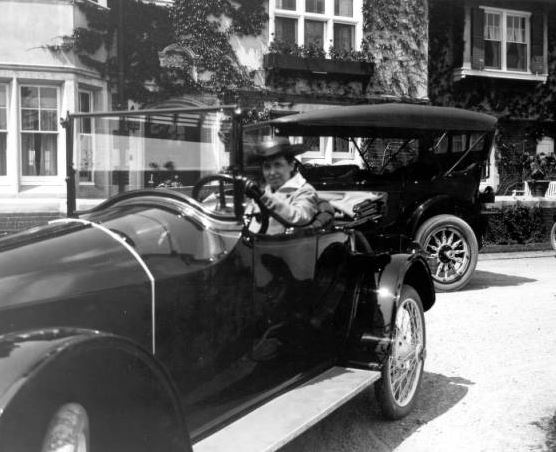
Alexandrine McEwen in her Scripps-Booth, 1916.  Cranbrook Archives.

Alexandrine McEwen in front of Cranbrook House in her Scripps-Booth, 1916. Cranbrook Archives.

As the organization that is currently hosting the exhibition A Driving Force: Cranbrook and the Carit would make sense that we at the Center were drawn to this photo for its representation of a 1916 Scripps-Booth, the car designed by James Scripps Booth and produced by his automotive company. Instead, though, the woman behind the wheel is the real star of the image. Alexandrine McEwen and her sister, Katherine, were co-founders of the Detroit Society of Arts and Crafts (DSAC) and friends of George Booth. Alexandrine was a bookplate artist, painted miniatures, and also authored many of the early plays for the DSAC. After living for decades in Detroit, she and Katherine relocated to Dragoon, Arizona where they ran a dude ranch.

Leslie S. Edwards, Head Archivist, and Shoshana Resnikoff, Cranbrook Center for Collections and Research


Create a website or blog at WordPress.com