The Horizons-Upward Bound program celebrated its 30th anniversary with the theme, “Inheriting the Legacy” during the 1994–1995 academic year. Like other anniversaries I’ve viewed during the HUB digitization project, HUB’s 30th year involved informal and formal events like banquets, cocktail receptions, and picnics.
Thirty years later, HUB has expanded this legacy—celebrating 60 years with micro events to incorporate “aspects of storytelling, history, fun, and fellowship” throughout the year. As HUB enters its 60th year, I thought it would be fun to look back at the ’90s and share a few images from HUB’s 30th anniversary.
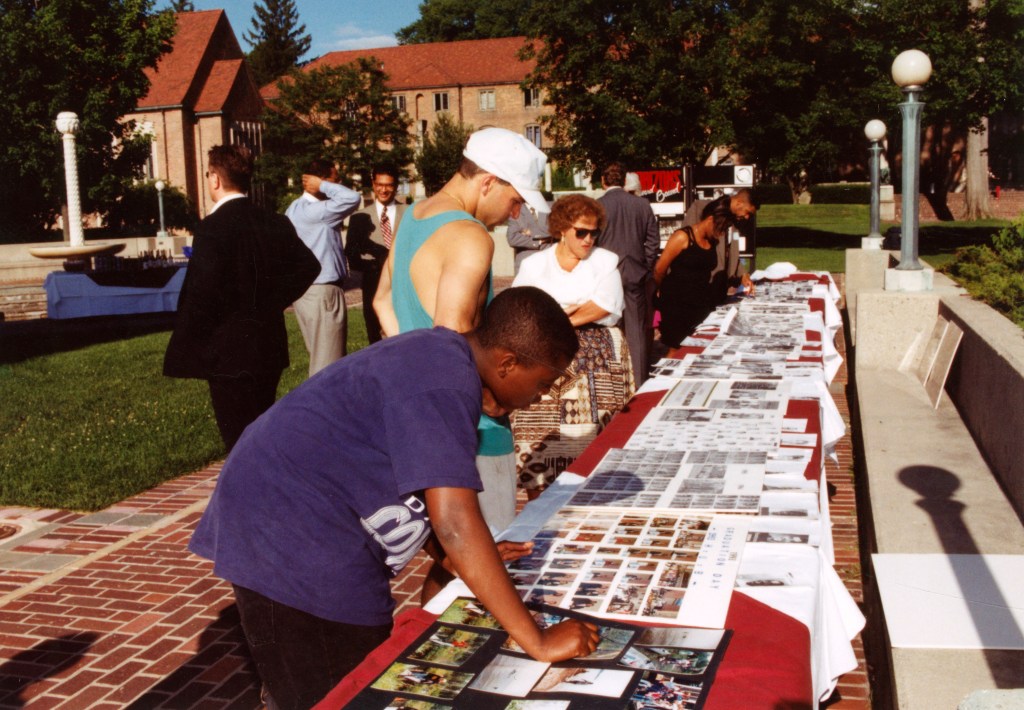
Members from the HUB community review photographs of the program on the Quad during HUB’s 30th anniversary celebration, August 1994. Courtesy of Cranbrook Archives.
Alumni, students, staff, and donors with family and friends exchanged memories and ideas about the HUB program. They listened to various speakers, enjoyed food with live music, and sorted through pictorial displays.
Jenny Hutchinson (HUB ’90) welcomes visitors during HUB’s 30th anniversary, including Hassan Miah (HUB ’73) on right, August 1994. Courtesy of Cranbrook Archives.
HUB alumni are honored during HUB’s 30th anniversary banquet, August 6, 1994. Courtesy of Cranbrook Archives.
HUB’s alumni have historically contributed to the program, especially during anniversary events when members serve as speakers, sponsors, greeters, recruiters, and other roles to foster community relationships and growth of the program.
Student saxophone ensemble provides music for guests on the Quad during HUB’s 30th anniversary, August 1994. Courtesy of Cranbrook Archives.
Join us as we continue to celebrate HUB’s sixtieth anniversary this year, and remember to check back each month to our virtual photo exhibition of HUB’s history, Sixty Years of Horizons-Upward Bound, 1965-2025!
—Courtney Richardson, Project Archivist, Cranbrook Center for Collections and Research
HUB digitization is funded by a NHPRC Archival Projects Grant for projects that ensure online public discovery and use of historical records collections. The NHPRC was established by Congress in 1934 as a statutory body affiliated with the National Archives and Records Administration and chaired by the Archivist of the United States.
This week Cranbrook Archives launched Sixty Years of Horizons-Upward Bound, 1965-2025, a virtual exhibition of HUB’s history, told primarily through photographs. While the HUB program celebrates its sixtieth anniversary this year, we’ve partnered with Amy Snyder, daughter of HUB’s founder, Ben Snyder, to select images from each decade. Those from HUB’s first five years are now available, with new images from subsequent decades slated to be revealed on a monthly basis as the HUB digitization project continues.
Aerial view of HUB summer of 1970. Henry A. Leung, photographer. Courtesy of Cranbrook Archives.
A Collaborative Effort
Creating captions for the exhibition coincided with efforts to describe each of the 2,200 images scanned so far. While some photographs included detailed annotations, describing persons and subjects, many did not, requiring additional research.
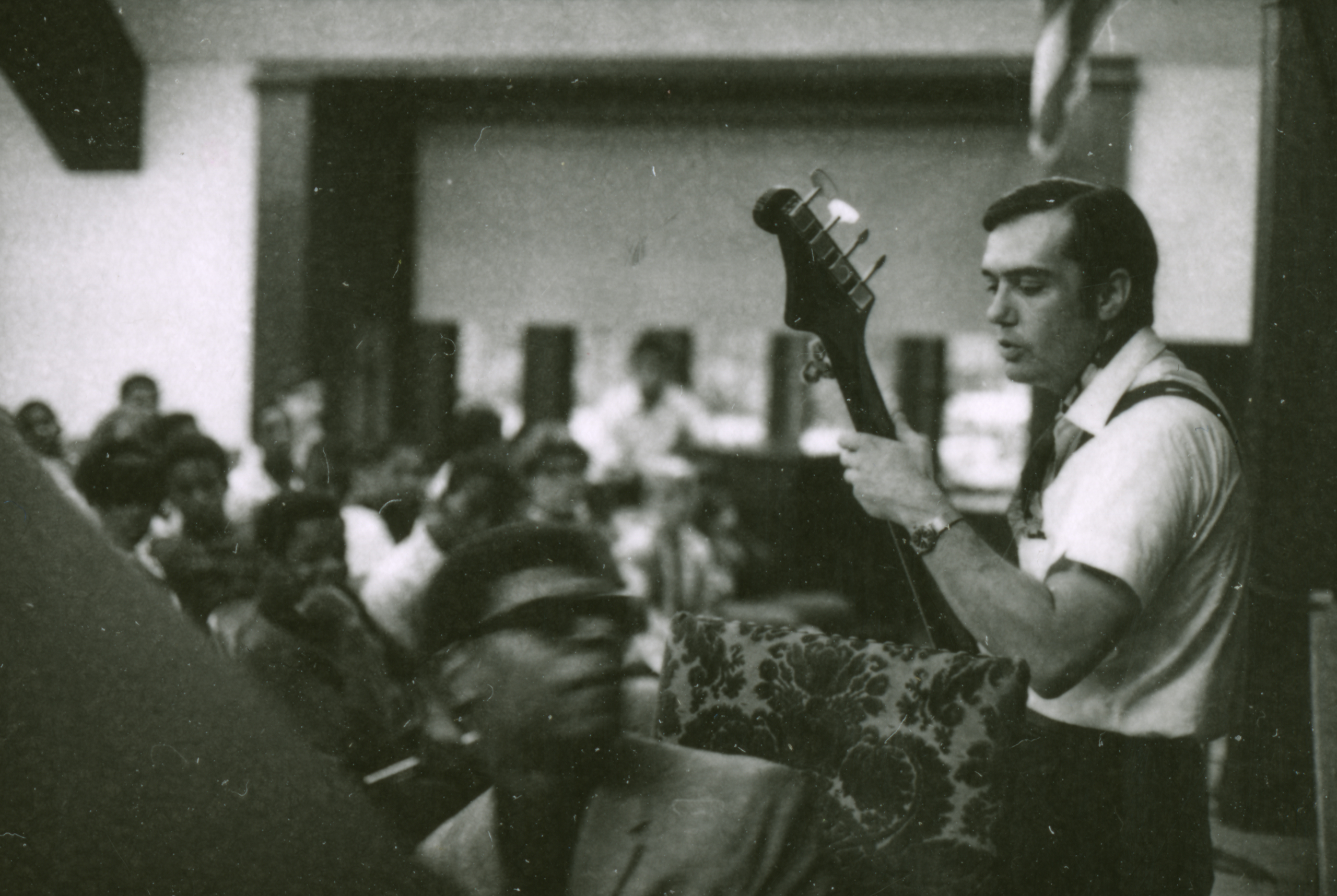
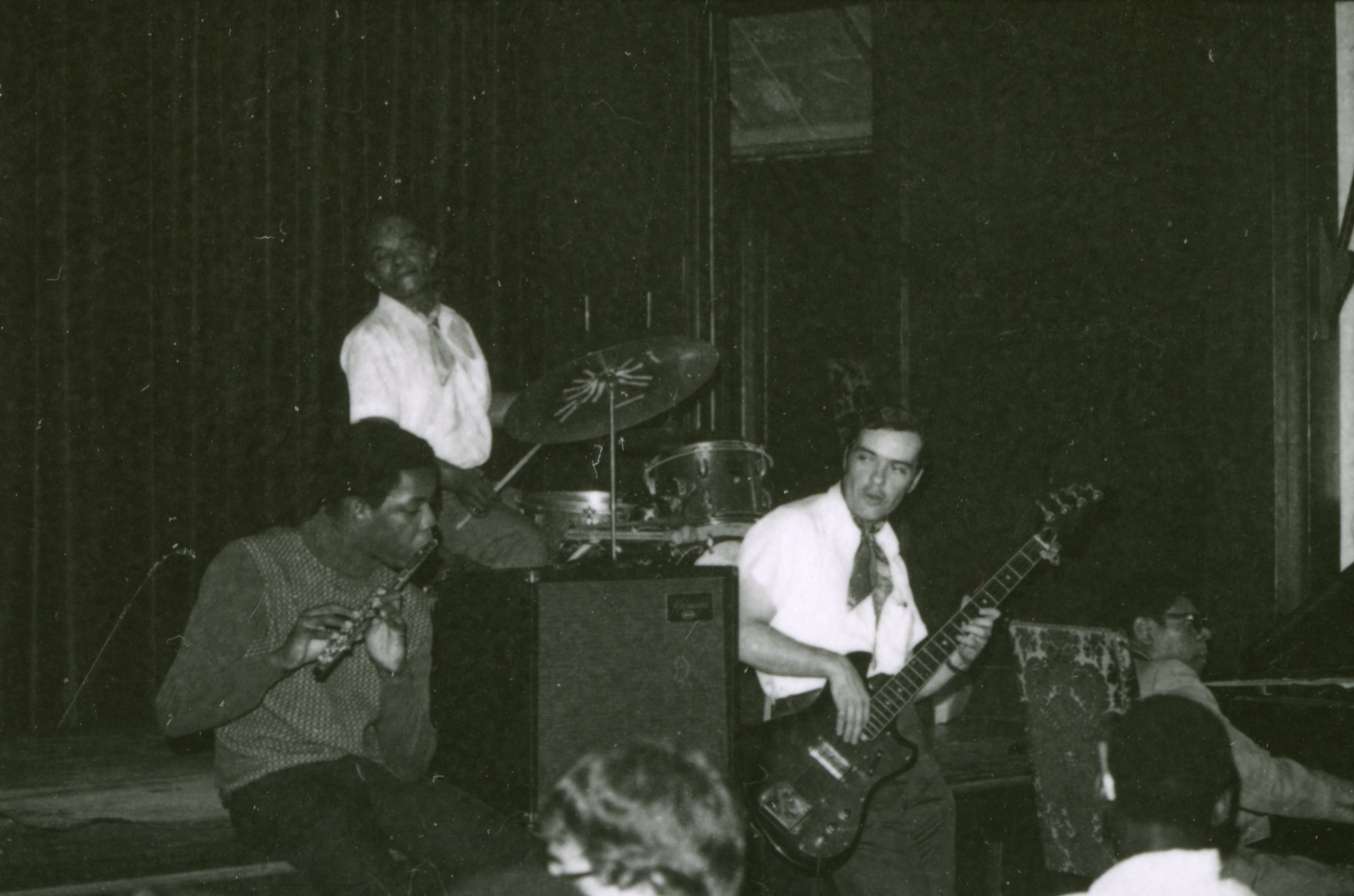
Images not yet identified or depicting unnamed activities have been fun and challenging. Cross-referencing photos with documents like class brochures, annual reports, and school rosters have helped with developing fuller descriptions. For instance, HUB’s annual reports detail various guests and artists that were invited to campus to inspire and entertain HUB students. But, they do not tell the full story. The following photographs feature an unnamed event and band that we hope to learn more about!
Guest band playing for HUB students in assembly hall, Summer 1969. Jack Kausch Photography. Courtesy of Cranbrook Archives.
Andre Boddie (HUB ’70) playing flute with band in assembly hall, Summer 1969. Jack Kausch Photography. Courtesy of Cranbrook Archives.
In addition to my research, HUB alumni have shared information in meetings, emails, and in-person visits, to help describe photographs.
For our studio sessions with Barry Roberts (HUB ’77), we prepared a workspace with enlarged photocopies of group images to annotate and class brochures and annual reports to cross-reference. It’s been a joy to witness how eyes light-up when alumni like Roberts remember people and places depicted in images. We are grateful for the stories they share because they essentially enrich the HUB collection with personal narrative.
Barry Roberts (HUB ’77) identifying HUB images at Thornlea Studio, February 19, 2025. Courtesy of Cranbrook Archives.
More From the 1960s
I have really enjoyed reviewing the program’s visual history. Since only a small number of images from the 1960s are featured in the exhibition, I thought I would share some others that really spoke to me.
It’s been exciting to finally see photographs for events and activities described in reports, like Theme Day, SoulFest, and other academic and extra-curricular subjects.
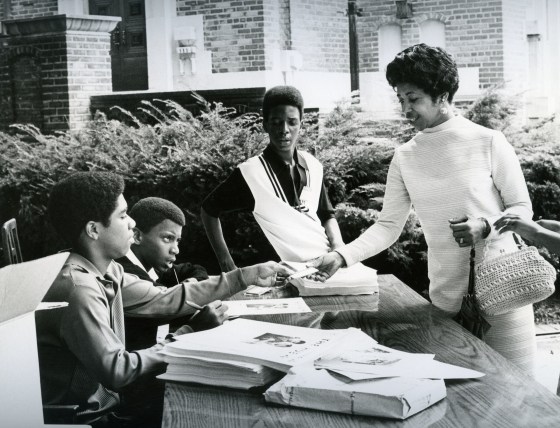
HUB students at the Theme Day registration table hand out issues of the student newsletter, The HUB, August 17, 1969. Courtesy of Cranbrook Archives.
Families of HUB students visiting Cranbrook’s campus for Theme Day, August 17, 1969. Courtesy of Cranbrook Archives.
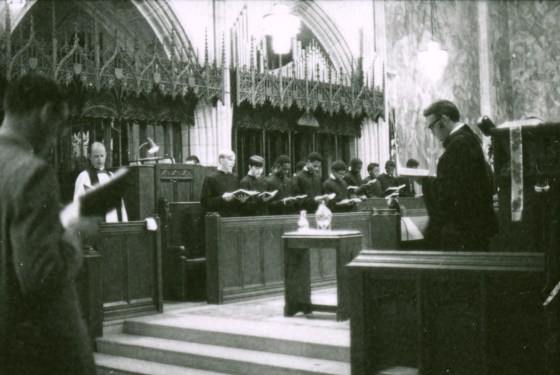
HUB students in choir at Christ Church Cranbrook on Theme Day, August 17, 1969. Courtesy of Cranbrook Archives.
It’s also been interesting to see how HUB students engaged with various spaces across Cranbrook’s campus.
HUB students with Paul Manship’s Armillary Sphere sculpture in Cranbrook School quadrangle , Summer 1969.
HUB student in the reading room of Cranbrook School Library , 1969. Courtesy of Cranbrook Archives.
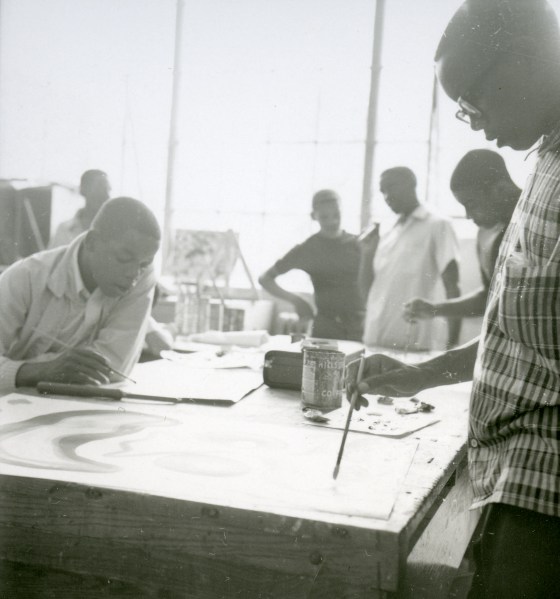
HUB students in design class, Andre Boddie (HUB ’70) on left, 1966. Courtesy of Cranbrook Archives.
I especially enjoyed a small collection of images featuring art work and displays of writing, which were exhibited during Theme Day in 1969. William Washington, English teacher and Theme Day facilitator at the time, described the event’s focus as students and staff answering the question, “Where Is Love?” (HUB Annual Report, 1969). The following image features students’ responses to this prompt with creative writings entitled “What is this love that we now seek? Love is the language that every man speaks.”
Theme Day display featuring students from Sections 7 and 9 of Gregory S. Mims and Philip Young’s English course, August 17, 1969. Courtesy of Cranbrook Archives.
This fall, all of the images digitized in year two of the digitization project will be available online, but in the meantime check back each month to see those featured in the virtual exhibition!
—Courtney Richardson, Project Archivist, Cranbrook Center for Collections and Research
HUB digitization is funded by a NHPRC Archival Projects Grant for projects that ensure online public discovery and use of historical records collections. The NHPRC was established by Congress in 1934 as a statutory body affiliated with the National Archives and Records Administration and chaired by the Archivist of the United States.
Year two of the Horizons-Upward Bound (HUB) digitization project has begun. This phase involves digitizing photographs, including images taken by local photographer Jack Kausch.
HUB student with teacher, William Moran, during a class activity, 1966. Courtesy of Cranbrook Archives.
The first year of the project was dedicated to digitizing publications and documents, which amounted to over 32,600 pages of student and administrative material! Digitization of student films was also completed offsite, totaling 57 minutes of footage. Entering the second year of this project, I am very excited to continue working with HUB’s history as it was documented through photography.
Part of digitization workspace with flatbed scanner and various photographic materials. Courtesy of Cranbrook Archives.
HUB photographs include approximately 2.5 boxes (2.9 linear feet) of photographs in the form of prints, slides, and negative film created from 1965 to 1997. HUB students, faculty, staff, and extended community are featured across class and group portraits, within academic and extra-curricular settings, and during many events such as graduations, award ceremonies, fundraisers, and symposiums.
Aerial view of HUB’s class of 1979. Courtesy of Cranbrook Archives.
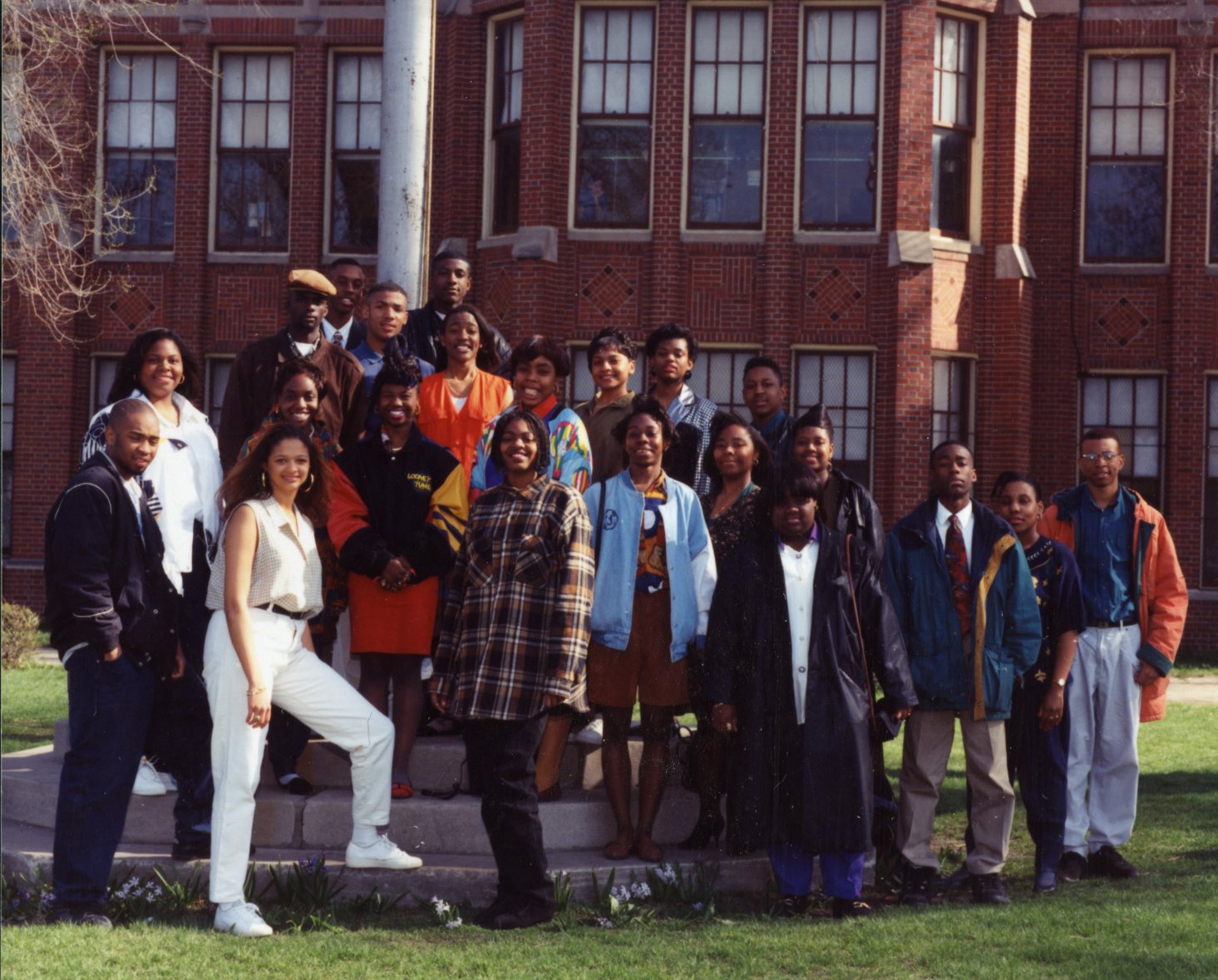
Group image of HUB’s 1994 students. Courtesy of Cranbrook Archives.
Similar to the first phase of the project, photo digitization began in-house at the Archives in Summer 2024. Two hard-working HUB student volunteers scanned 10% of the photographs.
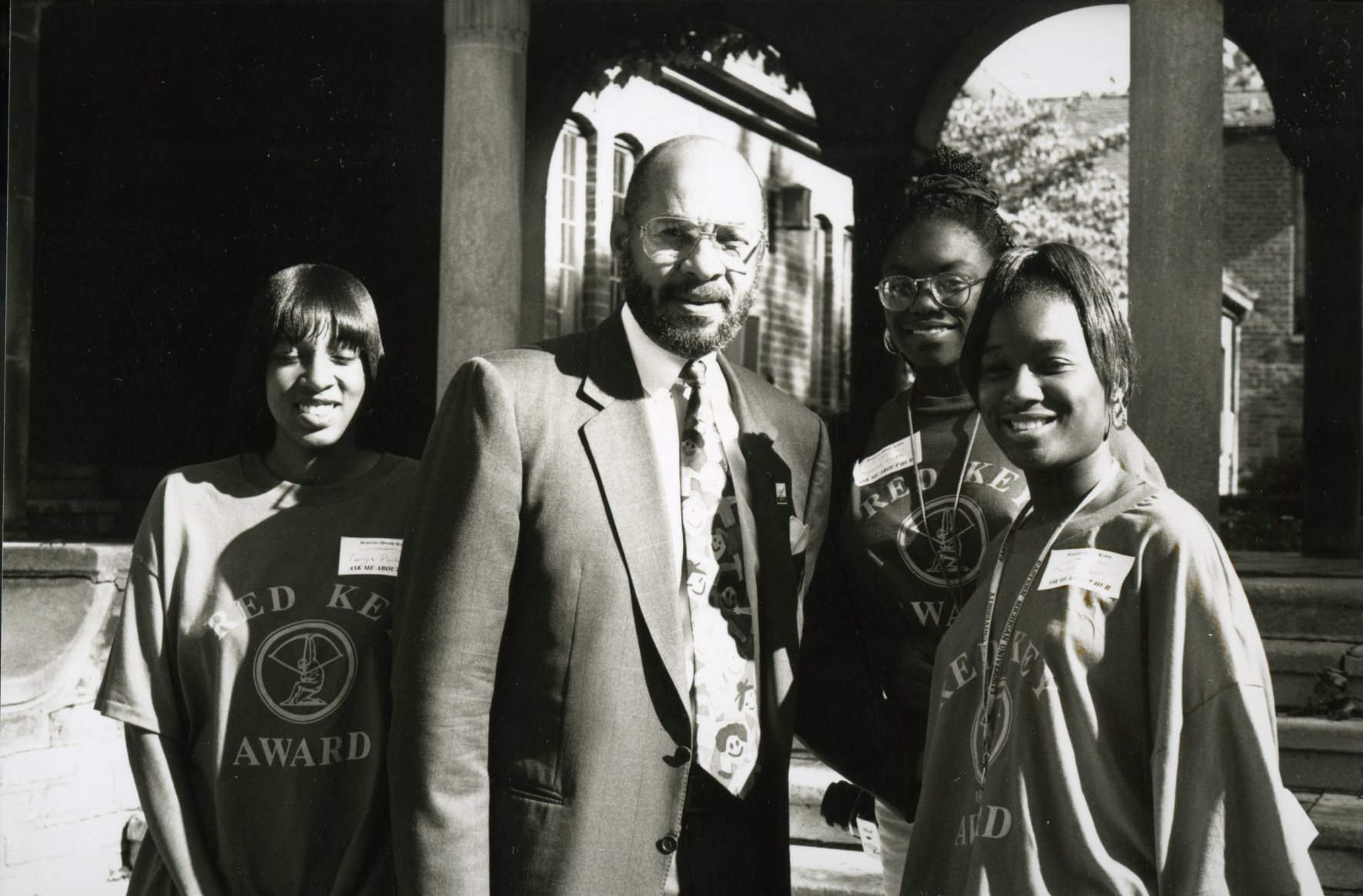
HUB Red Key students with Mayor Dennis Archer, 1995. Courtesy of Cranbrook Archives.
I am continuing the students’ work by adding description to the files they created and digitizing the remaining photographs. I will also write descriptions and keywords for these items and transfer the digital files to our digital collections website, where they will be made public at the end of the project.
Dancers during HUB fundraising event, Soulfest II, 1974. Jack Kausch Photography. Courtesy of Cranbrook Archives.
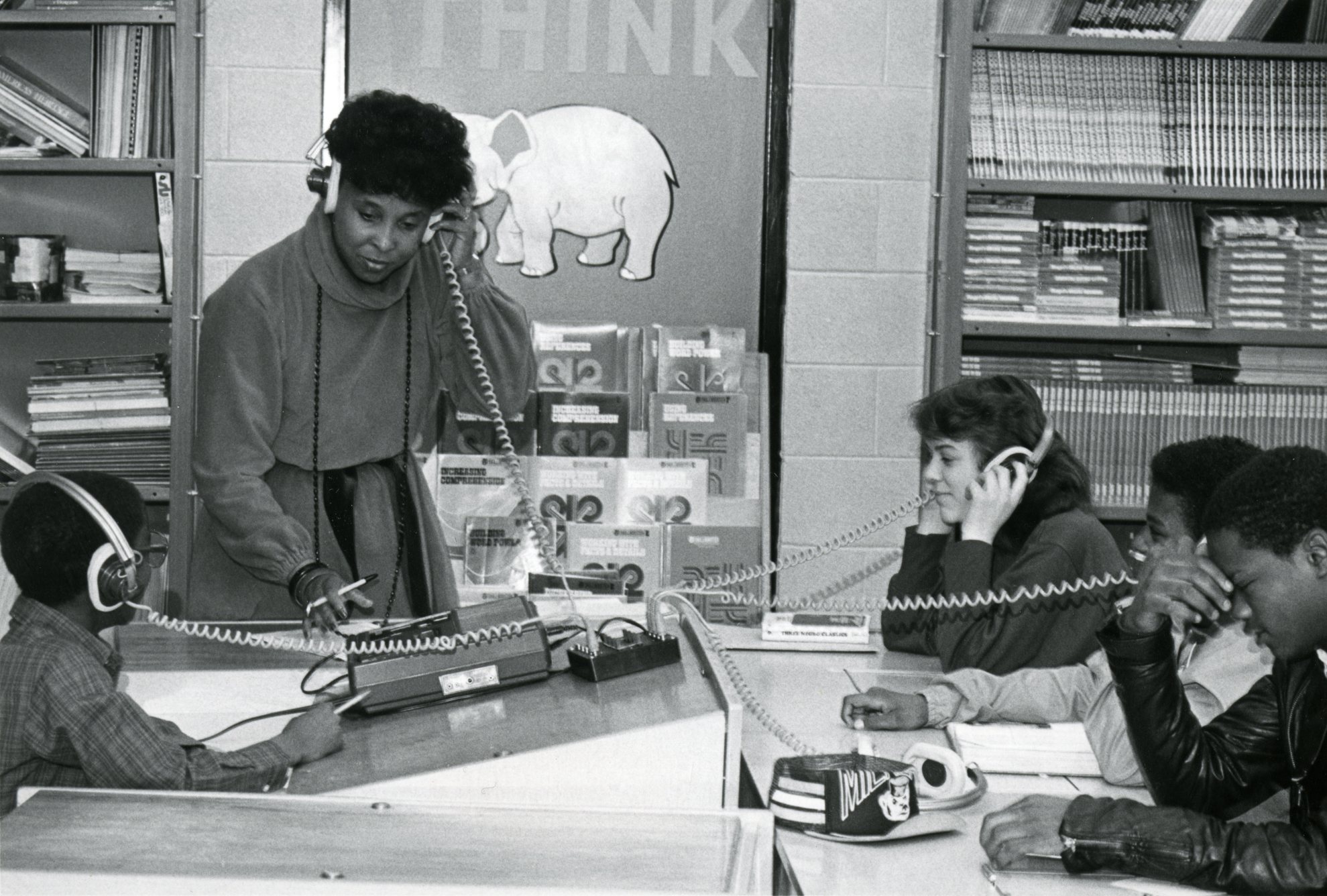
HUB students with teacher, Velma McCann Rodgers, during an in-class activity, 1986. Courtesy of Cranbrook Archives.
I look forward to sharing more findings as I continue to review and digitize HUB’s photographs!
—Courtney Richardson, Project Archivist, Cranbrook Center for Collections and Research
HUB digitization is funded by a NHPRC Archival Projects Grant for projects that ensure online public discovery and use of historical records collections. The NHPRC was established by Congress in 1934 as a statutory body affiliated with the National Archives and Records Administration and chaired by the Archivist of the United States.
Some years ago, former Cranbrook Archivist, Robbie Terman, posted a short blog post on one of the Titanic’s sister ships, RMS Olympic. In recent years, Cranbrook Archives has responded to numerous requests for images of the Olympic which are preserved in the first volume of Harry Scripps Booth’s Pleasures of Life albums.
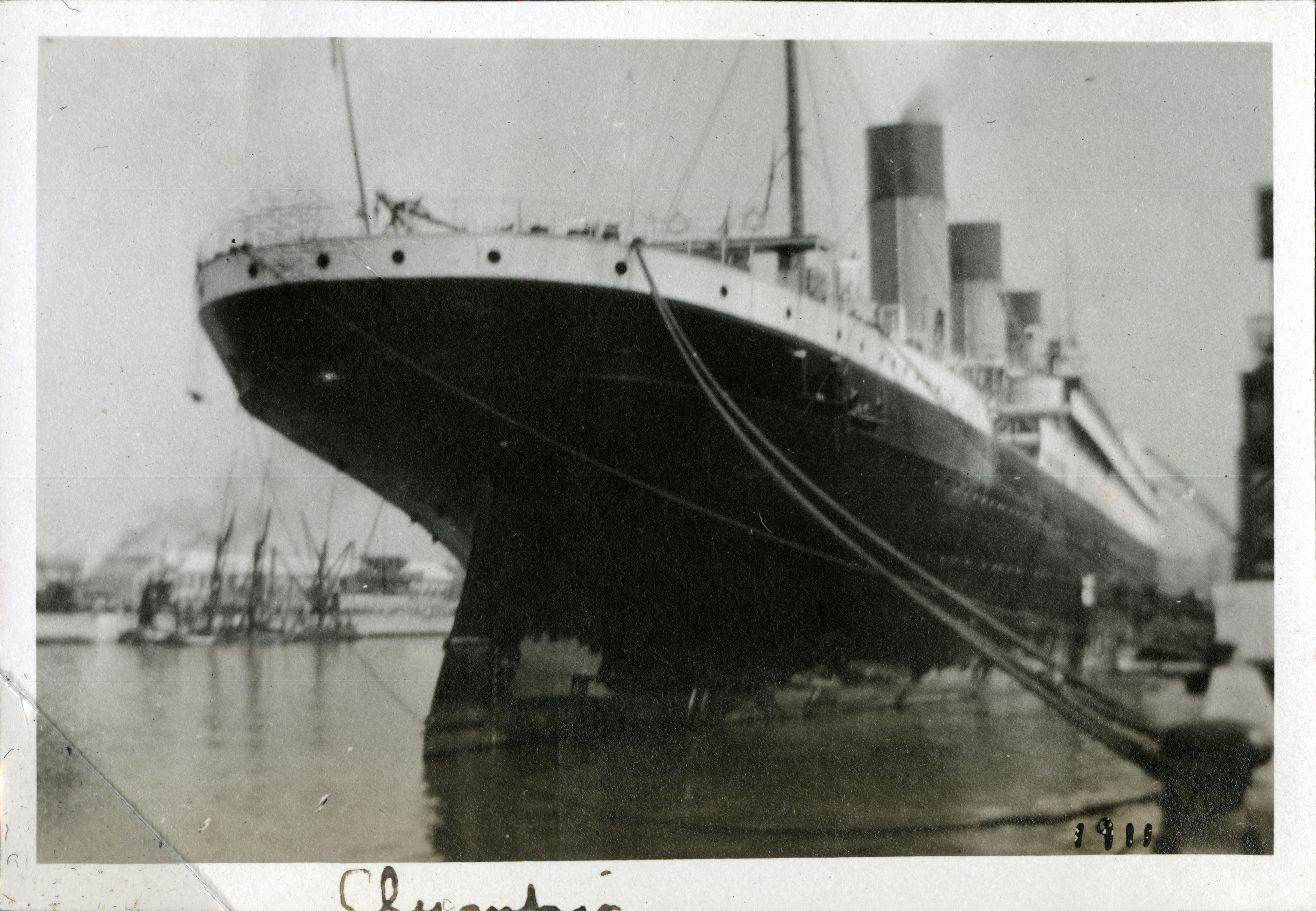
View of RMS Olympic before its first eastward crossing, June 28, 1911. [POL1.14.5]. Courtesy of Cranbrook Archives, Cranbrook Center for Collections and Research.
On June 28, 1911, the Booth family took the first eastward crossing of RMS Olympic from New York to Southampton, England. The family at that time was George and Ellen Booth; James Scripps and Jean McLaughlin Booth who had married the previous year; Grace, Warren, Henry, and Florence. They were joined by their Grand Rapids cousin, Esther Booth.
As I come from a maritime nation, these requests are particularly intriguing to me. I have wondered what other archives we have at Cranbrook to tell the story of transatlantic crossing and explain some of the images. George Gough Booth kept a record of the expenses in planning for the trip. These records tell us that he booked the steamship tickets with the Christian Leidich Travel Bureau in Detroit and he purchased Motor Union badges for himself and James.
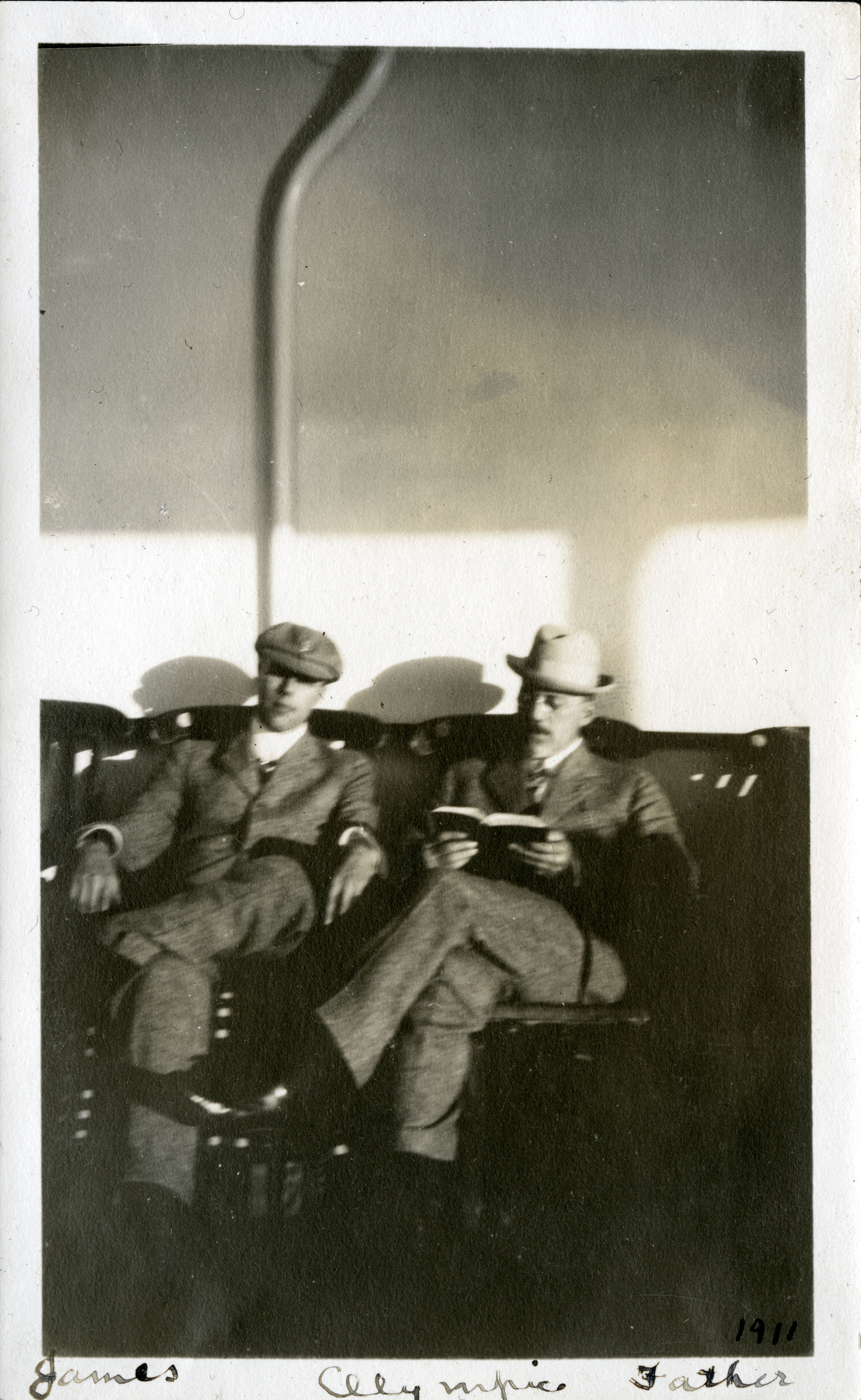
James Scripps Booth and George Gough Booth on the RMS Olympic, July 1911.[POL1.10.2] Courtesy of Cranbrook Archives, Cranbrook Center for Collections and Research.
As Henry recalls in his memoir after listing the family members who sailed,
“That wasn’t enough. Parks, the chauffeur, went; also The Pierce-Arrow, a 7-passenger touring car, and a Lozier Briarcliff, which accommodated four plus one in an airy seat on the left running board, designed for the chauffeur when the “master” took the wheel. That seat was a thrill for the young at heart.”
Then I came upon something quite wonderful—Henry’s journal of the sea crossing! He began the trip when he was just 14 years old, celebrating his 15th birthday in August during the vacation. As I read the entries, the images in the Pleasures of Life came alive. Here follows some moments from the journey in Henry’s words.
“Stayed at the Plaza. Esther’s trunk was lost. We found it later. On June 28, we went abord [sic] the great ship, “Olympic.” Henry Scripps Booth, June 27, 1911
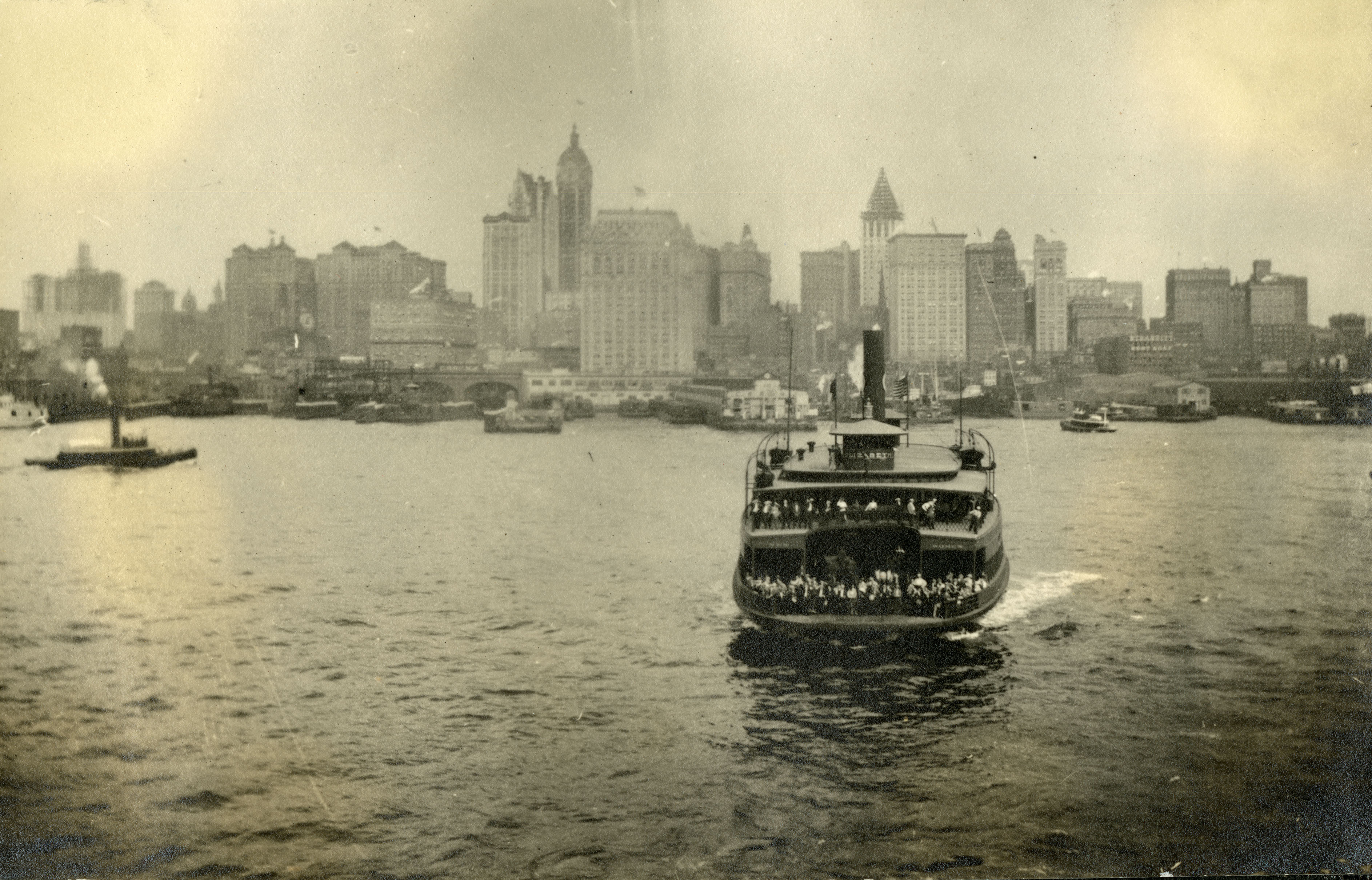
Leaving New York, June 28, 1911. Courtesy of Cranbrook Archives, Cranbrook Center for Collections and Research.
“On June 28, we went abord [sic] the great ship, “Olympic”. The Olympic is a fine ship. Florence was sick first night and day. It was somewhat rough on June 29th. I met a new friend but did not remember his name. In the morning, I could hardly stand, because of the new sensation. I was somewhat sick, but ate lots and I felt fine.” Henry Scripps Booth, June 28, 1911
“On June 30th the Campania was in view. I got acquainted with two girls, Constance Peabody and Katherine somebody.” Henry Scripps Booth, June 30th, 1911
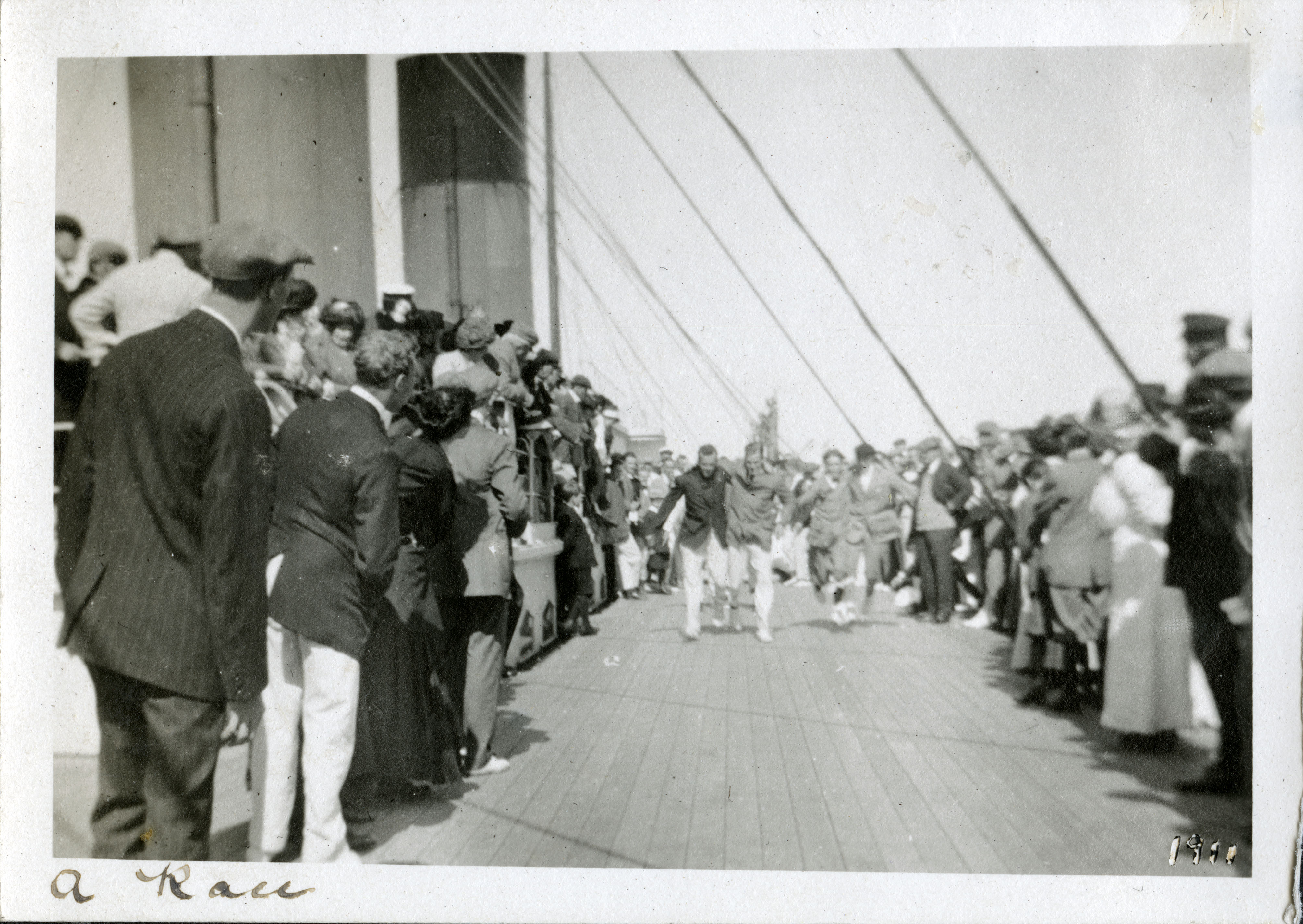
A race aboard the RMS Olympic on its first eastward crossing from New York to Southampton, July 1911. [POL1.11.4]. Courtesy of Cranbrook Archives, Cranbrook Center for Collections and Research.
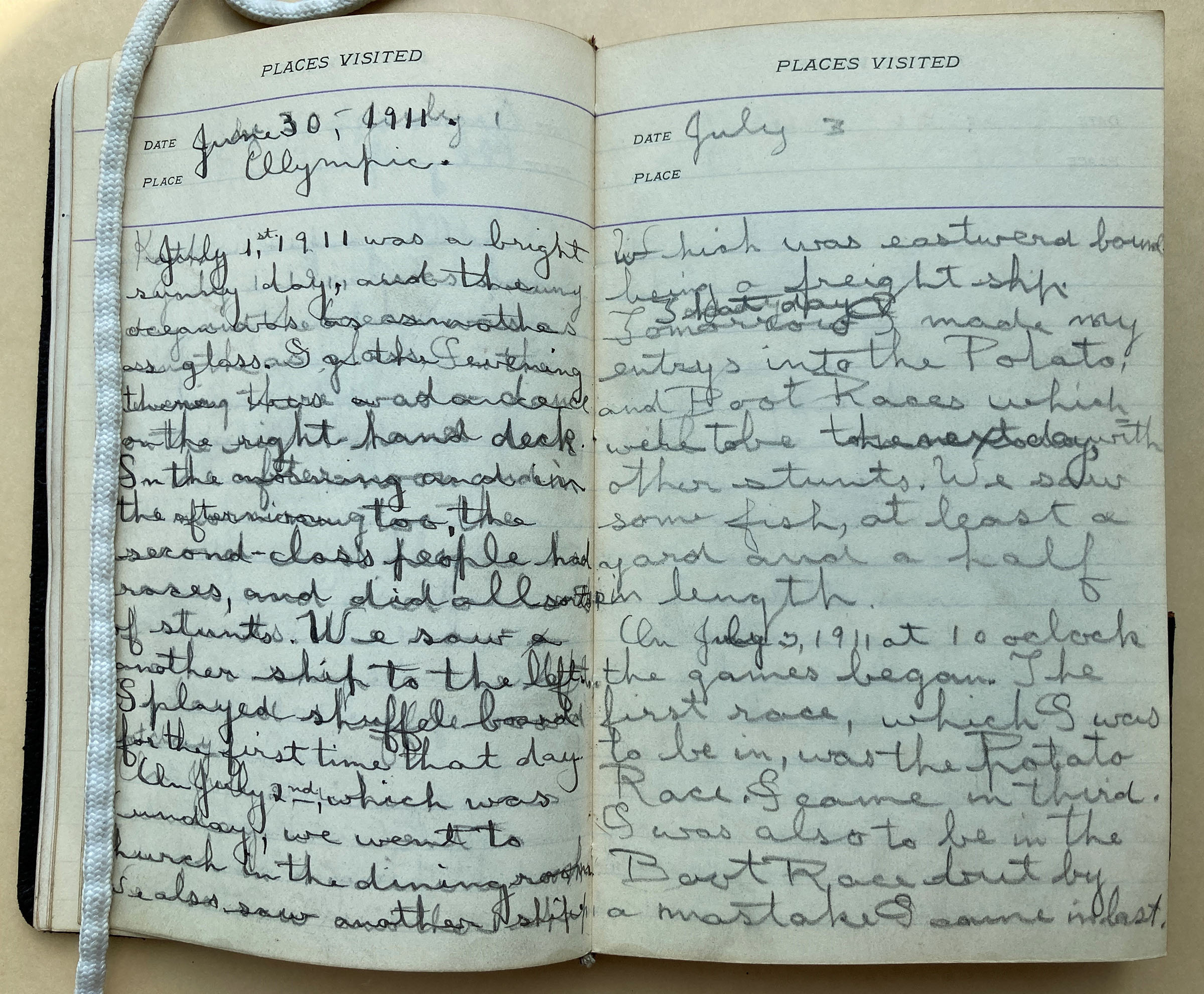
“July 1st, 1911, was a bright sunny day, and the ocean was as smooth as glass. In the evening, there was a dance on the right hand deck. In the morning and in the afternoon too, the second-class people had races, and did all sorts of stunts. We saw another ship to the left. I played shuffleboard for the first time that day. On July 2nd, which was Sunday, we went to church in the dining room. We also saw another ship [July 3] which was eastwerd [sic] bound being a freight ship.” Henry Scripps Booth, July 1, 1911
A race aboard the RMS Olympic on its first eastward crossing from New York to Southampton, July 1911. [POL1.12.5]. Courtesy of Cranbrook Archives, Cranbrook Center for Collections and Research.
“Tomorrow That day, I made my entrys [sic] into the Potato and Boot Races which were to be the next day with other stunts. We saw some fish, at least a yard and a half in length.
On July 3, 1911, at 10 o’clock the games began. The first race, which I was to be in, was the Potato Race. I came in third. I was also to be in the Boot Race but by a mistake, I came in last.
After other races came the Standing Broad Jump in which James sliped [sic].” Henry Scripps Booth, July 3, 1911
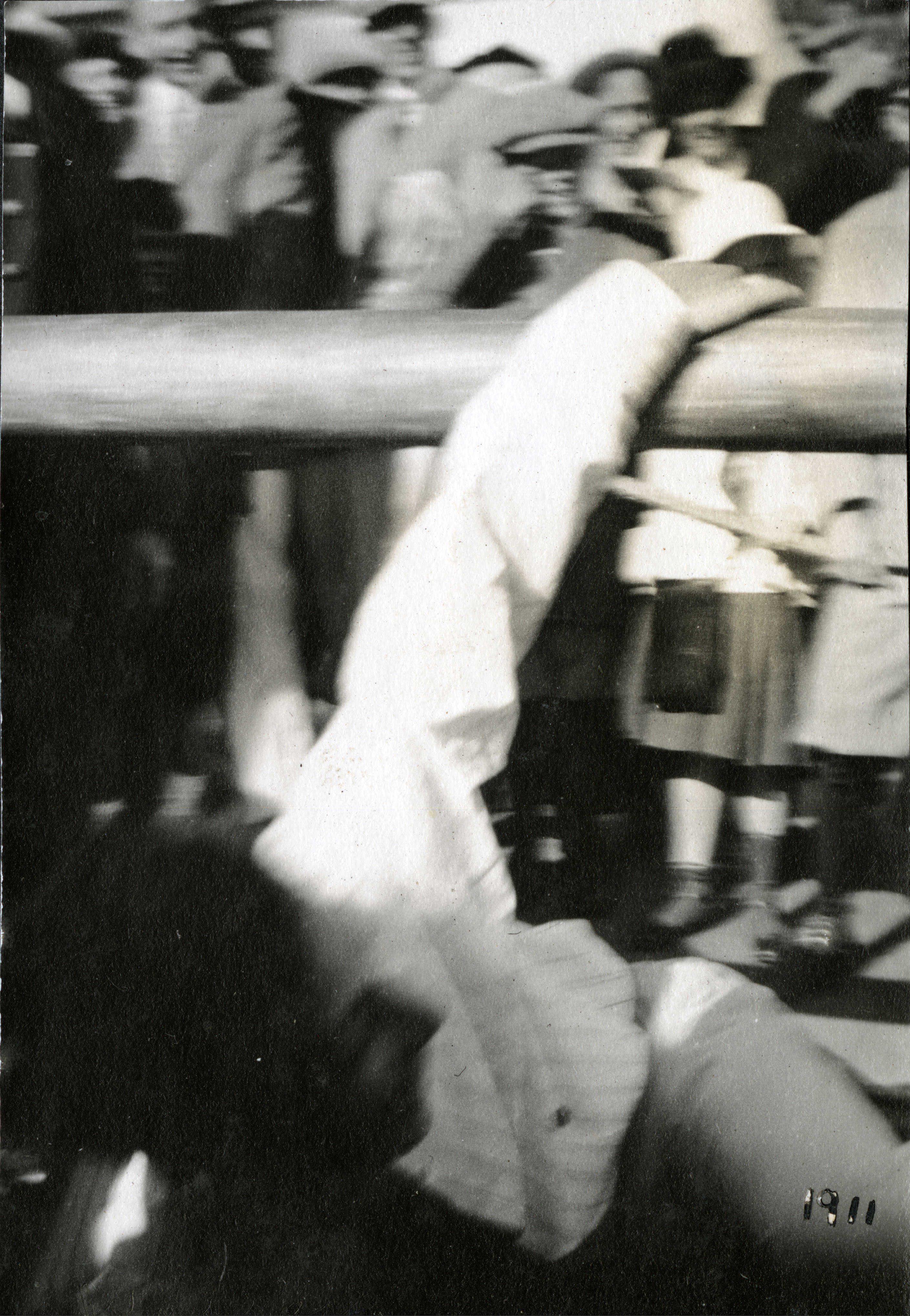
Warren Scripps Booth during a Spar Pillow Fight aboard the Steamship RMS Olympic, July 1911. [POL1.12.4]. Courtesy of Cranbrook Archives, Cranbrook Center for Collections and Research.
“James and Warren were both in the Spar Pillow Fight. In Warren’s case both fell off the bar at first but Warren was nocked [sic] off a second time. Warren did not win. James stayed on a number of times but was forced to give up. After dinner in the Reception Room the prizes were awarded. Also a dance on deck was given.” Henry Scripps Booth, July 3, 1911
Disembarking the RMS Olympic, July 5, 1911. [POL1.14.1]. Courtesy of Cranbrook Archives, Cranbrook Center for Collections and Research.
“Breakfast was served in the usual manner. After breakfast in the hall on the Sun Deck the band played the national cirs. Every body stood up. In the afternoon, at 4 o’clock we entered Plymouth Harbor. The mailtender got the mail and other boats got passengers off to land. We then started across the channel.” Henry Scripps Booth, July 4, 1911
“After getting off the steamer and having the officers make sure that we had no cigars or liquors with us, we took a cab to the hotel.” Henry Scripps Booth, July 5, 1911
Unloading the cars in France, August 1911. Courtesy of Cranbrook Archives, Cranbrook Center for Collections and Research.
As always, it is a great delight to share with scholars, colleagues, and those who are simply curious, these stories from the Archives. What is preserved in Cranbrook Archives help us to understand and enjoy not just Cranbrook, but any number of historic events from new perspectives.
There are more stories to tell about the family’s sojourn through England and France in 1911, which are both heartwarming and educational. But those tales must wait for another blog post–or for you to schedule a visit and come into the Archives Reading Room!
— Laura MacNewman, Associate Archivist, Cranbrook Archives, Cranbrook Center for Collections and Research
Cranbrook Archives is pleased to announce that the Carl and Annetta Wonnberger Papers are open for research. The collection contains biographical materials documenting their early life and education, a large series of personal correspondence between Carl and Annetta during their courtship, materials relating to Carl’s tenure as teacher and administrator at Cranbrook School, their involvement in establishing and directing the Cranbrook Theater School, as well as Carl’s involvement in outside organizations.
Performance Poster, 1950. Courtesy of Cranbrook Archives.
Carl and Annetta Wonnberger were fixtures at Cranbrook for well over half a century, raising two daughters on campus (Jo Anne and Nancy, Kingswood ’48 and ’53 respectively) and making significant contributions to Cranbrook School (Carl even wrote their fight song!) and community theater arts. They both received Cranbrook’s highest honor, the Founders’ Award, and Annetta had a day (July 17) named after her by the City of Bloomfield Hills.
They arrived at Cranbrook in September 1929 when Carl took the position of English teacher at Cranbrook School. The following year, Carl became the Head of the English Department, a position which he held until 1967 when he retired from Cranbrook and became Professor of English Language and Literature at Eastern Michigan University.
Carl and Annetta Wonnberger with Eva Le Gallienne and Joe Schildkraut. 1945. Harvey Croze, photographer.
Annetta helped Carl start Ergasterion (Cranbrook School’s drama club) in 1931. She created costumes, built and painted sets, applied make up, and played female roles in all boys’ productions. Annetta was also one of the founders, with Henry Scripps Booth and Brookside Schools Headmistress Jessie Winter, of St. Dunstan’s Theatre in 1932.
Carl and Annetta Wonnberger Papers (1991-14), Box 45, Folder 1. Courtesy of Cranbrook Archives.
Together they founded Cranbrook Theatre School (CTS) in 1942 with the first season held in the Greek Theater. The mission of the school was to provide a full liberal education through theater training including voice and diction, phonetics and language, development and control of the body, literature, history, philosophy, design, and technical science. Carl and Annetta taught theatrical training so as to provide experience in teamwork, good sportsmanship, and dialog. They celebrated theatrical training as a wonderful developer of personality.
Carl and Annetta Wonnberger Papers (1991-14). Box 19 Folder 10. Courtesy of Cranbrook Archives.
The bulk of the Wonnberger Papers relates to their involvement with Cranbrook Theatre School, comprising administrative materials as well as many scripts, announcements, and performance programs.
Alice Shaw, head director, discusses a staging problem with Carl Wonnberger. July 24, 1953. Harvey Croze, photographer. Courtesy of Cranbrook Archives.
Theater performances, themselves, are well documented by audio-visual formats including photographs, slides, and motion picture film. This collection provides a rich study of a fascinating facet of Cranbrook’s performing arts legacy, and a theater program that is still going strong today.
–Laura MacNewman, Associate Archivist, Cranbrook Center for Collections and Research
Cameras started rolling Monday for the Center’s new film celebrating Swedish American sculptor Carl Milles, premiering May 22nd at A Global House Party at Cranbrook and Millesgården. Centering on materials in the Archives, the day’s shoot featured handwritten correspondence, photographs, sketches, scrapbooks, and oral history recordings that help illuminate the story of the man behind the many iconic sculptures dotting Cranbrook’s campus.
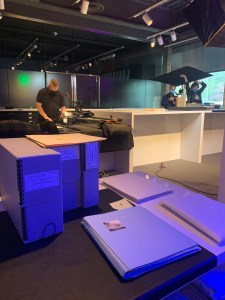
The film production crew captures closeups of materials featured in the film.
In preparation for the day, I mined several collections in the Archives that document Milles’ twenty years as artist-in-residence at Cranbrook and his work in America during that time. In the process, I made a few delightful discoveries. While most of these treasures were expertly captured by the film production crew (Elkhorn Entertainment), there were a few that just could not be accommodated in Associate Curator Kevin Adkisson’s masterful, but already dense script.
One of these items is a notebook from the Nancy Leitch Papers. A student of Milles’ in the early 1940s, Leitch, like many of Milles’ students, became friends with both him and his wife Olga while at Cranbrook. The brief diary-like entries in Leitch’s pocket-sized book date from 1945, and are an intimate glimpse of daily activities, remembrances, and artist philosophies recounted from shared experiences and conversations with Carl and Olga. A loose paper tucked inside and titled “Carl” is a bonus, containing hasty notes recording his birthday, recommendations of where to visit in Italy (Café Greco in Rome, the cathedral in Orvieto), and words of wisdom, such as, “It is better to be an artist even though you are poor.”
Part of an entry made by Nancy Leitch in her notebook. Courtesy of Cranbrook Archives.
Often times in collections we discover materials that are unexpected, rare, or just plain fabulous. The following images are all of the above. Several years ago, when processing a set of negatives from the Institute of Science, I was pleasantly surprised to discover a set of photographic images of Native Americans, primarily Odawa/Ottawa from Leelanau County in northern Michigan. They were taken by Walter E. Hastings (1887-1965) between 1928-1933. Hastings was a naturalist, photographer, and lecturer, and was Michigan’s first conservation film-maker.
From “He Knows All About Michigan’s Birds,” Detroit Free Press, 12 March 1922
Hastings’s interest in nature began as a child when his mother put together a collection of stones, shells, and Native American artifacts for him with the hope that he might become a naturalist. Clearly, it worked! His interest in photography began in 1918 when he received an inexpensive camera for Christmas from his boy scout troop. From 1921-1932, Hastings worked for the University of Michigan Museum as the “Custodian of Birds’ Eggs.” In that capacity, he served as a collections manager, enlarging and arranging the collection, and took numerous photographs which documented the nesting habits of Michigan birds. Employed as the photographer for the Michigan Department of Conservation from 1926-1951, Hastings was a pioneer of wildlife and conservation photography.
Johnny Willow Bird, age 3 yrs. Taken at St. Ignace, Michigan, Oct 1933. Courtesy Cranbrook Archives.
Native American Campsite, Horton’s Bay, Michigan, Jul 1933. Courtesy Cranbrook Archives.
The Institute of Science has several Odawa/Ottawa and Chippewa objects, collected and donated by Hastings, from the same geographical region where the photographs were taken. It is likely that the photographs were donated to the Institute of Science along with the artifacts. The Institute of Science photograph collection was later transferred to Cranbrook Archives. The Walter E. Hastings collection is located at the Archives of Michigan (MS 88-27).

















 Cranbrook Kitchen Sink