Stay Tuned…

Apologies for our tardiness! Due to the widespread power outage in Southeast Michigan, the blog will be delayed by a few days.

Postcard of the Mannleinlaufen (a mechanical clock that commemorates the Golden Bull of 1356) at the Frauenkirche (Church of Our Lady) in Nuremberg, 1921. Courtesy, Cranbrook Archives, The Virginia Kingswood Booth Vogel Papers.


Selfie (/ˈsɛlfi/) – A photographic self-portrait

Most people think that selfies are a new phenomenon, but they have been around since the beginnings of photography. American photographer Robert Cornelius took a daguerreotype of himself in 1839.

As technology advanced, photographers, both professional and amateur, figured out new ways to take self-portraits. The mirror was a popular medium for the selfie. Even the ill-fated Grand Duchess Anastasia Nikolaevna of Russia took her own photo in a mirror in 1914.

Therefore, it was not surprising that the prolific Booth family photographer Henry Scripps Booth sought a way to take self-portraits. When using something like a Folding Kodak camera, Henry would have “tied a long string to the shutter release so that some member of the group could pull the string and thus make the exposure while remaining in the picture.” (Kodakery: A Journal for Amateur Photographers.)

Here are two examples of Henry’s technique in action:

Henry Booth and Carolyn Farr, titled, "'The End' (note the string) 1924," Pleasures of Life (POL 7.78.3)

Henry Booth and Carolyn Farr, titled, “‘The End’ (note the string) 1924,” Pleasures of Life (POL 7.78.3)

The Booth Family Fourth of July picnic, titled, "Thistle pulls the string – Indipendance [sic] Day 1925", Pleasures of Life, POL 8.13.1.

The Booth Family Fourth of July picnic, titled, “Thistle pulls the string – Indipendance [sic] Day 1925”, Pleasures of Life (POL 8.13.1)

Leslie Mio, Assistant Registrar

House of the Poet

In 1995 a project was initiated to create a living monument to honor Cranbrook’s dedication to poetic imagination. The project, House of the Poet, was to be built on the ridge overlooking Lake Jonah and would honor works of imagination in art, sciences, and letters. Architect and educator, John Hejduk (1929-2000), was commissioned to develop plans for the building.

Hejduk largely abstained from conventional practice, but is known for his drawings that were combined into poetic and often highly personal narratives. Despite completing relatively few buildings, Hejduk is considered one of the most influential architects and theorists of the twentieth century. In an essay about Hejduk, architect Andreas Angelidakis states, “His drawings and writings, his essential approach to architecture, continue to function as a blueprint for a practice without clients, commissions, or even realization. What he built was a world of images and words.”

Exterior drawing, House of the Poet. Courtesy Cranbrook Archives.

Exterior drawing, House of the Poet. Courtesy Cranbrook Archives.

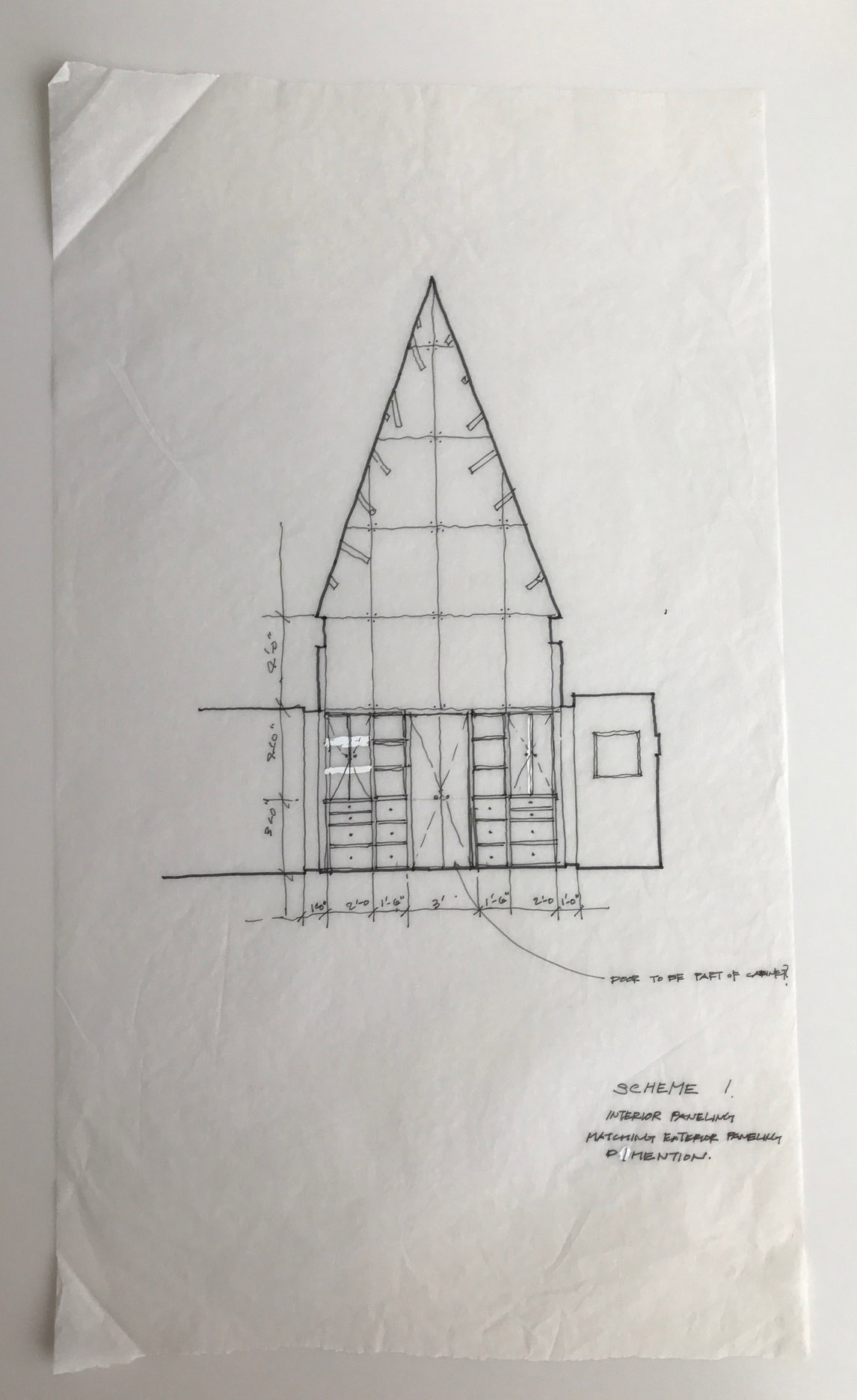
Hejduk designed a house built on stilts that included a bedroom, bath, living room, dining room, and kitchen. The plan was to create a space where “esteemed visitors” to the campus could stay. The exterior consisted of stucco in green, red, blue, and gunmetal, with a zinc roof.

Sketch of Scheme 1: interior paneling.

Sketch of Scheme 1: interior paneling.

In the fall of 1995, architects Dan Hoffman and Jennifer Lee of the Cranbrook Architecture Office (CAO) worked towards the project’s completion. Faculty and students from the Academy of Art’s Department of Architecture would provide the majority of the labor for the construction of the building, continuing the tradition of the integration of arts and crafts in the original buildings on campus. The CAO created extensive cost estimations and budgets, and thoroughly researched available materials for the construction of the house.

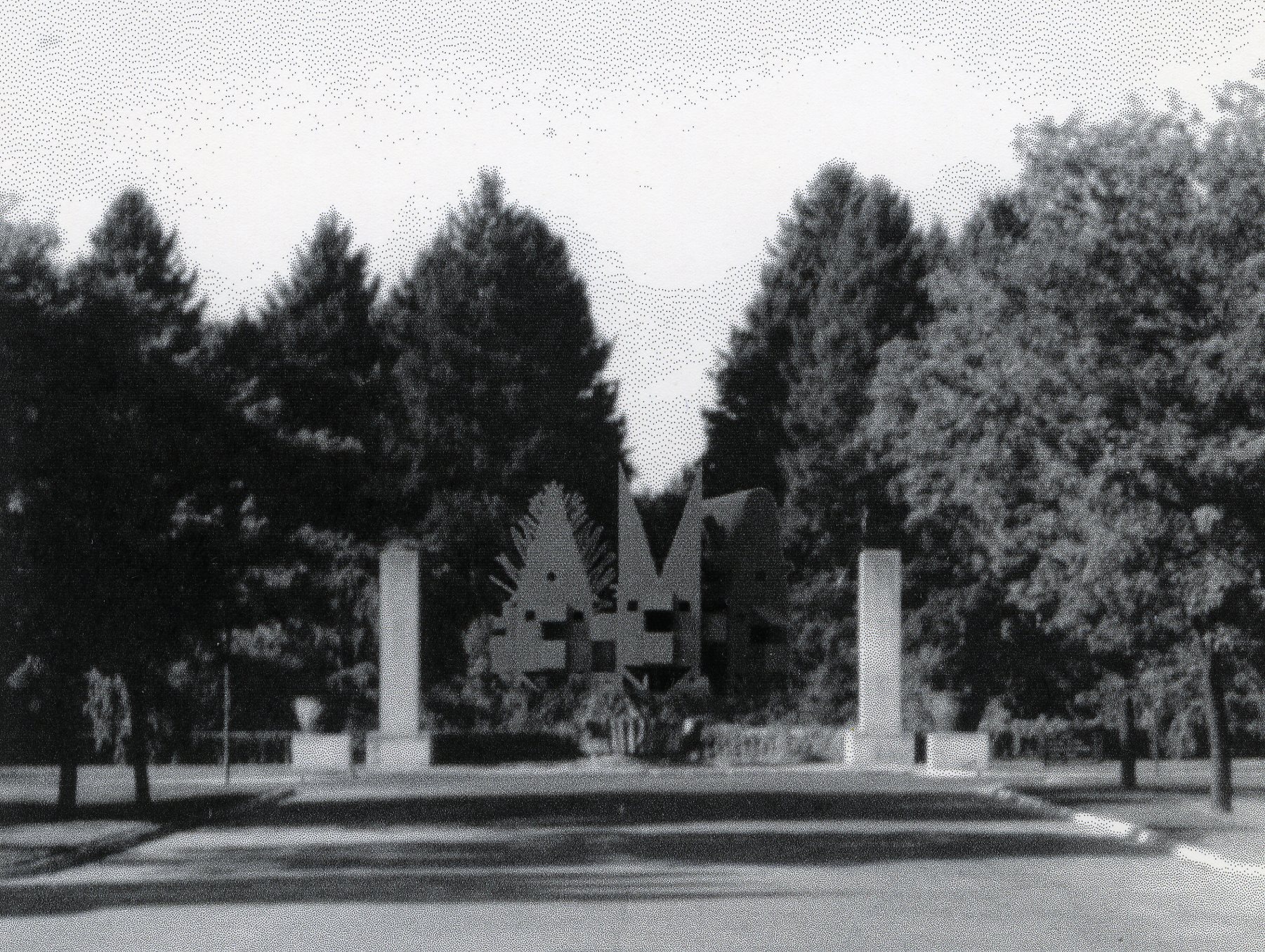
Digital model of the House of the Poet - view from Academy Way with the sculpture of Jonah and Whale in the foreground.

Digital model of the House of the Poet – view from Academy Way with the sculpture of Jonah and the Whale in the foreground.

Project correspondence indicated plans to complete the building in time to coincide with a 1997 exhibition at Cranbrook Art Museum honoring the work of John Hejduk. The project seemed set to move forward, however, due to lack of sufficient funding, was canceled.

Gina Tecos, Archivist

Special thanks to Rebecca Kallen (CKU ‘08) who contributed to the research of this blog.

Tree Falls on Shoe Falls: A Story of Restoration

This week’s post is from a new guest contributor, Ryan Pfeifer. Ryan works with Cranbrook’s Capital Projects Office, and we hope to feature more of his (and Capital Projects) work to preserve our historic campus in the future! -Ed.

Nestled in the forest between the Greek Theatre and Triton Pools sits an overlook known as Shoe Falls.* While researching original drawings at Cranbrook Archives, I discovered that the pond, waterfall, and overlook were designed in 1941 by Cranbrook’s civil engineer, John Buckberrough, and constructed in 1943.

During a storm in mid-November 2016, a large tree fell onto the railing, fatally cracking two railing caps and dislodging seven balusters. Cranbrook’s Capital Projects Office was tasked with managing the restoration of this historic site on campus.

The first step in the restoration process was to carefully remove the stones and set them aside. This way, the grounds crew could remove the fallen tree. The cracked limestone railing caps were digitally measured and new pieces were ordered from a local stone fabricator, who purchases new limestone from Indiana. The baluster stones were reused but meticulously cleaned of old mortar, dirt and other debris. To make sure the railing replacement was to the highest quality possible, holes were drilled in the bottom slab and stainless steel pins were inserted. The pins were epoxied into place which permanently attaches them to the bottom slab and creates an anchor point for the baluster. A small bed of mortar was placed around the pin and the balusters were set on top of the mortar. Each baluster was leveled vertically and horizontally to ensure the stone caps would sit perfectly level.

The same procedure, with the epoxied pins and mortar, was performed on top of each baluster so the railing cap would be tied to the supporting elements below. Finally, the caps were set into place, again keeping a close eye on leveling and placement so everything was put back seamlessly. Come spring, the site will be fully restored by planting grass seed. Many thanks to the contractor and crew for an outstanding historic restoration project!

*The small pond which feeds the waterfall was initially named Shoe Lake and the waterfall did not have a specific name, however, over the years, the name Shoe Falls has been adopted for this entire area.

Ryan Pfeifer, Project Manager II, Cranbrook Capital Projects

Craft in Time: Oscar Bach and the Cranbrook School Dining Hall Clock

For nearly ninety years, diners in the Cranbrook School dining hall have marveled at the clock that hangs high above the fireplace. Designed and fabricated by New York metalsmith Oscar Bruno Bach, the clock is a tribute to George Booth’s beloved Arts and Crafts Movement. Each hour is represented by an art or craft, ranging from metalworkers to woodworkers.

Cranbrook School Dining Hall, 1928. Peter A. Nyholm, photographer.

Cranbrook School Dining Hall, 1928. Peter A. Nyholm, photographer.

Oscar Bruno Bach (1884-1957), who was born in Germany, came to the United States in 1913 and established a metal design studio with his brother in New York City. As they built up their reputation and the business grew, Bach exhibited his work through The Architectural League of New York and at the Metropolitan Museum of Art, among others. His work graces numerous churches, industrial buildings, and residences primarily in New York but also in the Midwest. His first known work in Michigan was ornamental metalwork for the Blessed Sacrament Cathedral in Detroit (1915).

Bach was known for incorporating a variety of metals and metal techniques in his work. Cranbrook’s clock (1926) is made of four concentric iron rings with a center element (two male figures at an anvil) of repoussé brass surrounded by three brass “flame” rings. Each of the twelve figures representing arts, crafts, and trades are also made of brass, surrounded by floral elements made of iron. Copper was used for the rivets and for the small fleur-de-lis elements on the outer rim. Finally, the hour and minute hands are made of aluminum with brass rivets.

Detail of the center panel, 2001. The clock was restored courtesy Cranbrook Class of 2000.

Detail of the center panel, 2001. The clock was restored courtesy Cranbrook Class of 2000.

The clock however was not Bach’s first contribution to Cranbrook. In 1919, he fabricated lead “conductors” for the exterior of the east and west wings of Cranbrook House. George Booth also acquired a smoking stand (1922) and two table lamps (1929) for Cranbrook House, and commissioned Bach to fabricate Cranbrook School’s Peacock Gates (after Eliel Saarinen’s drawings) and the Treasury Door (1928) at Christ Church Cranbrook. Other local commissions include The Detroit Players Club (1925), Moulton Manor (1926), the estate of William Scripps (Ellen Booth’s brother) in Lake Orion, and the First National Bank (1927) in Ann Arbor.

One of the four Oscar Bach “conductors” at Cranbrook House, 2004. Mira Burack, photographer.

One of the four Oscar Bach “conductors” at Cranbrook House, 2004. Mira Burack, photographer.

One of the most interesting discoveries I made in writing this post was that the clock used similar elements as doors Bach designed for the new wing of the Toledo Art Museum (1925). They both feature arts and crafts figures – a potter, sculptor, glassblower, draughtsman, metal worker, and bookbinder. In January 1926, Bach received the “Medal of Honor in Design and Craftsmanship in Native Industrial Art” from the Architectural League for his design for the doors so it’s no wonder that he incorporated some of the same elements in the Cranbrook School dining hall clock. I may be a bit partial, but I think our clock is even more magnificent than the doors and I imagine you will too!

Leslie S. Edwards, Head Archivist


Advertising Your Business (Before Facebook)

Cranbrook Archives has an interesting selection of trade catalogs from the early 1930s to the 1990s. While the purpose of these publications was to promote and display a manufacturer’s products, I’m struck by the art and design work that went into creating them. As secondary resources, there is so much to learn about the decisions Cranbrook was making at the time these catalogs were in use. They are also important artifacts of American business and manufacturing.

We have several collections that contain trade catalogs here at the Archives. These publications represent building and landscape products for use in construction projects on campus, tennis courts, art supplies, household items, furniture, and farming equipment – to name a few. Check out a few of the catalogs from the Cranbrook Architectural Office Records below.

Russell-Built Museum Cases literature, ca 1939.

Russell-Built museum case literature, ca 1939.

The Allis-Chalmers company explains why mechanization is the key to multiplying your efforts on the farm, ca 1942.

The Allis-Chalmers company explains why mechanization is the key to multiplying your efforts on the farm, ca 1942.

Zonolite plaster by Vermiculite purports to be insulating, crack-resistant, and fire-safe, ca 1951.

Zonolite plaster by Vermiculite purports to be insulating, crack-resistant, and fire-safe, ca 1951.

If you’re interested in looking at more trade literature, check out the collections at the Smithsonian, the Henry Ford, and the University of California at Santa Barbara.

Gina Tecos, Archivist


Keep this Farwelliana?

botanical-gleanings

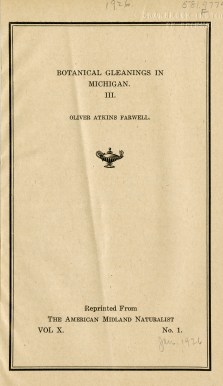
Farwell, O.A. (1926). Botanical Gleanings in Michigan. The American Midland Naturalist, 10 (1).

Late last year, a small uncatalogued archive of Oliver A. Farwell’s collections was transferred to the Archives from the Institute of Science. The collection includes many of Farwell’s published works, reference journals, a small sampling of correspondence related to his career as a botanist and druggist, a copy of Farwelliana: An Account Of The Life And Botanical Work Of Oliver Atkins Farwell, 1867-1944 by Rogers McVaugh, Stanley A. Cain, and Dale J. Hagenah, and a portrait of Farwell.

Farwell, a botanist (by hobby), drug inspector (by trade), and librarian (after my own heart) was born December 13, 1867, in Boston Massachusetts to Oliver A. Farwell and Charlotte (Brockway) Farwell. Spending his formative years in the Copper Harbor area of Michigan, Farwell developed a lifelong affinity and commitment to the study of Michigan’s flora as both a hobby and occupation. A career employee (1892-1933) of the Parke, Davis and Company (Detroit, MI), Farwell was responsible for the pharmacognosy of raw botanical products. He was also a long standing member of a multiplicity of scholarly clubs with branches pertaining to botanical interests, including the Michigan Academy of Sciences and the National Geographic. Farwell’s large personal collections of herbarium specimens are housed at the Cranbrook Institute of Science.
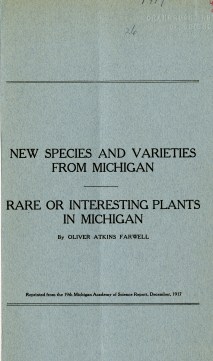
new-species

Farwell, O.A. (1917). New Species and Varieties from Michigan and Rare or Interesting Plans of Michigan. Michigan Academy of Science Report, 19.

After a long and prolific career (serially numbered and unnumbered collections potentially totaling 15,000), Farwell passed away in Lake Linden, Michigan in 1944.

Upon first inspection of the transferred material it was noted that a large portion of the contents were duplicative and non-original works. This discovery begged the question: is this content relevant and worthy of archival preservation? And if so, here? We determined the answer to be yes to both questions, as the collection represents the contributions and scholarly process of an individual whose botanical collections and samplings are part of the Cranbrook narrative. Although they represent an accumulation of thought and process in a period of pharmacological unearthing now well surpassed by modern scientific process and procedure, the collection of materials represents a long commitment at Cranbrook to exploration and discovery. We determined: it was a keeper.

The Cranbrook Archives looks forward to sharing this unique collection with our researchers in the coming months. Be sure to check back for more updates on newly acquired collections and material.
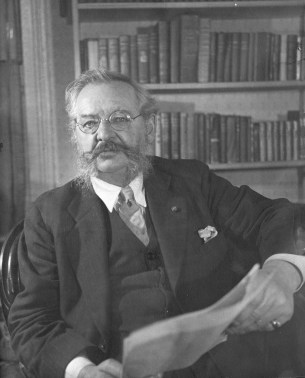
farwell

Oliver Atkins Farwell, Winter 1934.

-Belinda Krencicki, Associate Archivist

Author’s Note: The Oliver A. Farwell Papers are located at the Michigan Technological University Archives and Copper Country Historical Collections. For more detail, see the finding aid here.

Holiday Inspiration

Last week a researcher came to look for holiday inspiration in the Archives. As I was putting the materials away, I came across this lovely card by Academy of Art student, Alice Warren. The card piqued my interest and I did a little digging to learn more.

Holiday card from Alice Warren to Margueritte Kimball, 1947. Margueritte Kimball Papers, Courtesy Cranbrook Archives.

Holiday card from Alice Warren to Margueritte Kimball, 1947. Margueritte Kimball Papers, Courtesy Cranbrook Archives.

Inside design of holiday card from Alice Warren, 1947.

Inside design of holiday card from Alice Warren, 1947.

Warren, born in 1921, came to Cranbrook to study architecture with Eliel Saarinen in 1943-44. Warren’s father (Don) was a genetics professor, and her mother (Mira) assisted him with his lab work. In 1920 Don Warren, with Mira’s assistance, published three scientific papers about his genetic research of the fruit fly. Professor Warren went on to become a pioneer in poultry genetics, earning several awards and distinction in this field.

Alice Warren, like her parents, was a trailblazer. In 1942 she graduated from the University of Illinois with a B.S. in Architecture. In May 1943, she wrote to Henry Scripps Booth expressing her desire to come to Cranbrook for a summer session to “further [her studies] under Eliel Saarinen.” She received a letter of acceptance in June.

While at Cranbrook, Warren studied Architecture and City Planning. As part of a team (Annette Kite, painter and Eliza Miller, sculptor), her work was entered in the 1944 Rome Collaborative – an annual competition conducted by the Alumni Association of the American Academy in Rome. She later worked for Saarinen, Saarinen and Associates. Warren also met her husband, Fred Dockstader, while studying at the Academy. Dr. Dockstader taught history at Cranbrook School from 1943-52, and designed ethnological exhibits at Cranbrook Institute of Science in 1951-52.

Alice Warren working on her city planning model for Plymouth, MI, 1944. Photographer, Harvey Croze. Courtesy Cranbrook Archives.

Alice Warren working on her city planning model for Plymouth, MI, 1944. Photographer, Harvey Croze. Courtesy Cranbrook Archives.

Warren and Dockstader married on Christmas day, 1951. Dockstader was an anthropologist, art professor, and a noted authority on American Indian art. The couple worked together on several publications and also at the Museum of the American Indian in New York, where Alice was a staff architect, and Fred was the museum director from 1960-1975.

Gina Tecos, Archivist

Author’s Note: While researching Alice Warren Dockstader, I came across the finding aid for the Frederick Dockstader Collection at the Arizona Archives. One of the content notes describes holiday cards designed by Alice and Fred that incorporate their interest in Kachinas. You can see one of these on the Cranbrook Archives Facebook page!

Making Wartime History Come Alive

Last spring I gave a presentation about Cranbrook during World War II to the 8th grade history classes at the Girls Middle School. So, when our blogmaster asked for a post this week about WWII, I thought I would share that experience. After working in the archives for more than 14 years, I knew we had a myriad of materials relevant to WWII and I was excited to share these stories with the 8th grade girls. I was hopeful that it would help make a part of history more real to them. I began by asking each class (there were four that day!) how many thought Cranbrook was affected in ANY way by the war? Throughout the day, maybe 8 of the nearly 60 girls raised their hands. While I was surprised, I was also excited to enlighten them.

dsc_0299

Other ways in which the Cranbrook community supported war relief efforts included the British Children Refugee program, the Finnish War Relief Fund, and the Red Cross and Victory Book Drives

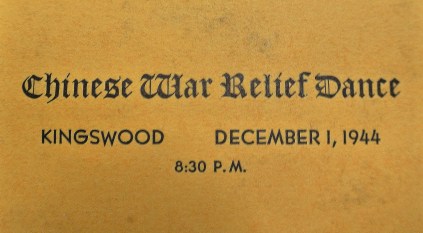
Cranbrook’s war-related activities were far-reaching – from Cranbrook School boys practicing military drills on the football field to Academy of Art ceramicist Maija Grotell who collected sweaters and unraveled them to repurpose into balls of yarn that she sent to families in Finland. War Bond drives were held at each of the school campuses, the Booth family closed off the west wing of Cranbrook House to conserve fuel due to rationing, and a previous blog post highlights one of Cranbrook’s own Monuments Men.  The 8th grade girls were particularly amused by the photograph of the Red Cross class which was held at Kingswood School, and that girls their same ages had collected waste fat from the school dining hall. There were a lot of “EWW!s”

cswar1

Cranbrook School Scrapbook, April 1942

I told the girls about the war memorial plaque which hangs at the base of Hoey tower and lists the names of all 678 Cranbrook School alumni who served in the war, including the 37 who lost their lives. We talked about the Cranbrook Committee on Civilian Defense and the air raid sirens/drills on campus, and how students from both Cranbrook and Kingswood Schools entertained the troops at Selfridge Air Force Base.

siren

Cranbrook had air raid sirens in numerous locations across campus.

At the end of each class, I asked the girls again how many thought Cranbrook was affected by World War II, and nearly all of them raised their hands. It was gratifying to be able to share primary source documents from our collections to help bring history out of the textbook and onto the campus. I’m looking forward to teaching again this school year!

Leslie S. Edwards, Head Archivist


Photo Friday: Feasting Together

The Center hopes you and your loved ones had a fantastic Thanksgiving, and that you were able to have a great meal together like these Cranbrook students back in 1935!

2791

Cranbrook School for Boys Dining Hall. Photographer, Dick G. Askew, June 1935.

Kevin Adkisson, Collections Fellow

Create a website or blog at WordPress.com