Five Things in Four Years: A Cranbrook Goodbye*

I’m not a hugely sentimental person, but I am a nostalgic one (I swear, there’s a difference). As I leave Cranbrook after four years here to embark on the next phase of my career, I can’t help but think about all the different places on campus I will miss. Here are my top five:

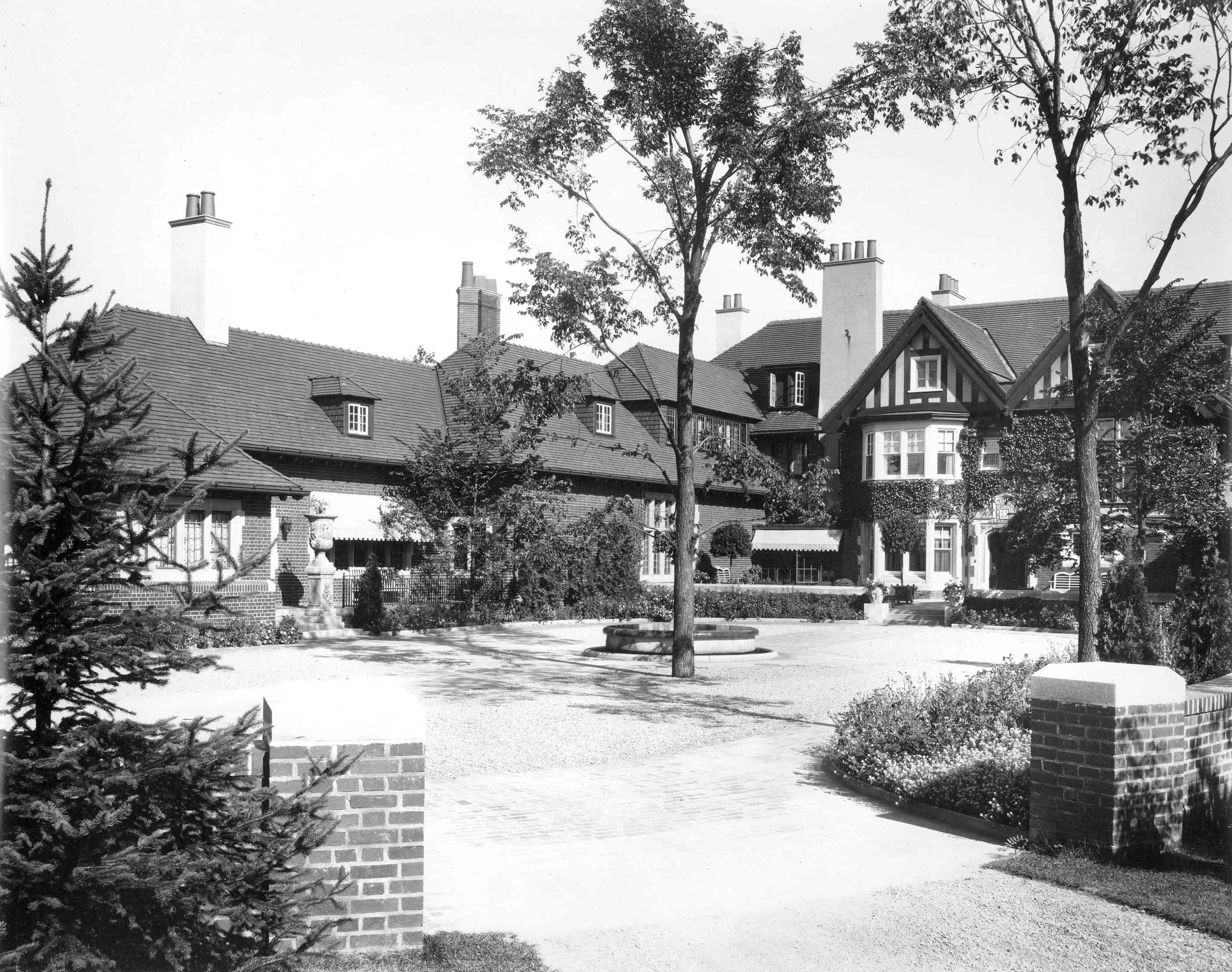
Cranbrook House, 1925.  Cranbrook Archives.

Cranbrook House, 1925. Cranbrook Archives.

Continue reading

Rocks That Teach: Cranbrook Institute of Science and the Sanilac Petroglyphs

Some say there are no coincidences in life, and in my many years of genealogical and historical research, I have found that perhaps a better word for these types of experiences is serendipity.  Often I find myself researching a certain topic and “by chance” I run into an expert standing next to me in line at the grocery store.  The other day just such a happenstance occurred.  I was invited to a lunch and who should sit next to me but Stacy Tchorzynski, an Archaeologist for Michigan’s State Historic Preservation Office and Department of Natural Resources.  She asked me if the Cranbrook Archives had any materials on the Sanilac Petroglyphs and we launched into a discussion about the importance of documenting and preserving Michigan’s only known prehistoric rock carvings.  Located in an historic state park covering 240 acres, the petroglyphs, which were carved into very soft sandstone, have eroded over time and weather exposure.   In addition, 19th and 20th century vandalism and graffiti have further degraded the carvings.

SanilacPetroglyphs_01

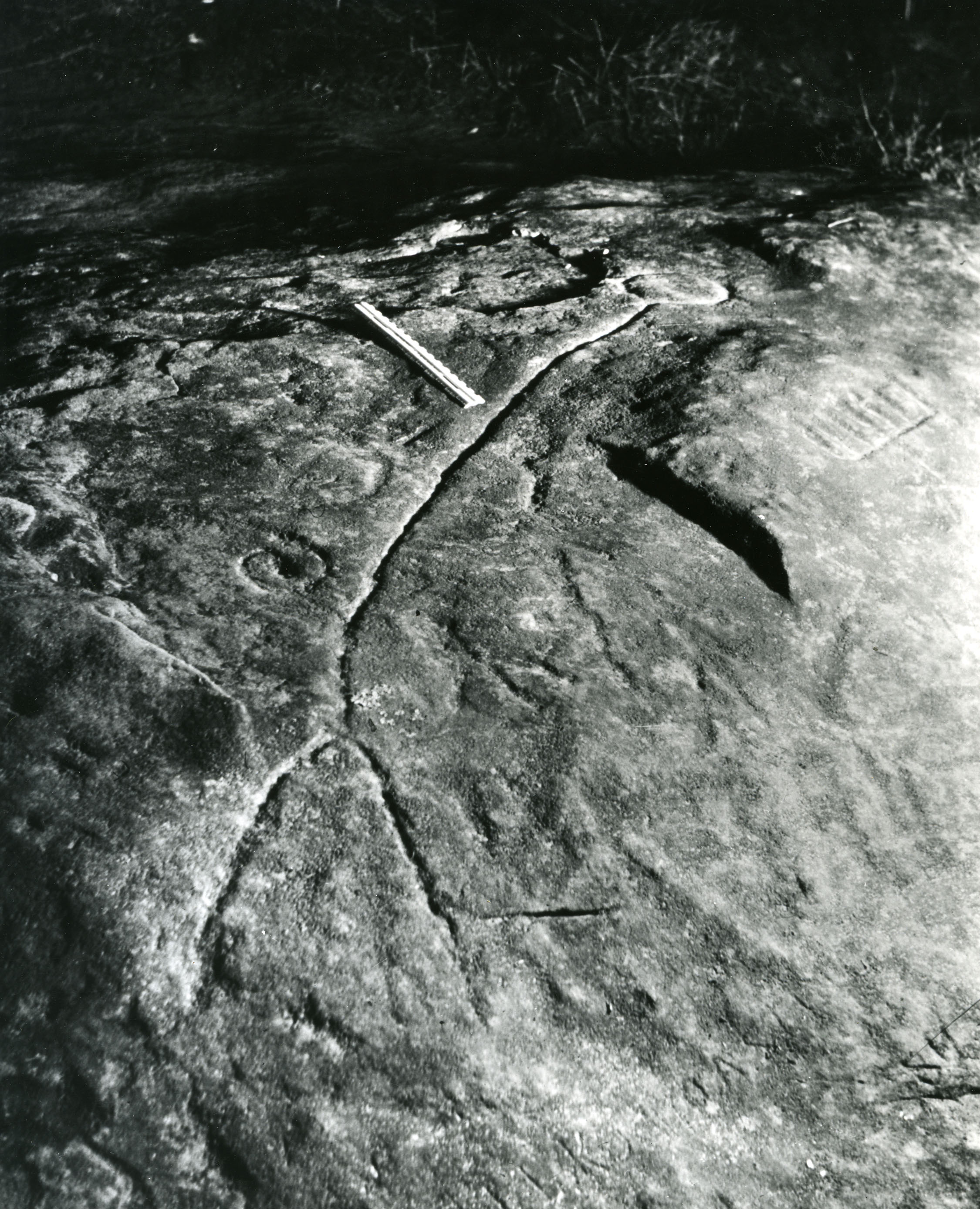
Sanilac Petroglyphs, Cass City, MI, 1945. Cranbrook Archives.

Cranbrook has had a long interest in the petroglyphs—in the 1940s, the director of Cranbrook Institute of Science (Dr. Robert Hatt) worked with the DNR and University of Michigan’s Museum of Anthropology to develop a preservation plan for the rock carvings.  In fact, Hatt’s 1942 report even suggested that the site would make an “excellent State Park” and that the main group of petroglyphs should be fenced off.  In 1958, the Institute of Science published a monograph on the petroglyphs followed in 1965 by a collaborative meeting between the Institute, the Michigan Archeological Society, and the Sanilac County Historical Society.   This meeting resulted in the acquisition of the 80-acre site by the Michigan Archeological Society.

SanilacPetroglyphs_02

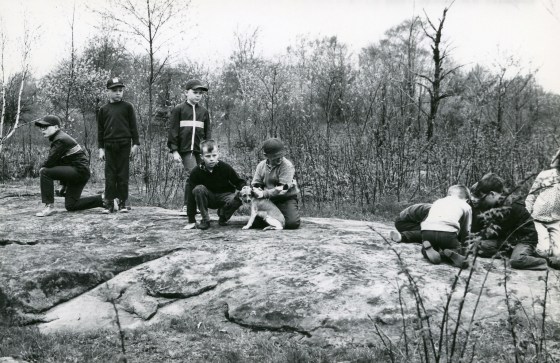
Cranbrook Institute of Science Educational Field Trip at the Sanilac Petroglyphs in Cass City, MI, circa 1968. Cranbrook Archives.

The site of the Sanilac Petroglyphs is also an important ceremonial site for the Anishinabek – the petroglyphs are very powerful places of learning and spirituality for them and are referred to as “rocks that teach.” 

Through the 1960s and 1970s, Cranbrook Institute of Science sponsored field trips to the site for its members.   Drawings of the petroglyphs, part of the collection of the Institute of Science, will soon be on display as part of the exhibition My Brain Is in My Inkstand: Drawing as Thinking and Process at the Cranbrook Art Museum.

~Leslie S. Edwards, Head Archivist

Dispatch from the Archives: “Gatescapes,” Old and New

On October 5, Cranbrook Archives will be opening its second exhibition in the From the Archives series.  From the Archives: Forging Cranbrook’s Gatescape explores the long-lasting significance of gates to Cranbrook’s campus.  Points of transition and transformation, the gates have also long stood as a public display of Cranbrook’s dedication to art and design.
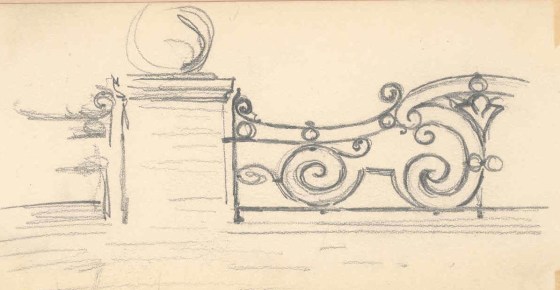
George Gough Booth sketch for a gate.  George Gough Booth Papers, Cranbrook Archives.

George Gough Booth sketch for a gate. George Gough Booth Papers, Cranbrook Archives.

Cranbrook’s love of gates originates with its founding father, George Gough Booth.  Booth, who came from a family of copper and tin metal workers, received early training at the Red Foundry in Ontario, Canada.  This, in part, led to his 1884 purchase of Barnum Wire and Iron Works in Windsor, Ontario with partner Fred Evans.  Booth wrote, “I conceived the idea of creating a new type of industry – selling with my pencil and not so much out of a catalogue – making special designs for fences, signs, bank counter railings…”   One of the earliest gates at Cranbrook designed by George Booth (and fabricated by Detroit Architectural Iron Works in 1916) is the first public gate located at the entrance to the Greek Theatre.
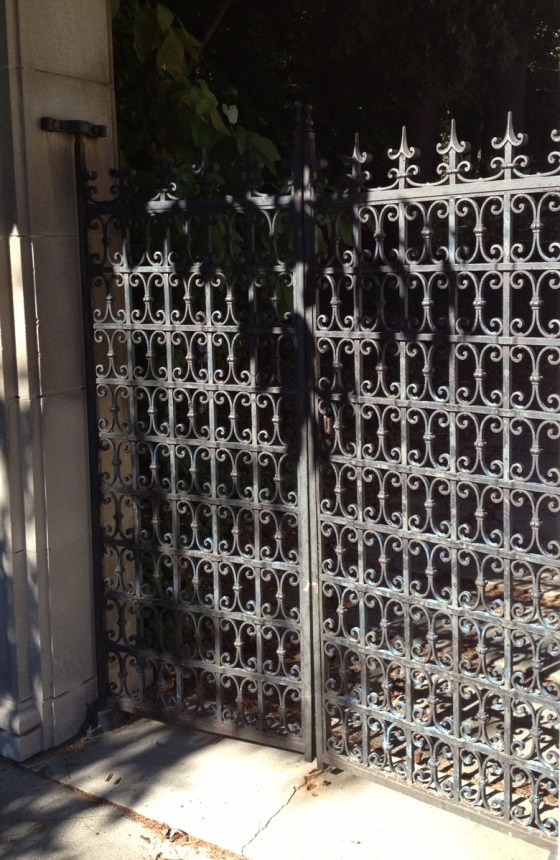
    Greek Theatre gates, designed by George Booth and produced by the Detroit Architectural Iron Works. 1916.

Greek Theatre gates, designed by George Booth and produced by the Detroit Architectural Iron Works. 1916.

Since Booth’s inception of Cranbrook, the community has steadily expanded the campus’ “gatescape.”  The most recent gates installed on campus are the “Valley Way” entrance gates (2012), designed by Architect-in-Residence William Massie.  Located at what was formerly known as the Vaughan Road Entrance, the gates were part of a project which widened the roadway to improve vehicular and pedestrian safety.  Working with Brian Oltrogge, Massie designed an abstraction of geometric triangles, a reference to Eliel Saarinen’s Kingswood gates.   The new gates were fabricated of laser-cut and bent steel.  The hand-bent “infill” was bolted to the steel frame and welded by Jody Cooper, Academy of Art alumni (Architecture Department 2012).

Closeup of Valley Way entrance gates, designed by Cranbrook Academy of Art Architect-in-Residence William Massie. The gates were completed in 2012.

Closeup of Valley Way entrance gates, designed by Cranbrook Academy of Art Architect-in-Residence William Massie. The gates were completed in 2012.

In conjunction with the exhibition opening, I’m going to be leading a walking and bus tour of the gates on Saturday, October 5.  We’ll be exploring all aspects of the gates, from their history in situ to the designers and makers who produced them.  Be sure to sign up here to join us, and get ready to delve deep into Cranbrook’s “gatescape”!

Leslie S. Edwards, Head Archivist

Photo Friday: Cranbrook’s Gatescape

Image

Close-up of the peacock for which Cranbrook School’s Peacock Gates are named. Designed and installed in 1927, restored in 2013. Cranbrook Archives.

Doors, entryways, gates – Cranbrook’s campus was designed with an eye towards points of transition.  Since its foundation 108 years ago, Cranbrook has maintained a long tradition of gate design and fabrication.  This close-up of a stylized peacock comes from Cranbrook School’s famous Peacock Gates; designed by Eliel Saarinen, they were produced by the metalsmith Oscar Bach in 1927.  Recently, a long restoration process culminated with their re-installation on the Cranbrook School campus.   This gate and many others are the subject of the second exhibition in the From the Archives series.  Drawing from the rich collection of the Cranbrook Archives, From the Archives: Forging Cranbrook’s Gatescape explores the history, design, and formation of Cranbrook’s historic and contemporary “gatescape.”

Experiencing the gates from within the walls of the Art Museum is nothing compared to seeing them in person.  With that in mind, Leslie S. Edwards, Head Archivist and exhibition curator, will be leading a walking and bus tour of the gates on Sunday, October 5.   The tour will take participants  to some of Leslie’s favorite gates, from beloved classics to the newest installations on campus.   More information on the exhibition and walking tour is available here.  Be sure to check it out, and get ready to see Cranbrook’s gates in a whole new light!

Old Words, New Sounds: Oral Histories from the Cranbrook Archives

For the past nine months I have been working on a project to breathe new life into an oral history initiative at Cranbrook that began as early as 1964 as a collaborative project between Cranbrook School and the Cranbrook Foundation. These oral histories give us an intimate view of life here at Cranbrook over the past half century with interviewees spanning across the entire community. They range from Dr. Lee Dice at the Institute of Science, to Cranbrook Academy of Art painter Zoltan Sepheshy, as well as interviews with members of the Vettraino family, whose time living on the grounds spanned several generations. These interviews give us the kind of glimpse into the past of Cranbrook that is difficult to find anywhere else.

Cranbrook’s oral histories are found in the archives in analogue sound formats, namely on magnetic tapes. In order to preserve these interviews and provide access to a wider audience, the Archives is implementing a plan to digitize all of the content. Each oral history is digitized in real time and then transcribed, with each hour of audio taking anywhere from 8 to 10 hours to transcribe, depending on sound quality.

One of the latest gems to be uncovered is a recording of a conversation with brother and sister James and Doris Smith who worked as model makers and production designers from the mid-1940s for many of the artists and architects associated with Cranbrook. James began working with the firm of Saarinen, Swanson, and Saarinen in 1943, while Doris joined them in 1946. Both had their hands on many of the largest projects, such as creating the models for the General Motors Technical Center, and their insight into the daily work and life in the office is unmatched and cannot be forgotten.

In the following clip you can listen to James Smith discuss events and the atmosphere that surrounded the winning entry from Eero Saarinen & Associates for the Gateway Arch in the Jefferson National Expansion Memorial in St. Louis, Missouri–better known as the St. Louis Arch.

Image

Construction of TWA model at Eero Saarinen & Associates taken by Claude de Forest, 1957.Cranbrook Archives.

Justine Tobiasz– Archives Assistant

Photo Friday: Twisted Sister

In the summer of 1911, the Booth clan left Cranbrook, headed for a European vacation.  The family traveled via New York, where they boarded the RMS Olympic, part of the White Star Line and sister ship to the Titanic. Designed as a luxury ship, many of the features on the Olympic were identical to the more famous Titanic The Olympic had its maiden voyage on June 14, 1911, arriving in New York on June 21, 1911.  The captain of its first voyage was none other than Edward Smith, who would lose his life aboard the Titanic one year later.  The ship’s return trip to England left June 28, 1911, carrying the Booths.  Another famous passenger on board was ship designer Thomas Andrews, who would also later perish on Titanic.

RMS Olympic

The RMS Olympic arrives in Southampton on July 5, 1911. Cranbrook Archives

In April of 1912, the Olympic was one of the ships that received the distress call from Titanic, but it was too far to help in the rescue.  The Olympic offered to take on survivors, but was turned down, as it was thought that passengers would panic at having to board a ship that was a mirror-image to the Titanic.

After the Titanic disaster, the Olympic had to be refitted, as it, too, did not carry enough life boats for all the passengers.

~Robbie Terman, Archivist

Photo Friday: Before Booths

Did you know that Bloomfield is one of the oldest townships in Michigan?  Originally part of a larger piece of land known as Oakland, in 1820 the southern portion was designated as Bloomfield. Long before George and Ellen Booth purchased the property known as Cranbrook, Amasa Bagley was already on the scene.  Arriving to the area in 1819 (when Woodward Avenue was still known as an Indian passage called Saginaw Trail!), Bagley quickly became a community leader. A farmer by trade, he was appointed the first judge of Oakland County, and helped to establish the area’s first bank. Perhaps his most significant contribution of the time – opening the town tavern! Built in 1833, the Bagley Inn was used not only to quench the thirst of locals, but also as a public house for political gatherings. Located at the corner of Long Lake and Woodward, the building still exists today.

~Robbie Terman, archivist

Portrait of Amasa Bagley. Cranbrook Archives.

Portrait of Amasa Bagley. Cranbrook Archives.

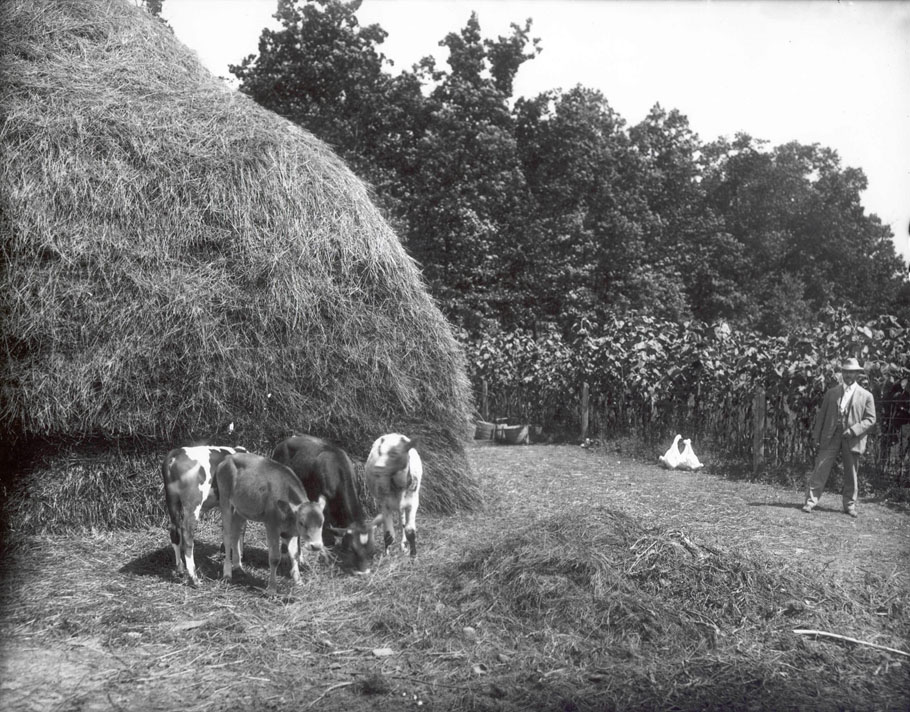
Guernsey Cows and George Booth

When most people hear the word “Cranbrook,” they think of Eliel Saarinen, modernist design, art and science, or private education.  Some even think of our sister schools in England, British Columbia or Australia.  But how many people think of farm animals named “Daisy Lovelace” or “Nellie of Cranbrook?”  When the Booths purchased the old Alexander farm in 1904, one could see rolling farmland covered with hay fields and orchards.  Indeed, George Booth soon became a gentleman farmer.

George Booth (right)

George Booth (right)

In fact, Cranbrook boasted TWO working farms, originally called Farm Group #1 and #2, situated on the grounds of what are now the campuses of Kingswood School and Cranbrook School respectively. Farm Group #1 (1904) was designed no, not by Saarinen, but by that other architect, Albert Kahn! – one of Kahn’s earliest commissions for George Booth. Farm Group #2 (1917) was designed by Canadian architect Marcus Burrowes and his partner Dalton Wells, recommended to Booth by Kahn who was getting mighty busy with his industrial projects. When the footprint for Cranbrook School for Boys was developed, George Booth asked Eliel Saarinen to follow the plan for Farm Group #2. Today’s Hoey Hall is on the site of the old silo. The only remaining evidence of the farm buildings is the orignal farmhouse designed by Burrowes and Wells.

~Leslie S. Edwards, Head Archivist

From an Intern’s Eyes: Old Drama and Timeless Art

In the second week of May, I began my first day at the Cranbrook Archives for my Senior May Project, a program ran by the Cranbrook Upper School to send anxious fourth quarter seniors off campus for internships and adventures.  And now, after two weeks of dealing with numerous dusty, yellowed papers (and one suspicious wooden box featuring some dead bugs and cobwebs) my initial excitement only grew.

One of my first projects here was to research the tenure of past Academy of Art faculty and staff members between the years of 1932-1976, and to make a comprehensive spreadsheet on the matter. That project led me to read through old faculty files comprised of payroll information (“how did people survive on $200 a month!” I thought to myself), retirement records, old correspondence­—I even came across the first telegram I had ever seen. I wondered, from time to time: “Did the secretary who typed this letter up ever think that a teenaged intern from China would one day behold this work and marvel at its antiquity?”

The first telegram I've ever seen.  1943, Cranbrook Archives.

The first telegram I’ve ever seen. 1943, Cranbrook Art Museum Exhibition Records, Cranbrook Archives.

Continue reading

Photo Friday: The Other Cranbrook

Coppersmith's shop, Cranbrook, England.  July, 1901.  Henry Wood Booth Papers, Cranbrook Archives.

Coppersmith’s shop, Cranbrook, England. July, 1901. Henry Wood Booth Papers, Cranbrook Archives.

In 1901, Henry Wood Booth, Cranbrook founder George Gough Booth’s father, took this photograph of the shop in Cranbrook, Kent, where his own father had worked as a coppersmith before moving to Canada with his young family.   A handwritten note on the back of the photograph, which is held in the Henry Wood Booth Papers at the Cranbrook Archives, explains that the copper tea kettle hanging from the door was made by Henry’s grandfather (the original George Booth), who also made his trade as a coppersmith.  Three generations (and a whole lot of people named Booth) later, George Booth’s great-great-grandson George Gough Booth would build an entire campus around the idea of promoting the applied arts, naming it “Cranbrook” in honor of this town and community.

Create a website or blog at WordPress.com