The Elves and the Saarinen Home

Cranbrook Center for Collections and Research “elves,” with help from the Cranbrook Archives and Cranbrook Art Museum, have worked their magic to bring out treasures designed for this summer’s reinvigorated and expanded tours of the landmark Saarinen House. This three-month installation entitled Saarinen Home: Living and Working with Cranbrook’s First Family of Design, expands on the life and work of the remarkable Saarinen family, displaying items used in their home, at Cranbrook, and for projects around the country.

SaarienHomeBlog1

Selecting sliver, glass, and ceramic items for the exhibition.

The exhibition kicks off with an Open House from 1-4pm this Sunday, April 30th, during the Art Academy’s OPEN(STUDIOS). It will also be open for four nights of special programming – “Finnish Fridays” – the first of which is May 5th. Normal tours of the exhibit are Friday, Saturday, and Sunday, May through July. For all the details, check out the Cranbrook Center for Collections and Research website.

SaarinenHomeBlog3

Preparing the space to display weavings by Studio Loja Saarinen.

Leslie Mio, Assistant Registrar

Photo Friday: Documenting Exhibitions Across Campus

As many of you know, Cranbrook Archives is located in the lower level of Cranbrook Art Museum (CAM). At various times throughout the year, museum registrars and preparators install and de-install the exhibitions presented in the galleries at CAM. Over the past few weeks this process of de-installing exhibitions in the lower galleries started, in preparation for new exhibitions to take over these spaces.

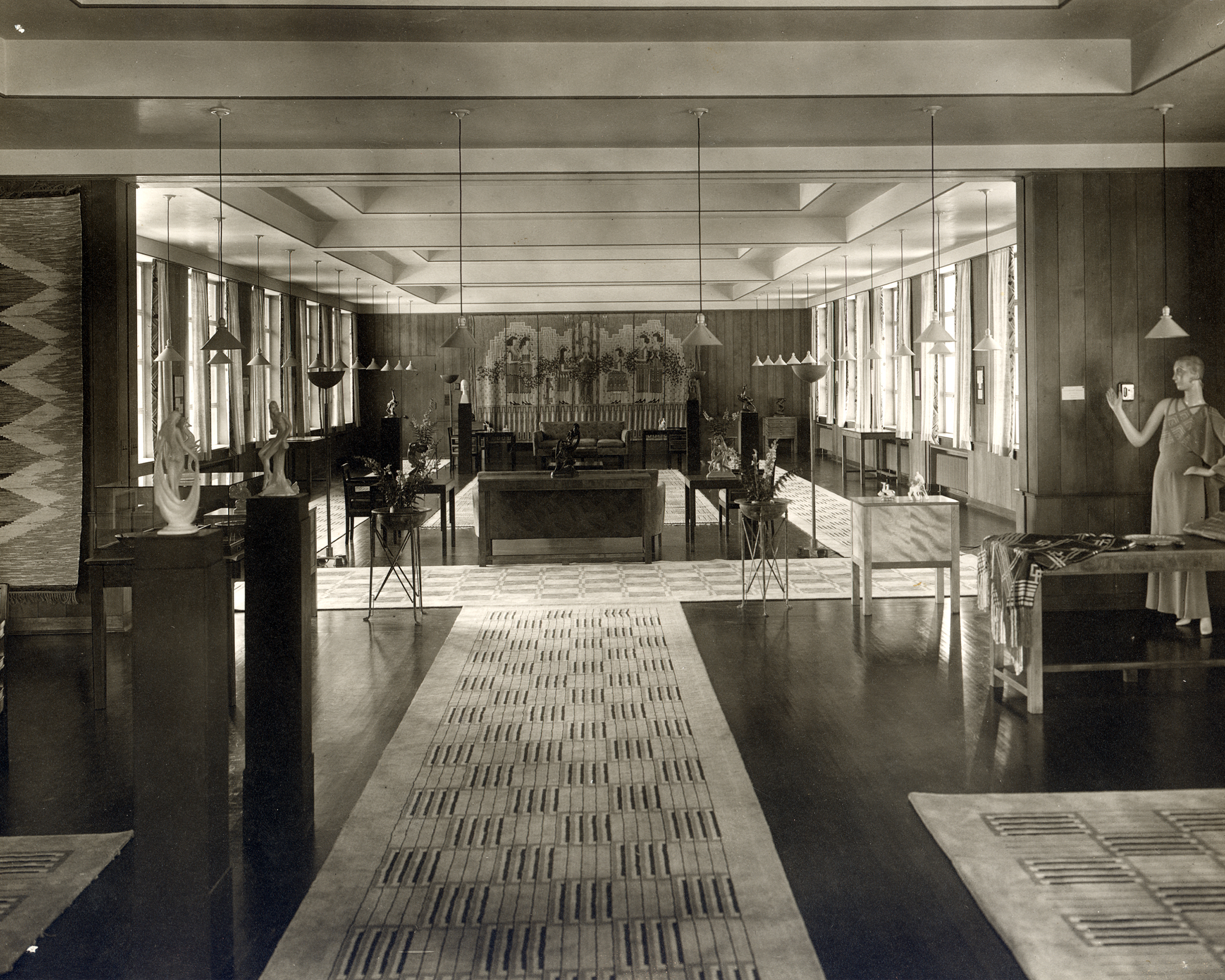
The first exhibition held at Kingswood School in what is now the weaving studio. Primarily designs for Kingswood School, but includes costume designs by Pipsan Saarinen Swanson. Photographer, George W. Hance, 1932

I am always in awe of the work that goes into changing these spaces to support new ideas and work – from the vision and physical work of the preparator and staff to the tracking, un-packing, and condition reporting that is completed by the registrars – it is impressive! In our collections at the Archives, we have correspondence, exhibition files, posters, publications, and photographs to document more than 85 years of exhibitions not only from CAM, but also from Cranbrook Kingswood Schools, the Institute of Science, and exhibitions that faculty and students have participated in across the country.

Gina Tecos, Archivist

House of the Poet

In 1995 a project was initiated to create a living monument to honor Cranbrook’s dedication to poetic imagination. The project, House of the Poet, was to be built on the ridge overlooking Lake Jonah and would honor works of imagination in art, sciences, and letters. Architect and educator, John Hejduk (1929-2000), was commissioned to develop plans for the building.

Hejduk largely abstained from conventional practice, but is known for his drawings that were combined into poetic and often highly personal narratives. Despite completing relatively few buildings, Hejduk is considered one of the most influential architects and theorists of the twentieth century. In an essay about Hejduk, architect Andreas Angelidakis states, “His drawings and writings, his essential approach to architecture, continue to function as a blueprint for a practice without clients, commissions, or even realization. What he built was a world of images and words.”

Exterior drawing, House of the Poet. Courtesy Cranbrook Archives.

Exterior drawing, House of the Poet. Courtesy Cranbrook Archives.

Hejduk designed a house built on stilts that included a bedroom, bath, living room, dining room, and kitchen. The plan was to create a space where “esteemed visitors” to the campus could stay. The exterior consisted of stucco in green, red, blue, and gunmetal, with a zinc roof.

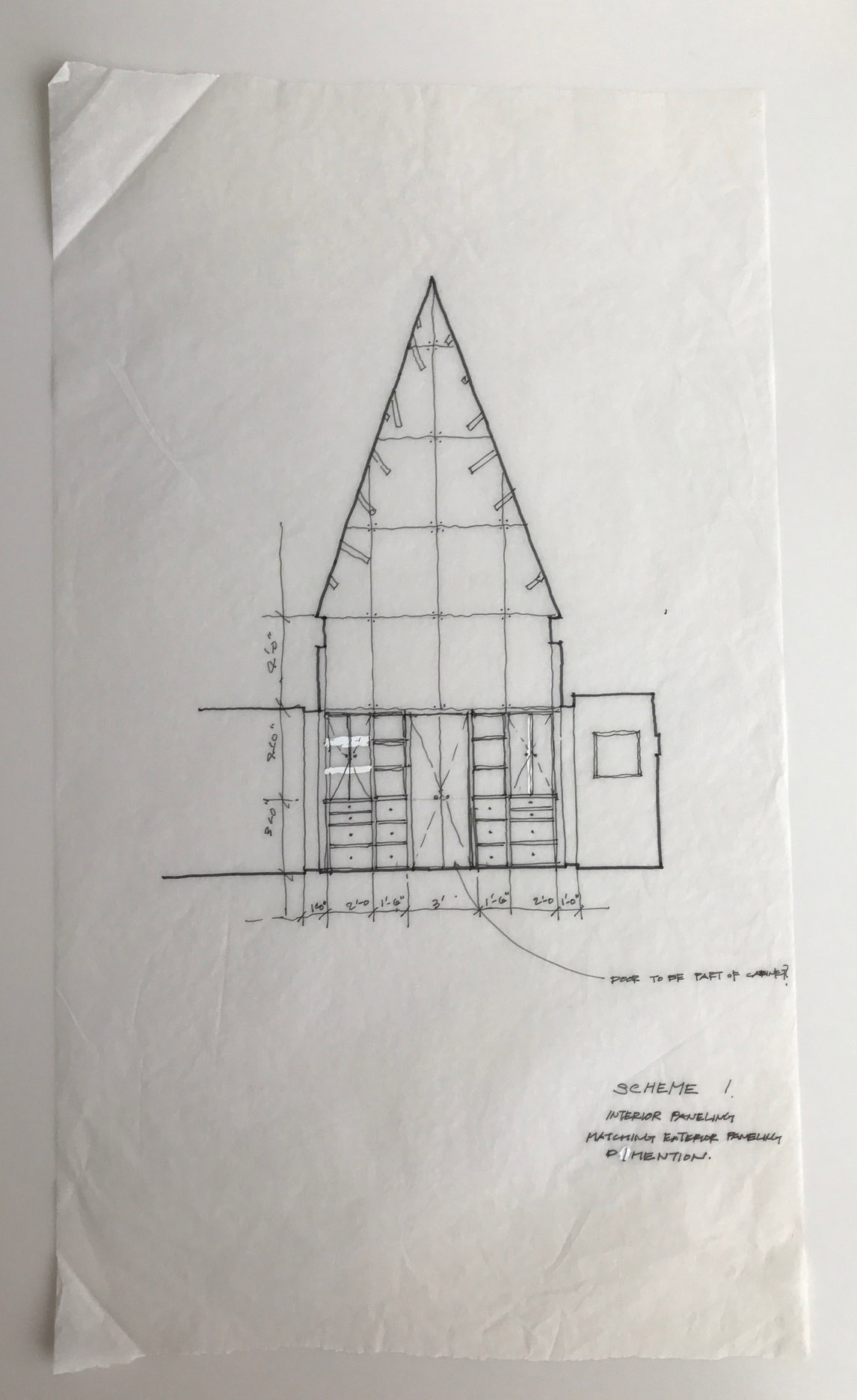
Sketch of Scheme 1: interior paneling.

Sketch of Scheme 1: interior paneling.

In the fall of 1995, architects Dan Hoffman and Jennifer Lee of the Cranbrook Architecture Office (CAO) worked towards the project’s completion. Faculty and students from the Academy of Art’s Department of Architecture would provide the majority of the labor for the construction of the building, continuing the tradition of the integration of arts and crafts in the original buildings on campus. The CAO created extensive cost estimations and budgets, and thoroughly researched available materials for the construction of the house.

Digital model of the House of the Poet - view from Academy Way with the sculpture of Jonah and Whale in the foreground.

Digital model of the House of the Poet – view from Academy Way with the sculpture of Jonah and the Whale in the foreground.

Project correspondence indicated plans to complete the building in time to coincide with a 1997 exhibition at Cranbrook Art Museum honoring the work of John Hejduk. The project seemed set to move forward, however, due to lack of sufficient funding, was canceled.

Gina Tecos, Archivist

Special thanks to Rebecca Kallen (CKU ‘08) who contributed to the research of this blog.

Manship’s Memorable Memorial Medal

As the Assistant Registrar for Cranbrook Educational Community, it is my job to keep track of the objects in the collections of the Art Museum and the Cultural Properties across the campus.  Though not trained as a Museum Registrar, George Booth had a similar goal: he fastidiously kept his many collections and cultural properties around his home and the various school buildings inventoried or appraised.

The inventory, “Cranbrook Museum Art collection: 400 thru,” led me to a wonderful collection of coins and medals.  Some were ancient, some were more contemporary, but one in particular stood out: a memorial medal for soldiers who died during the First World War.  What was the story behind this medal?  Since none of the Booth children died during the war, I wondered why George Booth would have one of these medals in his collection.

During World War I, many prominent Americans spoke out against the war in Europe, including Henry Ford and Reverend Samuel Marquis (who in 1927 became the first rector of Christ Church Cranbrook).  As the editor of The Detroit News, George Booth oversaw “the leading newspaper in the country to give open and courageous expression to criticism.”  The News editorial staff had “sincerity of purpose and courage to voice temporarily unpopular principles.”  The United States entered the war in 1917 but The Detroit News continued its criticism. That criticism, however, was focused on governments and policies, not at the soldiers who put their lives on the line.

Indeed, Booth was very supportive of the fighting men who went off to war and of the families of those who did not return. He, architect Albert Kahn, and Clyde Burroughs (Director of the Detroit Museum of Art) established the Welcome Home Committee of Detroit – similar committees were formed in other major U.S. cities. The committee made sure all soldiers who returned from the front received the thanks of the nation and distributed rings and certificates of service to them upon their return.

The Committee’s recognition did not end with the men who returned.  It also distributed the memorial medal to the families of the war dead from Detroit. This medal, designed by sculptor Paul Manship and forged by Medallic Art Company in New York, was given as “a token of sympathy and gratitude to the nearest kin of those who gave their lives in the country’s service” during the Great War.

memorialmedal-1

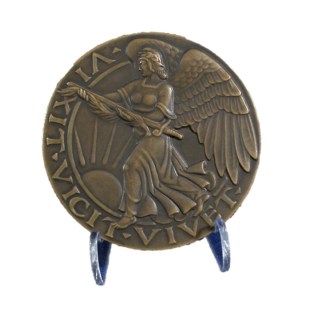
Detroit Soldiers Memorial Medal, 1919 (obverse). Image Courtesy of Cranbrook Art Museum.

The front of the medal bears a winged female figure representing Victory striding forward while holding a sword wrapped in a palm leaf (sword of war and palm of peace) with a radiant sun in the background. The text around Victory reads, “VIXIT VIVIT VIVET” [lived, lives, will live].

memorialmedal-2

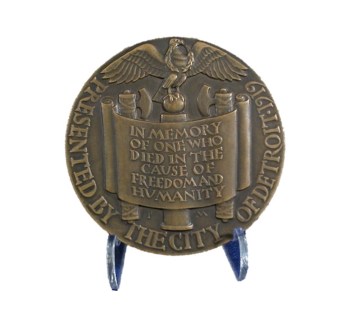
Detroit Soldiers Memorial Medal, 1919 (reverse). Image Courtesy of Cranbrook Art Museum.

The back of the medal reads, “Presented by the City of Detroit 1919.” At center is a scroll inscribed, “In Memory Of One Who Died in the Cause of Freedom and Humanity.”  Above, an eagle holding a laurel wreath is perched atop the end of a cannon and ball.

The Burton Historical Collection at the Detroit Public Library has a great image of a large crowd at Campus Martius for a memorial service to honor WWI soldiers.  I suspect that one of the men on the dais is George G. Booth, there to honor the Detroit war dead and their families.

For more on George Booth and his opinions on the war in Europe, see the George Gough Booth Papers and for more on Manship’s work at Cranbrook, check out Cranbrook Archives Digital Collections and Cranbrook Art Museum.

– Leslie S. Mio, Assistant Registrar

Photo Friday: Europa and the Bull

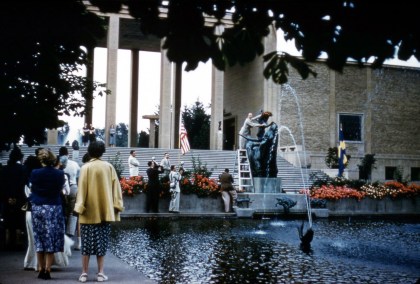
The year 1975 marked the centennial of the birth of Swedish sculptor, Carl Milles. In honor of this event, the Swedish Council Detroit held a reception at Cranbrook Art Museum on June 12, 1975. Those in attendance included the Swedish Counsel General, Karl Henrick Andersson, and Count Wilhelm Wachtmeister, Swedish Ambassador to the United States (1974-1989).

The Swedish Council Detroit places a wreath atop Milles' sculpture, Europa and the Bull. Henry Scripps Booth is holding the ladder and Cranbrook photographer, Harvey Croze, is in the foreground, to the left of the ladder. Courtesy Cranbrook Archives.

The Swedish Council Detroit places a wreath atop Milles’ sculpture, Europa and the Bull. Henry Scripps Booth is holding the ladder and Cranbrook photographer, Harvey Croze, is in the foreground, to the left of the ladder. Courtesy Cranbrook Archives.

In conjunction with the Jenny Lind Club of Detroit, they presented the Academy of Art with $1500 in support of the Carl and Olga Milles Scholarship Fund (which is still in existence today). It was part of $75,000 raised by Cranbrook as part of a Ford Foundation matching grant.

Dedicated to the preservation of Swedish cultural heritage, the Jenny Lind Club also participated in Cranbrook’s celebration of Carl Milles’s 75th birthday in 1945. The first vice-president at that time was Ingrid Koebel. The Koebel House, located in Grosse Pointe, was designed by J. Robert F. Swanson with interior decorations by Pipsan Saarinen Swanson.

Leslie S. Edwards, Head Archivist

Paris Calls: Cranbrook and Marcel Duchamp

Occasionally we post blogs that we hope will illustrate and educate about the work that we do here, both as archivists and registrars. One of my greatest pleasures is answering interesting research queries, so I thought I would share one from today.

I received a phone call from Paul B. Franklin, an independent art historian and one of the world’s experts on Marcel Duchamp. Born in Detroit, he received his doctorate from Harvard where his dissertation was on Duchamp. He now lives in Paris, where he edits the journal “Étant donné Marcel Duchamp.”

Exhibition card, 1959

Exhibition Announcement Card, 1959. Courtesy Cranbrook Archives.

Today, Paul was seeking clarification about the exhibition “Art and the Found Object” (which was held here at Cranbrook in April 1959 in what was then known as the Galleries of Cranbrook Academy of Art) for his catalogue essay in conjunction with the upcoming exhibition “”Marcel Duchamp: Porte-bouteilles” to be held in Paris in the fall.

News clipping, Detroit News, 9 Apr 1959. Courtesy Cranbrook Archives.

News clipping, Detroit News, 9 Apr 1959. Courtesy Cranbrook Archives.

In an email exchange with Paul, he told me the Paris exhibition “is centered on the version of “Bottle Rack” that Duchamp exhibited in “Art and the Found Object” and which Robert Rauschenberg purchased for a mere three dollars.” (Rauschenberg’s work “Odalisque/Odalisk” was also in the exhibition.) “Duchamp signed his readymade for Rauschenberg in March 1960, and Rauschenberg retained possession of it his entire life.”

What a great story! And the fact that we had materials in the collections of Cranbrook Archives to add to the story is even better. Thanks, Paul, for allowing me to share this story with our readers.

Leslie S. Edwards, Head Archivist

Transcontinental Threads: Maja Andersson Wirde

One of my favorite parts of my job as an archivist is assisting researchers with locating materials in our collections. Often times a scholar will visit here with a set plan for their research project, and pre-conceived ideas about what they might find here or how the materials in our collections will support their thinking. One of my personal pleasures is when the researcher finds something new or surprising in our collections that changes their course of action. This is exciting on many levels – for them as well as for me!

In August 2015, Swedish author Marie Andersson visited Cranbrook to study the work of the Swedish weaver Maja Andersson Wirde (no relation) in preparation for a monograph on the life and work of Wirde at the request of Wirde’s family. Wirde (1873-1952), an accomplished weaver and textile designer, was asked by Loja Saarinen to come to Cranbrook in 1929 and oversee the operation of Studio Loja Saarinen which was established to design and produce all of the textiles for Kingswood School Cranbrook. As many researchers before her, Marie Andersson found her visit to Cranbrook Archives to be a revelation, and she recently wrote to me that “the Cranbrook chapter became an important part of the book, much more than I thought before I visited you.”

Maja Andersson Wirde (standing) with Loja Saarinen, Studio Loja Saarinen, ca 1930. Detroit News photograph, Courtesy Cranbrook Archives.

Maja Andersson Wirde (standing) with Loja Saarinen, Studio Loja Saarinen, ca 1930. Detroit News photograph, Courtesy Cranbrook Archives.

Prior to coming to Cranbrook, Maja Andersson Wirde had been employed by Handarbetes Vänner (The Friends of Handicraft) in Stockholm from 1907-1929. Her textile designs were represented in international exhibitions including Stockholm (1909 and 1930), Malmo (1914), Gothenburg (1923), and Paris (1925). However, according to Marie Andersson, Wirde’s “time spent at Cranbrook must be looked upon as the most important period” in Wirde’s life as an artist, and she created some of her most significant work while here.

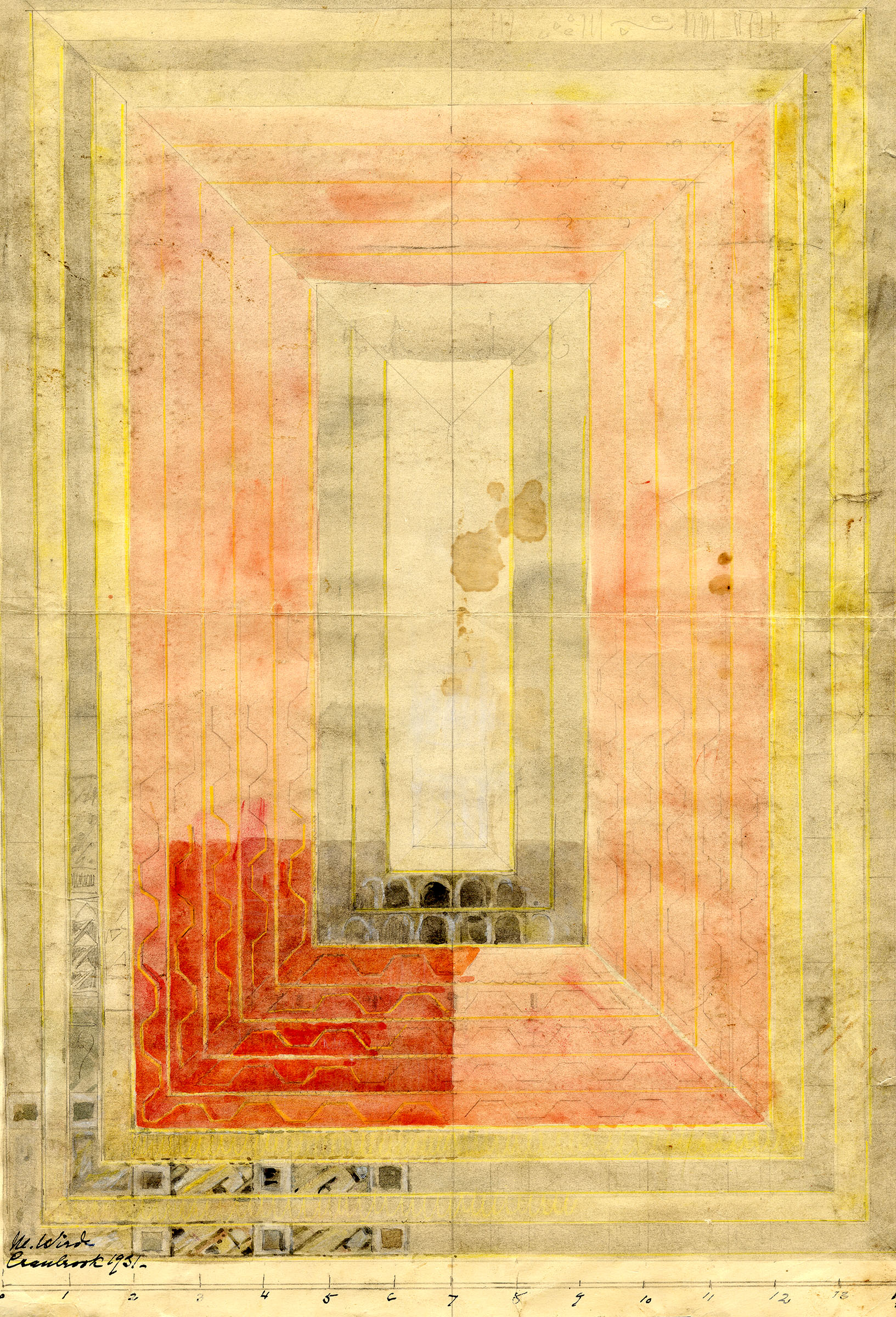
So, what did Marie discover at Cranbrook Archives? Comparing photographs and documents from our collections with images of watercolor sketches from museums and archives in Sweden, Marie and I spent two days of “fantastic co-operation” in order to uncover the extent of Wirde’s contribution to the history of textiles at Cranbrook, particularly Kingswood School.

Watercolour sketch by Maja Wirde (1873-1952), Collection of Smålands Museum, Växjö, Sweden.

Watercolour sketch by Maja Wirde (1873-1952), Collection of Smålands Museum, Växjö, Sweden.

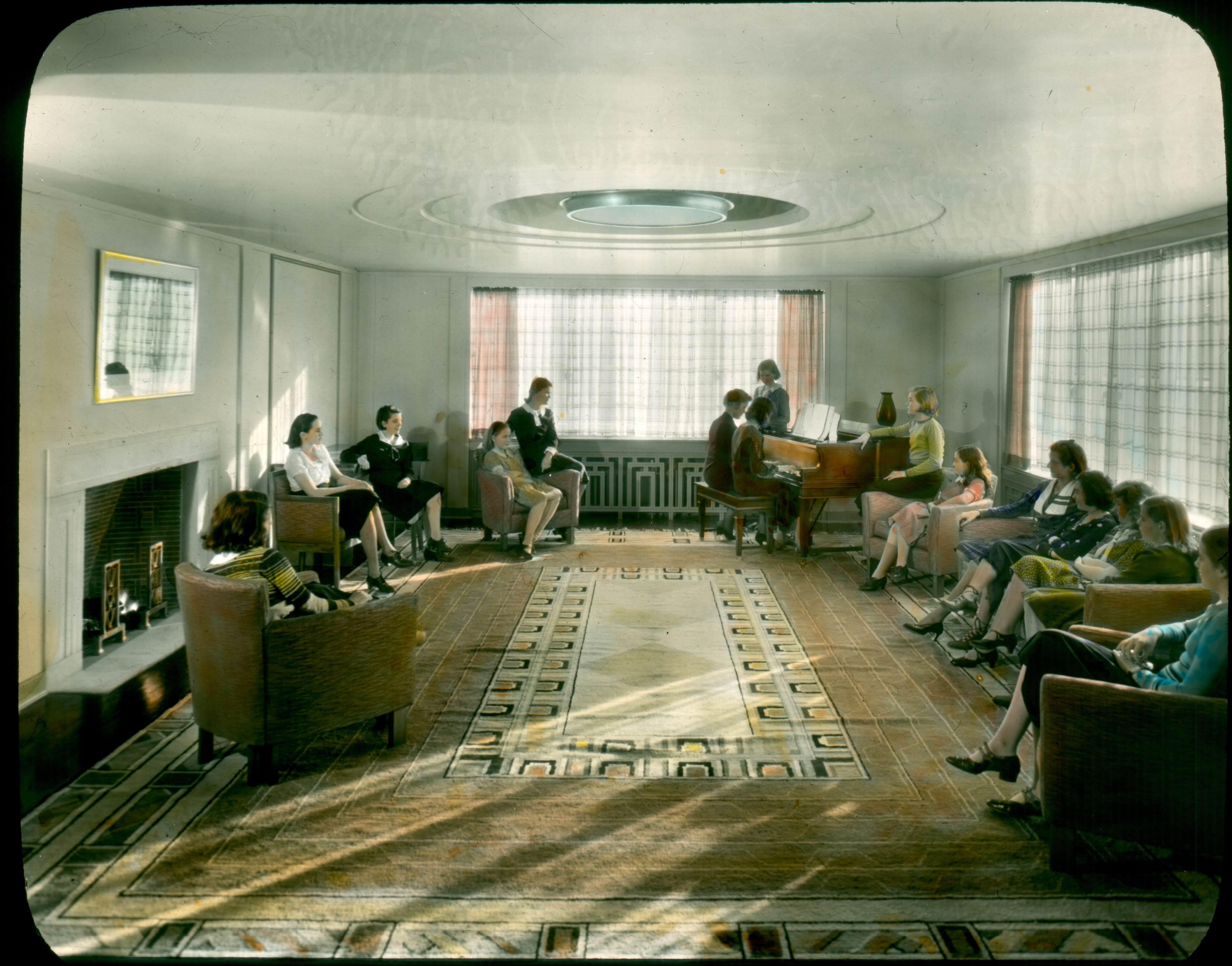
The rug for Reception Room III (Rose Lounge) in situ, Kingswood School, 1932. George Hance, photographer, Courtesy Cranbrook Archives.

The rug for Reception Room III (Rose Lounge) in situ, Kingswood School, 1932. George Hance, photographer, Courtesy Cranbrook Archives.

Prior to Marie’s visit, Wirde was known for her work as the shop supervisor at Studio Loja Saarinen, the weaving instructor at Kingswood School, and for her designs for several rugs and textiles for Kingswood School, including the fabric for the dining hall chairs and most notably, the large rug for the Green Lobby. However, Loja Saarinen was given credit for the rest. Now, Cranbrook can tell a more inclusive story – for we discovered that it was Maja Andersson Wirde who designed the majority of the textiles for Kingswood School – eleven rugs for lobby/reception halls, all of the curtains and rugs for the dormitory rooms, as well as curtains for the dining hall, study hall, and library! In addition, she designed rugs for the Academy of Art, Saarinen House, and George Booth’s Cranbrook Foundation Office.

While the book, “Trådar ur ett liv: textilkonstnären Maja Andersson Wirde” was published pirmarily in Swedish, there is a translation of the chapter on Cranbrook in the back, and the book features numerous images from Cranbrook Archives. We are so excited to be able to tell a more comprehensive story not only about the objects in our care, but also a key individual in our rich history.

Leslie S. Edwards, Head Archivist


Princess Di’s Dresses in the Archives?

At Cranbrook Archives, much of the work we do—processing manuscripts, arranging documents, scanning photographs—all have a rather similar procedure: repeat.

There is plenty of magnificence to be found in the mundane though. We don’t mind the monotonous details because it’s this repetitive process that wins us the occasional gem. Today, while going through Cranbrook’s historic exhibition brochures printed between the 1940s and 1990s, I came across an image of Princess Diana.

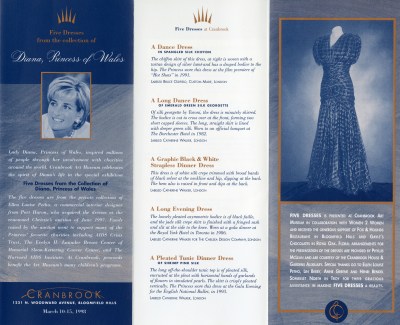
“Five Dresses from the Collection of Diana, Princess of Wales” was an exhibition held at the Cranbrook Art Museum from March 10-15, 1998. The royal dresses were premiered at Cranbrook before becoming part of a worldwide tour that traveled to Russia, Japan, Australia, and England through 1999. This selection from the Princess’s wardrobe was shown in conjunction with the “Art on the Edge of Fashion” exhibition held at Cranbrook at the same time.

2577027

Cranbrook Art Museum exhibition brochure, 1988. Courtesy Cranbrook Archives.

The five dresses were from the private collection of Ellen Louise Petho, a commercial interior designer who, incidentally, was the parent of a Kingswood School alumna. Susan Whitall’s press release in the Detroit News explained how the princess sold dozens of her dresses to benefit AIDs charities just months before her death in 1997. She wrote, “Petho scooped up the five frocks for what became, after Diana’s death, a bargain basement price—less than $100,000.”

The collection included a pleated pink silk tunic dinner dress that Diana wore at the Gala Evening for the English National Ballet and the long jade and black evening dress worn to a dinner at the Royal York Hotel in Toronto in 1986. Four of the five dresses were designed by Catherine Walker and the “piece de resistance,” designed by Bruce Oldfield, was the red dress the princess wore at the premiere of the motion picture “Hot Shots” in 1991.

The Archives are a trove of Cranbrook history. We love rediscovering the hidden materials—it’s what makes the repetition meaningful.

Danae Dracht, Archives Assistant

Cranbrook Up North

For many of us who grew up in Michigan, going up north during summer vacation was (and still is) something very special – a way to escape the hustle and bustle of city and suburban life and become one with the natural beauty it has to offer. Throughout the 20th century, Cranbrook scientists, artists, architects, students and faculty, as well as members of the Booth family, took advantage of the native woods, white sandy beaches, and waters of Lake Michigan.

Logo for Pinehurst Inn, Indian River, 1940. Cranbrook Archives

Logo for Pinehurst Inn, Indian River, 1940. Cranbrook Archives.

Shelley Selim, Cranbrook Art Museum’s Ralph and Jeanne Graham Assistant Curator, curated the exhibition Designing Summer: Objects of Escape which features Michigan designers and companies who have contributed to summer innovations including tents, boats, and bicycles as well as a summer home designed by Florence Schust Knoll. In response to the opening of the exhibition on Saturday, June 20th, I opted to post a few highlights of Cranbrook’s ongoing relationship with northern Michigan.
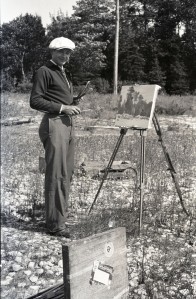
Dudley Blakely painting at group site, Bois Blanc Island, 1938. Cranbrook Archives.

Dudley Blakely painting at group site, Bois Blanc Island, 1938. Cranbrook Archives.

As early as 1929, staff and faculty from the Institute of Science traveled north to conduct studies of animal and plant life on the many islands in Lake Michigan – from Bois Blanc to the Manitous. Reports of these research trips were documented in photographs, field notes, and ultimately published in Institute of Science newsletters and bulletins.

During the 1940s and 1950s, Henry Scripps Booth took his family up north for several summers, often vacationing with friends. One of their favorite spots was Good Hart, where they stayed either at The Krude Kraft Lodge or the Old Trail Inn.
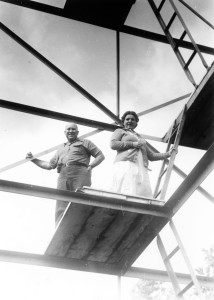
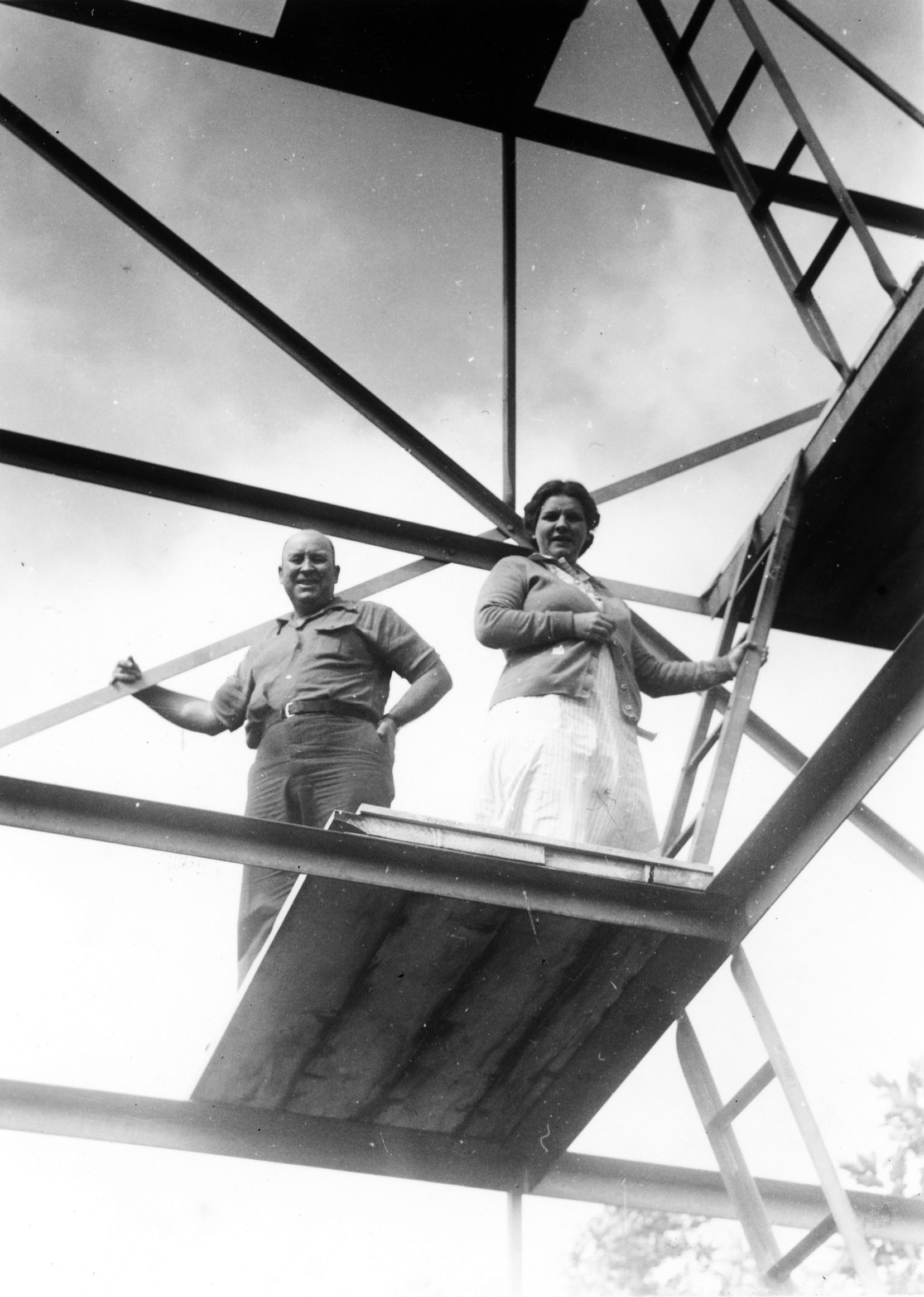
Carolyn Farr Booth and Chauncy Bliss on the Fire Tower at Good Hart, ca 1940. Cranbrook Archives.

Carolyn Farr Booth and Chauncy Bliss on the Fire Tower at Good Hart, ca 1940. Cranbrook Archives.

Communities like Cross Village, Harbor Springs, and Glen Arbor have been inspirational for Cranbrook artists and architects for centuries. Former head of architecture, Robert Snyder, designed an A-Frame beach cottage for Wally Mitchell, while architecture student Harry Weese designed a trifecta of summer homes (two for the Weese family) at Glen Arbor. “Shack Tamarack” (named after the tamarack logs used in its construction) was built in 1936 and is still used by Weese descendants today. Harry followed that with “Cottage Two” in 1939, a one story house designed with his brother John, and the Pritchard House which spoke to the modern aesthetic Weese experienced as an architecture student at Cranbrook Academy of Art.

Robert F. Swanson and Pipsan Saarinen Swanson spent decades designing commissions up north including the ultra-modern MacDonald Building in Harbor Springs, the L’Arbre Croche Condominium development, and the family’s own summer cottage at Menonaqua (along with son, Bob). Check out Shelley’s blog about Pipsan’s Sol Air furniture which is featured in the Designing Summer exhibition.

While architect Tod Williams (Cranbrook School ‘61) served as project manager for Richard Meier’s Douglas House project also located in Harbor Springs, other Cranbrook-related projects up north include The Munising Design Strategy Matrix – a community design project managed by The Community Design Advisory Program (CDAP). Established in 1987 by Design Michigan, a non-profit, state outreach program housed at Cranbrook Academy of Art, CDAP provided tailored community design and revitalization services to the city of Munising.

And, in 2013, Peter Pless (CAA ‘02) lead a design collaboration between the Human Centered Design Program at Northern Michigan University and the Lloyd Flanders furniture company of Menominee, Michigan.

Thankfully, there is seemingly no end in sight to the inspiration and possibilities of art, architecture, science, and plain old fashioned relaxation one can find up north.
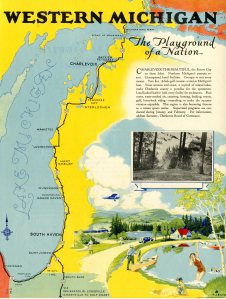
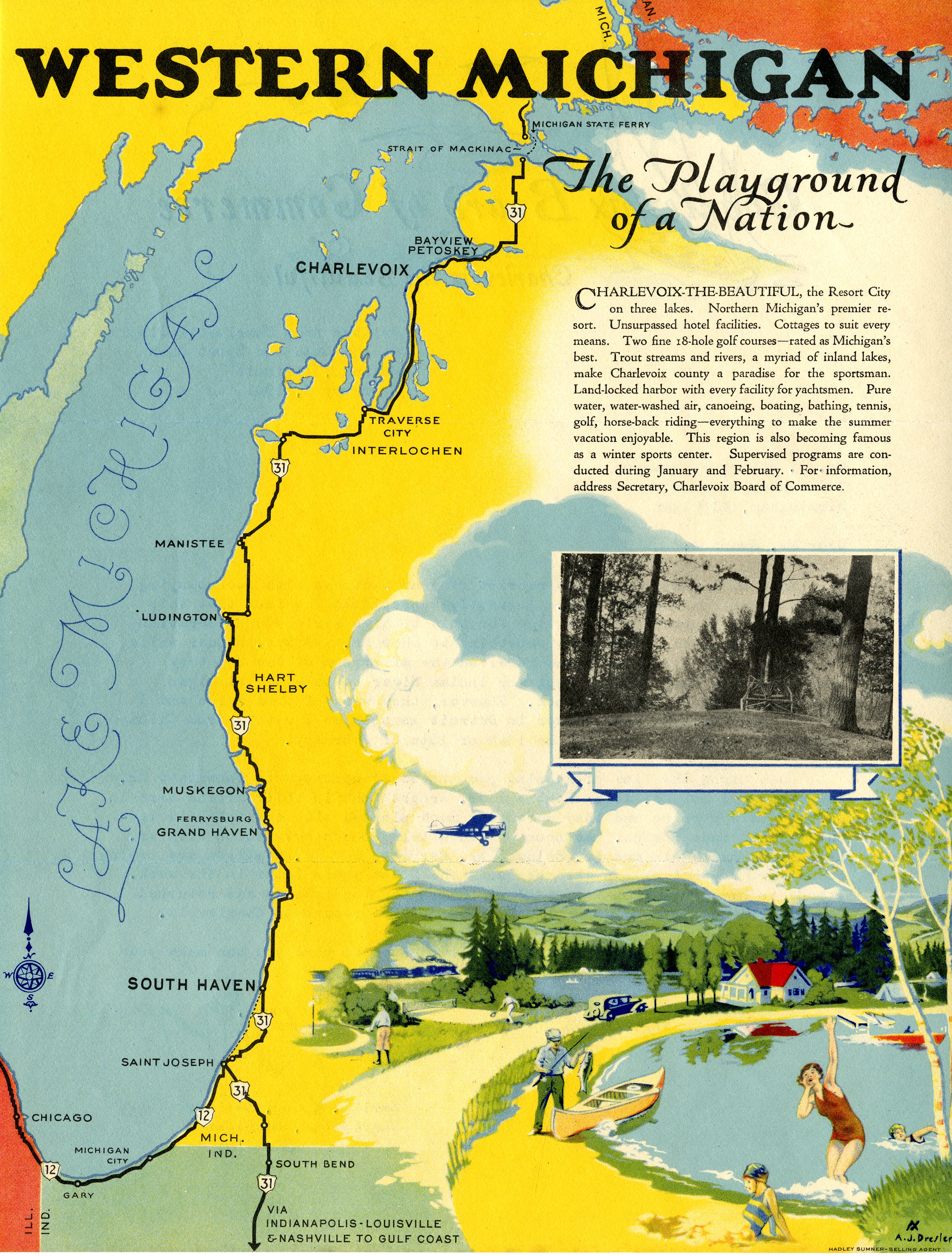
Promotional Literature, Charlevoix Chamber of Commerce, 1941. Cranbrook Archives.

Promotional Literature, Charlevoix Chamber of Commerce, 1941. Cranbrook Archives.

Leslie S. Edwards, Head Archivist
Photo Friday: Spectacular Strikeouts

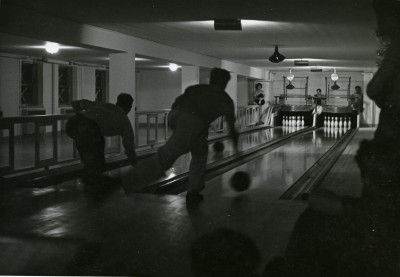
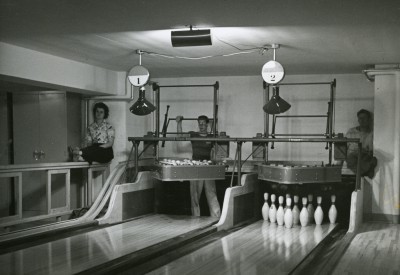
bowling alley_ CAA_1

Academy of Art students bowling. Courtesy Cranbrook Archives.

Academy of Art students waiting to reset pins. Courtesy Cranbrook Archives.

Today’s photos show Academy of Art students having some fun bowling! Bowling was popular on Cranbrook’s campus with alleys in both Cranbrook School for Boys and Kingswood School for Girls.  Kingswood School, which had the earliest alleys on campus, still uses their bowling alleys as part of the physical education curriculum.

The Academy of Art bowling lanes were located in the basement of the Art Museum and were for Academy of Art student and faculty use.  These lanes  did not have  mechanical pinsetters and therefore had to be manually set. In 1944 the lanes were removed from the Art Museum to allow for more storage for artworks, and relocated to the lower level of the Academic Building at Cranbrook School (now called Hoey Hall) under the study hall.

Stefanie Kae Dlugosz, Collections Fellow, Center for Collections and Research

Create a website or blog at WordPress.com