What would you want for your 75th birthday? If you were painter Robert Hopkin, it would be an artists’ club named in your honor. The Hopkin Club, formed in 1907, had no rules, officers, or dues. The members wanted to get together occasionally, to talk about art or host artists visiting Detroit. Hopkin passed away in 1909, but the club continued. In 1913, The Hopkin Club established by-laws and was renamed the Scarab Club–the name it continues under today.
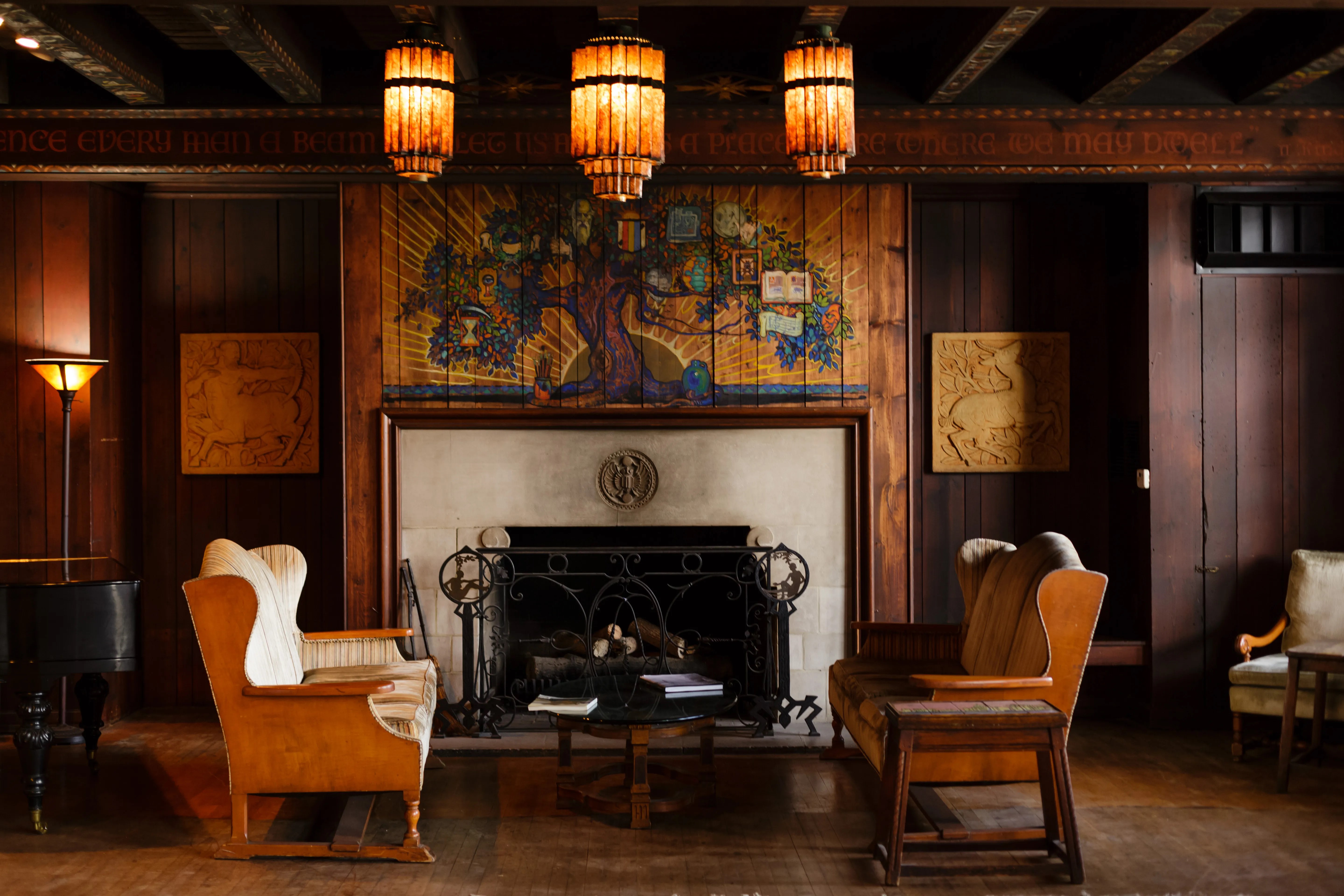
Scarab Club Room. Photography courtesy of Scarab Club.
But who was the man the club was originally named after?
Robert Hopkin was a maritime/marine artist born in Glasgow, Scotland, in 1832. He learned to paint and draw from his father. The family emigrated to Detroit in 1842. His grandfather was a sea captain which drew Hopkin to work on the wharves in Detroit and inspired his art. Though chiefly known as a painter of marine scenes and seascapes, Hopkin made frequent trips throughout the American west from 1860 to 1885, painting murals for public buildings and drop curtains and scenery for theaters, including the Tabor Grand Opera House in Denver.
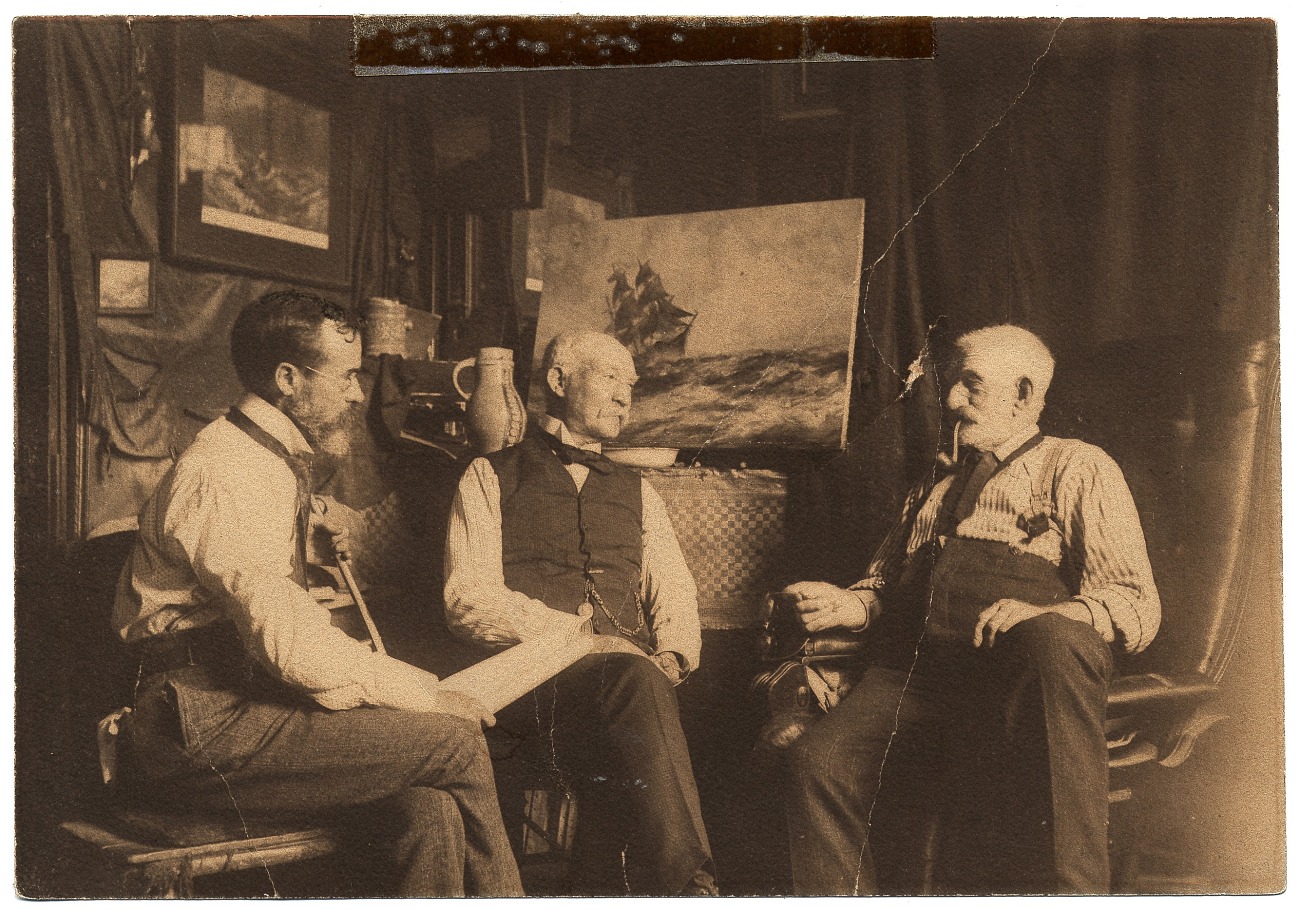
Robert Hopkin (right) and others in studio, ca. 1900. William H. Thomson papers, 1912-1950. Archives of American Art, Smithsonian Institution
In the latter half of the 19th century, Hopkins was considered the dean of Detroit artists; he decorated the interior (as well as the stage curtain) for the original Detroit Opera House (1868), painted murals in Detroit’s Fort Street Presbyterian and Ste. Anne’s churches, as well as the Cotton Exchange in New Orleans (1883). By April 1900, the Detroit Free Press wrote, “Many of the art lovers of this city possess one or more of [Hopkin’s] splendid marines, and they have been reproduced and published until everyone is familiar with his work.”
When Mr. Robert Hopkin’s Collection of Paintings opened at the Detroit Museum of Art in May 1901, “There was a large attendance of art-loving Detroiters” (Detroit Free Press, May 16, 1901).
Robert Hopkin (Scottish American, 1832 – 1909), Marine,Oil on Canvas. Cranbrook Center for Collections and Research.
George and Ellen Booth were no exception. Art lovers with many Detroit-based and self-taught artists in their growing collection, the first inventory of Cranbrook House in 1914 lists two Hopkin “Marine” paintings. The Booths gifted the larger of the two paintings to their daughter Grace Ellen Booth and her husband Harold L. Wallace. The painting returned to Cranbrook House about 1955, when Grace Booth Wallace’s collection was donated to the Cranbrook Foundation.
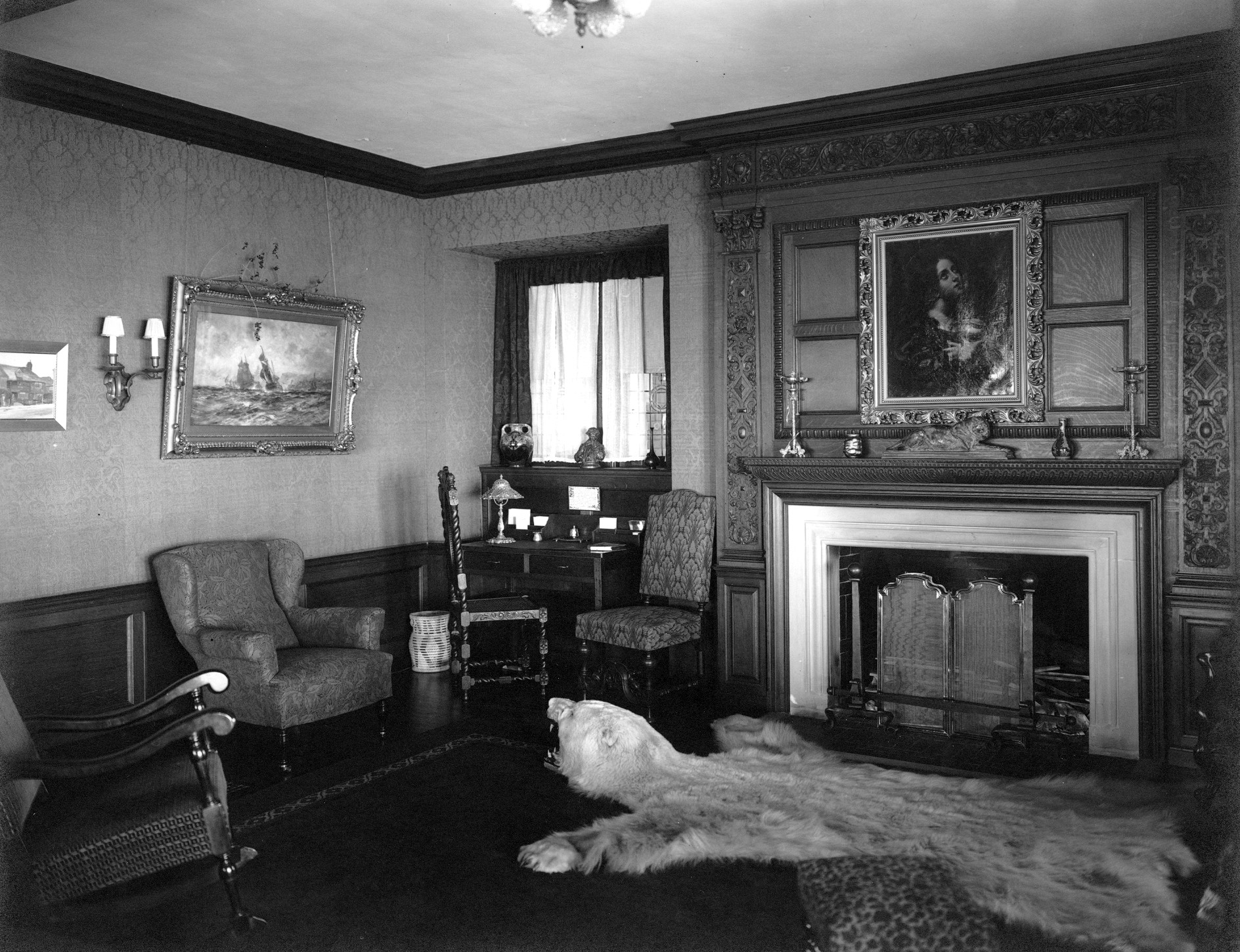
Cranbrook House Living Room, circa 1909, with Marine visible on the left. Cranbrook Archives, Cranbrook Center for Collections and Research.
The Detroit Historical Society has a copy of the Souvenir Catalogue of Mr. Robert Hopkin’s Collection of Paintings in its collection. The 85 exhibited paintings are listed, with several black and white images of them. “Price List” is written on the cover, and notes have been made indicating which have been sold and who purchased them. (Sadly, the name “Booth” does not appear.)
Another art-loving Detroiter was Merton E. Farr president of the American Shipbuilding Company and owner of a number of freighters on the Great Lakes. His daughter, Carolyn, married George and Ellen Booth’s youngest son, Henry.
The Hopkin painting in the Thornlea collection. Cranbrook Center for Collections and Research.
In 1927, Farr gifted the couple a Hopkin “Marine.” The painting hung in Thornlea, home to Harry and Carol Booth, from 1927.
The painting’s official title is not noted. The Thornlea painting is interchangeably referred to as Homeward Bound, Schooner on a Stormy Sea, Sailing Ship at Sea, and Marine. However, the 1901 Hopkin exhibition catalog does not list any paintings with those titles.
– Leslie Mio, Associate Registrar, Cranbrook Center for Collections and Research
The belated arrival of winter weather this year has allowed us all to enjoy the grounds of Cranbrook House far later into the year than is usually possible. However, the time has finally come to shroud our exterior sculptures and fountains in protective tarps for the season. This process is an annual reminder to our staff – and to the Brookside students who come to sing the statues to sleep – of just how numerous and varied the outdoor art collection at the house is. One part of the gardens is particularly rich in art and history: the north staircase.
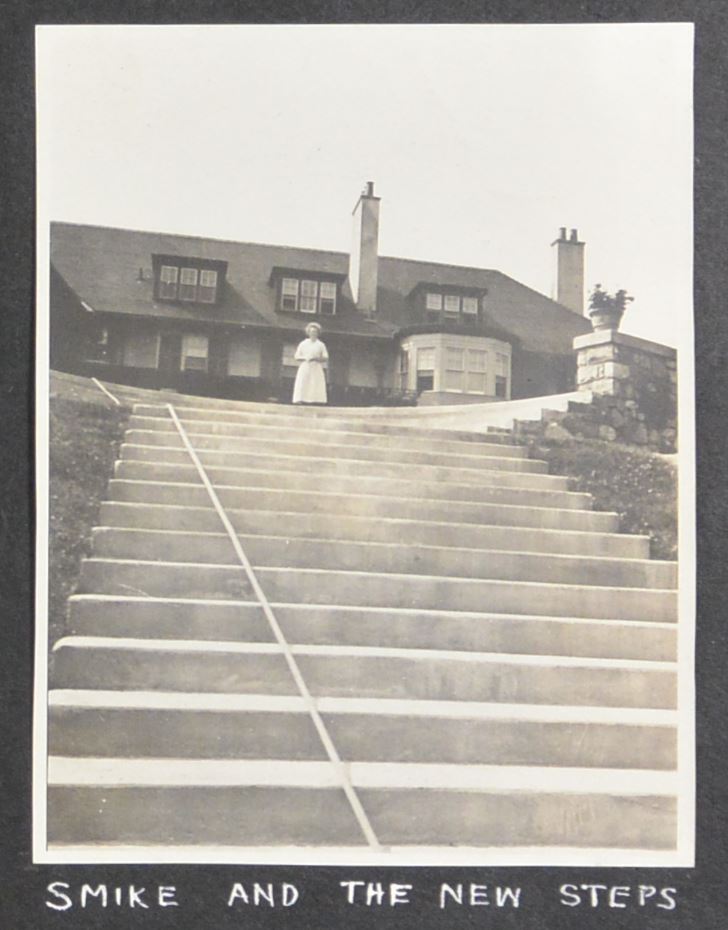
Florence Booth standing at the top of the new stairs connecting the upper and lower terraces at Cranbrook House, Summer 1921. From The Pleasures of Life, vol. 4, by Henry Scripps Booth. Courtesy Cranbrook Archives.
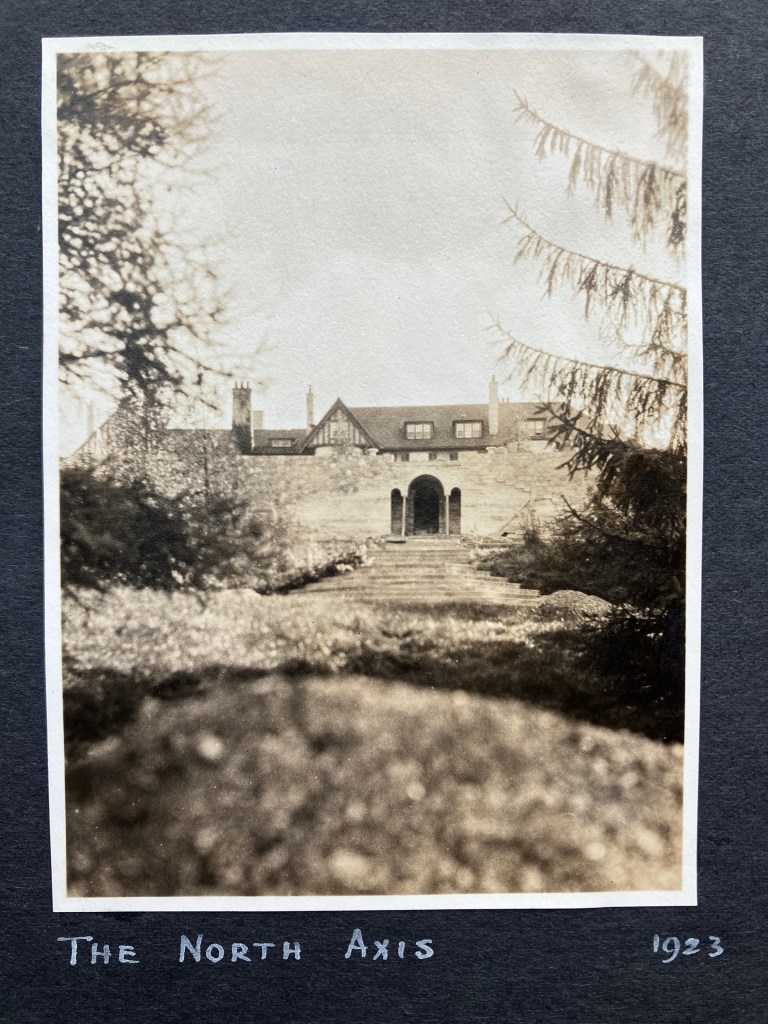
Stretching from the lakeside path at its base to the uppermost lawn outside Cranbrook House’s North Porch at its apex, the eighty concrete steps are lined with artworks, transforming the stairs into an open-air museum gallery. The stairs themselves were first built in the summer of 1921, as part of a spur-of-the-moment project to improve the view from the North Porch undertaken by James and Henry Scripps Booth. As their grandfather, Henry Wood Booth, recalled,
After ten years of sitting on the north porch and looking at a blank terrace wall, and talking about creating a vista through it, James and Henry got busy one May day with sledge hammers, and beside raising many blisters, razed about ten feet of wall the first day. Immediately a view of the lake came into being, and plans were made for a stairway down the hill.
Whether or not James and Henry had permission to make this change is contested; their grandfather’s account frames it as a collective impulse, while Henry remembers being disciplined for their impetuous action:
After construction of the curved steps, masons started building a series of flights which headed for a large wild cherry tree almost on axis along side rue Gagnier. According to one account, James and I were required to cut that tree down as a penalty for our reputed vandalism. While neither of us had a guilty conscience, we went to work sawing very hard wood and eventually (a full day later, I believe) the tree fell.
The concrete staircase was poured in July of 1921. The hillside around the new staircase was improved with new trees and paths under the oversight of O. C. Simonds, the landscape architect responsible for much of the re-foresting of the estate. After these changes, Henry Wood Booth noted with satisfaction that “[t]his hill, which for so many years had been an object of regret, was at last to be something really fine.”
Aeriel view of Cranbrook House and grounds, showing the new staircase at center right, circa 1921. From The Pleasures of Life, vol. 4, assembled by Henry Scripps Booth. Courtesy Cranbrook archives.
Further improvements were still in store, in the form of a dozen sculptural embellishments.
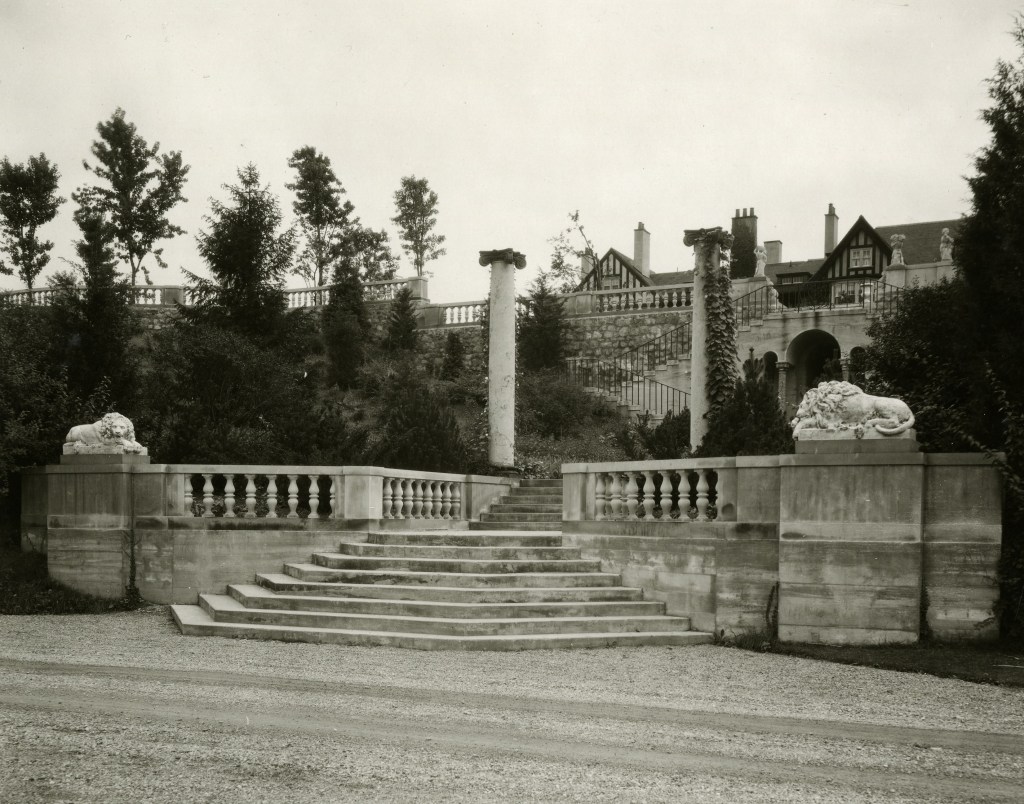
Walkers along the lakeside path today are met by two stone lions on pedestals flanking the base of the stairs. Carved from travertine and purchased by George Booth from the Galleria Sangiorgi in Rome in 1924, the lions are copies of works by the Italian neoclassical sculptor Antonio Canova, best known for his Cupid and Psyche, now in the Louvre, Paris. Canova sculpted the original lions in 1774 for the tomb of Pope Clement XIII in St Peter’s Basilica, in Rome. On Pope Clement’s tomb, the lions, one sleeping, one waking, face one another, symbolizing the confrontation of life and the long sleep of death. Here at Cranbrook, the lions face out toward the lake, one on guard, one enjoying a nap in the shade of the hill.
Stairway to Lower Terrace at Cranbrook House and Gardens, circa 1924. Photograph by George W. Hance. Courtesy Cranbrook Archives.
Although George Booth’s letters home from Italy in 1924 do not say as much, he and Ellen probably saw the original lions in the Vatican on their visit to Rome in 1922. In the intervening year, George Booth had considered buying copies of the Canova lions in cast stone, a form of concrete, from an American garden sculpture company, Howard Studios.
Just a few steps up, the stairway is flanked by concrete columns, topped with red stone Corinthian capitals. Their origins have not yet been traced, but George Booth purchased many marble capitals in Italy, most of them Roman or early medieval, for the Cranbrook Academy of Art. It would have been characteristic for the Booths to have retained a few Italian finds to ornament Cranbrook House as well.
The construction of the fountain niche and surrounding stairs, 1923. From The Pleasures of Life, vol. 7, assembled by Henry Scripps Booth. Courtesy Cranbrook archives.
From the lower landing of the staircase, its centerpiece is already visible – a fountain niche, added in 1923, requiring considerable reconstruction of this section of the stairs. At the back of the niche, now forming the fountain cascade, are a few of the original 1921 stairs.
The niche houses Mario Korbel’s Dawn, a near life-size female figure holding an apple. The symbolism of the figure is ambiguous. The apple may refer to Eve, the “dawn” of womanhood. It may also associate the figure with the goddess Aphrodite, who was awarded a golden apple as the prize in a divine beauty contest, and is associated with the planet Venus, sometimes called the morning star.
The staircase niche, photographed in 2016.
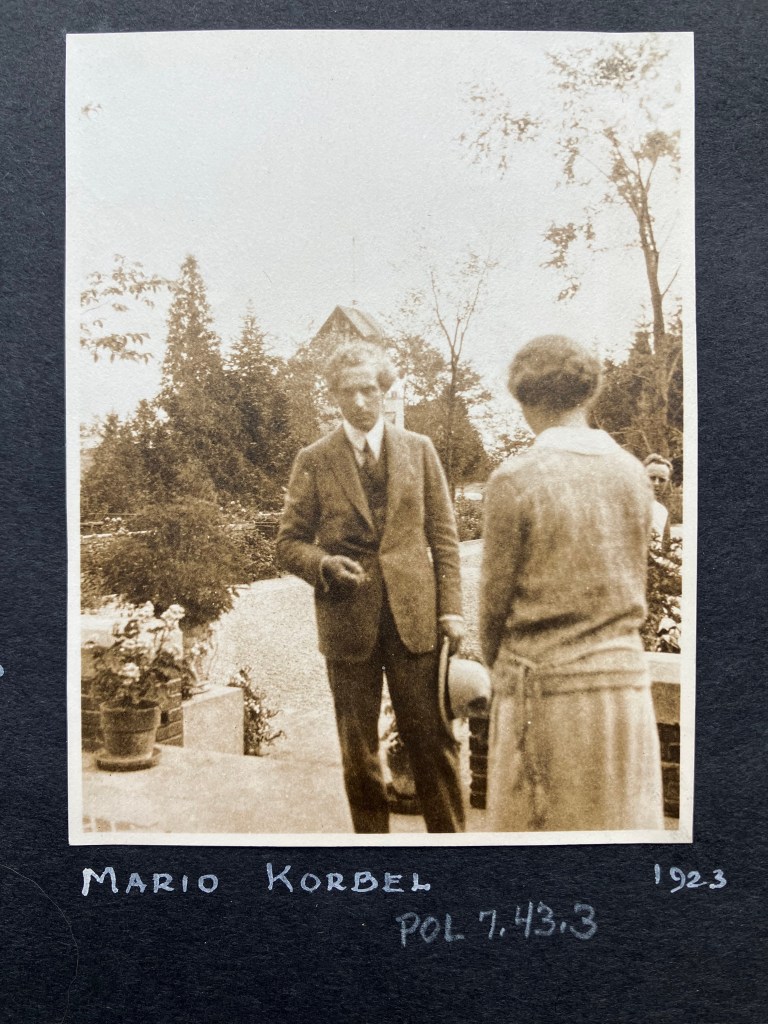
Korbel visited the grounds in 1923 and contributed ideas to the design of the niche for his sculpture. Cranbrook once also boasted a figurine version of Dawn, offered to George Booth by Korbel during the planning process for the full-size version, until it was stolen in 1926. George Booth did his best to soften the blow when informing Korbel of the loss, framing the theft as a compliment to the artist’s skill:
…you may feel flattered to learn that only a few nights ago some expert burglars after rifling the safe at the Cranbrook Office, ran off with your small figure of “Dawn”, taking along with her a supply of rugs and other articles so as to surround her with suitable luxury.
The Booths’ small Dawn was never recovered.
Mario Korbel in the gardens at Cranbrook House in 1923. From The Pleasures of Life, vol. 7, assembled by Henry Scripps Booth. Courtesy Cranbrook archives.
The newly completed niche, 1923. From The Pleasures of Life, vol. 7, assembled by Henry Scripps Booth. Courtesy Cranbrook archives.
The columns that flank Dawn’s niche are the work of an unknown Italian artist, and probably purchased by George Booth in the early or mid 1920s. Their design is based on twelfth-century examples from the Benedictine cloister at Monreale Cathedral, in Sicily. The courtyard fountain at Cranbrook School is a replica of a fountain from the same cathedral complex. First spotted by Henry Scripps Booth in 1922, George Booth later ordered a replica fountain from the Chiurazzi Foundry, who also carved the Canova lions at the base of the stairs. As evidenced by the blend of geometric, botanical, and animal ornament on this pair of columns, the architecture of medieval Sicily blended classical, Gothic, and Islamic influences, a reflection of the cultural diversity of the Norman Kingdom of Sicily. Their stylistic syncretism aptly complements the polysemy of Korbel’s figure of Dawn-Eve-Aphrodite.
The columns are not wrapped in the wintertime, allowing visitors to enjoy this feature of the staircase year-round.
The topmost landing of the stairs is ornamented with a curling iron railing, quite possibly designed by George Booth and executed at the Cranbrook metalsmithing workshop. To either side of the landing stand four cast stone cherubs, replacements for the original quartet of cherubic representations of the four seasons, which fell to pieces within fifty years of their purchase. One was already missing a head by 1949. The originals were purchased in Italy in 1924. Their replacements were donated by the Cranbrook House and Gardens Auxiliary in 1974.
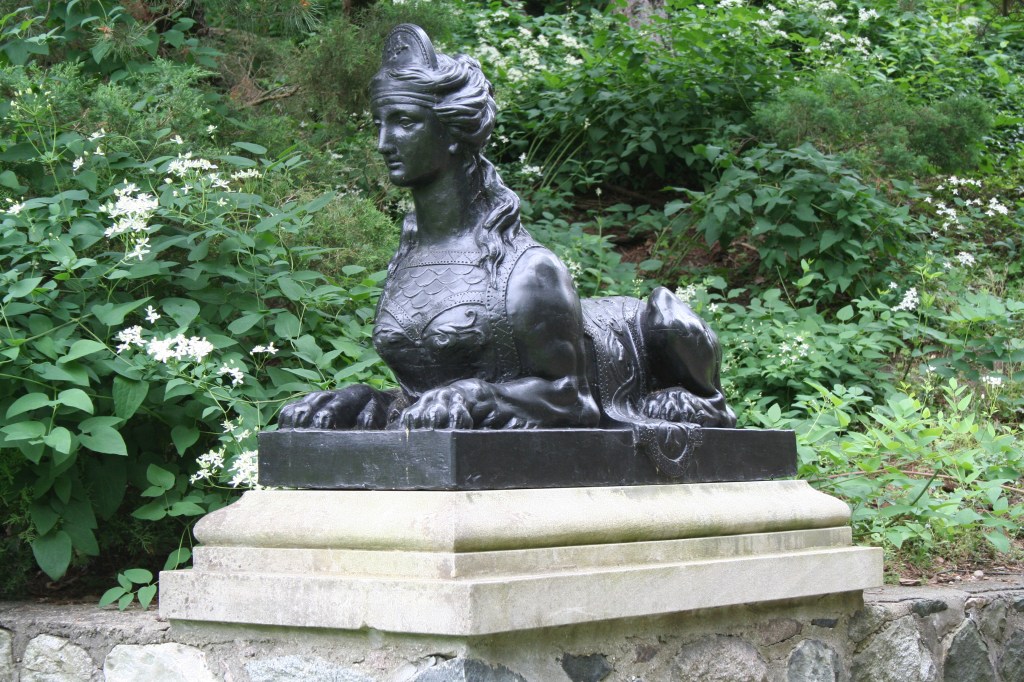
One of two bronze sphinxes by John Cheere, photographed on the north terrace of Cranbrook House in 2016.
Although the original cherub statues brought an end to the staircase’s parade of sculptures in George and Ellen Booth’s day, Henry Scripps Booth added a final flourish to the ascent in 1963. Two sphinxes, cast bronze copies of sculptures by the English artist John Cheere, bought at auction in England, keep watchful guard over the middle north terrace from either side of the wide upper stair. These bronzes, like so many other features of the staircase, are copies of European artworks. In this case, the eighteenth-century originals were created for Chiswick House, the Greater London home of Earls of Burlington, a Palladian style villa renowned for its refined neoclassical air.
As we set forth into the darkest season of the year, with all the familiar sculpted denizens of the gardens hidden beneath their winter coats, the grounds might start to feel a little lonely. Recalling the history of their making, from the reshaping of the hillsides to the final placing of statuary in their niches or atop their pedestals, can re-animate the familiar byways of Cranbrook, even on the coldest and greyest days. The Booths’ tribulations – a statuette stolen, others shattered by cold – remind us of the evolving nature of even a historic and well-preserved garden, and of the many winters that have passed over these grounds and left them largely unharmed.
The north terraces at Cranbrook House, photographed in January 2024.
The north staircase, a project begun in 1921 and completed more than forty years later, is still “something really fine,” with or without its sculptures and fountain. And the view from the top, which inspired the project, is even finer in winter, when frosty, leafless branches part to reveal a sparkling view of the frozen surface of Kingswood Lake and the snowy hills beyond.
— Mariam Hale, 2023-2025 Collections Fellow, Cranbrook Center for Collections and Research
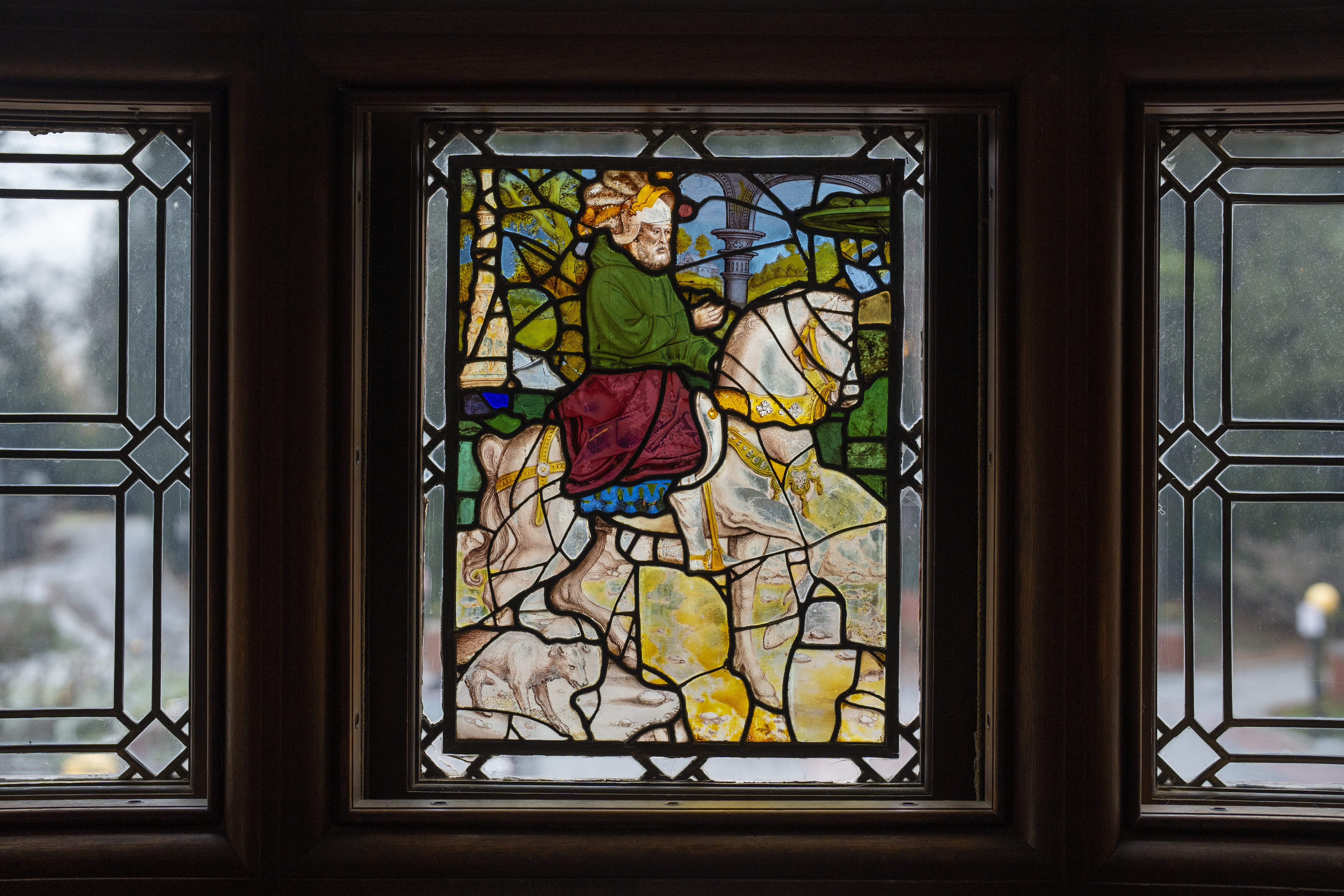
When you take the time to look, the windows of Cranbrook House are surprisingly varied. Some are leaded casement windows straight out of an Elizabethan manor house, others are modern sash windows, fitted with plate glass. A few rooms in the house enjoy a special distinction – their windows are fitted with inset panels of stained glass.
These stained-glass panels were a later addition to Cranbrook House. When first completed in 1908, the windows were all clear glass. It was only while pondering extending the house, in the latter half of the 1910s, that George Booth began purchasing stained-glass panels for his home. The most prominent stained-glass work in Cranbrook House is the 16th-century Flemish panel, depicting a man on horseback, placed in the main window over the staircase in the Reception Hall.
It was not part of the original design for the window, but added in 1922. That panel, and several others scattered throughout the house, were purchased from Thomas & Drake, an English firm specializing in historic glass.
Others, like the heraldic roundel in the library’s east window, were purchased by the Booths in Lucerne, Switzerland. There was some debate as to their final destination. George Booth wrote, in a letter to his son Henry, in March 1922:
They do not make an imposing collection but I think they are good and that everyone will like them – I did think I would let the [Detroit] museum [of Art] buy them at cost if they wished to begin to accumulate some historical glass, but your mother and Florence say no – they are to be put into the windows at Cranbrook but we will see.
(George Gough Booth to Henry Scripps Booth, 26 March 1922. Cranbrook Archives, George Gough Booth Papers.)
In the event, Ellen and Florence won out, and at least a few of the Swiss purchases made their way into the windows of Cranbrook House.
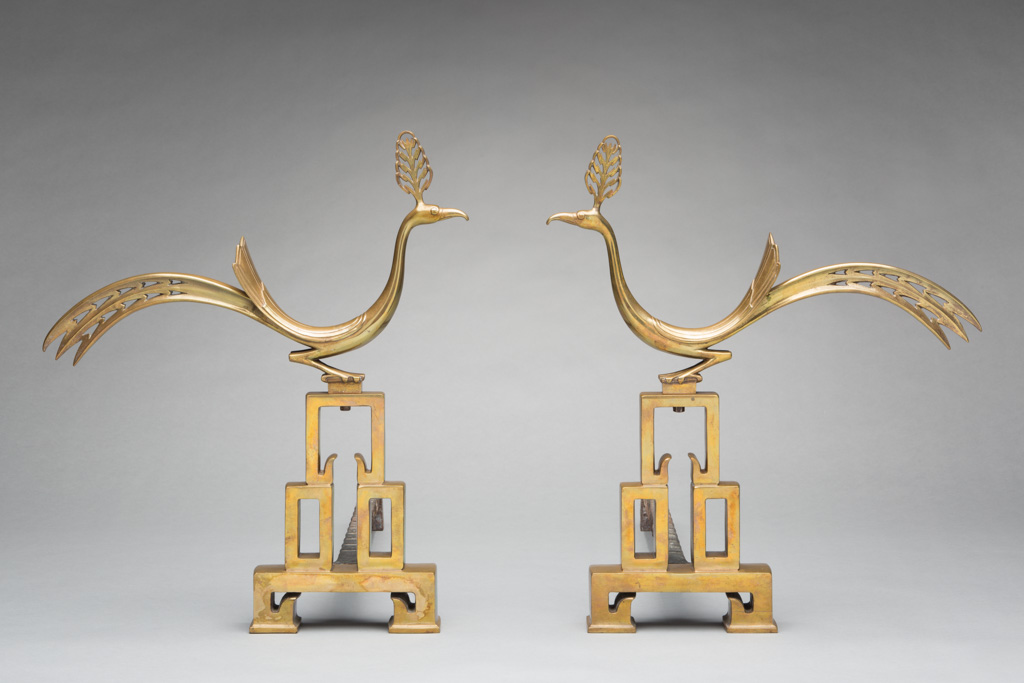
While researching the step-backed Peacock Andirons at Saarinen House last spring, I enthusiastically mustered a muster of peacocks from across Cranbrook’s campus with the generous help of my colleagues.
“Muster” is the official label for a group of peacocks.
Unlike a gaggle of geese, a muster of peacocks lacks both onomatopoeia and alliteration and implies a level of formality and regimental order in direct conflict with the species’ behavior! That is…judging by the peacocks I’ve witnessed at historic homes and castles throughout Europe, including a visit to Scone Castle in Scotland where an earlier visitor captured these free-spirited troops. Whether iridescent blue or albino, their graceful necks and distinctive crests rise to magnificence when tail feathers are splayed to attract a peahen mate or intimidate predators.
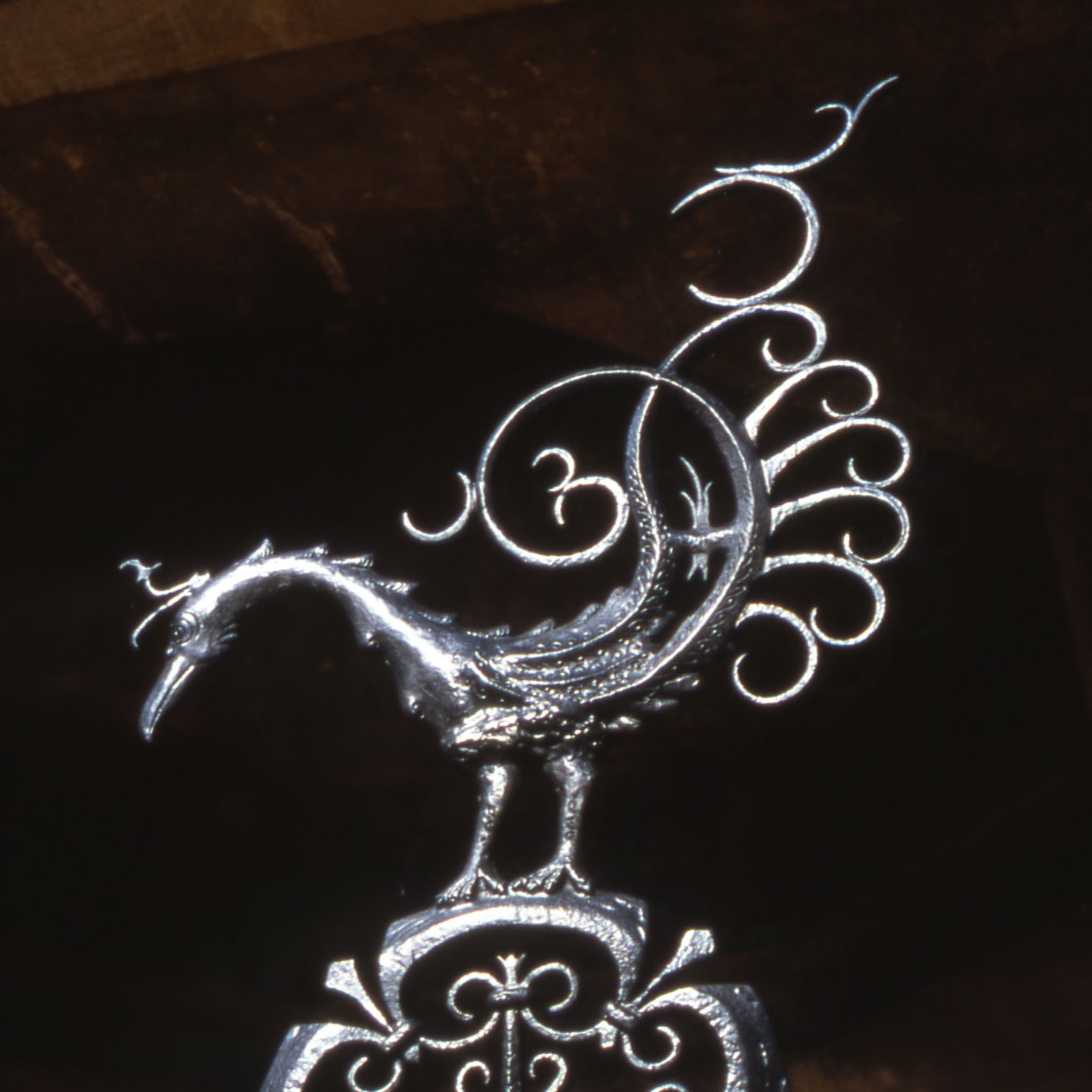
Throughout the ages, blue aka Indian peafowl have symbolized beauty and prosperity and served as sources of artistic inspiration. A favored theme at Cranbrook, the peacock’s dramatic curvilinear lines are represented at each institution across the campus.
One can discover…
WORKS IN METAL:
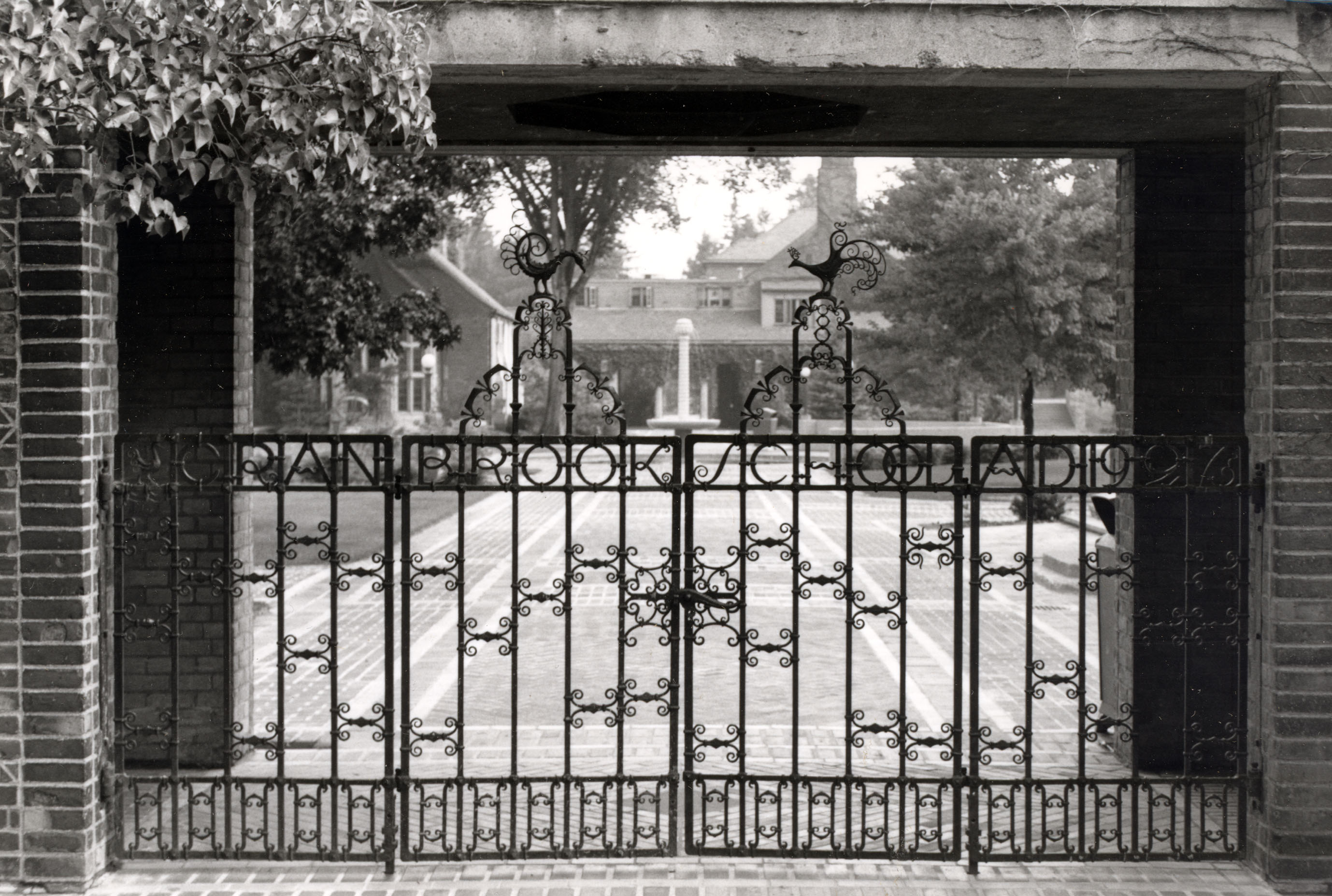
• The famed Peacock Gates designed by Finnish-American architect Eliel Saarinen and fabricated in wrought and cast iron by Oscar Bruno Bach, 1927, marking the former Lone Pine Road entrance to Cranbrook School for Boys:
Peacock Gates at Cranbrook School circa 1980. Jeffrey Welch, photographer. Courtesy Cranbrook Archives.
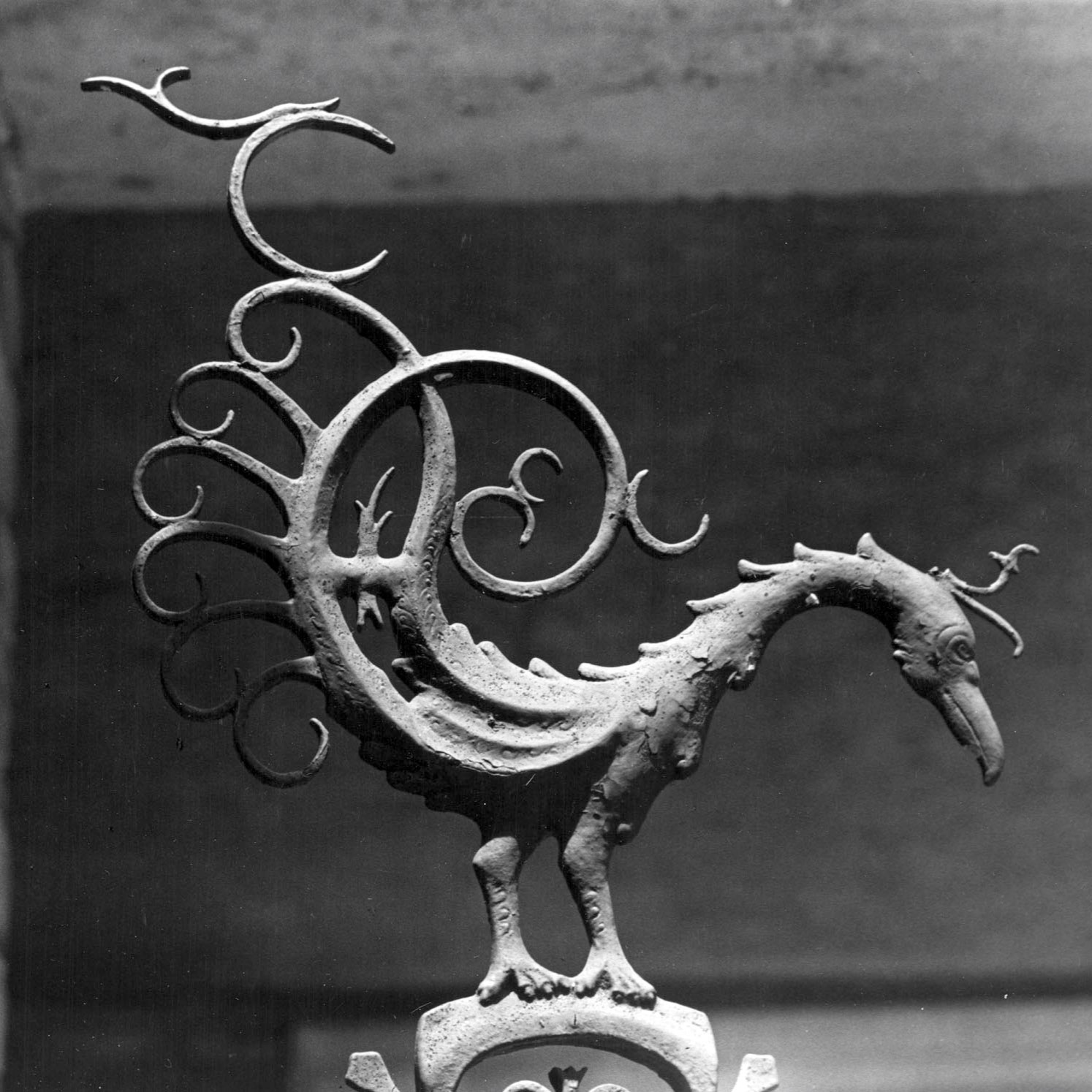
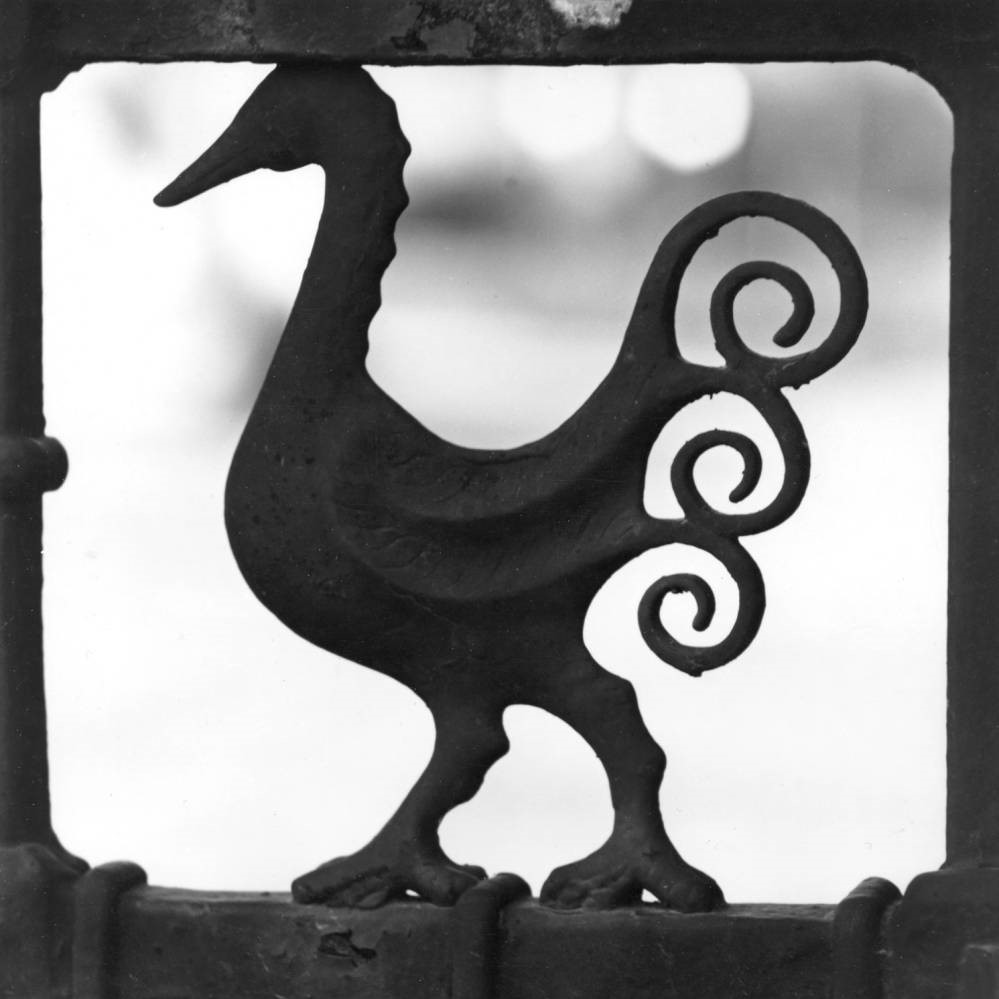
Details of the peacocks in cast iron:
Detail of Cranbrook School Peacock Gate, circa 1935. Courtesy Cranbrook Archives.
Detail of Cranbrook School Peacock Gate, circa 1935. Courtesy Cranbrook Archives.
Detail of Cranbrook School Peacock Gate, 2001. Balthazar Korab, photographer. Copyright Balthazar Korab | Cranbrook Archives.
• Eliel Saarinen’s cast bronze Peacock Andirons, 1928-29, on view at Saarinen House. Collection of Cranbrook Art Museum. Produced by Sterling Bronze Company, New York, between 1928 and 1929, these cast bronze andirons were paid for by the Cranbrook Foundation and entered in the 1928-1930 Arts & Crafts Building ledger on pages 40-41—Date: 1-7-30; No.: 515; Name: Sterling Bronze Co; Remarks: 1 pair/ Andirons for Saarinen Res[idence]; Amount: $152.50 (the equivalent of $2,704 in 2024):
Robert Hensleigh, photographer. Courtesy Cranbrook Art Museum.
From 1908 to 1919, the room we now call the Old Country Office was George Booth’s personal workspace in Cranbrook House, where he carried on managing his newspapers and met with the many farm employees, contractors, and artists involved in the operation and transformation of the estate. A side door leads directly into the entry vestibule, allowing outdoor workmen to come inside without tracking mud onto the hall carpeting.
George Booth’s tastes shaped the whole of Cranbrook House, but here in his own office we see a concentrated expression of his personal preferences in interior design. Yet, because it was also the space where George interacted with employees and colleagues, the office speaks not only to what George liked, but also to how he wished to be perceived.
George Booth’s office, photographed in 1910. Cranbrook Archives.
The office’s dark tones and simple, solid materials reflect the serious and businesslike side of George’s personality. The exposed timbers, wood paneling, and prominent fireplace all demonstrate George’s enthusiasm for historic English homes, and his pride in his own English heritage. Its furnishings – books, prints, and statuary – speak to his desire, despite his working-class background and his position as a newspaper manager, to be seen primarily as a sophisticated art lover.
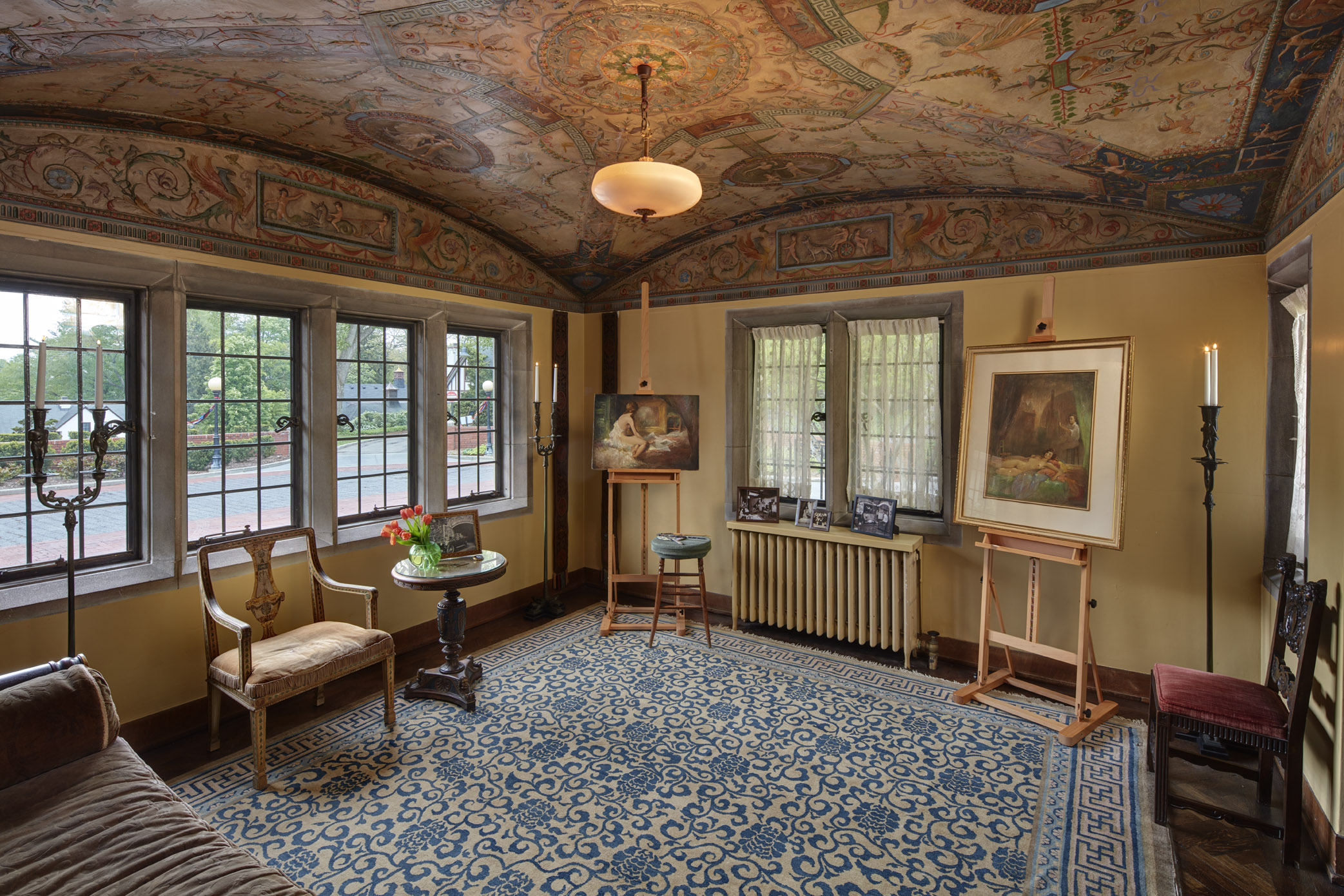
How different an impression of George’s personality we might form from the exuberant colors and rich textures of the Still Room! That space, wholly set aside for private relaxation, with its rainbow ceiling, walls hung with gold fabric, and violet velvet sofa (sadly faded now), reveals George’s inner aesthete. Yet both rooms, the luxurious Still Room and the somber office, tell us something about his character – specifically, how highly he valued the arts.
The Still Room at Cranbrook House, Summer 2023. Photograph by Jim Haefner.
In England in the 19th-century, a new school of thought about domestic design arose, which argued that the houses we live in do not just shelter us – they also shape us, emotionally, morally, and intellectually. Having a beautiful home with well-made furnishings could elevate the spirit, encourage thoughtfulness. Collectively, a community that dwelt surrounded by art would be a better society than one that lived without it. This ideal was embraced by the Arts and Crafts movement from its early days, and taken up by the Booths.
The mantelpiece in George’s Old Country Office, Cranbrook House. Photograph by Daniel Smith, CAA Architecture ’21.
George Booth once wrote, “A life without beauty is only half lived.” In his office, we can see how important it was to him to always be within reach of some great work of art or craftsmanship, even in the most ordinary moments of daily life. This same principle shaped the greater Cranbrook campus, for the benefit of all its community members.
— Mariam Hale, 2023-2025 Collections Fellow, Cranbrook Center for Collections and Research
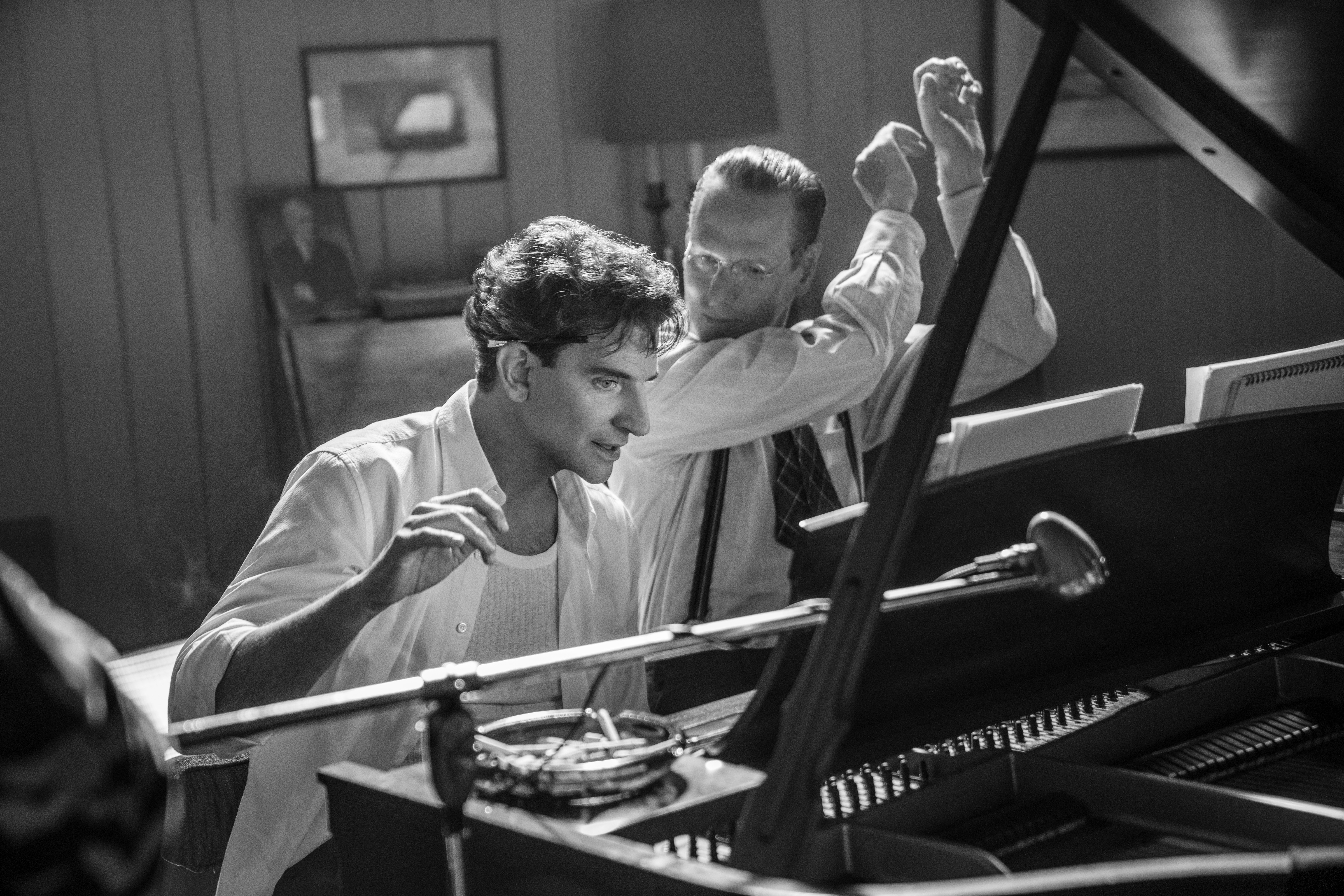
With Maestro now streaming on Netflix—and nominated for four Golden Globe Awards—it’s high time I set the record straight about the Cranbrook House Steinway Grand and its most famous pianist, Leonard Bernstein. It is a legendary story, told and retold for decades, that places Bernstein composing none other than his most famous work, West Side Story, here, at Cranbrook.
It is a story, however, that is hard to unravel fact from fiction. So, like all Center historians and archivists, I started by doing some digging in Cranbrook Archives. This is the story I uncovered.
Cranbrook has several Steinway grand pianos, including two of the grandest: a Model D concert grand in Page Hall on the original School for Boys campus, and a second Model D in the Cranbrook House Library. The Cranbrook House concert grand piano was manufactured by Steinway & Sons of New York City and completed a little more than eighty-five years ago on December 18, 1929. It was purchased by Grinnell Brothers of Detroit in January 1930 and, later that year, sold to the Colony Town Club, a women’s club located on East Jefferson Avenue in Detroit.
Cranbrook House library facing south. Steinway & Sons Model D Concert Grand piano sits below the “Story of Ceres” tapestry, March 1957. Photographer Harvey Croze. Courtesy of Cranbrook Archives.
Enter, George Booth
The black concert grand piano was to have a short life at the Colony Town Club. Within a few years, its members sold it back to Grinnell Brothers where, in February 1935, it was purchased by George Booth. I remain intrigued by the fact that Booth purchased a “pre-owned” piano. While America was in the throes of the Great Depression, I think it was more than a simple cost-saving measure; it was a decision warranted by the piano’s intended use.
The piano did not begin its life at Cranbrook in the Booths’ Library, the center of their social life after it was completed in 1919. Rather, Booth first placed the piano in the main hall of the Cranbrook Pavilion on Lone Pine Road. Known today as St. Dunstan’s Playhouse, in 1935 the recently renovated pavilion was being used as an exhibition gallery and event space for the Academy of Art and its nascent Art Museum. The piano was played at exhibition openings and for preludes before lectures, including at least one by Frank Lloyd Wright. Although St. Dunstan’s Guild began using the pavilion in 1937 for rehearsals and storage, Cranbrook Academy of Art continued to hold exhibitions there until 1942, when the new Eliel Saarinen-designed museum opened.
Cranbrook Pavilion staged for an Academy of Art formal party, January 16, 1936. In the center is what would become known as the Cranbrook House Steinway concert grand piano; in the background is the Cranbrook Map Tapestry, designed by Eliel Saarinen and woven by Studio Loja Saarinen in 1935. Courtesy of Cranbrook Archives.
Sometime between 1942 and the summer of 1946, when the pavilion was cleared out and rented by the Cranbrook Foundation to St. Dunstan’s Guild, George Booth moved the Steinway down the road to Christ Church Cranbrook “to protect the instrument from damage by dampness or other causes and to give it the benefit of expert use.” It was also during this period, in March 1944, that George and Ellen Booth formally deeded to the Cranbrook Foundation the Homestead Property, which encompassed not only Cranbrook House but also the forty acres adjacent to the house, including the Cranbrook Pavilion and its Steinway.
George G. Booth’s “Old Country Office” at Cranbrook House. Photograph by Kevin Adkisson.
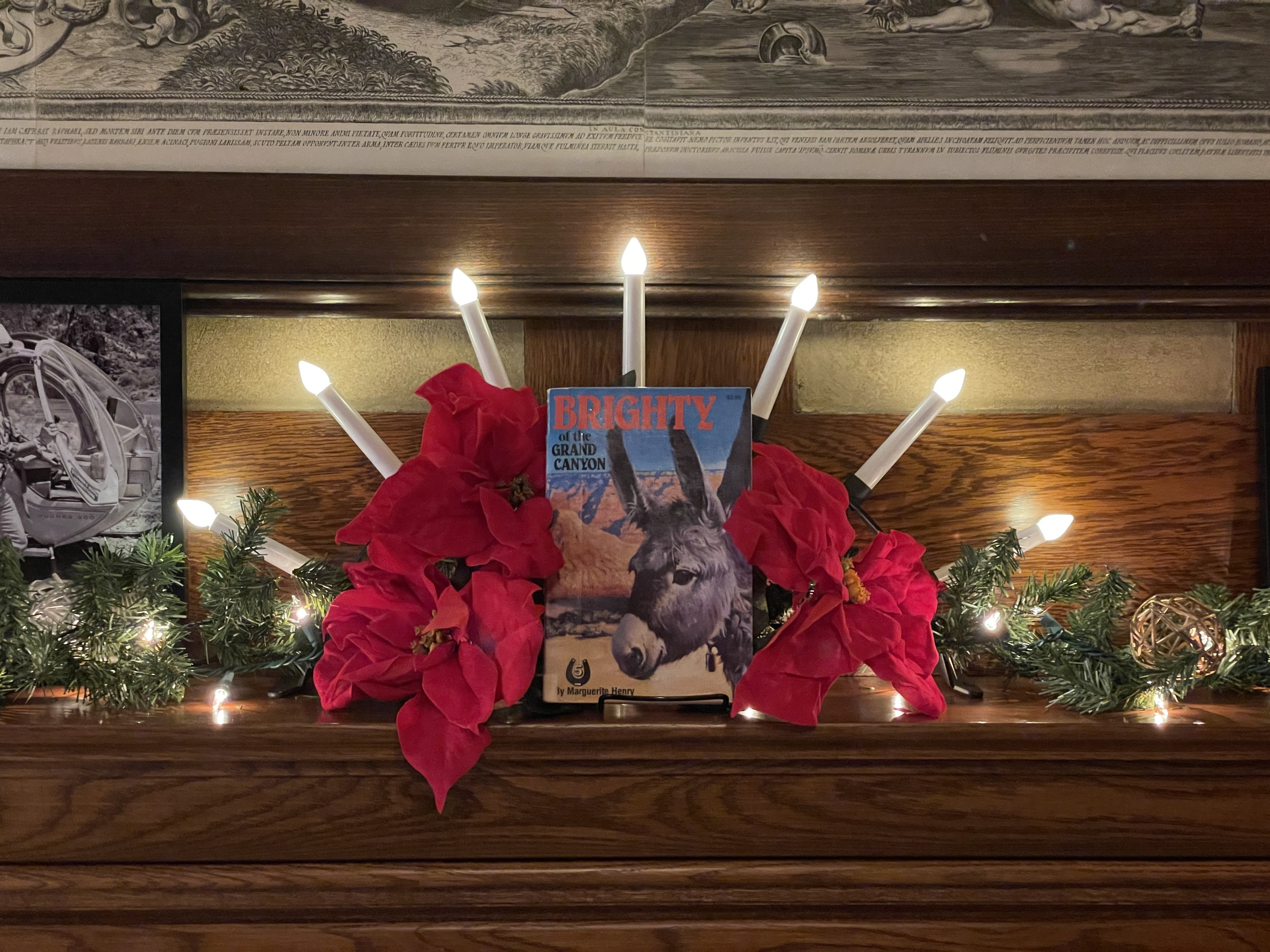
Every year at Christmas, the Center for Collections and Research decorates George Booth’s office in Cranbrook House with a special display. This year, our Christmas display is all about Brighty of the Grand Canyon, a movie produced by Stephen Booth, a grandson of Cranbrook’s cofounders. Brighty was a real donkey who inspired first a children’s novel, then a feature film.
In the late 1800s, there were hundreds of half-wild donkeys in the Grand Canyon, brought there by prospectors and then lost or abandoned. Brighty was one of them.
Photograph by Kevin Adkisson.
Brighty lived in the Grand Canyon from 1892 to 1922. In the winter, he roamed the warm depths of the canyon. A sociable animal, he liked the company of prospectors, hunters, and hikers, but if anyone loaded a heavy pack on his back he would soon make his escape. Every summer, he returned to the North Rim to stay with the McKee family who rented cabins to tourists. He would carry water, give children rides, and visit each cabin in turn for attention and treats—his favorite food was flapjacks and honey.
In 1953, the author Marguerite Henry learned about Brighty, and immediately decided to base her next novel on him. In search of more stories about the adventurous donkey, she travelled to the Grand Canyon herself, where she interviewed locals who had known him, hiked in the canyon, and even sampled the creek water and tasted the plants that Brighty would have eaten! She adopted her own donkey, Jiggs, to learn from him how the real Brighty might have behaved. In Brighty of the Grand Canyon, a free-spirited donkey helps solve a murder mystery and protects his human friends from a dangerous bandit.
This is the 1963 edition of the novel, the same year that the Booths bought a copy to read on their family road trip. Photograph by Kevin Adkisson.
Stephen Booth and his wife Betty bought a copy of the book to read to their children, Douglas, Charles, and George. They all loved the story, especially Stephen, who had his own film production company, and decided to make a movie about Brighty.
Filming began in 1965, with Marguerite Henry’s own pet donkey, Jiggs, starring as Brighty. Filmed on location at the Grand Canyon and in the Dixie National Forest in Utah, the actors and crew spent weeks living in the canyon. A tiny helicopter and an airplane with a camera mounted on the front were used for aerial shots, and for flying special visitors, like Stephen’s parents, Henry and Carolyn Booth, down into the canyon.
Norman Foster, the film’s director, reviews the script with Jiggs the Donkey. Stephen Farr Booth Papers, Cranbrook Archives
The movie premiered on November 22, 1966, just down the road in Birmingham, doubling as a fundraiser for Kingswood School for Girls. As the star of the movie, Jiggs himself came along to the premiere. Afterward, he participated in the Festival of Gifts at Christ Church Cranbrook, an annual Christmas tradition that began in 1928 and continues today.
From left to right: Betty Booth, Stephen Booth, Marguerite Henry, and Jiggs greet children at the film’s premiere. Stephen Farr Booth Papers, Cranbrook Archives.
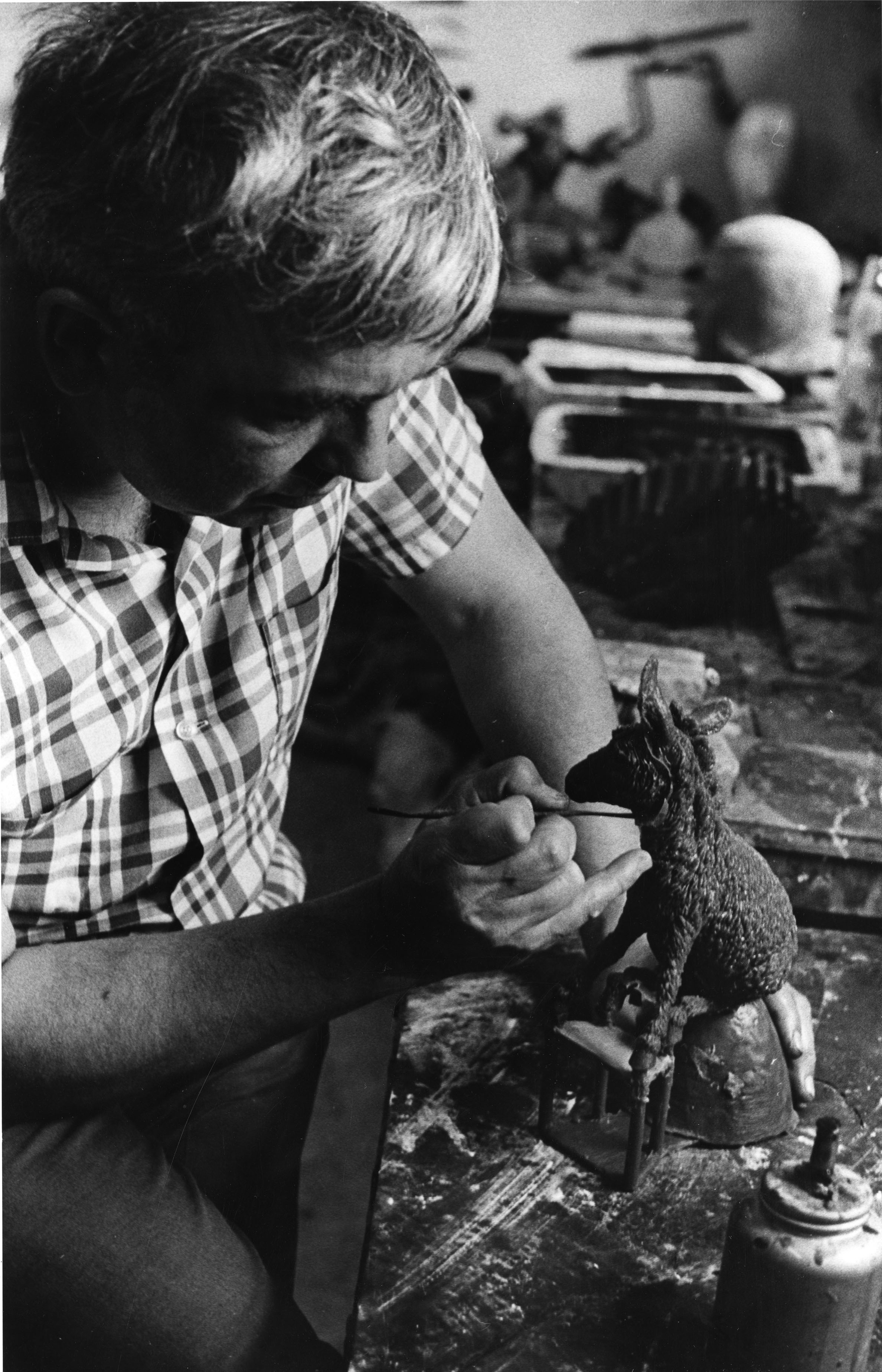
While Brighty was visiting Bloomfield Hills, he also posed for a series of sculptures by Peter Jepsen. They were modelled here at Cranbrook, on the second floor of Thornlea Studio. We still have one of the sixty Brighty figurines that Stephen Booth had made to give as presents to people who had helped in the making of the movie. Our Brighty was given to Stephen’s parents, Henry and Carolyn, to thank them for their support.
Photograph by Kevin Adkisson.
Peter Jepsen at work on Brighty in Thornlea Studio. Stephen Farr Booth Papers, Cranbrook Archives.
Stephen also commissioned Jepsen to make a life-size sculpture of Brighty. In 1968, Stephen gave that version to the Park Rangers at the Grand Canyon as a Christmas present. You can still see Jepsen’s Brighty at the visitor’s lodge on the North Rim of the Canyon, close to where the real Brighty spent his summers, more than a hundred years ago.
Peter Jepsen poses with his sculpture at the lodge on the North Rim of the Grand Canyon. Stephen Farr Booth Papers, Cranbrook Archives.
— Mariam Hale, Collections Fellow, Cranbrook Center for Collections and Research
Ed. Note (July 17, 2025): It appears the Dragon Bravo wildfire has severly damaged the original Brighty statue at the the lodge on the North Rim of the Grand Canyon. https://www.facebook.com/share/p/1CDkSfoutX/
Please know that the Cranbrook Center for Collections and Research will do everything it can to support efforts to restore or replace Brighty,
People of a certain age will remember listening to American Top 40 on the radio. Detroiter Casey Kasem offered an opportunity for listeners to give “long-distance dedications,” requesting a song for a loved one, a friend, or if they themselves needed cheering up.
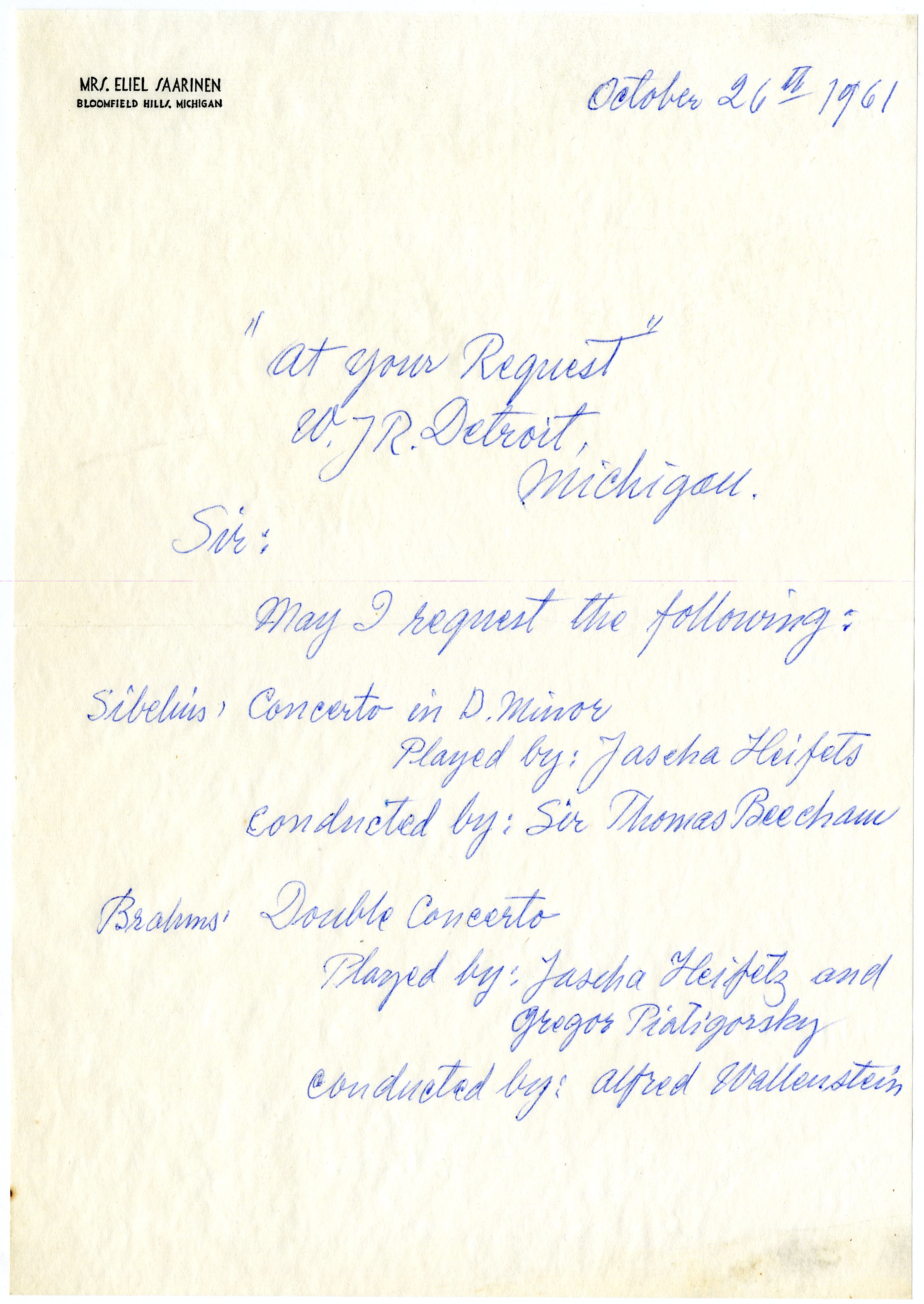
Loja Saarinen’s letter to WJR on October 26, 1961. Saarinen Family Papers, Cranbrook Archives.
Loja Saarinen wrote this note to the programers at WJR in Detroit, asking them to play two songs. Though she did not send this note to Casey Kasem, I imagine what Loja Saarinen’s words may have been if she had in October of 1961. On September 1, 1961, Eero Saarinen had died during surgery for a brain tumor:
Dear Casey,
I recently lost my son at far too young an age (51). He was overseeing the completion of a new music building for the University of Michigan School of Music, Theatre & Dance and our family so loved music. Casey, could you kindly play Concerto in D Minor by my good friend and fellow Finn Jean Sibelius?
Yours, Loja
Well, Loja, here is your long-distance dedication, Sibelius’ Concerto in D Minor played by Jascha Heifetz and conducted by Thomas Beecham.
London Philharmonic Orchestra London, 1935
If you’d like to make your own dedication, no need to be long-distance. Chamber Music in the Age of Resistance: Finland, Korea, Haiti and America, and France is being presented by Cranbrook Center for Collections and Research, in Collaboration with the University of Michigan “Art & Resistance” Fall 2023 Theme Semester, on Sunday, November 12th, 2023 at Cranbrook House.
Please join us for the concert and remember, as Casey Kasem said, “keep your feet on the ground and keep reaching for the stars.”
– Leslie S. Mio, Associate Registrar, Cranbrook Center for Collections and Research
The Center has made a new film! As part of our recent gala fundraiser, A House Party at Two Cranbrooks, we worked with Elkhorn Entertainment & Media to produce a short documentary about the Booth family’s connections between England and Michigan. Today, we are excited to share the film with the wider world! Watch the film below, or here.
A Tale of Two Cranbrooks
Now that you’ve seen the new documentary, I thought I’d invite you “behind-the-scenes” into how A Tale of Two Cranbrooks came together.
Cinematographer Josh Samson and producer Vince Chavez film the Booth-made tea kettle in Cranbrook House. April 6, 2023. Photograph by Nina Blomfield.
As with all Center projects, I started work on the film in Cranbrook Archives. The Booth family records are extensive, and with our archivists Deborah Rice and Laura MacNewman, I spent several afternoons consulting documents (letters, photographs, manuscripts, scrapbooks, etc.) assembled by many generations of Booths to learn the family story. Henry Wood Booth’s handwritten The Annals of Cranbrook were especially helpful.
Detail of a postcard of Cranbrook, Kent with handwritten notes by Henry Wood Booth, from The Annals of Cranbrook manuscript, 1914. Cranbrook Archives.
Then, through the support of Bobbi and Stephen Polk and Ryan Polk, I travelled to England! I visited Cranbrook, Kent, spending time at Cranbrook Museum and Archives and at Cranbrook School. (You can watch a walking history tour I did in Cranbrook, Kent, here and learn more about the Booth family and my trip to England in my virtual lecture, Uncovering Cranbrook: Two Pilgrimages to Kentish Cranbrook.)
My three weeks at the Center for Collections and Research have been an exhaustive tour of all the activities and responsibilities of maintaining Cranbrook’s history. From getting ready for the annual House Party, scanning historical documents, and cleaning the Smith House in preparation for summer, being a member of this community requires one to wear many hats to preserve its history.
Scrubbing the Frank Lloyd Wright Smith House in Bloomfield Township. Photo by Leslie Mio.
During my first week with the Center, I entered into the great anticipation of the annual House Party fundraiser. With this year’s theme involving Cranbrook’s influences from England, many of my projects involved making Cranbrook House a better fit for this theme. As favors for the guests, I assembled nearly 300 pastry boxes to fill with scones and other iconic English treats like tea and marmalade.
My collection of pastry boxes from my week at Cranbrook House. Photo by Grace Quinn.
Following the party, I helped scan many folders of documents from the Archives on George G. Booth and his involvement with the Detroit Arts and Crafts Society and with renowned architect Albert Kahn. Although I knew very little about the Arts and Crafts movements, I came to a much stronger understanding of how the Booths focused much of their wealth and influence on buying and displaying handcrafted goods.
These were not just shows of wealth but were a way of honoring the artisans who built this campus and saying, without words, that a quality place like this will withstand much more than inhuman, mass-produced art and furniture. Even though this notion is not new, rising technological advances seem to only make cheapness and speed priorities in design, rather than beauty or emotional value. The art of patience and supporting artists is a refreshing notion compared to the on-demand nature of online shopping and rampant consumerism.
While scanning documents from the George G. Booth Papers was my main Archives project, I also got to work with architectural drawings of Glen Paulsen from the 1950s. Photo by Deborah Rice.
When reflecting on what I had learned during this internship, I realized that before this I had never given much thought to how this campus came to fruition. I knew that some famous architects built it, but as I scanned archival documents and helped maintain Cranbrook’s houses, I can now fully realize the cultural influence Cranbrook has had in Detroit’s history.
Cranbrook’s inspiration stretches across borders and countries; it has a prominent space in contemporary architecture and in the earlier Arts and Crafts Movement. Cranbrook’s exercises in art and design are on display to inspire others to emphasize detail, quality, and creative talent in designing schools and creating diverse communities.
—Grace Quinn, Cranbrook Kingswood Upper School 2023
Editor’s Note: The Senior May Project is a school-sponsored activity that encourages Cranbrook Kingswood Upper School seniors to acquire work experience in a field they are considering as a college major, a potential profession, and/or as a personal interest.
Grace’s efforts in making A House Party at Two Cranbrooks a success, her can-do attitude, and her flexibility in tackling projects large and small were much appreciated by the Center staff. We wish her luck as she heads to the Rochester Institute of Technology’s College of Art and Design in the fall!


















 Cranbrook Kitchen Sink