Discovering the University of Michigan in the collections of Cranbrook Archives

In October, the University of Michigan Osher Lifelong Learning group visited Cranbrook for a lecture, luncheon, and tours of our historic houses, the Art Museum, and Cranbrook Archives. In gathering materials related to the university, I found that my growing archival display began to tell a wonderful story of the early relationship between the Booth family and the University of Michigan, predominantly between 1918 and 1924. The story begins with the friendship of George Booth and Emil Lorch.

Born in Detroit in 1870, Lorch had studied at MIT and Paris, before graduating Master of Arts at Harvard in 1903. In 1906, he arrived at the University of Michigan to establish the School of Architecture, which remained a unit of the School of Engineering until 1931. The correspondence between Booth and Lorch covers a manifold of topics over many years.
 

On January 11, 1918, George Booth gave an address to the students of the departments of Journalism and Architecture at the university, entitled The Spirit of Journalism and Architecture which focused on the development of the Detroit News business and the new News building, which had been recently completed.
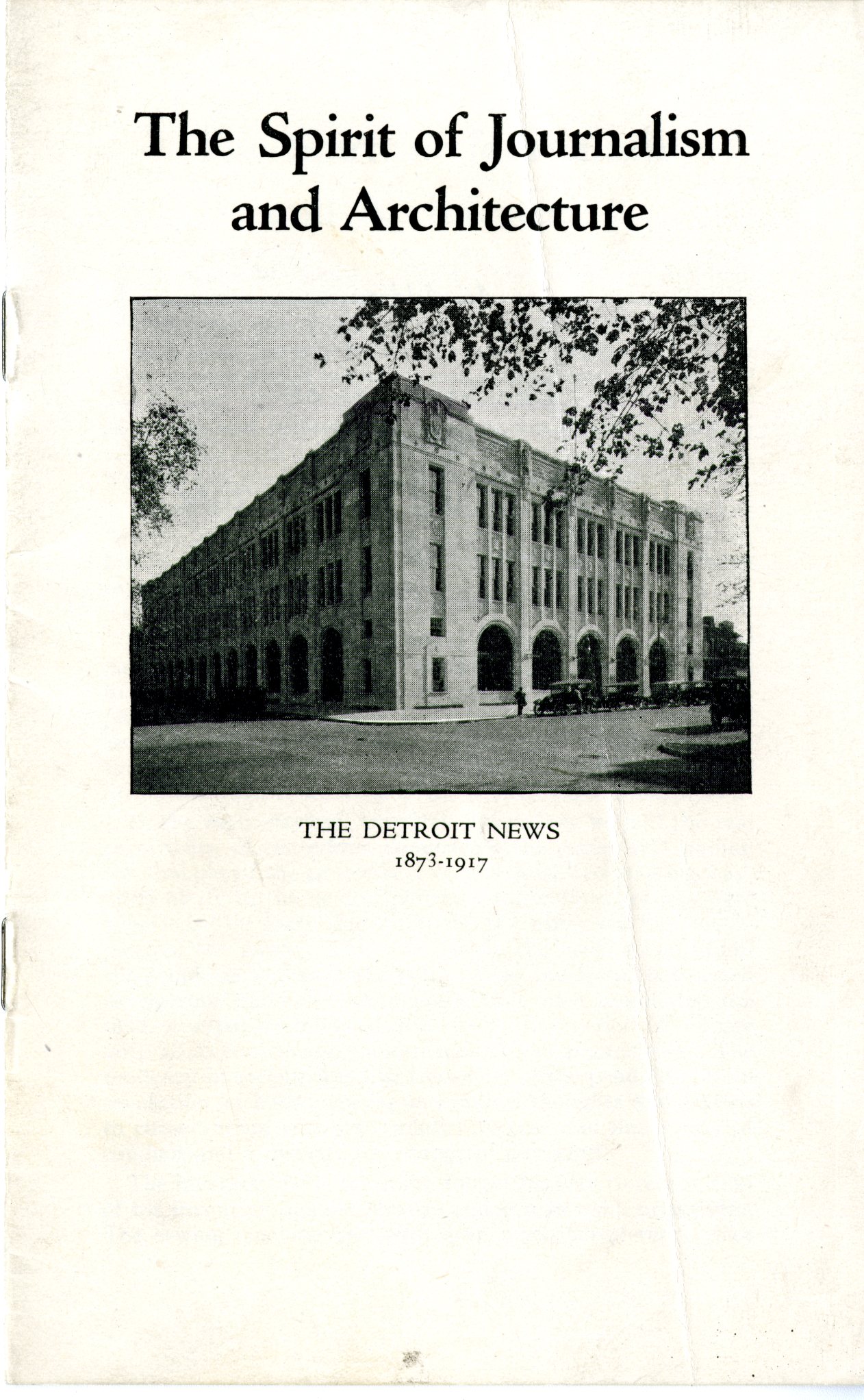
1981-01 1-19

Program for an address, The Spirit of Journalism and Architecture, delivered by George Booth at the University of Michigan, January 11, 1918. Copyright Cranbrook Archives.

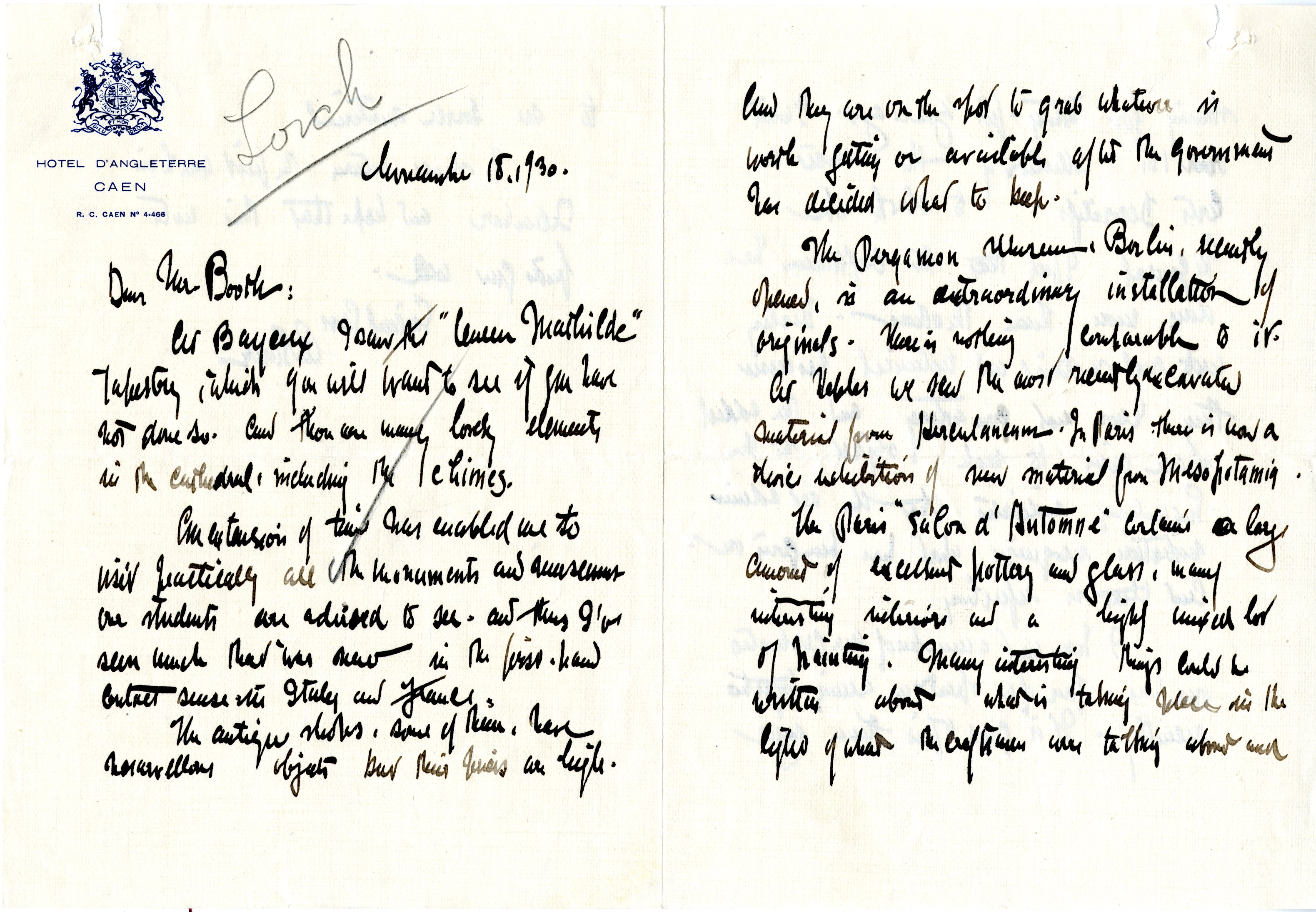
Later that year, in October, George’s son, Henry Scripps Booth began his studies in architecture at the university. It was there that he met J. Robert F. Swanson, with whom he traveled Europe for ten months beginning in June 1922, and later established the architectural practice Swanson and Booth between 1924 and 1926. Henry took with him letters of endorsement to help facilitate access to architectural treasures on their journey, including one from Professor Lorch:
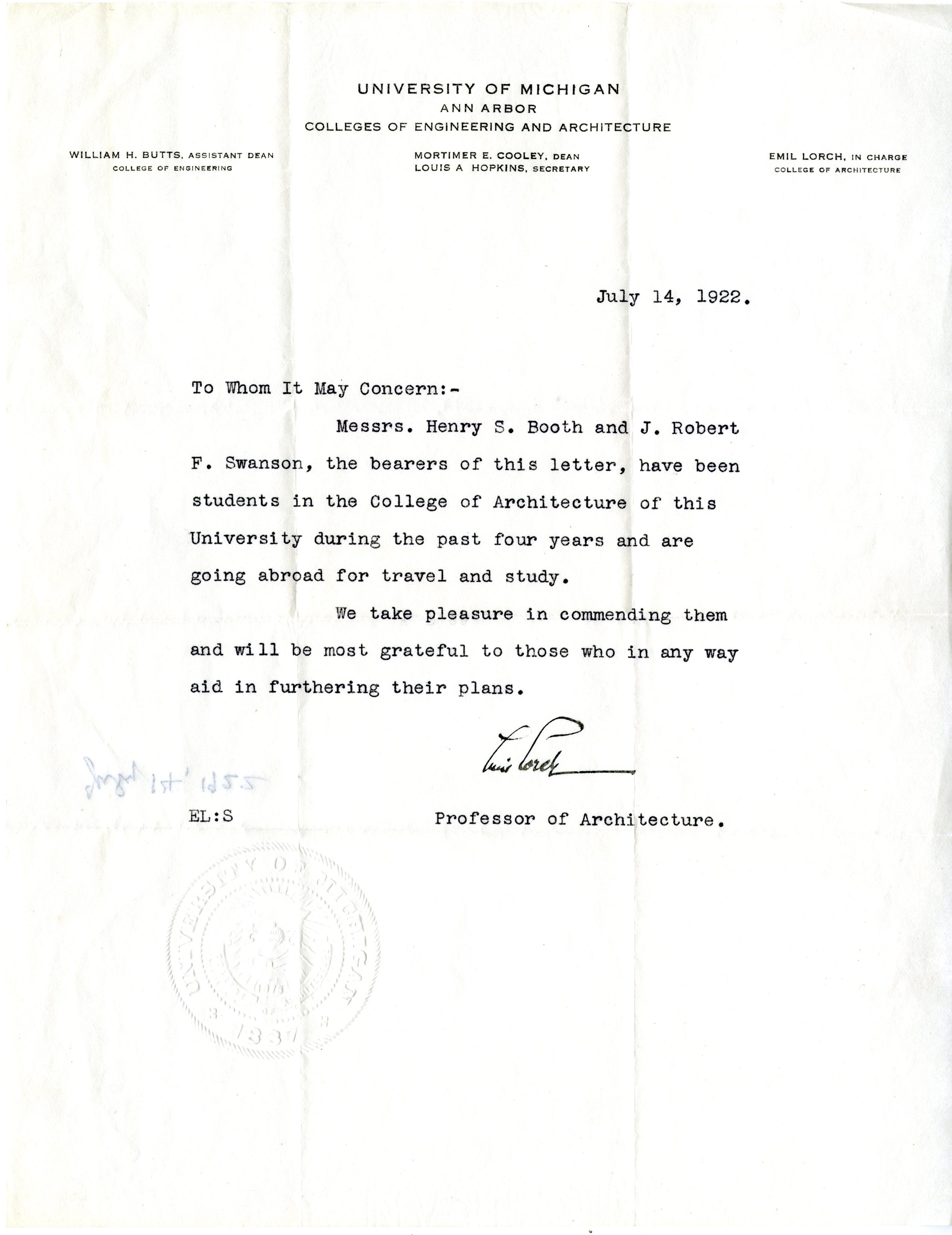
1982-05 5-7 EL

Letter of introduction for Henry Booth from Emil Lorch, July 17, 1922. Courtesy Cranbrook Archives.

Eliel Saarinen arrived at the University of Michigan as a Visiting Professor at the invitation of Emil Lorch the next year, staying from September 1923 through 1925. To extend a warm welcome, Henry wrote, costumed, and performed in a pageant in honor of Saarinen. Many of Henry’s classmates performed in the pageant, including Ralph Calder and J. Robert F. Swanson, who also designed the program. The event took place on December 8, 1923, in the Michigan Union ballroom. Many of the members of the Michigan Society of Architects and the Michigan branch of the American Institute of Architects were present. During the dinner, George G. Booth made the principal address of welcome to Eliel.
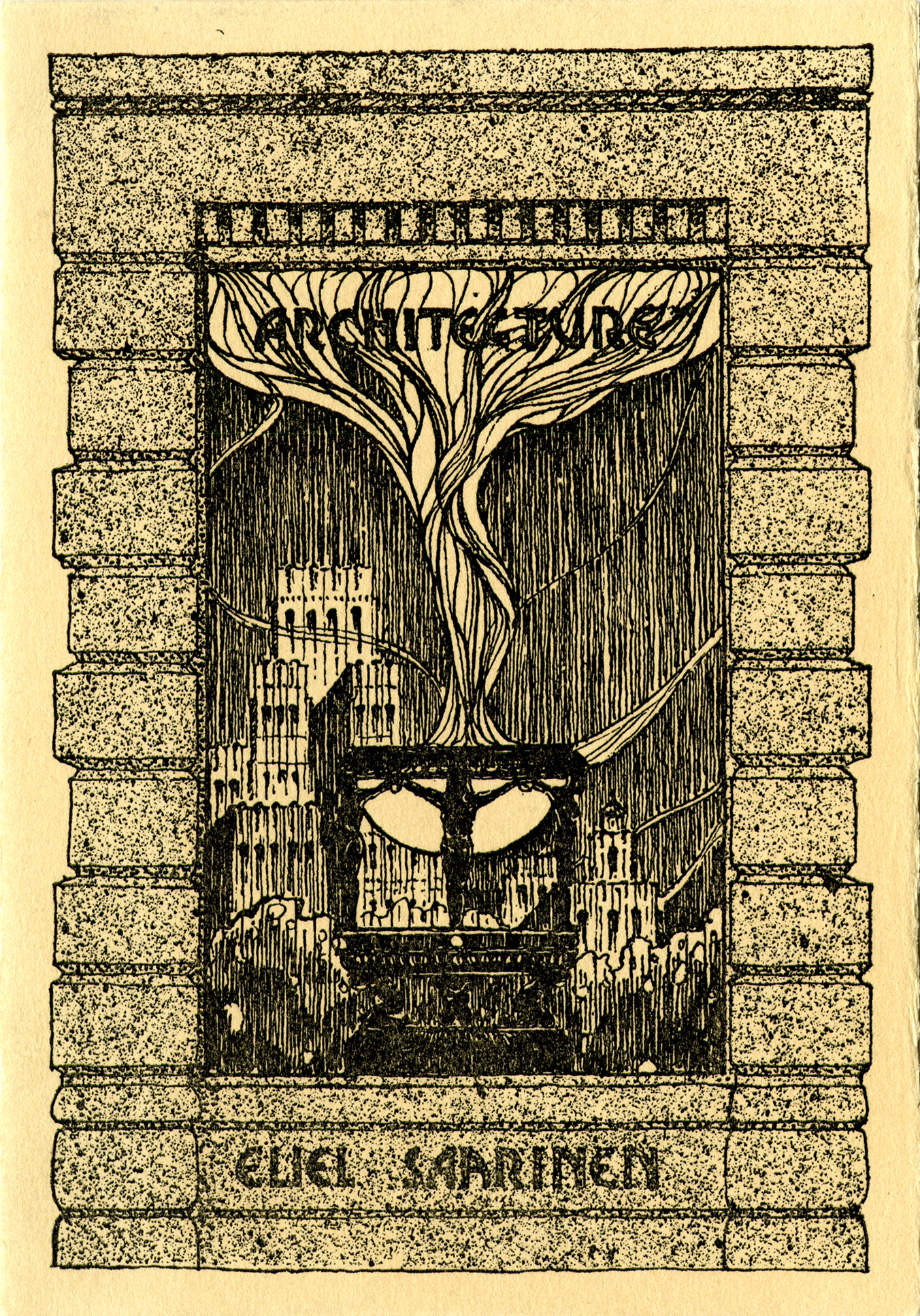
1990-08 1-14 cover

Program for A Pageant of Arts and Crafts, a Reception for Eliel Saarinen, program design by J. Robert F. Swanson, December 1923. Courtesy Cranbrook Archives.

1990-08 1-14 p2

Interior of the program. Courtesy Cranbrook Archives.

Henry and Robert graduated from the University of Michigan in 1924. Graduating with them was Ralph Calder, who was also one of the first two students to win the George G. Booth Traveling Fellowship, with which he traveled to England, France, and Italy. The fellowship continues to this day. Calder was among the original staff of the Cranbrook Architectural Office, working on Cranbrook School and Thornlea House. He later went on to design many buildings for colleges and universities in Michigan, including Michigan State University, Western Michigan University, Wayne State University, Hope College, and Hillsdale College.

1981-01 13-20 p1

Letter concerning the Booth Traveling Fellowship from the first recipient Ralph Calder to George G. Booth, June 12, 1924. Notice the Michigan logo on the letterhead. Courtesy Cranbrook Archives.

In another Cranbrook connection, Ralph Rapson submitted a Fellowship entry in 1938, and, while he didn’t win, his submission impressed Eliel Saarinen so much that Rapson was given a scholarship to the Art Academy.
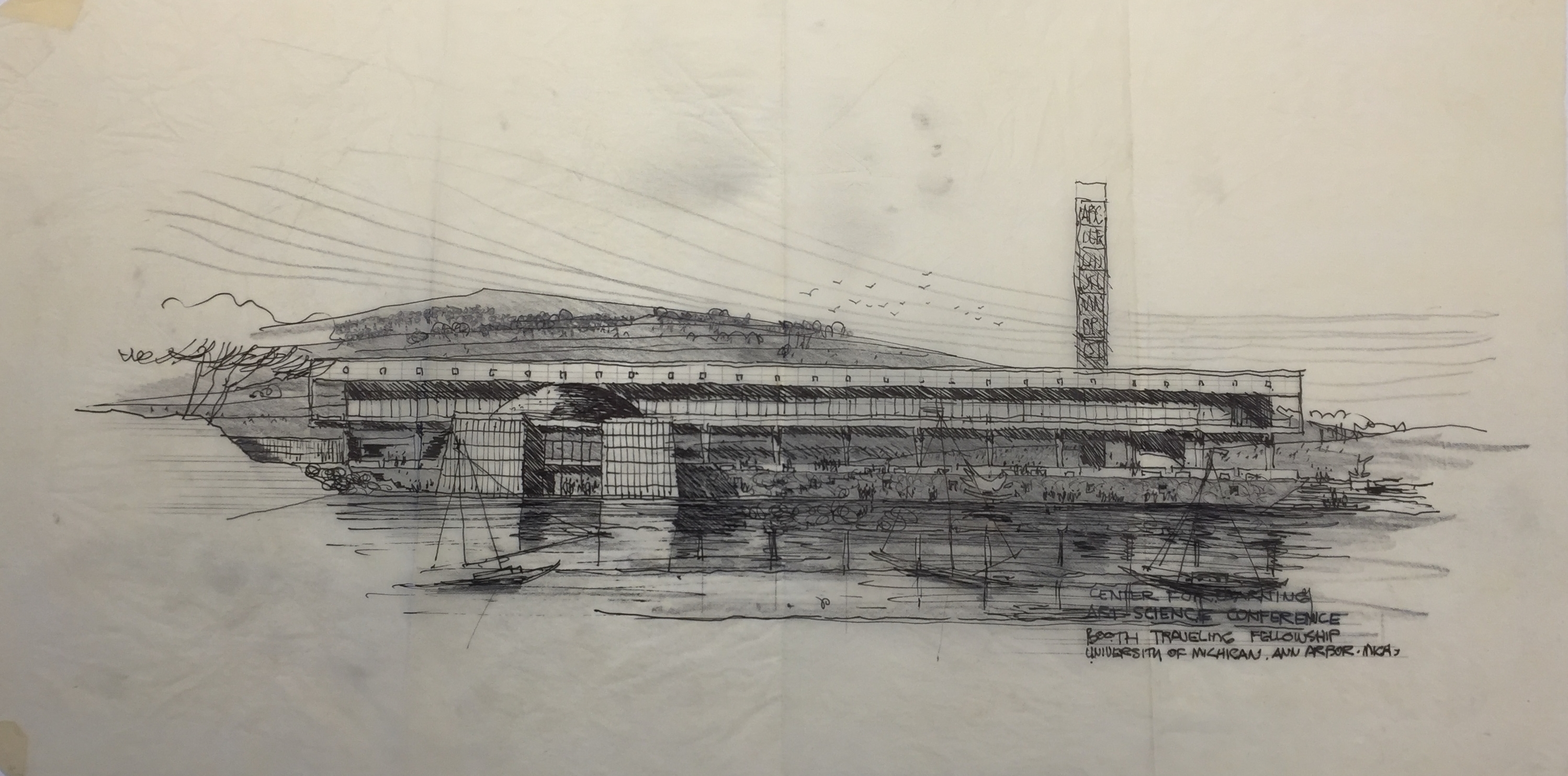
AD.26.01.03

Ralph Rapson’s submission to the George G. Booth Traveling Fellowship, AD.26.01.03. Ralph Rapson Architectural Drawing Collection, Cranbrook Archives. Gift of Rip Rapson.

There is much more in our collections about the University of Michigan; this post has selected items covering only the early years. In preparing for the Osher tour, I realized that, while the contents of processed archival collections remain the same, what we find in them depends on the question being asked. The collections of George G. Booth, Henry S. Booth, the Cranbrook Foundation, Swanson Associates, Inc. are among the most highly used and yet there is always something new to learn, something wonderful to discover.

— Laura MacNewman, Associate Archivist
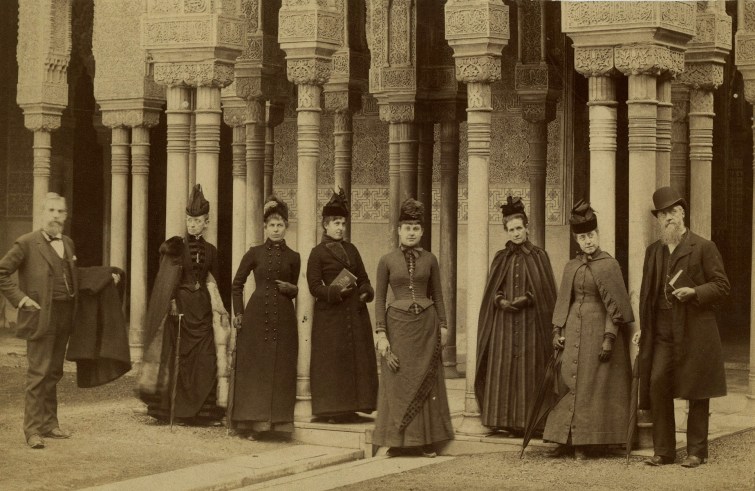
Hats in the Alhambra

After a long illness in 1886, Ellen Scripps Booth’s father James Edmund Scripps (1835-1906) retired from his work life in the newspaper business (he had founded Detroit’s The Evening News in 1873). James spent two years recuperating and traveling in England and continental Europe with his wife Harriet and their children. The family visited Scripps cousins and traveled with some of his twelve siblings and their children. James, who had become interested in architecture (particularly church architecture), spent many hours sketching at the locations they visited.

CEC4406

Scripps family members at the Courtyard of the Lions at Alhambra, Granada, Spain, November 1888.  From left: William Armiger Scripps, Ellen Browning Scripps, Eliza Virginia Scripps, Grace Locke Scripps, Florence May Scripps, Harriet Messinger Scripps, Anna Virginia Scripps, James Edmund Scripps. Courtesy Cranbrook Archives.

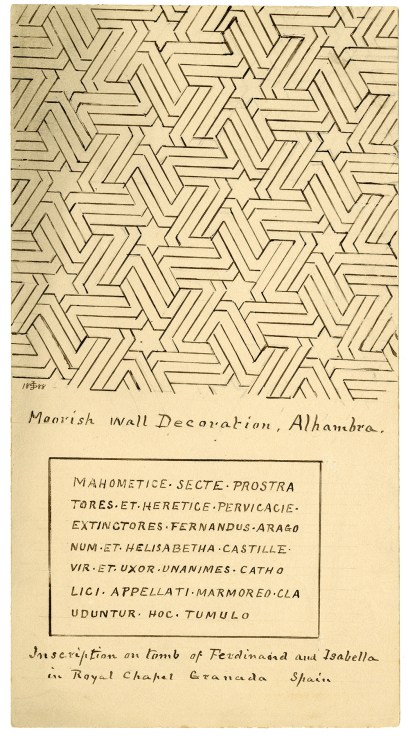
James Edmund Scripps sketched exterior wall decoration at Alhambra, below. Notice how closely it matches the wall in the photograph.

Moorish darwing043

In the picture at the Alhambra, take a look at James’s sister second from the left: Ellen Browning Scripps. Ellen was a publisher for The Evening News and wrote a daily column, nicknamed “Miss Ellen’s Miscellany” that rehashed local and national news in a conversational tone. She even sent dispatches back to Detroit from Europe. Shortly after their trip to Europe and well-hatted visit to the Alhambra, the Scripps siblings had a bit of a falling out: she and another brother headed to California, where she eventually founded many important educational and philanthropic organizations in the San Diego area.

If you want to hear more about Ellen Browning Scripps and the Scripps siblings, the Cranbrook Center for Collections and Research is hosting a lecture and book signing with Molly McClain on Sunday, November 12thEllen Browning Scripps: New Money and American Philanthropy  is a new book by Dr. McClain, Professor of History at the University of San Diego. To learn more about the lecture and to purchase tickets, click here. Books are also available to purchase through the Center.

–Cranbrook Center for Collections and Research


Photo Friday: “Things Architectural”

In November 1932, Cranbrook Academy of Art’s Executive Secretary, Richard Raseman, invited architects from the Detroit area to come to Cranbrook for “dinner and discussion of things Architectural.” The following Cranbrook School news article describes the evening.


Architectural

“Architects Gather Here for Forum,” The Crane, 20 Dec 1932

In addition to Raseman, Eliel Saarinen, Albert Kahn, and Emil Lorch, attendees included former Kahn associate Ernest Wilby and Ralph Hammett.

Leslie S. Edwards, Head Archivist


Phenomenologically Speaking

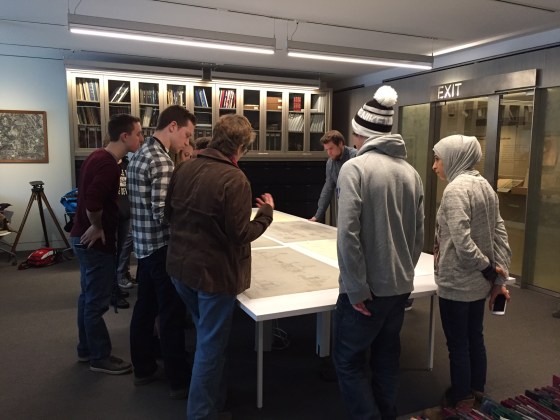
Ok, so I have to admit, I had no idea what the term “phenomenological” meant until yesterday when the Archives was host to a group of architecture students from Lawrence Technological Institute. Phenomenology was defined by the German philosopher Edmund Husserl as the philosophical study of the structures of experience and consciousness. So how does this fit in with architecture? Well, the idea that we experience architecture with all of our senses does seem perfectly logical and of course Cranbrook is a perfect example of that.

The two buildings the students focused on were the Cranbrook School Dining Hall and the Natatorium. If you have ever walked into either of those spaces, you can absolutely understand the phenomenological experience – the dining hall with its’ high vaulted ceilings, the Orrefors glass pendant light fixtures, and the 12 foot leaded glass windows that line the walls and throw patterns of light across the room – all of these contribute to both our visual and non-visual senses as we experience the space.

image2

Head Archivist, Leslie Edwards, discusses drawings with LTU students.

The Natatorium illustrates this concept even more dynamically. The complex use of materials – glazed exterior and interior brick, concrete block interior walls, the gray stone pool deck, the hand-glazed tiles in the locker rooms, and the use of mahogany for the walls, railing, and vertical louver panels – all contribute to the total sensation of the space. Add to that the windows that look out to the woods and the ceiling oculi that open up to the sky and you definitely experience phenomenology.

So thanks LTU students for teaching me something new when you came to the Archives to look at the architectural drawings. Days like this are another one of the perks of being a Cranbrook archivist.

Leslie S. Edwards, Head Archivist

Friday in the Reading Room

As part of outreach and education here in the Archives, today we hosted graduate students who are taking a course called, “Modern Michigan” at the A. Alfred Taubman College of Architecture and Urban Planning at the University of Michigan. The course covers the work of various architects between 1900-1960 and throughout the semester the class visits landmark sites in the area, including the GM Tech Center, the Packard Plant, Herman Miller, and Cranbrook (among others). We pulled a variety of architectural drawings and sketches from our collection for the students to view and ask questions. As a relatively new member of the Archives staff, I find these visits very rewarding. The students and instructors bring new perspectives and additional information that adds a new dimension to my knowledge of our collections.

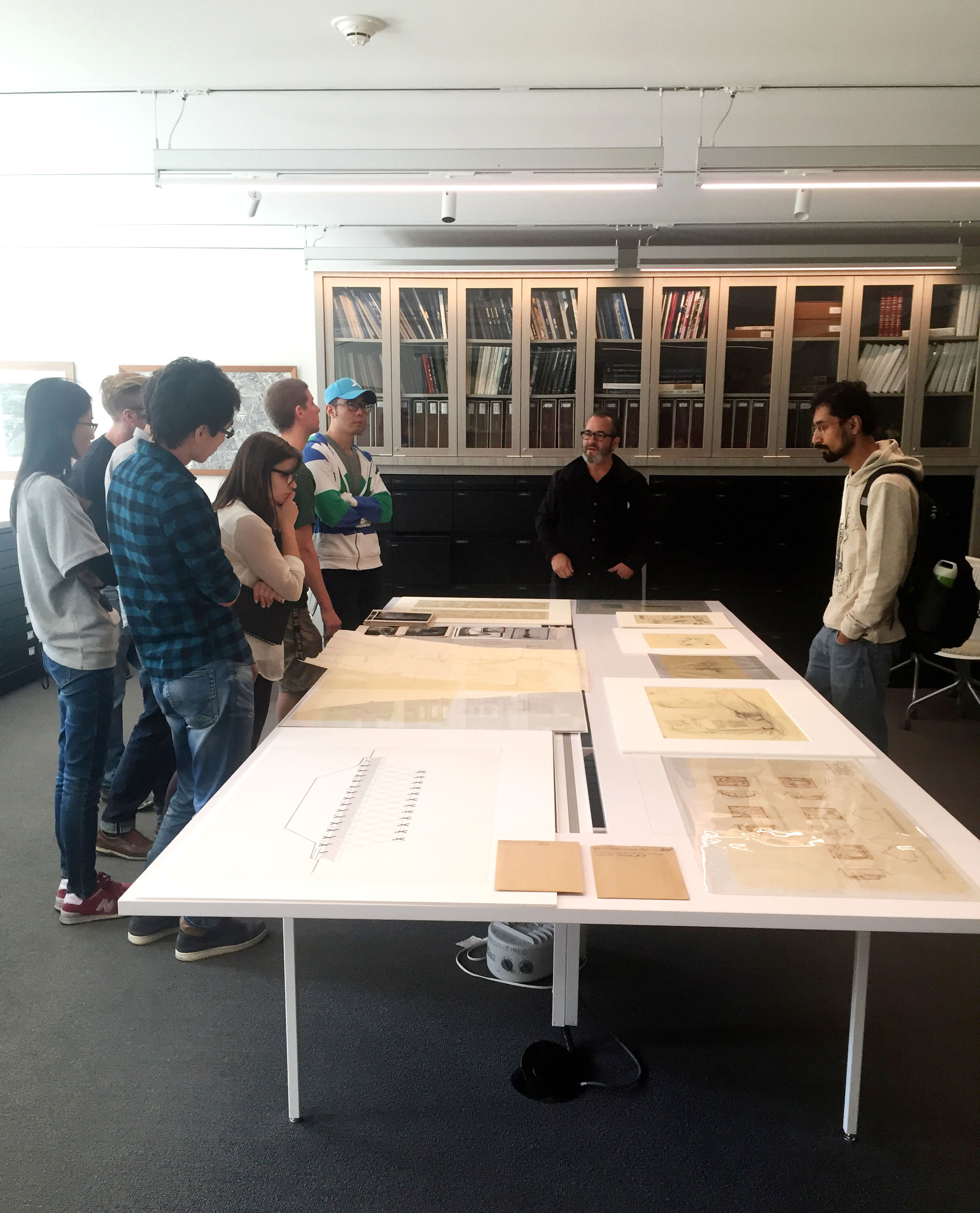
University of Michigan graduate students from the School of Architecture and Urban Planning look at drawings in the reading room.

University of Michigan graduate students from the School of Architecture and Urban Planning look at drawings in the reading room.

Gina Tecos, Archivist

Can You Say Lobster Roll?

It feels as though summer is winding down and this week is the final session of Cranbrook Art Museum Summer Camp. We enjoyed a visit from students earlier in the week who were part of the “Costumes and Characters” session. While pulling materials to show the students, we came across this photo of Ralph Russell Calder (1894-1969), an architect and friend of Henry Scripps Booth. He is in a lobster costume made by Loja Saarinen for a “May Party” in 1926.

1926

From the Henry Scripps and Carolyn Farr Booth Papers, Cranbrook Archives.

Calder, born in 1894, was a veteran of World War I and an accomplished musician. He graduated in 1923 from the University of Michigan College of Architecture (he and Henry were classmates). In 1924, he studied in England, France, and Italy as the winner of the George G. Booth Traveling Fellowship in Architecture.

Calder Card007

A card from Ralph Calder & Associates, Inc. with a 1924 sketch by Ralph Calder during his travels in Europe on the Booth Traveling Fellowship.

In 1925, Calder worked for several months as part of U of M’s Near East Research Expedition in Tunisia. The research and objects obtained from this expedition are the basis of the collection at the Francis W. Kelsey Museum of Archaeology at U of M. Calder joined the Cranbrook Architectural Office in 1926 and remained there until staff was reduced due to the economic depression. In 1937, he joined the firm of William G. Malcomson and Maurice E. Hammond where he stayed until 1945, when he started his own firm, Ralph Calder and Associates, in Detroit.

Calder worked on the following buildings on the Cranbrook campus: the main academic building (Hoey Hall) at Cranbrook School, Thornlea, and Thornlea Studio. In addition, he was the architect for buildings at Michigan State University, Michigan Technological University, Hope College, Northern Michigan University, Hillsdale College, Wayne State University, Ferris State University, Western Michigan University, and Lake Superior State University. He enjoyed music as a hobby and was the organist and choirmaster for St. Paul’s Episcopal Cathedral in Detroit in the 1940s.

Gina Tecos, Archivist

Logical Design: Using Primary Sources

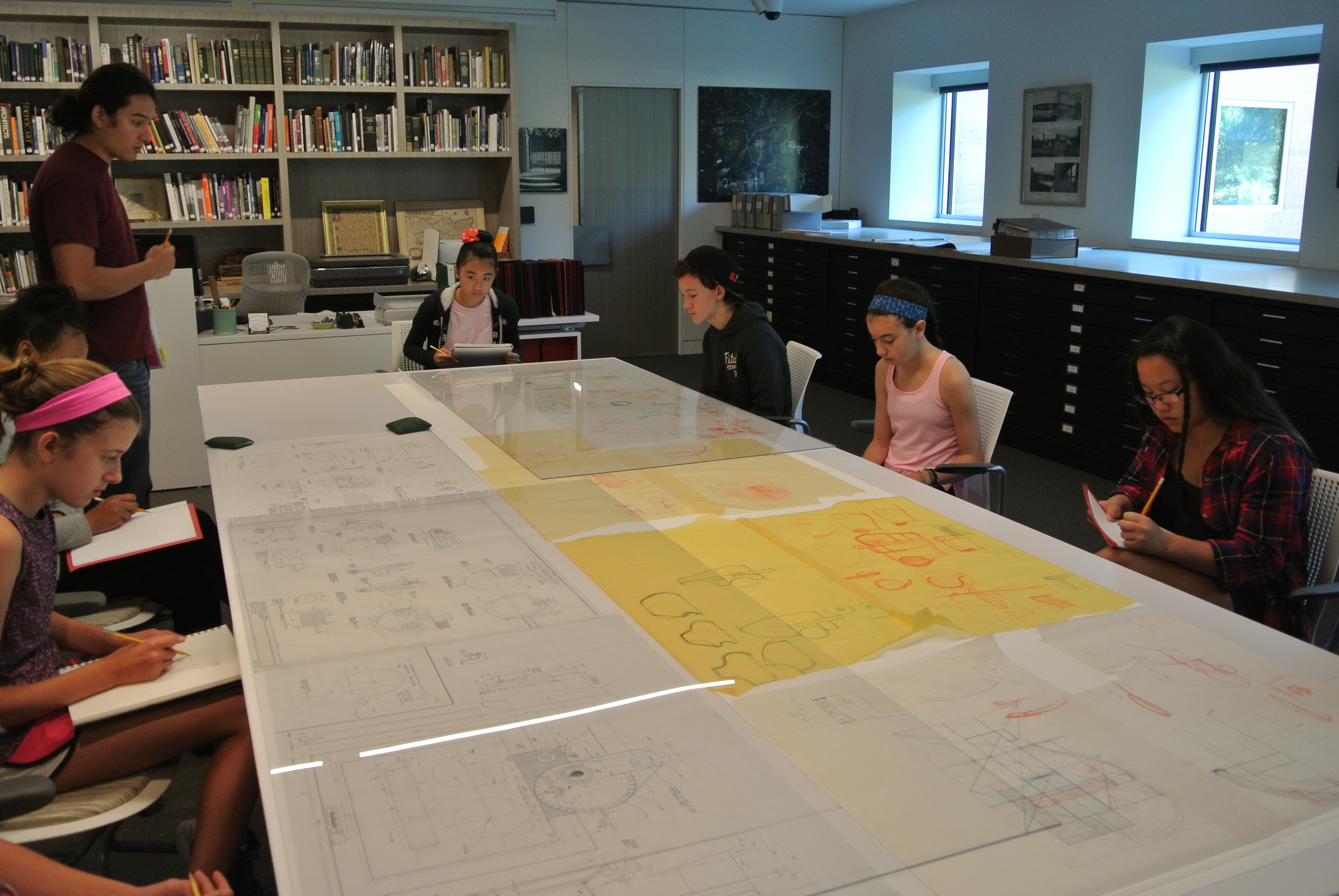
As summer camps are winding down, we wanted to share how campers used the collections in the Archives this week. Earlier in the week, my daughter, who is attending Cranbrook Art Museum’s camp session “Problem Solving by Design,” told me of the industrial design concepts they were learning. I immediately thought of the collection of Design Logic, Inc. Records that we have in the Archives, which contain beautiful color transparencies of 3D projects designed in the 1980s by David Gresham and Martin Thayer. (See Cheri Gay’s post.)

Studying the design drawings for the View Master and the Projector, Aug 2015.

Studying the design drawings for the View Master and the Projector, Aug 2015.

The next morning, I spoke with Kanoa, the camp instructor and a 2015 grad of the Academy of Art, and he agreed the photos would be great to show the kids. We coupled them with a copy of the exhibition catalog Cranbrook Design: The New Discourse, which featured several prototypes by Design Logic, as well as by other designers, many of whom studied under Kathy and Michael McCoy here at Cranbrook in the 1980s. The following day, I took the kids to the Art Museum vault to actually look at some of the objects. Kanoa had them do several sketches from different angles, all the while talking about various design concepts. Then the following day of course I had to show them some of Gresham and Thayer’s own design drawings which are also a part of the collection in the Archives. The kids were able to view conceptual sketches through finished drawings that were then sent to the manufacturer.

Sketching objects in the Cranbrook Art Museum vault, Aug 2015.

Sketching objects in the Cranbrook Art Museum vault, Aug 2015.

All in all, I hope it was a great experience for the kids. It certainly was fun for me to be able to enrich their camp experience with primary source materials from Cranbrook Archives.

Leslie S. Edwards, Head Archivist

Discoveries Around Campus

The dormers at Cranbrook House. Cranbrook Archives.

The dormers at Cranbrook House. Cranbrook Archives.

The staff at the Center for Collections and Research work closely with the Capital Projects and Facilities staff on campus restoration and repair projects. The archival staff often provides historical photographs, documentation, and architectural drawings to the project managers. Sometimes the staff makes interesting discoveries during the projects they are working on and share them with us.  The other day Craig Hoernschemeyer (Project Manager for Capital Projects) was in the archives looking for a historic photograph of a dormer window on the east addition (1918-1919) of Cranbrook House.  As luck would have it, he found one.  The following is from Craig:

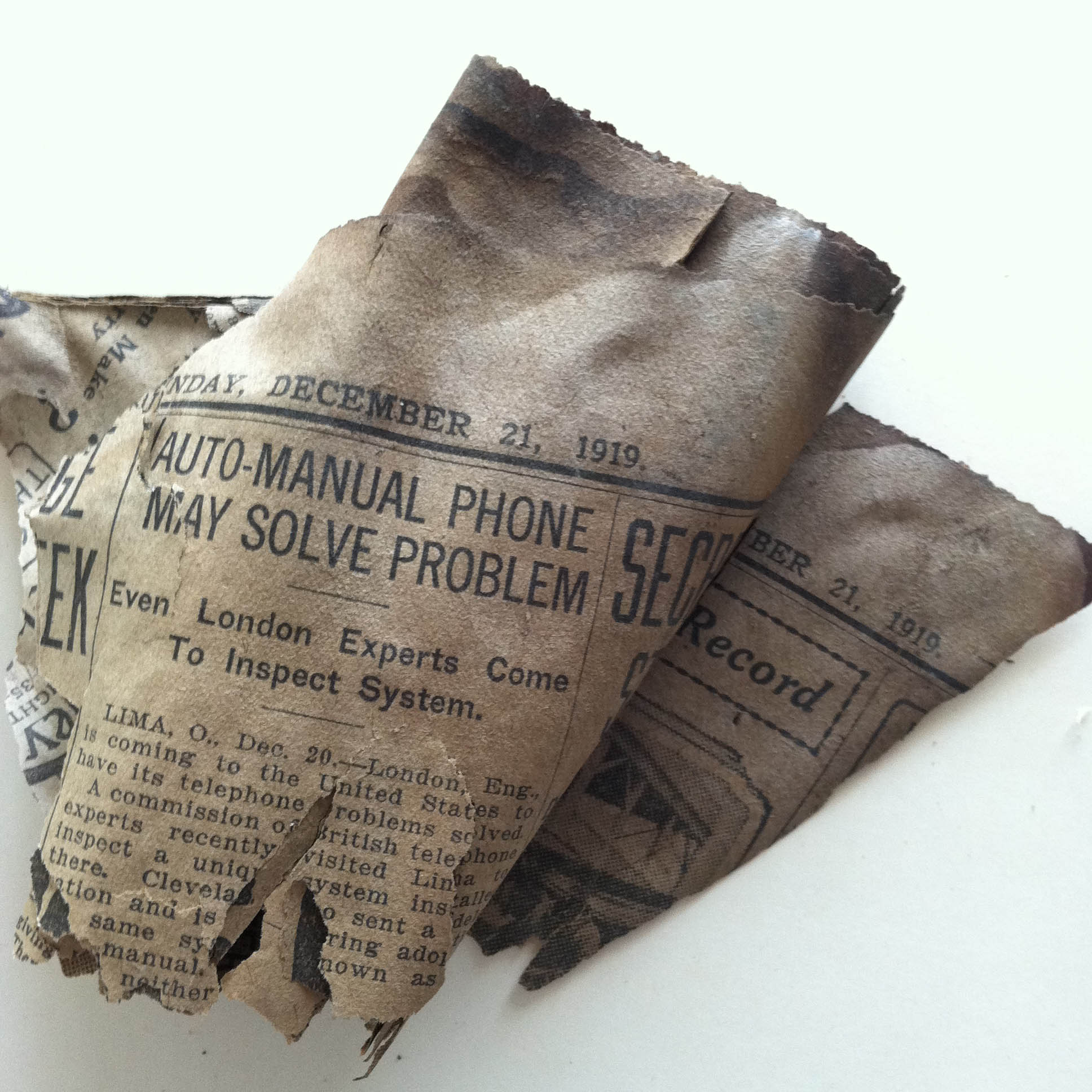
“Today, when the copper roof was opened up on that dormer – center right in the photo [above]- we found a bunch of newspaper mixed in with the insulation. It was no surprise that it was The Detroit News, but it was dated the first day of winter, December 21, 1919. It was there during the original construction of the wing.”

Detroit News, 1919. Photo Craig Hoernschemeyer.

Detroit News, 21 Dec 1919. Photo Craig Hoernschemeyer.

Leslie S. Edwards, Head Archivist

Icing on the Cake

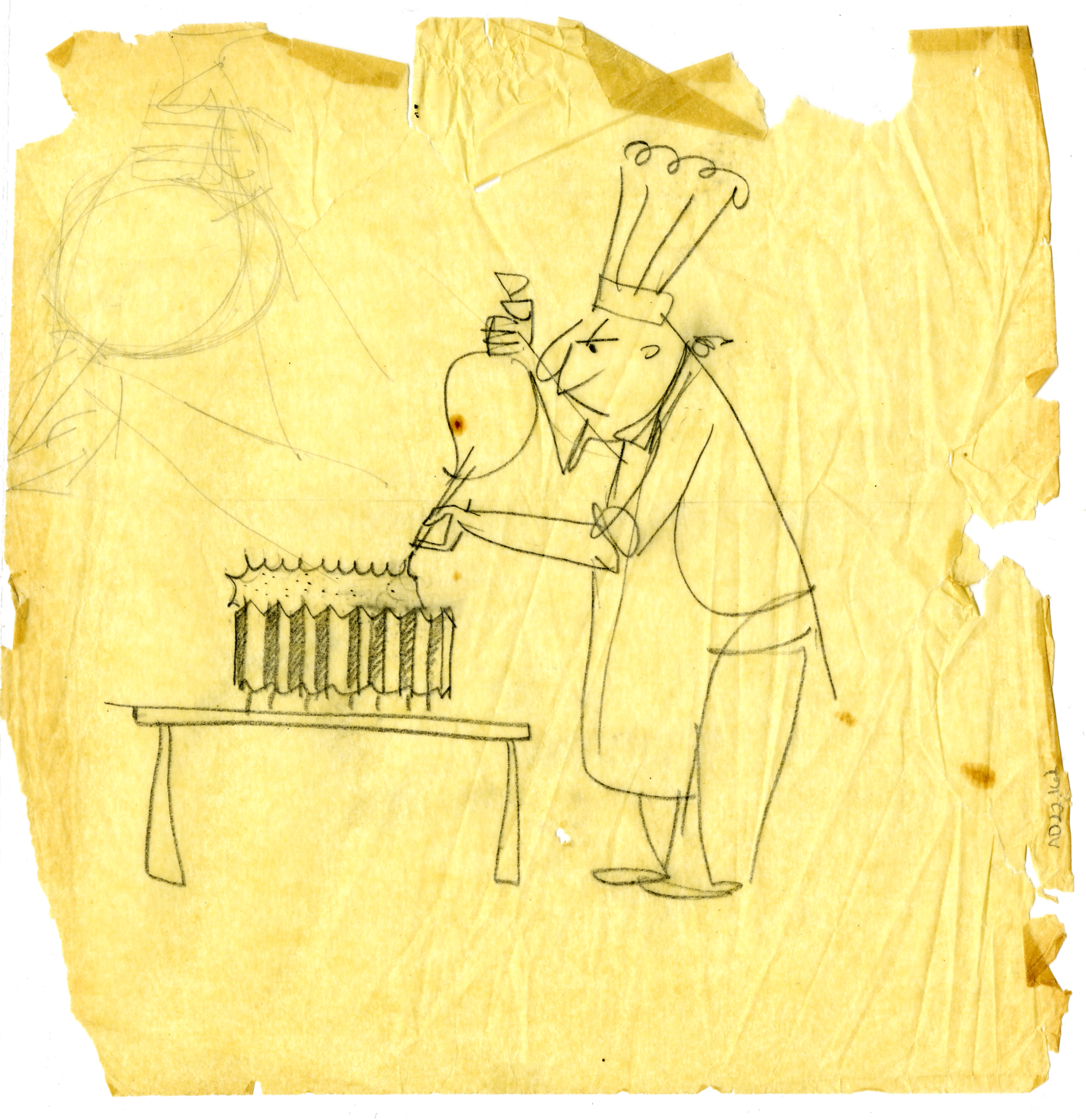
Claude de Forest cartoon

Claude de Forest Collection of Eero Saarinen and Associates Material (1995-68), Courtesy Cranbrook Archives.

It’s the holiday season. And, I don’t know about you, but for me, one of the best aspects of the holidays is the food. I love preparing a big holiday feast and the comforting aromas of spiced cider, or cookies and pies baking in the oven. Perhaps that is why the drawing featured in today’s Kitchen Sink appealed to me. While researching an archival inquiry, I came across this wonderful cartoon of a baker icing a cake by Claude de Forest (1931-2013).

Born in 1931 in Basel, Switzerland, de Forest descended from a long line of architects. This led him to pursue a BA in Architecture from the University of Manitoba and a Masters degree in Architecture from the Massachusetts Institute of Technology. After completing his studies at MIT, de Forest worked as a cartoonist and junior designer for Eero Saarinen and Associates from 1956-1958. Significant projects include the Ingalls Hockey Rink at Yale University, the IBM Research Center, the TWA Terminal at JFK, and the University of Chicago Law School. The “cake” in this photo is actually a model of the Chicago Law School.

In 1960 de Forest began teaching in the Faculty of Architecture at the University of Manitoba. He retired as a full professor in the Department of Environmental Studies in 1994. De Forest’s talents extended beyond design and teaching—he was also an activist and dedicated a significant amount of time and research to disability issues and responsible design. In 2007 he received the Lifetime Achievement Winnipeg Accessibility Award for community leadership in Universal Design.

Additional works in our collection related to Claude de Forest can be viewed here.

Gina Tecos, Archivist

Photo Friday: Plans Set Sail!

The Alura II from the James Scripps Booth and John McLaughlin Booth Papers. Cranbrook Archives

The Alura II from the James Scripps Booth and John McLaughlin Booth Papers. Cranbrook Archives

As the new Collections Fellow for the Cranbrook Center for Collections and Research, I was charged with coming up with a theme and writing today’s Photo Friday blog, a daunting task as it is only my first week. Lucky for me, a few of our archivists were working in our reading room pulling documents and photographs for a display this weekend for Cranbrook Art Museum’s PNC Bank Family Day and a few of them jumped out at me.

In 1928 James Scripps Booth, eldest son of Cranbrook’s founders George and Ellen Booth, designed a plan for a boat called the Alura II. Today’s photo includes a Booth’s original design for the bureau-book cases, mirror and window to the cockpit and a photograph of the “screened door companion-way from enclosed bridge area.” Although some of the plans were changed during manufacture, you can see the resemblance to Booth’s original design especially in the drawers and shape of the window shape. The Alura II was a fifty four foot long motor cruiser, with two 275 horsepower engines, so it could go as fast as 16 mph on the water! The boat included electric lights and toilet facilities, a four burner gas stove, and a gas water heater, as well as a Fridgeair ice box. The Alura II was completed in 1929. James and his wife Jean cruised in the boat for most of the summer that year, closing their home to take to the water.

Today’s photo is a sneak peak at some objects you can see on display in the Cranbrook Archives during PNC Bank Family Day this coming Sunday September 28th from 11am to 5pm. Many documents and photographs like today’s Photo Friday will be available to view and learn more about Cranbrook, the Booths, and boats! Learn more about the day’s nautical themed activities, tours, and lecture on the Cranbrook Art Museum’s website.

– Stefanie Dlugosz, Collections Fellow, Cranbrook Center for Collections and Research


Create a website or blog at WordPress.com