Art in the Time of War: Cranbrook’s Monuments Men

Monuments Men, opening today in theaters, chronicles the efforts of men and women in the US military to protect and preserve Europe’s artistic and cultural patrimony during World War II. Directed by George Clooney, the film has brought to national attention the work of these non-traditional soldiers, arts and cultural professionals who recognized that while the world was tangled in a struggle that engulfed countries and cost thousands of lives, the art and artifacts prized for centuries by those communities were equally at risk.

With the renewed attention to the work of the Monuments, Fine Arts, and Archives Section (MFAA)—nicknamed the “Monuments Men”—has come the realization at museums across the country that many of their early directors and curators were active members of the MFAA during World War II.  At Cranbrook we’ve uncovered the stories of two Monuments Men who played a role in our own history.

Robert S. Davis at Cranbrook, 1942. Cranbrook Archives.

Richard S. Davis at Cranbrook, 1942. Cranbrook Archives.

Continue reading

Old Words, New Sounds: Oral Histories from the Cranbrook Archives

For the past nine months I have been working on a project to breathe new life into an oral history initiative at Cranbrook that began as early as 1964 as a collaborative project between Cranbrook School and the Cranbrook Foundation. These oral histories give us an intimate view of life here at Cranbrook over the past half century with interviewees spanning across the entire community. They range from Dr. Lee Dice at the Institute of Science, to Cranbrook Academy of Art painter Zoltan Sepheshy, as well as interviews with members of the Vettraino family, whose time living on the grounds spanned several generations. These interviews give us the kind of glimpse into the past of Cranbrook that is difficult to find anywhere else.

Cranbrook’s oral histories are found in the archives in analogue sound formats, namely on magnetic tapes. In order to preserve these interviews and provide access to a wider audience, the Archives is implementing a plan to digitize all of the content. Each oral history is digitized in real time and then transcribed, with each hour of audio taking anywhere from 8 to 10 hours to transcribe, depending on sound quality.

One of the latest gems to be uncovered is a recording of a conversation with brother and sister James and Doris Smith who worked as model makers and production designers from the mid-1940s for many of the artists and architects associated with Cranbrook. James began working with the firm of Saarinen, Swanson, and Saarinen in 1943, while Doris joined them in 1946. Both had their hands on many of the largest projects, such as creating the models for the General Motors Technical Center, and their insight into the daily work and life in the office is unmatched and cannot be forgotten.

In the following clip you can listen to James Smith discuss events and the atmosphere that surrounded the winning entry from Eero Saarinen & Associates for the Gateway Arch in the Jefferson National Expansion Memorial in St. Louis, Missouri–better known as the St. Louis Arch.

Image

Construction of TWA model at Eero Saarinen & Associates taken by Claude de Forest, 1957.Cranbrook Archives.

Justine Tobiasz– Archives Assistant

Photo Friday Part 2: Bud West Caption Contest Winner!

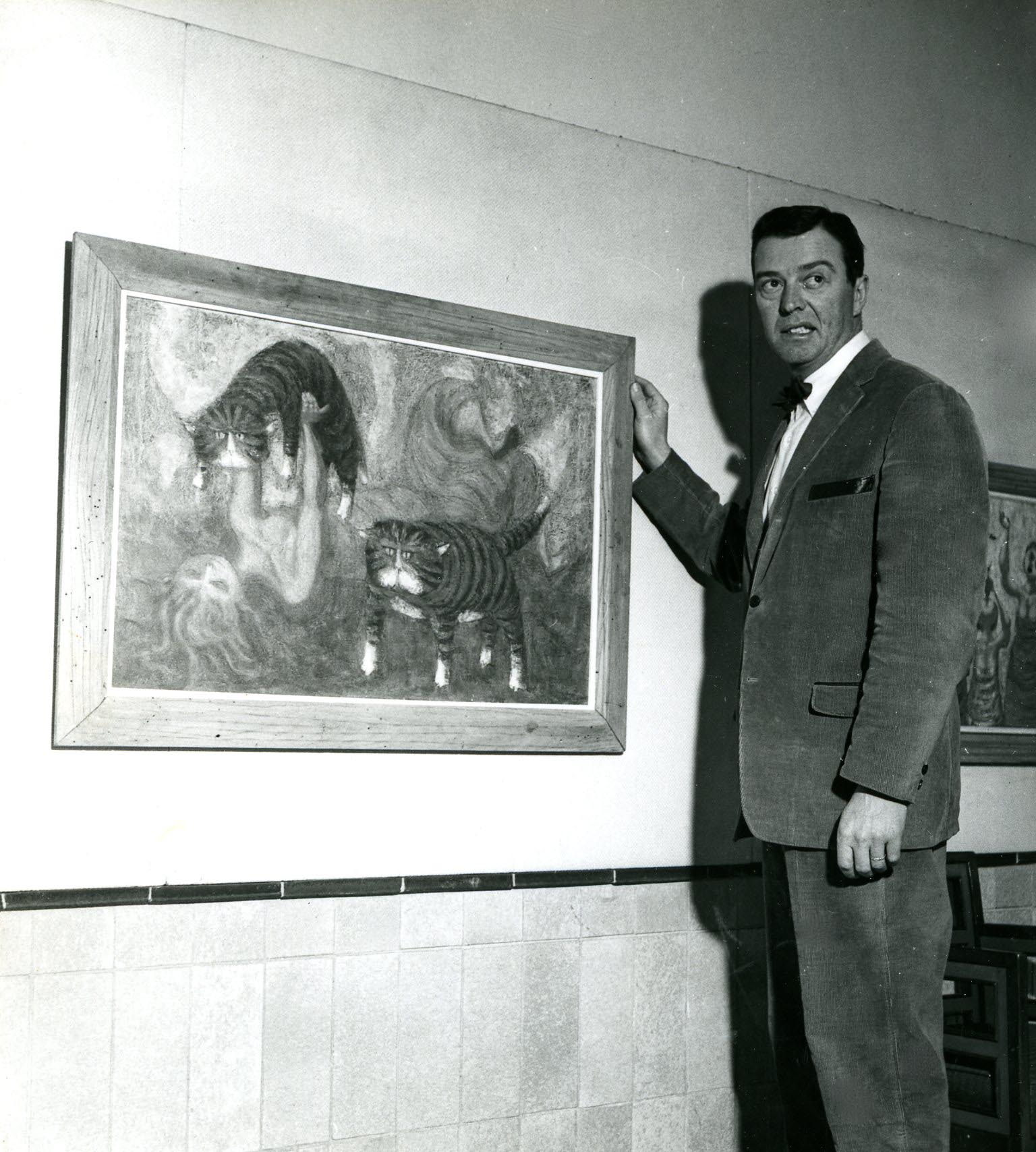
Apparently, my brain was already celebrating the fourth of July, because I posted Photo Friday on Wednesday (for no other reason than I thought Wednesday was Friday.  By the way, who else thinks today is Saturday?).  So, this week we’re going to  have TWO Photo Fridays.  Remember a few weeks back, when we held a caption contest for this fabulous photo of Clifford “Bud” West?

Our question was simple: what is Bud West thinking?  We had some great answers, but we’ve got to give the win to West’s son, Justin, who said, “What do the cats represent?  Heck, sometimes cats are just cats!”  We swear – only a hint of nepotism was involved in the decision.  Thanks to all who entered, and congrats, Justin!  And a special thanks to my colleagues, who never bothered to mention on Wednesday that I was confused about which day it was.

Photo Friday: Design of Radio Cabinets

In the early days at Cranbrook Academy of Art, students were encouraged to submit entries to a myriad of design and architecture competitions.  Sponsored by museums, magazines, colleges and industry, competitions were a way for fledgling designers to make a name for themselves.  Winning entries could catapult a designer or architect into the national arena.  In 1939, the “Design of Radio Cabinets” was sponsored by the Radio and Television Department of the General Electric Company through Interior Design and Decoration.  Designs were submitted in two categories: a table model and a console model.  The only design requirement was that a “dial or tuning control treatment” be incorporated in the design.

Entry for "Design of Radio Cabinets" competition.

Entry for “Design of Radio Cabinets” competition, 1939. Cranbrook Archives.

This entry was submitted by the team of Edward Elliott and Ted Luderowski, both architecture students studying under Eliel Saarinen.

From the Archives: Teaching and Exhibiting Painting at Cranbrook, 1930-1970

Image

From the Archives: Teaching and Exhibiting Painting at Cranbrook, 1930-1970, photograph courtesy of Justine Tobiasz.

With the opening of the summer exhibition season at the Cranbrook Art Museum, the campus is filled with opportunities to learn about art, design, and history.  This also marks the first of a regular series of exhibitions that explore the unplumbed depths of Cranbrook’s archival holdings.  From the Archives: Teaching and Exhibiting Painting at Cranbrook, 1930-1970 highlights the efforts of Cranbrook teachers and curators and explores the work they did promoting painting at Cranbrook at the mid-century mark.  Curated by Head Archivist Leslie S. Edwards, the show uncovers untold accounts about the moments and figures that populate Cranbrook’s storied painting history.   From the Archives: Teaching and Exhibiting Painting at Cranbrook, 1930-1970 will be on view in the Cranbrook Art Museum from June 14 to September 29, 2013, so be sure to check it out!

[Ed. note: if you missed the Archives exhibition in person, don’t worry – it lives forever on the internet! Check out the Archives online exhibition, From the Archives: Teaching and Exhibiting Painting at Cranbrook, 1930-1970.]

Photo Friday: Planning a Planetarium

Workmen spray down the McMath Planetarium dome, which is under construction. 1955. Cranbrook Archives.

Workmen spray down the McMath Planetarium dome while under construction at the Cranbrook Institute of Science.  1955. Cranbrook Archives.

The workmen who built the McMath Planetarium at the Cranbrook Institute of Science in the 1950s must have been circus performers as well as skilled craftsmen.  Here they balance on plywood platforms, managing a high-pressure hose as they perch above the nearly-completed dome.   The planetarium, which opened in 1955, has now been expanded into the Acheson Planetarium and includes research resources as well as visitor viewing opportunities.


Dispatch from the Archives: All Things Modernism

Mid-century Modernism has taken over my life!  I eat, sleep, and even dream Modernism these days.  In my role as Head Archivist, I wear many hats – the most recent being to assist the Michigan Modern curatorial team by locating all the cool “stuff” in our Archives related to the upcoming exhibition, which will be opening at the Cranbrook Art Museum on June 14, 2013.  This includes photographs, of course, but the most fun for me is finding correspondence, articles, and ephemera that when put together create a mosaic of a time or place. Continue reading

Cranbrook and the Car, Part 1: The Aristocrat of Small Cars

In its 100-year history, Cranbrook has been known for producing artists, designers, scholars, athletes, and leaders.  But cars?  An upcoming exhibition mounted by the Center for Collections and Research (that’s us!) at the Cranbrook Art Museum will explore the relationship between Cranbrook and the automobile industry. Called A Driving Force: Cranbrook and the Car, it will highlight the history of Cranbrook through the lens of the automobile, detailing the ways that members of Cranbrook’s community have innovated and influenced the auto industry for the past 100 years.  You can learn more about the exhibition at Cranbrook Art Museum’s website here.

As we prepare to open A Driving Force: Cranbrook and the Car on June 12, we’ll be writing up occasional posts about the exhibition, highlighting bits and pieces of our research and providing glimpses into the down-and-dirty world of museum exhibiting.   And we’re going to kick it all off with the story of James Scripps Booth and the Scripps-Booth Company.

James Scripps Booth (behind the wheel) with brother Warren Scripps Booth in a Scripps-Booth 4-cylinder Model C at Tower Garage at Cranbrook House. Their father George Gough Booth stands next to the car, partially hidden by the windshield.  Circa 1917, Cranbrook Archives.

James Scripps Booth (behind the wheel) with brother Warren Scripps Booth in a Scripps-Booth 4-cylinder Model C at Tower Garage at Cranbrook House. Their father George Gough Booth stands next to the car, partially hidden by the windshield. Circa 1917, Cranbrook Archives.

Continue reading

Welcome to the Kitchen Sink!

A Home Economics classroom from Kingswood School, 1932.  Ironically, there's no kitchen sink in sight.

Home Economics classroom at Kingswood School, 1932. Cranbrook Archives.

Welcome to the Cranbrook Kitchen Sink!  This is our very first post, so please bear with us as we explain what we’re doing here and get all excited.  If we had glitter, we’d be throwing it right now.

The Cranbrook Kitchen Sink is an exciting new undertaking for the Cranbrook Center for Collections and Research.  And what is the Cranbrook Center for Collections and Research, you might ask?  Well, we’re essentially a department of archivists and historians who focus on all things Cranbrook.  We’re charged with interpreting the history of this unique educational community, from its founding in 1908 as a country estate for George and Ellen Booth to its current incarnation as a 319-acre campus that includes a prestigious private school, a science museum, a graduate art academy and an art museum.  Also three historic houses, legendary gardens, architecture with National Historic Landmark status, a world-class art collection, and an archive so in-depth you could get lost in it for days…. you get the idea.  This is a big place with a lot of history, and we’re here to cover it all.

So what will you find at the Cranbrook Kitchen Sink?  Well, everything but the!  We want the Kitchen Sink to be a place where Cranbrook Center and Archives staff can post about their research, report back on cool and interesting documents or stories we’ve uncovered, and get just a sliver of the amazing material that makes up Cranbrook’s 100+ year history out into the wider world.  We’re here to tell you the stories you  haven’t heard about this strange, incredible place called Cranbrook.  So sit back, relax, and enjoy all things Cranbrook!

Create a website or blog at WordPress.com