Not once, but twice, Cranbrook has pulled out the figurative red carpet and with appropriate fanfare welcomed Swedish royalty to its campus. Anyone who knows and loves Cranbrook might not be all that surprised by this revelation. After all, Cranbrook is a very special place—the home of dozens of sculptures by Sweden’s celebrated sculptor Carl Milles, who lived and worked at Cranbrook for twenty years, as well as many tapestries woven by Loja Saarinen’s renowned Swedish weavers. But the larger Detroit community has also boasted a significant Swedish cultural presence.
While most Michiganders might be familiar with the role that Swedish immigrantsplayed in Michigan’s Upper Peninsula mining and lumber industries, Swedes also played major roles in Detroit’s development, from the auto industry to the fine and performing arts. Not least of all were the contributions made by Milles, including his sculpture The Hand of God, which has stood in front of the city’s Frank Murphy Hall of Justice since 1970. The founding in 1963 of the Detroit Swedish Councilby Charles J. Koebel (who, decades earlier, had commissioned Eliel Saarinen to design his family home in Grosse Pointe Farms), saw a concerted effort to promote Swedish culture in the area. It was likely the unique combination of Cranbrook’s artistic works and Detroit’s vibrant Swedish community that attracted visits from Sweden’s royal family on two separate occasions.
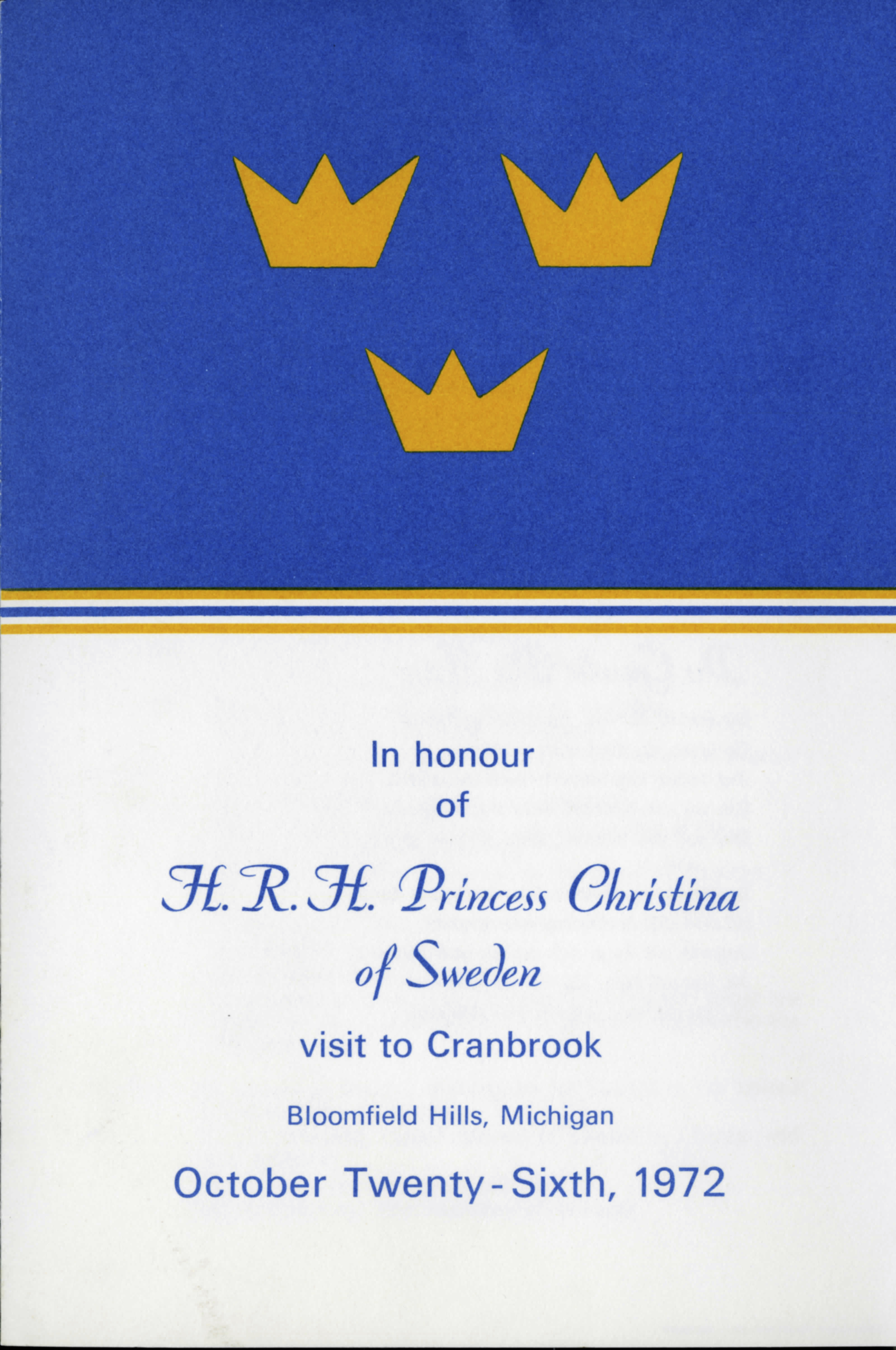
Program for the day’s activities. Courtesy of Cranbrook Archives.
So it was that on October 26, 1972, Princess Christina of Sweden set foot on Cranbrook grounds as part of her two-week tour of the States. And sixteen years later, her brother and his wife, King Carl XVI Gustaf and Queen Silvia, followed suit on April 18, 1988. Both visits focused largely on Carl Milles’ Cranbrook legacy, directly involved the Academy of Art and Art Museum, and were the result of collaborations between Cranbrook and the Detroit Swedish Council. Yet each visit had its own unique activities and sense of purpose.
The Nona Bymark Soderlind archival collectionconsists solely of one scrapbook, yet its contents provide an intriguing glimpse of the woman to which it is dedicated. In doing so, it also illuminates a brief but prolific period in the history of the Academy of Art and reveals a personal side to one of Cranbrook’s most celebrated Artists-in-Residence, the sculptor Carl Milles.
Nona Bymark Soderlind, circa February 1936. Courtesy of Cranbrook Archives.
Born Eleanora Maria Bymark on July 16, 1900 in a small Swedish immigrant community just outside of Minneapolis, Minnesota, Nona attended the Minneapolis School of Art (1920-1922) on a full scholarship, where she studied sculpture under Charles S. Wells. She later attended the University of Minnesota where she studied under the painter Samuel Chatwood Burton. In 1927 Nona returned for a semester at the School of Art, around the time she had her first child with husband Dr. Ragnar Soderlind. The Soderlinds had three young boys (two, eight, and nine years of age) when in 1936 Nona boarded a train to Detroit to study under Carl Milles.
Nona Bymark Soderlind works on a sculpture in Carl Milles Studio, 1936. Courtesy of Cranbrook Archives.
A February 13th letter from Richard Raseman, Academy of Art Executive Secretary, confirms Soderlind’s visit to campus and includes details of associated tuition and living costs required for the minimum period of study with Milles. Cross-referenced with items in her Academy student file, it is evident she had been invited by Milles to study for a month and arrived on the 18th. Perhaps it was Milles’ 1936 commission for Vision of Peace, in St. Paul, Minnesota that had first brought them in touch with each other?
Sometimes it seems there are infinite possible discoveries within a single archives collection. Such is the case with the Edward and Ruth Adler Schnee Papers. Just over a year ago I wrote about the Schnees’ long-running Detroit retail business, Adler/Schnee, but I knew then that story was only the tip of the iceberg.
And so I was happy to find myself returning recently to one of my favorite collections in the Archives. Replacing materials that had been on loan to the Cranbrook Art Museum for their exhibit, Ruth Adler Schnee: Modern Designs for Living, I was once again struck by her achievements as a high school student at Cass Technical High School in Detroit from 1940-1942. In particular, her skill at fashion design. Maybe it was the months of hearing about sweatpants and Zoom shirts, but it was so refreshing to spend a few moments remembering what real fashion means.
Ruth Adler Schnee illustration, circa 1941. Courtesy of Cranbrook Archives.
Before Ruth Adler Schnee made a name for herself in interior design, including her iconic textile designs, she was interested in becoming a fashion designer. Attending Cass Tech afforded Ruth the opportunity to nurture her natural artistic talents, which are clearly evident in drawings from her primary school days. And, she had already shown an affinity for fashion design—out of necessity, Ruth had already been designing her own clothes since she was a 13-year-old Jewish girl in Nazi Germany (her family emigrated in 1939).
Pages from “Dress Design VI,” Ruth Adler Schnee, circa 1942. Courtesy of Cranbrook Archives.
Amongst other documents in her collection, the story of Ruth’s high school years and her passion for fashion are perhaps best captured in three notebooks. One of my favorite boxes in the collection holds nothing but pages from a notebook entitled Dress Design VI. Labeled “hours 1-4″ it is clearly a class project, and one for which Ruth received high marks. Divided into four parts (Machine Attachments, Illustrative Material, Drafting Problems, and Analysis of Dresses), the book includes drawings, pattern pieces (not to scale), paper mockups of mainly women’s sportswear designs, samples of sewing technique (actual fabric pinned to the page), textile identification pages (with real fabric samples), and an essay on silk.
Sleeve Form page, in “Notes on the Draping of Garments,” Ruth Adler Schnee, circa 1942. Courtesy of Cranbrook Archives.
Correspondence, including special occasion cards, are not uncommon in archival collections, but sometimes you find remarkable standouts such as the panoramic handmade masterpiece in the Marianne Strengell Papers. Measuring 5 x 24 inches, I invite you to click on the image below and zoom in to see all of the amazing details.
Titled, “This Way to the Strengell-Hammarstrom Gallery,” the card depicts a wall of portraits of Strengell family members, each complete with a short anecdote.
First portrait in the gallery. Courtesy of Cranbrook Archives.
At the end of the gallery is an abstract portrait of “Marianne Strengell Hammarstrom ‘Our Birthday Gal’” (curious, since she was born in May!). The card is signed, “love from your Weavers.”
Portrait and greeting detail. Courtesy of Cranbrook Archives.
Since no real names are used and the card is not dated, the origins and meaning behind the drawings and greeting remain as yet unknown. So far, research has not yielded any definitive answers. What we do know, however, is that Strengell enjoyed a wonderful relationship with her students and developed many deep friendships with both students and colleagues such as Wallace Mitchell and Zoltan Sepeshy. The wry, irreverent humor that imbues the card certainly suggests the close-knit, sociable atmosphere Marianne experienced at the Academy. “In all a very happy studio and many wonderful, now famous students. For me, 25 marvelous years.” (Marianne Strengell, 1989)
Last portrait in the gallery. Courtesy of Cranbrook Archives.
Strengell’s students included Nelly Mehta Sethna, Ed Rossbach, Robert Sailors and Jack Lenor Larsen, but she also had students from other departments study with her. These ‘Minors’ as Strengell dubbed them included Charles Eames, Benjamin Baldwin, Harry Bertoia, and Harry Weese.
Letter to Mark Coir, Archives Director, 1995. Courtesy of Cranbrook Archives.
Strengell, in fact, highly encouraged interaction between the departments, establishing Open House Days in the weaving studio, as well as Weavers Parties, which were very popular.
Revelers at a Weavers Party, 1959. Harvey Croze, photographer. Courtesy of Cranbrook Archives.
Marianne Strengell was a weaving instructor (1937-1942) and head of the Department of Weaving and Textile Design (1942-1961) at the Academy of Art. She often worked closely with her second husband, Olav Hammarstrom, architect and furniture designer, whom she married in 1948.
Farewell dinner for Marianne Strengell in the weaving studio, 1961. Strengell is shown middle left. Harvey Croze, photographer. Courtesy of Cranbrook Archives.
There are several other examples of holiday greetings in the Archives’ collections from Strengell’s contemporaries, but, in my opinion, none as witty as the one created by her Academy admirers.
May your holiday season be as merry and bright!
—Deborah Rice, Head Archivist, Cranbrook Center for Collections and Research
With the holidays upon us and the observance of annual traditions in high gear it seems fitting to look back at one of Cranbrook’s most storied and festive occasions. Starting in 1950, every year at the beginning of December preparations would begin for the annual Twelfth Night Gala at Cranbrook House. Held on January 6th, the event was originally conceived as a small costume party in the 1920s by Cranbrook Founders’ son, Henry Scripps Booth. It eventually became an official Cranbrook gathering, with Henry at the helm.
The aim of Twelfth Night, as Henry stated, was “to recognize the contribution each employee and board member makes to Cranbrook by bringing them all together as participants in an enjoyable, annual, and ‘classless’ social event.” It was, in essence, a staff holiday party, but its magnificence was a far cry from the typical.
Joseph R. Scott Jr. practicing “piper’s piping” in Cranbrook House basement for the 1966 performance. Harvey Croze, photographer. Courtesy of Cranbrook Archives.
Not sure exactly what Twelfth Night signifies? Perhaps you know the classic carol Twelve Days of Christmas: “On the first day of Christmas, my true love gave to me ….” A medieval English observance, Twelfth Night, as defined by the Oxford English Dictionary, denotes “the twelfth and last day of Christmas festivities”—twelve days after Christmas, or January 6th. The Shakespeare playof the same name is thought to have been created as entertainment for a Twelfth Night celebration.
Inspired by his English heritage and impressed with a performance of the play at the Detroit Opera House when he was twelve years old, Henry Booth created a sixty-year tradition for Cranbrook staff, faculty, and supporters that revived the holiday’s twin themes of celebratory food and pageantry.
In Cranbrook Archives, theTwelfth Night Recordsmeticulously document the planning and execution of the gala as it took place at Cranbrook House, through programs, scripts, invitations, guest lists, receipts, budgets, meeting minutes, photographs and more. These items bring the party alive–and what a party it was!
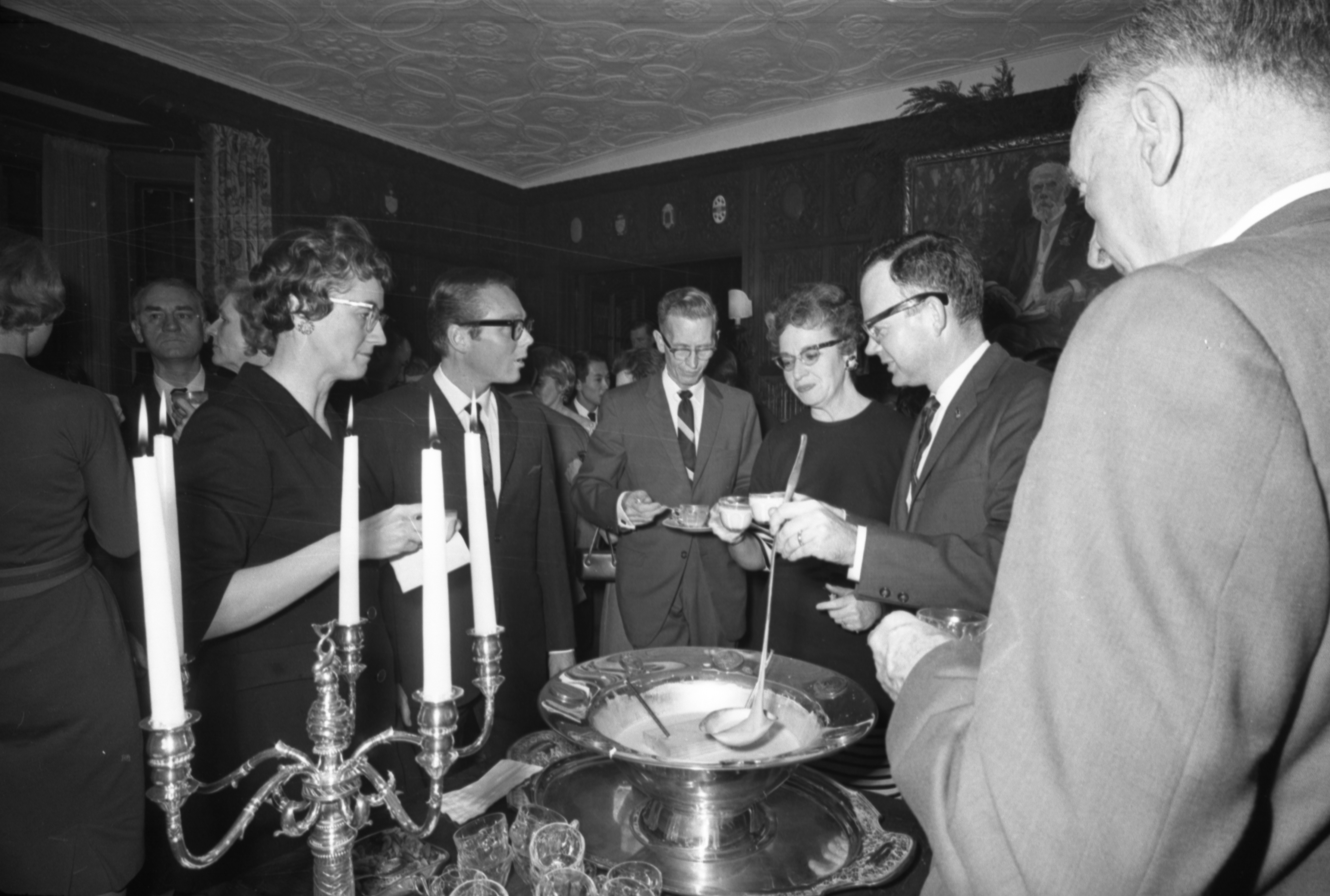
Eggnog in the Oak Room, 1967: (left to right) Helen Hays, Warren Hays, Chet Hard, Anita Hard, and Don Hays. Harvey Croze, photographer. Courtesy of Cranbrook Archives.
Choosing the decade of the 1960s to epitomize the revelry of the long-standing event, I give you the opening lines from the 1960 program, spoken by Cranbrook School Headmaster Harry Hoey:
We’ve all found a welcome in this mellow house Including, we trust, some young shivering mouse The wassail is heady The fellowship’s steady The mummers are ready So gay may this gala be in Cranbrook House On with the tom foolery!
Did you know that Cranbrook Art Museum’s educational partnerships with surrounding communities date back over sixty years? Long before the current museum trend of interactive educational programs for youth audiences, the Academy of Art and theJunior League of Birmingham had an idea: the Young People’s Art Center (YPAC).
Young People’s Art Center logo, from the 1962 enrollment form. Courtesy of Cranbrook Archives.
The year was 1958, and the Museum had recently changed names to the Academy of Art Galleries, shifting focus to feature more contemporary art practices. With that, came the desire to encourage young visitors to express their own artistic voices—participatory education, rather than simply art appreciation. Documenting the program’s first year, a June 1959 Detroit News Pictorial Magazine feature noted that YPAC “is fast gaining a national reputation for its lively approach to art education.”
In particular, it was Henry Booth (Academy Board of Trustees Chairman), Wallace Mitchell (Head of Galleries), and Zoltan Sepeshy (Academy Director) that approached the Junior League with a plan. In a 1957 report by Mitchell during the Center’s development phase, he states, “ The personnel of the Cranbrook Academy of Art has become increasingly aware of the growing country-wide interest in the visual arts and has long wished to more directly participate in the fostering and guiding of this interest as expressed in our community.” Seeking support from the Junior League, this “unique opportunity to bring to the children of Oakland County an integrated program in art education which concerns itself with the totality of the art experience” was green-lighted for the following year.
Children watch a judo demonstrator as part of a class exercise. Erik Strylander, photographer. From the article “Sketching to Jazz and Judo,” Detroit News Pictorial Magazine, June 28, 1959.
A perfect partnership was formed. The Academy would provide leadership, through the support of its trustees, director, and faculty; the Junior League would provide the necessary finances. Naturally, with so many talented artists on campus, there was no lack of creativity or helping hands! Junior League members were also heavily involved, providing volunteer docents to conduct gallery tours and assist with classes, both of which were located on the ground level of the Museum below the Academy Library.
As performance venues prepare to reopen in Michigan today, I thought it timely to take a look at the storied history of a group that’s nearly as old as Cranbrook itself: St. Dunstan’s Theatre Guild of Cranbrook. With ties to Cranbrook’s founding family, staff, and the physical Cranbrook campus, combined with its enduring cultural role in the surrounding community, this nearly ninety-year-old institution has a rich history. Allow me to share with you a few fascinating details from its early years.
View of St. Dunstan’s Playhouse from Lone Pine Road looking east. Balthazar Korab, photographer. Copyright Korab and Cranbrook Archives.
“The worst thing about it, it’s named for a saint. But don’t think it’s holy, ‘cause it certainly ain’t.”
Sheldon Noble, an early and active Guild member
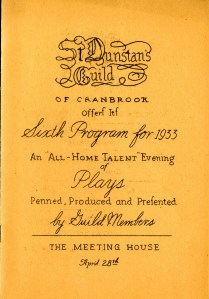
The Theatre Guild was indeed named after St. Dunstan, Archbishop of Canterbury in the ninth century and patron saint of the arts. As St. Dunstan lived in Kent, England, from where Cranbrook founder George Booth’s family hailed, the Guild’s name was fittingly suggested by his son and founding member, Henry Scripps Booth. Shortly after the Guild began in 1932, members were writing and producing their own one-act plays. In an April 1933 letter announcing an informal evening of a “Home Talent programme,” for the 100 Guild members and their guests, Jessie Winter, Guild Secretary and Brookside School Headmistress, implores them to “Be kind, be understanding, be generous . . . give the actors and authors the warm reception which such offerings warrant.” One such author was Henry Scripps Booth. Billed as Thistle, his play, Sedative Bed, was one of four being performed that April 28th evening at Brookside School for just $1. It was the tail end of the Great Depression, after all!
Front and back cover of the 1933 playbill. Courtesy of Cranbrook Archives, Cranbrook Center for Collections and Research.
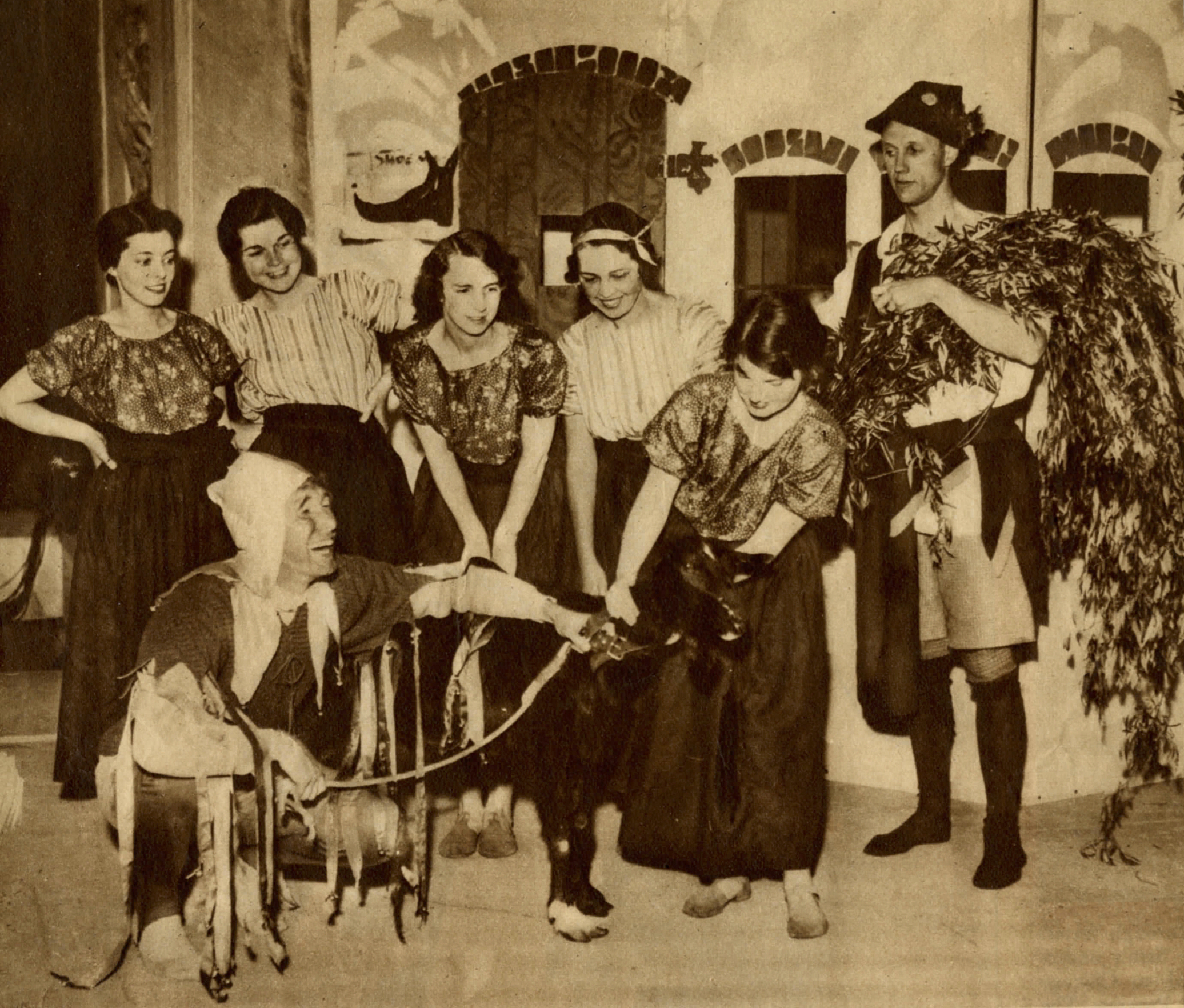
The first public performance of St. Dunstan’s Theatre Guild took place at the Greek Theatre with The King and the Commoner. Taking supporting roles were the likes of Annetta Wonnberger (Cranbrook Summer Theater School), Pipsan Saarinen Swanson (daughter of Cranbrook architect Eliel Saarinen), and Henry Scripps Booth, among others.
A scene from The King and the Commoner. Henry Booth on right. Detroit newspaper rotogravure clipping. Courtesy of Cranbrook Archives, Cranbrook Center for Collections and Research.
The cast and crew of the 1940 production of The Last of Mrs. Cheyney again reads like a who’s who of Cranbrook, including Harry Hoey (Cranbrook School Headmaster), Templin Licklider (Cranbrook School Faculty), Dorothy Sepeshy (wife of Cranbrook Academy of Art President, Zoltan Sepeshy), Rachel Raseman (wife of Richard Raseman, Cranbrook Academy of Art Executive Secretary and Vice President), the aforementioned Annetta Wonnberger, and various members of the Booth Family. Henry Scripps Booth, part of the Guild’s Scenic Design Committee, and his wife Carolyn, the production’s stage manager, created the sets.
Cranbrook Institute of Science (CIS) has long held a special place in the hearts of many area schoolchildren. Field trips, weekend family outings, and onsite demonstrations in schools and community centers are a part of the fabric of the metro Detroit K-12 educational experience.
Elementary students visit the Cranbrook Institute of Science in 1935. Robert T. Hatt, photographer. Courtesy of Cranbrook Archives, Cranbrook Center for Collections and Research.
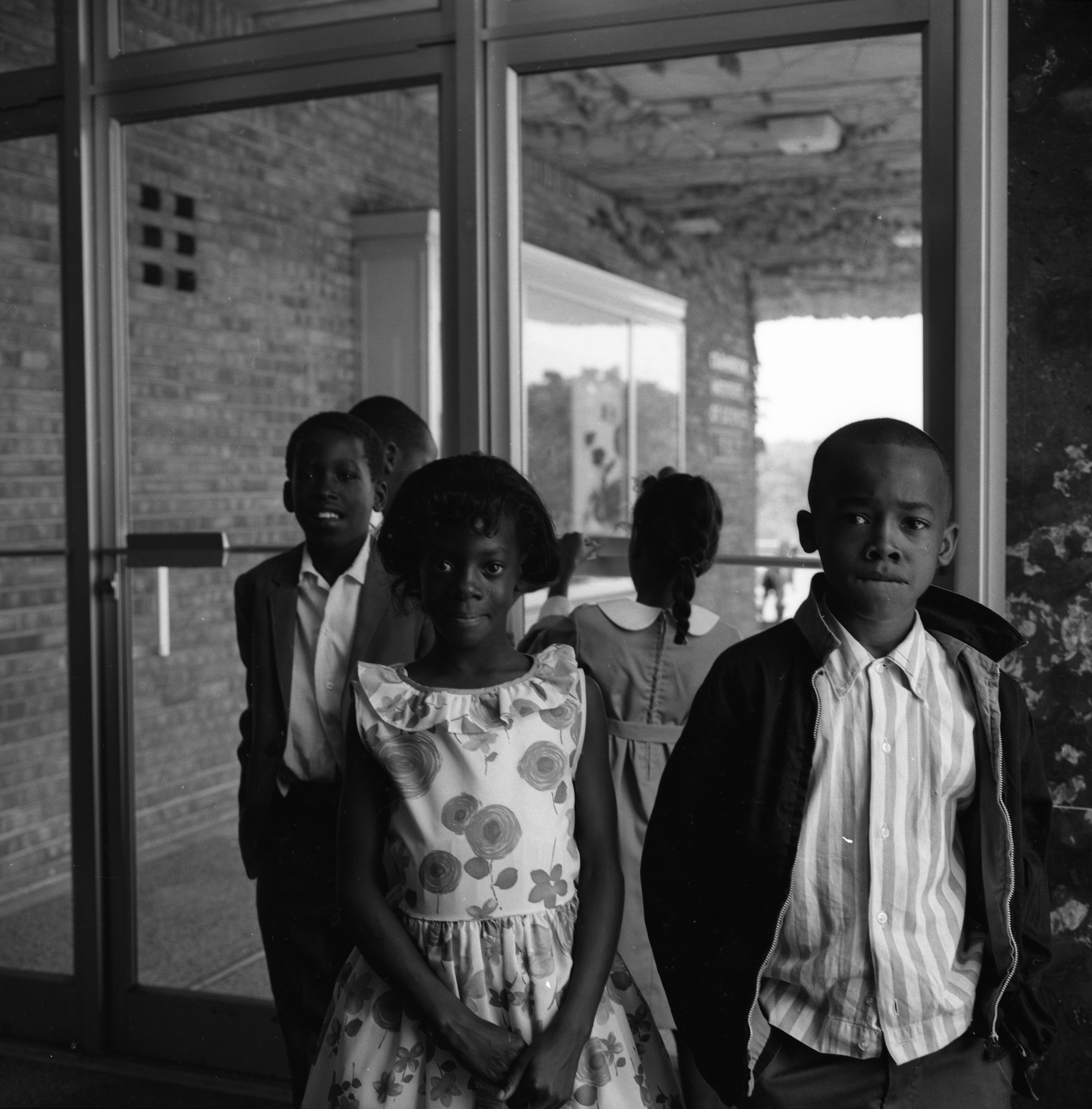
A recent discovery in our collections furthered my appreciation of the Institute’s educational outreach and its commitment to ensuring access to the world of science for all its surrounding communities. It all started with the folder titled “Pontiac Area Urban League, 1988” in the Institute of Science Director’s Records.
The Pontiac Area Urban League (PAUL), was founded in 1950 as an affiliate of the National Urban League. An integral part of PAUL’s mission was to improve educational opportunities for underserved residents. Through its Education Committee, they partnered with Pontiac Public Schools in the 1980s to empower students of color to seek equity in science and math education by providing real-world role models and encouraging parent involvement. In 1988 this effort took the form of a project that focused specifically on middle school students and lead PAUL to approach Cranbrook Institute of Science. The resulting partnership formed the basis of CIS’s relationship with students in the School District of the City of Pontiac that continues to this day.
A visiting school group, 1966. Robert T. Hatt, photographer. Courtesy of Cranbrook Archives, Cranbrook Center for Collections and Research.
Correspondence in the CIS Director’s Recordssuggests that CIS had already been considering educational outreach efforts to Pontiac residents. Janet M. Johnson, Director of Education, states in a 1988 memo to Director Robert M. West regarding the possible partnership with PAUL: “This may be another avenue for us to pursue interests with Pontiac.” West expresses his “delight” a few months later in a letter addressed to PAUL’s Interim Director, Jaqueline Washington:
One was from Detroit; one was from Pittsburgh. One attended Kingswood School; the other attended the Academy of Art. One was a writer and women’s rights activist; the other was a sculptor, photographer, and social worker. Both were named Harriet Cooper. Both were on Cranbrook’s campus in 1940.
This was the unusual story I uncovered working recently with the Archives’ digital collections. While tagging images with the names of Cranbrook’s staff photographers, who were responsible for the majority of photographs taken at Cranbrook between the years 1931-1970, I came across the name Harriet Cooper. As one of only two female photographers, I attempted to find out more, and in the process discovered a second Harriet Cooper who was also at Cranbrook around the same time.
What were the odds? And more importantly, which was my Harriet? I had to find out, not only for the sake of photographic description, but to satisfy intellectual curiosity about the lives of two seemingly individual Cranbrook women, who shared the same name and once lived in close proximity (temporal and geographic) to each other.
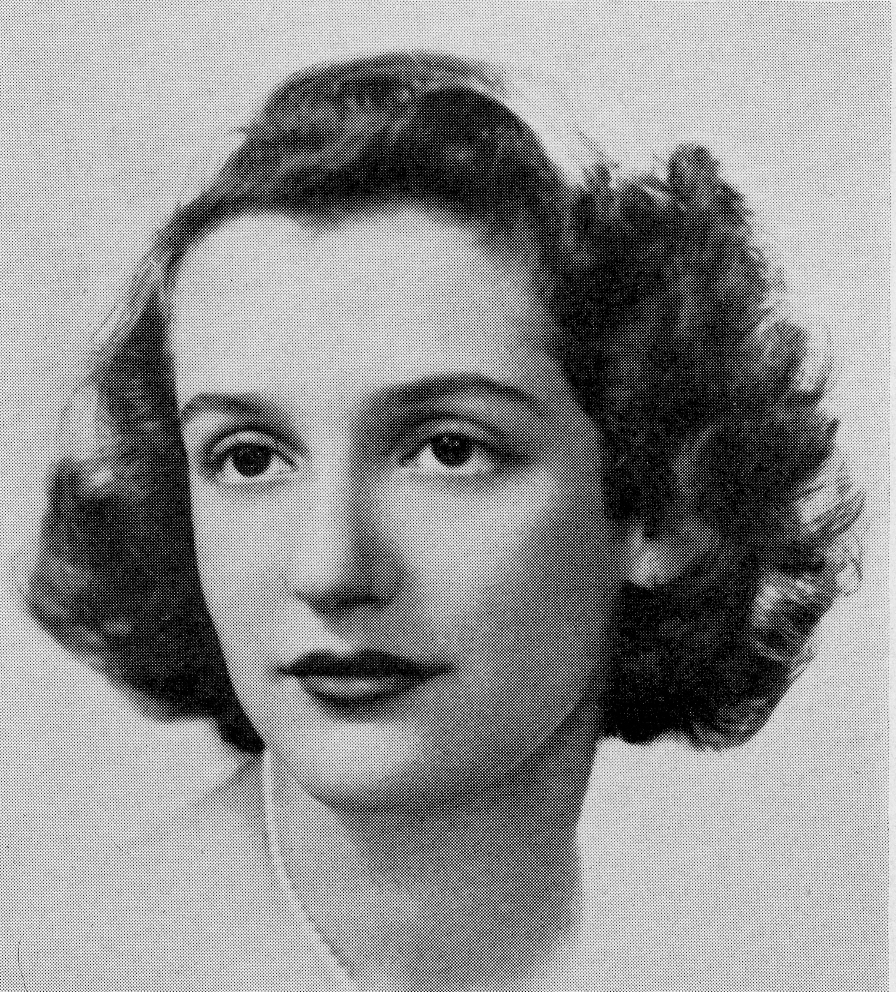
Senior picture of Harriet Cooper in the 1940 yearbook Woodwinds. Courtesy of Cranbrook Archives, Cranbrook Center for Collections and Research
Harriet Cooper Alpern was born in 1923. A Detroit native, she grew up on Chicago Boulevard in the Boston-Edison District. Attending Kingswood School (her twin brother attended Cranbrook School), she was active in theater and served as a reporter for The Clarion, graduating in 1940. According to the yearbook, Woodwinds, she was the senior voted for having the perfect speaking voice and known for splitting sides with her “unconscious humor.” After Kingswood, Harriet attended the University of Michigan, where her future husband E. Bryce Alpern also attended.
Poem appearing in the 1940 yearbook Woodwinds. Courtesy of Cranbrook Archives, Cranbrook Center for Collections and Research.
Harriet “Betty” Cooper, 1938. Courtesy of Cranbrook Archives, Cranbrook Center for Collections and Research.
Harriet Elizabeth (Betty) Cooper Lundquist was born in Valencia, Pennsylvania in 1916. She grew up in Pittsburgh, daughter of social workers and directors of Kingsley House, a settlement house. Betty attended both Antioch College and Yale University School of Fine Arts before coming to Cranbrook Academy of Art to study sculpture under Carl Milles from 1940 to 1942. While here, she also took classes in metalcraft, modeling, and design.
Untitled entry by CAA student Betty Cooper for the War Department Sculpture Competition, May 1, 1941. Courtesy of Cranbrook Archives, Cranbrook Center for Collections and Research.
And, she also took a job with Cranbrook Foundation as a photographer!
Although unknown whether she’d had any previous experience, Betty kept the Photography Department afloat on her own for several weeks during February and March 1942, and then stayed on for another seven months as assistant photographer. After graduation, Betty continued to work as a photographer for the Farm Security Administrationin Washington, D.C., where she met and married Oliver Lundquist.
Unattributed, this photograph of the interior of Milles House featuring Carl Milles’ sculpture collection was likely taken by Betty Cooper in February 1942. Courtesy of Cranbrook Archives, Cranbrook Center for Collections and Research.
While raising three children during the 1950s and 1960s, Betty was active in civil rights causes, including being a founding member of Women Strike for Peacein 1961. In the early 1970s, she went back to school and earned a graduate degree in social work, practicing her parents’ profession for the next thirty years until retirement.
It just goes to show that even while performing routine (but necessary!) archival tasks, fascinating stories reveal themselves, which provide new depth and understanding of Cranbrook’s people.
– Deborah Rice, Head Archivist, Cranbrook Center for Collections and Research
When we consider historical records, even digital ones, our thoughts do not usually extend to websites. Yet, just like student newsletters or exhibition catalogs, Cranbrook’s website is a compendium of institutional information regarding the people, places, and things that make it unique. As we ourselves shift evermore towards online existences, one focus of the Archives has been on how to ensure Cranbrook’s virtual legacy.
I’m sure everyone is familiar with the expression, “What goes on the internet, stays on the internet,” or some variation thereof. Cranbrook is no exception. Fortunately, there is the Internet Archive. A non-profit American digital library, it has been saving public websites since 1996. And, courtesy of its web archives, the Wayback Machine, Cranbrook’s evolving web presence has been captured over time from its beginnings in the mid to late 1990s to today. [Interesting aside: through the Internet Archives backup protocol, Cranbrook is a part of the Bibliotheca Alexandrina, the current incarnation of the famed ancient Library of Alexandria!]
Cranbrook home page as it looked in 1997. Courtesy of the Internet Archive.
One of the quickest ways to get a snapshot of what was going on at Cranbrook in the last twenty-three years is through its website. Get lost in Cranbrook 1997 by clicking on the above homepage image and navigating through the still active links.
How about exploring Cranbrook 2007?
Cranbrook home page as it looked in 2007. Courtesy of the Internet Archive.
There are only 1,450 more site captures to delve into, if you’ve got the time! While the interactive websites of Cranbrook’s past can be accessed in this way, it is important to note that the information and files used in their creation form part of the over two million items at the Archives. For example, the main homepage image from the 1997 website, the Woodward Entrance Feature, can be found in the Archives’ Architecture Slide Collection.
View of the entrance feature from Woodward Avenue at sunset, 1996. Dan Hoffman, designer. Balthazar Korab, photographer. Copyright Balthazar Korab/Cranbrook Archives.
As increasingly digital files become the only documentation of Cranbrook activities or events, its websites are more integral to understanding the context of these records. The Archives continues to expand its digital capabilities to keep pace. In the near future, we hope to provide our own copies of Cranbrook’s various websites (with keyword search capability), side by side with the digital records from which they were created.
–Deborah Rice, Head Archivist, Cranbrook Archives Cranbrook Center for Collections and Research








 Cranbrook Kitchen Sink