George Booth and Palermo: the Paschal Candelabrum

Christ Church Cranbrook Candelabra

Stone carvers at the Chiurazzi Foundry, 1929. Cranbrook Archives.

Even though Christ Church Cranbrook has not officially been a part of the Cranbrook Educational Community since 1973, our staff is often asked to give presentations or tours relevant to the church and the objects that George Booth purchased to adorn it. Gothic in architecture, and a showplace for the Arts and Crafts movement, Christ Church Cranbrook also features objects from the 12th century. One of these is a reproduction of the original Paschal Candelabrum located within the Cappella Palatina (1130-1140) in the Palazzo dei Normanni (Palace of the Normans) in Palermo, Sicily.

It appears as if Booth first became aware of the medieval sculpture in Sicily through his son, Henry, who traveled on a European trip in 1922 with his close friend, Bob Swanson. Henry wrote several letters home to his father describing his visits to Monreale and Palermo, and the artistic and architectural wonders he saw there. Records in the Cranbrook Archives show that in 1929, George and Ellen Booth traveled to Italy where they made several purchases, including a faithful reproduction of the candelabrum. George and Ellen discussed where to place the candelabrum in the church and George wrote Henry: “Now as for use–I thought if at the chancel we could establish a custom of lighting the big candle for weddings or at Easter and Christmas and if in the Narthex when a baptism was to occur. There is plenty of time to think it over as I have yet to place the order and they estimate it will take one year to complete.” The candelabrum was installed in the Christ Church Cranbrook Narthex in March 1931.
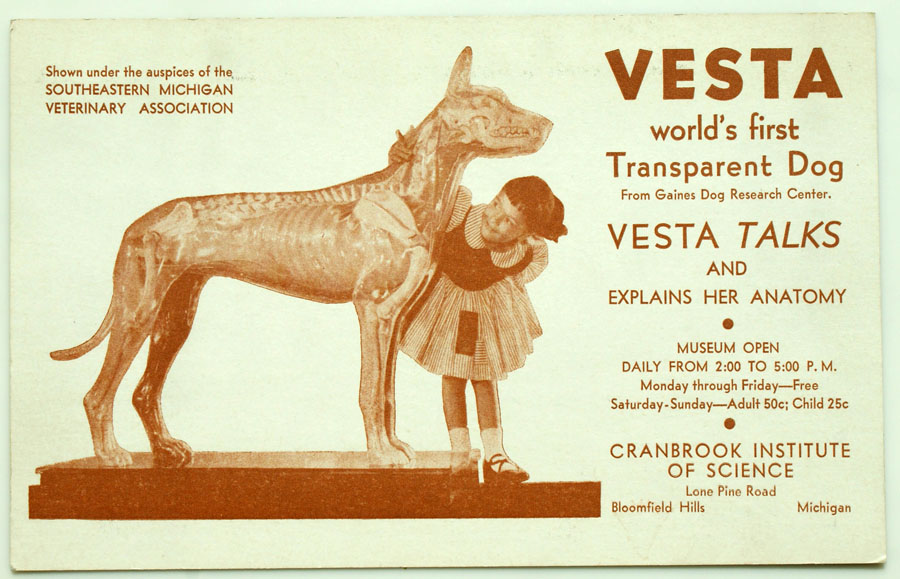
The Transparent Dog Talks

Vesta, the transparent dog

Exhibition Card, Cranbrook Institute of Science Records, 1955. Cranbrook Archives.

While preparing for an exhibition, it is inevitable that we stumble upon cool, unusual objects in our collection. I love the discovery of the unique stories associated with them.  This image announces an Institute of Science exhibition that featured Vesta, the talking dog.  Vesta (named after the Roman goddess and guardian of the home) was a transparent plastic model created in 1954 for the Gaines Dog Research Center by the Deutsches Museum in Germany. Vesta was then flown to Cleveland, where a team of experts installed an intricate sound system which enabled her to tell interesting facts about herself as parts of her anatomy lit up.   She was part of an educational and scientific traveling exhibition to help dog owners better understand their pets. Continue reading

Illuminating Lives: Documenting Women in the Cranbrook Archives

In the publication Perspectives on Women’s Archives, recently released by The Society of American Archivists , editors Tanya Zanish-Belcher and Anke Voss begin their introduction with the following : “the history of women’s archives and the collecting of women’s records reflect the larger cultural and societal developments occurring in American history over the past few centuries.” This poses the question—how do we at Cranbrook document the lives of the women who worked and studied here? What can we do to actively collect the papers and records that will illuminate the lives of these women? How have their experiences contributed to our community and to the world at large?

Currently, the Cranbrook Archives has a small percentage of collections donated by women or their families that speak to these issues, including the collections of Cranbrook artists and the papers of former CEC president Lillian Bauder. However, the bulk of women’s history can be found in our institutional records. I would like to spotlight three unsung women in this blog: Helen McIlroy, Pearl Peterson, and Marjorie Bingham.

Helen McIlroy at her desk at Cranbrook House, 1950. Cranbrook Archives.

Helen McIlroy at her desk at Cranbrook House, 1950. Cranbrook Archives.

Continue reading

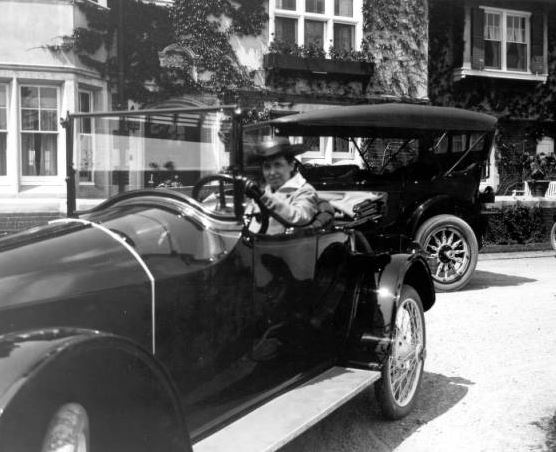
Photo Friday: Alexandrine Behind the Wheel

Alexandrine McEwen in her Scripps-Booth, 1916.  Cranbrook Archives.

Alexandrine McEwen in front of Cranbrook House in her Scripps-Booth, 1916. Cranbrook Archives.

As the organization that is currently hosting the exhibition A Driving Force: Cranbrook and the Carit would make sense that we at the Center were drawn to this photo for its representation of a 1916 Scripps-Booth, the car designed by James Scripps Booth and produced by his automotive company. Instead, though, the woman behind the wheel is the real star of the image. Alexandrine McEwen and her sister, Katherine, were co-founders of the Detroit Society of Arts and Crafts (DSAC) and friends of George Booth. Alexandrine was a bookplate artist, painted miniatures, and also authored many of the early plays for the DSAC. After living for decades in Detroit, she and Katherine relocated to Dragoon, Arizona where they ran a dude ranch.

Leslie S. Edwards, Head Archivist, and Shoshana Resnikoff, Cranbrook Center for Collections and Research


Dispatch from the Archives: Documenting Liggett

Part of the job of an archivist is to network with colleagues and provide guidance when neighboring organizations or institutions are looking to establish a new archive.  As luck would have it, two weeks ago I had the pleasure of visiting the University Liggett School in Grosse Pointe Woods to look at their archives, and work with the two stellar Sara(h)s: Sara Day Brewer and Sarah Gaines.  Both women—also current parents at the school—are working to preserve the heritage of the school.

Image

Liggett School ephemera noting architect Albert Kahn’s entrance to the school, 1942. The Liggett School Collection, Courtesy University Liggett School Archives.

Continue reading

Surely Shirley: an Early Knoll Textile

Architect Ralph Rapson may be a household word, especially among aficionados of mid-century modern architecture.  But few likely know of the creative talents of his first wife, Shirley Fletcher.  Just out of high school in 1941, Shirley enrolled in the Intermediate School at Cranbrook Academy of Art.  Like many other students of the day, she spent time in various departments, but found her niche in the weaving department under Marianne Strengell.  While here, she developed a series of block-printed textile designs.  Though she did not continue past her first year (she left to marry Ralph!), Shirley continued to design textiles after she left Cranbrook.

In 1944, Hans Knoll and Ralph Rapson (who was designing furniture at the time for Knoll) discussed the formation of a textile division within Knoll.  Their idea was to introduce contemporary textiles that would complement the modern furniture being produced by the company.  The following year, Rapson brought  Shirley’s designs to the attention of Hans Knoll and her textile “Isles” became one of the earliest printed fabrics at Knoll.  Marianne Strengell may also have contributed to Knoll’s decision to feature “Isles” which was published as part of an assemblage of Academy of Art student “textile studies” in the July 1945 issue of Arts and Architecture.

IMG_1571

“Isles” by Shirley Fletcher Rapson in Arts and Architecture, July 1945.

In October, Hans Knoll wrote Rapson that even though they were “very anxious to do something with Shirley’s fabrics,” due to the shortage of materials during the war, they had to wait until adequate supplies of cloth could be acquired.  The pattern was slightly altered (notice the solid in-fill blocks) when Florence Schust Knoll used “Isles” for drapery in the Rockefeller family offices at Rockefeller Center in 1946.

"Furniture by H.G. Knoll & Associates," Arts & Architecture, September 1947, p. 24. Cranbrook Academy of Art Library.

“Furniture by H.G. Knoll & Associates,” Arts & Architecture, September 1947, p. 24. Cranbrook Academy of Art Library.

The Knoll Textile Division debuted in February 1947 in a new Knoll showroom in New York.  Shirley Rapson textiles were part of the collection (a slightly different version of “Isles” was offered in four different color ways), along with designs by Cranbrook’s Marianne Strengell and Antoinette “Toni” Webster Prestini.

Image

Shirley Rapson’s”Isles” at the Rockefeller Center family office building, 1946.

Leslie S. Edwards, Head Archivist

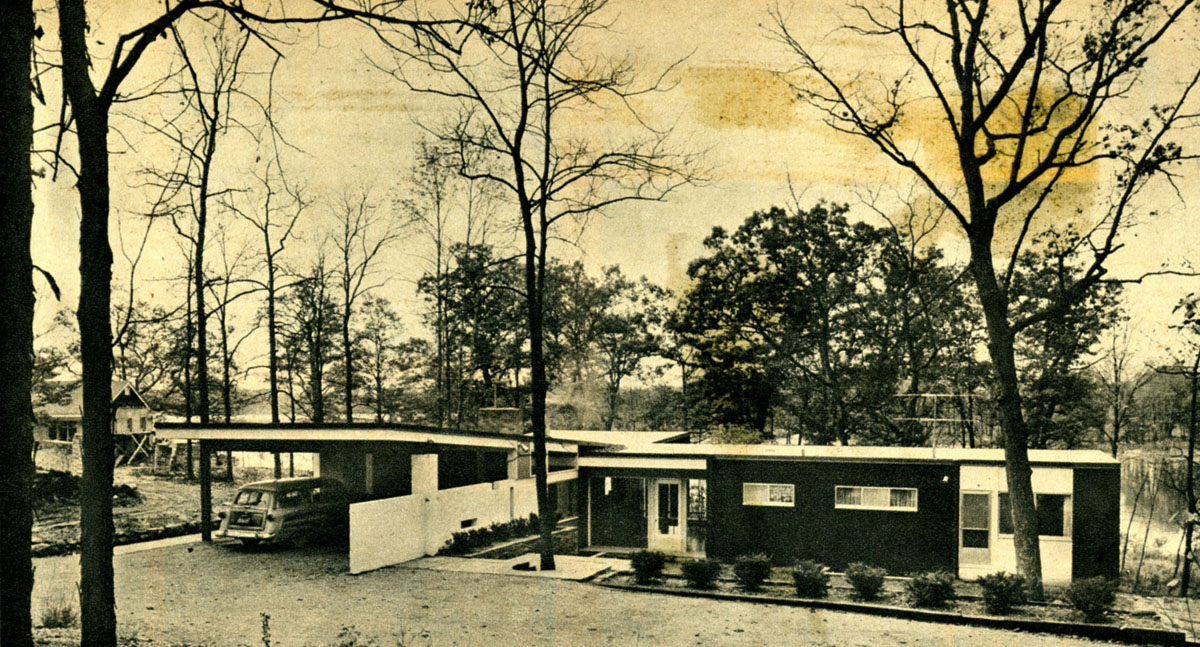
Walls Can Talk: Robert Snyder, the Buckner Residence, and the Mid-Century Home

The other day I had the pleasure of taking a fantastic (albeit very cold!) field trip to view a mid-century modern home designed by Birmingham architect Robert Snyder.  Snyder studied architecture at Cranbrook’s Academy of Art (1948-1950) and eventually took over as the Head of Architecture (1952-1965). The house, located on Walnut Lake in West Bloomfield and commissioned by Noel and Isabel Buckner, is slated for demolition any day.  I learned about the house from Liz Buckner, who called to donate the original blueprints of the house to the Archives.  Liz offered to give me a tour of the house and I enthusiastically accepted!

View of Buckner House from the drive above, circa 1955. Courtesy Liz Buckner. Detroit Free Press/Ray Pillsbury.

View of Buckner House from the drive above, circa 1955. Cranbrook Archives, Detroit Free Press/Ray Pillsbury.

Continue reading

Dispatch from the Archives: “The Councilman Doesn’t Like it”

Okay, I couldn’t resist! Today, while researching a query on sculptor Bernard “Tony” Rosenthal, I ran across this photo in our collection. When I showed it to one of our volunteers, Rita Faudman, she said (while laughing), “what can you do with THIS?” And my immediate reply was, “post it on the blog!”

©Wide World Photos.  Councilman Harold Harby leaves no doubt about his opinion.  Courtesy Bernard (Tony) Rosenthal Papers, Cranbrook Archives.

©Wide World Photos. Councilman Harold Harby leaves no doubt about his opinion. Courtesy Bernard (Tony) Rosenthal Papers, Cranbrook Archives.

Continue reading

Cranbrook and the Car: A Different Look

Currently on display, the exhibition A Driving Force: Cranbrook and the Car thoughtfully illustrates two key ways in which Cranbrook has been affiliated with the automotive industry throughout its history.  James Scripps Booth was an avid artist and inventor, even taking apart, rebuilding and designing cars in the garage of Cranbrook House from an early age.  Later on, the Academy of Art encouraged students to enter competitions which included designs for Packard Motor Car hood ornaments (1934) and exterior design, hood ornaments and trunk lid medallions (1950).  Graduates were employed by the Big Three automakers in a variety of ways—working in the design studios building models for new cars, as part of Harley Earl’s “Damsels in Design,” and as textile designers for automotive interiors.

But Cranbrook’s relationship with the car goes beyond the realm of design.  The Booth family’s list of cars includes a Winton (1904), a Christie (1904), a Cartercar (1907), two Pierce Arrows (one was a limousine), a Brush Runabout (1910), a Chalmers 40 (1910), a Lozier “Briarcliff” (1911) and a Detroit Electric (1921) which was driven by Henry Wood Booth at the age of 88.

Warren and Grace Booth with chauffeur in the Chalmers 40 in front of Cranbrook House. Circa 1910, Cranbrook Archives.

Warren and Grace Booth with chauffeur in the Chalmers 40 in front of Cranbrook House. Circa 1910, Cranbrook Archives.

Continue reading

Dispatch for the Archives: the Joys of Processing

Although we live in an age of technology, databases, and the digital representation of collections, one of the most interesting and rewarding jobs for an archivist (at least this one!) is still the processing of a collection.  What does this encompass? It is the way in which an archivist takes the paper records of an individual, group, or institution and sifts through them, weeding out duplicates, sorting, organizing, and  rehousing in acid-free folders and boxes, all to make it accessible for you, the user!.  To some this may seem a tedious task (and it certainly can be depending on the nature of the collection) but the rewards are usually worth it.  Finding that one gem that tells a new story, or that group of documents that sheds new light on an old story—this is the stuff archivists dream of!

I am currently processing the Swanson Associates Records that document the partnership between architect J. Robert F. Swanson and interior designer and textile artist Pipsan Saarinen Swanson.  Right now I am looking at the project files that relate to the firm’s architectural commissions from 1926 to 1977.  So, as a sneak preview (the collection is not yet open for research), here a couple of interesting discoveries:


Continue reading

Create a website or blog at WordPress.com