Photo Friday: Dinner at the Saarinens’

Loja Saarinen sets the table for guests.  Saarinen House, 1930-1940.  Cranbrook Archives.

Loja Saarinen sets the table for guests. Saarinen House, 1935-1940. Cranbrook Archives.

Loja and Eliel Saarinen were masterful entertainers.  That tradition continues every spring, when Cranbrook Art Museum opens up the house for tours.  Though the museum avoids serving food or drinks in the house (it is accessioned into the museum’s collection as a single historical object, after all), visitors get to experience the house as the Saarinens designed it between 1935 and 1940.  Every autumn the tour season ends and we pack up the house to hibernate for winter, opening it up again come spring.  To celebrate the closing of another great tour season (it finishes at the end of October, so get in while you can!), we wanted to showcase one of the most social environments in the house—the dining room.

Here, Loja Saarinen prepares the table for guests.  The round placemats were decorated by the Saarinen’s son, Eero Saarinen, when he was just a boy.  The table is at its smallest size—the outer rim of the table actually pulls out, allowing donut-shaped leaves to expand the table yet retain its circular shape. The swing door to the butler’s pantry is open, showing off the home’s state-of-the-art Frigidaire icebox.  Truly a modern home for a modern family!

Michigan Modern: The Model T has Left the Building

Sunday marked the last day of the exhibition Michigan Modern: Design That Shaped America at Cranbrook Art Museum.  This means that Monday saw the start of the museum staff’s busiest time—the five weeks in which we take down one exhibition and put up another.  Dismantling Michigan Modern is difficult; we need to say goodbye to objects we love and figure out the difficult process of getting them out the door.  And if there is one object in the entire exhibition that typifies the emotional drama of letting go as well as the physical challenge of moving giant historical artifacts, it is the Model T chassis.

Model T Chassis, The Henry Ford.  On view in Michigan Modern at Cranbrook Art Museum.  September 2013, Shell Hensleigh/Cranbrook Art Museum.

Model T Chassis, The Henry Ford. On view in Michigan Modern at Cranbrook Art Museum. September 2013, Shell Hensleigh/Cranbrook Art Museum.

Continue reading

Mary, Maija, and Toshiko: Re-Thinking Open Storage in the Collections Wing

Open storage.  Two words that mean nothing to the wider public, the phrase is a loaded one for museum professionals.  Love it or hate it (and I personally love it), open storage is an increasingly popular method of getting a museum collection—usually hidden away in the bowels of the institution—exposed to a wider audience.  Most museums only exhibit about 10% of their collection at one time, so building or retrofitting storage spaces to allow for public viewing of objects provides an opportunity to leverage museum storage and increase visitor-object interactions.  From the Luce Centers at the New York Historical Society and the Smithsonian American Art Museum to the open ceramics storage at the Victoria & Albert Museum in London, more and more institutions are removing the physical barrier between their visitors and their objects—or at least replacing an opaque barrier with a glass one.

In 2008, Cranbrook Art Museum had the opportunity to redesign the museum’s storage from the ground up.  The museum chose to strike a balance between the all-access open storage model of a Luce Center or the new American Wing at the Metropolitan Museum of Art and the traditional, old-fashioned model of closed-off storage with the rare “behind the scenes” mediated tour.  What resulted was the ceramics  vault in the new Collections Wing, a secure room with a glass wall that gives visitors—who enter the Collections Wing on one of the regularly scheduled weekly vault tours—a chance to look into storage and get a sense of the scope and depth of CAM’s holdings.  To add to the potential learning opportunities for visitors, no museum objects are assigned a permanent home on the first row of shelves in the vault.  Instead, the empty shelves serve as a miniature curatorial opportunity, with staff members changing out the objects on display there and tour guides serving as docents for “curated” shelves.

Ceramics vault in the newly built Collections Wing.  The first shelf is temporary shelving - it is used to curate within the collection. 2012. Jim Haefner/SmithGroup/Cranbrook Art Museum

The ceramics vault in the newly built Collections Wing. The first shelf is temporary shelving – Museum and Center staff use it to curate within the collection. Jim Haefner/SmithGroup/Cranbrook Art Museum, 2012.

Continue reading

Happy Birthday, Sol LeWitt!

Sol LeWitt, Wall Drawings 790A and 790B: Irregular Alternating Color Bands (1995), currently on view at the Cranbrook Art Museum.  Photo, P.D. Rearick/Cranbrook Art Museum.

Sol LeWitt, Wall Drawings 790A and 790B: Irregular Alternating Color Bands (1995), currently on view at the Cranbrook Art Museum. Photo, P.D. Rearick/Cranbrook Art Museum.

Solomon “Sol” LeWitt was born in Hartford, Connecticut, on September 9, 1928, making today the 85th anniversary of his birth.   LeWitt died in 2007, but his groundbreaking work continues to be exhibited around the world.  If you’re interested, however, you can catch LeWitt closer to home at Cranbrook.

On exhibition at the Cranbrook Art Museum, LeWitt’s Wall Drawings 790A and 790B: Alternating Color Bands dominate the Hartmann Gallery.  These striking wall paintings are deceptive – though they seem permanent, they exist only for the run of the exhibition.  This short-lived existence reveals LeWitt’s important role in the conceptual art movement, in which the “idea” of the piece holds more significance than the physical manifestation of the concept.  Check out Sol LeWitt: Wall Drawings 790A and 790B: Alternating Color Bands on view at CAM now.

– Shoshana Resnikoff, Collections Fellow

California to Cranbrook: What I Did on My Summer Vacation

Everyone who has endured a Michigan winter agrees that a Michigan summer is the universe’s way of making it up to you.  Having completed my first winter at Cranbrook, then, it seems a shame that I missed the glory of summer in the Mitten State.   I was called back to my home state of California to celebrate my mother’s birthday (a milestone year that she wouldn’t appreciate having publicized on the internet) and to enjoy a few solid weeks of family reunions, state-wide road trips, and delicious, delicious tacos.  I traded the sun and heat of Southeastern Michigan for the fog and chill of Northern California, but at the end of the day I still managed to find a little bit of Cranbrook in California. Continue reading

From the Archives: Teaching and Exhibiting Painting at Cranbrook, 1930-1970

Image

From the Archives: Teaching and Exhibiting Painting at Cranbrook, 1930-1970, photograph courtesy of Justine Tobiasz.

With the opening of the summer exhibition season at the Cranbrook Art Museum, the campus is filled with opportunities to learn about art, design, and history.  This also marks the first of a regular series of exhibitions that explore the unplumbed depths of Cranbrook’s archival holdings.  From the Archives: Teaching and Exhibiting Painting at Cranbrook, 1930-1970 highlights the efforts of Cranbrook teachers and curators and explores the work they did promoting painting at Cranbrook at the mid-century mark.  Curated by Head Archivist Leslie S. Edwards, the show uncovers untold accounts about the moments and figures that populate Cranbrook’s storied painting history.   From the Archives: Teaching and Exhibiting Painting at Cranbrook, 1930-1970 will be on view in the Cranbrook Art Museum from June 14 to September 29, 2013, so be sure to check it out!

[Ed. note: if you missed the Archives exhibition in person, don’t worry – it lives forever on the internet! Check out the Archives online exhibition, From the Archives: Teaching and Exhibiting Painting at Cranbrook, 1930-1970.]

Credit Where Credit’s Due

My favorite thing about being an archivist is that sometimes a seemingly simply question turns into a new discovery.  This happened recently when I was researching the artist of a ceramic vase located in Cranbrook House, a historic house on Cranbrook’s campus and the home of Cranbrook founders George and Ellen Booth.    Finding the answer should have been a simple task: open the object file, locate artist’s name.  A two-minute job.

Two-minutes turned into a two-week journey.

The mysterious vase in question, currently living at Cranbrook House.

The mysterious vase in question, currently living at Cranbrook House.

Continue reading

Worker Bees and Spider Webs: Preparing Saarinen House

Walking through Saarinen House during the historic house tour season (May 1st – October 31st) visitors expect to see a few things; perfection in architecture, intricacies in woven textiles, beautiful leaded glass, and ingeniously designed furnishings. What visitors miss during the off-season is the buzzing of many “worker bees” laboring over the house’s care. As the Associate Registrar for the Center for Collections and Research, however, I am commissioned with task of caring for the house and preparing it for the public tour season.

Exterior plaque, Saarinen House.  Considered part of the Cranbrook Art Museum, Saarinen House operates as a historic house open to tours from May to October.   The house is interpreted to the 1930s, when the Saarinen family first built and inhabited the home.  Copyright Cranbrook Art Museum/Balthazar Korab.

Exterior plaque, Saarinen House. The house is open from tours between May and October and is interpreted to the period in the 1930s when Eliel and Loja Saarinen built and furnished their home. © Cranbrook Art Museum/Balthazar Korab.

Continue reading

Dispatch from the Archives: All Things Modernism

Mid-century Modernism has taken over my life!  I eat, sleep, and even dream Modernism these days.  In my role as Head Archivist, I wear many hats – the most recent being to assist the Michigan Modern curatorial team by locating all the cool “stuff” in our Archives related to the upcoming exhibition, which will be opening at the Cranbrook Art Museum on June 14, 2013.  This includes photographs, of course, but the most fun for me is finding correspondence, articles, and ephemera that when put together create a mosaic of a time or place. Continue reading

Photo Friday: Graduate Degree Exhibition

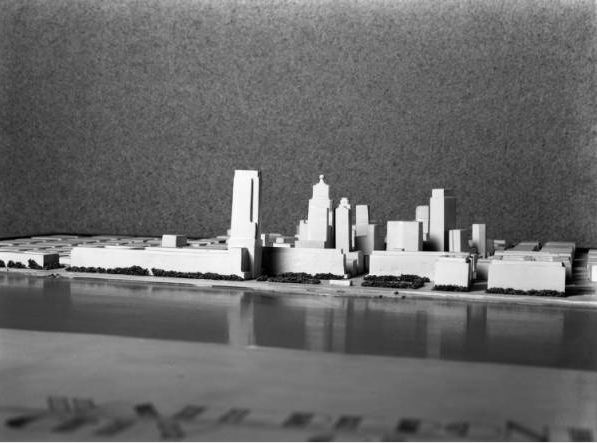
walter hickey thesis

Cranbrook Academy of Art student Walter Hickey’s model for a proposed development for the Detroit waterfront, 1935. Cranbrook Archives.

You know it’s April at the Cranbrook Art Museum when the building is overrun by graduate students from the Academy of Art, frantically putting together their final projects for the Graduate Degree Exhibition.  While the degree show (opening this year on April 22 and running until May 12) is a longtime tradition at Cranbrook (staged in some iteration since 1940!),  graduate theses date back to 1943— the first year the Academy was accredited as a degree-granting institution.   In 1935 Walter Hickey created this model as part of a larger project to redesign the Detroit waterfront helmed by Cranbrook Academy of Art director and famed architect Eliel Saarinen.

Create a website or blog at WordPress.com