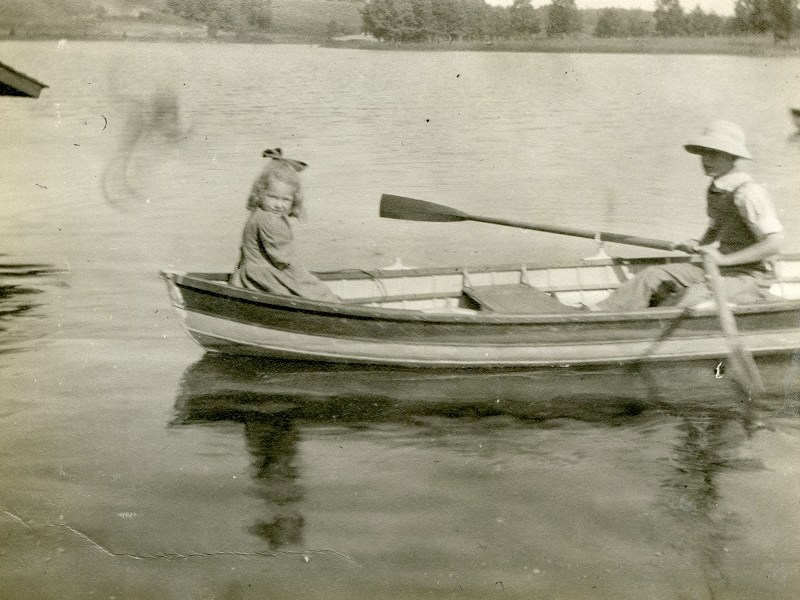
The Name Game
From the beginning of Cranbrook’s history in 1904, place names at Cranbrook have evolved and changed. Once the Booths turned the original mill pond into a lake,…
Read moreNothing at Cranbrook is just one thing. Every tree, garden, rock, and railing has a story–and often times, a name.
In 2022, with the help of an anonymous donor and our friends at RE-TREE, a Camperdown elm (Ulmus glabra ‘Camperdownii’) was transplanted from a local garden to the Meadow in Cranbrook House Gardens, where it joined another established Camperdown elm. Since RE-TREE names all of the trees they relocate, I decided our Camperdown elms needed names, too. I started to refer to the larger tree as Thistle and the smaller tree as Smike to honor the two youngest Booth children, who grew up primarily on the Cranbrook Estate.

In 1908, George and Ellen Booth and their children, James, Grace, Warren, Harry, and Florence, moved from their home on Trumbull Avenue in Detroit to their new home Cranbrook, in the “wilds” of Bloomfield Township. At the time of the move, James was twenty, only two years away from marriage; Grace was eighteen; and Warren, fourteen, was already in boarding school. Youngest siblings Harry (eleven) and Florence (six) pretty much had the run of the grounds, exploring every nook and cranny (pun intended).
As the family explored and improved their country estate, they also took to naming significant features: every pond, hill, tree, and drive would be christened with its own name. Some names stuck (Angley Woods), others changed (Glassenbury Lake became Kingswood Lake), and others have been forgotten.
From the beginning of Cranbrook’s history in 1904, place names at Cranbrook have evolved and changed. Once the Booths turned the original mill pond into a lake,…
Read moreHarry and Florence were no exception; they had pet names for each other. Harry, known as Thistle, received his nickname during an illness. He did not shave for days, and someone said kissing his cheek was like kissing a thistle. We don’t have a record of the origin of Florence’s nickname, but friends and family called her Smike her whole life.

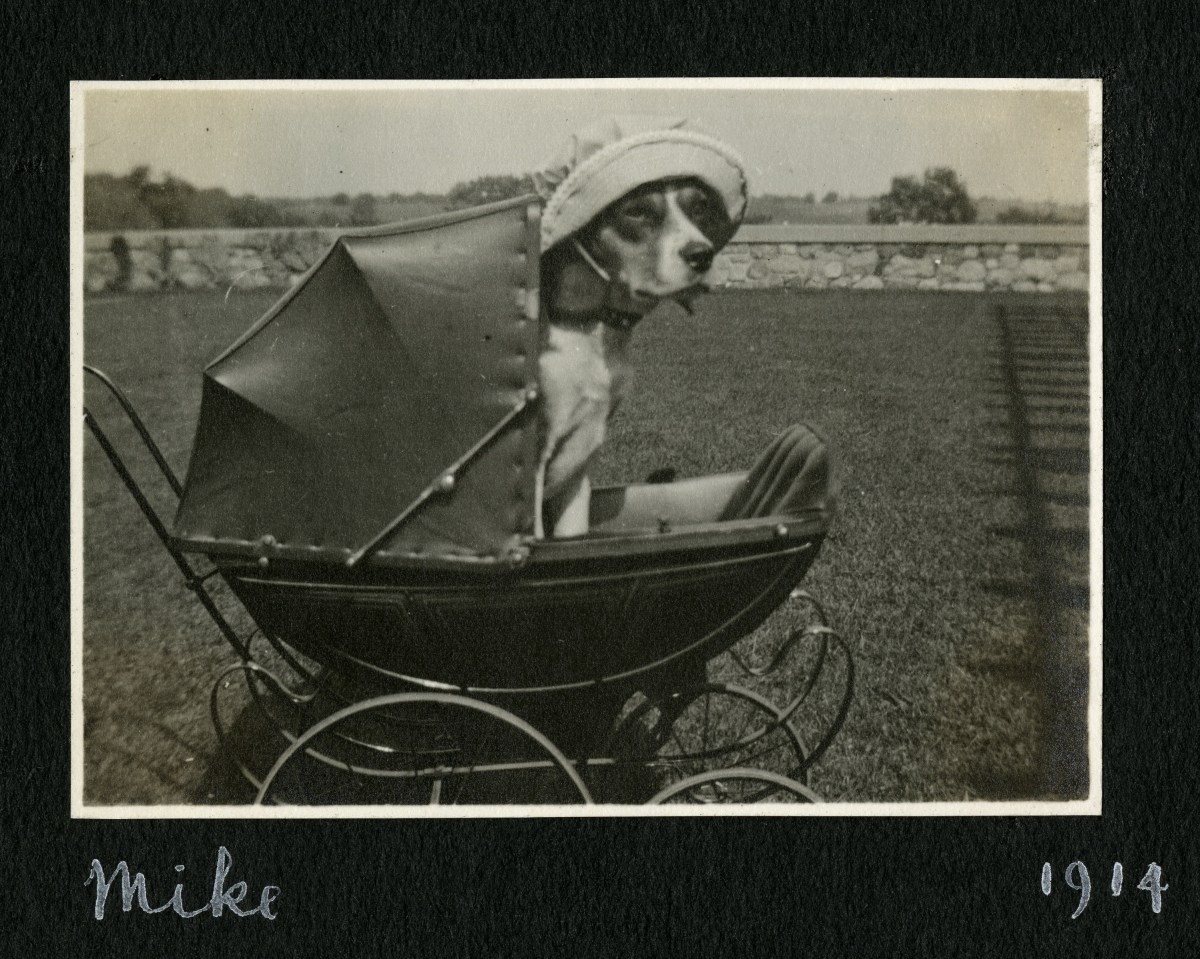
The Camperdown elms’ location below the West Terrace are also significant to Smike’s story. The Booths (especially Florence) loved animals. Family dogs Bud, Sandy, Spot, Prince, Larkspur, and Craig were well cared for and loved. The family beagle Mike was so beloved as to be made to wear a bonnet as he travelled around in a baby carriage!
The biggest canine event at Cranbrook came in 1914. As Harry Booth later wrote, “On June 20, 1914, the Booth family celebrated the 70th anniversary of the family’s landing on North America from England. After a picnic, everyone attended a dog show Florence Booth organized on the new West Terrace.”


So, when I look at the two Camperdown elms below the West Terrace–one slightly bigger than the other–I think of all the stories the grounds of Cranbrook hold, and of the happy days Thistle and Smike spent growing, adventuring, and imagining around campus.
Perhaps you’ll agree with my names for the trees, and next time you are strolling in the Meadow at Cranbrook House Gardens, just below the West Terrace, say hello to Thistle and Smike.
– Leslie Mio, Associate Registrar, Cranbrook Center for Collections and Research
Ed. note: Special thanks to Paul Nelson, one of the arborists for Cranbrook House and Gardens Auxiliary. He has been a champion for Thistle and Smike, making sure they are trimmed, watered, fertilized, and kept looking their best.
When sifting through images to post on the Center’s Facebook page, I often come across an image of someone and wonder, “How did this person end up at Cranbrook?” This week, that “someone” is Alger Munt.
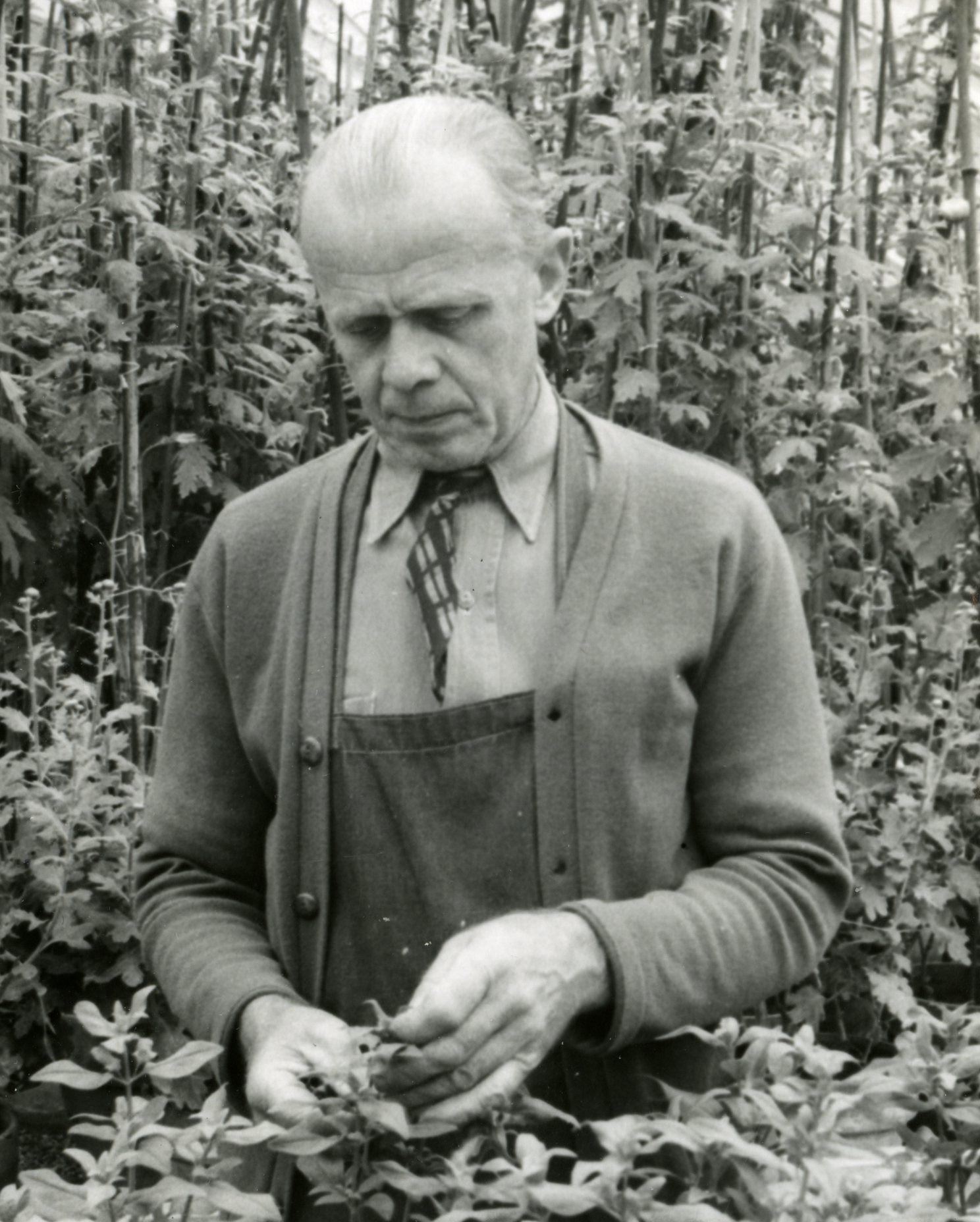
Alger Munt working in the greenhouse at Cranbrook, October 1950. Photo by Harvey Croze. Courtesy Cranbrook Archives.
Algernon George Munt (“Alger”) was born in St. Albans, Hertfordshire, England in 1894. From the age of 14, he worked as a gardener on estates near his hometown. When he was 18, he started work manufacturing straw hats in one of the area factories. Soon, his country called and he joined the army, serving in the Royal Field Artillery during World War I. After the war, he did not return to the factory but resumed gardening instead.
Munt came to America in 1921 to work for his uncle William Munt in St. Clair, Michigan, in the commercial greenhouse business. He would work for his uncle for eight years. In 1926, Munt briefly returned to England to marry Grace Barker Skinner (1898-1981) of Ware, Southampton, Hampshire, England.
Munt soon tired of the greenhouse business and came to the Birmingham-Bloomfield area to become a gardener on a private estate. Based on census information and Munt’s oral history account in Cranbrook Archives, the “private estate” was Strandcrest, the estate of lumberman Carl A. Strand, which boasted 14.3 acres, fruit trees, and a caretaker’s residence.
It was in 1936 that Munt came to work at Cranbrook. He was a gardener at Cranbrook from 1936 to 1941. From October 1941 to December 1942, Munt worked at Spindletop Hall in Lexington, Kentucky.
George G. Booth had told Munt in 1941 that he didn’t want him to go but that anytime he wanted to make a change—if things did not work out in Kentucky—get in contact with him. When Spindletop Hall had to switch to economy/war-mode in 1942, Munt took Mr. Booth up on his offer and returned to Cranbrook as a gardener and part-time chauffeur. His wife Grace worked as a laundress for the Booths.
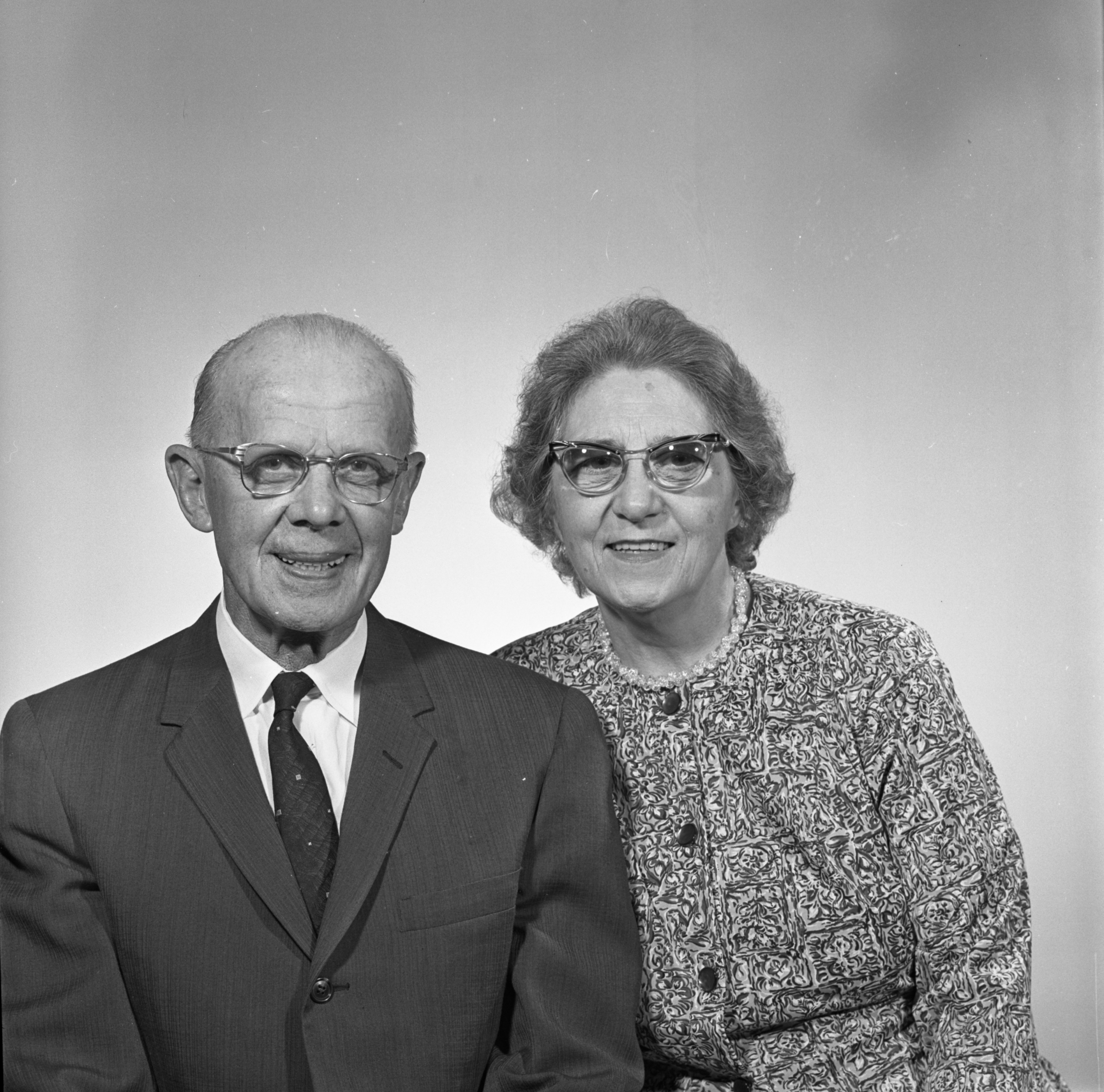
Alger and Grace Munt, circa 1965. Courtesy Cranbrook Archives.
By the 1950s, Munt was the Superintendent of the Greenhouse and Grounds at Cranbrook, and his wife was working as a maid in the dormitories at Cranbrook Academy of Art.
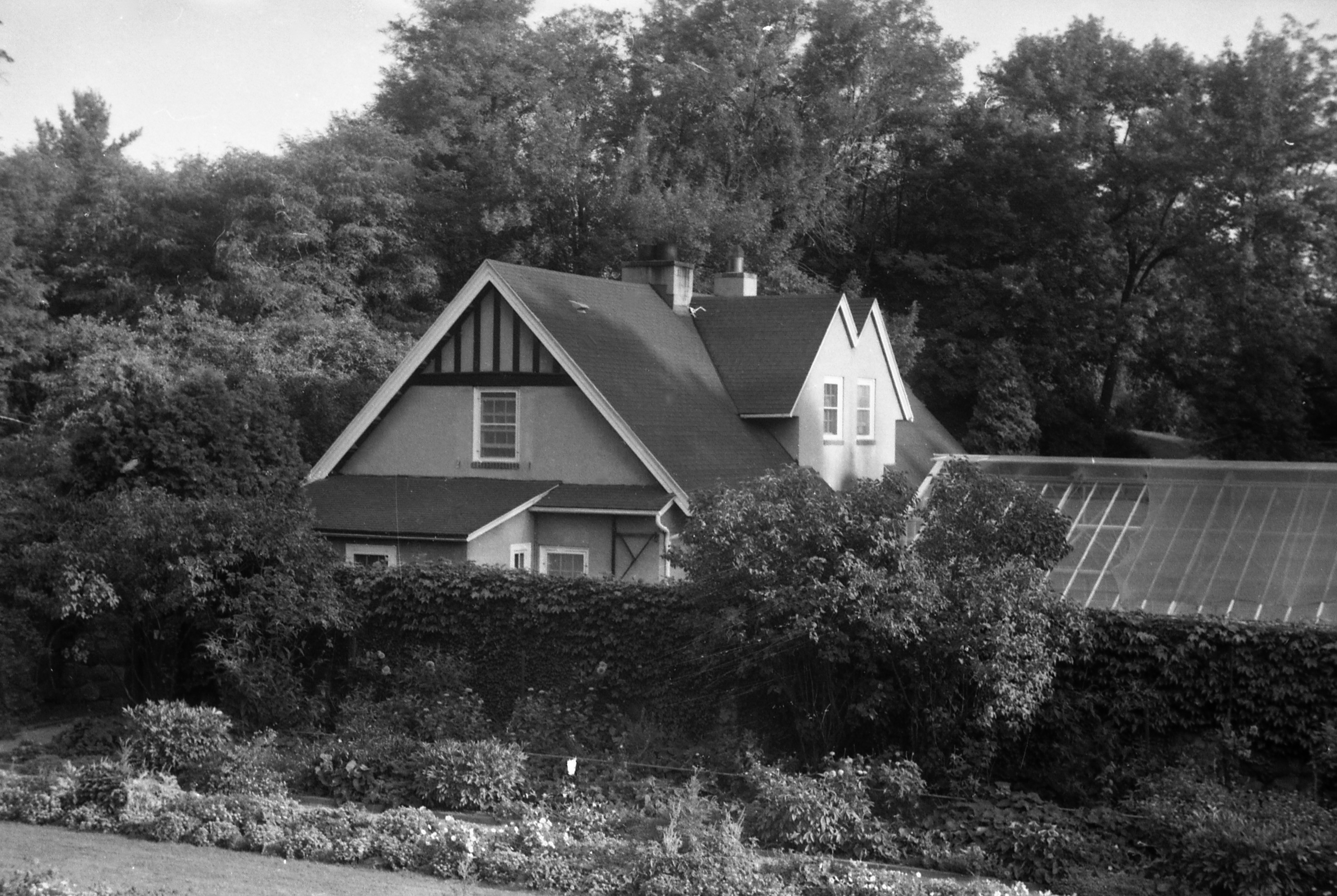
The Munts lived in Twin Cottage on the estate, pictured here in 1957, when they returned to Cranbrook in 1942 until their retirement in 1966. Photo by Harvey Croze. Courtesy Cranbrook Archives.
The Munts retired from Cranbrook in August 1966 and they moved back to England, intending to settle in Cornwall. Unfortunately, Munt died suddenly in November 1966, just short of his 72nd birthday.
–Leslie S. Mio, Associate Registrar
One of my many duties here at the Center for Collections and Research is to maintain the sculptures on the campus. This can mean finding conservators to repair works, contractors to clean them, or, in some cases, clean them myself. Recently, I was working on a sculpture in the gardens at Cranbrook House. I had seen the sculpture before but wondered about its backstory. Turns out it was a tale of two names.
The sculpture is Mario Korbel’s statue Atalanta, the Greek goddess of the hunt, travel, and adventure. It was commissioned by George Gough Booth in 1927 for one of the gardens at Cranbrook House, part of a series of work Korbel completed for the Booth house and gardens — including Dawn and Harmony in the gardens and Andante and Nocturne in the house.

July 12, 1927 letter from Mario Korbel to George G. Booth, referencing both his works Atalanta and Andante. George Gough Booth Papers, Cranbrook Archives.
Booth, admiring the beauty of the clear, white marble of Atalanta, transferred the work into the collection of the Art Museum. It was part of the original art museum exhibition in 1930.

Atalanta (left) in the first Art Museum exhibition in 1930. Courtesy Cranbrook Archives.
Later, Booth wrote: “We have finally concluded that the figure will make a very important and striking center art element in connection with the new School for Girls at Cranbrook.” When the Kingswood dormitory was built, the sculpture was transferred to Kingswood and installed on the terrace.

Atalanta (right) adorns the terrace at the Kingswood School for Girls dormitory in this undated photo. Courtesy Cranbrook Archives.
In 1969, the sculpture was vandalized and smashed into many pieces (no one was ever implicated in the crime–or at least, their name isn’t in my file!). Those pieces were put back together, but when Atalanta was finally repaired, she was not as pristine. Henry Scripps Booth decided to rename her Ecolo. He also wrote a verse to explain the new name:
Ecolo, Goddess of Earth
Who is this sweet maid who stoops protectively to save the earth from man’s pernicious tread?
It is the blithe spirit of Ecology by whom all life and natural things are fed.

Ecolo in her new home in the Herb Garden at Cranbrook House.
Ecolo, or the sculpture-formerly-known-as-Atalanta, now greets visitors in the Herb Garden at Cranbrook House.
– Leslie S. Mio, Associate Registrar
A folly, in landscaping terms, is a ornamental building or tower with no practical purpose built in a large garden or park. Around 1961, Mr. and Mrs. Henry S. Booth placed a small folly on the grounds of Cranbrook. However, for anyone wanting to play a joke on a friend, this folly has a very practical purpose.
 Weeping Zeus (or more formally Zeus of Otricoli [Roman copy of Greek original]) is a marble bust comprised of the shoulders, chest, and head of the Greek god, Zeus. The chest is carved to resemble draped cloth. The curly hair has a wreath in it, and the beard is curly with a full mustache. The bust is set on top of a concrete block column.
This sculpture has an interesting and complex history. It was carved of Carrara marble in Italy in the early 19th Century and soon afterward became a decorative feature of the manor house of Abercairny, Crieff, Perthshire, Scottland. It remained there for well over 100 years until it sold at auction. Henry Scripps Booth purchased the bust in 1961 from Michael Brett of Broadway, England. Brett had purchased it from the Abercairny the year before. The manor house, once visited by Queen Victoria, was demolished in 1960, hence the sale of sculptures from the estate.
 Here at Cranbrook, it would seem the father of the Greek gods finds the peace of this Michigan mountain dull in comparison with the revelries of either Mt. Olympus or his later home in the Scottish Highlands. It is reported tears well up in his eyes and sometimes gush forth. The sculpture became a folly (and why we call him Weeping Zeus) after Henry had holes drilled through the eyes to allow water to flow (squirt, really) out.
In reality, he’s not crying on his own. Have your guest stand in front of Zeus while you, as their friend, stand on the special stone that activates water to splash the guest from Zeus’s eyes.
As Summer comes to a close, invite that one friend who always pulls tricks on you for a beautiful walk through Cranbrook House Gardens and introduce them to Zeus.
– Leslie S. Mio, Associate Registrar
Note: Weeping Zeus is located on the Mountain in the Cranbrook House Gardens, up the stairs directly opposite the House’s front door. Cranbrook Gardens is open daily from 9:00 am to 5:00 pm, May 1 through October 31. Admission to Cranbrook Gardens is FREE for the 2018 tour season, courtesy of presenting sponsor, PNC Bank, and sponsors, All Seasons Independent Living, fleurdetroit, and Roberts Restaurant Group.

Italian laborers at Cranbrook, ca 1906/Cranbrook Archives
For many Americans, Labor Day’s most popular meaning is a “last hurrah to summer,” but its national significance is much greater than that. In 1894, Grover Cleveland designated the first Monday in September as a national holiday paying tribute to the contributions and achievements of the working force in America. The Italian laborers pictured here arrived at Cranbrook in 1905. Hired by George Booth, men with the last names of Angelosanto, DiPonio, Roselli, Soave, and Vettraino built roads and stone walls, dug ponds, contoured the land, planted, and cared for the property. In 1955 the Cranbrook Foundation Board of Trustees dedicated a plaza north of the Brookside School in appreciation of groundskeeper Michael Vettraino’s 50 years of service to the Cranbrook community. In his speech at the “Piazza Vettraino” dedication, Henry S. Booth said, “We acknowledge a debt to his native Italy, his affection for the world of growing things, his quest for beauty, his tireless hands and feet, and the part he has played as one of the many founders of Cranbrook today.”
Click here to listen to a clip from our oral history collection of Dominick Vettraino speaking about the work the Italians did on the grounds of Cranbrook.
– Gina Tecos, Archivist
 Cranbrook Kitchen Sink