Object in Focus: Travel with Saarinen

Full Trunk

Trunks in storage. Photographer, Gretchen Sawatzki.

While organizing and re-arranging some of the cultural properties late last week, Associate Registrar Gretchen Sawatzki and I came across an exciting surprise. Tucked away in a corner of one of the many storage areas across the Cranbrook Campus, we found a pair of steamer trunks. (Steamer trunks are traveling trunks that were used when steamships and ocean liners were the best way to travel overseas.) Upon further inspection we realized that they had many stickers bearing international hotels and transatlantic ocean liners. Painted on one of the trunks we found the initials ES.

E.S. Initials. Photographer, Gretchen Sawatzki.

E.S. Initials. Photographer, Gretchen Sawatzki.

Trunk interior. Photographer, Gretchen Sawatzki.

With a bit more digging and some research we found that these trunks were purchased by Eliel Saarinen from The J.L. Hudson Company in Detroit shortly after his arrival to Michigan in 1923. These trunks traveled with the Saarinens back to Finland, and to other European and international destinations. Check out the inside of the trunks. This is a wardrobe trunk, which you can see from the drawers and hanging section with hangers still inside! Although I don’t think it is practical for travel today, I imagine all the exciting places it voyaged while accompanying Eliel Saarinen on his journeys.

Stefanie Kae Dlugosz, Collections Fellow, Center for Collections and Research

All Roads Lead to Cranbrook: A Fellow Says Goodbye

I began writing this blog post weeks ago but had to set it aside—because I became too sentimental to continue, but also because I was pulled into a discussion about an issue around 19th century chairs, Eliel Saarinen, and Cranbrook House (the exact details escape me). This, to me, is the perfect encapsulation of what the last two years have been: a whirlwind of emotional investment, intellectual engagement, and a work pace that proceeds at a quick clip as projects emerge from questions as diverse as “is this sandbox at Brookside a historic one?” (the answer is, “no”) to “how did those Cranbrook School chairs get all the way out to California, and what do we do with them now?” (the answer is, “we don’t know” and “return them into circulation after ensuring their condition and documentation”).

As the first full-term, resident Collections Fellow at the Cranbrook Center for Collections and Research, I have worked with an amazing staff of individuals to field these questions and countless more (the less said about the discussion regarding spray-painted vandalism on the posterior of a sculpture on campus, the better). I have also had the chance to both figuratively and literally reach across the aisle to collaborate with the staff of Cranbrook Art Museum and Cranbrook Institute of Science, as well as the amazing volunteers at Cranbrook House. For two years I have watched the seasons turn from my desk in the lower level of the art museum. I have made a place for myself in CAM’s gleaming new Collections Wing as well as the less glamorous (but perhaps more curious and mysterious) storage spaces that fill attics and basements across Cranbrook’s sprawling campus. I have learned this storied site’s history, engaging with its past through three exhibitions and countless house tours, lectures, and public programming. And now, unfortunately, it is time for me to say goodbye.

Here I am hard at work in the Cranbrook House attic, cataloging and photographing historic costume. This job was always a surprise! May 2014.

Here I am hard at work in the Cranbrook House attic, cataloging and photographing historic costumes. This job is always a surprise! May 2014.

Continue reading

Fashioning Architecture

In 1931, attendees at the Beaux-Arts Ball in New York came dressed to impress. An annual party thrown by the Society of Beaux-Arts Architects, the ball featured a different theme each year. 1931’s theme of “Fete Moderne — a Fantasie [sic] in Flame and Silver” was inspired by the New York skyline and the iconic skyscrapers that had recently come to define it. Fully committing to the theme, many guests came dressed as famous New York buildings. In this photo William Van Alen holds center court as the Chrysler Building (of which he was the architect) while other personified buildings crowd around him.

William Van Alen as the Chrysler Building, with other masquerading architects around him. On the far right is Joseph Freelander as the Museum of the City of New York.  Source: NY Times/untappedcities.com.

William Van Alen as the Chrysler Building, with other masquerading architects around him. On the far right is Joseph Freelander as the Museum of the City of New York. Source: NY Times/untappedcities.com.


Continue reading

West to East: Cranbrook School Chairs Return

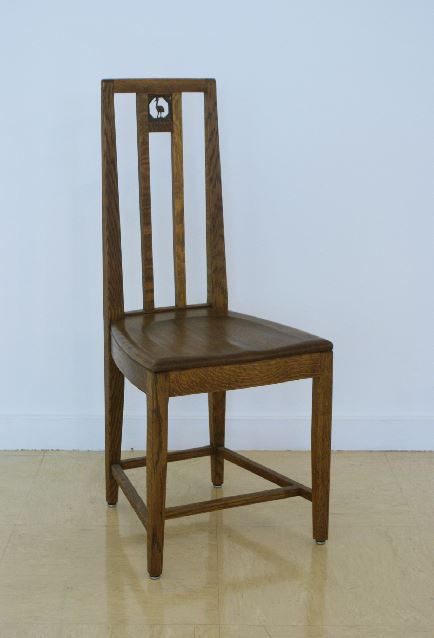
The scene feels like the opening shot in a movie: a man browses a flea market, aimlessly brushing his hands over knickknacks while he waits for something to catch his attention. A pair of chairs  jump out at him, their warm brown wood and right angles crying out for his attention.  He investigates them, noting their early 20th century construction and the curious metal design inset at the crest of the chairs.  They look familiar, he thinks, and the camera zooms out as he purchases them and takes them home.

Cranbrook School Dining Hall side chair, designed by Eliel Saarinen in 1928.

Cranbrook School Dining Hall side chair, designed by Eliel Saarinen in 1928. The chairs discovered in California are identical.

Continue reading

Happy Birthday, Raymond Loewy!

Anyone who did a search on Google today probably saw the sketched-out train engine that forms the word “Google” on the homepage.  Honoring the 120th birthday of pioneering American designer Raymond Loewy, the Google doodle pays homage to Loewy’s trademark streamlined look.  While we can’t claim Raymond Loewy as a Cranbrook designer, we took his birthday as an opportunity to identify what sort of material and ephemera we have connected to this design powerhouse. Continue reading

“In the Twenty-Ninth Century Mode”: Crandemonium Returns

The theme of the first Crandemonium Ball was the Court of Crandemonium. It prompted this newspaper article declaring that the party was in the "twenty ninth century mode." 1934, Cranbrook Archives.

The theme of the first Crandemonium Ball was the Court of Crandemonium. It prompted this newspaper article declaring that the party was in the “twenty ninth century mode.” 1934, Cranbrook Archives.

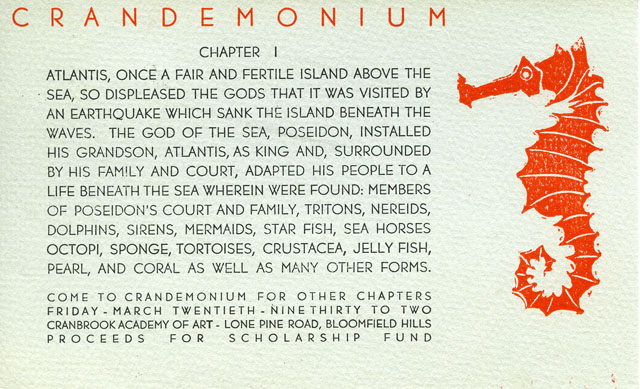
Since we already upset tradition by posting a “Photo Thursday,” we thought we’d skip today’s Photo Friday and instead focus on a subject near and dear to our hearts—Crandemonium!  A costume ball thrown at various intervals during the Saarinens’ tenure at the Cranbrook Academy of Art, Crandemonium was a no-holds-barred party.  From the painted backdrops to the fantastical mythology, Crandemonium had it all.  Academy of Art students were essential to the party, competing to design the interiors and often appearing in the most outlandish costumes of all. This year the Museum Committee has resurrected the beloved Crandemonium party for their yearly fundraiser, happening this Saturday at the Cranbrook Art Museum.  Just in time, enjoy the Crandemonium ephemera from the past!

An intriguing invitation to 1936's Atlantis-themed Crandemonium, this card featured the first part of the story of Atlantis. The invitee would presumably learn the remaining chapters upon attending the party. 1936, Cranbrook Archives.

An intriguing invitation to 1936’s Atlantis-themed Crandemonium, this card featured the first part of the story of Atlantis. The invitee would presumably learn the remaining chapters upon attending the party. 1936, Cranbrook Archives.

The 1936 Atlantis Crandemonium theme led to some amazing promotional material. 1936, Cranbrook Archives.

The 1936 Atlantis Crandemonium theme led to some amazing promotional material. 1936, Cranbrook Archives.


Photo Friday: Dinner at the Saarinens’

Loja Saarinen sets the table for guests.  Saarinen House, 1930-1940.  Cranbrook Archives.

Loja Saarinen sets the table for guests. Saarinen House, 1935-1940. Cranbrook Archives.

Loja and Eliel Saarinen were masterful entertainers.  That tradition continues every spring, when Cranbrook Art Museum opens up the house for tours.  Though the museum avoids serving food or drinks in the house (it is accessioned into the museum’s collection as a single historical object, after all), visitors get to experience the house as the Saarinens designed it between 1935 and 1940.  Every autumn the tour season ends and we pack up the house to hibernate for winter, opening it up again come spring.  To celebrate the closing of another great tour season (it finishes at the end of October, so get in while you can!), we wanted to showcase one of the most social environments in the house—the dining room.

Here, Loja Saarinen prepares the table for guests.  The round placemats were decorated by the Saarinen’s son, Eero Saarinen, when he was just a boy.  The table is at its smallest size—the outer rim of the table actually pulls out, allowing donut-shaped leaves to expand the table yet retain its circular shape. The swing door to the butler’s pantry is open, showing off the home’s state-of-the-art Frigidaire icebox.  Truly a modern home for a modern family!

Photo Friday: Cranbrook’s Contractor

Wermuth House, Fort Wayne, Indiana.  Designed by Eliel and Eero Saarinen, 1941. Cranbrook Archives.

Wermuth House, Fort Wayne, Indiana. Designed by Eliel and Eero Saarinen, 1941. Cranbrook Archives.

This distinctly modern house was designed by the architecture firm Saarinen, Swanson & Saarinen for a man whose introduction to Cranbrook happened in a somewhat old-fashioned way—the construction of Christ Church Cranbrook, George Booth’s ecclesiastical ode to the British Arts and Crafts Movement.

In 1923, Albert Charles (A.C.) Wermuth was contracted by the architect Bertram Goodhue to oversee construction of the Trinity English Lutheran Church in Fort Wayne, Indiana.  Goodhue was so impressed with his construction work that he contracted with Wermuth again for the upcoming Christ Church Cranbrook commission in 1924.  Goodhue died before construction on the church could begin in 1925, but the firm Goodhue & Associates retained Wermuth as general contractor for the project.

When Christ Church Cranbrook was completed in 1927, the Booths immediately snatched up A.C. Wermuth for more Cranbrook projects—the building of the Cranbrook School campus and an addition to Brookside.  Thus began a decades-long professional relationship between Wermuth and Cranbrook, with Wermuth serving as general contractor for Kingswood, the Cranbrook Academy of Art, and the Cranbrook Institute of Science.  Wermuth also did private work for the Booth children as they built their own homes in the area.  Eliel and Eero Saarinen used Wermuth for their non-Cranbrook projects as well; he served as contractor on the First Christian Church in Columbus, Indiana, as well as on other Saarinen buildings.

With professional connections like these, it seems only fitting that Wermuth turned to the Saarinens when it was time for him to build his own house in Fort Wayne. While the Wermuth House, which was completed in 1941, was built under the names of both Eliel and Eero, the design of the house speaks a bit more to the son than the father.  A Saarinen, Swanson, & Saarinen project, however, Wermuth ended up with a home for his family that expressed many of the same modernist ideals that he himself helped bring to life as the general contractor for Cranbrook.

Shoshana Resnikoff, Collections Fellow, and Robbie Terman, Archivist

Photo Friday: Cranbrook’s Gatescape

Image

Close-up of the peacock for which Cranbrook School’s Peacock Gates are named. Designed and installed in 1927, restored in 2013. Cranbrook Archives.

Doors, entryways, gates – Cranbrook’s campus was designed with an eye towards points of transition.  Since its foundation 108 years ago, Cranbrook has maintained a long tradition of gate design and fabrication.  This close-up of a stylized peacock comes from Cranbrook School’s famous Peacock Gates; designed by Eliel Saarinen, they were produced by the metalsmith Oscar Bach in 1927.  Recently, a long restoration process culminated with their re-installation on the Cranbrook School campus.   This gate and many others are the subject of the second exhibition in the From the Archives series.  Drawing from the rich collection of the Cranbrook Archives, From the Archives: Forging Cranbrook’s Gatescape explores the history, design, and formation of Cranbrook’s historic and contemporary “gatescape.”

Experiencing the gates from within the walls of the Art Museum is nothing compared to seeing them in person.  With that in mind, Leslie S. Edwards, Head Archivist and exhibition curator, will be leading a walking and bus tour of the gates on Sunday, October 5.   The tour will take participants  to some of Leslie’s favorite gates, from beloved classics to the newest installations on campus.   More information on the exhibition and walking tour is available here.  Be sure to check it out, and get ready to see Cranbrook’s gates in a whole new light!

California to Cranbrook: What I Did on My Summer Vacation

Everyone who has endured a Michigan winter agrees that a Michigan summer is the universe’s way of making it up to you.  Having completed my first winter at Cranbrook, then, it seems a shame that I missed the glory of summer in the Mitten State.   I was called back to my home state of California to celebrate my mother’s birthday (a milestone year that she wouldn’t appreciate having publicized on the internet) and to enjoy a few solid weeks of family reunions, state-wide road trips, and delicious, delicious tacos.  I traded the sun and heat of Southeastern Michigan for the fog and chill of Northern California, but at the end of the day I still managed to find a little bit of Cranbrook in California. Continue reading

Create a website or blog at WordPress.com