Photo Friday: A Labor of Love

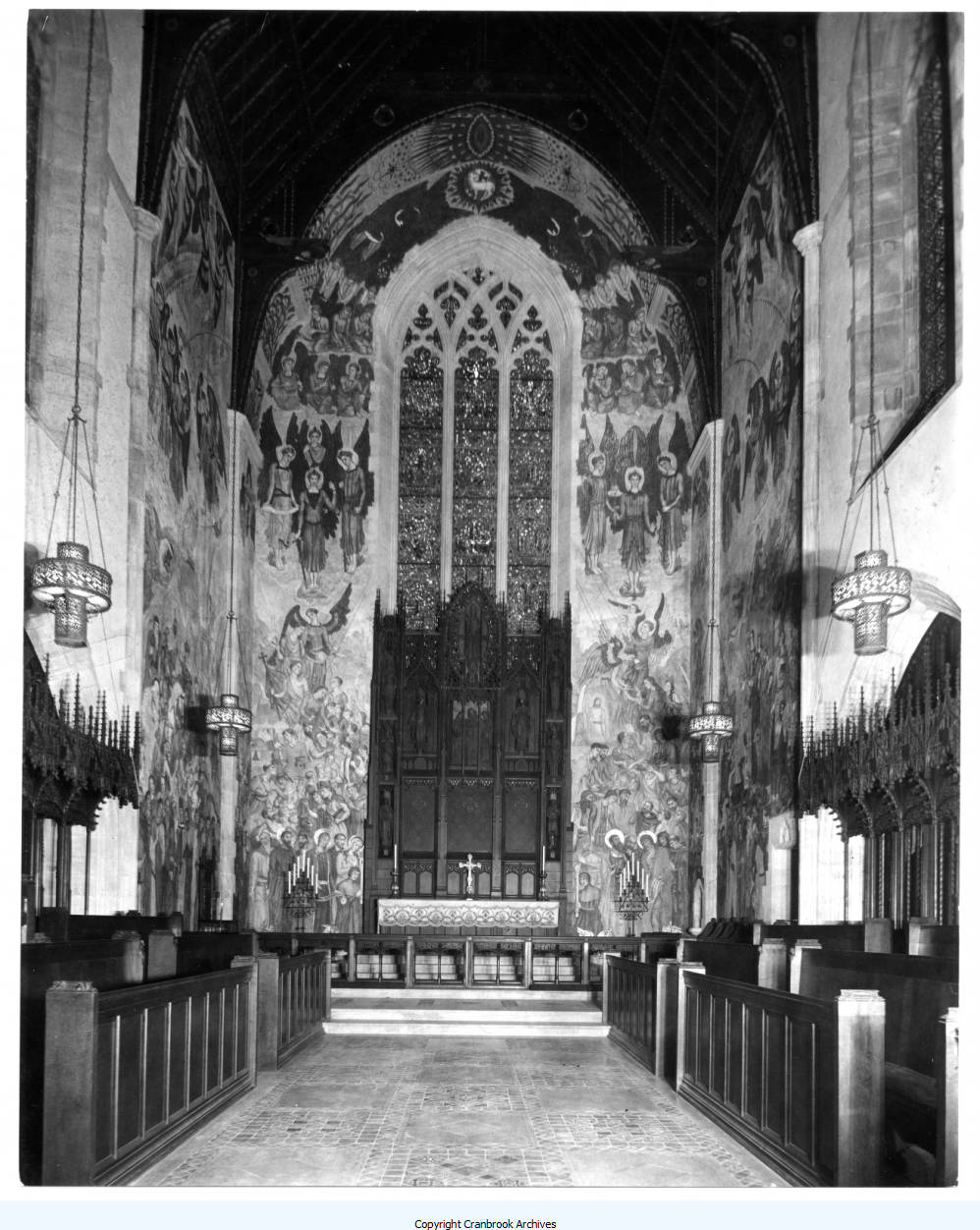
Christ Church Cranbrook Interior. Cranbrook Historic Photograph Collection, Cranbrook Archives.
CCCnave

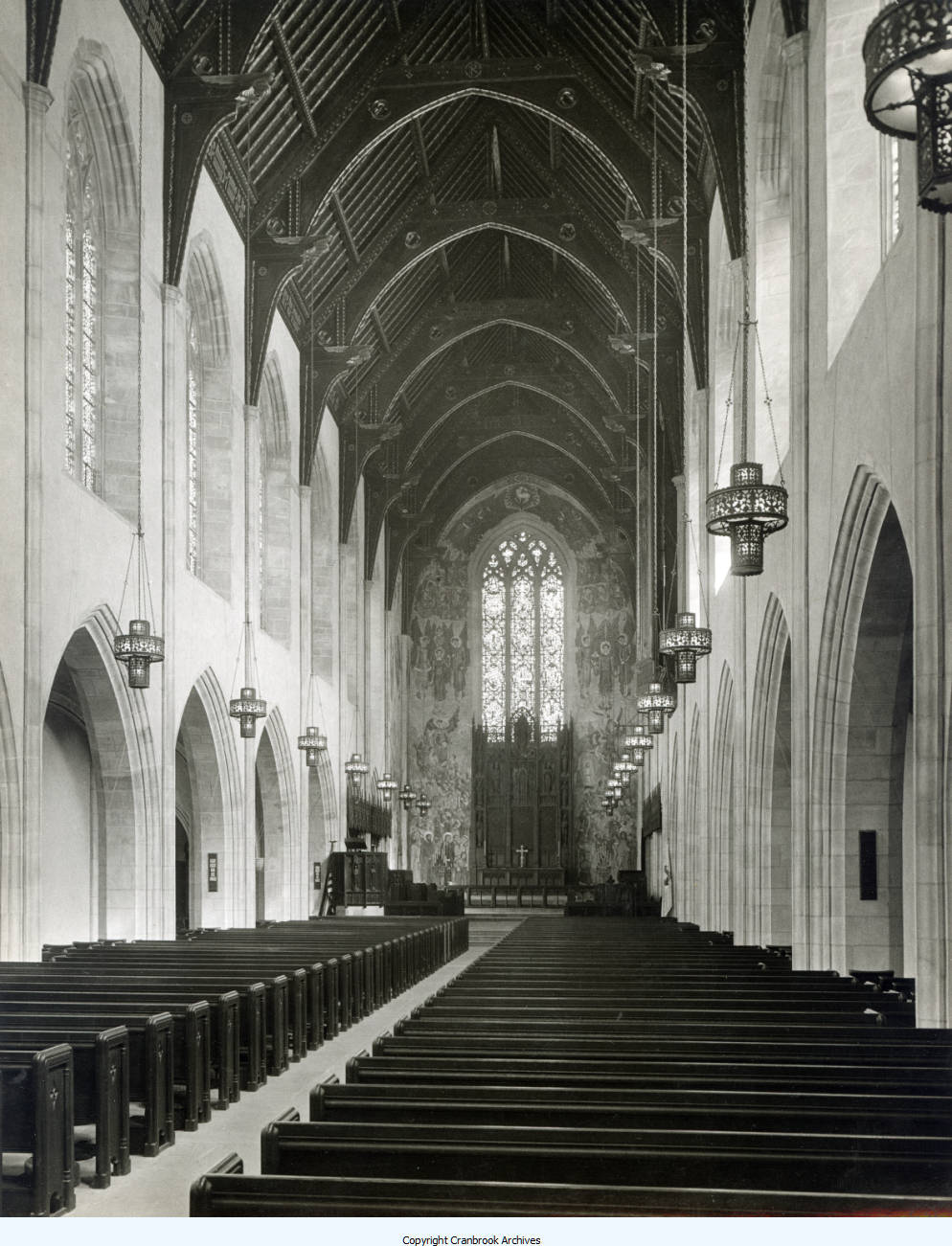
Christ Church Cranbrook Nave. Cranbrook Historic Photograph Collection, Cranbrook Archives.

After a visit to Christ Church Cranbrook earlier this week, I knew it needed to be highlighted as today’s Photo Friday! George G. Booth conceived Christ Church to be the moral center of the new community which he was building at Cranbrook. The photos show a great overview of the expansiveness of the church and shed some light on the magnitude of the work involved in its design. Each of these elements adds to the overwhelming detail of George Booth’s vision and the care in the design of Christ Church Cranbrook.

The church is Booth’s testament to the Arts and Crafts movement. He carefully acquired and commissioned each work of art to add to the overall wonderment of the church and to pay tribute to those who have devoted their lives toward artistic and altruistic pursuits.  The works of art range from the sterling altar plate to stained glass windows, altar frontals, tilework, woodcarvings, paintings, sculptures, and metalwork, most from noted Arts and Crafts men and women.

These photographs, taken five years after the 1928 dedication of Christ Church Cranbrook show the interior of the church sanctuary and a detail view of the nave of the church. The large fresco flanking the high altar was designed and executed by Katherine McEwen, an old friend of Booth’s, and one of the founding members of the Detroit Society of Arts and Crafts.  From the work of Katherine McEwen to Oscar Bach, Samuel Yellin, and Hildreth Meire, to name a few, Christ Church Cranbrook is an architectural gem which should be experienced in person!

Stefanie Dlugosz, Center for Collections and Research, Collections Fellow


George Booth and Palermo: the Paschal Candelabrum

Christ Church Cranbrook Candelabra

Stone carvers at the Chiurazzi Foundry, 1929. Cranbrook Archives.

Even though Christ Church Cranbrook has not officially been a part of the Cranbrook Educational Community since 1973, our staff is often asked to give presentations or tours relevant to the church and the objects that George Booth purchased to adorn it. Gothic in architecture, and a showplace for the Arts and Crafts movement, Christ Church Cranbrook also features objects from the 12th century. One of these is a reproduction of the original Paschal Candelabrum located within the Cappella Palatina (1130-1140) in the Palazzo dei Normanni (Palace of the Normans) in Palermo, Sicily.

It appears as if Booth first became aware of the medieval sculpture in Sicily through his son, Henry, who traveled on a European trip in 1922 with his close friend, Bob Swanson. Henry wrote several letters home to his father describing his visits to Monreale and Palermo, and the artistic and architectural wonders he saw there. Records in the Cranbrook Archives show that in 1929, George and Ellen Booth traveled to Italy where they made several purchases, including a faithful reproduction of the candelabrum. George and Ellen discussed where to place the candelabrum in the church and George wrote Henry: “Now as for use–I thought if at the chancel we could establish a custom of lighting the big candle for weddings or at Easter and Christmas and if in the Narthex when a baptism was to occur. There is plenty of time to think it over as I have yet to place the order and they estimate it will take one year to complete.” The candelabrum was installed in the Christ Church Cranbrook Narthex in March 1931.

Photo Friday: Twisted Sister

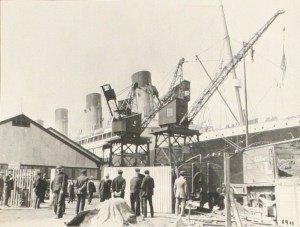
In the summer of 1911, the Booth clan left Cranbrook, headed for a European vacation.  The family traveled via New York, where they boarded the RMS Olympic, part of the White Star Line and sister ship to the Titanic. Designed as a luxury ship, many of the features on the Olympic were identical to the more famous Titanic The Olympic had its maiden voyage on June 14, 1911, arriving in New York on June 21, 1911.  The captain of its first voyage was none other than Edward Smith, who would lose his life aboard the Titanic one year later.  The ship’s return trip to England left June 28, 1911, carrying the Booths.  Another famous passenger on board was ship designer Thomas Andrews, who would also later perish on Titanic.

RMS Olympic

The RMS Olympic arrives in Southampton on July 5, 1911. Cranbrook Archives

In April of 1912, the Olympic was one of the ships that received the distress call from Titanic, but it was too far to help in the rescue.  The Olympic offered to take on survivors, but was turned down, as it was thought that passengers would panic at having to board a ship that was a mirror-image to the Titanic.

After the Titanic disaster, the Olympic had to be refitted, as it, too, did not carry enough life boats for all the passengers.

~Robbie Terman, Archivist

Guernsey Cows and George Booth

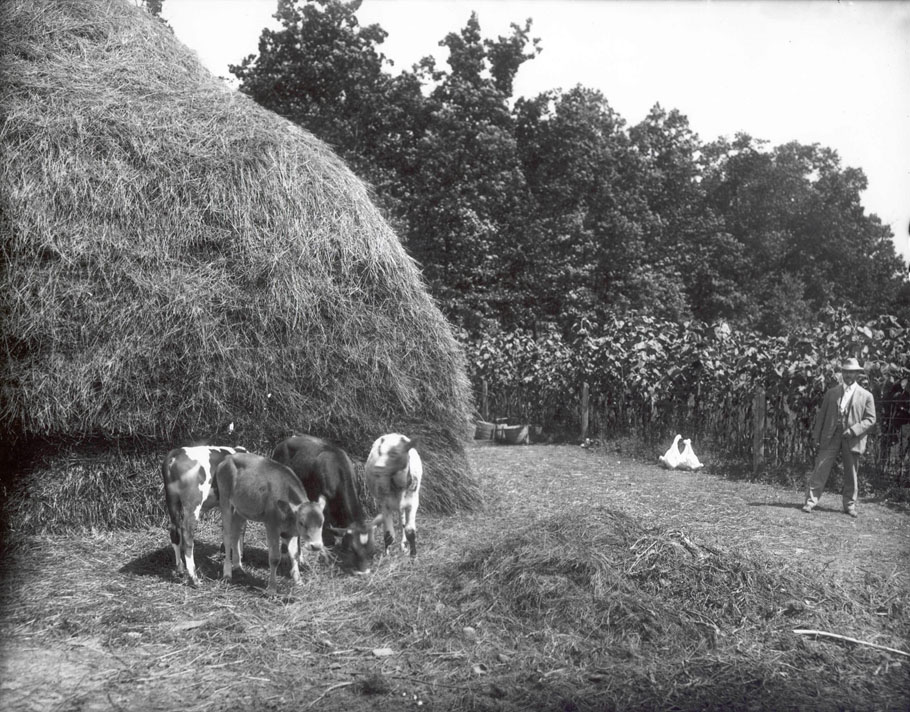
When most people hear the word “Cranbrook,” they think of Eliel Saarinen, modernist design, art and science, or private education.  Some even think of our sister schools in England, British Columbia or Australia.  But how many people think of farm animals named “Daisy Lovelace” or “Nellie of Cranbrook?”  When the Booths purchased the old Alexander farm in 1904, one could see rolling farmland covered with hay fields and orchards.  Indeed, George Booth soon became a gentleman farmer.

George Booth (right)

George Booth (right)

In fact, Cranbrook boasted TWO working farms, originally called Farm Group #1 and #2, situated on the grounds of what are now the campuses of Kingswood School and Cranbrook School respectively. Farm Group #1 (1904) was designed no, not by Saarinen, but by that other architect, Albert Kahn! – one of Kahn’s earliest commissions for George Booth. Farm Group #2 (1917) was designed by Canadian architect Marcus Burrowes and his partner Dalton Wells, recommended to Booth by Kahn who was getting mighty busy with his industrial projects. When the footprint for Cranbrook School for Boys was developed, George Booth asked Eliel Saarinen to follow the plan for Farm Group #2. Today’s Hoey Hall is on the site of the old silo. The only remaining evidence of the farm buildings is the orignal farmhouse designed by Burrowes and Wells.

~Leslie S. Edwards, Head Archivist

Photo Friday: Maija and Nelly

Maija Grotell and Nelly Beveridge at work on the base of a fountain, 1940.

Maija Grotell and Nelly Beveridge at work on the base of a fountain, 1940. Richard P. Raseman, Historical Photograph Collection, Cranbrook Archives.

Finnish-born ceramicist Maija Grotell served as the head of the Ceramics Department at the Cranbrook Academy of Art from 1938 to 1966.  Here, she works on the base of a fountain with student Nelly Beveridge.  Beveridge played many roles on campus, serving as a companion and nurse to George and Ellen Booth in their later years even as she completed her studies at the Academy.

Credit Where Credit’s Due

My favorite thing about being an archivist is that sometimes a seemingly simply question turns into a new discovery.  This happened recently when I was researching the artist of a ceramic vase located in Cranbrook House, a historic house on Cranbrook’s campus and the home of Cranbrook founders George and Ellen Booth.    Finding the answer should have been a simple task: open the object file, locate artist’s name.  A two-minute job.

Two-minutes turned into a two-week journey.

The mysterious vase in question, currently living at Cranbrook House.

The mysterious vase in question, currently living at Cranbrook House.

Continue reading

Welcome to the Kitchen Sink!

A Home Economics classroom from Kingswood School, 1932.  Ironically, there's no kitchen sink in sight.

Home Economics classroom at Kingswood School, 1932. Cranbrook Archives.

Welcome to the Cranbrook Kitchen Sink!  This is our very first post, so please bear with us as we explain what we’re doing here and get all excited.  If we had glitter, we’d be throwing it right now.

The Cranbrook Kitchen Sink is an exciting new undertaking for the Cranbrook Center for Collections and Research.  And what is the Cranbrook Center for Collections and Research, you might ask?  Well, we’re essentially a department of archivists and historians who focus on all things Cranbrook.  We’re charged with interpreting the history of this unique educational community, from its founding in 1908 as a country estate for George and Ellen Booth to its current incarnation as a 319-acre campus that includes a prestigious private school, a science museum, a graduate art academy and an art museum.  Also three historic houses, legendary gardens, architecture with National Historic Landmark status, a world-class art collection, and an archive so in-depth you could get lost in it for days…. you get the idea.  This is a big place with a lot of history, and we’re here to cover it all.

So what will you find at the Cranbrook Kitchen Sink?  Well, everything but the!  We want the Kitchen Sink to be a place where Cranbrook Center and Archives staff can post about their research, report back on cool and interesting documents or stories we’ve uncovered, and get just a sliver of the amazing material that makes up Cranbrook’s 100+ year history out into the wider world.  We’re here to tell you the stories you  haven’t heard about this strange, incredible place called Cranbrook.  So sit back, relax, and enjoy all things Cranbrook!

Create a website or blog at WordPress.com