Swimming Was a Privilege: The By-Gone Days of Lake Jonah

Mention Lake Jonah to anyone who has been around Cranbrook since 1999, and the response will be immediate – bittersweet. Fond memories mixed with sadness that it is not used as a swimming hole any longer. Originally referred to as the “Milles Fountain Lake,” the man-made lake is also known as Jonah Lake or Jonah Pool. Funded by George Booth as a place for community members to swim during the summer months, Lake Jonah, built in 1933, became a gathering place – for Trustees and Directors and their families, Academy of Art students and faculty, Summer Theatre and Summer Institute campers, Horizons-Upward Bound students, and hundreds of Cranbrook-Kingswood day and boarding school students, who all loved to hang out in the natural setting.

George Booth originally intended for the lake to be a water feature at the end of Academy Way, but quickly realized that people would swim in it anyway, so he turned it into a swimming pool. When the water was first turned on, a large amount of seepage was discovered so waterproofing of the pool bottom began in July 1934.

Lining the bottom of Lake Jonah

Lining the bottom of Lake Jonah, Sep 1934. Richard G. Askew, photographer.

The cost of construction was just over $34,000. This included the liner, the drain, paving, and landscaping around the pool, designed by Detroit landscape architect, Edward Eichstaedt. The pools covered 54,375 square feet (or 1.248 acres) and held 3,082,830 gallons of water.

Swimming lessons Summer Institute

Swimming lessons, Summer Institute, Jul 1946. Harvey Croze, photographer.

Initially overseen by the Cranbrook Central Committee (a department of the Cranbrook Foundation), Lake Jonah gradually became too expensive and too risky for Cranbrook Educational Community to maintain. Swimmers snuck onto campus at all hours and swam in the pools without lifeguard supervision. After the summer of 1999, the decision was made to close Lake Jonah for swimming and thus ended decades of summer memories.

Leslie S. Edwards, Head Archivist

A Portrait Comes Home to Cranbrook House

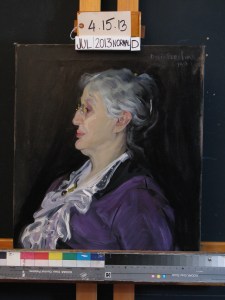
The portrait of Clara Gagnier Booth, mother of Cranbrook founder George Gough Booth, has been mounted in the Oak Room at Cranbrook House. This painting is on long-term loan to Cranbrook from the Saginaw Art Museum, which acquired the painting through a donation from Clara Booth’s grandson, John Lord Booth I.

Perelma_Image

Conservation in-progress, April 2013 by Kenneth B. Katz, Conservation and Museum Services.

After receiving conservation treatment and a new frame, this painting of Clara Booth will accompany that of her husband, Henry Wood Booth, as well as their son George, his wife Ellen Scripps Booth, and Ellen’s father James Edmund Scripps. Financial support from John Lord Booth II affords this opportunity to join the painting of the Booth family matriarch with those of her relatives at Cranbrook House.

The artwork was painted in 1918 by Russian-born artist Ossip Perelma, known particularly for his portraits of men of stature such as President Woodrow Wilson, King Albert I of Belgium, and several Russian and French political officials. Perelma also executed the stately portrait of Henry Wood Booth, currently on view in the Oak Room.

Demure in size and executed with soft and fluid brush strokes, Clara Booth’s portrait contrasts with that of her husband. While Henry is depicted in full length in an outdoor background, his wife is shown only by profile, with just the upper half of her torso included in the composition. The stylistic distinction between Clara’s portrait and that of her husband—and indeed many of Perelma’s other subjects—emphasizes the differing approach Perelma took to depicting a woman.

In the early twentieth century, even women of position, beauty, and culture were often removed from public view after their role as wife and mother was fulfilled, and their youth had faded. This portrait was painted when Clara Booth was 79, and it is notable that Perelma chose not to conceal his subject’s age. Indeed, the portrait is a rare and significant example of art providing legitimacy and prestige to a woman who remained elegant and strong as she reached an age when most women no longer had a public presence or were being immortalized by artists.

Both portraits, Clara Gagnier Booth and Henry Wood Booth, will be available for viewing when Cranbrook House opens for public tours on Sunday June 14th! For more information on the tours check out the Cranbrook House & Gardens Auxillary website.

Stefanie Dlugosz-Acton, Collections Fellow, Center for Collections and Research

The Ramp of the Chinese Dog

For George Gough Booth, the vista from Cranbrook House to the Ramp of the Chinese Dog was a crucial one – he could see the Cranbrook Art Museum from his west wing office at Cranbrook House and the Chinese Dog guarding the entrance.

Though Cranbrook’s sculpture is commonly referred to as the “Chinese Dog”, the sculpture is actually a stone lion. In October 1940, George Booth purchased the lion from S. & G. Gump Co. in San Francisco and it is considered to be from the Wei Dynasty (386-557). A buyer for Gumps had acquired it in Beijing, China in 1938 where he was told that the lion came from the “Ta Fo Tze Temple in Chien Ting Fu Prefecture in Hopei.” Hebei (Hopei) Province is known for its stone and iron lions, and lion sculptures similar to the one at Cranbrook are still located at the entrance to the Ta Fo Tze Temple, now known as the Longxing Temple.

lion096

“Sacred Lion-Dog,” S. & G. Gump Co.’s showroom, San Francisco, ca 1940. Courtesy Cranbrook Art Museum.

During the Ming Dynasty, sacred guardian lions were placed in front of palaces, government buildings and temples as a symbol of bravery, power and good luck. In Western countries, the lions are often referred to as “Fu Dogs” as the word “fu” means Buddha or prosperity. George Booth placed another pair of Chinese stone lions at Cranbrook House, as well as several other stone lion sculptures around the grounds. In addition, he purchased two terracotta lions for the quadrangle at Cranbrook School, and numerous other objects with representations of lions in them including stained glass medallions, stone panels, and a gilt bronze lion sculpture by Carl Milles. As I write this, I am thinking that it would be an interesting project to research just what Booth’s interest or fascination (obsession?) with lions truly was.

CR4066

One of two terracotta lions at Cranbrook School. Filmmaker Brad Mitzelfeld behind the camera, 1970. Harvey Croze, photographer. Courtesy Cranbrook Archives.

Leslie S. Edwards, Head Archivist

Photo Friday: Viva Mexico!

With Cinco de Mayo quickly approaching, we are thinking about Mexico. George and Ellen Booth visited Mexico for two months in 1939. The image below was taken by their travel companion, Nellie Beveridge. The Booths traveled by rail and visited Chichen-Itza,Vera Cruz, Merida, and the ruins of Uxmal.

Temple of Quetzalcoatl

Temple of Quetzalcoatl, 1939. George Gough Booth Papers, Cranbrook Archives.

Six Degrees of Separation, Again

Every Sunday night I look forward to watching “Who Do You Think You Are?” A show that combines historical research, genealogy, and archives all in one? Perfect for a research geek like me. This past Sunday, actor Tony Goldwyn was the featured celebrity seeking to uncover his roots. I never realized that his paternal grandfather is THE Samuel Goldwyn! And even more surprisingly is that his maternal grandfather is Sidney Coe Howard. I bolted upright in my chair when I heard that name as, of course, Howard has a Cranbrook connection!

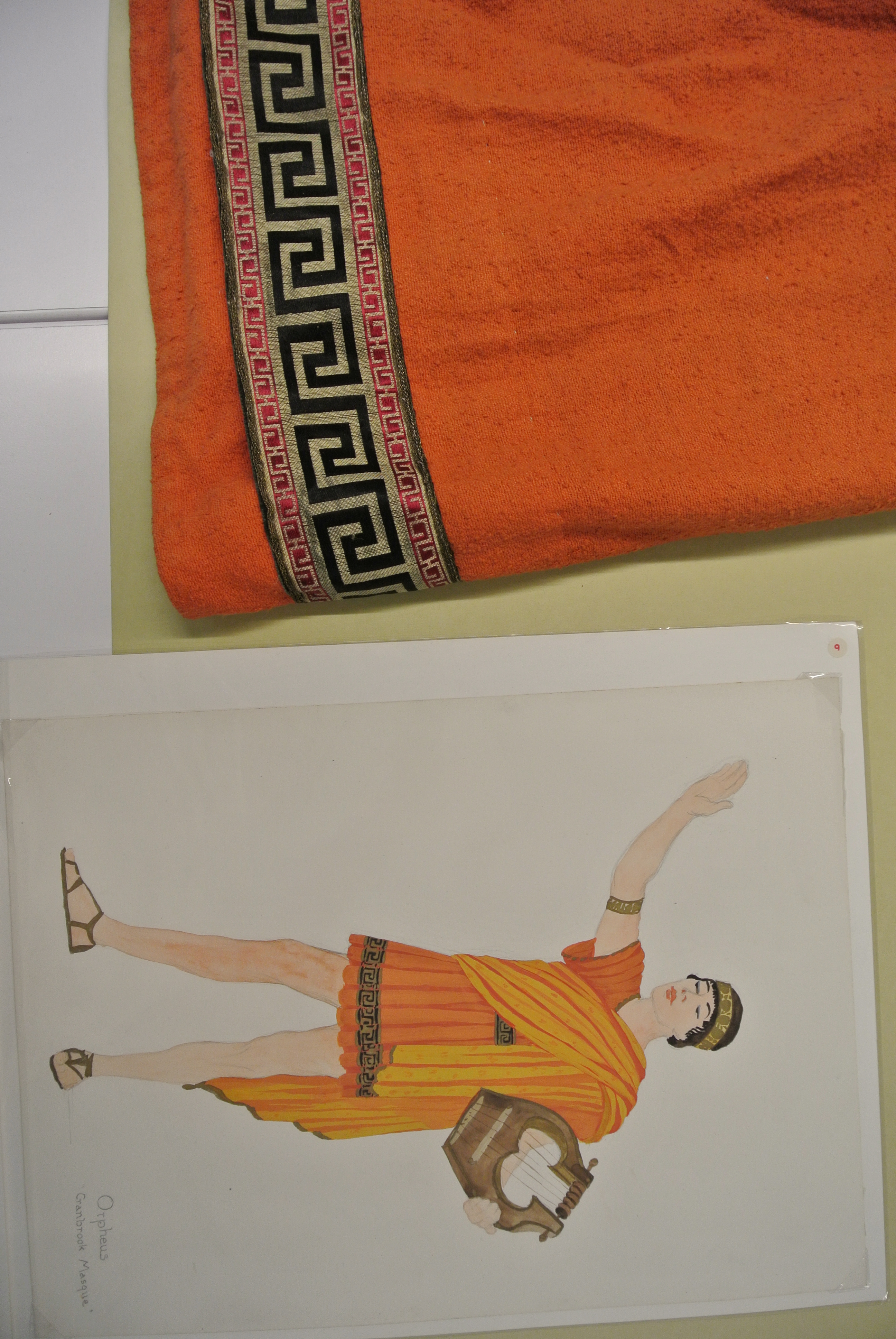
Howard (1891-1939) was the American playwright and screenwriter best known as the posthumous winner of the 1939 Academy of Award for adaptation of the screen play for Gone with the Wind. However, 23 years earlier, Howard penned the script for the Detroit Society of Arts and Crafts (DSAC) production, The Cranbrook Masque. Commissioned by George Booth at the suggestion of director Sam Hume, Howard wrote the Masque as the dedication program for Booth’s new Greek Theatre at Cranbrook. Howard and Hume sought to utilize every part of the theatre in order to demonstrate its possibilities. Costumes were designed and made at Cranbrook by the costume department of the DSAC, led by Katherine McEwen, and were fitted to the actors onsite.

The Costume for Orpheus is part of Cranbrook's Cultural Properties collection.

The Costume for Orpheus is part of Cranbrook’s Cultural Properties collection.

The Cranbrook Masque tells the story of the conflict between romance and materialism, and was expressed through five episodes showing the development of drama throughout the ages – ancient Greece, medieval Europe, Elizabethan England, and 17th century Italy. Through research and travel in Europe, Howard was able to gather material to ensure the historical accuracy of both the scenes and the dialogue. A contemporary news critic wrote “the use of archaic words and the introduction of long-forgotten customs are said by experts to be flawless.” Howard also made use of the natural outdoor setting of the Greek Theatre for special effects. In the first episode, timed at sunset, Pan made his appearance silhouetted against the backdrop of the setting sun. As the light faded, a sophisticated artificial lighting system, designed by Hume, was gradually introduced.

Correspondence to Frederick Alexander

Correspondence to Frederick Alexander, music director of the Cranbrook Masque. Cranbrook Archives.

The performance ran for two consecutive nights in June 1916, and the theatre was filled to capacity with more than 500 guests. The Cranbrook Masque was the first public production of Sidney Coe Howard’s, yet he did not attend the performance. Though the Booths invited Howard to visit Cranbrook, he sailed for France in early June to serve as an ambulance driver for the duration of WWI.

  • Leslie S. Edwards, Head Archivist
Confessions of a Book Nerd

I have a confession to make. The smell of library books, an afternoon at an independent book store, re-reading a favorite novel – these are my ultimate indulgences. I could spend hours reading book blogs, listening to author interviews, or pouring over book-related tchotchkes on Etsy. I am a book nerd. My (nearly) one year as an Archivist at Cranbrook has been heaven. I discover something new every time I have the opportunity to walk into George Booth’s personal library at Cranbrook House. I find profound satisfaction in creating a catalog record for a new book or discussing MARC records with colleagues.

One of my favorite collections at Cranbrook is the Cranbrook Press and Photo Department Records. While working on a Cranbrook Press request recently, I came across the work of the bookbinder, Jean Eschmann (1896-1961), hired by George Booth in 1929. Eschmann was hired to set up the bookbinding workshop in the Arts and Crafts Studios at Cranbrook, where he remained until 1933 when desperate financial times forced the closure of the studio.

Jean Eschmann binding, Cranbrook Archives

English Fairy Tales, tooled leather. ca 1931. Cranbrook Archives.

Educated in Zurich, Eschmann traveled and studied in Austria, France and Switzerland. He came to the United States with his family in 1919. He was a member of the Society of Arts and Crafts in Boston and studied with Mary C. Sears. In 1929 George Booth hired Eschmann to create handmade bindings for the Art library and for his own personal library. Eschmann also taught bookbinding and hand-tooling classes to the community.

211044-145

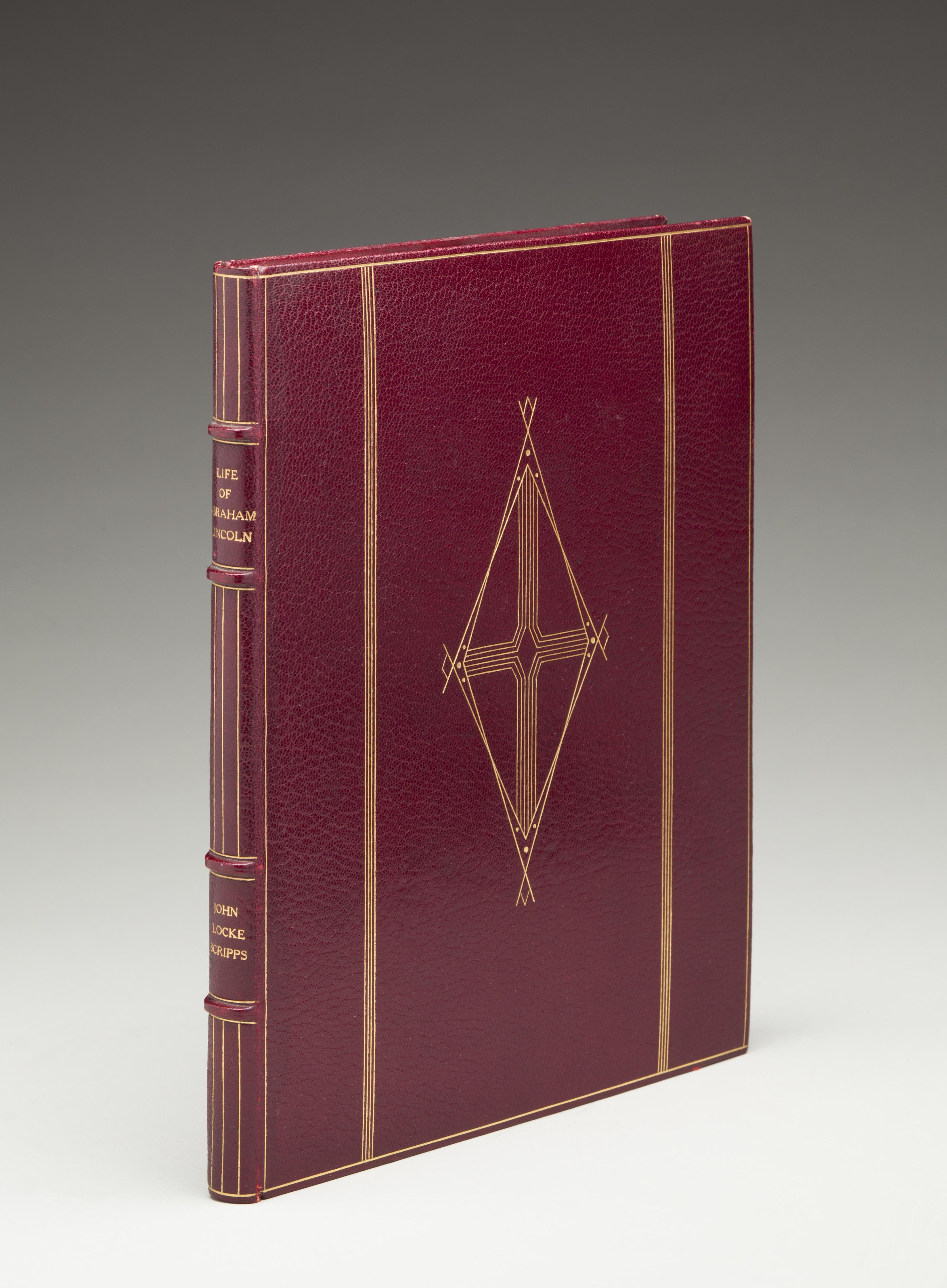
The First Published Life of Abraham Lincoln, tooled leather. ca 1931. Cranbrook Archives.

Eschmann’s work has been exhibited at various museums in the United States, as well as at the Book Workers Guild in New York. His bindings were included at the World Fair in Paris in 1937 and at the Golden Gate Exposition in San Francisco in 1939. In 1945 Eschmann received the emblem for Meritorious Service from the Civilian Awards Committee of the Surgeon General’s Office for his work in restoring thousands of rare books at the Army Medical Library during World War II.

Evidence of Eschmann’s beautiful leather and tooling work can be seen in several examples in the rare book collections here in the Archives, and also in the Academy of Art library. I hope you enjoy the examples in this post. They definitely make this book nerd swoon!

Gina Tecos, Archivist

The Case of the Bogdani

The other night I saw the most interesting show on PBS called “Fake or Forgery.” An investigative journalist and two noted art sleuths joined forces with cutting edge scientists to discover the truth behind a painting the owner thought to be a Degas. They thoroughly searched the provenance of the painting, and used scientific methods like X-ray fluorescence (XRF) to determine if the pigments used in the painting were compatible with Degas’ known palette. It made me think of the many works of art across the Cranbrook campus that could benefit from in-depth scientific research like this. And, it prompted me to relay the story of a discovery the archives staff made several years ago.

The painting we fondly refer to as “The Bogdani” was originally purchased by George Booth for Kingswood School for Girls, where it hung in the Domestic Science Dining Room. Purportedly painted by noted Hungarian Jakob Bogdani (1658-1724), the still life was found in a storage room badly in need of cleaning and restoration.

The painting was conserved by Ken Katz of Conservation & Museum Services in Detroit. During the several months of conservation, we were able to visit the studio in order to see the work in process, and the results were amazing.

during

During conservation.

As I looked closely at the work, my heart almost stopped beating. Bogdani’s signature was gone, and in its place was another name! My first thought was how hard I had lobbied to get the painting conserved and now it was a forgery!  However, after doing additional research, I discovered that the artist, Tobias Stranover (1684-1731) was actually Bogdani’s son-in-law and former student. Phew! Although this meant the still life was painted around 1810 instead of 1790, at least we still had an original painted by an artist who, with his father-in-law, provided the finest exotic bird and animal paintings in England. The painting currently hangs in the reading room of Cranbrook Archives.

Before conservation.

Before conservation.

after

After conservation, details in the painting can be seen can be seen more clearly, and the brilliance of the colors pop.


Leslie S. Edwards, Head Archivist


Early Bicycle Sled?

Courtesy Cranbrook Archives

Courtesy Cranbrook Archives

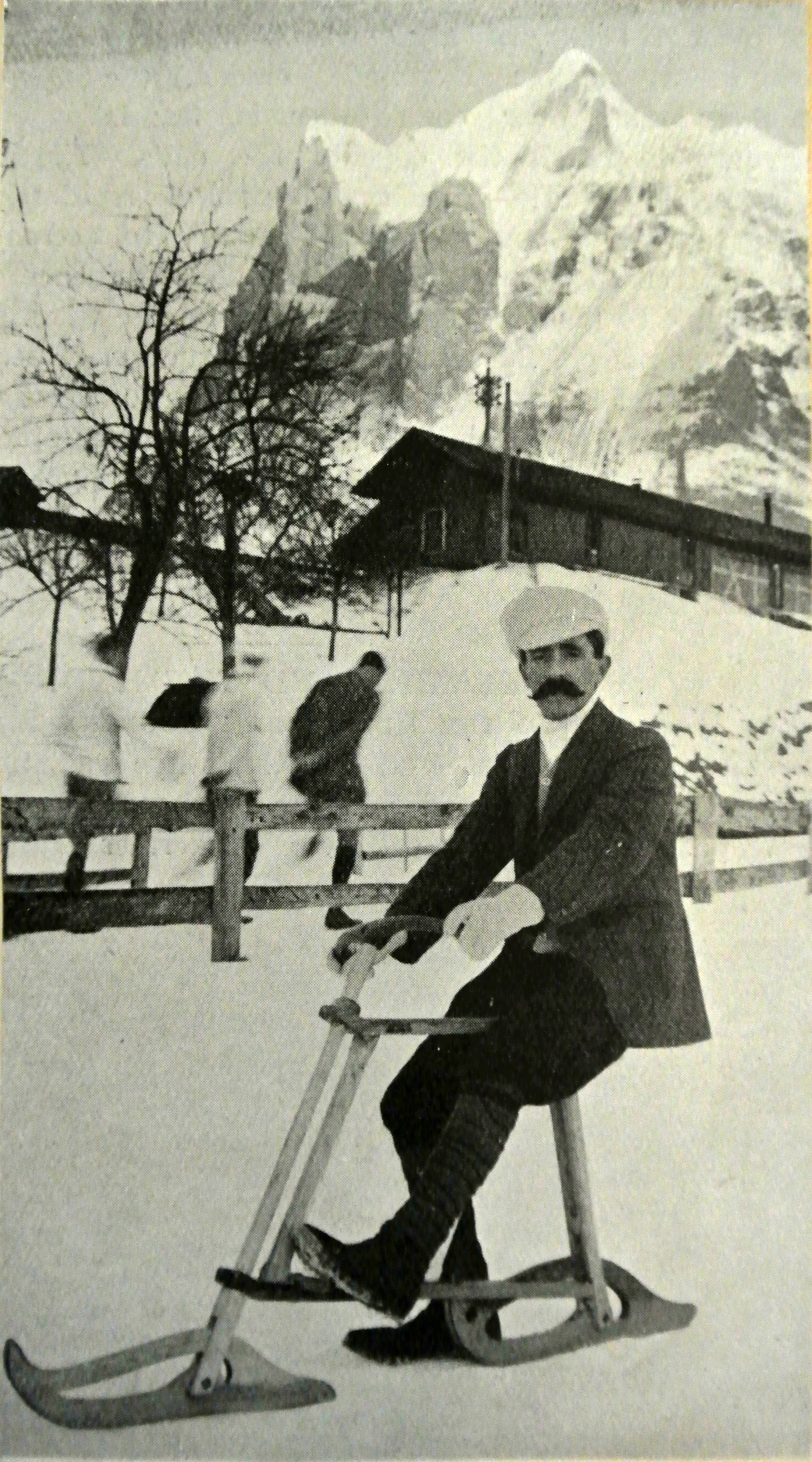
This gentleman caught my eye as a colleague was browsing through a George G. Booth (GGB) scrapbook containing clippings of illustrations from magazines. The scrapbook was GGB’s “Dream Book” of art and architecture examples on which to model his new home at Cranbrook, and is part of his papers.

Amidst illustrations of terraces, statues and waterfalls was this Alpine dandy. Why is his picture there, and what is that contraption he’s sitting on? A search on the Internet revealed no information on this early 20th century, bladed “vehicle” for seated conveyance. If anyone out there knows more about it, I’d be delighted to know!

–Cheri Gay, Archivist

Good news! One of the Archives’ volunteers, Lois Harsh, spent a cold afternoon diligently searching the Internet and found this web site, www.ski-bike.org that identifies several versions of the ski bike. This particular version is from around 1914. Thanks, Lois!


It’s all in the details: Cranbrook’s Homestead Property

In 1914 George Gough Booth commissioned the Coats & Burchard Company to complete an appraisal of the “Homestead Property” which included a full inventory of Cranbrook House and its outbuildings. This was not uncommon, and Booth continued the practice several times during his life as the Cranbrook campus and its buildings grew and changed.

Blog_1.26_image1

Selection of Cranbrook House flooring materials. Courtesy Cranbrook Archives.

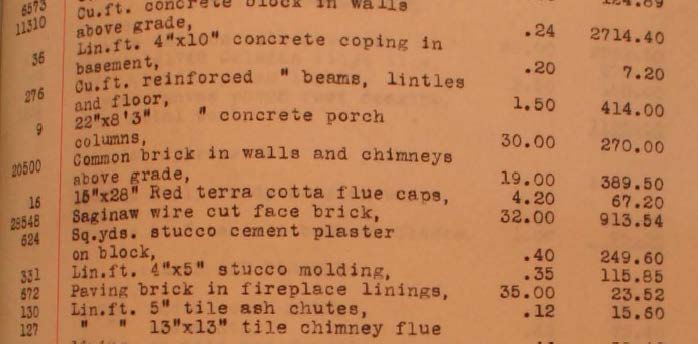
Since Cranbrook House was constructed in 1908, the 1914 appraisal ledger is the first in our collection, and is markedly different from the subsequent ones. The biggest difference is that in addition to the furnishings and artwork, all building materials, down to every last detail including number of bricks used, cubic feet for flooring, and even all of the hardware was judiciously and meticulously cataloged.

Blog_1.26_image2

Selection of “Bill of Materials” for Cranbrook House. Courtesy Cranbrook Archives.

This ledger and the others (which were taken in 1921, 1933, 1937, and in 1944) have been immensely helpful in historic research of the home and properties. They can be used to help locate objects in their original location in the house, and often point to the year they were purchased and even original purchase invoices. Using this ledger in conjunction with the original drawings and blueprints have been assisted campus architects and project managers with restoration projects on campus as well as projects which determine the structural integrity of buildings for building use and preservation.

Stefanie Kae Dlugosz, Collections Fellow, Center for Collections and Research

Illumination!

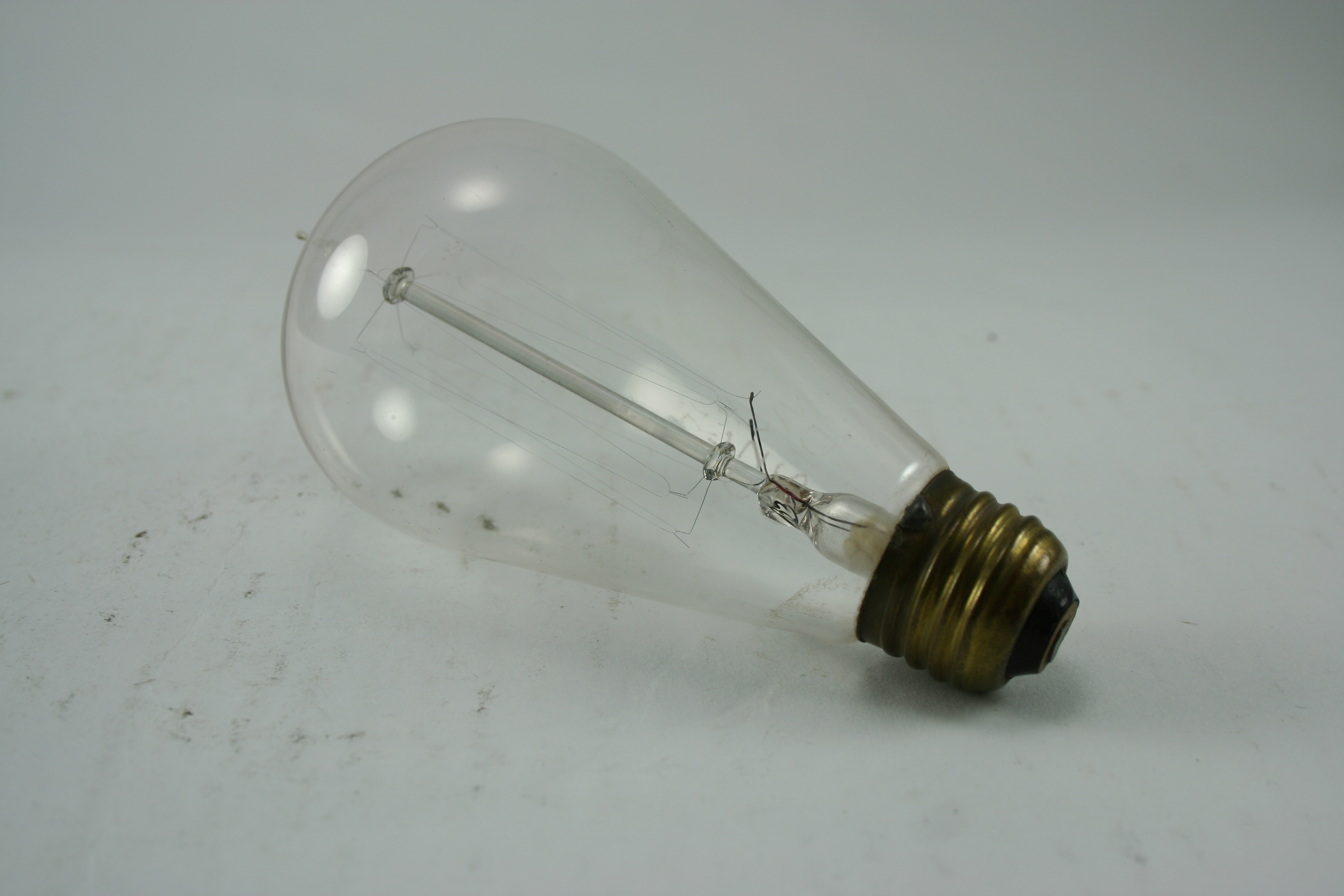
Glass etched Edison bulb from 1920, found in Cranbrook House.

Glass-etched Edison bulb from 1920, Cranbrook Cultural Properties Collection..

While browsing the historical writings of Henry Scripps Booth recently, I came upon the answer to a question that Collections Fellow, Stefanie Dlugosz, had posed late last year. As she prepared the Center for Collections and Research’s Holiday Tables exhibit (“Illuminate the Seasons” was the theme), which highlighted the early use of electricity in Cranbrook House, Stefanie had wondered what the source of electricity was, in 1908, for a relatively isolated place like Cranbrook. Efforts by several people could not turn up an answer. Until now.

“Although Caldwell’s electric fixtures had been installed about December 1, we still had to use candles and oil lamps for light because the private Edison line being installed from Highland Park to Cranbrook House was incomplete.”  This was recorded during the 1980’s in Henry’s unpublished History (which relates the history of Cranbrook Educational Community and the Booth family between 1800 and 1987).

As the bill from Albert Kahn shows, George G. Booth spent $1863.48, around $49,000 in today’s dollars, on lighting fixtures in Cranbrook House. The order is itemized, room by room, on seven pages of legal-sized paper, in Booth’s papers.

Albert Kahn’s bill to George Booth for Cranbrook House lighting fixtures provided by Edward.F. Caldwell Co.  Papers of George and Ellen Booth 14:23

George Gough Booth Papers, courtesy Cranbrook Archives.

Read the original blog for more information on the Caldwell lighting fixtures at Cranbrook House.

— Cheri Gay, Archivist

Create a website or blog at WordPress.com