Photo Friday: Cranbrook’s Contractor

Wermuth House, Fort Wayne, Indiana.  Designed by Eliel and Eero Saarinen, 1941. Cranbrook Archives.

Wermuth House, Fort Wayne, Indiana. Designed by Eliel and Eero Saarinen, 1941. Cranbrook Archives.

This distinctly modern house was designed by the architecture firm Saarinen, Swanson & Saarinen for a man whose introduction to Cranbrook happened in a somewhat old-fashioned way—the construction of Christ Church Cranbrook, George Booth’s ecclesiastical ode to the British Arts and Crafts Movement.

In 1923, Albert Charles (A.C.) Wermuth was contracted by the architect Bertram Goodhue to oversee construction of the Trinity English Lutheran Church in Fort Wayne, Indiana.  Goodhue was so impressed with his construction work that he contracted with Wermuth again for the upcoming Christ Church Cranbrook commission in 1924.  Goodhue died before construction on the church could begin in 1925, but the firm Goodhue & Associates retained Wermuth as general contractor for the project.

When Christ Church Cranbrook was completed in 1927, the Booths immediately snatched up A.C. Wermuth for more Cranbrook projects—the building of the Cranbrook School campus and an addition to Brookside.  Thus began a decades-long professional relationship between Wermuth and Cranbrook, with Wermuth serving as general contractor for Kingswood, the Cranbrook Academy of Art, and the Cranbrook Institute of Science.  Wermuth also did private work for the Booth children as they built their own homes in the area.  Eliel and Eero Saarinen used Wermuth for their non-Cranbrook projects as well; he served as contractor on the First Christian Church in Columbus, Indiana, as well as on other Saarinen buildings.

With professional connections like these, it seems only fitting that Wermuth turned to the Saarinens when it was time for him to build his own house in Fort Wayne. While the Wermuth House, which was completed in 1941, was built under the names of both Eliel and Eero, the design of the house speaks a bit more to the son than the father.  A Saarinen, Swanson, & Saarinen project, however, Wermuth ended up with a home for his family that expressed many of the same modernist ideals that he himself helped bring to life as the general contractor for Cranbrook.

Shoshana Resnikoff, Collections Fellow, and Robbie Terman, Archivist

Dispatch from the Archives: “Gatescapes,” Old and New

On October 5, Cranbrook Archives will be opening its second exhibition in the From the Archives series.  From the Archives: Forging Cranbrook’s Gatescape explores the long-lasting significance of gates to Cranbrook’s campus.  Points of transition and transformation, the gates have also long stood as a public display of Cranbrook’s dedication to art and design.

George Gough Booth sketch for a gate.  George Gough Booth Papers, Cranbrook Archives.

George Gough Booth sketch for a gate. George Gough Booth Papers, Cranbrook Archives.

Cranbrook’s love of gates originates with its founding father, George Gough Booth.  Booth, who came from a family of copper and tin metal workers, received early training at the Red Foundry in Ontario, Canada.  This, in part, led to his 1884 purchase of Barnum Wire and Iron Works in Windsor, Ontario with partner Fred Evans.  Booth wrote, “I conceived the idea of creating a new type of industry – selling with my pencil and not so much out of a catalogue – making special designs for fences, signs, bank counter railings…”   One of the earliest gates at Cranbrook designed by George Booth (and fabricated by Detroit Architectural Iron Works in 1916) is the first public gate located at the entrance to the Greek Theatre.

    Greek Theatre gates, designed by George Booth and produced by the Detroit Architectural Iron Works. 1916.

Greek Theatre gates, designed by George Booth and produced by the Detroit Architectural Iron Works. 1916.

Since Booth’s inception of Cranbrook, the community has steadily expanded the campus’ “gatescape.”  The most recent gates installed on campus are the “Valley Way” entrance gates (2012), designed by Architect-in-Residence William Massie.  Located at what was formerly known as the Vaughan Road Entrance, the gates were part of a project which widened the roadway to improve vehicular and pedestrian safety.  Working with Brian Oltrogge, Massie designed an abstraction of geometric triangles, a reference to Eliel Saarinen’s Kingswood gates.   The new gates were fabricated of laser-cut and bent steel.  The hand-bent “infill” was bolted to the steel frame and welded by Jody Cooper, Academy of Art alumni (Architecture Department 2012).

Closeup of Valley Way entrance gates, designed by Cranbrook Academy of Art Architect-in-Residence William Massie. The gates were completed in 2012.

Closeup of Valley Way entrance gates, designed by Cranbrook Academy of Art Architect-in-Residence William Massie. The gates were completed in 2012.

In conjunction with the exhibition opening, I’m going to be leading a walking and bus tour of the gates on Saturday, October 5.  We’ll be exploring all aspects of the gates, from their history in situ to the designers and makers who produced them.  Be sure to sign up here to join us, and get ready to delve deep into Cranbrook’s “gatescape”!

Leslie S. Edwards, Head Archivist

Cartoons and Crusades: Booth, Herter, and the Making of a Tapestry

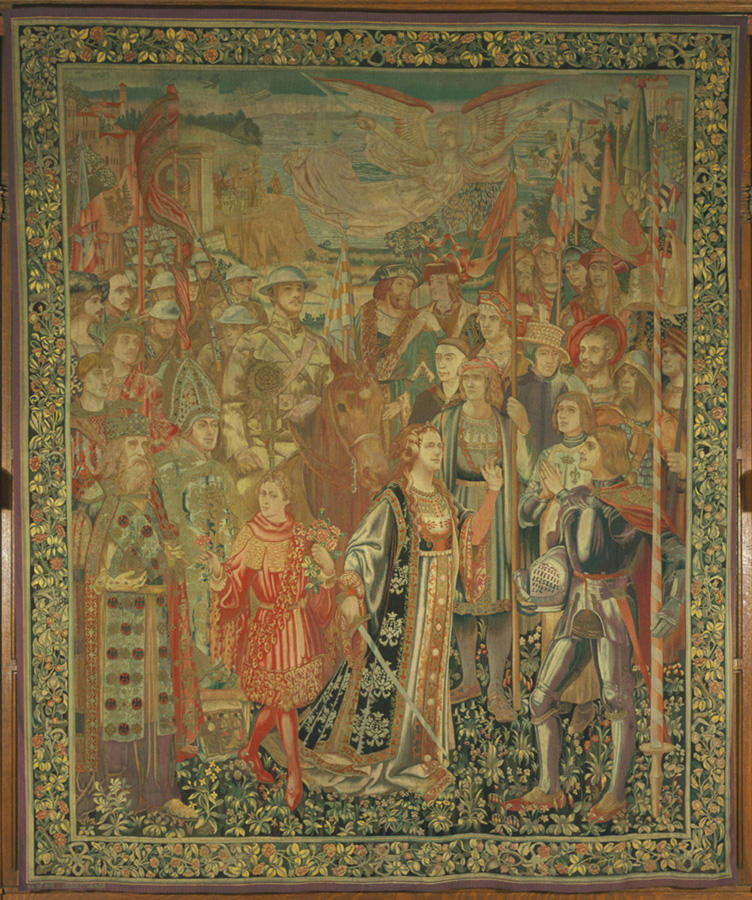
If you’ve ever visited the Cranbrook House library, you’ve probably noticed The Great Crusade, a large tapestry hanging on the south wall.  Many people associate tapestries with medieval times, when they were used to keep drafty castles warm in winter.  Woven wall hangings were also popular as decorations, especially as a sign of wealth since the extensive labor and pricy materials made tapestries more expensive to produce than paintings.  While most of the tapestries that adorn Cranbrook House are fifteenth-century Flemish, The Great Crusade is a toddler; though it utilizes a historic technique, it was designed and produced in the early twentieth century.

Herter Looms, The Great Crusade, 1920.  Cranbrook Art Museum.

Herter Looms, The Great Crusade, 1920. Cranbrook Art Museum.

Continue reading

Booth House + Scripps Land = Library

The Detroit connections of James E. Scripps and George G. Booth are well-documented: Scripps as founder of the Detroit News and founding member of what is today the Detroit Institute of Arts, and Booth as a founder of the Detroit Society of Arts and Crafts.  Less known, perhaps, is a venture near the end of Scripps’s life that helped create the Scripps Branch of the Detroit Public Library at Trumbull and Myrtle. The library was actually George Booth’s former home, renovated to accommodate library services. It stood in Scripps Park though a different library (the Frederick Douglass branch) sits there now.

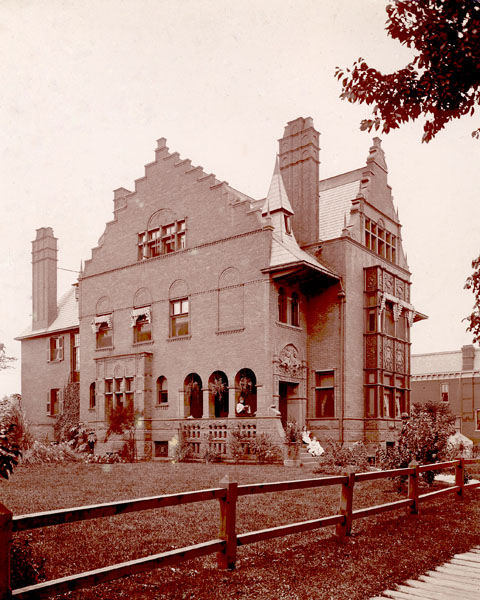
Here’s the story. When George Gough Booth and Ellen Warren Scripps married in 1887, James Scripps built a house for them, designed by Mason & Rice, across the street from his own on Trumbull Ave. Fast forward to 1905. James Scripps donated 15 lots of property, on Grand River between Trumbull and Commonwealth, to the city of Detroit as a site for a park and branch library. He included $50,000 to be used for city beautification.

Booth Family Home, 605 Trumbull Avenue, 1898

Booth Family Home, 605 Trumbull Avenue, 1898

The Library Commission, on which Scripps served for five years, was already thinking of putting a branch in this area (no doubt influenced by Scripps), so the city gave the Commission the land. Now things get more confusing. Upon the death of James Scripps in 1906, the estate purchased the George Booth home (located next door to Scripps’s donated property; by this time the Booths had moved to Cranbrook) and included that in the gift. So the Library Commission didn’t have to build a new branch and used the $14,000 designated for that purpose to renovate Booth’s house as a library.

Scripps Park

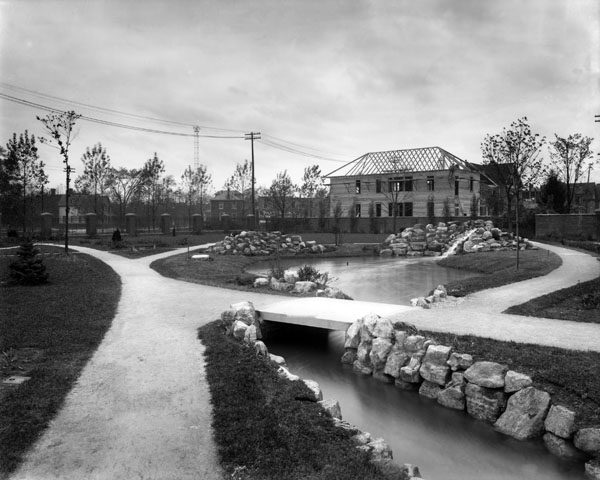
Early landscape, Scripps Park, ca 1908

In fulfilling Scripps’s intent for a park, Booth hired H.J. Corfield, landscape gardener who designed the basic landscape for Booth’s Cranbrook estate.  Booth wrote to Corfield “I feel quite sure that we can carry through a nice piece of work and will be able to pay the foundation for a small park of unusual attractiveness in this city.”  Corfield transformed land that was “little better than a city dump …  into one of the prettiest parks in the city of Detroit.”

Entrance to Scripps Park

Entrance to Scripps Park

The former Booth home was almost doubled in size and opened on July 3, 1909 as Scripps Branch Library.

There’s another interesting twist to the story. In 1898, James Scripps added an 800-ton octagonal chapter house, modeled after the one in Westminster Abbey, to his own home on Trumbull across the street from the Booth’s. It contained his book and art collection. In 1927, James’s son, William E. Scripps, made a gift of the tower to the Library, along with its collections, it was moved across the street and attached to the Scripps Branch Library!

The sad ending is that the branch closed in 1959, and was demolished in 1966. The Gothic tower was razed sometime later, after a valiant attempt to save structure, by George Booth’s youngest son, Henry Scripps Booth, failed.

~Cheri Gay, Archivist

Photo Friday: The Other Cranbrook

Coppersmith's shop, Cranbrook, England.  July, 1901.  Henry Wood Booth Papers, Cranbrook Archives.

Coppersmith’s shop, Cranbrook, England. July, 1901. Henry Wood Booth Papers, Cranbrook Archives.

In 1901, Henry Wood Booth, Cranbrook founder George Gough Booth’s father, took this photograph of the shop in Cranbrook, Kent, where his own father had worked as a coppersmith before moving to Canada with his young family.   A handwritten note on the back of the photograph, which is held in the Henry Wood Booth Papers at the Cranbrook Archives, explains that the copper tea kettle hanging from the door was made by Henry’s grandfather (the original George Booth), who also made his trade as a coppersmith.  Three generations (and a whole lot of people named Booth) later, George Booth’s great-great-grandson George Gough Booth would build an entire campus around the idea of promoting the applied arts, naming it “Cranbrook” in honor of this town and community.

Cranbrook and the Car, Part 1: The Aristocrat of Small Cars

In its 100-year history, Cranbrook has been known for producing artists, designers, scholars, athletes, and leaders.  But cars?  An upcoming exhibition mounted by the Center for Collections and Research (that’s us!) at the Cranbrook Art Museum will explore the relationship between Cranbrook and the automobile industry. Called A Driving Force: Cranbrook and the Car, it will highlight the history of Cranbrook through the lens of the automobile, detailing the ways that members of Cranbrook’s community have innovated and influenced the auto industry for the past 100 years.  You can learn more about the exhibition at Cranbrook Art Museum’s website here.

As we prepare to open A Driving Force: Cranbrook and the Car on June 12, we’ll be writing up occasional posts about the exhibition, highlighting bits and pieces of our research and providing glimpses into the down-and-dirty world of museum exhibiting.   And we’re going to kick it all off with the story of James Scripps Booth and the Scripps-Booth Company.

James Scripps Booth (behind the wheel) with brother Warren Scripps Booth in a Scripps-Booth 4-cylinder Model C at Tower Garage at Cranbrook House. Their father George Gough Booth stands next to the car, partially hidden by the windshield.  Circa 1917, Cranbrook Archives.

James Scripps Booth (behind the wheel) with brother Warren Scripps Booth in a Scripps-Booth 4-cylinder Model C at Tower Garage at Cranbrook House. Their father George Gough Booth stands next to the car, partially hidden by the windshield. Circa 1917, Cranbrook Archives.

Continue reading

Create a website or blog at WordPress.com