Collaging the Architecture of Detroit

Each year before my History of American Architecture lecture series, I like to commission Cranbrook Academy of Art student or recent alumni to design a poster to promote the event. This year, I asked second-year 2D Design student Luis Quintanilla to create a poster for this year’s series, Detroit and the World. I am thrilled with how the poster turned out—you can pick one up at the first lecture February 6, 2024—and thought I would share with you some of how it came about.

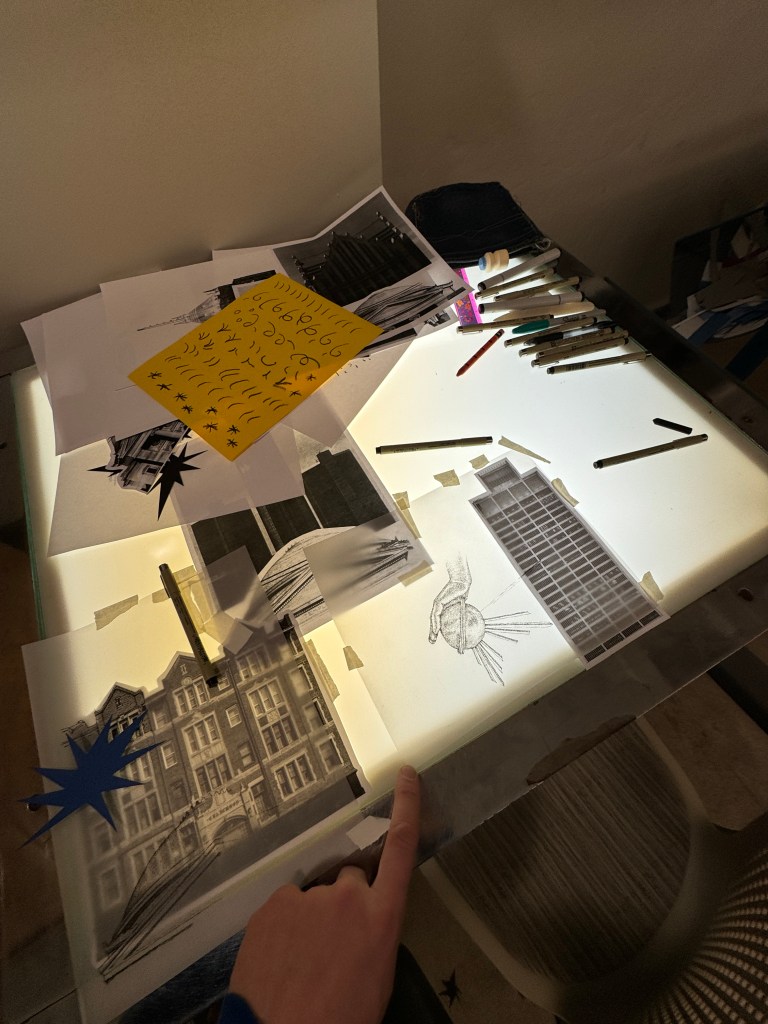
When I visited Luis’ studio in the Arts and Crafts Court, I was struck by their graphic sensibility combining imagery and text in sticker-like collages. I was also very impressed by a series of stipple drawings in ink on tracing paper, which Luis kept in a shoebox. As we talked about the themes of my upcoming lectures, and what we both admire about Detroit and its architecture, the idea of the poster came about. With Luis’ sketches strewn across the table in their studio, I was reminded of the great tradition of architectural capricci.

Architectural capprici are fantasies, where artists or architects combine buildings from across time in a single image. Traditionally, 18th century capprici could be oil paintings, pencil or ink sketches, or engravings. Joseph Michael Gandy is the most famous painter of architectural fantasies. Here, he is combining the London works of Sir John Soane into a single fantasy, set within the studio of Soane’s own house.

Joseph Michael Gandy, Public and Private Buildings Executed by Sir John Soane between 1780 and 1815, first exhibited 1818. Courtesy of Sir John Soane Museum, London.

If you’ve come to many of my previous architecture lectures, you might recognize my favorite painting: Thomas Cole’s The Architect’s Dream of 1840, a capprici which embodies the mid-19th century debate between gothic and classical styles. Contemporary British painter Carl Laubin creates stunning work inspired by Gandy, using contemporary architects for elaborate capprici.

What might an architectural capprici of Detroit include?
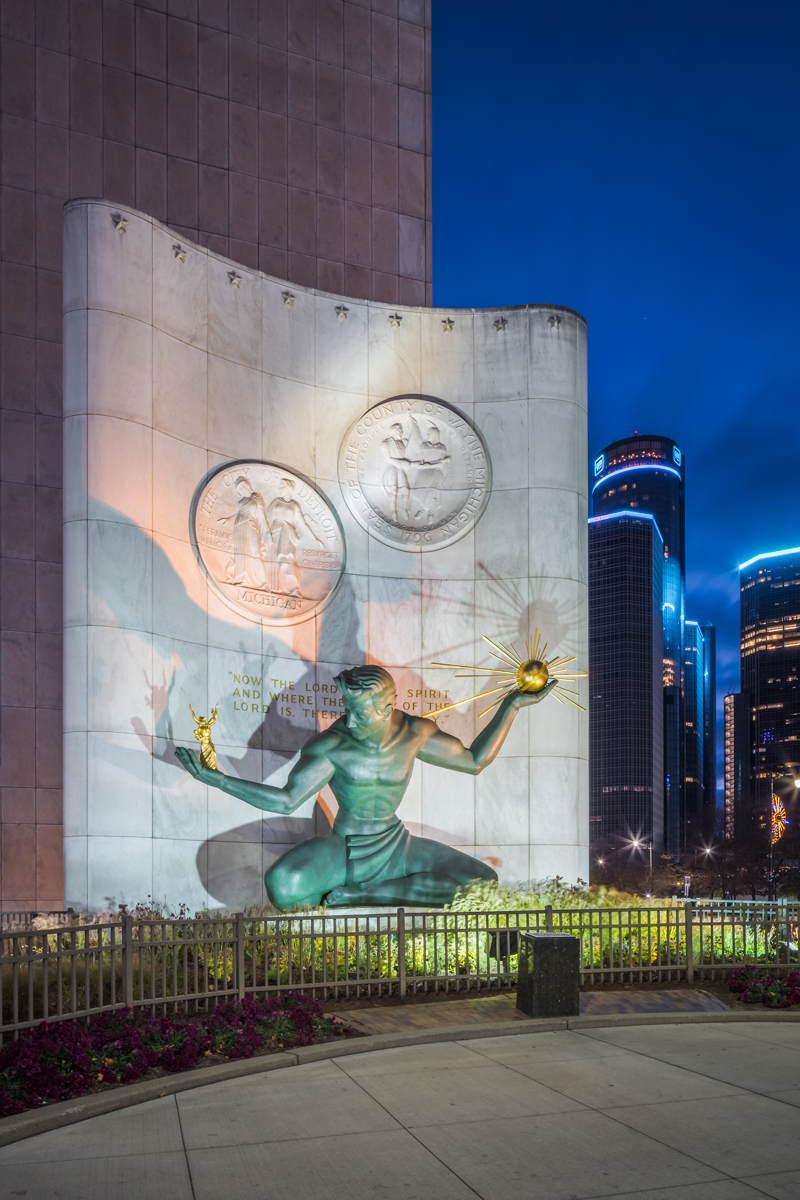
Marshall M. Fredericks’ The Spirit of Detroit, 1958, photographed by Helmut Ziewers for Historic Detroit Area Architecture.

I created a list of forty buildings I thought embodied the best of Detroit architecture. I narrowed it down to twenty buildings for Luis’ consideration, and shared images of each. My only real request: include at least one building from each of the five lectures, and center the poster on John Portman and Associates’ 1977 Renaissance Center.

I don’t think Detroit has a more iconic building than the RenCen, with its piston-like glass towers rising up from the Detroit River. There are better works of architecture, sure, but as far as an associated image of Detroit? Nothing tops the RenCen.

I suggested, too, that Luis include the 1901 St. Josaphat’s church by architects Joseph G. Kastler and William E. N. Hunter in front of the RenCen, to recall the almost too-good-to-be-true alignment of these two structures when driving into the city from the northern suburbs on I-75. After all, by the nature of delivering lectures about Detroit from the distance of Cranbrook, this is the view (from the suburbs, from the car) many of us hold toward the city.

We went back and forth about including the Spirit of Detroit, former Cranbrook Schools faculty member Marshall M. Fredericks’ monumental bronze at the Detroit City-County Building. What attracts me to the Spirit is its iconic status and its graphic replicability: whether on the redesigned city buses or the new city holiday lights, all you really need is an orb and some rays of light to know: that’s the Spirit of Detroit.

What would be the mood of our Detroit capprici?

Inextricably linked to the history of Detroit since 1980 is Detroit Techno, a form of Electronic Dance Music (EDM) that combines synth-pop with African American styles such as house, electro, and funk. For me, Detroit is most exciting, and its dynamism most electrifying, at night. In riding through the city after dark, buildings become speeding landmarks, and its possible to disappear for a time into a former factory or repurposed commercial building for a party or a rave. In these moments, buildings become less defined by their former glory or current decay than by their inhabitation as a dancefloor pulsating with music and lights. It’s a new way of occupying the city’s architecture to unique advantage.

Luis went to work. They began by printing out and arranging the buildings I’d shared. Then, they began overdrawing some of the images—distorting or highlighting certain features.

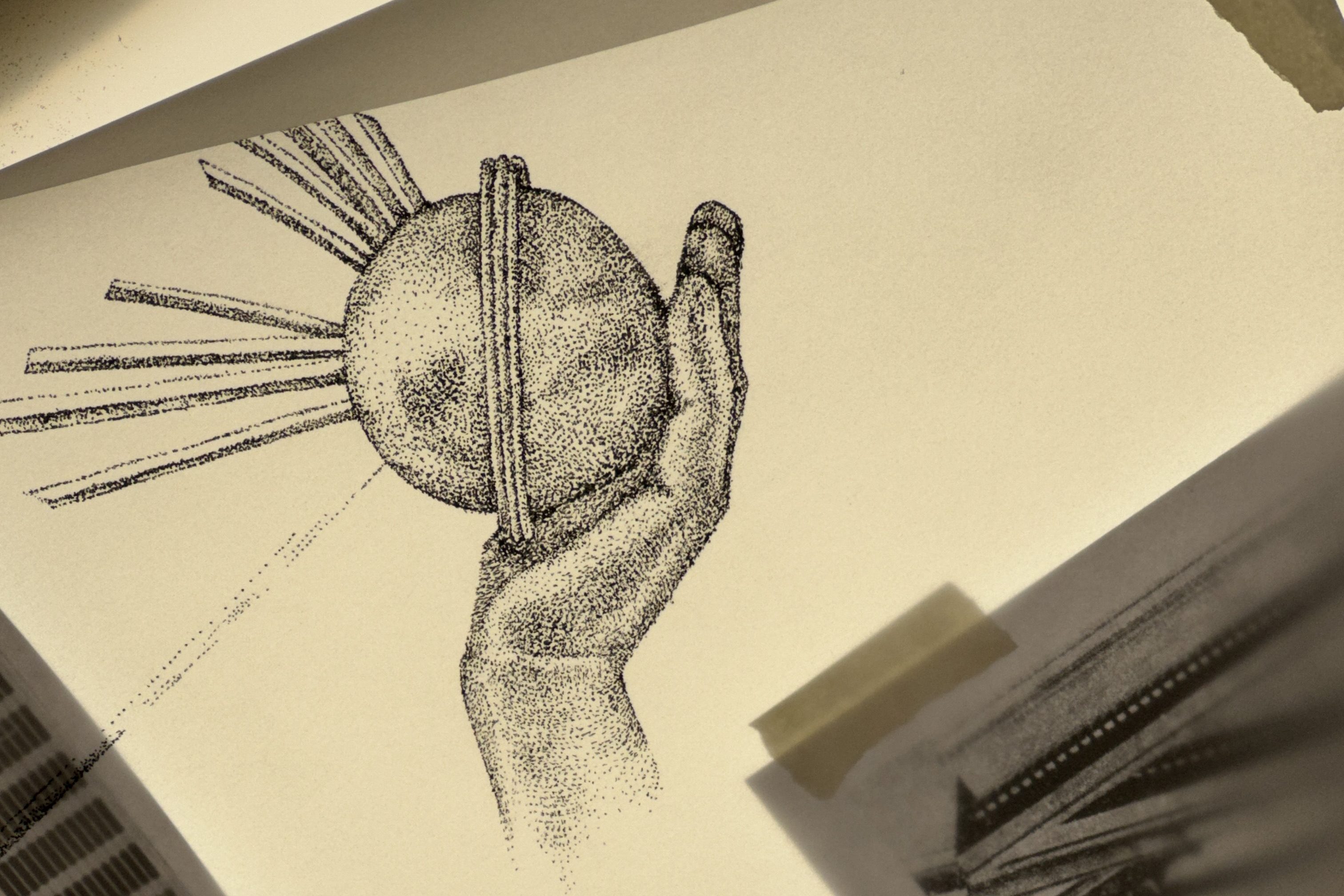
Layering on tracing paper, Luis dutifully stippled certain prominent architectural elements. I was especially impressed at the beautifully rendered hand, orb, and rays of Spirit of Detroit.
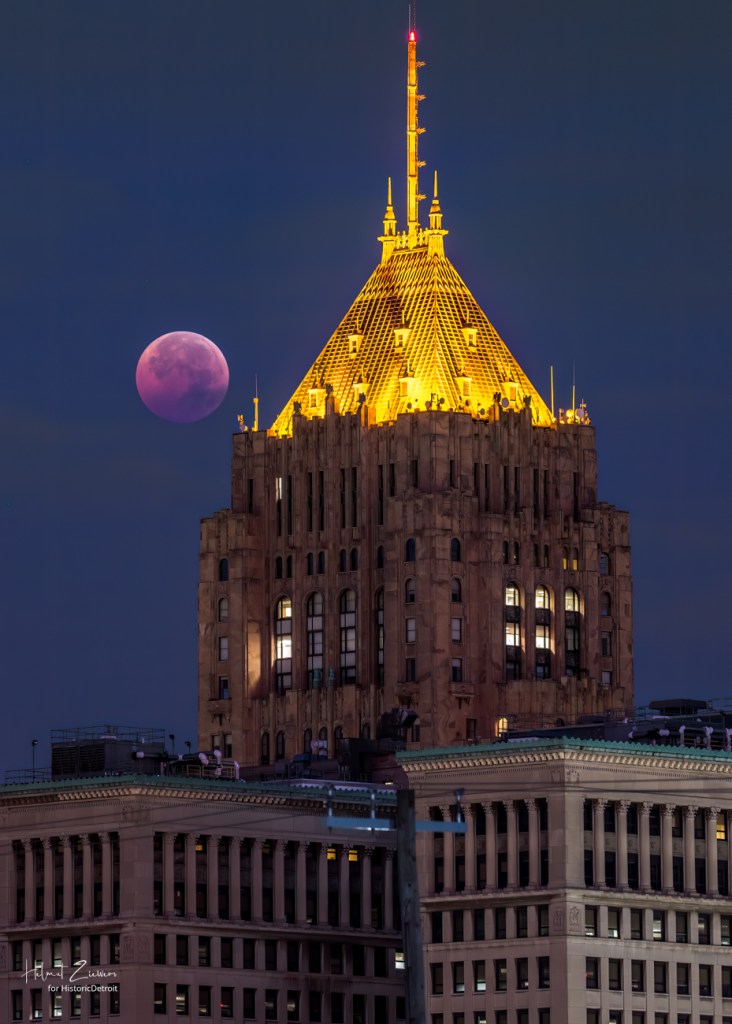
Luis then cut out stars on blue and yellow paper, adding in light sources to the night scene. The Ambassador Bridge, Dodge Memorial Fountain, Penobscot and Fisher Buildings are all recognized for their dramatic nighttime illumination, and Luis captured this with hand-drawn and cut stars.

Finally, Luis scanned in the physical elements of the poster and reassembled them in Illustrator, where text was added. Luis took inspiration from Detroit Techno posters for the colors and fonts. I could not be more thrilled with our poster, and the capprici of Detroit at night (with techno).

Luis Quintanilla, CAA ’24, working on the poster. Luis is from Austin, Texas, and earned their BFA from Virginia Commonwealth University.

Can you identify all the buildings shown? Can you speculate why I chose them?

If you can, you’ll love this year’s History of American Architecture: Detroit and the World lecture series! If you can’t, you’ll also love this year’s History of American Architecture: Detroit and the World lecture series! The first lecture is February 6, 2024, at 12:00pm ET online and at 6:30pm ET online and in de Salle Auditorium at Cranbrook Art Museum. Purchase your tickets and learn more on our website. All lectures will be available for viewing after the lecture to ticket holders. See you there!

Kevin Adkisson, Curator, Cranbrook Center for Collections and Research

Special thanks to Artist-in-Residence Elliot Earls, Head of 2D Design, for suggesting Luis for this project. A perfect fit!

Time to Study! (History, that is)

As college students across the country buckle down to study for final exams and finish writing end-of-semester papers, there will be one school where that’s not happening: Cranbrook Academy of Art. Instead, our Academy students are busy making in their studios, and frantically producing work for their semi-regular critiques with Artists-in-Residence. This follows the model set up here by founding president Eliel Saarinen, who famously rejected what he called the “non-creative-school-book-learned-art-teacher” in favor of a method he called “self-education under good leadership.”

While the Academy’s extremely self-directed, studio-based education is proudly traced back to our founding, Cranbrook did, in fact, once offer formal courses in the history of art. These quarterly courses—taught by museum curators, visiting professors, and artists—utilized both slide shows and actual paintings.

Museum Director Albert Christ-Janer teaching his “Survey of the Arts” history class for Cranbrook Academy of Art students, 1945. Christ-Janer arrived at Cranbrook in June of 1945 and left for the University of Chicago in September 1947. Harvey Croze, photographer. Courtesy Cranbrook Archives.

Here, we see Museum Director Albert Christ-Janer lecturing in the then-new Cranbrook Academy of Art Museum and Library. The classroom is simple, just folding chairs and an illuminated blackboard set up in the lower-level galleries. In front of the students hangs Doris Lee’s Fisherman’s Wife. I admire Christ-Janers books, and imagine it would’ve been very exciting to attend one of his lectures.

Christ-Janer discussing Fisherman’s Wife by Doris Lee (CAM 1945.27). Lee painted the scene of Key West, Florida while she was a visiting artist at Michigan State in 1945. It was purchased by the Cranbrook Foundation that same year. Harvey Croze, photographer. Courtesy Cranbrook Archives.

In the Academy’s 1945 Course Catalog, Christ-Janer is listed as “Instructor in the Survey of the Arts.” By the 1970s, then President Wallace Mitchell stopped offering anything like a history of art course at the Academy in favor of a history/theory seminar called the Humanities Forum. This evolved into the Critical Studies program today—the only required lecture/seminar for Academy students, but which is, as always, ungraded.

I’d note that Christ-Janer is teaching in a full suit and tie—a sight rarer at the Academy today than a history of art course!

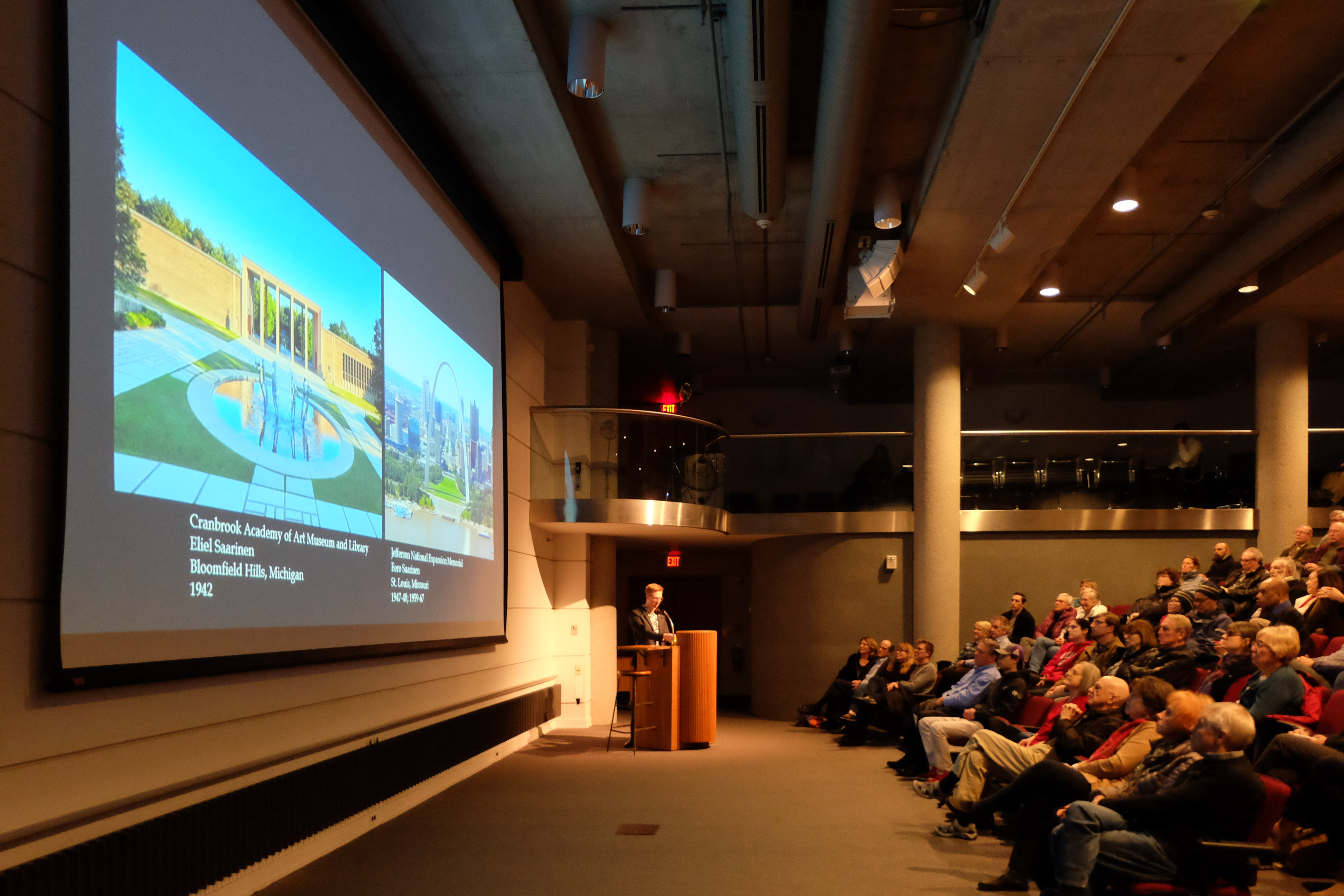
Even though the Academy no longer offers a History of Art course in its curriculum, I like to think that the Center’s History of American Architecture lecture series continues the tradition of art history at Cranbrook. For the past six years, I’ve taught architecture history to interested Academy and Cranbrook Schools students, and open to members of the public.

Kevin Adkisson teaching History of American Architecture: Cranbrook in Context, March 3, 2020. Photography by Daniel Smith, CAA 2021, Courtesy Cranbrook Center for Collections and Research.

Starting on February 6, 2024, the History of American Architecture lecture series returns. This year’s subject is “Detroit and the World,” and we are offering two ways to attend the lecture: virtually, at noon or 6:30pm EST, or in person at Cranbrook Art Museum’s de Salle Auditorium at 6:30pm. We launched the website and ticket sales on Wednesday, and I encourage you to read more about each week’s topic and consider signing up over on our website. There’s so much great Detroit architecture, and I am excited to share it with you in lectures this winter!

In his unpublished 1950 manuscript, The Story of Cranbrook, Eliel Saarinen wrote of Cranbrook students as “the pupil is like an empty sack to be filled during the school year.” I hope you’ll join me in February as we fill ourselves up with knowledge!

Kevin Adkisson, Curator, Cranbrook Center for Collections and Research

Image: The Greater Penobscot Building by Wirt Rowland of Smith, Hinchman & Grylls, Detroit, Michigan, 1928;  Photography by James Haefner, Courtesy James Haefner.    

HISTORY OF AMERICAN ARCHITECTURE

DETROIT AND THE WORLD

This installment will focus on the architecture of Detroit, studying the buildings, designers, and policymakers that shaped the city’s dramatic transformations from the late nineteenth century to today, and how Detroiters have influenced the course of architecture around the globe. 

Adler/Schnee’s Flower Fiesta

Are you enjoying the snow this winter? Or do you need something to brighten your February mood? Have you considered fake flowers?

This week, as the country was pummeled by winter storms, I was busy in Cranbrook Archives researching for my History of American Architecture: Eero Saarinen and His Circle lecture series. One important member of Eero’s circle of designers? Ruth Adler Schnee.

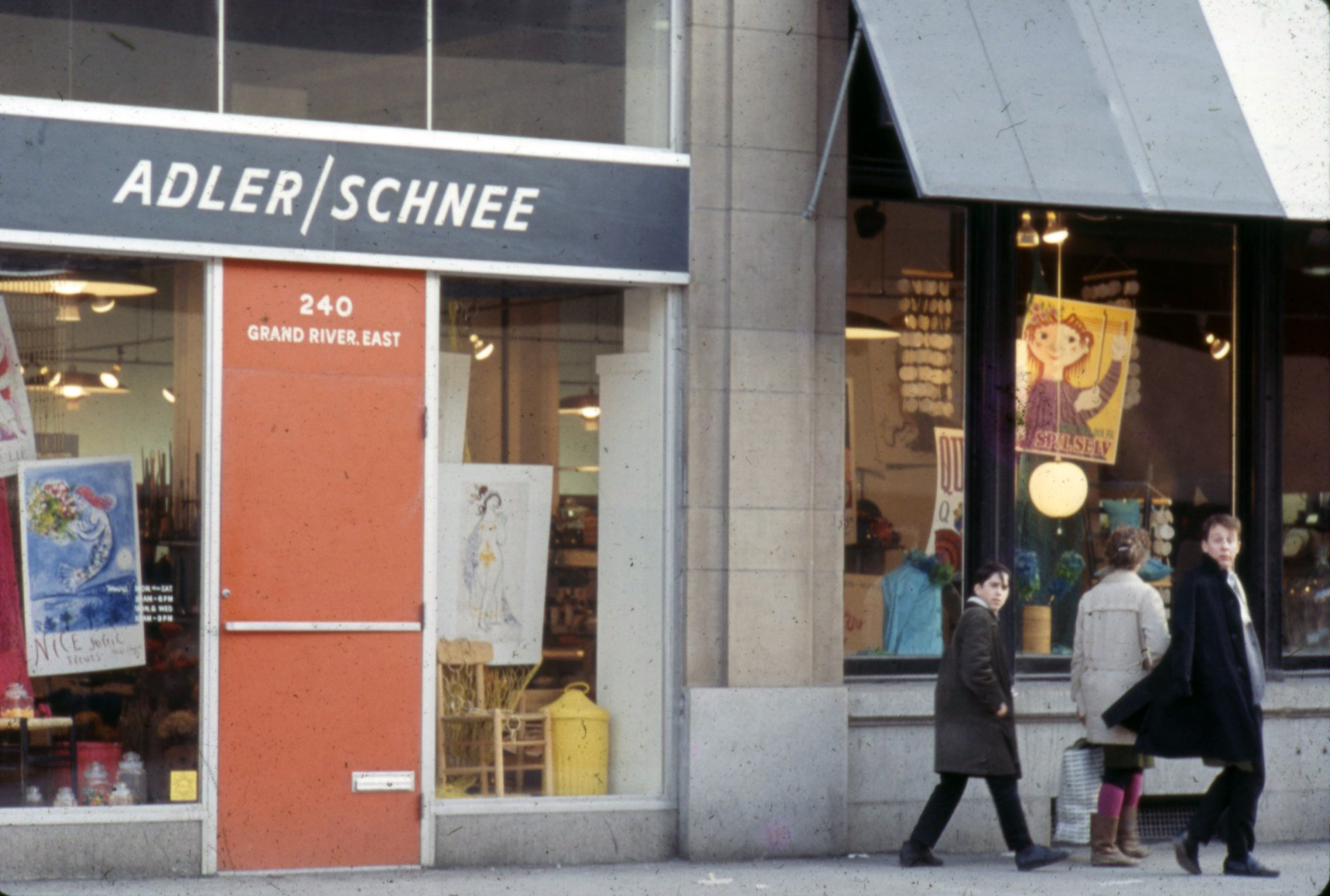
Ruth, a 1946 graduate of Cranbrook Academy of Art’s Design Department, was known for her printed textiles, interior designs, and the store she operated with her husband, Edward, in Detroit from 1948 to the 1977. In Cranbrook Archives, we have the Edward and Ruth Adler Schnee Papers, which includes a wide variety of designs, notes, samples, and PR materials.

Adler/Schnee, Inc. on Harmonie Park. The design store was located at 240 Grand River East in Detroit between 1964 and 1977. Photograph February 1965. Copyright Cranbrook Archives.

As I looked for materials related to Ruth’s work on the General Motors Technical Center—the subject of my lecture Monday—I came across this charming fold-out advertisement from the winter of 1966. Although it has nothing to do with my upcoming talk, it certainly brightened my mood, and I wanted to share it with you! The outside reads:

Sometimes it’s June in January…but at A/S it’s Bloomin’ February

The ad copy gets even better inside. Underneath a bright-pink line drawing of Scandinavian, Japanese, Danish, and Mexican home goods surrounded by Ferry-Morse seeds, a cat, birds, and flowers, it reads:

Stamp out snow with fake and fabulous flowers!

Put posies on everything—put posies in everything.

Color runs riot at Adler/Schnee Flower Fiesta

With kooky dried flowers ala Dr. Seuss; passionate pillows, dizzy dinnerware, palpitating papergoods, terrific totes and much marvelous more—all bursting with scintillating springtime.

Kick winter gloom and check Adler/Schnee, where even Harmonie Park itself is coming up new and exciting.

This pamphlet made me smile, and gets first prize in the alliterative Olympics. Based on other handwritten records in the Archives, it is possible Ruth herself wrote this little ditty (she wrote and designed much of the firm’s PR materials). Again based off other mailers, it seems likely the Schnees mailed out between 5,000 and 15,000 of these large fold-out advertisements.

Continue reading

Le Corbusier Comes to Cranbrook

On November 21, 1935, celebrated French architect Le Corbusier arrived in Detroit and promptly demanded to be taken to Henry Ford’s River Rouge Complex. That one of the world’s leading modernist architects wanted to visit Ford’s factory shouldn’t have been too surprising, as for the previous two decades Le Corbusier—born Charles-Édouard Jeanneret—had been advocating for a revolution in architecture like Ford’s revolution in transportation.

In his groundbreaking 1923 book, Toward an Architecture (or, as it was titled in its first English translations, Towards a New Architecture,) Le Corbusier made the famous claim, “A house is a machine for living in.” As he believed, “Machines will lead to a new order both of work and of leisure.”

Le Corbusier told reporter Florence Davies of the Detroit News that “Detroit is the logical city for the production of the houses of tomorrow, the pre-fabricated efficient mass-production house.” He went on to claim that it would be automobile manufacturers, not architects, who would “undertake the production of the homes of tomorrow” because they understood the problems of mass production.

But while Ford may have attracted Le Corbusier to visit Detroit during the his one and only trip to America, it was Cranbrook Academy of Art and its president Eliel Saarinen that played host to the great architect.

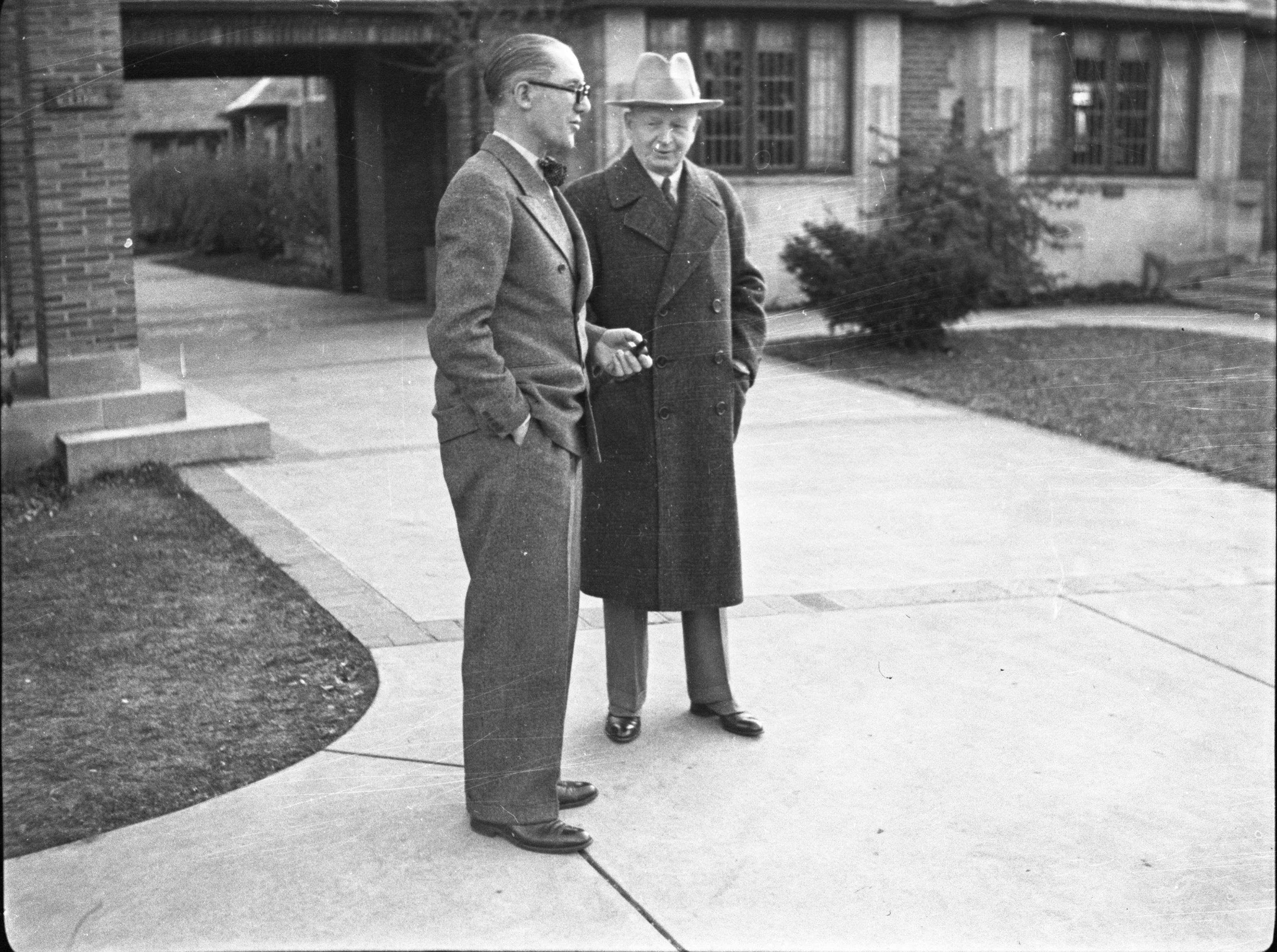
Le Corbusier, with pipe, and Eliel Saarinen at Cranbrook, November 1935. Richard G. Askew, photographer. Cranbrook Archives.

After seeing the Ford complex and a making a few stops downtown, Le Corbusier wound his way up to Bloomfield Hills. On display in the Cranbrook Pavilion (now St. Dunstan’s Theater) were twenty-four enlarged photographs, a selection of movies, fourteen building and city plans, and a single model documenting his work. These items were part of a small show on the architect open from November 19 to November 22. But the main event was Le Corbusier’s lecture at 8:00pm on November 21, 1935.

Delivered in French and translated by his American associate Robert Jacobs, Le Corbusier enthralled an at-capacity audience with his theories of architecture. He spoke of his work in Europe, including the recently completed Villa Savoye in Poissy. The focus, however, were his theories of city planning and mechanization. Le Corbusier used a sheet of tracing paper some 8- to 12-feet-long and pinned along the wall to execute large, colorful pastel sketches that illustrated his ideas of architecture and planning. This drawing was saved by the Academy, though it has since, sadly, been lost.

Installation view of Modern Architecture:
International Exhibition
at the Museum of Modern Art with Le Corbusier’s Villa Savoye at center and in photographs on left, February 9–March 23, 1932. While no photographs of Le Corbusier’s lecture or exhibition at Cranbrook survive, it was likely similar to this installation. MoMA Archives.

Le Corbusier lectured throughout most of his career as an architect. As he told an interviewer in 1951:

I never prepare my lectures…Improvisation is a wonderful thing: I draw, and when you draw and speak at the same time, you create something new. And all my theory—my introspection and retrospection on the phenomenon of architecture and urbanism—derives from my improvisation and drawings during these lectures.

After the Cranbrook lecture, Le Corbusier was the guest of the Academy of Art’s Executive Secretary Richard Raseman and Instructor in Interior Design Rachel DeWolfe Raseman. The couple had both studied architecture at Cornell (Rachel Raseman was Cornell’s first woman architecture graduate) and resided at Academy Residence #3 across Academy Way from Saarinen House. In the morning, Le Corbusier continued by train to the next stop on his cross-country journey.

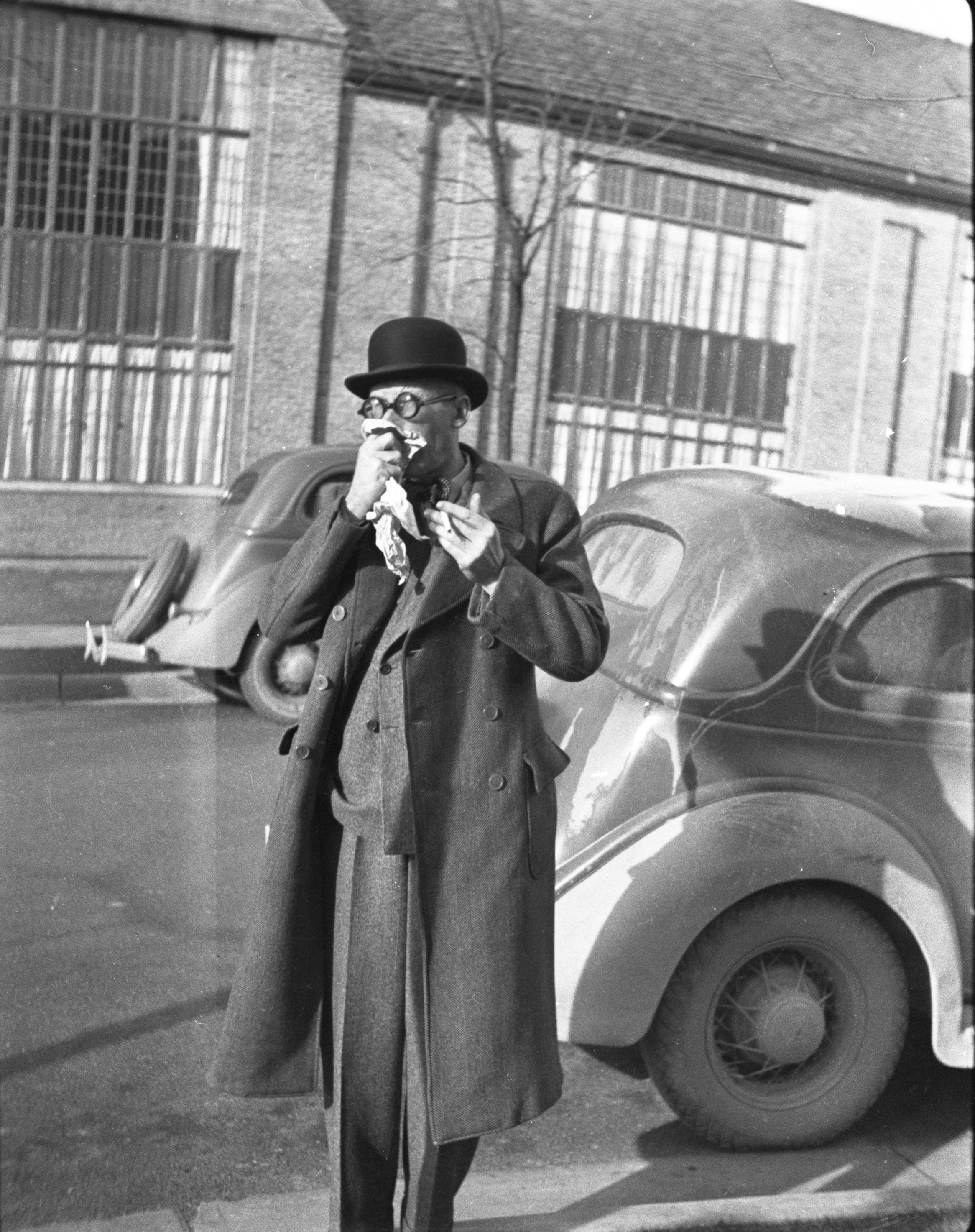
As the Detroit Free Press reported November 22, “With a few deft strokes Thursday, Le Corbusier, the famous French modernist-architect…sketched the vision that he sees through what is perhaps the most ponderous pair of eyeglasses ever fabricated.”

Le Corbusier in his famous eyeglasses at Cranbrook, November 1935. Richard G. Askew, photographer. Cranbrook Archives.

Alongside an earlier lecture in April 1935 by Frank Lloyd Wright, the visit to Cranbrook by Le Corbusier was one of the highlights of the Academy’s first decade. Reflecting in his Annual Report to the Cranbrook Foundation, Richard Raseman wrote that:

The Le Corbusier lecture, although delivered in French, was a good show, and as he is a world figure we were well satisfied…the public must have agreed with us as these lectures [by Wright and Le Corbusier] were by far the best attended of any of our functions…men of this caliber are rare indeed.

To learn more about Le Corbusier and his visit to Cranbrook, sign up for the Center’s History of American Architecture: Cranbrook Visitors Lecture Series! For the next five weeks, I will be discussing visitors, like Le Corbusier, who have lectured at Cranbrook since the Academy opened in 1932. From Le Corbusier, Wright, and Alvar Aalto in the 1930s through to Jeanne Gang, Greg Pasquarelli, and David Adjaye in the 2010s, I will tell the story of American design through architects who’ve spoken at Cranbrook. Learn more and sign up on our website. “See” you Monday at 11:00am or 7:00pm EST for our first virtual lecture!

Kevin Adkisson, Associate Curator, Cranbrook Center for Collections and Research

Create a website or blog at WordPress.com