While researching the step-backed Peacock Andirons at Saarinen House last spring, I enthusiastically mustered a muster of peacocks from across Cranbrook’s campus with the generous help of my colleagues.
“Muster” is the official label for a group of peacocks.
Unlike a gaggle of geese, a muster of peacocks lacks both onomatopoeia and alliteration and implies a level of formality and regimental order in direct conflict with the species’ behavior! That is…judging by the peacocks I’ve witnessed at historic homes and castles throughout Europe, including a visit to Scone Castle in Scotland where an earlier visitor captured these free-spirited troops. Whether iridescent blue or albino, their graceful necks and distinctive crests rise to magnificence when tail feathers are splayed to attract a peahen mate or intimidate predators.
Throughout the ages, blue aka Indian peafowl have symbolized beauty and prosperity and served as sources of artistic inspiration. A favored theme at Cranbrook, the peacock’s dramatic curvilinear lines are represented at each institution across the campus.
One can discover…
WORKS IN METAL:
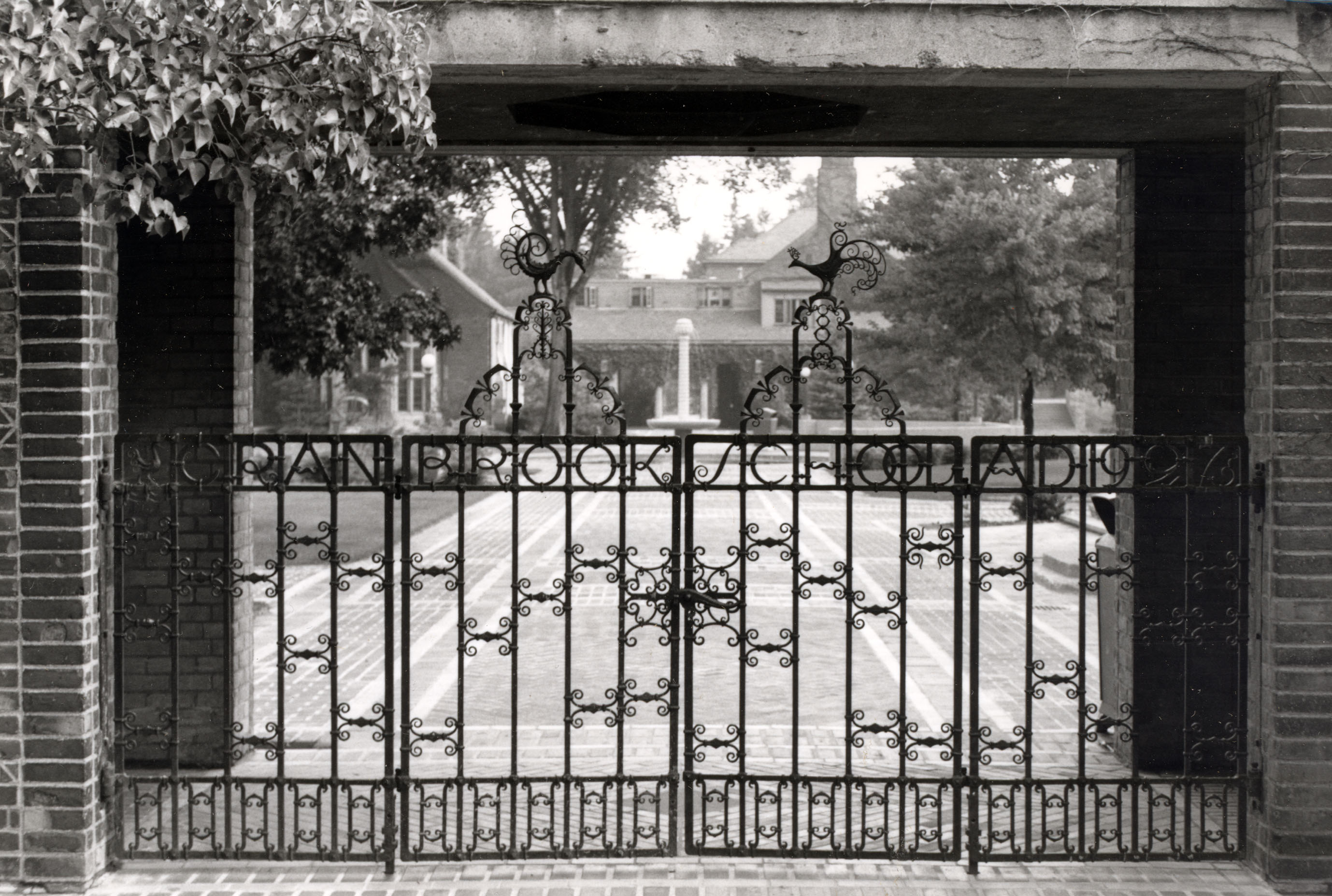
• The famed Peacock Gates designed by Finnish-American architect Eliel Saarinen and fabricated in wrought and cast iron by Oscar Bruno Bach, 1927, marking the former Lone Pine Road entrance to Cranbrook School for Boys:
Peacock Gates at Cranbrook School circa 1980. Jeffrey Welch, photographer. Courtesy Cranbrook Archives.
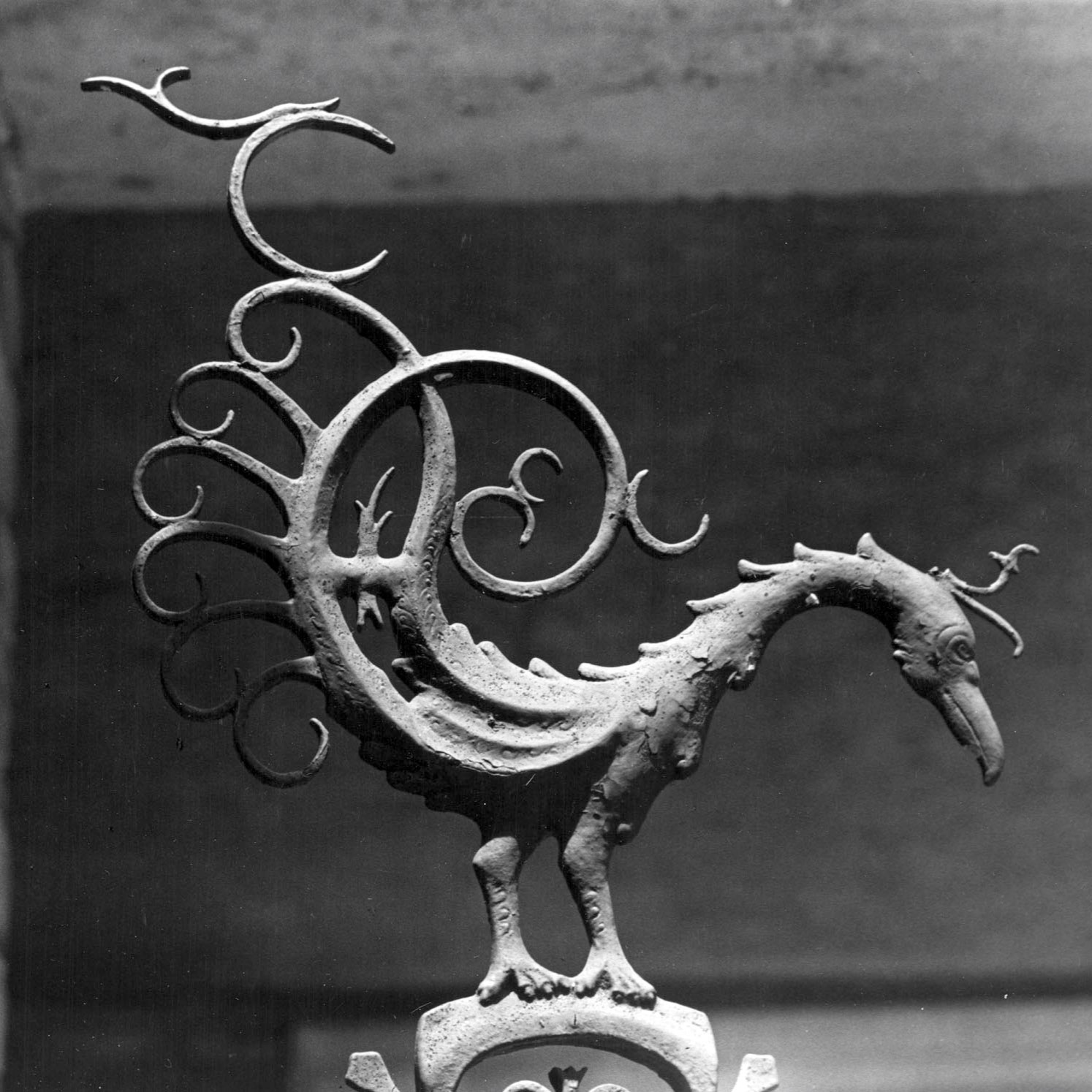
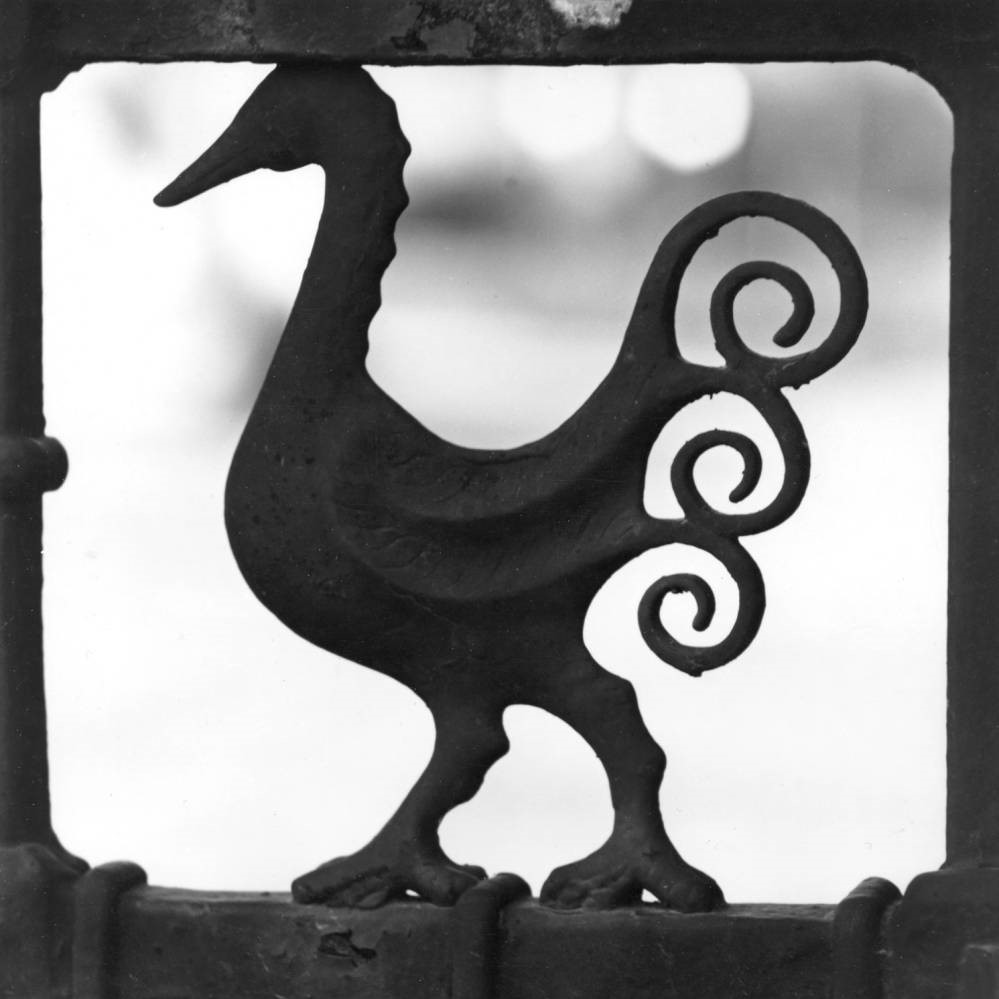
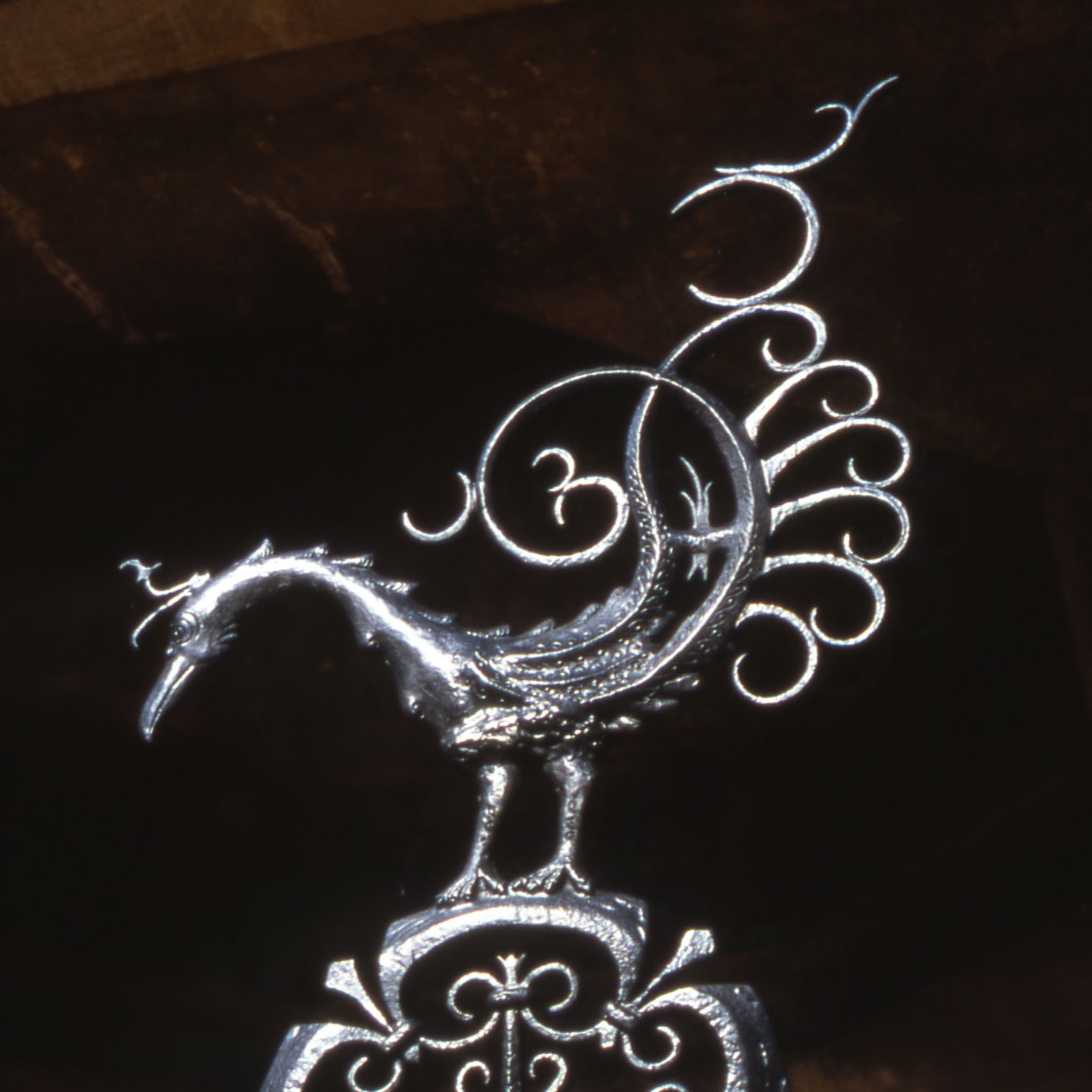
Details of the peacocks in cast iron:
Detail of Cranbrook School Peacock Gate, circa 1935. Courtesy Cranbrook Archives.
Detail of Cranbrook School Peacock Gate, circa 1935. Courtesy Cranbrook Archives.
Detail of Cranbrook School Peacock Gate, 2001. Balthazar Korab, photographer. Copyright Balthazar Korab | Cranbrook Archives.
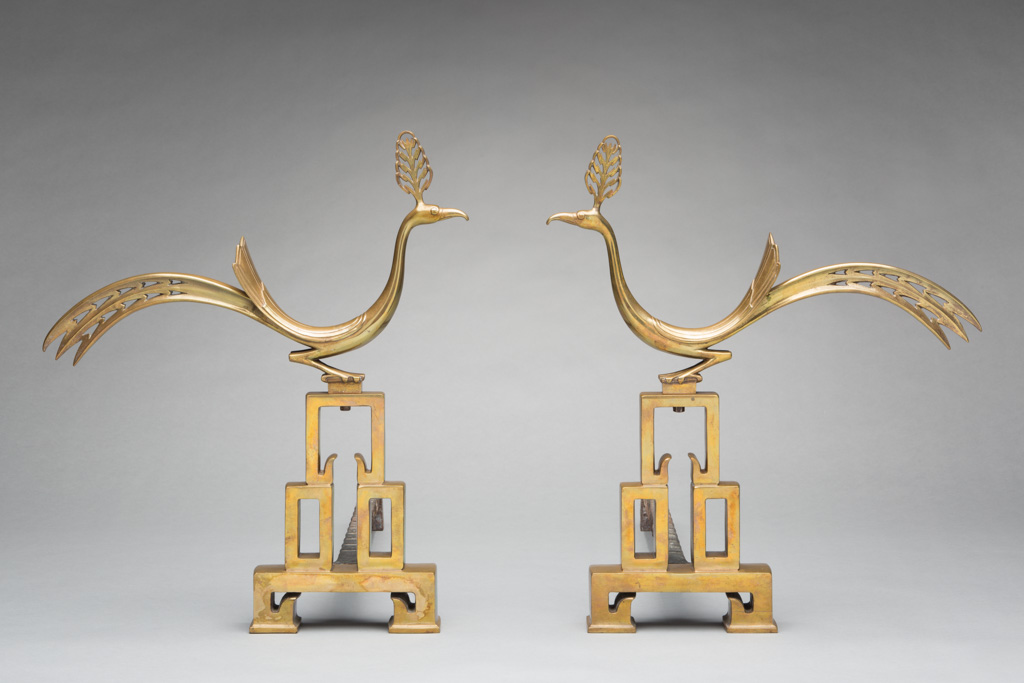
• Eliel Saarinen’s cast bronze Peacock Andirons, 1928-29, on view at Saarinen House. Collection of Cranbrook Art Museum. Produced by Sterling Bronze Company, New York, between 1928 and 1929, these cast bronze andirons were paid for by the Cranbrook Foundation and entered in the 1928-1930 Arts & Crafts Building ledger on pages 40-41—Date: 1-7-30; No.: 515; Name: Sterling Bronze Co; Remarks: 1 pair/ Andirons for Saarinen Res[idence]; Amount: $152.50 (the equivalent of $2,704 in 2024):
Robert Hensleigh, photographer. Courtesy Cranbrook Art Museum.
Every four years, we add an extra day to the calendar to catch up to Earth’s revolutions around the Sun. For most of us, it is just February 29th, an extra day in the week. For leaplings, it is a day to celebrate their true birthday.
Different cultures have different customs associated with February 29th, known as Leap Day. In some cultures, it is also known as Bachelor’s Day or Ladies’ Privilege, because that is the day that women can propose to men.
In Finland, leap-year day proposals are considered good luck. If, however, the gentleman says “no,” he is required to give the woman enough fabric to make a skirt.
According to Medium.com, “The tradition reflects the Finnish spirit of equality and a shared sense of humor within romantic relationships. It challenges gender norms in a playful manner, encouraging women to take the lead in expressing their feelings and creating a shared memory that will be cherished for years to come.”
“While leap-year day may be just one day every four years, the tradition of women proposing adds a touch of magic and unpredictability to Finnish love stories. It’s a celebration of love, luck, and the joy of shared laughter, reminding couples that romance can be both traditional and delightfully unexpected in the heart of Finland.”
Something else unexpected is an elopement, a sudden and secret ceremony involving a flight from home without parental approval. One of Cranbrook’s “Finnish love stories” involved one such elopement.
Shortly after she turned 21, Eva-Lisa “Pipsan” Saarinen eloped to Toledo, Ohio with Jons Robert Ferdinand “Bob” Swanson, one of Eliel’s architecture students. They were married on May 8, 1926. According to Pipsan Saarinen researcher Alison Kowalski, “The young couple eloped because Eliel and/or Loja objected to the match, probably in part because Bob was of a lower socio-economic status than the Saarinens. According to Henry Scripps Booth, a close friend of Bob and Pipsan, Loja felt Bob was using Pipsan to get close to Eliel.”
Eliel, Bob, Bobby, and Pipsan aboard the MS Gripsholm, 1929. Courtesy Cranbrook Archives.
Bob struggled to support himself and Pipsan at the beginning of their marriage. Perhaps she proposed, and he didn’t have enough money to cover the cost of skirt fabric for such a fashionable lady.
Watercolor dress design by Pipsan Saarinen Swanson, circa 1933. Collection Cranbrook Art Museum.
More likely, they were truly in love. They were married from 1926 until Pipsan passed away in 1979.
—Leslie Mio, Associate Registrar, Cranbrook Center for Collections and Research
People of a certain age will remember listening to American Top 40 on the radio. Detroiter Casey Kasem offered an opportunity for listeners to give “long-distance dedications,” requesting a song for a loved one, a friend, or if they themselves needed cheering up.
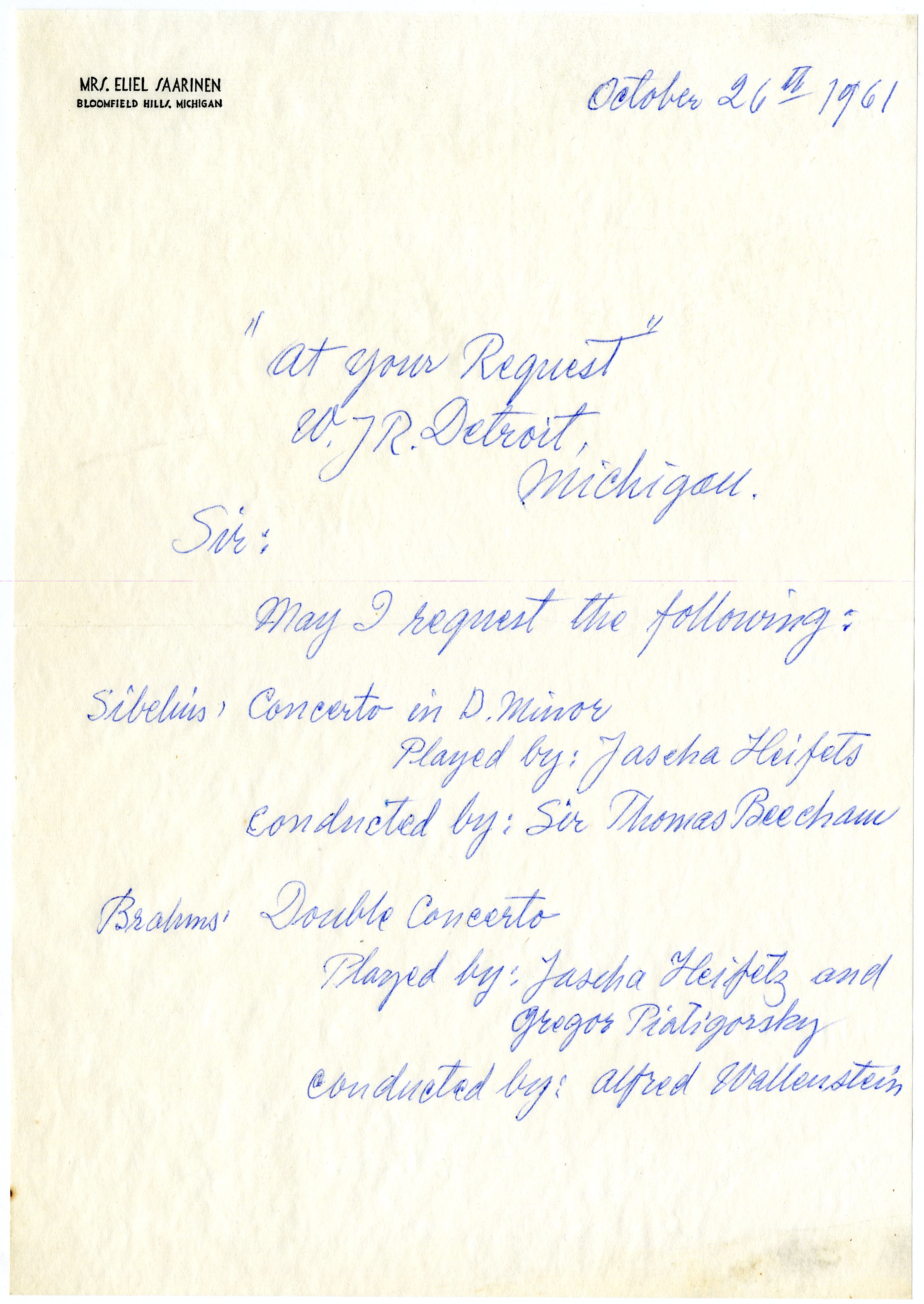
Loja Saarinen’s letter to WJR on October 26, 1961. Saarinen Family Papers, Cranbrook Archives.
Loja Saarinen wrote this note to the programers at WJR in Detroit, asking them to play two songs. Though she did not send this note to Casey Kasem, I imagine what Loja Saarinen’s words may have been if she had in October of 1961. On September 1, 1961, Eero Saarinen had died during surgery for a brain tumor:
Dear Casey,
I recently lost my son at far too young an age (51). He was overseeing the completion of a new music building for the University of Michigan School of Music, Theatre & Dance and our family so loved music. Casey, could you kindly play Concerto in D Minor by my good friend and fellow Finn Jean Sibelius?
Yours, Loja
Well, Loja, here is your long-distance dedication, Sibelius’ Concerto in D Minor played by Jascha Heifetz and conducted by Thomas Beecham.
London Philharmonic Orchestra London, 1935
If you’d like to make your own dedication, no need to be long-distance. Chamber Music in the Age of Resistance: Finland, Korea, Haiti and America, and France is being presented by Cranbrook Center for Collections and Research, in Collaboration with the University of Michigan “Art & Resistance” Fall 2023 Theme Semester, on Sunday, November 12th, 2023 at Cranbrook House.
Please join us for the concert and remember, as Casey Kasem said, “keep your feet on the ground and keep reaching for the stars.”
– Leslie S. Mio, Associate Registrar, Cranbrook Center for Collections and Research
Ms. Rice warned me that the first week of my Senior May Project would be hectic and slightly crazy, and it definitely was, but in the best possible way! Being a lifer at Cranbrook, I have learned a lot about our amazing campus over the years, but nothing could have prepared me for the intensely interesting and extremely entertaining Senior May opportunity I have encountered at the Center for Collections and Research.
Riya Batra on set in Saarinen House for the Susan Saarinen interview. Photo by Nina Blomfield.
I joined the department in the week prior to A House Party, the Center’s annual fundraiser, this year honoring Loja Saarinen. Within minutes I was fully immersed into the event preparation. From unboxing the beautifully printed mugs to sitting in on engaging interviews, I was able to experience and assist in a variety of tasks that made me feel like I was actually contributing, even though my contribution was likely quite small in the grand scheme of things.
Riya as Susan Saarinen’s camera stand-in. Photo by Nina Blomfield.
One moment I will never forget was driving Susan Saarinen back to her hotel, after her interview for the film, and seeing an actual dress created by her cherished grandmother Loja. Where else in the world would I ever get to experience something like this?
Leslie Mio packs up the dress by Loja Saarinen. Photo by Riya Batra.
Does your family have a certain pose that they always do for a family picture? My cousins and I always had to stand or sit by the same log at our cottage each summer to get a group picture. Even when the log had disintegrated, and we were all adults, we still stood in the same spot to take the picture.
The Swedish weavers of Studio Loja Saarinen were the same way. After every rug was completed, they would unroll it behind the studio, lay it on the lawn, and pose at the end. This not only documented their work, but also served as a record of who worked on each piece. In Cranbrook Archives, we have a few examples of these images.
Cranbrook Academy of Art Rug No. 14
This rug lay in the center of the Studio Loja Saarinen Weaving Room. A flatwoven rug with stylized meanders in the border, and an elegant color scheme of dark browns, blues, and beiges, in form, structure, color, and design it shows the contemporary style of Swedish weaving that would become the foundation of Studio Loja Saarinen’s work.
Cranbrook Academy of Art Rug No. 14, designed by Maja Andersson Wirde and woven by Lillian Holm for Studio Loja Saarinen, 1930. CAM 1955.2. Photographer James Haefner.
This was one of the first rugs executed under the “Design and Supervision” of Maja Andersson Wirde, who was Loja’s right-hand-woman from 1930 to 1933. The rug is actually a variation of a design Wirde made for the 1925 International Exhibition of Modern Decorative and Industrial Arts in Paris (the “Art Deco” World’s Fair).
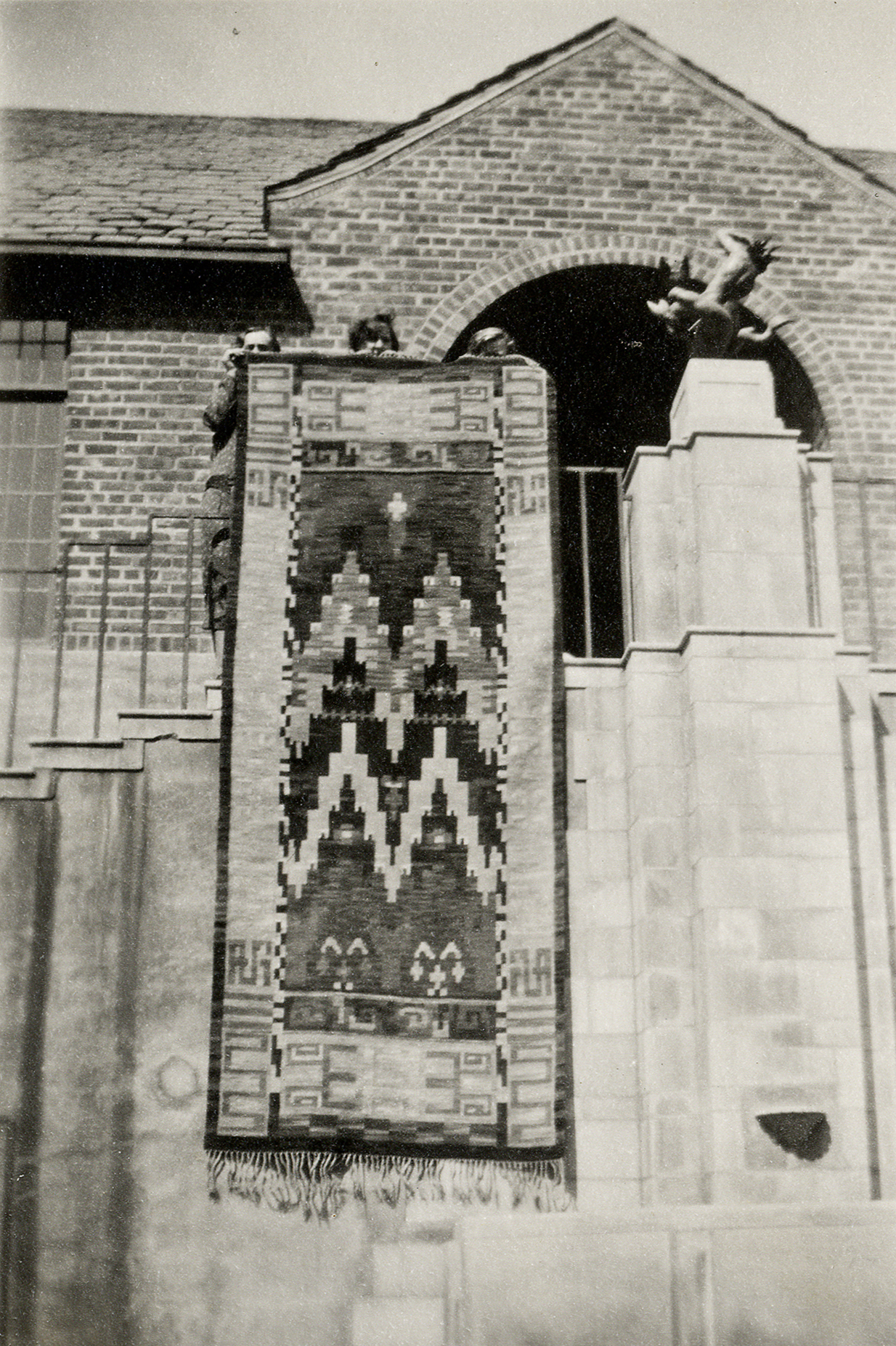
When Wirde wrote to Cranbrook’s secretary from Sweden before immigrating, she said she would bring along prepared designs and wool and linen yarns to be able to get started right away. She certainly did! Below, you can see Wirde and possibly Lillian Holm and Ruth Ingvarsson holding up the rug behind Studio Loja Saarinen just months after their arrival to Cranbrook.
Studio Loja Saarinen weavers with Rug No. 14 behind the Cranbrook Arts and Crafts Studios, 1930. Courtesy Smålands Museum, Sweden.
This year the Center is celebrating the life and work of Loja Saarinen for our House Party fundraiser. Lynette Mayman’s post on 1930s fashion offered an excellent guide to dressing à la mode for this historically themed evening event, while highlighting Loja’s freedom and creativity in celebrating her own authentic style. Being curious about the events to which such attire might be worn, I looked to the Kingswood School records to explore its history of music and dance events during that era.
Kingswood School Annual Dance Book, 1932. Courtesy of Cranbrook Archives.
From the abundance of programs and ephemera, it was clear that music and dance were a valued part of the curriculum and school life, and its purpose was elucidated by the educational philosophy in the school catalogs for the 1930s:
“Music and Dance, two of the greatest social forces, and most closely related in essential nature, are organized in the curriculum under the direction of one department for concurrent purposes… The program of work is such as to encourage the fullest and freest development of individual personality which is the basis for true dramatic and musical expression.”
Kingswood School Catalogs, Kingswood School Records (1980-01)
Formal classes in music theory and social dancing (taught in physical education classes under the direction of Luella Hauser) were augmented by extracurricular activities. These included the Glee Club and various kinds of themed and annual dances, which offered students a variety of ways in which they could learn through participation, as well as recitals by visiting performers, which offered learning through observation and listening.
Program for the Mothers’ Day Tea, May 1937. Courtesy of Cranbrook Archives.
The Glee Club for girls was formed in 1932 for those interested in singing. They performed one concert per year, the first being held on March 11, 1932. The Club would also perform at other events throughout the year, such as the Mothers’ Day Tea and the ‘Carnival,’ which was an informal jamboree of themed gaiety and fun. The first Carnival, on December 10, 1932, was described as one of “grand vaudeville,” including a fashion show that embraced lovely old fashions and lively modern ones.
The 1937 Carnival was a Masque that traced the development of dance from the fourteenth century to the present time, including the Carole, Pavane, Sarabande, Minuet, Gavotte, Waltz, Schottische, Tango, and Fox Trot. The Glee Club sang songs typical of each period, while three jolly spirits, Dance, Play, and Song, presented the dancers.
Invitation to the Ypsilanti Madrigal Club performance, December 1931. Courtesy of Cranbrook Archives.
The first visiting performance was held on December 11, 1931, when the Madrigal Club, a choir of men and women from State Normal College, Ypsilanti, under the direction of Mr. Frederic Alexander, performed as a Christmas gift from Mr. Alexander to Mr. George Booth. The concert of unaccompanied songs and compositions on harpsichord was described as “unusual in character and delightful in content,” and became an annual event at the school.
Other annual visitors included Mildred Dilling, the internationally known harpist, and Cameron McLean, the Canadian baritone who was accompanied by various local pianists, including Detroiter Gizi Szanto. There were also one-time visits by performers such as pianists Stanley Fletcher and Samuel Sorin, singer Marion Anderson, baritone Earle Spicer, and opera singer Alexander Kipnis.
Program of Music printed by Cranbrook Press, April 1932.
Kingswood School Records. Courtesy of Cranbrook Archives.
Celebrated teachers of modern dance were invited to give dance recitals including Ted Shawn, Ronny Johansson, and Martha Graham. Visiting in March 1936, Graham gave a comprehensive recital of her work, leaving us with an autographed program—an archival treasure!
Program for Dance Recital autographed by Martha Graham, March 1936. Courtesy of Cranbrook Archives.
While Graham’s dance was reported in the Kingswood Newssheet as casting aside, “all old standards of beauty and grace,” through her use of angles and quick movements rather than the legato rhythm of conventional dancing, her philosophy of the dancer speaks poetically to the purpose of the 1930s Kingswood curriculum for music and dance—drawing out the essence of the individual through social artforms:
“You traverse, you come to the light, you work, you make it right… you embody within yourself as much curiosity, use that curiosity and avidity for life … and the body becomes a sacred garment – it’s your first and your last garment, and as such it should be treated with honor, and with joy, and with fear too, but always with blessing.”
As we celebrate the life and work of Loja Saarinen this year, we celebrate her as immigrant, entrepreneur, designer, and fashionista. Please join us for the Virtual Film Premiere as we support and acknowledge the work of the Center at our House Party, May 21, 2022.
– Laura MacNewman, Associate Archivist, Center for Collections and Research
Before everybody buys, borrows, or burrows in a closet for something to wear for Cranbrook Center’s annual House Party, let us consider the fashions of the times. We’re going back to the 1930s, to celebrate the heyday of Loja Saarinen, doyenne of the Cranbrook art scene as designer of interiors, weaver, fashionista, textile designer, businesswoman, landscaper, and modelmaker. Between husband Eliel, daughter Pipsan, and son Eero, the Saarinen family had inventiveness, imagination, skill, and audacity all sewn up. With the Saarinens’ extensive network of friends, colleagues, and students, the atmosphere at the Art Academy must have been rarified indeed.
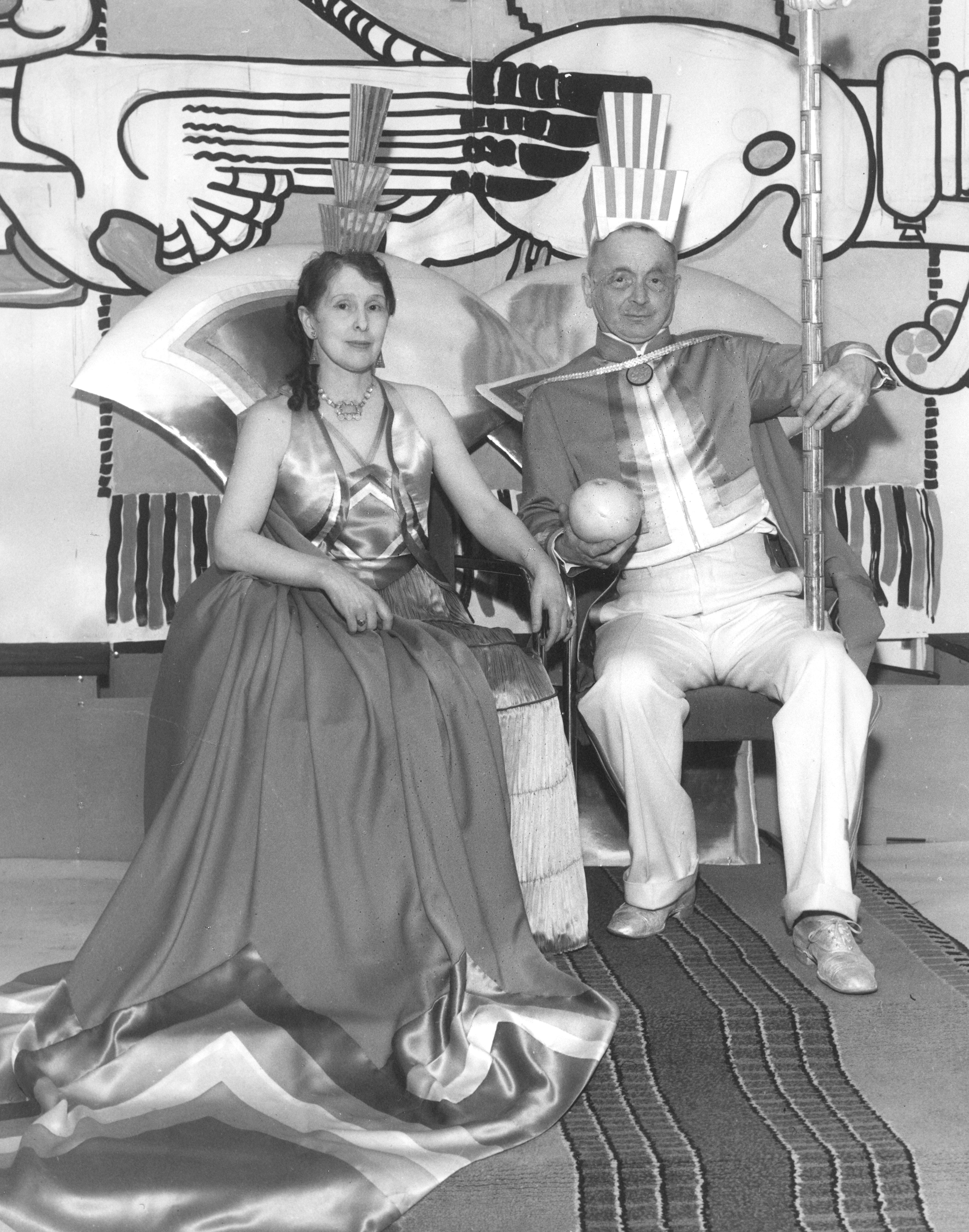
Small wonder, then, that when it came time for parties, Loja Saarinen could craft her own iconic evening attire for the Art Academy’s Crandemonium Ball of February 1934, including that of her consort, as you can find in the photograph on the flyer for the event of May 21, 2022.
Eliel and Loja Saarinen at the Cranbrook Academy of Art “Crandemonium Ball,” February 1934. Photography by Richard G. Askew, Copyright Cranbrook Archives.
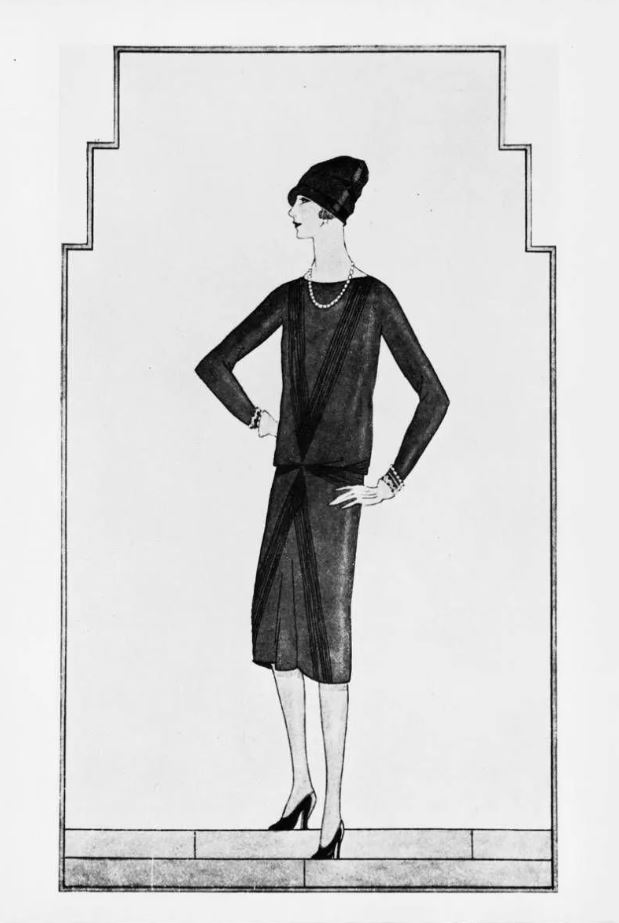
Four our House Party, if you were thinking of the little black dress, Coco Chanel brought this simple concept to the public eye in 1926, with Vogue Magazine proclaiming it “Chanel’s Ford” in homage to the Model T which famously came in any color you wanted as long as it was black. Do note the chevrons (just visible in the Chanel dress) on the Saarinen dress also.
Coco Chanel–the Little Black Dress, as illustrated in American Vogue, October 1926. Source: Vogue.
Post WWI 1920s design was the big break away from the 19th century drapery which required all kinds of padding and corsetry. Chanel prided herself on getting women out of corsets, and they never went back into them. The fashions were shapeless, short, and sack-like at their extreme, with lots of embellishment for evening dresses to make up for their lack of pizazz. Think Fitzgerald and Gatsby.
At this time too, the tuxedo or dinner jacket was becoming acceptable for ordinary men who were not English royalty or American billionaires.
In 2021, the home of Loja Saarinen at Cranbrook Academy of Art, which she shared with her husband Eliel, was designated as a site in the Historic Artists’ Homes & Studios program. As the team at the Center were going through the process of researching Loja, the too-often-overlooked designer of textiles, gardens, and clothing, we were constantly reminded that the rugs created by Loja and her professional weaving studio, Studio Loja Saarinen, were poorly documented in our records.
Studio Loja Saarinen made rugs, window treatments, wall hangings, upholstery fabrics, and more at Cranbrook between 1928 and 1942. Many of the Studio’s largest rugs were made for Kingswood School for Girls between 1930 and 1932. Because of the fragility of the rugs, and through natural wear-and-tear, almost all of the original Studio Loja Saarinen rugs were put in storage at Cranbrook Art Museum in the 1970s and 1980s.
Loja Saarinen, circa 1934. Courtesy Cranbrook Archives.
We have excellent archival records about the operation of the studio, including records of yarn orders and charts of the time spent weaving rugs (it was a lot!). But the rugs are very large, and often, we only had black-and-white photographs of the rugs on the floor in the 1930s. Color photographs were limited to poorly distorted slides, or photographs of portions of the rugs taken on early digital cameras while the rugs were half-rolled-up in storage.
We had almost no ‘born digital’ high-resolution photographs of Loja’s work–these are the best kind of photographs for sharing her work in slides, online, or in print. The lack of excellent, high quality images limited not only how we at Cranbrook understood and shared Loja’s legacy, but also made it difficult for students or scholars researching Loja Saarinen to get a complete sense of her artistic output.
This winter, as the Center prepares for our next fundraiser, A House Party at Cranbrook Celebrating Loja Saarinen on May 21, 2022, it has become mission-critical to get better documentation of Studio Loja Saarinen’s rugs.
Enter in our latest project!
Jim Haefner and his assistant set up the camera in Cranbrook Art Museum’s Vault. Photographer Kevin Adkisson, Courtesy of Cranbrook Center for Collections and Research.Jim Haefner checking his image of Kingswood School Rug No. 31, Reception Hall Rug, Auditorium Lobby Rug. Photographer Leslie Mio, Courtesy of Cranbrook Center for Collections and Research.Kingswood School Rug No. 31, Reception Hall Rug, Auditorium Lobby Rug. Photographer Kevin Adkisson, Courtesy of Cranbrook Center for Collections and Research.
On January 7, 2022, photographer James Haefner and his assistant Erik Henderson, with the help of Center Curator Kevin Adkisson, Center Associate Registrar Leslie Mio, Cranbrook Art Museum Registrar Corey Gross, Cranbrook Art Museum Head Preparator Jon Geiger, and Jon’s installation crew embarked on a very ambitious project: documenting all the Studio Loja Saarinen rugs in the Cranbrook collections.
First, we had to take the several-hundred-pound rugs down from racks where they are stored, rolled. Then, we covered the floor in clean plastic drop cloths. With a camera bolted via a vise-grip to the ceiling of the Cranbrook Art Museum Collections Wing, and controlled via computer from a remote workstation, we unrolled, photographed, and rerolled over forty works of Studio Loja Saarinen’s functional art.
Kingswood School Rug No. 3, 1928-1929; Studio Loja Saarinen (maker), Loja Saarinen (designer); Linen warp, wool weft; 66½ x 49 inches (168.9 x 124.5 centimeters); Cultural Properties Collection, Kingswood School for Girls. Photographer James Haefner.Curator Kevin Adkisson and his attention to detail. Photographer Leslie Mio, Courtesy of Cranbrook Center for Collections and Research.Maker’s label on Kingswood School Rug No. 3, 1928-1929; Studio Loja Saarinen (maker), Loja Saarinen (designer); Linen warp, wool weft; 66½ x 49 inches (168.9 x 124.5 centimeters); Cultural Properties Collection, Kingswood School for Girls.
No detail went undocumented, from weaver’s signatures knotted into the face of a rug, to maker’s labels written and sewn on by Loja herself.
Below is just a fraction of the forty-plus pieces photographed:
Kingswood School Rug No. 31, Reception Hall Rug, Auditorium Lobby Rug, 1931; Studio Loja Saarinen (maker), Loja Saarinen (designer); Wool pile, wool weft, linen warp; 312 x 144 inches (792.5 x 365.8 centimeters); Cultural Properties Collection, Kingswood School for Girls. Photographer James Haefner.Detail of Kingswood School Rug Number 28, Library Rug, 1931; Studio Loja Saarinen (maker), Maja Andersson Wirde (designer); Wool pile, wool weft, linen warp; 243½ x 96 inches (618.5 x 243.8 centimeters); Cultural Properties Collection, Kingswood School for Girls. Photographer James Haefner.Detail of Kingswood School Blue Rug for Reception Room I, 1931; Studio Loja Saarinen (maker), Maja Andersson Wirde (designer); Wool pile, wool weft, linen warp; 183 x 142½ inches (464.8 x 362 centimeters); Cultural Properties Collection, Kingswood School for Girls. Photographer James Haefner.Rug with Animal Motif, 1932; Studio Loja Saarinen (maker), Maja Andersson Wirde (designer); Linen warp, wool weft, wool file; plain weave with four picks of weft between each row of knots; 151½ x 108 inches (384.8 x 274.3 centimeters); Collection of Cranbrook Art Museum. Photographer James Haefner.Detail of Kingswood School Rug No 29 – Rooftops, 1931; Studio Loja Saarinen (maker), Maja Andersson Wirde (designer); Wool pile, wool weft, linen warp; 85 x 137½ inches (215.9 x 349.3 centimeters); Cultural Properties Collection, Kingswood School for Girls. Photographer James Haefner.Rug, 1932; Studio Loja Saarinen (maker), Maja Andersson Wirde (designer); Wool and linen; 119 x 98 inches (302.3 x 248.9 centimeters) including fringe; Collection of Cranbrook Art Museum. Photographer James Haefner.Detail of Rug with Tree Motif, 1930; Studio Loja Saarinen (maker), Maja Andersson Wirde (designer), Lillian Holm (weaver), Lilly Bjerken (weaver); Wool and linen; 131 x 54½ inches (332.7 x 138.4 centimeters); Collection of Cranbrook Art Museum. Photographer James Haefner.Detail of Studio Loja Saarinen Rug No. 2, 1929; Studio Loja Saarinen (maker), Loja Saarinen (designer/weaver), Eliel Saarinen (designer), Walborg Nordquist Smalley (weaver); Cotton warp; wool pile; plain weave with ten picks of weft between each row of knots; 110½ x 39 inches (280.7 x 99.1 centimeters); Collection of Cranbrook Art Museum. Photographer James Haefner.Tree of Life Tapestry, circa 1933; Loja Saarinen (designer/weaver); Linen and wool; 60½ x 54 inches (153.7 x 137.2 centimeters); Collection of Cranbrook Art Museum. Photographer James Haefner.
It was a joy to unroll and see these pieces up close after knowing many of them for years through black-and-white images. While even these photographs do not do justice to seeing their beauty in person, having such high-resolution photography of Studio Loja Saarinen’s rugs means that future scholars and fans of Loja Saarinen will be able to have a richer understanding of her, and Cranbrook’s, remarkable legacy.
For even more Loja Saarinen, join the Center in person or online on May 21, 2022 for A House Party at Cranbrook Celebrating Loja Saarinen. We’ll be premiering a new, thirty-minute documentary about Loja, produced by the Center, at the event–you don’t want to miss it!
– Leslie S. Mio, Associate Registrar, and Kevin Adkisson, Curator, Cranbrook Center for Collections and Research
In Part I of this post, we explored Cranbrook’s love of the book, from its origins with founders George and Ellen Booth, to the existing special collections at the Archives and Academy of Art. I invite you now to learn of the many rare, valuable, and historical tomes whose existence may be unknown to most or simply overlooked in collections at the Schools, Institute of Science, and two historic homes cared for by the Center for Collections and Research: Saarinen House and Smith House.
Hoey Patch Collection at the Cranbrook School Library. Courtesy of Kate Covintree, Cranbrook Kingswood Upper Schools.
Like the Academy of Art, although not at all on the same scale, books from George and Ellen’s Cranbrook House Library were dispersed to the Cranbrook Schools Libraries, now comprised of five separate spaces. Following the Booth’s example, Cranbrook School Headmaster Harry D. Hoey (1950-1964) and Latin teacher George Patch (1928-1944, Emeritus 1944-1950) donated 120 books from their personal libraries to the School’s library in the 1950s, forming one of several special collections. Known as the Hoey Patch Collection, all of the volumes focus on an aspect of Abraham Lincoln or the American Civil War.
He Knew Lincoln, a fictionalized account written by Ida Tarbell, a progressive journalist, and published in 1907. The book’s custodial history is documented with correspondence from the author, written directly on the inside of the book. Courtesy of Kate Covintree, Cranbrook Kingswood Upper Schools.
Highlights include a First edition of The Life of Abraham Lincoln, the first full-scale biography of the President. Written by newspaper editor J.G. Holland, it was published shortly after Lincoln’s assassination in 1865. Also included is a first edition, two-volume set of the Personal Memoirs of U.S. Grant. Ulysses S. Grant penned his autobiography shortly before his death in 1885 as a means of financial support for his family. It was published with the support of his friend Mark Twain by the Charles L. Webster Company (owned by Twain’s nephew).
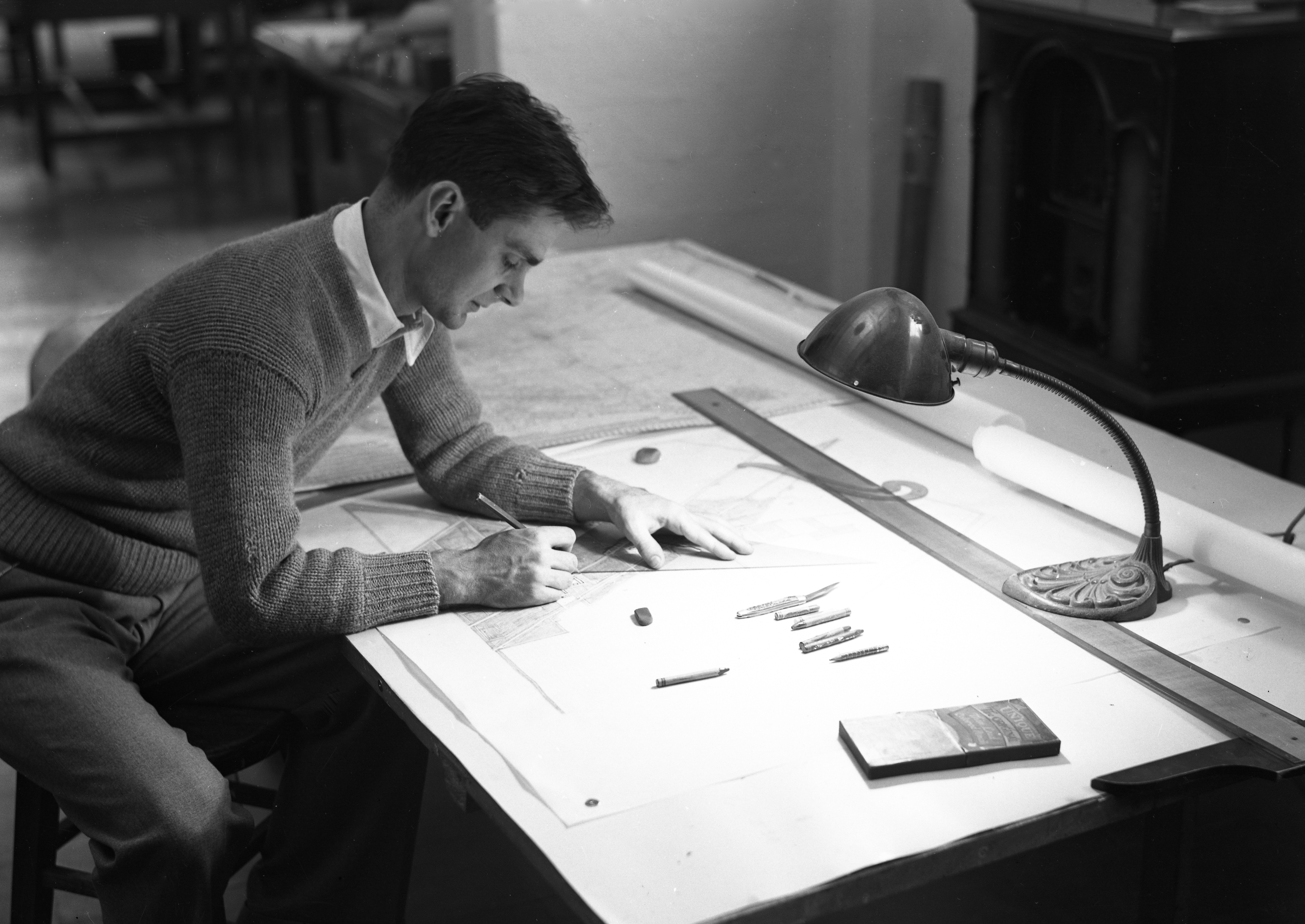
Cranbrook Archives is pleased to announce a new collection available for research. An intriguing collection, it comprises the personal and professional papers, photographs, realia, and architectural drawings of Walter Preston Hickey, a student of Eliel Saarinen. Yet, while traces of key life events and relationships—birth, parentage, education, marriage, friends, and employers—can be found in the collection, Hickey’s life after Cranbrook remains largely a mystery.
Walter Hickey working in the Architecture Studio, 1935. Courtesy of Cranbrook Archives, Cranbrook Center for Collections and Research.
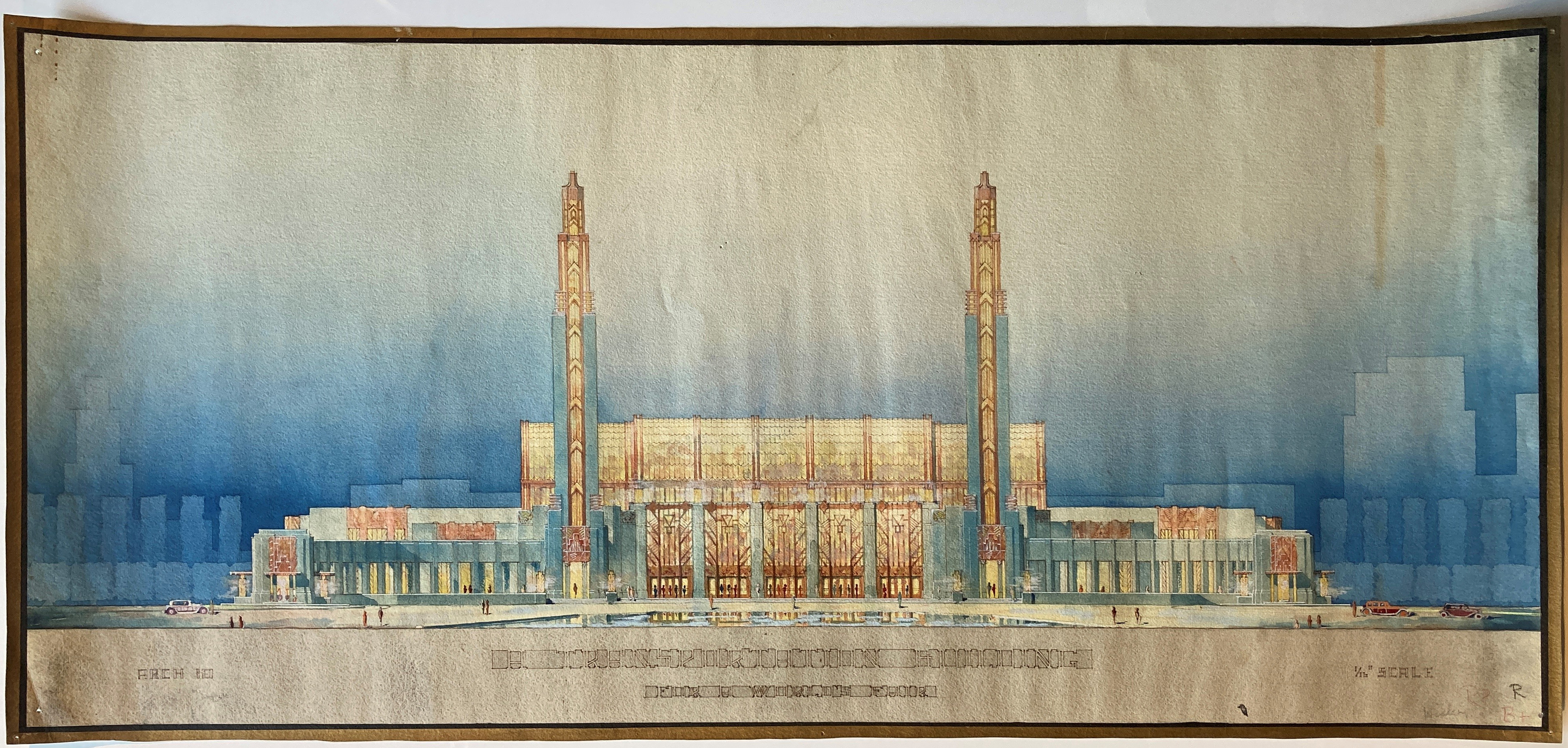
A native of Detroit, Hickey attended the University of Michigan School of Architecture (1926-1930), during which time he worked with architects Albert Kahn (1928) and Thomas Tanner, as well as being one of the first staff members of the Cranbrook Architectural Office.
A Transportation Building for a World’s Fair, circa 1926-1930. A University of Michigan Class Project by Walter Hickey. Courtesy of Cranbrook Archives, Cranbrook Center for Collections and Research.
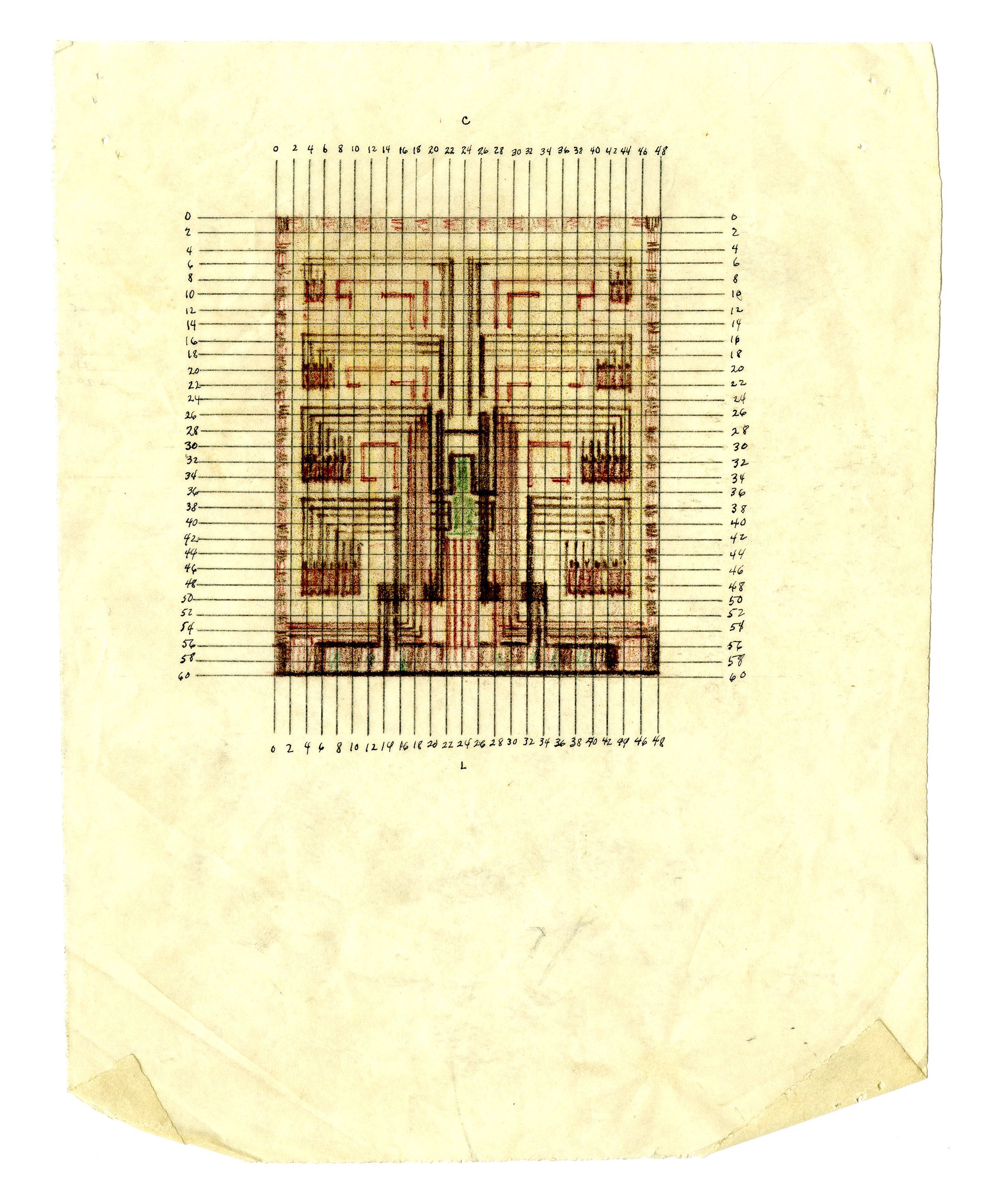
He applied to study architectural design with instruction in city planning at Cranbrook Academy of Art, starting in September of 1932. He became especially interested in highway traffic control, which formed the topic of his 1935 thesis on theWaterfront Development for the City of Detroit. Hickey submitted designs to various Academy competitions and won a $10 prize from Loja Saarinen for design No. 13 in the Cranbrook Academy of Art Rug Competition in 1934.
Drawing by Walter Hickey, undated. Courtesy of Cranbrook Archives, Cranbrook Center for Collections and Research.
After leaving Cranbrook, Hickey worked for various architecture firms, including Smith, Hinchman, and Grylls, and Clair W. Ditchy. After a short time with the Federal Housing Administration, he returned to work with Eliel and Eero Saarinen on the Kleinhans Music Hall project. He also completed private architectural designs for residences, including work on Ralph Rapson’s Hoey vacation home, Longshadows, in Metamora, MI. Around this time, he went to work at the General Motors Technical Center and continued to live in Birmingham, Michigan. And here is where his story ends in the collection.
Jane Viola Shepherd. Courtesy of Cranbrook Archives, Cranbrook Center for Collections and Research.
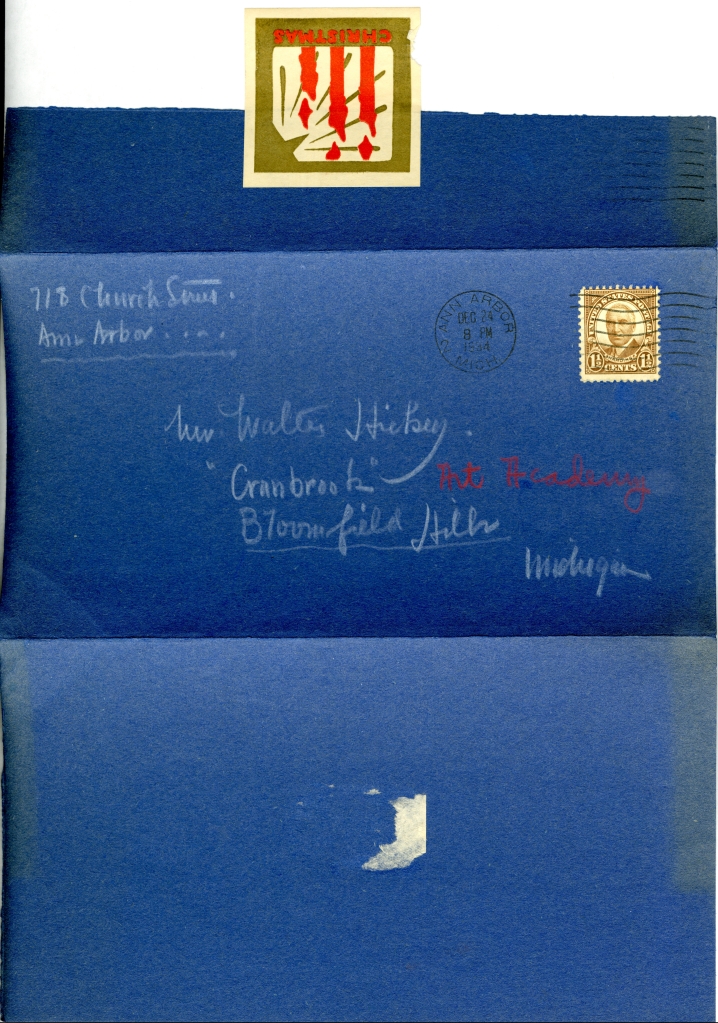
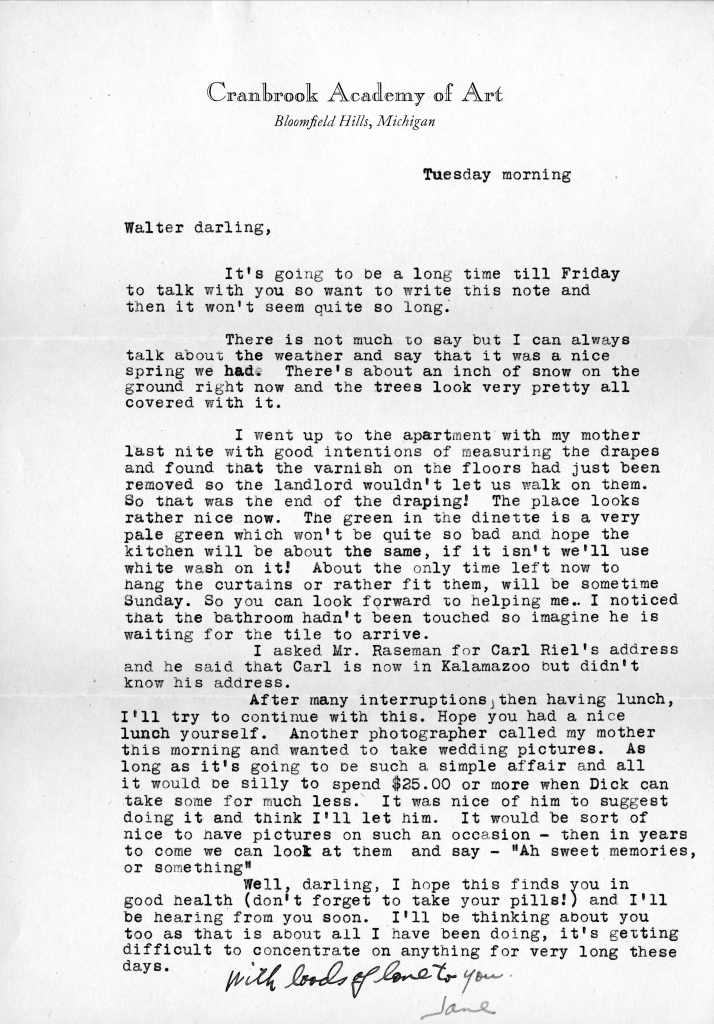
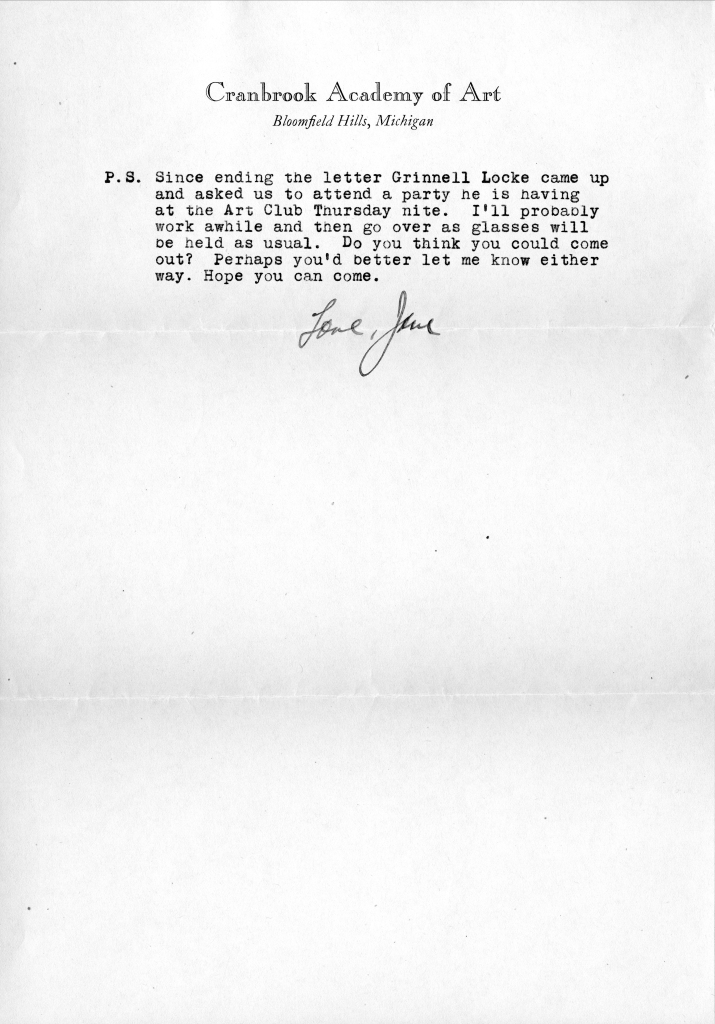
Although this is a very small collection, the diversity of content is rewarding for its ability to convey snapshots of his life in individual and unique items. It includes Christmas cards, such as one from “the Lorches” (Emil Lorch was the President of the University of Michigan Architecture School), a few letters from friends, and something of a typed love letter (on Cranbrook Academy of Art letterhead!) from Zoltan Sepeshy’s Secretary Jane Viola Shepherd to whom he was married on April 22, 1937.
Correspondence to Walter Hickey, 1934-1937. Courtesy of Cranbrook Archives, Cranbrook Center for Collections and Research.
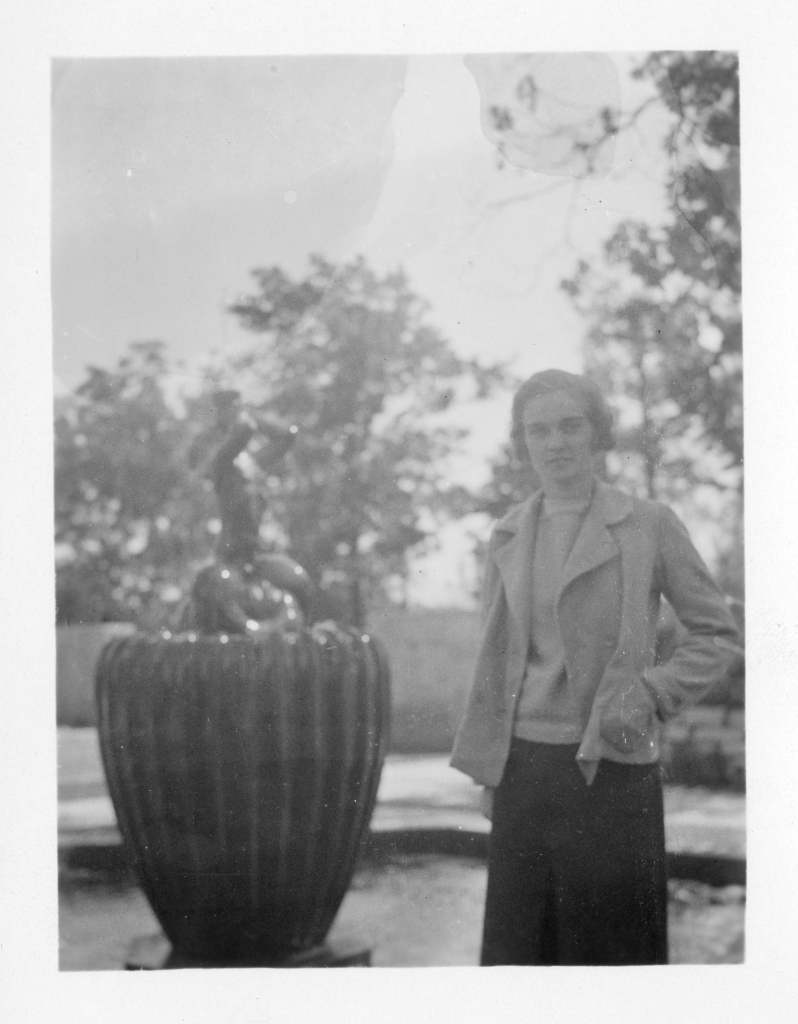
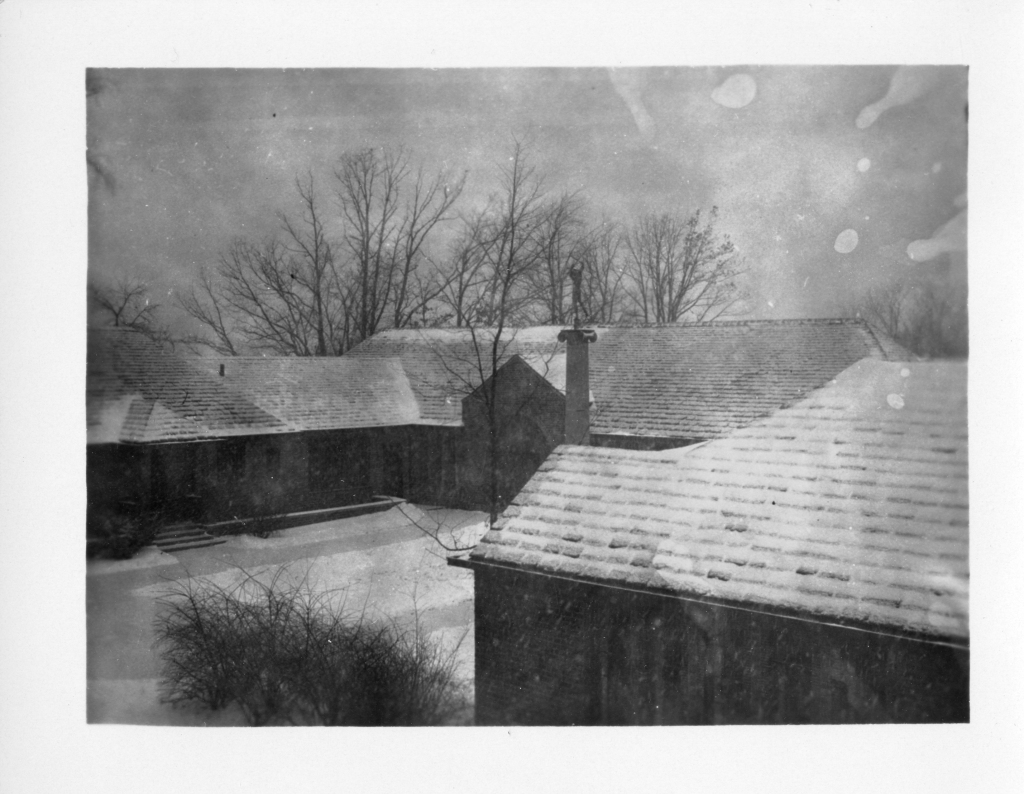
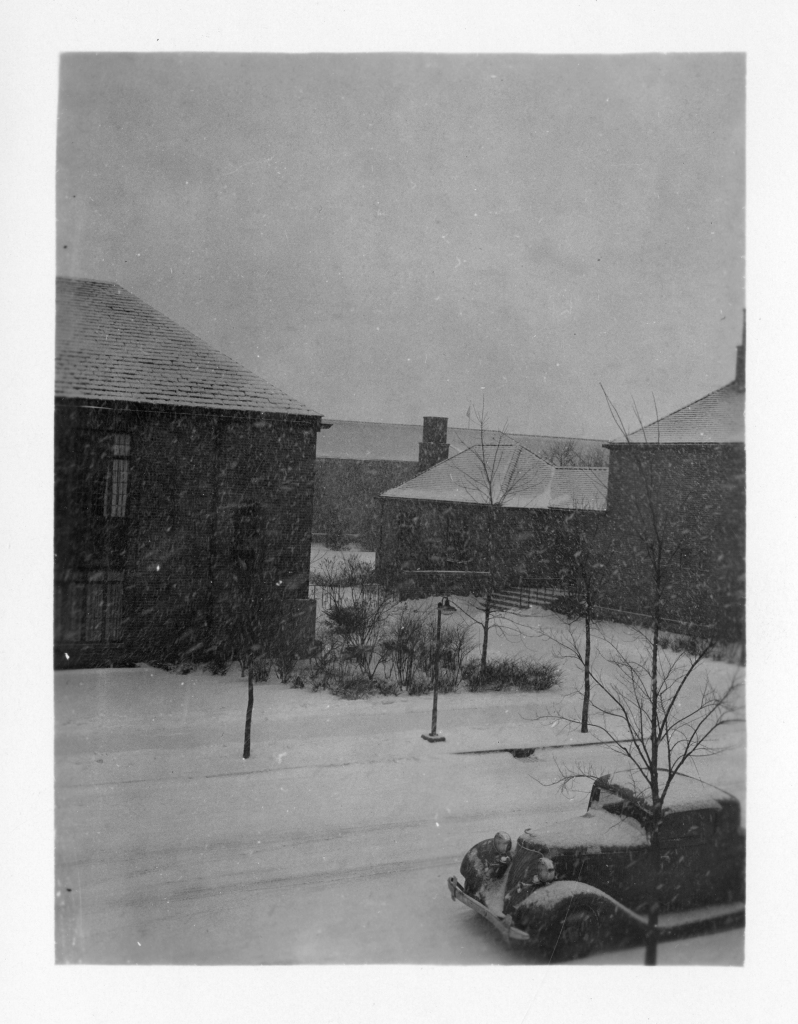
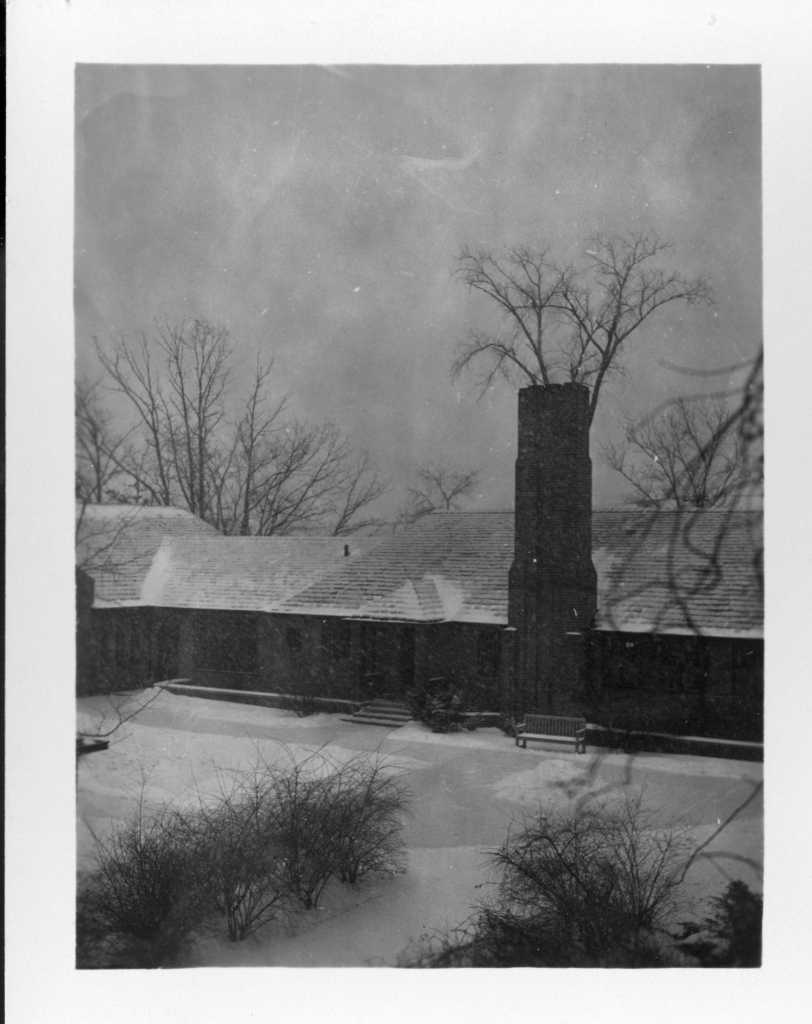
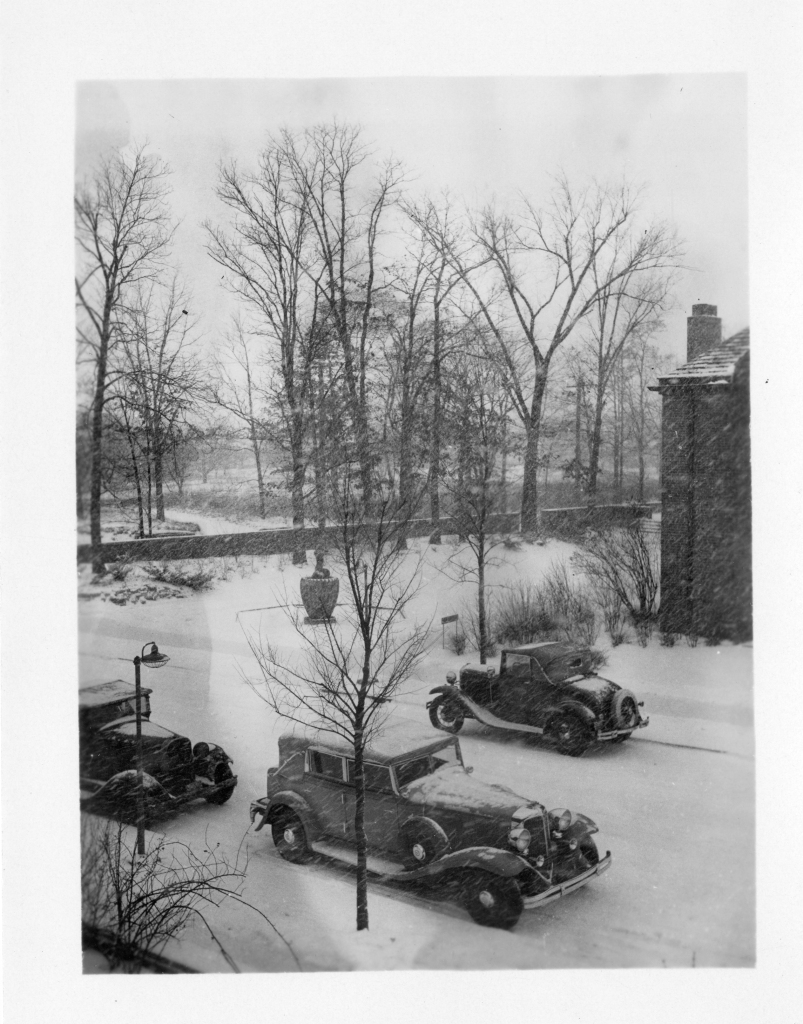
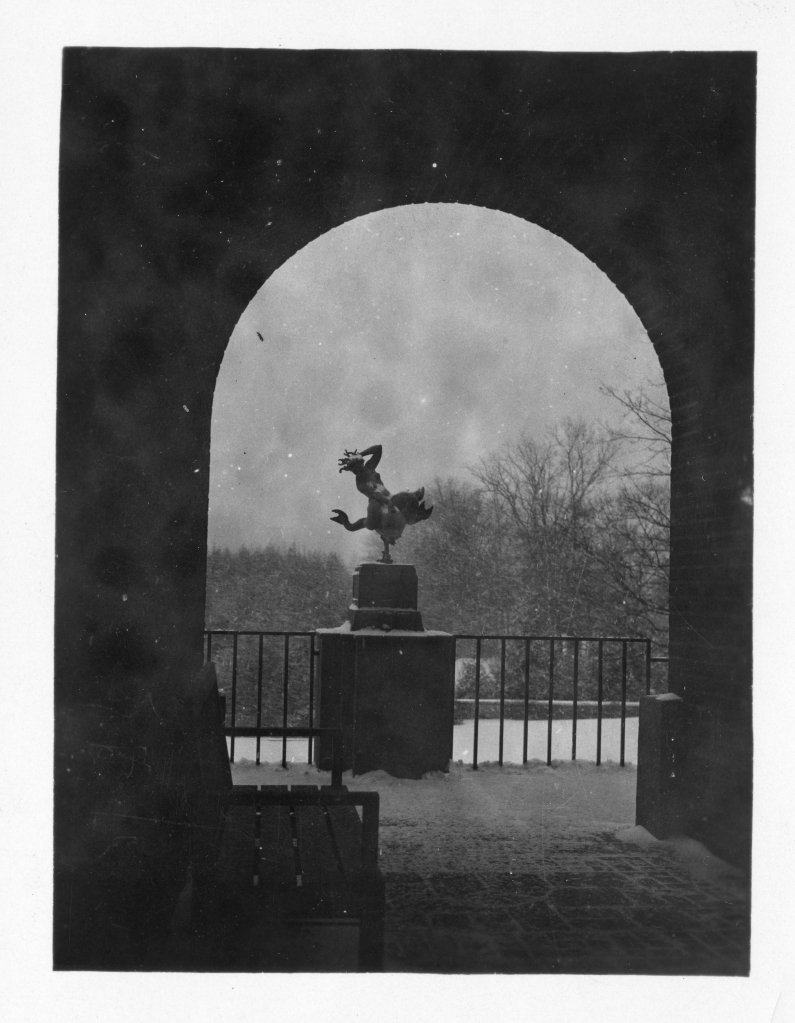
A small series of photographs hold moments of his life and some of the people with whom he shared it, including his father, eminent roentgenologist (radiography) Dr. Preston Hickey; his wife, Jane; his teacher, Eliel; and his fellow Academy students. A series of snowy scenes of Cranbrook campus beautifully capture the quietness of falling snow with hints of sunlight upon the architecture and sculptures that were then in their infancy and are now historic.
Cranbrook Academy of Art campus, circa 1932-1935. Courtesy of Cranbrook Archives, Cranbrook Center for Collections and Research.
The Walter Hickey Papers give insight into a short period in Hickey’s life and the Cranbrook of his time. It also gives us a lovely look into a life that was surely shaped by his experience at Cranbrook, but one that remains yet to be fully discovered.
–Laura MacNewman, Associate Archivist, Cranbrook Center for Collections and Research











 Cranbrook Kitchen Sink