When you take the time to look, the windows of Cranbrook House are surprisingly varied. Some are leaded casement windows straight out of an Elizabethan manor house, others are modern sash windows, fitted with plate glass. A few rooms in the house enjoy a special distinction – their windows are fitted with inset panels of stained glass.
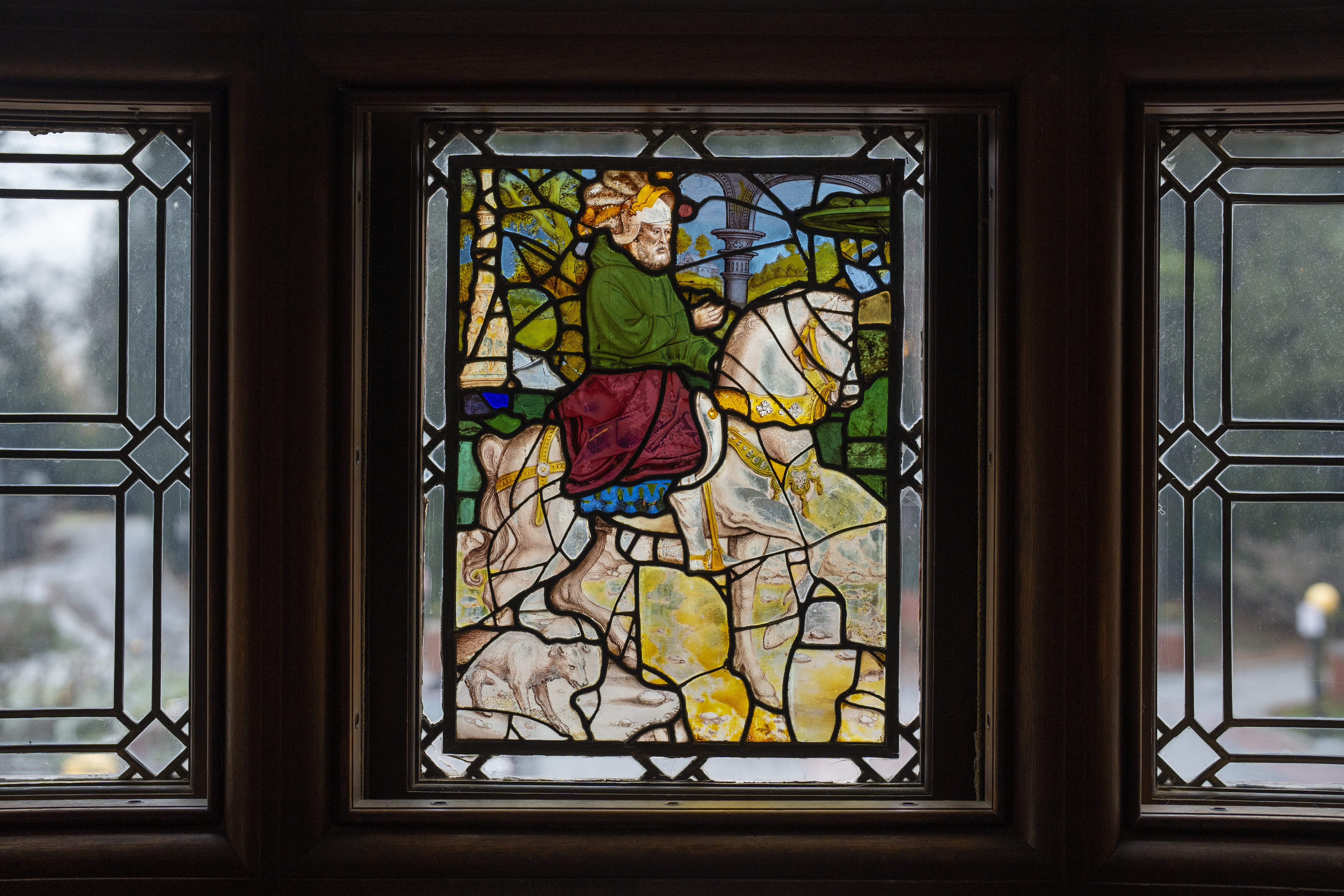
These stained-glass panels were a later addition to Cranbrook House. When first completed in 1908, the windows were all clear glass. It was only while pondering extending the house, in the latter half of the 1910s, that George Booth began purchasing stained-glass panels for his home. The most prominent stained-glass work in Cranbrook House is the 16th-century Flemish panel, depicting a man on horseback, placed in the main window over the staircase in the Reception Hall.
It was not part of the original design for the window, but added in 1922. That panel, and several others scattered throughout the house, were purchased from Thomas & Drake, an English firm specializing in historic glass.
Others, like the heraldic roundel in the library’s east window, were purchased by the Booths in Lucerne, Switzerland. There was some debate as to their final destination. George Booth wrote, in a letter to his son Henry, in March 1922:
They do not make an imposing collection but I think they are good and that everyone will like them – I did think I would let the [Detroit] museum [of Art] buy them at cost if they wished to begin to accumulate some historical glass, but your mother and Florence say no – they are to be put into the windows at Cranbrook but we will see.
(George Gough Booth to Henry Scripps Booth, 26 March 1922. Cranbrook Archives, George Gough Booth Papers.)
In the event, Ellen and Florence won out, and at least a few of the Swiss purchases made their way into the windows of Cranbrook House.
Each year before my History of American Architecture lecture series, I like to commission Cranbrook Academy of Art student or recent alumni to design a poster to promote the event. This year, I asked second-year 2D Design student Luis Quintanilla to create a poster for this year’s series, Detroit and the World. I am thrilled with how the poster turned out—you can pick one up at the first lecture February 6, 2024—and thought I would share with you some of how it came about.
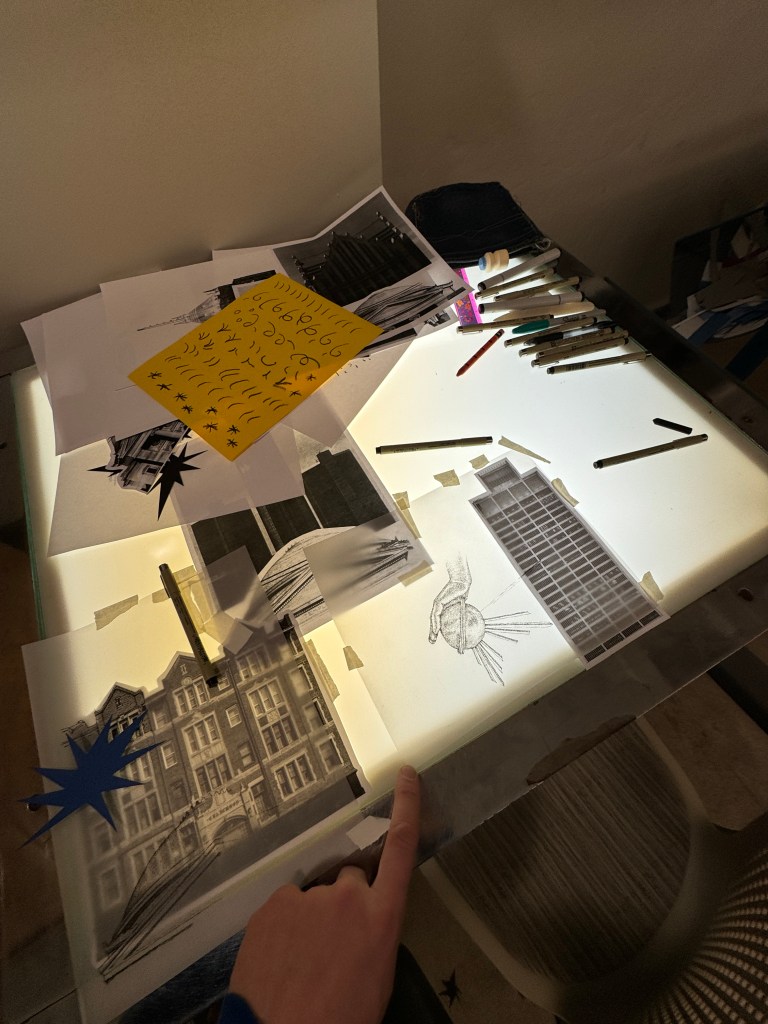
When I visited Luis’ studio in the Arts and Crafts Court, I was struck by their graphic sensibility combining imagery and text in sticker-like collages. I was also very impressed by a series of stipple drawings in ink on tracing paper, which Luis kept in a shoebox. As we talked about the themes of my upcoming lectures, and what we both admire about Detroit and its architecture, the idea of the poster came about. With Luis’ sketches strewn across the table in their studio, I was reminded of the great tradition of architectural capricci.
Architectural capprici are fantasies, where artists or architects combine buildings from across time in a single image. Traditionally, 18th century capprici could be oil paintings, pencil or ink sketches, or engravings. Joseph Michael Gandy is the most famous painter of architectural fantasies. Here, he is combining the London works of Sir John Soane into a single fantasy, set within the studio of Soane’s own house.
Joseph Michael Gandy, Public and Private Buildings Executed by Sir John Soane between 1780 and 1815, first exhibited 1818. Courtesy of Sir John Soane Museum, London.
If you’ve come to many of my previous architecture lectures, you might recognize my favorite painting: Thomas Cole’s The Architect’s Dream of 1840, a capprici which embodies the mid-19th century debate between gothic and classical styles. Contemporary British painter Carl Laubin creates stunning work inspired by Gandy, using contemporary architects for elaborate capprici.
What might an architectural capprici of Detroit include?
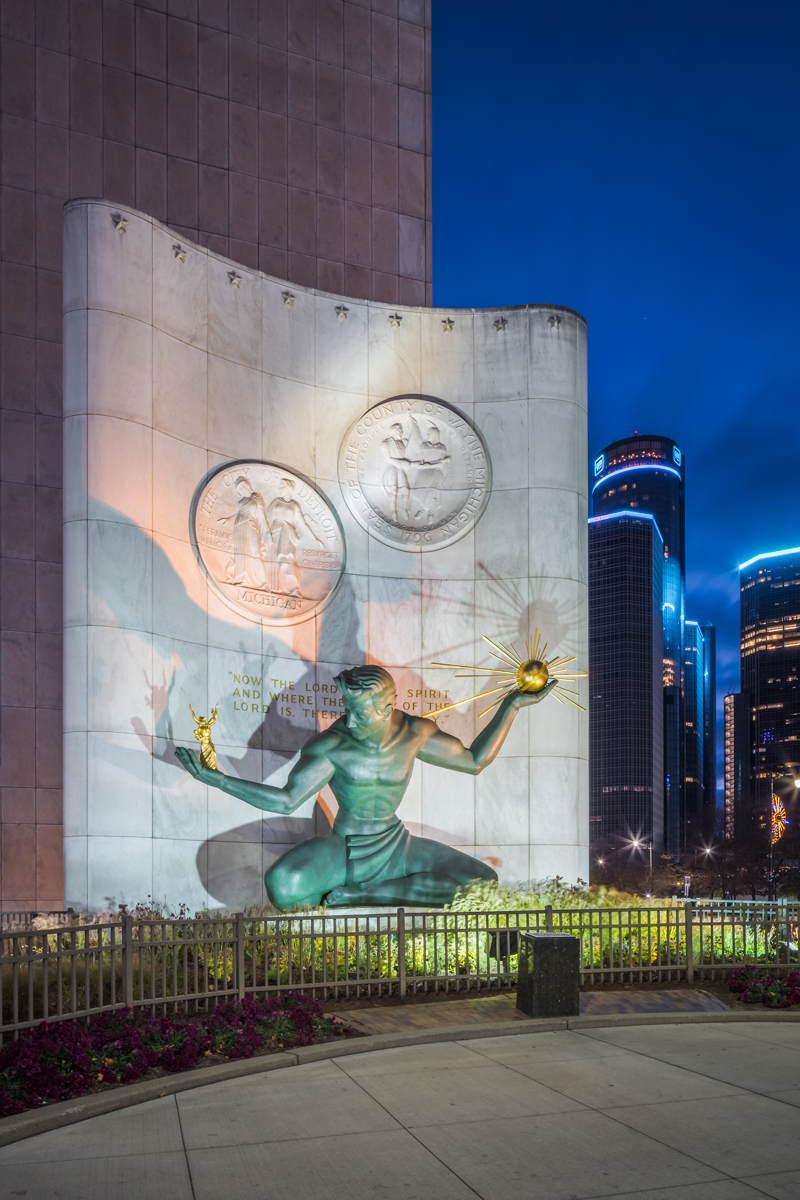
Marshall M. Fredericks’ The Spirit of Detroit, 1958, photographed by Helmut Ziewers for Historic Detroit Area Architecture.
I created a list of forty buildings I thought embodied the best of Detroit architecture. I narrowed it down to twenty buildings for Luis’ consideration, and shared images of each. My only real request: include at least one building from each of the five lectures, and center the poster on John Portman and Associates’ 1977 Renaissance Center.
I don’t think Detroit has a more iconic building than the RenCen, with its piston-like glass towers rising up from the Detroit River. There are better works of architecture, sure, but as far as an associated image of Detroit? Nothing tops the RenCen.
I suggested, too, that Luis include the 1901 St. Josaphat’s church by architects Joseph G. Kastler and William E. N. Hunter in front of the RenCen, to recall the almost too-good-to-be-true alignment of these two structures when driving into the city from the northern suburbs on I-75. After all, by the nature of delivering lectures about Detroit from the distance of Cranbrook, this is the view (from the suburbs, from the car) many of us hold toward the city.
We went back and forth about including the Spirit of Detroit, former Cranbrook Schools faculty member Marshall M. Fredericks’ monumental bronze at the Detroit City-County Building. What attracts me to the Spirit is its iconic status and its graphic replicability: whether on the redesigned city buses or the new city holiday lights, all you really need is an orb and some rays of light to know: that’s the Spirit of Detroit.
What would be the mood of our Detroit capprici?
Inextricably linked to the history of Detroit since 1980 is Detroit Techno, a form of Electronic Dance Music (EDM) that combines synth-pop with African American styles such as house, electro, and funk. For me, Detroit is most exciting, and its dynamism most electrifying, at night. In riding through the city after dark, buildings become speeding landmarks, and its possible to disappear for a time into a former factory or repurposed commercial building for a party or a rave. In these moments, buildings become less defined by their former glory or current decay than by their inhabitation as a dancefloor pulsating with music and lights. It’s a new way of occupying the city’s architecture to unique advantage.
Luis went to work. They began by printing out and arranging the buildings I’d shared. Then, they began overdrawing some of the images—distorting or highlighting certain features.
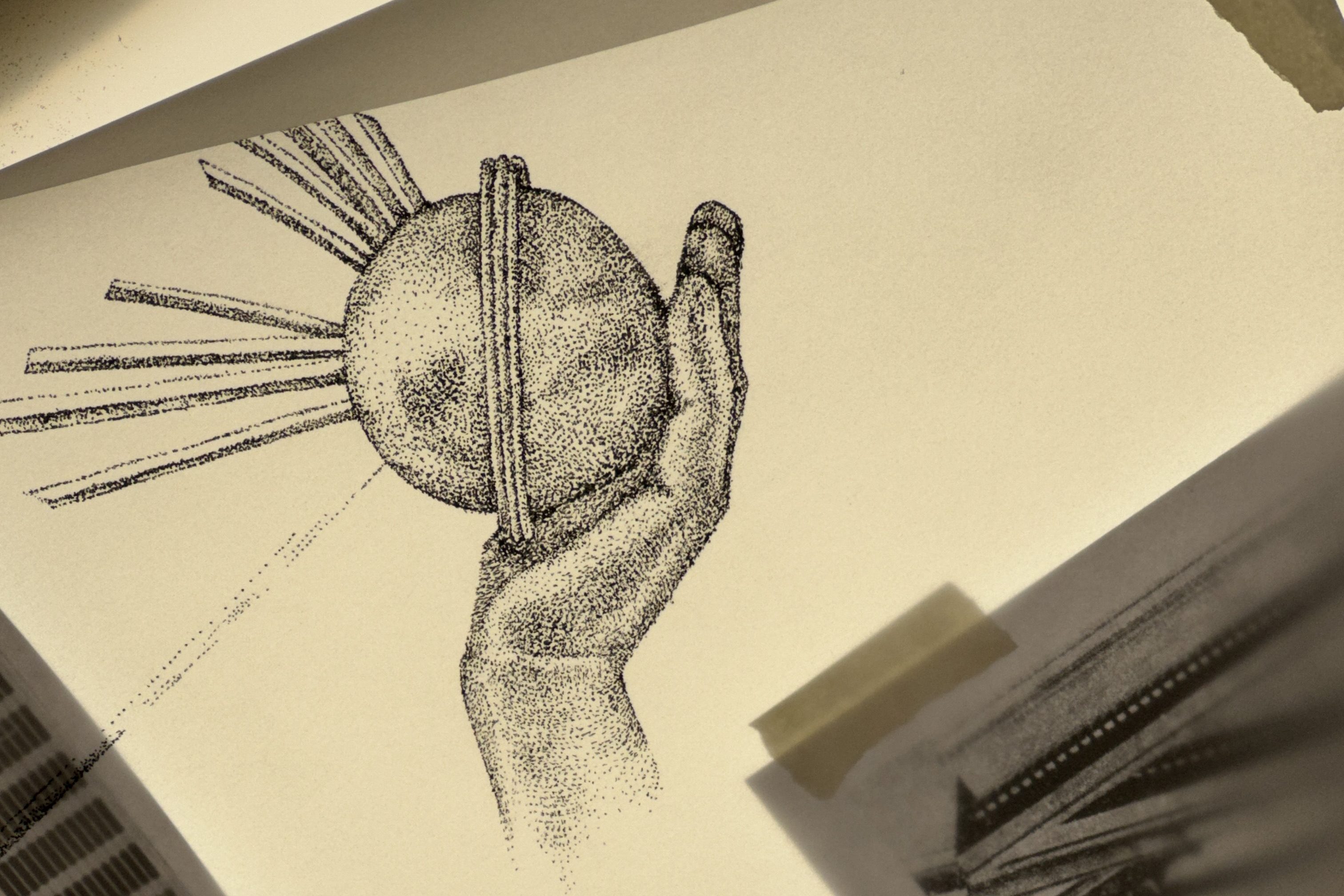
Layering on tracing paper, Luis dutifully stippled certain prominent architectural elements. I was especially impressed at the beautifully rendered hand, orb, and rays of Spirit of Detroit.
Luis then cut out stars on blue and yellow paper, adding in light sources to the night scene. The Ambassador Bridge, Dodge Memorial Fountain, Penobscot and Fisher Buildings are all recognized for their dramatic nighttime illumination, and Luis captured this with hand-drawn and cut stars.
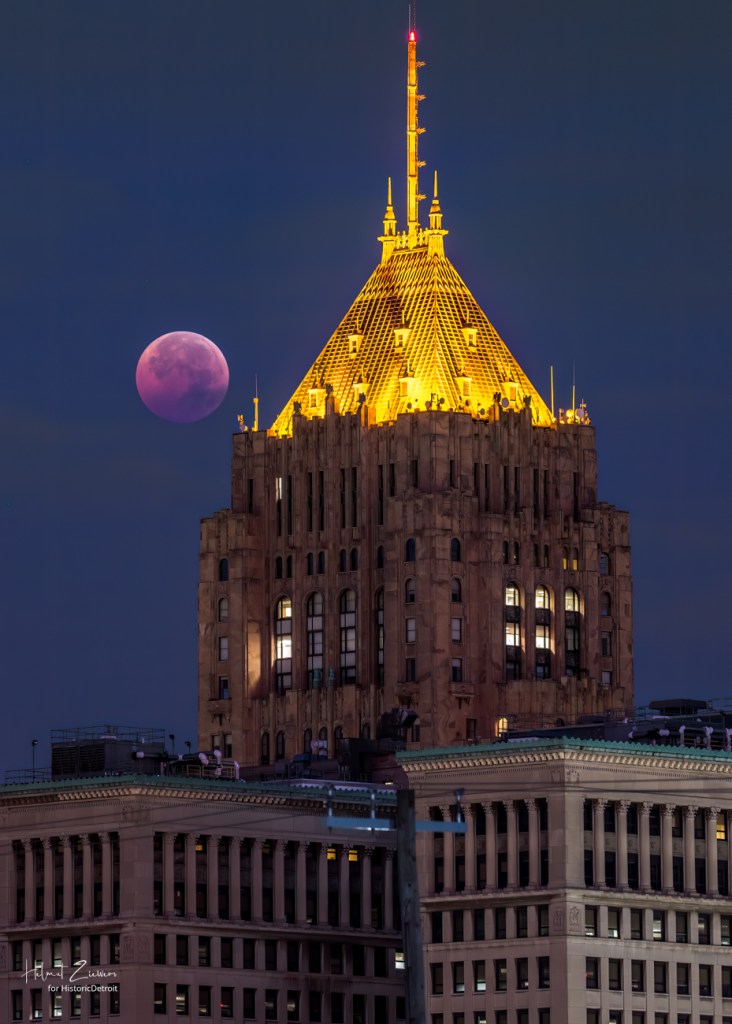
Fisher Building with Full Moon Eclipse in Nov. 2022
Finally, Luis scanned in the physical elements of the poster and reassembled them in Illustrator, where text was added. Luis took inspiration from Detroit Techno posters for the colors and fonts. I could not be more thrilled with our poster, and the capprici of Detroit at night (with techno).
Luis Quintanilla, CAA ’24, working on the poster. Luis is from Austin, Texas, and earned their BFA from Virginia Commonwealth University.
Can you identify all the buildings shown? Can you speculate why I chose them?
If you can, you’ll love this year’s History of American Architecture: Detroit and the Worldlecture series! If you can’t, you’ll also love this year’s History of American Architecture: Detroit and the World lecture series! The first lecture is February 6, 2024, at 12:00pm ET online and at 6:30pm ET online and in de Salle Auditorium at Cranbrook Art Museum. Purchase your tickets and learn more on our website. All lectures will be available for viewing after the lecture to ticket holders. See you there!
—Kevin Adkisson, Curator, Cranbrook Center for Collections and Research
Special thanks to Artist-in-Residence Elliot Earls, Head of 2D Design, for suggesting Luis for this project. A perfect fit!
May 30, 2023, marks one hundred years since Henry S. Booth and J. Robert F. Swanson returned home from ten months of travel in Europe. Midway through their architecture studies at the University of Michigan, the friends and classmates set off on August 1, 1922 for a “Grand Tour” through Norway, Finland, Sweden, Denmark, Germany, Tunisia, Italy, France, and England to study and sketch European architecture.
In today’s post, I want to share moments from their journey through France, which is so beautifully documented by Henry’s letters and photographs, and by both of their sketches.
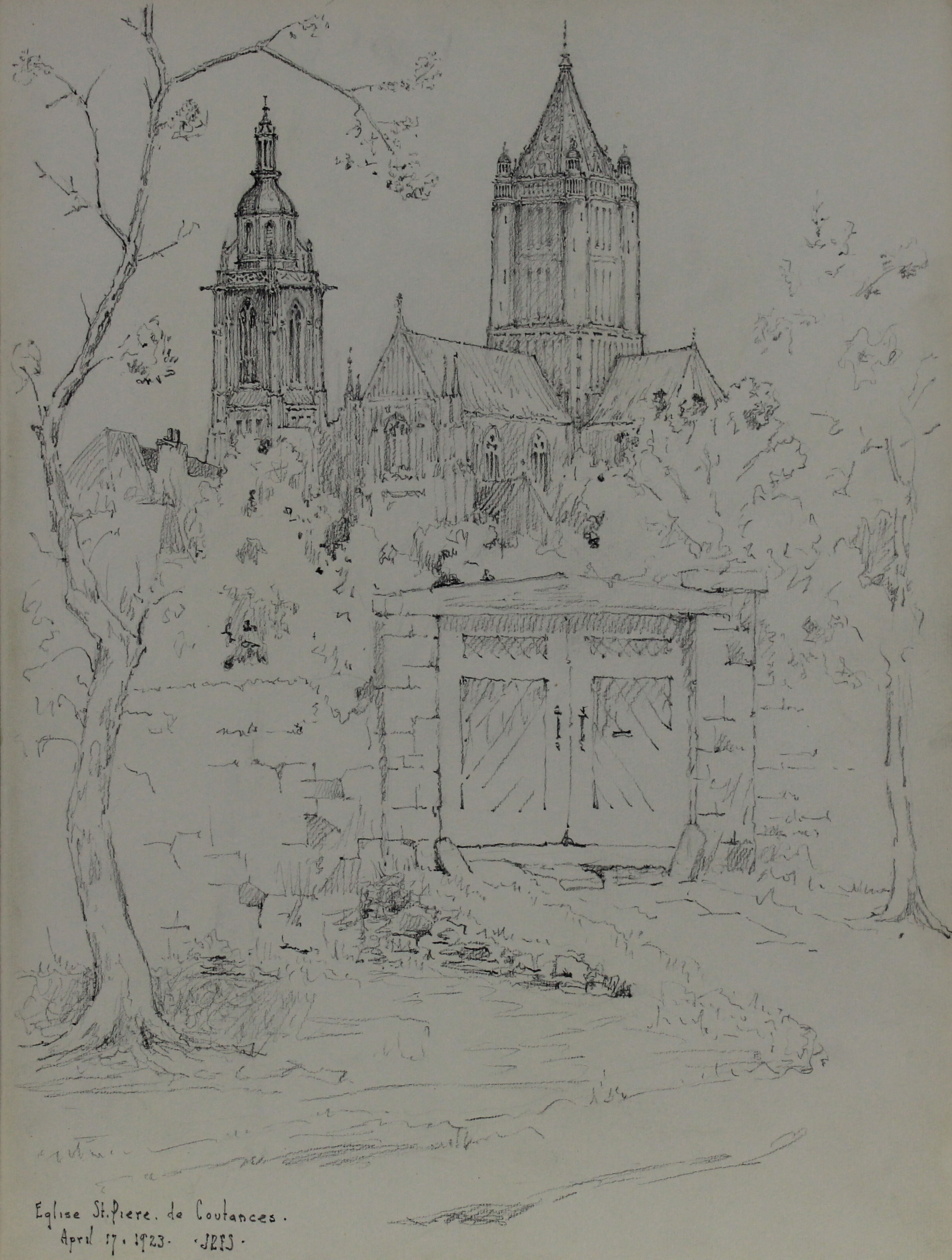
Eglise St. Pierre de Coutances, April 29, 1923, J. Robert F. Swanson. Courtesy of Cranbrook Art Museum.
Arriving in France in March 1923, Harry and Bob journeyed through Nice to Cannes, then through Lyon to the city of Bourges. Henry describes the scenery en route:
“…mountains on the right and the “Cote d’Azure” on the other, flowers overhanging balustraded walls, old olives and tall but easily climbed palms, rocks and breaking waves, and then always the bluest of skies and sea to match, and dazzling sunlight–quite warm and ‘drowsy’.“
At Bourges, they headed for the Cathedral, which they visited several times: at night by the light of gas lamps; in the afternoon sunlight; at dusk with a handful of worshippers on their knees; and then later that evening filled with the faithful.
Cathédrale St. Etiénne de Bourges, March 1923. Henry Scripps Booth, photographer. Courtesy of Cranbrook Archives.
“It was an inspiring sight—the nave packed, and both the inner and outer aisles (for there are two) on the north side filled also, and not a few on the other side of the church. The light was dim all during the sermon, and when that was over, a quantity of candles were lighted almost instantaneously about the “Host,” and all the electric candles down the nave came on, so that suddenly this great cathedral was changed from a imaginative forrest in the night, to a great cathedral church ablaze with the lights associated with a feast.
“But I thought more of other things than of the architecture that night. The preacher talked too fast for me to understand his French, but I knew what he should have been saying even if he wasn’t…, I looked at the great number of long black vails [sic] everywhere, noticed the lack of men of middle age, and saw many young fellows who are now “heads” of their father’s family standing by their veiled mother’s side.”
They stopped in Tours before taking in the Chateaux of the Loire: from Loche to Langais, Ussé, Villandry and Azey.
In 1881 James Edmund Scripps, founder of the Detroit Evening News (later the Detroit News) and father of Ellen Scripps Booth took a five-month trip to Europe with his wife Harriet Messenger Scripps and daughter Grace. As they traveled, Scripps wrote about his experiences and sent the blog-like entries back to his newspaper to publish. Detroit readers loved it.
James Edmund Scripps, ca 1870. Courtesy Cranbrook Archives.
Because the response to his entries was so positive, Scripps compiled them into a book, Five Months Abroad: Or, The Observations and Experiences of an Editor in Europe, published in 1882. Scripps visited Italy, France, Germany, England, and the Netherlands exploring museums and churches. He wrote about art and culture and also sketched the details of many churches and cathedrals.
James Edmund Scripps bookplate from Five Months Abroad, ca 1882. Courtesy Cranbrook Archives.
William H. Brearley, the advertising manager for the Detroit Evening News, was so impressed with the response from Detroit residents about Scripps’ travel entries, that he decided to organize an art exhibit. Brearley gathered paintings, sculptures, etchings, and engravings (in all, 4,100 items) from collectors in Detroit, Boston, and Cleveland, and even a painting, “The Betrothal of St. Catherine,” from Pope Leo XIII.
Scripps’ sketches of Austrian steeples. Courtesy Cranbrook Archives.
Scripps’ sketches from Wells Cathedral in Somerset, England. Courtesy Cranbrook Archives.
Brearley’s “Art Loan Exhibition of 1883” was held in a temporary hall on Larned Street. The exhibition ran for 10 weeks and attracted more than 134,000 visitors at 25 cents each, covering the costs of the promoters and making a profit. With this success and a generous offer from Senator Thomas Palmer, Brearley and his associates undertook the task of raising money for a permanent museum of art. A group of 40 Detroit citizens each gave $1,000, Sen. Palmer provided $12,000, and soon the group had raised $100,000.
In 1884, Brearley announced a $50,000 gift from James Edmund Scripps, and on April 16, 1885, the Detroit Museum of Art (later the Detroit Institute of Arts) was incorporated. The museum opened in 1888, and in 1889 Scripps bought and donated 70 European paintings. At a cost of $75,000 (roughly $2.1 million dollars today), this gift was among the first major accessions of European Old Master paintings for any American museum.
– Gina Tecos, Archivist
Additional Sources:
Burton, Clarence, William Stocking and Gordon K. Miller. The City of Detroit, Michigan 1701-1922. S.J. Clarke Publishing Co., 1922.
Detroit Museum of Art Hand Book of Paintings, Compiled by James E. Scripps. John F. Eby and Co.,1895.
Thanks to a generous grant from the Fred A. and Barbara M. Erb Family Foundation, thousands of negatives from the collections at Cranbrook Archives have been re-housed to ensure their long-term stability and preservation. One of these collections, which documents a research trip conducted in the Middle East by Cranbrook Institute of Science (CIS), has been digitized and is now available to users from our online database.
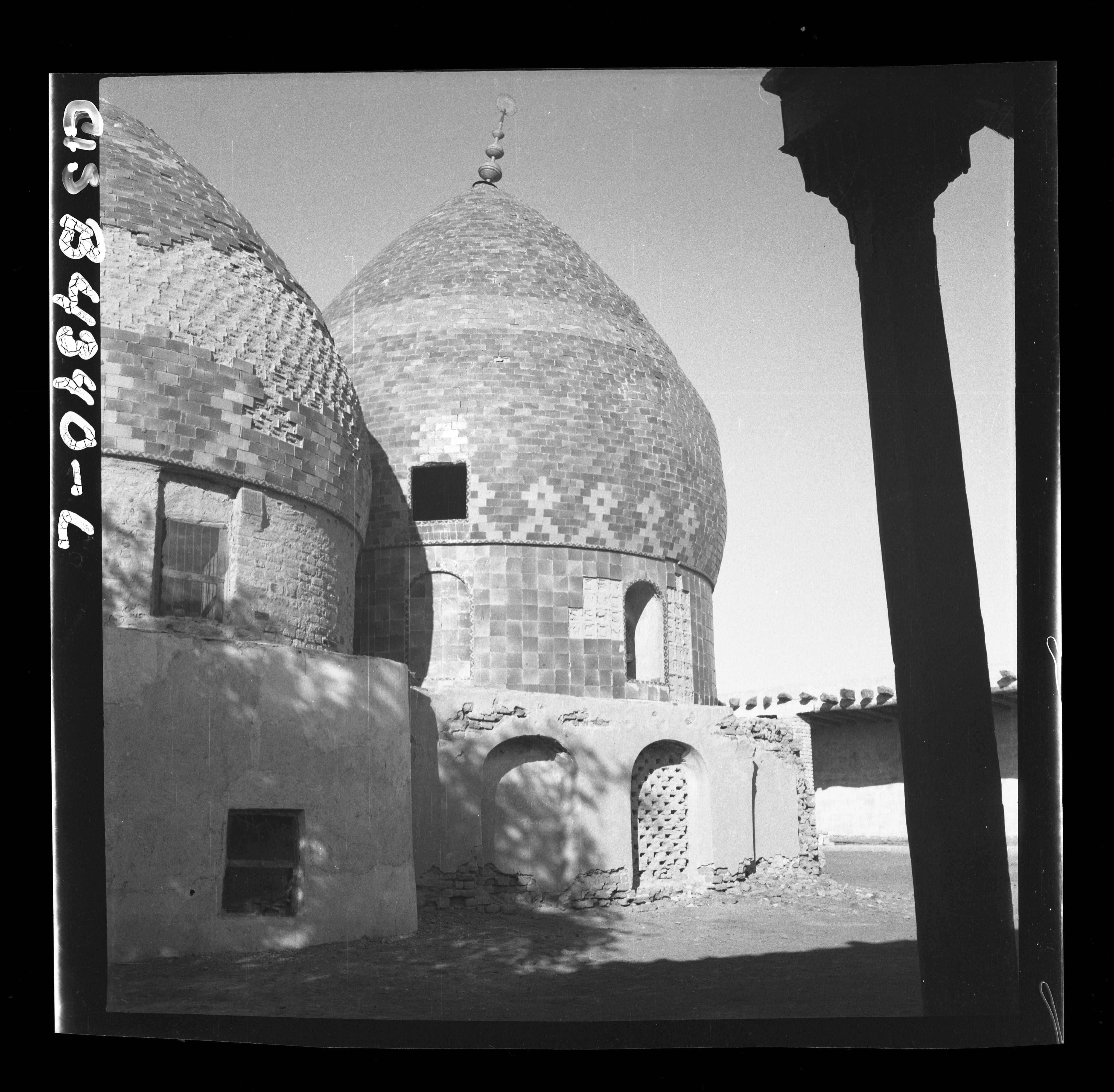
Domed Structures near Babylon. Photograph by Robert T. Hatt.
From 1952-1953, Dr. Robert T. Hatt (Director of CIS from 1935-1967) led an exhibition in Iraq, Syria, Jordan, and Egypt. Hatt recorded his observations in a travel journal which is part of the Robert Torrens Hatt Papers at Cranbrook Archives. In addition to his research and work as a scientist, Hatt was an avid photographer. Our collection includes more than 400 photographs taken by Hatt during his travels.
Dr. Hatt’s travel diary, 1952-1953. Courtesy Cranbrook Archives.
We are excited to share this unique collection that documents communities and antiquities which may no longer exist. Users can browse the collection image by image, or use the Search box at the top of each page in the online database. To browse the 400+ images in the collection, click the Browse All button (next to Home).
Dr. Hatt (right) and an unidentified man in Babylon.
We hope you enjoy this new collection! Special thanks to Archives Assistants Veronica Wood and Kaitlin Scharra Eraqi for their hard work and the many hours they spent on this project.
After a long illness in 1886, Ellen Scripps Booth’s father James Edmund Scripps (1835-1906) retired from his work life in the newspaper business (he had founded Detroit’s The Evening News in 1873). James spent two years recuperating and traveling in England and continental Europe with his wife Harriet and their children. The family visited Scripps cousins and traveled with some of his twelve siblings and their children. James, who had become interested in architecture (particularly church architecture), spent many hours sketching at the locations they visited.
Scripps family members at the Courtyard of the Lions at Alhambra, Granada, Spain, November 1888. From left: William Armiger Scripps, Ellen Browning Scripps, Eliza Virginia Scripps, Grace Locke Scripps, Florence May Scripps, Harriet Messinger Scripps, Anna Virginia Scripps, James Edmund Scripps. Courtesy Cranbrook Archives.
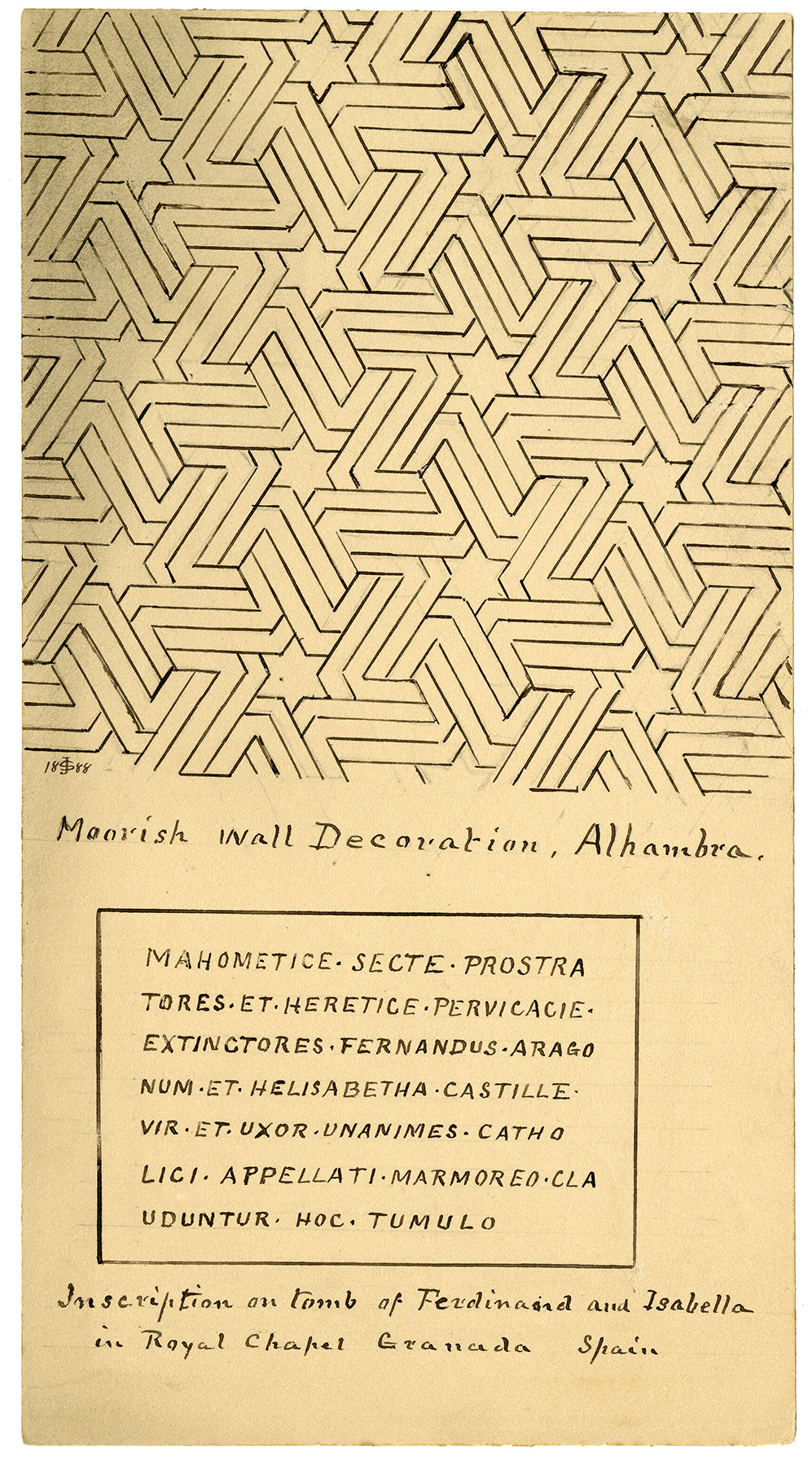
James Edmund Scripps sketched exterior wall decoration at Alhambra, below. Notice how closely it matches the wall in the photograph.
In the picture at the Alhambra, take a look at James’s sister second from the left: Ellen Browning Scripps. Ellen was a publisher for The Evening News and wrote a daily column, nicknamed “Miss Ellen’s Miscellany” that rehashed local and national news in a conversational tone. She even sent dispatches back to Detroit from Europe. Shortly after their trip to Europe and well-hatted visit to the Alhambra, the Scripps siblings had a bit of a falling out: she and another brother headed to California, where she eventually founded many important educational and philanthropic organizations in the San Diego area.
If you want to hear more about Ellen Browning Scripps and the Scripps siblings, the Cranbrook Center for Collections and Research is hosting a lecture and book signing with Molly McClain on Sunday, November 12th. Ellen Browning Scripps: New Money and American Philanthropy is a new book by Dr. McClain, Professor of History at the University of San Diego. To learn more about the lecture and to purchase tickets, click here. Books are also available to purchase through the Center.
Trunks in storage. Photographer, Gretchen Sawatzki.
While organizing and re-arranging some of the cultural properties late last week, Associate Registrar Gretchen Sawatzki and I came across an exciting surprise. Tucked away in a corner of one of the many storage areas across the Cranbrook Campus, we found a pair of steamer trunks. (Steamer trunks are traveling trunks that were used when steamships and ocean liners were the best way to travel overseas.) Upon further inspection we realized that they had many stickers bearing international hotels and transatlantic ocean liners. Painted on one of the trunks we found the initials ES.
E.S. Initials. Photographer, Gretchen Sawatzki.
Trunk interior. Photographer, Gretchen Sawatzki.
With a bit more digging and some research we found that these trunks were purchased by Eliel Saarinen from The J.L. Hudson Company in Detroit shortly after his arrival to Michigan in 1923. These trunks traveled with the Saarinens back to Finland, and to other European and international destinations. Check out the inside of the trunks. This is a wardrobe trunk, which you can see from the drawers and hanging section with hangers still inside! Although I don’t think it is practical for travel today, I imagine all the exciting places it voyaged while accompanying Eliel Saarinen on his journeys.
–Stefanie Kae Dlugosz, Collections Fellow, Center for Collections and Research













 Cranbrook Kitchen Sink