Some years ago, former Cranbrook Archivist, Robbie Terman, posted a short blog post on one of the Titanic’s sister ships, RMS Olympic. In recent years, Cranbrook Archives has responded to numerous requests for images of the Olympic which are preserved in the first volume of Harry Scripps Booth’s Pleasures of Life albums.
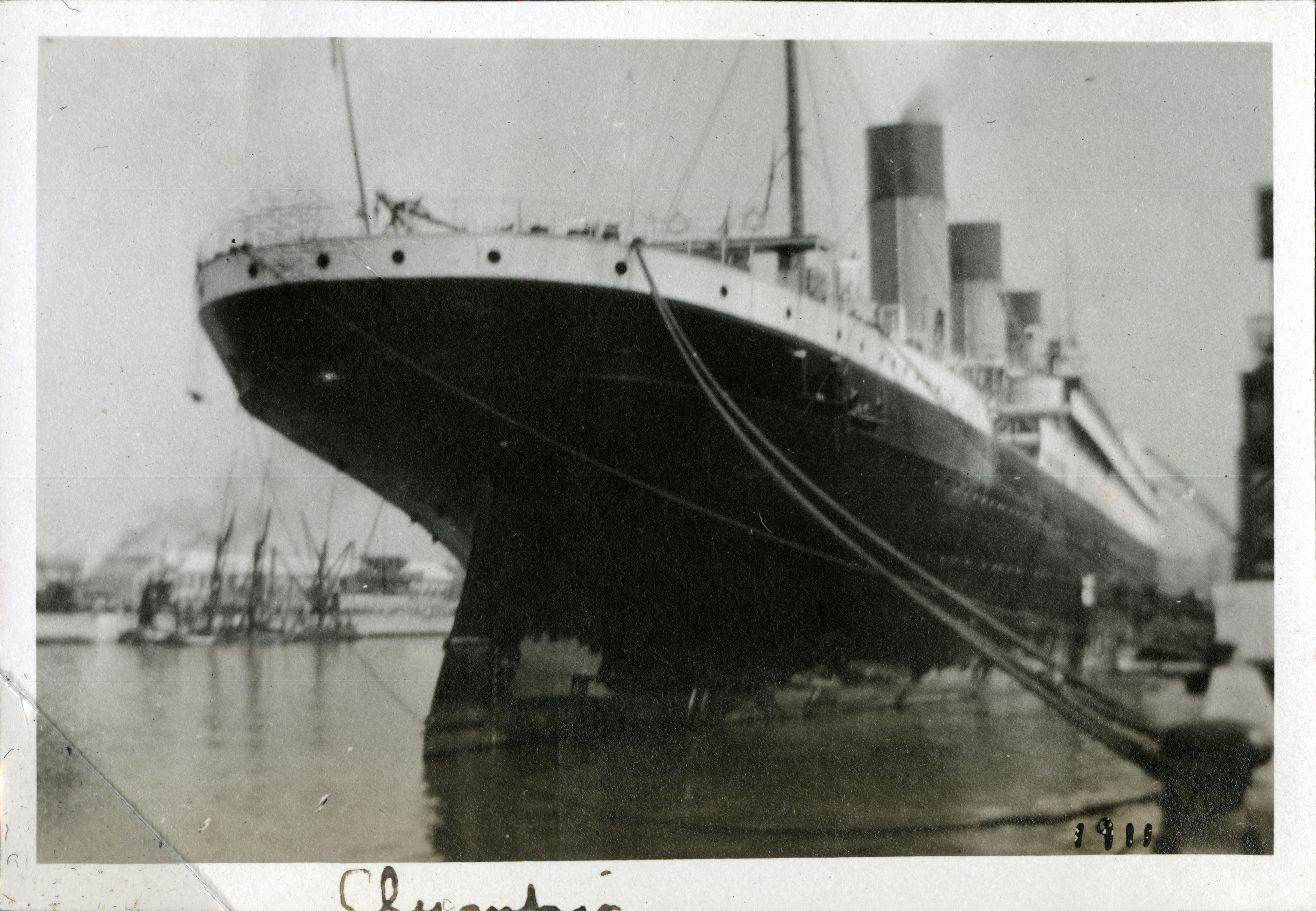
View of RMS Olympic before its first eastward crossing, June 28, 1911. [POL1.14.5]. Courtesy of Cranbrook Archives, Cranbrook Center for Collections and Research.
On June 28, 1911, the Booth family took the first eastward crossing of RMS Olympic from New York to Southampton, England. The family at that time was George and Ellen Booth; James Scripps and Jean McLaughlin Booth who had married the previous year; Grace, Warren, Henry, and Florence. They were joined by their Grand Rapids cousin, Esther Booth.
As I come from a maritime nation, these requests are particularly intriguing to me. I have wondered what other archives we have at Cranbrook to tell the story of transatlantic crossing and explain some of the images. George Gough Booth kept a record of the expenses in planning for the trip. These records tell us that he booked the steamship tickets with the Christian Leidich Travel Bureau in Detroit and he purchased Motor Union badges for himself and James.
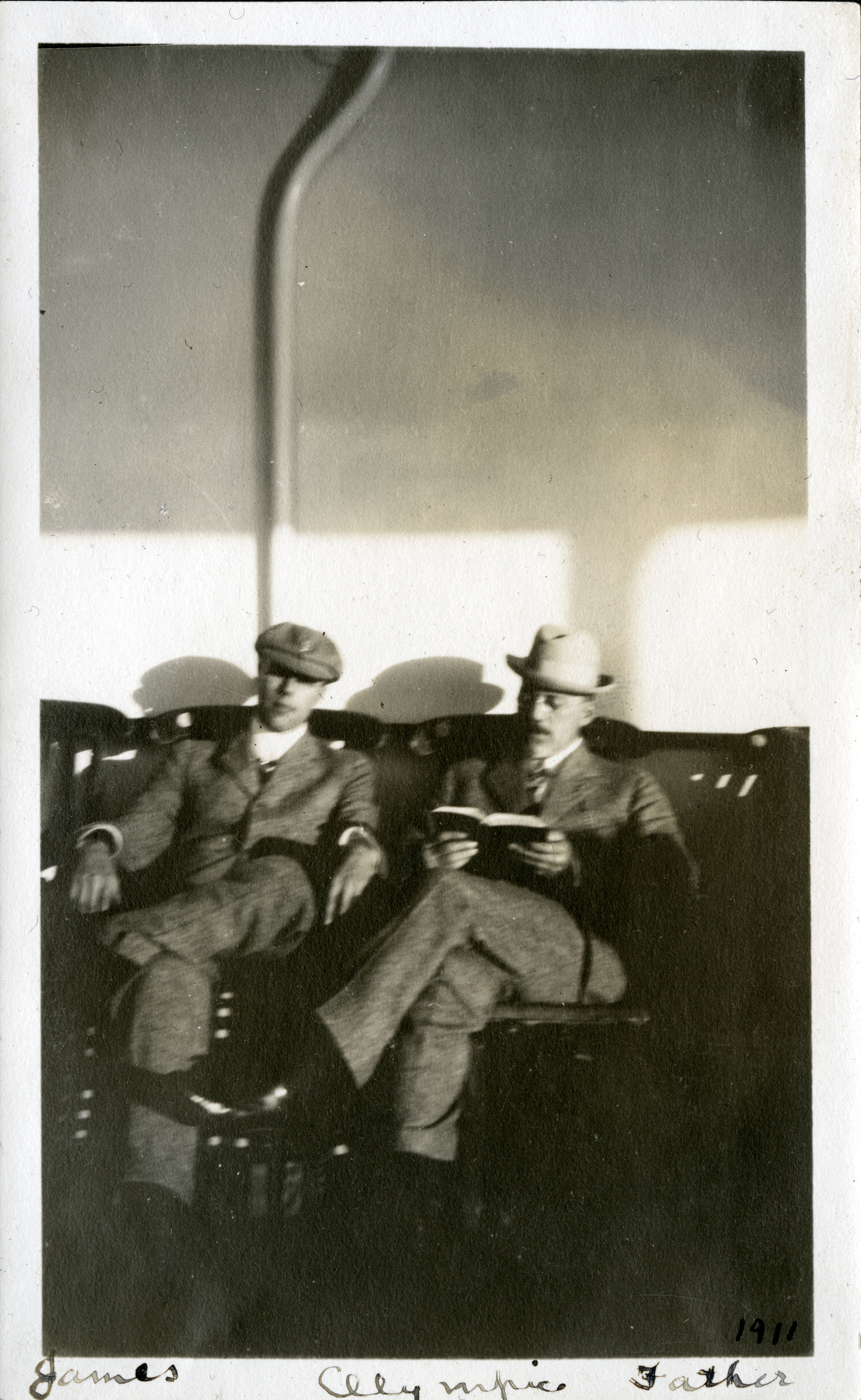
James Scripps Booth and George Gough Booth on the RMS Olympic, July 1911.[POL1.10.2] Courtesy of Cranbrook Archives, Cranbrook Center for Collections and Research.
As Henry recalls in his memoir after listing the family members who sailed,
“That wasn’t enough. Parks, the chauffeur, went; also The Pierce-Arrow, a 7-passenger touring car, and a Lozier Briarcliff, which accommodated four plus one in an airy seat on the left running board, designed for the chauffeur when the “master” took the wheel. That seat was a thrill for the young at heart.”
Then I came upon something quite wonderful—Henry’s journal of the sea crossing! He began the trip when he was just 14 years old, celebrating his 15th birthday in August during the vacation. As I read the entries, the images in the Pleasures of Life came alive. Here follows some moments from the journey in Henry’s words.
“Stayed at the Plaza. Esther’s trunk was lost. We found it later. On June 28, we went abord [sic] the great ship, “Olympic.” Henry Scripps Booth, June 27, 1911
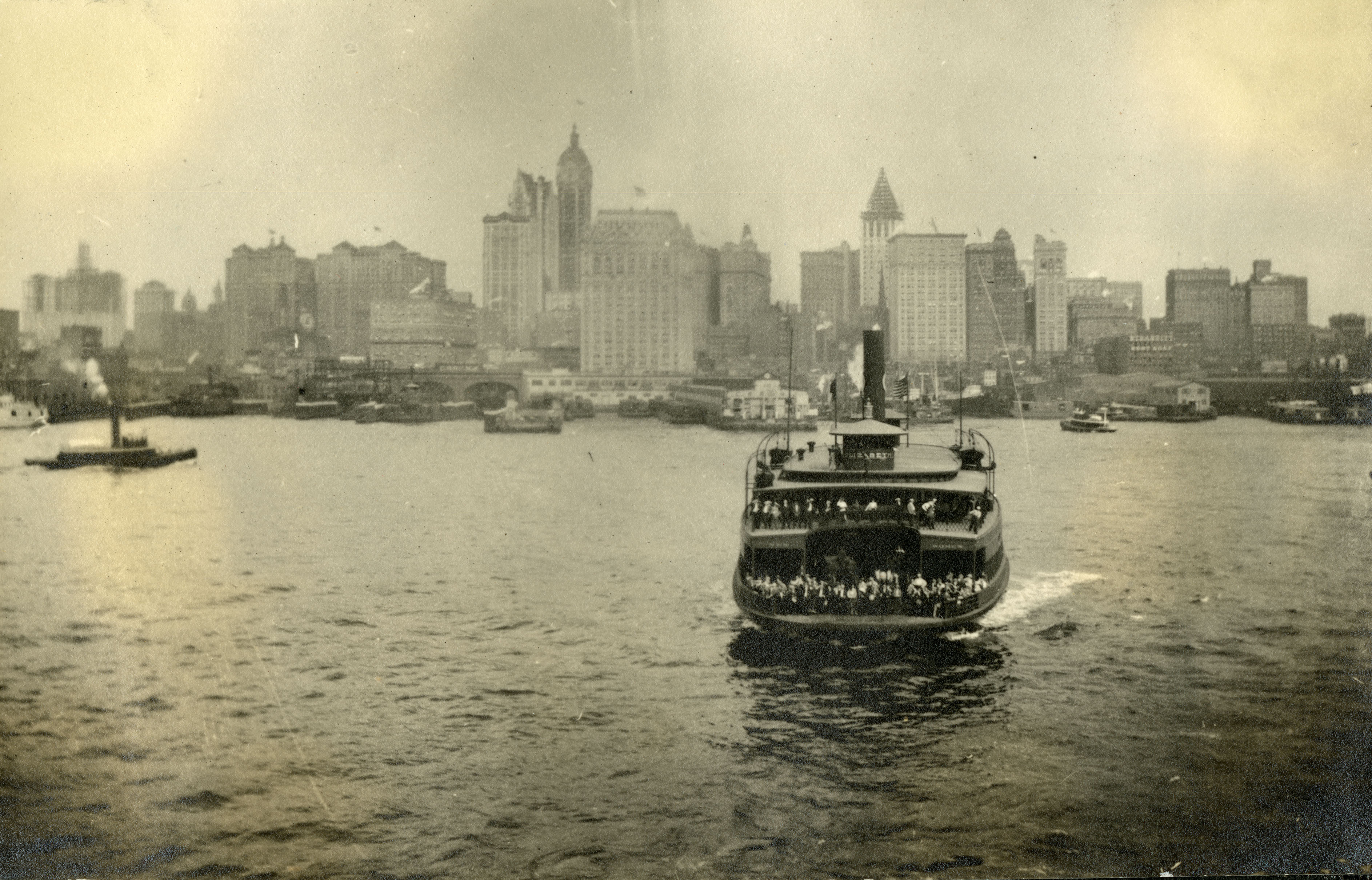
Leaving New York, June 28, 1911. Courtesy of Cranbrook Archives, Cranbrook Center for Collections and Research.
“On June 28, we went abord [sic] the great ship, “Olympic”. The Olympic is a fine ship. Florence was sick first night and day. It was somewhat rough on June 29th. I met a new friend but did not remember his name. In the morning, I could hardly stand, because of the new sensation. I was somewhat sick, but ate lots and I felt fine.” Henry Scripps Booth, June 28, 1911
“On June 30th the Campania was in view. I got acquainted with two girls, Constance Peabody and Katherine somebody.” Henry Scripps Booth, June 30th, 1911
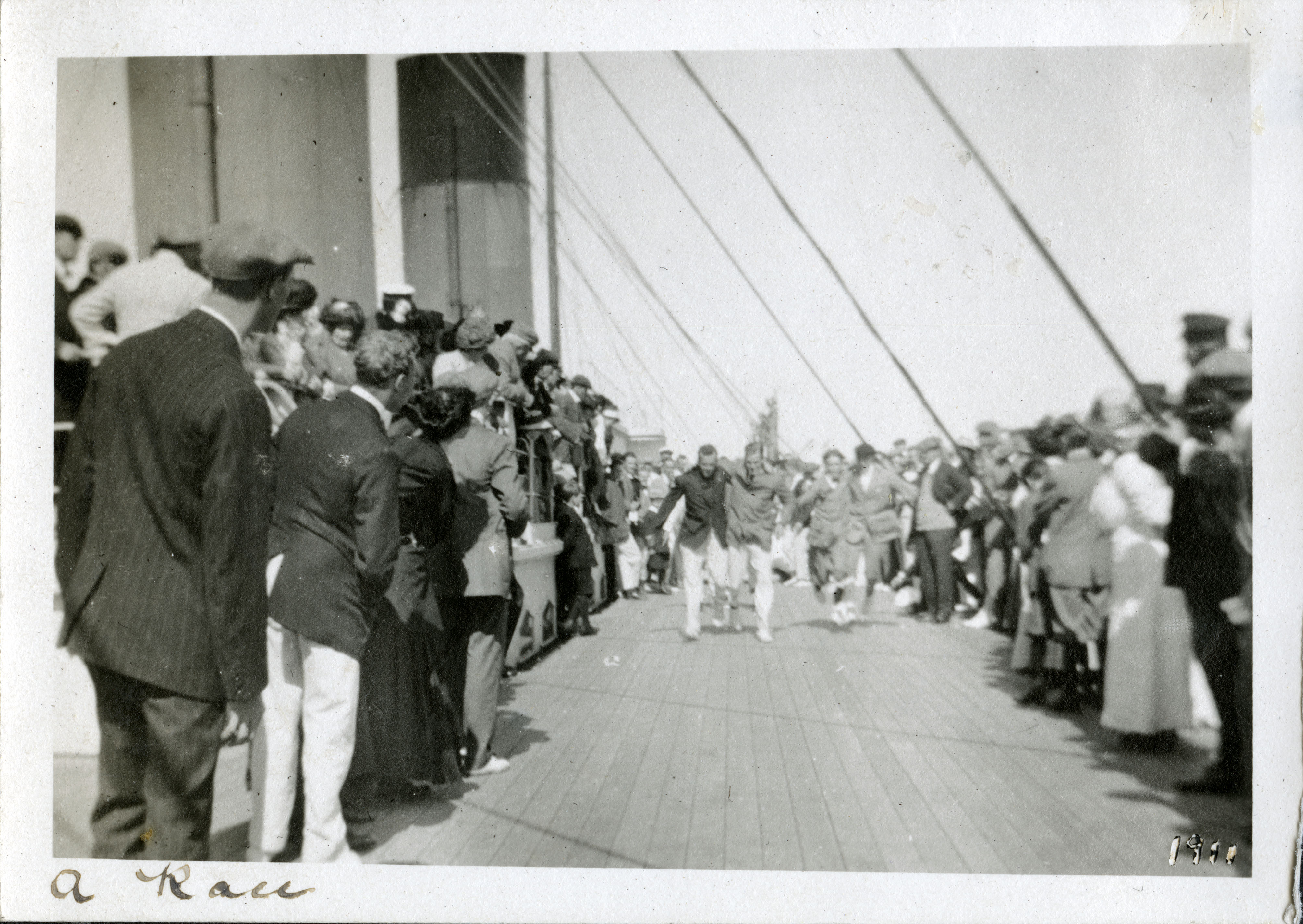
A race aboard the RMS Olympic on its first eastward crossing from New York to Southampton, July 1911. [POL1.11.4]. Courtesy of Cranbrook Archives, Cranbrook Center for Collections and Research.
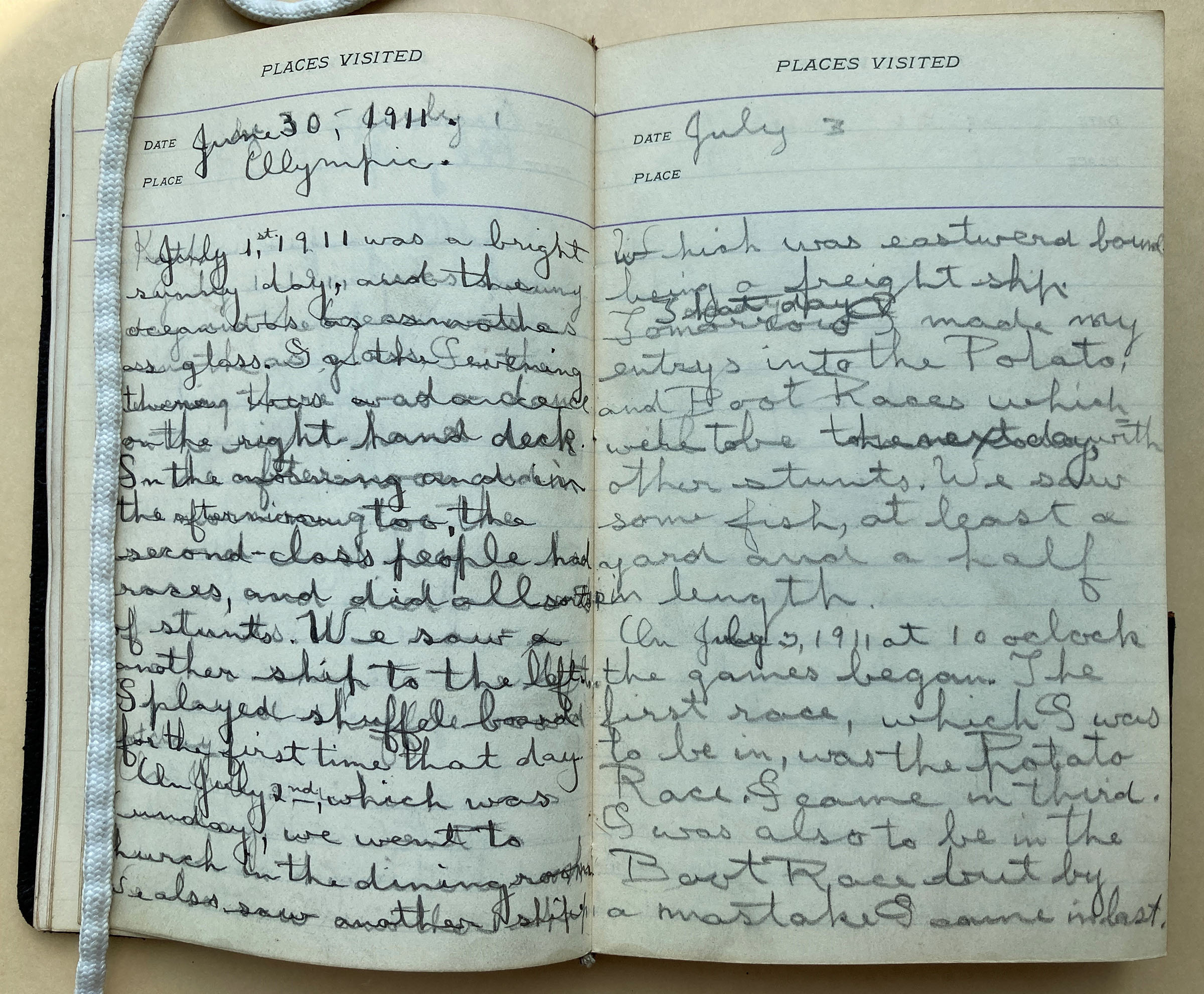
“July 1st, 1911, was a bright sunny day, and the ocean was as smooth as glass. In the evening, there was a dance on the right hand deck. In the morning and in the afternoon too, the second-class people had races, and did all sorts of stunts. We saw another ship to the left. I played shuffleboard for the first time that day. On July 2nd, which was Sunday, we went to church in the dining room. We also saw another ship [July 3] which was eastwerd [sic] bound being a freight ship.” Henry Scripps Booth, July 1, 1911
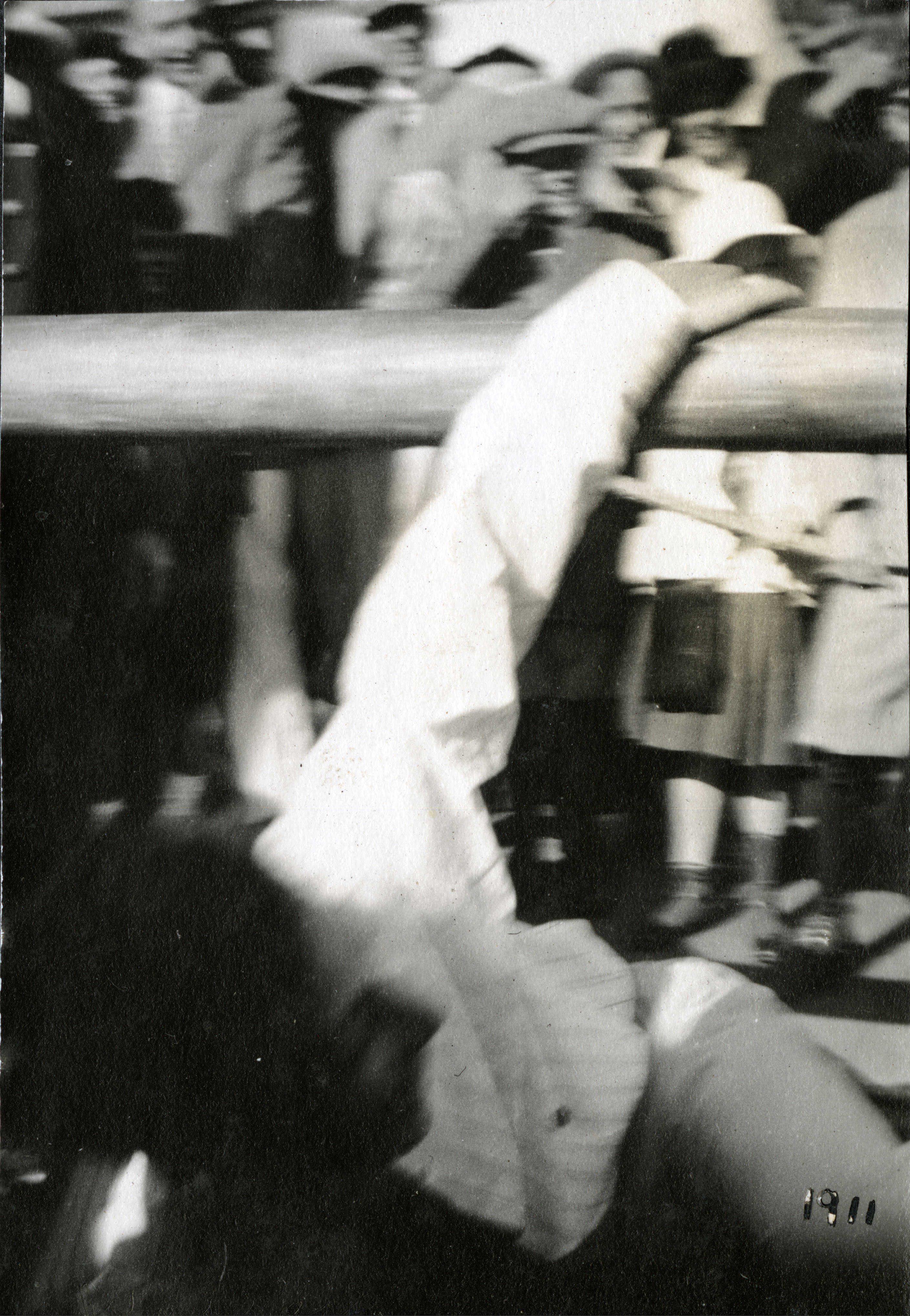
A race aboard the RMS Olympic on its first eastward crossing from New York to Southampton, July 1911. [POL1.12.5]. Courtesy of Cranbrook Archives, Cranbrook Center for Collections and Research.
“Tomorrow That day, I made my entrys [sic] into the Potato and Boot Races which were to be the next day with other stunts. We saw some fish, at least a yard and a half in length.
On July 3, 1911, at 10 o’clock the games began. The first race, which I was to be in, was the Potato Race. I came in third. I was also to be in the Boot Race but by a mistake, I came in last.
After other races came the Standing Broad Jump in which James sliped [sic].” Henry Scripps Booth, July 3, 1911
Warren Scripps Booth during a Spar Pillow Fight aboard the Steamship RMS Olympic, July 1911. [POL1.12.4]. Courtesy of Cranbrook Archives, Cranbrook Center for Collections and Research.
“James and Warren were both in the Spar Pillow Fight. In Warren’s case both fell off the bar at first but Warren was nocked [sic] off a second time. Warren did not win. James stayed on a number of times but was forced to give up. After dinner in the Reception Room the prizes were awarded. Also a dance on deck was given.” Henry Scripps Booth, July 3, 1911
Disembarking the RMS Olympic, July 5, 1911. [POL1.14.1]. Courtesy of Cranbrook Archives, Cranbrook Center for Collections and Research.
“Breakfast was served in the usual manner. After breakfast in the hall on the Sun Deck the band played the national cirs. Every body stood up. In the afternoon, at 4 o’clock we entered Plymouth Harbor. The mailtender got the mail and other boats got passengers off to land. We then started across the channel.” Henry Scripps Booth, July 4, 1911
“After getting off the steamer and having the officers make sure that we had no cigars or liquors with us, we took a cab to the hotel.” Henry Scripps Booth, July 5, 1911
Unloading the cars in France, August 1911. Courtesy of Cranbrook Archives, Cranbrook Center for Collections and Research.
As always, it is a great delight to share with scholars, colleagues, and those who are simply curious, these stories from the Archives. What is preserved in Cranbrook Archives help us to understand and enjoy not just Cranbrook, but any number of historic events from new perspectives.
There are more stories to tell about the family’s sojourn through England and France in 1911, which are both heartwarming and educational. But those tales must wait for another blog post–or for you to schedule a visit and come into the Archives Reading Room!
— Laura MacNewman, Associate Archivist, Cranbrook Archives, Cranbrook Center for Collections and Research
September 24 is the birthday of Cranbrook’s co-founder George Gough Booth. Trying to decide how best to commemorate his 157th birthday, I landed on the idea of sharing the story of the day he came into the world.
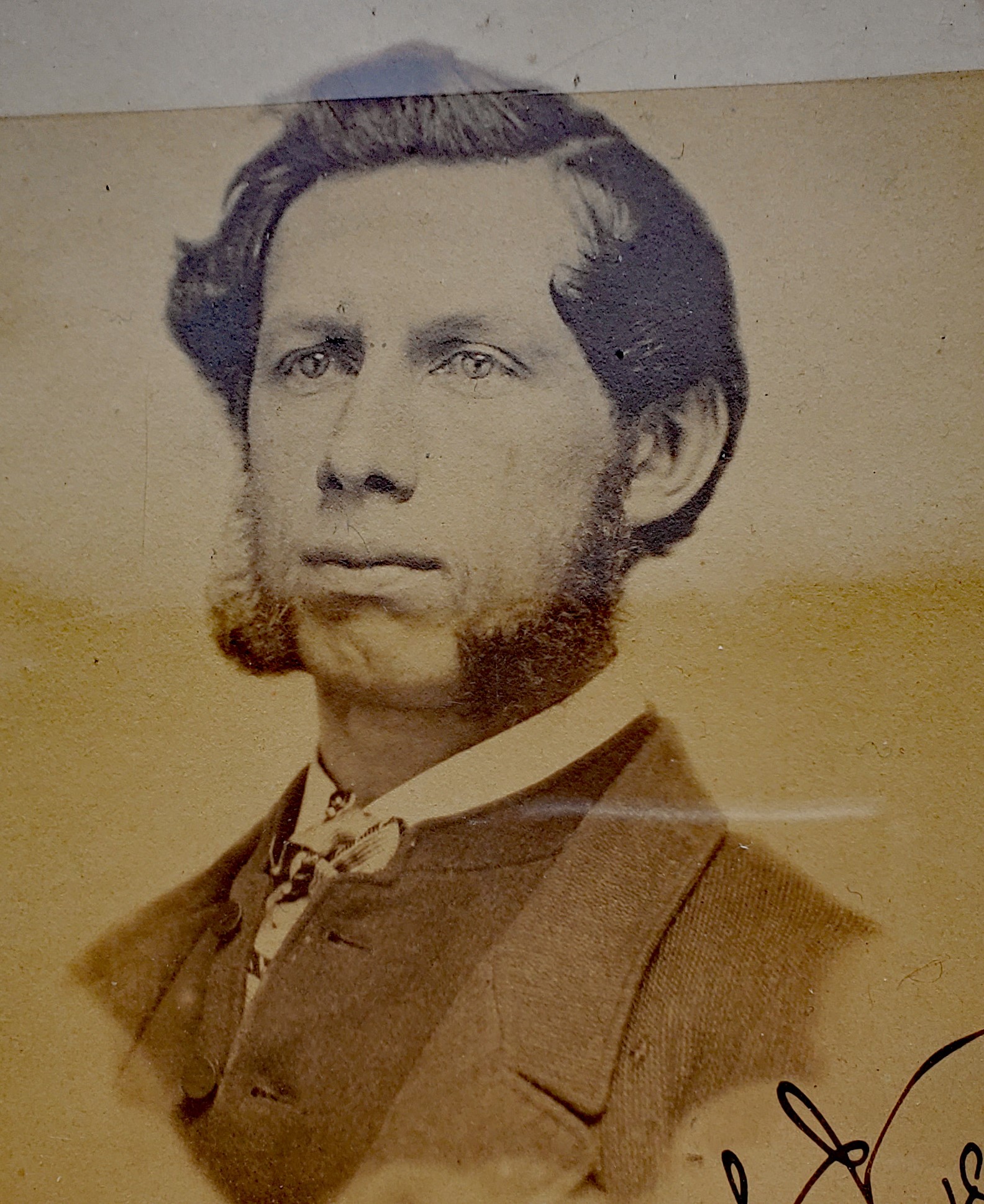
Portrait of George when he was around twelve years old. Photographer W. E. Lindop, Elgin Gallery, St. Thomas, Ontario. Courtesy of Cranbrook Archives, Cranbrook Center for Collections and Research.
In 1864, Henry Wood Booth and Clara Louise Irene Gagnier Booth were living in Canada. Clara had already given birth to three children: Charles, Alice, and Grace. Baby Grace had, unfortunately, died at seven months. Clara would go on to have six more children—Edmund, Theodora, Adelaide, Ralph, Roland, and Bertha—for a total of nine children to live past infancy.
Clara Louise Irene Gagnier Booth in 1857. Courtesy of Cranbrook Archives, Cranbrook Center for Collections and Research.
Henry Wood Booth in 1862. Courtesy of Cranbrook Archives, Cranbrook Center for Collections and Research.
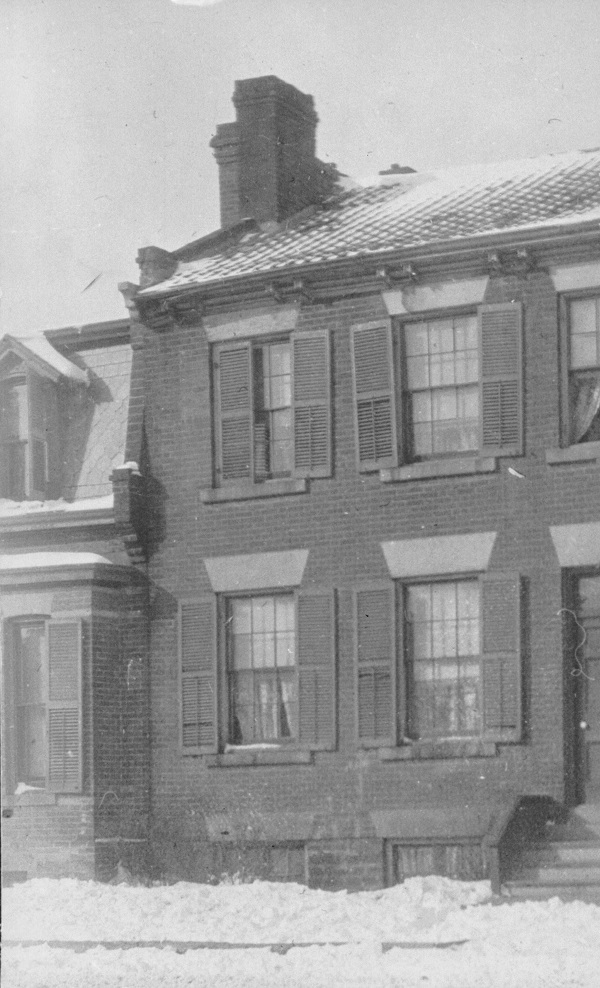
George Gough Booth arrived on September 24, 1864, at 8 Magill (now McGill) Street in Toronto, Ontario, Canada. Henry Wood Booth recalled that George was, “Born in the house at the East end of row on the South side of Magill St. about the middle of the block from Younge St. at 11.30 p.m. on Saturday, Sept. 24, 1864.”
The terrace house at No. 8 Magill Street, the birthplace of George G. Booth in Toronto, Ontario, Canada, as it looked in 1902. Courtesy of Cranbrook Archives, Cranbrook Center for Collections and Research
In a missive written much later about the night of George’s birth, Henry recalled “the time when, on opening the front door, I heard your sonorous voice for the first time, while your grandmother, coming down the stairs, assured me ‘it’s a fine boy.’”
But why was Henry out so late on the night George was born? Shouldn’t he have been home with Clara?
Henry Wood Booth’s recollection of the birth of George Gough Booth in 1864. George Gough Booth (1864-1949) Papers (1981-01), Box 1 Folder 1, Cranbrook Archives.
Distraught during Clara’s labor—”The warning came at about 10 p.m.” Henry recalled—the father-to-be was ushered out of the house to get help. His first stop was the home of Mrs. Cavie, across Magill Street, “who was in bed but promised to ‘dress and go over at once,’ which she did.” Henry then ran to Mother Gagnier’s house. She lived a mile away. “She also promised to go at once, and did.”
His final stop was the home of Dr. James Ross, who lived almost three miles away. Dr. Ross, however, took his time, dressing while a nervous Henry waited. He regretted waiting for the doctor, “I should have hurried home and told them there that the doctor was coming.”
George, “being a lively one,” commented Henry, “and his mother equal to the task,” had already made his entrance into the world, with the assistance of the experienced Grandmother Gagnier, before the doctor and Henry had reached the house.
George Gough got his first name from his great-grandfather as well as his uncle, both named George Booth. Gough came from two sources. Henry’s grandmother Elizabeth Dann Gough Booth had been a member of the influential Gough family back in England, and Henry’s father’s name was Henry Gough Booth.
In addition, Henry and Clara enjoyed the work of the famous temperance orator John Gough. Henry had once heard Gough lecture in 1849, where Henry signed “the pledge” to stop drinking, and became a champion of temperance. The Booths sought to dedicate George to “the sacred cause of temperance” and thought the strong middle name would help.
George Gough Booth did maintain a temperate life, so Henry and Clara’s goal was achieved.
Another thing Henry and Clara passed on to their son George: a tradition of honoring the family ancestry through names:
George’s second son’s name was Warren, his wife Ellen Scripps Booth’s middle name
His first daughter was named Grace Ellen, after his sister who died in infancy and his wife
His youngest son was named Henry after his father, grandfather, and a long line of Henrys before him
His youngest daughter Florence’s middle name was Louise, his mother’s middle name
All three of his sons’ middle names were Scripps, his wife’s maiden name
Ellen Scripps Booth and George Gough Booth with their children on their 50th wedding anniversary in 1937. The Booths are, from front row, from left: James Scripps, Henry Scripps, Warren Scripps. Second row from left: Ellen Scripps, George Gough, Grace Ellen, Florence Louise. Courtesy of Cranbrook Archives, Cranbrook Center for Collections and Research
And George and Ellen’s home, estate, and community they founded was, of course, named for the town in Kent, England, where Henry Wood Booth was born: Cranbrook.
And with that, I’d like to wish a very Happy Birthday, Mr. Booth!
—Leslie S. Mio, Associate Registrar, Cranbrook Center for Collections and Research
Memorial Day Weekend marks the beginning of summer, and in Michigan, what better way to celebrate than with a typical summer activity: boating.
Florence Louise Booth and Warren Scripps Booth rowing on Glastonbury Lake (now Kingswood Lake) in 1906. Courtesy of Cranbrook Archives.
Florence and Warren are pictured in a rowboat at what was known as the Booth family’s summer retreat, two years before the building of Cranbrook House. In 1906, Henry Wood Booth recalled, “The millpond was enlarged and made into a lake by deepening and extending to the old millrace at the north-west end.” The lake was called Glastonbury Lake, after a pond near the village of Cranbrook, Kent, England (Henry Wood Booth’s birthplace). It has since been renamed Kingswood Lake.
Warren Scripps Booth sits in a boat near the original frame boathouse on Glastonbury Lake (now Kingswood Lake) in 1906. Courtesy of Cranbrook Archives.
So, as summer begins, remember to be safe while boating. Although Florence (4) and Warren (12) may be missing their life jackets 115 years ago, a new Federal Law now requires children under 13 years of age to wear one when a vessel is underway.
– Leslie S. Mio, Associate Registrar, Cranbrook Center for Collections and Research
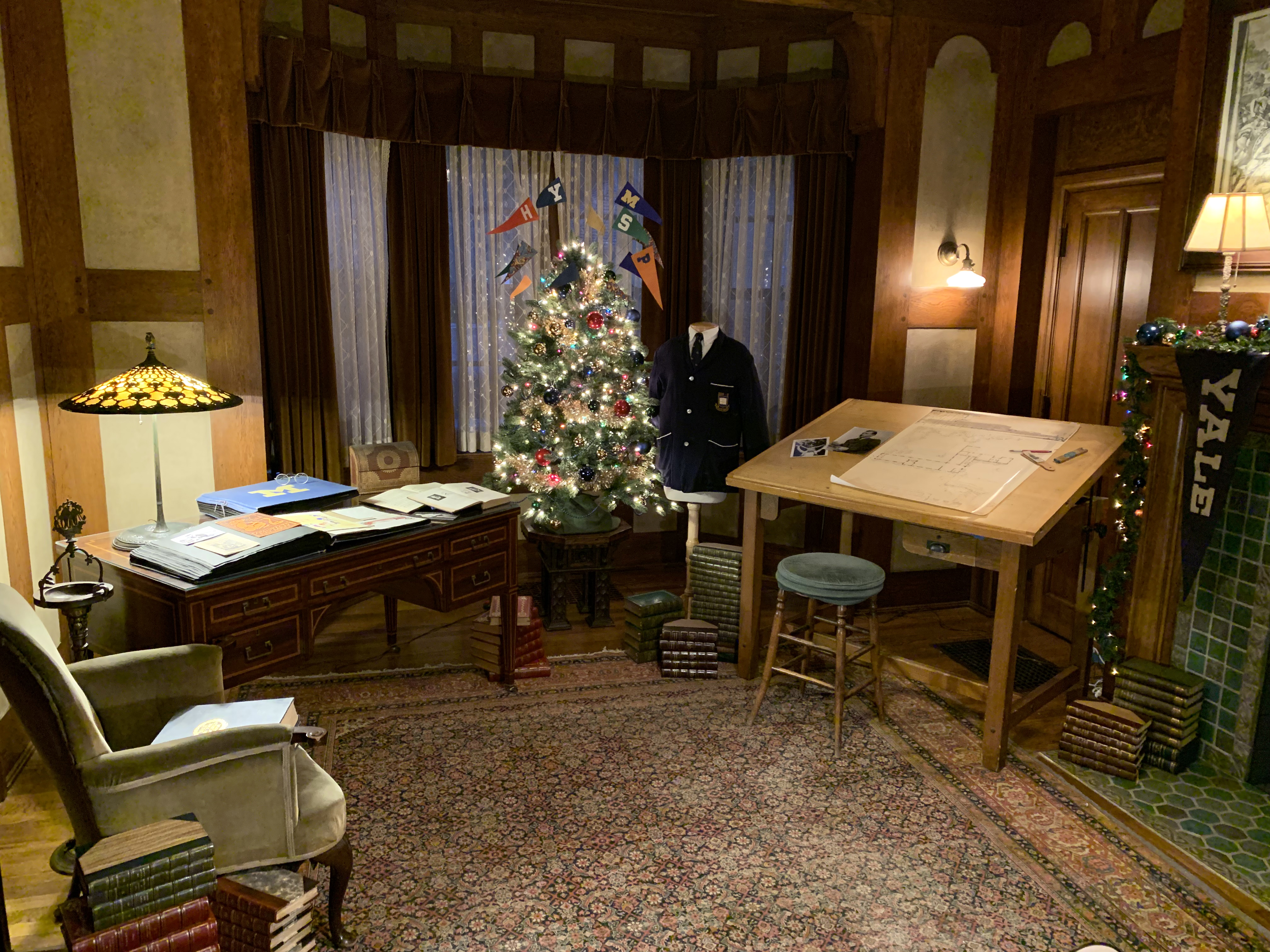
Each year, the Center for Collections and Research has the pleasure of decorating George Booth’s office at Cranbrook House for the holidays. This year, I went with a theme of Cranbrook sons heading off to college.
Overview of the Center for Collections and Research display at Cranbrook House for Holiday Splendor 2018.
I was inspired by a recent visit to Cranbrook by Warren Booth’s daughter Dorothy (fondly known as Blammy) and her family entourage. The fourth of five children of Warren and Alice Newcomb Booth, as a young girl Blammy lived at Cranbrook House’s Tower Cottage.
Blammy’s grandson (and George and Ellen Booth’s great-great-grandson, and my college friend) Riley was along for the tour. He told me about having Warren’s Yale blazer and Warren’s amazing Raccoon coat. I thought it would be great to return the blazer to Cranbrook for display.
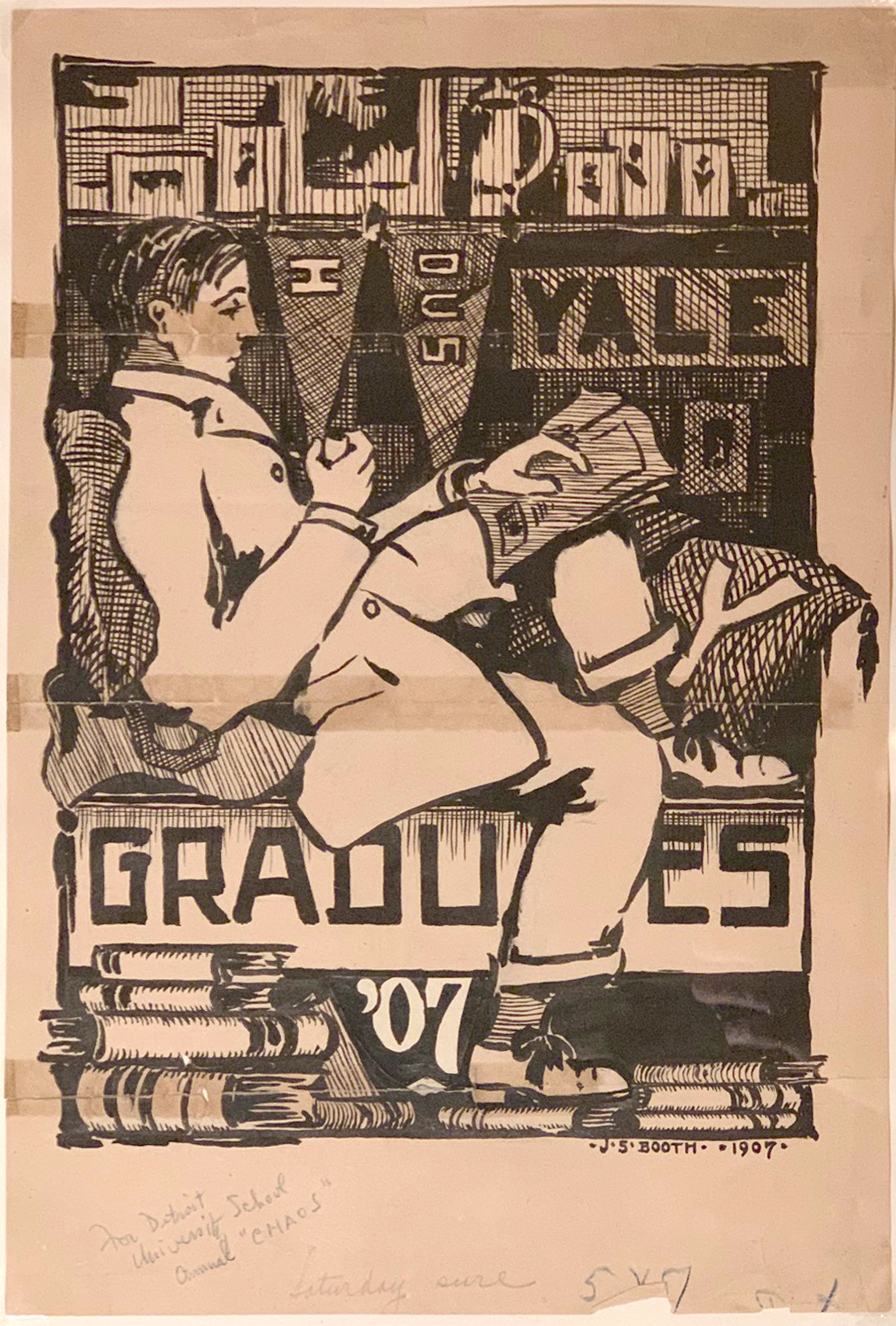
Looking in Cranbrook Archives for what might compliment Warren’s Yale blazer, I found this amazing 1907 illustrationby James Scripps Booth for the yearbook of Detroit University School. The oldest child of George and Ellen Booth, James was an artist, engineer, writer, philosopher and inventor. Although he shows a college student with his pipe and pennants, surrounded by books, James himself did not attend college.
James Scripps Booth’s illustration for Detroit University School, 1907. Courtesy Cranbrook Archives.
The first Booth to go to college was the middle child, Warren Scripps Booth. He moved to Cranbrook with his parents in 1908 and studied at the University School in Detroit. Around 1909, he headed east to the Lawrenceville Schoolin New Jersey. After his 1912 graduation, he studied with the Sargent Travel School for a year.
Warren Scripps Booth’s entry in the Yale Class of 1916-S Yearbook. Courtesy of Riley Scripps Ford.
Enrolling at Yale in 1913, Warren studied civil engineering at the Sheffield Scientific School (the “S” on his blazer—at the time, undergraduates were divided between the four-year Yale College and the three-yearSheffield Scientific School). After graduating in 1916, Warren served as a U.S. Army Captain of Field Artillery in World War One, and saw action at Meuse-Argonne, Metz, France. After the war, he served as president of The Evening News Association and Booth Newspapers, as well as on many Cranbrook boards. Warren, his wife Alice, and their five children lived next door to Cranbrook at a house fondly called “NoBrook.”
The Booth’s youngest son Henry began his education at the Liggett School, but after the family moved to Cranbrook he was educated at home. He matriculated at theAsheville Schoolin North Carolina for high school and returned north in 1918 to study architecture at the University of Michigan. While an undergraduate, Henry traveled extensively through Europe with his friend and classmate J. Robert F. Swanson, and in his final year in Ann Arbor, studied with Finnish architect Eliel Saarinen.
Henry Scripps Booth’s Michigan scrapbook, 1924, in foreground. J. Robert F. Swanson scrapbook, 1924, rear. Cranbrook Archives.
A page from Henry’s Michigan scrapbook, 1924. Cranbrook Archives.
For the holiday display, I included Henry’s college scrapbook showing some of his many talents and activities. Bob Swanson had the same scrapbook (much less filled!) and I included it in the display to show the lovely maize “M” on the cover.
Finally, I jumped forward in time to another Cranbrook family who sent their son off to college. Son of distinguished Finnish architect Eliel Saarinen, Eero immigrated to the U.S. with his family in 1923. The Saarinens moved to Cranbrook in 1925 to help realize the Booths’ vision of an educational and arts community.
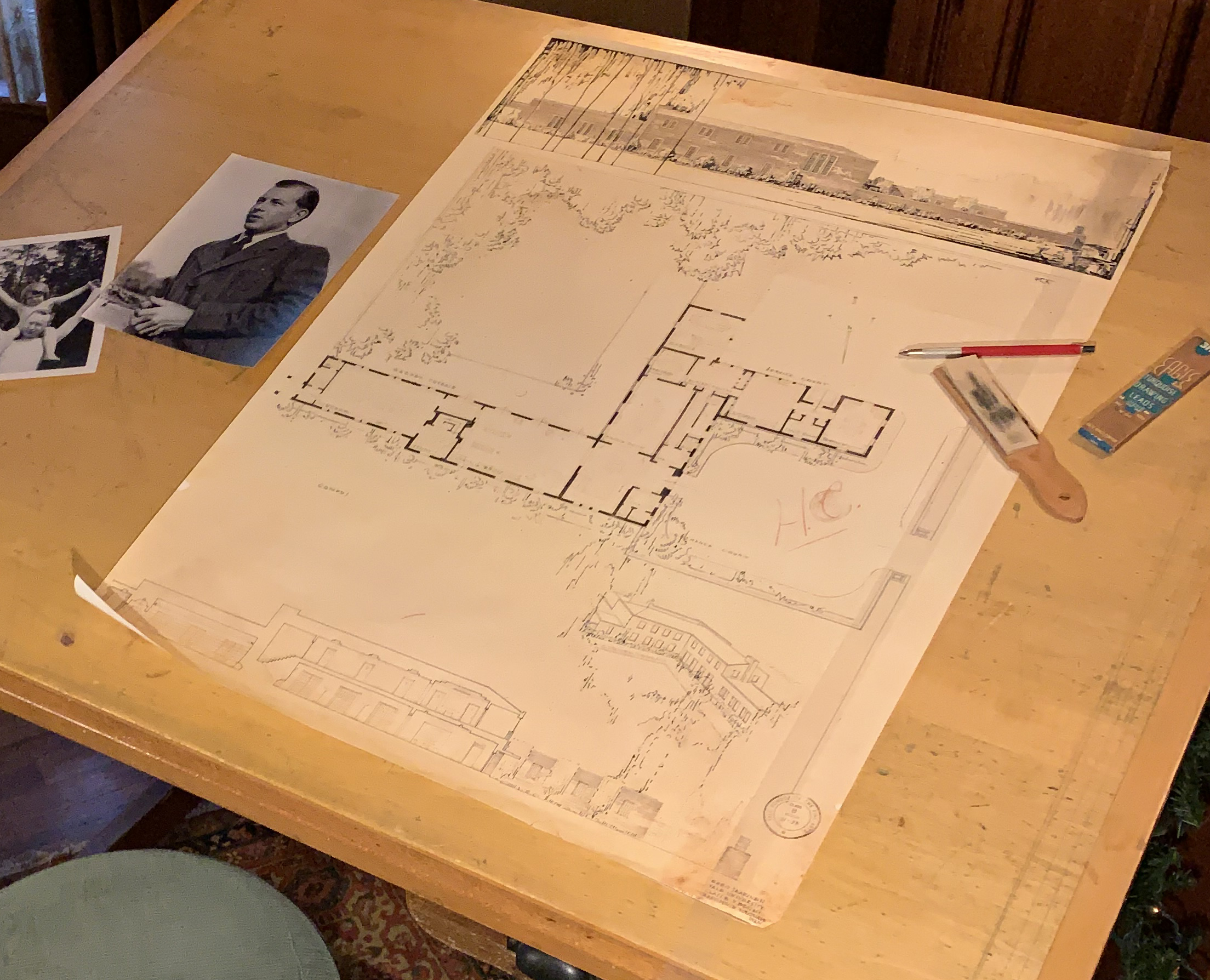
A talented artist from a young age, after graduating from Baldwin High School Eero studied sculpture in Paris’ Académie de la Grande Chaumière for one year before enrolling at Yale’s School of the Fine Arts in 1931. I included a reproduction of one of Eero’s drawing from Yale, resting on George Booth’s drafting table.
“A Residence for a College Dean,” Eero Saarinen, 1931. In this student project, Eero’s use of an open floor plan, symmetrical furniture layouts, textiles, torchieres, and telescoping design elements all mirror his father’s designs for Saarinen House here at Cranbrook. Notice the “H.C.” written in red crayon: this stands for Hors Concours, or not competing. In the strict Beaux-Arts methodology of Yale’s architecture program, this project did not pass muster to be considered for a prize! Original drawing courtesy of Cranbrook Archives.
At Yale, he took a wide variety of coursework: design, freehand drawing, engineering mechanics, history, economics, and scenic design. Even in his first year, his student work earned national recognition in architecture magazines. Eero also took a course on “Archaeology Research” with Raymond Hood(the architect who took first prize over Eliel Saarinen in the Chicago Tribune Tower competition of 1922).
Detail of “A Residence for a College Dean,” Eero Saarinen, 1931.
Saarinen heartily embraced college life, including serving on the Decorating Committee of the student Beaux-Arts Ball. Though he excelled in the student architectural competitions, Eero almost always came just short of winning the First Medal, earning him the nickname Second-Medal Saarinen. His thesis project in the spring of 1934 received the international silver medal of the Société des Architectes Diplômés par le Gouvernement.
Along with many of his classmates, after Yale Eero entered the Office of Strategic Services(a precursor to the CIA), where he designed graphics for defusing bombs as well as underground bunkers, including the White House’s “situation” or war room.
Charles Eames shares cigarettes with Eero Saarinen and Warren Booth at the opening of the 1939 Cranbrook Academy of Art Faculty Exhibition. Perhaps Eero and Warren were chatting about their happy bygone days in New Haven?Photographcourtesy of Cranbrook Archives. “Souvenir of Yale” plate, c. 1910, courtesy of the author.
Eero returned to Bloomfield Hills in 1936 to work with his father and brother-in-law, J. Robert F. Swanson. After Eliel’s death in 1950, Eero set up his own office. Among his many significant projects were a handful of university buildings: dormitories for Brandeis University in Boston, the law quadrangle at theUniversity of Chicago, the North Campus and the school of music for the University of Michigan, the entire campus of Concordia Collegein Fort Wayne, Indiana, dormitories at Vassar, and two Residential Colleges and thehockey rink for his alma mater Yale. At the time of his premature death in 1961, Eero was also serving as Yale’s campus planner.
I’m grateful for the many stories Blammy and her family shared with me on our tour of Cranbrook earlier this Fall, and to Riley for lending us another piece of Cranbrook history to share with guests to Cranbrook House this holiday season.
– Kevin Adkisson, 2016-2019 Collections Fellow, Cranbrook Center for Collections and Research (…and Yale Class of 2012)
As I’ve mentioned previously on the blog, one of my hobbies is giving tours of Greenwood Cemetery in Birmingham, Michigan. It is the resting place of Marshall M. Fredericks, Buck and Mary Chase Perry Stratton, Elmore Leonard, and Cranbrook Founders George and Ellen Booth (and many members of their family).
On a recent drive through Birmingham, I decided to stop and visit our founders. I had always wondered, when I gave tours of the cemetery, why some family members had certain symbols on their markers. After working here at Cranbrook for a couple of years, those symbols now make sense. I captured photos of several of the markers to share with you.
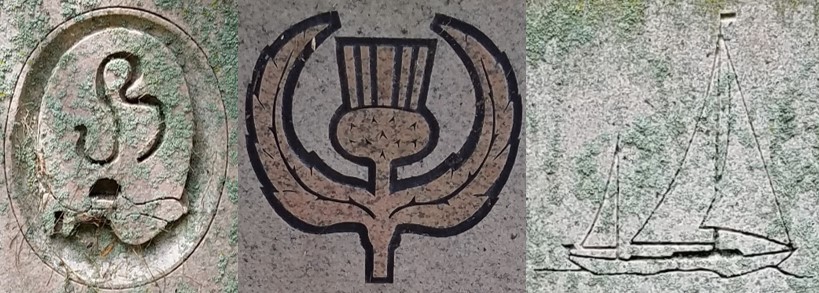
Warren Scripps Booth has a yacht on his marker, but he wasn’t a sailor in World War I – he was in the Field Artillery. It was only by reading his obituary that I learned that his favorite activity was to sail on his yacht when he wanted to get away from it all.
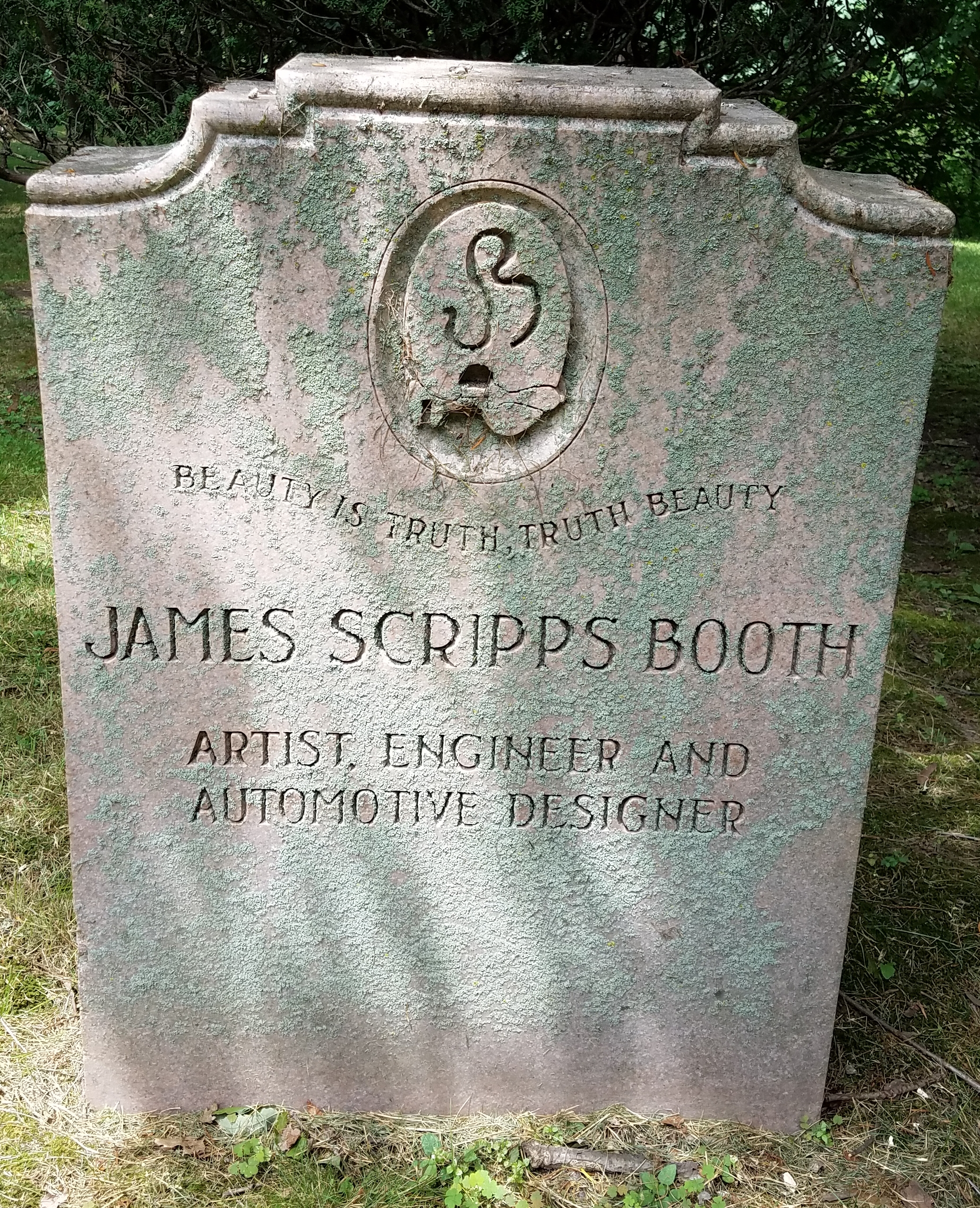
James Scripps Booth was a wonderful artist. His marker features an artist’s pallet with a stylized version of his initials “JSB.”
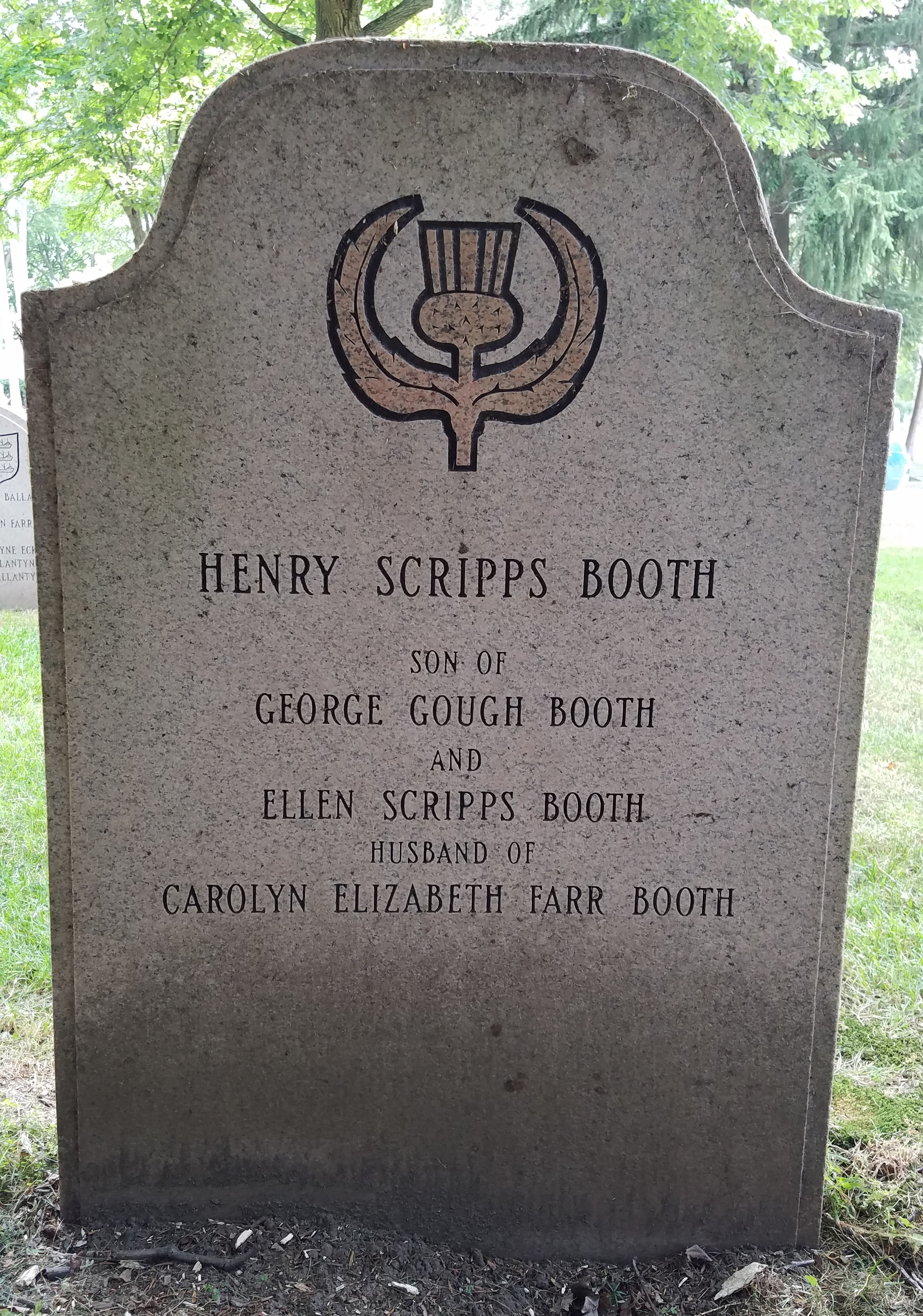
Henry Scripps Booth was called “Thistle” since he was a child. It was no surprise a beautiful thistle adorns his marker.












 Cranbrook Kitchen Sink