A Living Tradition: The Oak Room Cartouches 

In November of 1920, George Gough Booth was getting impatient. For two years, his home, Cranbrook House, had been a construction site as the new library wing and east wing were slowly completed. A series of letters from George Booth to the Massachusetts woodcarving firm, William F. Ross & Co., implored them to finish the paneling in the east wing’s new Oak Room in time for the holidays.

By the end of the month, the room was finished, its four walls covered with hand-carved oak paneling designed by John Kirchmayer.
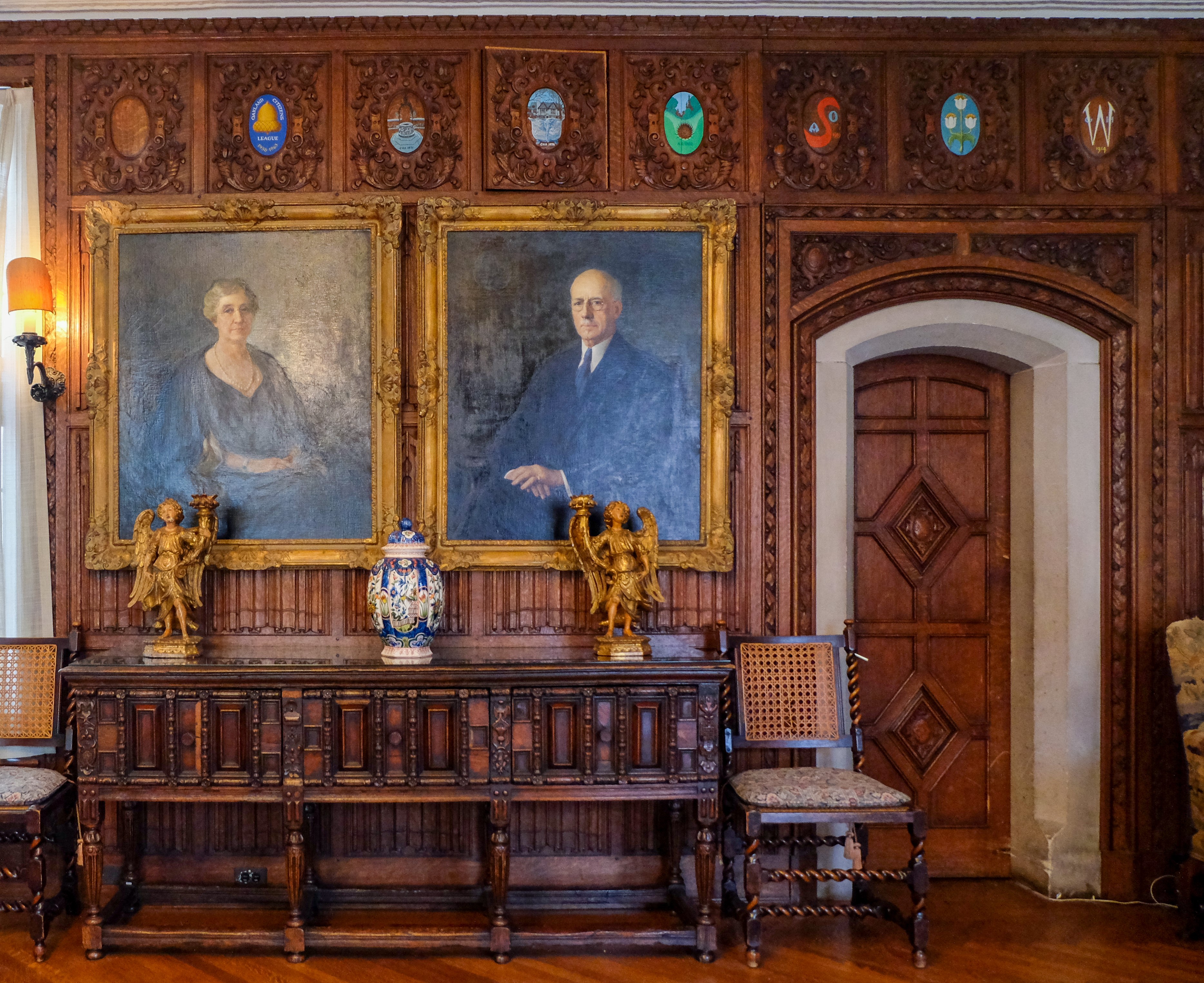
Cranbrook House Oak Room, photographed by Daniel Smith (CAA Architecture 2021), December 2020. © Cranbrook Center for Collections and Research

The Booths celebrated Christmas in the Oak Room that year, for the first and only time. A few years later, to commemorate the holiday, their youngest son, Henry Scripps Booth, painted a Christmas tree on one of the panels over the fireplace. Harry took advantage of the empty space at the center of the panel’s cartouche: a smooth, enclosed oval.
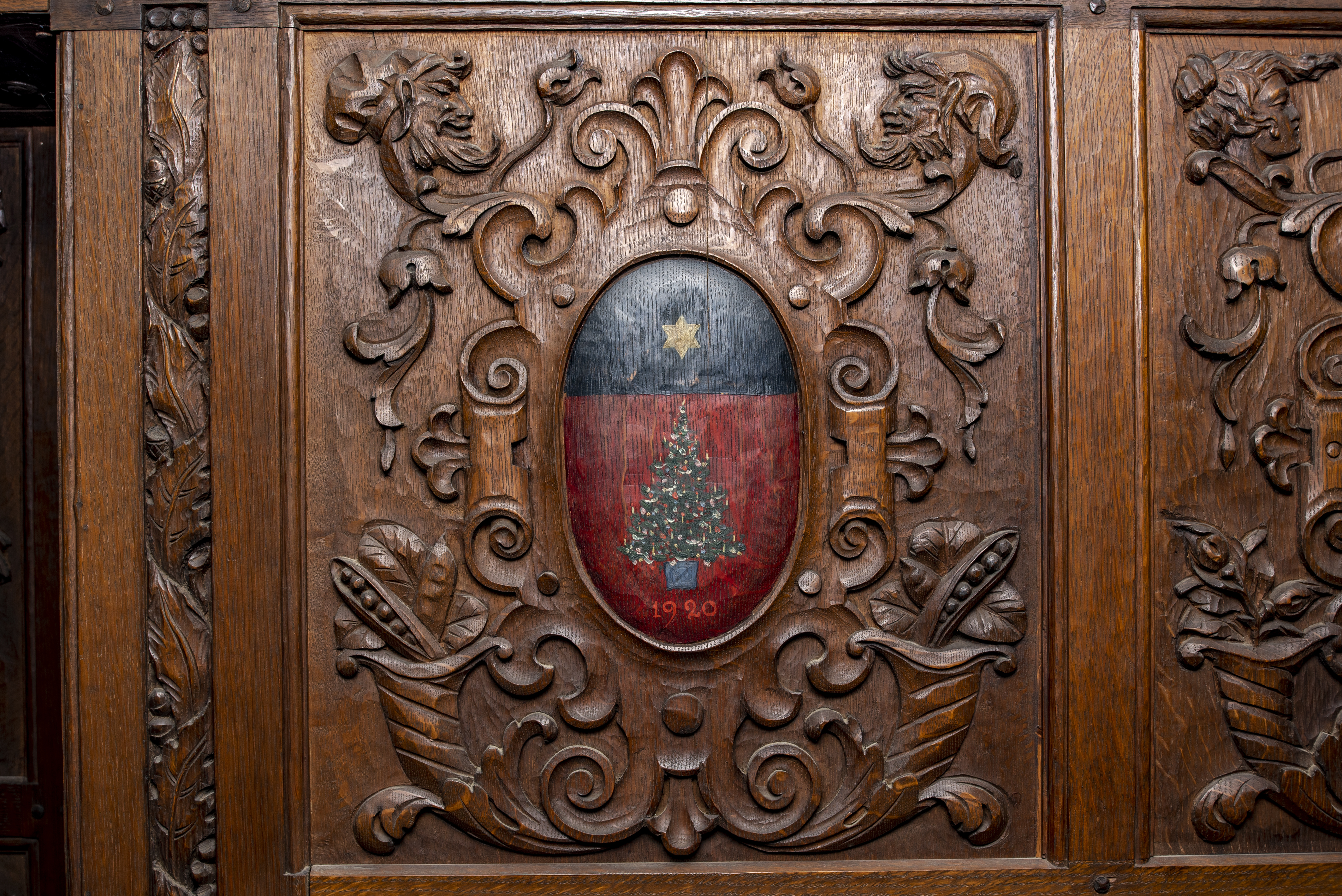
The first cartouche painting, November 2021. Photographed by Tryst Red (CAA Photography 2023). © Cranbrook Center for Collections and Research

The Christmas panel is one of the first five cartouche paintings (all added above the fireplace) designed and executed by Harry in 1922. Each commemorated events held at Cranbrook House in 1920 (Christmas) and 1921 (a Sigma Gamma Association picnic outing; an engagement party for Ruth Raymond to Norton Ives and Margaret Booth to Frazer Whitehead; Warren Booth and Alice Newcomb’s pre-wedding dinner; and Ellen Scripps Booth’s surprise 58th birthday party).
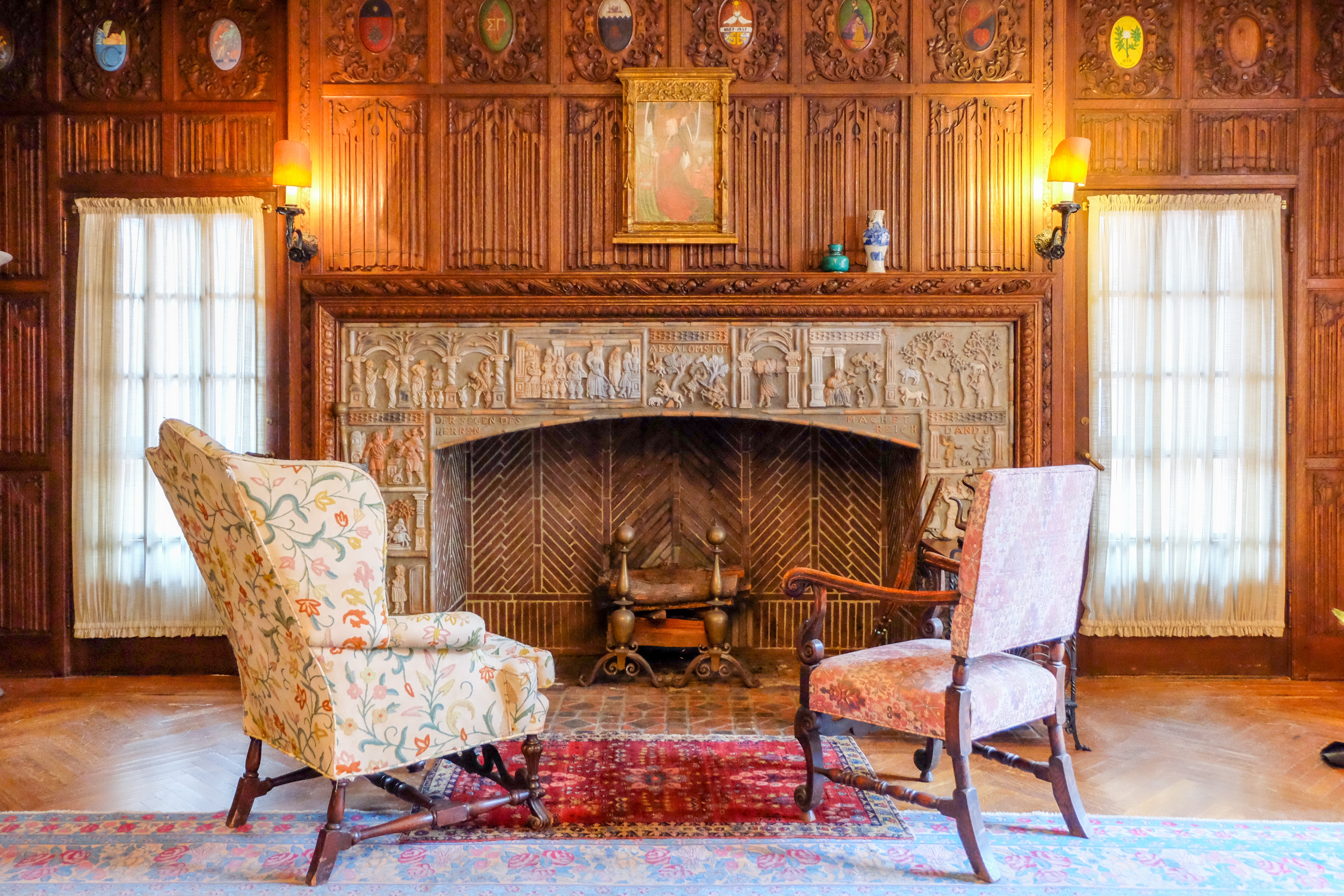
The cartouches over the Oak Room fireplace, photographed by Daniel Smith, 2021. © Cranbrook Center for Collections and Research

Over the following decades, Harry and artist friends or Academy students he recruited would paint in many more of the cartouche panels around the walls of the Oak Room. Those before the 1930s celebrate moments in the personal lives of the Booths at Cranbrook House. In following years, community initiatives, collaborations with national organizations, and the many achievements of the Cranbrook Foundation were commemorated with cartouche paintings. The tradition has continued through the generations.

Today, the Oak Room’s forty-one painted cartouche panels tell the story of Cranbrook’s evolution from a family estate to a globally-renowned center for art, science, and education. Most mark events that took place, entirely or in part, at Cranbrook House or in its gardens.

This past March, a new cartouche was painted in the Oak Room. The design was created and carried out by Corey Booth, the great-grandson of Henry Scripps Booth and an artist and animator. His portfolio of work includes The Powerpuff Girls and Rick and Morty.

The new cartouche celebrates the tenure and achievements of Cranbrook Education Community President Emeritus Dominic DiMarco, who served as President from 2012 to 2021.
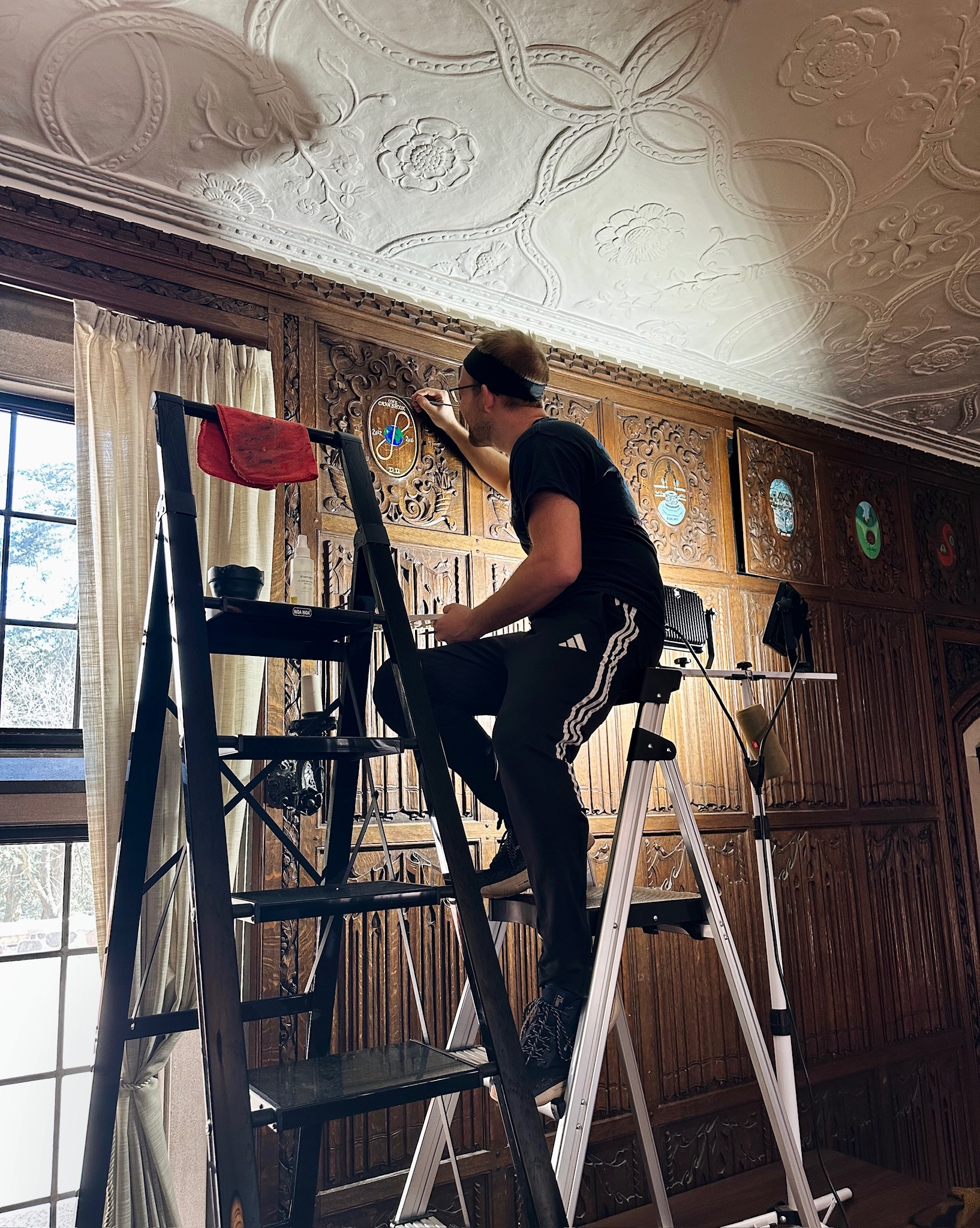
Corey Booth at work on the cartouche, May 2025, photograph by Amy Klein.
The finished cartouche, May 2025, photograph by Amy Klein.

Henry Scripps Booth set a precedent for representing the subject of a cartouche painting through oblique symbols, even visual puns. Thus, the message of Corey Booth’s cartouche is also encoded in the image. In the artist’s own words,  

A golden infinity symbol wraps around the Earth (passing over Cranbrook, Kent, England), signifying Cranbrook’s prestigious global impact extending beyond place and time. A shining golden star marks the Michigan institution on the globe, symbolizing the state’s connection to Cranbrook’s global influence. Seven distinct shines adorn the infinity symbol, representing the Schools, Academy of Art, Institute of Science, Art Museum, Center for Collections and Research, Horizons-Upward Bound, and House & Gardens Auxiliary – programs that empower students and professionals alike, contributing to Cranbrook’s continued positive global impact; One Cranbrook. This simple, yet effective, solution designed to represent that concept symbolizes the widespread contributions Cranbrook is able to make across the globe because of leaders like Dominic and the opportunities provided within those seven program areas.  

The motto, “One Cranbrook,” was a concept championed by President DiMarco in his work to unite Cranbrook’s program areas as one community defined by collaborative work and shared successes. Alongside the other forty painted cartouches in the Oak Room, Corey Booth’s work speaks to Cranbrook’s global impact, and its aspirational spirit. Collectively, they recall how far Cranbrook has come from its not-so-long-ago beginnings, and challenge us to imagine what future achievements might be commemorated on the Oak Room’s walls. 

Mariam Hale, 2023-2025 Collections Fellow, Cranbrook Center for Collections and Research

Curious about the other cartouches in the Oak Room? Visit my newly posted essays on each cartouche via https://cranbrook.emuseum.com/search/cartouche to read their stories and to discover many other objects in the Founders Collection at the Cranbrook Center for Collections and Research. 

You may also learn more on YouTube by watching our December 2021 Uncovering Cranbrook lecture, “Sign and Symbol: The Oak Room Cartouches,” by curator Kevin Adkisson and presented with Cranbrook House and Gardens Auxiliary docents.
Structural Engineering: Bridges of the Japanese Garden

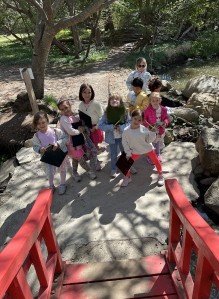
This spring, Dawn Straith, Innovation & Technology Specialist at the Vlasic Early Childhood Center & Cranbrook Kingswood Lower School Brookside, used the bridges in the Japanese Garden as a tool in her Design Thinking Unit with the Senior Kindergarteners. I asked Mrs. Straith to explain the project.

The Senior Kindergarteners exploring the Cranbrook Japanese Bridge (aka Red Wood Bridge) in the Japanese Garden, 2025.

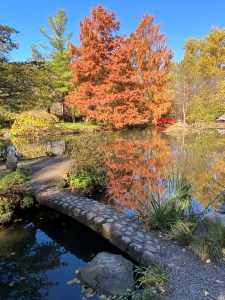
DS: In our design thinking and engineering unit, the Senior Kindergarten students became bridge investigators! They explored six different bridges in the Japanese Garden to see how safe and strong they are. While investigating, they discovered that bridges with beams and columns are much stronger than those without. They considered what goes over and under the bridges, who and what use the bridges, the materials the bridges are made from, and whether they had handrails. Some bridges didn’t have handrails at all, which we determined made them feel a bit less safe. They also noticed that the ground near a few of the bridges was eroding, which isn’t as safe either.

Side view of the Japanese Garden Round Island Footbridge.

DS: The bridge to “Round Island” (a small island the children have affectionately named for themselves as “SK Island”) got the lowest safety score—it’s tilted, there are no support beams, the ground is eroding, the materials used aren’t the strongest and there are no handrails to hold onto!

Japanese Garden Round Island Footbridge from the eastern shore of the Lily Pond. Photo by Saida Malarney.

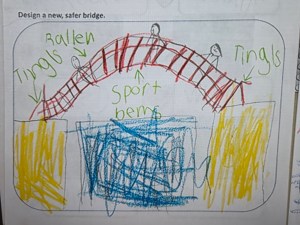
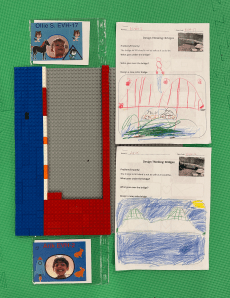
DS: After analyzing all this, the students got to work designing a safer bridge for “SK Island”. They learned that triangles are super strong shapes and that engineers use them all the time when building bridges. With their users in mind, the students carefully designed and built models of brand-new, safer bridges. Their final step is to share their ideas with the garden’s groundskeepers.

Round Island Bridge design, incorportating safety features like “rallens” and “sport beams.”

Enter the Center, the aforementioned “garden’s groundskeepers”!

I am the “Proud Museum Person” with some of our Japanese Garden volunteers working in the garden in April 2025.

As the Associate Registrar, and once-a-month “Gardener” in the Japanese Garden, I was invited to visit the SK classes as they presented their bridge models.

Most of my friends in SK had already helped cover garden sculptures for a number of seasons, so I knew they understood taking care of objects on the campus, but I was once again impressed by our students. They carefully considered what changes could be made to make our bridge safer for all visitors — kids, parents, guests with limitied mobility, and furry friends.

A very big THANKS! to our SK engineers.

Some of the students’ ideas even aligned with designs by our garden designer Sadafumi (Sada) Uchiyama, a third-generation Japanese gardener, registered landscape architect, and Curator Emeritus of Portland Japanese Garden.

Design for Round Island Bridge by Sadafumi Uchiyama.
Design for Round Island Bridge by Gretchen and Liam.

As we start the construction of the new Welcome Garden in the Japanese Garden this summer, we hope our future structural engineers will return in the fall to see how we are progressing.

Leslie Mio, Associate Registrar, Cranbrook Center for Collections and Research

Christ Church Cranbrook Groundbreaking Centennial

July 5th, 2025, marks one hundred years since the groundbreaking for Christ Church Cranbrook. As we mark this milestone in Cranbrook’s history, I believe it is important to reflect on George Gough Booth’s long discernment of this generous gift to the community.

From the beginning, there were always places of worship at Cranbrook. The story that leads us through these spaces to the establishment of Christ Church Cranbrook is especially meaningful to me.

Rev. Dr. S. S. Marquis, D.D. with the first spade of earth, July 5, 1925. Courtesy of Cranbrook Archives, Cranbrook Center for Collections and Research.

After George and Ellen Booth purchased ‘The Farm’ in January 1904, his father, Henry Wood Booth, was the first family member to live on the country estate. The elder Booth stayed for the month of May with Frank Brose, the farmer, and his family. On May 15, 1904, the first worship service at Cranbrook took place under a tent, on the site upon which the Altar of Atonement now sits, with Henry as lay preacher. He continued in this ministry, also offering Sunday School, at the same spot until 1909. This was the first act of service offered to the Bloomfield Hills community at Cranbrook.

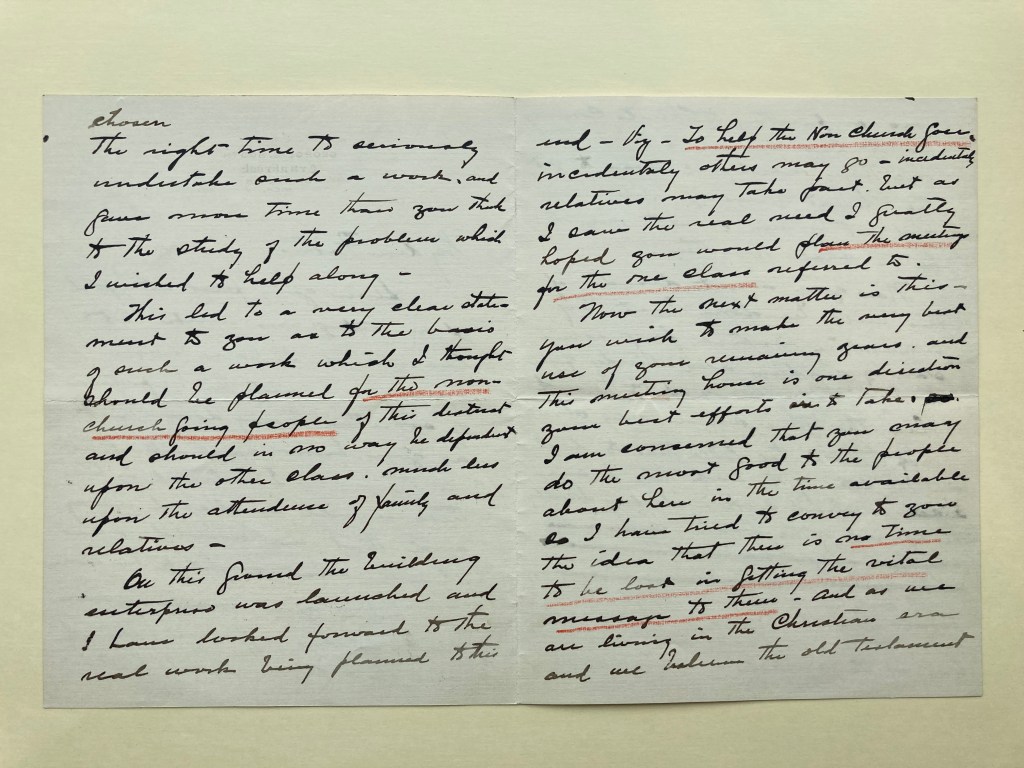
Letter from George Gough Booth to Henry Wood Booth, August 24, 1918. Courtesy of Cranbrook Archives, Cranbrook Center for Collections and Research.

In 1914, George and Ellen considered building a chapel at the site on which the Kingswood flagpole now sits, but the project was rejected, most likely due to the outbreak of World War I. As the war ended, a permanent place of worship and Sunday School was established with the building of the Meeting House.

The letter, above, preserves the dignity with which George writes of the Meeting House “building enterprise” to honor and give freedom to his father’s calling to share the Christ message with the non-church goers in the district. From this letter, we can learn and understand why George built the Meeting House for worship and Bible study through his father’s ministry.

Decoration of the Meeting House by Katherine McEwen, 1918. Laura MacNewman, photographer.

In the letter from George to his father, we also learn that he is prudent in observing the religious character of Bloomfield residents. During the years in which the Meeting House was used for religious services (1918-1926), Mr. Booth would reflect on the visiting clergy and service attendees (both of which came from diverse denominations), from which he would eventually discern the denomination of “Cranbrook church.”

Continue reading

Create a website or blog at WordPress.com