In addition to working as an Associate Archivist at Cranbrook, I am also a fledgling volunteer docent at Christ Church Cranbrook. Recently, I gave a tour of the Chancel to test my skills with my teachers. As I prepared, I found there was very little written about the history of the pipe organ at the church. So, where to turn for more information? Cranbrook Archives, of course.
In August of 1925, George Booth and Oscar Murray (of Bertram G. Goodhue Associates, the church architect), started in earnest to finalize their thoughts and feelings about the choice of organ for the church. While the organ itself was installed in January 1928, plans for its ducts and conduits had to be decided early, before the concrete floors were poured.
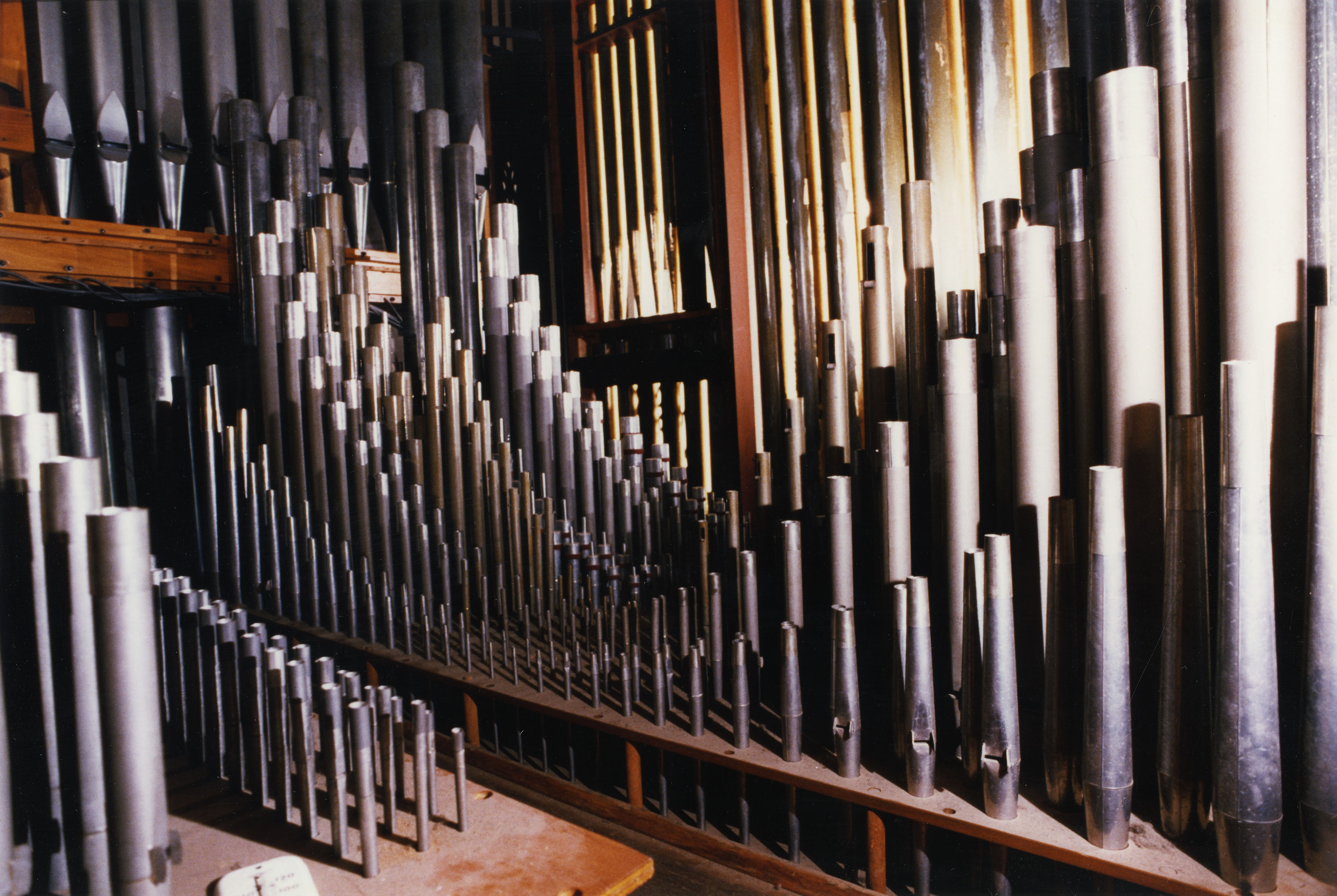
Christ Church Cranbrook organ pipes prior to the 1997 restoration. Jack Kausch, photographer. Courtesy of Cranbrook Archives.
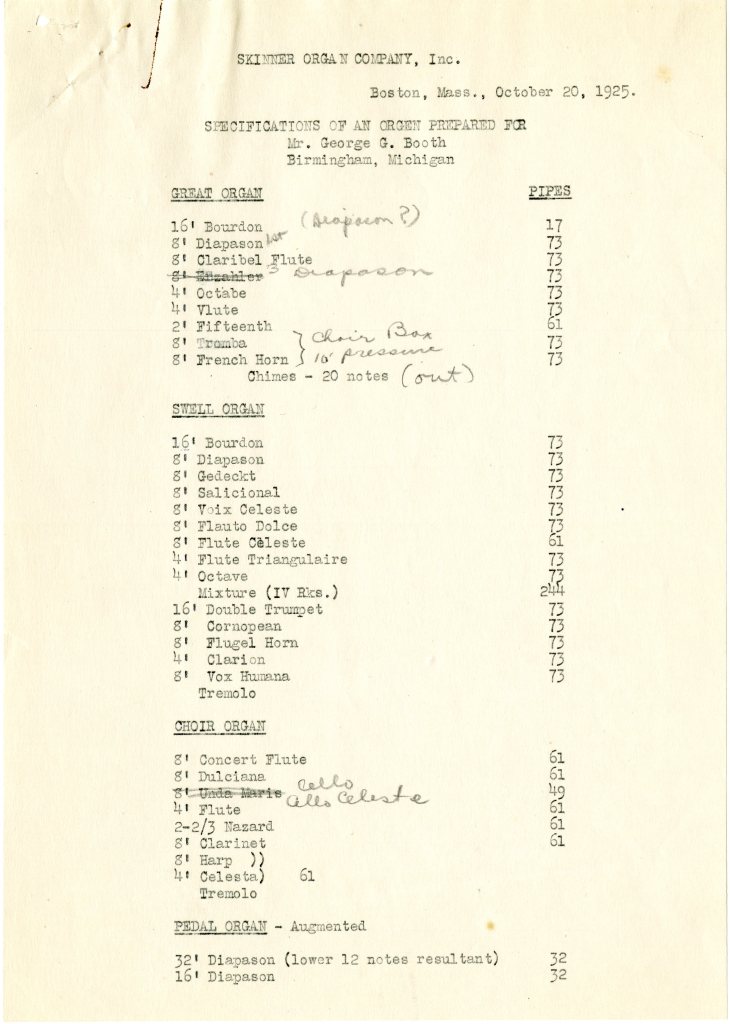
The correspondence suggests that the E.M. Skinner Organ Company was the only company considered. The Boston-based firm was considered America’s finest and most technologically advanced organ builder. Skinner’s specifications for the organ, console, and bench were submitted in October 1925.
George Booth inquired of his colleague Cyril Player to provide comments on the specifications, and Player begins his commentary saying,
“I think I would emphasize gently to them that you want gravity, dignity and softness—the three prime essentials of any church organ, large or small… [gravity] is secured by an adequate and properly-balanced pedal department; dignity by volume of foundation tone in the basic divisions of the instrument; and softness and refinement by skillful voicing with a copious wind stream at a moderate pressure.”
Cyril Player to George G. Booth, November 1925
In passing along the comments to Murray, Booth remarks that, “the desired qualities, viz; gravity, dignity and softness; seems to me peculiarly to express my own feelings and desire.”
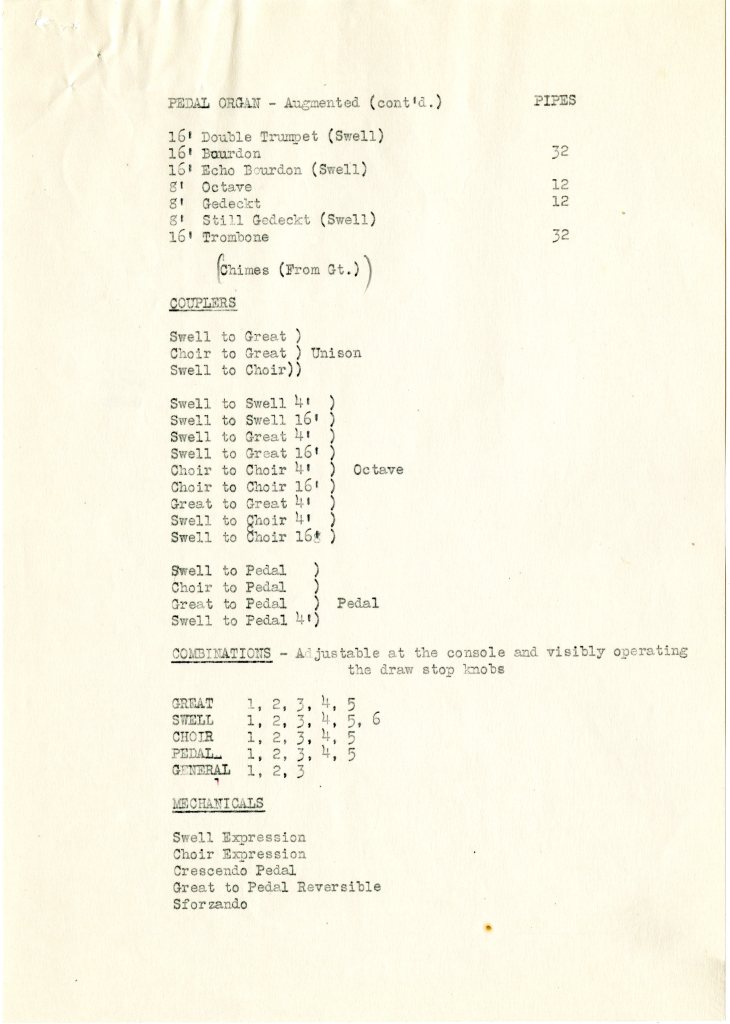
Skinner Organ Company Specifications for Christ Church Cranbrook Organ, October 1925. Courtesy of Cranbrook Archives.
William Zeuch of Skinner Organ Company revised the specifications following some of Player’s suggestions, while some revisions were the suggestion of Henry Willis, the great English organ builder who was a consultant to the firm. The contract for the organ (including the Great, Swell, Choir, and Pedal pipe divisions) was duly signed in December 1925 and work proceeded.
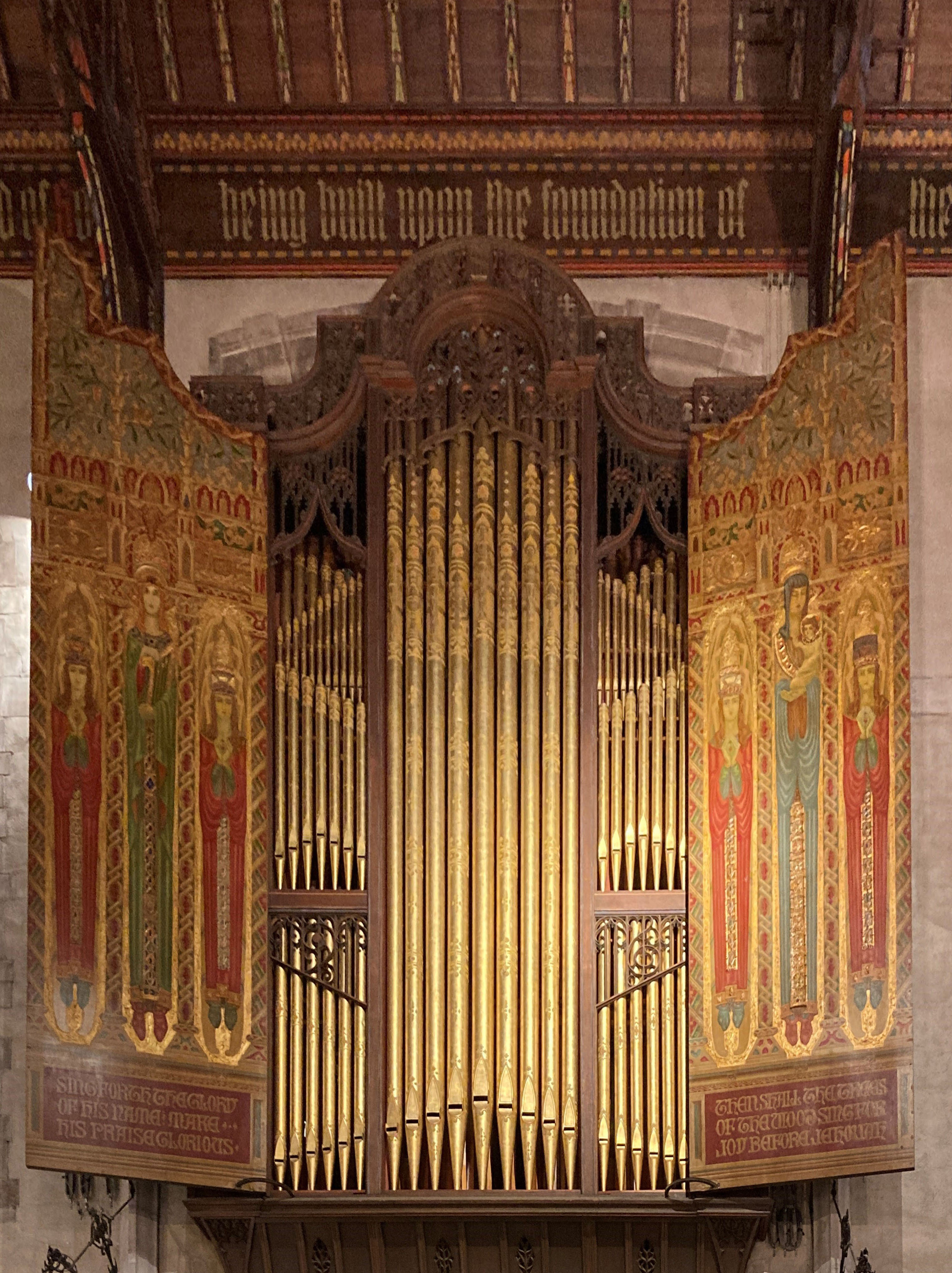
At the same time, a separate contract was made with Alfred Floegel to decorate the organ case doors. Booth wished to confine the oak finish to the exterior of the doors while having the rest richly decorated with color. Booth imagined the opening of the organ doors to represent the opening of the mind. He also envisioned the organ case to read as a triptych (a picture or altarpiece on three hinged panels) when open.
Organ case doors, woodwork by Irving and Casson, decoration by Alfred Floegel. Gift of James Scripps Booth. Laura MacNewman, photographer.
In July 1927, work on the organ console began. The console is where the organist sits to play the instrument, distinguished by its multiple hand keyboards (called manuals), pedalboard, and other controls. Rev. Dr. Marquis requested a change from a 3-manual (Great, Swell, and Choir pipe divisions) to a 4-manual, by adding the Solo division. Zeuch responded positively as it was not too late to build a 4-manual console; however, having already instructed the architect to reduce the dimensions of the organ chamber, which had been too large and would have interfered with the proper effect of the sound in the church, the architect would now need to find space for the Solo division. Room was found above the Sacristy.
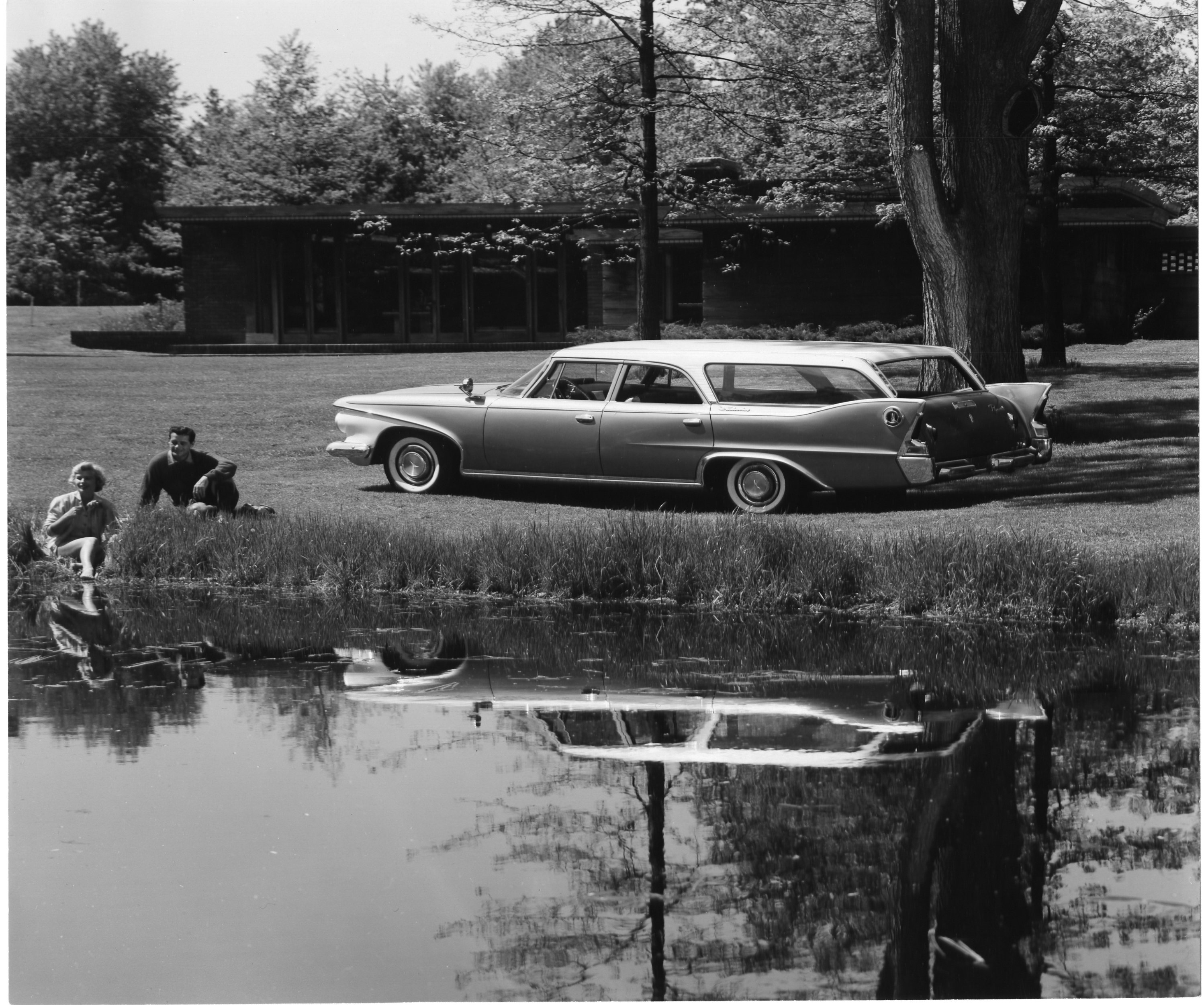
Oakland County is decked out in checkered flags this Friday for the annual Woodward Dream Cruise. As the crowds gather in their folding chairs and thousands of classic cars roar past my windows, I’m reminded of a much more serene image from automotive history: the 1960 Plymouth Suburban stretched out on the manicured lawn of the Frank Lloyd Wright Smith House.
1960 Plymouth Suburban, on location at the Frank Lloyd Wright Smith House. Smith Papers, Cranbrook Archives.
In 1959, Chrysler was developing promotional materials for the 1960 Plymouth. Seeking a sleek, modern backdrop for the long lines of the Suburban station wagon, Chrysler’s Public Relations Department contacted Melvyn and Sara Smith about staging a photoshoot at their Frank Lloyd Wright-designed home in Bloomfield Hills. The resulting photographs show the 18-ft long Suburban, not parked in the pea-gravel driveway or the distinctive cantilevered carport, but pulled to the back of the house where it could be reflected in the natural setting of the Smith’s newly expanded pond.
1960 Plymouth Suburban, on location at the Frank Lloyd Wright Smith House. Smith Papers, Cranbrook Archives.
The long, low horizon line of Frank Lloyd Wright’s Usonian architecture, with its stacking roof planes, seems a great fit for the station wagon’s extended style lines and characteristic fins. In a second image, two casually-dressed models (check out those long socks and walking shorts!) lounge in rattan Tropi-Cal armchairs on the living room patio. Designed by Danny Ho Fong, the Tropi-Cal armchairs were recently identified through the diligent research of the Center’s Summer intern Clare Catallo.
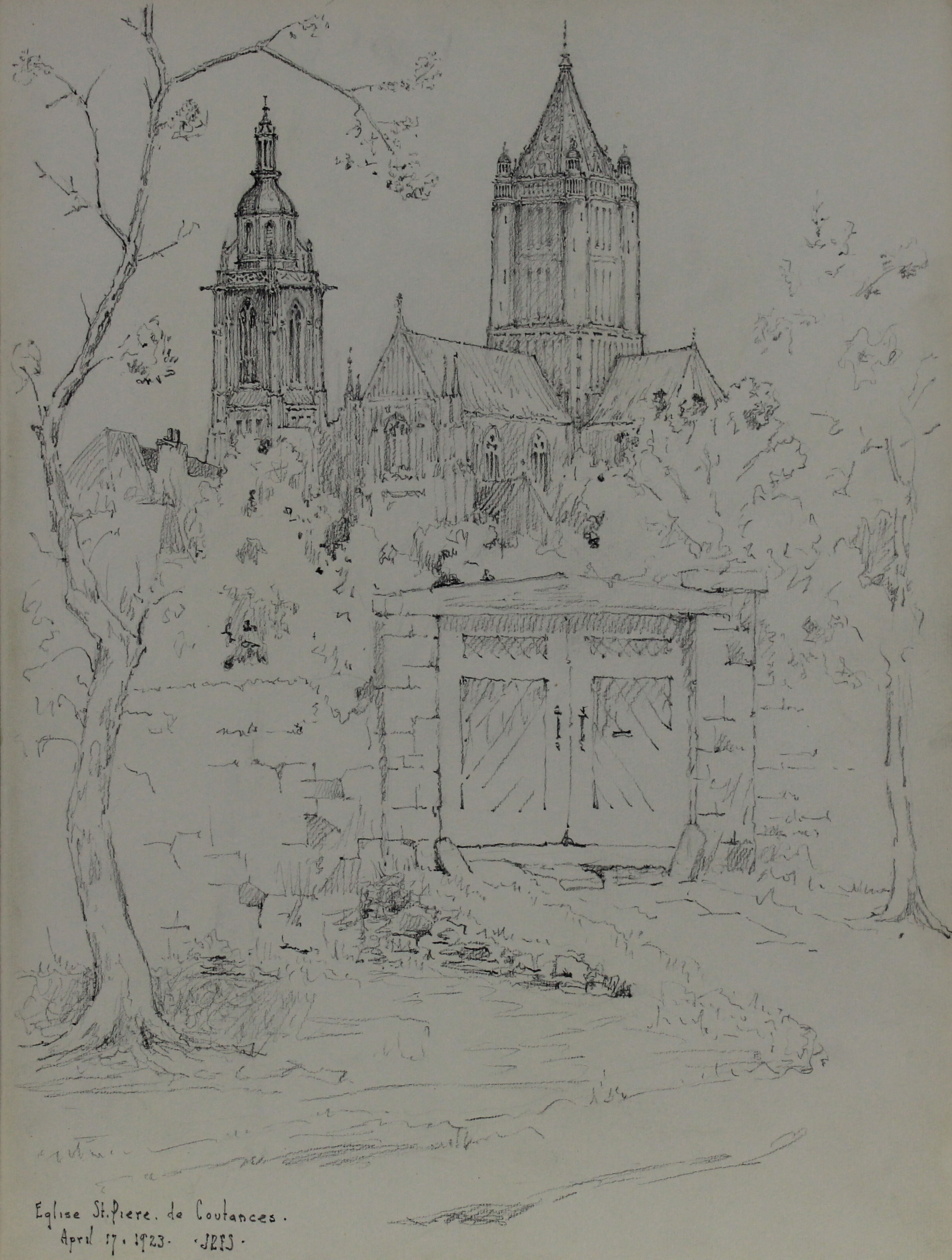
May 30, 2023, marks one hundred years since Henry S. Booth and J. Robert F. Swanson returned home from ten months of travel in Europe. Midway through their architecture studies at the University of Michigan, the friends and classmates set off on August 1, 1922 for a “Grand Tour” through Norway, Finland, Sweden, Denmark, Germany, Tunisia, Italy, France, and England to study and sketch European architecture.
In today’s post, I want to share moments from their journey through France, which is so beautifully documented by Henry’s letters and photographs, and by both of their sketches.
Eglise St. Pierre de Coutances, April 29, 1923, J. Robert F. Swanson. Courtesy of Cranbrook Art Museum.
Arriving in France in March 1923, Harry and Bob journeyed through Nice to Cannes, then through Lyon to the city of Bourges. Henry describes the scenery en route:
“…mountains on the right and the “Cote d’Azure” on the other, flowers overhanging balustraded walls, old olives and tall but easily climbed palms, rocks and breaking waves, and then always the bluest of skies and sea to match, and dazzling sunlight–quite warm and ‘drowsy’.“
At Bourges, they headed for the Cathedral, which they visited several times: at night by the light of gas lamps; in the afternoon sunlight; at dusk with a handful of worshippers on their knees; and then later that evening filled with the faithful.
Cathédrale St. Etiénne de Bourges, March 1923. Henry Scripps Booth, photographer. Courtesy of Cranbrook Archives.
“It was an inspiring sight—the nave packed, and both the inner and outer aisles (for there are two) on the north side filled also, and not a few on the other side of the church. The light was dim all during the sermon, and when that was over, a quantity of candles were lighted almost instantaneously about the “Host,” and all the electric candles down the nave came on, so that suddenly this great cathedral was changed from a imaginative forrest in the night, to a great cathedral church ablaze with the lights associated with a feast.
“But I thought more of other things than of the architecture that night. The preacher talked too fast for me to understand his French, but I knew what he should have been saying even if he wasn’t…, I looked at the great number of long black vails [sic] everywhere, noticed the lack of men of middle age, and saw many young fellows who are now “heads” of their father’s family standing by their veiled mother’s side.”
They stopped in Tours before taking in the Chateaux of the Loire: from Loche to Langais, Ussé, Villandry and Azey.
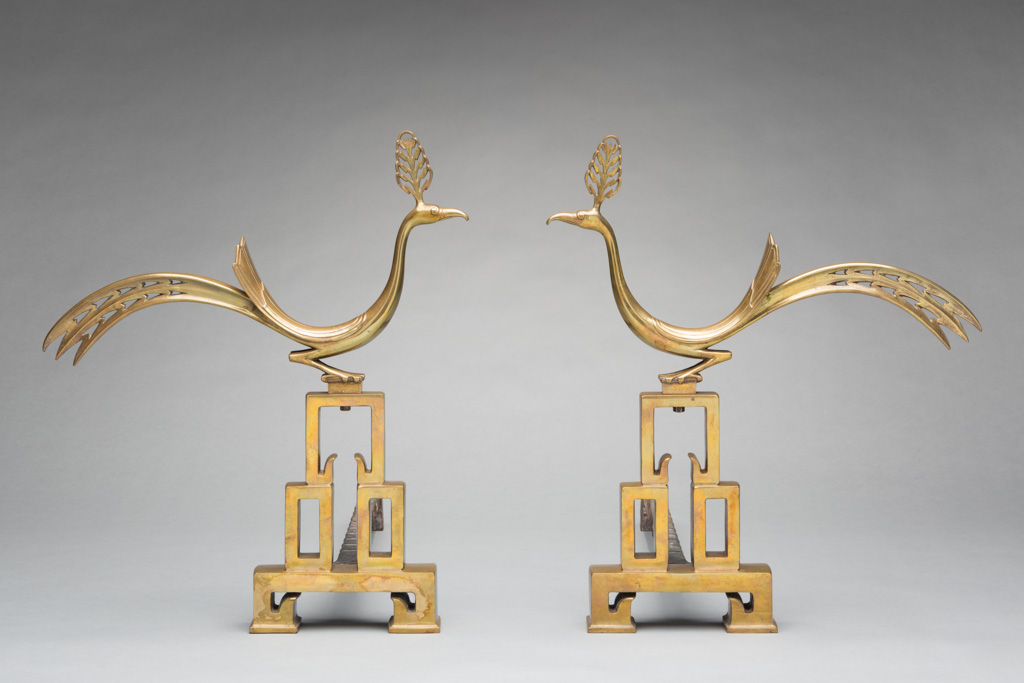
From the moment I entered Saarinen House twenty-seven years ago to give my first public tour, to my upcoming presentation for the Kingswood Middle School for Girls Explore Cranbrook students, I remain . . . simply enthralled. No more so than by the vibrant Peacock Andirons gracing the living room hearth.
Eliel Saarinen’s cast bronze Peacock Andirons, 1928-29. Each 21-1/4” W x 22-3/8” H x 27-1/4” D. Collection of Cranbrook Art Museum, CAM1985.2 a-b. Robert Hensleigh, photographer.
Designed by Finnish-American architect Eliel Saarinen and produced by Sterling Bronze Company, New York between 1928 and 1929, these cast bronze andirons were paid for by the Cranbrook Foundation and entered in the 1928-1930 Arts & Crafts Building ledger on pages 40-41 (third line from the bottom)—Date: 1-7-30; No.: 515; Name: Sterling Bronze Co; Remarks: 1 pair/ Andirons for Saarinen Res[idence]; Amount: $152.50 (the equivalent of $2,631.50 in 2023).
Arts & Crafts Building ledger, 1928-30. Laura MacNewman, photographer, 2023. Cranbrook Archives.
The pair of birds are fabulous. Ready and alert, they face each other, ankles bent, balanced upon splayed toes.
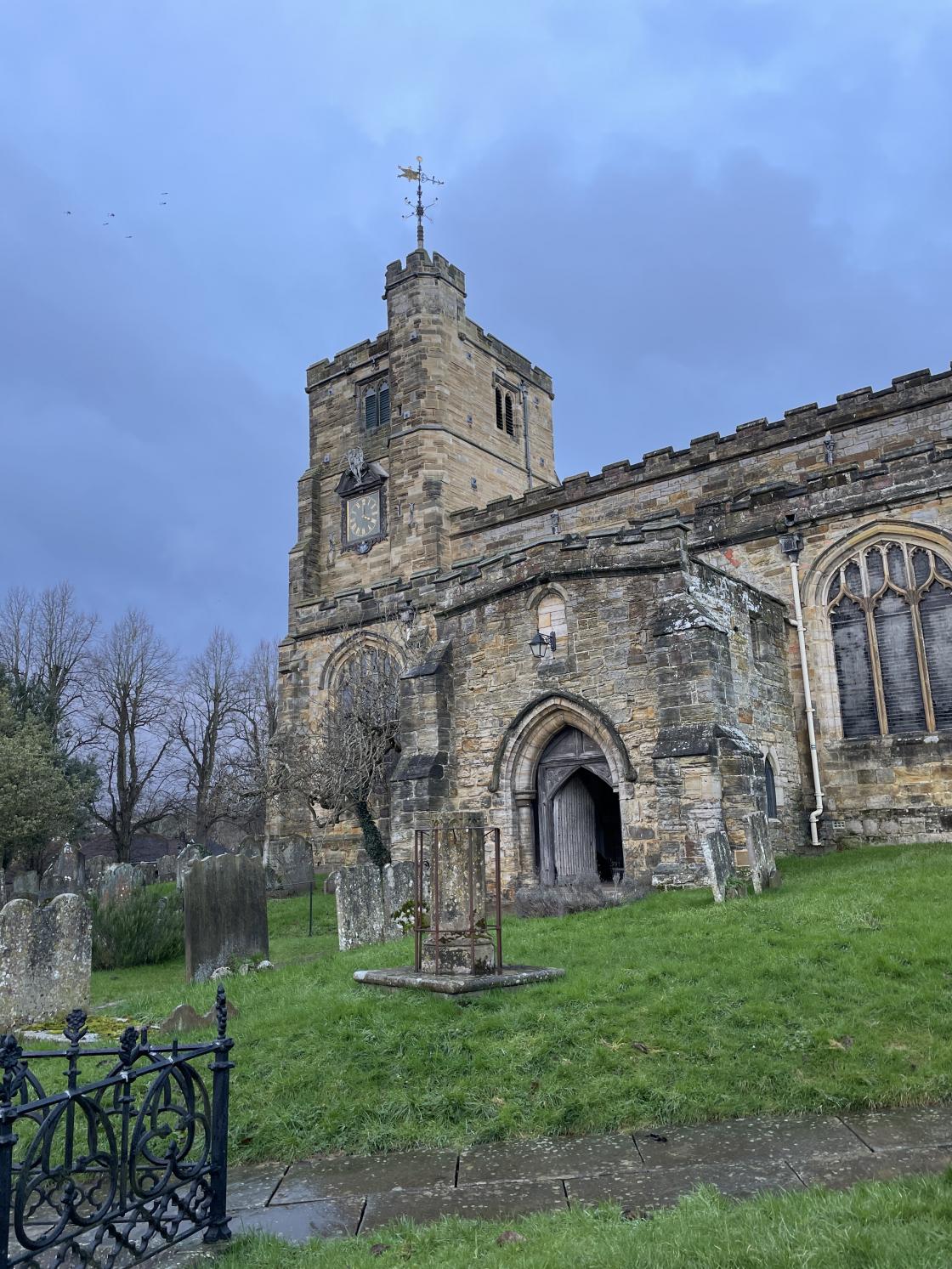
When I was asked to gather archival materials related to Cranbrook in Kent, England, a short series of correspondence in the Henry Scripps and Carolyn Farr Booth Papers particularly caught my notice. Written to Henry Scripps Booth, the letters discuss a stone from St. Dunstan’s Church in Cranbrook, Kent, and its overseas delivery to Christ Church Cranbrook. I became quite curious about it.
Carved coign from St. Dunstan’s Church, Cranbrook, Kent, at Christ Church Cranbrook. Laura MacNewman, photographer. Courtesy of Cranbrook Archives.
One handwritten letter in the correspondence was rather difficult to decipher, but once I got the pattern of it, it helped me begin to comprehend the story.
In July 1930, St. Dunstan’s Vicar, Rev. Swingler, acknowledged a request from Booth for a fragment of the church which could be placed in the chapel of the same name at Christ Church Cranbrook.
It was July 1931 before Rev. Swingler wrote again to inform Booth that the stone was ready for dispatch. He explained that the Church Council had welcomed the idea and directed the Fabric Committee to select a stone, which they had, but that the Secretary had forgotten to inform Booth until then, a year later, and it was already on its way!
Letter from Rev. Swingler to Henry Scripps Booth, July 22, 1931. Courtesy of Cranbrook Archives.Letter from Rev. Swingler to Henry Scripps Booth, July 22, 1931. Courtesy of Cranbrook Archives.Letter from Rev. Swingler to Henry Scripps Booth, July 22, 1931. Courtesy of Cranbrook Archives.
The forgetfulness of the Secretary and finding appropriate shipping arrangements for such an unusual commodity had caused quite a delay, to which Rev. Swingler writes,
“I am sorry that the matter has not been dealt with more speedily but old Cranbrook has hardly yet learned modern methods of business, as perhaps you know.”
St. Dunstan’s Church, Cranbrook, Kent. Kevin Adkisson, photographer. Courtesy of the Center for Collections and Research.
He goes on to describe the provenance of the stone, at least as far as he could tell. A fifteenth century carved coign (an architectural term for a “projected corner”), it once formed part of the string course (a projected band of stone) which runs at the base of the battlements of the church nave. The course includes a series of grotesque heads, some of which were pierced for waterspouts. A grotesque, common in medieval church architecture, is a decoratively carved stone used to ward off evil spirits and to signify the sanctuary and safety of the church. On inspecting an historic photograph of the church, I could identify similar stones at the top of the drainpipes and around the tower battlements.
St. Dunstan’s Church, Cranbrook, Kent, July 1901, with grotesques in situ. Courtesy of Cranbrook Archives.
Rev. Swingler had first seen it laying in the churchyard and surmised that it had not been replaced during past repairs. He doesn’t mention why they selected that particular stone, but one could conjecture that it was because it was no longer part of the fabric of the church building and hence was available to be gifted to Christ Church. He notes that it is probably of Hartley stone, which was quarried in the Parish.
Henry Scripps Booth contributed great efforts to building relationships between the old and new Cranbrooks by establishing and maintaining connections between the two churches. The grotesque that arrived at Christ Church more than 90 years ago is an artifact that tells just one story of his efforts. From St. Dunstan’s of old Cranbrook, known as the “Cathedral of the Weald,” to St. Dunstan’s of Christ Church Cranbrook, the carved coign continues to herald sanctuary and give confidence to those who enter.
–Laura MacNewman Associate Archivist, Cranbrook Center for Collections and Research
The clerestory windows designed by G. Owen Bonawit in the nave of Christ Church seem to be one of the least described elements of the church’s artwork. The work was negotiated and subcontracted through architect Oscar H. Murray at Bertram Grosvenor Goodhue Associates rather than commissioned directly through George G. Booth. Consequently, there are few documentary vestiges of the artist’s process in our records.
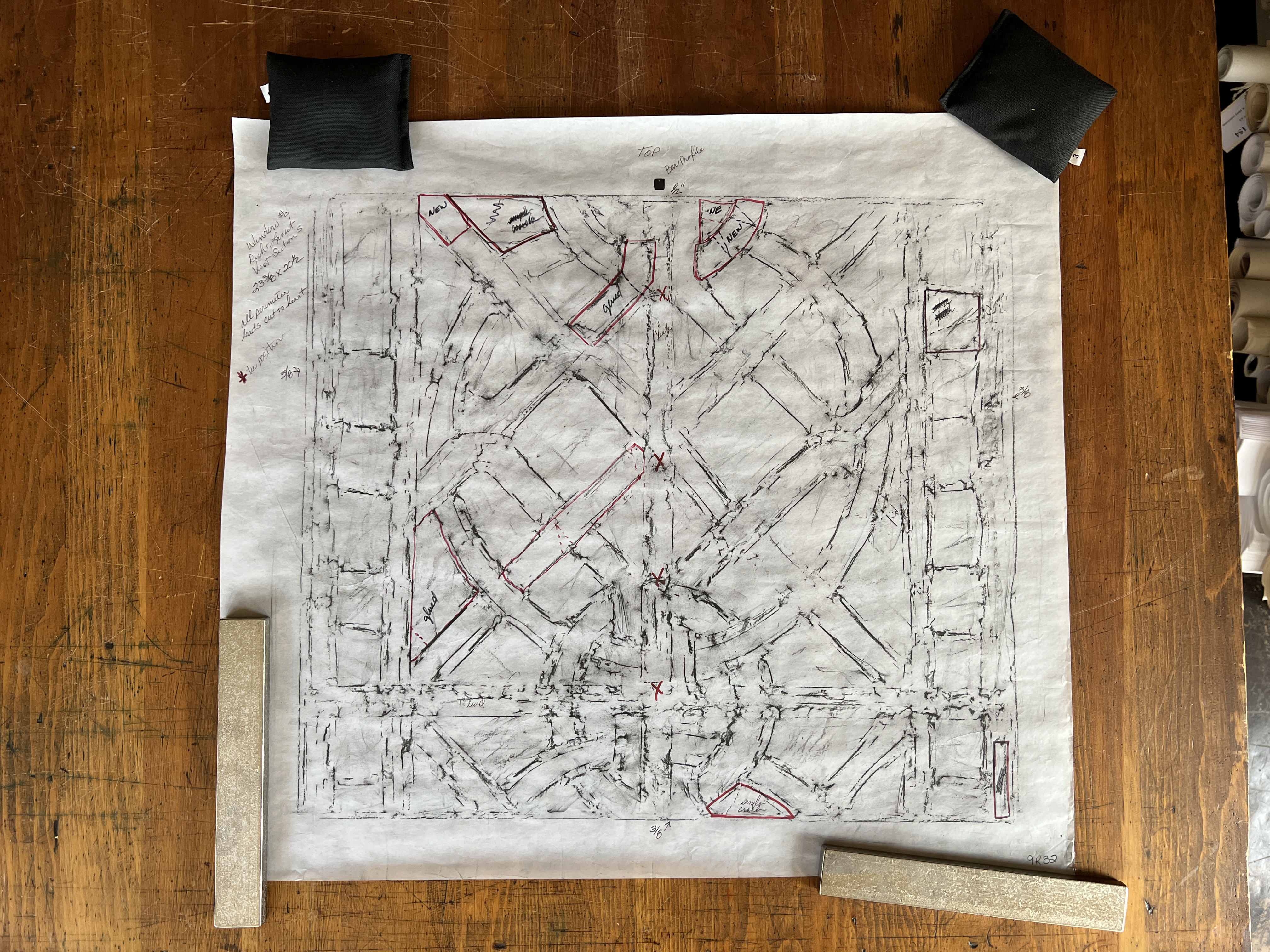
The windows can be studied through other materials held by the Archives, including architectural drawings, photographs, and the records of a window restoration project which commenced in 1993. In 1995, the Thompson Art Glass company made rubbings of the window for the purposes of identifying their care and preservation needs.
Window rubbings by Thompson Art Glass made June 19, 1995. Courtesy of Cranbrook Archives.
There are seventeen grisaille clerestory windows in the nave and chancel at Christ Church, which were analyzed as part of this stained-glass restoration project. They are made of clear antique glass upon which minute floral detail is painted and accentuated by the addition of small amounts of colored glass. In the chancel, there are two lancets and tracery of nine panels supported by T-bars including one ventilator panel. In the nave, they are comprised of three lancets and tracery with eight panels, with ventilator panels making up the bottom row.
Detail from Architectural drawing of Christ Church Cranbrook, North Elevation. April 30, 1925. Drawn by J.E.M./Oscar H. Murray, Bertram Grosvenor Goodhue Architects. [AD.10.33]. Courtesy of Cranbrook Archives.
Grisaille, literally meaning ‘to grey,’ is a type of stained glass that is mostly monochromatic, with a silver or grey tone being painted onto the finished glass. The purpose of the plainness of grisaille is twofold: they let more light into the space both literally and metaphorically in that they were intended to limit distraction from meditation.
The grisaille stained glass style is thought to have originated in French Cistercian abbeys after a prohibition on colored glass issued by St. Bernard of Clairvaux in 1134 in accordance with their charism of simplicity. St. Bernard, the master of paradox, also banned the use of figurative decoration according to the First Commandment of no graven images. Under his guidance, the Cistercians seek the face of God, a theological anomaly that produces an exquisite spiritual discipline and religious practice through which the monk contemplates holiness by virtue of continually recognizing the poverty of their thoughts and feelings when weighed down by seeking to satisfy worldly desire. The style often employs natural or geometric patterns, much like a labyrinth.
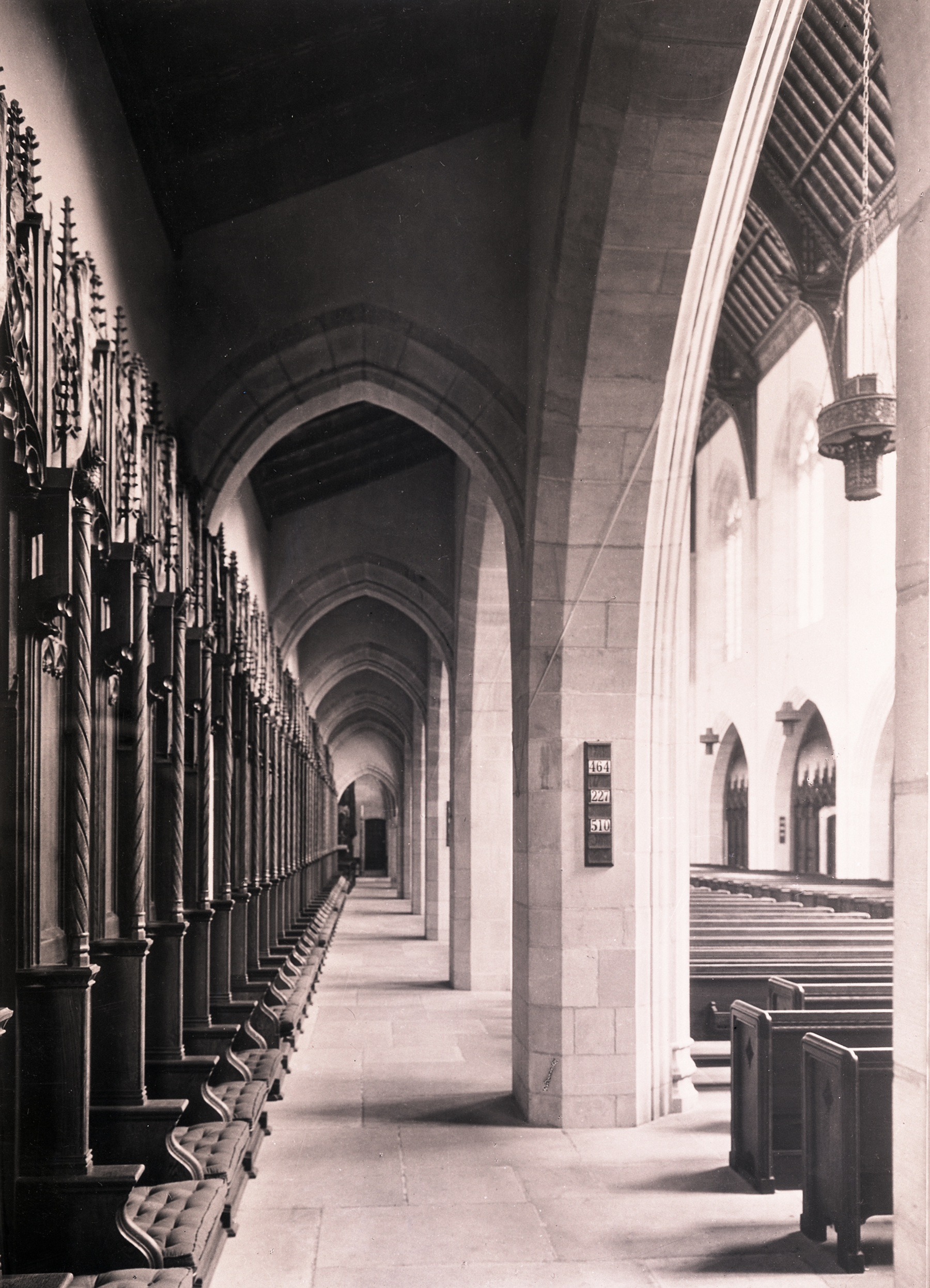
The windows can best be observed by sitting in the aisle stalls of the nave, which are in themselves an unusual feature otherwise only found in Oxford college chapels. The walls of the nave were originally intended to display memorials and artwork, but the latter idea was revised due to the objection that it would bring a museum feel to a house of worship.
Aisle stalls in left side of sanctuary. June 23, 1946. Photographer, Harvey Croze. Courtesy of Cranbrook Archives.
Added in 1930, the aisle stalls offer a fine perspective from which to observe the grisaille, and Bonawit’s elegant craftmanship brings with it a history of monastic inspired light. Since a life without beauty is only half lived, the artistic eclecticism of Christ Church offers all those who enter the opportunity to embrace the other half both in its resplendency and in its simplicity.
– Laura MacNewman, Associate Archivist, Cranbrook Center for Collections and Research
With Laura MacNewman’s Kitchen Sink blog entry of May 2019 serving as an excellent guide to the Women’s Window of Christ Church, Cranbrook, it seems worthwhile to take a more detailed look at the individual panels.
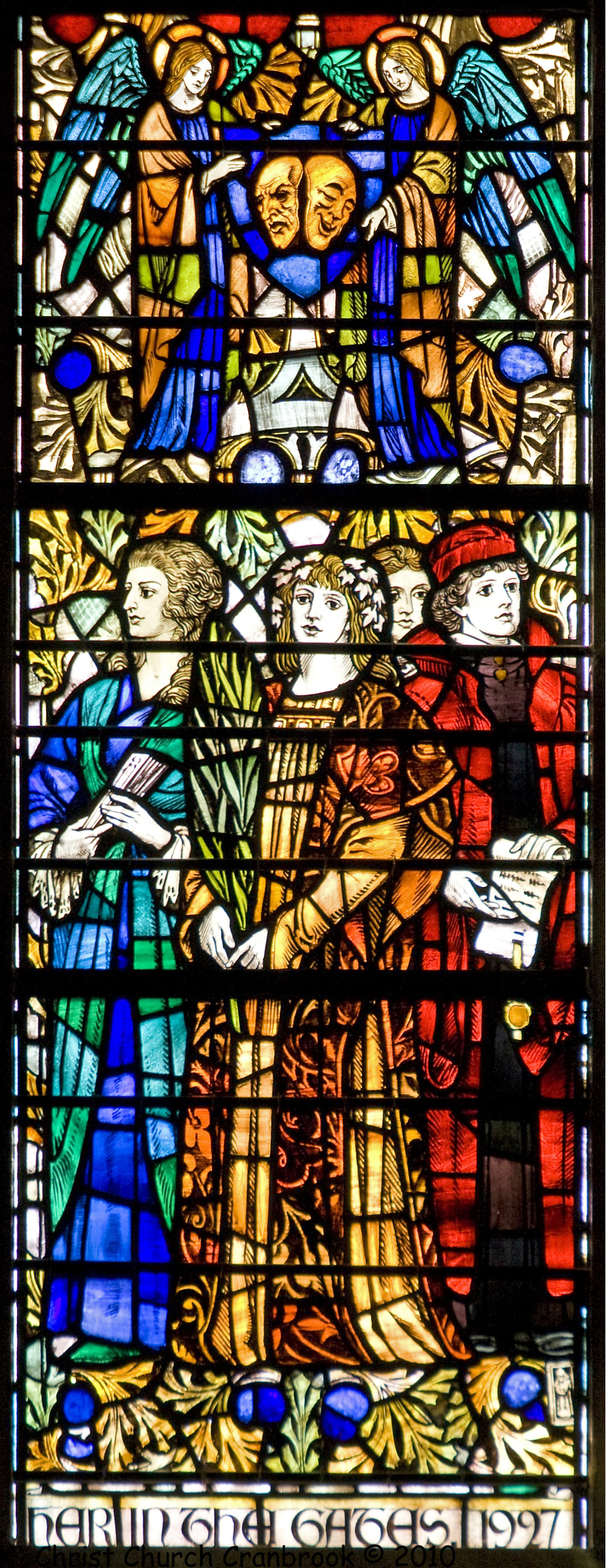
Panel 16, Actresses: Sarah Siddons (English, 1755-1831); Sarah Bernhardt (French, 1845-1923); Mary Anderson (American, 1859-1940); Ellen Terry (English, 1848-1928). Tom Booth, photographer. Copyright Christ Church Cranbrook 2010.
Though the window was the gift of Florence Booth Beresford and her husband James, the choice of women to be included was made by the Reverend Samuel S. Marquis, the first rector of the church. What is intriguing is how or why the Rev. Marquis chose the women who appear. Since no documentation has yet come to light, we can only look at who the women are as well as how they are depicted. Marquis aimed to cover mostly western culture through the ages up to his present day, the 1920s, and clearly was choosing exemplary members of the categories. Thus, we find that the actresses under study here, except for one, are well-known to this day in the French and English-speaking world.
The profession of actress almost until the present has had a bad reputation. A woman was not supposed to put herself on display or seek approval. Odd then that the quotation from Proverbs 31:28, 31 enters the window as the dedication to women: Her children rise up and call her blessed … and her works praise her in the gates. These works would not include appearing on stage or screen.
Shakespeare’s women were played by young men who aged out of the roles into male leads if they were lucky. The comedic role where the young female lead must disguise herself as a man then becomes an interesting part to watch, especially if the young actor, appearing as a young woman, must pretend to be man playing a woman as in As You Like It.
The first woman to appear on the English stage in her own right was reputedly Margaret Hughes in the role of Desdemona in 1660 after the restoration of Charles II. Our window’s first actress (from the left) is the Welsh actress Sarah Siddons, born 1755, older sister of the great John Kemble and aunt of also great Fanny Kemble. Siddons was a tragic actress, scorning comedy as buffoonery beneath her talents. Her great roles were Lady Macbeth and Volumnia from Coriolanus. These are two of Shakespeare’s nastiest ladies, beloved of actresses everywhere. As critic William Hazlitt said of Siddons, “Passion emanated from her breast.”
Stuart, Gilbert; Sarah Siddons, nee Kemble; National Portrait Gallery, London.
She was possibly the first actress superstar of the modern world, so famous she was painted by all the great portraitists including Gainsborough and our own Gilbert Stuart. All the paintings, even the stained-glass version, show off her famous Kemble nose.
The next actress is Sarah Bernhardt born in 1844 in Paris to the Dutch mistress of an aristocratic lover who sent young Sarah off to the Paris Conservatoire, then a partly government-sponsored school of acting. Bernhardt graduated into becoming a member of the Comédie-Française, where she found the techniques old-fashioned. Always a tearaway, she was dismissed for slapping a senior actress.
Bernhardt did not need the national theater to become one of the most famous actresses of all time. She was an exceptional self-promoter and entertained all the society men of her age, numbering the future Edward VII of England and Victor Hugo amongst her lovers. She had a mass of wild hair, big blue eyes, perfect teeth, and with her good looks and purity of diction and a voice variously described as silvery or golden she attracted enormous crowds to any theater. She made Victor Hugo cry in a performance of one of his own plays.
Sarah Bernhardt as Hamlet, June 1899, by James Lafayette, Library of Congress Prints and Photographs Division Washington, D.C.
Her roles were again mostly tragic playing Cordelia in Le Roi Lear, Hamlet, Desdemona, Joan of Arc, Racine’s Phèdre. Her offstage behavior was just as spirited; she slept in a coffin to prepare for roles and abandoned the corset.
She founded her own theaters, toured the United States nine times, toured the world, built and worked in a hospital in World War I, played a young man of twenty when she was fifty-five, took on all the great tragic roles, faced, fought and surmounted anti-Semitic slurs all her life, appeared in silent films and melodramas. She lost a lung, a kidney, a leg but still trod the boards.
Bernhardt incarnated the French wife of an English artist in Detroit in the play The False Model on November 25, 1916, but there is no record of any Booths attending.
Next is English actress Ellen Terry, born in 1847, contemporaneous with Sarah Bernhardt, but not the quite the world player. Beautiful Terry, teenage actress and the artist’s model, married pre-Raphaelite painter G.F. Watts but went off to live with architect-designer Edward William Godwin where she caught the eye of renowned actor Henry Irving. Irving sought luxurious stage settings and a beautiful actress to complement his own great talent. In addition to appearing in all the great female roles of Shakespeare and more humble parts, Terry entered into a lively correspondence with George Bernard Shaw who cast her in roles he had written for her.
The unrivaled team of Irving and Terry lasted 24 years. Even today, to be able to say that your great-great grand relatives had seen them onstage together is still impressive. Terry and Irving appeared in Detroit 25 through 27 January 1900. We find in Ellen Scripps Booth’s diary for Friday, January 26: “I went to see Irving and Terry tonight in Robespierre.” Mrs. Booth makes no comment on Terry’s performance of loving wife Clarisse, but the Detroit Free Press of the next day praised Terry for her “characteristic grace” and “personal charm” in a not very demanding role. There were many curtain calls.
The “half” actress who owns the little face inserted between Bernhardt and Terry is Mary Anderson, born 1859, the American tragedian here, who also took on comedic roles. Her claim to fame was playing two parts (Perdita and Hermione) in Shakespeare’s The Winter’s Tale which bought her great acclaim. Audiences raved over her, while critics appreciated her beauty but found her lacking in feeling. By contrast with the others her star burned for a much shorter time. She toured extensively but withdrew from the public eye in 1889 due to exhaustion and the offer of marriage and a home in England.
Stained-glass artist James Hogan’s pre-Raphaelite influence can be seen in the depictions in the window, but he is not copying from any standard image. Siddons appears in one of her classical roles, Bernhardt as Phèdre, and Terry in her signature red lawyer’s robes as Portia from the Merchant of Venice playing a man.
What unites these women is their ability to stand up and be counted as women of talent at a time when they were more regarded as curiosities. Of the three greats, not one of them had a happy love life. Two of them famously had children out of wedlock and all three were regarded as unworthy by the men who should have revered them. All three nineteenth-century actresses played the roles of men. Considering their unconventional lives, it is surprising perhaps that Rector Marquis chose them, but then all the women in the window were unusual because they stood out as pioneers in some way. Who was the most famous? From the 1870s on there were two well-known women: Queen Victoria and Sarah Bernhardt, in no particular order.
– Lynette Mayman, Collections Interpreter, Cranbrook Center for Collections and Research
Melvyn and Sara Smith filled their Frank Lloyd Wright-designed home with a fascinating mixture of objects. Over three decades in the house, they collected everything from finely crafted ceramics, handwoven textiles, and original sculpture to the kinds of reproductions one might find in a museum gift shop. This eclectic blend of mass-produced décor and unique art objects can be seen on the hallway shelves, where two sets of plates demonstrate two very different engagements with the artistic legacy of Frank Lloyd Wright.
Gallery shelves in the Smith House hallway, November 2021. Photograph by Nina Blomfield, Cranbrook Center for Collections and Research.
The center shelf displays a reproduction of the dinnerware used in the cabaret of the Imperial Hotel, Tokyo. The Imperial Hotel was a monumental project, commissioned in 1916 and completed in 1923. Frank Lloyd Wright conceived the hotel as a total aesthetic environment, a space in which all decoration was unified: from the carved Oya stone of the exterior structure all the way down to the coffee pots and sugar bowls on breakfast tables. Famously, the structure survived the Great Kantō earthquake of 1923, although it was not completely undamaged as Wright proclaimed.
Frank Lloyd Wright, manufactured by Noritake Porcelain Company, Place Setting for the Imperial Hotel, 1979 (designed c.1922). Photograph by Nina Blomfield, Cranbrook Center for Collections and Research.
The porcelain cabaret service was designed by Wright and manufactured by Noritake Porcelain Company. Its pattern served both an aesthetic and practical purpose. The floating bubbles not only reinforced the festive atmosphere of informal cabaret dining (Wright had designed more conservative gilt porcelain for the banquet hall), the red circle at the lip of the teacup would also conveniently disguise any inelegant lipstick marks. Noritake produced replacement pieces for the hotel while the service was in use and continued to reissue the original designs for sale to consumers.
Books from the Smith Collection, from left: Frank Lloyd Wright, The Japanese Print: An Interpretation. New York: Horizon Press, 1967; Cary James, The Imperial Hotel: Frank Lloyd Wright and the Architecture of Unity. Rutland, VT: Tuttle, 1968; Newspaper clipping of Ada Louise Huxtable, “Anatomy of a Failure,” The New York Times, March 17, 1968, p.35. Photograph by Nina Blomfield, Cranbrook Center for Collections and Research.
By 1968, the original design for the hotel had been significantly compromised and the building was demolished to make space for an expansion. Cary James captured the hotel in its final years in his book The Imperial Hotel: Frank Lloyd Wright and the Architecture of Unity. The Smith House library includes this volume and, slipped inside the front cover, a clipping from Ada Louise Huxtable’s New York Times article “Anatomy of a Failure,” a lament of the hotel’s destruction.
Imperial Hotel teacup showing “The Oak Park Collection 1979” mark. Photograph by Nina Blomfield, Cranbrook Center for Collections and Research.
In the late 1970s, architect and Frank Lloyd Wright scholar Thomas Heinz began selling Wright furniture designs and reproductions of the Imperial Hotel porcelain. Although produced by Noritake, the original manufacturer, the legitimacy of the reissued dinnerware was contentious, and the service was the subject of lengthy legal disputes between Heinz and the Frank Lloyd Wright Foundation. The Smith Noritake is from “The Oak Park Collection,” dated to 1979. As a mass-produced reproduction issued a decade after the Hotel’s demolition, the acquisition of the service gives a small glimpse into the Smiths’ devotion to everything Frank Lloyd Wright. Along with copies of work by Marc Chagall and Auguste Rodin in the Smith House collection, the Imperial Hotel dinnerware speaks to a mode of collecting that was perhaps less concerned with authenticity than with aesthetic appeal and personal taste.
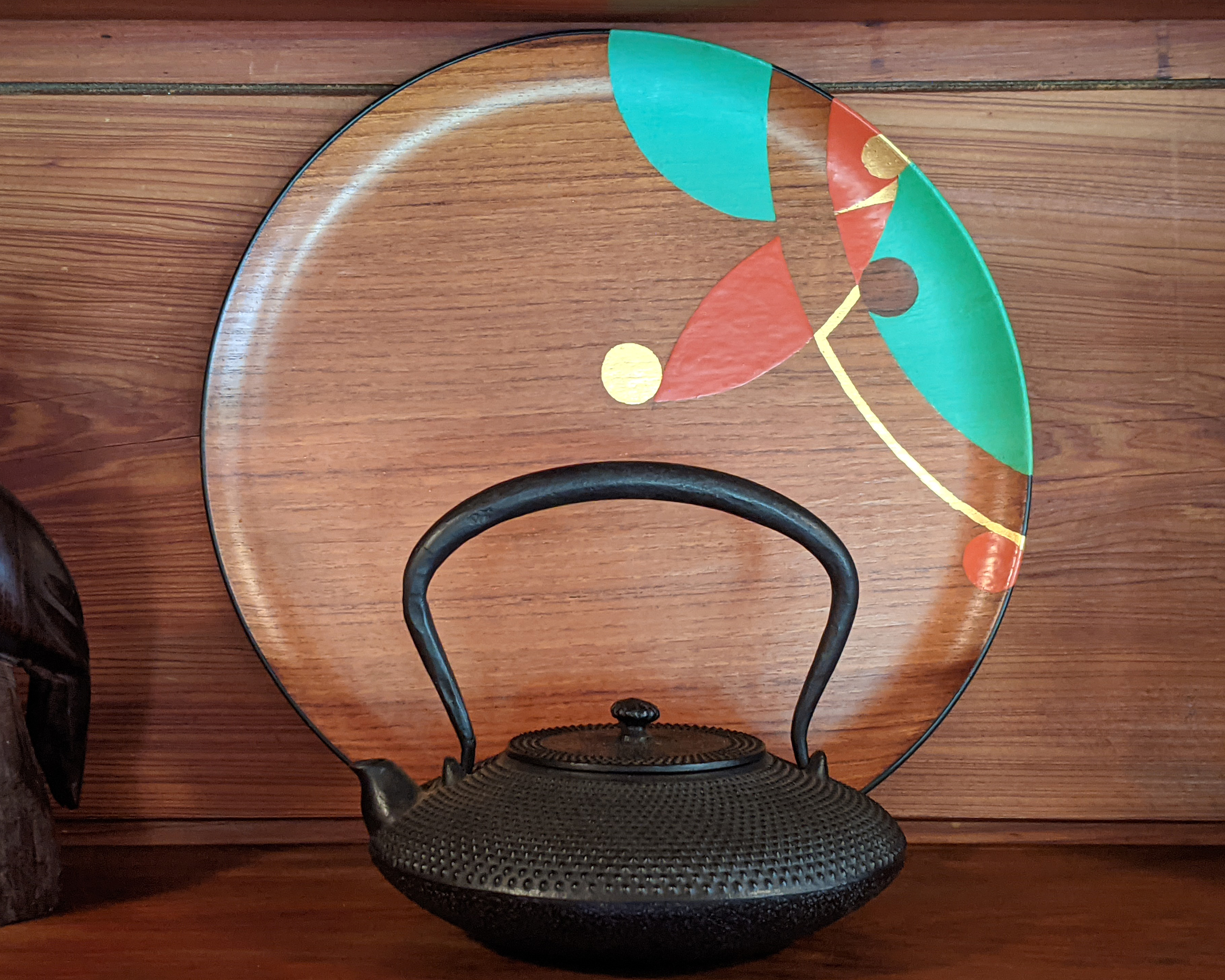
Val M. Cox, hand-painted teak plate, 1982. Photograph by Nina Blomfield, Cranbrook Center for Collections and Research.
On the shelf above the Imperial Hotel dinnerware, a painted teak plate tells a very different story. This plate is one of a set of twelve that were designed and hand-painted for the Smiths by artist Val M. Cox. Each plate features a unique design of rhythmic arcs, segments, and overlapping circles in gold leaf, red and green enamel, and dark stain.
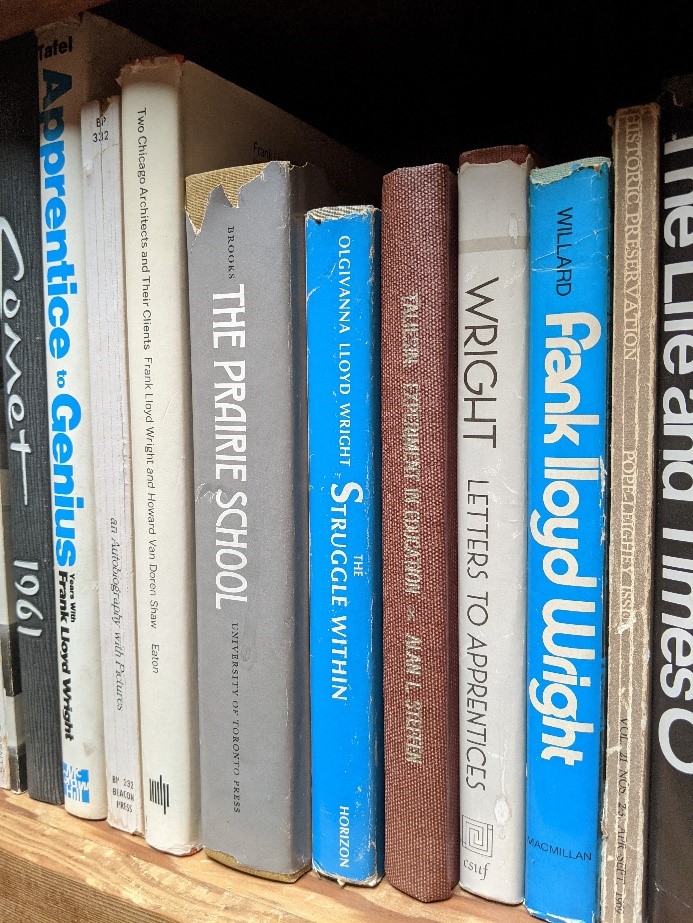
The geometric forms belong to a tradition of abstraction developed by Frank Lloyd Wright and the community of architects and artists that gathered around him at his homes in Wisconsin and Arizona. This community was formalized as the Taliesin Fellowship in 1932, an educational program for those interested in furthering Wright’s theories of organic architecture and “learning by doing.”
Books on the Taliesin Fellowship from the Smith House Library. Photograph by Nina Blomfield, Cranbrook Center for Collections and Research.
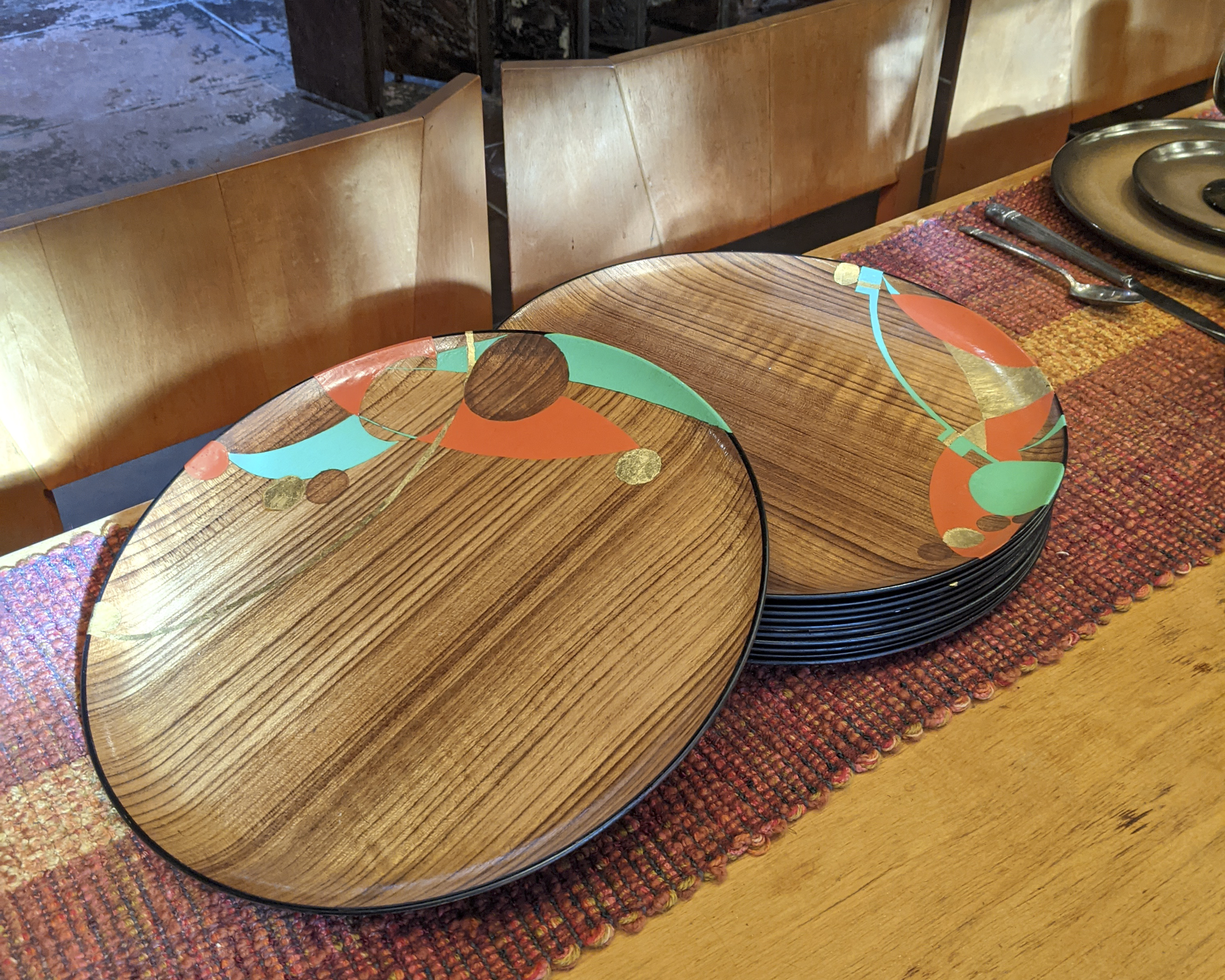
The Smiths maintained a lifelong connection with the Fellowship. It was a Taliesin apprentice who invited Melvyn and Sara Smith to first meet Frank Lloyd Wright. Members of the Fellowship aided in the 1950 construction of the house, designed the 1968 Garden Room addition, and continued to correspond with the Smiths about future projects (including an unbuilt teahouse and jacuzzi). The Smiths brought the set of undecorated plates with them on a visit to Taliesin in 1982 and asked Cox, then a fellow, to develop an original design for their table.
Val M. Cox, hand-painted teak plates, 1982. Photograph by Nina Blomfield, Cranbrook Center for Collections and Research.
Although the geometric patterns of the teak and the porcelain plates harmonize, the circumstances of their production are quite different. One, a personal commission from an artist with an intimate connection to Taliesin, represents the meaningful artistic relationships that the Smiths cultivated throughout their lives. The other, a mass-produced reproduction from one of Frank Lloyd Wright’s most well-known designs demonstrates the breadth of their lifelong interest in the work of Frank Lloyd Wright. These two sets of plates symbolize the varied ways that the Smiths acquired art and filled their home with beauty.
—Nina Blomfield, The Decorative Arts Trust Marie Zimmermann Collections Fellow for Cranbrook Center for Collections and Research, 2021-2023
Eliel Saarinen wasn’t much for philosophizing about his work. Cranbrook’s principal architect demonstrated his beliefs about architecture through the bricks and stones of his buildings, rather than through academic lectures or theoretical treatise.
When I give tours of campus, I often highlight the fact that in Saarinen’s buildings, a brick wall is a structural brick wall, and a stone column is a structural stone column. If that sounds obvious, well, it’s because architects are excellent at deception.
Bricks and Mankato Kasota stone pilasters at Cranbrook Art Museum. Photograph by Daniel Smith CAA Architecture 2021. Courtesy Cranbrook Center.
In the 1920s and 1930s (and straight through to today), it was much cheaper to build a wall of concrete block or wood and then cover it in a façade of brick, or to design a reinforced concrete column and then wrap it in thin stone veneer. Solid brick walls and true stone columns are more expensive and more limiting to the designer (you can build taller, wider, and cheaper in steel and concrete). Regardless of a building’s style, by the early 20th century most of our country’s institutional buildings were constructed of modern materials and wrapped in traditional ones.
This habit of facadism (a focus on the material appearance without regard to the structural reality) was abhorrent to devotees of modernism. In International Style modern architecture, then, architects simply did away with brick walls and stone columns—materials used in construction for millennia—in favor of concrete, glass, and steel. The structure and the appearance of the architecture were one in the same.
But at Cranbrook, with its deep roots in the Arts and Crafts Movement, Saarinen went the other direction. True stone and brick construction was integral to our founding ethos, and to Saarinen’s designs.
Detail of brickwork on the dormitories of Cranbrook School for Boys (Cranbrook Campus, Cranbrook Kingswood Upper School). Photograph by Kevin Adkisson, Courtesy Cranbrook Center.
While many of Saarinen’s contemporaries were dealing with so-called ‘dishonest’ forms of architecture (steel and concrete frames clad in traditional styles rooted in masonry construction), Saarinen avoided the problem of ‘dishonesty’ by building modern buildings traditionally. Saarinen did use concrete vaults and floor slabs, as well as steel trusses, but he connected these to brick load bearing walls and stone columns.
Adding to the unusual fact that Cranbrook’s brick walls and brick vaults are structural, the beauty of Saarinen’s brickwork stands out. He achieved a special blend of true engineering and true artistry. This combination of beauty and utility was key to the Arts and Crafts Movement, and to the form-following-function ethos of Saarinen’s modernism.
More simply, the brickwork of Cranbrook is a visual delight.
Patterned brick and Mankato Kasota stone bench at Kingswood School for Girls (Kingswood Campus, Cranbrook Kingswood Upper School). Photograph by James Haefner, Courtesy Cranbrook Center.
In Edward Ford’s The Details of Modern Architecture (1996), the architecture historian and professor writes that:
“Few Modernists were less interested in industrialization and standardization than Eliel Saarinen, and it is more than ironic that fate was eventually to place him at its heart, Detroit, and that he was to spend the second half of his career…at Cranbrook, fifteen miles from Highland Park and twenty miles from River Rouge, designing schools for the children of auto executives.”
Basket-woven brick barrel vault in the Arts and Crafts Courtyard, Cranbrook Academy of Art. Photograph by James Haefner, Courtesy Cranbrook Center.
There is much more to say about Saarinen’s brickwork, and bricks at Cranbrook more broadly. On October 25, 2021, I invite you to join me for the Center’s next Uncovering Cranbrook virtual lecture: The Bricks of Cranbrook: Humble Material, Monumental Design. I’ll discuss the history of bricks, where our bricks came from and what makes them unique, and, most importantly, revel in the beauty of the billions of bricks on this campus. And, after the lecture, join me on campus for a special behind-the-scenes brick themed tour!
—Kevin Adkisson, Curator, Cranbrook Center for Collections and Research
Cranbrook Archives is pleased to announce a new collection available for research. An intriguing collection, it comprises the personal and professional papers, photographs, realia, and architectural drawings of Walter Preston Hickey, a student of Eliel Saarinen. Yet, while traces of key life events and relationships—birth, parentage, education, marriage, friends, and employers—can be found in the collection, Hickey’s life after Cranbrook remains largely a mystery.
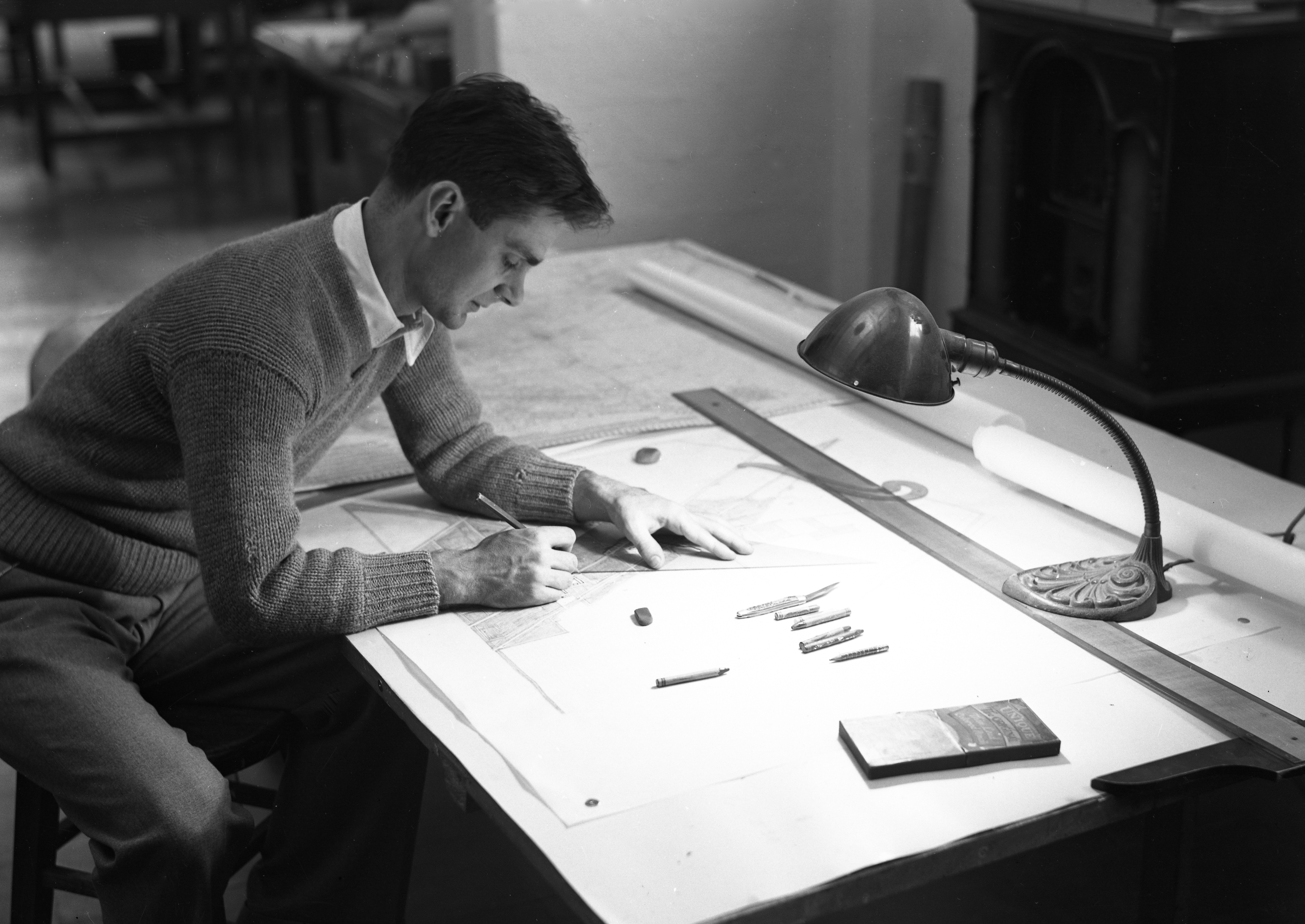
Walter Hickey working in the Architecture Studio, 1935. Courtesy of Cranbrook Archives, Cranbrook Center for Collections and Research.
A native of Detroit, Hickey attended the University of Michigan School of Architecture (1926-1930), during which time he worked with architects Albert Kahn (1928) and Thomas Tanner, as well as being one of the first staff members of the Cranbrook Architectural Office.
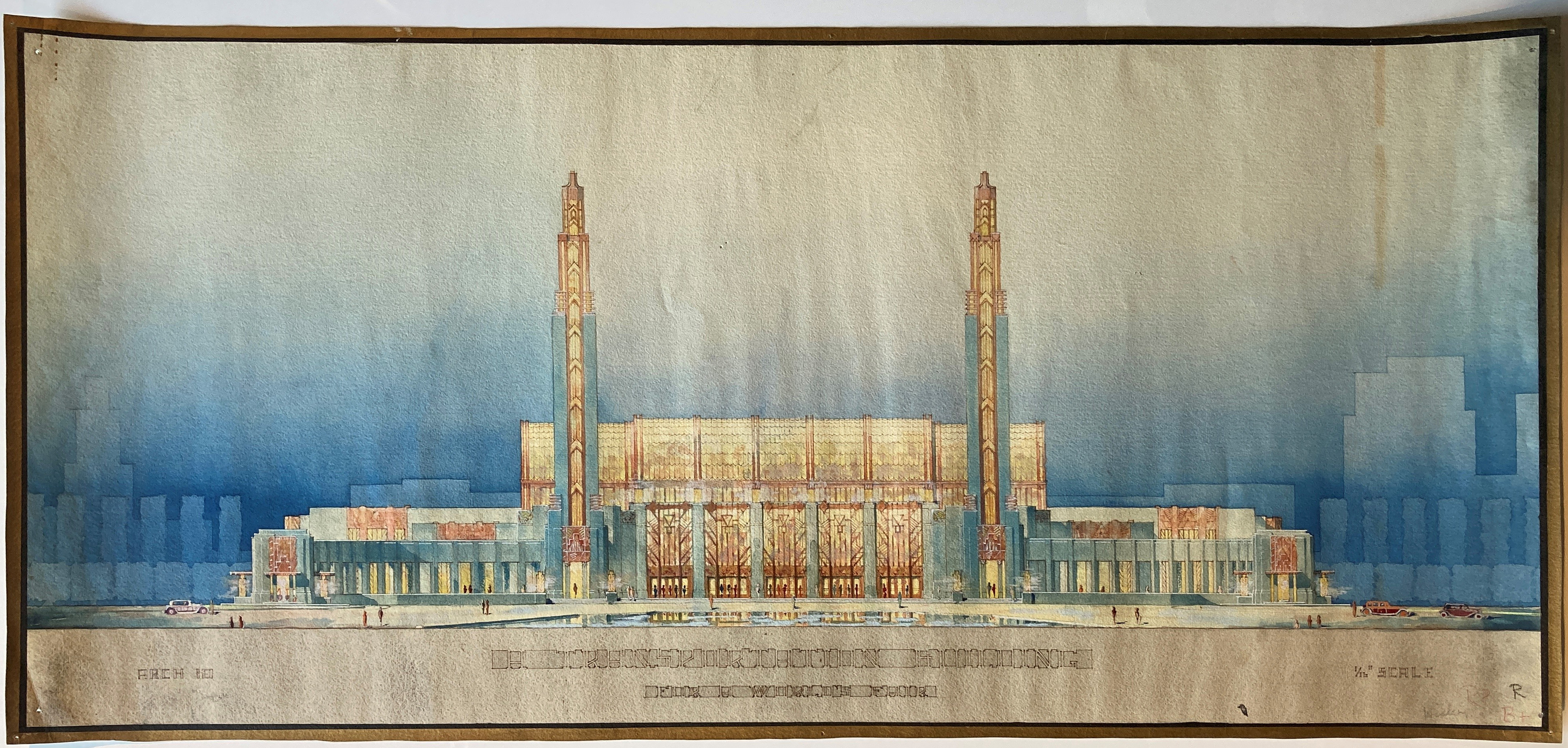
A Transportation Building for a World’s Fair, circa 1926-1930. A University of Michigan Class Project by Walter Hickey. Courtesy of Cranbrook Archives, Cranbrook Center for Collections and Research.
He applied to study architectural design with instruction in city planning at Cranbrook Academy of Art, starting in September of 1932. He became especially interested in highway traffic control, which formed the topic of his 1935 thesis on theWaterfront Development for the City of Detroit. Hickey submitted designs to various Academy competitions and won a $10 prize from Loja Saarinen for design No. 13 in the Cranbrook Academy of Art Rug Competition in 1934.
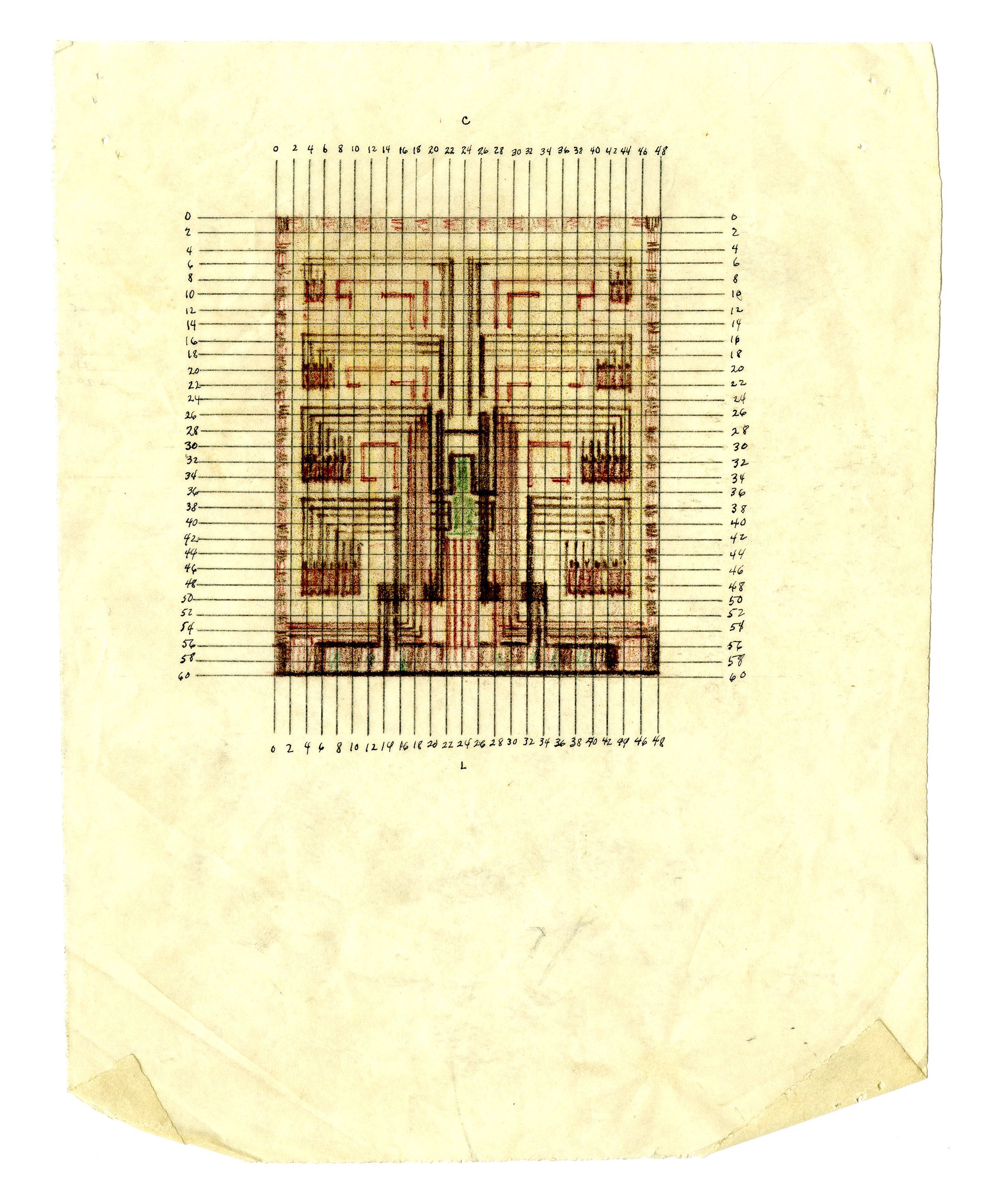
Drawing by Walter Hickey, undated. Courtesy of Cranbrook Archives, Cranbrook Center for Collections and Research.
After leaving Cranbrook, Hickey worked for various architecture firms, including Smith, Hinchman, and Grylls, and Clair W. Ditchy. After a short time with the Federal Housing Administration, he returned to work with Eliel and Eero Saarinen on the Kleinhans Music Hall project. He also completed private architectural designs for residences, including work on Ralph Rapson’s Hoey vacation home, Longshadows, in Metamora, MI. Around this time, he went to work at the General Motors Technical Center and continued to live in Birmingham, Michigan. And here is where his story ends in the collection.
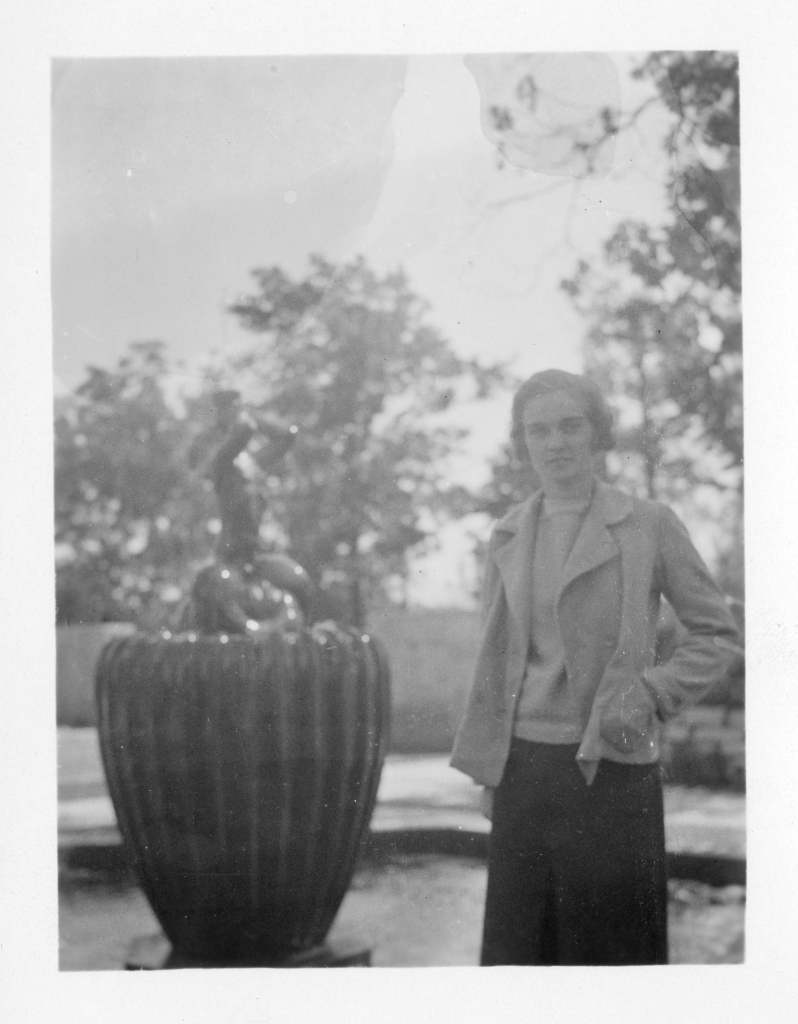
Jane Viola Shepherd. Courtesy of Cranbrook Archives, Cranbrook Center for Collections and Research.
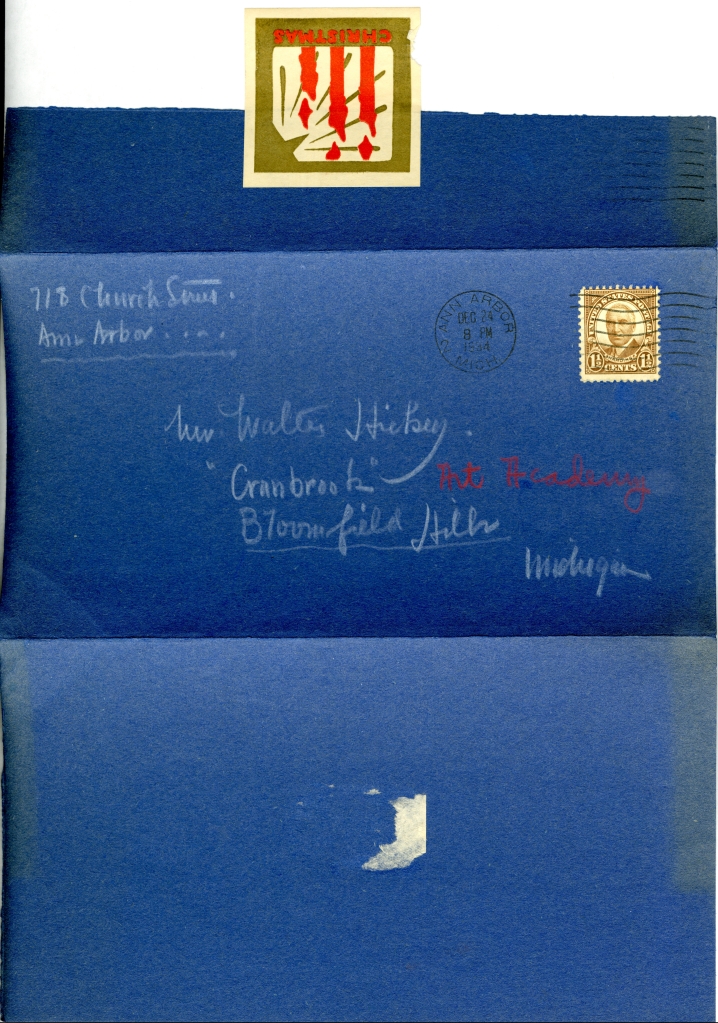
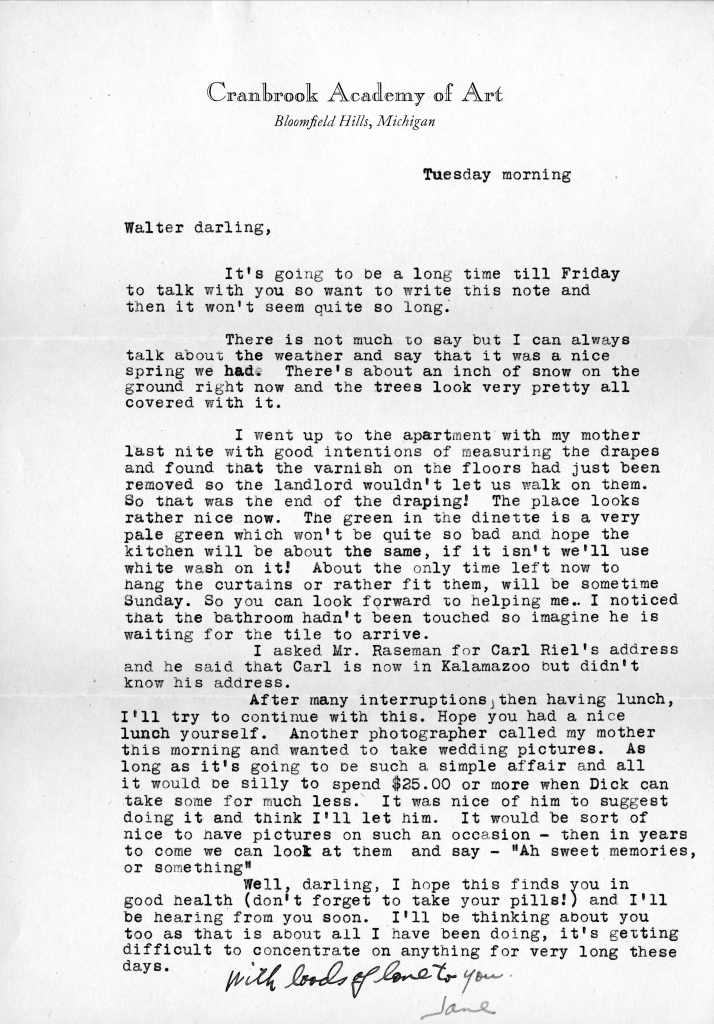
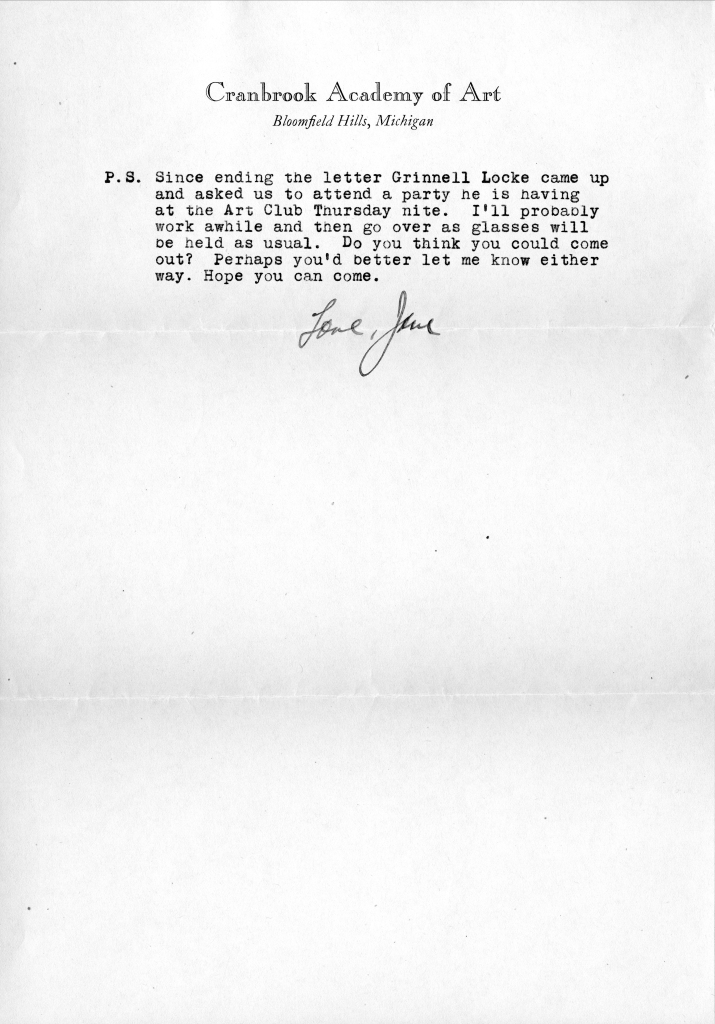
Although this is a very small collection, the diversity of content is rewarding for its ability to convey snapshots of his life in individual and unique items. It includes Christmas cards, such as one from “the Lorches” (Emil Lorch was the President of the University of Michigan Architecture School), a few letters from friends, and something of a typed love letter (on Cranbrook Academy of Art letterhead!) from Zoltan Sepeshy’s Secretary Jane Viola Shepherd to whom he was married on April 22, 1937.
Correspondence to Walter Hickey, 1934-1937. Courtesy of Cranbrook Archives, Cranbrook Center for Collections and Research.
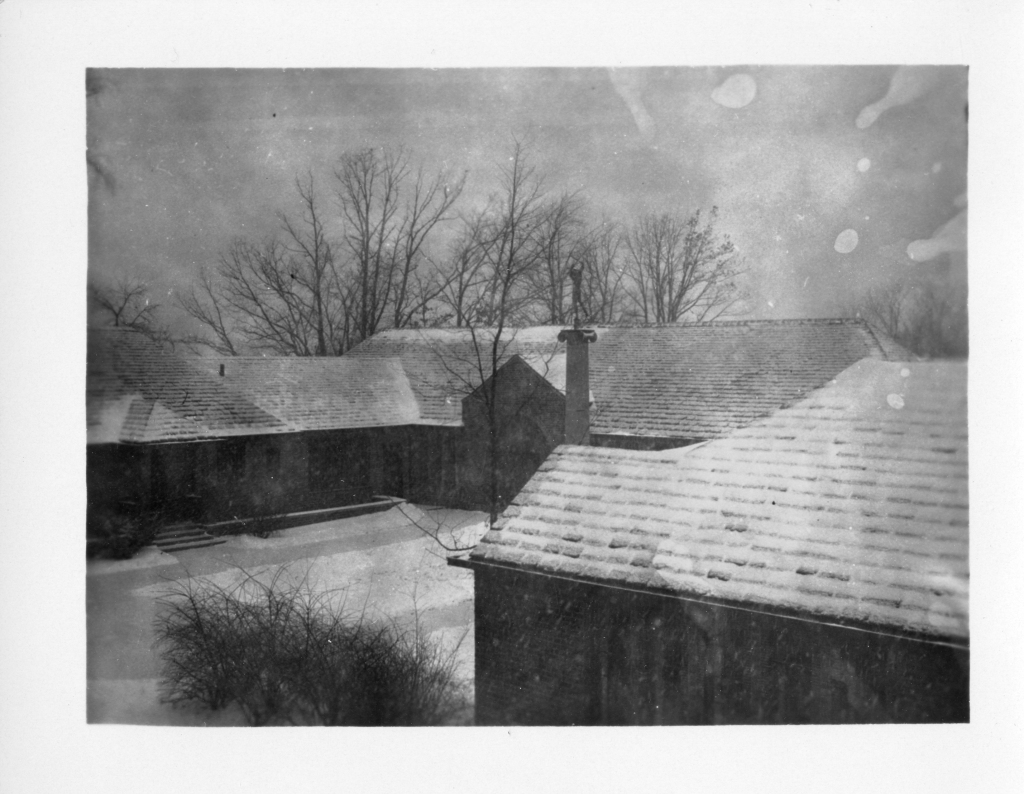
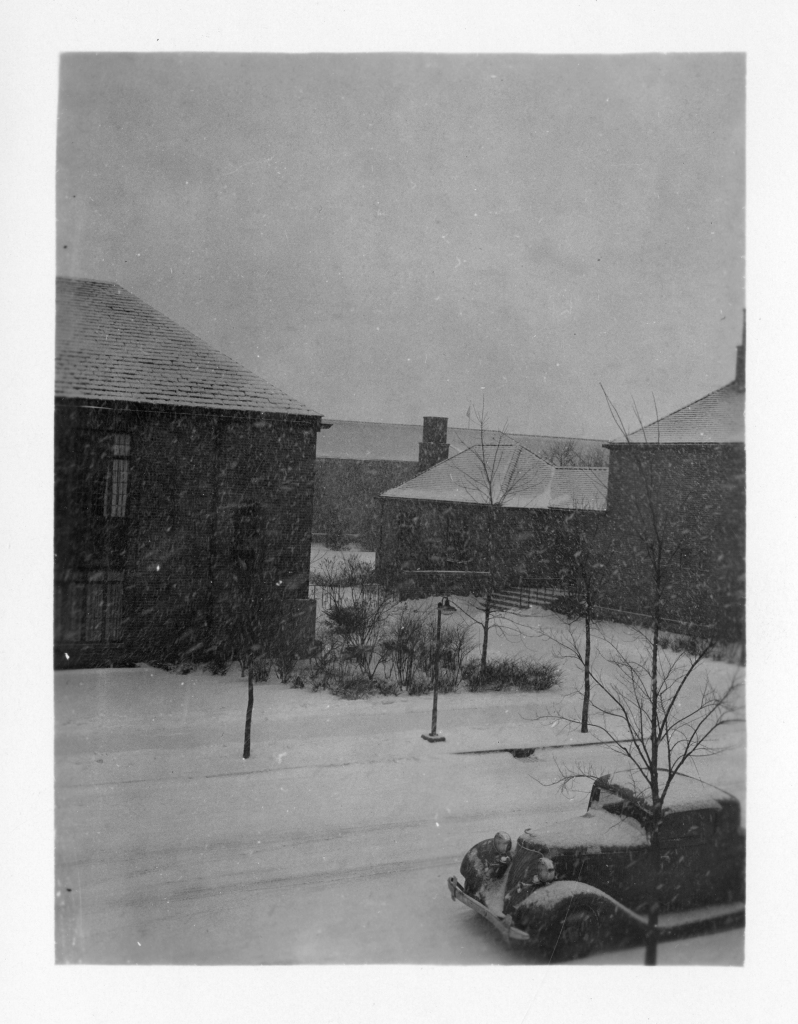
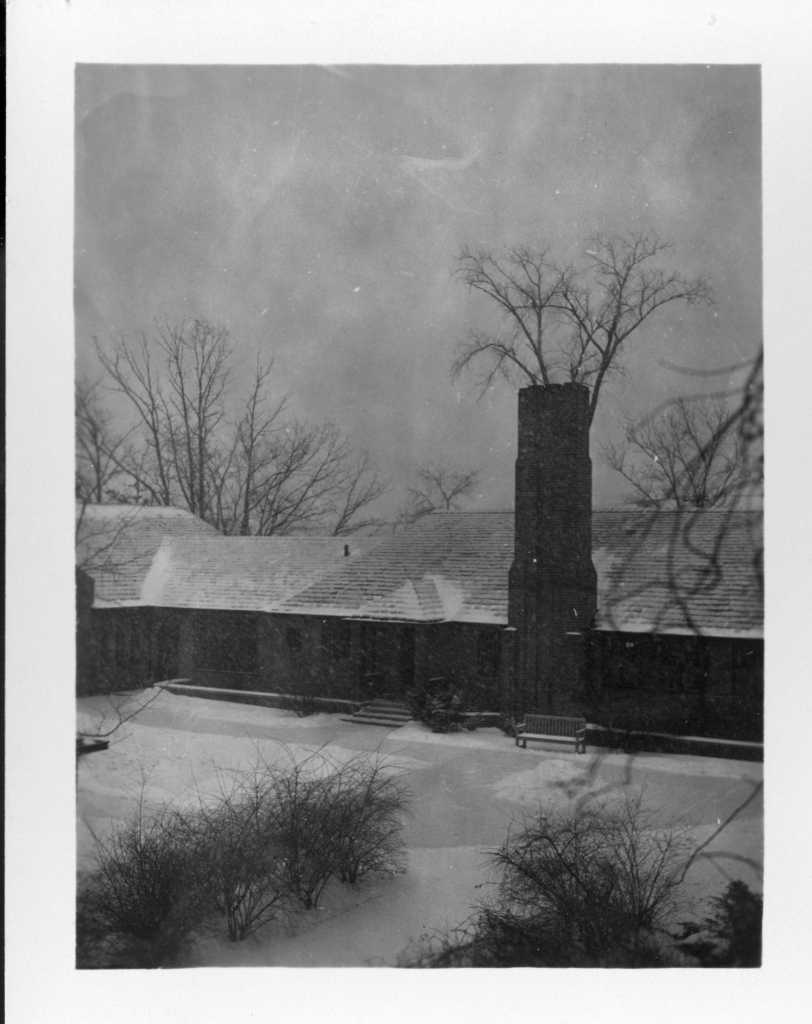
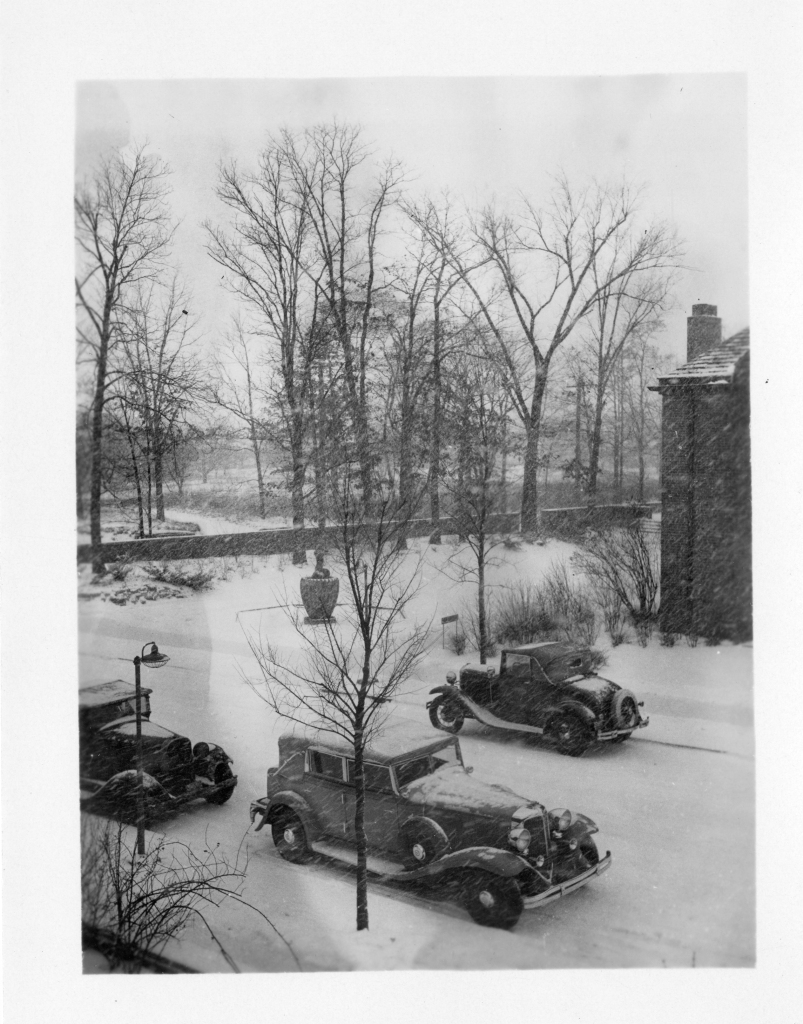
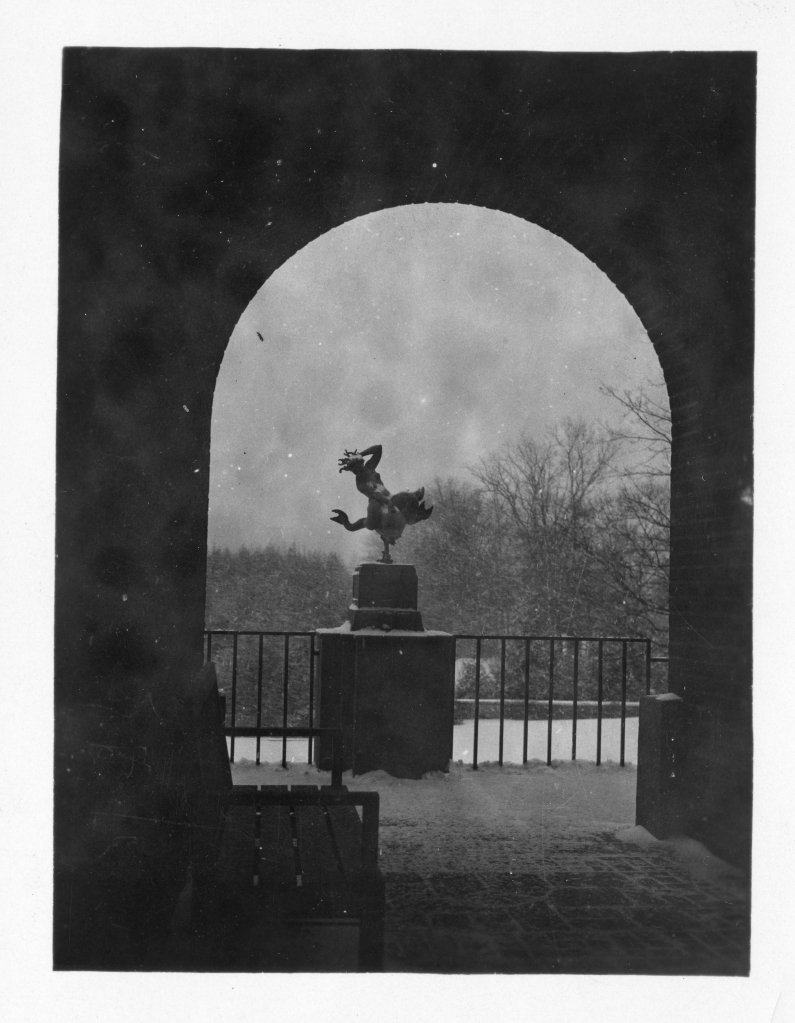
A small series of photographs hold moments of his life and some of the people with whom he shared it, including his father, eminent roentgenologist (radiography) Dr. Preston Hickey; his wife, Jane; his teacher, Eliel; and his fellow Academy students. A series of snowy scenes of Cranbrook campus beautifully capture the quietness of falling snow with hints of sunlight upon the architecture and sculptures that were then in their infancy and are now historic.
Cranbrook Academy of Art campus, circa 1932-1935. Courtesy of Cranbrook Archives, Cranbrook Center for Collections and Research.
The Walter Hickey Papers give insight into a short period in Hickey’s life and the Cranbrook of his time. It also gives us a lovely look into a life that was surely shaped by his experience at Cranbrook, but one that remains yet to be fully discovered.
–Laura MacNewman, Associate Archivist, Cranbrook Center for Collections and Research






![Window rubbing by Thompson Art Glass, June 19, 1995. [CCC4.] Window #9 [3 and 4 of 5].](https://cranbrookkitchensink.com/wp-content/uploads/2022/03/ccc4_3and4.jpg)








 Cranbrook Kitchen Sink