Experimental Jazz at Cranbrook

Last week’s post about jazz legend, Dave Brubeck, led to water cooler discussions and Facebook murmurings about additional jazz collaborations here at Cranbrook. Thanks to an inquiry on Facebook I discovered the great story of Yusef Lateef’s Cranbrook connection.

Lateef was born in Chattanooga, Tennessee in 1920, but grew up in Detroit. After graduating from high school he began playing professionally in swing bands at the age of 18. In 1949, he was invited to tour with Dizzy Gillespie and his orchestra. A year later, he returned to Detroit to begin his studies in composition and flute at Wayne State University. He eventually received his undergraduate and graduate degrees from the Manhattan School of Music and his Ph.D. in Music Education at the University of Massachusetts at Amherst. Lateef’s main instruments were the tenor sax and flute, though he played many other traditional and non-traditional instruments.

In the late 1950s, Lateef was invited to perform at Cranbrook by members of the Academy of Art Student Council. The Council thought it would be worthwhile for art students to learn something about another form of artistic expression – in this case, jazz. In April 1958, Lateef performed in the galleries at the Academy of Art. Seating  capacity was limited and patrons sat on pillows on the floor.

Promotional material for the jazz concert, April 9, 1958. Courtesy Cranbrook Archives.

Promotional material for the jazz concert, April 9, 1958. Courtesy Cranbrook Archives.

It turned out the students and Lateef were of one mind about the value of exchange between the arts, and agreed that the concerts should be held in the galleries, rather than an auditorium. Lateef had a reputation for experimental sounds, and the audience was treated to a concert that included non-traditional instruments, such as an inflated balloon and a 7-Up bottle.
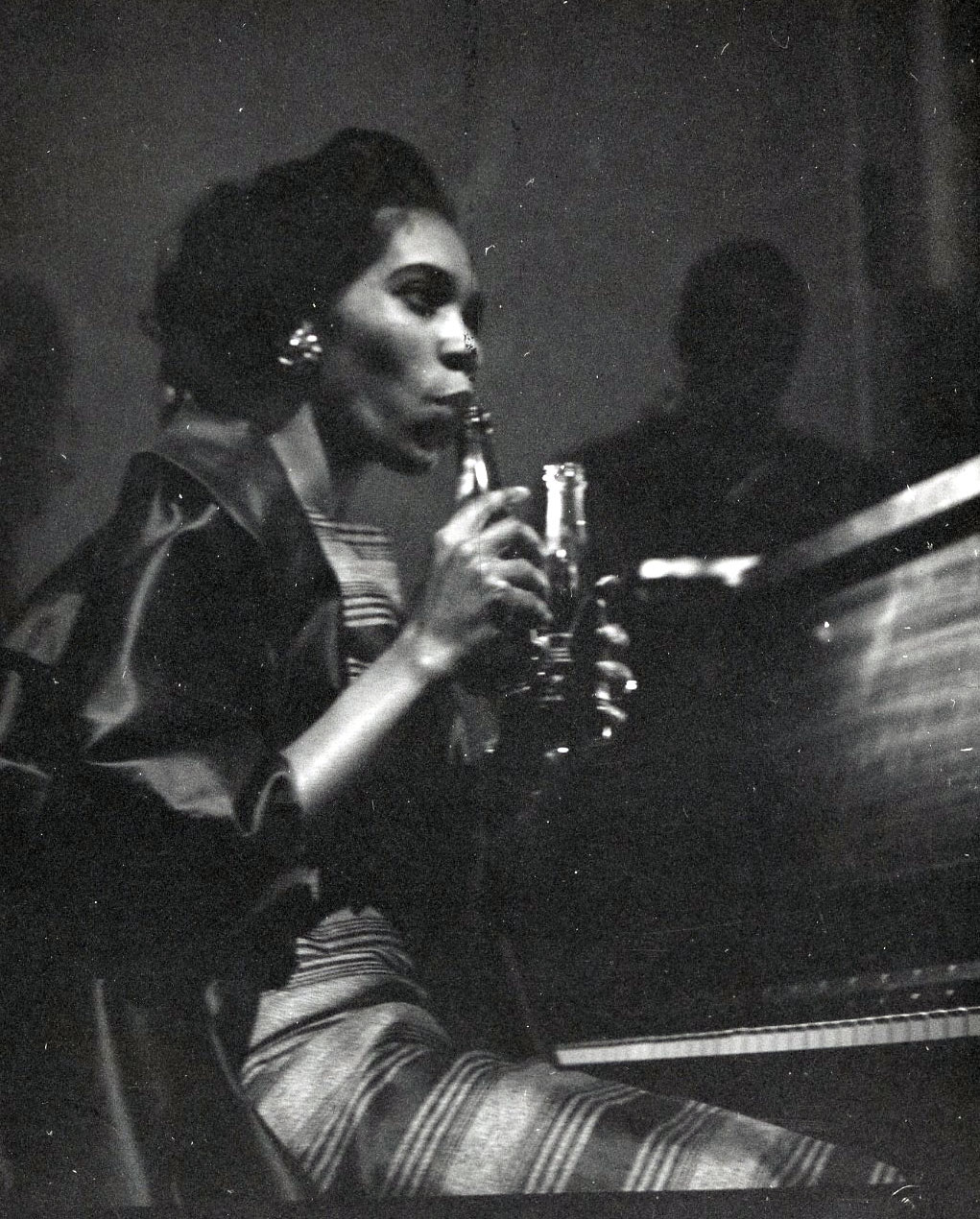
Pianist, Terry Pollard, plays the 7-Up bottle. Harvey Croze, photographer. Courtesy Cranbrook Archives.

Pianist, Terry Pollard, plays the 7-Up bottle. Harvey Croze, photographer. Courtesy Cranbrook Archives.

One of the great treats of this collaboration was a recording from that night! The LP, “Yusef Lateef at Cranbrook,” includes the following pieces: Morning, Brazil, Let Every Soul Say Amen, and Woody ‘N’ You. In 1988 Lateef received a Grammy award for Best New Age album and in 2010, he received the Jazz Master Fellow award from the National Endowment of the Arts. When Lateef passed away in 2013, he had recorded more than 75 albums.

Yusef Lateef and his band perform in the CAA galleries. Harvey Croze, photographer. Courtesy Cranbrook Archives.

Yusef Lateef and his band perform in the CAA galleries. Harvey Croze, photographer. Courtesy Cranbrook Archives.

Gina Tecos, Archivist


Contemporary Jazz Finds Its Way to Cranbrook

For more than 60 years, the Cranbrook Music Guild has been providing chamber music to Oakland County residents. The Guild, started by a group of music lovers in 1951, wanted to promote and provide chamber music on the beautiful grounds of Cranbrook. Consequently, the first Cranbrook Festival was held during the summer that year. While the early years focused on presenting classical music, including performances by the Julliard String Quartet and the Detroit Symphony Wind Quartet, by 1959 the Guild members were looking to expand the roster and even included ballet in the summer program.

img_5384

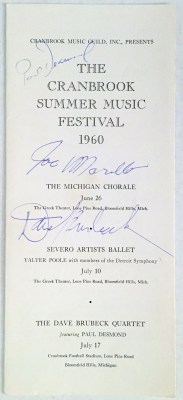
Encouraged by the response during the 1959 season, the summer of 1960 featured the Michigan Chorale (a 100-mixed voice ensemble), the Severo Ballet accompanied by the DSO, and even a jazz concert in order to “present the best in all fields of art.” The first two performances were, as usual, held at the Greek Theatre. The third of the season was the Dave Brubeck Quartet. One Rochester [Michigan] News reporter called it “the Guild’s boldest experiment” to date. In anticipation of a capacity crowd, the performance was held at the football stadium at Cranbrook School instead of the Greek Theatre, which is a smaller venue.

Dave Brubeck Quartet, Cranbrook School, July 14, 1960. Harvey Croze, photographer. Copyright Cranbrook Archives.

Dave Brubeck Quartet, Cranbrook School, July 14, 1960. Harvey Croze, photographer. Copyright Cranbrook Archives.

In 1960, the members of The Dave Brubeck Quartet were Dave Brubeck (piano), Paul Desmond (alto saxophone), Joe Morello (drums), and Eugene Wright (double bass). The concert at Cranbrook was held on Sunday afternoon, July 14th at 4:30 pm. While the Guild was hopeful for a full house of 2,000, more than 1,100 people actually attended, still beating the Guild’s previous attendance record of 775.

Cranbrook Music Guild Records. Courtesy Cranbrook Archives.

Cranbrook Music Guild Records. Courtesy Cranbrook Archives.

While I was not able to find any notes or articles about what the Quartet played at Cranbrook, it is highly likely that they played at least a few songs from their album, “Time Out,” which was recorded in 1959. Most of you will recognize the song “Take Five” from the album, which became one of their most popular. It is fun to imagine sitting outside at the stadium (now known as Thompson Oval) listening to this “new jazz.”

Leslie S. Edwards, Head Archivist

Editor’s Note: Thanks to Chris Morton for bringing this event to our attention!


The Skeptics Tale

The dichotomy of reading is much like the daily work undertaken in the archives. Reading, like research, can feel private, almost sacrosanct, something to escape to; on the other hand, there is a great draw to share the stories and information one discovers, seek commentary and comparison, enlighten someone’s thought process. As archivists, it is our job to assist researchers on their paths to discovery. Often times this direction and assistance leads us to insights as well. In fact, I have yet to assist a researcher along their path of inquiry without further developing my own along the way.

This was very much the case last week while I was scouring our collections for autumnal ephemera to add color to our Facebook followers’ harvest season. In my seasonally focused search I was delighted to come across Cranbrook’s very own ghost story—Cranbrook Boasts a Ghost; or, The Skeptics Tale, by Henry Scripps Booth (Thistle, as he was commonly known). I was intrigued and excited — what a timely discovery, what with Halloween just around the corner! And while I was enticed by the mystery, and enjoyed reading the descriptions of the vaulted spaces of St. Dunstan’s chapel [editor’s note: St. Dunstan’s is at Christ Church Cranbrook] filled with apparitions (a place I was lucky enough to tour, and you can too!) The Skeptics Tale, more importantly, reiterated an intrinsic truth about Cranbrook – that it is a space imagined and created by many minds and hands.

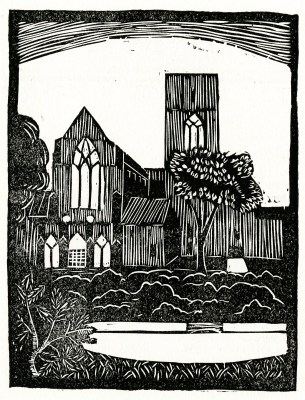
Christ Church Cranbrook, from "Highlights of Detroit". Cut by Eugene Reeber, Jefferson Intermediate School, 1932.

Christ Church Cranbrook, from “Highlights of Detroit”. Cut by Eugene Reeber, Jefferson Intermediate School, 1932.

Throughout the tale, I gained a sense of workmanship and craft, two features indicative of most spaces on Cranbrook’s sprawling campus. The characters in the tale pined over the construction of the brilliant structure, venerating its beauty as a testament to their commitment to their craft. It is, however, only near the end of the short story where I began to feel (if not see) the intentions of individuals who worked throughout the years to craft Cranbrook into the sprawling idyllic landscape of natural and man-made elements we know today.

“He discovered familiar faces in that strange assembly—faces of men who had lived and worked at Cranbrook. There before him was Tony by the column which bears his name; Mike Vettraino; Henry Booth, the coppersmith; his distinguished-looking father with the sideburns who brought the craftsman’s tradition from the ancient Cranbrook to this continent. There in the fourth chair of the fifth row: Milles, famed for his sculpture; a row or two behind, Saarinen, famed for his buildings; and nearby, Kirk, the silversmith.”

Though only apparitions in The Skeptics Tale, these individuals’ real accomplishments and contributions to Cranbrook, along with those of countless other influential men, women, and students, can be discovered through our collections. In the spirit of the season, we invite you to journey into our crypt and discover some of their stories yourself.

Belinda Krencicki, Associate Archivist

Cranbrook’s Other Kahn

What many people do not know is that Albert Kahn had a famous daughter, Lydia Kahn Winston Malbin (1897-1989). She was not an architect, nor a famous actress or TV personality, but was referred to as the “First Lady of Modernism” in a 1984 Detroit News magazine article by art critic Joy Hakanson Colby. Malbin, a lifetime trustee and honorary curator of the DIA, chairman of the Detroit Artists Market, and a member of the Detroit Arts Commission, was also a student at Cranbrook Academy of Art in 1934 and then again from 1940-1944 when she received her MFA in Ceramics. (Malbin took additional ceramics classes with Maija Grotell and painting with Zoltan Sepeshy through 1950.)

img_5334

Lydia Malbin in her Manhattan apartment, 1984. Courtesy Cranbrook Archives.

But what she was best known for was her vast collection of modern art, an interest that began for her in the 1930s and continued throughout her lifetime. This week I received a query from an art auction house in London, England. They have a work by German-American painter, Lyonel Feininger, that had once been in Malbin’s collection and was on display in a 1951 exhibition at Cranbrook Art Museum called “The Collection of Mr. and Mrs. Harry Lewis Winston.” (Winston was Lydia Kahn’s first husband.) As auction houses often do, they wanted to verify that Feininger’s painting “Becalmed” had indeed been in this exhibition. As I researched this work, it reminded me of Malbin’s additional connections to Cranbrook.


winstoncatalog099

Exhibition Catalog, 1951. Courtesy Cranbrook Archives.

Not only was Malbin a student at the Academy of Art, she was also one of the six Cranbrook-related artists who contributed to the Saarinen-Swanson Group, an affordable, coordinated line of modern home furnishings, which debuted in 1947. Malbin designed the oven-ware pottery, manufactured by Frankoma Pottery Company, and china with glazes meant to “simulate the quality and color of semi-precious stones” manufactured by Glenco Porcelain Company. She also designed ash trays and vases – a line of “red ware” – which featured clay and glazes from Ferro Enamel in Cleveland, Ohio.

img_5331

Detroit Free Press, September 1948. Courtesy Cranbrook Archives.

Malbin began collecting modern art in the 1930s. Though her father, Albert Kahn, couldn’t stand modern art, he did instill in all of his children the lesson that they should be independent thinkers. So, Malbin sought out what SHE liked – “tough, off-beat things” rather than popular artists or “pretty pictures.” She and her first husband, Harry Winston, were an art collecting team until Harry’s death in 1965, and Malbin’s second husband, Barnett Malbin, while not a collector himself, supported her collecting activities and even made photographic records of her art for her archives.

For more on Malbin’s collecting interests, check out the Lydia Winston Malbin Papers at Yale’s Beinecke Rare Book and Manuscript Library and the Barnett and Lydia Winston Malbin Papers, 1940-1973 at the Archives of American Art.

Leslie S. Edwards, Head Archivist

Upcoming Day Away: Albert Kahn and the University of Michigan

Henry Scripps Booth, photographer. Pleasures of Life, Vol. IV. Courtesy Cranbrook Archives.

Henry Scripps Booth, photographer. Pleasures of Life, Vol. IV. Courtesy Cranbrook Archives.

In this 1919 photo taken by Henry Scripps Booth of his two friends and architecture classmates Fred Morse and Martin Lexen, they’re all hanging out (and almost off of!) the roof of the University of Michigan’s brand new General Library by architect Albert Kahn. I found this snapshot in volume four of Booth’s Pleasures of Life series, which has lots of great images of the Booths at Cranbrook and of his friends at the university (where Henry studied from 1918- 1924). The building they’re sitting on here, known as the Harlan Hatcher Graduate Library since 1971, figures prominently in the Center for Collections and Research’s next Day Away trip on October 28!

Henry Scripps Booth’s Scrapbook Album, Courtesy Cranbrook Archives.

Dedication of the new (Hatcher) library building, 1920. Henry Scripps Booth’s Scrapbook Album, Courtesy Cranbrook Archives.

While we won’t be quite so daring as to dangle our feet off the roof, you are invited to join the Center as we explore Albert Kahn’s architecture at University of Michigan. Best known for his industrial architecture in and around Detroit (and of course Cranbrook House), this tour will introduce you to his academic buildings. The day includes morning lectures followed by in-depth tours of five Kahn structures (including rarely accessible spaces like the carillon in Burton Memorial Tower), all interspersed with narrated walks and drives.

I should mention, though, that the Day Away won’t just be about touring. We’ll stop for a delicious lunch at Taste Kitchen, an acclaimed new restaurant by owner and chef Danny Van. It came highly recommended by friends of the Center, and we’re very happy Van has designed a three course meal, with optional drink pairings, just for us.

Henry Scripps Booth, photographer. Pleasures of Life, Vol. IV. Courtesy Cranbrook Archives.

Henry Scripps Booth, photographer. Pleasures of Life, Vol. IV. Courtesy Cranbrook Archives.

In this photo, we see Booth’s friend Fred’s “long, lankey and lean” body around a street sign—with assistance from the bottom-half of another Cranbrook luminary and friend of Henry, J. Robert F. Swanson.* The photo shows the two goofing around on a road outside of Ann Arbor. For this post’s purposes, I’ll imagine they’re on the very route we’ll be taking from Cranbrook to Ann Arbor on October 28! There shouldn’t be any dangerous curves on our trip, though it’s guaranteed to be informative, delicious, and fun. Call and get your tickets today!

*Did you know Booth and Swanson met studying architecture at U of M, where they also encountered a certain visiting professor, Eliel Saarinen?

-Kevin Adkisson, Collections Fellow, Cranbrook Center for Collections and Research

Vitrolite: Better than Marble

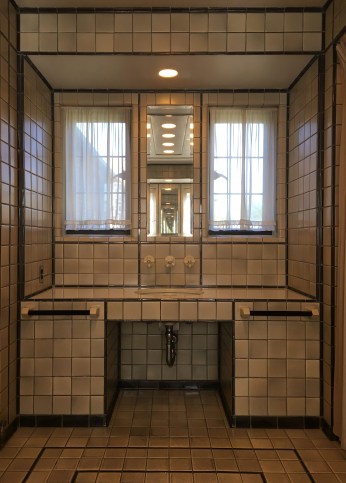
At Saarinen House, the 1930 home of Eliel and Loja Saarinen at Cranbrook, the master bath is one of the best rooms in the house.

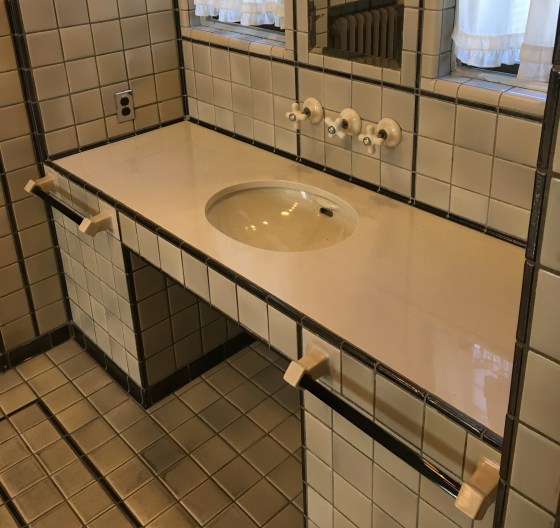
img_1580The bathroom is symmetrical, with his and hers sinks on either end of the room. The tile is off-the-shelf, not custom made for Saarinen, but deployed in an utterly unique way. In this post, I want to look specifically at the material of the countertops, Vitrolite glass.
Pigmented structural glass was developed at the start of the 20th century, and its first uses were in hospital, laboratory, and industrial food environments where its qualities of cleanliness, imperviousness, strength, and durability could be exploited. From institutional uses, structural glass took the next logical step into other places where sanitation mattered: bars, restaurants and restrooms.


vitrolitec1922

Vitrolite trade catalog, c. 1922, Courtesy of the Hagley Library Digital Archives

The first structural glass came out in 1900, Sani Onyx by the Marietta Manufacturing Company, but it was under the brand name Vitrolite that structural glass achieved its greatest success. Vitrolite was manufactured from 1908 to 1947, first by the Vitrolite Company, and after 1935, by the Libby-Owen-Ford Company (both out of Toledo, Ohio).

At first, structural glass was manufactured only in black or white, colors befitting its promotion as an alternative to marble (Pittsburgh Plate Glass’ Vitrolite rival was called Carrara Glass, after Carrara marble, and Vitrolite’s sometime slogan was “Vitrolite: Better Than Marble.”) In its 1922 promotional material “Vitrolite Sanitary Tables and Counters,” the company claims that the products “delightfully cool, bright surface is just the place to serve palatable drinks and dainties. It keeps clean— nothing stains it and it just wears and wears.”

img_1585The sanitation and durability arguments likely appealed to Eliel Saarinen as he specified white Vitrolite for the master bathroom, but he was probably also drawn to its aesthetic potential: a single, seamless, and uniform surface for the countertop. It offsets the grid of the bathroom tile beautifully, providing a place to rest both your toothbrush and your eye.img_1590

caorecordsinvoice092

Correspondence concerning Saarinen House Vitrolite bathrooms, from our Archives

Installed by the plumbing contractor Robert Purcell, the sink bowls are vitreous china set beneath the Vitrolite counter. It’s likely that the oval for the sink basin was cut out of the Vitrolite by hand by Purcell’s team, and if you look at the result, it’s not a perfect oval—this isn’t your machined Corian countertop! In a house (and on a campus) where craftspeople are often celebrated, it’s neat that the bathroom counter’s utterly modern material still reflects the hand of the maker.


na6220_l69_tc_f_p69

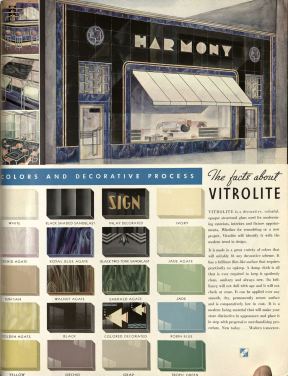
Colors of Vitrolite from 1936, published in “52 Designs to Modernize Main Street with Glass,” Libbey-Owens-Ford Glass Co., Courtesy of the Winterthur Library, Printed Book and Periodical Collection

Once Vitrolite bcame available in an array of colors and patterns, its aesthetic potential boomed. After its purchase by Libby-Owen-Ford in 1935, the glass was heavily marketed towards architects for its use in building facades, particularly for remodeling storefronts. In many design competitions and promotional literature, Vitrolite was sold as a way of “Modernizing Main Street,” a quick way to freshen up old buildings. Its these flashy, Art Deco facades that stand out in structural glass history, but it’s nice to remember its humbler, utilitarian beginnings.

 
One final note on the Saarinen House countertops: where are the faucets?! Look inside the sink, the water came out of the small bump at the top of the bowl itself. I hope they had great water pressure.


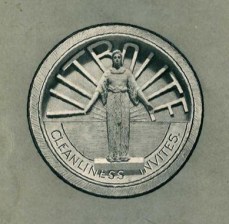
cleanliness-invites-vitrolite

Back cover of “Vitrolite Sanitary Tables and Counters,” c. 1922

-Kevin Adkisson, Collections Fellow, Cranbrook Center for Collections and Research


Photo Friday: Good Things Come To Those Who Wait

In October 2014, archivist Cheri Gay, wrote a blog on the pet cemetery at Thornlea Studio and the love the Booth family had for their animals.

In the blog, Cheri states, “When Henry was growing up, the Booth family had beagles, Prince and Mike, and a great dane, Ginger. Mike, according to Henry, ‘… loved having a fuss made over him, one time going so far as being pushed around in a doll carriage while wearing a canvas hat.’ Oh to have a photograph of that!”

On this Photo Friday, the Cranbrook Kitchen Sink is proud to present:

Mike the beagle, being pushed in a doll stroller... wearing a canvas hat!

Mike the beagle, being pushed around in a doll carriage… while wearing a canvas hat!

Leslie S. Mio, Assistant Registrar

Photo Friday: Europa and the Bull

The year 1975 marked the centennial of the birth of Swedish sculptor, Carl Milles. In honor of this event, the Swedish Council Detroit held a reception at Cranbrook Art Museum on June 12, 1975. Those in attendance included the Swedish Counsel General, Karl Henrick Andersson, and Count Wilhelm Wachtmeister, Swedish Ambassador to the United States (1974-1989).

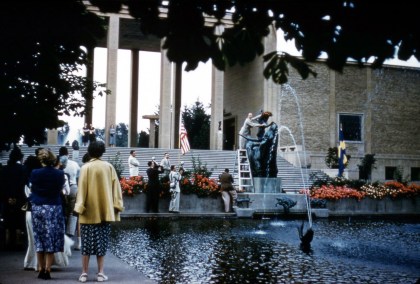
The Swedish Council Detroit places a wreath atop Milles' sculpture, Europa and the Bull. Henry Scripps Booth is holding the ladder and Cranbrook photographer, Harvey Croze, is in the foreground, to the left of the ladder. Courtesy Cranbrook Archives.

The Swedish Council Detroit places a wreath atop Milles’ sculpture, Europa and the Bull. Henry Scripps Booth is holding the ladder and Cranbrook photographer, Harvey Croze, is in the foreground, to the left of the ladder. Courtesy Cranbrook Archives.

In conjunction with the Jenny Lind Club of Detroit, they presented the Academy of Art with $1500 in support of the Carl and Olga Milles Scholarship Fund (which is still in existence today). It was part of $75,000 raised by Cranbrook as part of a Ford Foundation matching grant.

Dedicated to the preservation of Swedish cultural heritage, the Jenny Lind Club also participated in Cranbrook’s celebration of Carl Milles’s 75th birthday in 1945. The first vice-president at that time was Ingrid Koebel. The Koebel House, located in Grosse Pointe, was designed by J. Robert F. Swanson with interior decorations by Pipsan Saarinen Swanson.

Leslie S. Edwards, Head Archivist

Balthazar Korab and his Island of Serenity

A great portion of the time I’ve spent as an archivist at Cranbrook has focused on our photo collections. It would be impossible for me to choose a favorite photo, but I definitely find that one photographer in particular always comes to mind when I get a photo request or when I conjure up an image of campus.

Born in Budapest, Hungary, architect and photographer Balthazar Korab (1926-2013) documented life and work here at Cranbrook for several decades. His iconic images continue to be some of our most requested.

Korab at work at Eero Saarinen and Associates, 1957. Courtesy Cranbrook Archives.

Korab at work at Eero Saarinen and Associates, 1957. Courtesy Cranbrook Archives.

Korab studied architecture at the Polytechnicum Jozsef Nador in Budapest until he felt the necessity to escape his country’s communist regime in 1949. He opted for France, where he continued his education at the École des Beaux Arts in Paris, and received his degree in architecture there in 1954. During this time, Korab worked throughout Europe as a journeyman with notable architects, including Le Corbusier.

In 1955 he came to the United States and was hired by Eero Saarinen to work at Eero Saarinen and Associates (ESA). While Korab was worked there, he saw how Saarinen built models of his designs. Korab volunteered to use his knowledge of photography to develop techniques for dramatic photos of the models. This took him off the drawing board and he soon began to get assignments from other architects. What followed was an illustrious career photographing the works of many of the most significant architects world-wide, including: Ludwig Mies van der Rohe, Gunner Birkerts, Minoru Yamasaki, Frank Lloyd Wright, and many others.

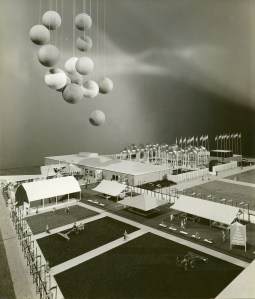
Yamasaki's model of the U.S. Pavilion at the World Agricultural Fair, India. Photograph by Balthazar Korab, ca 1959.

Yamasaki’s model of the U.S. Pavilion at the World Agricultural Fair, India. Photograph by Balthazar Korab, ca 1959.

Korab was introduced to Cranbrook during his time at ESA. In an interview for the Observer and Eccentric in June 1995, he said: “Arriving from a war-torn Europe, I soon was involved with Eero Saarinen’s GM Tech Center, a marvel of the dynamic, brash, wining face of America. It left me in awe and admiration. But my love went for the other Saarinen marvel, a then-middle-aged beauty, Cranbrook. It became a place of refuge and comfort, a source of nutrients for my severed roots to take hold in this strange soil. Its radiant aura was my inspiration.”

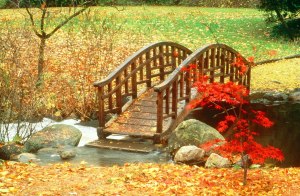
Oriental Garden bridge, Fall 1980. Copyright Balthazar Korab/Cranbrook Archives.

“Oriental Garden” bridge, Fall 1980. Copyright Balthazar Korab/Cranbrook Archives.

In the early 1980’s Korab was hired as one of several contract photographers here at Cranbrook. Over the next three decades, his images provided breath-taking panoramas, as well as minute details of the grounds, art, and architecture of this campus. The beauty of his work cannot be over-stated.

Gina Tecos, Archivist

Editor’s Note: In an July 1998 article in ambassador magazine, Korab referred to Cranbrook Educational Community as his “island of serenity.”

Photo Friday: Back to School

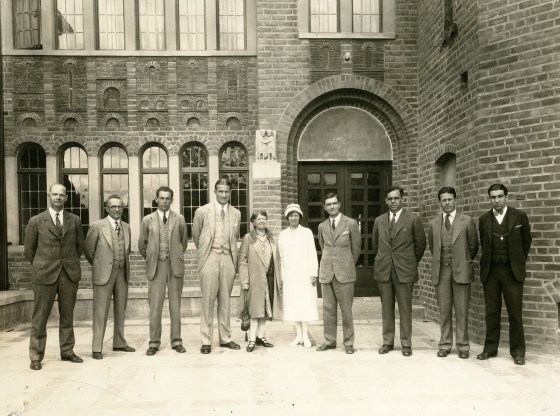
From left to right: Charles Keppel (Chemistry), John M. Harlow (French), George T. Mickelson (English), Herbert Snyder, Elizabeth Bemis (Dietician), Estelle Adams, (Nurse), William O. Stevens, Unidentified, C. Warren Moore (Arts & Crafts), Howard Yule (Latin)

Cranbrook School faculty and staff in front of the Cranbrook School Main academic building (now known as Hoey Hall), ca 1928. From left to right: Charles Keppel (Chemistry), John M. Harlow (French), George T. Nickerson (English), Herbert Snyder, Elizabeth Bemis (Dietician), Estelle Adams, (Nurse), William O. Stevens (Headmaster), Unidentified, C. Warren Moore (Arts & Crafts), and Howard Yule (Latin)


Create a website or blog at WordPress.com