Leap Day

Every four years, we add an extra day to the calendar to catch up to Earth’s revolutions around the Sun. For most of us, it is just February 29th, an extra day in the week. For leaplings, it is a day to celebrate their true birthday.

Different cultures have different customs associated with February 29th, known as Leap Day. In some cultures, it is also known as Bachelor’s Day or Ladies’ Privilege, because that is the day that women can propose to men.

In Finland, leap-year day proposals are considered good luck. If, however, the gentleman says “no,” he is required to give the woman enough fabric to make a skirt.

According to Medium.com, “The tradition reflects the Finnish spirit of equality and a shared sense of humor within romantic relationships. It challenges gender norms in a playful manner, encouraging women to take the lead in expressing their feelings and creating a shared memory that will be cherished for years to come.”

“While leap-year day may be just one day every four years, the tradition of women proposing adds a touch of magic and unpredictability to Finnish love stories. It’s a celebration of love, luck, and the joy of shared laughter, reminding couples that romance can be both traditional and delightfully unexpected in the heart of Finland.”

Something else unexpected is an elopement, a sudden and secret ceremony involving a flight from home without parental approval. One of Cranbrook’s “Finnish love stories” involved one such elopement.

Shortly after she turned 21, Eva-Lisa “Pipsan” Saarinen eloped to Toledo, Ohio with Jons Robert Ferdinand “Bob” Swanson, one of Eliel’s architecture students. They were married on May 8, 1926. According to Pipsan Saarinen researcher Alison Kowalski, “The young couple eloped because Eliel and/or Loja objected to the match, probably in part because Bob was of a lower socio-economic status than the Saarinens. According to Henry Scripps Booth, a close friend of Bob and Pipsan, Loja felt Bob was using Pipsan to get close to Eliel.”

Eliel, Bob, Bobby, and Pipsan aboard the MS Gripsholm, 1929. Courtesy Cranbrook Archives.

Bob struggled to support himself and Pipsan at the beginning of their marriage. Perhaps she proposed, and he didn’t have enough money to cover the cost of skirt fabric for such a fashionable lady.

Watercolor dress design by Pipsan Saarinen Swanson, circa 1933. Collection Cranbrook Art Museum.

More likely, they were truly in love. They were married from 1926 until Pipsan passed away in 1979.

—Leslie Mio, Associate Registrar, Cranbrook Center for Collections and Research

Revealing Horizons-Upward Bound History

Cranbrook Archives is excited to announce the launch of a historical digitization project, made possible by a generous two-year grant from the National Historical Publications & Records Commissions (NHPRC). The Archival Projects grant “supports projects that promote access to America’s historical records to encourage understanding of our democracy, history, and culture.” One of 21 awardees in 2023, alongside the Amistad Research Center, NYU, and others, we have begun full digitization of Cranbrook Schools’ Horizons-Upward Bound Program (HUB) records in an effort to facilitate discovery and use of material that documents one of the nation’s oldest and largest college access programs. The new online collection promises to elevate the visibility of HUB’s important story, and by extension, experiences of under-represented youth, primarily African American, in the U.S. educational system.

Cover of Horizons-Upward Bound’s first annual report, 1965. Courtesy of Cranbrook Archives.

HUB historical materials include approximately 18 boxes (20.4 linear feet) of material relaying HUB’s history from its founding in 1965 through the year 2000. Material includes paper, news, photo, and film media primarily generated by HUB administration and HUB students. During the first year of the grant we are focused on digitizing all paper material. The second year will be devoted to digitizing photography and film, including images taken by local photographer Jack Kausch.

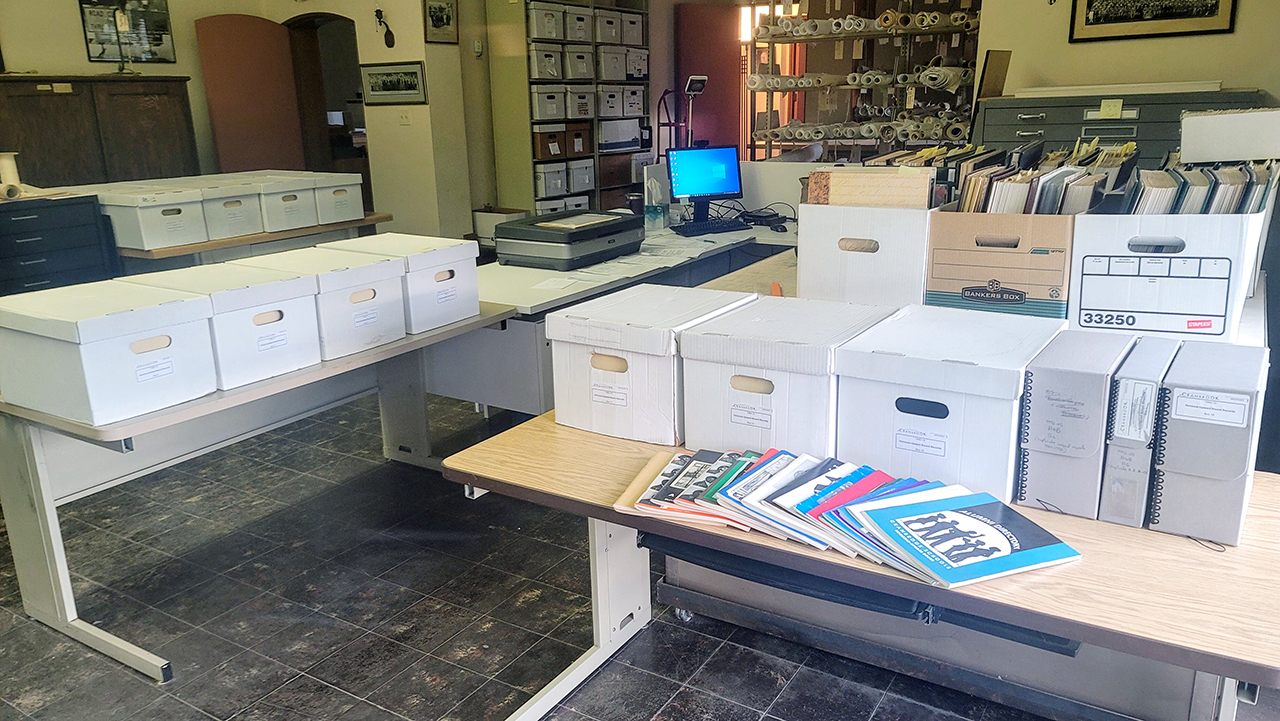
Photo of Archives workspace inside Thornlea Studio. Desks covered with archival boxes and material.
Digitization workstation where paper records are currently being scanned.

What we’ve done so far…

Digitization began in-house at the Archives in Summer 2023, with two HUB student volunteers who scanned a selection of newsletters and annual reports and drafted initial keyword/descriptions of the material. Later that Fall, I was hired to dedicate full-time attention to the project for the duration of the grant period. I continued the students’ work by first conducting quality control of the scanned material and digitizing the remaining publications in the collection. So far, I have digitized and quality checked over 7,500 pages of paper material. Currently, I am writing descriptions and creating keywords for these items and transferring the digital files to our online collections website, where they will be made public at the end of the project.

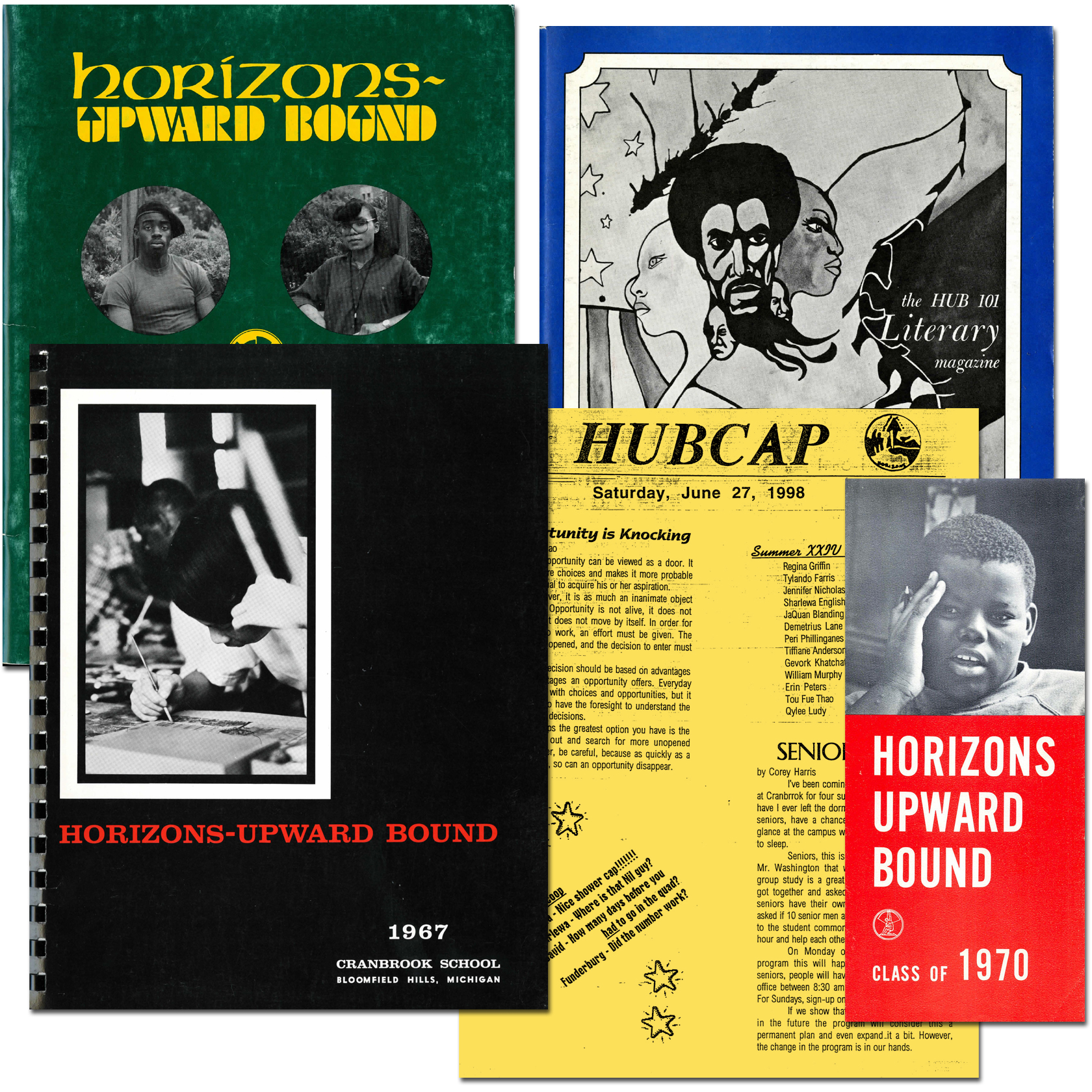
Collage of HUB paper publication covers. Primarily green, black, yellow, and red.
Selection of Horizons-Upward Bound publications spanning from the 1960s to 1990s, including annual reports, literary magazines, brochures, and newsletters. Courtesy of Cranbrook Archives.

More to come!

In honor of HUB’s founder and first director, Ben Snyder (1965-1989), we hope for this digitization project to help realize the desire he expressed for HUB’s records in his 1977-1978 Annual Report:

Annual Report cover, featuring HUB’s first cohort to include young women, 1977-1978. Courtesy of Cranbrook Archives.

“One hopes that these annual entries will, at some point in the future, be useful to the educational historian or, in a narrower sense, to someone reviewing the Cranbrook scene as it relates to community involvement. Should that time come in say the next century, the task would be far happier if the nation had in the meantime eliminated the need for compensatory education.”

–Ben Snyder (pg. 34)

Initially self-described as “An Experimental Enrichment Program,” in conjunction with representatives from Detroit Public Schools and Oakland County Schools, HUB was the only program of its kind at its inception. The artifacts and stories found within its historical collection have great potential to inform and inspire continued community-building and educational programming that span across metro Detroit and the nation. We hope you will share in our excitement about this project and we look forward to sharing more updates about the Horizons-Upward Bound collection!

– Courtney Richardson, Project Archivist, Cranbrook Center for Collections and Research
Editor’s Note: The NHPRC was established by Congress in 1934 as a statutory body affiliated with the National Archives and Records Administration. Chaired by the Archivist of the United States, it is composed of representatives of the three branches of the Federal Government and professional associations of archivists, historians, documentary editors, and records administrators.

Did Leonard Bernstein Write “West Side Story” at Cranbrook?

With Maestro now streaming on Netflix—and nominated for four Golden Globe Awards—it’s high time I set the record straight about the Cranbrook House Steinway Grand and its most famous pianist, Leonard Bernstein. It is a legendary story, told and retold for decades, that places Bernstein composing none other than his most famous work, West Side Story, here, at Cranbrook.

It is a story, however, that is hard to unravel fact from fiction. So, like all Center historians and archivists, I started by doing some digging in Cranbrook Archives. This is the story I uncovered.

Bradley Cooper as Leonard Bernstein, and Brian Klugman as Aaron Copland in Maestro. Courtesy of Netflix © 2023.

First, the Piano

Cranbrook has several Steinway grand pianos, including two of the grandest: a Model D concert grand in Page Hall on the original School for Boys campus, and a second Model D in the Cranbrook House Library. The Cranbrook House concert grand piano was manufactured by Steinway & Sons of New York City and completed a little more than eighty-five years ago on December 18, 1929. It was purchased by Grinnell Brothers of Detroit in January 1930 and, later that year, sold to the Colony Town Club, a women’s club located on East Jefferson Avenue in Detroit.

Cranbrook House library facing south. Steinway & Sons Model D Concert Grand piano sits below the “Story of Ceres” tapestry, March 1957. Photographer Harvey Croze. Courtesy of Cranbrook Archives.

Enter, George Booth

The black concert grand piano was to have a short life at the Colony Town Club. Within a few years, its members sold it back to Grinnell Brothers where, in February 1935, it was purchased by George Booth. I remain intrigued by the fact that Booth purchased a “pre-owned” piano. While America was in the throes of the Great Depression, I think it was more than a simple cost-saving measure; it was a decision warranted by the piano’s intended use.

The piano did not begin its life at Cranbrook in the Booths’ Library, the center of their social life after it was completed in 1919. Rather, Booth first placed the piano in the main hall of the Cranbrook Pavilion on Lone Pine Road. Known today as St. Dunstan’s Playhouse, in 1935 the recently renovated pavilion was being used as an exhibition gallery and event space for the Academy of Art and its nascent Art Museum. The piano was played at exhibition openings and for preludes before lectures, including at least one by Frank Lloyd Wright. Although St. Dunstan’s Guild began using the pavilion in 1937 for rehearsals and storage, Cranbrook Academy of Art continued to hold exhibitions there until 1942, when the new Eliel Saarinen-designed museum opened.

Cranbrook Pavilion staged for an Academy of Art formal party, January 16, 1936. In the center is what would become known as the Cranbrook House Steinway concert grand piano; in the background is the Cranbrook Map Tapestry, designed by Eliel Saarinen and woven by Studio Loja Saarinen in 1935. Courtesy of Cranbrook Archives.

Sometime between 1942 and the summer of 1946, when the pavilion was cleared out and rented by the Cranbrook Foundation to St. Dunstan’s Guild, George Booth moved the Steinway down the road to Christ Church Cranbrook “to protect the instrument from damage by dampness or other causes and to give it the benefit of expert use.” It was also during this period, in March 1944, that George and Ellen Booth formally deeded to the Cranbrook Foundation the Homestead Property, which encompassed not only Cranbrook House but also the forty acres adjacent to the house, including the Cranbrook Pavilion and its Steinway.

Enter, Leonard Bernstein

Continue reading

A Donkey for Christmas: Brighty Comes to Cranbrook

George G. Booth’s “Old Country Office” at Cranbrook House. Photograph by Kevin Adkisson.

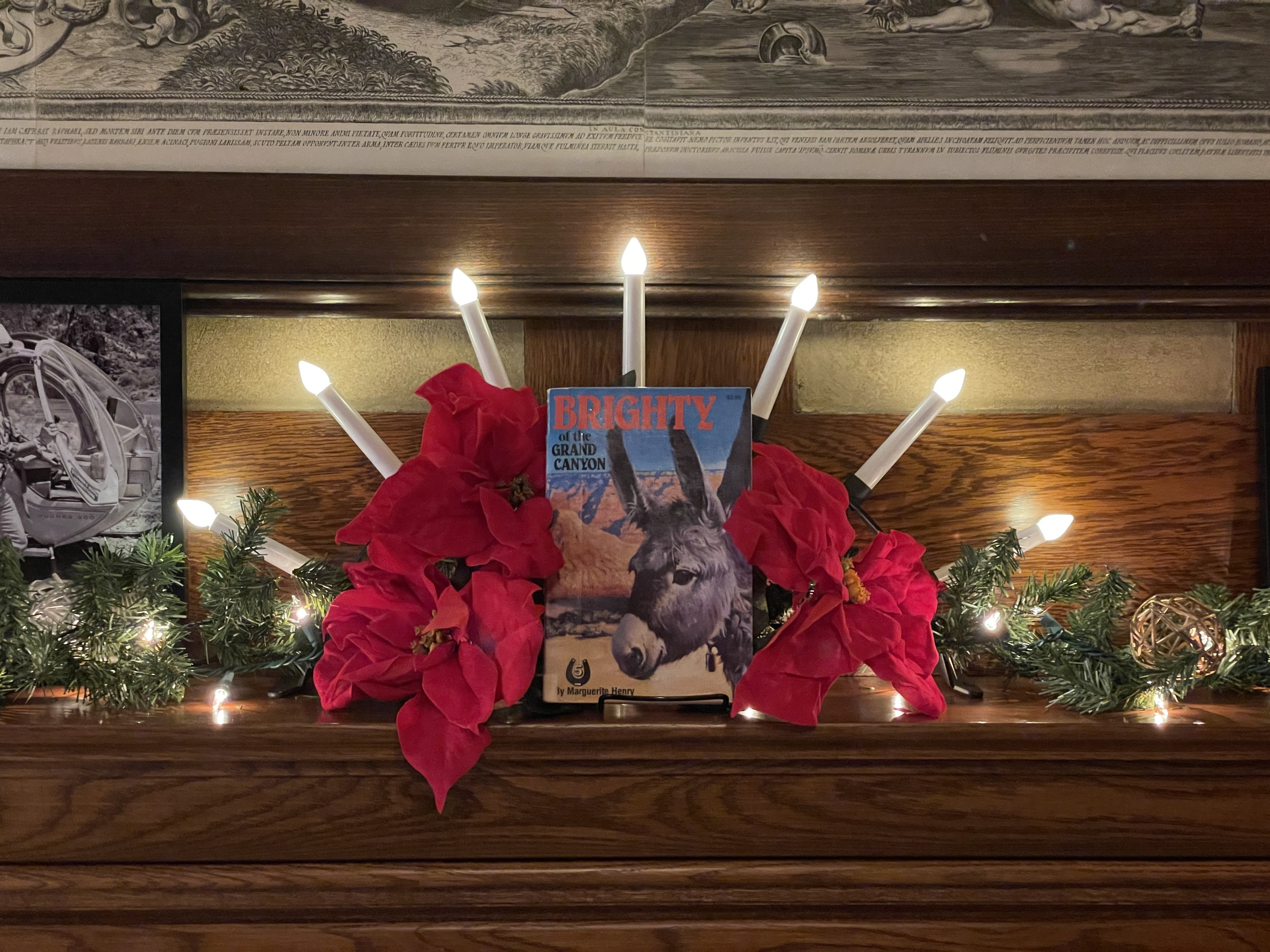
Every year at Christmas, the Center for Collections and Research decorates George Booth’s office in Cranbrook House with a special display. This year, our Christmas display is all about Brighty of the Grand Canyon, a movie produced by Stephen Booth, a grandson of Cranbrook’s cofounders. Brighty was a real donkey who inspired first a children’s novel, then a feature film.

In the late 1800s, there were hundreds of half-wild donkeys in the Grand Canyon, brought there by prospectors and then lost or abandoned. Brighty was one of them. 

Photograph by Kevin Adkisson.

Brighty lived in the Grand Canyon from 1892 to 1922. In the winter, he roamed the warm depths of the canyon. A sociable animal, he liked the company of prospectors, hunters, and hikers, but if anyone loaded a heavy pack on his back he would soon make his escape. Every summer, he returned to the North Rim to stay with the McKee family who rented cabins to tourists. He would carry water, give children rides, and visit each cabin in turn for attention and treats—his favorite food was flapjacks and honey.

In 1953, the author Marguerite Henry learned about Brighty, and immediately decided to base her next novel on him. In search of more stories about the adventurous donkey, she travelled to the Grand Canyon herself, where she interviewed locals who had known him, hiked in the canyon, and even sampled the creek water and tasted the plants that Brighty would have eaten! She adopted her own donkey, Jiggs, to learn from him how the real Brighty might have behaved. In Brighty of the Grand Canyon, a free-spirited donkey helps solve a murder mystery and protects his human friends from a dangerous bandit.

This is the 1963 edition of the novel, the same year that the Booths bought a copy to read on their family road trip. Photograph by Kevin Adkisson.

Stephen Booth and his wife Betty bought a copy of the book to read to their children, Douglas, Charles, and George. They all loved the story, especially Stephen, who had his own film production company, and decided to make a movie about Brighty. 

Filming began in 1965, with Marguerite Henry’s own pet donkey, Jiggs, starring as Brighty. Filmed on location at the Grand Canyon and in the Dixie National Forest in Utah, the actors and crew spent weeks living in the canyon. A tiny helicopter and an airplane with a camera mounted on the front were used for aerial shots, and for flying special visitors, like Stephen’s parents, Henry and Carolyn Booth, down into the canyon. 

Norman Foster, the film’s director, reviews the script with Jiggs the Donkey. Stephen Farr Booth Papers, Cranbrook Archives

The movie premiered on November 22, 1966, just down the road in Birmingham, doubling as a fundraiser for Kingswood School for Girls. As the star of the movie, Jiggs himself came along to the premiere. Afterward, he participated in the Festival of Gifts at Christ Church Cranbrook, an annual Christmas tradition that began in 1928 and continues today. 

From left to right: Betty Booth, Stephen Booth, Marguerite Henry, and Jiggs greet children at the film’s premiere. Stephen Farr Booth Papers, Cranbrook Archives.

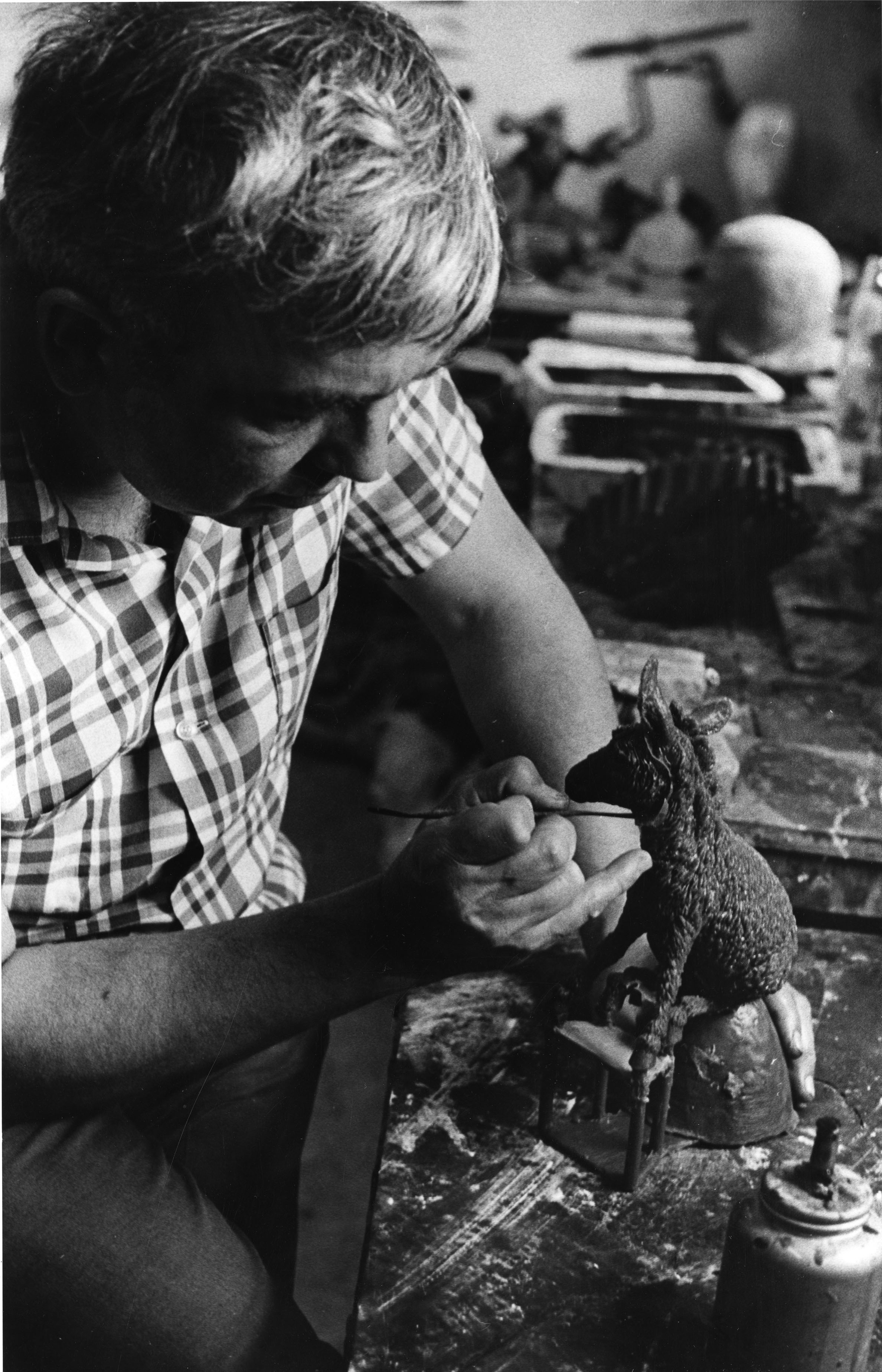
While Brighty was visiting Bloomfield Hills, he also posed for a series of sculptures by Peter Jepsen. They were modelled here at Cranbrook, on the second floor of Thornlea Studio. We still have one of the sixty Brighty figurines that Stephen Booth had made to give as presents to people who had helped in the making of the movie. Our Brighty was given to Stephen’s parents, Henry and Carolyn, to thank them for their support.

Photograph by Kevin Adkisson.
Peter Jepsen at work on Brighty in Thornlea Studio. Stephen Farr Booth Papers, Cranbrook Archives.

Stephen also commissioned Jepsen to make a life-size sculpture of Brighty. In 1968, Stephen gave that version to the Park Rangers at the Grand Canyon as a Christmas present. You can still see Jepsen’s Brighty at the visitor’s lodge on the North Rim of the Canyon, close to where the real Brighty spent his summers, more than a hundred years ago.

Peter Jepsen poses with his sculpture at the lodge on the North Rim of the Grand Canyon. Stephen Farr Booth Papers, Cranbrook Archives.

Mariam Hale, Collections Fellow, Cranbrook Center for Collections and Research
Ed. Note (July 17, 2025): It appears the Dragon Bravo wildfire has severly damaged the original Brighty statue at the the lodge on the North Rim of the Grand Canyon. https://www.facebook.com/share/p/1CDkSfoutX/

Please know that the Cranbrook Center for Collections and Research will do everything it can to support efforts to restore or replace Brighty,

A Long-distance Dedication

People of a certain age will remember listening to American Top 40 on the radio. Detroiter Casey Kasem offered an opportunity for listeners to give “long-distance dedications,” requesting a song for a loved one, a friend, or if they themselves needed cheering up.

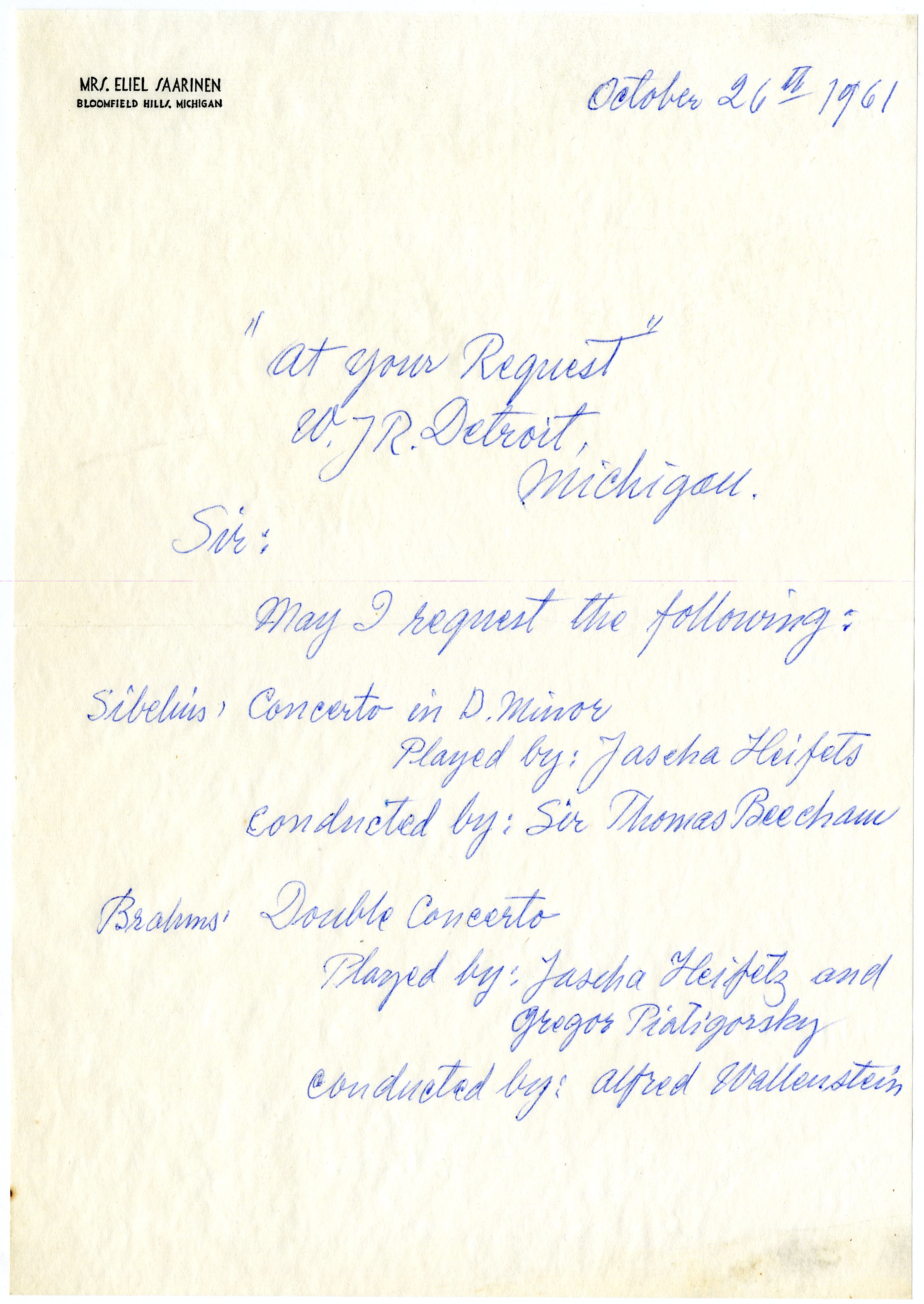
Loja Saarinen’s letter to WJR on October 26, 1961. Saarinen Family Papers, Cranbrook Archives.

Loja Saarinen wrote this note to the programers at WJR in Detroit, asking them to play two songs. Though she did not send this note to Casey Kasem, I imagine what Loja Saarinen’s words may have been if she had in October of 1961. On September 1, 1961, Eero Saarinen had died during surgery for a brain tumor:

Dear Casey,

I recently lost my son at far too young an age (51). He was overseeing the completion of a new music building for the University of Michigan School of Music, Theatre & Dance and our family so loved music. Casey, could you kindly play Concerto in D Minor by my good friend and fellow Finn Jean Sibelius?

Yours, Loja

Well, Loja, here is your long-distance dedication, Sibelius’ Concerto in D Minor played by Jascha Heifetz and conducted by Thomas Beecham.

London Philharmonic Orchestra London, 1935

If you’d like to make your own dedication, no need to be long-distance. Chamber Music in the Age of Resistance: Finland, Korea, Haiti and America, and France is being presented by Cranbrook Center for Collections and Research, in Collaboration with the University of Michigan “Art & Resistance” Fall 2023 Theme Semester, on Sunday, November 12th, 2023 at Cranbrook House.

Please join us for the concert and remember, as Casey Kasem said, “keep your feet on the ground and keep reaching for the stars.”

Leslie S. Mio, Associate Registrar, Cranbrook Center for Collections and Research

Photo Friday: Cranbrook School Senior Cabin

A headline in the January 19, 1928 Birmingham Eccentric newspaper declared “Pavilion Opens at Cranbrook.” An odd choice of words, perhaps, since what the article describes was actually a rustic cabin. Built in December 1927, it was a gift from George G. Booth to Cranbrook School in its first year of operation, which, as Headmaster William O. Stevens wrote in the school bulletin, “provided for the happiness of School life.”

Cranbrook School Cabin, later known as the Senior Cabin, circa 1928. Courtesy of Cranbrook Archives.

One of the coldest months of the year may seem like an odd time for an opening, but the cabin was purposefully built to serve students year-round for Saturday overnight camping excursions. Equipped with both a huge fireplace on one end and a wood stove on the other, the main gallery offered ample room for cots.

View of “Campfire Island”, May 1955. Harvey Croze, photographer. Courtesy of Cranbrook Archives.

Opening festivities included a campfire and games for Cranbrook School students, complete with light refreshments. In a school editorial written shortly after, a student thanks George Booth on behalf of his fellow students, ” We wish to express our gratefulness for this unique feature, which we are sure is no part of any other school.” Indeed!

Students paddle canoes under the bridge by the Senior Cabin, circa 1930s. Courtesy of Cranbrook Archives.

Built on the main island in the lagoon north of Cranbrook School campus, the cabin included a bridge and a canoe dock. By 1939, at least, it was referred to as the Senior Cabin. In 1941, a similar Senior Cabin was built for the students at Kingswood School.

Deborah Rice, Head Archivist, Cranbrook Center for Collections and Research
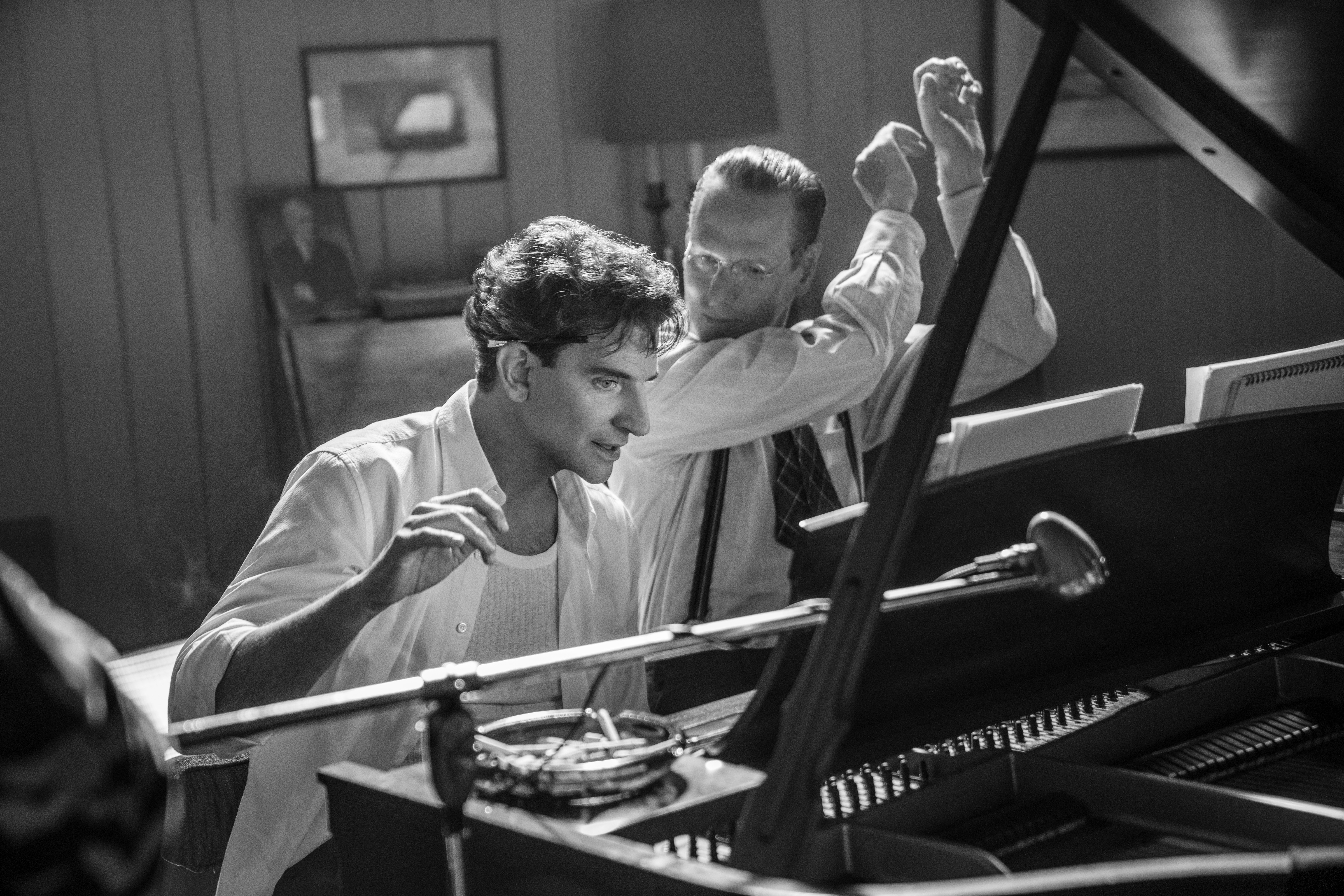
Photo Friday: Happy 95th Anniversary, Christ Church Cranbrook!

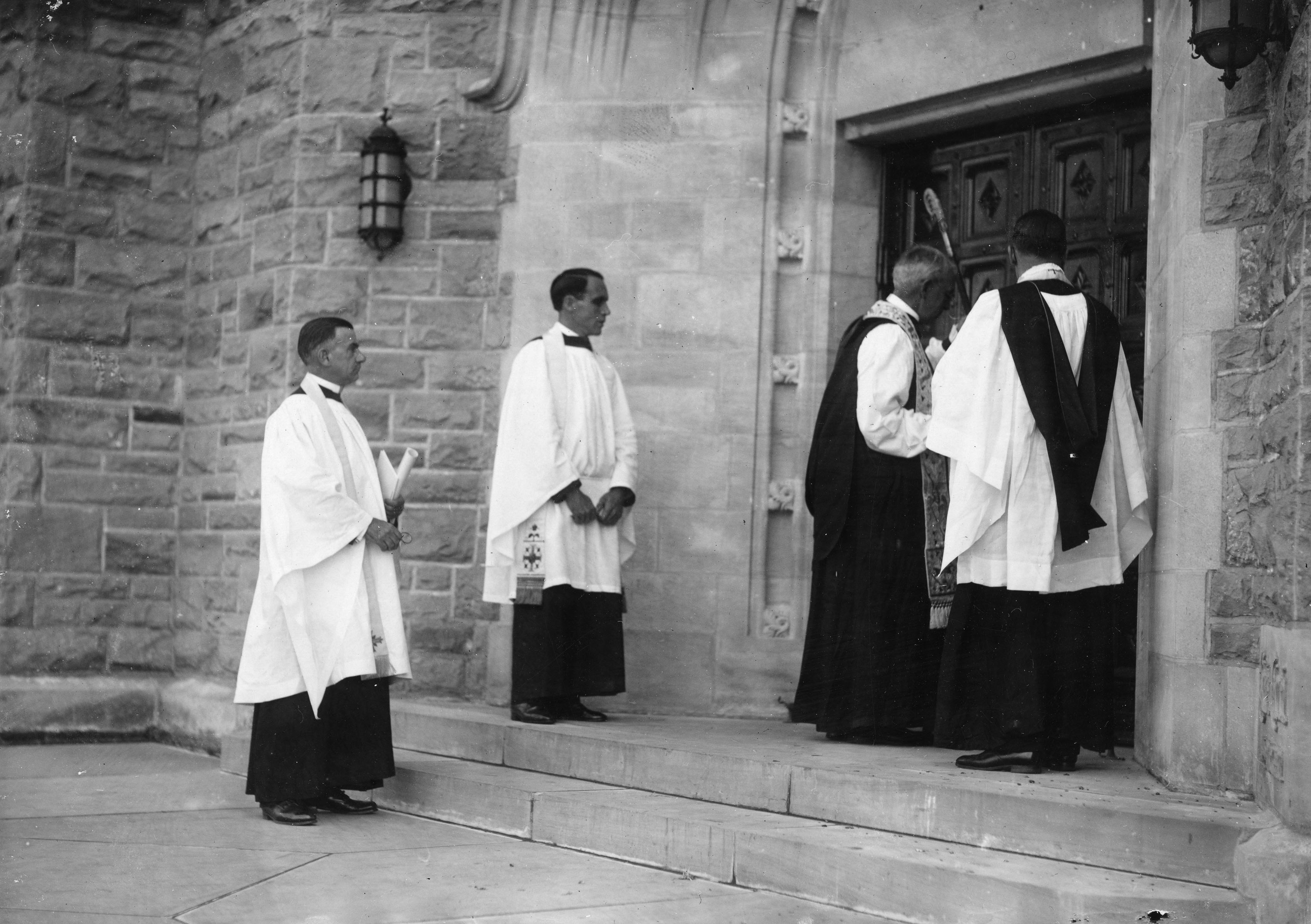
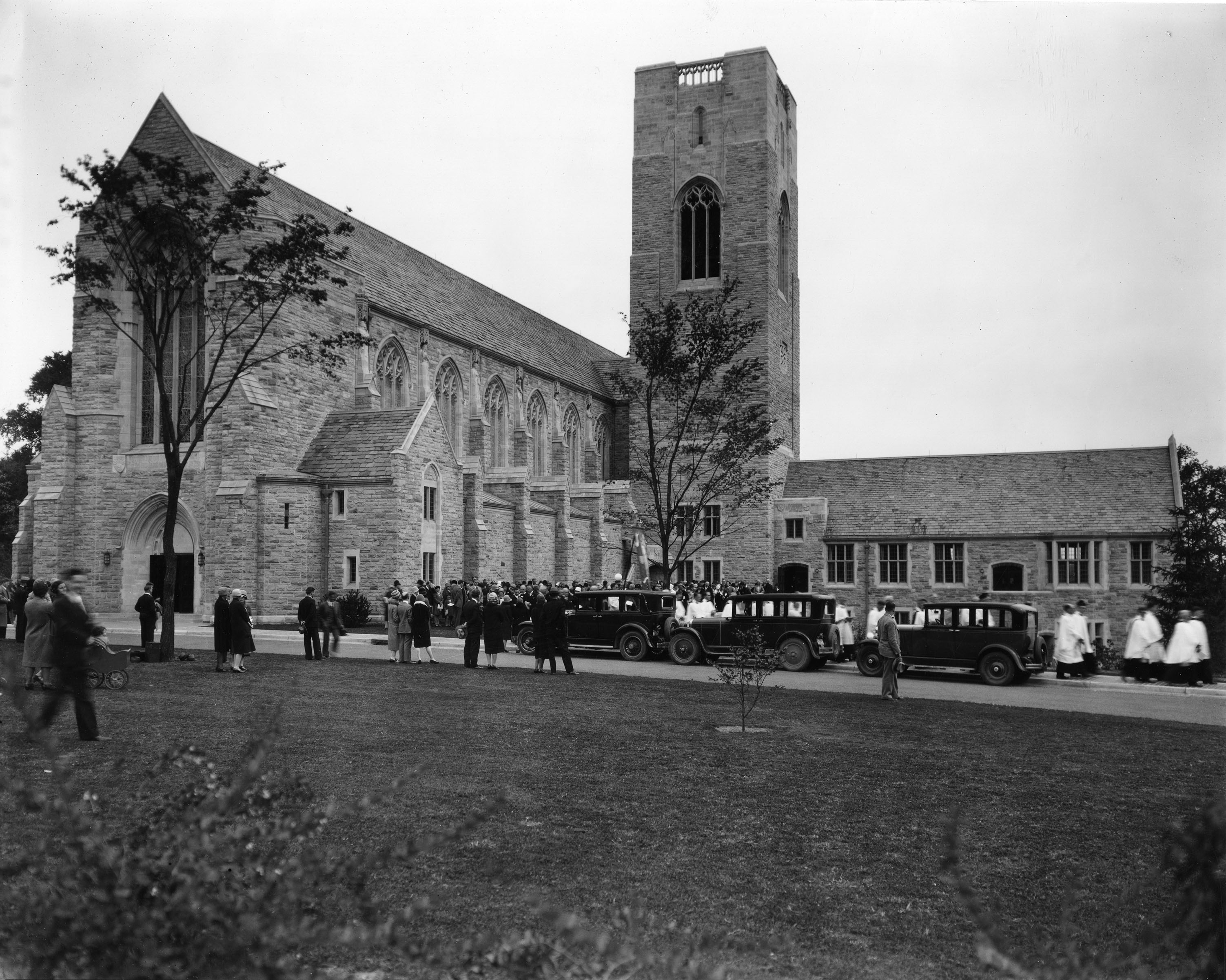
Consecration of Christ Church Cranbrook, September 29, 1928. Archdeacon Ramsey knocks on the door of the church, accompanied by Mr. Kinder, Bishop Page, Mr. Forsyth.

Today marks ninety-five years since the consecration of Christ Church Cranbrook!

Consecration Service Program for Consecration of Christ Church Cranbrook, September 29, 1928.

Planning for the church began in earnest in 1923, with the cornerstone being laid in 1925. After three years of construction, and countless hours of labor from masons, artisans, and clergy, the church was ready to be consecrated.

Christ Church Cranbrook Consecration–Parish House Recessional, September 29, 1928.

The consecration was led by Charles L. Ramsay, Archdeacon of the Episcopal Diocese of Michigan, declared the church sacred and ready for services. While the architecture was complete in 1928, it would be several more years before the last pieces of art were installed.

Consecration of Christ Church Cranbrook Recessional, September 29, 1928.

Kevin  Adkisson, Curator, and Laura MacNewman, Associate Archivist, Cranbrook Center for Collections and Research

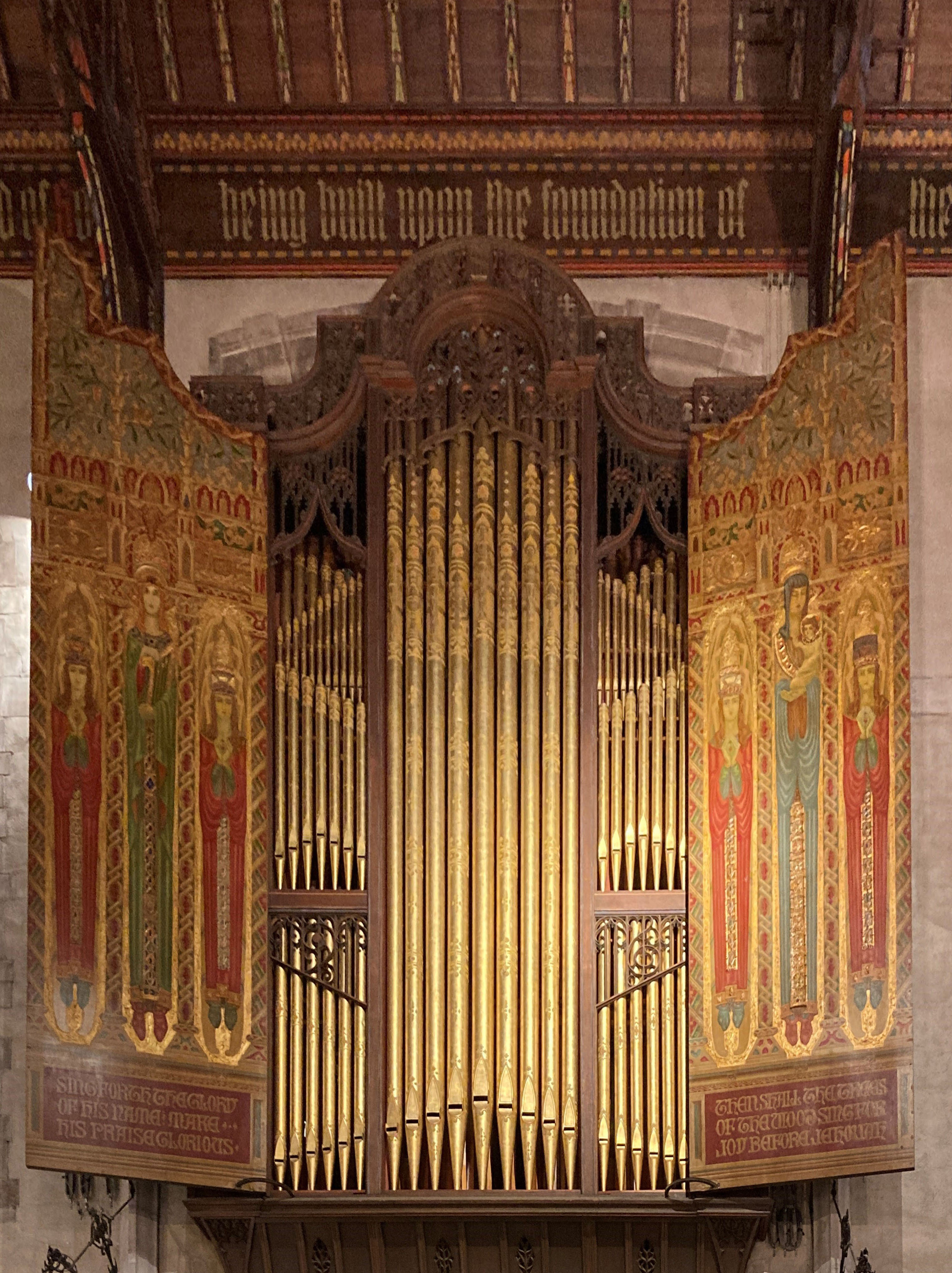
Gravity, Dignity, and Softness: The Voice of the Pipe Organ

In addition to working as an Associate Archivist at Cranbrook, I am also a fledgling volunteer docent at Christ Church Cranbrook. Recently, I gave a tour of the Chancel to test my skills with my teachers. As I prepared, I found there was very little written about the history of the pipe organ at the church. So, where to turn for more information? Cranbrook Archives, of course.

In August of 1925, George Booth and Oscar Murray (of Bertram G. Goodhue Associates, the church architect), started in earnest to finalize their thoughts and feelings about the choice of organ for the church. While the organ itself was installed in January 1928, plans for its ducts and conduits had to be decided early, before the concrete floors were poured.

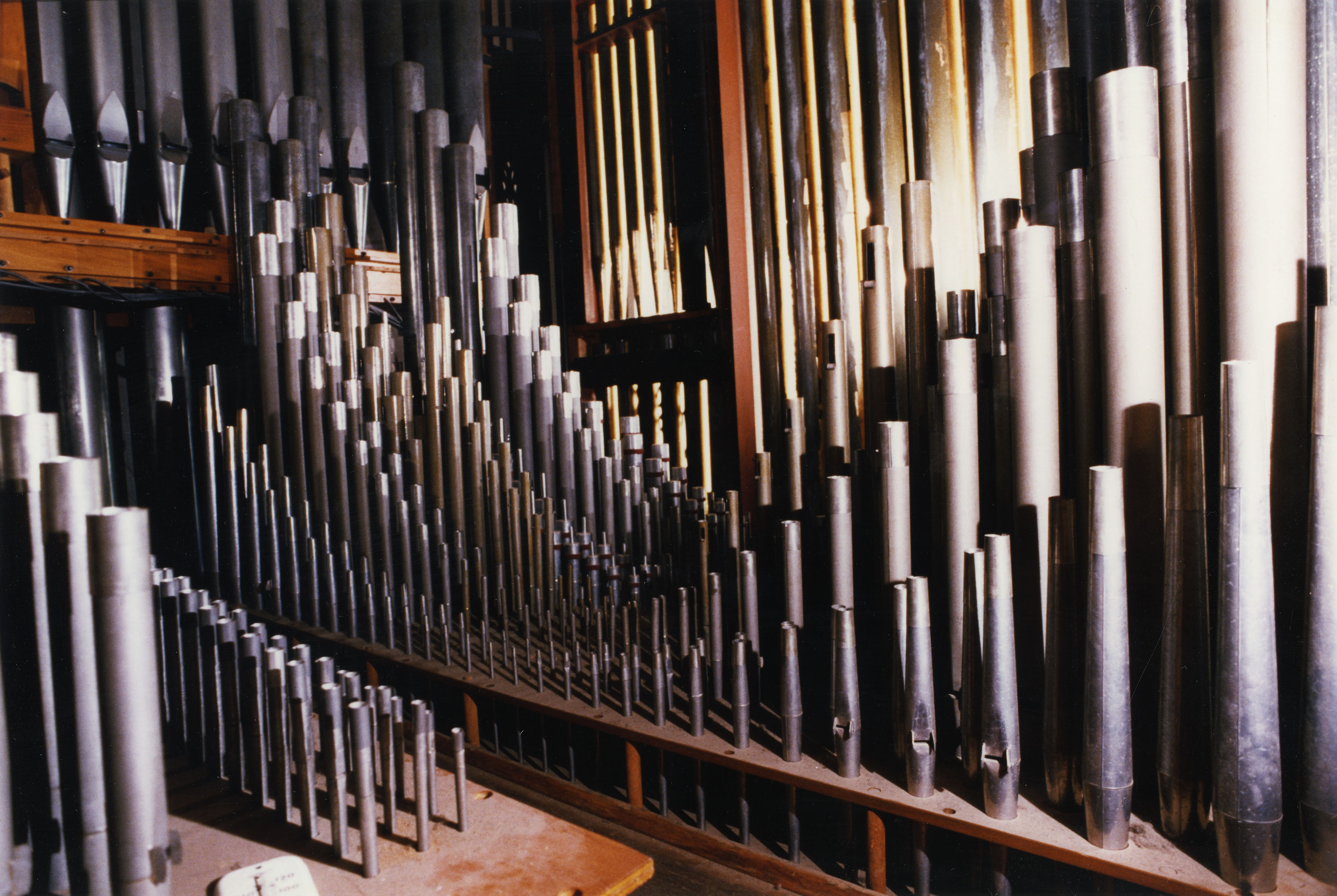
Christ Church Cranbrook organ pipes prior to the 1997 restoration. Jack Kausch, photographer. Courtesy of Cranbrook Archives.

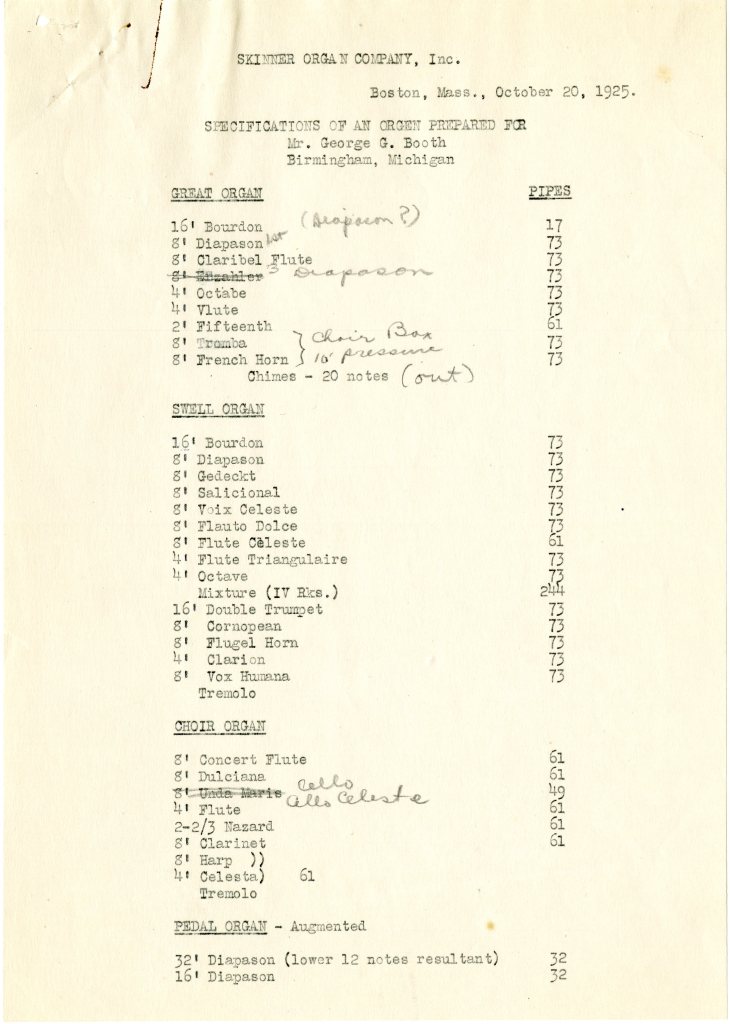
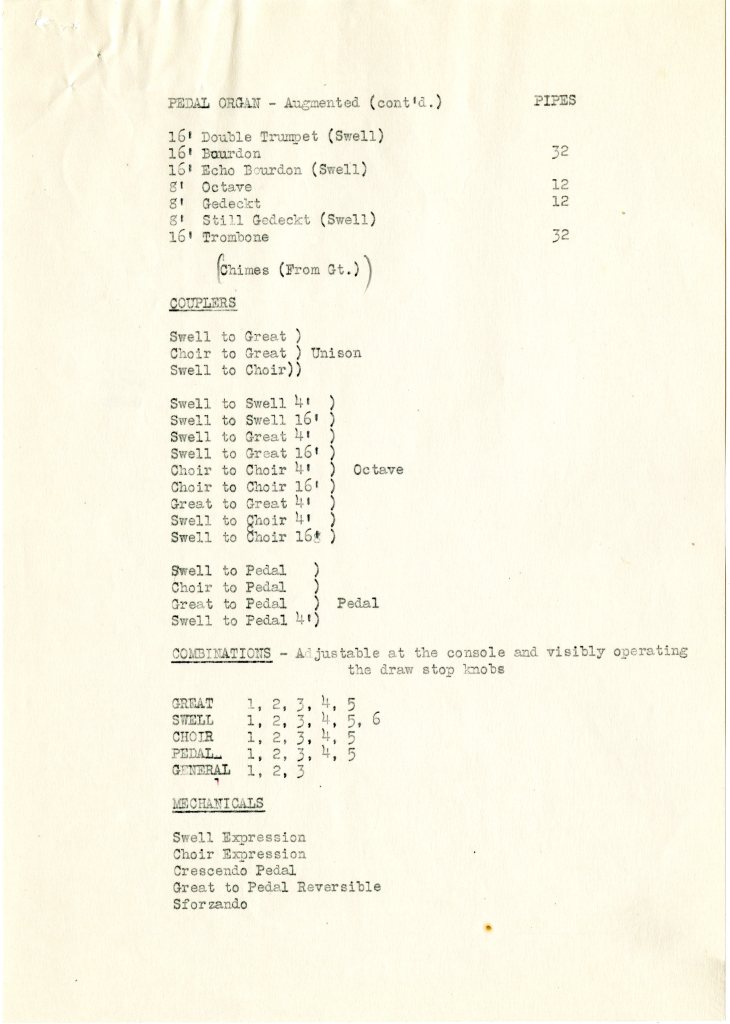
The correspondence suggests that the E.M. Skinner Organ Company was the only company considered. The Boston-based firm was considered America’s finest and most technologically advanced organ builder. Skinner’s specifications for the organ, console, and bench were submitted in October 1925.

George Booth inquired of his colleague Cyril Player to provide comments on the specifications, and Player begins his commentary saying,

“I think I would emphasize gently to them that you want gravity, dignity and softness—the three prime essentials of any church organ, large or small… [gravity] is secured by an adequate and properly-balanced pedal department; dignity by volume of foundation tone in the basic divisions of the instrument; and softness and refinement by skillful voicing with a copious wind stream at a moderate pressure.”

Cyril Player to George G. Booth, November 1925

In passing along the comments to Murray, Booth remarks that, “the desired qualities, viz; gravity, dignity and softness; seems to me peculiarly to express my own feelings and desire.”

William Zeuch of Skinner Organ Company revised the specifications following some of Player’s suggestions, while some revisions were the suggestion of Henry Willis, the great English organ builder who was a consultant to the firm. The contract for the organ (including the Great, Swell, Choir, and Pedal pipe divisions) was duly signed in December 1925 and work proceeded.

At the same time, a separate contract was made with Alfred Floegel to decorate the organ case doors. Booth wished to confine the oak finish to the exterior of the doors while having the rest richly decorated with color. Booth imagined the opening of the organ doors to represent the opening of the mind. He also envisioned the organ case to read as a triptych (a picture or altarpiece on three hinged panels) when open.  

Organ case doors, woodwork by Irving and Casson, decoration by Alfred Floegel. Gift of James Scripps Booth. Laura MacNewman, photographer.

In July 1927, work on the organ console began. The console is where the organist sits to play the instrument, distinguished by its multiple hand keyboards (called manuals), pedalboard, and other controls. Rev. Dr. Marquis requested a change from a 3-manual (Great, Swell, and Choir pipe divisions) to a 4-manual, by adding the Solo division. Zeuch responded positively as it was not too late to build a 4-manual console; however, having already instructed the architect to reduce the dimensions of the organ chamber, which had been too large and would have interfered with the proper effect of the sound in the church, the architect would now need to find space for the Solo division. Room was found above the Sacristy.

Continue reading

Photo Friday: Rosa Parks at HUB

Last weekend, Cranbrook’s Horizons-Upward Bound program celebrated the completion of its fifty-eighth annual six-week summer residency program. Students and their families spent Theme Day on campus learning about the academic and artistic successes of the summer (including a display organized by the Center about our Architecture Elective, and a performance in the Greek Theatre by students and the Autophysiopsychic Millennium collective).

Rosa Parks addresses Cranbrook’s Horizons-Upward Bound graduation, held at Cleveland Middle School, July 11, 1989. Cranbrook Archives.

But did you know that in 1989, HUB celebrated the end of the summer with a special graduation address by legendary activist Rosa Parks? The “mother of the freedom movement,” Parks spoke to Cranbrook’s HUB students in a ceremony held at Cleveland Middle School in Detroit on July 11, 1989.

A speaker at the HUB graduation stands beneath a banner welcoming Rosa Parks, July 11, 1989. Cranbrook Archives.

While we couldn’t find the subject matter of Park’s HUB address or too many details of the special occasion, I am confident we will learn more about this moment in HUB history (and so many others) as Cranbrook Archives embarks on an exciting, multi-year digitization effort of the Horizons-Upward Bound Records made possible by a grant from the National Archives and Records Administration, through the National Publications and Records Commission’s Access Program.

In fact, the work has already begun! During the summer months, two current HUB students worked in the archives, digitizing more amazing materials like these images of Rosa Parks! Look for more Cranbrook Kitchen Sink posts drawn from the HUB collection in the future!

Kevin Adkisson, Curator, Cranbrook Center for Collections and Research

One For the Books: The Ward Just Papers

Wonderful news for literary researchers and enthusiasts: the Ward Swift Just Papers have grown substantially in size and completeness! The new collection now more fully represents Just’s remarkable and multidimensional career in both news and creative writing, thanks to a recent substantial donation from the Just Family.

Head Archivist Deborah Rice and I are partial to the undated portrait of Just in a beret, likely while living in Paris. To your health!

The correspondence series of Just’s papers, alone, has increased tenfold. Some highlights include the young writer’s letters home to his family from Cranbrook School and Trinity College, as well as letters with many friends, fellow writers, and literary editors.

We also now have letters, reporter’s notes, images and clippings from the year and a half (December 1965-1967) when Ward Just, age 30-32, covered the American War in Vietnam for The Washington Post. Before his death in 2019, Just told Cranbrook Archives that the addition of these papers would be of special interest to scholars of the Vietnam War. They also give a much fuller story of these formative years in Just’s life and career.

Continue reading

Create a website or blog at WordPress.com