Cranbrook Archives is excited to announce the opening of the Ralph Rapson Collection (1935-1954) for research. The collection focuses on the early years of Rapson’s work, including his time as a student at Cranbrook Academy of Art. Rapson’s later work is retained at the Northwest Architectural Archives at the University of Minnesota, where he was the Dean of the School of Architecture from 1954-1984.
Rapson was born in Alma, Michigan in 1914. He earned Architecture degrees at the University of Michigan (1938) and at Cranbrook Academy of Art (1940). Upon completing his studies at CAA, Rapson set up his studio and was invited to help Eliel Saarinen with a planning project, which was to provide an analysis of the site for a new State Capitol complex in Lansing, Michigan. Following this experience, Rapson decided to focus more on architecture than planning. Between 1938 and 1942, Rapson contributed designs and drawings, and built models, for various projects and competitions for Eliel Saarinen and his associates.


While at Cranbrook, Rapson collaborated on several competition drawings with Eero Saarinen, Frederick James, David Runnells, Walter Hickey, Harry Weese and others. Rapson established an early reputation for his experimental concept houses like the 1939 “Cave House” and “Fabric House,” (both designed at CAA with fellow student David Runnells) and the 1945 “Greenbelt House” or Case Study House #4, one of the experiments in American residential architecture sponsored by Arts & Architecture magazine.

Case Study House #4 for Arts & Architecture magazine, Jun 1944.
In the early 1940s, Rapson moved to Chicago where he taught under the Hungarian Bauhaus artist, Laszlo Moholy-Nagy. Rapson served as Head of the Architectural Curriculum at the Institute of Design (New Bauhaus) from 1942-1946. He left this position late in 1946, when MIT Dean of Architecture, William Wurster, invited him to relocate to Massachusetts where he taught architecture alongside Finnish architect, Alvar Aaalto.


In 1951, Rapson was hired by the U.S. State Department to design a series of American embassies in Western Europe with architect John Van der Meulen. Rapson worked on several embassy projects, as well as residential projects, in the mid-1950s. In the spring of 1954, Rapson and his family moved to Minnesota where Rapson served as the Dean of the School of Architecture at the University of Minnesota from 1954-1984. He continued to work in private practice in Minneapolis until his death in 2008 at the age of 93.
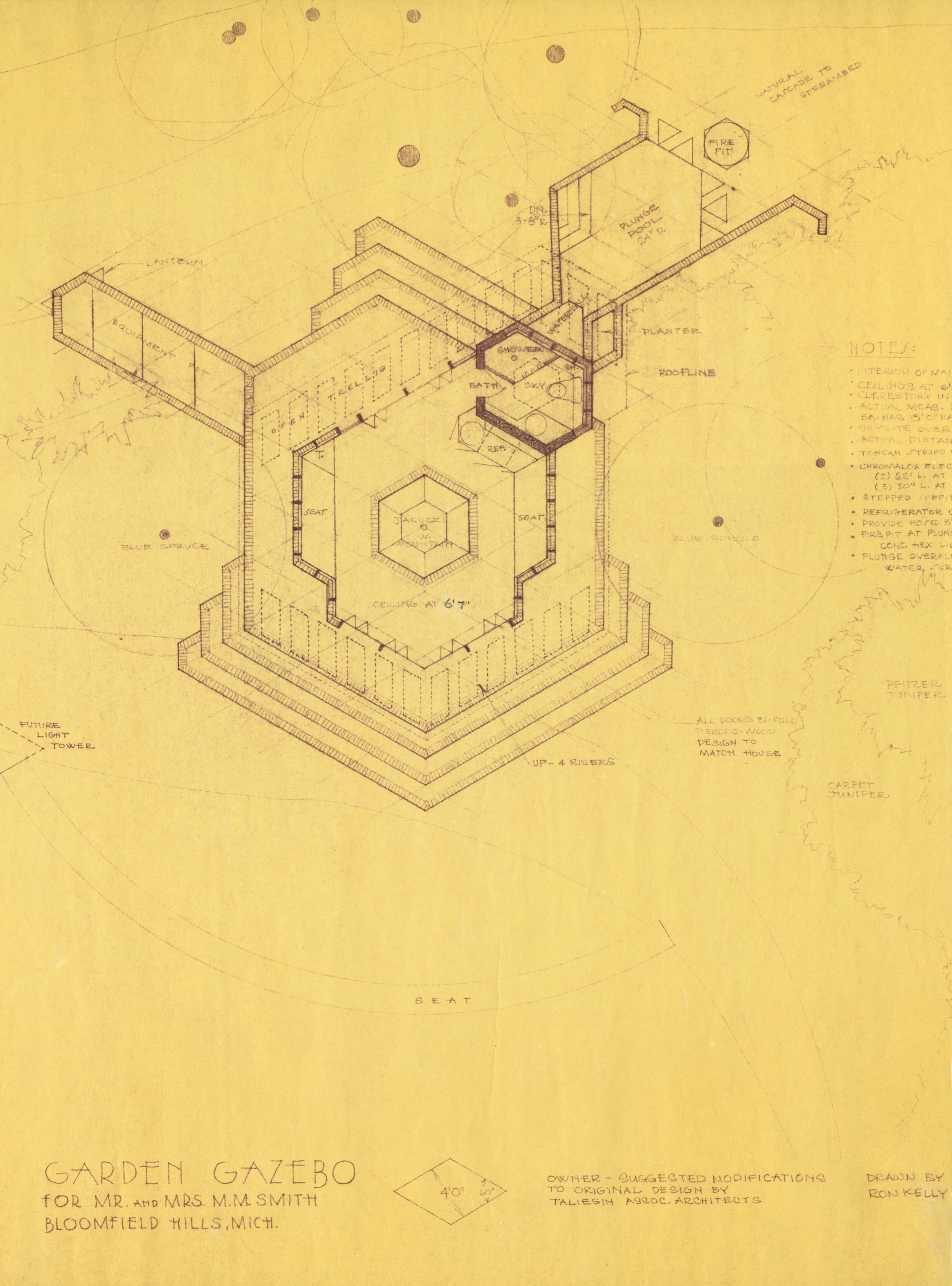
The Ralph Rapson Collection includes project files, research, correspondence, architectural drawings, and photographic material from many of Rapson’s embassy projects, as well as design competition materials and residential projects. In addition to the physical collection, a digital site (including drawings, photographs, and ephemera) is now accessible from our web site. The Archives staff will continue to add to this site, as more material is digitized.
– Gina Tecos, Archivist
Sources:
Hession, Jane King, Rapson, Rip, and Wright, Bruce. Ralph Rapson Sixty Years of Modern Design. Afton, MN: Afton Historical Society Press, 1999.
Heyer, Paul, ed. Architects on Architecture. New York: Walker and Co. 1965.











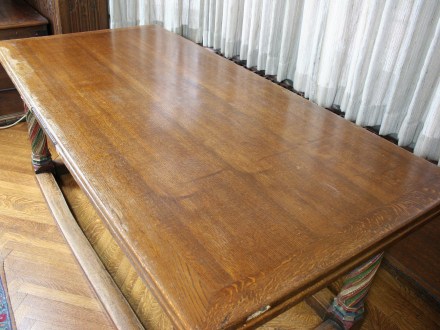 Purchased by George G. Booth, before 1949, for use in Cranbrook House, the Refectory Table (CEC 37) in the Cranbrook House Oak Room has a plain 76 inch by 35-1/2 inch rectangular top, with two extendable tops of 31-1/2 inches each.
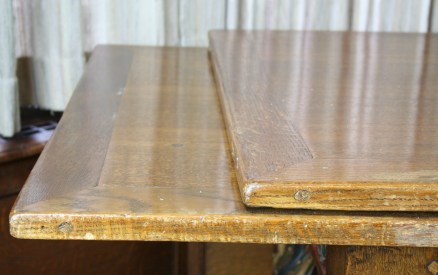 The extension mechanism works by removing the top wood leaf, pulling out each side of tabletop – these are supported by bars under the table top that pull out – removing the center section, then placing the top leaf in the center.
 The frieze runs all around the table and features a grapevine interspersed at regular intervals with Medieval-style figures: mermaids, men, women, and animals.
 The figures carry banners and staffs, are sitting on benches, and, in the case of the mermaid, holding a fish.
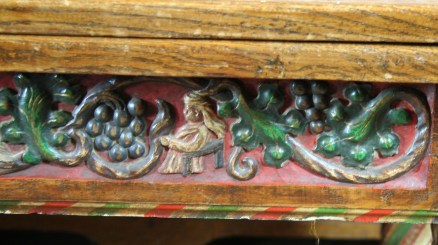 The frieze background is painted red; the grapevine and grapes are brown with black and the leaves are green with gold detailing; the figures and animals are mostly tan with gold and the mermaids are gold as well. The lower edge molding of the frieze is painted with diagonal lines of green, gold, and red.
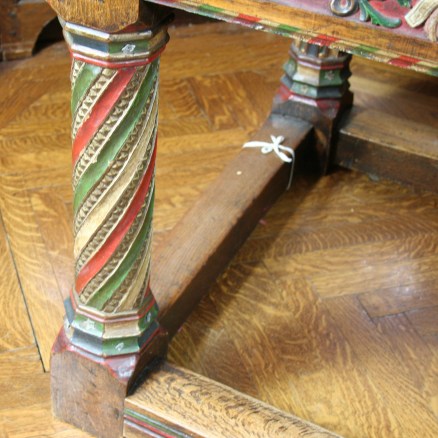 Each of the four carved and painted legs is decorated with a different linear design of stripes, twisted around the trunk, with hexagonal base and top.
 Metal stars are attached to the base and top of each leg. The legs are painted blue, green, red, and tan, all with gold detailing.
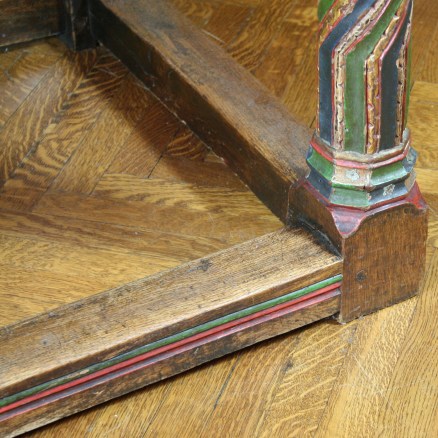 The outer side of each stretcher has carved lines painted red and green.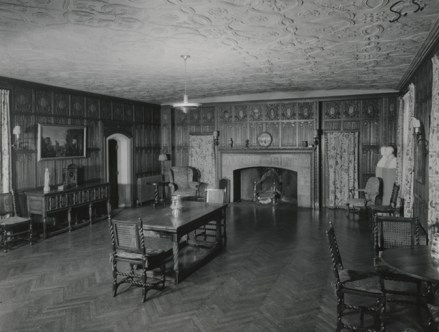

 Cranbrook Kitchen Sink