This spring, Dawn Straith, Innovation & Technology Specialist at the Vlasic Early Childhood Center & Cranbrook Kingswood Lower School Brookside, used the bridges in the Japanese Garden as a tool in her Design Thinking Unit with the Senior Kindergarteners. I asked Mrs. Straith to explain the project.
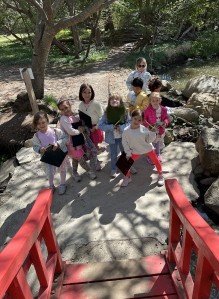
The Senior Kindergarteners exploring the Cranbrook Japanese Bridge (aka Red Wood Bridge) in the Japanese Garden, 2025.
DS: In our design thinking and engineering unit, the Senior Kindergarten students became bridge investigators! They explored six different bridges in the Japanese Garden to see how safe and strong they are. While investigating, they discovered that bridges with beams and columns are much stronger than those without. They considered what goes over and under the bridges, who and what use the bridges, the materials the bridges are made from, and whether they had handrails. Some bridges didn’t have handrails at all, which we determined made them feel a bit less safe. They also noticed that the ground near a few of the bridges was eroding, which isn’t as safe either.
Side view of the Japanese Garden Round Island Footbridge.
DS: The bridge to “Round Island” (a small island the children have affectionately named for themselves as “SK Island”) got the lowest safety score—it’s tilted, there are no support beams, the ground is eroding, the materials used aren’t the strongest and there are no handrails to hold onto!
Japanese Garden Round Island Footbridge from the eastern shore of the Lily Pond. Photo by Saida Malarney.
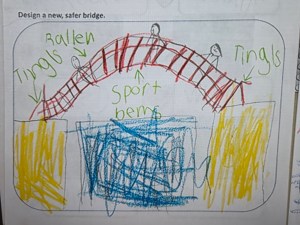
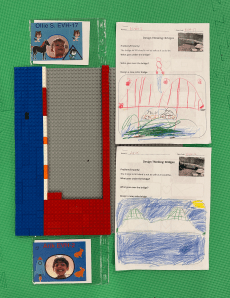
DS: After analyzing all this, the students got to work designing a safer bridge for “SK Island”. They learned that triangles are super strong shapes and that engineers use them all the time when building bridges. With their users in mind, the students carefully designed and built models of brand-new, safer bridges. Their final step is to share their ideas with the garden’s groundskeepers.
Round Island Bridge design, incorportating safety features like “rallens” and “sport beams.”
Enter the Center, the aforementioned “garden’s groundskeepers”!
I am the “Proud Museum Person” with some of our Japanese Garden volunteers working in the garden in April 2025.
As the Associate Registrar, and once-a-month “Gardener” in the Japanese Garden, I was invited to visit the SK classes as they presented their bridge models.
Most of my friends in SK had already helped cover garden sculptures for a number of seasons, so I knew they understood taking care of objects on the campus, but I was once again impressed by our students. They carefully considered what changes could be made to make our bridge safer for all visitors — kids, parents, guests with limitied mobility, and furry friends.
A very big THANKS! to our SK engineers.
Some of the students’ ideas even aligned with designs by our garden designer Sadafumi (Sada) Uchiyama, a third-generation Japanese gardener, registered landscape architect, and Curator Emeritus of Portland Japanese Garden.
Design for Round Island Bridge by Sadafumi Uchiyama.
Design for Round Island Bridge by Gretchen and Liam.
As we start the construction of the new Welcome Garden in the Japanese Garden this summer, we hope our future structural engineers will return in the fall to see how we are progressing.
– Leslie Mio, Associate Registrar, Cranbrook Center for Collections and Research
Each May, the Center is honored to host outstanding seniors from Cranbrook Kingswood Upper School for a three-week immersive internship.
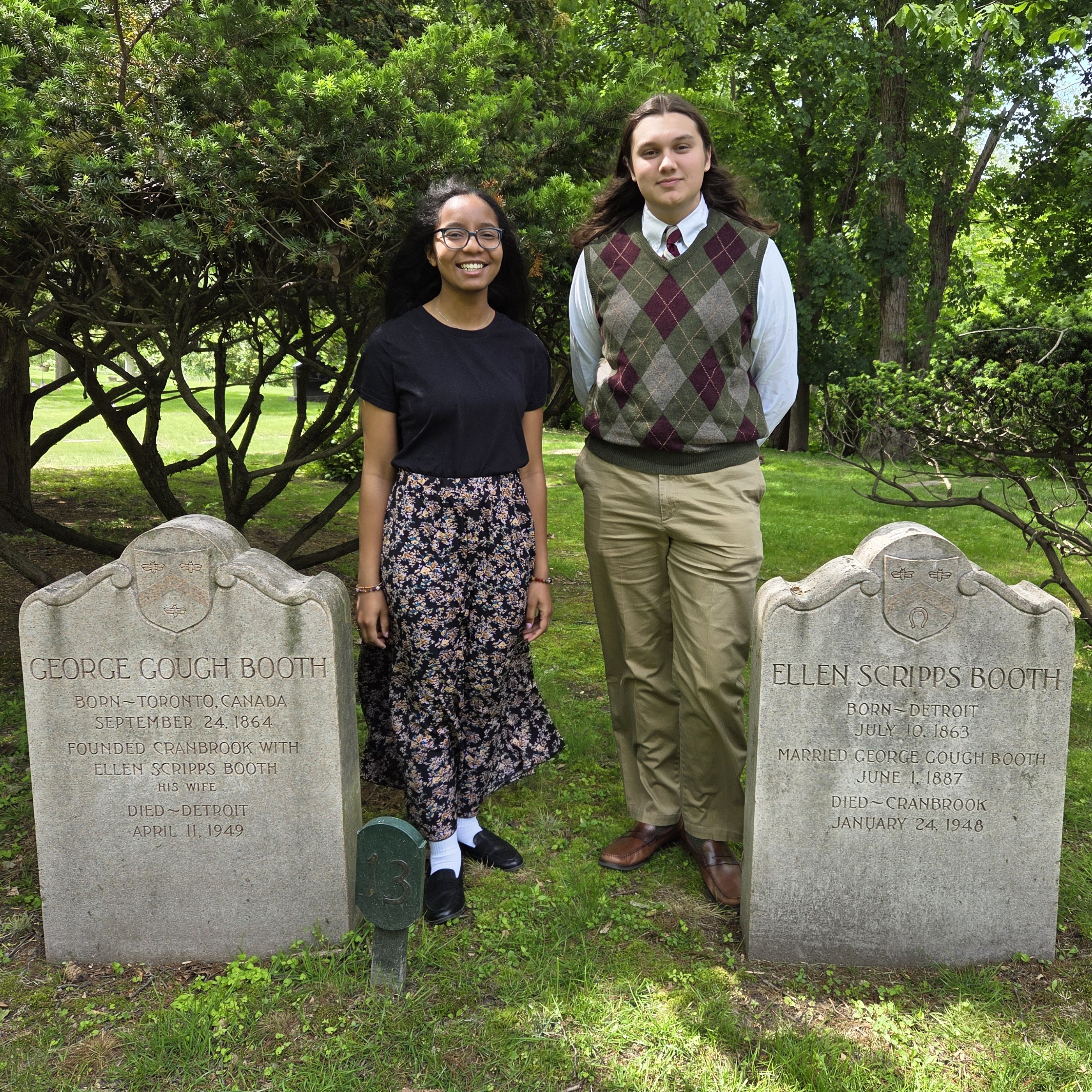
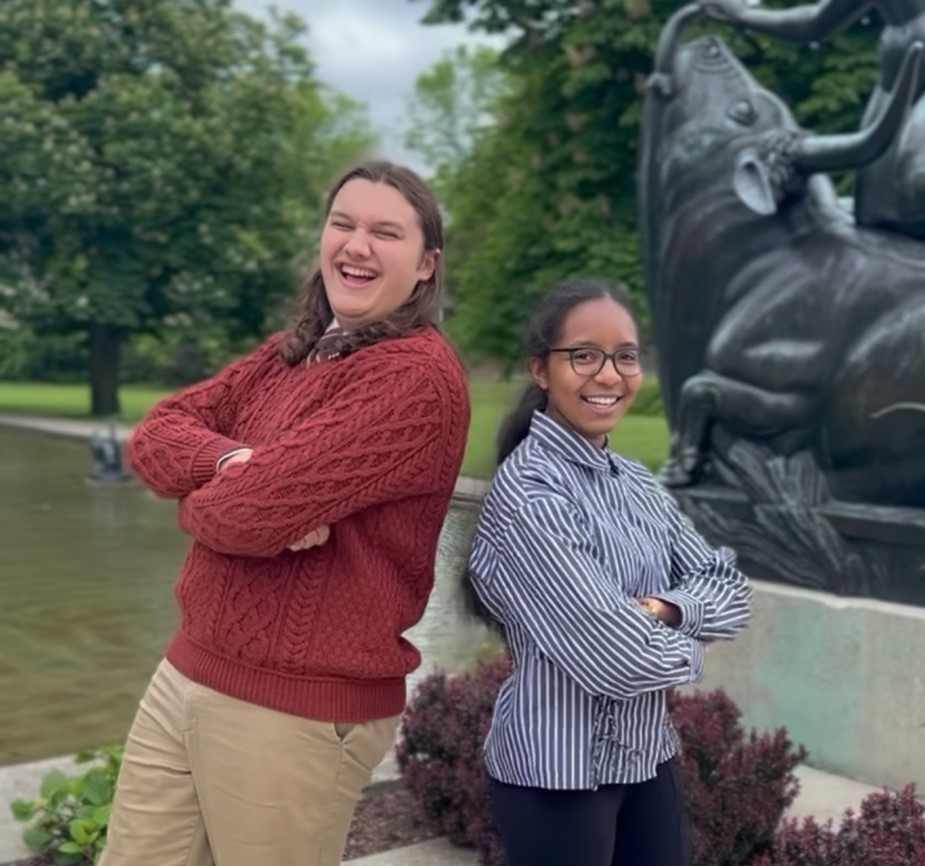
Kamilah Moore and Joel Kwiatkowski, 2025 Senior May interns, visit George and Ellen Booth at Greenwood Cemetery, Birmingham. Photography by Leslie Mio.
This year two seniors, Kamilah Moore and Joel Kwiatkowski, worked with the Center and Archives staff, including writing blogs! Hear from Joel today and look out for Kamilah’s post next week.
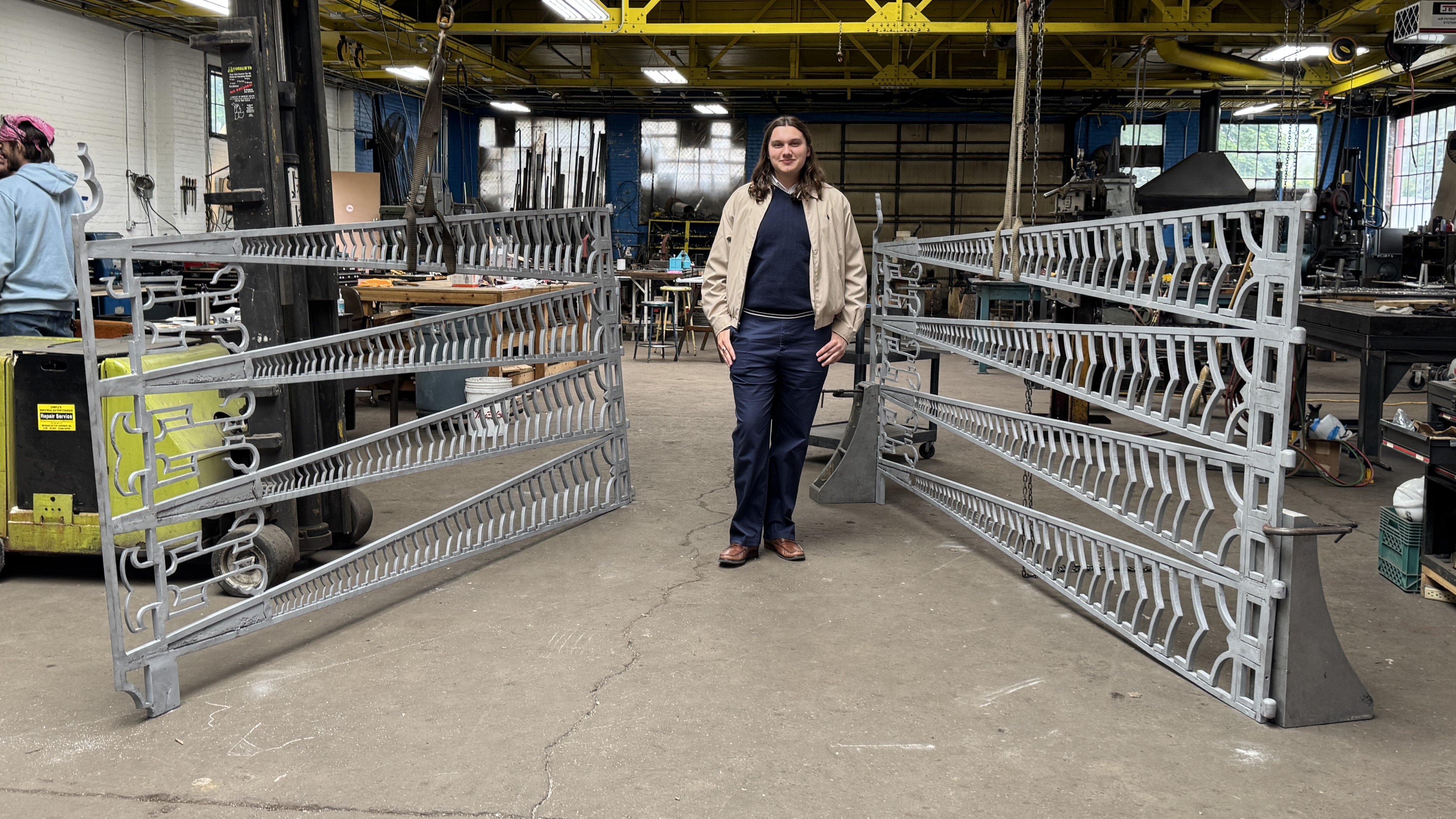
Checking in on the Eliel Saarinen-designed Kingswood main gate at Smith Shop in Highland Park, May 2025. Photography by Kevin Adkisson.
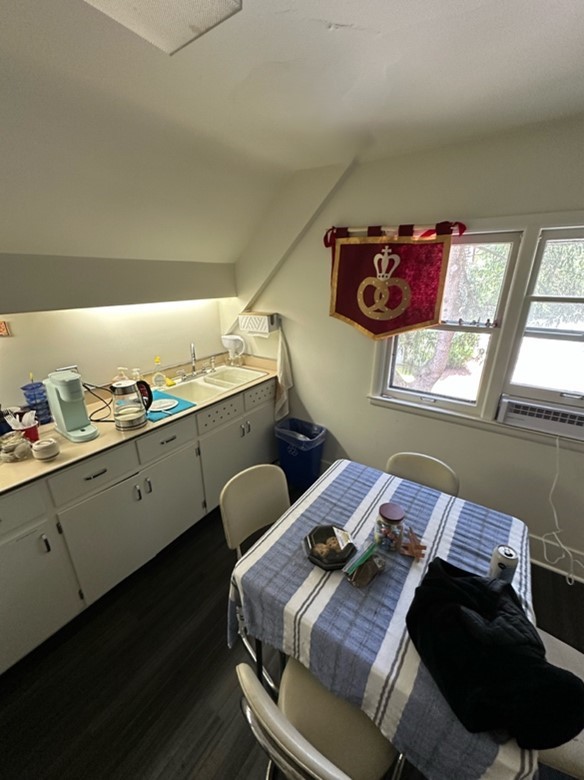
Cranbrook Center for Collections and Research is a name that invokes the image of some grand museum or hall, with many sterile prep rooms and rows upon rows of file cabinets. Now don’t get me wrong, there are plenty of file cabinets, but the Annex is far from grand. Instead, the rather humble staff apartment-turned-offices are befitting the lovely people there.
The Center’s Annex, next door to Cranbrook House, is situated above the House & Garden Auxiliary offices, up a set of winding stairs that require me to duck in a few places. But up there you will find a quaint little kitchen (complete with a toaster oven and healthy snack collection), a few offices, and closets and cabinets dotted with curiosities.
The quaint kitchenette of the Annex, compete with decommissioned Cranbrook Institute of Science Library chairs, May 2025. Photography by the Author.
It was this atmosphere, over many chatty lunches, that I got to know Leslie Mio, the Associate Registrar, and Mariam Hale, the 2023-2025 Center Collections Fellow. It was a pleasure to find two individuals who cared so greatly for history and conservation, and we bonded over our shared love of museums and particular historical eras.
But, let it be known that work at the collections isn’t all comfortable work behind a desk or searching a filing cabinet. This illusion, if I ever had it, was quickly broken on my first full day of the internship. Our task? Moving five solid wood cabinets from the rooms of retirement-age nuns across the building to be used to store Cranbrook’s lacy dresses and costumes.
Briarbank, a neighboring estate to Booth’s land, was converted into a place for sisters to stay once they needed a bit more care later in life. But, at some point, the demand for a place such as that ran dry, and Cranbrook bought the campus. And now, in that spirit, I was near horizontal in my penny loafers, shoving a giant wardrobe into place across some very tasteful carpet.
Mariam and I defy the friction of decades old carpet, May 2025. Photography by Leslie Mio.
In the coming days, the purpose of these heavy cabinets would be realized, as we began the true overarching theme of my time at the Center: moving a seemingly infinite number of objects from the hot attic of Cranbrook House to the comparatively “less hot” and climate-controlled storage area at Briarbank. Paintings, prints, textiles, rugs, hats, and racks of clothing and costumes were deftly maneuvered through the halls and offices of Cranbrook House (or, alternatively, very carefully down the narrowest, steepest, stairwell known to mankind).
Each day packing and moving Cultural Properties in the attic was sure to bring new surprises. Everything from a fur hat belonging to George Booth to paper parasols, or entire handwoven rugs the size of a small house. While these days meant a bit of manual labor, they never ceased to bring me joy, as the wonderful folk of the Center doled out tidbits of Cranbrook’s story connected to each unearthed gem.
The fabulous hat in a box marked “G.G.B.” — the box is possibly a later acquisition by Henry S. Booth — May 2025. Photography by the Author.
Now those familiar with the Center may be wondering: “Now wait just a minute. Where is my favorite curator? Where is the delightful presence of the steward of Saarinen House?” Well, fear not good reader, for while Kevin may not have been at every boxing and unboxing, Kevin joined Kamilah and me on many excursions outside the Samuel-Yellin-forged gates of Cranbrook. For those unacquainted, Kevin Adkisson is Curator of the Center, the veritable fountain of all knowledge concerning Cranbrook, and legend in his own time among students.
My first trip with Kevin came when we were tasked with heading to Detroit to give a tour of Holy Redeemer Church to a group of 8th graders from the Catholic school next door. I thought that getting middle schoolers excited about Corinthian columns would be impossible, but Kevin’s energy and skill made it look easy.
Kevin and I had fun teaching Holy Redeemer 8th graders about architecture. Photography by Holy Redeemer.
Afterword, we headed to visit the master ironworkers at Smith Shop, where the Eliel Saarinen-designed Kingswood main gate is being repaired and restored. I stood back and observed while Kevin, Cranbrook Capital Projects Director Jean-Claude Azar, and Amy Weiks and Gabriel Craig (co-owners of Smith Shop) debated the ins and outs of the gate’s making and breaking.
I enjoy a tour of the facilities of Smith Shop with Cranbrook Capital Projects Director Jean-Claude Azar and Smith Shop co-owner Gabriel Craig in Highland Park, May 2025. Photography by Kevin Adkisson.
Across my three week Senior May, I also took trips to the paint store to debate shades of grey, the frame shop to mount an object, Ken Katz’s painting conservation studio, and even Birmingham’s historic cemetery. On each of these trips, I gained insight into the multifaceted work of the Center for Collections and Research, including care and handling, teaching, conservation, and cataloging.
I cannot fully capture in a blog what a delight it was to be in the presence of such knowledgeable individuals. For every question about Cranbrook’s history, each member of staff was sure to add in their own expertise, citing obscure letters and photographs, adding a beautiful familiarity to their responses and giving color to the story of Cranbrook.
Of course, I would be remiss to leave out some of the other folks who make the Center function, like Greg, Jody, Amy, and Jess. These are the people who drive the work, managing, fundraising, and promoting the vision of Collections and ensuring the continued progress of the Center’s goals.
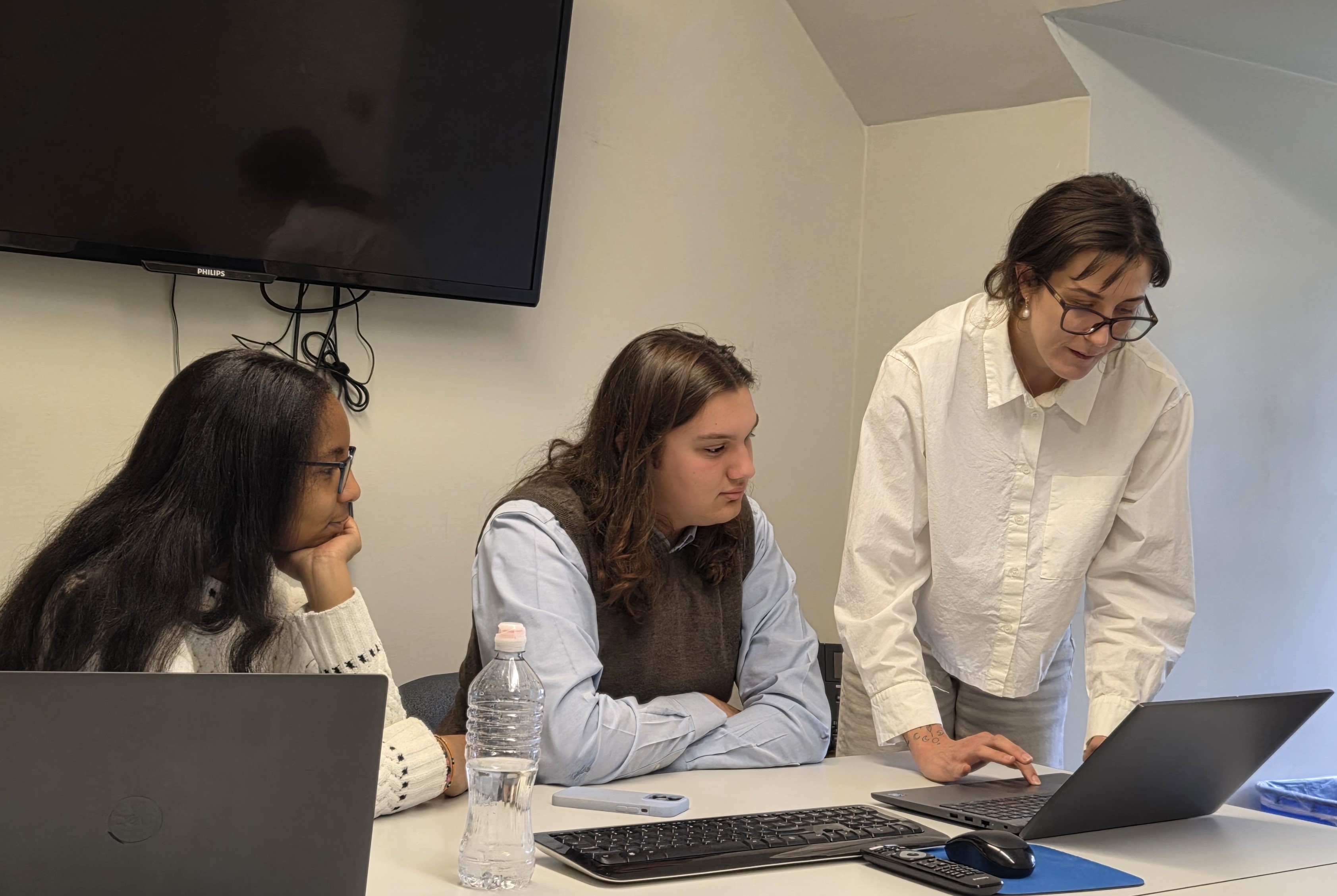
Even interns have meetings, Kamilah and I sat in on one of the Center’s weekly staff meetings. Photography by Kevin Adkisson.
On my last day, I had the privilege of working with Jess Webster, Development Coordinator, who also helps run the Center’s social media. With Kamilah, I researched, drafted, workshopped, and delivered a script for an Instagram Reel commemorating the 150th birthday of Carl Milles., During my time working out ideas for the video (and even this blog), I gained a new appreciation for the way in which Cranbrook is viewed from the outside.
Kamilah and I workshopping our reel for Carl Milles’s 150th birthday with Jess, May 2025. Photography by Leslie Mio.
For me, as a student at Cranbrook, my view is that of someone on the inside, who has the privilege to walk by art on campus each and every day (admittedly at times without a second thought). But getting to see the behind-the-scenes of Cranbrook’s beautiful historic campus has given me an appreciation that feels wholly unique amongst my peers.
If you’ve read this blog, I urge you to take a moment to appreciate all that goes on caring for a 100-plus-year-old campus to live on to this day and serve its many students and visitors. From calls, texts, emails, and meetings, the Center is busy planning, filing, caring, and protecting the legacy of Cranbrook. The work is never done.
Yet despite the challenges, the Center rises to the task, willing to give their all to something they passionately care for. It would be hard not to be inspired.
Kamilah and I make a video for Carl Milles’s 150th birthday, May 2025. Photography by Jessica Webster.
This internship has truly been a dream-come-true, and I am grateful to Mariam, Leslie, and Kevin for their warm welcome and tutelage.
– Joel Kwiatkowski, Cranbrook Kingswood Upper School Class of 2025 and Cranbrook Center for Collections and Research 2025 Senior May
Editor’s Note: The Senior May Project is a school-sponsored activity that encourages Cranbrook Kingswood Upper School seniors to acquire work experience in a field they are considering as a college major, a potential profession, and/or as a personal interest.
Joel Kwiatkowski graduated from Cranbrook in June 2025 and will be attending the University of California San Diego in the fall to pursue a degree in Molecular and Cellular Biology. Joel first came to Cranbrook Schools in sixth grade, and has since gained a passion for the institution’s rich history of influential artists and personalities.
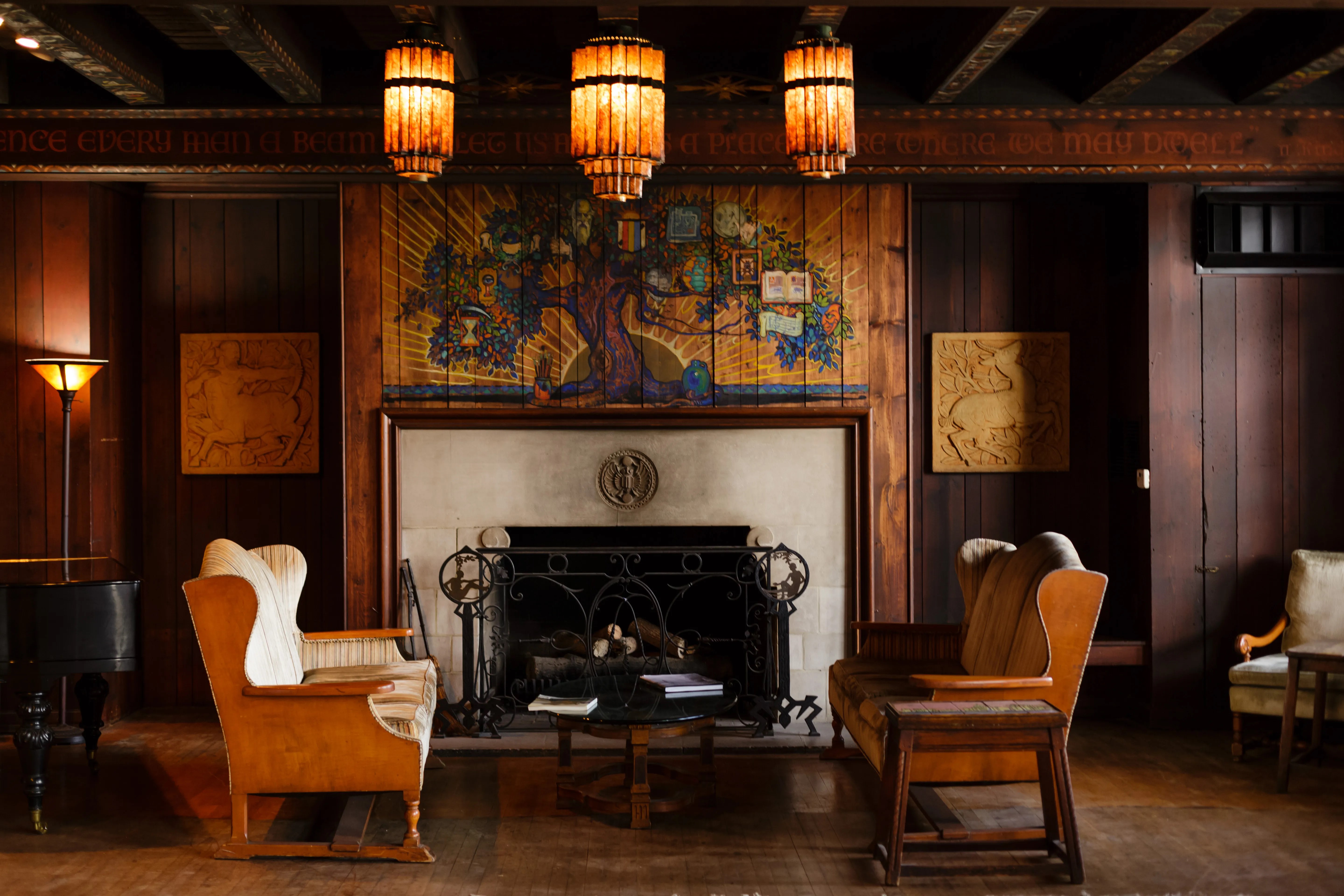
What would you want for your 75th birthday? If you were painter Robert Hopkin, it would be an artists’ club named in your honor. The Hopkin Club, formed in 1907, had no rules, officers, or dues. The members wanted to get together occasionally, to talk about art or host artists visiting Detroit. Hopkin passed away in 1909, but the club continued. In 1913, The Hopkin Club established by-laws and was renamed the Scarab Club–the name it continues under today.
Scarab Club Room. Photography courtesy of Scarab Club.
But who was the man the club was originally named after?
Robert Hopkin was a maritime/marine artist born in Glasgow, Scotland, in 1832. He learned to paint and draw from his father. The family emigrated to Detroit in 1842. His grandfather was a sea captain which drew Hopkin to work on the wharves in Detroit and inspired his art. Though chiefly known as a painter of marine scenes and seascapes, Hopkin made frequent trips throughout the American west from 1860 to 1885, painting murals for public buildings and drop curtains and scenery for theaters, including the Tabor Grand Opera House in Denver.
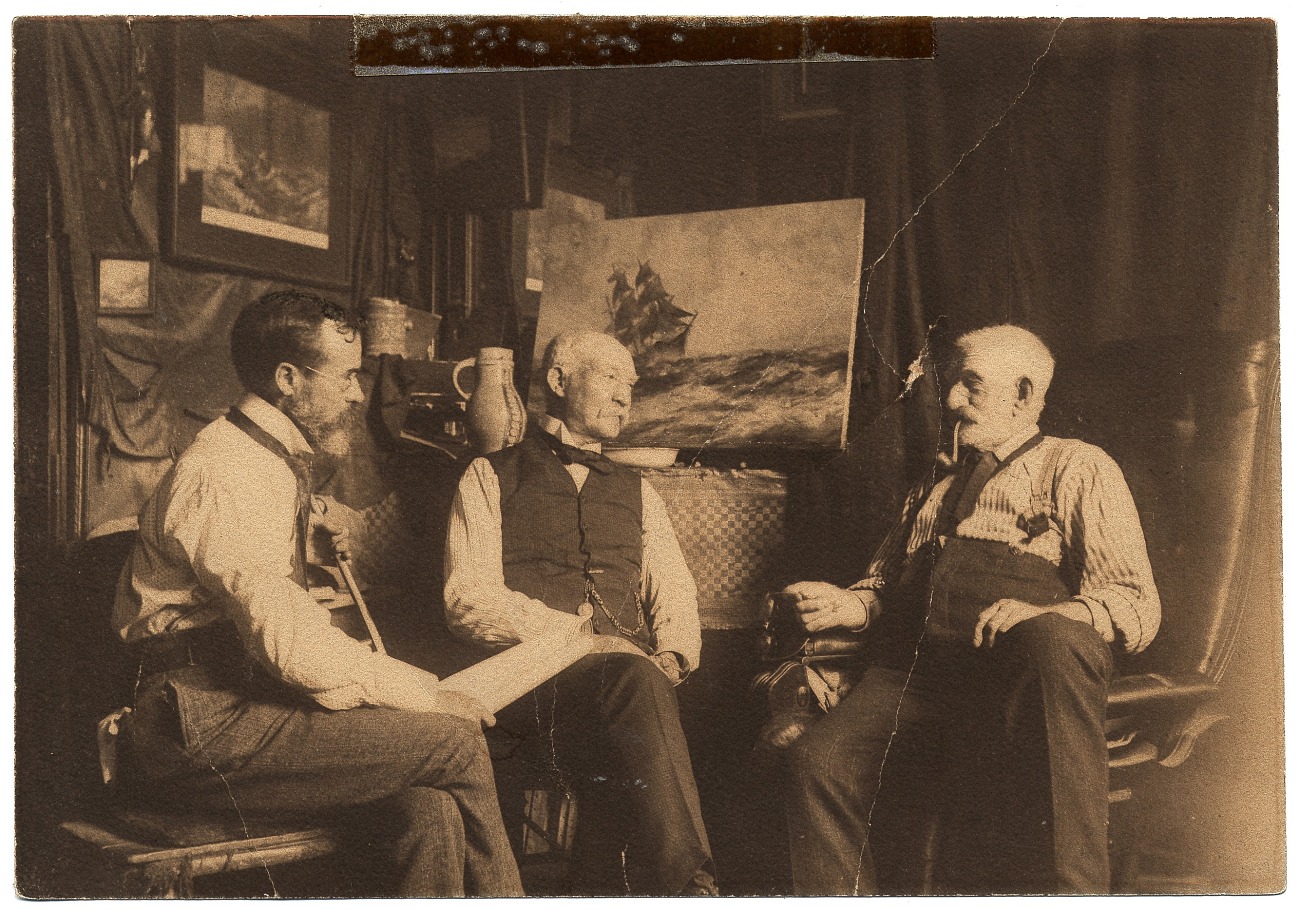
Robert Hopkin (right) and others in studio, ca. 1900. William H. Thomson papers, 1912-1950. Archives of American Art, Smithsonian Institution
In the latter half of the 19th century, Hopkins was considered the dean of Detroit artists; he decorated the interior (as well as the stage curtain) for the original Detroit Opera House (1868), painted murals in Detroit’s Fort Street Presbyterian and Ste. Anne’s churches, as well as the Cotton Exchange in New Orleans (1883). By April 1900, the Detroit Free Press wrote, “Many of the art lovers of this city possess one or more of [Hopkin’s] splendid marines, and they have been reproduced and published until everyone is familiar with his work.”
When Mr. Robert Hopkin’s Collection of Paintings opened at the Detroit Museum of Art in May 1901, “There was a large attendance of art-loving Detroiters” (Detroit Free Press, May 16, 1901).
Robert Hopkin (Scottish American, 1832 – 1909), Marine,Oil on Canvas. Cranbrook Center for Collections and Research.
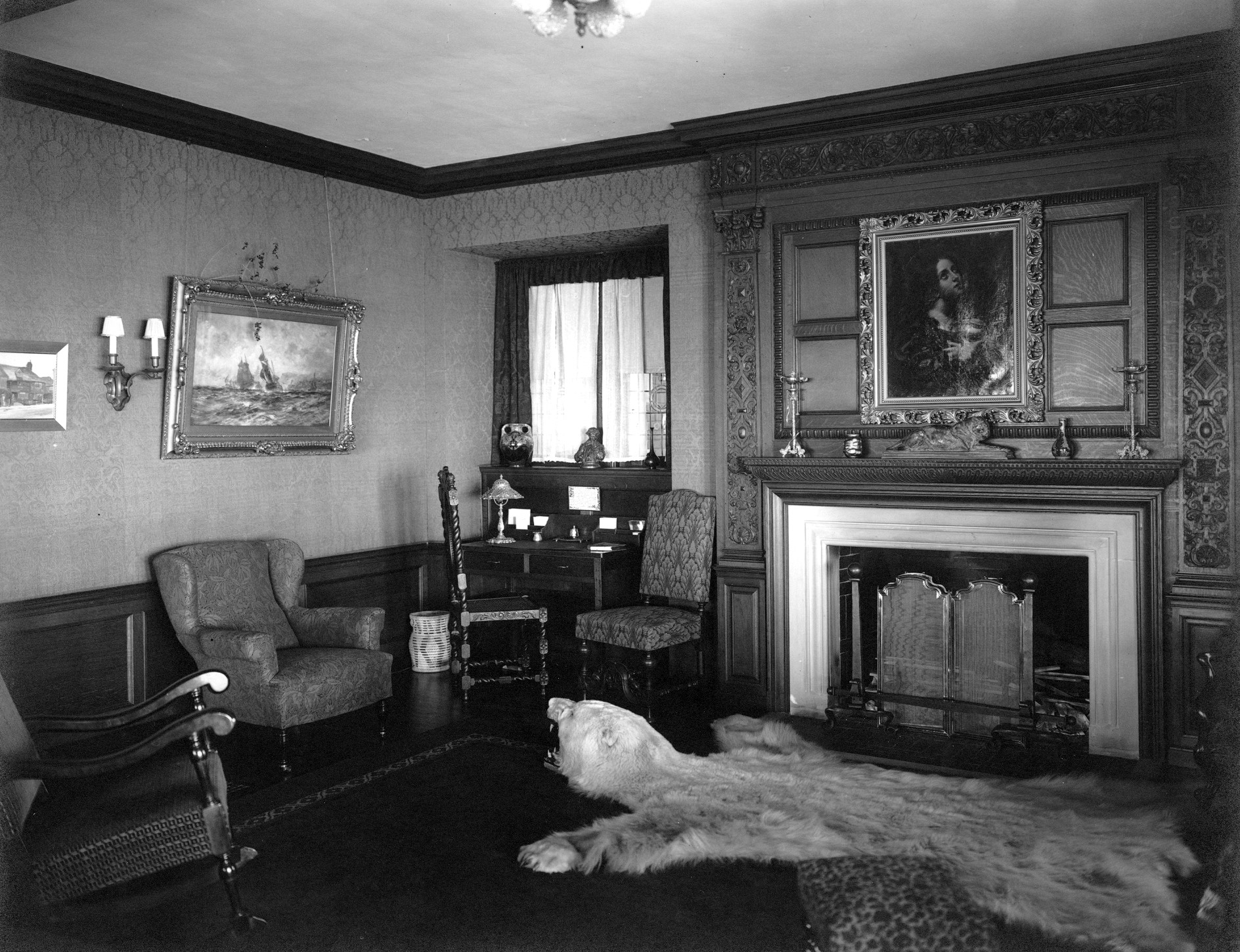
George and Ellen Booth were no exception. Art lovers with many Detroit-based and self-taught artists in their growing collection, the first inventory of Cranbrook House in 1914 lists two Hopkin “Marine” paintings. The Booths gifted the larger of the two paintings to their daughter Grace Ellen Booth and her husband Harold L. Wallace. The painting returned to Cranbrook House about 1955, when Grace Booth Wallace’s collection was donated to the Cranbrook Foundation.
Cranbrook House Living Room, circa 1909, with Marine visible on the left. Cranbrook Archives, Cranbrook Center for Collections and Research.
The Detroit Historical Society has a copy of the Souvenir Catalogue of Mr. Robert Hopkin’s Collection of Paintings in its collection. The 85 exhibited paintings are listed, with several black and white images of them. “Price List” is written on the cover, and notes have been made indicating which have been sold and who purchased them. (Sadly, the name “Booth” does not appear.)
Another art-loving Detroiter was Merton E. Farr president of the American Shipbuilding Company and owner of a number of freighters on the Great Lakes. His daughter, Carolyn, married George and Ellen Booth’s youngest son, Henry.
The Hopkin painting in the Thornlea collection. Cranbrook Center for Collections and Research.
In 1927, Farr gifted the couple a Hopkin “Marine.” The painting hung in Thornlea, home to Harry and Carol Booth, from 1927.
The painting’s official title is not noted. The Thornlea painting is interchangeably referred to as Homeward Bound, Schooner on a Stormy Sea, Sailing Ship at Sea, and Marine. However, the 1901 Hopkin exhibition catalog does not list any paintings with those titles.
– Leslie Mio, Associate Registrar, Cranbrook Center for Collections and Research
The belated arrival of winter weather this year has allowed us all to enjoy the grounds of Cranbrook House far later into the year than is usually possible. However, the time has finally come to shroud our exterior sculptures and fountains in protective tarps for the season. This process is an annual reminder to our staff – and to the Brookside students who come to sing the statues to sleep – of just how numerous and varied the outdoor art collection at the house is. One part of the gardens is particularly rich in art and history: the north staircase.
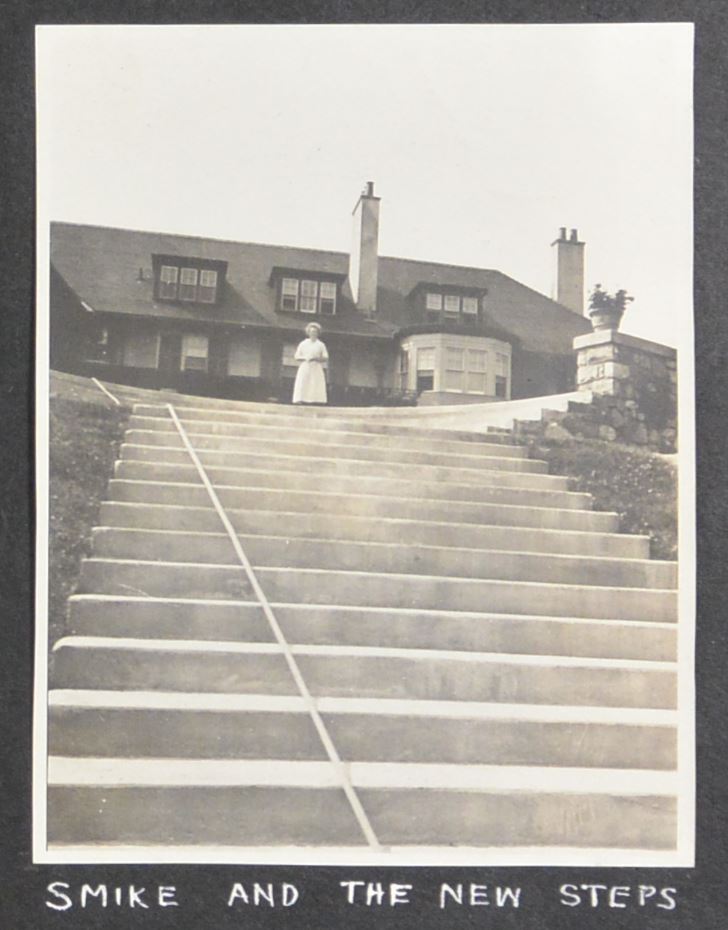
Florence Booth standing at the top of the new stairs connecting the upper and lower terraces at Cranbrook House, Summer 1921. From The Pleasures of Life, vol. 4, by Henry Scripps Booth. Courtesy Cranbrook Archives.
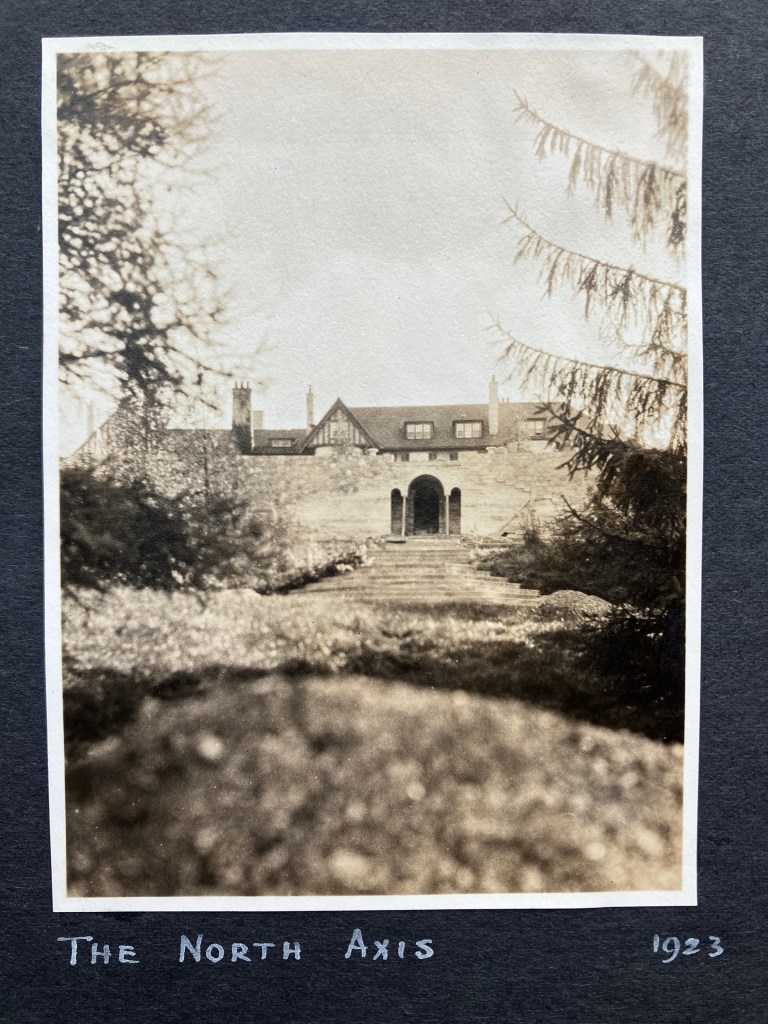
Stretching from the lakeside path at its base to the uppermost lawn outside Cranbrook House’s North Porch at its apex, the eighty concrete steps are lined with artworks, transforming the stairs into an open-air museum gallery. The stairs themselves were first built in the summer of 1921, as part of a spur-of-the-moment project to improve the view from the North Porch undertaken by James and Henry Scripps Booth. As their grandfather, Henry Wood Booth, recalled,
After ten years of sitting on the north porch and looking at a blank terrace wall, and talking about creating a vista through it, James and Henry got busy one May day with sledge hammers, and beside raising many blisters, razed about ten feet of wall the first day. Immediately a view of the lake came into being, and plans were made for a stairway down the hill.
Whether or not James and Henry had permission to make this change is contested; their grandfather’s account frames it as a collective impulse, while Henry remembers being disciplined for their impetuous action:
After construction of the curved steps, masons started building a series of flights which headed for a large wild cherry tree almost on axis along side rue Gagnier. According to one account, James and I were required to cut that tree down as a penalty for our reputed vandalism. While neither of us had a guilty conscience, we went to work sawing very hard wood and eventually (a full day later, I believe) the tree fell.
The concrete staircase was poured in July of 1921. The hillside around the new staircase was improved with new trees and paths under the oversight of O. C. Simonds, the landscape architect responsible for much of the re-foresting of the estate. After these changes, Henry Wood Booth noted with satisfaction that “[t]his hill, which for so many years had been an object of regret, was at last to be something really fine.”
Aeriel view of Cranbrook House and grounds, showing the new staircase at center right, circa 1921. From The Pleasures of Life, vol. 4, assembled by Henry Scripps Booth. Courtesy Cranbrook archives.
Further improvements were still in store, in the form of a dozen sculptural embellishments.
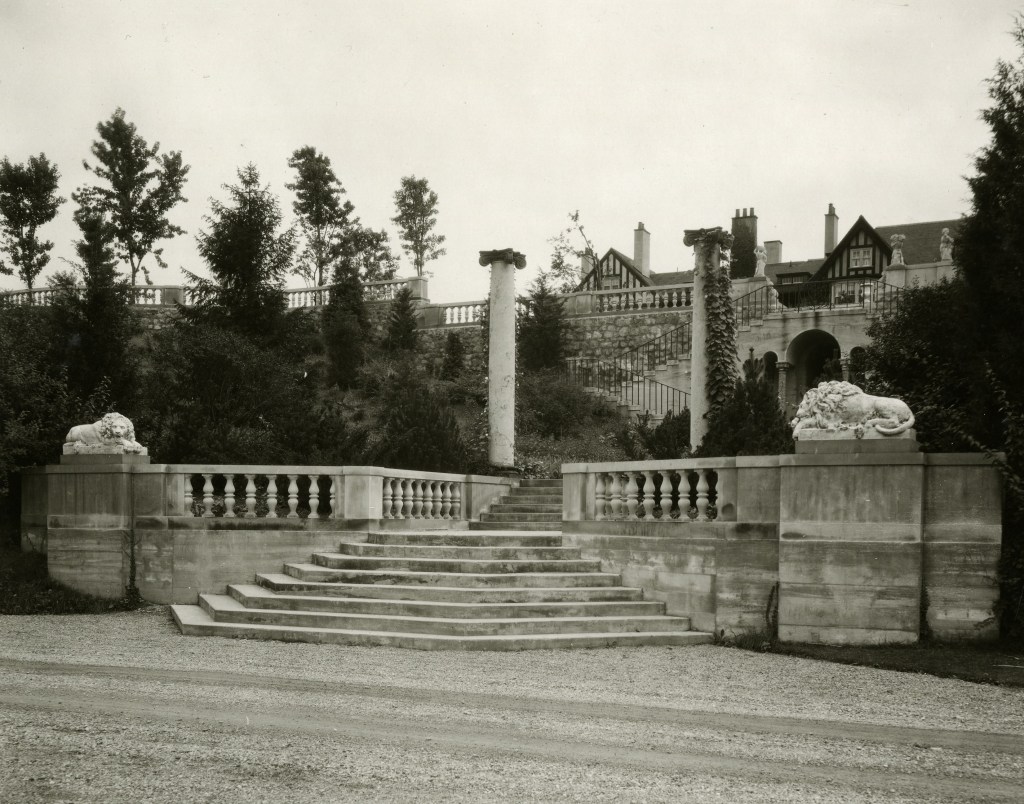
Walkers along the lakeside path today are met by two stone lions on pedestals flanking the base of the stairs. Carved from travertine and purchased by George Booth from the Galleria Sangiorgi in Rome in 1924, the lions are copies of works by the Italian neoclassical sculptor Antonio Canova, best known for his Cupid and Psyche, now in the Louvre, Paris. Canova sculpted the original lions in 1774 for the tomb of Pope Clement XIII in St Peter’s Basilica, in Rome. On Pope Clement’s tomb, the lions, one sleeping, one waking, face one another, symbolizing the confrontation of life and the long sleep of death. Here at Cranbrook, the lions face out toward the lake, one on guard, one enjoying a nap in the shade of the hill.
Stairway to Lower Terrace at Cranbrook House and Gardens, circa 1924. Photograph by George W. Hance. Courtesy Cranbrook Archives.
Although George Booth’s letters home from Italy in 1924 do not say as much, he and Ellen probably saw the original lions in the Vatican on their visit to Rome in 1922. In the intervening year, George Booth had considered buying copies of the Canova lions in cast stone, a form of concrete, from an American garden sculpture company, Howard Studios.
Just a few steps up, the stairway is flanked by concrete columns, topped with red stone Corinthian capitals. Their origins have not yet been traced, but George Booth purchased many marble capitals in Italy, most of them Roman or early medieval, for the Cranbrook Academy of Art. It would have been characteristic for the Booths to have retained a few Italian finds to ornament Cranbrook House as well.
The construction of the fountain niche and surrounding stairs, 1923. From The Pleasures of Life, vol. 7, assembled by Henry Scripps Booth. Courtesy Cranbrook archives.
From the lower landing of the staircase, its centerpiece is already visible – a fountain niche, added in 1923, requiring considerable reconstruction of this section of the stairs. At the back of the niche, now forming the fountain cascade, are a few of the original 1921 stairs.
The niche houses Mario Korbel’s Dawn, a near life-size female figure holding an apple. The symbolism of the figure is ambiguous. The apple may refer to Eve, the “dawn” of womanhood. It may also associate the figure with the goddess Aphrodite, who was awarded a golden apple as the prize in a divine beauty contest, and is associated with the planet Venus, sometimes called the morning star.
The staircase niche, photographed in 2016.
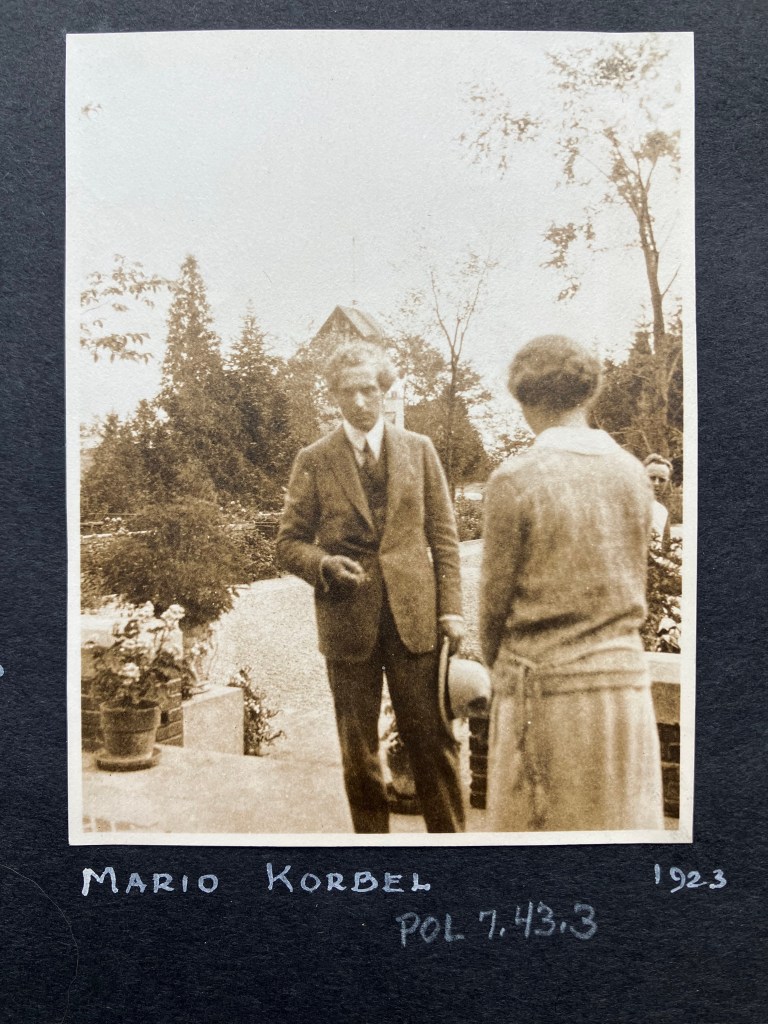
Korbel visited the grounds in 1923 and contributed ideas to the design of the niche for his sculpture. Cranbrook once also boasted a figurine version of Dawn, offered to George Booth by Korbel during the planning process for the full-size version, until it was stolen in 1926. George Booth did his best to soften the blow when informing Korbel of the loss, framing the theft as a compliment to the artist’s skill:
…you may feel flattered to learn that only a few nights ago some expert burglars after rifling the safe at the Cranbrook Office, ran off with your small figure of “Dawn”, taking along with her a supply of rugs and other articles so as to surround her with suitable luxury.
The Booths’ small Dawn was never recovered.
Mario Korbel in the gardens at Cranbrook House in 1923. From The Pleasures of Life, vol. 7, assembled by Henry Scripps Booth. Courtesy Cranbrook archives.
The newly completed niche, 1923. From The Pleasures of Life, vol. 7, assembled by Henry Scripps Booth. Courtesy Cranbrook archives.
The columns that flank Dawn’s niche are the work of an unknown Italian artist, and probably purchased by George Booth in the early or mid 1920s. Their design is based on twelfth-century examples from the Benedictine cloister at Monreale Cathedral, in Sicily. The courtyard fountain at Cranbrook School is a replica of a fountain from the same cathedral complex. First spotted by Henry Scripps Booth in 1922, George Booth later ordered a replica fountain from the Chiurazzi Foundry, who also carved the Canova lions at the base of the stairs. As evidenced by the blend of geometric, botanical, and animal ornament on this pair of columns, the architecture of medieval Sicily blended classical, Gothic, and Islamic influences, a reflection of the cultural diversity of the Norman Kingdom of Sicily. Their stylistic syncretism aptly complements the polysemy of Korbel’s figure of Dawn-Eve-Aphrodite.
The columns are not wrapped in the wintertime, allowing visitors to enjoy this feature of the staircase year-round.
The topmost landing of the stairs is ornamented with a curling iron railing, quite possibly designed by George Booth and executed at the Cranbrook metalsmithing workshop. To either side of the landing stand four cast stone cherubs, replacements for the original quartet of cherubic representations of the four seasons, which fell to pieces within fifty years of their purchase. One was already missing a head by 1949. The originals were purchased in Italy in 1924. Their replacements were donated by the Cranbrook House and Gardens Auxiliary in 1974.
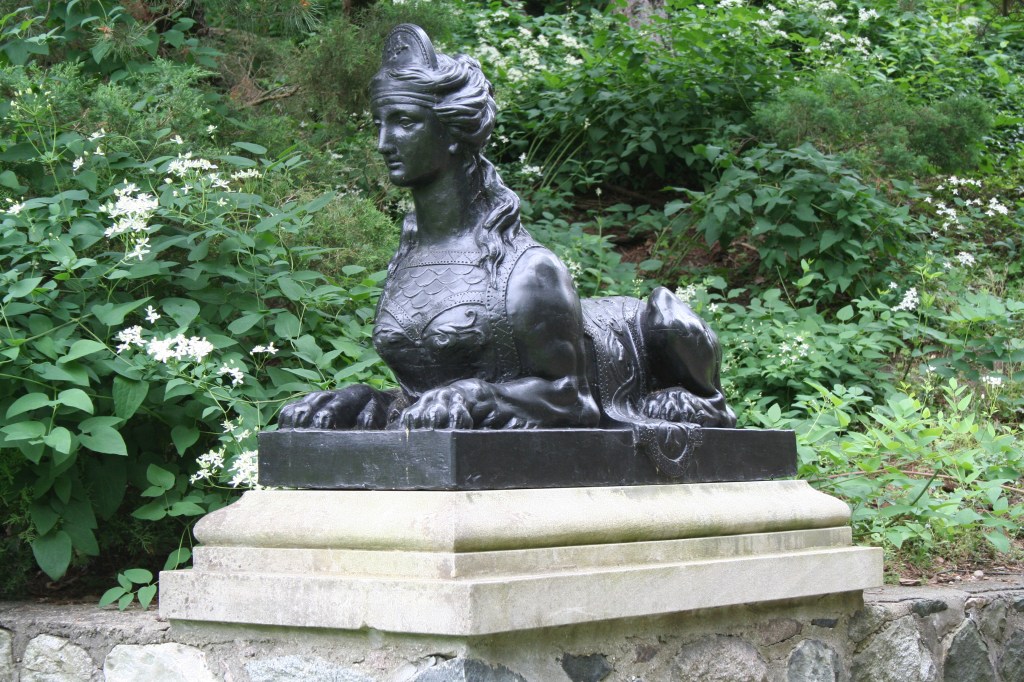
One of two bronze sphinxes by John Cheere, photographed on the north terrace of Cranbrook House in 2016.
Although the original cherub statues brought an end to the staircase’s parade of sculptures in George and Ellen Booth’s day, Henry Scripps Booth added a final flourish to the ascent in 1963. Two sphinxes, cast bronze copies of sculptures by the English artist John Cheere, bought at auction in England, keep watchful guard over the middle north terrace from either side of the wide upper stair. These bronzes, like so many other features of the staircase, are copies of European artworks. In this case, the eighteenth-century originals were created for Chiswick House, the Greater London home of Earls of Burlington, a Palladian style villa renowned for its refined neoclassical air.
As we set forth into the darkest season of the year, with all the familiar sculpted denizens of the gardens hidden beneath their winter coats, the grounds might start to feel a little lonely. Recalling the history of their making, from the reshaping of the hillsides to the final placing of statuary in their niches or atop their pedestals, can re-animate the familiar byways of Cranbrook, even on the coldest and greyest days. The Booths’ tribulations – a statuette stolen, others shattered by cold – remind us of the evolving nature of even a historic and well-preserved garden, and of the many winters that have passed over these grounds and left them largely unharmed.
The north terraces at Cranbrook House, photographed in January 2024.
The north staircase, a project begun in 1921 and completed more than forty years later, is still “something really fine,” with or without its sculptures and fountain. And the view from the top, which inspired the project, is even finer in winter, when frosty, leafless branches part to reveal a sparkling view of the frozen surface of Kingswood Lake and the snowy hills beyond.
— Mariam Hale, 2023-2025 Collections Fellow, Cranbrook Center for Collections and Research
With thousands of years of recorded history to draw from, every day of the year has some distinction as an anniversary. Today, the 27th of September, is the 958th anniversary of the day William, Duke of Normandy, set sail to conquer England, the 560th anniversary of the birth of Cosimo de’ Medici, founder of the de facto ruling family of Renaissance Florence, and the 100th anniversary of the wedding of Henry Scripps Booth to Carolyn Elizabeth Farr. Here at Cranbrook, it is this last anniversary that holds top billing on our calendars.
Carolyn Elizabeth Farr, on her wedding day. Courtesy of Cranbrook Archives, Cranbrook Center for Collections and Research.
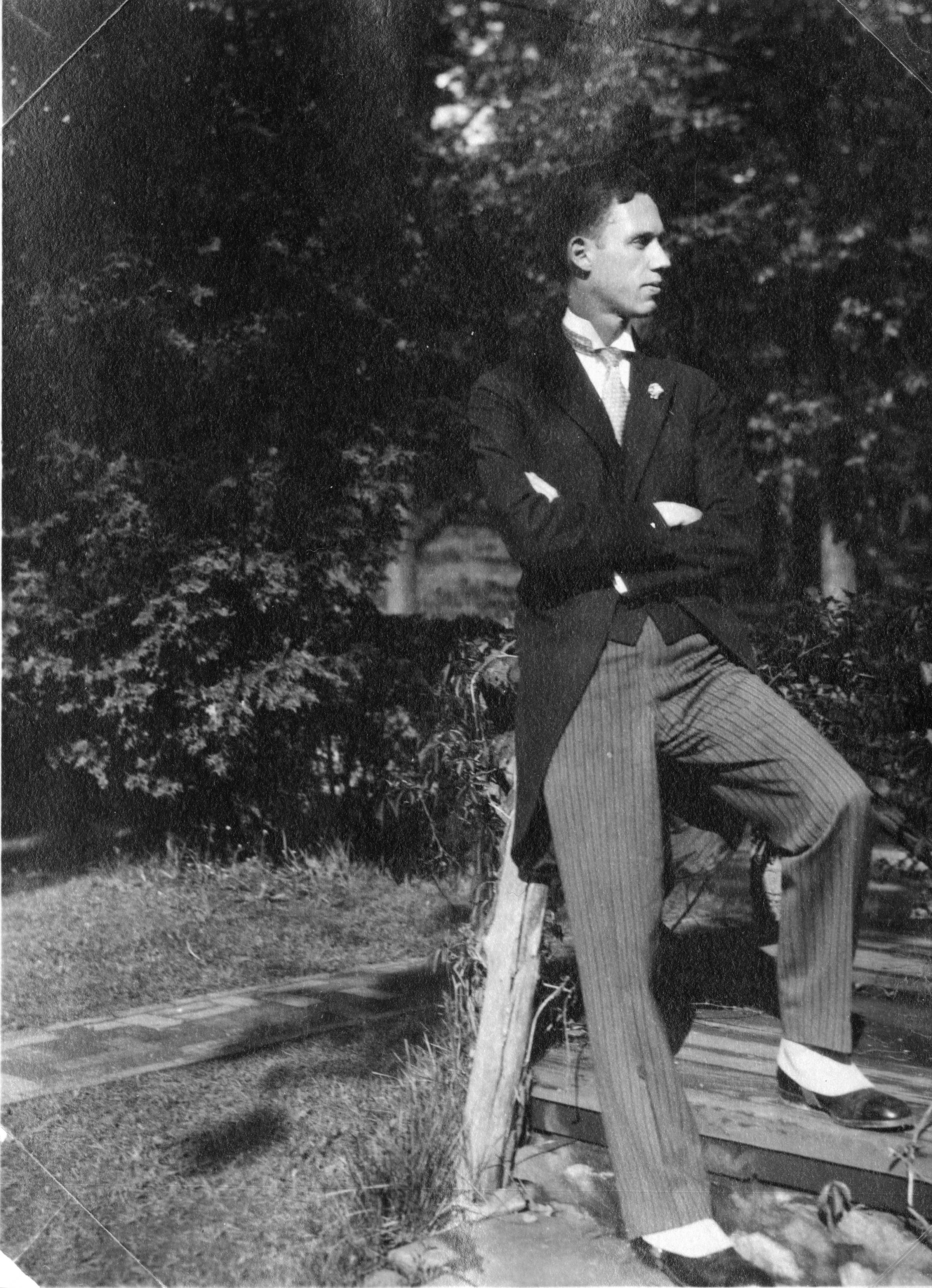
Henry Scripps Booth, on his wedding day. He later joked that it was the last time that he would ever wear a waistcoat. Courtesy of Cranbrook Archives, Cranbrook Center for Collections and Research.
Henry Booth, youngest son of Cranbrook’s founders, George and Ellen Booth, and Carolyn Farr, daughter of shipbuilding magnate Merton Elmer Farr and Emma Rothe, first announced their engagement on June 29th, 1925. Neither of them believed in long engagements, it appears, as they were married just three months later, at the First Congregational Church in Detroit. The wedding had some competition for most memorable event of the year for Carolyn Farr. On August 30th, while on her way home from a shopping trip to New York City to complete her trousseau, Carolyn’s train crashed into the back of another train which had made an accidental stop on the westbound line near Syracuse.
Clipping from Buffalo Courier, August 31, 1924, page 56
Fortunately, no one was killed in the crash. Some members of a Boy Scouts troop riding at the back of the rear train actually slept through the collision and had to be shaken awake by their bemused troop leaders. Though she escaped serious injury, the crash left Carolyn with cuts on her nose and mouth, which may have still been painful on her wedding day, though they are invisible in her wedding photos.
Both of Henry’s sisters were married at Cranbrook House itself, Grace Booth in the living room and Florence Booth in the library. Although Henry was not married at Cranbrook, the wedding was still very much a Cranbrook event in one way, because it featured an Arts and Crafts artwork. The ring was carried down the aisle by Carolyn’s nephew, Henry Gerhauser, in a silver and enamel box made by the noted Boston-based artist Elizabeth Copeland.
Carolyn Farr and ring bearer Henry Gerhauser holding the Copeland box. Detroit Free Press, October 5th, 1924.
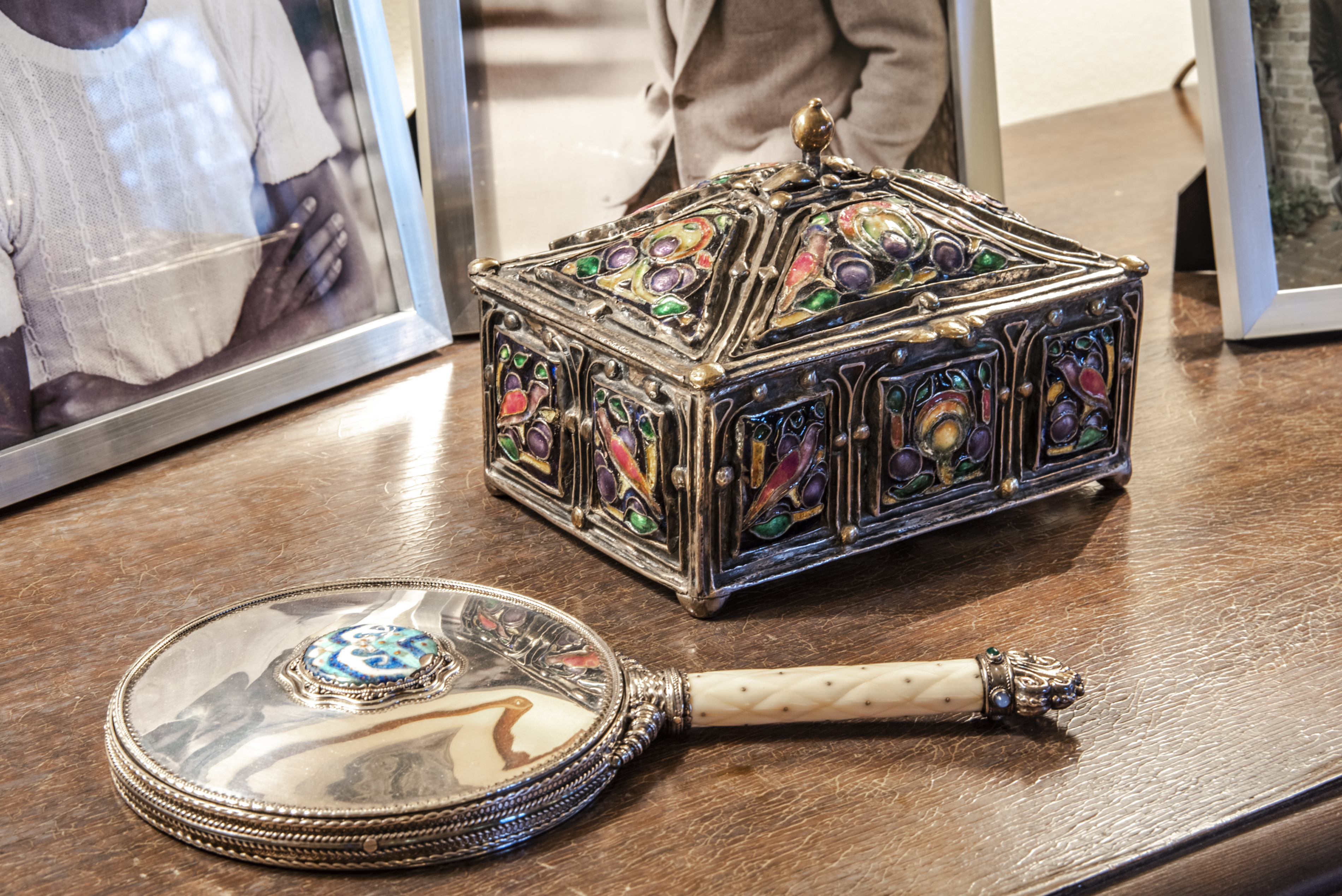
Enameled silver casket, Elizabeth E. Copeland, circa 1922. Courtesy of Cranbrook Center for Collections and Research.
Enameling, like tapestry weaving and illumination, was a medieval art form revived by the Arts and Crafts movement in England in the nineteenth century. In the twentieth century, enameling evolved out of the medievalist styles that characterized its revival to become a primary medium of both Art Nouveau and Art Deco decorative art and jewelry.
Elizabeth Copeland was the foremost enamel artist of the American Arts and Crafts movement. Born in Revere, Massachusetts in 1866, she did not begin her artistic training until she was in her early thirties. Like many women artists, she was expected to balance her own work with domestic labor. Copeland had to commute daily to attend the Cowles Art School in Boston, and she studied her design patterns while carrying out household chores. So great was her talent, however, that within just a few years her enamels and silver work were already enjoying critical acclaim, including a feature in Craftsman magazine in 1903. Her work is now in many museum collections, including the Metropolitan Museum of Art, the Art Institute of Chicago, and the Museum of Fine Arts, Boston.
As an artist, Copeland embraced the Arts and Crafts movement’s ideals. Eschewing a machine-like precision in her work, her silver work proudly exhibits subtle variations and inconsistencies that distinguish them as truly hand-crafted objects. Her enamel work embraces the fluidity of the medium, allowing different colors to flow into one another within each metal embrasure shaped to contain the liquid medium. Unlike most women artists of her time, Copeland was able to support herself independently through the sale of her work, during a career of more than three decades. She exhibited her work at many venues, including the Detroit Society of Arts and Crafts, where Henry Scripps Booth purchased the silver box that would hold the ring for his wedding, two years later.
Henry Scripps Booth with his first child, Stephen Farr Booth, in Brookside Cottage, February 17th, 1925. Note the Copeland box on the mantelpiece. Courtesy of Cranbrook Archives, Cranbrook Center for Collections and Research.
The Copeland Box in Thornlea with a hand mirror by Arthur Nevill Kirk. Photography by Tryst Red, 2021. Courtesy of Cranbrook Center for Collections and Research.
After the wedding, the new couple moved into Brookside Cottage, the little stone house just west of Kingswood School, where they lived for two years until Thornlea House was completed. The Copeland box became a fixture of their new home, where they lived together from 1927 until Carolyn’s death in 1984. During her lifetime, the ring box spent many years on a table in Carolyn’s own bedroom, as a memento of a milestone occasion which we are celebrating again, one hundred years down the line.
— Mariam Hale, 2023-2025 Collections Fellow, Cranbrook Center for Collections and Research
In 1759, British forces led by General James Wolfe defeated the French in a pivotal battle outside besieged Quebec. General Wolfe’s death from injuries sustained on the battlefield, just moments after victory was declared, made him a hero to the British public. The victory at Quebec turned the tide in the Seven Years War for the British, securing Britain’s rule of their new North American territories and paving the way for the eventual creation of Canada and the USA. But what does the Battle of Quebec have to do with Cranbrook?
In October 1928, George Booth bought three paintings from a Boston gallery, including one depicting the battle, The Death of General Wolfe, attributed to Benjamin West. He gave all three paintings to Cranbrook School for Boys, where they still hang today, on the walls of Page Hall Commons. Cranbrook’s The Death of General Wolfe is a studio copy of a famous work depicting the end of the Battle of Quebec. The painting represents a turning point both in American history, and in the history of art.
The artist, Benjamin West, was born in Springfield, Pennsylvania, in 1732. Like many artists living in the North American colonies, he was acutely conscious of the shortage of opportunities for training and patronage on this side of the Atlantic. At 31, he left America for Europe, where he embarked on a study tour of Italy, before settling in England. There, he quickly established himself as an artist of skill and imagination. West attracted clients to his studio by deliberately playing up his background as an émigré from the still largely unknown North American continent, even claiming to have had his first lessons in painting from Native American artists. His talent and social charms quickly won him support from colleagues and patrons alike, but it was the triumph of The Death of General Wolfe that made him a national celebrity.
Self Portrait, Unknown 18th century artist, after Benjamin West, circa 1776. National Gallery of Art, Andrew W. Mellon Collection, Washington, D.C.
In 1771, twelve years after the Battle of Quebec, West exhibited a monumental canvas depicting Wolfe’s death on the battlefield at the Royal Academy of Art’s summer exhibition in London. At its debut, West’s painting was lambasted by critics for his then unconventional choice to portray all the subjects of his work in accurate, contemporary dress, rather than classical draperies. However, critical disputes were drowned by popular acclaim.
The painting’s dramatization of an already thrilling moment in recent British history captured the public’s sentiments, while fellow artists praised West’s dynamic composition, effective use of classic postures and gestures, and brilliant color. Joshua Reynolds, the first President of the Royal Academy, who had advised West against his choice to include contemporary dress, confessed that he had been wrong. West’s balance of realistic costumes and props with compositional techniques borrowed from the Italian Renaissance set a new standard for verisimilitude and expressiveness in British history painting.
The Death of General Wolfe, Benjamin West, 1770. National Gallery of Canada, Ottawa. Gift of the 2nd Duke of Westminster to the Canadian War Memorials, 1918; Transfer from the Canadian War Memorials, 1921.
At the center of the eight foot wide canvas, General Wolfe lies dying in the arms of his officers. From the far left, a messenger approaches bearing news of the French surrender, while in the background, windblown clouds and smoke open up to reveal a patch of blue sky, signaling the imminent arrival of good news. Though all accounts of the general’s death place just three men with him, West has ringed Wolfe with fellow soldiers, whose gestures direct our attention to the dying man, and express mingled grief and awe. Wolfe’s own pose echoes that of the dead Christ in the Virgin Mary’s lap in Michaelangelo’s Pieta (1499). His upturned face is illuminated by the sun breaking through the clouds. It is a profoundly unsubtle portrait of a patriotic martyr.
At the left of the group, two figures speak to the specifically North American character of the battlefield. The figure in the green coat, who points over his shoulder at the approaching messenger, is Sir William Johnson, an English immigrant to the North American colonies who established close personal relationships with the Mohawk, and was appointed by their leadership to represent their interests to the British government. Johnson’s negotiations were critical to the British alliance with four Iroquois peoples, who fought alongside the British against the French in the Seven Years War. The unknown Native American man who sits beside Johnson represents the Iroquois contribution to the British war effort. His pensive posture as he watches the dying general is based on two major art historical precedents; the “Belvedere Torso”, a fragment of Roman sculpture at the Vatican Museums in Rome, and Melancholia, an allegorical depiction of melancholy, by Albrecht Dürer. The pose reflects two of the many views of Native American people then current in British society – they were both recognized as valiant military allies, and romanticized as tragic representatives of a culture fated to disappear in the face of inevitable British conquest and the expansion of their colonized territories.
Melencolia I, Albrecht Dürer, 1514. Metropolitan Museum of Art, New York. Harris Brisbane Dick Fund, 1943.
The triumph of The Death of General Wolfe, like the real victory it depicts, is a watershed moment in history – that is, in the history of British historical subject art. Over the next hundred years, history painting would evolve from a genre reserved for the walls of palaces, and confined by the conventions royal aggrandizement and allegory, to a popular genre of narrative art, characterized by dual commitments to historical accuracy and psychological drama. Though West was not the first to introduce modern dress into historical scenes (nor even the first to portray the death of Wolfe in this manner), the extraordinary merits of his work turned the tide in favor of realism and emotionally driven narrative for the genre as a whole.
And When Did You Last See Your Father?, William Frederick Yeames, 1878. Walker Art Gallery, Liverpool. A fictionalized depiction of the interrogation of the young son of a Royalist sympathizer by a Parliamentarian, Yeames’s work epitomizes the 19th century turn towards envisioning history through the lens of individual experiences.
West went on to be appointed court historical painter under George III, and became the second president of the Royal Academy of Art, succeeding Joshua Reynolds in 1792. Though he never resettled in America, West lent his support to many young American artists visiting England, fostering the growth of American art up to the Revolution and beyond.
The Death of General Wolfe Comes to Cranbrook
The version of The Death of General Wolfe at Cranbrook is one of at least seven copies of the painting produced in West’s lifetime. Several were painted by West himself, others by studio assistants. We do not know the exact provenance of this painting. The technique reveals it to be the work of a less experienced artist, perhaps a junior studio assistant. The painting lacks the exacting finish that characterized West’s work and was demanded of all artists at this period. In the original work, not a single brushstroke is visible, while in the Cranbrook copy, the artist has not learned to conceal the work of their brush.
The panel is about half as large as the original, slightly taller and narrower in its dimensions. To adapt the painting to a differently proportioned canvas, the artist was forced to compress the space between some of its figures. Many features of the battle in the background, such as press of boats along the river’s edge on the right of the canvas, were omitted altogether. A key figure, the messenger bearing news of victory, is crammed into the left-hand margin, and partially cut off by the frame. The missing details raise the possibility that this work was painted from a print, rather than from close study of the original or a copy by West himself.
Print of The Death of General Wolfe, William Boydell and Rowlands Woollett, after Benjamin West, 1 January 1776. National Maritime Museum, Greenwich, London.
George Booth paid the Vose Gallery $3,000 for this painting – twice as much as he paid for either of the other two paintings, and a remarkable price for a work that is almost certainly not from the artist’s own hand. (The other works were The Clipper Midnight, by Samuel Walters, and a portrait of Washington Irving by John Vanderlyn.) Why was it so important to the Booths that Cranbrook have some version of West’s masterpiece?
Six months before George Booth bought the painting, another version of The Death of General Wolfe was presented to the University of Michigan at Ann Arbor, by William L. Clements. Clements, a noted collector of American artifacts and documents, bought the painting to ornament the library of Americana that he had just given to the university, the William L. Clements library. The painting at Ann Arbor is a full-scale replica of the original work, painted by Benjamin West in 1775 for the Prince Regent of Waldeck, a region in Germany. The library, with its new painting in place, opened to the public in June of 1928, when visitors packed the rooms to see the collection. The Booths may well have been in attendance, and would certainly have been aware of the well-publicized gift. Perhaps it was Clements’s generosity that inspired George Booth to seek out a Death of General Wolfe for the Cranbrook campus as well.
The Death of General Wolfe, Benjamin West, 1776. William L. Clements Library. Courtesy of the University of Michigan.
By giving the painting to the school, George Booth probably hoped that it would add something to the students’ education there. In the most straightforward sense, the painting depicts a critical moment in the history of the United States, Canada, Great Britain, and the First Nations. It also represents a turning point in the history of art, and in the life of one artist in particular. Benjamin West rose from American obscurity to the highest eminence in British art, thanks to his talent, effort, and amiable personality, but it was this painting that secured him national recognition. Throughout his career, he sought to help younger artists to success, teaching many American artists in his own studio. General Wolfe was a hero of his own nation and time, but to an art lover and sometime pacifist like George Booth, Benjamin West may well have seemed like the true exemplar of a life well spent, and an ideal role model for the students of Cranbrook School.
— Mariam Hale, 2023-2025 Collections Fellow, Cranbrook Center for Collections and Research
When you take the time to look, the windows of Cranbrook House are surprisingly varied. Some are leaded casement windows straight out of an Elizabethan manor house, others are modern sash windows, fitted with plate glass. A few rooms in the house enjoy a special distinction – their windows are fitted with inset panels of stained glass.
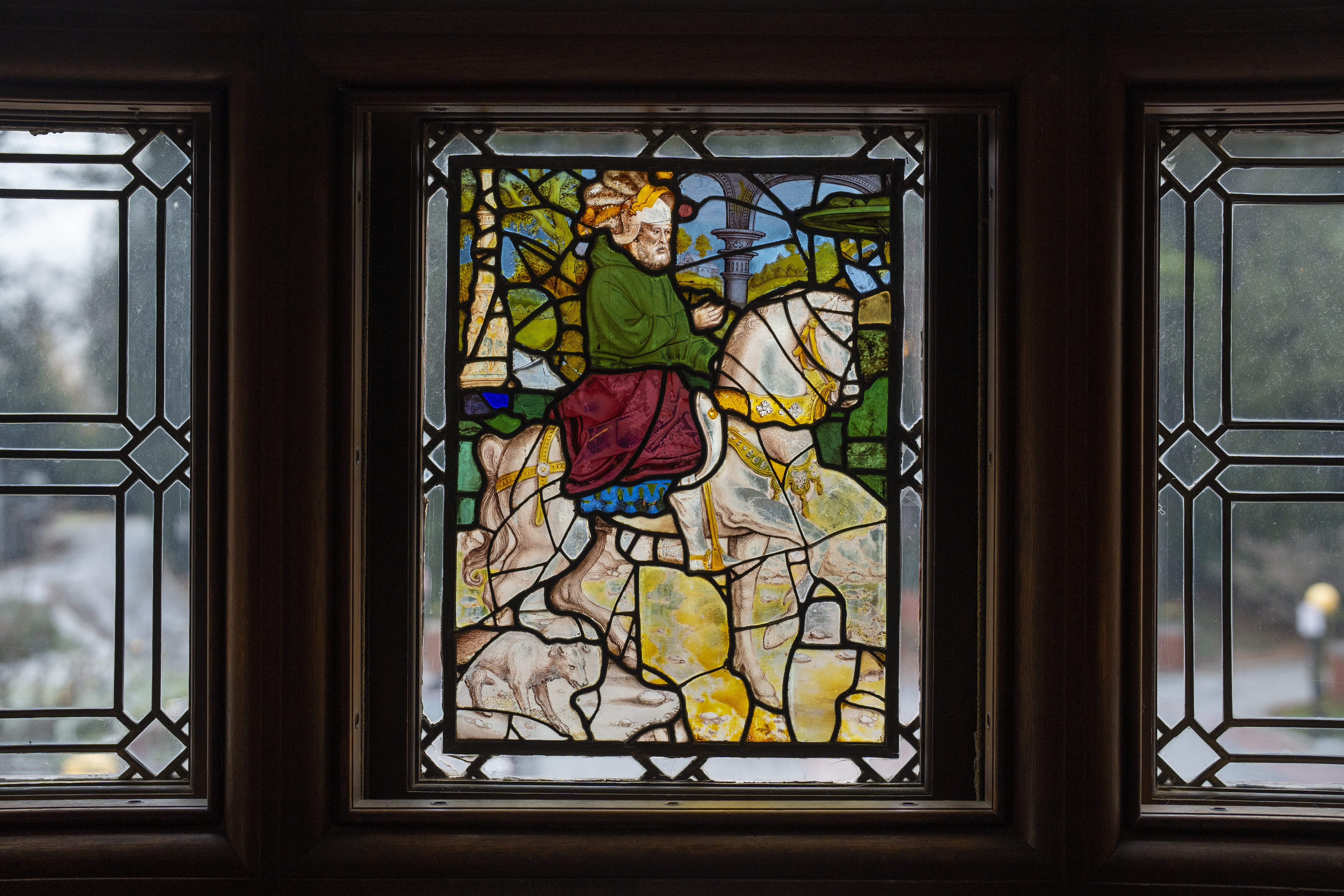
These stained-glass panels were a later addition to Cranbrook House. When first completed in 1908, the windows were all clear glass. It was only while pondering extending the house, in the latter half of the 1910s, that George Booth began purchasing stained-glass panels for his home. The most prominent stained-glass work in Cranbrook House is the 16th-century Flemish panel, depicting a man on horseback, placed in the main window over the staircase in the Reception Hall.
It was not part of the original design for the window, but added in 1922. That panel, and several others scattered throughout the house, were purchased from Thomas & Drake, an English firm specializing in historic glass.
Others, like the heraldic roundel in the library’s east window, were purchased by the Booths in Lucerne, Switzerland. There was some debate as to their final destination. George Booth wrote, in a letter to his son Henry, in March 1922:
They do not make an imposing collection but I think they are good and that everyone will like them – I did think I would let the [Detroit] museum [of Art] buy them at cost if they wished to begin to accumulate some historical glass, but your mother and Florence say no – they are to be put into the windows at Cranbrook but we will see.
(George Gough Booth to Henry Scripps Booth, 26 March 1922. Cranbrook Archives, George Gough Booth Papers.)
In the event, Ellen and Florence won out, and at least a few of the Swiss purchases made their way into the windows of Cranbrook House.
Each May, the Center is honored to host an outstanding senior from Cranbrook Kingswood Upper School for a three-week immersive internship.
The Center’s 2024 “Senior May” Sav Hayward writes about their time working with the Center team.
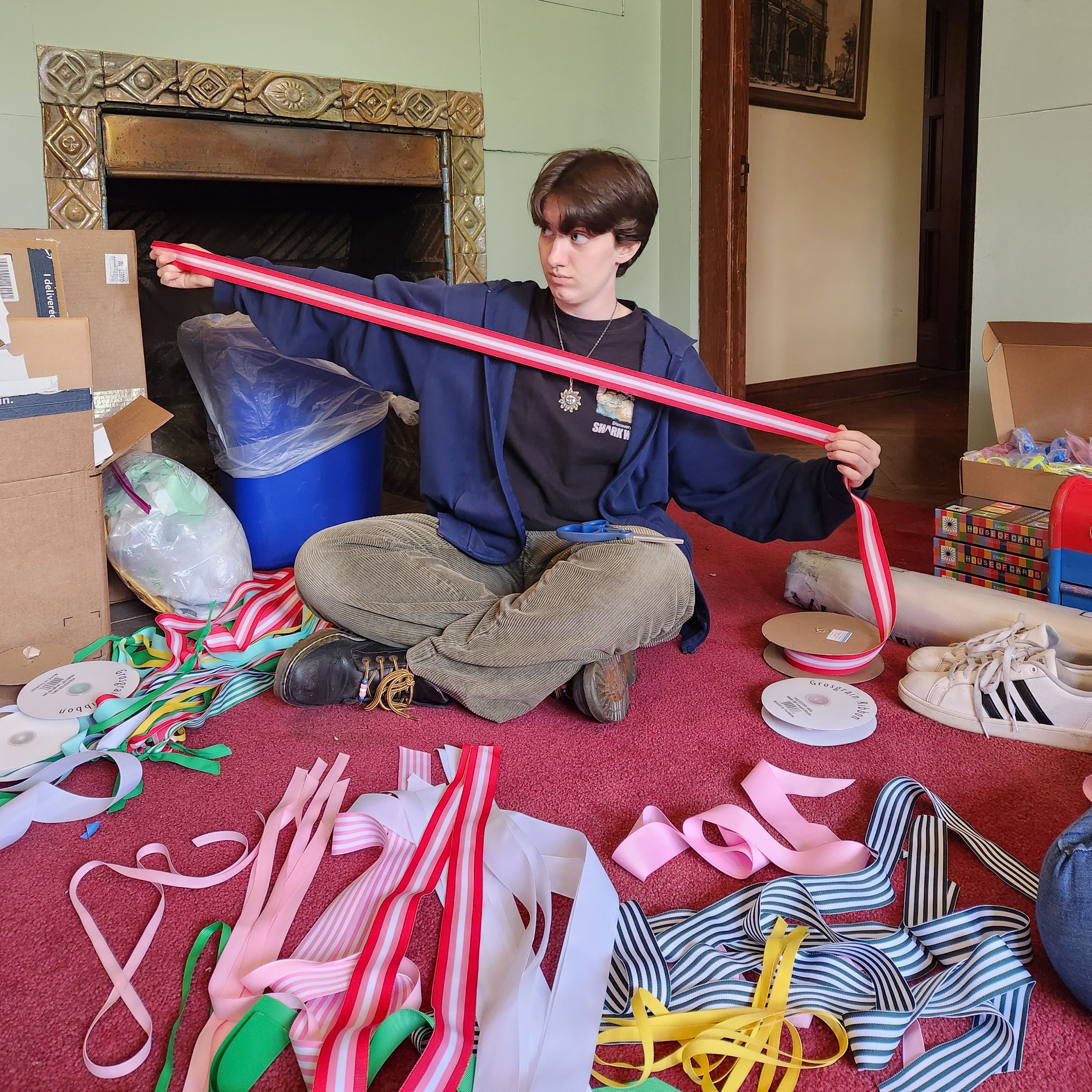
I hit the ground at my Senior May running. The very first day, I had to help prepare for the Center’s annual House Party gala. This year it was held at Thornlea House which needed a lot of TLC before the event on Saturday. During my first week, I worked all over the house to help prepare it. Things like vacuuming (Ed. note: No one, in the history of the universe, was as excited as Sav about vacuuming), wiping windows, sorting cupboards, cutting ribbons, crafting decorations, and going to Cranbrook Archives to help move items from the collection for displays. Once everything was completed the final product was extremely satisfying, and I heard many wonderful things about the night. I had to decline my invitation to the House Party in favor of my Senior Prom.
Cutting ribbon to create bunting for the House Party. Photograph by Leslie Mio, May 2024.
The following two weeks, I never had the same task twice in a row. Some of my favorite days consisted of working in the Archives with Deborah Rice and Laura MacNewman, helping around in the Annex offices with the Center’s Registrar, Leslie Mio, and going on random little trips.
In the Archives, I helped organize and re-box some items we got out for the House Party. There was a very relaxed environment there, and it was cool seeing all the documentation Cranbrook has about our history.
The following day I helped Kevin and Leslie take the painting A Hunter of Taos by Oscar Edmund Berninghaus from the Cranbrook Kingswood Middle School for Boys and drive it to a conservation studio in Detroit. When we were finishing our visit, the conservator, Ken Katz, told us to go upstairs and check out the exhibit being set up at the Metropolitan Museum of Design Detroit (MM-O-DD). There we met some cool people, including the Founder/Executive BOD President Leslie Ann Pilling and Chuck Duquet of Collected Detroit, who took us downstairs and showed us artwork stored there.
Standing around looking at the framing studio. Photograph by Kevin Adkisson, May 2024.
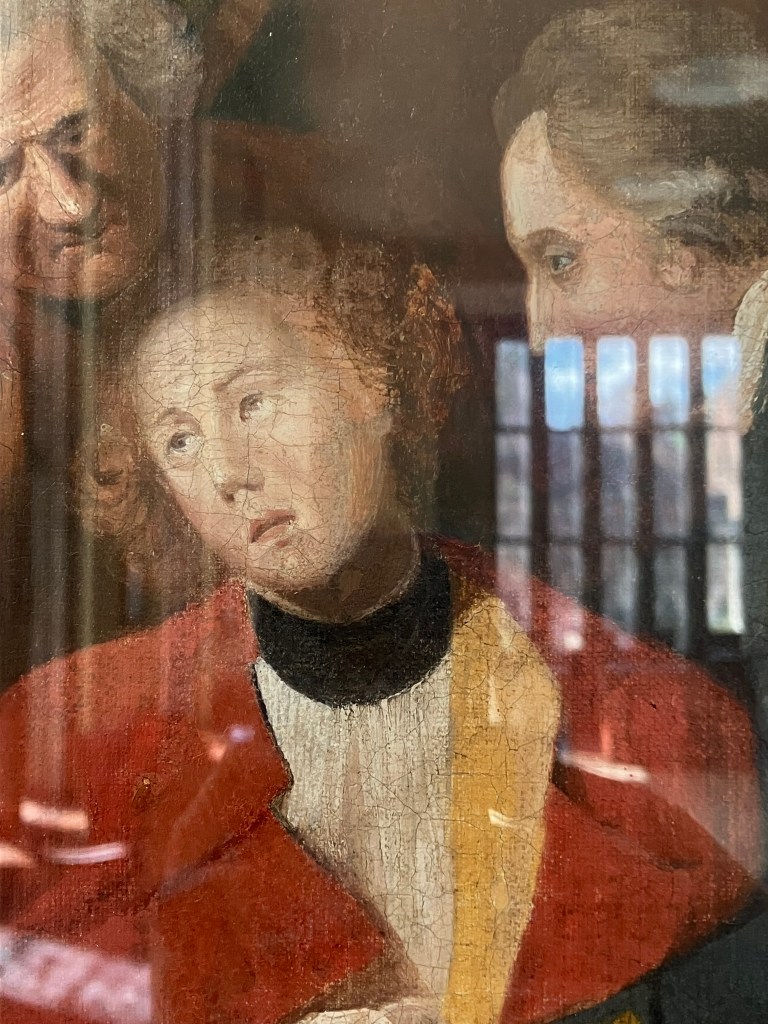
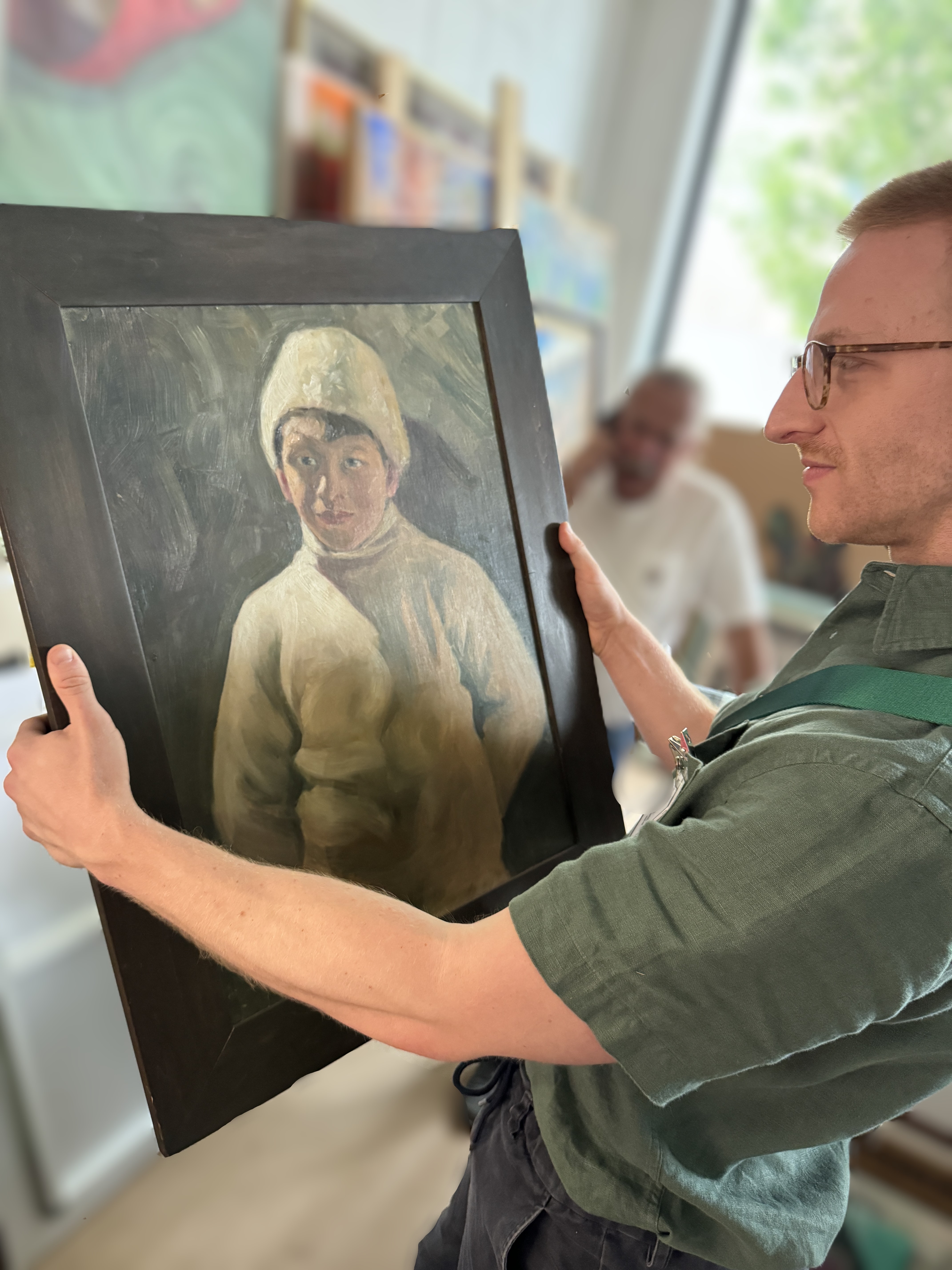
While looking around I saw pieces by many Cranbrook Artists, including some that had been loaned to Cranbrook Art Museum’s recent exhibition LeRoy Foster: Solo Show. I also saw an amazing painting of Eero Saarinen as a boy, painted in Finland by his father (and architect of Cranbrook) Eliel Saarinen.
Kevin admires Eliel Saarinen’s painting of his son Eero at Collected Detroit. Photograph by Leslie Mio, May 2024.
Ever since I started going to Cranbrook, I have dreamed of going up into the old astronomy tower at Hoey Hall. I was able to achieve this dream thanks to Kevin. He was working with photographer James Haefner to document the tower after some recent cleaning. Luckily, I was invited to join Kevin and see how the entire photshoot process worked. I helped do some tasks, like dusting, carrying equipment cases, and bringing water up to the ridiculously hot rooms.
Standing next to the upper door in the Cranbrook Campus tower. Photograph by Kevin Adkisson, May 2024.
On the last day of Senior May, I joined Leslie and Kevin on a trip to Hagopian World of Rugs in Birmingham. We met with architect Erinn Rooks of Cranbrook Capital Projects to pick out colors for a reproduction rug. Suzanne Hagopian, Executive Vice President, brought out a test sample made a while back to see if the colors matched the original and if it was what we were looking for.
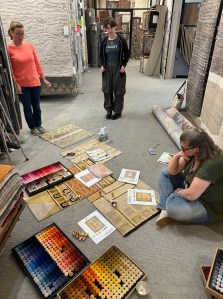
When we looked at the sample, we realized that the colors were lacking, so we all sat around and debated over small tufts of colorful yarn samples. What was nice was that these color samples were neatly lined up in multiple boxes. After a while, we finally decided on more vibrant colors compared to the sample, but this was to help make the carpet pop. Ed. note: Sav’s knowledge of color theory and use of technology to compare color tones greatly assisted in this project.
Erinn, Leslie, and I examine carpet and color samples. Photograph by Kevin Adkisson, May 2024.
Kevin and I take a “magic carpet ride” while looking at yarn samples. Photograph by Leslie Mio, May 2024.
I will always remember this Senior May and how fun it was. The people I met during this time are amazing and I will miss seeing them every day. While some of my classmates went off campus for their Senior May, doing mine on Cranbrook’s entire campus felt like I was a part of one large family. I have never felt more connected to Cranbrook, its history, and its legacy.
– Sav Hayward, Cranbrook Kingswood Upper School Class of 2024 and Cranbrook Center for Collections and Research 2024 Senior May
Editor’s Note: Sav Hayward is a member of the CKU Class of 2024 and a proud resident of Lansing, Michigan. In Fall 2024, Sav will continue their education at the College for Creative Studies in Detroit, where they will study Interior Design. CCS is the modern iteration of the Detroit Society of Arts and Crafts, co-founded by George G. Booth in 1906. Sav is hoping to land a paper route for the Detroit News to complete the Booth trifecta.
Another day, another lunch break. The Center feeds its Senior Mays well – Sav was treated to lunches at some of the staff’s favorite local eats, including Panera, 29º 41º Mediterranean Street Food, Green Dot Stables, and Paris Baguette Café (pictured here on their last day with us). Photograph by Kevin Adkisson, May 2024.
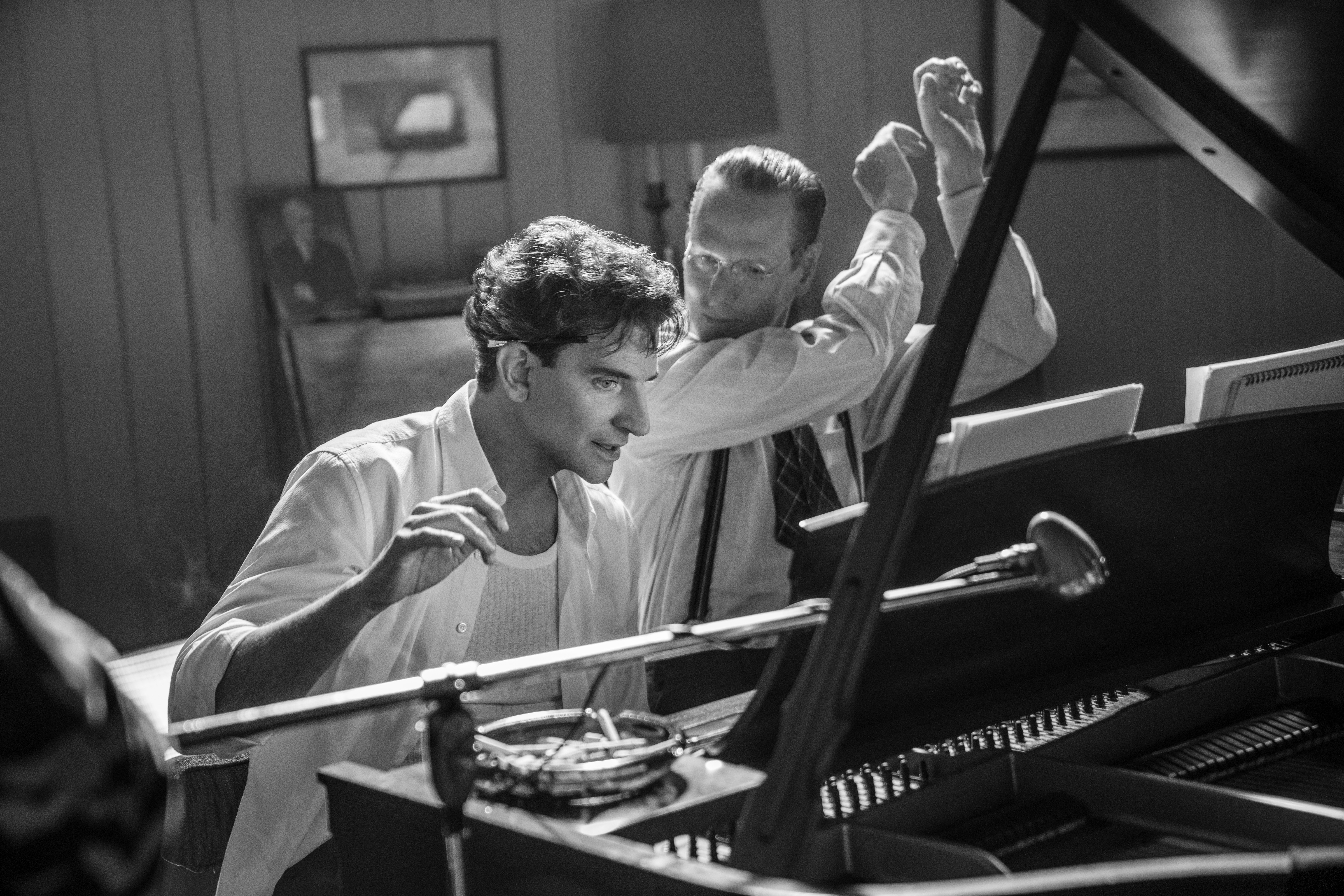
With Maestro now streaming on Netflix—and nominated for four Golden Globe Awards—it’s high time I set the record straight about the Cranbrook House Steinway Grand and its most famous pianist, Leonard Bernstein. It is a legendary story, told and retold for decades, that places Bernstein composing none other than his most famous work, West Side Story, here, at Cranbrook.
It is a story, however, that is hard to unravel fact from fiction. So, like all Center historians and archivists, I started by doing some digging in Cranbrook Archives. This is the story I uncovered.
Cranbrook has several Steinway grand pianos, including two of the grandest: a Model D concert grand in Page Hall on the original School for Boys campus, and a second Model D in the Cranbrook House Library. The Cranbrook House concert grand piano was manufactured by Steinway & Sons of New York City and completed a little more than eighty-five years ago on December 18, 1929. It was purchased by Grinnell Brothers of Detroit in January 1930 and, later that year, sold to the Colony Town Club, a women’s club located on East Jefferson Avenue in Detroit.
Cranbrook House library facing south. Steinway & Sons Model D Concert Grand piano sits below the “Story of Ceres” tapestry, March 1957. Photographer Harvey Croze. Courtesy of Cranbrook Archives.
Enter, George Booth
The black concert grand piano was to have a short life at the Colony Town Club. Within a few years, its members sold it back to Grinnell Brothers where, in February 1935, it was purchased by George Booth. I remain intrigued by the fact that Booth purchased a “pre-owned” piano. While America was in the throes of the Great Depression, I think it was more than a simple cost-saving measure; it was a decision warranted by the piano’s intended use.
The piano did not begin its life at Cranbrook in the Booths’ Library, the center of their social life after it was completed in 1919. Rather, Booth first placed the piano in the main hall of the Cranbrook Pavilion on Lone Pine Road. Known today as St. Dunstan’s Playhouse, in 1935 the recently renovated pavilion was being used as an exhibition gallery and event space for the Academy of Art and its nascent Art Museum. The piano was played at exhibition openings and for preludes before lectures, including at least one by Frank Lloyd Wright. Although St. Dunstan’s Guild began using the pavilion in 1937 for rehearsals and storage, Cranbrook Academy of Art continued to hold exhibitions there until 1942, when the new Eliel Saarinen-designed museum opened.
Cranbrook Pavilion staged for an Academy of Art formal party, January 16, 1936. In the center is what would become known as the Cranbrook House Steinway concert grand piano; in the background is the Cranbrook Map Tapestry, designed by Eliel Saarinen and woven by Studio Loja Saarinen in 1935. Courtesy of Cranbrook Archives.
Sometime between 1942 and the summer of 1946, when the pavilion was cleared out and rented by the Cranbrook Foundation to St. Dunstan’s Guild, George Booth moved the Steinway down the road to Christ Church Cranbrook “to protect the instrument from damage by dampness or other causes and to give it the benefit of expert use.” It was also during this period, in March 1944, that George and Ellen Booth formally deeded to the Cranbrook Foundation the Homestead Property, which encompassed not only Cranbrook House but also the forty acres adjacent to the house, including the Cranbrook Pavilion and its Steinway.
George G. Booth’s “Old Country Office” at Cranbrook House. Photograph by Kevin Adkisson.
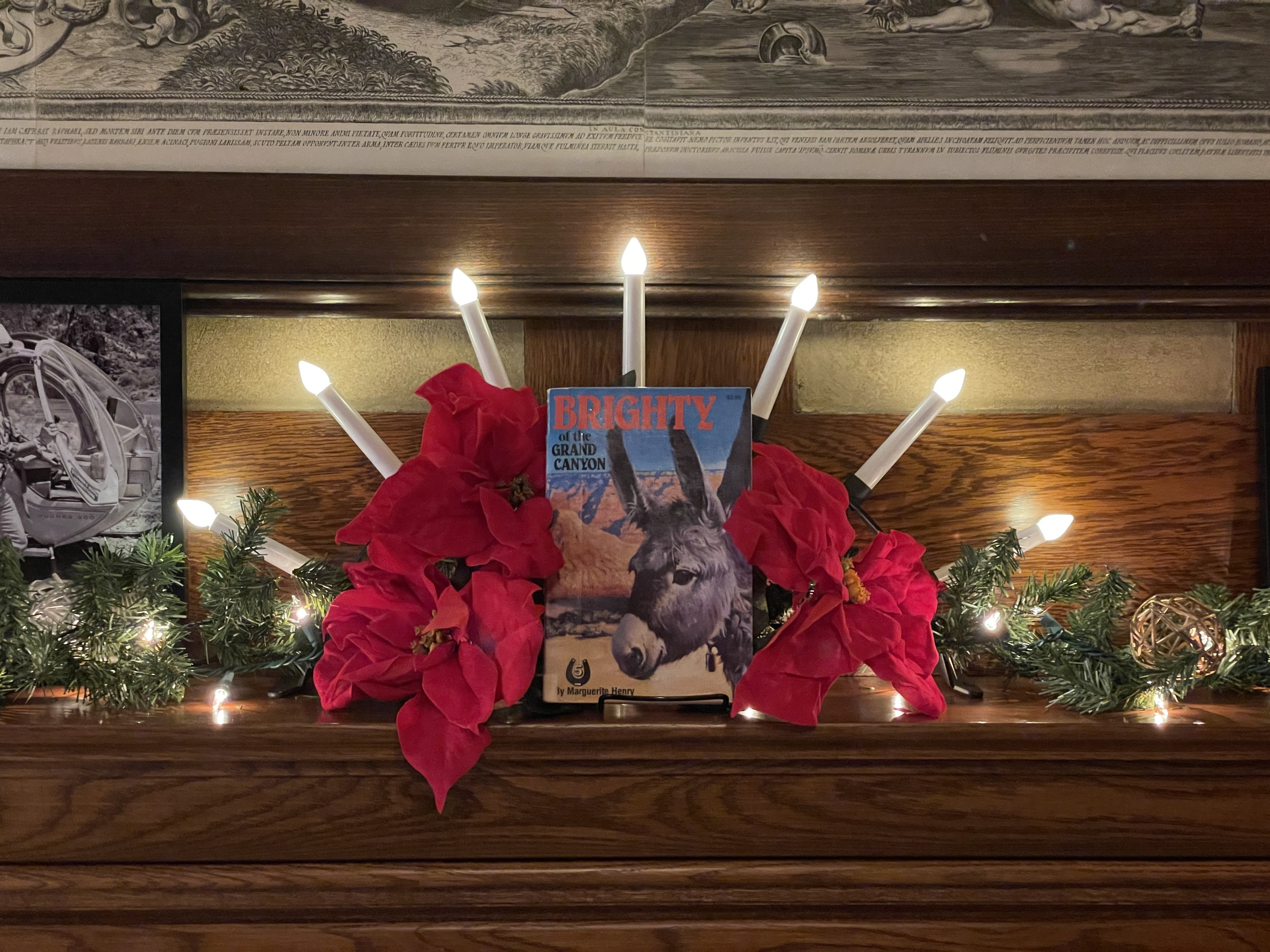
Every year at Christmas, the Center for Collections and Research decorates George Booth’s office in Cranbrook House with a special display. This year, our Christmas display is all about Brighty of the Grand Canyon, a movie produced by Stephen Booth, a grandson of Cranbrook’s cofounders. Brighty was a real donkey who inspired first a children’s novel, then a feature film.
In the late 1800s, there were hundreds of half-wild donkeys in the Grand Canyon, brought there by prospectors and then lost or abandoned. Brighty was one of them.
Photograph by Kevin Adkisson.
Brighty lived in the Grand Canyon from 1892 to 1922. In the winter, he roamed the warm depths of the canyon. A sociable animal, he liked the company of prospectors, hunters, and hikers, but if anyone loaded a heavy pack on his back he would soon make his escape. Every summer, he returned to the North Rim to stay with the McKee family who rented cabins to tourists. He would carry water, give children rides, and visit each cabin in turn for attention and treats—his favorite food was flapjacks and honey.
In 1953, the author Marguerite Henry learned about Brighty, and immediately decided to base her next novel on him. In search of more stories about the adventurous donkey, she travelled to the Grand Canyon herself, where she interviewed locals who had known him, hiked in the canyon, and even sampled the creek water and tasted the plants that Brighty would have eaten! She adopted her own donkey, Jiggs, to learn from him how the real Brighty might have behaved. In Brighty of the Grand Canyon, a free-spirited donkey helps solve a murder mystery and protects his human friends from a dangerous bandit.
This is the 1963 edition of the novel, the same year that the Booths bought a copy to read on their family road trip. Photograph by Kevin Adkisson.
Stephen Booth and his wife Betty bought a copy of the book to read to their children, Douglas, Charles, and George. They all loved the story, especially Stephen, who had his own film production company, and decided to make a movie about Brighty.
Filming began in 1965, with Marguerite Henry’s own pet donkey, Jiggs, starring as Brighty. Filmed on location at the Grand Canyon and in the Dixie National Forest in Utah, the actors and crew spent weeks living in the canyon. A tiny helicopter and an airplane with a camera mounted on the front were used for aerial shots, and for flying special visitors, like Stephen’s parents, Henry and Carolyn Booth, down into the canyon.
Norman Foster, the film’s director, reviews the script with Jiggs the Donkey. Stephen Farr Booth Papers, Cranbrook Archives
The movie premiered on November 22, 1966, just down the road in Birmingham, doubling as a fundraiser for Kingswood School for Girls. As the star of the movie, Jiggs himself came along to the premiere. Afterward, he participated in the Festival of Gifts at Christ Church Cranbrook, an annual Christmas tradition that began in 1928 and continues today.
From left to right: Betty Booth, Stephen Booth, Marguerite Henry, and Jiggs greet children at the film’s premiere. Stephen Farr Booth Papers, Cranbrook Archives.
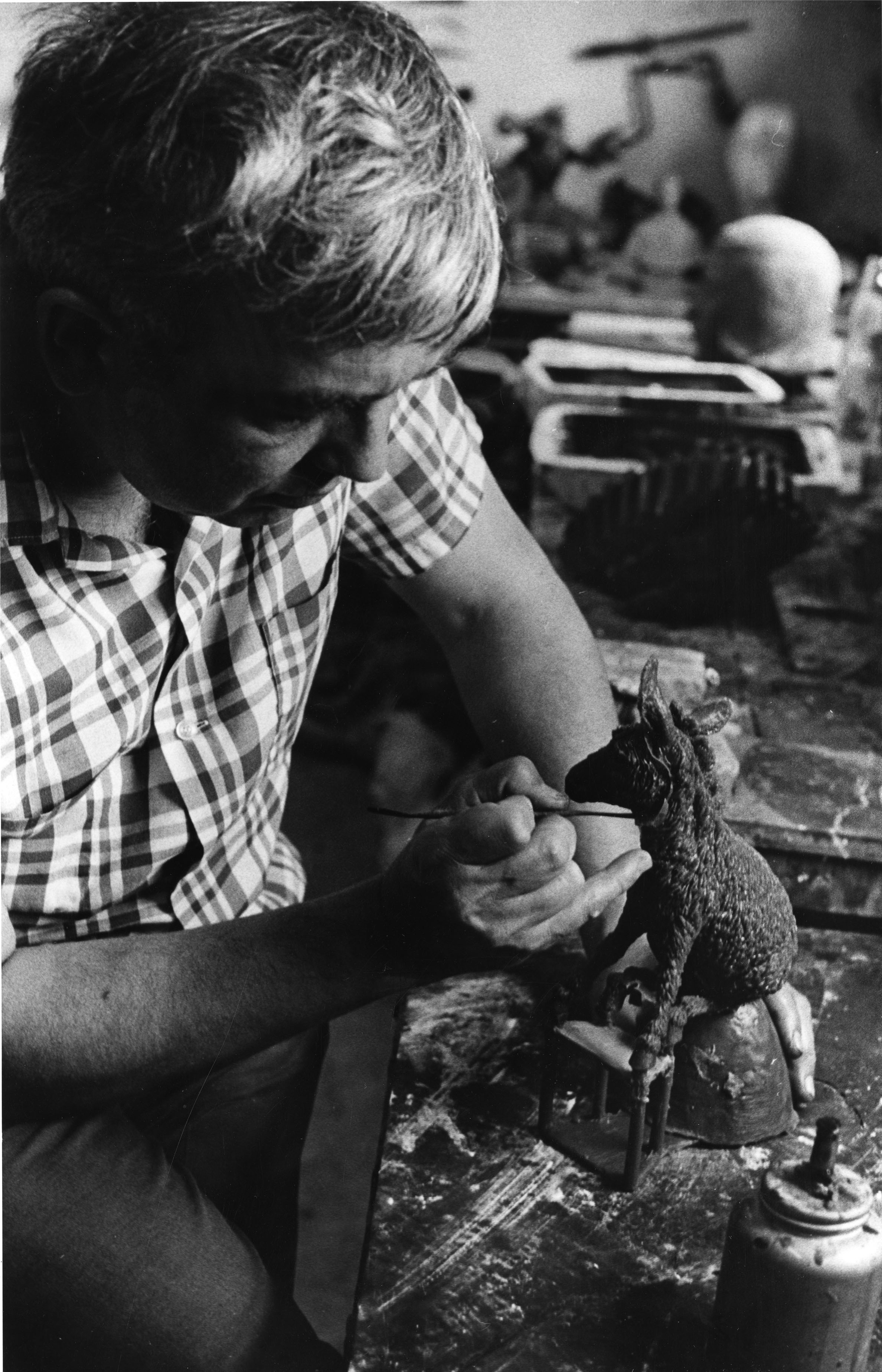
While Brighty was visiting Bloomfield Hills, he also posed for a series of sculptures by Peter Jepsen. They were modelled here at Cranbrook, on the second floor of Thornlea Studio. We still have one of the sixty Brighty figurines that Stephen Booth had made to give as presents to people who had helped in the making of the movie. Our Brighty was given to Stephen’s parents, Henry and Carolyn, to thank them for their support.
Photograph by Kevin Adkisson.
Peter Jepsen at work on Brighty in Thornlea Studio. Stephen Farr Booth Papers, Cranbrook Archives.
Stephen also commissioned Jepsen to make a life-size sculpture of Brighty. In 1968, Stephen gave that version to the Park Rangers at the Grand Canyon as a Christmas present. You can still see Jepsen’s Brighty at the visitor’s lodge on the North Rim of the Canyon, close to where the real Brighty spent his summers, more than a hundred years ago.
Peter Jepsen poses with his sculpture at the lodge on the North Rim of the Grand Canyon. Stephen Farr Booth Papers, Cranbrook Archives.
— Mariam Hale, Collections Fellow, Cranbrook Center for Collections and Research
Ed. Note (July 17, 2025): It appears the Dragon Bravo wildfire has severly damaged the original Brighty statue at the the lodge on the North Rim of the Grand Canyon. https://www.facebook.com/share/p/1CDkSfoutX/
Please know that the Cranbrook Center for Collections and Research will do everything it can to support efforts to restore or replace Brighty,
































 Cranbrook Kitchen Sink