Lost and Found in a Sea of Cranbrook History

Ye Triumphe Ship

Ye Triumphe Ship, CEC 1918.1

Every day at the Center for Collections and Research brings new adventures and discoveries. During a visit to one of the storage spaces on Cranbrook’s campus, I stumbled upon a curious object, which inspired me to research it and its past. Like most things around here, the object has a great lineage throughout the campus with connections to George Booth, the Detroit Society of Arts and Crafts, and Cranbrook School.

The Ye Triumphe model ship was crafted by Henry Brundage Culver (1869-1946), and although it is a model, it is a large one: about 40 inches long and 32 inches high. George Gough Booth purchased the Ye Triumphe in September 1918 from the Detroit Society of Arts and Crafts. The model, which was advertised in the Detroit Sunday News, had been on display in the window of the Detroit Society of Arts and Crafts shop during that same year.

Henry Brundage Culver worked as an attorney and also served as secretary for The Ship Model Society in New York. He participated in building ship models, and contributed to scholarship on the art of model-making. He produced several publications including Contemporary Scale Models of Vessels of the Seventeenth Century (1926) and The Book of Old Ships: Something of their Evolution and Romance (1924). In the introduction to Contemporary Scale Models Culver compares the art of ship-model building to that of painting.

The finest examples of these miniature vessels are, in the eyes of those best fitted to judge productions of the highest artistic quality, appealing in general composition, line, mass and technical execution, to the aesthetic susceptibilities of those, who have eyes to see, in a no less degree than do the best examples of pictorial art.”

­—Henry B. Culver, Contemporary Scale Models of Vessels of the Seventeenth Century, New York: Payson and Clarke Ltd.1926, pg.ix.

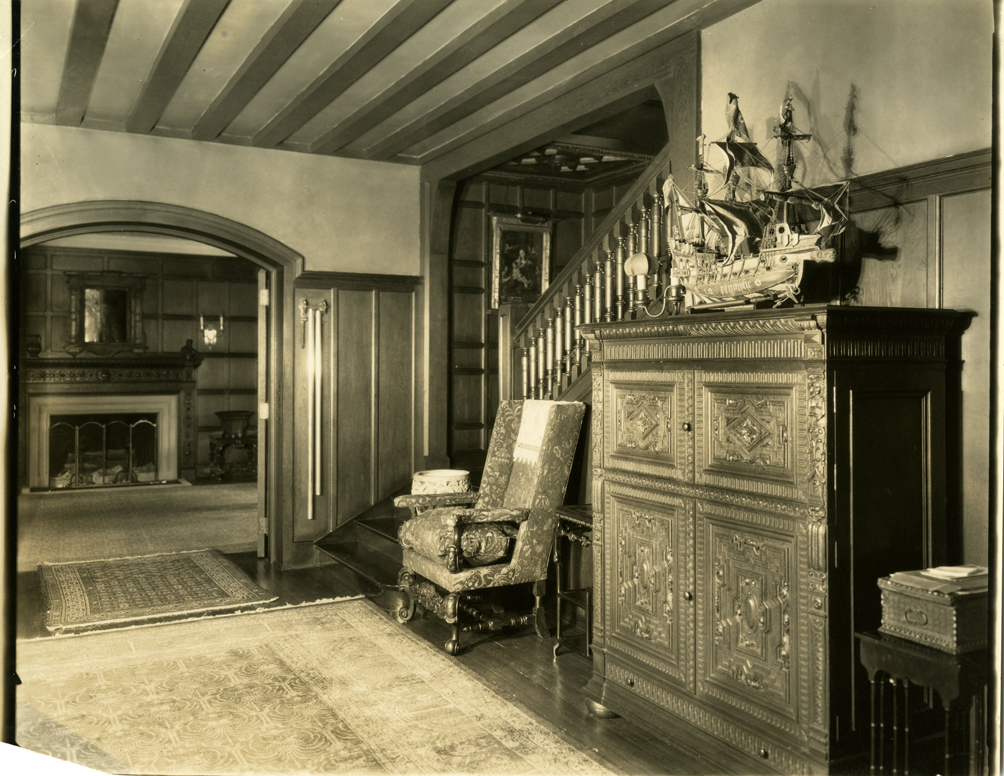
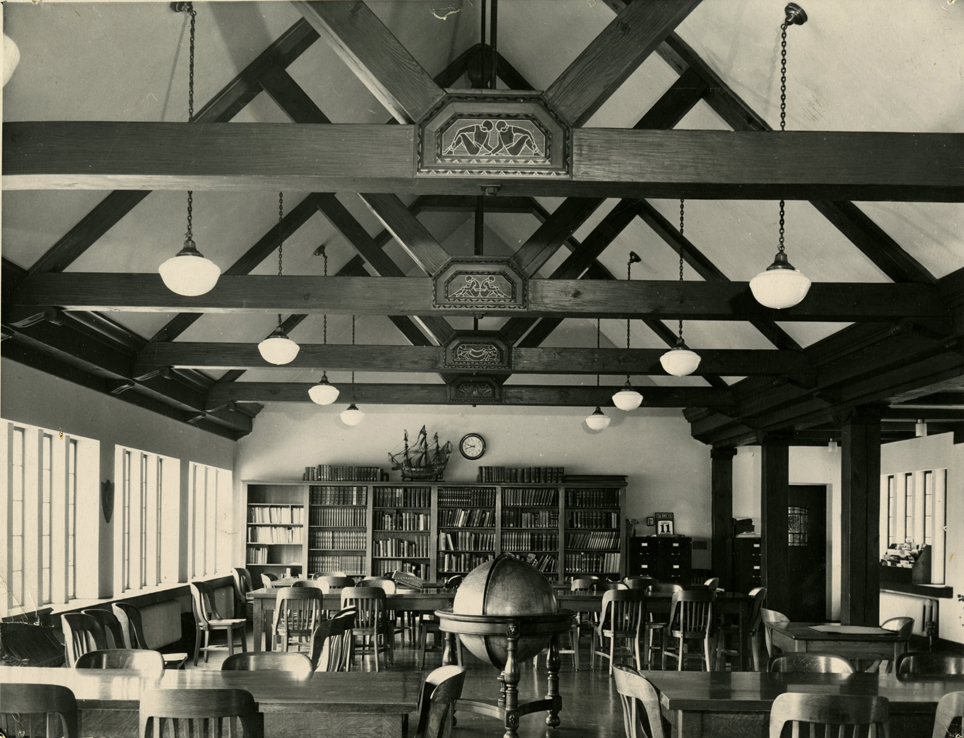
Originally, the ship was placed in the reception hall of Cranbrook House, and was later loaned by Booth for display in the library at Cranbrook School for Boys. Each of the photographs show the ship on display and its presence throughout Cranbrook.
CH_entrance hall_Ship_Blogpost

Cranbrook House reception hall, ca. 1920. Cranbrook Archives
CS_Library_Ship_Blogpost

Cranbrook School for Boys, Library interior, ca. 1945. Cranbrook Archives.

The Ye Triumphe will be returning to view at the Cranbrook Art Museum’s upcoming exhibition The Cranbrook Hall of Wonders: Artworks, Objects, and Natural Curiosities opening November 23rd, 2014. Come and check out the Ye Triumphe and many other fabulous objects from across the Cranbrook campus including works from the Center for Collections and Research, Cranbrook Art Museum, and the Cranbrook Institute of Science!

—Stefanie Kae Dlugosz, Center for Collections and Research, Collections Fellow
Letters Left Behind: Advertising Local History

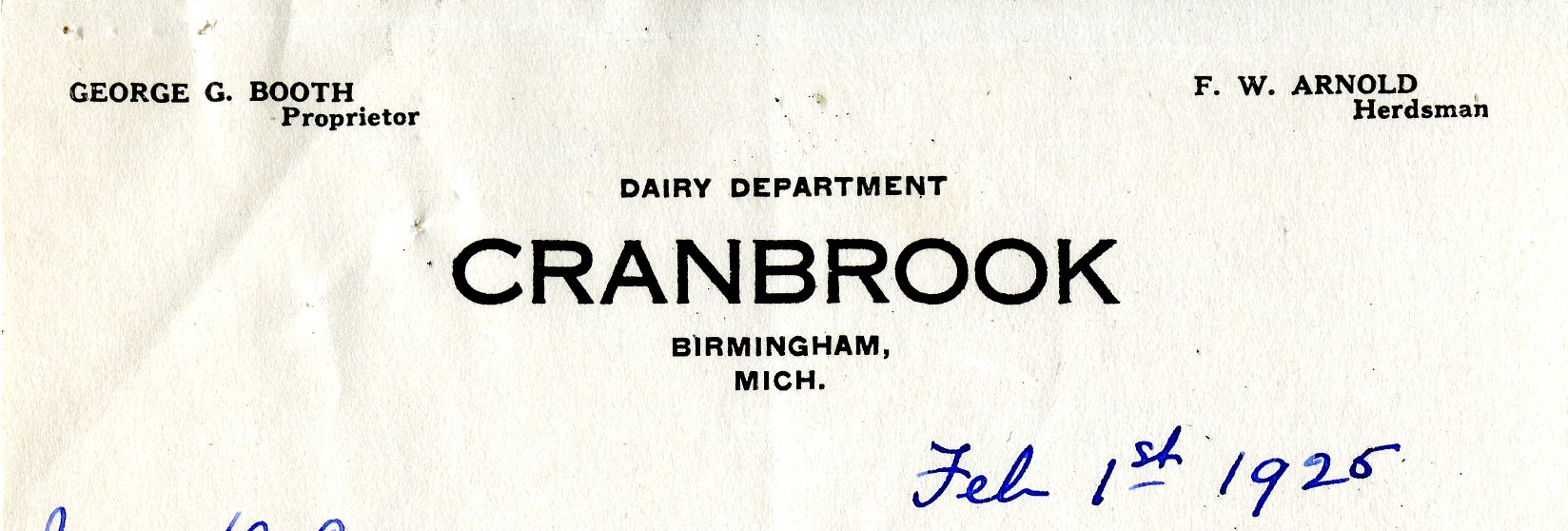
In pulling together the final selections for the Cranbrook Archives’ exhibition “Ephemera: Stories that Letterhead Tells,” I had many difficult choices to make. We have so many fantastic examples of letterhead that span 150 years. It was hard to choose which stories to tell in the exhibition!

That said, I have to say that some of my favorites are the ones that document Michigan history, and specifically, local area history. Numerous businesses including retail stores, restaurants, gas stations, hotels, industries and civic organizations, are no longer in existence and the letterhead is the last bit of evidentiary proof of existence. This post is an opportunity to spotlight a few of these.

farm003

lumber001

paper007

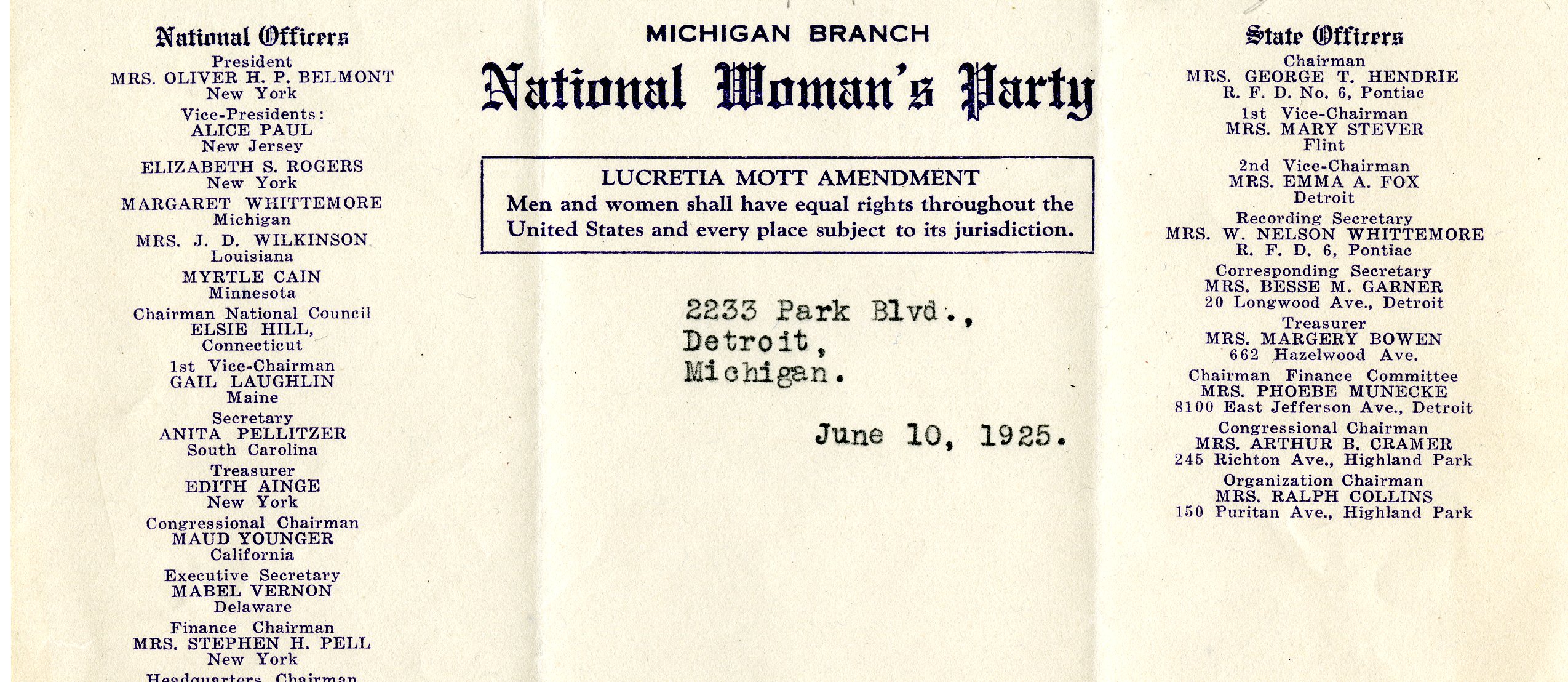
women006

flag002

Beginning this Thursday, the Archives, as part of the Center for Collections and Research, will be host to a lecture series about Michigan history. In each of the three lectures, the speakers will highlight letterhead from their own institution’s archival collections that relate to the stories they are telling. Please join us this Thursday October 16th for the first in the series: “Boom Town: Detroit in the Roaring ‘20s” by Joel Stone, Senior Curator of the Detroit Historical Society. The lecture will be held in DeSalle Auditorium, Cranbrook Art Museum, from 7-8:30pm and include a tour of the exhibition “Ephemera: Stories that Letterhead Tells.”

Leslie S. Edwards, Head Archivist

Evening Post: Summer Exhibitions Are Almost Here!

Posting on a Thursday night is a rare activity for this blog, but it’s worth staying late in the office to help install the upcoming shows. Cranbrook Art Museum will kick off its summer exhibition season this Saturday with six all new exhibitions. Two of those are Center for Collections and Research projects, and we are so excited to show them off!

Two selections of ephemera from the exhibition highlight the variety of documents that fall under this important archival category. Cranbrook Archives.

We’ve already highlighted one exhibition on the blog, but it is worth mentioning again. Officially opened on April 22, Cranbrook Archives’ Ephemera: Fragments from Cranbrook’s Social Life went into hibernation with the rest of the museum during the changeover from the Academy of Art Graduate Degree Show in May. Re-opening along with the rest of the galleries, it presents an exciting opportunity to explore Cranbrook’s diverse history through the campus’ ephemera – the paper material (fliers, invitations, notices, tickets, etc.) that populate our daily life yet are so often discarded rather than saved. Called “the transient evidence of everyday life,” ephemera collections are ripe for exploration, which is what the Archives will be doing as it launches this first show in a series of exhibitions that mine the Archives’ rich collection of ephemera.

Films and objects come together in Cranbrook Goes to the Movies. Left: Tea urn and tray, Eliel Saarinen, 1934 (or earlier). Right: Still from Cranbrook Academy of Art Experimental Films, circa 1941. Cranbrook Art Museum/Cranbrook Archives.

The second Center exhibition opening at Cranbrook Art Museum on Saturday, June 21 features an under-explored medium in Cranbrook’s history: film. Cranbrook Goes to the Movies: Films and Their Objects, 1925-1975 takes Cranbrook Archives’ incredible collection of historic film as its jumping off point, using footage from multiple time periods and many distinct parts of Cranbrook’s community to provide a fresh look into the past. Incorporating objects that appear in films and remain within Cranbrook’s various collections, the show reunites the ephemeral with the physical to activate the historic film and provide context to objects that are still considered some of Cranbrook’s greatest treasures.

On loan to the exhibition from Cranbrook Institute of Science, this stuffed duck finds many of his friends in a 1960s film that details the attractions of the early Institute.  Shoshana Resnikoff/Cranbrook Center for Collections and Research

On loan to the exhibition from Cranbrook Institute of Science, this stuffed duck finds many of his friends in a 1960s film that details the attractions of the early Institute. Shoshana Resnikoff/Cranbrook Center for Collections and Research

We can’t show you the completed gallery, but enjoy this sneak peek into the installation. And be sure to visit Cranbrook Art Museum on opening weekend! Besides these two shows, CAM will be opening four other exhibitions that are sure to impress – Paul Evans: Crossing Boundaries and Crafting Modernism, Warhol on Vinyl: The Record Covers, 1949-1987+, Modern/Moderna:Amie Siegel and Terence Gower, and Culture Breakers: The Living Structures of Ken Isaacs. Also exciting is Sunday’s PNC Family Fun Celebration day, featuring live music, silk screening activities, and tours of the exhibitions!

Alright, enough blogging – back to putting the finishing touches on our shows!


Dinosaurs and Doodles

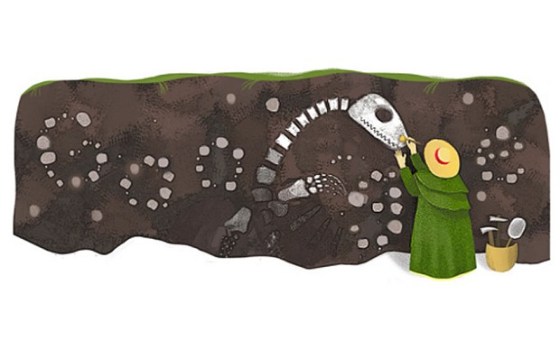
Google Doodle honoring Mary Anning's 215th birthday. Google.com.

Google Doodle honoring Mary Anning’s 215th birthday. Google.com.

If you find yourself on Google’s homepage today, you will likely run into a Google Doodle featuring a little-known 19th century Englishwoman named Mary Anning. Born in 1799, Anning was barred by her gender and social class from access to Britain’s community of leading scientists and palaeontologists, yet nonetheless she slowly became known in scientific circles throughout Europe and the United States. Anning’s discoveries include the first icthyosaur to come to scientific attention in England, as well as a partial skeleton of an unknown marine reptile that would later earn the title of plesiosaurus. The Google Doodle celebrates her 215th birthday and helps to give Anning the credit and attention that she so richly deserves, even centuries after her death.

There aren’t many connections between a 19th century female English palaeontologist and Cranbrook, but the timing of her 215th birthday is an ideal opportunity to mention Cranbrook Institute of Science’s current special exhibition Dinosaurs – The Lost World. Featuring more than fifty full-scale dinosaur skeletons and skeleton casts, Dinosaurs tells a story of prehistoric life that would not have been possible without the contributions of early amateur palaeontologists like Mary Anning. The exhibition closes on June 29, so be sure to visit and get a glimpse into the world that Mary and her colleagues discovered!


Photo Friday: Art by Degrees

Young women take in the Annual Exhibition of Student Work at the Cranbrook Art Museum. The central painting is Untitled (1957) by student Frank Okada. June 1957. Harvey Croze/Cranbrook Archives.

Visitors take in the Annual Exhibition of Student Work at Cranbrook Art Museum. The central painting is Untitled (1957) by student Frank Okada. June 1957. Harvey Croze/Cranbrook Archives.

It’s that time of year again—the Graduate Degree Exhibition is up and running at Cranbrook Art Museum! Staged in some form or another since 1940, the Graduate Degree Exhibition is a celebration of work produced by Cranbrook’s graduating class of MFA students. This photograph from 1957’s Annual Exhibition of Student Work (an earlier name for the Graduate Degree Exhibition) shows a painting by Academy of Art graduate Frank Okada that might be familiar to eagle-eyed museum visitors—it was featured in the 2013 exhibition What to Paint and Why: Modern Painters at Cranbrook, 1936-1974.

For more information about the 2014 Graduate Degree Exhibition, check out Cranbrook Art Museum’s website. And be sure to check out the show while you still can—it closes May 11!

The Transparent Dog Talks

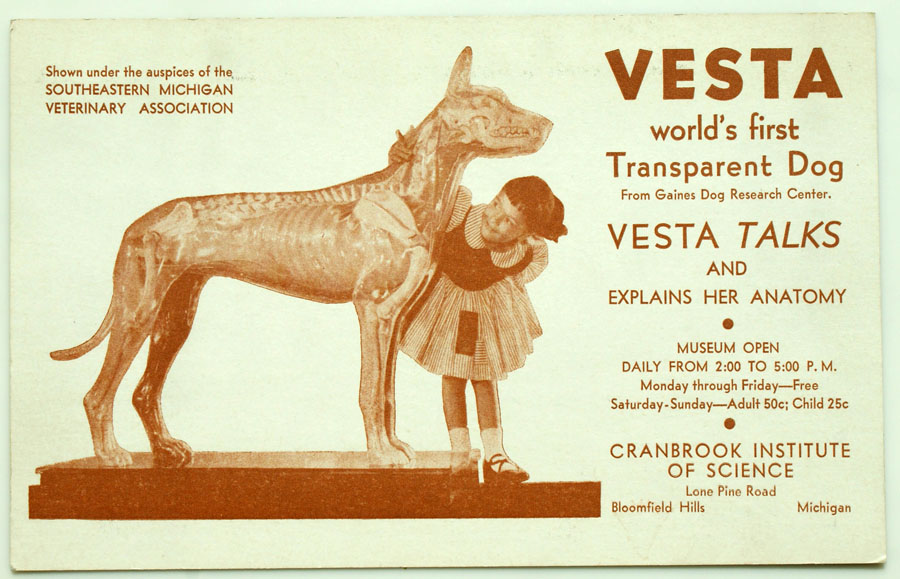
Vesta, the transparent dog

Exhibition Card, Cranbrook Institute of Science Records, 1955. Cranbrook Archives.

While preparing for an exhibition, it is inevitable that we stumble upon cool, unusual objects in our collection. I love the discovery of the unique stories associated with them.  This image announces an Institute of Science exhibition that featured Vesta, the talking dog.  Vesta (named after the Roman goddess and guardian of the home) was a transparent plastic model created in 1954 for the Gaines Dog Research Center by the Deutsches Museum in Germany. Vesta was then flown to Cleveland, where a team of experts installed an intricate sound system which enabled her to tell interesting facts about herself as parts of her anatomy lit up.   She was part of an educational and scientific traveling exhibition to help dog owners better understand their pets. Continue reading

Cranbrook and the Car, Part 4: On the Road Again

A Driving Force: Cranbrook and the Car may have closed to the public, but we’re not done with it yet here at the Center for Collections and Research. As Cranbrook Art Museum switches out exhibitions (and gets ready to install the yearly Graduate Degree Exhibition, a show everyone must check out), staff of both the Center and the Museum are busy dismantling cases, assessing the condition of objects as they come down from the display, and preparing spaces to hold new and exciting displays of art and design.

While A Driving Force: Cranbrook and the Car was not a huge show, it did have one very sizable object: the 1914 Scripps-Booth Rocket Cyclecar. In the collection of the Detroit Historical Museum, the Rocket came to us from the Owls Head Transportation Museum where it had been on loan for a number of years (if you missed it, read more about the move here). Now, nine months after going on view, it was time to return it home. This morning our registrar Roberta Frey Gilboe and associate registrar Gretchen Sawatzki helped to wheel the Rocket out onto Cranbrook Art Museum’s loading dock and send it back to the Detroit Historical Museum.

Museum objects need to be preserved in as best condition as possible, which means that driving the Rocket is pretty much out of the question. Even if we wanted to drive it out the building, though, that would be impossible – the car is not in working condition. Instead, we hired a car transporter to pick up the Rocket and drive it the twenty-something miles down to DHM. The following videos (filmed by Gretchen) give a sense of what is involved in moving a vehicle of this size and age. In the first video, Roberta and our truck driver roll the Rocket out into the dock and onto a lift. In the second, the three of them (Roberta, driver, and Rocket) ride the lift up to meet the bed of the truck. In the final video, they roll the Rocket onto the truck. As you can see, moving objects (especially ones as large and as complicated as antique cars) is a complex task. With a team of talented professionals, though, and given enough time, we can safely transport objects from space to space and make room for the new and exciting exhibitions to come.

<p><a href=”http://vimeo.com/90781705″>Video 1: The Rocket Starts Rolling</a> from <a href=”http://vimeo.com/user21903363″>Cranbrook Kitchen Sink</a> on <a href=”https://vimeo.com”>Vimeo</a&gt;.</p>

<p><a href=”http://vimeo.com/90781706″>Video 2:The Rocket Rises</a> from <a href=”http://vimeo.com/user21903363″>Cranbrook Kitchen Sink</a> on <a href=”https://vimeo.com”>Vimeo</a&gt;.</p>

<p><a href=”http://vimeo.com/90781707″>Video 3: The Rocket Rolls into Place</a> from <a href=”http://vimeo.com/user21903363″>Cranbrook Kitchen Sink</a> on <a href=”https://vimeo.com”>Vimeo</a&gt;.</p>


– Shoshana Resnikoff, Collections Fellow

Photo Friday: The Rocket Takes Off (and Says Goodbye)

James Scripps Booth showing off the JB Rocket prototype in Indianapolis, the conclusion of a test-drive from Detroit to Indiana, 1913. Cranbrook Archives.

James Scripps Booth showing off the JB Rocket prototype in Marion, Indiana, at the conclusion of a test-drive from Detroit to Indiana, 1913. Cranbrook Archives.

Today’s Photo Friday comes courtesy of A Driving Force: Cranbrook and the Car. The exhibition, organized by the Cranbrook Center for Collections and Research and hosted at Cranbrook Art Museum, features objects, renderings, and historic photographs that connect the Cranbrook community with Detroit’s long and venerable history of car production. And of course we also brought in actual 1914 car, because how could we not? Anyone who reads this blog regularly already knows quite a bit about the exhibition, so we won’t go on. If you haven’t had a chance to see the show, though, be sure to stop by Cranbrook Art Museum on Saturday or Sunday before the whole thing comes down once and for all!

Shoshana Resnikoff, Collections Fellows

“Neither Snow Nor Rain”: Cranbrook and the New Deal Post Office Murals

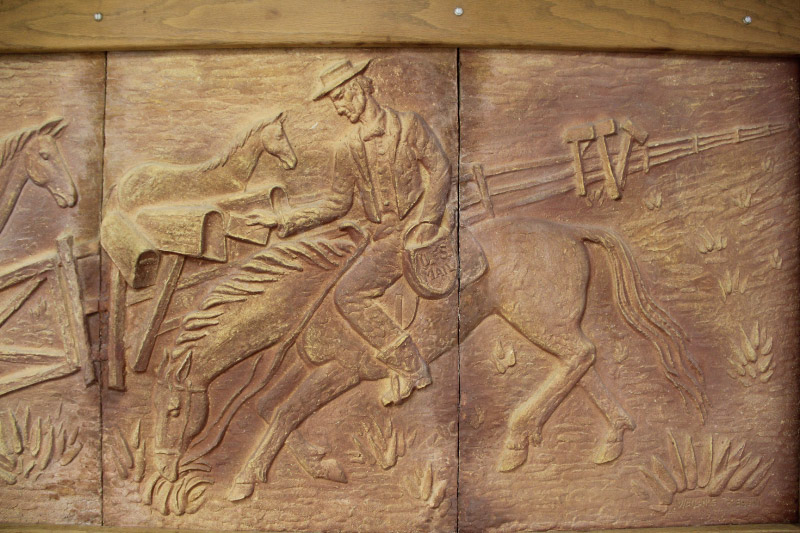
In 1940, the Columbus, Kansas post office received an imposing addition: a giant slab of terra-cotta.  Mounted on the wall, the bas-relief showed mail delivery in a rural community, the sort of neighborhood where the postman drops off the mail in a field of horses.  Crafted by Waylande Gregory as part of a New Deal art project funded first through the Public Works of Art Project (PWAP) and then the U.S. Treasury Section of Fine Arts, the post office mural (titled R.F.D.) represents not only an example of Gregory’s large scale sculptural installations but also a period of time when the American government invested heavily in the idea that public art installed in everyday environments could bolster the American economy and elevate the national discourse.

Waylande Gregory, R.F.D. (detail), Columbus, Kansas.  Charles Swaney/Living New Deal Project, University of California, Berkeley

Waylande Gregory, R.F.D. (detail), Columbus, Kansas. Charles Swaney/Living New Deal Project, University of California, Berkeley

Continue reading

Cranbrook and the Car: A Different Look

Currently on display, the exhibition A Driving Force: Cranbrook and the Car thoughtfully illustrates two key ways in which Cranbrook has been affiliated with the automotive industry throughout its history.  James Scripps Booth was an avid artist and inventor, even taking apart, rebuilding and designing cars in the garage of Cranbrook House from an early age.  Later on, the Academy of Art encouraged students to enter competitions which included designs for Packard Motor Car hood ornaments (1934) and exterior design, hood ornaments and trunk lid medallions (1950).  Graduates were employed by the Big Three automakers in a variety of ways—working in the design studios building models for new cars, as part of Harley Earl’s “Damsels in Design,” and as textile designers for automotive interiors.

But Cranbrook’s relationship with the car goes beyond the realm of design.  The Booth family’s list of cars includes a Winton (1904), a Christie (1904), a Cartercar (1907), two Pierce Arrows (one was a limousine), a Brush Runabout (1910), a Chalmers 40 (1910), a Lozier “Briarcliff” (1911) and a Detroit Electric (1921) which was driven by Henry Wood Booth at the age of 88.

Warren and Grace Booth with chauffeur in the Chalmers 40 in front of Cranbrook House. Circa 1910, Cranbrook Archives.

Warren and Grace Booth with chauffeur in the Chalmers 40 in front of Cranbrook House. Circa 1910, Cranbrook Archives.

Continue reading

Create a website or blog at WordPress.com