Photo Friday: Detroit Society of Arts & Crafts

George Booth’s devotion to the ideals of the Arts & Crafts Movement was evident in the early buildings of Cranbrook (Cranbrook House, the Greek Theatre, Brookside, Christ Christ Church Cranbrook). One of the hallmarks of the movement was to support living, working artists.  Enter the Detroit Society of Arts & Crafts (DSAC). Founded in 1906, the DSAC provided an environment where artists, craftsmen, architects, and designers could share ideas and coordinate activities to raise the level of American craftsmanship. Out of their showroom, works by nearly every major craftsman active in Europe and America were exhibited and sold. George Booth was not only one of the founders of the DSAC, but also its first president.

Watson Street Showroom

Detroit Society of Arts & Crafts Watson Street Showroom. Cranbrook Archives

George Booth was also a great supporter of the DSAC and filled his home with items he purchased or commissioned.  A collection of those objects is currently on display at Cranbrook House in an exhibit titled, “Crafting a Life: George Gough Booth and the Detroit Society of Arts & Crafts.

~Robbie Terman, Archivist

Finland Visited: Part One

I’m recently back from a fantastic vacation to Helsinki, Finland with my daughter.  We took a boat tour around the archipelago (did you know there are 315 islands surrounding the Helsinki harbor?), swam in the 1952 Olympics swimming stadium (where we had our first sauna experience), and visited the famed Temppeliaukio Church (rock church), a Lutheran church in the Töölö neighborhood of Helsinki.

Temppeliaukio Church

Temppeliaukio Church

Designed by brothers Timo and Tuomo Suomalainen, the church, which was carved out of the granite bedrock, has a strong connection with nature – exactly what the brothers intended.  When you walk through the door, the cool air of the belowground atmosphere wraps around you.  The interior walls were left rough-hewn, and metal and glass were chosen carefully to complement the rock.  The interior is lit by natural light streaming through 180 vertical window panes that connect the dome and the wall. Quite astounding was the copper dome ceiling – a Google search tells me that it is over 13 miles of copper strips!

And how could an inquisitive archivist from Cranbrook go to Finland without doing a little research relative to the Saarinens?  Naturally we visited the Saarinen’s home, Hvittrask, where we were warmly welcomed by the curator, Pepita Ehrnrooth-Jokinen, who showed us around the current exhibition, “Home as a Work of Art,” by Sirkkaliisa and Jari Jetsonen.  (By the way, the Jetsonens visited Cranbrook and the Archives a couple of summers ago on their research tour of U.S. homes designed by Eliel and/or Eero Saarinen.)

For me, however, one of the highlights of my trip was visiting Bobäcks skola (elementary school), not far from Hvittrask.  What’s so great about visiting a school you might ask? Well, it just so happens that in the 1930s, when Studio Loja Saarinen was weaving the famed May Queen Tapestry for Kingswood School for Girls, they also wove a smaller sample.  In 1952, Loja Saarienn donated this piece to Bobäcks.  And there it hung for nearly sixty years without anyone realizing the importance of it.  Fast forward to 2010, when the nearby village association determined to save the faded and worn tapestry by having it restored.  However, they also felt a responsibility to give the school a replacement in order to continue to provide students, teachers and parents alike the opportunity to experience such a fantastic tapestry.

Enter artist Ann (known as Annsi) Jonasson who had been teaching woodworking classes to adults in the school for years.  Annsi, a weaver with her own home studio in the community, was commissioned to undertake the monumental task of creating a replica of the Saarinen tapestry!  Annsi took on the responsibility and dedicated many months to studying the tapestry, meticulously counting threads and spaces in order to plot the pattern on graph paper for the copy to be as accurate as possible.  The original fabric was made of linen, wool, and silk threads in a variety of shades- nearly 170 different colors.  Annsi studied the colors from the backside which were less faded, and then tried to replicate the threads.
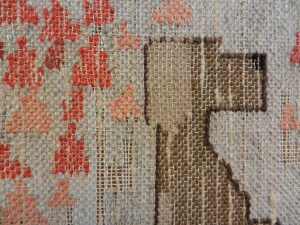
May Queen tapestry sample

A detail of the May Queen tapestry sample showing the dog’s head. Note the spaces that were not woven, and the combinations of thread colors – sometimes a linen yarn twisted with a thread from embroidery yarn – that were used to match the original colors.

Fortunately, Annsi said she has never thrown away anything useful, so she used her own personal collection to match the colors and textures.  Over the years, her collection had grown thanks to the transfer of yarns and threads from friends, acquaintances, and the inheritance of yarns from her mother and grandmother.

Annsi, a most kind and welcoming woman, is proud of her work and rightly so – though you probably can’t tell from the photographs here, the replica is stunning.
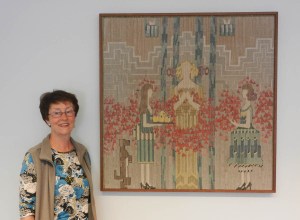
Annsi and the replica

Annsi and the May Queen tapestry sample replica.

We have to give thanks that a contemporary weaver cared enough to dedicate many months of her life and literally weave part of herself into a tapestry that connects to us here at Cranbrook.  Soon she will donate to the Cranbrook Archives a copy of her research, which will help keep the Finnish-Cranbrook connection alive.

Oh, and by the way, did you know that the May Queen tapestry sample is the only known Studio Loja Saarinen work in Finland?

~Leslie S. Edwards, Head Archivist

Photo Friday: Who’s That Man?

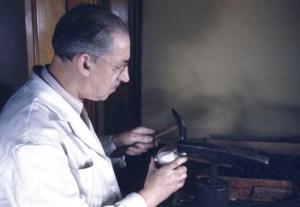
It’s Arthur Nevill Kirk! Wooed by George Booth, the famed silversmith arrived at Cranbrook in 1927 to head the metals department at the Academy of Art. Kirk also taught at the Art School of the Detroit Society of Arts and Crafts and Cranbrook School for Boys. His specialty was the design and execution of ecclesiastical silver, of which Cranbrook still has many pieces in its collection.  During the Great Depression, lack of funds curtailed the use of precious metals and the department closed in 1933. Kirk went on the help establish the Artisans’ Guild, and organized the metal department at Wayne State University in Detroit, where he taught until his retirement in 1957.

~Robbie Terman, archivist

Arthur Nevill Kirk. Cranbrook Archives.

Arthur Nevill Kirk at work. Cranbrook Archives

Photo Friday: Before Booths

Did you know that Bloomfield is one of the oldest townships in Michigan?  Originally part of a larger piece of land known as Oakland, in 1820 the southern portion was designated as Bloomfield. Long before George and Ellen Booth purchased the property known as Cranbrook, Amasa Bagley was already on the scene.  Arriving to the area in 1819 (when Woodward Avenue was still known as an Indian passage called Saginaw Trail!), Bagley quickly became a community leader. A farmer by trade, he was appointed the first judge of Oakland County, and helped to establish the area’s first bank. Perhaps his most significant contribution of the time – opening the town tavern! Built in 1833, the Bagley Inn was used not only to quench the thirst of locals, but also as a public house for political gatherings. Located at the corner of Long Lake and Woodward, the building still exists today.

~Robbie Terman, archivist

Portrait of Amasa Bagley. Cranbrook Archives.

Portrait of Amasa Bagley. Cranbrook Archives.

Photo Friday: A Quiet Force

She was petite and reserved, the constant helpmate of her husband George Booth, but Ellen Scripps Booth (1863-1948) was a powerhouse in her own right. It was Ellen who insisted that a girl’s school be built so that her granddaughters could get a good education. In January 1928, Ellen gifted $200,000 to the Cranbrook Foundation for the building of Kingswood School for Girls. She would later contribute more to ensure the project reached completion.

Known for her modesty, strong religious values, and devotion to her family, Ellen was a steadfast force in the Cranbrook community, and beyond.

~Robbie Terman, archivist

Ellen Scripps Booth, c.1914. Cranbrook Archives

Ellen Scripps Booth, c.1914. Cranbrook Archives

Booth House + Scripps Land = Library

The Detroit connections of James E. Scripps and George G. Booth are well-documented: Scripps as founder of the Detroit News and founding member of what is today the Detroit Institute of Arts, and Booth as a founder of the Detroit Society of Arts and Crafts.  Less known, perhaps, is a venture near the end of Scripps’s life that helped create the Scripps Branch of the Detroit Public Library at Trumbull and Myrtle. The library was actually George Booth’s former home, renovated to accommodate library services. It stood in Scripps Park though a different library (the Frederick Douglass branch) sits there now.

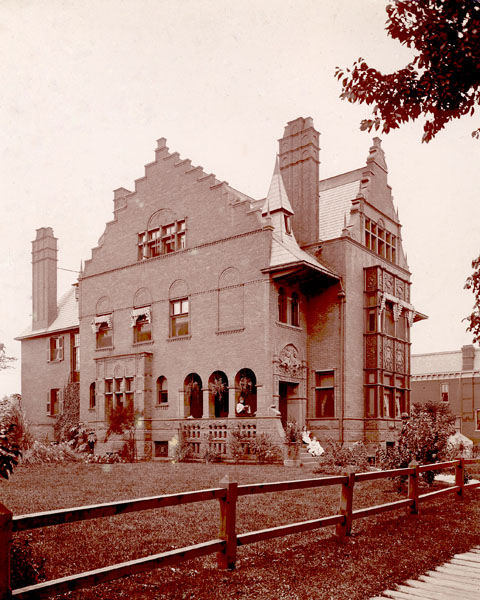
Here’s the story. When George Gough Booth and Ellen Warren Scripps married in 1887, James Scripps built a house for them, designed by Mason & Rice, across the street from his own on Trumbull Ave. Fast forward to 1905. James Scripps donated 15 lots of property, on Grand River between Trumbull and Commonwealth, to the city of Detroit as a site for a park and branch library. He included $50,000 to be used for city beautification.

Booth Family Home, 605 Trumbull Avenue, 1898

Booth Family Home, 605 Trumbull Avenue, 1898

The Library Commission, on which Scripps served for five years, was already thinking of putting a branch in this area (no doubt influenced by Scripps), so the city gave the Commission the land. Now things get more confusing. Upon the death of James Scripps in 1906, the estate purchased the George Booth home (located next door to Scripps’s donated property; by this time the Booths had moved to Cranbrook) and included that in the gift. So the Library Commission didn’t have to build a new branch and used the $14,000 designated for that purpose to renovate Booth’s house as a library.

Scripps Park

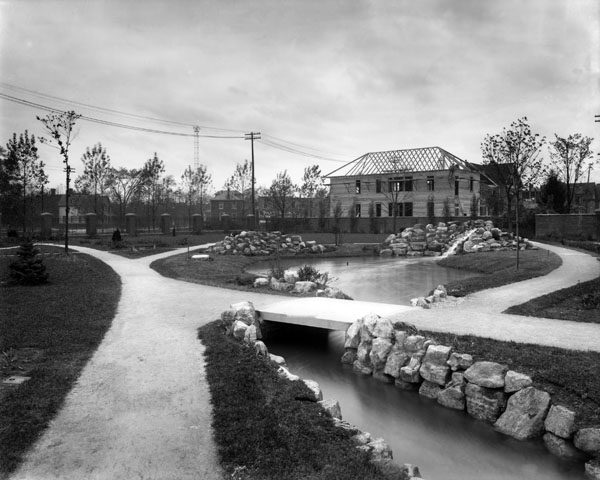
Early landscape, Scripps Park, ca 1908

In fulfilling Scripps’s intent for a park, Booth hired H.J. Corfield, landscape gardener who designed the basic landscape for Booth’s Cranbrook estate.  Booth wrote to Corfield “I feel quite sure that we can carry through a nice piece of work and will be able to pay the foundation for a small park of unusual attractiveness in this city.”  Corfield transformed land that was “little better than a city dump …  into one of the prettiest parks in the city of Detroit.”

Entrance to Scripps Park

Entrance to Scripps Park

The former Booth home was almost doubled in size and opened on July 3, 1909 as Scripps Branch Library.

There’s another interesting twist to the story. In 1898, James Scripps added an 800-ton octagonal chapter house, modeled after the one in Westminster Abbey, to his own home on Trumbull across the street from the Booth’s. It contained his book and art collection. In 1927, James’s son, William E. Scripps, made a gift of the tower to the Library, along with its collections, it was moved across the street and attached to the Scripps Branch Library!

The sad ending is that the branch closed in 1959, and was demolished in 1966. The Gothic tower was razed sometime later, after a valiant attempt to save structure, by George Booth’s youngest son, Henry Scripps Booth, failed.

~Cheri Gay, Archivist

Photo Friday: Days of Yore

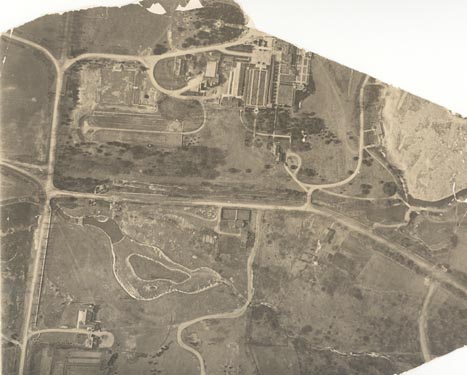
The year was 1918, fourteen years after George and Ellen Booth purchased the property they called Cranbrook.  The lay of the land was far different from the lush greenery, grading hillsides, and bountiful gardens which exist today.  An estimated 150,000 trees were planted during George’s lifetime, a testament to his devotion to the Arts & Crafts ideal of surrounding one’s self with nature.  Buildings during this time were scarce; in this aerial view, the only two existing Cranbrook buildings seen are Cranbrook House (top middle) and the Meeting House (middle left), which would later become Brookside Lower School.  The house seen in the lower left, called Edgevale, was the home of George’s cousin, Clarence Booth.

~Robbie Terman, archivist

Intersection of Lone Pine and Cranbrook Roads, c1917. Cranbrook Archives

Intersection of Lone Pine and Cranbrook Roads, c1917. Cranbrook Archives

Photo Friday: The Man Behind the Camera

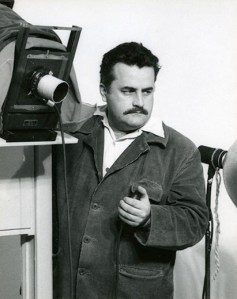
For nearly thirty years, a stocky man with his trademark black mustache and the nickname “chief mug-taker” was a ubiquitous figure around Cranbrook. He was Harvey Croze, and he served as the official Cranbrook Foundation photographer from 1943-1970. Croze started his career in the darkrooms of Chrysler and General Motors, later studying under Ansel Adams. As chief photographer, Croze was a fixture at all Cranbrook institutions, snapping shots at everything from Cranbrook School for Boys sports games to the Academy of Art studios to the Institute of Science exhibitions and beyond. An award-winning photographer whose photographs have appeared worldwide, Croze will forever be remembered at Cranbrook as the man who captured history in the lens of his Leica.

~Robbie Terman, archivist

Cranbrook photographer, Harvey Croze. Cranbrook Archives

Cranbrook photographer Harvey Croze. Cranbrook Archives

Photo Friday Part 2: Bud West Caption Contest Winner!

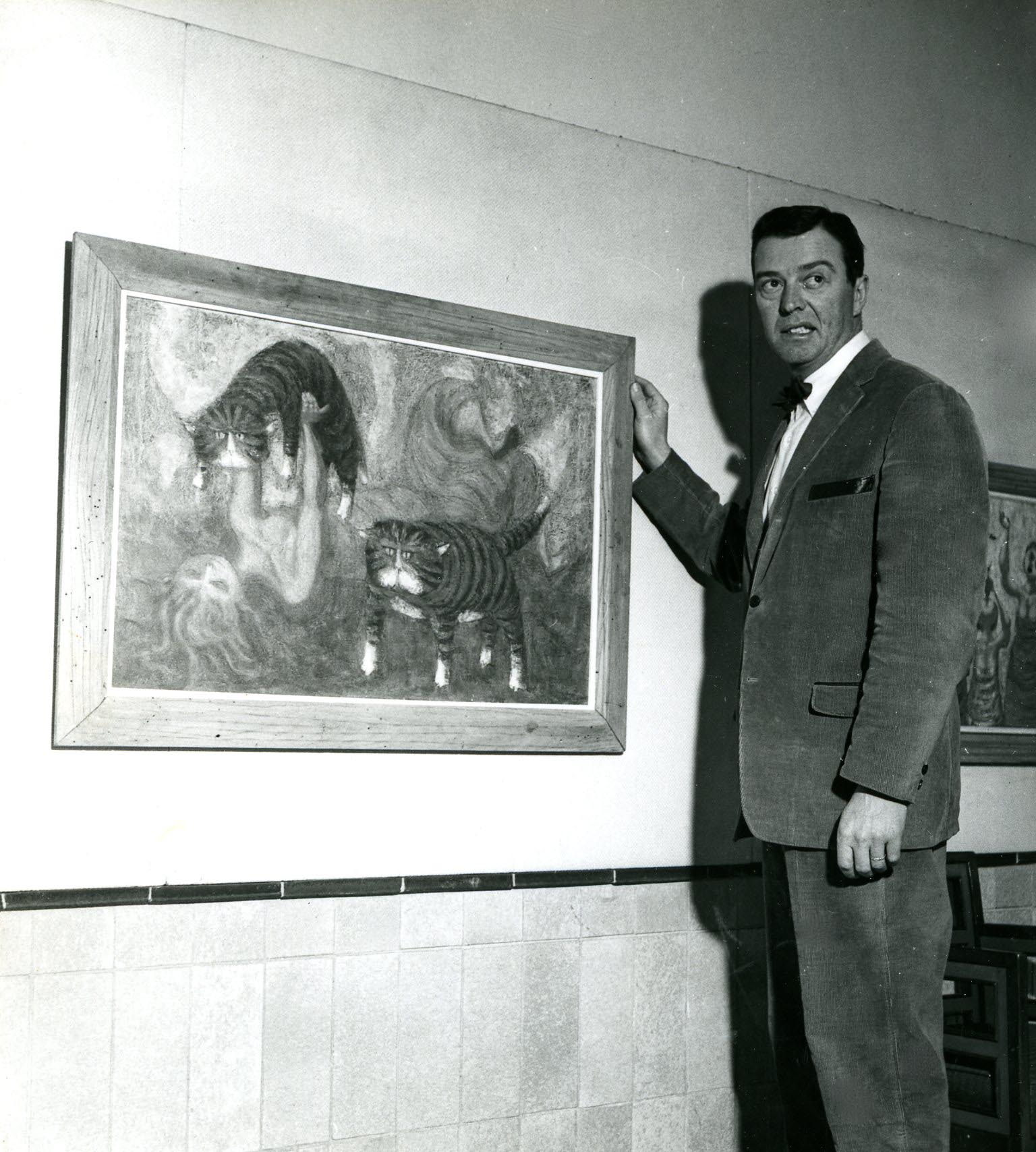
Apparently, my brain was already celebrating the fourth of July, because I posted Photo Friday on Wednesday (for no other reason than I thought Wednesday was Friday.  By the way, who else thinks today is Saturday?).  So, this week we’re going to  have TWO Photo Fridays.  Remember a few weeks back, when we held a caption contest for this fabulous photo of Clifford “Bud” West?

Our question was simple: what is Bud West thinking?  We had some great answers, but we’ve got to give the win to West’s son, Justin, who said, “What do the cats represent?  Heck, sometimes cats are just cats!”  We swear – only a hint of nepotism was involved in the decision.  Thanks to all who entered, and congrats, Justin!  And a special thanks to my colleagues, who never bothered to mention on Wednesday that I was confused about which day it was.

Photo Friday: Design of Radio Cabinets

In the early days at Cranbrook Academy of Art, students were encouraged to submit entries to a myriad of design and architecture competitions.  Sponsored by museums, magazines, colleges and industry, competitions were a way for fledgling designers to make a name for themselves.  Winning entries could catapult a designer or architect into the national arena.  In 1939, the “Design of Radio Cabinets” was sponsored by the Radio and Television Department of the General Electric Company through Interior Design and Decoration.  Designs were submitted in two categories: a table model and a console model.  The only design requirement was that a “dial or tuning control treatment” be incorporated in the design.

Entry for "Design of Radio Cabinets" competition.

Entry for “Design of Radio Cabinets” competition, 1939. Cranbrook Archives.

This entry was submitted by the team of Edward Elliott and Ted Luderowski, both architecture students studying under Eliel Saarinen.

Create a website or blog at WordPress.com