Photo Friday: Back to School in 1912

Stock certificate for the Bloomfield Hills Seminary issued in 1912/Courtesy Cranbrook Archives.

Stock certificate for the Bloomfield Hills Seminary issued in 1912. Cranbrook Archives.

In early June of 1912 a small group of Bloomfield Hills residents assembled at the home of William T. Barbour (president of Detroit Stove Works) to discuss the formation of a small local private school. After general discussion, it was moved by George Gough Booth to establish a corporation with capital of $5,000.00 in order to establish the school. According to meeting minutes, the objectives were to “give the young people of Bloomfield Hills, and those from nearby towns, the opportunity to study in the country; to offer a course of study that will fit them for life as well as for college.” With these objectives in place, the Bloomfield Hills Seminary was incorporated in August.

Often referred to as the precursor to Brookside School, the Seminary was located on five acres at the corner of Woodward Avenue and Lone Pine, in a historic house built in 1820 by Ezra Parke. Booth, who had purchased the property in 1910, offered use of the house and added a five-class-room addition with the caveat that the property would revert back to him should the school ever close.

Mary Eade, who had been the principal of the Detroit Seminary for Girls, became the principal and taught grammar and upper level courses, including History of Art. Elizabeth K. Seward (granddaughter of William Henry Seward of the Alaska purchase fame) taught intermediate classes including French, and Winifred Eastman was responsible for the elementary age children. The coeducational day school used the Montessori method of instruction.

In 1916, the trustees voted to change the name of the school to the Bloomfield Hills School. At its peak, there were eight teachers and fifty-one students enrolled. Due in part to the resignation of Mary Eade (who resigned to do war work) and the construction of new schools in Birmingham and Pontiac, the school closed in 1918 after six years. The property reverted back to Booth who purchased all of the stock certificates back from the trustees, and later became known as the Lone Pine Inn and Tea House, but that’s another story!

Leslie S. Edwards, Head Archivist and, Gina Tecos, Archivist

Photo Friday: Ciao Cranbrook!

Italian workers at Cranbrook

Italian laborers at Cranbrook, ca 1906/Cranbrook Archives

For many Americans, Labor Day’s most popular meaning is a “last hurrah to summer,” but its national significance is much greater than that. In 1894, Grover Cleveland designated the first Monday in September as a national holiday paying tribute to the contributions and achievements of the working force in America. The Italian laborers pictured here arrived at Cranbrook in 1905. Hired by George Booth, men with the last names of Angelosanto, DiPonio, Roselli, Soave, and Vettraino built roads and stone walls, dug ponds, contoured the land, planted, and cared for the property. In 1955 the Cranbrook Foundation Board of Trustees dedicated a plaza north of the Brookside School in appreciation of groundskeeper Michael Vettraino’s 50 years of service to the Cranbrook community. In his speech at the “Piazza Vettraino” dedication, Henry S. Booth said, “We acknowledge a debt to his native Italy, his affection for the world of growing things, his quest for beauty, his tireless hands and feet, and the part he has played as one of the many founders of Cranbrook today.”

Click here to listen to a clip from our oral history collection of Dominick Vettraino speaking about the work the Italians did on the grounds of Cranbrook.

Gina Tecos, Archivist

Photo Friday: Arthur Nevill Kirk on Facebook

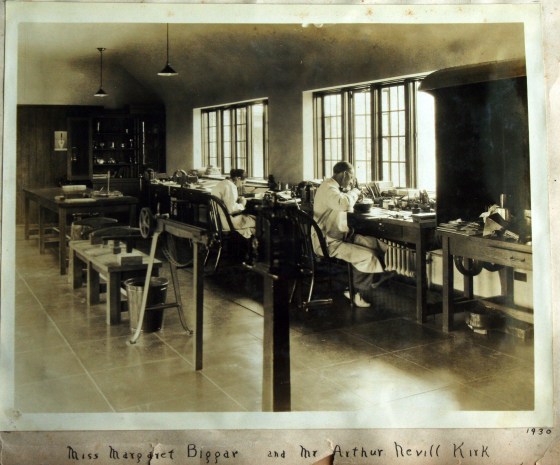
Famed metalsmith Arthur Nevill Kirk and apprentice Margaret Elleanor Biggar work in the metalsmithing studio at the Cranbrook Academy of Art, 1930. Cranbrook Archives.

Famed silversmith Arthur Nevill Kirk and apprentice Margaret Elleanor Biggar work in the metalsmithing studio at the Cranbrook Arts and Crafts Studios, 1930. Cranbrook Archives.

In this scrapbook page from 1930, “Miss Margaret Biggar” and “Mr. Arthur Nevill Kirk” are found working in the metalsmithing studios at the arts and crafts studios, the predecessor to the Cranbrook Academy of Art. An English-born silversmith, Arthur Nevill Kirk came to Cranbrook in 1927 at the urging of George Booth, who contracted him to produce silver designs for Christ Church Cranbrook. Kirk eventually taught silversmithing at the Cranbrook Arts and Crafts Studios before going on to found the Metals department at Wayne State, where he worked until 1957.

We at the Kitchen Sink are excited to use this post as an opportunity to promote not just the amazing history of Arthur Nevill Kirk but also highlight a new edition to the Cranbrook social media landscape – Cranbrook Archives’ Facebook page! As the beating heart of the Center for Collections and Research and the repository for all things historical at Cranbrook, the Archives uses Facebook to promote its extensive holdings, provide a portal through which researchers can access information about the collection, and give casual readers a daily glimpse into the fascinating history of the community through posts like yesterday’s, which featured this very photo. Check out their Facebookpage and learn more about this incredible resource!


Currently off-site doing research at the Archives of American Art in Washington, DC, Cranbrook Art Museum’s Jeanne and Ralph Graham Collections Fellow Shelley Selim has been making her way through the Harry Bertoia papers there. She stumbled upon this delightful tidbit today:

A September, 1942, letter from artist and designer Bertoia to his fiance Brigitta Valentiner captures the awkwardness of eating on Cranbrook’s campus as an instructor at the Academy of Art: “We still go over to the boys’ school to eat. Excellent food is served with an overdose of etiquette which for me is hard to swallow.”

Harry Bertoia, 1942. Richard Askew/Cranbrook Archives.

Harry Bertoia, who began studying at the Cranbrook Academy of Art in 1937 and was enlisted as the head of the Metalsmithing Department by 1938, might have felt an extra level of discomfort at the dining experience at Cranbrook School—only 24 years old when he began his tenure as an instructor, he likely looked the same age as many of the high school students.

The formality captured in Bertoia’s letter is not overstated, however. Film footage of Cranbrook School in the 1930s shows a formalized dining experience that would be unrecognizable to today’s students, with uniformed maids delivering hot dishes to the young boys who line up at their tables in coats and ties, waiting to sit in unison.  The film is featured in the Center’s current exhibition Cranbrook Goes to the Movies, on view now at Cranbrook Art Museum.

Shelley’s Bertoia research, meanwhile, has proven productive, feeding into an exciting project that Cranbrook Art Museum is cooking up in honor of the 100th anniversary of Harry Bertoia’s birth in 2015. We can’t say more right now, but watch the CAM website as this project develops over the new few months. And, just because we love it, enjoy a photo of Harry Bertoia and Brigitta Valentiner at Cranbrook Academy of Art’s themed “Come as a Song” party in 1942! We featured it as a Photo Friday a while ago, but it is just too good to not post again.

"Come as a Song" party, 1942.  Cranbrook Archives.

“Come as a Song” party; Harry Bertoia and fiance Brigitta Valentiner speak with an unidentified man in a playing card costume, 1942. Cranbrook Archives.

Shoshana Resnikoff, Collections Fellow, and Shelley Selim, Jeanne and Ralph Graham Collections Fellow, Cranbrook Art Museum

Photo Friday: Cranbrook’s World Cup

Cranbrook student John Vining Ogden (left) competes for the ball in a match against the opposing team from Nichols, a rival school, 1960. Cranbrook Archives/Harvey Croze.

Cranbrook student John Vining Ogden (left) competes for the ball in a match against the opposing team from Nichols, a rival school, 1960. Cranbrook Archives/Harvey Croze.

As we prepare for the final round of World Cup soccer (Germany vs. Argentina, this Sunday), we’re looking back on Cranbrook’s own soccer history. Here, Cranbrook student John Vining Ogden tries to get one step ahead of a rival player as they vie for control of the ball. We’re especially taken with the Nichols’ players’ uniforms: with their striped jerseys, they look like a team made up entirely of referees!

Photo Friday: Pleasures of Life

Close-up of page 104 of Pleasures of Life, Volume 2. Cranbrook Archives.

Close-up of page 104 of Pleasures of Life, volume 2. Cranbrook Archives.

For this week’s Photo Friday, we’re showcasing an image from Henry Scripps Booth’s epic photographic undertaking, Pleasures of Life. A series of photographic albums documenting his life from 1911 to 1940, Pleasures of Life follows Booth through experiences at Cranbrook, boarding school in Asheville, NC, and travels domestic and international.

This photograph, found on page 104of Pleasures of Life, volume 2, features a “Mrs. Scranton and Mrs. Brixton” dressed in angels’ wings and halos and labeled “Cranbrook’s guardian angels.” Taken during a nativity theatrical performance at Cranbrook’s Greek Theatre in 1916, the photo provides visual documentation for what are likely the same wings as those that appear in the Center’s newest exhibition,Cranbrook Goes to the Movies: Films and Their Objects, 1925-1975, now open at Cranbrook Art Museum.

Wings, circa 1916, featured in the exhibition Cranbrook Goes to the Movies.

Wings, circa 1916, featured in the exhibition Cranbrook Goes to the Movies.

Evening Post: Summer Exhibitions Are Almost Here!

Posting on a Thursday night is a rare activity for this blog, but it’s worth staying late in the office to help install the upcoming shows. Cranbrook Art Museum will kick off its summer exhibition season this Saturday with six all new exhibitions. Two of those are Center for Collections and Research projects, and we are so excited to show them off!

Two selections of ephemera from the exhibition highlight the variety of documents that fall under this important archival category. Cranbrook Archives.

We’ve already highlighted one exhibition on the blog, but it is worth mentioning again. Officially opened on April 22, Cranbrook Archives’ Ephemera: Fragments from Cranbrook’s Social Life went into hibernation with the rest of the museum during the changeover from the Academy of Art Graduate Degree Show in May. Re-opening along with the rest of the galleries, it presents an exciting opportunity to explore Cranbrook’s diverse history through the campus’ ephemera – the paper material (fliers, invitations, notices, tickets, etc.) that populate our daily life yet are so often discarded rather than saved. Called “the transient evidence of everyday life,” ephemera collections are ripe for exploration, which is what the Archives will be doing as it launches this first show in a series of exhibitions that mine the Archives’ rich collection of ephemera.

Films and objects come together in Cranbrook Goes to the Movies. Left: Tea urn and tray, Eliel Saarinen, 1934 (or earlier). Right: Still from Cranbrook Academy of Art Experimental Films, circa 1941. Cranbrook Art Museum/Cranbrook Archives.

The second Center exhibition opening at Cranbrook Art Museum on Saturday, June 21 features an under-explored medium in Cranbrook’s history: film. Cranbrook Goes to the Movies: Films and Their Objects, 1925-1975 takes Cranbrook Archives’ incredible collection of historic film as its jumping off point, using footage from multiple time periods and many distinct parts of Cranbrook’s community to provide a fresh look into the past. Incorporating objects that appear in films and remain within Cranbrook’s various collections, the show reunites the ephemeral with the physical to activate the historic film and provide context to objects that are still considered some of Cranbrook’s greatest treasures.

On loan to the exhibition from Cranbrook Institute of Science, this stuffed duck finds many of his friends in a 1960s film that details the attractions of the early Institute.  Shoshana Resnikoff/Cranbrook Center for Collections and Research

On loan to the exhibition from Cranbrook Institute of Science, this stuffed duck finds many of his friends in a 1960s film that details the attractions of the early Institute. Shoshana Resnikoff/Cranbrook Center for Collections and Research

We can’t show you the completed gallery, but enjoy this sneak peek into the installation. And be sure to visit Cranbrook Art Museum on opening weekend! Besides these two shows, CAM will be opening four other exhibitions that are sure to impress – Paul Evans: Crossing Boundaries and Crafting Modernism, Warhol on Vinyl: The Record Covers, 1949-1987+, Modern/Moderna:Amie Siegel and Terence Gower, and Culture Breakers: The Living Structures of Ken Isaacs. Also exciting is Sunday’s PNC Family Fun Celebration day, featuring live music, silk screening activities, and tours of the exhibitions!

Alright, enough blogging – back to putting the finishing touches on our shows!


Photo Friday: Brookside at Play

Brookside students enjoy the Cranbrook fire engine, 1936. Richard G. Askew/Cranbrook Archives.

Brookside students enjoy the Cranbrook fire engine, 1936. Richard G. Askew/Cranbrook Archives.

Brookside students know how to multitask—while enjoying playtime, they’re also learning the ins and outs of fire safety.  This photo, taken in 1936, shows Brookside students enjoying playtime on the Cranbrook fire engine. Especially endearing are the rubber galoshes; whether the children are wearing them to fight a fire or jump in puddles, they’re prepared for anything.

Photo Friday: En Plein Air(tarium)*

Students sketch the partially-completed McMath Planetarium at CIS. June, 1955. Harvey Croze/Cranbrook Archives.

Students sketch the partially completed McMath Planetarium at CIS. June, 1955. Harvey Croze/Cranbrook Archives.

As the McMath Planetarium went up at the Cranbrook Institute of Science over the course of the summer of 1955, students took the opportunity to work on their outdoor sketching. Here a young woman captures the newly constructed dome still clad in scaffolding. Note the sign to the left of the planetarium: it reads “Michigan’s First Public Planetarium.”

* “En plein air” is an expression that refers to the practice of painting outdoors – or “in the open air” – which was popularized by Impressionist painters, many of whom made the use of natural light a hallmark of their work. We apologize for the corny “en plein air”/”planetarium” joke, but we just couldn’t resist.

Photo Friday: Art by Degrees

Young women take in the Annual Exhibition of Student Work at the Cranbrook Art Museum. The central painting is Untitled (1957) by student Frank Okada. June 1957. Harvey Croze/Cranbrook Archives.

Visitors take in the Annual Exhibition of Student Work at Cranbrook Art Museum. The central painting is Untitled (1957) by student Frank Okada. June 1957. Harvey Croze/Cranbrook Archives.

It’s that time of year again—the Graduate Degree Exhibition is up and running at Cranbrook Art Museum! Staged in some form or another since 1940, the Graduate Degree Exhibition is a celebration of work produced by Cranbrook’s graduating class of MFA students. This photograph from 1957’s Annual Exhibition of Student Work (an earlier name for the Graduate Degree Exhibition) shows a painting by Academy of Art graduate Frank Okada that might be familiar to eagle-eyed museum visitors—it was featured in the 2013 exhibition What to Paint and Why: Modern Painters at Cranbrook, 1936-1974.

For more information about the 2014 Graduate Degree Exhibition, check out Cranbrook Art Museum’s website. And be sure to check out the show while you still can—it closes May 11!

Create a website or blog at WordPress.com