Collaging the Architecture of Detroit

Each year before my History of American Architecture lecture series, I like to commission Cranbrook Academy of Art student or recent alumni to design a poster to promote the event. This year, I asked second-year 2D Design student Luis Quintanilla to create a poster for this year’s series, Detroit and the World. I am thrilled with how the poster turned out—you can pick one up at the first lecture February 6, 2024—and thought I would share with you some of how it came about.

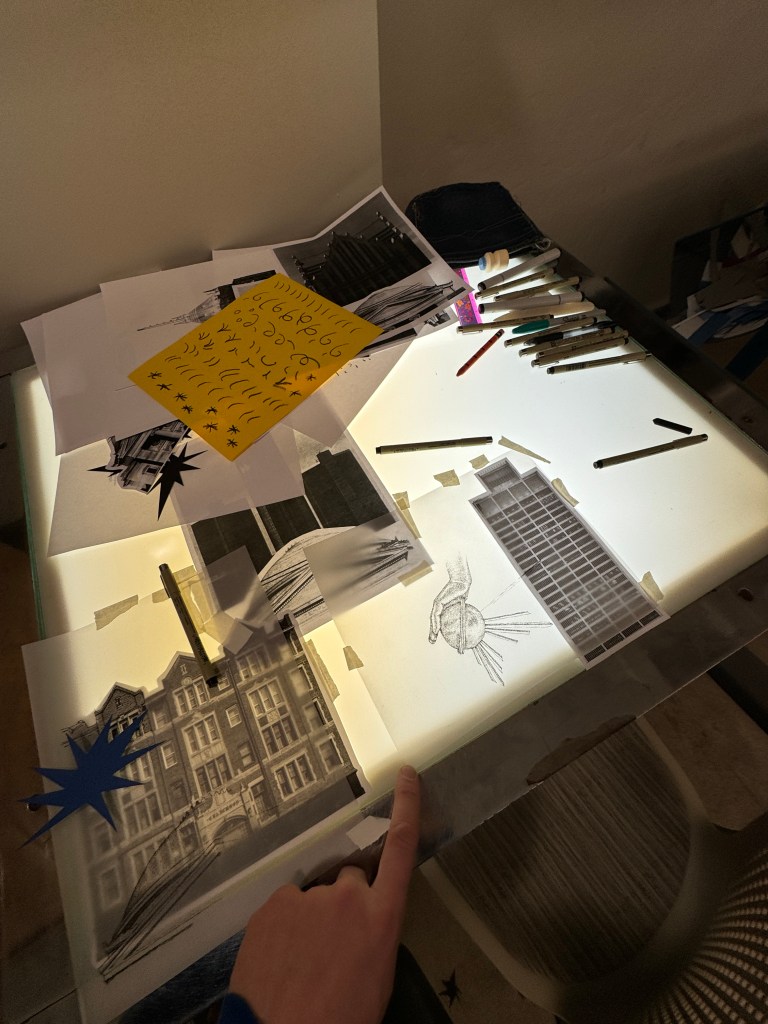
When I visited Luis’ studio in the Arts and Crafts Court, I was struck by their graphic sensibility combining imagery and text in sticker-like collages. I was also very impressed by a series of stipple drawings in ink on tracing paper, which Luis kept in a shoebox. As we talked about the themes of my upcoming lectures, and what we both admire about Detroit and its architecture, the idea of the poster came about. With Luis’ sketches strewn across the table in their studio, I was reminded of the great tradition of architectural capricci.

Architectural capprici are fantasies, where artists or architects combine buildings from across time in a single image. Traditionally, 18th century capprici could be oil paintings, pencil or ink sketches, or engravings. Joseph Michael Gandy is the most famous painter of architectural fantasies. Here, he is combining the London works of Sir John Soane into a single fantasy, set within the studio of Soane’s own house.

Joseph Michael Gandy, Public and Private Buildings Executed by Sir John Soane between 1780 and 1815, first exhibited 1818. Courtesy of Sir John Soane Museum, London.

If you’ve come to many of my previous architecture lectures, you might recognize my favorite painting: Thomas Cole’s The Architect’s Dream of 1840, a capprici which embodies the mid-19th century debate between gothic and classical styles. Contemporary British painter Carl Laubin creates stunning work inspired by Gandy, using contemporary architects for elaborate capprici.

What might an architectural capprici of Detroit include?
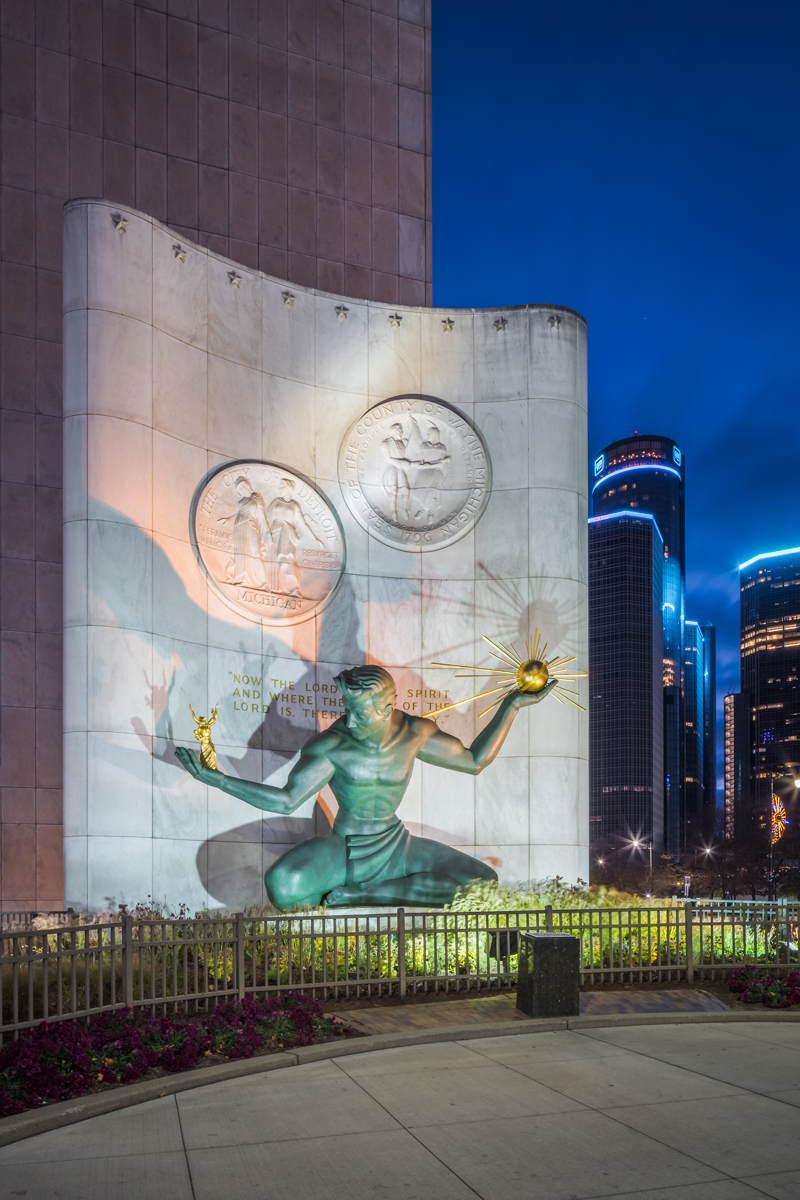
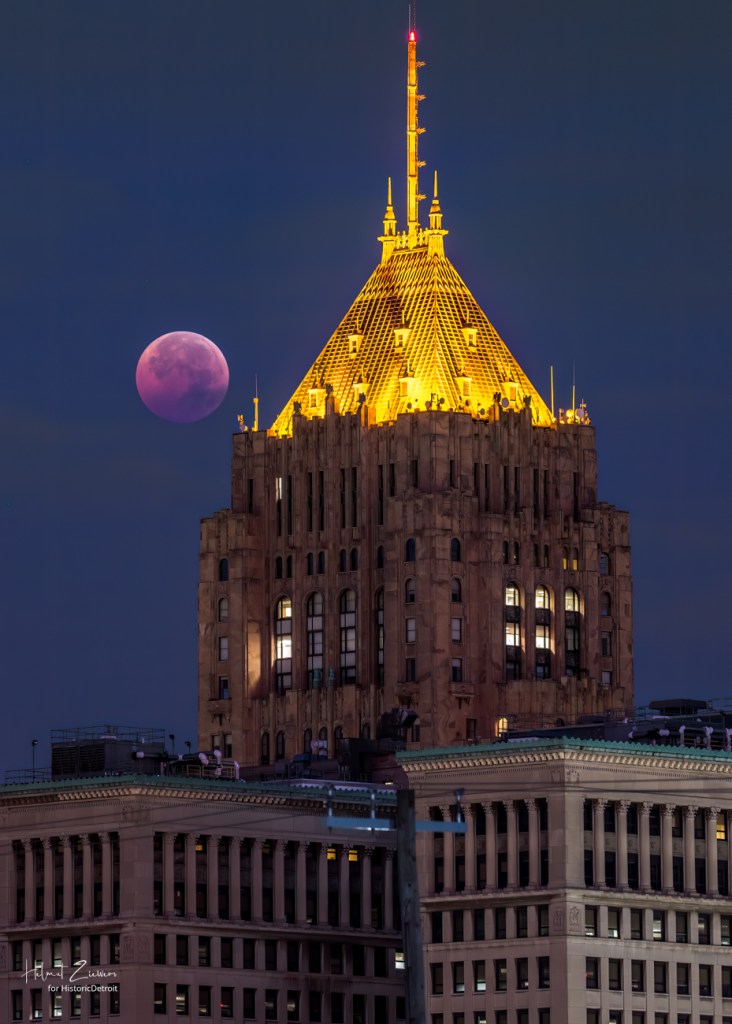
Marshall M. Fredericks’ The Spirit of Detroit, 1958, photographed by Helmut Ziewers for Historic Detroit Area Architecture.

I created a list of forty buildings I thought embodied the best of Detroit architecture. I narrowed it down to twenty buildings for Luis’ consideration, and shared images of each. My only real request: include at least one building from each of the five lectures, and center the poster on John Portman and Associates’ 1977 Renaissance Center.

I don’t think Detroit has a more iconic building than the RenCen, with its piston-like glass towers rising up from the Detroit River. There are better works of architecture, sure, but as far as an associated image of Detroit? Nothing tops the RenCen.

I suggested, too, that Luis include the 1901 St. Josaphat’s church by architects Joseph G. Kastler and William E. N. Hunter in front of the RenCen, to recall the almost too-good-to-be-true alignment of these two structures when driving into the city from the northern suburbs on I-75. After all, by the nature of delivering lectures about Detroit from the distance of Cranbrook, this is the view (from the suburbs, from the car) many of us hold toward the city.

We went back and forth about including the Spirit of Detroit, former Cranbrook Schools faculty member Marshall M. Fredericks’ monumental bronze at the Detroit City-County Building. What attracts me to the Spirit is its iconic status and its graphic replicability: whether on the redesigned city buses or the new city holiday lights, all you really need is an orb and some rays of light to know: that’s the Spirit of Detroit.

What would be the mood of our Detroit capprici?

Inextricably linked to the history of Detroit since 1980 is Detroit Techno, a form of Electronic Dance Music (EDM) that combines synth-pop with African American styles such as house, electro, and funk. For me, Detroit is most exciting, and its dynamism most electrifying, at night. In riding through the city after dark, buildings become speeding landmarks, and its possible to disappear for a time into a former factory or repurposed commercial building for a party or a rave. In these moments, buildings become less defined by their former glory or current decay than by their inhabitation as a dancefloor pulsating with music and lights. It’s a new way of occupying the city’s architecture to unique advantage.

Luis went to work. They began by printing out and arranging the buildings I’d shared. Then, they began overdrawing some of the images—distorting or highlighting certain features.

Layering on tracing paper, Luis dutifully stippled certain prominent architectural elements. I was especially impressed at the beautifully rendered hand, orb, and rays of Spirit of Detroit.
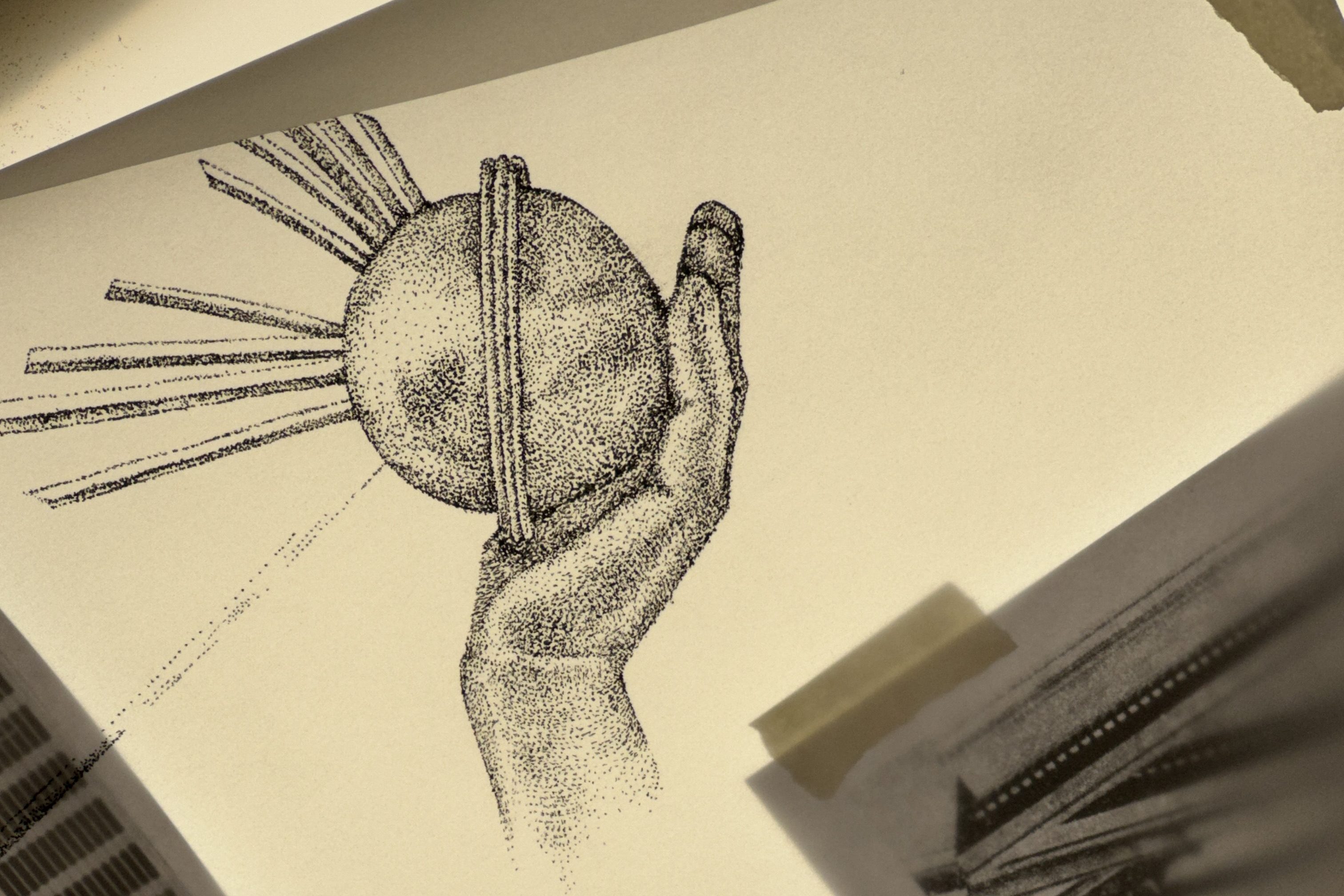
Luis then cut out stars on blue and yellow paper, adding in light sources to the night scene. The Ambassador Bridge, Dodge Memorial Fountain, Penobscot and Fisher Buildings are all recognized for their dramatic nighttime illumination, and Luis captured this with hand-drawn and cut stars.

Finally, Luis scanned in the physical elements of the poster and reassembled them in Illustrator, where text was added. Luis took inspiration from Detroit Techno posters for the colors and fonts. I could not be more thrilled with our poster, and the capprici of Detroit at night (with techno).

Luis Quintanilla, CAA ’24, working on the poster. Luis is from Austin, Texas, and earned their BFA from Virginia Commonwealth University.

Can you identify all the buildings shown? Can you speculate why I chose them?

If you can, you’ll love this year’s History of American Architecture: Detroit and the World lecture series! If you can’t, you’ll also love this year’s History of American Architecture: Detroit and the World lecture series! The first lecture is February 6, 2024, at 12:00pm ET online and at 6:30pm ET online and in de Salle Auditorium at Cranbrook Art Museum. Purchase your tickets and learn more on our website. All lectures will be available for viewing after the lecture to ticket holders. See you there!

Kevin Adkisson, Curator, Cranbrook Center for Collections and Research

Special thanks to Artist-in-Residence Elliot Earls, Head of 2D Design, for suggesting Luis for this project. A perfect fit!
Summer School: HUB Architecture Edition

On this, the last day of summer, I thought we’d look back at the Center’s second-annual Architecture Elective for the Horizons-Upward Bound Summer Component. It was a real highlight of my summer!

A grant from the Society for Architecture Historians enabled Nina Blomfield, the Center’s Collection Fellow, and me to co-teach the six-week elective. Each Monday and Wednesday morning from June 28 to August 2, we met in Gordon Hall of Science at Cranbrook with fifteen enthusiastic HUB students, grades 9 through 12. While we started most mornings in the classroom with our textbook or a slideshow of images, the real excitement came on class trips.

I mean, what better way to learn about excellent architecture than to study the buildings of Cranbrook?

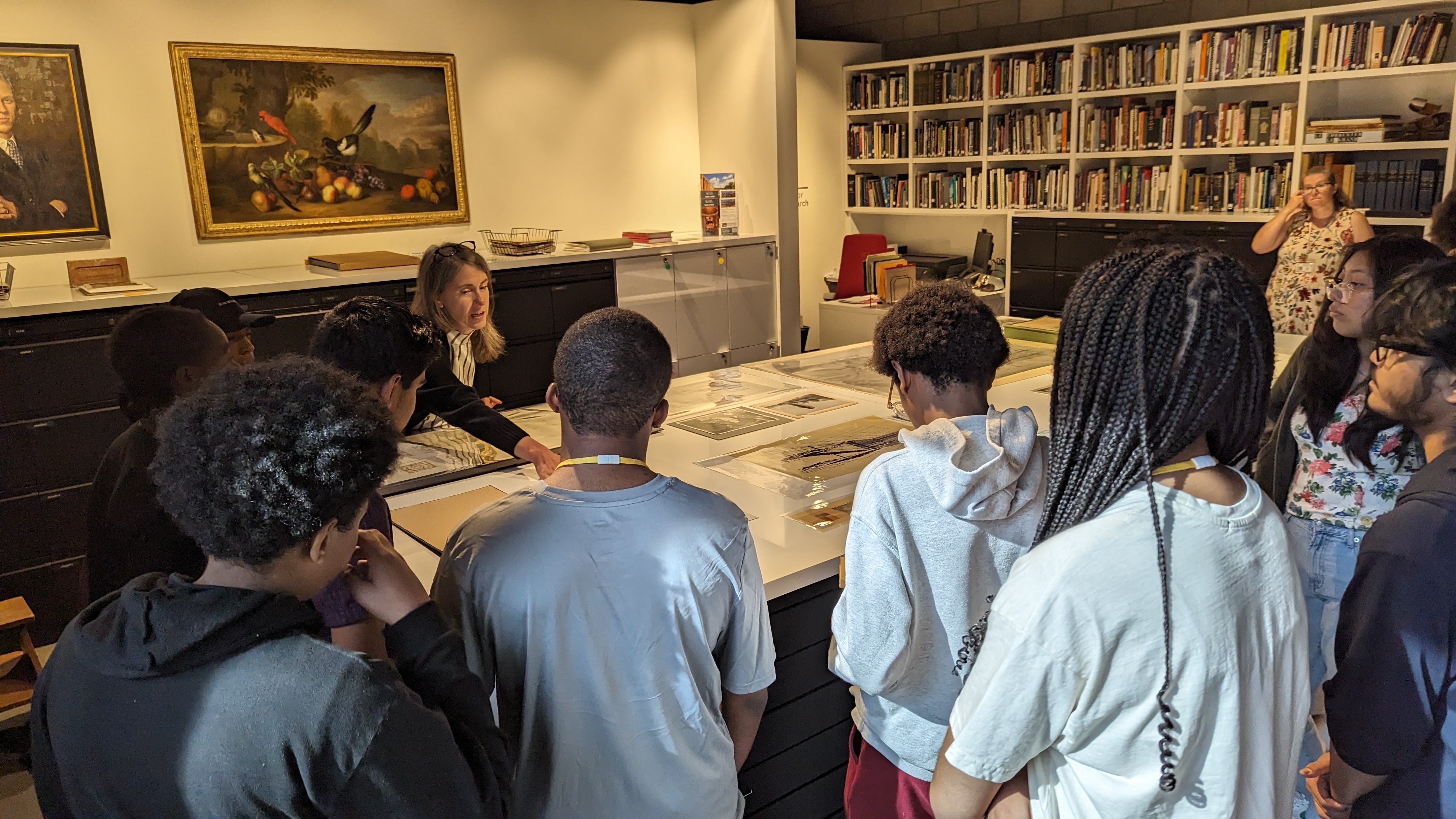
Head Archivist Deborah Rice showing our HUB students architectural treasures from Cranbrook Archives. Nina Blomfield, photographer.

To orient ourselves, we started with a morning spent in Cranbrook Archives, studying original sketches, renderings, blueprints, photographs, and even fundraising literature about Cranbrook’s many architectural treasures. We saw the great diversity of how our buildings were imagined, represented, and constructed, and how an architect moves from a loose, gestural sketch to formal construction documents that communicate complex structural systems.

Then, we spent a class period each at Cranbrook House, Saarinen House, and the Frank Lloyd Wright-designed Smith House. In each location, students carried their sketchbooks and made notes and drawings about the architecture. I was especially impressed at the students’ analytical skills. In fact, while I usually love talking about the nitty-gritty specifics of Saarinen House, I found myself sitting much more quietly, asking students questions about what they noticed, liked, or disliked in each room. Listening to their observations and conversation helped me see each space anew.

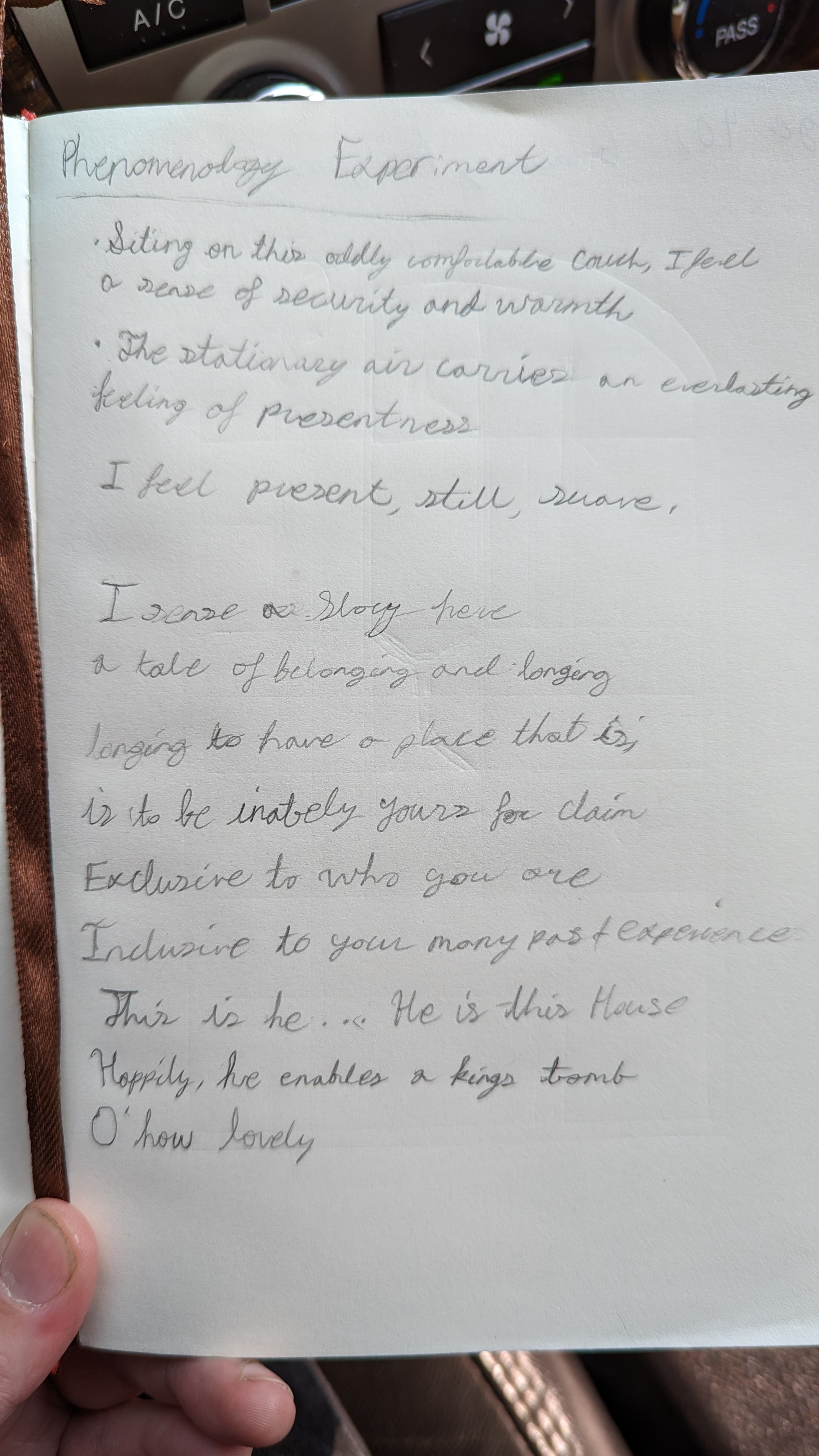
At Smith House, Nina led a phenomenology exercise, where, instead of telling the students the story of Frank Lloyd Wright and the Smiths, she simply asked each student to find a spot in the house to sit in quietly. Then, they wrote or sketched what they observed and sensed. Having such a tactile experience with the architecture and nature proved to be more memorable than a conventional tour.

Continue reading

A Century Ago: Travel to France with Messrs. Booth and Swanson

May 30, 2023, marks one hundred years since Henry S. Booth and J. Robert F. Swanson returned home from ten months of travel in Europe. Midway through their architecture studies at the University of Michigan, the friends and classmates set off on August 1, 1922 for a “Grand Tour” through Norway, Finland, Sweden, Denmark, Germany, Tunisia, Italy, France, and England to study and sketch European architecture.

In today’s post, I want to share moments from their journey through France, which is so beautifully documented by Henry’s letters and photographs, and by both of their sketches.

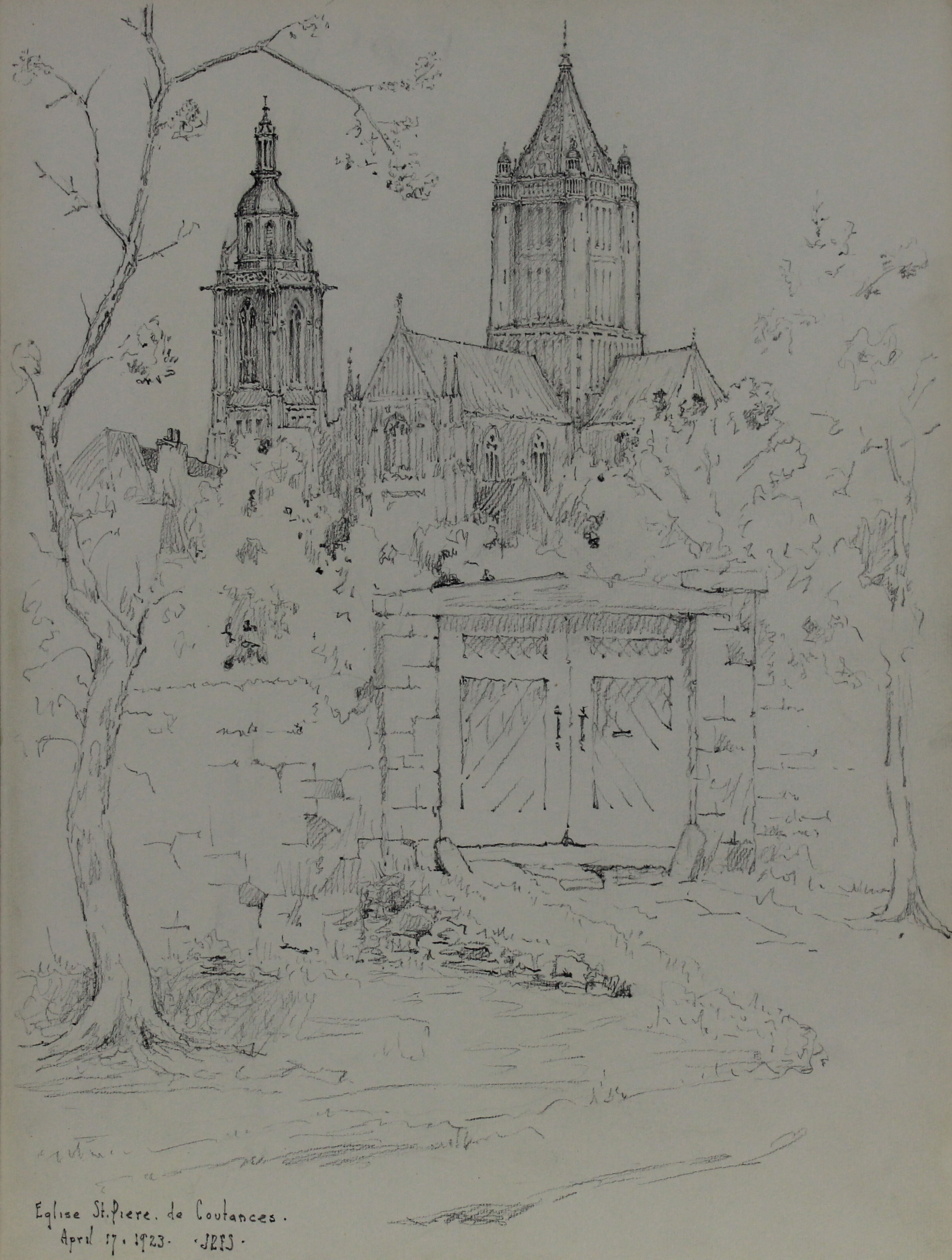
Eglise St. Pierre de Coutances, April 29, 1923, J. Robert F. Swanson. Courtesy of Cranbrook Art Museum.

Arriving in France in March 1923, Harry and Bob journeyed through Nice to Cannes, then through Lyon to the city of Bourges. Henry describes the scenery en route:

…mountains on the right and the “Cote d’Azure” on the other, flowers overhanging balustraded walls, old olives and tall but easily climbed palms, rocks and breaking waves, and then always the bluest of skies and sea to match, and dazzling sunlight–quite warm and ‘drowsy’.

At Bourges, they headed for the Cathedral, which they visited several times: at night by the light of gas lamps; in the afternoon sunlight; at dusk with a handful of worshippers on their knees; and then later that evening filled with the faithful.

Cathédrale St. Etiénne de Bourges, March 1923. Henry Scripps Booth, photographer. Courtesy of Cranbrook Archives.

It was an inspiring sight—the nave packed, and both the inner and outer aisles (for there are two) on the north side filled also, and not a few on the other side of the church. The light was dim all during the sermon, and when that was over, a quantity of candles were lighted almost instantaneously about the “Host,” and all the electric candles down the nave came on, so that suddenly this great cathedral was changed from a imaginative forrest in the night, to a great cathedral church ablaze with the lights associated with a feast.

But I thought more of other things than of the architecture that night. The preacher talked too fast for me to understand his French, but I knew what he should have been saying even if he wasn’t…, I looked at the great number of long black vails [sic] everywhere, noticed the lack of men of middle age, and saw many young fellows who are now “heads” of their father’s family standing by their veiled mother’s side.”

They stopped in Tours before taking in the Chateaux of the Loire: from Loche to Langais, Ussé, Villandry and Azey.

Continue reading

Step-back with a Peacock

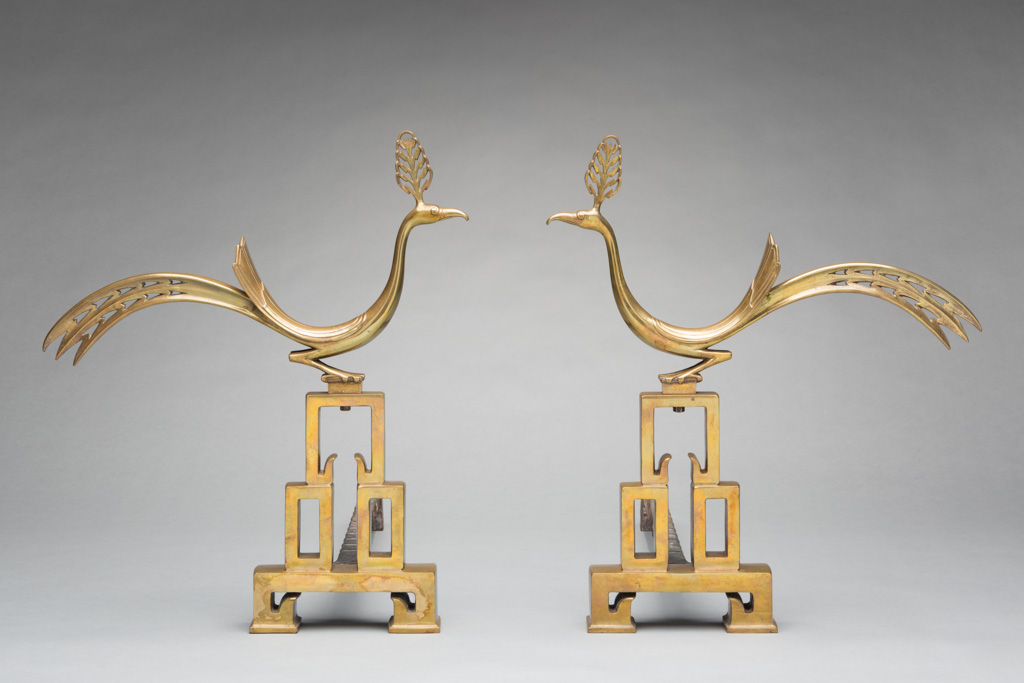
From the moment I entered Saarinen House twenty-seven years ago to give my first public tour, to my upcoming presentation for the Kingswood Middle School for Girls Explore Cranbrook students, I remain . . . simply enthralled. No more so than by the vibrant Peacock Andirons gracing the living room hearth.

Eliel Saarinen’s cast bronze Peacock Andirons, 1928-29. Each 21-1/4” W x 22-3/8” H x 27-1/4” D. Collection of Cranbrook Art Museum, CAM1985.2 a-b. Robert Hensleigh, photographer.

Designed by Finnish-American architect Eliel Saarinen and produced by Sterling Bronze Company, New York between 1928 and 1929, these cast bronze andirons were paid for by the Cranbrook Foundation and entered in the 1928-1930 Arts & Crafts Building ledger on pages 40-41 (third line from the bottom)—Date: 1-7-30; No.: 515; Name: Sterling Bronze Co; Remarks: 1 pair/ Andirons for Saarinen Res[idence]; Amount: $152.50 (the equivalent of $2,631.50 in 2023).

Arts & Crafts Building ledger, 1928-30. Laura MacNewman, photographer, 2023. Cranbrook Archives.

The pair of birds are fabulous. Ready and alert, they face each other, ankles bent, balanced upon splayed toes.

Continue reading

Material Honesty in Saarinen’s Structures

Eliel Saarinen wasn’t much for philosophizing about his work. Cranbrook’s principal architect demonstrated his beliefs about architecture through the bricks and stones of his buildings, rather than through academic lectures or theoretical treatise.

When I give tours of campus, I often highlight the fact that in Saarinen’s buildings, a brick wall is a structural brick wall, and a stone column is a structural stone column. If that sounds obvious, well, it’s because architects are excellent at deception.

Bricks and Mankato Kasota stone pilasters at Cranbrook Art Museum. Photograph by Daniel Smith CAA Architecture 2021. Courtesy Cranbrook Center.

In the 1920s and 1930s (and straight through to today), it was much cheaper to build a wall of concrete block or wood and then cover it in a façade of brick, or to design a reinforced concrete column and then wrap it in thin stone veneer. Solid brick walls and true stone columns are more expensive and more limiting to the designer (you can build taller, wider, and cheaper in steel and concrete). Regardless of a building’s style, by the early 20th century most of our country’s institutional buildings were constructed of modern materials and wrapped in traditional ones.

This habit of facadism (a focus on the material appearance without regard to the structural reality) was abhorrent to devotees of modernism. In International Style modern architecture, then, architects simply did away with brick walls and stone columns—materials used in construction for millennia—in favor of concrete, glass, and steel. The structure and the appearance of the architecture were one in the same.

But at Cranbrook, with its deep roots in the Arts and Crafts Movement, Saarinen went the other direction. True stone and brick construction was integral to our founding ethos, and to Saarinen’s designs.

Detail of brickwork on the dormitories of Cranbrook School for Boys (Cranbrook Campus, Cranbrook Kingswood Upper School). Photograph by Kevin Adkisson, Courtesy Cranbrook Center.

While many of Saarinen’s contemporaries were dealing with so-called ‘dishonest’ forms of architecture (steel and concrete frames clad in traditional styles rooted in masonry construction), Saarinen avoided the problem of ‘dishonesty’ by building modern buildings traditionally. Saarinen did use concrete vaults and floor slabs, as well as steel trusses, but he connected these to brick load bearing walls and stone columns.

Adding to the unusual fact that Cranbrook’s brick walls and brick vaults are structural, the beauty of Saarinen’s brickwork stands out. He achieved a special blend of true engineering and true artistry. This combination of beauty and utility was key to the Arts and Crafts Movement, and to the form-following-function ethos of Saarinen’s modernism.

More simply, the brickwork of Cranbrook is a visual delight.

Patterned brick and Mankato Kasota stone bench at Kingswood School for Girls (Kingswood Campus, Cranbrook Kingswood Upper School). Photograph by James Haefner, Courtesy Cranbrook Center.

In Edward Ford’s The Details of Modern Architecture (1996), the architecture historian and professor writes that:

“Few Modernists were less interested in industrialization and standardization than Eliel Saarinen, and it is more than ironic that fate was eventually to place him at its heart, Detroit, and that he was to spend the second half of his career…at Cranbrook, fifteen miles from Highland Park and twenty miles from River Rouge, designing schools for the children of auto executives.”

Basket-woven brick barrel vault in the Arts and Crafts Courtyard, Cranbrook Academy of Art. Photograph by James Haefner, Courtesy Cranbrook Center.

There is much more to say about Saarinen’s brickwork, and bricks at Cranbrook more broadly. On October 25, 2021, I invite you to join me for the Center’s next Uncovering Cranbrook virtual lecture: The Bricks of Cranbrook: Humble Material, Monumental Design. I’ll discuss the history of bricks, where our bricks came from and what makes them unique, and, most importantly, revel in the beauty of the billions of bricks on this campus. And, after the lecture, join me on campus for a special behind-the-scenes brick themed tour!

Kevin Adkisson, Curator, Cranbrook Center for Collections and Research

Collection Highlight: Walter Hickey Papers

Cranbrook Archives is pleased to announce a new collection available for research. An intriguing collection, it comprises the personal and professional papers, photographs, realia, and architectural drawings of Walter Preston Hickey, a student of Eliel Saarinen. Yet, while traces of key life events and relationships—birth, parentage, education, marriage, friends, and employers—can be found in the collection, Hickey’s life after Cranbrook remains largely a mystery.

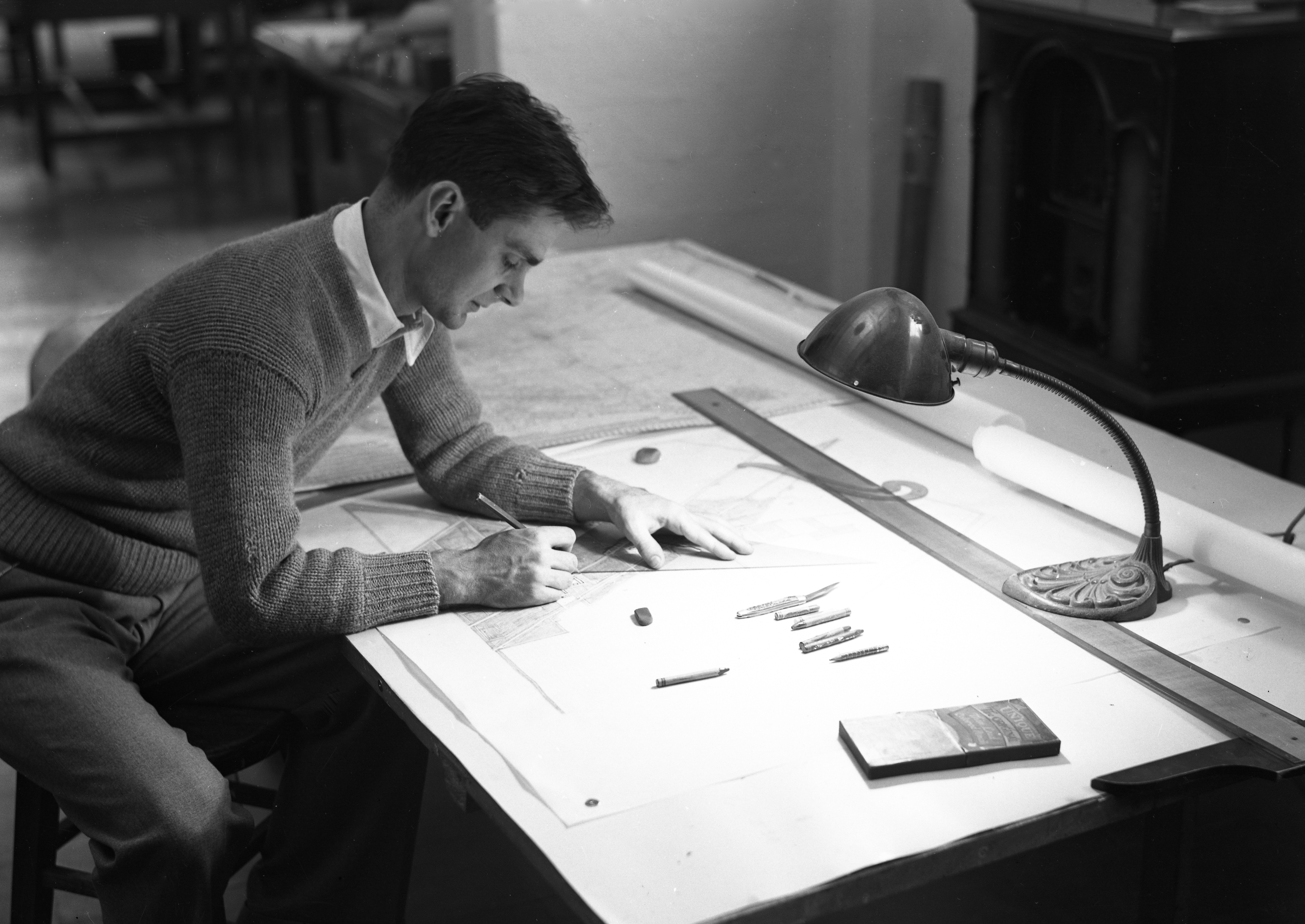
Walter Hickey working in the Architecture Studio, 1935. Courtesy of Cranbrook Archives, Cranbrook Center for Collections and Research.

A native of Detroit, Hickey attended the University of Michigan School of Architecture (1926-1930), during which time he worked with architects Albert Kahn (1928) and Thomas Tanner, as well as being one of the first staff members of the Cranbrook Architectural Office.

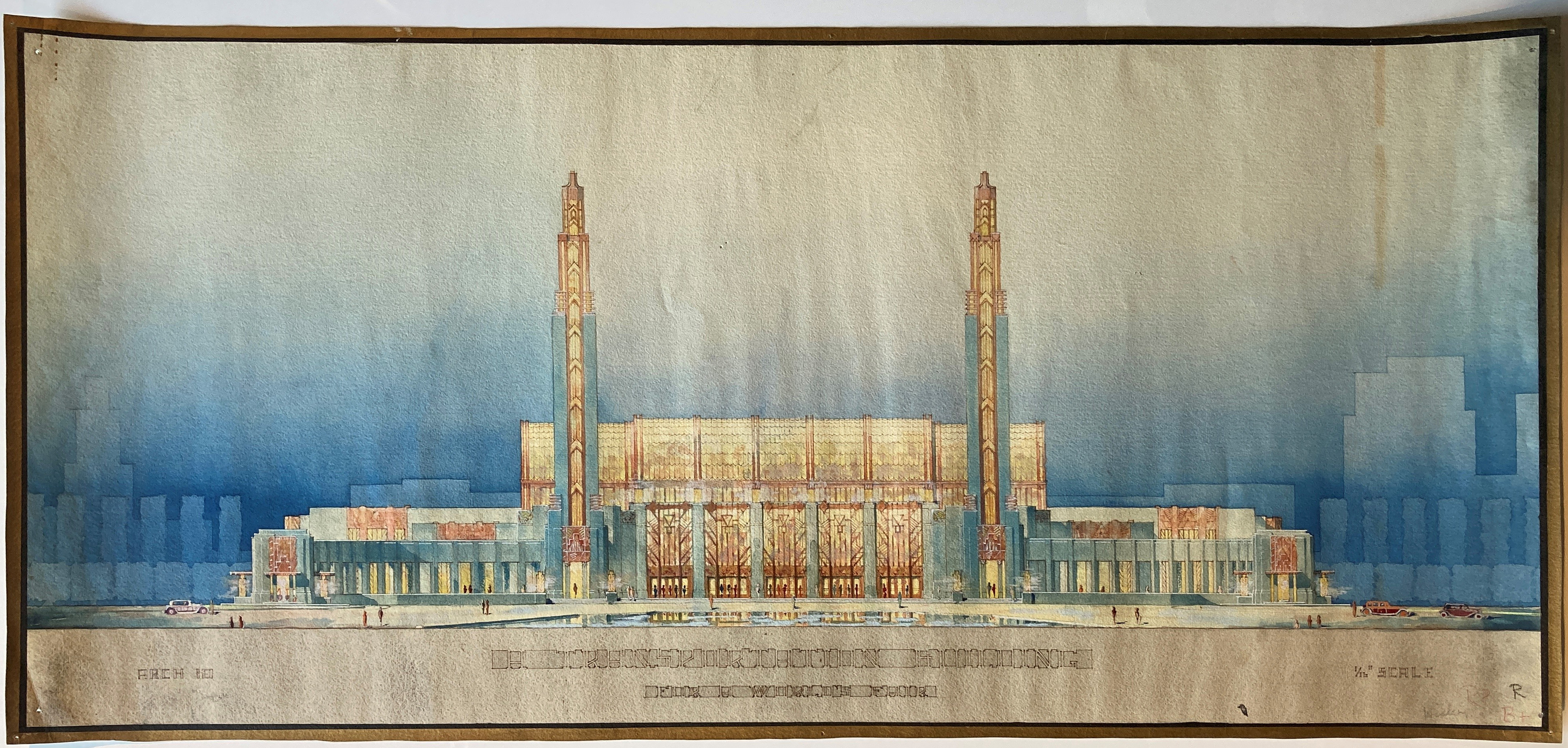
A Transportation Building for a World’s Fair, circa 1926-1930. A University of Michigan Class Project by Walter Hickey. Courtesy of Cranbrook Archives, Cranbrook Center for Collections and Research.

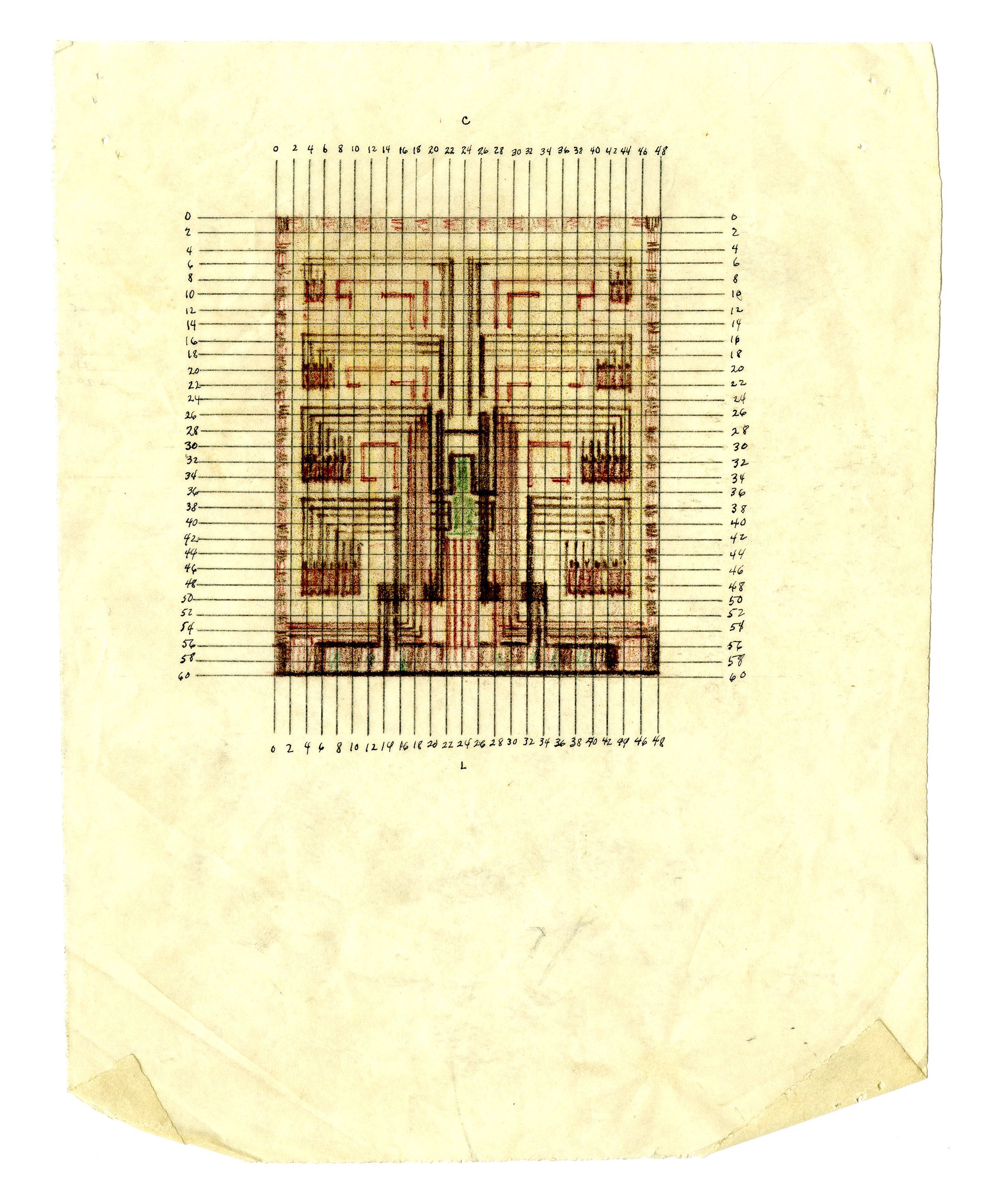
He applied to study architectural design with instruction in city planning at Cranbrook Academy of Art, starting in September of 1932. He became especially interested in highway traffic control, which formed the topic of his 1935 thesis on the Waterfront Development for the City of Detroit. Hickey submitted designs to various Academy competitions and won a $10 prize from Loja Saarinen for design No. 13 in the Cranbrook Academy of Art Rug Competition in 1934.

Drawing by Walter Hickey, undated. Courtesy of Cranbrook Archives, Cranbrook Center for Collections and Research.

After leaving Cranbrook, Hickey worked for various architecture firms, including Smith, Hinchman, and Grylls, and Clair W. Ditchy. After a short time with the Federal Housing Administration, he returned to work with Eliel and Eero Saarinen on the Kleinhans Music Hall project. He also completed private architectural designs for residences, including work on Ralph Rapson’s Hoey vacation home, Longshadows, in Metamora, MI. Around this time, he went to work at the General Motors Technical Center and continued to live in Birmingham, Michigan. And here is where his story ends in the collection.

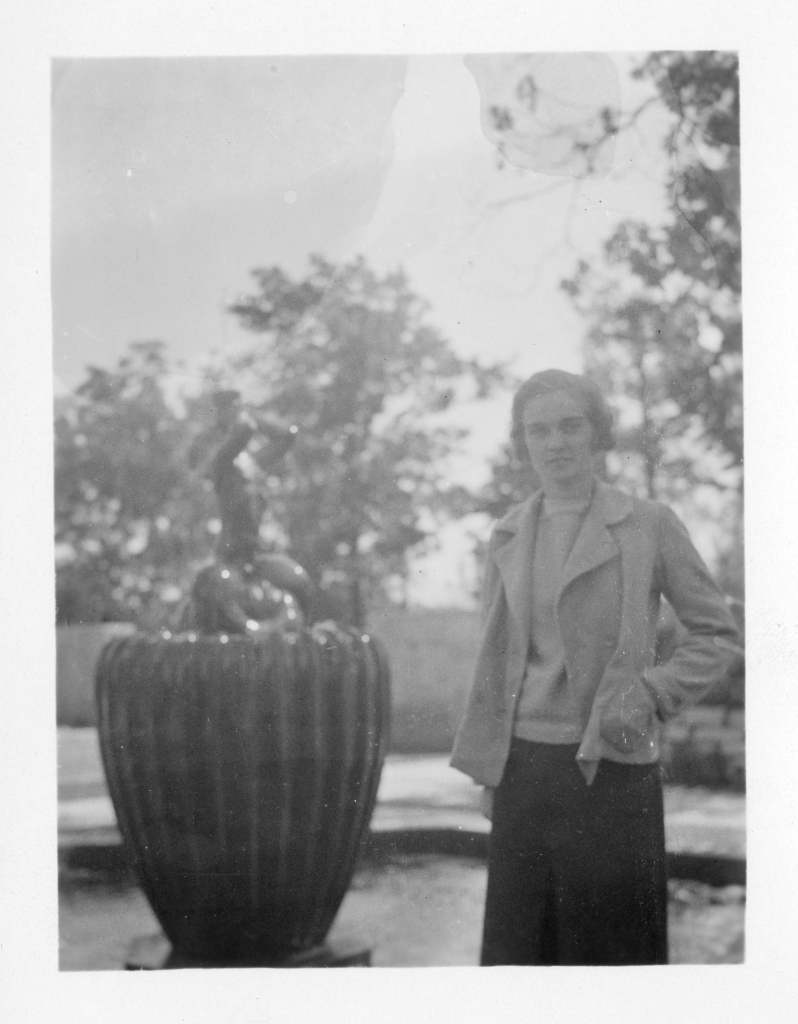
Jane Viola Shepherd. Courtesy of Cranbrook Archives, Cranbrook Center for Collections and Research.

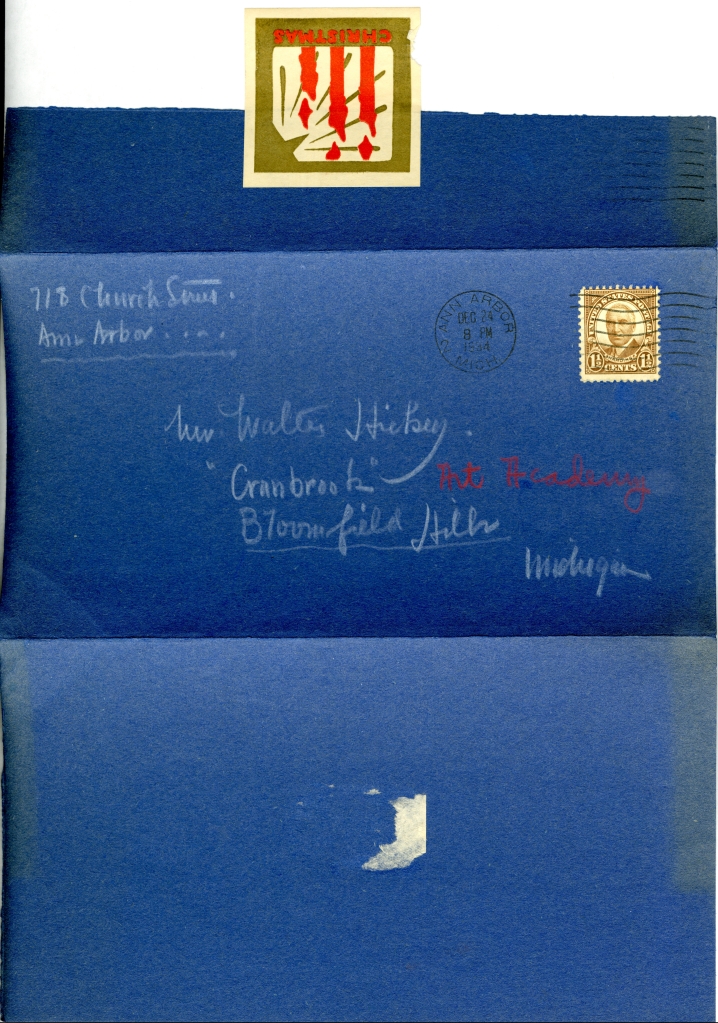
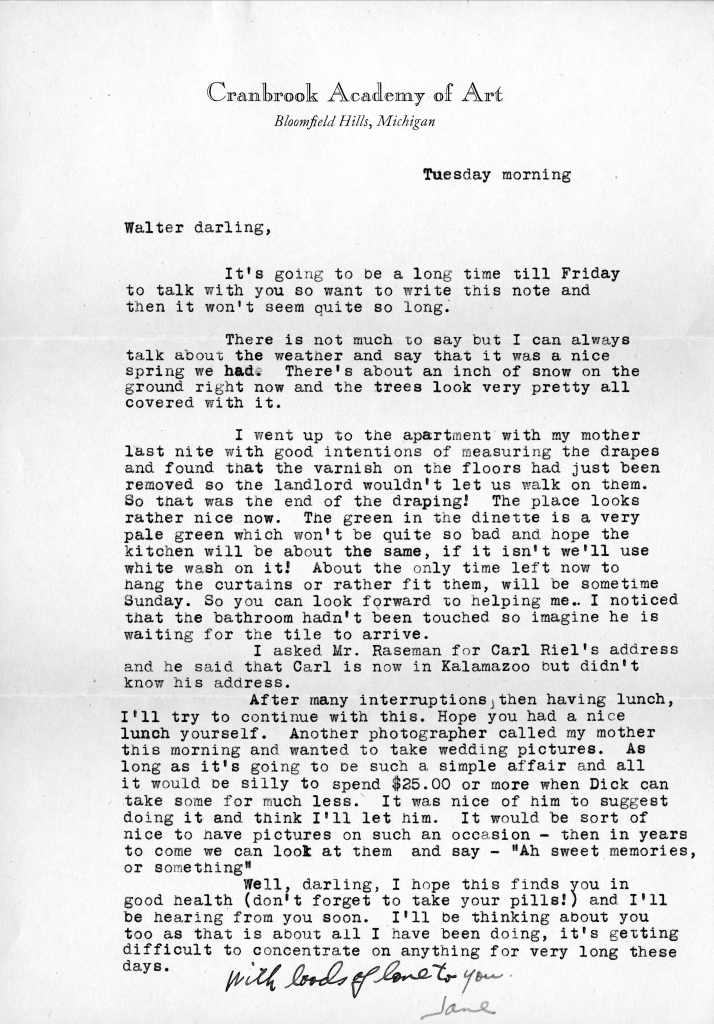
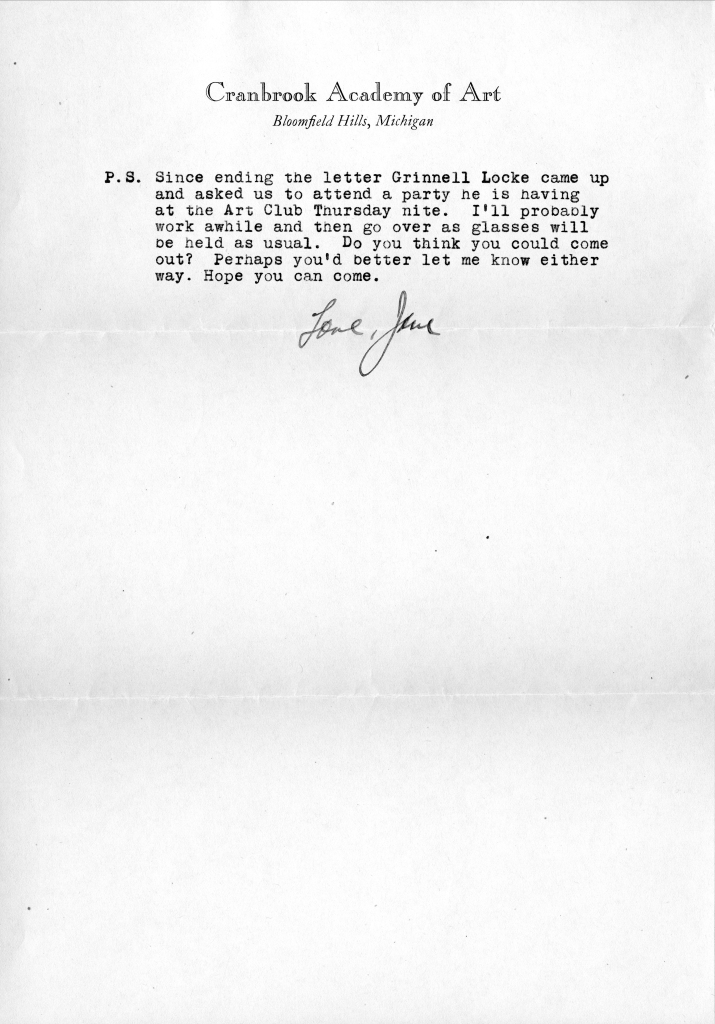
Although this is a very small collection, the diversity of content is rewarding for its ability to convey snapshots of his life in individual and unique items. It includes Christmas cards, such as one from “the Lorches” (Emil Lorch was the President of the University of Michigan Architecture School), a few letters from friends, and something of a typed love letter (on Cranbrook Academy of Art letterhead!) from Zoltan Sepeshy’s Secretary Jane Viola Shepherd to whom he was married on April 22, 1937.

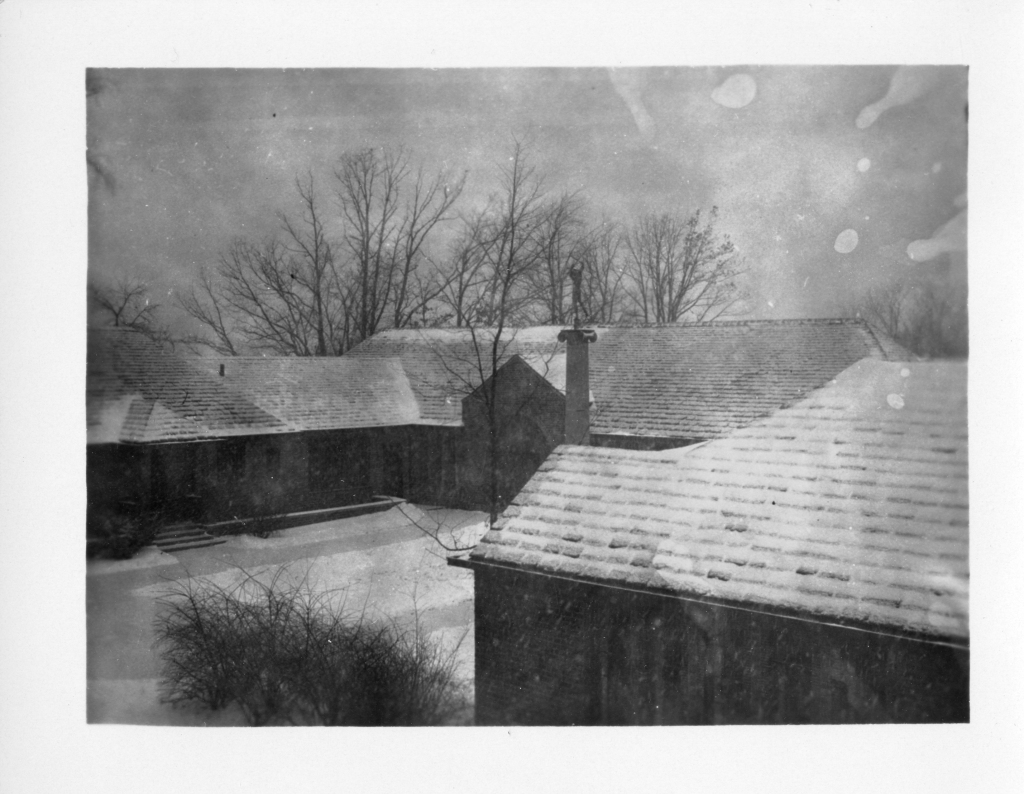
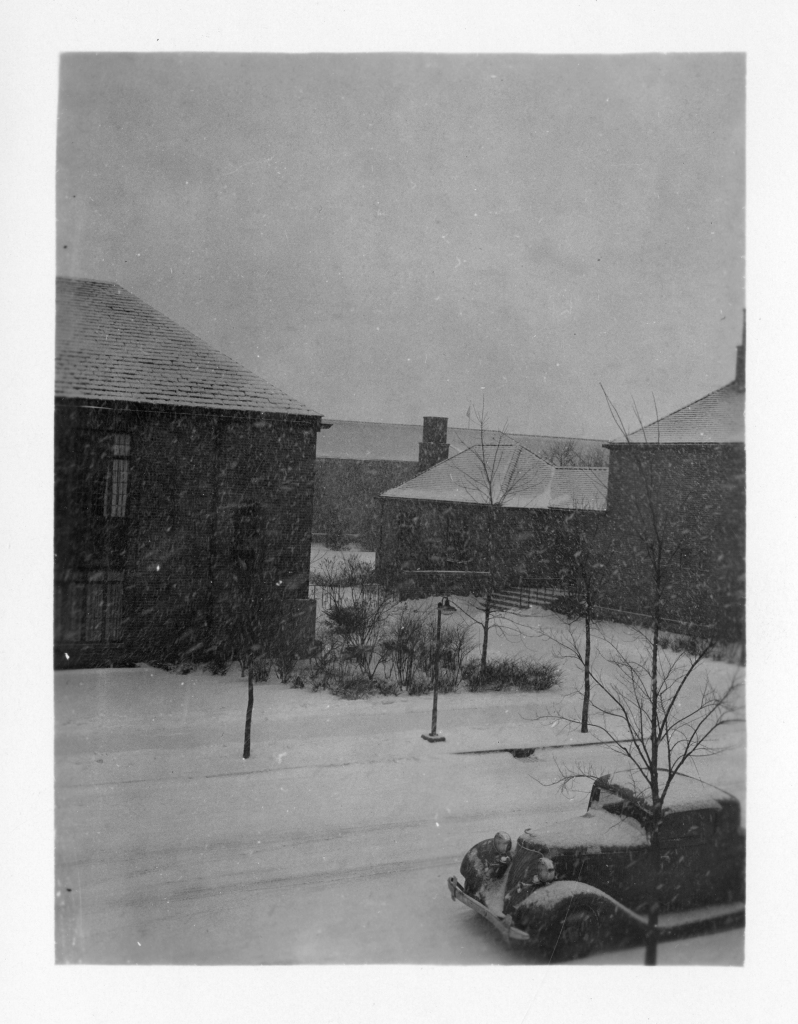
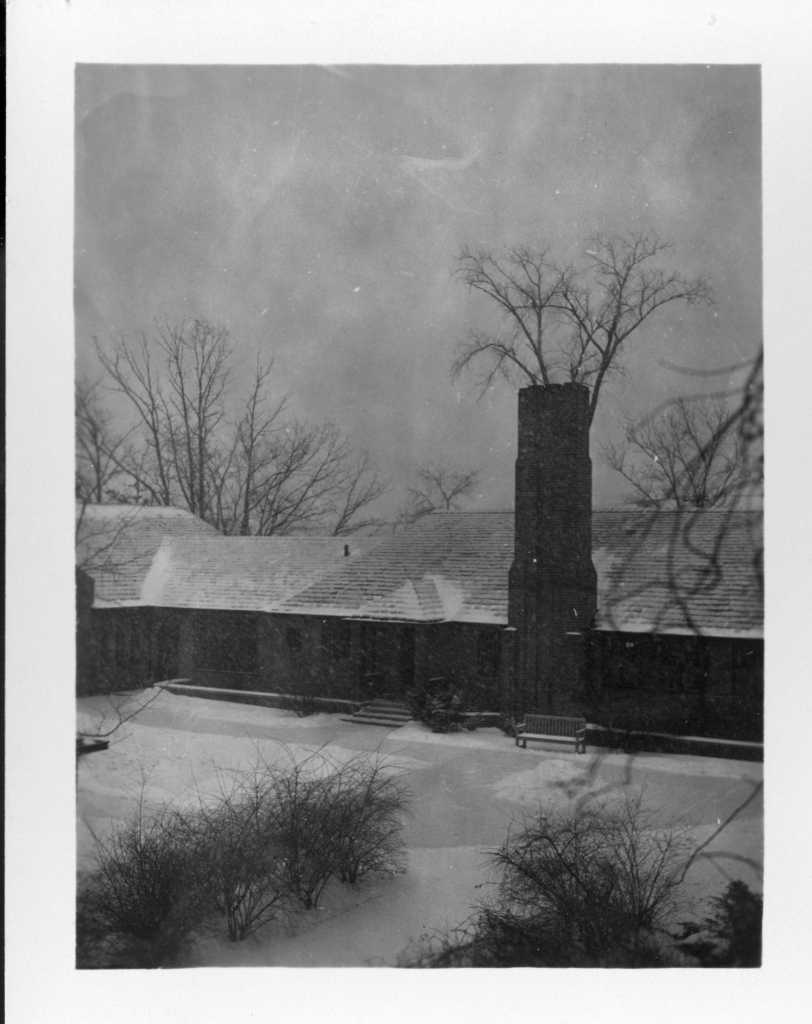
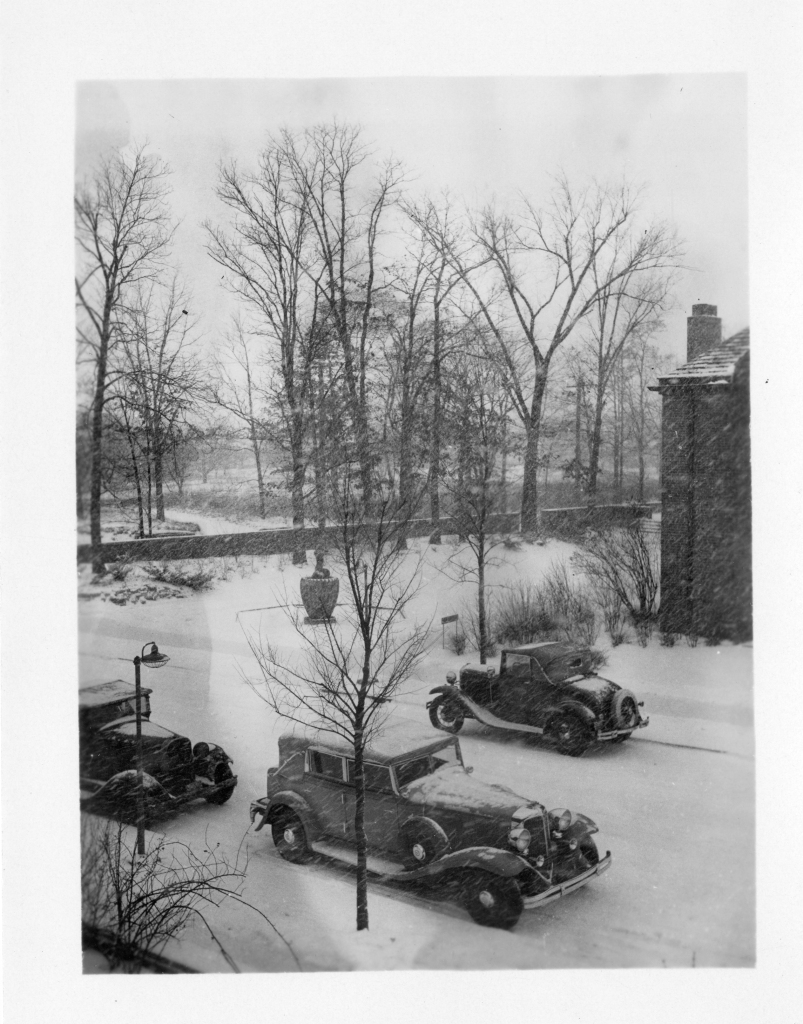
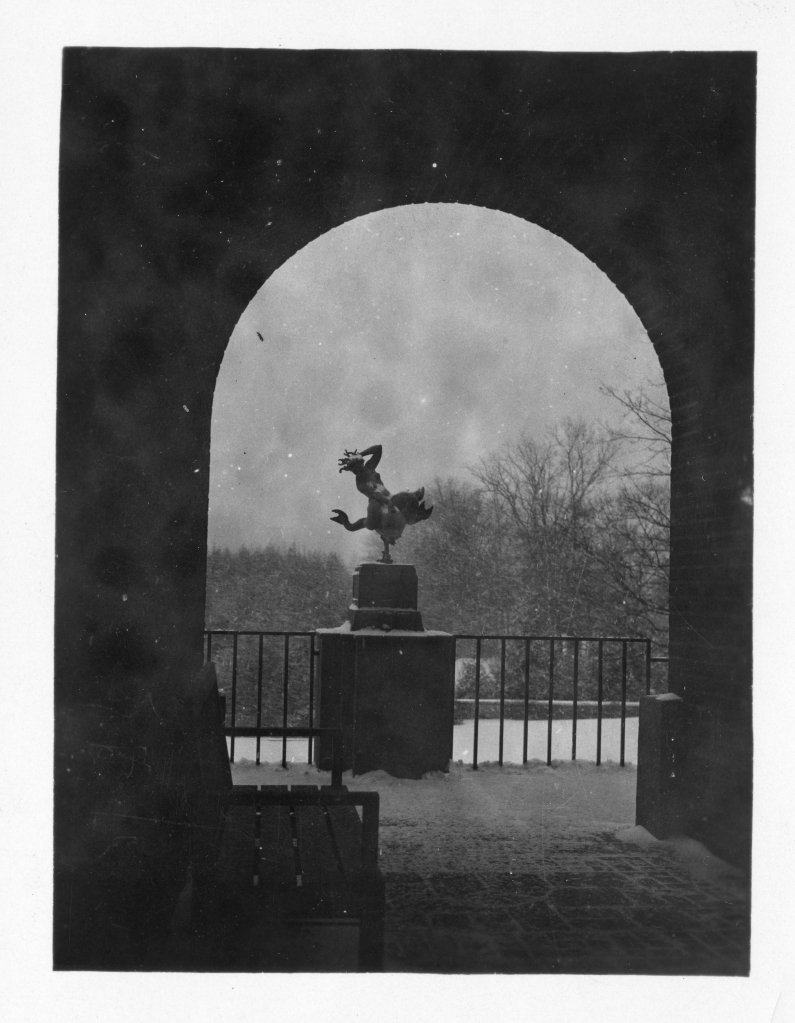
A small series of photographs hold moments of his life and some of the people with whom he shared it, including his father, eminent roentgenologist (radiography) Dr. Preston Hickey; his wife, Jane; his teacher, Eliel; and his fellow Academy students. A series of snowy scenes of Cranbrook campus beautifully capture the quietness of falling snow with hints of sunlight upon the architecture and sculptures that were then in their infancy and are now historic.

The Walter Hickey Papers give insight into a short period in Hickey’s life and the Cranbrook of his time. It also gives us a lovely look into a life that was surely shaped by his experience at Cranbrook, but one that remains yet to be fully discovered.

Laura MacNewman, Associate Archivist, Cranbrook Center for Collections and Research

Getting a Green Roof

In the Architectural Forum of January 1932, an advertisement announced that 160,000 pounds of 16-ounce Anaconda Copper had been used for the newly opened Kingswood School Cranbrook. There are copper gutters, cornices, louvers, moldings, and chimney covers, but most impressive is the 90,000 square foot batten seam copper roof.

Kingswood Roof Construction Copyright Cranbrook Archives

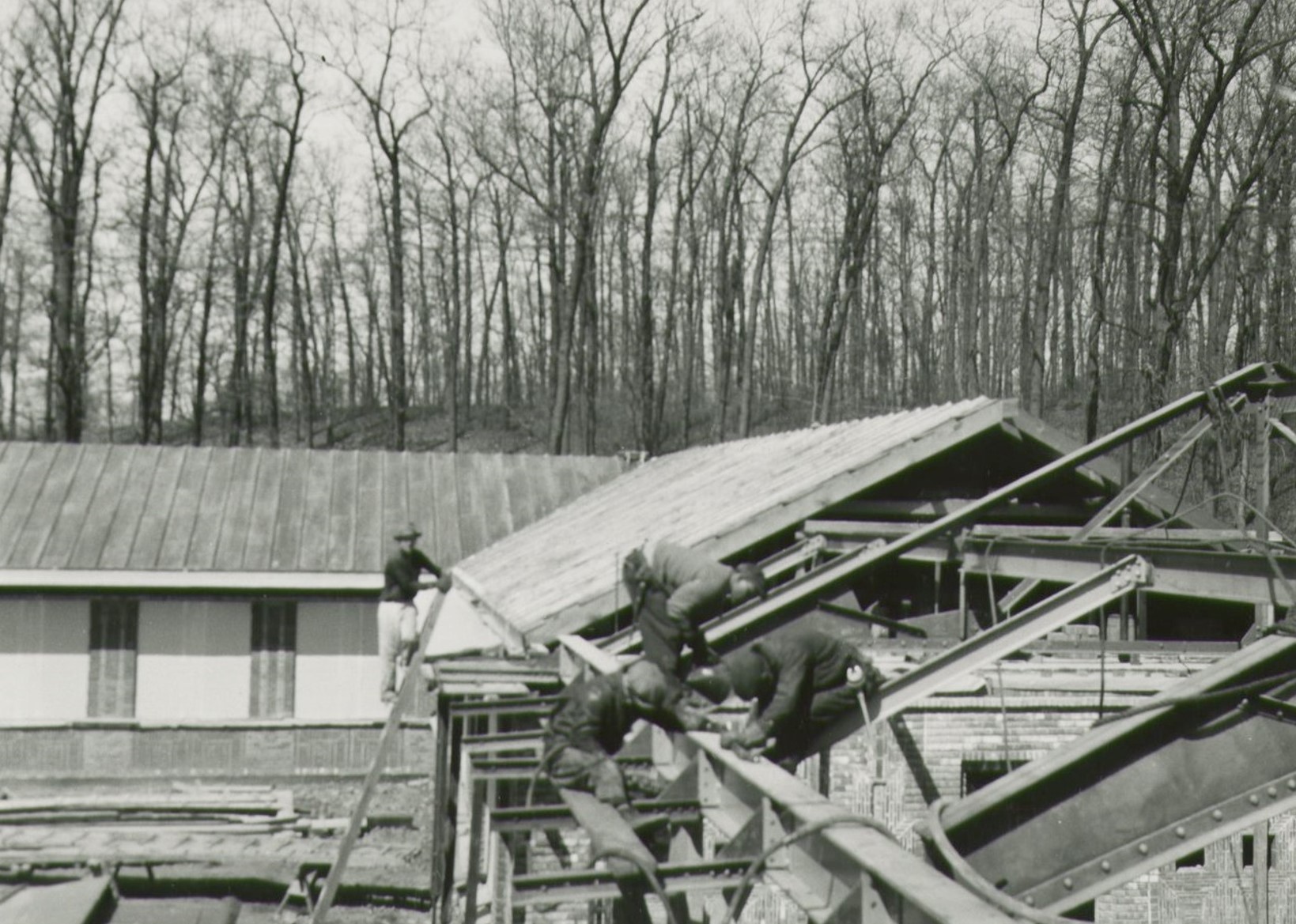
Workers assembling the roof structure above Unit A, the classroom wing of Kingswood School for Girls. The copper roof behind them is already installed. No barrels of uric acid can be spotted in construction photos. c. 1931. Copyright Cranbrook Archives.

There was just one problem with the new copper roof: it was installed with rolls of bright, new-penny-orange, sheet copper. Eliel Saarinen wanted a green roof, and I think he wanted it quickly.

Yes, he could have waited for the shiny new copper to patinate naturally from rain, humidity, and time. But who has the patience for natural aging when you have an architectural tour de force to complete? Instead, Saarinen turned to chemistry. Using a historic technique common in Europe, the contractor, A. C. Wermuth, directed his workmen to collect their urine in small jars and transfer it to barrels on site. These barrels were then hoisted to the ridge line of the roof, where the pungent catalyst was poured down the copper slope and then spread evenly with brooms.

Science did the rest, and Saarinen got his verdigris color which the Architectural Forum described as a “neutralized complement” to the warm tan brick and buff Mankato stone walls which “harmonized admirably with the heavy foliage of the location.”

Kingswood Early Slide c 1940 Copyright Cranbrook Archives

Color slide of Kingswood School for Girls showing the harmony between landscape, building mass, and materials. c. 1940-1945. Copyright Cranbrook Archives.

The story of more than just rain tinkling on the roof is recorded in Archives as told to former archivist Mark Coir by Dominick Vettraino, who grew up at Cranbrook and served as our landscaper, fireman, superintendent, and jack-of-all-trades. I was asked about the story of peeing-on-the-roof this week by an Upper School chemistry teacher, who’d heard the rumor and is now using it in her lessons for students stuck at home. You, too, can run the experiment: you just need to have a glass, a penny, and be hydrated!

Just like rust develops on iron, patina develops on copper when left exposed to the elements. The copper sulfate on the surface reacts to oxygen in the environment. Unlike rust, the patina actually protects and preserves the copper. However, copper doesn’t turn green quickly: it can take twenty to thirty years for copper to become green! Uric acid can significantly speed up the process. The fact that the Kingswood roof is quite green in early color photos does reinforce the idea that they used a catalyst to age the roof.

The entire copper roof was recycled and replaced in two phases, from 1998 to 2002 and from 2005 to 2007. In the replacement, the copper patination was not accelerated. The fact that the replacement roof is still not green, seventeen to thirteen years on, is to be expected. The roof quickly changed from bright orange to dull brown, and then slowly toward the purplish black you see today. However, I am noticing this spring that when you look at the section of 2002 roof at an acute angle, it’s distinctly turning green at the seams!

05-Cranbrook-Kingswood-School-Copper-Roof-Replacement-HIstorical-Building-Renovations-by-CASS-Detroit-MI-500w

Progress on the new roof. Phase one, completed in 2002, is at the far left and already dull brown. The original (though urethane coated) roof is at right. The new copper roof is shining at the center. May 27, 2006. Courtesy of C.A.S.S. Sheet Metal Specialist, Detroit.

The current color of the roof disappoints many graduates, but in time, it will return to the beautiful green color Saarinen and Wermuth achieved through their very affordable, if not very polite, method. And if you were at Kingswood between 1988 and the new roof replacement: you weren’t seeing a green patina, but a mint-green urethane coating sprayed on the entire roof to (unsuccessfully) slow the leaks!

—Kevin Adkisson, Curatorial Associate

PS: Between the joined “Studio #3” and “Dorm # 2” at the Academy, built in 1932 and 1936 respectively, there is a visible difference between the color of the two copper roofs where the patination has never matched. This can be attributed to different batches of copper. In the new Kingswood roof, every delivery of copper sheeting and copper solder delivered to the site was tested for quality and composition: we wouldn’t want the roof to change color irregularly.

From Concept to Cover

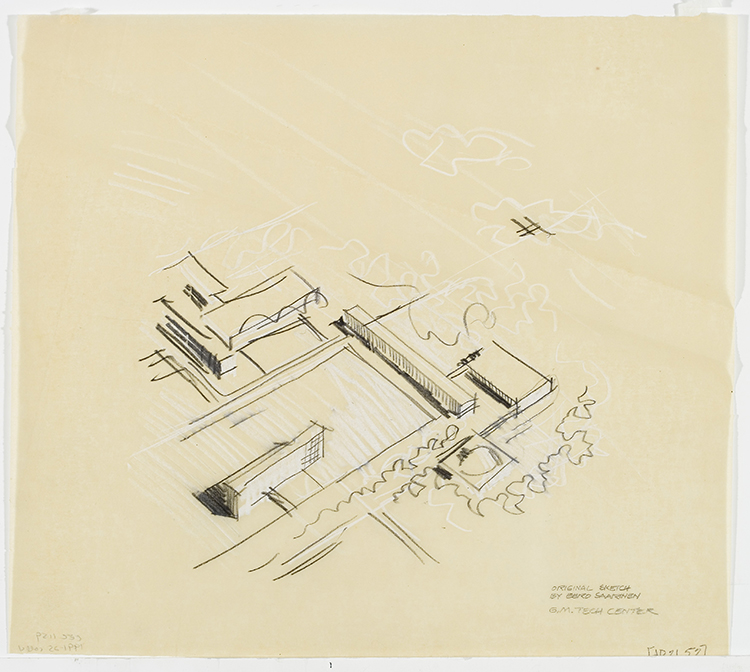
The General Motors Technical Center is one of Eero Saarinen’s most acclaimed projects. Dedicated in 1956, the “Corporate Cranbrook” was years in development, starting with initial designs by Eliel Saarinen and J. Robert F. Swanson (with Eero consulting) in 1945.

After a hiatus in the project by GM and reorganization of the Saarinen Swanson office, Eero completely redesigned the scheme in late 1948. The new design is high modernism at its finest: clean lines, experimental materials, and a lot of flat roofs. We can see Eero’s boxy proposal here, a treasured sketch from Cranbrook Archives:

Eero Saarinen GM Tech Center Sketch Small ad21-12

Eero Saarinen sketch of General Motors Technical Center, Warren, Michigan, 1949. Copyright Cranbrook Archives.

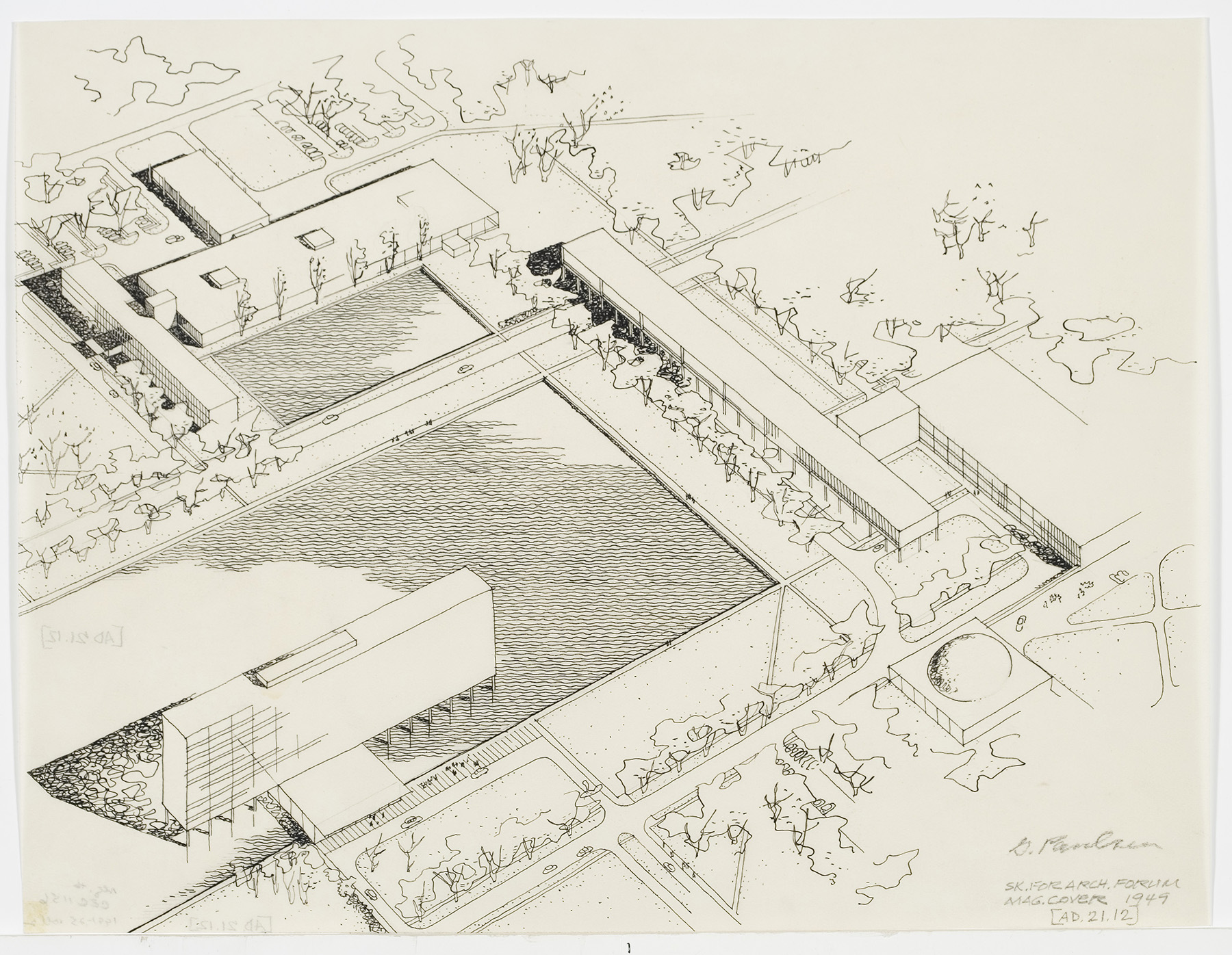
As the son of a world-famous architect building for one of America’s greatest companies, the project drew lots of attention well before it opened. Architectural Forum, in fact, featured the Tech Center as its cover story in July 1949. But what to show of the yet-constructed campus?

Glen Paulsen Eero Saarinen GM Tech Center Rendering ad21-12

Glen Paulsen drawing depicting Eero Saarinen’s proposed General Motors Technical Center, Saarinen Saarinen and Associates, 1949. Copyright Cranbrook Archives.

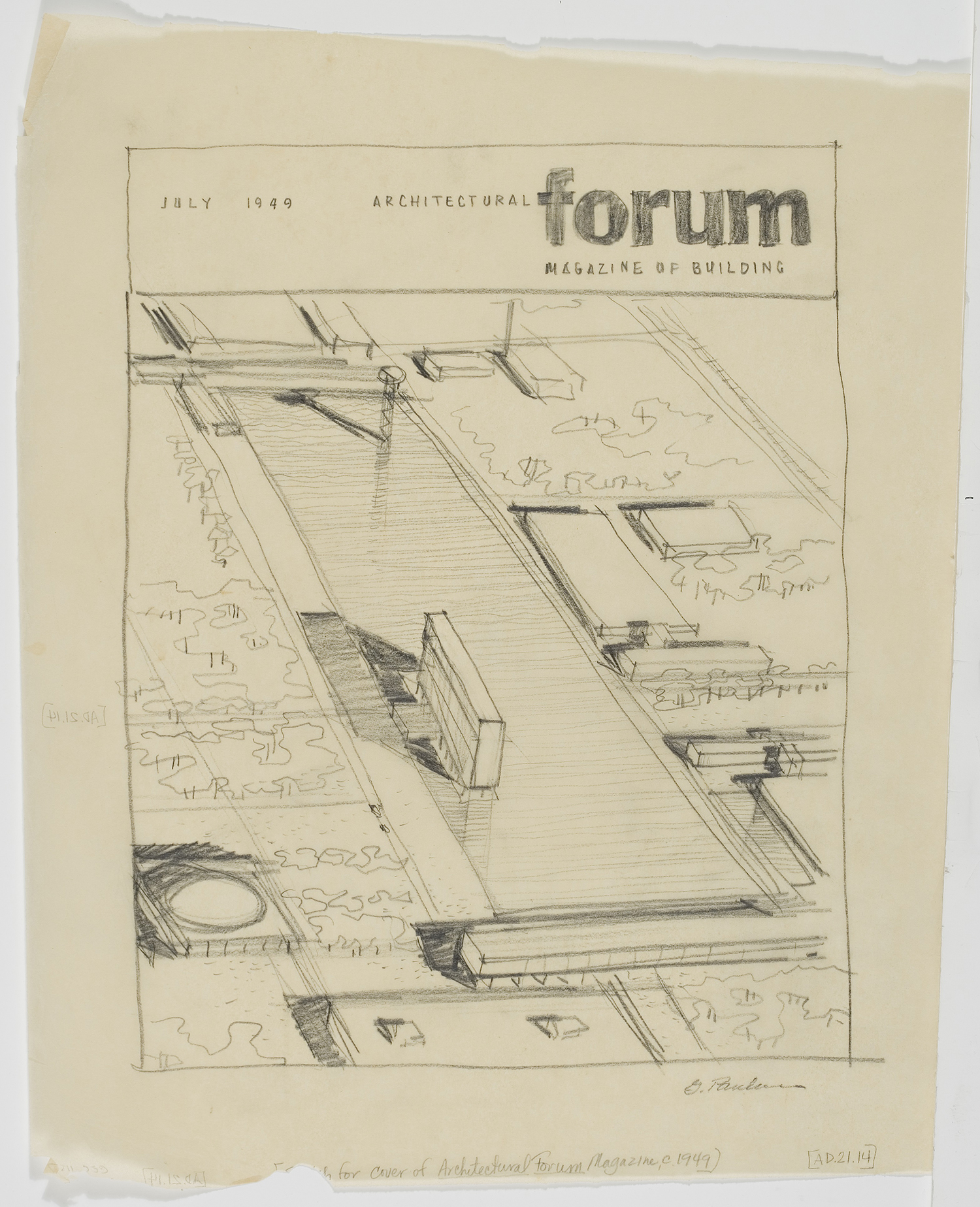
Eero turned to a talented young architect in his office, Glen Paulsen, to delineate the Tech Center for the magazine cover. Paulsen was known for his complex and sophisticated architectural renderings, and had worked for various firms as a renderer before coming to Saarinen’s office in 1949 as a design architect.  He sketched out several different options for Forum , and my favorite includes the entire layout of the cover, not just the buildings:

Arch Forum July 1949 Glen Paulsen rendering Eero Saarinen ad21-14

Concept art for cover of Architectural Forum by Glen Paulsen, depicting Eero Saarinen’s proposed General Motors Technical Center, Saarinen Saarinen and Associates, 1949. Copyright Cranbrook Archives.

Finally, in June 1949, the magazine hit the presses with a crisp, color drawing by Glen Paulsen depicting Eero’s General Motors Tech Center.

Architectural Forum July 1949 Glen Paulsen cover for Eero Saarinen

Architectural Forum 91, no. 1 (July 1949). Cover art by Glen Paulsen of Saarinen Saarinen and Associates. Courtesy of Cranbrook Academy of Art Library.

—Kevin Adkisson, Curatorial Associate

Birds of a Feather …

“… the Cranbrook Foundation, dealing with things material and visible, rests in turn upon another foundation made up of things invisible – that is, of thought, vision, and ideals… No product of human hands exists which was not a thought before it became a thing.”
Rev. Dr. Samuel Simpson Marquis, “The Laying of a New Foundation for Cranbrook Institutions,” Commencement Address to Cranbrook School, June 6, 1936

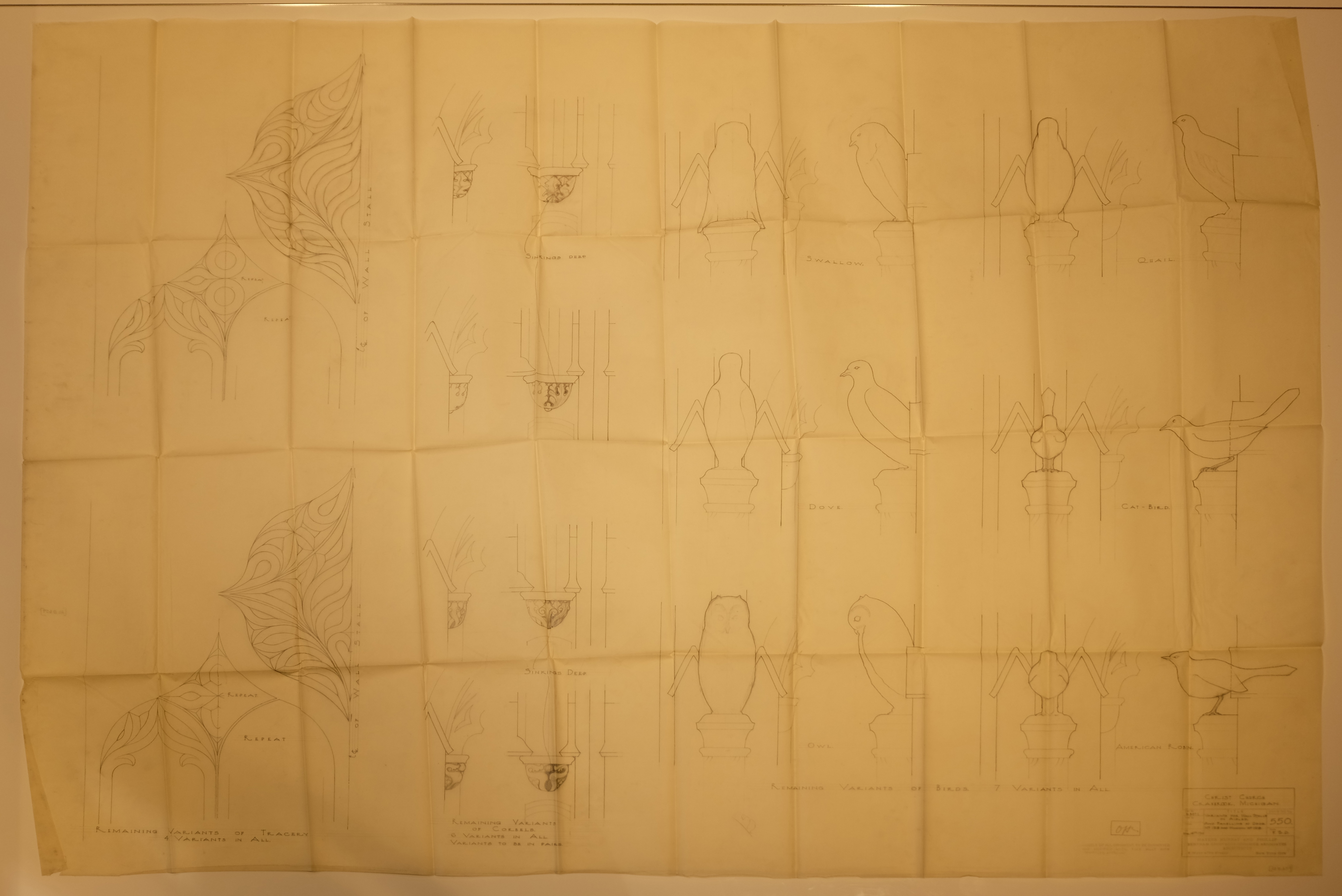
The thought, vision, and ideals of George and Ellen Booth endure in the cultural community and architectural landscape that we enjoy today. One of the great joys of working in the Archives is witnessing the documentary heritage which traces the stories of the people, places, and things that contribute to Cranbrook’s history. All record types — from correspondence, financial records, and reports to written and oral memories and reflections — provide a different insight into the process of making an idea a reality.  I am particularly fond of architectural records, because it is possible to see the built campus in its earliest form. Cranbrook Archives holds a large collection of architectural drawings for the entire Cranbrook Educational Community, as well as for  projects of Cranbrook affiliated firms and architects. The drawings are arranged by division or creator and housed according to their format. One format that is housed separately are detail drawings, which include millwork details and decorative designs. They are pencil on tissue drawings preserved folded in their original envelopes, many for almost a century. I would like to share with you an example of this type of drawing, one that documents the birds sitting atop of the columns of the aisle wall stalls at Christ Church Cranbrook.

CCC birds

View of the aisle wall stalls at Christ Church Cranbrook. Center for Collections and Research.

Finding sources in an archives depends upon the arrangement and description of the collections. Because of their very nature, sometimes a fair amount of detective work is required when the material being described is a visual format. Architectural drawings that have been catalogued are searchable using the Cranbrook Academy of Art library catalog, so the search most often begins there. In my case, a search for the wall stalls at the church returned seven results, none of which refer to the birds specifically. Yet, one of the descriptions suggested that there was great potential that it would include a drawing of the birds and, indeed, that is what I discovered.

AD-10-659_001

Architectural drawing (AD.10.659) Variants for Wall Stalls in Aisles and Paneling at Door #128 and Window #128, March 1930. Cranbrook Archives.

AD-10-659_003

Architectural drawing (AD.10.659), detail of the owl. Cranbrook Archives.

AD-10-659_004

Architectural drawing (AD.10.659), detail of the American robin. Cranbrook Archives.

The discussion between George Booth and Oscar Murray about the design and contract for the stalls began in early December 1929 and the stalls, carved by Irving and Casson, arrived for installation in August 1930. Booth left it to Murray’s judgment as to whether to have a continuous row of the same model for the columns or whether to include the variation. As you can see, this drawing includes two variants of tracery, four variants of corbels, and six of seven variants of birds, including the swallow, quail, dove, cat-bird, owl, and American robin. The seventh bird yet remains a mystery, leaving us something to discover in the future. Discoveries like these, and helping others achieve similar ones, make the job of a Cranbrook Archivist both enjoyable and rewarding.

– Laura MacNewman, Associate Archivist

[Editor’s Note: When this post was first published, the quote was attributed to George Gough Booth. Subsequent research has revealed that it is from an address by the Rev. Dr. Samuel S. Marquis.]

New Archival Collection: the Melvyn Maxwell and Sara Evelyn Smith Papers

Cranbrook Archives is delighted to announce that the Melvyn Maxwell and Sara Evelyn Smith Papers are now open for research. This archival collection was acquired as part of the Frank Lloyd Wright Smith House, which was donated to Cranbrook in 2017 by the Towbes Foundation with assistance from Anne Smith Towbes. Melvyn and Sara were schoolteachers who dreamed of building a Frank Lloyd Wright designed home – a dream that was realized in 1950. They cherished their dream home and adorned it with art objects which they bought from local artists, including Cranbrook Art Academy students and artists-in-residence. Over the years they welcomed many visitors, students, and guests into their home, including Frank Lloyd Wright himself and the landscape architect, Thomas Church.

2017-10 23-9 FLW

Frank Lloyd Wright’s entry in the Smiths’ guest book, 1951. Courtesy Cranbrook Archives.

The collection documents the personal and professional life of the Smiths, as well as their many contributions to the community through patronage of the arts, including theater and performing arts. It documents the construction and adornment of the house, as well as its preservation as a historic home and renovation under the Towbes Foundation. It also contains a rare and unique collection of news clippings and periodicals, spanning from 1937 to 2016, about Frank Lloyd Wright and his work .

2017-10 2-8

Letter from Sara to Melvyn Smith, July 1940. Courtesy Cranbrook Archives.

Melvyn Maxwell Smith aspired to be an architect. After graduating Northern High School in Detroit, Michigan, he was accepted into the School of Architecture at the University of Michigan. However, due to the economic depression, his parents suggested he attend Wayne University College of Education until his brother had completed his degree in dentistry. Much inspired by an English teacher, Miss Boyer, in his first semester, Melvyn decided to pursue a career in teaching, and remained at the university to pursue a doctorate. Melvyn’s architectural aspirations were instead to manifest in his life in quite a different way than he had first anticipated. In an art history class taught by Jane Betsey Welling, Melvyn learned of Frank Lloyd Wright. This was the beginning of a lifelong love of Wright’s work and the pursuit of Melvyn’s dream home. After graduating, Melvyn became a teacher at Cody High School in Detroit, where he remained for his entire career of 38 years. He later became a board member of the Wayne State University Alumni Association and created the Betsey Welling Memorial Court for which he donated the sculpture, In Lieu, by Robert Schefman.

2017-10 6-1

Melvyn, Sara and Robert Schefman in front of Schefman’s sculpture, In Lieu, at Wayne State University, 1977. Courtesy Cranbrook Archives.

Sara Evelyn Stein was born in Pennsylvania and moved to Detroit during her childhood. She met Melvyn at the B’nai Moshe Sunday School in 1937 and they were married in 1940. Sara had dreamed of being an actress, but she too joined the teaching profession and trained to be a kindergarten teacher. As it had been for Melvyn, Sara’s theatrical aspirations were fulfilled in a different way than her young mind had envisioned, namely an enthusiasm for teaching the performing arts to others. She was deeply involved in community theaters, including the Popcorn Players at Birmingham Community House and the Cranbrook Theatre School. Both Melvyn and Sara were passionate supporters of all the arts and actively worked to cultivate and sustain the arts in Detroit, Bloomfield Hills, and the surrounding communities.

2017-10 26-13.jpg

Frank Lloyd Wright Smith House, August 1960. Courtesy Cranbrook Archives.

Sara shared Melvyn’s dream of a Frank Lloyd Wright designed home. In 1941, they traveled to Lake Louise and Banff National Park in Alberta. Their journey took them through Wisconsin, where they were able to visit Taliesin, the home and studio of Frank Lloyd Wright, and meet with the architect himself. Melvyn later recalled that during the visit, Wright had advised him to find land that no one else wants because it will likely have an interesting natural feature. In 1942, Melvyn joined the US Army and it would be 1946 before he returned to Detroit. Sara was able to join him for much of the time and their son, Robert “Bobby” Nathaniel Smith, was born in 1944. Having located a property upon which to build their home on Ponvalley Road in Bloomfield Township, they began work in 1949. The house was completed in 1950, and Wright visited the house for the first time in 1951, calling it “My Little Gem.” He visited several more times – among the highlights of this collection are his entries in the guest books. Also included in the collection are two books signed by Wright (there are more than 900 books in the Center’s cultural properties collection at Smith House, which may be made available for research in the Archives reading room by request).

The Smiths welcomed countless guests and visitors to their home, providing house tours for local community groups as well as architectural schools. The collection also contains an abundance of thank you letters in gratitude for the hospitality of the Smiths. Many visitors thank Sara for her gift of sharing joy.

2017-10 8-6

Letter to Melvyn and Sara Smith from Wayne State University Theatre, 1973. Courtesy Cranbrook Archives.

The Melvyn Maxwell and Sara Evelyn Smith Papers tell the story of the Smiths’ home and of the lives of the couple who dreamed the home. The Smiths were not only teachers in the classroom: through their tenacity, generosity, and sheer joy of living, they inspired countless people who visited their home or met them through their artistic and philanthropic endeavors. As the Smiths’ home is preserved just as it was when they lived in it, their zeal to share and teach is perpetuated. This collection is a fine example of how the team at the Center for Collections and Research works together to tell the story of Cranbrook through historic houses, cultural properties, and archival materials.

The Frank Lloyd Wright Smith House is a must-see. Find out more about house tours here. If you’ve already been, consider going again in a different season to see the changing blend of architecture and nature that is pure Frank Lloyd Wright.

–Laura MacNewman, Associate Archivist


Create a website or blog at WordPress.com