Photo Friday: The Fate of the North Gates

Arriving at  Cranbrook House you have probably noticed the large wrought iron entrance gates that welcome guests to the property along Lone Pine Road. A collaborative design by Cranbrook Founder, George Gough Booth (1864 – 1949) and Polish-American blacksmith, Samuel Yellin (1885 – 1940), this pair of gates were completed in 1917and are among the most cherished historic decorative elements at Cranbrook. But did you know that they are not the only gates that were a Booth-Yellin collaboration situated on the property?

North Gates

The North (Woods) Entrance Gates in Yellin’s studio, 1917. Courtesy Cranbrook Archives

Affectionately referred to as the North Gates, the gates seen in this photograph were also a collaborative design by Booth and Yellin. Forged by Yellin in his Philadelphia studio in 1917, the North Gates were installed as a part of a stone entrance wall at the old Cranbrook House entrance drive just north of Kingswood School on Cranbrook Road. When the drive was closed to re-route traffic to the house, the gates were ultimately removed and put into storage where they have remained – until now! Next week the North Gates will be leaving Cranbrook for a short journey to Cleveland for a full restoration. The six month project will include the fabrication of hand-wrought ironwork to replicate missing elements, chiseling to recreate bird faces and leaf veins, sandblasting, and the replication of a historic surface finish. Upon their return next spring the gates will be reinstalled at the new exit drive at Cranbrook House on Lone Pine Road just west of the South Entrance gates. So keep your eyes peeled for the triumphant return of the freshly restored gates!

CECT852det11

The original site of the North Gates as it appears today on Cranbrook Road. Photographer, Gretchen Sawatzki


Gretchen Sawatzki, Associate Registrar


To check out some more gate related information click here and here!
Letters Left Behind: Advertising Local History

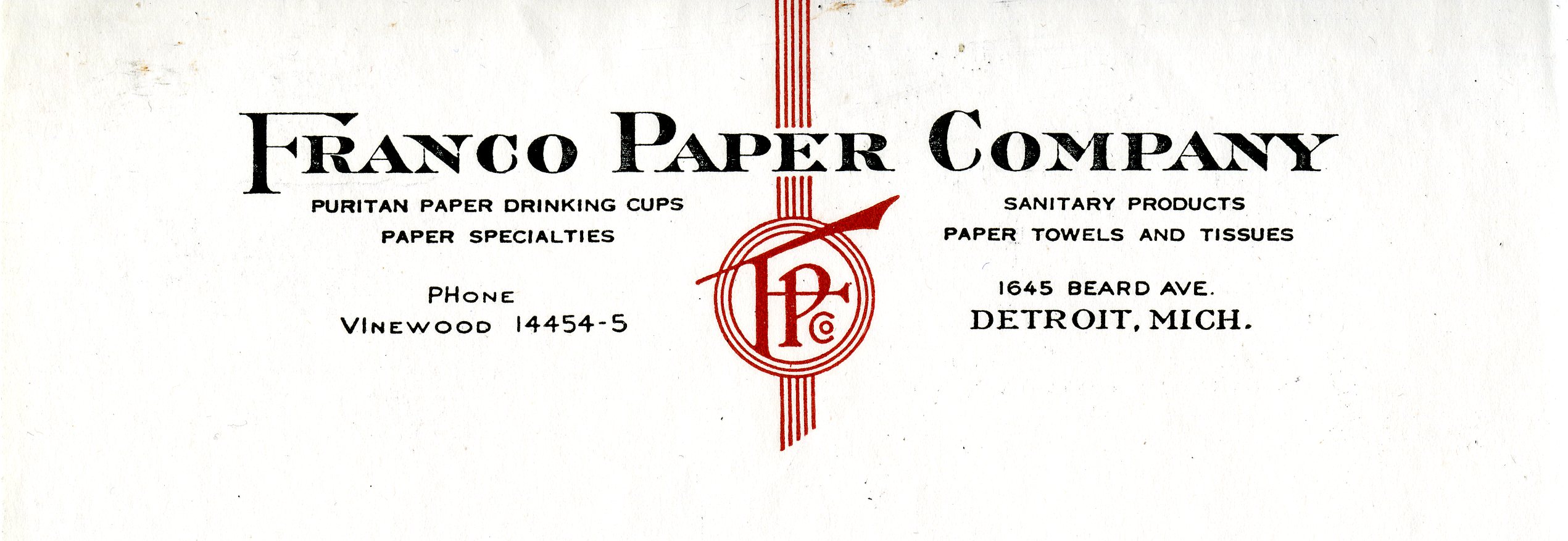
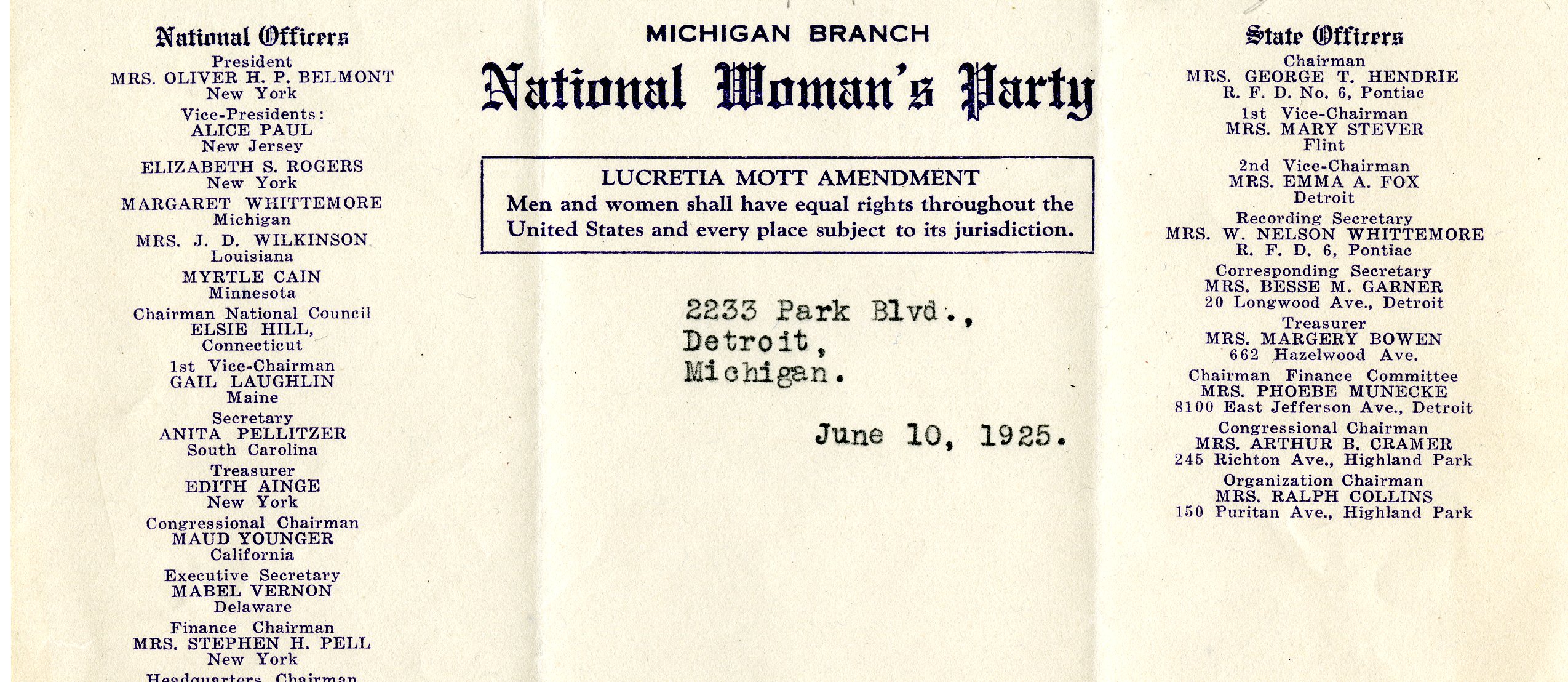
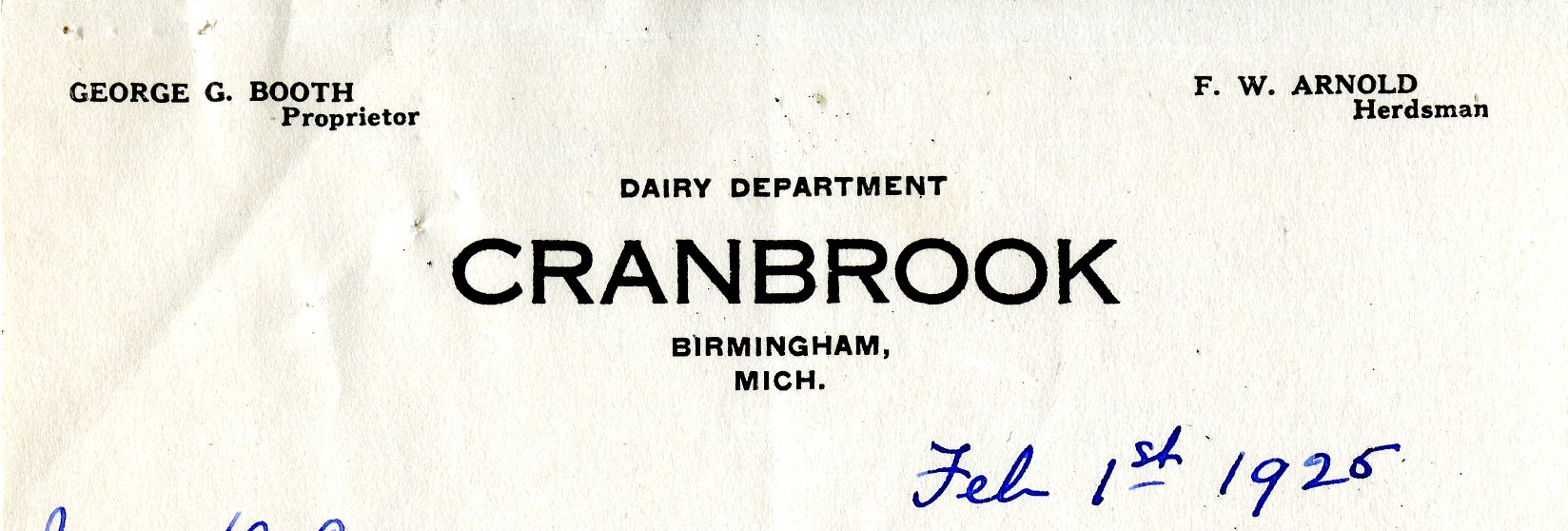
In pulling together the final selections for the Cranbrook Archives’ exhibition “Ephemera: Stories that Letterhead Tells,” I had many difficult choices to make. We have so many fantastic examples of letterhead that span 150 years. It was hard to choose which stories to tell in the exhibition!

That said, I have to say that some of my favorites are the ones that document Michigan history, and specifically, local area history. Numerous businesses including retail stores, restaurants, gas stations, hotels, industries and civic organizations, are no longer in existence and the letterhead is the last bit of evidentiary proof of existence. This post is an opportunity to spotlight a few of these.

farm003

lumber001

paper007

women006

flag002

Beginning this Thursday, the Archives, as part of the Center for Collections and Research, will be host to a lecture series about Michigan history. In each of the three lectures, the speakers will highlight letterhead from their own institution’s archival collections that relate to the stories they are telling. Please join us this Thursday October 16th for the first in the series: “Boom Town: Detroit in the Roaring ‘20s” by Joel Stone, Senior Curator of the Detroit Historical Society. The lecture will be held in DeSalle Auditorium, Cranbrook Art Museum, from 7-8:30pm and include a tour of the exhibition “Ephemera: Stories that Letterhead Tells.”

Leslie S. Edwards, Head Archivist

Photo Friday: A Splash of Color

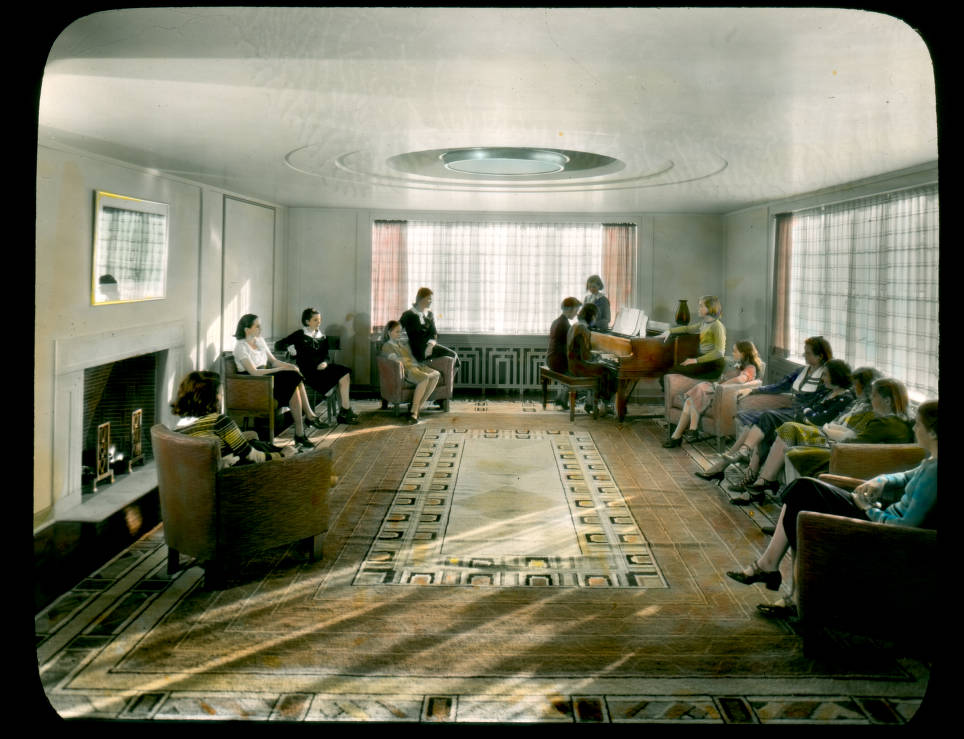
Kingswood School Rose Lounge. Cranbrook Archives

Kingswood School Rose Lounge, The Cranbrook Hand-Colored Lantern Slide Collection. Cranbrook Archives

As the weather here at Cranbrook is more than a little dreary, today’s photo provides a look into a bright and cozy atmosphere perfect for reading, relaxing and being inside. Taken around 1932, it shows a group of students gathered in the lounge of the Kingswood School dormitory (originally known as Reception Room III) listening to two of their peers play the piano. The photograph comes from Cranbrook Archives’ Hand-Colored Lantern Slide Collection. The photographs in this collection were originally black-and-white and were painted with watercolor years later, and not by the original photographer. This jump in time explains the vibrant color choices in the photograph as the painter was not present when the image was originally captured.

The Cranbrook Hand-Colored Lantern Slide Collection contains over 30 images of Cranbrook institutions taken primarily during the 1920s and 1930s. Several of the original black and white images were taken by architectural photographers for inclusion in publications.

Today’s photo was taken by George W. Hance, Cranbrook’s first paid staff photographer (1931-1932). Hance had been commissioned by George Booth as early as 1916 to photograph his art collection and later photographed Cranbrook’s campus and grounds including Kingswood, Cranbrook House (home to George and Ellen Booth) and Thornlea (home to Henry Scripps Booth). Explore more photographs like these on our digital image database or in person at the Archives!

Stefanie Dlugosz, Collections Fellow, Cranbrook Center for Collections and Research


Photo Friday: Plans Set Sail!

The Alura II from the James Scripps Booth and John McLaughlin Booth Papers. Cranbrook Archives

The Alura II from the James Scripps Booth and John McLaughlin Booth Papers. Cranbrook Archives

As the new Collections Fellow for the Cranbrook Center for Collections and Research, I was charged with coming up with a theme and writing today’s Photo Friday blog, a daunting task as it is only my first week. Lucky for me, a few of our archivists were working in our reading room pulling documents and photographs for a display this weekend for Cranbrook Art Museum’s PNC Bank Family Day and a few of them jumped out at me.

In 1928 James Scripps Booth, eldest son of Cranbrook’s founders George and Ellen Booth, designed a plan for a boat called the Alura II. Today’s photo includes a Booth’s original design for the bureau-book cases, mirror and window to the cockpit and a photograph of the “screened door companion-way from enclosed bridge area.” Although some of the plans were changed during manufacture, you can see the resemblance to Booth’s original design especially in the drawers and shape of the window shape. The Alura II was a fifty four foot long motor cruiser, with two 275 horsepower engines, so it could go as fast as 16 mph on the water! The boat included electric lights and toilet facilities, a four burner gas stove, and a gas water heater, as well as a Fridgeair ice box. The Alura II was completed in 1929. James and his wife Jean cruised in the boat for most of the summer that year, closing their home to take to the water.

Today’s photo is a sneak peak at some objects you can see on display in the Cranbrook Archives during PNC Bank Family Day this coming Sunday September 28th from 11am to 5pm. Many documents and photographs like today’s Photo Friday will be available to view and learn more about Cranbrook, the Booths, and boats! Learn more about the day’s nautical themed activities, tours, and lecture on the Cranbrook Art Museum’s website.

– Stefanie Dlugosz, Collections Fellow, Cranbrook Center for Collections and Research


Photo Friday: Seeing the Unseen

Dr. Harold Edgerton

Dr. Harold E. Edgerton giving a lecture at Cranbrook Institute of Science, Jan 1950. Cranbrook Archives.

A Fellow of the American Academy of Arts and Sciences, who was awarded the National Medal of Science, and won an Oscar  – the subject of today’s Photo Friday has quite the list of accomplishments! Dr. Harold E. Edgerton gave a lecture at Cranbrook Institute of Science in 1950 called “Seeing the Unseen”. Edgerton advanced the development of strobes – using them to freeze objects in motion to capture on film. Utilizing short duration electronic flash, Edgerton developed techniques for photographing athletic events, bullets, and drops and splashes. Many of his photographs were published in Time magazine.  In 1937, one of Edgerton’s milk-drop photographs was included in the first photography exhibition at the Museum of Modern Art.

In 1952, the National Geographic Society invited Edgerton to join Jacques Cousteau on an underwater exploration. Edgerton built underwater cameras and flashes for Cousteau, and also developed sonar technology that enabled him to search for the ancient Greek city of Helike (submerged around 373 B.C.) and locate an H-bomb off the coast of Spain.

Gina Tecos, Archivist


Object in Focus: Viktor Schreckengost Correspondence

Viktor Schreckengost letter, 1938

Saarinen Family Papers, Cranbrook Archives

While doing research for the Cranbrook Archives’ upcoming exhibition Ephemera: The Stories that Letterhead Tells, I discovered a beautiful example of bold, colorful letterhead from 1938. The letterhead, designed by Viktor Schreckengost, was clearly influenced by the Bauhaus designs of the 1920s and 1930s which featured asymmetrical compositions and expressive typography. The content of the letter is of course also very interesting. A response to textile designer Loja Saarinen’s request to purchase the ceramic sculpture “Young Pegasus,” the letter shows a mutual respect between the two artists. The sculpture, which Schreckengost sold to Loja Saarinen, lived for many years in Saarinen House, and is now in the permanent collection of Cranbrook Art Museum.

As the saying goes, “curiosity killed the cat,” and as I knew nothing about Schreckengost, I set out to see what I could discover about him. Turns out that Schreckengost, who spent the majority of his life in Cleveland Heights, Ohio, was not only an industrial designer (think streamlined pedal cars and the Sears Spaceline bicycle), but was also a painter and ceramicist. The son of a commercial potter, Schreckengost dabbled in clay sculpture as a child, and went on to design mid-century modern dinnerware for American Limoges and Salem China. Perhaps his best-known ceramic work is the Jazz Bowl (1930-1931) that he created at Cowan Pottery in Rocky River, Ohio, for a commission from Eleanor Roosevelt.

Viktor Schreckengost letter, 1948

Cranbrook Art Museum Exhibition records, Cranbrook Archives

In 1948, then curator of Cranbrook Art Museum, Esther Sperry, was in the process of planning the Academy of Art’s Second Biennial Ceramics and Textile Exhibition and reached out to Schreckengost. The exhibition records yielded two more very interesting letterhead from Schreckengost. With simplified typography, the first reflects Schreckengost’s response to post-war graphic design and the promotion of “less is more” concept, while the second illustrates how Schreckengost constantly experimented with type and design elements. Both 1948 letters show his conscious effort to utilize negative space as an active element.

Viktor Schreckengost letter, 1948

Cranbrook Art Museum Exhibition records, Cranbrook Archives

The bottom line is that for me, these three objects in our collection are fascinating – in their design, in their content and how they, as cultural artifacts, reflect the changing world of design through their rich visual vocabulary.

Leslie S. Edwards, Head Archivist

Photo Friday: Happy Birthday Ralph Rapson!

New Moon by Ralph Rapson

Plan for Rapson’s New Moon Homes, Alma, Michigan, 1945. (Project not realized) Cranbrook Archives

In honor of Ralph Rapson’s 100th birthday, (September 13th) today’s Photo Friday features images from the Ralph Rapson Collection (1935-1954). Rapson studied architecture under Eliel Saarinen at the Cranbrook Academy of Art from 1938-1940.  He worked in the Saarinen office until 1941 when he moved to Chicago and taught at the New Bauhaus with Lazlo Moholy-Nagy.  In 1954, he relocated to Minneapolis where he established the University of Minnesota’s School of Architecture.  One of the country’s leading modernist architects, Rapson created hundreds of sketches and is perhaps best known for his whimsical illustrations of people and transportation.

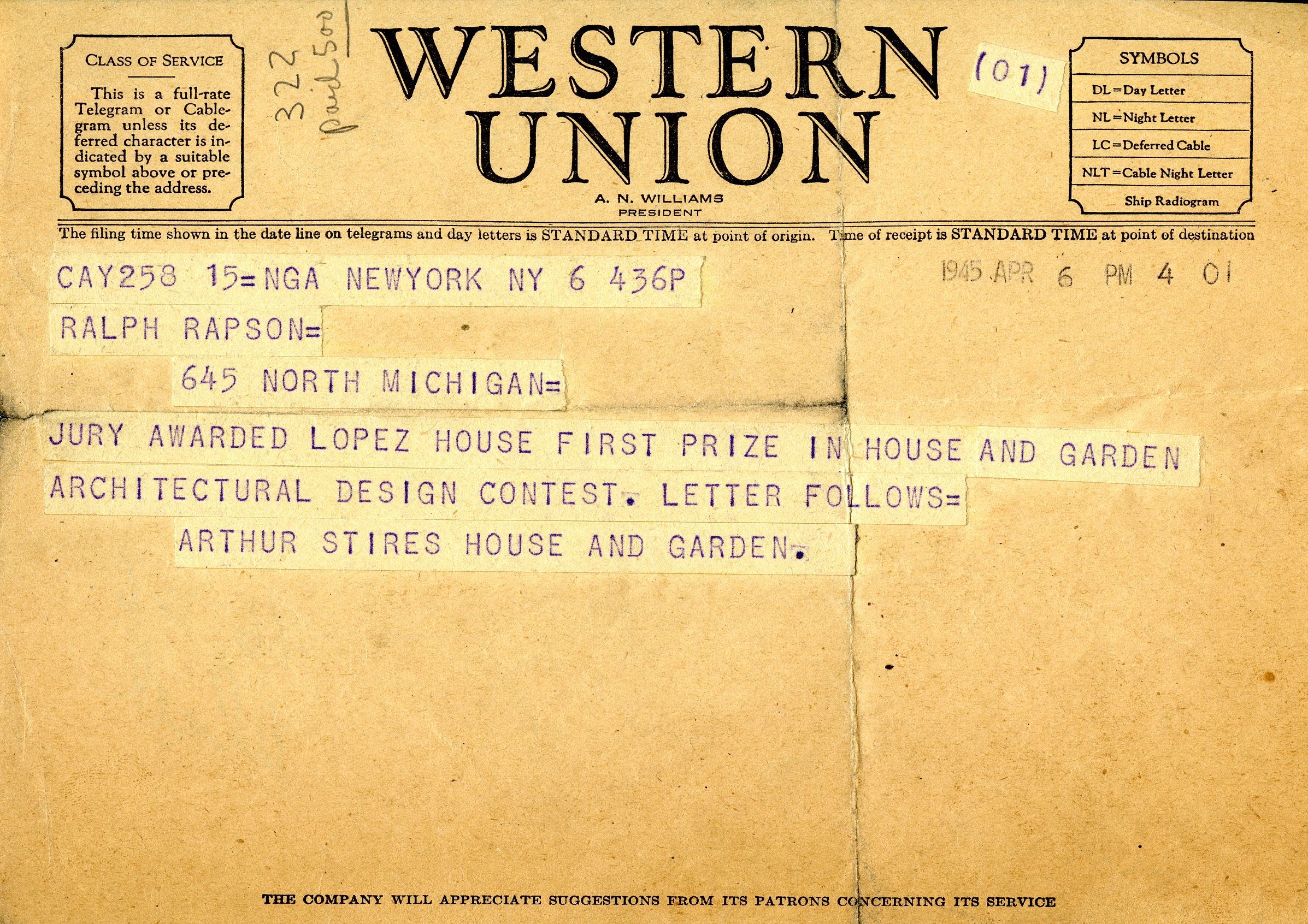
Ralph Rapson telegram

Telegram announcing Ralph Rapson’s first prize win for the “Lopez House” in the House and Garden Architectural Design Contest, 1945. Cranbrook Archives

Leslie S. Edwards, Head Archivist, and Gina Tecos, Archivist

Object in Focus: “Cabin” by Marjorie Young

Cabin, by Marjorie Young

The unpublished manuscript, “Cabin,” by Cranbrook Academy of Art student, Marjorie Young. Cranbrook Archives.

My family has been going “up north” for nearly 50 years and in 1967, purchased property in Good Hart, Michigan. A popular vacation spot nestled in the woods along the bluff of Lake Michigan, the area from Harbor Springs to Cross Village has been a retreat for numerous Cranbrook-related luminaries over the years. In the 1940s, Henry Scripps Booth and his family vacationed in Good Hart at the Blisswood and the Old Trail Inn resorts. In the 1950s, Cranbrook Academy of Art painting instructor Wally Mitchell began vacationing up north, and in 1972 built an A-frame cottage on the beach just south of Cross Village. Bob and Pipsan Swanson began designing buildings near Harbor Springs as early as 1941 as well. Blog posts about these and other Cranbrook stories in northern Michigan can be found on the Cranbrook Sightings blog.

This object in focus today is an unpublished manuscript in our collection penned by a lesser known Cranbrook Academy of Art student named Marjorie Young. When I first read “Cabin,” my heart skipped a beat as I soon realized that Young was writing about MY up north: the place where I go for, as I jokingly say, my “mental health holidays.” The place of trees and wind and waves lapping in the distance, of spectacular sunsets and so many beautiful rocks that there is not time to look at much less collect them all. Young wrote about the same sort of experiences and thought-feelings in “Cabin” from the time she first visited the area in 1935 with her family, to 1946 when she bought her parcel of land with her friend Barbara, and through the 1980s. (Marjorie passed away in 1988.)

Cabin in northern Michigan

Marjorie Young’s cabin in Cross Village, Michigan. Private Collection.

Marjorie Young received her M.F.A. in painting from Cranbrook Academy of Art in 1951. She and Barbara originally intended to build a small studio in which to work and house their “cultural artifacts.” The initial cabin sat close to the bluff but due to land erosion but was moved back and expanded to a larger cottage in 1973. Over the course of Young’s career, she taught art at the Toledo Museum of Art, The Detroit Institute of Art, Western Michigan University, and The Oakland Art Museum in California among others. She was also Director of the Battle Creek Art Center from 1963-1974. However, no matter where she lived or worked, she always returned to her cabin up north.

Cranbrook Academy of Art student, Marjorie Young. Cranbrook Archives.

Portrait of Marjorie Young. Cranbrook Archives.

In the preface of “Cabin,” Young wrote “sitting in the studio which overlooks Lake Michigan . . . I am distracted. Everywhere is growth and beauty, all senses are pleased and excited whatever the hour or season. As I stand inside at the window, waiting for that most hushed and spectacular wonder of each day – the setting of the sun – I know once more the serenity of being here, absolved from all conflicts.” Marjorie’s up north, my up north, and the up north of many of us will always be this same place of respite, of refuge, and of creativity, hopefully for decades to come.

Interior of Marjorie Young's cabin in northern Michigan. Cranbrook Archives.

An interior view of cabin studio. Private Collection.

Leslie S. Edwards, Head Archivist

Photo Friday: Ciao Cranbrook!

Italian workers at Cranbrook

Italian laborers at Cranbrook, ca 1906/Cranbrook Archives

For many Americans, Labor Day’s most popular meaning is a “last hurrah to summer,” but its national significance is much greater than that. In 1894, Grover Cleveland designated the first Monday in September as a national holiday paying tribute to the contributions and achievements of the working force in America. The Italian laborers pictured here arrived at Cranbrook in 1905. Hired by George Booth, men with the last names of Angelosanto, DiPonio, Roselli, Soave, and Vettraino built roads and stone walls, dug ponds, contoured the land, planted, and cared for the property. In 1955 the Cranbrook Foundation Board of Trustees dedicated a plaza north of the Brookside School in appreciation of groundskeeper Michael Vettraino’s 50 years of service to the Cranbrook community. In his speech at the “Piazza Vettraino” dedication, Henry S. Booth said, “We acknowledge a debt to his native Italy, his affection for the world of growing things, his quest for beauty, his tireless hands and feet, and the part he has played as one of the many founders of Cranbrook today.”

Click here to listen to a clip from our oral history collection of Dominick Vettraino speaking about the work the Italians did on the grounds of Cranbrook.

Gina Tecos, Archivist

Dispatch from the Archives: Documenting Liggett

Part of the job of an archivist is to network with colleagues and provide guidance when neighboring organizations or institutions are looking to establish a new archive.  As luck would have it, two weeks ago I had the pleasure of visiting the University Liggett School in Grosse Pointe Woods to look at their archives, and work with the two stellar Sara(h)s: Sara Day Brewer and Sarah Gaines.  Both women—also current parents at the school—are working to preserve the heritage of the school.

Image

Liggett School ephemera noting architect Albert Kahn’s entrance to the school, 1942. The Liggett School Collection, Courtesy University Liggett School Archives.

Continue reading

Create a website or blog at WordPress.com