The Name Game

From the beginning of Cranbrook’s history in 1904, place names at Cranbrook have evolved and changed. Once the Booths turned the original mill pond into a lake, they named it first Glassenbury Lake (after Glassenbury, England), then it was known as Cranbrook Lake for a very short time, and ultimately Kingswood Lake. The man-made Jonah Lake (or Lake Jonah as it is also known) was originally called Lake Manitou. Brookside School was originally called Bloomfield Hills School and Cranbrook School was Cranbrook School for Boys. Although Brookside School retains its name, since 1985 when the boys and girls schools merged, they are jointly known as Cranbrook Kingswood Schools.

Building names have also changed, often due to an alteration in use or sometimes because they were dedicated to an influential or long-time faculty member.  The Garden House became the Cranbrook Pavilion and is now St. Dunstan’s Playhouse. The Cranbrook School academic building became Hoey Hall after former Headmaster Harry Hoey and what was originally called the “Arcade” is now known as the Peristyle at the Cranbrook Art Museum. Lyon House was first called Stonelea (after its owner Ralph Stone, a long-time friend of George Booth), then Belwood, then the Kyes House before being acquired by Cranbrook.

And even Cranbrook Educational Community is not our first name. In 1927, the Booths established The Cranbrook Foundation as the legal and financial entity that oversaw the then six institutions: Brookside School, Christ Church Cranbrook, Cranbrook Academy of Art, Cranbrook Institute of Science, Cranbrook School, and Kingswood School.

So, what is really in a name? How do we name our campus buildings and landmarks going forward and what legacy will we be imparting with them?

That said, I wish you all a Happy New Year! Or should I say Bonne année? Feliz Año Nuevo? Or maybe Xin nian kuai le?

(And thank you Stefanie Dlugosz-Acton for getting me thinking about names at Cranbrook!)

From the Virginia Kingswood Booth Vogel Papers.

From the Virginia Kingswood Booth Vogel Papers.

Leslie S. Edwards, Head Archivist
Mapping Cranbrook History

Last night I ran across an article in the Huffington Post about a new blog at the Library of Congress called “Worlds Revealed: Geography and Maps.” Maps have always held a fascination for me, in fact, I am trying to teach my daughter to read a road map instead of using “Siri” or Google Maps to find our way somewhere. This generation just does not understand the value and intrinsic beauty of maps. My friend Maria, for example, is a map-aholic. One time we spent several days of our vacation obsessing over a jigsaw puzzle of a map. For the past 35 years, I have used numerous types of maps and atlases in my personal family history research, and in our work here at the Archives, maps, site plans, topographical maps, landscape architecture maps, and more are used weekly by our campus architects, architecture students, and scholars from across the country.

The staff of the Geography and Map Division at the Library of Congress have recently undertaken the “Dynamic Indexing Project” intended to digitize over 2.5 million map sheets. According to Mike Schoelen, a Post-Graduate GIS Research Fellow, “if the collection were stacked into a single pile, it would tower the Washington Monument by over 300 feet.”

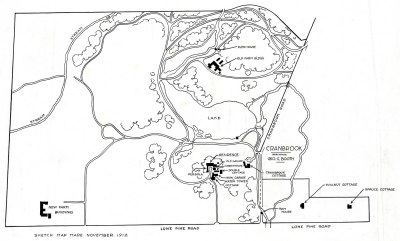
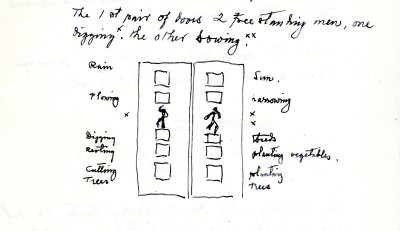
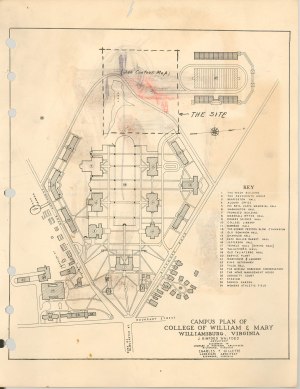
While the map collection at Cranbrook Archives is nowhere near this extensive, we do have an interesting range of maps. Below are some examples.

copper

Map of the Copper Range of Northern Michigan, n.d.

1912.jpg

Sketch Map of Cranbrook, 1912.

hatt532

Sketch, Sedalia, CO, 1919. Robert T. Hatt travel journal.

milles533

Finance Building doors, Harrisburg, PA, 1938. Sketch by Carl Milles.

william_mary

Campus Plan for the College of William and Mary, Competition Packet, 1938.

See Also:

What is a Map?

Maps: Finding Our Place in the World

Maps in the British National Archives

Leslie S. Edwards, Head Archivist

To Sit or Not to Sit

Chair design at Cranbrook has always had its own special niche and fascination among artists and patrons alike. George Booth altered chair designs for his own use at Cranbrook House. Eliel Saarinen designed unique chairs for Cranbrook School and Saarinen House. Ralph Rapson conceived of his chair design for what became known as the Rapson Rocker while a student here. Most of us are familiar with the famous chair designers, but what about projects by less famous designers?

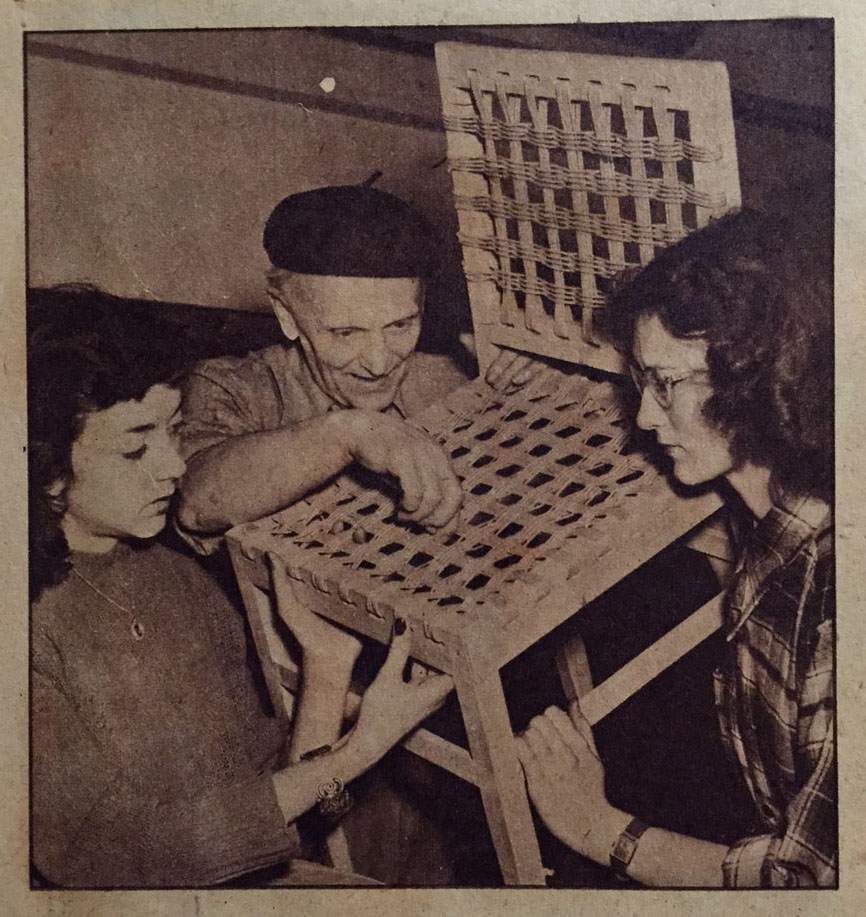
During the war years, Academy of Art students were encouraged to experiment with modern design and new and unusual materials. In 1944, Academy students Gloria Bucerzan and Jean Roberts designed and constructed a chair born of war shortages, by eliminating the use of springs and creating webbing using “non-critical” materials.

Gloria (left) and Jean with woodworking instructor Svend Steen, 1944. Copyright Cranbrook Archives.

Unknown student setting up work for Student Show, 1958. Copyright Cranbrook Archives.

Unknown student setting up work for Student Show, 1958. Copyright Cranbrook Archives.

Art Room, Early Childhood Center at Brookside School, 1997. Chairs designed by Dan Hoffman, Cranbrook Architecture Office. Photograph copyright Christina Capetillo.

Art Room, Early Childhood Center at Brookside School, 1997. Chairs designed by Dan Hoffman, Cranbrook Architecture Office. Photograph copyright Christina Capetillo.

For more on chair design in general, check out the 2012 Year of No-Chair-Design and the Guide to Great Chair Design which features links to chair blogs, the history of chair design, museums, galleries, and books that all feature what else? Chairs!

Leslie S. Edwards, Head Archivist

The Story of a Sweater: 1930-1953

As fall fast approaches and the nights are cooler, all Michiganders are pulling out their jackets and sweaters. Cranbrook School for Boys (as it was once known) had, over the years a variety of sweaters made for the boys to wear, particularly if they were involved in athletics. Although Cranbrook Archives primary collects manuscript collections and institutional records, sometimes we are lucky enough to acquire objects that relate to our past, particularly that of the schools. The Cranbrook Sweater is one such object.

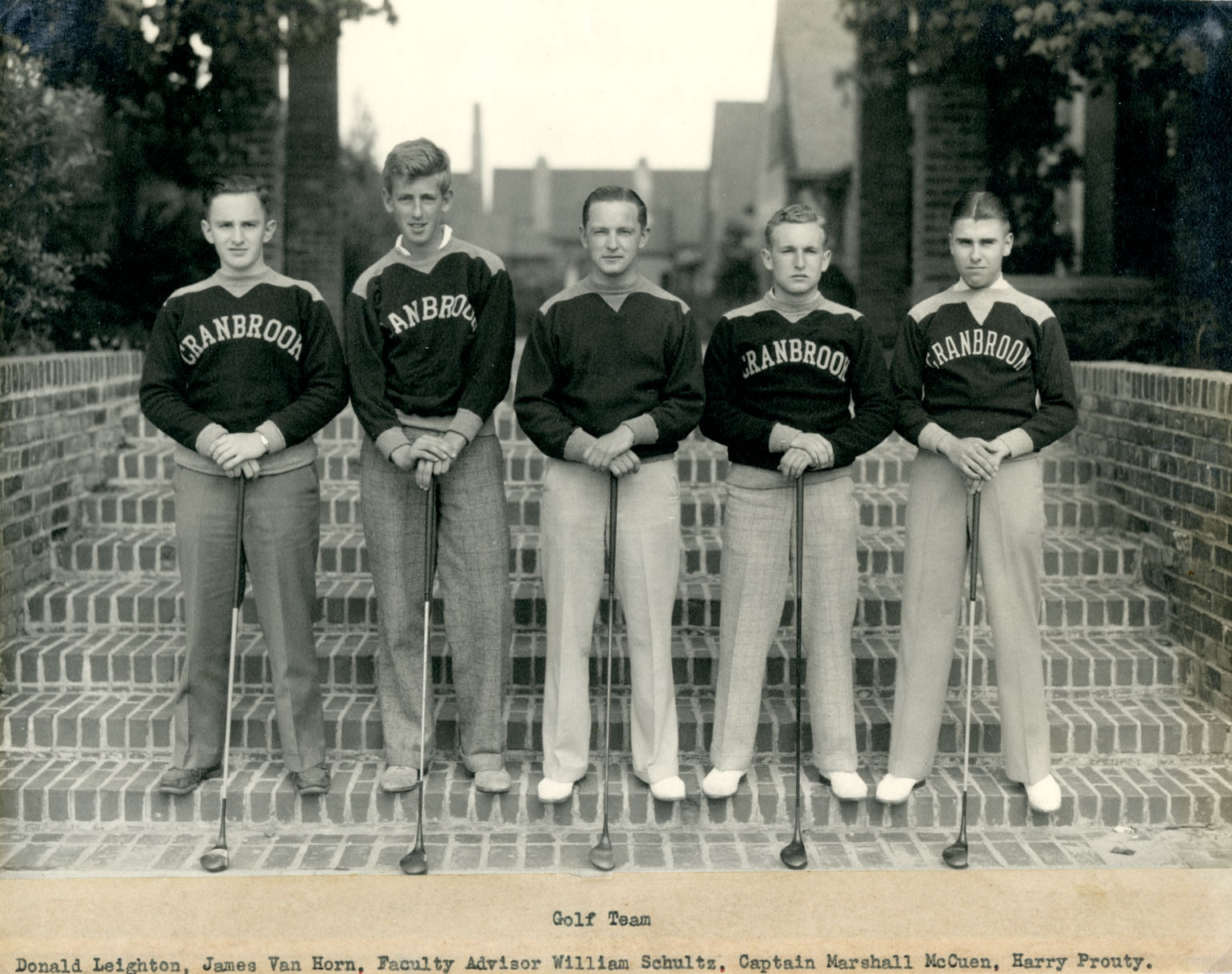
First featured in a team photo for the 1930-31 basketball team, it was a signature uniform for the basketball team photo for the next 22 years. Throughout Cranbrook School’s sports history, athletes on the basketball team, golf team, wrestling team, hockey team, football team, and baseball team all wore the sweater.  Beginning in the 1934-35 season, members of the golf team wore the sweater.

As time passed, the sweater gained increasing momentum in its popularity and peaked among the athletes in the 1940s. However, aside from the basketball team and golf team photos (where the sweater was worn by the entire team), most of the other team photos show only one or two members wearing the sweater for the team photo.  This could be due to the fact that the sweater is made of 100% wool!

Gradually, the sweater lost popularity and by the end of the 1953 school year, it faded out altogether. We are lucky to be caretakers of such a great piece of history, and the type of object that current school students love to see on their visits to the Archives.

Donald Leighton (far left in the photo below) is shown wearing the sweater in our collection.

Golf team 1935-36.

Golf team 1935-36.

Leslie S. Edwards, Head Archivist
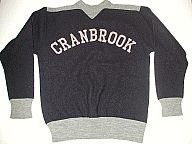
Photo Friday: Reporting the News in Style

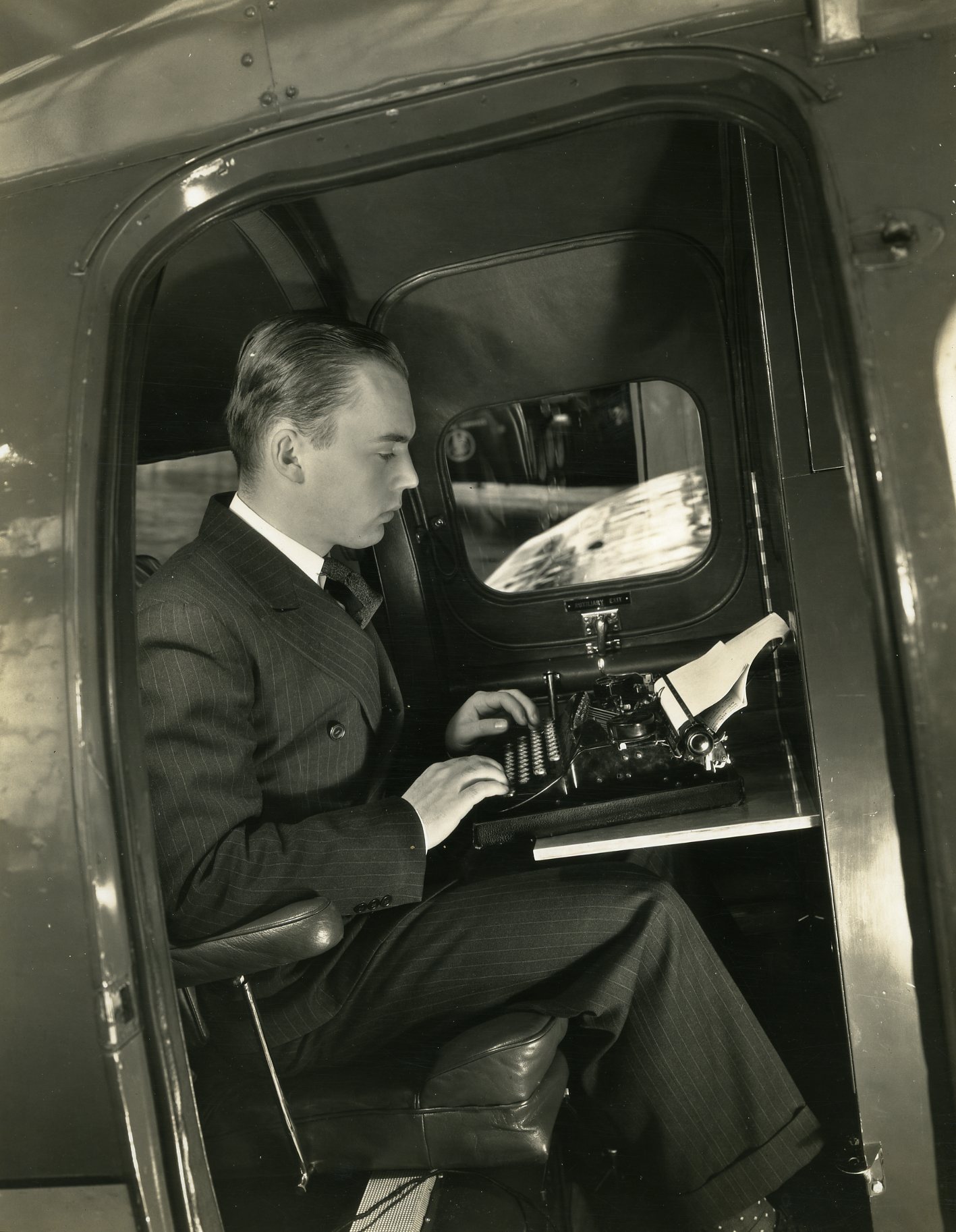
Archivists never know what we might run across during the course of our daily work, which is, of course, part of the allure of the job! Today it was a photo of W Stoddard White (1913-1972) from the Lee A White Papers. (No typo – neither man used a period after his initial!)  Lee White (Stoddard’s father) was a personal friend and confidante of George Booth’s from the Detroit News. White followed Booth to Cranbrook once Cranbrook School was opened and was on the Board of Directors, later becoming head of the public relations department for the community. Clearly Stoddard followed in his father’s footsteps, becoming a news reporter after his graduation from UM in 1935. (Interestingly, while at UM, he was in Sigma Chi along with Edgar Guest Jr.)

Stoddard White, Detroit News Employee, Oct 1935. Courtesy Cranbrook Archives, Lee A White Papers.

Stoddard White, Detroit News Employee, Oct 1935. Courtesy Cranbrook Archives, Lee A White Papers.

This photo caught my attention because of the content – what a great image of young Stoddard, as a Detroit News reporter, seated at his typewriter in what was likely the Detroit News Lockheed Vega airplane. Just one more reason I love my job!

Leslie S. Edwards, Head Archivist
Logical Design: Using Primary Sources

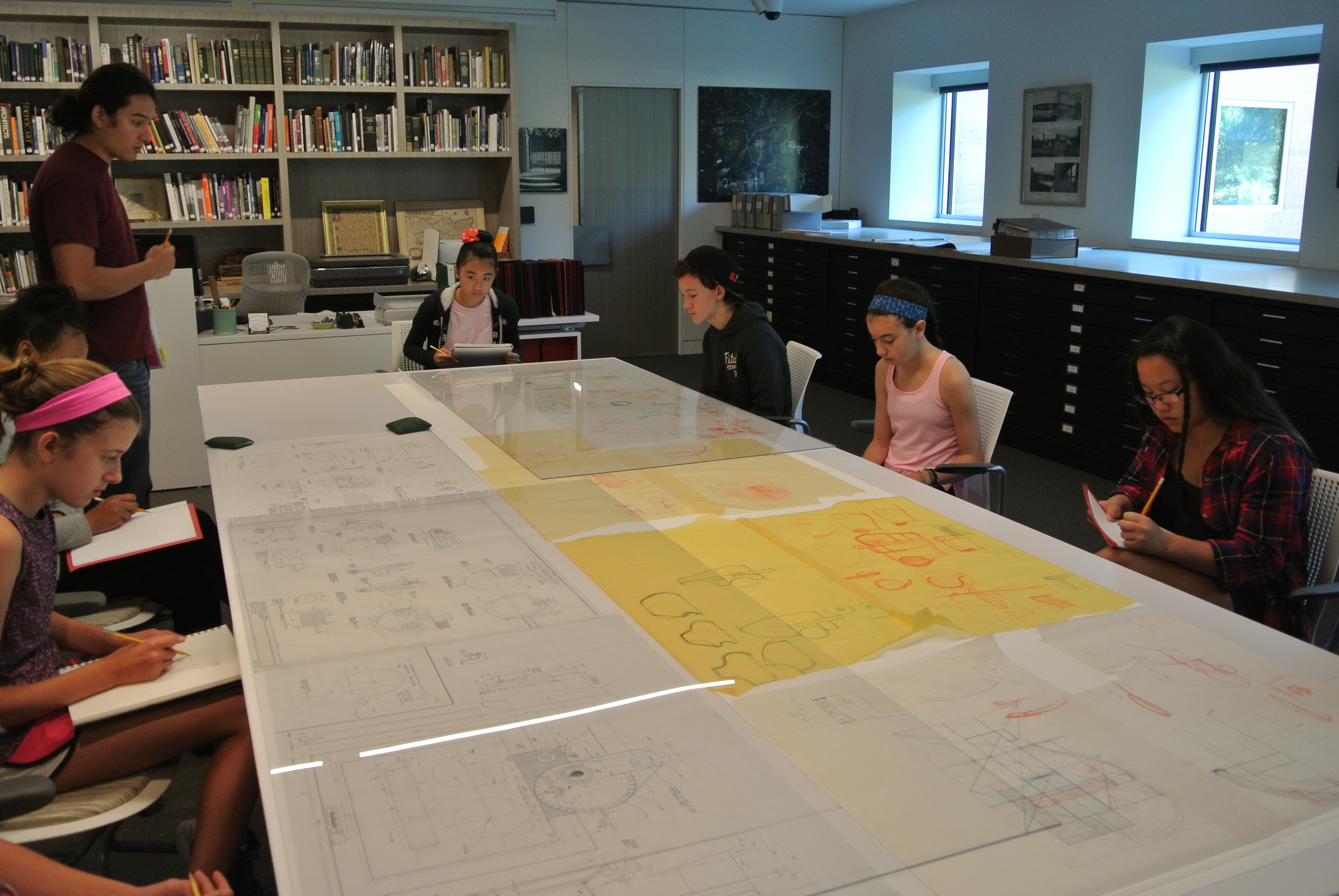
As summer camps are winding down, we wanted to share how campers used the collections in the Archives this week. Earlier in the week, my daughter, who is attending Cranbrook Art Museum’s camp session “Problem Solving by Design,” told me of the industrial design concepts they were learning. I immediately thought of the collection of Design Logic, Inc. Records that we have in the Archives, which contain beautiful color transparencies of 3D projects designed in the 1980s by David Gresham and Martin Thayer. (See Cheri Gay’s post.)

Studying the design drawings for the View Master and the Projector, Aug 2015.

Studying the design drawings for the View Master and the Projector, Aug 2015.

The next morning, I spoke with Kanoa, the camp instructor and a 2015 grad of the Academy of Art, and he agreed the photos would be great to show the kids. We coupled them with a copy of the exhibition catalog Cranbrook Design: The New Discourse, which featured several prototypes by Design Logic, as well as by other designers, many of whom studied under Kathy and Michael McCoy here at Cranbrook in the 1980s. The following day, I took the kids to the Art Museum vault to actually look at some of the objects. Kanoa had them do several sketches from different angles, all the while talking about various design concepts. Then the following day of course I had to show them some of Gresham and Thayer’s own design drawings which are also a part of the collection in the Archives. The kids were able to view conceptual sketches through finished drawings that were then sent to the manufacturer.

Sketching objects in the Cranbrook Art Museum vault, Aug 2015.

Sketching objects in the Cranbrook Art Museum vault, Aug 2015.

All in all, I hope it was a great experience for the kids. It certainly was fun for me to be able to enrich their camp experience with primary source materials from Cranbrook Archives.

Leslie S. Edwards, Head Archivist
Corajoyce Rauss (1925-2015): A Cranbrook Legend

The Archives was saddened to learn this week of the passing of Corajoyce Nancy Lane, of Bloomfield Hills, who worked at Cranbrook for over five decades. Raised by parents who taught her that women didn’t, and shouldn’t, work, Corajoyce (who was headstrong even at a young age!) tried to convince her parents to let her get a job. Her first thought was airplane pilot, followed by truck driver so that she could drive across the country! Instead, at the age of 20, without her parents’ permission, she responded to an ad in the Birmingham Eccentric for a photographer’s assistant at the Cranbrook Foundation. Corajoyce was offered the job by staff photographer Harvey Croze, and finally received consent from her parents. The job only lasted two months, which she followed with a job working for Margaret Auger, then headmistress of Kingswood School. In 1948, Corajoyce married Robert Rauss (they honeymooned at a dude ranch in Colorado) and two years later, left Cranbrook to become a stay-at-home mom to her daughter.

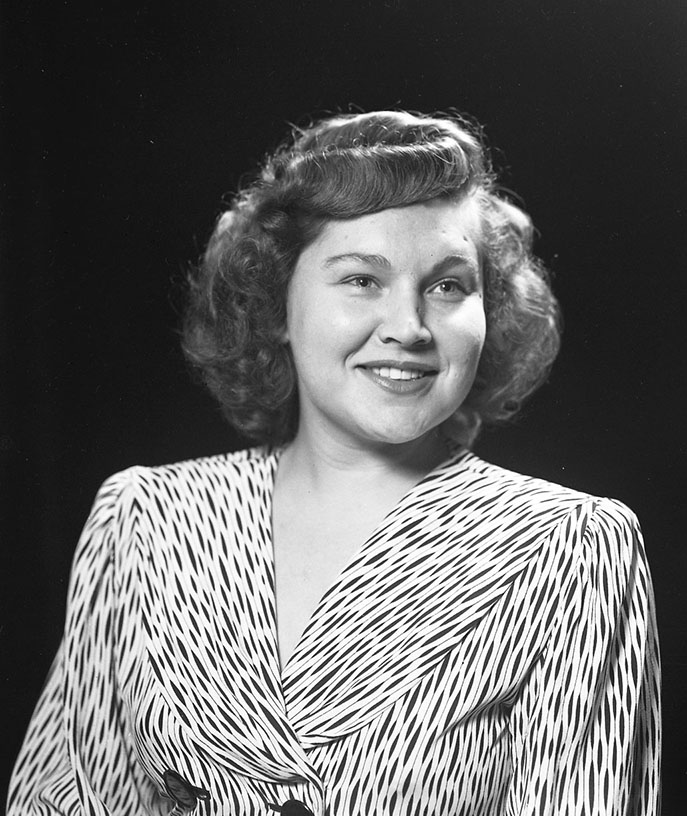
Corajoyce Rauss, Nov 1947.

Corajoyce Rauss, Nov 1947. Harvey Croze, photographer.

In 1961, Corajoyce returned to Cranbrook, this time securing a job as Henry Scripps Booth’s personal secretary. As she and Henry became lifelong friends, she was given more responsibility and became the manager of Henry’s personal estate. During her tenure at Cranbrook, Corajoyce met Carl Milles, Zoltan Sepeshy and Eliel Saarinen among others. George and Ellen Booth used to drop by Kingswood School, often unannounced, and Corajoyce also met visitors including Isaac Stern, Leonard Bernstein, and Princess Christina of Sweden.

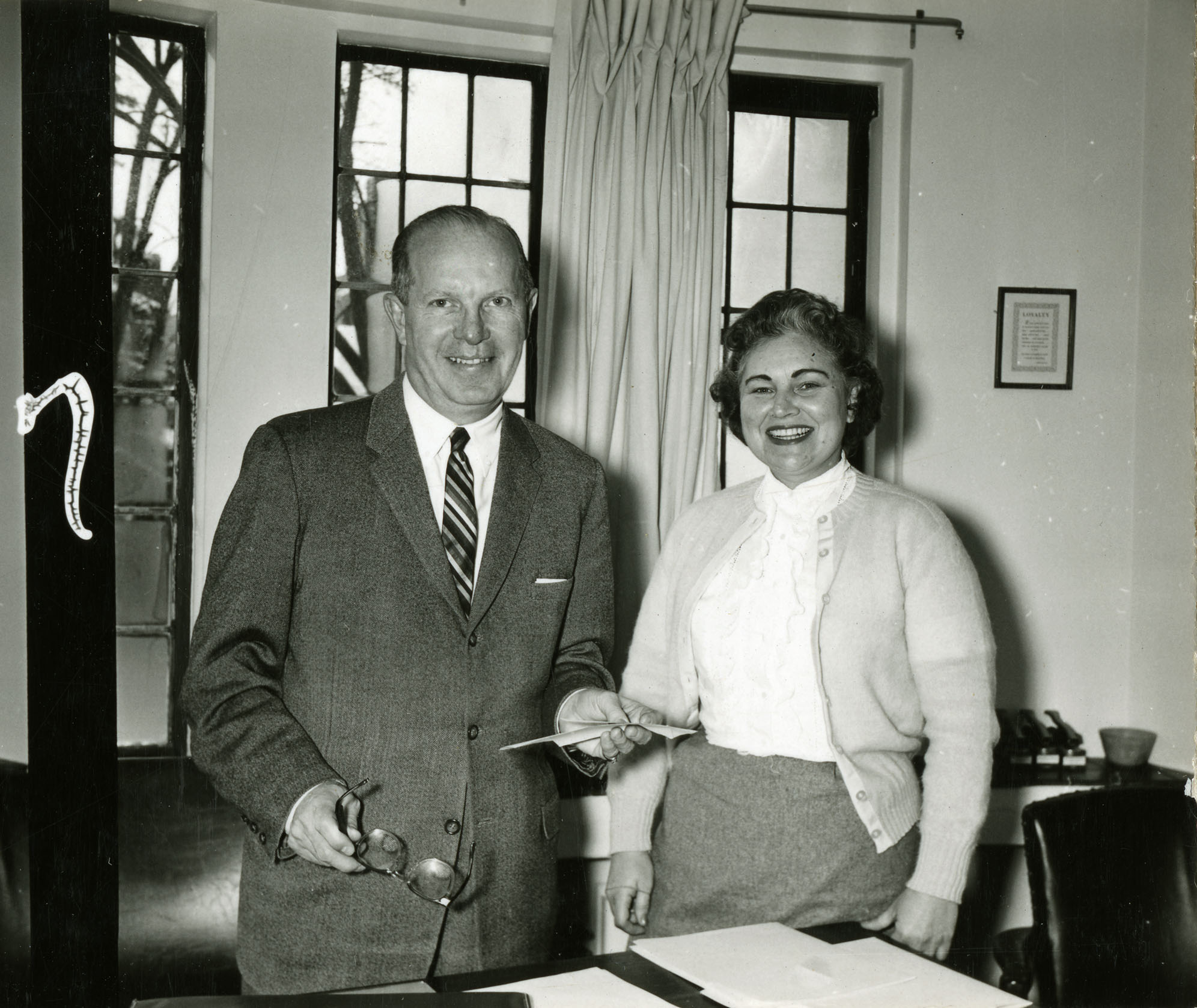
Arthur Witleff and Corajoyce Rauss, Jan 1962.

Arthur Wittliff and Corajoyce Rauss, Jan 1962. Harvey Croze, photographer.

Soon after Henry’s death in 1988, Corajoyce began work at the Cranbrook Archives as the part-time bookkeeper. She volunteered additional time and took on the task of organizing, with the help of a core of volunteers, the Booth family photographs, creating photo albums that are housed in the Archives today. She worked tirelessly on compiling The Cranbrook Booth Family of America genealogy which required copious amounts of correspondence with various Booth family members. Her hard work and dedication earned her Cranbrook’s President’s Award for Excellence in 1990. Corajoyce remained a fixture at Cranbrook Archives until her retirement in 2007. She was once quoted as saying that she “lived a Cinderella life.” While Cranbrook has lost a dedicated employee, her love of Cranbrook and the work she accomplished here lives on in the Archives.

Leslie S. Edwards, Head Archivist
Kaoka: Homeopathic Coffee?

Kaoka, the brainchild of Henry Wood Booth, came about after a doctor suggested that he quit drinking caffeine and gave Booth a recipe for “bran coffee.” Since Booth and his children all liked the beverage, he determined one night that it might make a good business venture. He experimented with various roasting pans– even one in the form of a coffee roaster which was a failure as “it nearly blew up with the generated steam.” Booth finally made one that roasted to his satisfaction and the family gathered together to name this new beverage and “Kaoka” was born. Wrappers were printed and family members made paper boxes to put in local grocery stores.

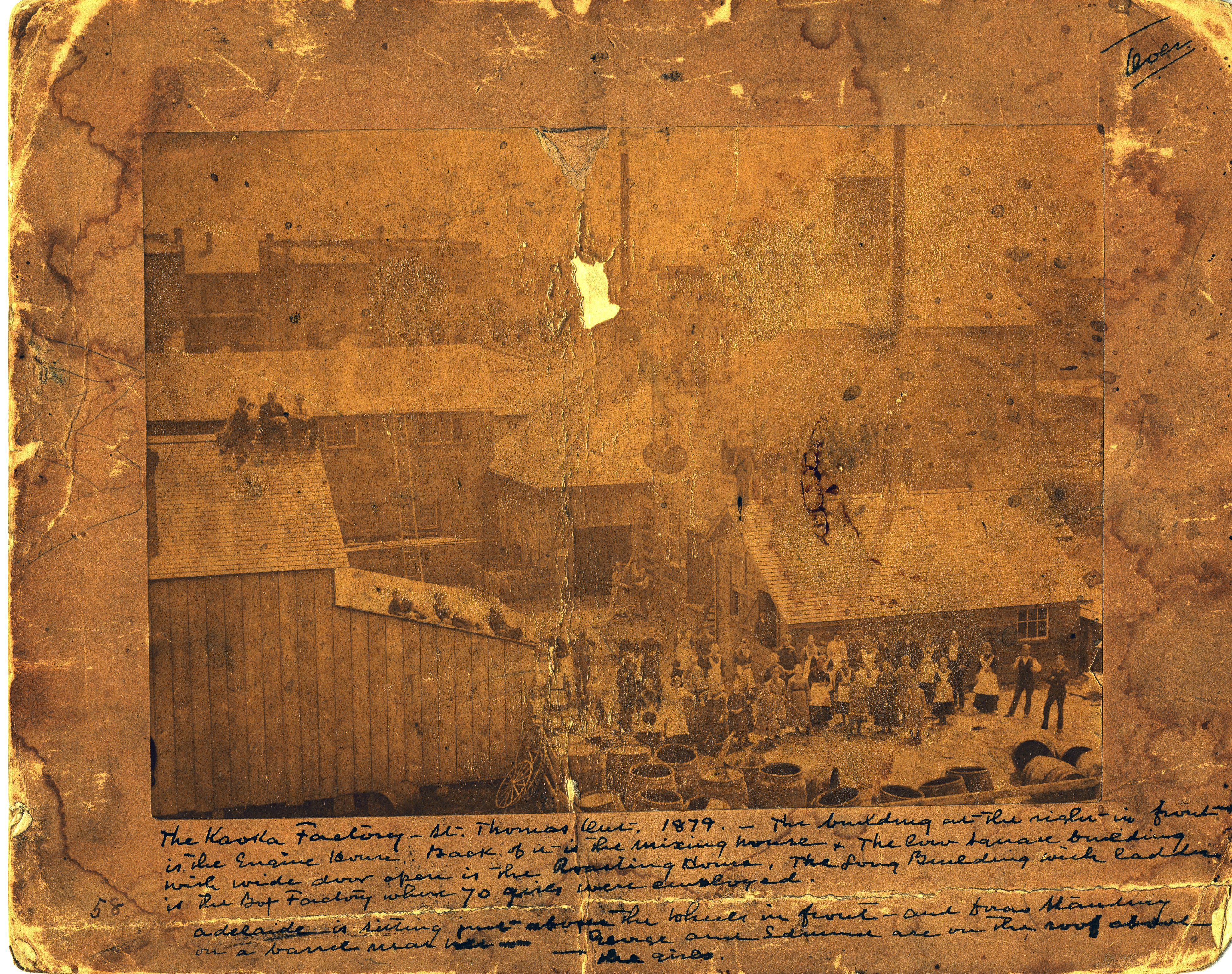
On June 10, 1879, a patent was issued to the Kaoka Manufacturing Company in St. Thomas, Ontario. Booth located a building and fitted it with a large steam engine and boiler and seven roasters which ran day and night. In addition to the male employees, seventy-five women were employed (to make boxes), and soon a joint stock company was formed. Booth was retained as the manager of the plant and also served as the public relations “salesman.” In November 1879, Booth set up a display at the First Annual Exhibition of the Agricultural and Industrial Exhibition Association of Toronto with a “kaoka coffee pot” and gave away free samples of the drink. A local newspaper reported that “kaoka was found to be palatable and quite fit – at least with a large number of people – to be used as a regular beverage.”

The Kaoka Factory, 1879. Henry Wood Booth Papers.

The Kaoka Manufacturing Company, 1879. Henry Wood Booth Papers.

In 1880, the company’s directors asked Booth to go to Detroit in order to establish the business in the United States. However, Booth made the decision (which he later deemed “unwise”) to strike out on his own and set up the American business for himself, and sold his interest in the Canadian venture. After several set-backs, and his money ran out, Henry Wood Booth got out of the Kaoka business and went to work for the United States Post Office. The Detroit venture was, however, what ultimately relocated the Booth family to Detroit. And, Henry Wood Booth was considered the originator of the commercial cereal beverage.

Sidebar: during the time the company was trying to set up the Detroit enterprise, two men who had worked at the Kaoka plant in St. Thomas went to Battle Creek and established the cereal drink under a new name!

Leslie S. Edwards, Head Archivist

Cranbrook Up North

For many of us who grew up in Michigan, going up north during summer vacation was (and still is) something very special – a way to escape the hustle and bustle of city and suburban life and become one with the natural beauty it has to offer. Throughout the 20th century, Cranbrook scientists, artists, architects, students and faculty, as well as members of the Booth family, took advantage of the native woods, white sandy beaches, and waters of Lake Michigan.

Logo for Pinehurst Inn, Indian River, 1940. Cranbrook Archives

Logo for Pinehurst Inn, Indian River, 1940. Cranbrook Archives.

Shelley Selim, Cranbrook Art Museum’s Ralph and Jeanne Graham Assistant Curator, curated the exhibition Designing Summer: Objects of Escape which features Michigan designers and companies who have contributed to summer innovations including tents, boats, and bicycles as well as a summer home designed by Florence Schust Knoll. In response to the opening of the exhibition on Saturday, June 20th, I opted to post a few highlights of Cranbrook’s ongoing relationship with northern Michigan.

Dudley Blakely painting at group site, Bois Blanc Island, 1938. Cranbrook Archives.

Dudley Blakely painting at group site, Bois Blanc Island, 1938. Cranbrook Archives.

As early as 1929, staff and faculty from the Institute of Science traveled north to conduct studies of animal and plant life on the many islands in Lake Michigan – from Bois Blanc to the Manitous. Reports of these research trips were documented in photographs, field notes, and ultimately published in Institute of Science newsletters and bulletins.

During the 1940s and 1950s, Henry Scripps Booth took his family up north for several summers, often vacationing with friends. One of their favorite spots was Good Hart, where they stayed either at The Krude Kraft Lodge or the Old Trail Inn.

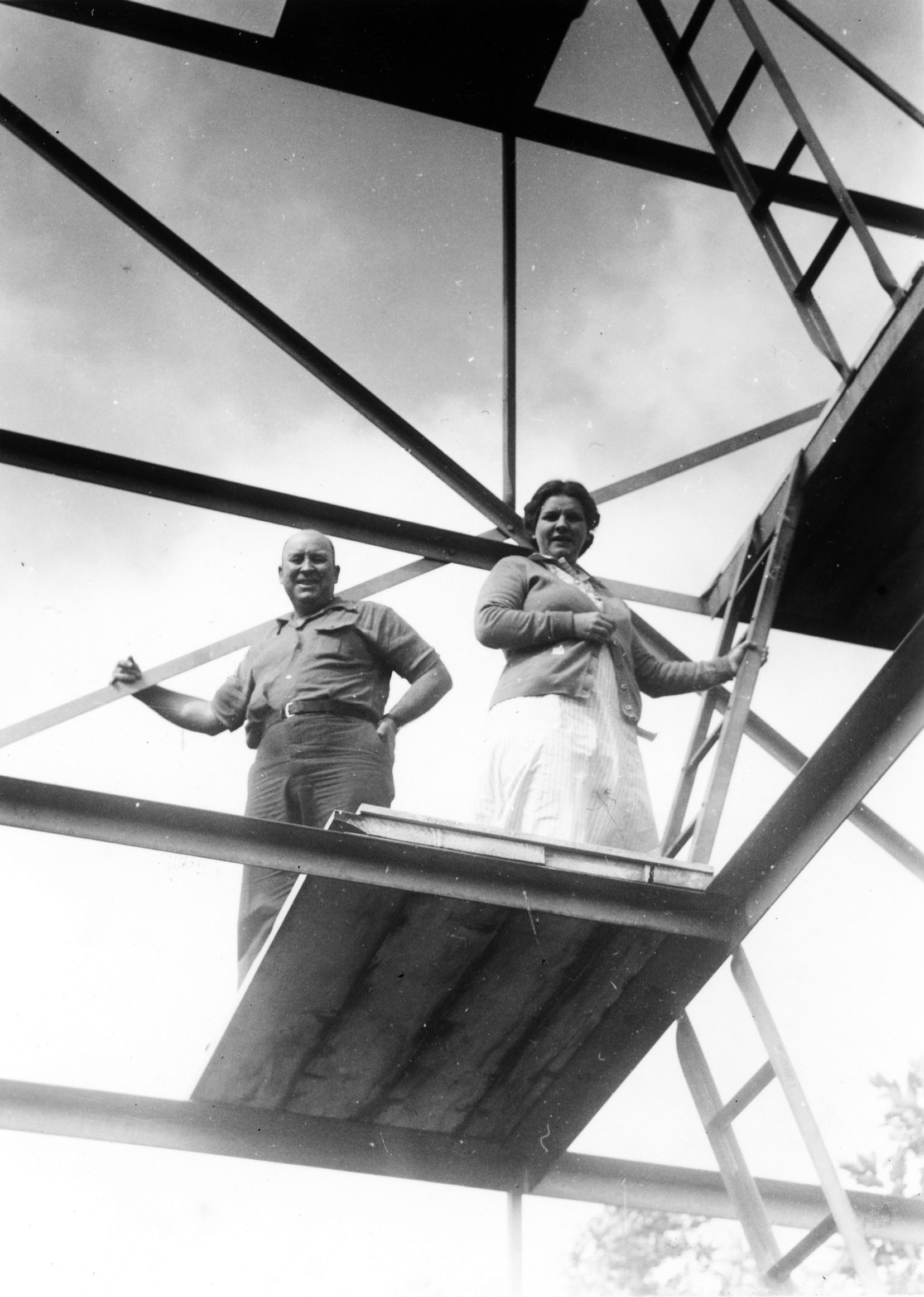
Carolyn Farr Booth and Chauncy Bliss on the Fire Tower at Good Hart, ca 1940. Cranbrook Archives.

Carolyn Farr Booth and Chauncy Bliss on the Fire Tower at Good Hart, ca 1940. Cranbrook Archives.

Communities like Cross Village, Harbor Springs, and Glen Arbor have been inspirational for Cranbrook artists and architects for centuries. Former head of architecture, Robert Snyder, designed an A-Frame beach cottage for Wally Mitchell, while architecture student Harry Weese designed a trifecta of summer homes (two for the Weese family) at Glen Arbor. “Shack Tamarack” (named after the tamarack logs used in its construction) was built in 1936 and is still used by Weese descendants today. Harry followed that with “Cottage Two” in 1939, a one story house designed with his brother John, and the Pritchard House which spoke to the modern aesthetic Weese experienced as an architecture student at Cranbrook Academy of Art.

Robert F. Swanson and Pipsan Saarinen Swanson spent decades designing commissions up north including the ultra-modern MacDonald Building in Harbor Springs, the L’Arbre Croche Condominium development, and the family’s own summer cottage at Menonaqua (along with son, Bob). Check out Shelley’s blog about Pipsan’s Sol Air furniture which is featured in the Designing Summer exhibition.

While architect Tod Williams (Cranbrook School ‘61) served as project manager for Richard Meier’s Douglas House project also located in Harbor Springs, other Cranbrook-related projects up north include The Munising Design Strategy Matrix – a community design project managed by The Community Design Advisory Program (CDAP). Established in 1987 by Design Michigan, a non-profit, state outreach program housed at Cranbrook Academy of Art, CDAP provided tailored community design and revitalization services to the city of Munising.

And, in 2013, Peter Pless (CAA ‘02) lead a design collaboration between the Human Centered Design Program at Northern Michigan University and the Lloyd Flanders furniture company of Menominee, Michigan.

Thankfully, there is seemingly no end in sight to the inspiration and possibilities of art, architecture, science, and plain old fashioned relaxation one can find up north.

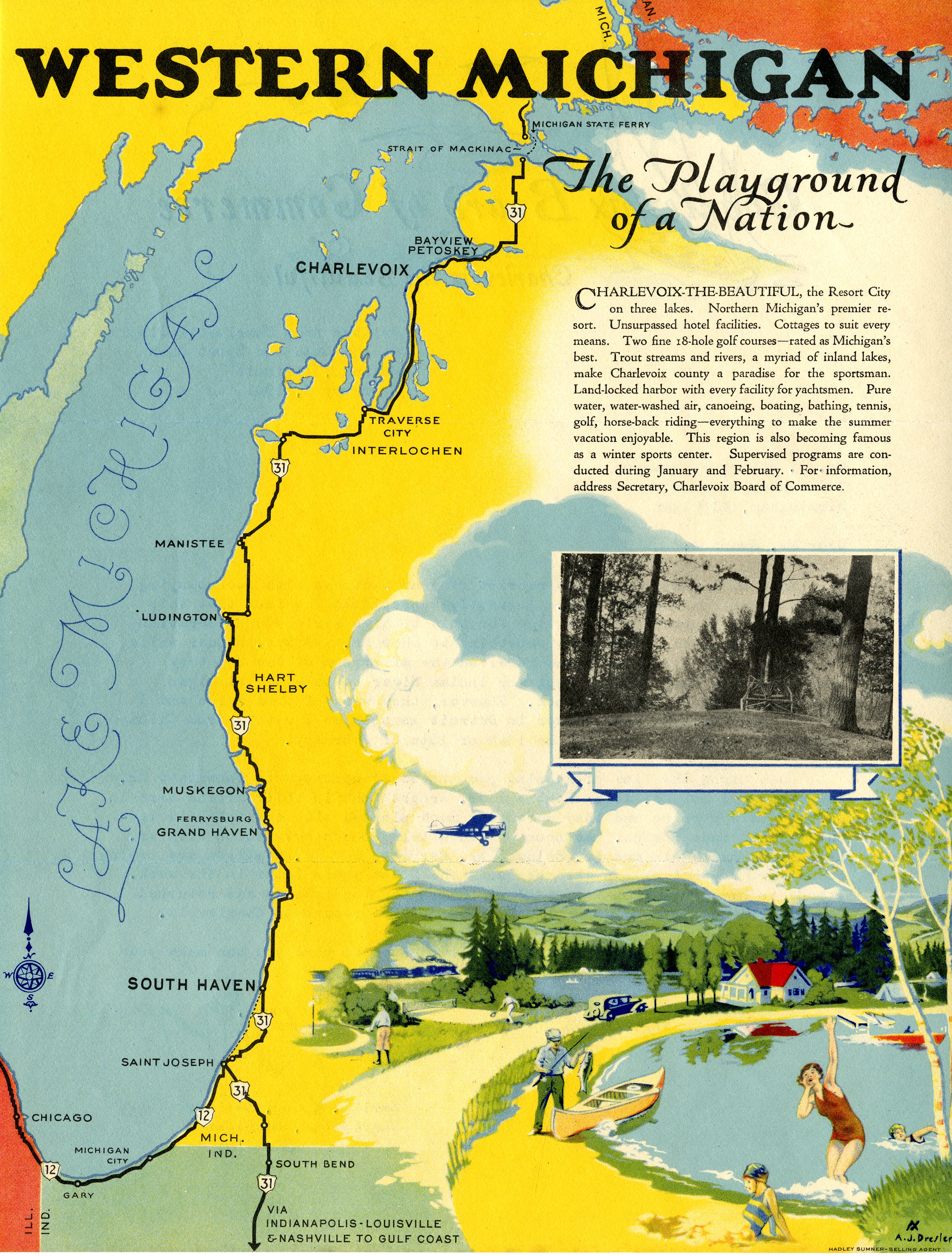
Promotional Literature, Charlevoix Chamber of Commerce, 1941. Cranbrook Archives.

Promotional Literature, Charlevoix Chamber of Commerce, 1941. Cranbrook Archives.

Leslie S. Edwards, Head Archivist
Swimming Was a Privilege: The By-Gone Days of Lake Jonah

Mention Lake Jonah to anyone who has been around Cranbrook since 1999, and the response will be immediate – bittersweet. Fond memories mixed with sadness that it is not used as a swimming hole any longer. Originally referred to as the “Milles Fountain Lake,” the man-made lake is also known as Jonah Lake or Jonah Pool. Funded by George Booth as a place for community members to swim during the summer months, Lake Jonah, built in 1933, became a gathering place – for Trustees and Directors and their families, Academy of Art students and faculty, Summer Theatre and Summer Institute campers, Horizons-Upward Bound students, and hundreds of Cranbrook-Kingswood day and boarding school students, who all loved to hang out in the natural setting.

George Booth originally intended for the lake to be a water feature at the end of Academy Way, but quickly realized that people would swim in it anyway, so he turned it into a swimming pool. When the water was first turned on, a large amount of seepage was discovered so waterproofing of the pool bottom began in July 1934.

Lining the bottom of Lake Jonah

Lining the bottom of Lake Jonah, Sep 1934. Richard G. Askew, photographer.

The cost of construction was just over $34,000. This included the liner, the drain, paving, and landscaping around the pool, designed by Detroit landscape architect, Edward Eichstaedt. The pools covered 54,375 square feet (or 1.248 acres) and held 3,082,830 gallons of water.

Swimming lessons Summer Institute

Swimming lessons, Summer Institute, Jul 1946. Harvey Croze, photographer.

Initially overseen by the Cranbrook Central Committee (a department of the Cranbrook Foundation), Lake Jonah gradually became too expensive and too risky for Cranbrook Educational Community to maintain. Swimmers snuck onto campus at all hours and swam in the pools without lifeguard supervision. After the summer of 1999, the decision was made to close Lake Jonah for swimming and thus ended decades of summer memories.

Leslie S. Edwards, Head Archivist
Create a website or blog at WordPress.com