Christmas card, 1941. Benjamin Baldwin Papers (2006-02), Courtesy Cranbrook Archives

2006-02

Wedding photo, 1941. Benjamin Baldwin Papers (2006-02), Courtesy Cranbrook Archives

Today we are celebrating Ray Eames’ birthday a few days early. In honor of her birthday, which is December 15th, we selected a few photos from our collections. Ray Kaiser studied weaving and design at Cranbrook Academy of Art in the fall of 1940, where she met her future husband, Charles Eames.

Stefanie Kae Dlugosz, Collections Fellow  & Gina Tecos, Archivist, Center for Collections and Research

Form Follows Emotion

View-Master 3D Viewer by Design Logic

View-Master 3D Viewer by Design Logic

This is one of the more successful products created by Design Logic, a product design company whose records I’m currently processing. This View-Master 3D Viewer was a new take on an old, familiar product, and reflected the company’s philosophy that every product has both a technical and emotional element. This new version, created in 1985, featured “push-button technology,” and larger image magnification to make it more technologically competitive with other toys of the era, while maintaining the overall look of its predecessor. Time magazine named it one of the best designs of the year.

Design Logic was founded in 1985 by Cranbrook Art Academy graduate David Gresham, and Martin Thayer, a Royal College of Art graduate; the two worked together at ITT Corporation. Operating out of Chicago, the mission of the company was to “create designs that are functional, beautiful, profitable and based on a distinctively American perspective.” The company is no longer in business.

Once the processing of the Design Logic records is complete, a finding aid will be posted on our web site and more images of their creative, unusual products will be in our digital database, so keep an eye out!

– Cheri Gay, Archivist

Object in Focus: “The Spirit of Nursing” Monument

Army-Navy Nurse Memorial

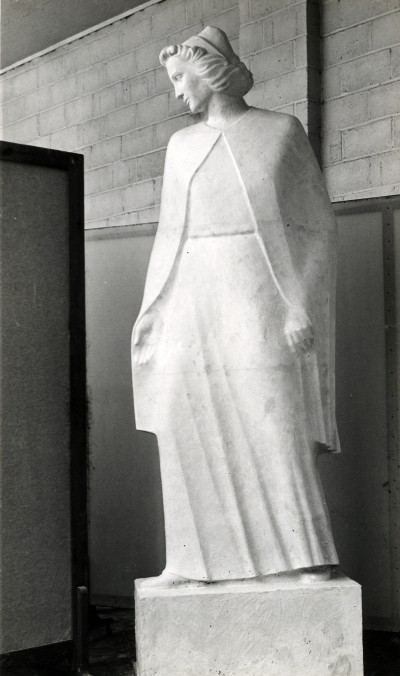
The Army-Navy Nurse Memorial, 1938. Cranbrook Archives.

Although there are many connections to Veteran’s Day within the Cranbrook community, the story I would like to share today is about a woman who left behind a Hollywood movie and stage career to serve her country. Frances Rich (1910-2007)  enlisted in the United States Naval Reserve during World War II and left a lasting legacy for all who visit Arlington National Cemetery.

The daughter of silent film star Irene Rich and the adopted daughter of naval officer Charles Rich, Frances was born in Spokane, WA in 1910. She received her bachelor’s degree in English Literature from Smith College in 1931. Between the years of 1932-1933, Rich appeared in six Hollywood films and one Broadway play. During this time she also became very interested in sculpture and started taking drawing, fresco painting, and clay carving classes in Paris, Rome, and Boston.

While in Paris, Rich met the sculptress Malvina Hoffman (1885-1966) and studied with her for two years. Upon returning to the United States, she continued to hone her craft at the School of the Museum of Fine Arts in Boston. Between 1937-1940 she studied sculpture with Carl Milles at Cranbrook Academy of Art, whom she worked with for 18 years.

In 1942, Rich enlisted in the U.S. Naval Reserve as a Lieutenant Jr. Grade. She served as the Special Assistant to Mildred McAfee (1900-1994), director of WAVES (Women Accepted for Voluntary Emergency Service). Prior to her enlistment, and while a student at Cranbrook, Rich sculpted the Army-Navy Nurse Memorial (1938). One of her best-known works, the 10-foot high statue was made from Tennessee marble and commemorated nurses who died during military service. The statue resides at Arlington National Cemetery and is often referred to as the “Spirit of Nursing” monument.

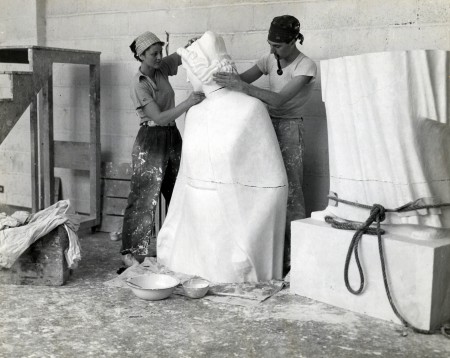
Frances Rich working on sculpture

Frances Rich working on the Army-Navy Nurse Memorial at Cranbrook, 1938. Cranbrook Archives.

Today, along with all of the men and women who have bravely served our country, we salute Frances Rich.

Gina Tecos, Archivist

Object in Focus: Gone but Not Forgotten

Buddy_blog

Grave of Buddy. Photo taken by Cheri Gay.

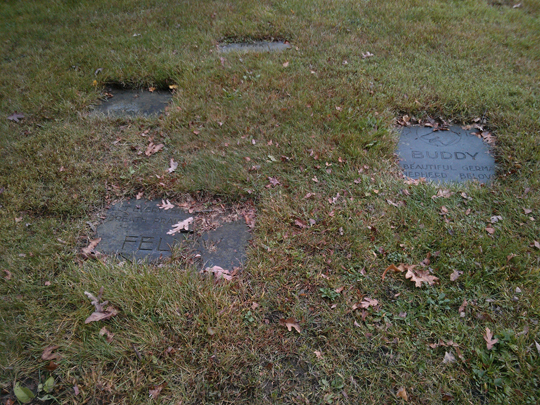
Taking a stroll one day on the grounds of the Thornlea Studio (where Cranbrook Archives was previously housed) I was startled to come across small tombstones, almost buried in the grass. What were these, I wondered? Seeing the names, I immediately understood: Buddy, Homer, Perky, Heinie, Fellow, Ricky, Zorah—a pet cemetery, which had seen better days.

Thornlea Studio was the artistic lair of Henry Scripps Booth, who designed and placed the building across the wide expanse of lawn from his home Thornlea. The family actually lived in the studio in 1949 when “… our daughter Melinda was a student at Kingswood. She was embarrassed by our living in “such a big house” and prevailed on her mother to close the house and move across the lawn to the Studio.”

The Henry Scripps Booth and Carolyn Farr Booth Papers document six dogs, almost all black and tan German shepherds. Receipts from Sheldon Granite Co. in Detroit reveal they made the monuments for Heinie, Perky and the lyrically named, Homer the Wanderer. A 1961 notebook paper receipt identifies Albert Leipold, of Birmingham, as the stone carver for Fellow’s monument for $40.

Mike

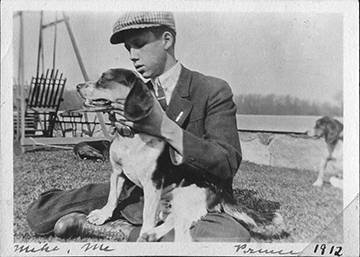
Henry Scripps Booth with Mike, 1912. Cranbrook Archives.

Buddy 1929

Buddy at Thornlea, 1929. Cranbrook Archives.

When Henry was growing up, the Booth family had beagles, Prince and Mike, and a great Dane, Ginger. Mike, according to Henry, “ … loved having a fuss made over him, one time going so far as being pushed around in a doll carriage while wearing a canvas hat.” Oh to have a photograph of that! When Henry had his own family, black and tan German shepherds predominated.

Henry’s photo albums, called Pleasures of Life, include 17 different dogs, though not all are his. His hand-written captions under the photographs always give the dog’s name followed by (dog) in case there’s any doubt, for example, in a photo of Cynthia and Curlytail, who is who.

Though the grounds and building of the Thornlea Studio are maintained, unfortunately that care doesn’t extend to Henry Booth’s lovingly buried companions. It’s a project waiting to happen.

Dog Graveyard_Blog

Thornlea Studio pet cemetery. Photo by Cheri Gay.

–Cheri Gay, Archivist

Lost and Found in a Sea of Cranbrook History

Ye Triumphe Ship

Ye Triumphe Ship, CEC 1918.1

Every day at the Center for Collections and Research brings new adventures and discoveries. During a visit to one of the storage spaces on Cranbrook’s campus, I stumbled upon a curious object, which inspired me to research it and its past. Like most things around here, the object has a great lineage throughout the campus with connections to George Booth, the Detroit Society of Arts and Crafts, and Cranbrook School.

The Ye Triumphe model ship was crafted by Henry Brundage Culver (1869-1946), and although it is a model, it is a large one: about 40 inches long and 32 inches high. George Gough Booth purchased the Ye Triumphe in September 1918 from the Detroit Society of Arts and Crafts. The model, which was advertised in the Detroit Sunday News, had been on display in the window of the Detroit Society of Arts and Crafts shop during that same year.

Henry Brundage Culver worked as an attorney and also served as secretary for The Ship Model Society in New York. He participated in building ship models, and contributed to scholarship on the art of model-making. He produced several publications including Contemporary Scale Models of Vessels of the Seventeenth Century (1926) and The Book of Old Ships: Something of their Evolution and Romance (1924). In the introduction to Contemporary Scale Models Culver compares the art of ship-model building to that of painting.

The finest examples of these miniature vessels are, in the eyes of those best fitted to judge productions of the highest artistic quality, appealing in general composition, line, mass and technical execution, to the aesthetic susceptibilities of those, who have eyes to see, in a no less degree than do the best examples of pictorial art.”

­—Henry B. Culver, Contemporary Scale Models of Vessels of the Seventeenth Century, New York: Payson and Clarke Ltd.1926, pg.ix.

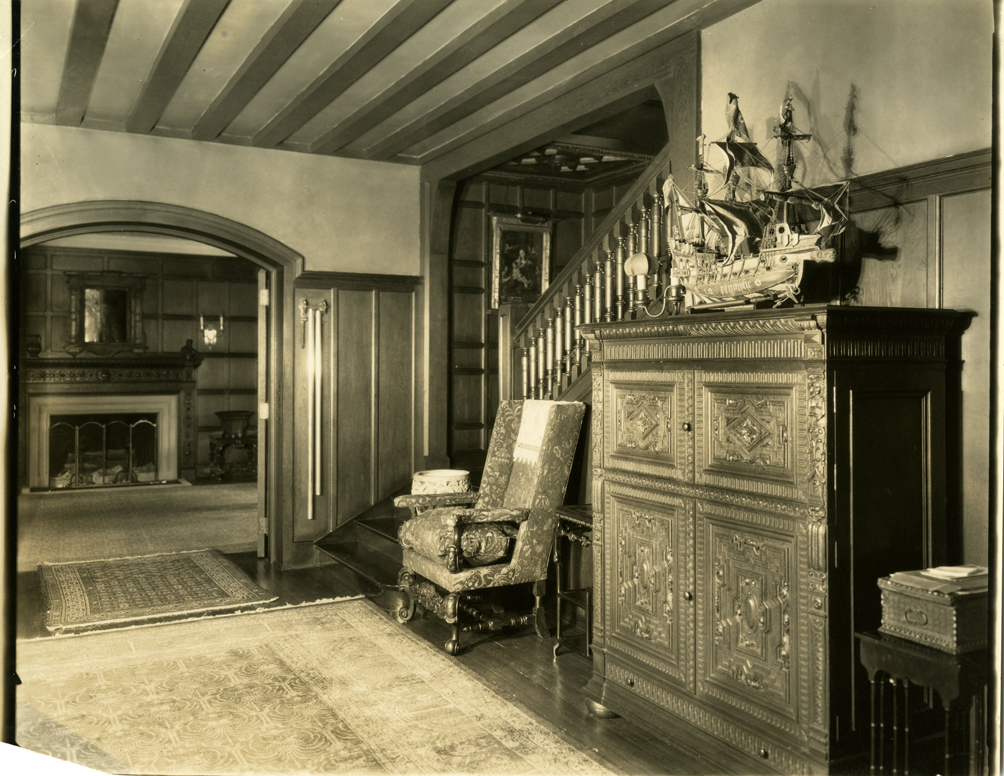
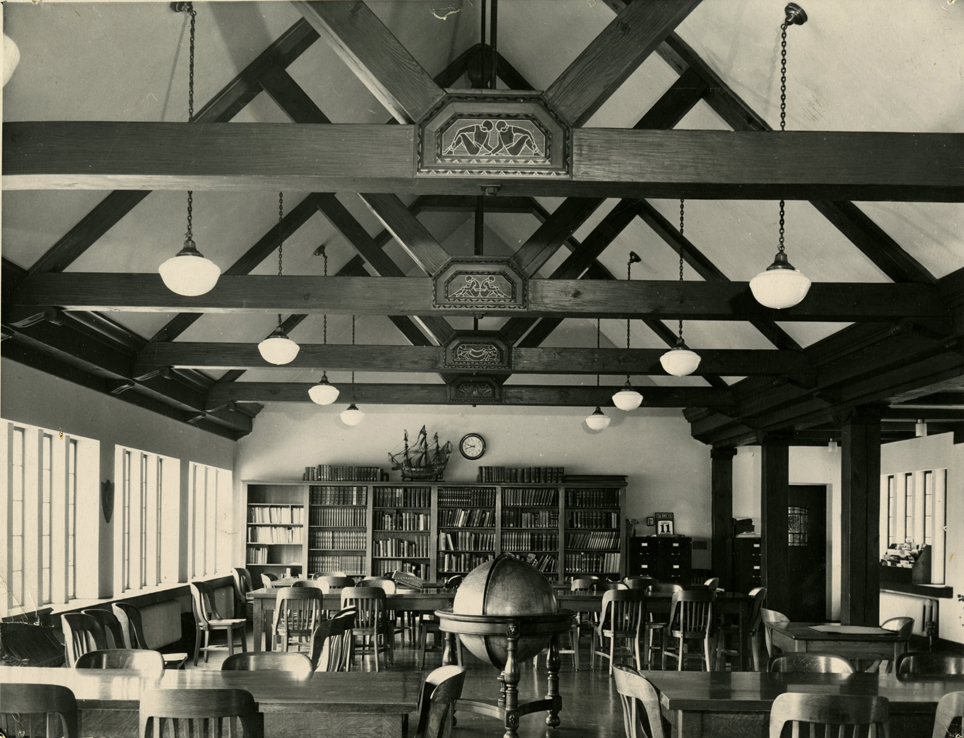
Originally, the ship was placed in the reception hall of Cranbrook House, and was later loaned by Booth for display in the library at Cranbrook School for Boys. Each of the photographs show the ship on display and its presence throughout Cranbrook.
CH_entrance hall_Ship_Blogpost

Cranbrook House reception hall, ca. 1920. Cranbrook Archives

CS_Library_Ship_Blogpost

Cranbrook School for Boys, Library interior, ca. 1945. Cranbrook Archives.

The Ye Triumphe will be returning to view at the Cranbrook Art Museum’s upcoming exhibition The Cranbrook Hall of Wonders: Artworks, Objects, and Natural Curiosities opening November 23rd, 2014. Come and check out the Ye Triumphe and many other fabulous objects from across the Cranbrook campus including works from the Center for Collections and Research, Cranbrook Art Museum, and the Cranbrook Institute of Science!

—Stefanie Kae Dlugosz, Center for Collections and Research, Collections Fellow

Happy Belated Birthday to Our Founder!

September 24th marked the 150th birthday of Cranbrook’s founder, George Gough Booth. Born in Toronto, Mr. Booth had an early interest in art and architecture. In 1881 his family moved to Detroit and he put his artistic talents to work by purchasing half of an interest in an ornamental ironworks firm. The business was successful and used many of Booth’s product designs.

George Gough Booth, ca 1876.  W. E. Lindop, photographer.  Cranbrook Archives

George Gough Booth, ca 1876. W. E. Lindop, photographer. Cranbrook Archives

In 1887 Booth married Ellen Warren Scripps, daughter of Detroit News founder James Scripps. The following year he sold his share in the ironworks business and joined the News staff as its business manager. The News blossomed under Booth’s direction, becoming one of the leading metropolitan dailies in the nation. In 1906, Booth became president of the newspaper, succeeding his father-in-law.

In 1904 George and Ellen Booth purchased a run-down 174 acre farm in Bloomfield Hills and named it Cranbrook after Booth’s ancestral town in England. Booth called upon his long-time friend, and noted Detroit architect, Albert Kahn, to prepare working drawings for the building of Cranbrook House. Kahn responded with an English Arts and Crafts inspired design the Booths moved into their new home in 1908.

In 1922, believing their country estate could serve a larger public purpose, the Booths shifted their focus toward building the six institutions at Cranbrook: Brookside School, Christ Church Cranbrook, Cranbrook School (for boys), Cranbrook Academy of Art, Cranbrook Institute of Science, and Kingswood School (for girls). George Booth was a visionary, and with his wife Ellen, set new standards for generosity, leaving us a legacy we are proud to be a part of. Happy belated birthday George!

“We were unwilling to go through life with our aims centered mainly in the pursuit of wealth and with a devotion wholly to the ordinary opportunities for social satisfaction.  We were not willing to leave all of the more enduring joys for our children or the joy of work in so good a cause entirely to our friends after we had passed on; rather did we wish, in our day, to do what we could and give tangible expression now to our other accomplishments by adventures into a still more enduring phase of life.  We wished to see our dreams come true while we were, to the best of our ability, helping to carry on the work of creation.”  (George Gough Booth, Address at Founders Day, October 28, 1927)

Gina Tecos, Archivist

Photo Friday: Plans Set Sail!

The Alura II from the James Scripps Booth and John McLaughlin Booth Papers. Cranbrook Archives

The Alura II from the James Scripps Booth and John McLaughlin Booth Papers. Cranbrook Archives

As the new Collections Fellow for the Cranbrook Center for Collections and Research, I was charged with coming up with a theme and writing today’s Photo Friday blog, a daunting task as it is only my first week. Lucky for me, a few of our archivists were working in our reading room pulling documents and photographs for a display this weekend for Cranbrook Art Museum’s PNC Bank Family Day and a few of them jumped out at me.

In 1928 James Scripps Booth, eldest son of Cranbrook’s founders George and Ellen Booth, designed a plan for a boat called the Alura II. Today’s photo includes a Booth’s original design for the bureau-book cases, mirror and window to the cockpit and a photograph of the “screened door companion-way from enclosed bridge area.” Although some of the plans were changed during manufacture, you can see the resemblance to Booth’s original design especially in the drawers and shape of the window shape. The Alura II was a fifty four foot long motor cruiser, with two 275 horsepower engines, so it could go as fast as 16 mph on the water! The boat included electric lights and toilet facilities, a four burner gas stove, and a gas water heater, as well as a Fridgeair ice box. The Alura II was completed in 1929. James and his wife Jean cruised in the boat for most of the summer that year, closing their home to take to the water.

Today’s photo is a sneak peak at some objects you can see on display in the Cranbrook Archives during PNC Bank Family Day this coming Sunday September 28th from 11am to 5pm. Many documents and photographs like today’s Photo Friday will be available to view and learn more about Cranbrook, the Booths, and boats! Learn more about the day’s nautical themed activities, tours, and lecture on the Cranbrook Art Museum’s website.

– Stefanie Dlugosz, Collections Fellow, Cranbrook Center for Collections and Research


A Registrar’s Perspective

Tawny Nelb Workshop

Framed Ralph Rapson drawing, The Ralph Rapson Collection, 1935-1954. Photographer, Gretchen Sawatski.

This past Monday I had the great fortune of taking part in an archival workshop lead by forty-year archives veteran Tawny Ryan Nelb of Nelb Archival Consulting, Inc. As a Registrar, I primarily work with three-dimensional objects (furniture, paintings, gates, etc.), so I was eager to learn that this workshop focused on architectural records, the sub-genres within that medium, and how to properly care for and store these records.

I reference architectural records quite frequently when I am trying to learn more about, or troubleshoot, a problem related to an object. In all honesty, I thought I knew the proper handling, usage, and storage of these records as this knowledge is vital to my job; but it was obvious that I really needed the refresher course in “Paper Management 101.”

Archives workshop at Cranbrook Center for Collections and Research

Tawny Ryan Nelb (third from left). Photographer, Justine Tobiasz.

Tawny’s discussion covered all areas of architectural records including paper mediums, drawing types, and then some. I have to admit though that I cringed when the conversation moved towards the exhibition processes for architectural records! Often, we loan architectural sketches, floorplans, and section drawings to other institutions that require us to frame the documents using a hinge system. A hinge, simply put, is a tab that is glued to a document using a reversible wheat paste that is then adhered to an acid-free backer board. To my dismay, this approach was used historically on tissue and tracing type papers records in our collections, which are likely to tear and off-gas inside their expensive frames, creating a microclimate of havoc. In a moment of panic my hand shot up in the middle of the lecture and I uttered, “But we have documents framed in our collection like this! What should we do?”

Thank goodness for archival specialists, because Tawny truly eased my conscience. She, in very kind words simply replied, “It’s ok. We can remove the tissue and tracing paper from their frames, disrupting the microclimate, and use archival paper and matting to resolve the issue.” My response, “what about those hinges?” And, again she calmed my nerves, “Leave the hinges, and store the objects in flat files, so there is no need to use the frames. Then, if these documents go on exhibition again, they are already hinged and ready to go.” In one word: genius. That is what I experienced at this workshop, shear genius. In all of the workshops I have been a part of, I have never been so glad to have attended an archives workshop in all of my life.

Gretchen Sawatski, Associate Registrar

Photo Friday: Back to School in 1912

Stock certificate for the Bloomfield Hills Seminary issued in 1912/Courtesy Cranbrook Archives.

Stock certificate for the Bloomfield Hills Seminary issued in 1912. Cranbrook Archives.

In early June of 1912 a small group of Bloomfield Hills residents assembled at the home of William T. Barbour (president of Detroit Stove Works) to discuss the formation of a small local private school. After general discussion, it was moved by George Gough Booth to establish a corporation with capital of $5,000.00 in order to establish the school. According to meeting minutes, the objectives were to “give the young people of Bloomfield Hills, and those from nearby towns, the opportunity to study in the country; to offer a course of study that will fit them for life as well as for college.” With these objectives in place, the Bloomfield Hills Seminary was incorporated in August.

Often referred to as the precursor to Brookside School, the Seminary was located on five acres at the corner of Woodward Avenue and Lone Pine, in a historic house built in 1820 by Ezra Parke. Booth, who had purchased the property in 1910, offered use of the house and added a five-class-room addition with the caveat that the property would revert back to him should the school ever close.

Mary Eade, who had been the principal of the Detroit Seminary for Girls, became the principal and taught grammar and upper level courses, including History of Art. Elizabeth K. Seward (granddaughter of William Henry Seward of the Alaska purchase fame) taught intermediate classes including French, and Winifred Eastman was responsible for the elementary age children. The coeducational day school used the Montessori method of instruction.

In 1916, the trustees voted to change the name of the school to the Bloomfield Hills School. At its peak, there were eight teachers and fifty-one students enrolled. Due in part to the resignation of Mary Eade (who resigned to do war work) and the construction of new schools in Birmingham and Pontiac, the school closed in 1918 after six years. The property reverted back to Booth who purchased all of the stock certificates back from the trustees, and later became known as the Lone Pine Inn and Tea House, but that’s another story!

Leslie S. Edwards, Head Archivist and, Gina Tecos, Archivist

Photo Friday: Pleasures of Life

Close-up of page 104 of Pleasures of Life, Volume 2. Cranbrook Archives.

Close-up of page 104 of Pleasures of Life, volume 2. Cranbrook Archives.

For this week’s Photo Friday, we’re showcasing an image from Henry Scripps Booth’s epic photographic undertaking, Pleasures of Life. A series of photographic albums documenting his life from 1911 to 1940, Pleasures of Life follows Booth through experiences at Cranbrook, boarding school in Asheville, NC, and travels domestic and international.

This photograph, found on page 104of Pleasures of Life, volume 2, features a “Mrs. Scranton and Mrs. Brixton” dressed in angels’ wings and halos and labeled “Cranbrook’s guardian angels.” Taken during a nativity theatrical performance at Cranbrook’s Greek Theatre in 1916, the photo provides visual documentation for what are likely the same wings as those that appear in the Center’s newest exhibition,Cranbrook Goes to the Movies: Films and Their Objects, 1925-1975, now open at Cranbrook Art Museum.

Wings, circa 1916, featured in the exhibition Cranbrook Goes to the Movies.

Wings, circa 1916, featured in the exhibition Cranbrook Goes to the Movies.

Create a website or blog at WordPress.com