Putting on a Holiday Scene

Every year, the Center for Collections and Research decorates George G. Booth’s Office for the Cranbrook House & Gardens Auxiliary’s Holiday Splendor event. This year, we were inspired by the Booth children and grandchildren.

xmas_grandkids1

Some of the Booth grandchildren put on a play at George and Ellen Booth’s 50th wedding anniversary, 1937. Courtesy of Cranbrook Archives.

All children enjoy playing “dress-up” – whether in a costume or in the clothes of a family member. For George and Ellen Booth’s family, especially their youngest children Florence (“Smike”) and Henry (“Thistle”), any occasion was an excuse to dress-up – a family picnic, a visit from family or friends, the arrival of a new boat for Glastonbury Lake.

xmas_marji

Marjorie Booth wearing her grandmother Ellen Scripps Booth’s wedding dress, on the occasion of George and Ellen’s 50th wedding anniversary, 1937. Courtesy of Cranbrook Archives

For this year’s holiday installation, we imagined the Booth grandchildren playing dress-up with clothes from their grandparent’s closet—their grandmother’s dresses and hats, costumes from performances at the Greek Theater, and other items stored in the vast closets here at Cranbrook House. Perhaps they’re putting on a play, as they did for their grandparents’ anniversary in 1937, or maybe they’re simply celebrating and having fun, as Smike and Thistle were so fond of doing in their youth.

Accompanying the five outfits, the Center decorated a small tree and the mantle with iridescent, green, and silver ornaments, drawing out the colors of Florence Booth’s green dress and a beautiful Rene Lalique (1860-1945) glass vase (before 1930) we’ve set out on the desk. In the center of the mantle we’ve displayed Henry Scripps Booth and Carolyn Farr Booth’s Nativity (mid-20th century), sculpted by Clivia Calder Morrison (1909-2010). A Michigan native, Calder Morrison studied at the Detroit Society of Arts and Crafts with Samuel Cashwan and later at the Art Students League in New York, and this small crèche featuring the three Magi with gifts, Mary holding Jesus, and Joseph was kept in the oratory at Thornlea. Oh, and the Santa bag and hat on display were part of Henry’s costume he donned for Christmas parties here at the House!

Our display will be up through the New Year.  If you are in Cranbrook House for the Center’s piano/violin concert & book launch, Carl Milles’s Muse: Ludwig van Beethoven on December 11, or a Holiday Tea, Luncheon, or just for a meeting, please stop by and visit.

-Kevin Adkisson, Center Collections Fellow; Leslie S. Mio, Assistant Registrar

Upcoming Day Away: Albert Kahn and the University of Michigan

Henry Scripps Booth, photographer. Pleasures of Life, Vol. IV. Courtesy Cranbrook Archives.

Henry Scripps Booth, photographer. Pleasures of Life, Vol. IV. Courtesy Cranbrook Archives.

In this 1919 photo taken by Henry Scripps Booth of his two friends and architecture classmates Fred Morse and Martin Lexen, they’re all hanging out (and almost off of!) the roof of the University of Michigan’s brand new General Library by architect Albert Kahn. I found this snapshot in volume four of Booth’s Pleasures of Life series, which has lots of great images of the Booths at Cranbrook and of his friends at the university (where Henry studied from 1918- 1924). The building they’re sitting on here, known as the Harlan Hatcher Graduate Library since 1971, figures prominently in the Center for Collections and Research’s next Day Away trip on October 28!

Henry Scripps Booth’s Scrapbook Album, Courtesy Cranbrook Archives.

Dedication of the new (Hatcher) library building, 1920. Henry Scripps Booth’s Scrapbook Album, Courtesy Cranbrook Archives.

While we won’t be quite so daring as to dangle our feet off the roof, you are invited to join the Center as we explore Albert Kahn’s architecture at University of Michigan. Best known for his industrial architecture in and around Detroit (and of course Cranbrook House), this tour will introduce you to his academic buildings. The day includes morning lectures followed by in-depth tours of five Kahn structures (including rarely accessible spaces like the carillon in Burton Memorial Tower), all interspersed with narrated walks and drives.

I should mention, though, that the Day Away won’t just be about touring. We’ll stop for a delicious lunch at Taste Kitchen, an acclaimed new restaurant by owner and chef Danny Van. It came highly recommended by friends of the Center, and we’re very happy Van has designed a three course meal, with optional drink pairings, just for us.

Henry Scripps Booth, photographer. Pleasures of Life, Vol. IV. Courtesy Cranbrook Archives.

Henry Scripps Booth, photographer. Pleasures of Life, Vol. IV. Courtesy Cranbrook Archives.

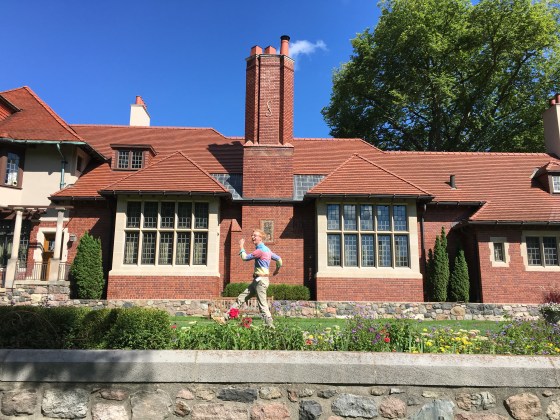
In this photo, we see Booth’s friend Fred’s “long, lankey and lean” body around a street sign—with assistance from the bottom-half of another Cranbrook luminary and friend of Henry, J. Robert F. Swanson.* The photo shows the two goofing around on a road outside of Ann Arbor. For this post’s purposes, I’ll imagine they’re on the very route we’ll be taking from Cranbrook to Ann Arbor on October 28! There shouldn’t be any dangerous curves on our trip, though it’s guaranteed to be informative, delicious, and fun. Call and get your tickets today!

*Did you know Booth and Swanson met studying architecture at U of M, where they also encountered a certain visiting professor, Eliel Saarinen?

-Kevin Adkisson, Collections Fellow, Cranbrook Center for Collections and Research

Living among Gardens


Before starting at Cranbrook last month, I was a grad student at the Winterthur Museum in Delaware. At both places, buildings sit in and around gardens, and both Winterthur and Cranbrook consider landscape not as secondary to their missions of education, preservation, and scholarship, but as an integral piece in the character of the institution. It makes for two very enjoyable places to live and work.

12963564_10206660751493703_1077505487977495956_n

The grounds of Winterthur Museum, on a walk I took last spring.

While I didn’t live on Winterthur’s thousand rolling acres, I did spend a lot of time traversing the grounds. Staff and students parked in the woods, with oak, poplar, and black gum trees providing a shady canopy over a bubbling stream running alongside the road. As you approached the house, the gardens became progressively more formal, with rolling lawns, specimen trees and shrubs, and eventually stone planters and flowering perennials ushering you into the museum.

Inside the museum (which was the home of Henry Francis du Pont, 1880-1969), are some one-hundred and seventy-five rooms chock-a-bloc full of American decorative and fine art from the 1640s to 1860s. One of the great joys of studying inside the house are the views out. Across the year, the views change. In winter, you might see all the way to the ponds and railroad station at the edge of the estate, in the spring, your view is foreshortened to just the snowdrop and daffodil covered embankment beneath the window.

Maple Room 1990

Winterthur’s Maple Bedroom in the fall, courtesy, Winterthur Museum

Mr. du Pont, who began collecting in the 1920s, was always concerned with color coordination in his period rooms, and when you enter certain rooms at the right moment in the year, the landscape becomes perfectly in tune with the décor. Walking through the house in the fall, the copious amounts of brown furniture sings alongside the rich colors of fall. The effect is subtle but sublime.

I’ve had much less time with the gardens at Cranbrook, but I’m already beginning to notice certain things. For one, there’s a lot more activity on Cranbrook’s 319 acre suburban campus than Winterthur’s country seat. Yet the many hands that have shaped Cranbrook have used the landscape to maintain the sense that the campus is a special place removed from the everyday.

On my walk to work, I pass from the row houses and dormitories of Academy Way to the monumental Art Museum peristyle and Orpheus Fountain, through the Ramp of the Chinese Dog and into a parking lot. (I appreciate the parking lot, it’s a reminder that even in the most beautifully designed spaces, there are still functional requirements).

But once I’ve crossed the lot, I get to my favorite spot: a long downhill path cut straight through the woods and paved in crumbling cast stone pavers. Its linearity is formal, but its worn state and its location in the woods make it feel as if one is walking down toward some long-abandoned city. At the bottom of the hill is a great swath of grass that flows toward the lake. Across the grass are stairs up and into the formal, Cranbrook House gardens.

14034942_10207533215704763_2747205191076444885_n

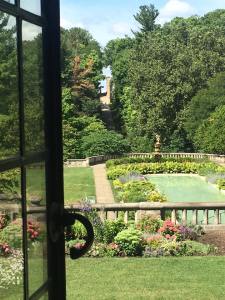
The view from Mr. Booth’s old office in Cranbrook house, showing the path I take to work.

My office is in Cranbrook House, and these European-style gardens, paired to the Manor-house architecture, provide some pretty amazing office views. While Winterthur’s gardens relied on color, massing, and the passing of time for effect, the gardens of Cranbrook are most impactful in their vistas. From one side of the house, offices look down a series of terraces toward the campus lake, another side over the reflecting pool, and my own view looks out over the circular court and fountain at the front of the house. These views, of course, were planned and enjoyed by George Booth, Cranbrook’s founder who lived and worked in Cranbrook House.

At both Winterthur and Cranbrook, gardens and landscapes provide a context in which to study great collections and their histories. I don’t think the value of a beautifully designed approach to your school or workplace can be overlooked—something with which I know du Pont at Winterthur, Booth at Cranbrook, and their designers agreed.

I’m looking forward to seeing how the seasons change my understanding of Cranbrook and its grounds, but for now, I’m going to head out and enjoy the perfect weather in these lovely gardens.

IMG_0240.JPG

Off I go to enjoy the grounds!

Kevin Adkisson Collections Fellow

Photo Friday: Diogenes’ Search for an Honest Man

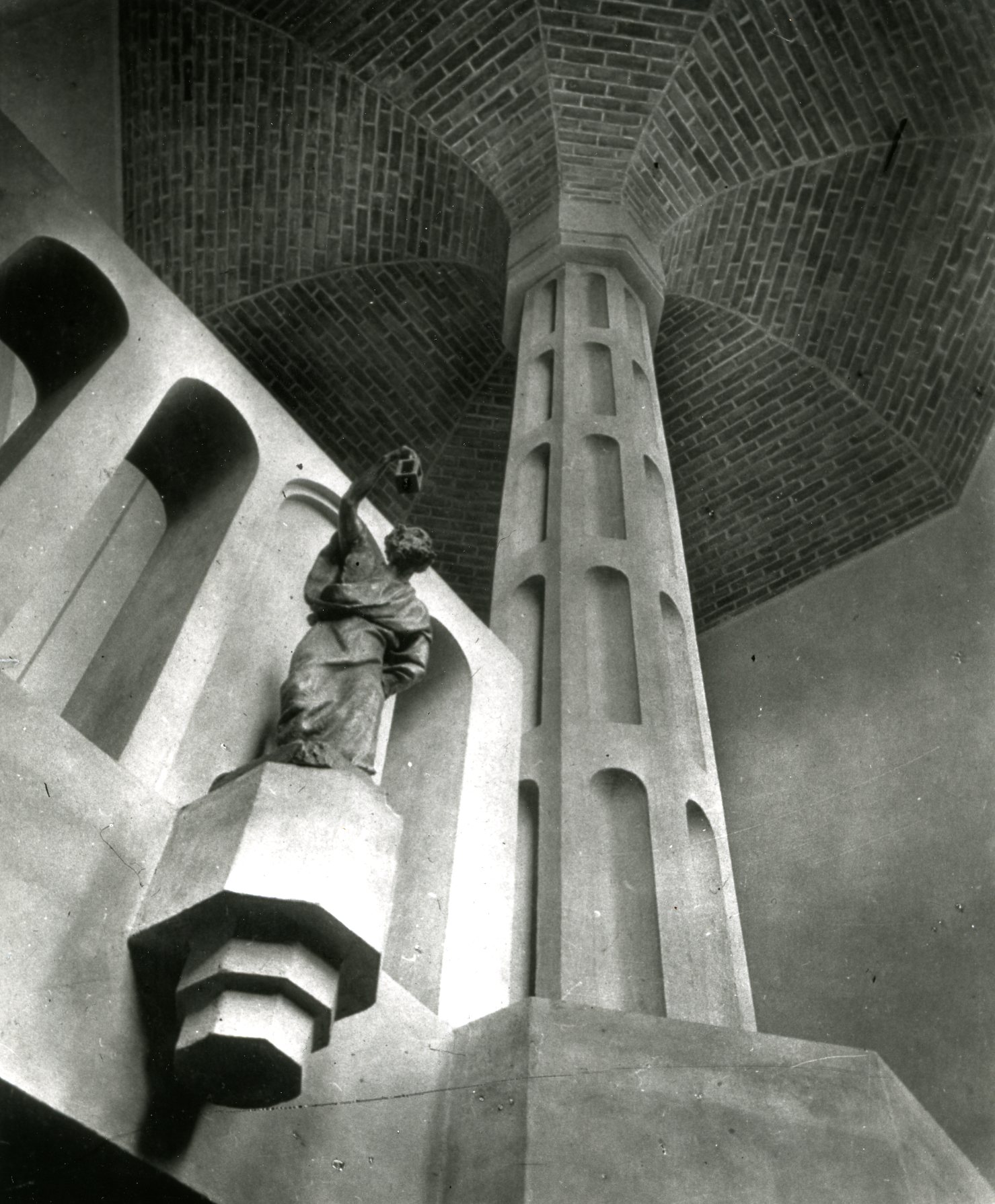
A view of Diogenes. Photographer, Harvey Croze, 1961.

A view of Diogenes. Photographer, Harvey Croze, 1961.

You might not immediately notice the small bronze statue that sits at the top of Hoey Tower’s stairwell at Cranbrook School. The statue is Diogenes – a Greek philosopher best known for holding a lantern and claiming to be on a quest for an honest man. Diogenes is considered to be one of the founders of Cynicism – a doctrine that supports a life in accordance with nature and rejects convention.

George Booth originally purchased Diogenes for Cranbrook House from the Gorham Silver Company in May 1914. One of the many statues he purchased during his lifetime, he bequeathed it to Cranbrook School upon his death.

Diogenes has been depicted throughout the centuries in paintings, drawings, and sculpture. Our sculpture was created by George Edwin Bissell (1839-1920) in 1906. Bissell, who was born in Connecticut, studied in Paris at the Academie Julian, the Academie Colarossi, the Ecole des Arts Decoratifs, and the Ecole des Beaux Arts. In 1876, he studied at the American Academy in Rome. He also served in the Civil War as a private in the 23rd Connecticut (1862-1863) and as assistant Postmaster for the U.S. Navy (1863, 1865).

Gina Tecos, Archivist

Three Women and a Conservator

One of the interesting components of our jobs as collections managers, registrars, and archivists is that we get to interact and learn from conservators in our fields. On Friday, three of us went down to Detroit and met with Giogio Ginkas of Venus Bronze Works. A non-descript warehouse building sported a gray metal door which led us into the lobby gallery where Giorgio has displayed art from his personal collection of metro-Detroit artists, including Cranbrook’s Gary Griffin. Then we walked into the “shop” where his tools and equipment are interspersed with numerous sculptures (primarily metal) in various stages of repair, restoration, and conservation.

Giorgio Ginkas explaining the conservation process for the Wishing Well. Courtesy Cranbrook Archives.

Giorgio Ginkas explaining the conservation process for the Wishing Well. Courtesy Cranbrook Archives.

Currently, Venus Bronze Works has three of Cranbrook’s works in his shop – two are awaiting reinstallation on the grounds, while the metal “arch” from the Wishing Well at Cranbrook House is just undergoing restoration.

Parts of the Wishing Well “arch” removed for restoration. One element was missing so a replacement piece had to be fabricated. Courtesy Cranbrook Archives.

Parts of the Wishing Well “arch” removed for restoration. One element was missing so a replacement piece had to be fabricated. Courtesy Cranbrook Archives.

Orpheus figure, restored and waiting to be reinstalled at Cranbrook Academy of Art (CAM 1931.9). Courtesy Cranbrook Archives.

Orpheus figure, restored and waiting to be reinstalled at Cranbrook Academy of Art (CAM 1931.9). Courtesy Cranbrook Archives.

For more on Venus Bronze Works, including Detroit’s own RoboCop statue, see: http://www.dailydetroit.com/2015/08/24/remember-robo-cop-statue/

Leslie S. Edwards, Head Archivist

Photo Friday: Opening Doors

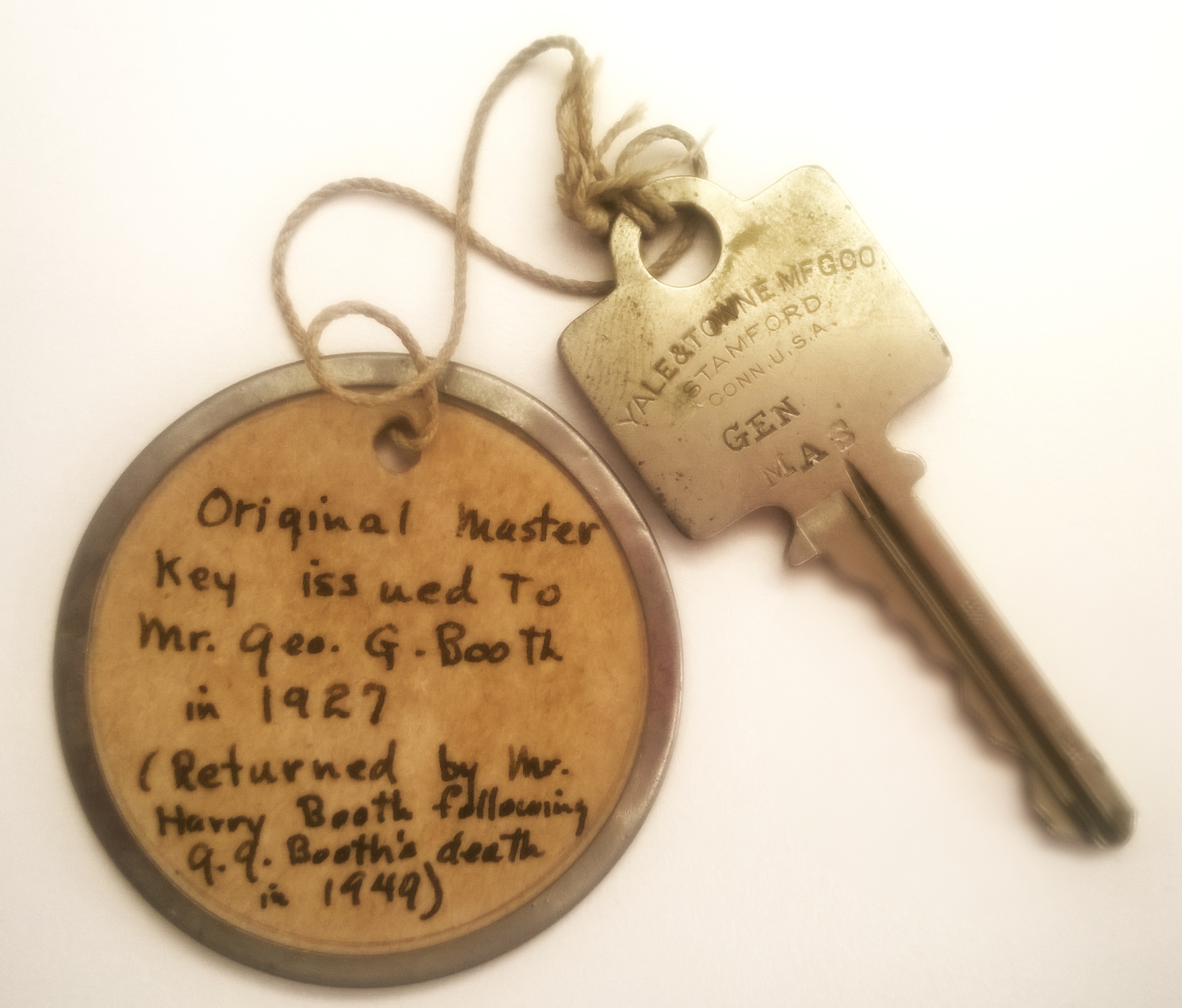
Today, while up in storage at Cranbrook House, we rediscovered the Master Key for Cranbrook School For Boys, given to George G. Booth in 1927. The locks have changed, after almost 90 years, but it is still fun to see and think about.

Cranbrook Schools original master key.

Cranbrook School original master key.

Bart Simpson: What’s that weird key for?
Ralph Wiggum: That’s Daddy’s magic key. It opens every door in town.
Bart Simpson: The police master key? Oh, Ralph. Do you realize what we can do with…

Like Bart Simpson in This Little Wiggy, what would you do with the Master Key to the Cranbrook Schools? I think I’d eat all the cookies in the dining hall . . .

Leslie Mio, Assistant Registrar

To Sit or Not to Sit

Chair design at Cranbrook has always had its own special niche and fascination among artists and patrons alike. George Booth altered chair designs for his own use at Cranbrook House. Eliel Saarinen designed unique chairs for Cranbrook School and Saarinen House. Ralph Rapson conceived of his chair design for what became known as the Rapson Rocker while a student here. Most of us are familiar with the famous chair designers, but what about projects by less famous designers?

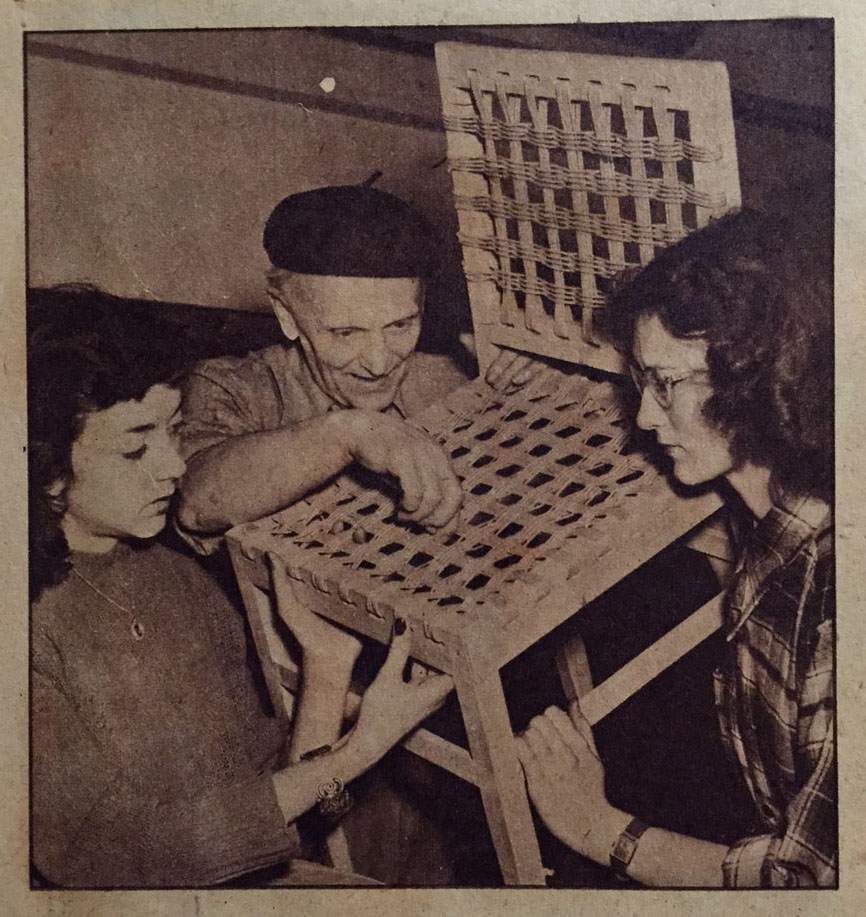
During the war years, Academy of Art students were encouraged to experiment with modern design and new and unusual materials. In 1944, Academy students Gloria Bucerzan and Jean Roberts designed and constructed a chair born of war shortages, by eliminating the use of springs and creating webbing using “non-critical” materials.

Gloria (left) and Jean with woodworking instructor Svend Steen, 1944. Copyright Cranbrook Archives.

Unknown student setting up work for Student Show, 1958. Copyright Cranbrook Archives.

Unknown student setting up work for Student Show, 1958. Copyright Cranbrook Archives.

Art Room, Early Childhood Center at Brookside School, 1997. Chairs designed by Dan Hoffman, Cranbrook Architecture Office. Photograph copyright Christina Capetillo.

Art Room, Early Childhood Center at Brookside School, 1997. Chairs designed by Dan Hoffman, Cranbrook Architecture Office. Photograph copyright Christina Capetillo.

For more on chair design in general, check out the 2012 Year of No-Chair-Design and the Guide to Great Chair Design which features links to chair blogs, the history of chair design, museums, galleries, and books that all feature what else? Chairs!

Leslie S. Edwards, Head Archivist

I Have a Crush on James Scripps Booth

After the second week of May, I readily began my Senior May Project, an intensive program that allows second semester seniors to explore a field of study for three weeks. Pulling open the imposing silver doors of the Cranbrook Archives on my first day, I had no idea what truly occurred on the other side. As I, with the fumbling hands of a novice, used fundamental archival tools such as finding aids, vertical and photo files, indexes, backlogs, and the digital image database over the course of the three weeks, I began to understand what an archivist does behind those argent doors.

Margaret Harney, CKU '15

Margaret Harney, CKU ’15

Honestly, it is a lot of filing. Archivists receive chaotic and often decaying papers, photographs, and other documents deemed worthy of being preserved, and they organize them into various categorizes and topics. Everything has a place, and that place is well recorded in differing indexes and inventories. As a person whose nickname as a child was “Messy Meg,” I inevitably struggled to learn the complex organizational system. Often, I would stand in a dim corner of the archives, afraid of disarranging the gray archival boxes like some omnipotent entropic force, or a two-year-old. Thus, in the second week when I was tasked with organizing three filing cabinets of photographs from Cranbrook Kingswood post-merger, I inwardly panicked. Once I removed the folders, I discovered that they were in complete disarray from the disinterested teenager who had supposedly organized the cabinets before me. While their quite arrogant lack of effort often made me want to pry my muscles from my bones, it also relieved my anxiety, for I knew no matter how badly I mismanaged the cabinets, it would never be nearly as appalling as it was prior.

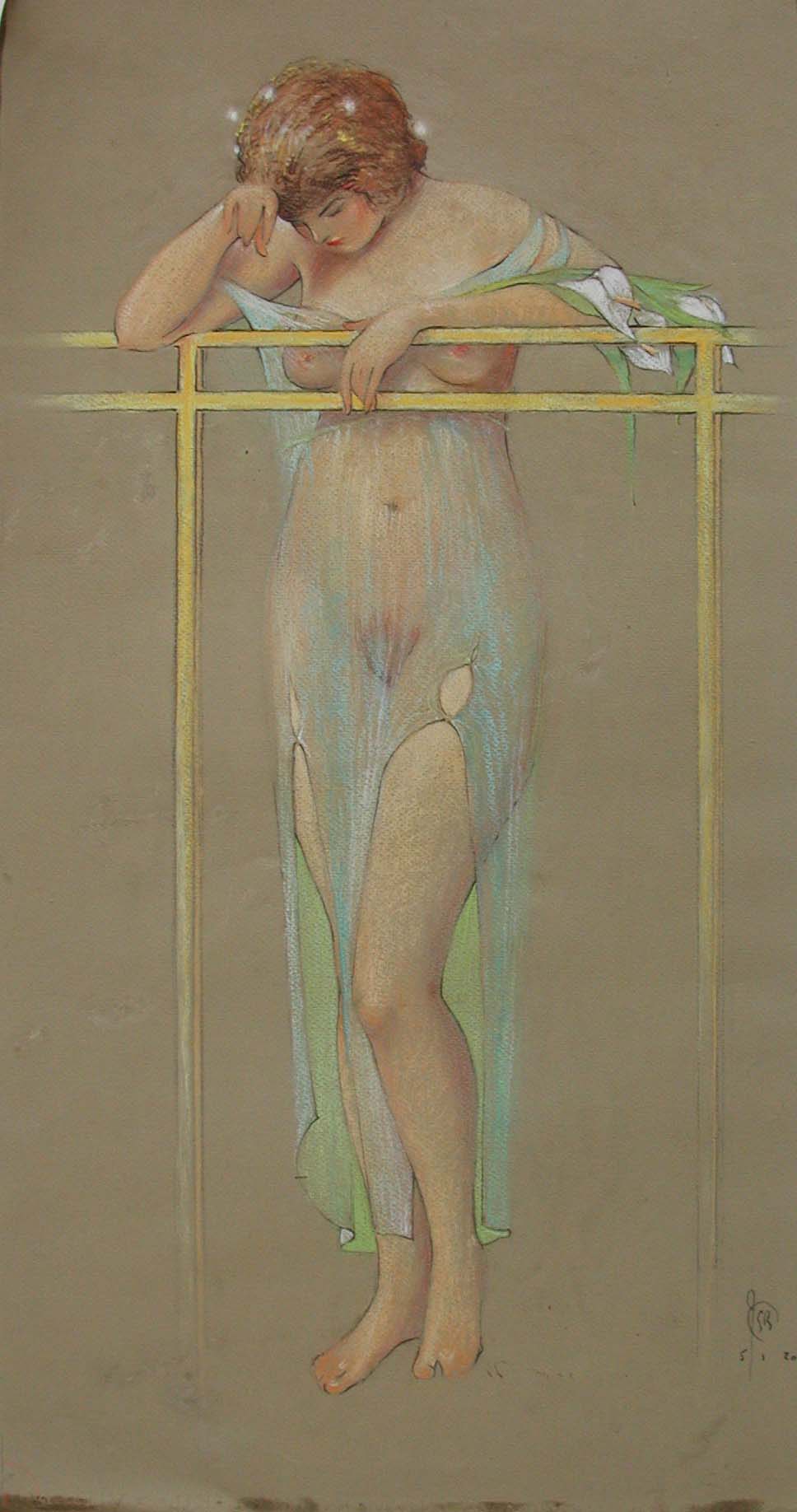
Study for Blessed Damozel, 1920.  James Scripps Booth

Study for Blessed Damozel, 1920. James Scripps Booth

After finishing the cabinets, I helped Ms. Edwards rummage for posters in the metallic archive vaults, and there in James Scripps Booth’s yellowing, rigid pastels, I discovered why an archivist undertakes all that grueling and mind-numbing filing. Beneath the waxy paper shielding the drawings, nude female figures innocently and exquisitely revealed themselves among impatient pastel strokes. While I was beguiled by the striking beauty of the sketches, I was equally as captivated by their ability to reveal the whims of Booth. Thus, not only the women, but Booth as well lay exposed. Such drawings and degenerating documents that archivists strive to preserve are like little vitrines displaying various aspects of the past. Each frame depicts a story and when all the frames combine, a larger impression is formed. Like an ink blot, this impression allows the viewer to decide what the greater story is. The ability to interpret the past for yourself is a rare and remarkable privilege, and that was the greatest gift my time in the archives gave me.

Cranbrook House, 1917.  James Scripps Booth

Cranbrook House, 1917. James Scripps Booth

Margaret Harney, CKU ’15

The Ramp of the Chinese Dog

For George Gough Booth, the vista from Cranbrook House to the Ramp of the Chinese Dog was a crucial one – he could see the Cranbrook Art Museum from his west wing office at Cranbrook House and the Chinese Dog guarding the entrance.

Though Cranbrook’s sculpture is commonly referred to as the “Chinese Dog”, the sculpture is actually a stone lion. In October 1940, George Booth purchased the lion from S. & G. Gump Co. in San Francisco and it is considered to be from the Wei Dynasty (386-557). A buyer for Gumps had acquired it in Beijing, China in 1938 where he was told that the lion came from the “Ta Fo Tze Temple in Chien Ting Fu Prefecture in Hopei.” Hebei (Hopei) Province is known for its stone and iron lions, and lion sculptures similar to the one at Cranbrook are still located at the entrance to the Ta Fo Tze Temple, now known as the Longxing Temple.

lion096

“Sacred Lion-Dog,” S. & G. Gump Co.’s showroom, San Francisco, ca 1940. Courtesy Cranbrook Art Museum.

During the Ming Dynasty, sacred guardian lions were placed in front of palaces, government buildings and temples as a symbol of bravery, power and good luck. In Western countries, the lions are often referred to as “Fu Dogs” as the word “fu” means Buddha or prosperity. George Booth placed another pair of Chinese stone lions at Cranbrook House, as well as several other stone lion sculptures around the grounds. In addition, he purchased two terracotta lions for the quadrangle at Cranbrook School, and numerous other objects with representations of lions in them including stained glass medallions, stone panels, and a gilt bronze lion sculpture by Carl Milles. As I write this, I am thinking that it would be an interesting project to research just what Booth’s interest or fascination (obsession?) with lions truly was.

CR4066

One of two terracotta lions at Cranbrook School. Filmmaker Brad Mitzelfeld behind the camera, 1970. Harvey Croze, photographer. Courtesy Cranbrook Archives.

Leslie S. Edwards, Head Archivist

Discoveries Around Campus

The dormers at Cranbrook House. Cranbrook Archives.

The dormers at Cranbrook House. Cranbrook Archives.

The staff at the Center for Collections and Research work closely with the Capital Projects and Facilities staff on campus restoration and repair projects. The archival staff often provides historical photographs, documentation, and architectural drawings to the project managers. Sometimes the staff makes interesting discoveries during the projects they are working on and share them with us.  The other day Craig Hoernschemeyer (Project Manager for Capital Projects) was in the archives looking for a historic photograph of a dormer window on the east addition (1918-1919) of Cranbrook House.  As luck would have it, he found one.  The following is from Craig:

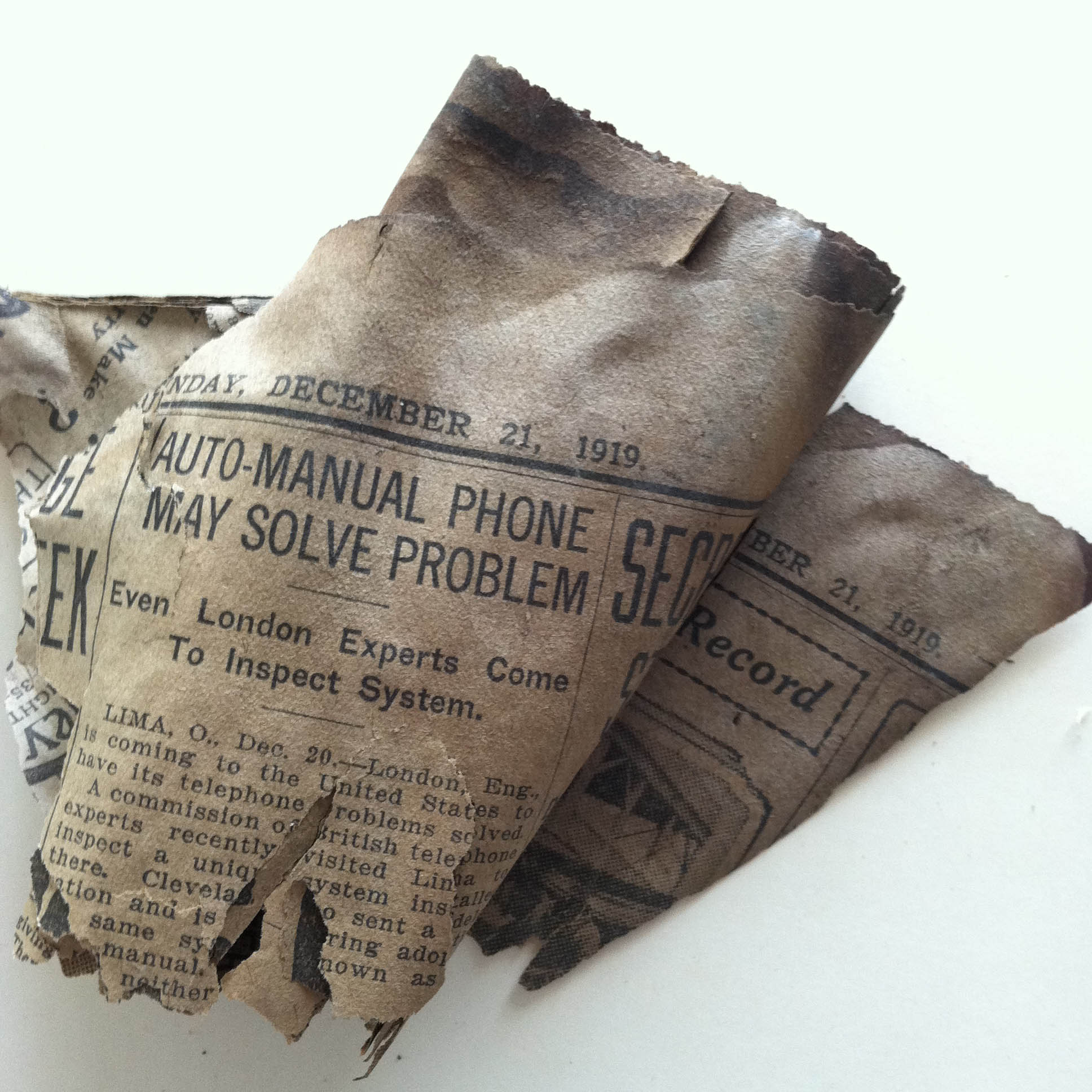
“Today, when the copper roof was opened up on that dormer – center right in the photo [above]- we found a bunch of newspaper mixed in with the insulation. It was no surprise that it was The Detroit News, but it was dated the first day of winter, December 21, 1919. It was there during the original construction of the wing.”

Detroit News, 1919. Photo Craig Hoernschemeyer.

Detroit News, 21 Dec 1919. Photo Craig Hoernschemeyer.

Leslie S. Edwards, Head Archivist

Create a website or blog at WordPress.com