It’s all in the details: Cranbrook’s Homestead Property

In 1914 George Gough Booth commissioned the Coats & Burchard Company to complete an appraisal of the “Homestead Property” which included a full inventory of Cranbrook House and its outbuildings. This was not uncommon, and Booth continued the practice several times during his life as the Cranbrook campus and its buildings grew and changed.

Blog_1.26_image1

Selection of Cranbrook House flooring materials. Courtesy Cranbrook Archives.

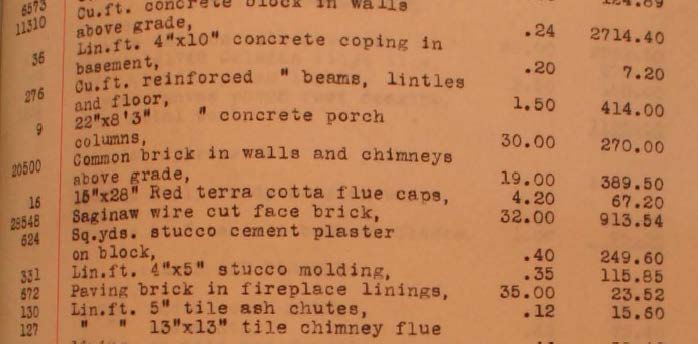
Since Cranbrook House was constructed in 1908, the 1914 appraisal ledger is the first in our collection, and is markedly different from the subsequent ones. The biggest difference is that in addition to the furnishings and artwork, all building materials, down to every last detail including number of bricks used, cubic feet for flooring, and even all of the hardware was judiciously and meticulously cataloged.
Blog_1.26_image2

Selection of “Bill of Materials” for Cranbrook House. Courtesy Cranbrook Archives.

This ledger and the others (which were taken in 1921, 1933, 1937, and in 1944) have been immensely helpful in historic research of the home and properties. They can be used to help locate objects in their original location in the house, and often point to the year they were purchased and even original purchase invoices. Using this ledger in conjunction with the original drawings and blueprints have been assisted campus architects and project managers with restoration projects on campus as well as projects which determine the structural integrity of buildings for building use and preservation.

Stefanie Kae Dlugosz, Collections Fellow, Center for Collections and Research

Lighting Up Cranbrook House: Edward F. Caldwell & Co.

HT_2014_1

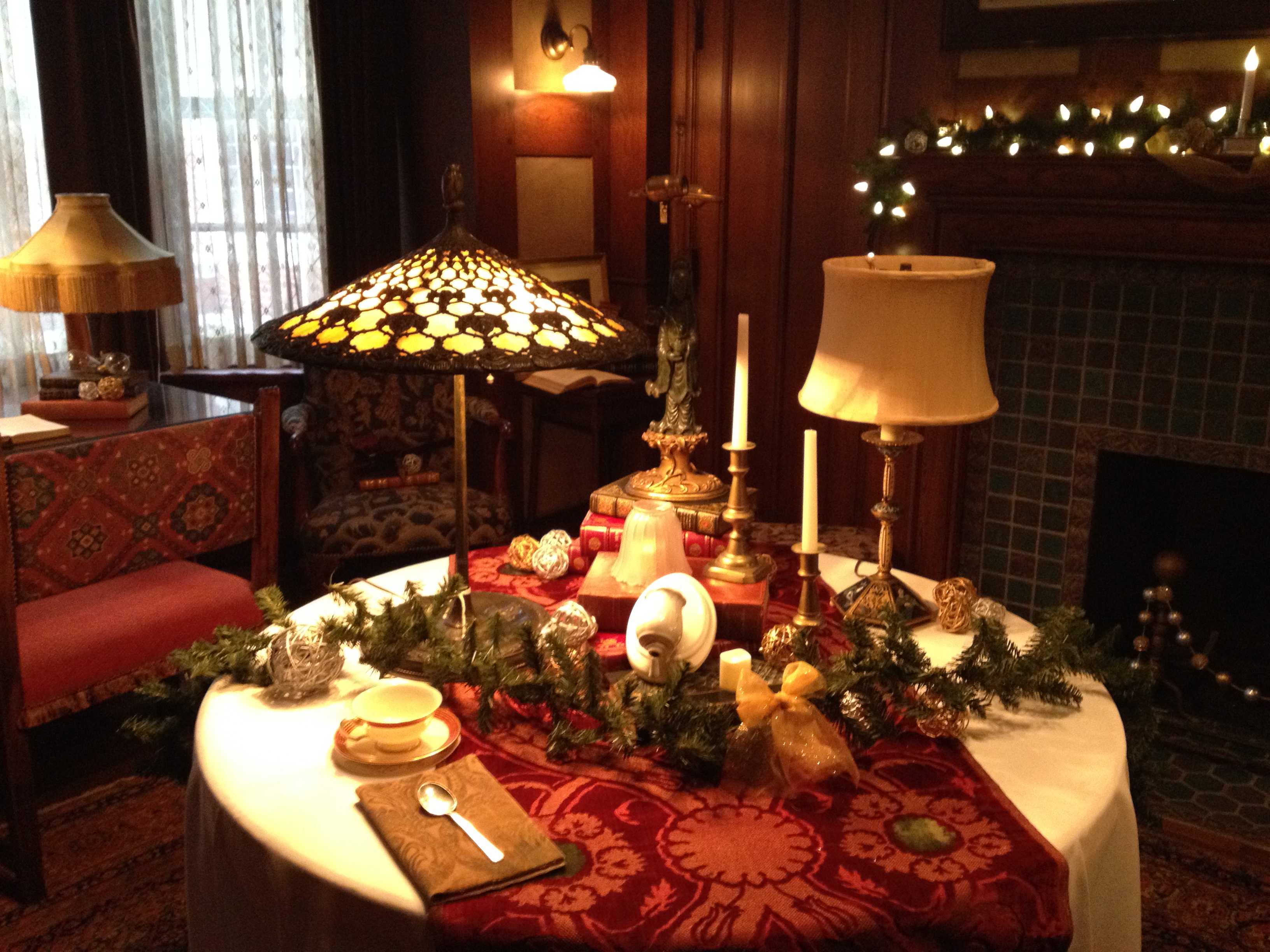
Holiday Tables, 2014. Stefanie Dlugosz, photographer.

This past weekend the Center for Collections and Research put on a display for Holiday Tables at Cranbrook House, organized by the Cranbrook House and Gardens Auxiliary.  Associate Registrar Gretchen Sawatzki and I put together a display highlighting the electric lighting original to the home, focused on lamps and lighting by the Edward F. Caldwell & Company.

Cranbrook House was designed and built in 1908, and George Gough Booth always had the intention of having electric lighting throughout the home. Within the city of Detroit there had been an interest in electricity, and by 1906 there were two power plants on the Detroit River owned and operated by the Detroit Edison Company. However, with Cranbrook House being roughly 20 miles to downtown Detroit, this was an achievement. The Booth’s interest in innovation propelled them to always be ahead of their time by investing in the newly available widespread utility for their home.

HT_2014_2

Holiday Tables, 2014. Stefanie Dlugosz, photographer.

HT_2014_3

Holiday Tables, 2014. Stefanie Dlugosz, photographer.

In the first half of the twentieth century Edward F. Caldwell & Company was America’s premier design and manufacturer for electric light fixtures. The New York firm founded in 1895 created designed and works with several prominent clients at the time including the Frick, Morgan, and Carnegie families. Much of their work was done in tandem with architectural commissions, and therefore clients like Booth were able to provide input and alter details to customize their lighting choices. Booth provided his own ideas about a few pieces for the home, but overall selected most of the pieces directly from their catalogues. During the construction and design of Cranbrook House, George G. Booth was actively involved in conversations with Albert Kahn, the architect, and many of the vendors providing goods and products for the home. Booth was enthusiastically involved in providing input on the design elements of the home, and the lighting was no different. Many of the Edward F. Caldwell & Co. catalogues can be found online through the Cooper-Hewitt Museum Library, Smithsonian Institution Libraries

Stefanie Dlugosz, Collections Fellow, Center for Collections and Research


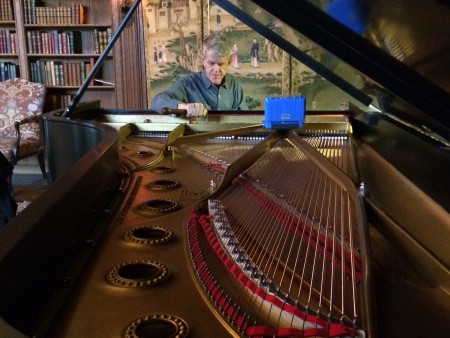
Photo Friday: Tuning a Concert Grand

Hugh Gulledge patiently tunes the 1929 Steinway & Sons Model D Concert Grand in the West Wing Library of Cranbrook House. Photographer: Gretchen Sawatzki

Hugh Gulledge patiently tunes the piano in the West Wing Library of Cranbrook House. Photographer: Gretchen Sawatzki.

In 2013, the Cranbrook House and Gardens Auxiliary took action to restore the 1929 Steinway & Sons, Model D Concert Grand Piano currently housed in the West Wing Library of Cranbrook House. After traveling to the Steinway & Sons factory in New York, it underwent a nine-month restoration process which included a new sounding board, bridges, strings, and action components. The piano was returned this past June where it sat acclimating to the environment of the house after taking such an extensive trip and waiting to be played. This past Thursday, Hugh Gulledge, a registered piano technician put the finishing touches on the piano, tuning and voicing it for its official unveiling. On Thursday, November 20, 2014 the Concert Grand will make its public, post-restoration debut at the Cranbrook House and Gardens Auxiliary’s annual fund raising event Holiday Tables 2014

Gretchen Sawatzki, Associate Registrar

Photo Friday: The Fate of the North Gates

Arriving at  Cranbrook House you have probably noticed the large wrought iron entrance gates that welcome guests to the property along Lone Pine Road. A collaborative design by Cranbrook Founder, George Gough Booth (1864 – 1949) and Polish-American blacksmith, Samuel Yellin (1885 – 1940), this pair of gates were completed in 1917and are among the most cherished historic decorative elements at Cranbrook. But did you know that they are not the only gates that were a Booth-Yellin collaboration situated on the property?

North Gates

The North (Woods) Entrance Gates in Yellin’s studio, 1917. Courtesy Cranbrook Archives

Affectionately referred to as the North Gates, the gates seen in this photograph were also a collaborative design by Booth and Yellin. Forged by Yellin in his Philadelphia studio in 1917, the North Gates were installed as a part of a stone entrance wall at the old Cranbrook House entrance drive just north of Kingswood School on Cranbrook Road. When the drive was closed to re-route traffic to the house, the gates were ultimately removed and put into storage where they have remained – until now! Next week the North Gates will be leaving Cranbrook for a short journey to Cleveland for a full restoration. The six month project will include the fabrication of hand-wrought ironwork to replicate missing elements, chiseling to recreate bird faces and leaf veins, sandblasting, and the replication of a historic surface finish. Upon their return next spring the gates will be reinstalled at the new exit drive at Cranbrook House on Lone Pine Road just west of the South Entrance gates. So keep your eyes peeled for the triumphant return of the freshly restored gates!

CECT852det11

The original site of the North Gates as it appears today on Cranbrook Road. Photographer, Gretchen Sawatzki


Gretchen Sawatzki, Associate Registrar


To check out some more gate related information click here and here!

Photo Friday: A Splash of Color

Kingswood School Rose Lounge. Cranbrook Archives

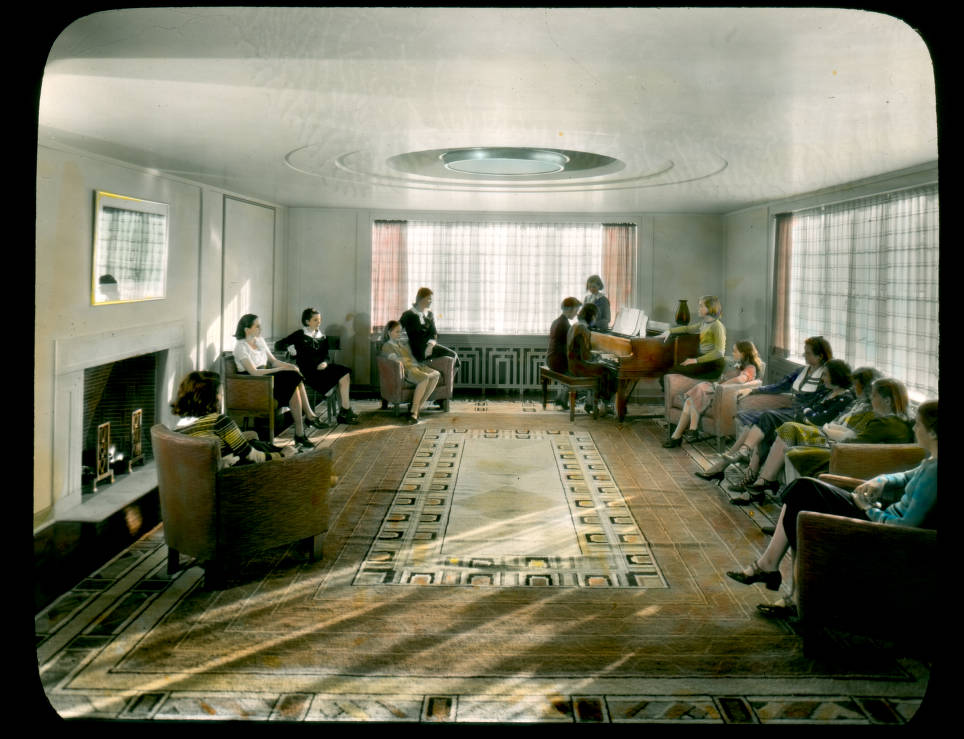
Kingswood School Rose Lounge, The Cranbrook Hand-Colored Lantern Slide Collection. Cranbrook Archives

As the weather here at Cranbrook is more than a little dreary, today’s photo provides a look into a bright and cozy atmosphere perfect for reading, relaxing and being inside. Taken around 1932, it shows a group of students gathered in the lounge of the Kingswood School dormitory (originally known as Reception Room III) listening to two of their peers play the piano. The photograph comes from Cranbrook Archives’ Hand-Colored Lantern Slide Collection. The photographs in this collection were originally black-and-white and were painted with watercolor years later, and not by the original photographer. This jump in time explains the vibrant color choices in the photograph as the painter was not present when the image was originally captured.

The Cranbrook Hand-Colored Lantern Slide Collection contains over 30 images of Cranbrook institutions taken primarily during the 1920s and 1930s. Several of the original black and white images were taken by architectural photographers for inclusion in publications.

Today’s photo was taken by George W. Hance, Cranbrook’s first paid staff photographer (1931-1932). Hance had been commissioned by George Booth as early as 1916 to photograph his art collection and later photographed Cranbrook’s campus and grounds including Kingswood, Cranbrook House (home to George and Ellen Booth) and Thornlea (home to Henry Scripps Booth). Explore more photographs like these on our digital image database or in person at the Archives!

Stefanie Dlugosz, Collections Fellow, Cranbrook Center for Collections and Research


Happy Belated Birthday to Our Founder!

September 24th marked the 150th birthday of Cranbrook’s founder, George Gough Booth. Born in Toronto, Mr. Booth had an early interest in art and architecture. In 1881 his family moved to Detroit and he put his artistic talents to work by purchasing half of an interest in an ornamental ironworks firm. The business was successful and used many of Booth’s product designs.

George Gough Booth, ca 1876.  W. E. Lindop, photographer.  Cranbrook Archives

George Gough Booth, ca 1876. W. E. Lindop, photographer. Cranbrook Archives

In 1887 Booth married Ellen Warren Scripps, daughter of Detroit News founder James Scripps. The following year he sold his share in the ironworks business and joined the News staff as its business manager. The News blossomed under Booth’s direction, becoming one of the leading metropolitan dailies in the nation. In 1906, Booth became president of the newspaper, succeeding his father-in-law.

In 1904 George and Ellen Booth purchased a run-down 174 acre farm in Bloomfield Hills and named it Cranbrook after Booth’s ancestral town in England. Booth called upon his long-time friend, and noted Detroit architect, Albert Kahn, to prepare working drawings for the building of Cranbrook House. Kahn responded with an English Arts and Crafts inspired design the Booths moved into their new home in 1908.

In 1922, believing their country estate could serve a larger public purpose, the Booths shifted their focus toward building the six institutions at Cranbrook: Brookside School, Christ Church Cranbrook, Cranbrook School (for boys), Cranbrook Academy of Art, Cranbrook Institute of Science, and Kingswood School (for girls). George Booth was a visionary, and with his wife Ellen, set new standards for generosity, leaving us a legacy we are proud to be a part of. Happy belated birthday George!

“We were unwilling to go through life with our aims centered mainly in the pursuit of wealth and with a devotion wholly to the ordinary opportunities for social satisfaction.  We were not willing to leave all of the more enduring joys for our children or the joy of work in so good a cause entirely to our friends after we had passed on; rather did we wish, in our day, to do what we could and give tangible expression now to our other accomplishments by adventures into a still more enduring phase of life.  We wished to see our dreams come true while we were, to the best of our ability, helping to carry on the work of creation.”  (George Gough Booth, Address at Founders Day, October 28, 1927)

Gina Tecos, Archivist

Photo Friday: Ciao Cranbrook!

Italian workers at Cranbrook

Italian laborers at Cranbrook, ca 1906/Cranbrook Archives

For many Americans, Labor Day’s most popular meaning is a “last hurrah to summer,” but its national significance is much greater than that. In 1894, Grover Cleveland designated the first Monday in September as a national holiday paying tribute to the contributions and achievements of the working force in America. The Italian laborers pictured here arrived at Cranbrook in 1905. Hired by George Booth, men with the last names of Angelosanto, DiPonio, Roselli, Soave, and Vettraino built roads and stone walls, dug ponds, contoured the land, planted, and cared for the property. In 1955 the Cranbrook Foundation Board of Trustees dedicated a plaza north of the Brookside School in appreciation of groundskeeper Michael Vettraino’s 50 years of service to the Cranbrook community. In his speech at the “Piazza Vettraino” dedication, Henry S. Booth said, “We acknowledge a debt to his native Italy, his affection for the world of growing things, his quest for beauty, his tireless hands and feet, and the part he has played as one of the many founders of Cranbrook today.”

Click here to listen to a clip from our oral history collection of Dominick Vettraino speaking about the work the Italians did on the grounds of Cranbrook.

Gina Tecos, Archivist

Dear Diary: Women in Their Own Words

“When women tell their life stories in their own words, a distinct enthusiasm, engagement and affirmation emerges . . . these are the stories in which women are the central actors, even if their stories are camouflaged by modesty and disclaimers.” So writes Judy Nolte Lensink in Perspectives on Women’s Archives. One of the most common ways in which women tell their life stories is through their personal diaries. The stories can range from day-to-day events, personal reflections, or comments about the world at large. Nearly every archive has diaries in its collection, and ours is no exception. Below are a few examples of the range of journals found in the Cranbrook Archives.

Harriet Messinger Scripps, circa 1872. Cranbrook Archives.

Harriet Messinger Scripps, circa 1872. Cranbrook Archives.

Continue reading

Cranbrook and the Car: A Different Look

Currently on display, the exhibition A Driving Force: Cranbrook and the Car thoughtfully illustrates two key ways in which Cranbrook has been affiliated with the automotive industry throughout its history.  James Scripps Booth was an avid artist and inventor, even taking apart, rebuilding and designing cars in the garage of Cranbrook House from an early age.  Later on, the Academy of Art encouraged students to enter competitions which included designs for Packard Motor Car hood ornaments (1934) and exterior design, hood ornaments and trunk lid medallions (1950).  Graduates were employed by the Big Three automakers in a variety of ways—working in the design studios building models for new cars, as part of Harley Earl’s “Damsels in Design,” and as textile designers for automotive interiors.

But Cranbrook’s relationship with the car goes beyond the realm of design.  The Booth family’s list of cars includes a Winton (1904), a Christie (1904), a Cartercar (1907), two Pierce Arrows (one was a limousine), a Brush Runabout (1910), a Chalmers 40 (1910), a Lozier “Briarcliff” (1911) and a Detroit Electric (1921) which was driven by Henry Wood Booth at the age of 88.

Warren and Grace Booth with chauffeur in the Chalmers 40 in front of Cranbrook House. Circa 1910, Cranbrook Archives.

Warren and Grace Booth with chauffeur in the Chalmers 40 in front of Cranbrook House. Circa 1910, Cranbrook Archives.

Continue reading

Photo Friday: Holiday Tables

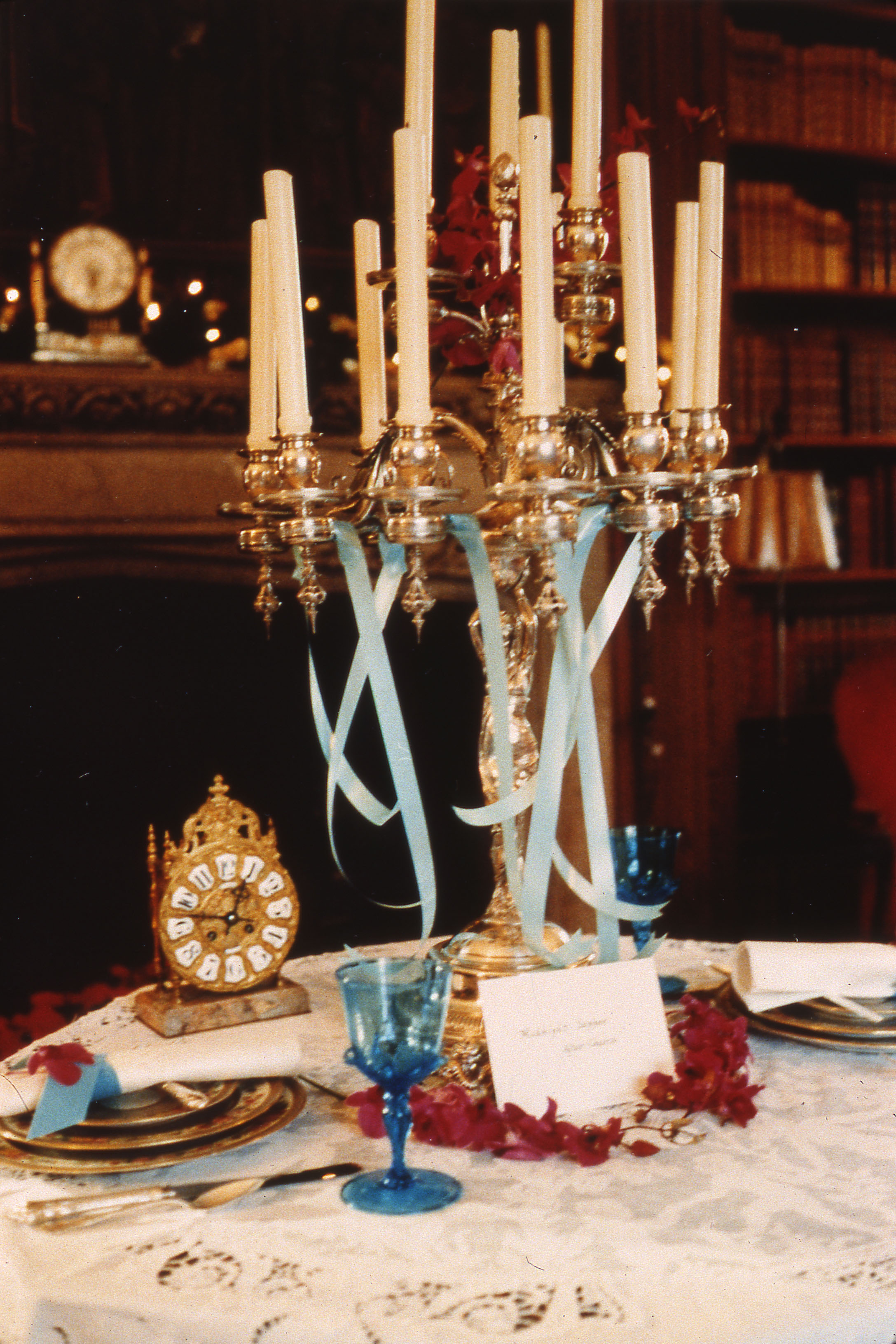
A 1988 Holiday Tables display features a candelabra and antique clock.  1988, Cranbrook Archives.

A 1988 Holiday Tables display features a candelabra and antique clock. 1988, Cranbrook Archives.

Since 1975, the Cranbrook House and Gardens Auxiliary has hosted their glamorous yearly fundraiser “Holiday Tables” in November.  An invitation to local retailers and decorators to show off their holiday decorating chops, Holiday Tables also gives participants a new view into Cranbrook House.  Filled for a brief time with contemporary and thematic design, visitors get to see what Cranbrook House looks like as a bustling house and pretend for a few short days that they live there.  Here, an exhibitor from the 1988 Holiday Tables shows off a candelabra center piece on a table in the library.

Create a website or blog at WordPress.com