Some years ago, former Cranbrook Archivist, Robbie Terman, posted a short blog post on one of the Titanic’s sister ships, RMS Olympic. In recent years, Cranbrook Archives has responded to numerous requests for images of the Olympic which are preserved in the first volume of Harry Scripps Booth’s Pleasures of Life albums.
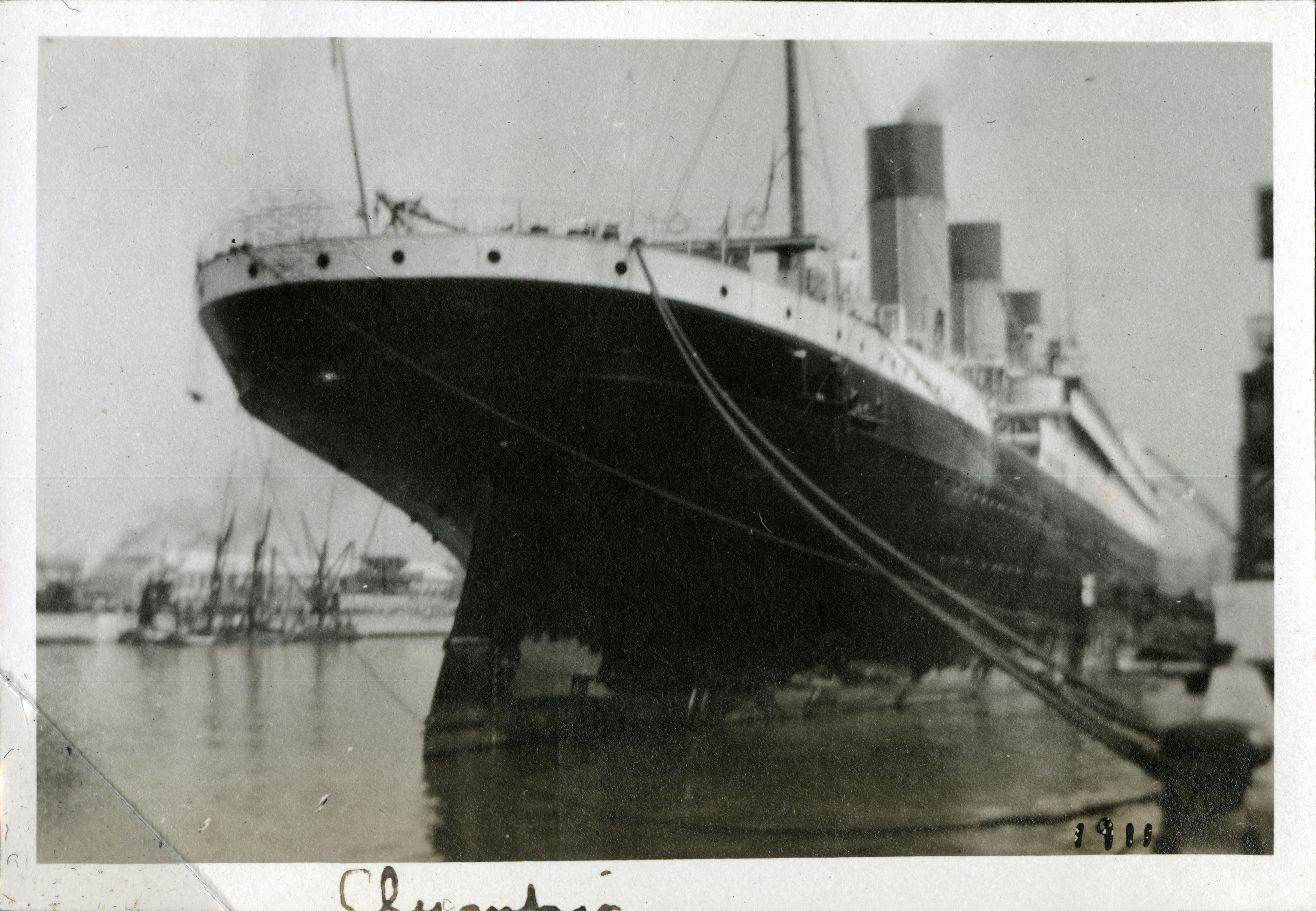
View of RMS Olympic before its first eastward crossing, June 28, 1911. [POL1.14.5]. Courtesy of Cranbrook Archives, Cranbrook Center for Collections and Research.
On June 28, 1911, the Booth family took the first eastward crossing of RMS Olympic from New York to Southampton, England. The family at that time was George and Ellen Booth; James Scripps and Jean McLaughlin Booth who had married the previous year; Grace, Warren, Henry, and Florence. They were joined by their Grand Rapids cousin, Esther Booth.
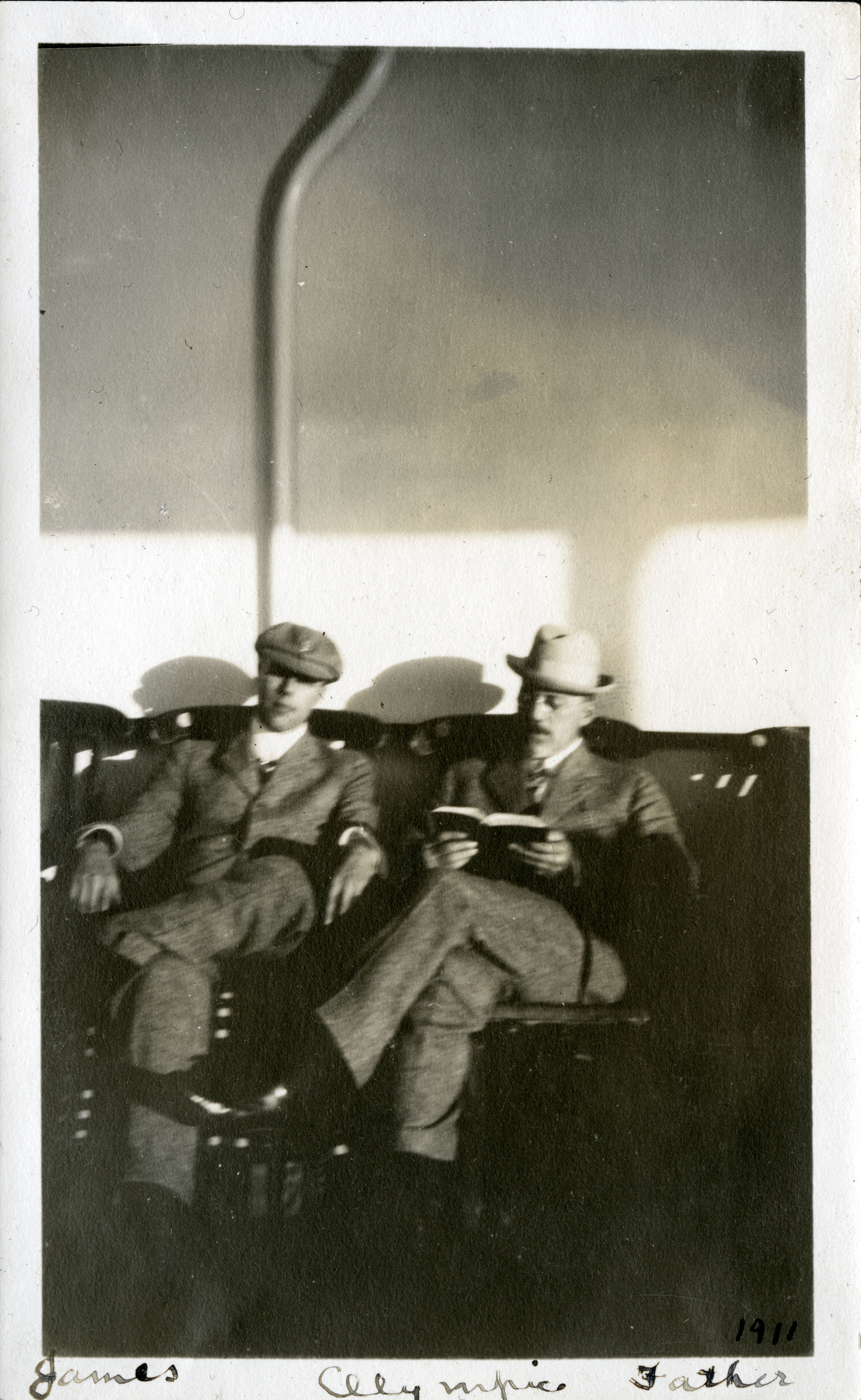
As I come from a maritime nation, these requests are particularly intriguing to me. I have wondered what other archives we have at Cranbrook to tell the story of transatlantic crossing and explain some of the images. George Gough Booth kept a record of the expenses in planning for the trip. These records tell us that he booked the steamship tickets with the Christian Leidich Travel Bureau in Detroit and he purchased Motor Union badges for himself and James.
James Scripps Booth and George Gough Booth on the RMS Olympic, July 1911.[POL1.10.2] Courtesy of Cranbrook Archives, Cranbrook Center for Collections and Research.
As Henry recalls in his memoir after listing the family members who sailed,
“That wasn’t enough. Parks, the chauffeur, went; also The Pierce-Arrow, a 7-passenger touring car, and a Lozier Briarcliff, which accommodated four plus one in an airy seat on the left running board, designed for the chauffeur when the “master” took the wheel. That seat was a thrill for the young at heart.”
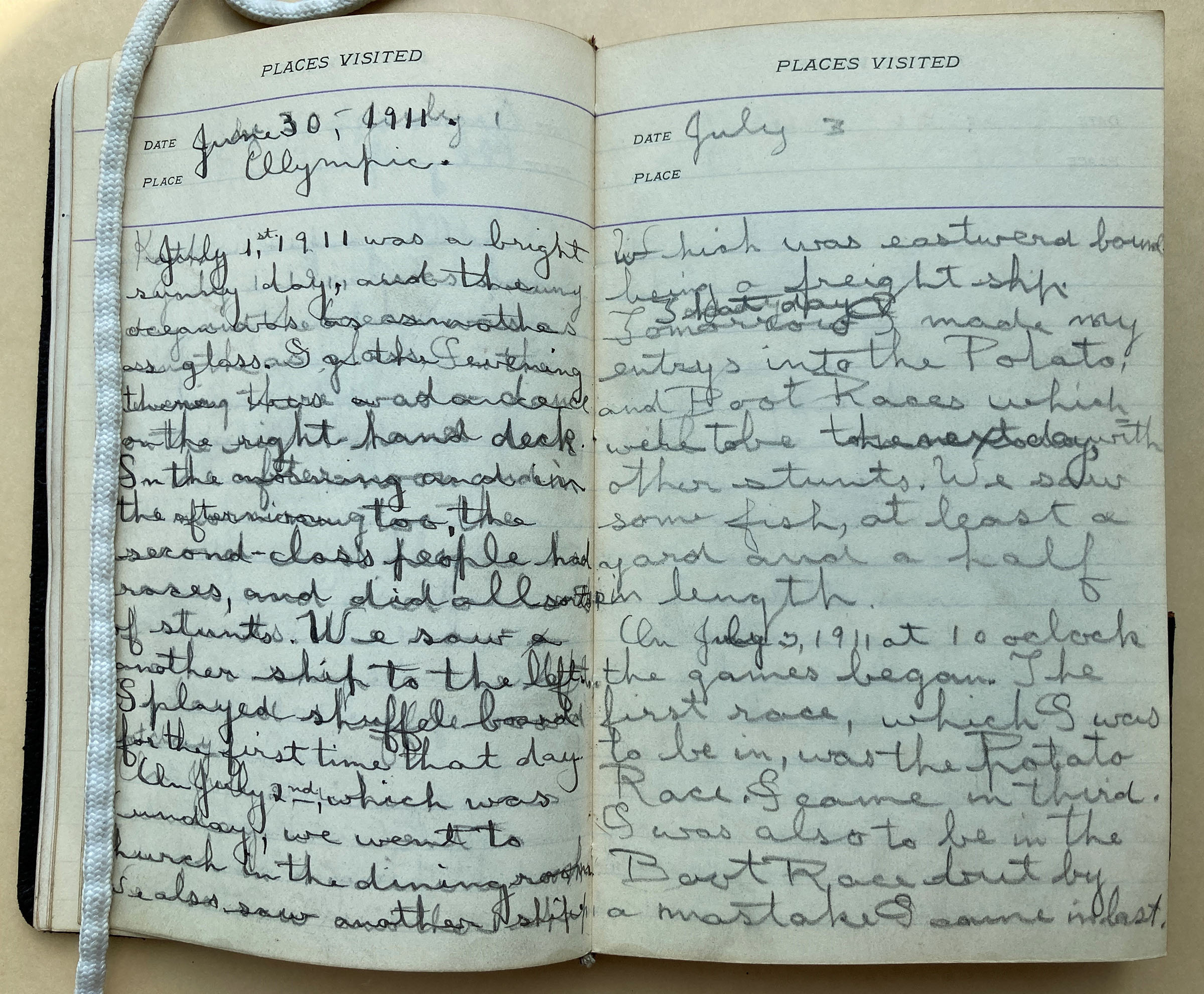
Then I came upon something quite wonderful—Henry’s journal of the sea crossing! He began the trip when he was just 14 years old, celebrating his 15th birthday in August during the vacation. As I read the entries, the images in the Pleasures of Life came alive. Here follows some moments from the journey in Henry’s words.
“Stayed at the Plaza. Esther’s trunk was lost. We found it later. On June 28, we went abord [sic] the great ship, “Olympic.” Henry Scripps Booth, June 27, 1911
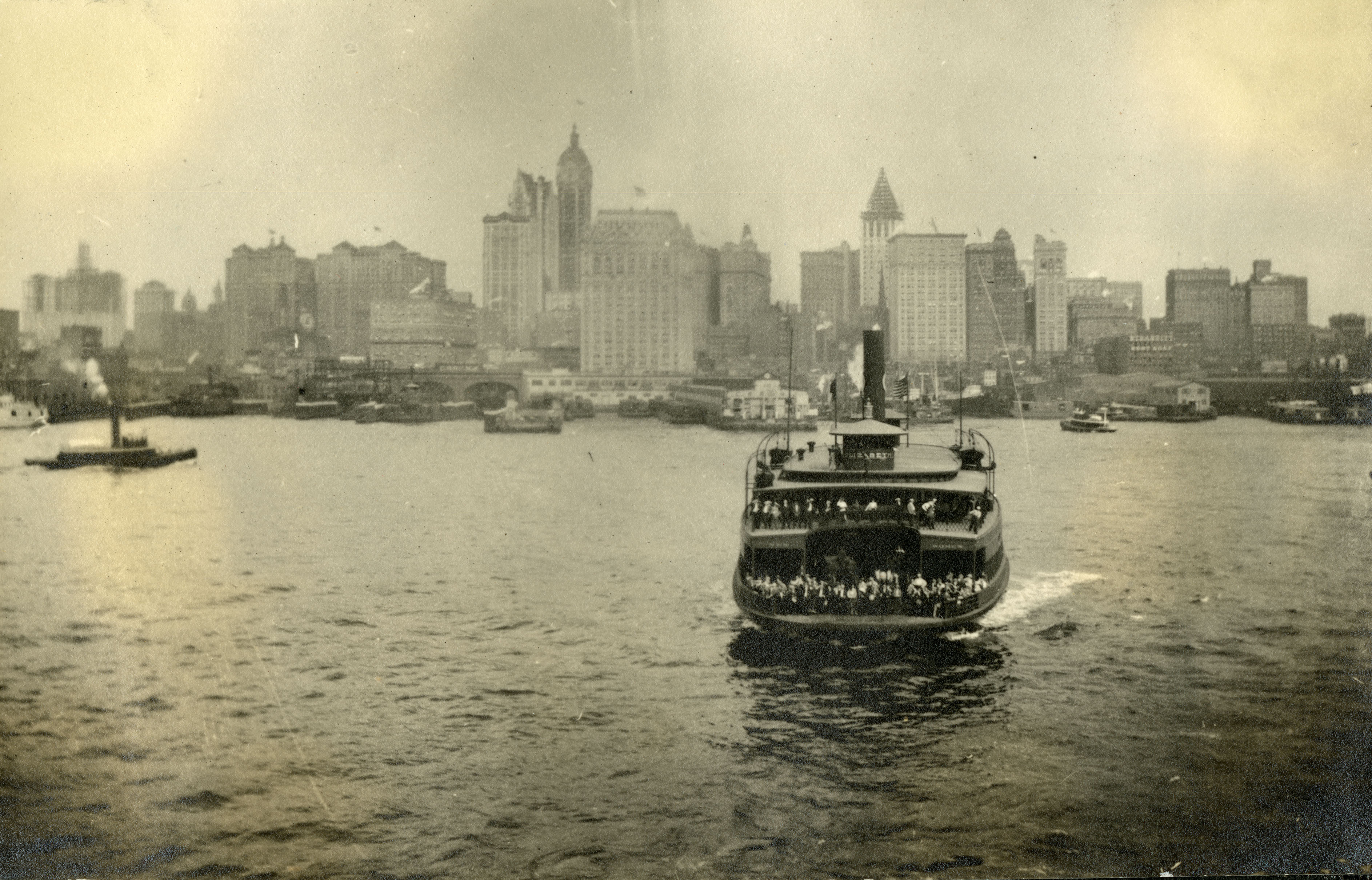
Leaving New York, June 28, 1911. Courtesy of Cranbrook Archives, Cranbrook Center for Collections and Research.
“On June 28, we went abord [sic] the great ship, “Olympic”. The Olympic is a fine ship. Florence was sick first night and day. It was somewhat rough on June 29th. I met a new friend but did not remember his name. In the morning, I could hardly stand, because of the new sensation. I was somewhat sick, but ate lots and I felt fine.” Henry Scripps Booth, June 28, 1911
“On June 30th the Campania was in view. I got acquainted with two girls, Constance Peabody and Katherine somebody.” Henry Scripps Booth, June 30th, 1911
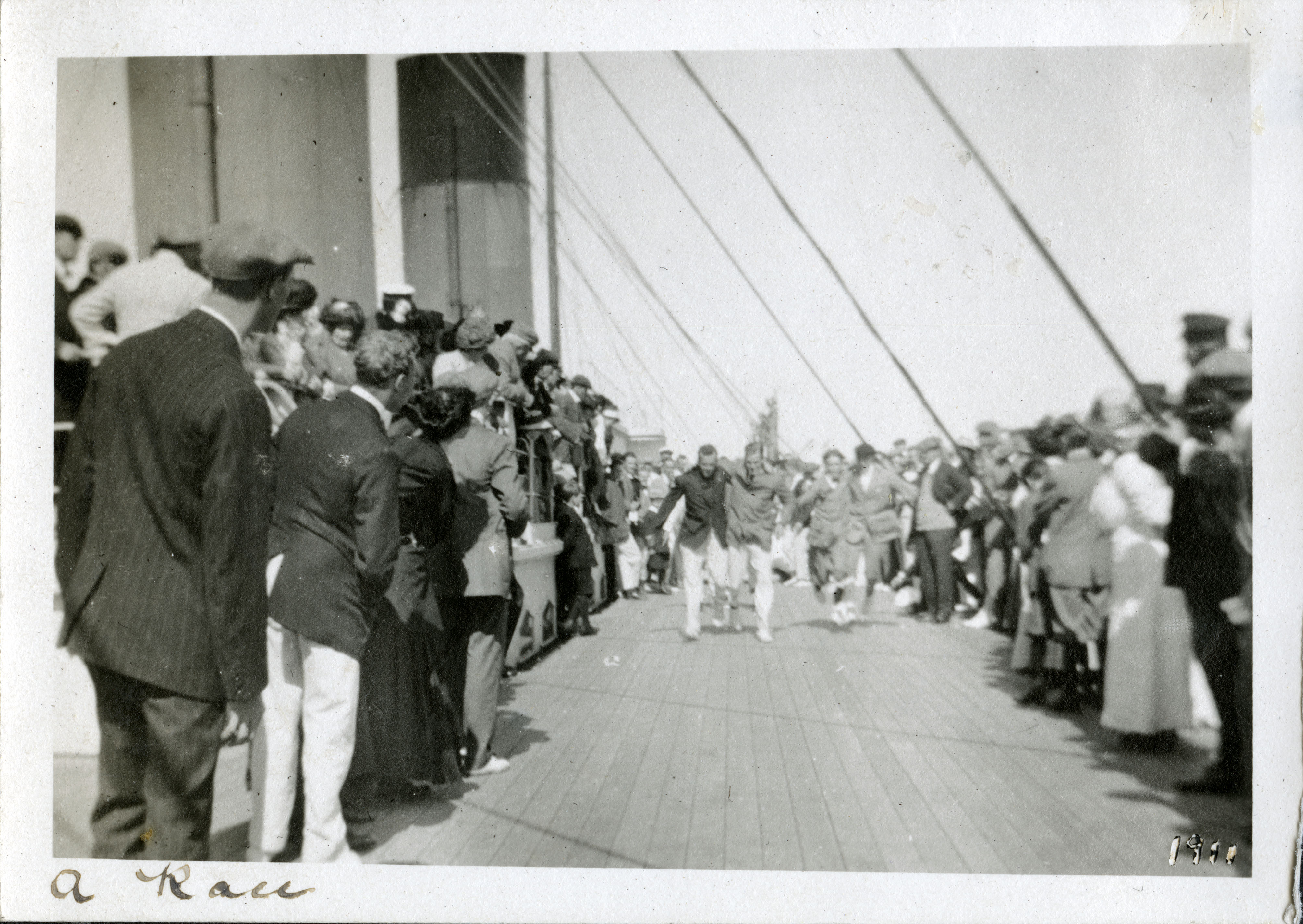
A race aboard the RMS Olympic on its first eastward crossing from New York to Southampton, July 1911. [POL1.11.4]. Courtesy of Cranbrook Archives, Cranbrook Center for Collections and Research.
“July 1st, 1911, was a bright sunny day, and the ocean was as smooth as glass. In the evening, there was a dance on the right hand deck. In the morning and in the afternoon too, the second-class people had races, and did all sorts of stunts. We saw another ship to the left. I played shuffleboard for the first time that day. On July 2nd, which was Sunday, we went to church in the dining room. We also saw another ship [July 3] which was eastwerd [sic] bound being a freight ship.” Henry Scripps Booth, July 1, 1911
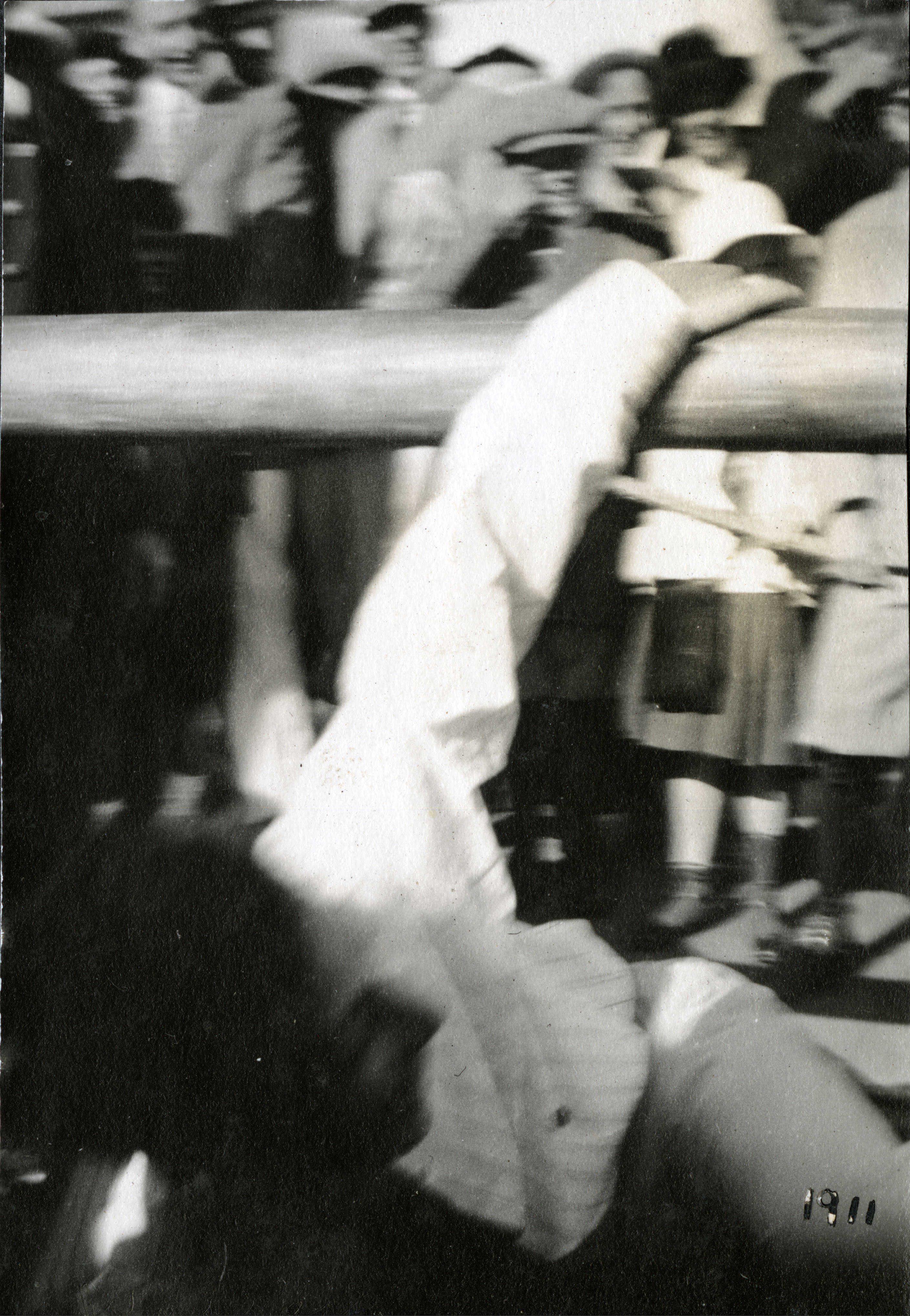
A race aboard the RMS Olympic on its first eastward crossing from New York to Southampton, July 1911. [POL1.12.5]. Courtesy of Cranbrook Archives, Cranbrook Center for Collections and Research.
“Tomorrow That day, I made my entrys [sic] into the Potato and Boot Races which were to be the next day with other stunts. We saw some fish, at least a yard and a half in length.
On July 3, 1911, at 10 o’clock the games began. The first race, which I was to be in, was the Potato Race. I came in third. I was also to be in the Boot Race but by a mistake, I came in last.
After other races came the Standing Broad Jump in which James sliped [sic].” Henry Scripps Booth, July 3, 1911
Warren Scripps Booth during a Spar Pillow Fight aboard the Steamship RMS Olympic, July 1911. [POL1.12.4]. Courtesy of Cranbrook Archives, Cranbrook Center for Collections and Research.
“James and Warren were both in the Spar Pillow Fight. In Warren’s case both fell off the bar at first but Warren was nocked [sic] off a second time. Warren did not win. James stayed on a number of times but was forced to give up. After dinner in the Reception Room the prizes were awarded. Also a dance on deck was given.” Henry Scripps Booth, July 3, 1911
Disembarking the RMS Olympic, July 5, 1911. [POL1.14.1]. Courtesy of Cranbrook Archives, Cranbrook Center for Collections and Research.
“Breakfast was served in the usual manner. After breakfast in the hall on the Sun Deck the band played the national cirs. Every body stood up. In the afternoon, at 4 o’clock we entered Plymouth Harbor. The mailtender got the mail and other boats got passengers off to land. We then started across the channel.” Henry Scripps Booth, July 4, 1911
“After getting off the steamer and having the officers make sure that we had no cigars or liquors with us, we took a cab to the hotel.” Henry Scripps Booth, July 5, 1911
Unloading the cars in France, August 1911. Courtesy of Cranbrook Archives, Cranbrook Center for Collections and Research.
As always, it is a great delight to share with scholars, colleagues, and those who are simply curious, these stories from the Archives. What is preserved in Cranbrook Archives help us to understand and enjoy not just Cranbrook, but any number of historic events from new perspectives.
There are more stories to tell about the family’s sojourn through England and France in 1911, which are both heartwarming and educational. But those tales must wait for another blog post–or for you to schedule a visit and come into the Archives Reading Room!
— Laura MacNewman, Associate Archivist, Cranbrook Archives, Cranbrook Center for Collections and Research
As Michigan emerges from our lockdown and we slowly begin driving to more places and contemplating summer road trips, I thought we’d look back to a time before asphalt, air conditioning, and safety features.
Ellen Scripps Booth, Jean McLaughlin Booth and Henry Scripps Booth on Lahser Road with the 1908 Pierce-Arrow in the ditch, 1911. Courtesy Cranbrook Archives.
Here, we see Ellen Scripps Booth, daughter-in-law Jean McLaughlin Booth, and young Henry stranded somewhere along Lahser Road. I love the ladies’ wide hats and wraps, intended to keep their hair in and dust out. Henry looks particularly pleased with the situation (sort of like me when my own mom got a speeding ticket—she didn’t appreciate my backseat smirking, either).
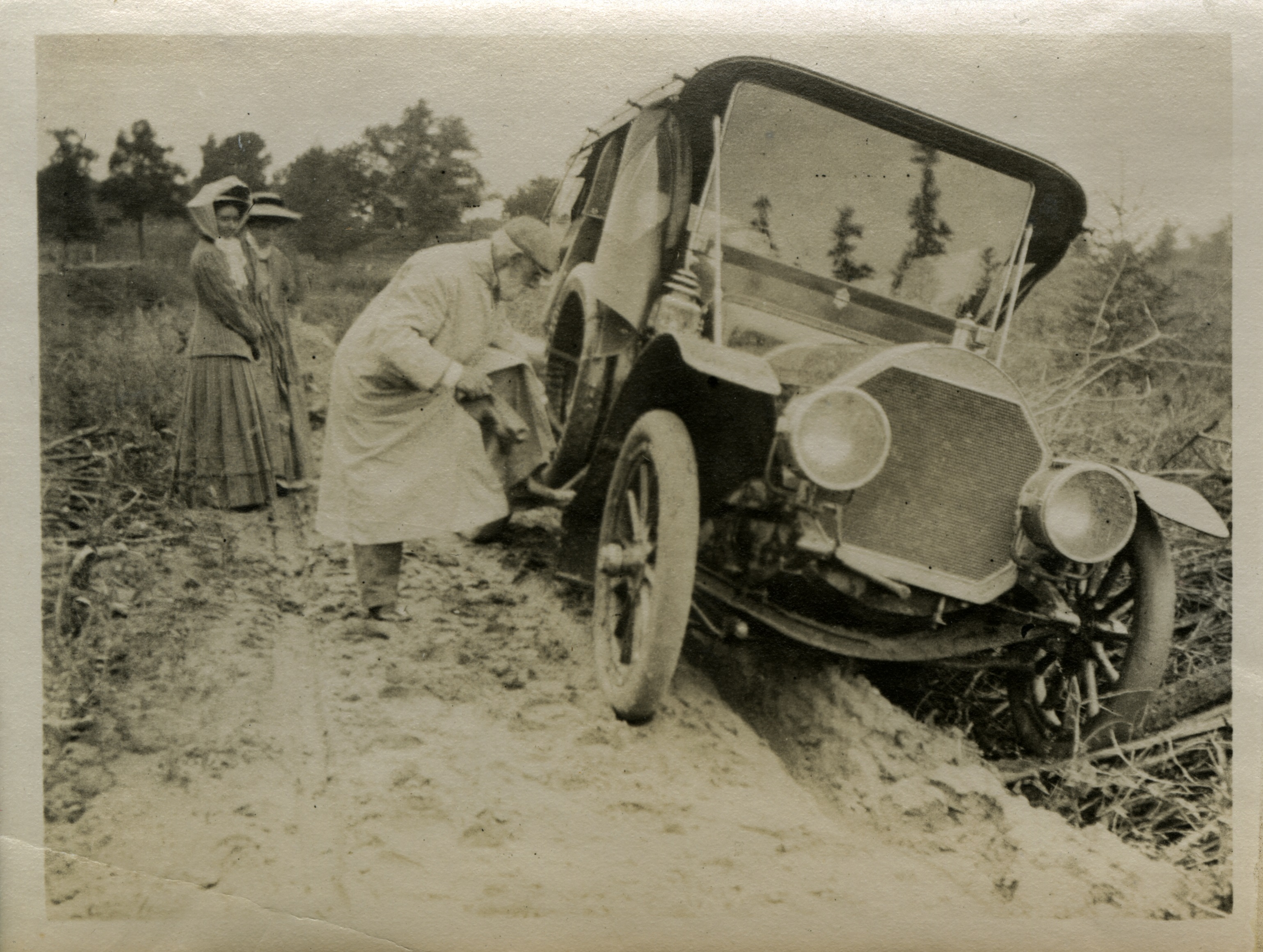
Instead of AAA, the family turned to their own skills. Here’s Henry Wood Booth, Ellen’s father-in-law, addressing the situation:
Henry Wood Booth works on the Pierce-Arrow on Lahser Road, 1911. Courtesy Cranbrook Archives.
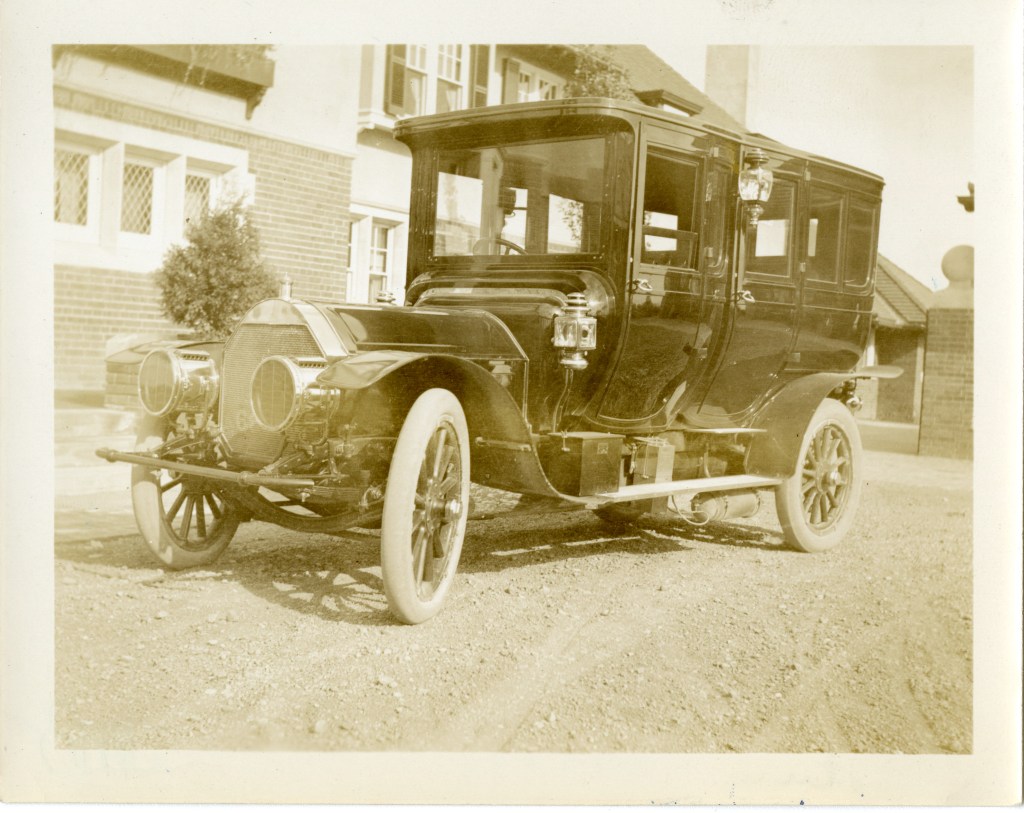
The Booth family’s Pierce-Arrow Limousine was one of several cars they used to move about here in Michigan and in Europe (where they traveled with the Pierce-Arrow and chauffeur). Purchased for $7,750 in July 1908 ($215,984.08 in 2020), the seven-seater, 6-cylinder touring car came with two bodies: a closed limousine body for winter use and a sports-touring body for summer. As Henry Scripps Booth later wrote:
The original garage at Cranbrook House had a traveling crane in it so the Pierce-Arrow’s winter and summer bodies could be conveniently changed with the seasons. The crane spanned the depth of the garage, having an iron track bolted to the east and west walls on which the crane with a hand operated hoist could be pulled to the spot where the two respective bodies could be removed or hoisted into place.
The Pierce-Arrow with its winter body in front of Cranbrook House, 1908. James Scripps Booth photographer, Copyright Cranbrook Archives.
The Pierce-Arrow with its summer body in front of Cranbrook House, 1908. James Scripps Booth photographer, Copyright Cranbrook Archives.
The accident on Lahser Road wasn’t the first time Ellen had been betrayed by poor road conditions. In 1908, she wrote in her diary of a similar event that took place as the family traveled from Grand Rapids to Lake Michigan:
“Wed. Aug. 12. We decided to take the auto as far as Holland on the way to Ottawa Beach but I wish we hadn’t for it took us five hours to go the 25 miles—We got off the road and one place slid into a ditch. It took an hour & a half to get a team to pull us out. We later frightened a horse and it ran down this deep ditch and horse, top-buggy and all just lay right down flat. The old couple in it were not hurt at all.”
If you want to learn more about the history and social impact of cars, register for our free virtual Bauder Lecturethis Sunday, June 28, 2020, at 3:00pm EST. Brendan Cormier, Senior Design Curator at the Victoria and Albert Museum in London, will be speaking about his recent exhibition and publication, Cars: Accelerating the Modern World. Center for Collections and Research Director Greg Wittkopp will deliver an introduction about Cranbrook and cars, featuring more treasures from Cranbrook Archives relating to our place in automobile history.
—Kevin Adkisson, Associate Curator, Cranbrook Center for Collections and Research
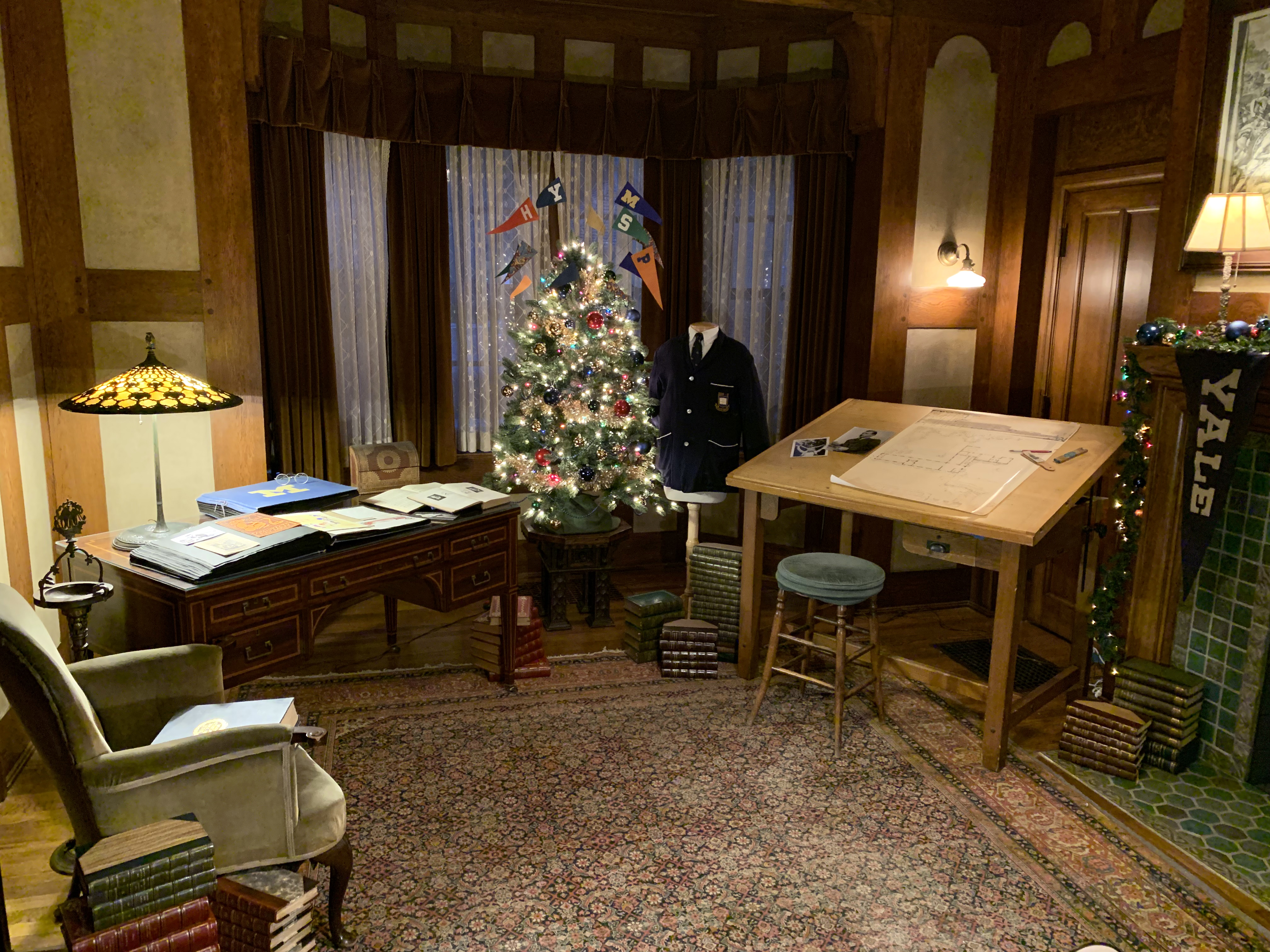
Each year, the Center for Collections and Research has the pleasure of decorating George Booth’s office at Cranbrook House for the holidays. This year, I went with a theme of Cranbrook sons heading off to college.
Overview of the Center for Collections and Research display at Cranbrook House for Holiday Splendor 2018.
I was inspired by a recent visit to Cranbrook by Warren Booth’s daughter Dorothy (fondly known as Blammy) and her family entourage. The fourth of five children of Warren and Alice Newcomb Booth, as a young girl Blammy lived at Cranbrook House’s Tower Cottage.
Blammy’s grandson (and George and Ellen Booth’s great-great-grandson, and my college friend) Riley was along for the tour. He told me about having Warren’s Yale blazer and Warren’s amazing Raccoon coat. I thought it would be great to return the blazer to Cranbrook for display.
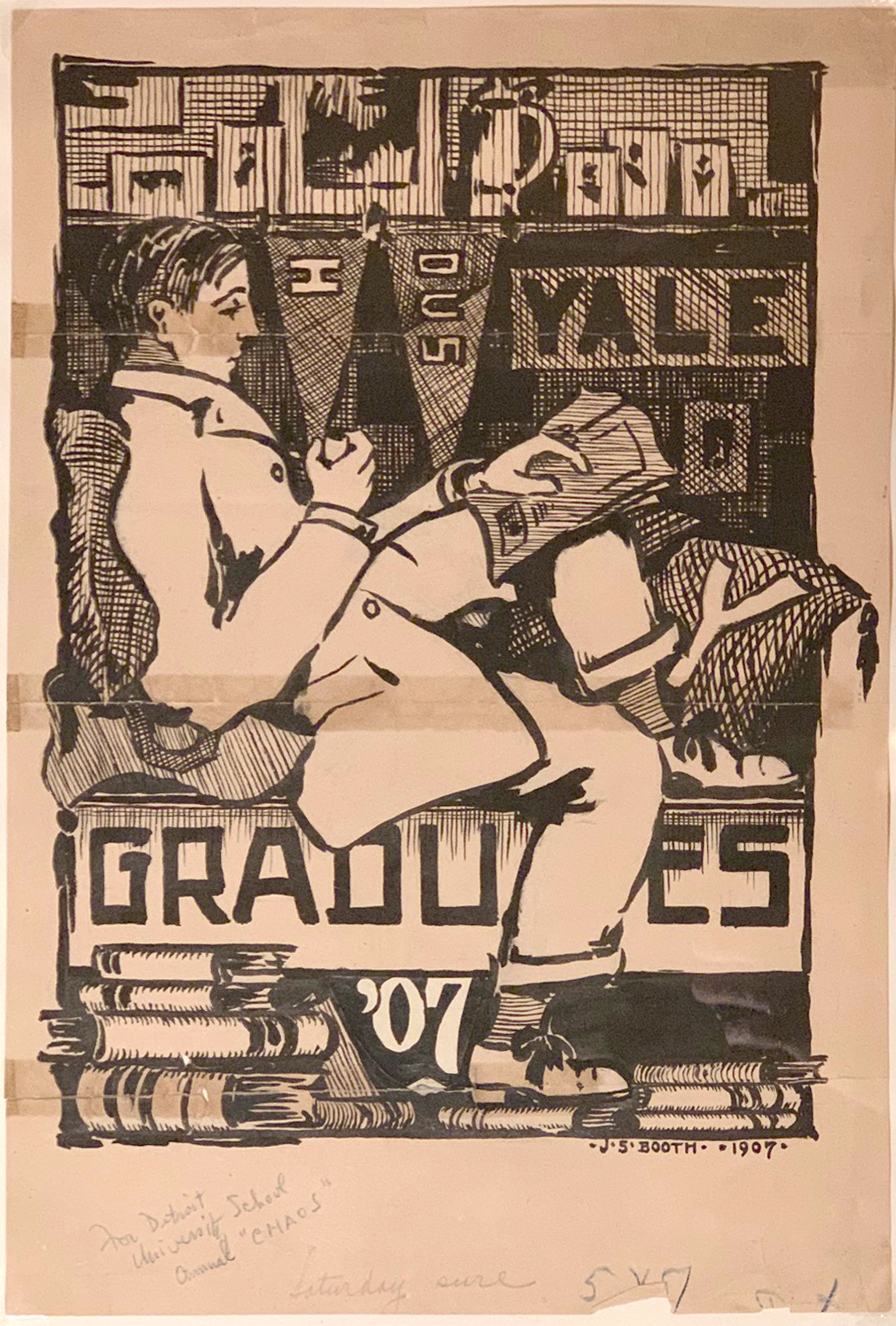
Looking in Cranbrook Archives for what might compliment Warren’s Yale blazer, I found this amazing 1907 illustrationby James Scripps Booth for the yearbook of Detroit University School. The oldest child of George and Ellen Booth, James was an artist, engineer, writer, philosopher and inventor. Although he shows a college student with his pipe and pennants, surrounded by books, James himself did not attend college.
James Scripps Booth’s illustration for Detroit University School, 1907. Courtesy Cranbrook Archives.
The first Booth to go to college was the middle child, Warren Scripps Booth. He moved to Cranbrook with his parents in 1908 and studied at the University School in Detroit. Around 1909, he headed east to the Lawrenceville Schoolin New Jersey. After his 1912 graduation, he studied with the Sargent Travel School for a year.
Warren Scripps Booth’s entry in the Yale Class of 1916-S Yearbook. Courtesy of Riley Scripps Ford.
Enrolling at Yale in 1913, Warren studied civil engineering at the Sheffield Scientific School (the “S” on his blazer—at the time, undergraduates were divided between the four-year Yale College and the three-yearSheffield Scientific School). After graduating in 1916, Warren served as a U.S. Army Captain of Field Artillery in World War One, and saw action at Meuse-Argonne, Metz, France. After the war, he served as president of The Evening News Association and Booth Newspapers, as well as on many Cranbrook boards. Warren, his wife Alice, and their five children lived next door to Cranbrook at a house fondly called “NoBrook.”
The Booth’s youngest son Henry began his education at the Liggett School, but after the family moved to Cranbrook he was educated at home. He matriculated at theAsheville Schoolin North Carolina for high school and returned north in 1918 to study architecture at the University of Michigan. While an undergraduate, Henry traveled extensively through Europe with his friend and classmate J. Robert F. Swanson, and in his final year in Ann Arbor, studied with Finnish architect Eliel Saarinen.
Henry Scripps Booth’s Michigan scrapbook, 1924, in foreground. J. Robert F. Swanson scrapbook, 1924, rear. Cranbrook Archives.
A page from Henry’s Michigan scrapbook, 1924. Cranbrook Archives.
For the holiday display, I included Henry’s college scrapbook showing some of his many talents and activities. Bob Swanson had the same scrapbook (much less filled!) and I included it in the display to show the lovely maize “M” on the cover.
Finally, I jumped forward in time to another Cranbrook family who sent their son off to college. Son of distinguished Finnish architect Eliel Saarinen, Eero immigrated to the U.S. with his family in 1923. The Saarinens moved to Cranbrook in 1925 to help realize the Booths’ vision of an educational and arts community.
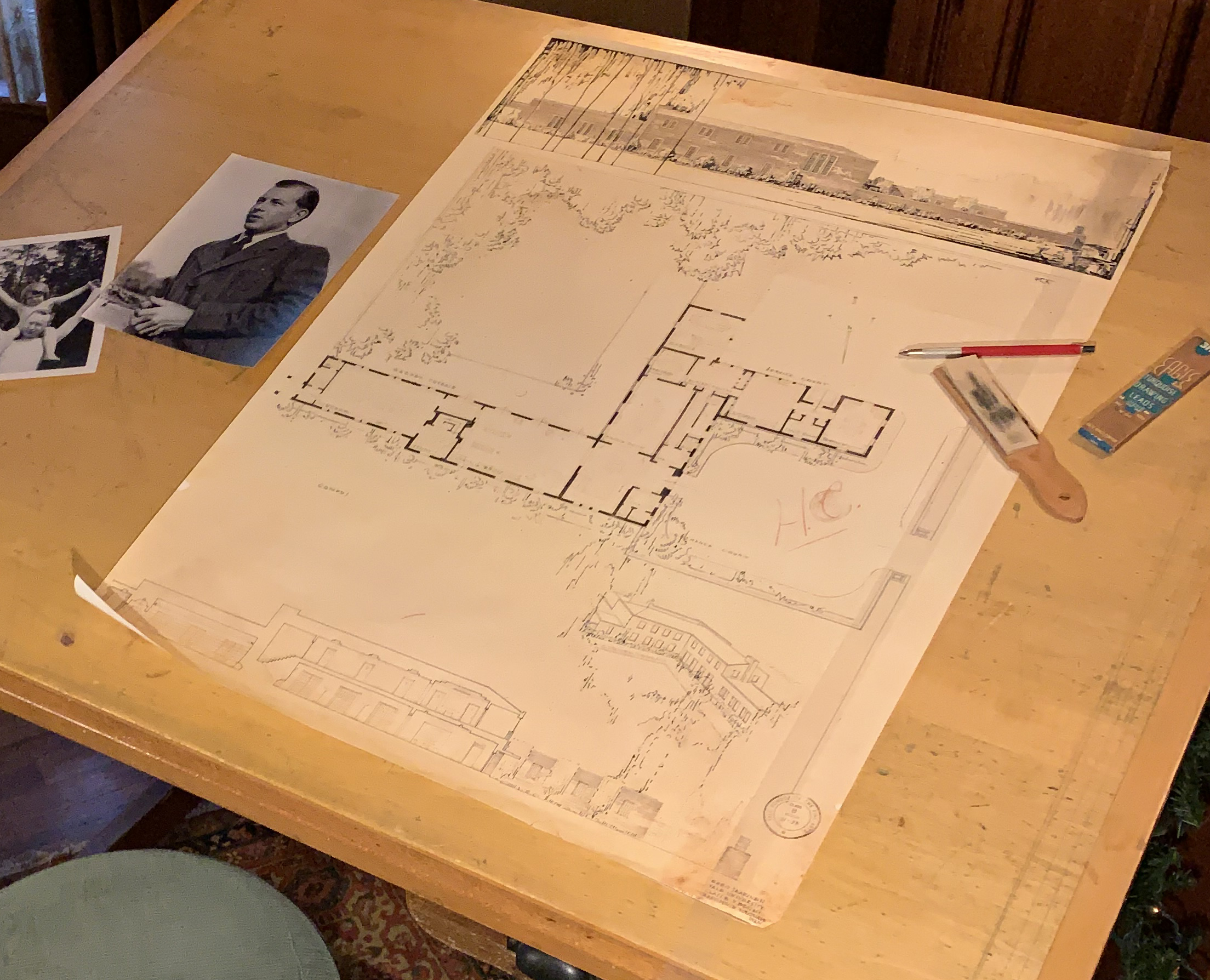
A talented artist from a young age, after graduating from Baldwin High School Eero studied sculpture in Paris’ Académie de la Grande Chaumière for one year before enrolling at Yale’s School of the Fine Arts in 1931. I included a reproduction of one of Eero’s drawing from Yale, resting on George Booth’s drafting table.
“A Residence for a College Dean,” Eero Saarinen, 1931. In this student project, Eero’s use of an open floor plan, symmetrical furniture layouts, textiles, torchieres, and telescoping design elements all mirror his father’s designs for Saarinen House here at Cranbrook. Notice the “H.C.” written in red crayon: this stands for Hors Concours, or not competing. In the strict Beaux-Arts methodology of Yale’s architecture program, this project did not pass muster to be considered for a prize! Original drawing courtesy of Cranbrook Archives.
At Yale, he took a wide variety of coursework: design, freehand drawing, engineering mechanics, history, economics, and scenic design. Even in his first year, his student work earned national recognition in architecture magazines. Eero also took a course on “Archaeology Research” with Raymond Hood(the architect who took first prize over Eliel Saarinen in the Chicago Tribune Tower competition of 1922).
Detail of “A Residence for a College Dean,” Eero Saarinen, 1931.
Saarinen heartily embraced college life, including serving on the Decorating Committee of the student Beaux-Arts Ball. Though he excelled in the student architectural competitions, Eero almost always came just short of winning the First Medal, earning him the nickname Second-Medal Saarinen. His thesis project in the spring of 1934 received the international silver medal of the Société des Architectes Diplômés par le Gouvernement.
Along with many of his classmates, after Yale Eero entered the Office of Strategic Services(a precursor to the CIA), where he designed graphics for defusing bombs as well as underground bunkers, including the White House’s “situation” or war room.
Charles Eames shares cigarettes with Eero Saarinen and Warren Booth at the opening of the 1939 Cranbrook Academy of Art Faculty Exhibition. Perhaps Eero and Warren were chatting about their happy bygone days in New Haven?Photographcourtesy of Cranbrook Archives. “Souvenir of Yale” plate, c. 1910, courtesy of the author.
Eero returned to Bloomfield Hills in 1936 to work with his father and brother-in-law, J. Robert F. Swanson. After Eliel’s death in 1950, Eero set up his own office. Among his many significant projects were a handful of university buildings: dormitories for Brandeis University in Boston, the law quadrangle at theUniversity of Chicago, the North Campus and the school of music for the University of Michigan, the entire campus of Concordia Collegein Fort Wayne, Indiana, dormitories at Vassar, and two Residential Colleges and thehockey rink for his alma mater Yale. At the time of his premature death in 1961, Eero was also serving as Yale’s campus planner.
I’m grateful for the many stories Blammy and her family shared with me on our tour of Cranbrook earlier this Fall, and to Riley for lending us another piece of Cranbrook history to share with guests to Cranbrook House this holiday season.
– Kevin Adkisson, 2016-2019 Collections Fellow, Cranbrook Center for Collections and Research (…and Yale Class of 2012)
James Scripps Booth (JSB), eldest son of George Gough and Ellen Scripps Booth, attended St. Luke’s School in Wayne, Pennsylvania. According to the Tredyffrin Easttown Historical Society, St. Luke’s School operated from 1863-1927. It was in its Wayne, Pennsylvania location from 1902 until its closing. In 1907, JSB was a student there and drew pictures for the school’s annual.
Cranbrook Archives retains the original drawings of the pages James contributed, as well as copies of pages from the annual which feature JSB, his work, or his friends.
For more on James Scripps Booth, see some of our previous blog posts:
“My father got me started the other day decorating and coloring a very elaborate plaster ceiling and nobody knows when I’ll get it finished.” So wrote James Scripps Booth in a letter to a favorite artist’s model Helen Knudson. The elaborate ceiling he referenced is the ceiling of the Still Room at Cranbrook House:George G. Booth created the Still Room as a part of his office suites in 1918. It was as a place to take a noonday rest. In old English country houses, the Still Room was a place where medicines were prepared, herbs and flowers were infused in water or oils, and where home-brewed beers and wines were made. As Henry Scripps Booth recalled in another letter, “We started applying the term to the small room at the south end of the wing although Mr. Booth had no intention of making whiskey, beer or wine, but on using it as a quiet place for reading, conversation and taking undisturbed naps.”
Commissioned by Booth, Ulysses Ricci and Anthony DiLorenzo designed the ceiling for the Still Room in 1919. The ceiling depicts classical Pompeiian figures, animals, and motifs of swags, festoons, masks, floral and foliage. The ceiling consists of four arched sections, a central medallion, and a tympanum* piece on each wall.
James Scripps Booth described his painting method for the ceiling: “I have to lie down in a steamer chair that is rigged up high on a scaffold, when I work and there is such a lot of detail design it keeps me guessing…” James painted the ceiling in blues, pinks, greens, yellows, purples, and browns against an off-white background.
Words can not describe the beauty of the ceiling. As they say, a picture is worth 1,000 words.
This slideshow requires JavaScript.
– Leslie S. Mio, Associate Registrar, Cranbrook Center for Collections and Research
*tympanum is a semi-circular or triangular decorative wall surface over an entrance, door or window
As I’ve mentioned previously on the blog, one of my hobbies is giving tours of Greenwood Cemetery in Birmingham, Michigan. It is the resting place of Marshall M. Fredericks, Buck and Mary Chase Perry Stratton, Elmore Leonard, and Cranbrook Founders George and Ellen Booth (and many members of their family).
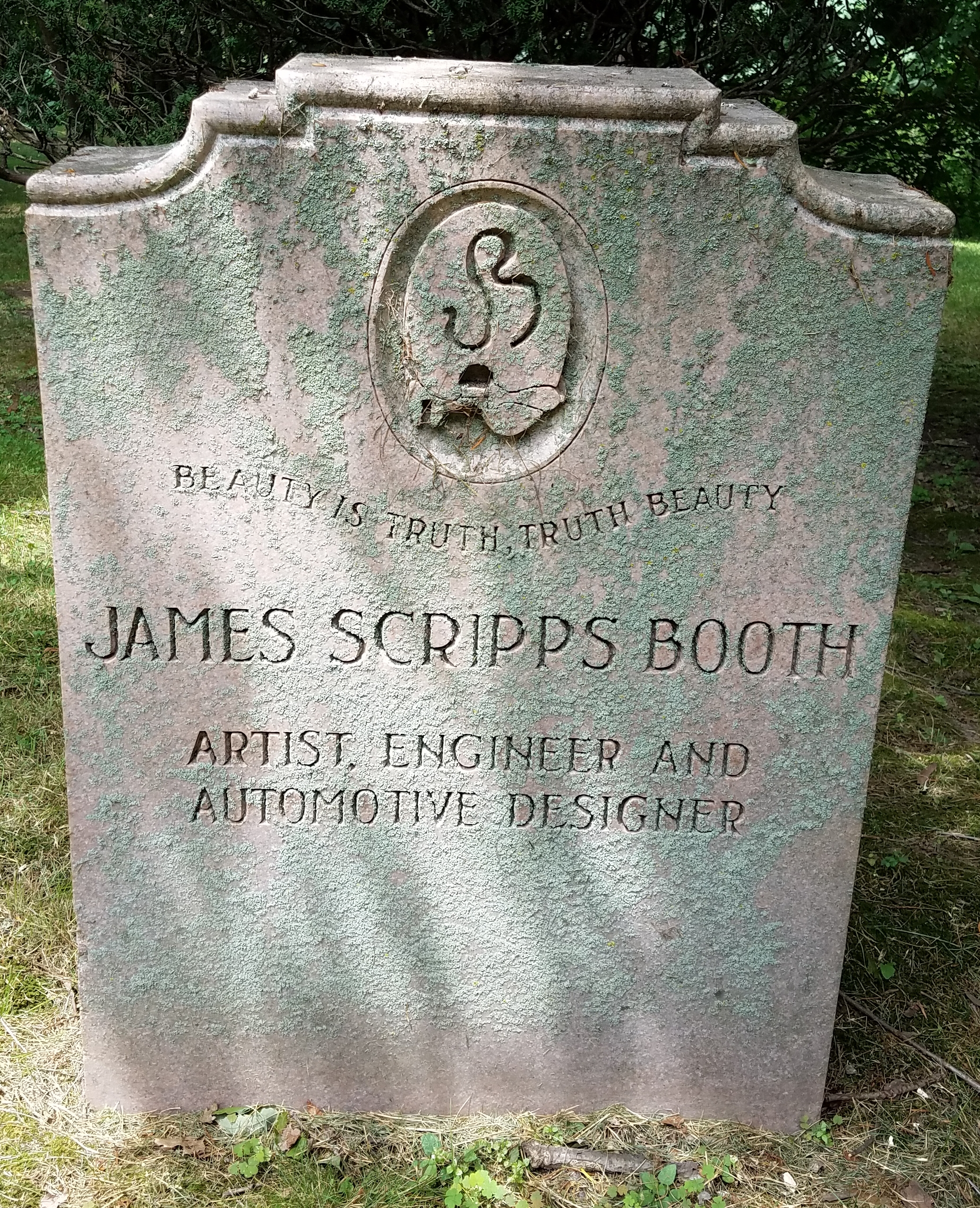
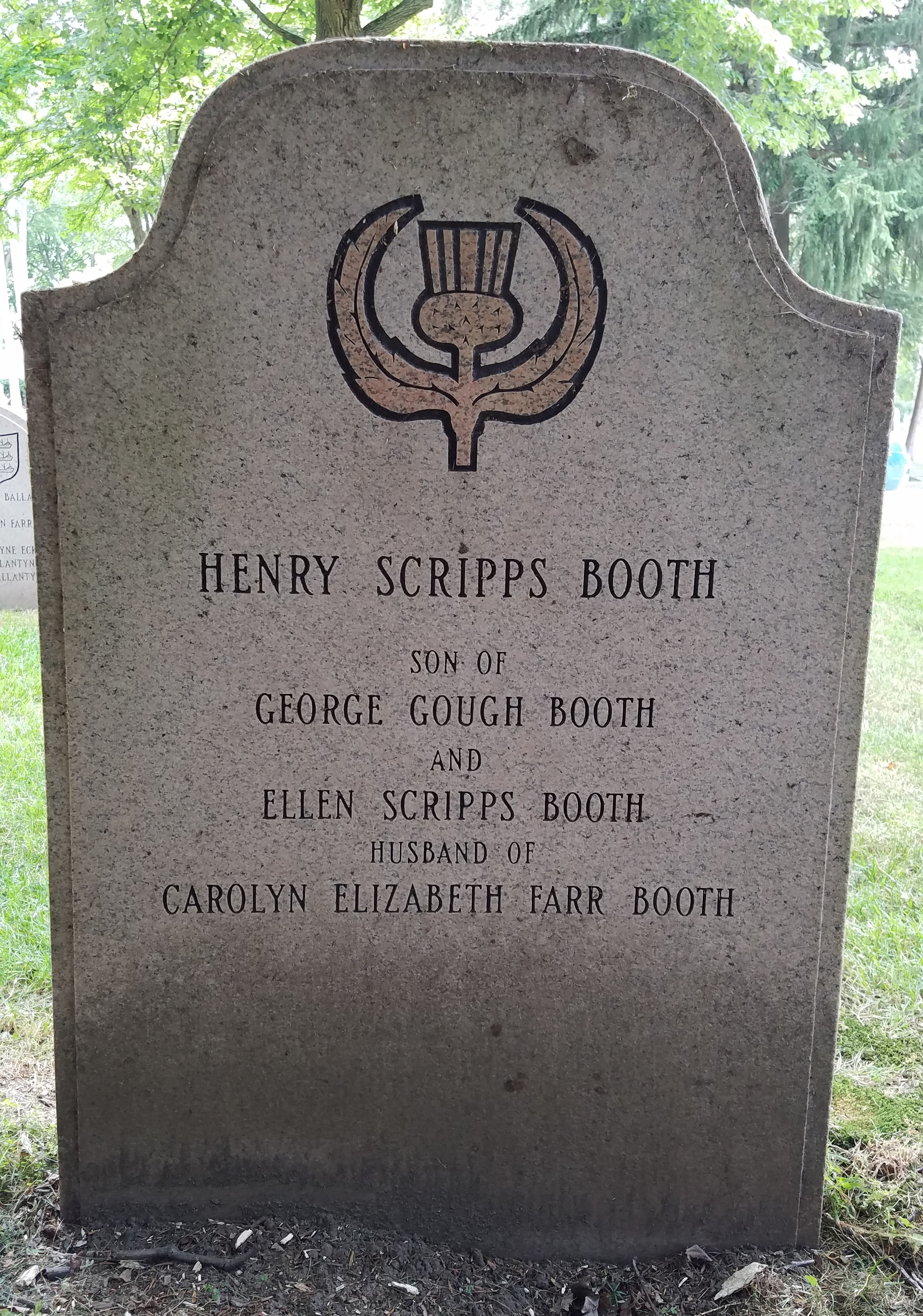
On a recent drive through Birmingham, I decided to stop and visit our founders. I had always wondered, when I gave tours of the cemetery, why some family members had certain symbols on their markers. After working here at Cranbrook for a couple of years, those symbols now make sense. I captured photos of several of the markers to share with you.
Warren Scripps Booth has a yacht on his marker, but he wasn’t a sailor in World War I – he was in the Field Artillery. It was only by reading his obituary that I learned that his favorite activity was to sail on his yacht when he wanted to get away from it all.
James Scripps Booth was a wonderful artist. His marker features an artist’s pallet with a stylized version of his initials “JSB.”
Henry Scripps Booth was called “Thistle” since he was a child. It was no surprise a beautiful thistle adorns his marker.
Since it is Preservation Week, today’s Photo Friday features an image from one of the collections we have been working to stabilize. For the past few weeks my colleague, Belinda Krencicki, and I have photographed and captured metadata for the watercolor paintings, pen and pencil drawings, and pastels in the James Scripps Booth and John McLaughlin Booth Papers. This information will be used to catalog the items in our Collections Management system. In addition to documenting the works, we re-housed all of the items–placing them in archival folders and interleaving each work to protect it.
Pencil and pastel sketch of the exterior of the Detroit News building, James Scripps Booth, 1917.
The artwork ranges from pastel landscapes, to portrait studies, to automobile racing. The image above is one of my favorites – a sketch of the Detroit News building. I hope you enjoy it too!
After the second week of May, I readily began my Senior May Project, an intensive program that allows second semester seniors to explore a field of study for three weeks. Pulling open the imposing silver doors of the Cranbrook Archives on my first day, I had no idea what truly occurred on the other side. As I, with the fumbling hands of a novice, used fundamental archival tools such as finding aids, vertical and photo files, indexes, backlogs, and the digital image database over the course of the three weeks, I began to understand what an archivist does behind those argent doors.
Margaret Harney, CKU ’15
Honestly, it is a lot of filing. Archivists receive chaotic and often decaying papers, photographs, and other documents deemed worthy of being preserved, and they organize them into various categorizes and topics. Everything has a place, and that place is well recorded in differing indexes and inventories. As a person whose nickname as a child was “Messy Meg,” I inevitably struggled to learn the complex organizational system. Often, I would stand in a dim corner of the archives, afraid of disarranging the gray archival boxes like some omnipotent entropic force, or a two-year-old. Thus, in the second week when I was tasked with organizing three filing cabinets of photographs from Cranbrook Kingswood post-merger, I inwardly panicked. Once I removed the folders, I discovered that they were in complete disarray from the disinterested teenager who had supposedly organized the cabinets before me. While their quite arrogant lack of effort often made me want to pry my muscles from my bones, it also relieved my anxiety, for I knew no matter how badly I mismanaged the cabinets, it would never be nearly as appalling as it was prior.
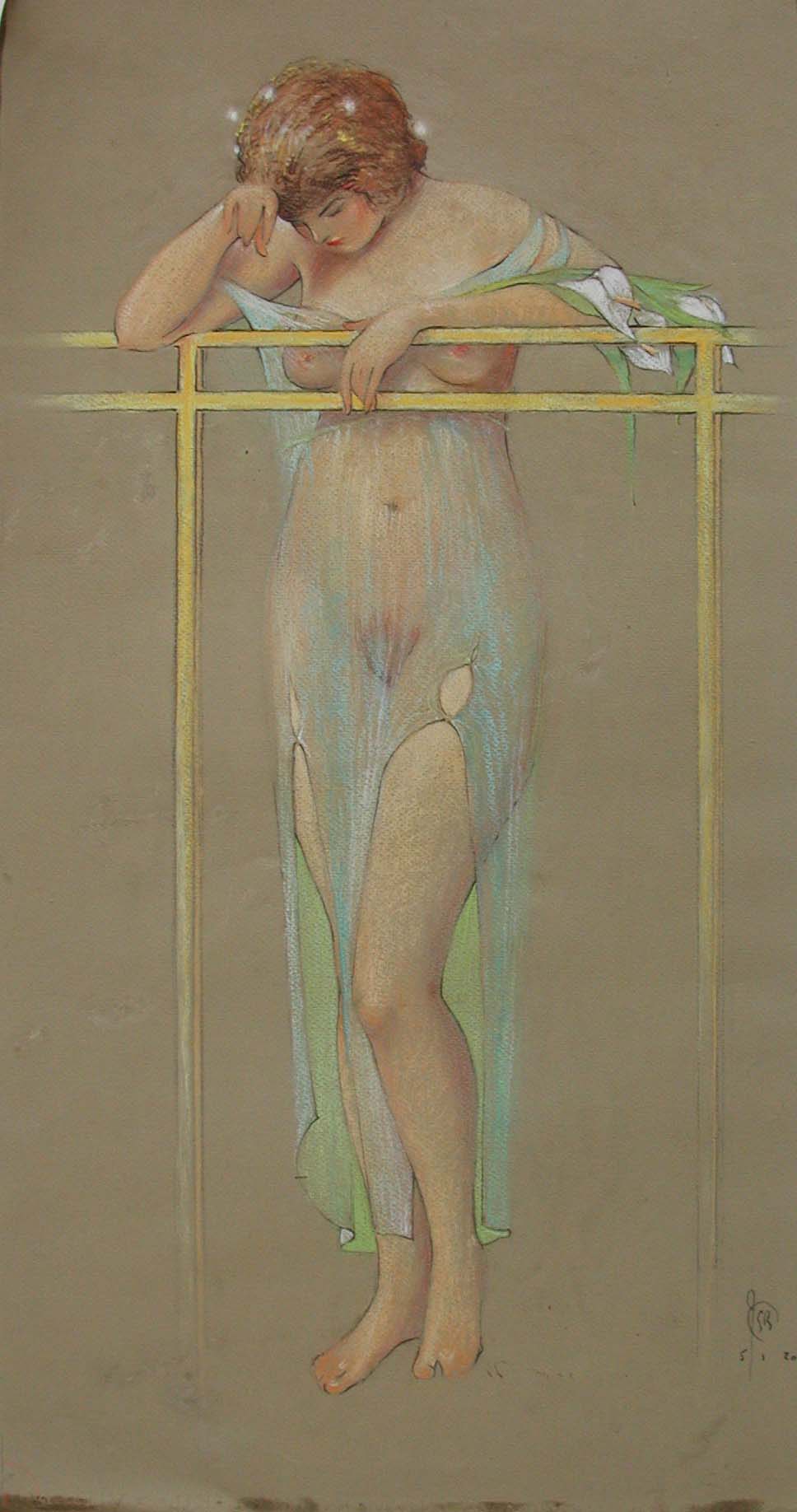
Study for Blessed Damozel, 1920. James Scripps Booth
After finishing the cabinets, I helped Ms. Edwards rummage for posters in the metallic archive vaults, and there in James Scripps Booth’s yellowing, rigid pastels, I discovered why an archivist undertakes all that grueling and mind-numbing filing. Beneath the waxy paper shielding the drawings, nude female figures innocently and exquisitely revealed themselves among impatient pastel strokes. While I was beguiled by the striking beauty of the sketches, I was equally as captivated by their ability to reveal the whims of Booth. Thus, not only the women, but Booth as well lay exposed. Such drawings and degenerating documents that archivists strive to preserve are like little vitrines displaying various aspects of the past. Each frame depicts a story and when all the frames combine, a larger impression is formed. Like an ink blot, this impression allows the viewer to decide what the greater story is. The ability to interpret the past for yourself is a rare and remarkable privilege, and that was the greatest gift my time in the archives gave me.
The Alura II from the James Scripps Booth and John McLaughlin Booth Papers. Cranbrook Archives
As the new Collections Fellow for the Cranbrook Center for Collections and Research, I was charged with coming up with a theme and writing today’s Photo Friday blog, a daunting task as it is only my first week. Lucky for me, a few of our archivists were working in our reading room pulling documents and photographs for a display this weekend for Cranbrook Art Museum’s PNC Bank Family Day and a few of them jumped out at me.
In 1928 James Scripps Booth, eldest son of Cranbrook’s founders George and Ellen Booth, designed a plan for a boat called the Alura II. Today’s photo includes a Booth’s original design for the bureau-book cases, mirror and window to the cockpit and a photograph of the “screened door companion-way from enclosed bridge area.” Although some of the plans were changed during manufacture, you can see the resemblance to Booth’s original design especially in the drawers and shape of the window shape. The Alura II was a fifty four foot long motor cruiser, with two 275 horsepower engines, so it could go as fast as 16 mph on the water! The boat included electric lights and toilet facilities, a four burner gas stove, and a gas water heater, as well as a Fridgeair ice box. The Alura II was completed in 1929. James and his wife Jean cruised in the boat for most of the summer that year, closing their home to take to the water.
Today’s photo is a sneak peak at some objects you can see on display in the Cranbrook Archives during PNC Bank Family Day this coming Sunday September 28th from 11am to 5pm. Many documents and photographs like today’s Photo Friday will be available to view and learn more about Cranbrook, the Booths, and boats! Learn more about the day’s nautical themed activities, tours, and lecture on the Cranbrook Art Museum’s website.
– Stefanie Dlugosz, Collections Fellow, Cranbrook Center for Collections and Research
A Driving Force: Cranbrook and the Car may have closed to the public, but we’re not done with it yet here at the Center for Collections and Research. As Cranbrook Art Museum switches out exhibitions (and gets ready to install the yearly Graduate Degree Exhibition, a show everyone must check out), staff of both the Center and the Museum are busy dismantling cases, assessing the condition of objects as they come down from the display, and preparing spaces to hold new and exciting displays of art and design.
While A Driving Force: Cranbrook and the Car was not a huge show, it did have one very sizable object: the 1914 Scripps-Booth Rocket Cyclecar. In the collection of the Detroit Historical Museum, the Rocket came to us from the Owls Head Transportation Museum where it had been on loan for a number of years (if you missed it, read more about the move here). Now, nine months after going on view, it was time to return it home. This morning our registrar Roberta Frey Gilboe and associate registrar Gretchen Sawatzki helped to wheel the Rocket out onto Cranbrook Art Museum’s loading dock and send it back to the Detroit Historical Museum.
Museum objects need to be preserved in as best condition as possible, which means that driving the Rocket is pretty much out of the question. Even if we wanted to drive it out the building, though, that would be impossible – the car is not in working condition. Instead, we hired a car transporter to pick up the Rocket and drive it the twenty-something miles down to DHM. The following videos (filmed by Gretchen) give a sense of what is involved in moving a vehicle of this size and age. In the first video, Roberta and our truck driver roll the Rocket out into the dock and onto a lift. In the second, the three of them (Roberta, driver, and Rocket) ride the lift up to meet the bed of the truck. In the final video, they roll the Rocket onto the truck. As you can see, moving objects (especially ones as large and as complicated as antique cars) is a complex task. With a team of talented professionals, though, and given enough time, we can safely transport objects from space to space and make room for the new and exciting exhibitions to come.










 George G. Booth created the Still Room as a part of his office suites in 1918. It was as a place to take a noonday rest. In old English country houses, the Still Room was a place where medicines were prepared, herbs and flowers were infused in water or oils, and where home-brewed beers and wines were made. As Henry Scripps Booth recalled in another letter, “We started applying the term to the small room at the south end of the wing although Mr. Booth had no intention of making whiskey, beer or wine, but on using it as a quiet place for reading, conversation and taking undisturbed naps.”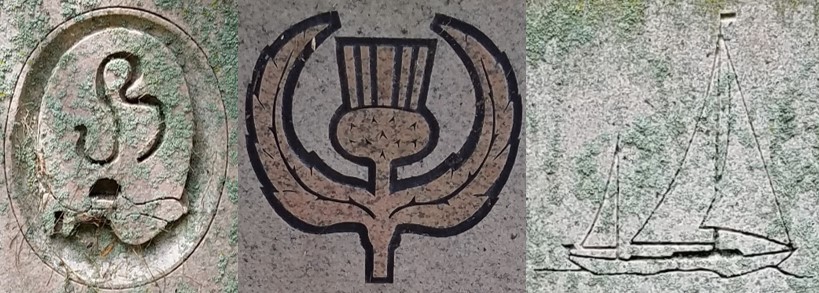





 Cranbrook Kitchen Sink