The Annex, the Attic, and My Senior May Adventures

Each May, the Center is honored to host outstanding seniors from Cranbrook Kingswood Upper School for a three-week immersive internship.
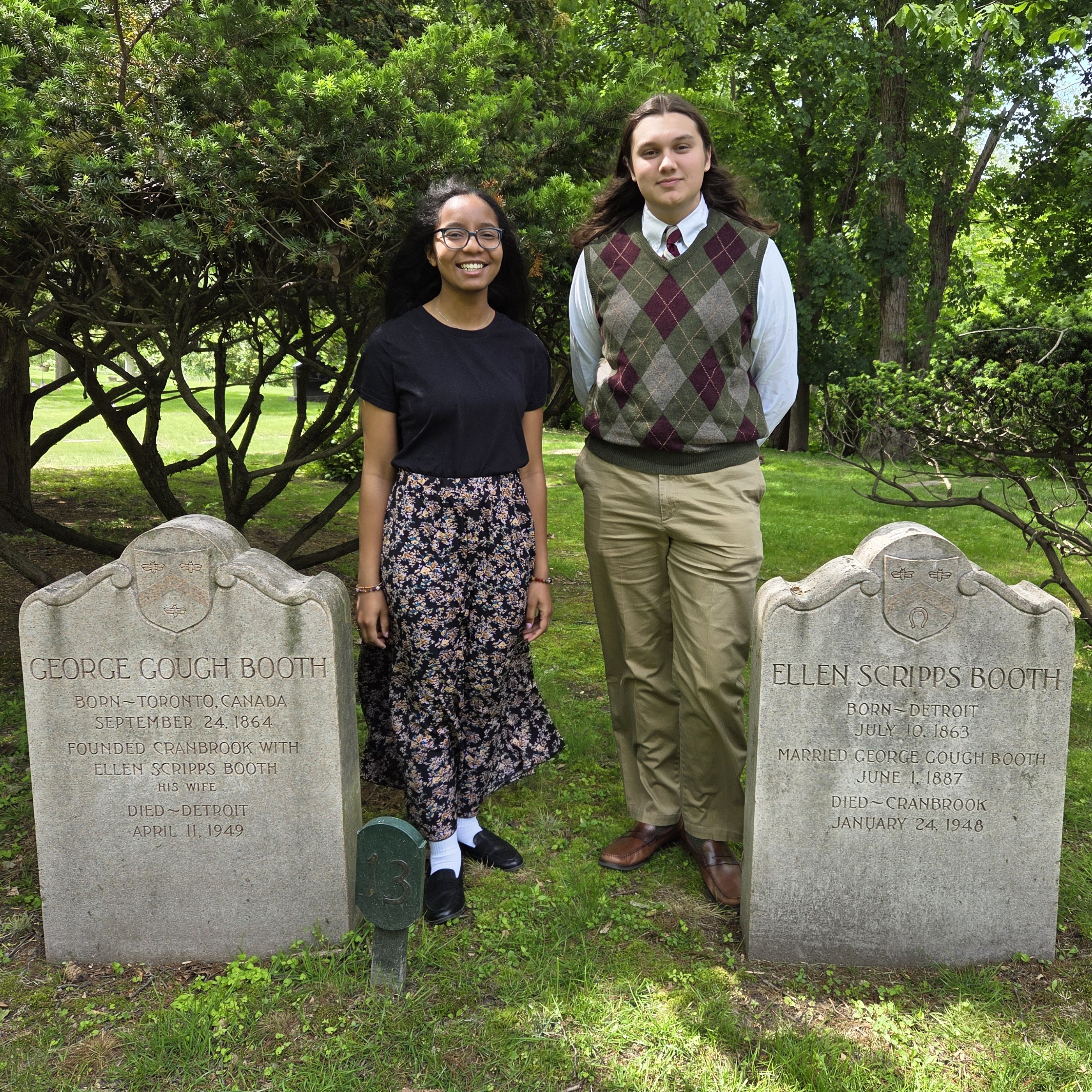
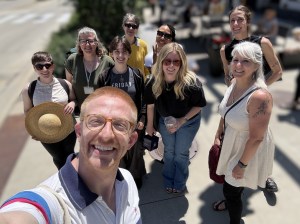
Kamilah Moore and Joel Kwiatkowski, 2025 Senior May interns, visit George and Ellen Booth at Greenwood Cemetery, Birmingham. Photography by Leslie Mio.

This year two seniors, Kamilah Moore and Joel Kwiatkowski, worked with the Center and Archives staff, including writing blogs! Hear from Joel today and look out for Kamilah’s post next week.
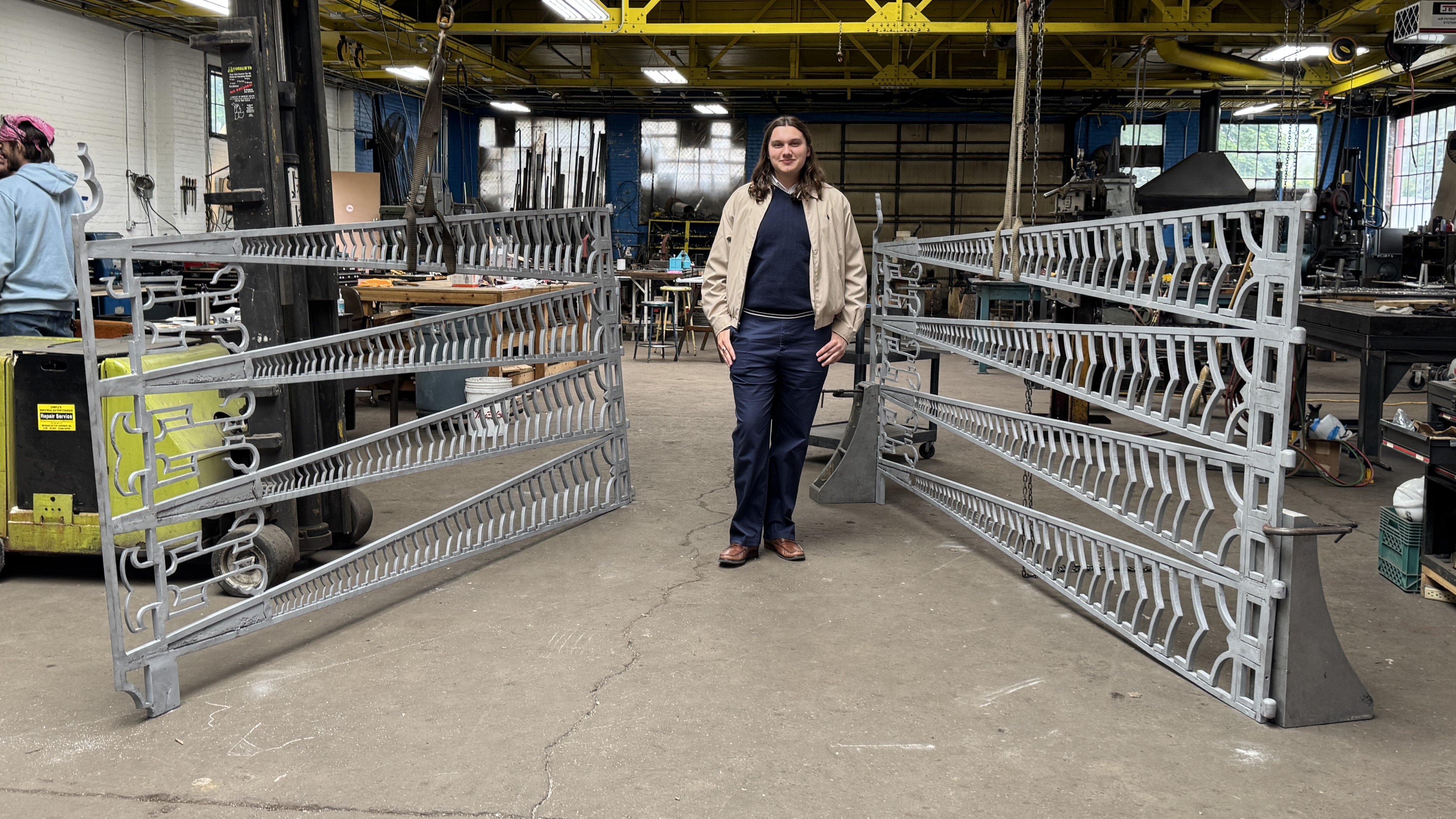
Checking in on the Eliel Saarinen-designed Kingswood main gate at Smith Shop in Highland Park, May 2025. Photography by Kevin Adkisson.

Cranbrook Center for Collections and Research is a name that invokes the image of some grand museum or hall, with many sterile prep rooms and rows upon rows of file cabinets. Now don’t get me wrong, there are plenty of file cabinets, but the Annex is far from grand. Instead, the rather humble staff apartment-turned-offices are befitting the lovely people there.

The Center’s Annex, next door to Cranbrook House, is situated above the House & Garden Auxiliary offices, up a set of winding stairs that require me to duck in a few places. But up there you will find a quaint little kitchen (complete with a toaster oven and healthy snack collection), a few offices, and closets and cabinets dotted with curiosities.
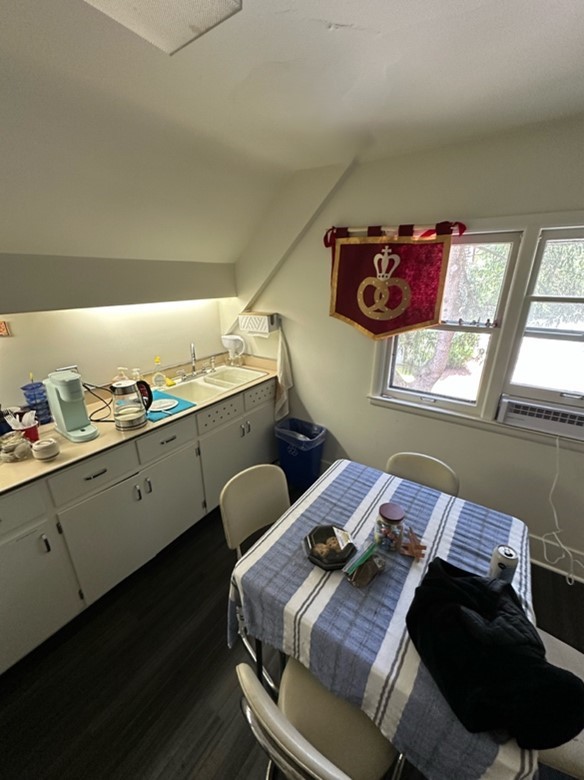
The quaint kitchenette of the Annex, compete with decommissioned Cranbrook Institute of Science Library chairs, May 2025. Photography by the Author.

It was this atmosphere, over many chatty lunches, that I got to know Leslie Mio, the Associate Registrar, and Mariam Hale, the 2023-2025 Center Collections Fellow. It was a pleasure to find two individuals who cared so greatly for history and conservation, and we bonded over our shared love of museums and particular historical eras.

But, let it be known that work at the collections isn’t all comfortable work behind a desk or searching a filing cabinet. This illusion, if I ever had it, was quickly broken on my first full day of the internship. Our task? Moving five solid wood cabinets from the rooms of retirement-age nuns across the building to be used to store Cranbrook’s lacy dresses and costumes.

Briarbank, a neighboring estate to Booth’s land, was converted into a place for sisters to stay once they needed a bit more care later in life. But, at some point, the demand for a place such as that ran dry, and Cranbrook bought the campus. And now, in that spirit, I was near horizontal in my penny loafers, shoving a giant wardrobe into place across some very tasteful carpet.

Mariam and I defy the friction of decades old carpet, May 2025. Photography by Leslie Mio.

In the coming days, the purpose of these heavy cabinets would be realized, as we began the true overarching theme of my time at the Center: moving a seemingly infinite number of objects from the hot attic of Cranbrook House to the comparatively “less hot” and climate-controlled storage area at Briarbank. Paintings, prints, textiles, rugs, hats, and racks of clothing and costumes were deftly maneuvered through the halls and offices of Cranbrook House (or, alternatively, very carefully down the narrowest, steepest, stairwell known to mankind).

Each day packing and moving Cultural Properties in the attic was sure to bring new surprises. Everything from a fur hat belonging to George Booth to paper parasols, or entire handwoven rugs the size of a small house. While these days meant a bit of manual labor, they never ceased to bring me joy, as the wonderful folk of the Center doled out tidbits of Cranbrook’s story connected to each unearthed gem.

The fabulous hat in a box marked “G.G.B.” — the box is possibly a later acquisition by Henry S. Booth — May 2025. Photography by the Author.

Now those familiar with the Center may be wondering: “Now wait just a minute. Where is my favorite curator? Where is the delightful presence of the steward of Saarinen House?” Well, fear not good reader, for while Kevin may not have been at every boxing and unboxing, Kevin joined Kamilah and me on many excursions outside the Samuel-Yellin-forged gates of Cranbrook. For those unacquainted, Kevin Adkisson is Curator of the Center, the veritable fountain of all knowledge concerning Cranbrook, and legend in his own time among students.

My first trip with Kevin came when we were tasked with heading to Detroit to give a tour of Holy Redeemer Church to a group of 8th graders from the Catholic school next door. I thought that getting middle schoolers excited about Corinthian columns would be impossible, but Kevin’s energy and skill made it look easy.

Kevin and I had fun teaching Holy Redeemer 8th graders about architecture. Photography by Holy Redeemer.

Afterword, we headed to visit the master ironworkers at Smith Shop, where the Eliel Saarinen-designed Kingswood main gate is being repaired and restored. I stood back and observed while Kevin, Cranbrook Capital Projects Director Jean-Claude Azar, and Amy Weiks and Gabriel Craig (co-owners of Smith Shop) debated the ins and outs of the gate’s making and breaking.
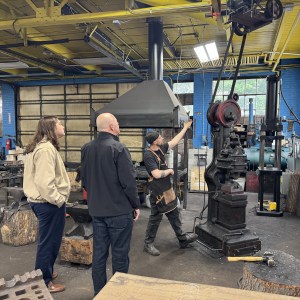
I enjoy a tour of the facilities of Smith Shop with Cranbrook Capital Projects Director Jean-Claude Azar and Smith Shop co-owner Gabriel Craig in Highland Park, May 2025. Photography by Kevin Adkisson.

Across my three week Senior May, I also took trips to the paint store to debate shades of grey, the frame shop to mount an object, Ken Katz’s painting conservation studio, and even Birmingham’s historic cemetery. On each of these trips, I gained insight into the multifaceted work of the Center for Collections and Research, including care and handling, teaching, conservation, and cataloging.

I cannot fully capture in a blog what a delight it was to be in the presence of such knowledgeable individuals. For every question about Cranbrook’s history, each member of staff was sure to add in their own expertise, citing obscure letters and photographs, adding a beautiful familiarity to their responses and giving color to the story of Cranbrook.

Of course, I would be remiss to leave out some of the other folks who make the Center function, like Greg, Jody, Amy, and Jess. These are the people who drive the work, managing, fundraising, and promoting the vision of Collections and ensuring the continued progress of the Center’s goals.

Even interns have meetings, Kamilah and I sat in on one of the Center’s weekly staff meetings. Photography by Kevin Adkisson.

On my last day, I had the privilege of working with Jess Webster, Development Coordinator, who also helps run the Center’s social media. With Kamilah, I researched, drafted, workshopped, and delivered a script for an Instagram Reel commemorating the 150th birthday of Carl Milles., During my time working out ideas for the video (and even this blog), I gained a new appreciation for the way in which Cranbrook is viewed from the outside.
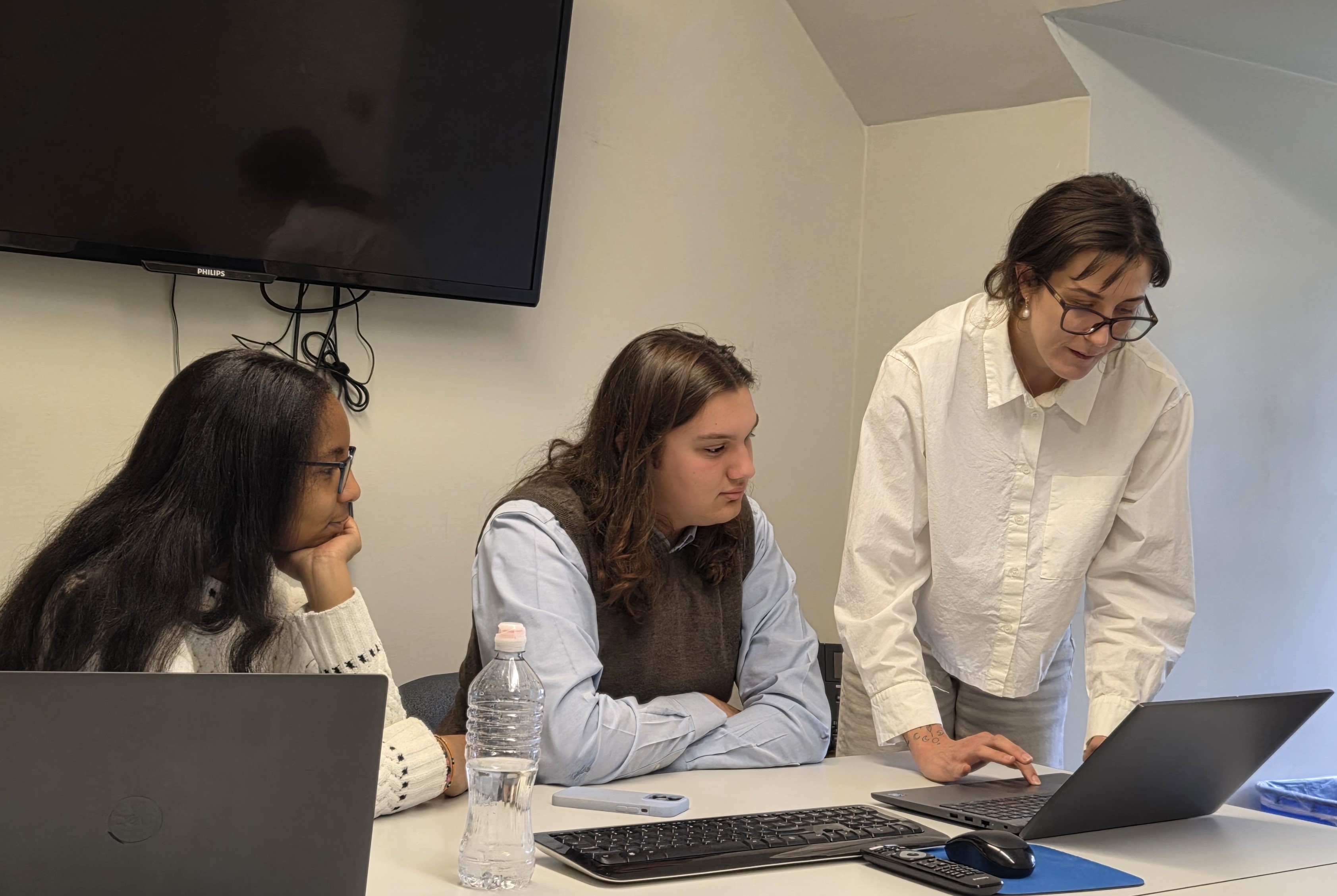
Kamilah and I workshopping our reel for Carl Milles’s 150th birthday with Jess, May 2025. Photography by Leslie Mio.

For me, as a student at Cranbrook, my view is that of someone on the inside, who has the privilege to walk by art on campus each and every day (admittedly at times without a second thought). But getting to see the behind-the-scenes of Cranbrook’s beautiful historic campus has given me an appreciation that feels wholly unique amongst my peers.

If you’ve read this blog, I urge you to take a moment to appreciate all that goes on caring for a 100-plus-year-old campus to live on to this day and serve its many students and visitors. From calls, texts, emails, and meetings, the Center is busy planning, filing, caring, and protecting the legacy of Cranbrook. The work is never done.

Yet despite the challenges, the Center rises to the task, willing to give their all to something they passionately care for. It would be hard not to be inspired.
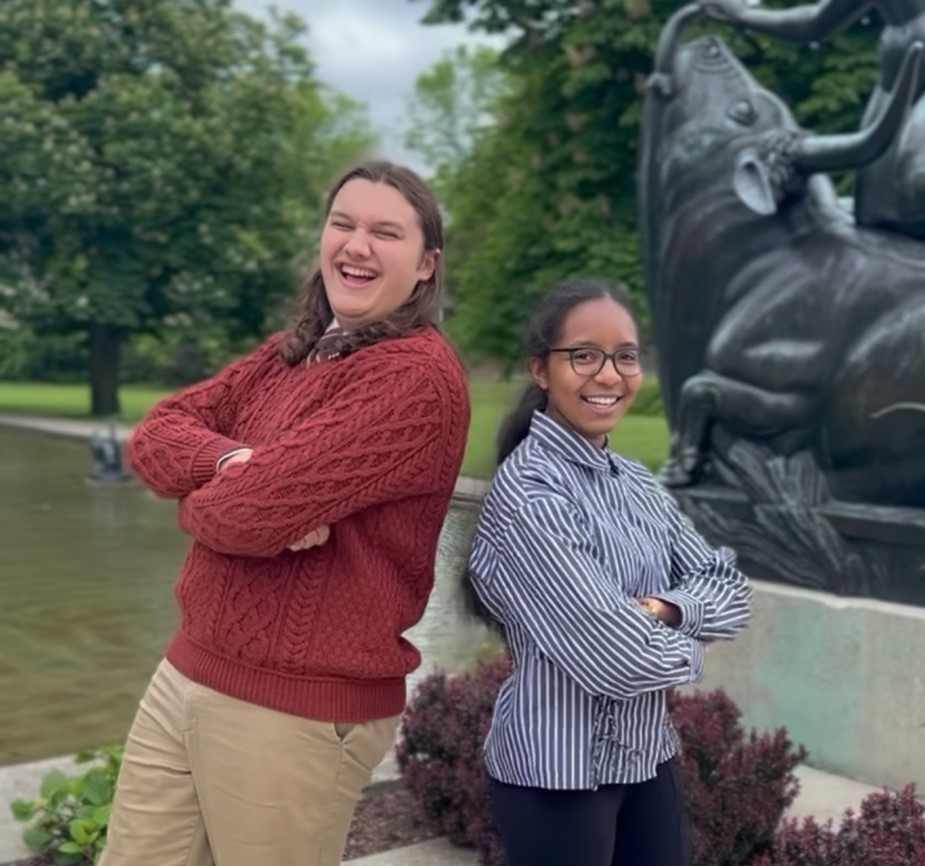
Kamilah and I make a video for Carl Milles’s 150th birthday, May 2025. Photography by Jessica Webster.

This internship has truly been a dream-come-true, and I am grateful to Mariam, Leslie, and Kevin for their warm welcome and tutelage.

Joel Kwiatkowski, Cranbrook Kingswood Upper School Class of 2025 and Cranbrook Center for Collections and Research 2025 Senior May

Editor’s NoteThe Senior May Project is a school-sponsored activity that encourages Cranbrook Kingswood Upper School seniors to acquire work experience in a field they are considering as a college major, a potential profession, and/or as a personal interest.

Joel Kwiatkowski graduated from Cranbrook in June 2025 and will be attending the University of California San Diego in the fall to pursue a degree in Molecular and Cellular Biology. Joel first came to Cranbrook Schools in sixth grade, and has since gained a passion for the institution’s rich history of influential artists and personalities. 

Cranbrook, a Home Away from Home: My Senior May Experience

Each May, the Center is honored to host an outstanding senior from Cranbrook Kingswood Upper School for a three-week immersive internship.

The Center’s 2024 “Senior May” Sav Hayward writes about their time working with the Center team.

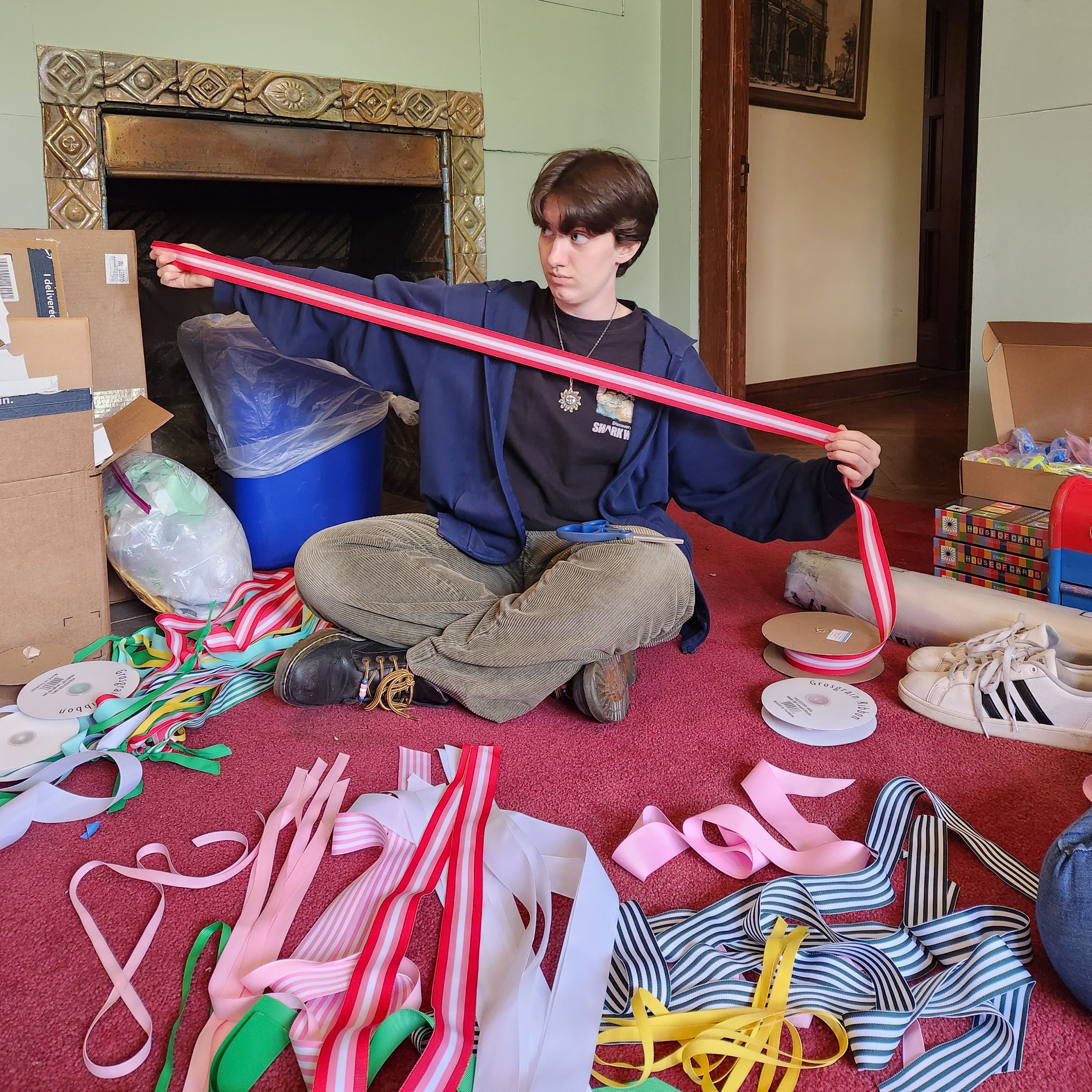
I hit the ground at my Senior May running. The very first day, I had to help prepare for the Center’s annual House Party gala. This year it was held at Thornlea House which needed a lot of TLC before the event on Saturday. During my first week, I worked all over the house to help prepare it. Things like vacuuming (Ed. note: No one, in the history of the universe, was as excited as Sav about vacuuming), wiping windows, sorting cupboards, cutting ribbons, crafting decorations, and going to Cranbrook Archives to help move items from the collection for displays. Once everything was completed the final product was extremely satisfying, and I heard many wonderful things about the night. I had to decline my invitation to the House Party in favor of my Senior Prom.

Cutting ribbon to create bunting for the House Party. Photograph by Leslie Mio, May 2024.

The following two weeks, I never had the same task twice in a row. Some of my favorite days consisted of working in the Archives with Deborah Rice and Laura MacNewman, helping around in the Annex offices with the Center’s Registrar, Leslie Mio, and going on random little trips.

In the Archives, I helped organize and re-box some items we got out for the House Party. There was a very relaxed environment there, and it was cool seeing all the documentation Cranbrook has about our history.

The following day I helped Kevin and Leslie take the painting A Hunter of Taos by Oscar Edmund Berninghaus from the Cranbrook Kingswood Middle School for Boys and drive it to a conservation studio in Detroit. When we were finishing our visit, the conservator, Ken Katz, told us to go upstairs and check out the exhibit being set up at the Metropolitan Museum of Design Detroit (MM-O-DD). There we met some cool people, including the Founder/Executive BOD President Leslie Ann Pilling and Chuck Duquet of Collected Detroit, who took us downstairs and showed us artwork stored there.

Standing around looking at the framing studio. Photograph by Kevin Adkisson, May 2024.

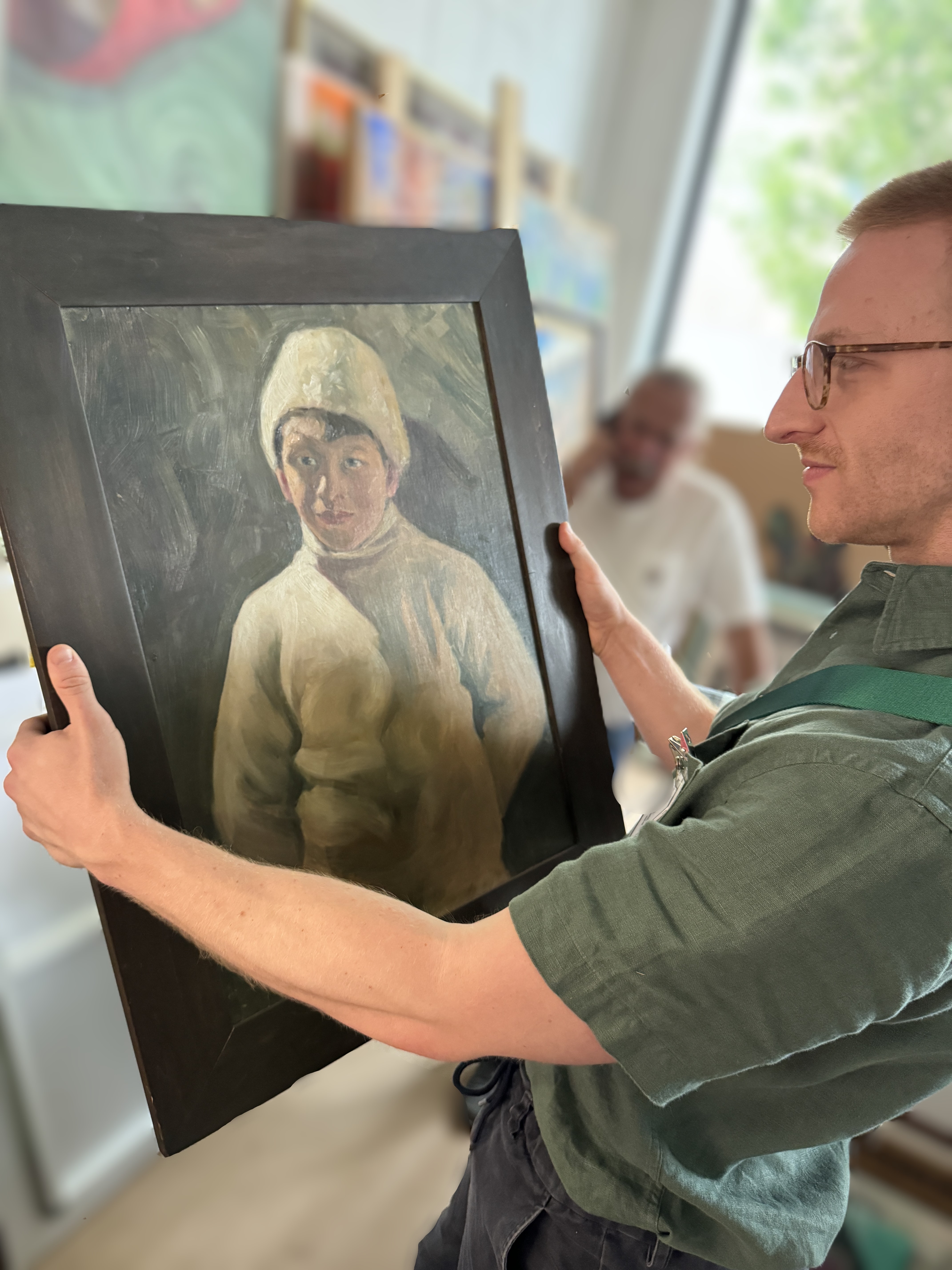
While looking around I saw pieces by many Cranbrook Artists, including some that had been loaned to Cranbrook Art Museum’s recent exhibition LeRoy Foster: Solo Show. I also saw an amazing painting of Eero Saarinen as a boy, painted in Finland by his father (and architect of Cranbrook) Eliel Saarinen.

Kevin admires Eliel Saarinen’s painting of his son Eero at Collected Detroit. Photograph by Leslie Mio, May 2024.

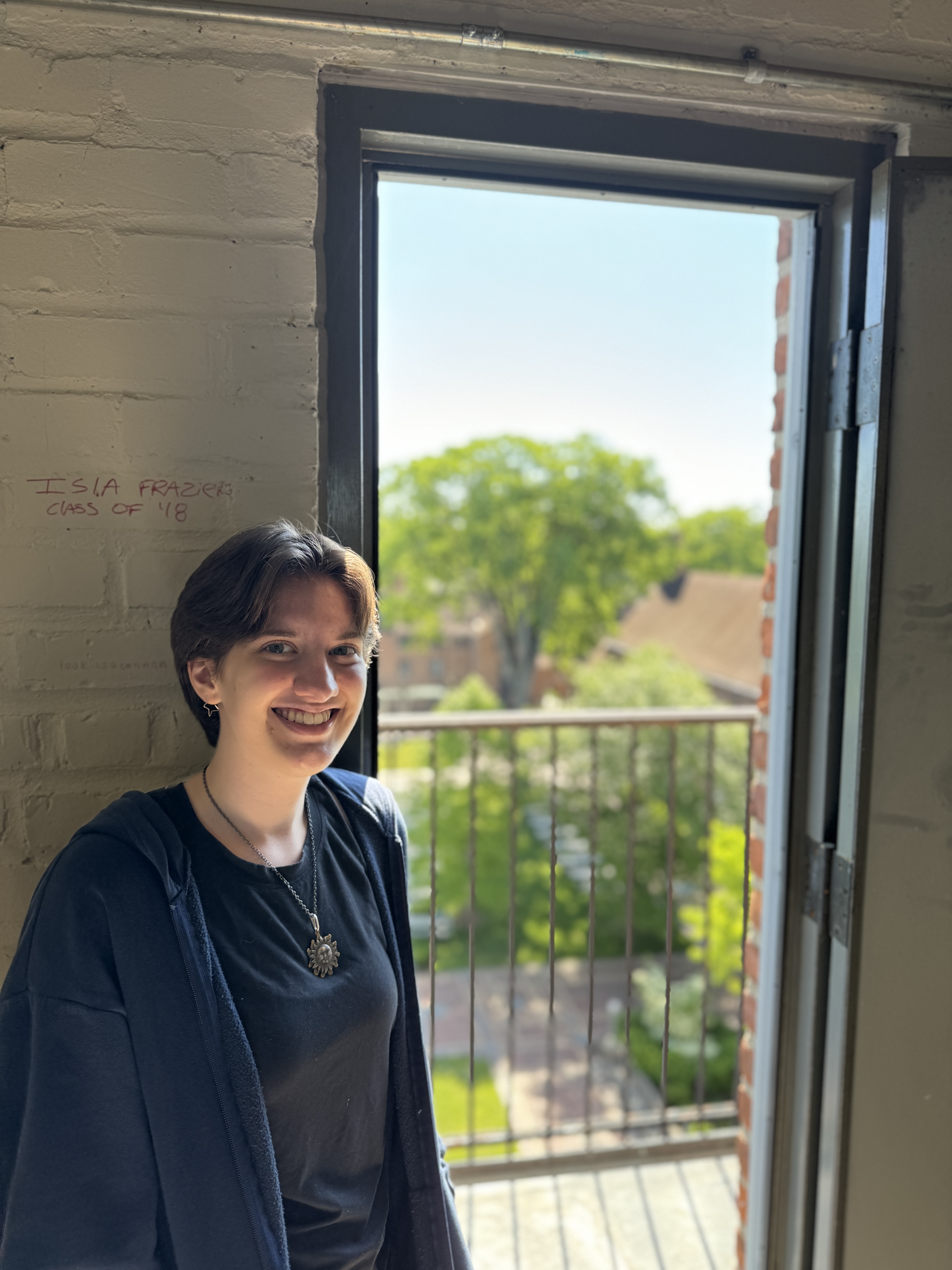
Ever since I started going to Cranbrook, I have dreamed of going up into the old astronomy tower at Hoey Hall. I was able to achieve this dream thanks to Kevin. He was working with photographer James Haefner to document the tower after some recent cleaning. Luckily, I was invited to join Kevin and see how the entire photshoot process worked. I helped do some tasks, like dusting, carrying equipment cases, and bringing water up to the ridiculously hot rooms.

Standing next to the upper door in the Cranbrook Campus tower. Photograph by Kevin Adkisson, May 2024.

On the last day of Senior May, I joined Leslie and Kevin on a trip to Hagopian World of Rugs in Birmingham. We met with architect Erinn Rooks of Cranbrook Capital Projects to pick out colors for a reproduction rug. Suzanne Hagopian, Executive Vice President, brought out a test sample made a while back to see if the colors matched the original and if it was what we were looking for.

When we looked at the sample, we realized that the colors were lacking, so we all sat around and debated over small tufts of colorful yarn samples. What was nice was that these color samples were neatly lined up in multiple boxes. After a while, we finally decided on more vibrant colors compared to the sample, but this was to help make the carpet pop. Ed. note: Sav’s knowledge of color theory and use of technology to compare color tones greatly assisted in this project.

Erinn, Leslie, and I examine carpet and color samples. Photograph by Kevin Adkisson, May 2024.
Kevin and I take a “magic carpet ride” while looking at yarn samples. Photograph by Leslie Mio, May 2024.

I will always remember this Senior May and how fun it was. The people I met during this time are amazing and I will miss seeing them every day. While some of my classmates went off campus for their Senior May, doing mine on Cranbrook’s entire campus felt like I was a part of one large family. I have never felt more connected to Cranbrook, its history, and its legacy.

Sav Hayward, Cranbrook Kingswood Upper School Class of 2024 and Cranbrook Center for Collections and Research 2024 Senior May

Editor’s Note: Sav Hayward is a member of the CKU Class of 2024 and a proud resident of Lansing, Michigan. In Fall 2024, Sav will continue their education at the College for Creative Studies in Detroit, where they will study Interior Design. CCS is the modern iteration of the Detroit Society of Arts and Crafts, co-founded by George G. Booth in 1906. Sav is hoping to land a paper route for the Detroit News to complete the Booth trifecta.

Another day, another lunch break. The Center feeds its Senior Mays well – Sav was treated to lunches at some of the staff’s favorite local eats, including Panera, 29º 41º Mediterranean Street Food, Green Dot Stables, and Paris Baguette Café (pictured here on their last day with us). Photograph by Kevin Adkisson, May 2024.

Celebrating and Preserving Cranbrook’s History: My Senior May Experience

My three weeks at the Center for Collections and Research have been an exhaustive tour of all the activities and responsibilities of maintaining Cranbrook’s history. From getting ready for the annual House Party, scanning historical documents, and cleaning the Smith House in preparation for summer, being a member of this community requires one to wear many hats to preserve its history.

Scrubbing the Frank Lloyd Wright Smith House in Bloomfield Township. Photo by Leslie Mio.

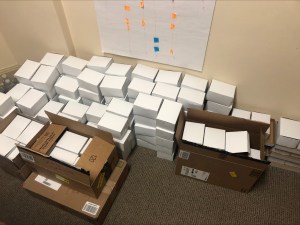
During my first week with the Center, I entered into the great anticipation of the annual House Party fundraiser. With this year’s theme involving Cranbrook’s influences from England, many of my projects involved making Cranbrook House a better fit for this theme. As favors for the guests, I assembled nearly 300 pastry boxes to fill with scones and other iconic English treats like tea and marmalade.

My collection of pastry boxes from my week at Cranbrook House. Photo by Grace Quinn.

Following the party, I helped scan many folders of documents from the Archives on George G. Booth and his involvement with the Detroit Arts and Crafts Society and with renowned architect Albert Kahn. Although I knew very little about the Arts and Crafts movements, I came to a much stronger understanding of how the Booths focused much of their wealth and influence on buying and displaying handcrafted goods.

These were not just shows of wealth but were a way of honoring the artisans who built this campus and saying, without words, that a quality place like this will withstand much more than inhuman, mass-produced art and furniture. Even though this notion is not new, rising technological advances seem to only make cheapness and speed priorities in design, rather than beauty or emotional value. The art of patience and supporting artists is a refreshing notion compared to the on-demand nature of online shopping and rampant consumerism.

While scanning documents from the George G. Booth Papers was my main Archives project, I also got to work with architectural drawings of Glen Paulsen from the 1950s. Photo by Deborah Rice.

When reflecting on what I had learned during this internship, I realized that before this I had never given much thought to how this campus came to fruition. I knew that some famous architects built it, but as I scanned archival documents and helped maintain Cranbrook’s houses, I can now fully realize the cultural influence Cranbrook has had in Detroit’s history.

Cranbrook’s inspiration stretches across borders and countries; it has a prominent space in contemporary architecture and in the earlier Arts and Crafts Movement. Cranbrook’s exercises in art and design are on display to inspire others to emphasize detail, quality, and creative talent in designing schools and creating diverse communities.

—Grace Quinn, Cranbrook Kingswood Upper School 2023

Editor’s Note: The Senior May Project is a school-sponsored activity that encourages Cranbrook Kingswood Upper School seniors to acquire work experience in a field they are considering as a college major, a potential profession, and/or as a personal interest.

Grace’s efforts in making A House Party at Two Cranbrooks a success, her can-do attitude, and her flexibility in tackling projects large and small were much appreciated by the Center staff. We wish her luck as she heads to the Rochester Institute of Technology’s College of Art and Design in the fall!

Cranbrook Behind the Scenes: My Senior May Experience

Ms. Rice warned me that the first week of my Senior May Project would be hectic and slightly crazy, and it definitely was, but in the best possible way! Being a lifer at Cranbrook, I have learned a lot about our amazing campus over the years, but nothing could have prepared me for the intensely interesting and extremely entertaining Senior May opportunity I have encountered at the Center for Collections and Research.

Riya Batra on set in Saarinen House for the Susan Saarinen interview. Photo by Nina Blomfield.

I joined the department in the week prior to A House Party, the Center’s annual fundraiser, this year honoring Loja Saarinen. Within minutes I was fully immersed into the event preparation. From unboxing the beautifully printed mugs to sitting in on engaging interviews, I was able to experience and assist in a variety of tasks that made me feel like I was actually contributing, even though my contribution was likely quite small in the grand scheme of things.

Riya as Susan Saarinen’s camera stand-in. Photo by Nina Blomfield.

One moment I will never forget was driving Susan Saarinen back to her hotel, after her interview for the film, and seeing an actual dress created by her cherished grandmother Loja. Where else in the world would I ever get to experience something like this?

Leslie Mio packs up the dress by Loja Saarinen. Photo by Riya Batra.
Continue reading

In the Archives: My Senior May Experience

I went into my Senior May Project hoping to find the “secrets” of Cranbrook. On the second or third day, Mr. Adkisson asked Desai, another Senior May student, and me why we chose the Archives. I said because I wanted to learn more—and because I thought it would be easy. What I meant to say is that I thought it would be low stress. Even though I didn’t uncover any “secrets,” I learned a lot about the history of Cranbrook Schools and had a very enjoyable (and low stress) Senior May experience.

IMG_5707

Aya Miller, CKU ’19, at work in the Archives Reading Room. Photo Kevin Adkisson.

My project was primarily scanning copies of The Cranbrook Kingswood Crane-Clarion to create a database of The Crane and moving the archival files to different shelving units. Along the way, I helped out with other Archives related tasks that came up. These included transferring larger files to and from Thornlea Studio, preparing displays for small tour groups, and picking out photos that could be used on the Center for Collections and Research Facebook page.

One of the high points of my experience was a task we did on the first day. Laura MacNewman, my supervisor, Mr. Adkisson, Desai, and I went to Christ Church Cranbrook in search of a friar within the Women’s Window. The friar was an insignia from the designer and glassmaker who constructed the window. We took a very narrow staircase, hidden in the wall, up to the bottom of the window. The area was so small that Mr. Adkisson could barely walk over with his tripod to take the picture. While we were up there, they turned the lights out in the main sanctuary. The daylight filtered in through the stained-glass window and gave the church a faint pink tint. I was awe struck; it was simply stunning. I felt like I was in a picture from National Geographic. That view and many other small things I learned helped make my time in the Archives memorable.

IMG_8952

A view from the Women’s Window at Christ Church Cranbrook. Photo by Aya Miller, CKU ’19.

As for scanning, I learned a lot about stories that were covered in the past. In the March 2006 issue of the Crane-Clarion there was a two-page article called “The Problem of ‘Self-Segregation’ at Cranbrook.” The article covered how minorities often group together and how white students don’t notice that the majority of their friends, as well as the majority of the school, is white. It takes editors that find these issues important to bring them to the forefront. Although for many it may be an uncomfortable subject, it is a necessary one to discuss.

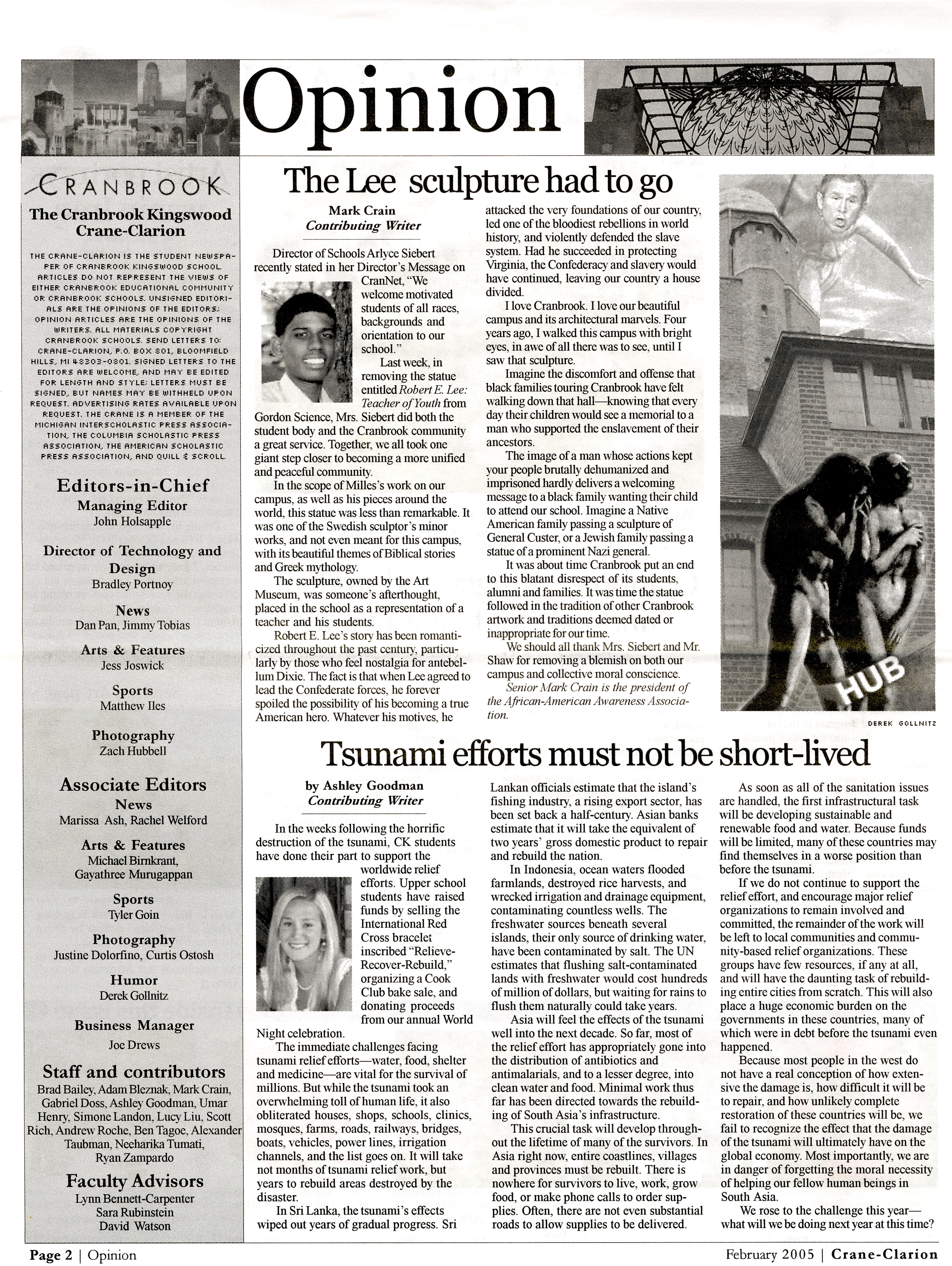
I also read interesting articles about the removal of a Robert E. Lee statue that used to stand in Gordon Hall of Science. In reading the articles, I was surprised that the students had many contrasting opinions. Some people quoted were against the statue’s removal because they saw Lee as an American hero in terms of his post-War accomplishments and his fight for states’ rights in the Civil War. In the end, the faculty choose to remove it because Lee’s role as a leading general in support of slavery during the Civil War was offensive to many students and families. The coverage opened my eyes to different opinions and reaffirmed my belief that there are always many sides and opinions to a situation.

No. 3, February 2004, Opinion, Pg.2

Opinion section of The Cranbrook Kingswood Crane-Clarion, February 2005. Courtesy of Cranbrook Archives.

To put it simply, Senior May was great. The Archives was a relaxing and enjoyable place to work for the last three weeks of my Senior Year. I’m proud that I was able to help and make a difference, even if it was a small one. In fact, I enjoyed it so much that I’ll be staying on throughout the summer to continue working as a volunteer. I’d like to thank those who work at the Center for Collections and Research as well as my supervisor, Laura MacNewman, for welcoming and hosting me.

Aya Miller, Cranbrook Kingswood Upper School 2019

Editor’s Note: The Senior May Project is a school-sponsored activity that encourages Cranbrook Kingswood Upper School seniors to acquire work experience in a field they are considering as a college major, a potential profession, and/or as a personal interest.

Aya Miller is a native of Kalamazoo, Michigan, and has been a boarding student at Cranbrook since 2015. Aya will be enrolling at Western Michigan University in Kalamazoo this fall. The Center thanks her for her tireless efforts scanning important documents about Cranbrook’s history, and her volunteering to continue with us this summer. We know she will be a success as she embarks on the next phase of her education!


Cranbrook, Unseen: My Senior May Experience

When I first visited Cranbrook on a snowy January day, the campus felt magical. I knew nothing about its history—not of the Booths, Saarinens, Milles. Yet when I pulled open the heavy leaded glass doors and stepped into a green-tiled lobby, I was in awe of its beauty.

Desai Wang, CKU ‘19, with Jim Miller-Melberg’s Porpoise play structure at the Cranbrook Middle School for Boys.

Desai Wang, CKU ‘19, with Jim Miller-Melberg’s Porpoise play structure at the Cranbrook Kingswood Middle School for Boys. Photo Kevin Adkisson.

For the past three years, I have been fortunate to study here and to call Kingswood dorms my home. The names previously foreign now ring close to heart.

Or do they?

As senior year came to a close, I realized that perhaps my understanding was no more than the facts handed to Gold Key student tour guides. I knew “the names,” and roughly, their accomplishments, but not why; I did not know their stories.  

I knew I wanted to use my Senior May Project to better understand Cranbrook. My wish was vague, and if asked to define it I probably would have said something about wanting to learn more about the buildings and “the names.” As my three-week internship with the Cranbrook Center for Collections and Research comes to an end, I think my time working with Mrs. Mio and Mr. Adkisson can be summarized by one word: unseen.

I finally toured Cranbrook House, Saarinen House, and the Smith House, and the past three weeks were filled with discoveries of details I never noticed before. However, I think the most important thing the Center gave me is a change in perspective.

Previously, my interest rested directly on what was visible: the existing architecture, their designers and their history. But, as trips to Cranbrook Archives proved, plans unbuilt are just important as those built. I saw George Booth’s plan for a school attached to Christ Church, Saarinen’s original designs for the Institute of Science and Academy of Art (only parts were realized for both), the multi-story elevations for Gordon Hall of Science, and a guest house proposed by John Hejduck that would have sat behind Lake Jonah.

Further, I was introduced to Cranbrook beyond its schools and museums. I joined Eastern Michigan University historic preservation students as they surveyed Tower Cottage and Lyon House. The former previously hosted a water tower, Cranbrook’s fire truck, and apartments that were in use through the 1980s. The latter was a family home built in the 1920s and acquired by Cranbrook almost twenty years ago. Both historic buildings have been repainted many times, so a paint analysis was performed. I found the process of slicing out small pieces of the buildings, analyzing them under a microscope, and studying the layers of paint and dirt to determine original colors, exciting. For the Tower Cottage window frames, layers of green appeared under the current brown.

Ron Koenig, the owner of Building Arts & Conservation, takes samples of paint on the window frame at Tower Cottage.

Ron Koenig, the owner of Building Arts & Conservation, takes samples of paint on the window frame at Tower Cottage. Photo Desai Wang, CKU ’19.

Most importantly, I saw Cranbrook from behind the scenes. I spent some of my first week scanning photographs and slides of Andrea Arens, a local artist who wove pillows for the Smith House.

Slide of Andrea Arens's pillows on display on the bench in Smith House. Courtesy Arens Family.

Slide of Andrea Arens’s pillows on display on the bench in Smith House. Courtesy Arens Family.

Yet the small stack of material I digitized is nothing compared to the cabinets after cabinets of pictures and files stored in the Archives. Just thinking about the amount of time it took to digitize my small binder sends a shiver through my spine about how much work it takes to digitize records, and about just how vast the collections of Cranbrook Archives are.

Scanning aside, at the Frank Lloyd Wright-designed Smith House Mr. Adkisson, Mrs. Mio and I cleaned the Smiths’ exterior cabinets and organized a closet full of their pamphlets and magazines. We vacuumed and moved around artworks so UV protection film could be installed on windows to prevent further textile damages.

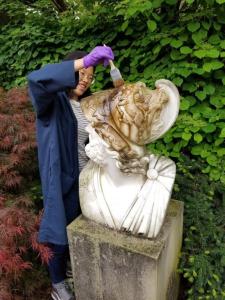
One day, we drove to Ken Katz’s conservation studio in Detroit to deliver a wood panel painting, a lamp, and a jade piece—all in need of restoration. Mrs. Mio and I applied inventory numbers to George and Ellen Booth’s silverware and china, and we even scrubbed Menelaus with Elephant Snot (a cleaning product).

Ken Katz, Mrs. Mio, and Mr. Adkisson discuss restoration plans for the painting on wood panels— Flora, Ceres, Pomona (Three Goddesses) by Corrado Scapecchi.

Ken Katz, Mrs. Mio, and Mr. Adkisson discuss restoration plans for the painting on wood panels— Flora, Ceres, Pomona (Three Goddesses) by Corrado Scapecchi. Photo Desai Wang, CKU ’19.

Desai, brushing Elephant Snot onto Menelaus.

Desai, brushing Elephant Snot onto Menelaus. Photo Leslie Mio.

I feel privileged to have organized items in a Frank Lloyd Wright house-museum, handled art created by famous painters, sculptors and ceramicists, and labeled plates and spoons that were used by the Booths. Above all, I am grateful to have met some of the people who dedicate themselves to preserving and sustaining Cranbrook’s history and beauty.

Desai, applying removable adhesive on Booths’ saucers to attach inventory numbers.

Desai, applying removable adhesive on Booths’ saucers to attach inventory numbers. Photo Leslie Mio.

Mr. Adkisson, at Smith House, organizing Smiths’ pamphlets, brochures and magazines.

Mr. Adkisson, at Smith House, organizing Smiths’ pamphlets, brochures and magazines. Photo Desai Wang, CKU ’19.

Three years ago, I opened a door that led me to Cranbrook, and to my interest in its past. Three weeks ago, I opened a door that led beyond history and urged me to see the present. I leave here with “the names,” some stories, but most importantly, acknowledgment and appreciation of the ongoing work that keeps this place running.

Desai Wang CKU ‘19

Editor’s NoteThe Senior May Project is a school-sponsored activity that encourages Cranbrook Kingswood Upper School seniors to acquire work experience in a field they are considering as a college major, a potential profession, and/or as a personal interest.

A native of Xi’an, China and Ann Arbor, Desai Wang has been a boarding student at Cranbrook since 2016. This fall, she will head off to Cornell University to study architecture. We thank her for her willingness to assist in projects across campus and her enthusiasm for Cranbrook history. We wish her luck as she embarks on another chapter of her life!

Indiana Jones and the Search for the Pergola Picture: My Senior May Experience

Growing up so close to the Henry Ford Museum, or watching my family’s favorite go-to movie, Raiders of the Lost Ark, I knew that I was interested in history from an early age. Yet, I never stopped to think about Cranbrook’s own fascinating and world-renowned past. To me, this community was just “home”, and the only history I thought of was of my family’s connection with the school. Nevertheless, for my Senior May project, I wanted to learn more about the inter-workings of the educational community as a whole. With this in mind, I chose to intern at the Cranbrook Center for Collections and Research and the Archives for my last senior assignment.

Elizabeth Fairman, CKU ’17

The purpose of Cranbrook’s Senior May project is to give soon-to-be Upper School graduates a taste of a “real world” job for the month of May in their field of interest.  Initially, I assumed I would be either in Art Museum storage moving art pieces or doing research on the computer every day, but I could not have been more wrong.

Over the course of my three weeks, I had behind-the-scenes tours of Cranbrook’s many historic landmarks, firsthand looks at restorations, handling and moving donated art pieces, and countless hours of both digital and primary source research. I met many people who are tasked with adding to and preserving this living historical landmark, no small task given the expansive campus. My perspective of the community, initially as the place of my education and a source of livelihood for my family, was altered, and I began to see it as an operational historical site.

In short, I had a very full, albeit whirlwind experience of almost everything that being an archivist or registrar entails.

Organizing original Kingswood School silverware in Heaven.

My favorite experiences were the tours of campus. Although I have attended this school for 14 years, very rarely did my classes study the history of Cranbrook or take field trips to different buildings on campus besides Cranbrook Institute of Science. In fact, I had only visited Saarinen House and Thornlea once before Senior May, just three weeks before I am set to graduate. My supervisor, Mrs. Mio, added another element of the visits, a look at them through the eyes of a registrar who is tasked with upkeep and restoration of historic sites. Through tasks such as cataloging Booth dinner plates at Cranbrook House, identifying historic bookbinding tools used at the Academy of Art, and even checking mouse traps at Thornlea, I developed a deeper appreciation for the amount of work it takes to showcase the history of this community, as well as a chance to see rooms or storage out of the public’s eye.

Clothing collection at Cranbrook House storage.

Another aspect I enjoyed was the research itself, like searching through “the stacks”, where many of the important archival files are kept. It is a place where you can find both important and unexpected things. For instance, one afternoon while searching for photos and records of the Cranbrook House Pergola for Ms. Edwards, I came across security reports from the 1960’s detailing the dangers of “hippie types” on campus. I was also able to piece together more of the history of Cranbrook firsthand through organizing and filing other primary sources created by prominent figures in the Community’s past.

Elizabeth Fairman, CKU ’17

Editor’s Note: Elizabeth Fairman is a “lifer” at Cranbrook, having attended school here since Kindergarten. In addition to that, her father Andy is the upper school baseball coach and physical education teacher at Brookside School. Both of Elizabeth’s grandmothers (Sue Tower and Marilyn Sutton) taught school at Brookside for many years. We thank Elizabeth for her exemplary work ethic and positive attitude and wish her the best of luck in her new adventure at Bates College in Maine.

I Have a Crush on James Scripps Booth

After the second week of May, I readily began my Senior May Project, an intensive program that allows second semester seniors to explore a field of study for three weeks. Pulling open the imposing silver doors of the Cranbrook Archives on my first day, I had no idea what truly occurred on the other side. As I, with the fumbling hands of a novice, used fundamental archival tools such as finding aids, vertical and photo files, indexes, backlogs, and the digital image database over the course of the three weeks, I began to understand what an archivist does behind those argent doors.

Margaret Harney, CKU '15

Margaret Harney, CKU ’15

Honestly, it is a lot of filing. Archivists receive chaotic and often decaying papers, photographs, and other documents deemed worthy of being preserved, and they organize them into various categorizes and topics. Everything has a place, and that place is well recorded in differing indexes and inventories. As a person whose nickname as a child was “Messy Meg,” I inevitably struggled to learn the complex organizational system. Often, I would stand in a dim corner of the archives, afraid of disarranging the gray archival boxes like some omnipotent entropic force, or a two-year-old. Thus, in the second week when I was tasked with organizing three filing cabinets of photographs from Cranbrook Kingswood post-merger, I inwardly panicked. Once I removed the folders, I discovered that they were in complete disarray from the disinterested teenager who had supposedly organized the cabinets before me. While their quite arrogant lack of effort often made me want to pry my muscles from my bones, it also relieved my anxiety, for I knew no matter how badly I mismanaged the cabinets, it would never be nearly as appalling as it was prior.

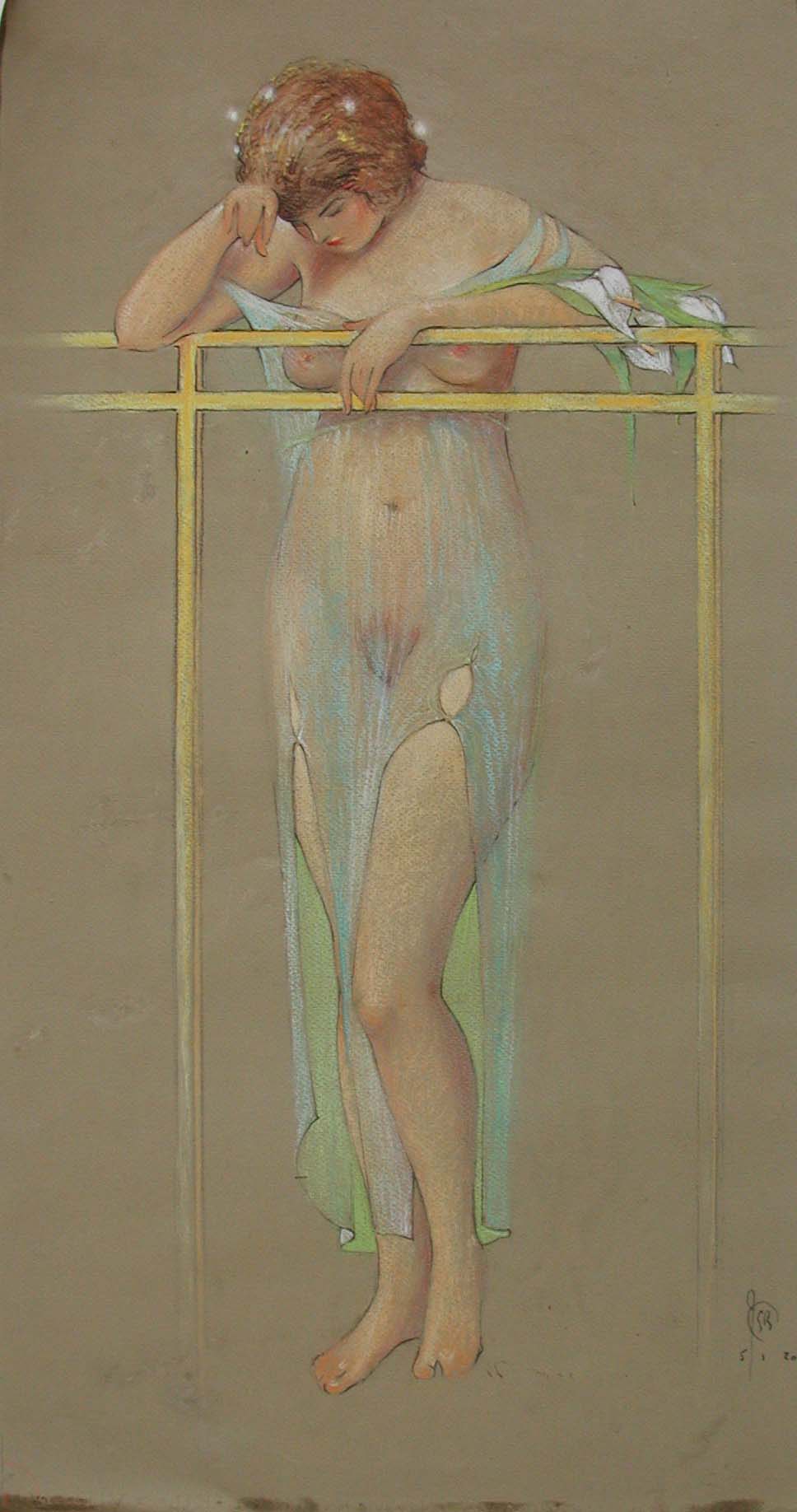
Study for Blessed Damozel, 1920.  James Scripps Booth

Study for Blessed Damozel, 1920. James Scripps Booth

After finishing the cabinets, I helped Ms. Edwards rummage for posters in the metallic archive vaults, and there in James Scripps Booth’s yellowing, rigid pastels, I discovered why an archivist undertakes all that grueling and mind-numbing filing. Beneath the waxy paper shielding the drawings, nude female figures innocently and exquisitely revealed themselves among impatient pastel strokes. While I was beguiled by the striking beauty of the sketches, I was equally as captivated by their ability to reveal the whims of Booth. Thus, not only the women, but Booth as well lay exposed. Such drawings and degenerating documents that archivists strive to preserve are like little vitrines displaying various aspects of the past. Each frame depicts a story and when all the frames combine, a larger impression is formed. Like an ink blot, this impression allows the viewer to decide what the greater story is. The ability to interpret the past for yourself is a rare and remarkable privilege, and that was the greatest gift my time in the archives gave me.

Cranbrook House, 1917.  James Scripps Booth

Cranbrook House, 1917. James Scripps Booth

Margaret Harney, CKU ’15

From an Intern’s Eyes: Old Drama and Timeless Art

In the second week of May, I began my first day at the Cranbrook Archives for my Senior May Project, a program ran by the Cranbrook Upper School to send anxious fourth quarter seniors off campus for internships and adventures.  And now, after two weeks of dealing with numerous dusty, yellowed papers (and one suspicious wooden box featuring some dead bugs and cobwebs) my initial excitement only grew.

One of my first projects here was to research the tenure of past Academy of Art faculty and staff members between the years of 1932-1976, and to make a comprehensive spreadsheet on the matter. That project led me to read through old faculty files comprised of payroll information (“how did people survive on $200 a month!” I thought to myself), retirement records, old correspondence­—I even came across the first telegram I had ever seen. I wondered, from time to time: “Did the secretary who typed this letter up ever think that a teenaged intern from China would one day behold this work and marvel at its antiquity?”

The first telegram I've ever seen.  1943, Cranbrook Archives.

The first telegram I’ve ever seen. 1943, Cranbrook Art Museum Exhibition Records, Cranbrook Archives.

Continue reading

Create a website or blog at WordPress.com