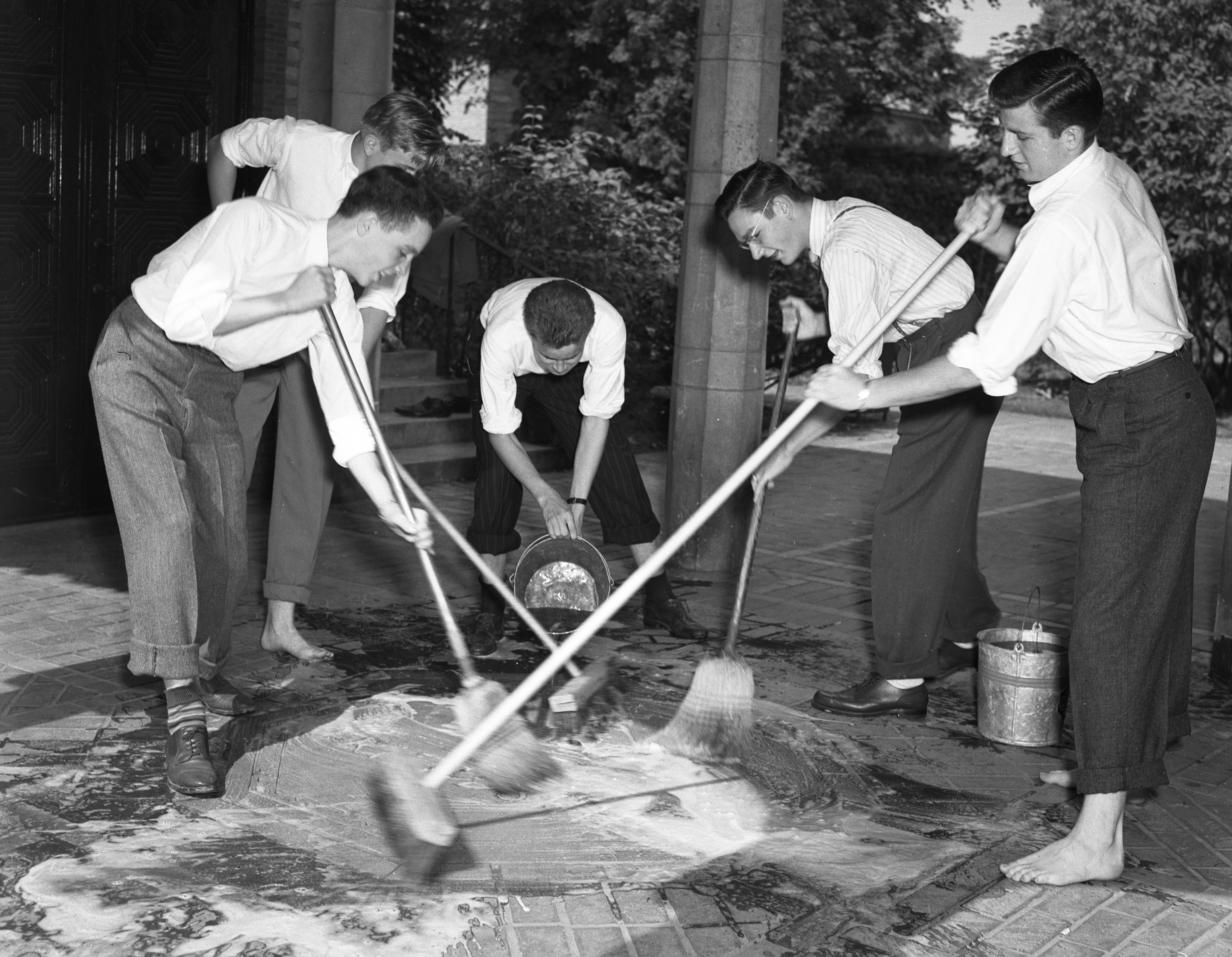
Prefects scrubbing the Gateway of Friendship plaque, Cranbrook School for Boys. September 18, 1944. Cranbrook Archives.
In the early 1940s, Cranbrook School students Pete Wilson and Tom Tyree wrote a modest suggestion in their “Cranium” column in The Crane student newspaper. The young men, both from the Class of 1943, suggested that students:
…refrain from walking on the plaque in the center of the gateway. It is inscribed “Gateway of Friendship” and it was pointed out that usually we do what we can to strengthen and propagate our friendships rather than trampling on them. The Crane feels this is a good point and a good example of a custom we might start.
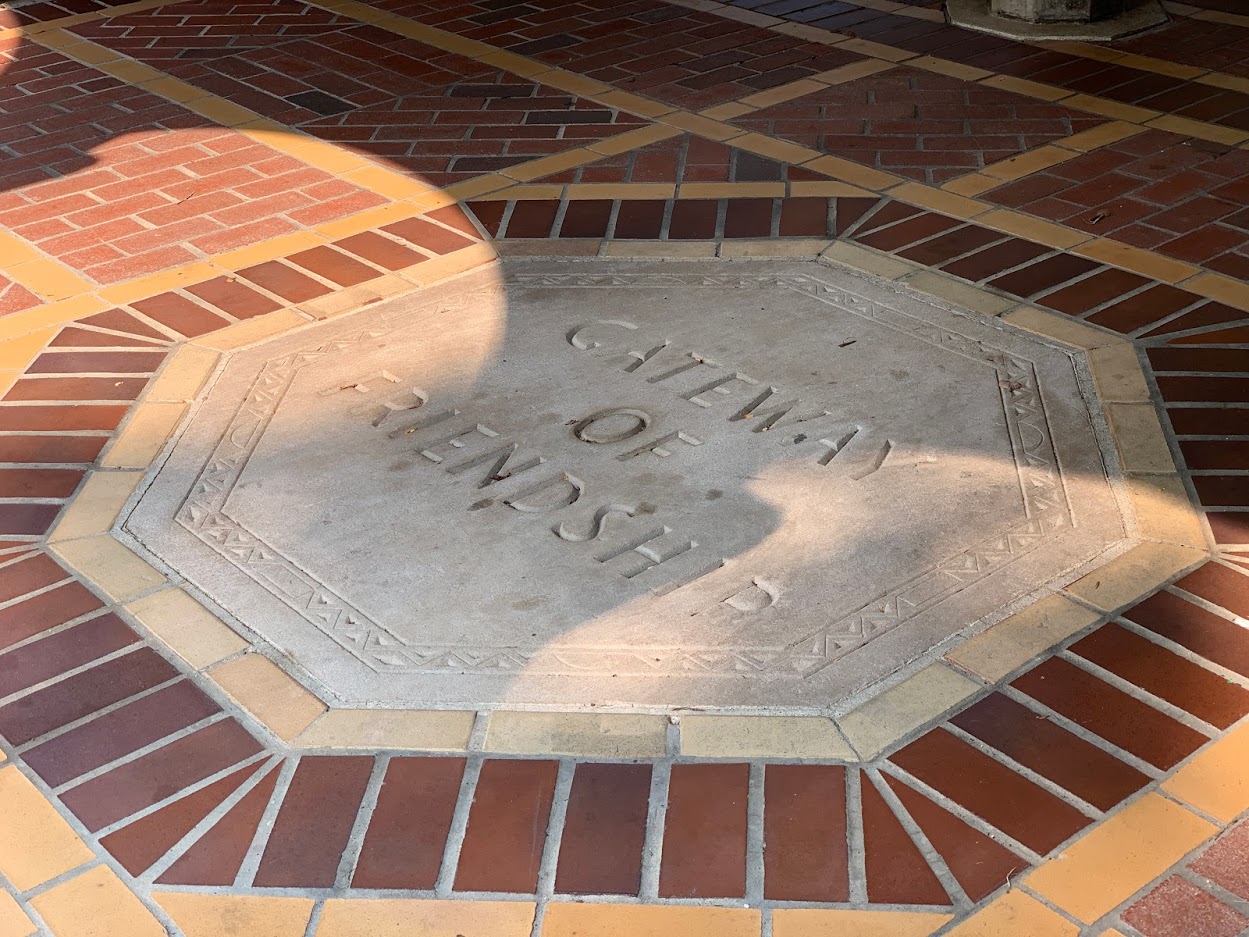
The tradition stuck, and today students resist walking over the octagonal “Gateway of Friendship” plaque. One tradition that hasn’t stuck around, unfortunately: the annual scrubbing of the plaque!
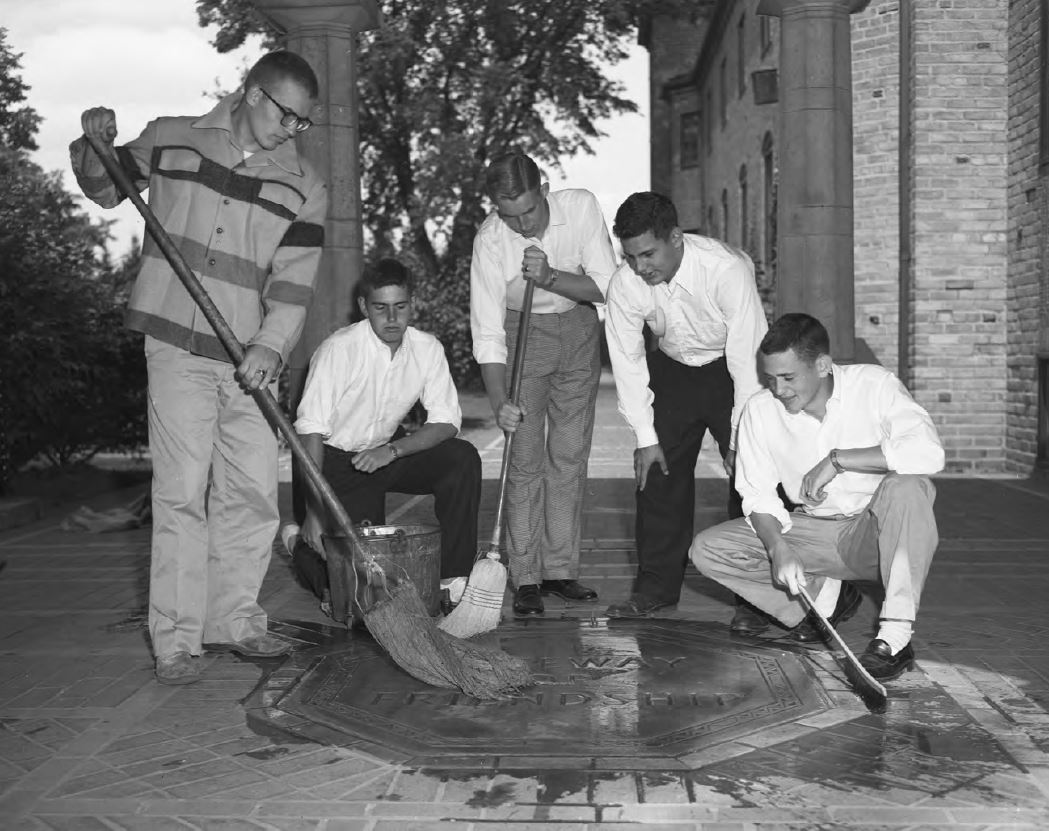
Prefects scrubbing the Gateway of Friendship plaque, Cranbrook School for Boys. September 1953. Cranbrook Archives.
Meant to symbolize the importance of friendship among the Cranbrook community, Cranbrook School for Boys Prefects would clean the plaque at the start of each school year. It’s not clear, looking at the photographs, how clean they got the stone compared to how wet and soapy they got themselves, but it was an important symbolic gesture. In caring for the stone, the boys were demonstrating the spirit of the quotes carved into the archway. One, from James Fenimore Cooper, seems especially relevant:
Friendship that flows from the heart cannot be frozen by adversity as the water that flows from the spring cannot congeal in winter.
While the cleaning ceremony was described as a “sacred rite” in 1976 by Bruce Coulter in his history of the School, Forty Years On, I am not sure when or why the tradition stopped.
Gateway of Friendship plaque, unscrubbed. September 2020. Design attributed to Eliel Saarinen, ca. 1927-1928. Cranbrook Center for Collections and Research.
Cranbrook Schools students returned to class this past Monday for a school year like no other, donning masks and sitting at desks spread six feet apart. Instead of scrubbing the plaque, the most important thing students can wash this year is their hands! Maybe the tradition will return for 2021?
—Kevin Adkisson, Associate Curator, Cranbrook Center for Collections and Research
Cranbrook Institute of Science (CIS) has long held a special place in the hearts of many area schoolchildren. Field trips, weekend family outings, and onsite demonstrations in schools and community centers are a part of the fabric of the metro Detroit K-12 educational experience.
Elementary students visit the Cranbrook Institute of Science in 1935. Robert T. Hatt, photographer. Courtesy of Cranbrook Archives, Cranbrook Center for Collections and Research.
A recent discovery in our collections furthered my appreciation of the Institute’s educational outreach and its commitment to ensuring access to the world of science for all its surrounding communities. It all started with the folder titled “Pontiac Area Urban League, 1988” in the Institute of Science Director’s Records.
The Pontiac Area Urban League (PAUL), was founded in 1950 as an affiliate of the National Urban League. An integral part of PAUL’s mission was to improve educational opportunities for underserved residents. Through its Education Committee, they partnered with Pontiac Public Schools in the 1980s to empower students of color to seek equity in science and math education by providing real-world role models and encouraging parent involvement. In 1988 this effort took the form of a project that focused specifically on middle school students and lead PAUL to approach Cranbrook Institute of Science. The resulting partnership formed the basis of CIS’s relationship with students in the School District of the City of Pontiac that continues to this day.
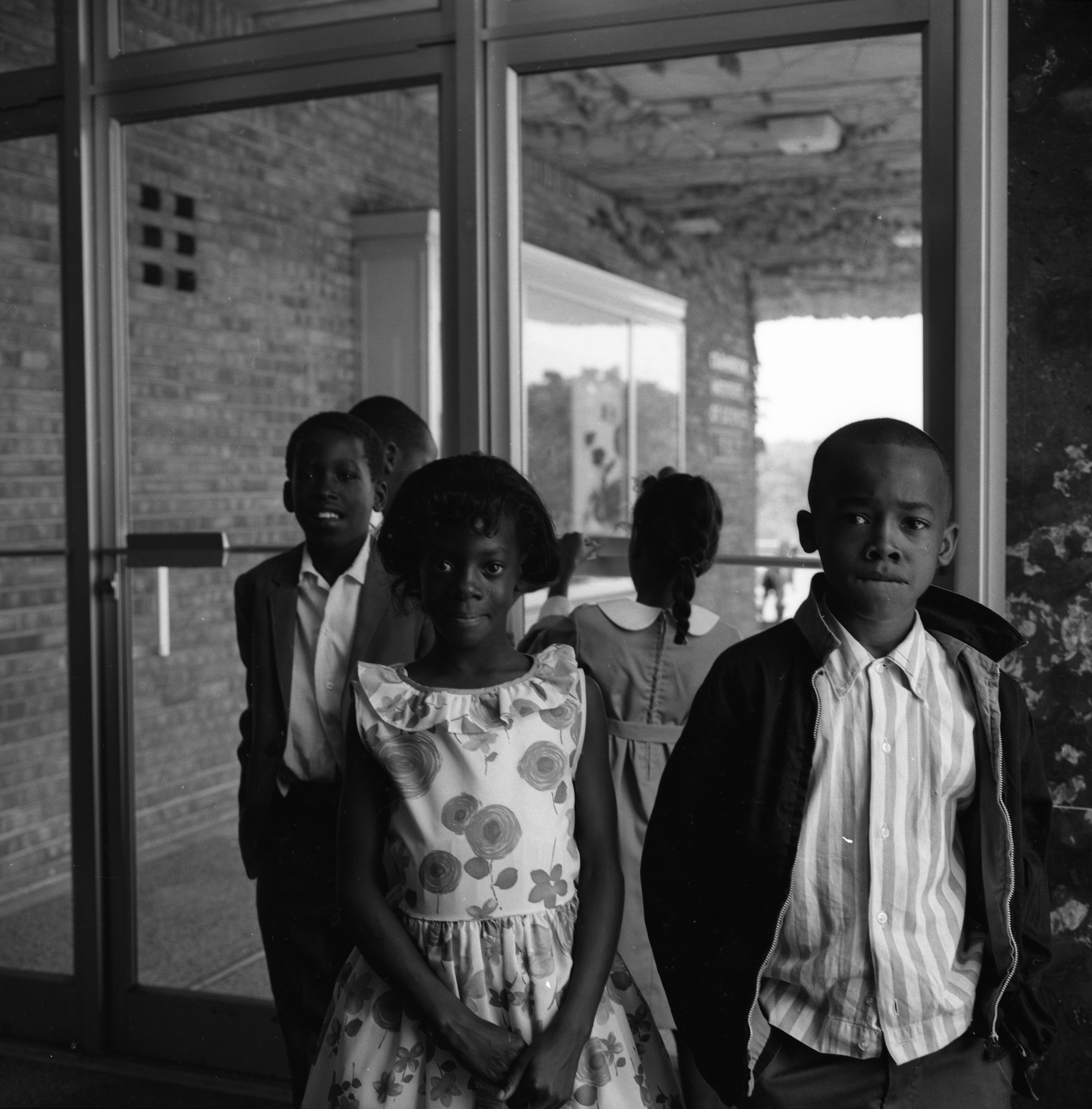
A visiting school group, 1966. Robert T. Hatt, photographer. Courtesy of Cranbrook Archives, Cranbrook Center for Collections and Research.
Correspondence in the CIS Director’s Recordssuggests that CIS had already been considering educational outreach efforts to Pontiac residents. Janet M. Johnson, Director of Education, states in a 1988 memo to Director Robert M. West regarding the possible partnership with PAUL: “This may be another avenue for us to pursue interests with Pontiac.” West expresses his “delight” a few months later in a letter addressed to PAUL’s Interim Director, Jaqueline Washington:
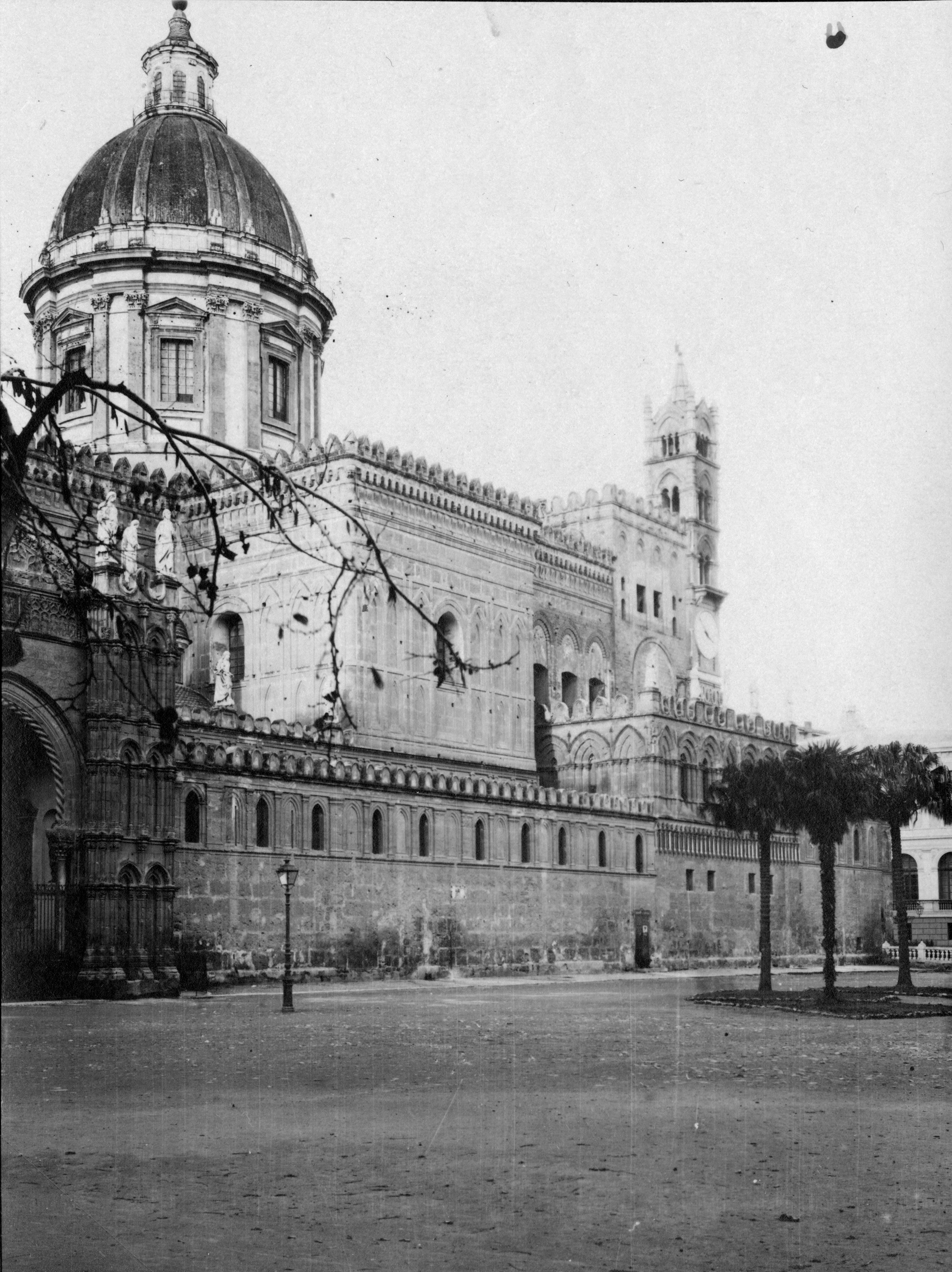
In the center of the Quadrangle at Cranbrook School is a replica of a fountain which stands in the southwestern corner of the cloister of Duomo Monreale in Palermo, Sicily. Completed in 1182, the cathedral unites Arabic, Byzantine, and Norman architectural and cultural influences and is famed for its mosaics.
The inspiration for the fountain’s long-treasured presence on the Cranbrook campus dates back to 1922, when Henry Scripps Booth first saw the original in the cathedral cloister. This was a site that Henry seems to have particularly wanted to see while on a ten-month architectural study tour of Scandinavia, Germany, Switzerland, Italy, Great Britain, and France, with his friend, J. Robert F. Swanson.
View of the Duomo Monreale, December 1922. Henry Scripps Booth, photographer. Cranbrook Archives.
Writing to his father, Cranbrook founder George G. Booth, on December 26, 1922, he describes the cathedral thus:
“Mosaic everywhere — luminous gold, and dull colors — with intricate geometric patterns in abundance and fine but rather arcaic [sic] representations of Biblical stories roofed over with a richly decorated trussed ceiling. The cloister in the cathedral’s shade is that delightful one with such delicate columns in pairs, decorated by mosaics, that is illustrated so frequently.”
View of the Duomo Monreale, December 1922. Henry Scripps Booth, photographer. Cranbrook Archives.
Henry laments that there isn’t time enough to study the monuments as closely as he would like, to measure them and draw them up, for if they did, they would end up knowing only one thing well but miss out on so many others. His letter includes this sketch of the fountain:
Letter from Henry Scripps Booth to George Gough Booth, December 24-26, 1922. Cranbrook Archives.
Several years later, George is in Naples, Italy, at one of his favored workshops, the Chiurazzi Foundry. On March 2, 1927, George wrote to Henry to tell him of numerous purchases he made at the foundry, all to be gifts to the new Cranbrook School for Boys. While the specific uses of the items might be determined later, as was characteristic of George he had a tentative plan for all of them. The most important was the replica of the Monreale fountain. Here, we can see George’s sketch of the replica fountain, showing its dimensions:
World War II caused global upheaval and change. Closer to home, two schoolteachers from Detroit—Melvyn and Sara Smith—and their dream of building a home designed by Frank Lloyd Wright would have to wait for war.
On December 7, 1941, the Japanese bombed Pearl Harbor. Sara Smith recalled her husband’s concern: “One day he confessed to [me] that in addition to his worries about the catastrophe the country was facing, he felt if there was a war, that also would be the end of his Frank Lloyd Wright house.”
In February 1942, Melvyn Maxwell Smith was drafted into the U.S. Armed Forces. “Smithy thought about being a conscientious objector because he didn’t believe in wars,” recalled Sara, “but the more he thought about it, the more he decided he would have to go. ‘We want peace and I’m going to do what I can to help,’ he told me.” The thought of Smithy going off to war weighed heavily on Sara. They had only been married a short time, and now they were being separated.
Smithy was sent off to training, first at Fort Custer near Battle Creek, Michigan, then Sheppard Field in Wichita Falls, Texas, and finally Atlantic City, New Jersey. The Smiths could only see each other during school vacations (Sara was still teaching) or holidays, provided Smithy was not shipped off to the front.
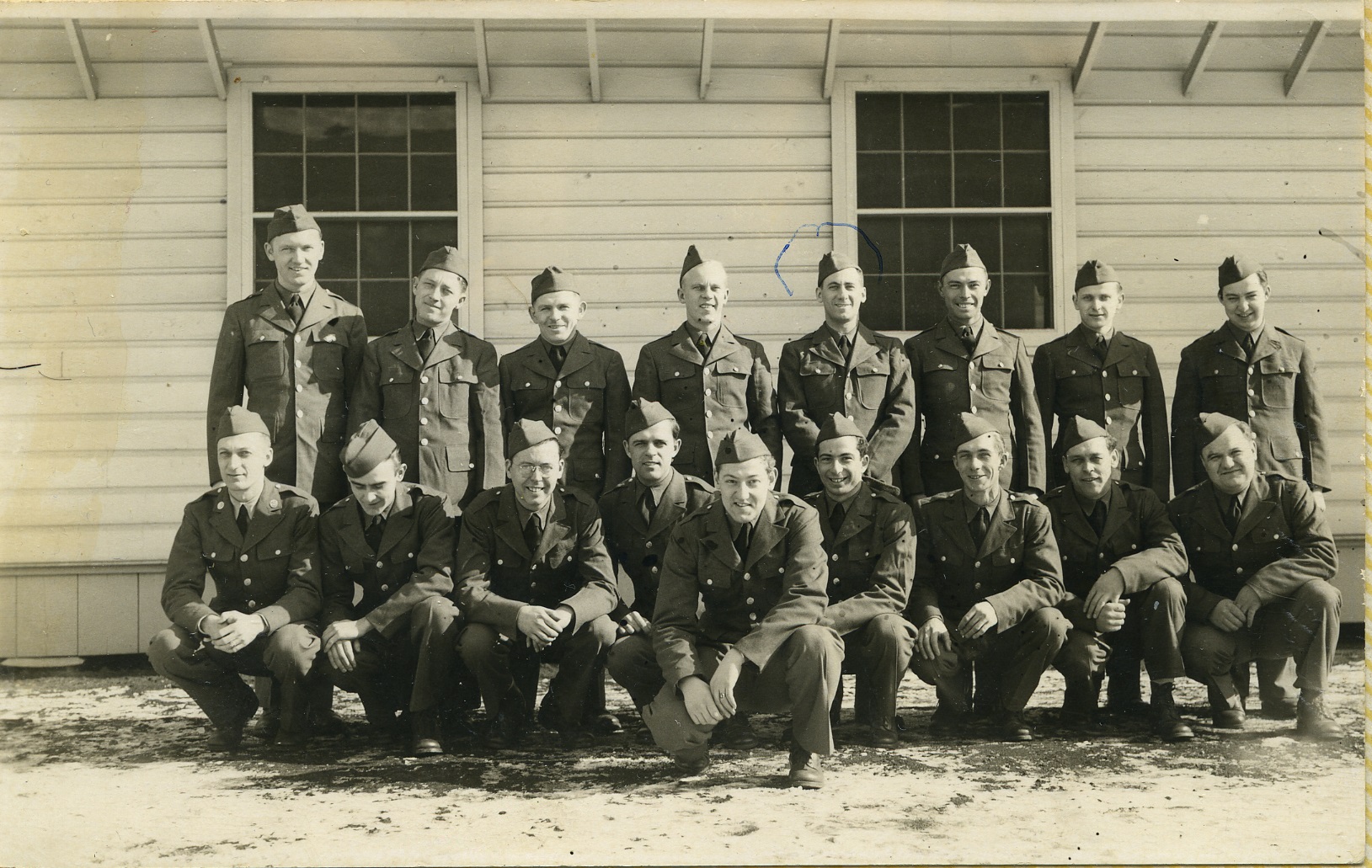
Melvyn (circled in back row) and other officers, circa 1943. Courtney of Smith Family Papers, Cranbrook Archives.
In Atlantic City, Smithy was offered the opportunity to train as a Warrant Officer in the Army Air Corps. He would be sticking around Atlantic City for a while and, with an officer’s salary, Sara could finally join him. At Christmas 1942, “[Sara] boarded the night train to Atlantic City and her new life.”
Sara and Melvyn Smith in Atlantic City, 1942. Courtney of Smith Family Papers, Cranbrook Archives.
After Atlantic City, the Smiths were relocated to Goldsborough, North Carolina. Sara and Smithy lived in a studio apartment in an Army project. Sara enjoyed living there, commiserating with all the other Army wives. Since they were all typically newly married and removed from their families, the wives helped each other. “The women, on their own during the days, supported each other by sharing supplies and tips and small and large acts of kindness.”
Warrant Officer Melvyn Maxwell Smith. Courtney of Smith Family Papers, Cranbrook Archives.
It was in Goldsborough that Sara became pregnant with her son Bobby. When she was seven months pregnant, Smithy was transferred to Gulfport, Mississippi. Sara was sure this would mean Smithy would be shipped to the front. Smithy worried too, so he asked Sara to return to Detroit and her family for the birth of their baby, instead of following him to Mississippi. While Sara was in Detroit awaiting the birth of Bobby, Smithy was again transferred, this time to Biloxi, Mississippi, for which the Smiths were happy. It meant not being overseas.
One of the things I love about my work is that I never know what I will discover next. I go in search of one thing and find much more and, sometimes, the unexpected. This happened recently when I ventured into the Ellen Warren Scripps Booth Papers.
Ellen’s papers primarily record her personal life from the 1870s through 1948, with a preponderance on the years 1880-1910. They include drawings, maps, an autograph book from her school days, leaflets from the Epiphany Reformed Church and its reconstitution asTrinity Episcopal Church, letters from her mother, Harriet J. Scripps (letters written 1901-1927), and photographs.
Drawing by Ellen Warren Scripps, age 10, 1873. Cranbrook Archives.
But, the bulk of the collection are her diaries which cover 1880-1944, though the coverage is spotty after 1910. The research value of a diary is variable, depending much upon the focus and meticulousness of the author, and its intersection with the researcher’s interest. The dates in Ellen’s diaries are unquestionably reliable, as other documents in the archives verify their accuracy. Frequently recorded topics include the weather, who preached at church/other churches attended, what she was reading, her music and singing lessons, unwell family members, and who came for tea or dinner.
Her diaries not only tell her story, but also describe the life of the Scripps family and the appearance of the Booth family, particularly Alice and George, in the early 1880s. We can also see glimpses of Detroit history, such as Governor Pingree’s funeral in July 1901, and her visit to Barnum Wire Works with George in January 1887. On February 15, 1882, Ellen writes:
“Walked to and from school today. Went to social at Mr. Woolfenden’s with Theodore. Had a splendid time. Theodore asked me to go to hear Oscar Wilde Friday evening but I concluded not to go. I began reading Old Curiosity Shop this afternoon.”
Oscar Wilde! She notes in her Friday entry, that Theodore went to hear Wilde with Mr. Woolfenden instead. There are many mentions of “Mr. Woolfenden,” who otherwise has only been found mentioned in George Booth’s Memories (pp.53-55).
Ellen Warren Scripps’ Diary, 1886. Cranbrook Archives.
Frederick W. Woolfenden is one of two people that Henry Wood Booth met during his first visit to Detroit in 1880, the other being James E. Scripps. This story is quite widely known and the information about it, published in Arthur Pound’s book about George Booth, The Only Thing Worth Finding (pp.63-68), comes from George’s writings. Woolfenden had taken interest in Henry Wood Booth’s Ka-o-ka idea, and, after visiting him in St. Thomas, Ontario, convinced him to move to Detroit in 1881. Woolfenden was Assistant Postmaster of Detroit and a co-founder of the Dime Savings Bank, but he was also a Pastor at the Epiphany Church where Henry Wood Booth had first met him.
Ellen’s diaries record his deep involvement with the family as a friend and pastor who conducted the christenings, confirmations, funerals, and weddings of both families. It was Woolfenden who married George and Ellen in 1887.
Frederick W. Woolfenden, ca. 1880s. Cranbrook Archives.
Memorial notice for Frederick W. Woolfenden, ca. 1881. Cranbrook Archives.
Ellen’s diaries provide a complete record of her life until 1910 and so the earliest memories of Cranbrook are recorded. The story that we know and love so well, of George and Ellen purchasing the old farm from Samuel Alexander is captured in her hand and it was lovely to read as she describes, albeit briefly, the snow drifts as they visit the farm:
Ellen Warren Scripps Booth’s Diary, 1904. Cranbrook Archives.
A few days later, on January 18, 1904, she writes, “Went down town to sign the mortgage for the farm. It is ours now, and we are all so glad.” All these years later, I am so glad too.
—Laura MacNewman, Associate Archivist, Cranbrook Center for Collections and Research
Among the treasures in Cranbrook Archives is a manuscript that, although I can’t read anything written inside, is one of my favorite things at Cranbrook. Bound in handwoven cloth by the author herself, the cover hints at what’s inside. This is Ruth Ingvarsson’s weaving book.
Ruth Ingvarsson’s weaving manuscript, hand-bound in a cloth cover of her own design and execution, ca. 1932-1935. Rigid Swedish-style counterbalanced loom depicted on the front, “R I” on reverse. Copyright Cranbrook Archives.
One of two manuscripts written in Swedish and assembled by Ingvarsson between 1932 and 1935, each of the more than 100 pages discuss different weave structures, materials, patterns, and techniques. Who was Ingvarsson, and how did these treasures end up at Cranbrook?
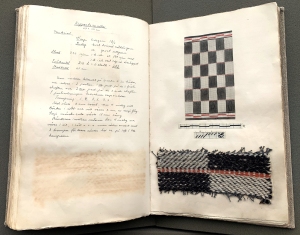
Weaving patterns, handwritten instructions, rug design, and handwoven samples by Ruth Ingvarsson, ca. 1932-1935. Copyright Cranbrook Archives.
Rut “Ruth” Elisabeth Ingvarsson was born on October 1, 1897 in Glemminge, Skäne, Sweden. Like many Scandinavian girls, she learned weaving first from her mother and then at school, graduating from the Glemminge Folkskola in 1918. In 1922, Ingvarsson began studies at the celebrated weaving studio of Märta Måås-Fjetterström in Båstad, Sweden.
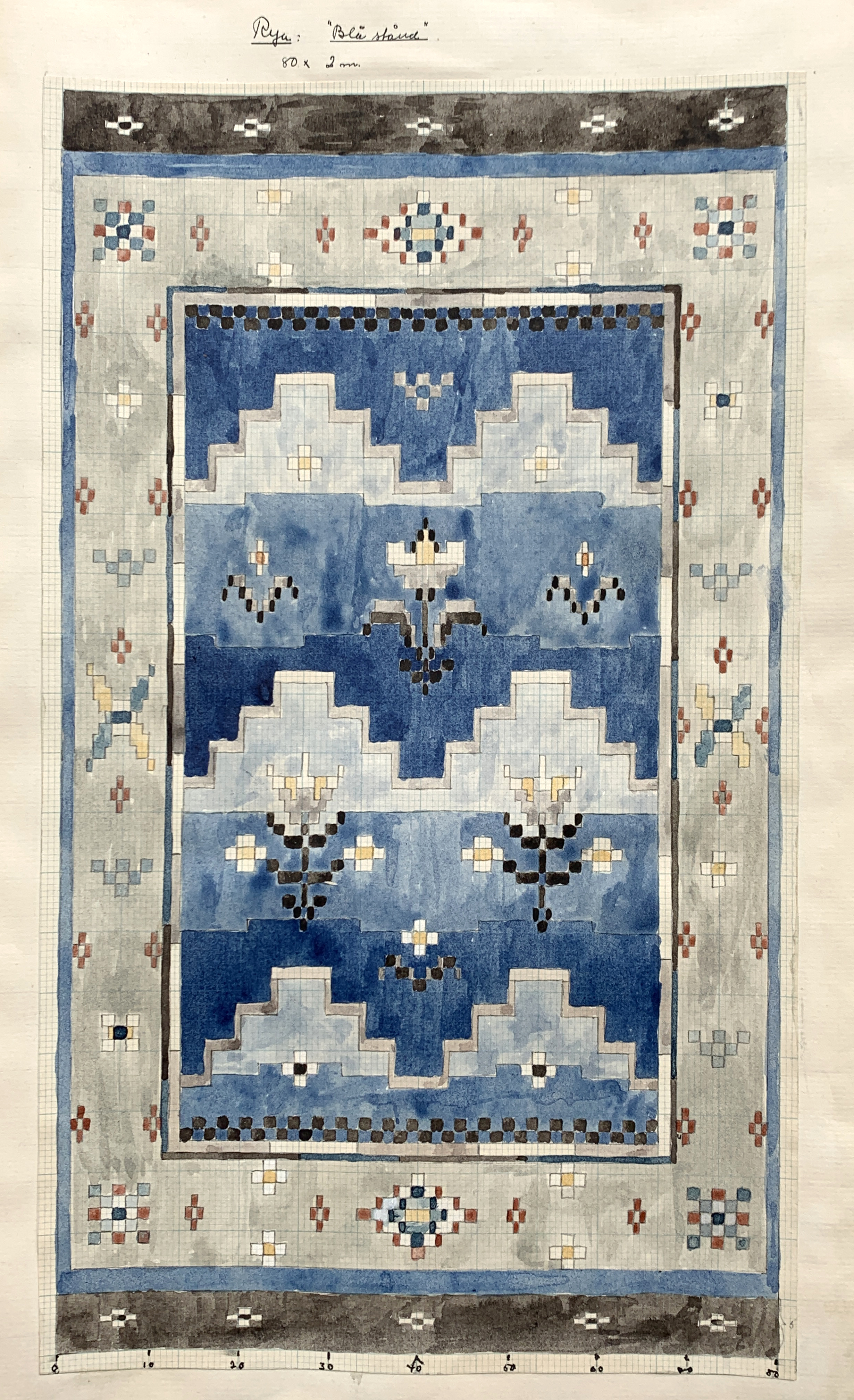
Ingvarsson continued working for Måås-Fjetterström until 1928, learning technical skills including knotted pile rya or flossa weaves, rölakan flatweave, and a discontinuous (or supplemental) weft style of tapestry weaving known as the MMF technique. Under Måås-Fjetterström, Ingvarsson developed great skill painting watercolor sketches on graph paper in the popular “Swedish Grace” (or “Swedish Modern”) style. She also befriended another young weaver, Lillian Holm, who entered into the Måås-Fjetterström studio in 1926.
Watercolor of a rug design in the “Swedish Grace” style by Ruth Ingvarsson in her untitled manuscript on weaving, ca. 1932-1935. Copyright Cranbrook Archives.
In late 1929, Ruth Ingvarsson and Lillian Holm immigrated to America to start work that December at Studio Loja Saarinen, Cranbrook’s weaving workshop. Here, Ingvarsson executed designs from Loja herself and other members of the Saarinen family, as well as designs by the Studio’s shop supervisor and prominent Swedish weaving expert Maja Andersson Wirde.
One was from Detroit; one was from Pittsburgh. One attended Kingswood School; the other attended the Academy of Art. One was a writer and women’s rights activist; the other was a sculptor, photographer, and social worker. Both were named Harriet Cooper. Both were on Cranbrook’s campus in 1940.
This was the unusual story I uncovered working recently with the Archives’ digital collections. While tagging images with the names of Cranbrook’s staff photographers, who were responsible for the majority of photographs taken at Cranbrook between the years 1931-1970, I came across the name Harriet Cooper. As one of only two female photographers, I attempted to find out more, and in the process discovered a second Harriet Cooper who was also at Cranbrook around the same time.
What were the odds? And more importantly, which was my Harriet? I had to find out, not only for the sake of photographic description, but to satisfy intellectual curiosity about the lives of two seemingly individual Cranbrook women, who shared the same name and once lived in close proximity (temporal and geographic) to each other.
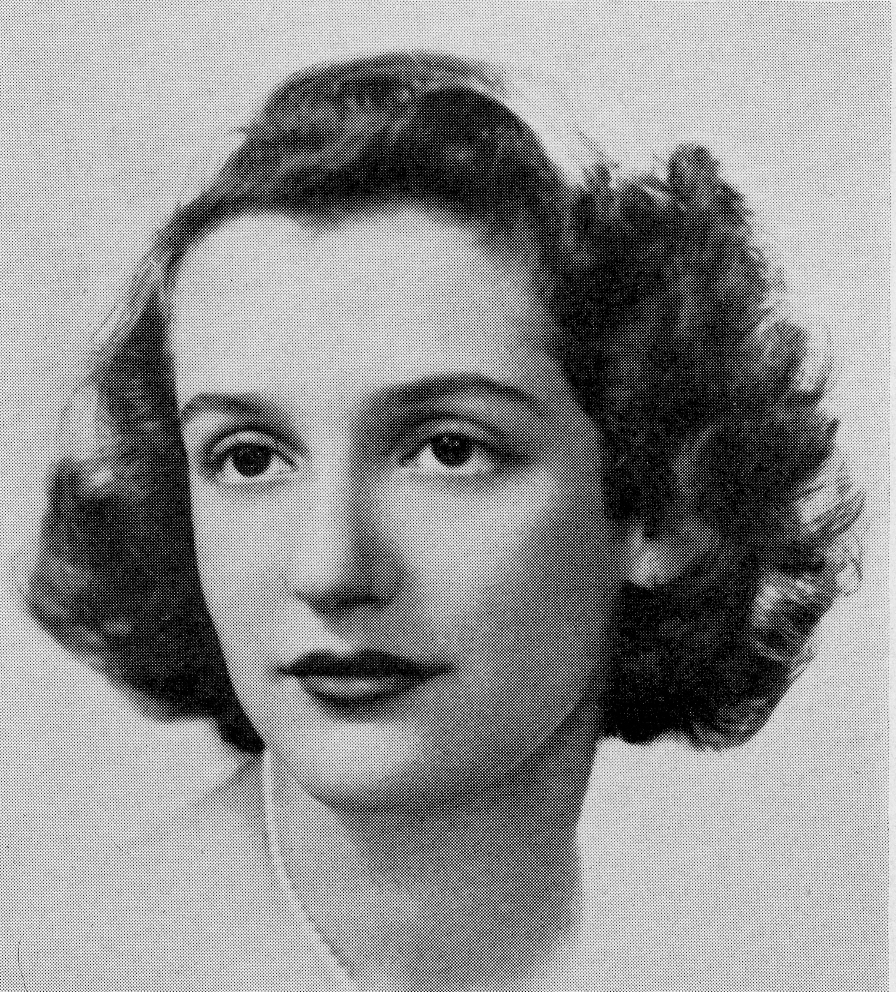
Senior picture of Harriet Cooper in the 1940 yearbook Woodwinds. Courtesy of Cranbrook Archives, Cranbrook Center for Collections and Research
Harriet Cooper Alpern was born in 1923. A Detroit native, she grew up on Chicago Boulevard in the Boston-Edison District. Attending Kingswood School (her twin brother attended Cranbrook School), she was active in theater and served as a reporter for The Clarion, graduating in 1940. According to the yearbook, Woodwinds, she was the senior voted for having the perfect speaking voice and known for splitting sides with her “unconscious humor.” After Kingswood, Harriet attended the University of Michigan, where her future husband E. Bryce Alpern also attended.
Poem appearing in the 1940 yearbook Woodwinds. Courtesy of Cranbrook Archives, Cranbrook Center for Collections and Research.
Harriet “Betty” Cooper, 1938. Courtesy of Cranbrook Archives, Cranbrook Center for Collections and Research.
Harriet Elizabeth (Betty) Cooper Lundquist was born in Valencia, Pennsylvania in 1916. She grew up in Pittsburgh, daughter of social workers and directors of Kingsley House, a settlement house. Betty attended both Antioch College and Yale University School of Fine Arts before coming to Cranbrook Academy of Art to study sculpture under Carl Milles from 1940 to 1942. While here, she also took classes in metalcraft, modeling, and design.
Untitled entry by CAA student Betty Cooper for the War Department Sculpture Competition, May 1, 1941. Courtesy of Cranbrook Archives, Cranbrook Center for Collections and Research.
And, she also took a job with Cranbrook Foundation as a photographer!
Although unknown whether she’d had any previous experience, Betty kept the Photography Department afloat on her own for several weeks during February and March 1942, and then stayed on for another seven months as assistant photographer. After graduation, Betty continued to work as a photographer for the Farm Security Administrationin Washington, D.C., where she met and married Oliver Lundquist.
Unattributed, this photograph of the interior of Milles House featuring Carl Milles’ sculpture collection was likely taken by Betty Cooper in February 1942. Courtesy of Cranbrook Archives, Cranbrook Center for Collections and Research.
While raising three children during the 1950s and 1960s, Betty was active in civil rights causes, including being a founding member of Women Strike for Peacein 1961. In the early 1970s, she went back to school and earned a graduate degree in social work, practicing her parents’ profession for the next thirty years until retirement.
It just goes to show that even while performing routine (but necessary!) archival tasks, fascinating stories reveal themselves, which provide new depth and understanding of Cranbrook’s people.
– Deborah Rice, Head Archivist, Cranbrook Center for Collections and Research
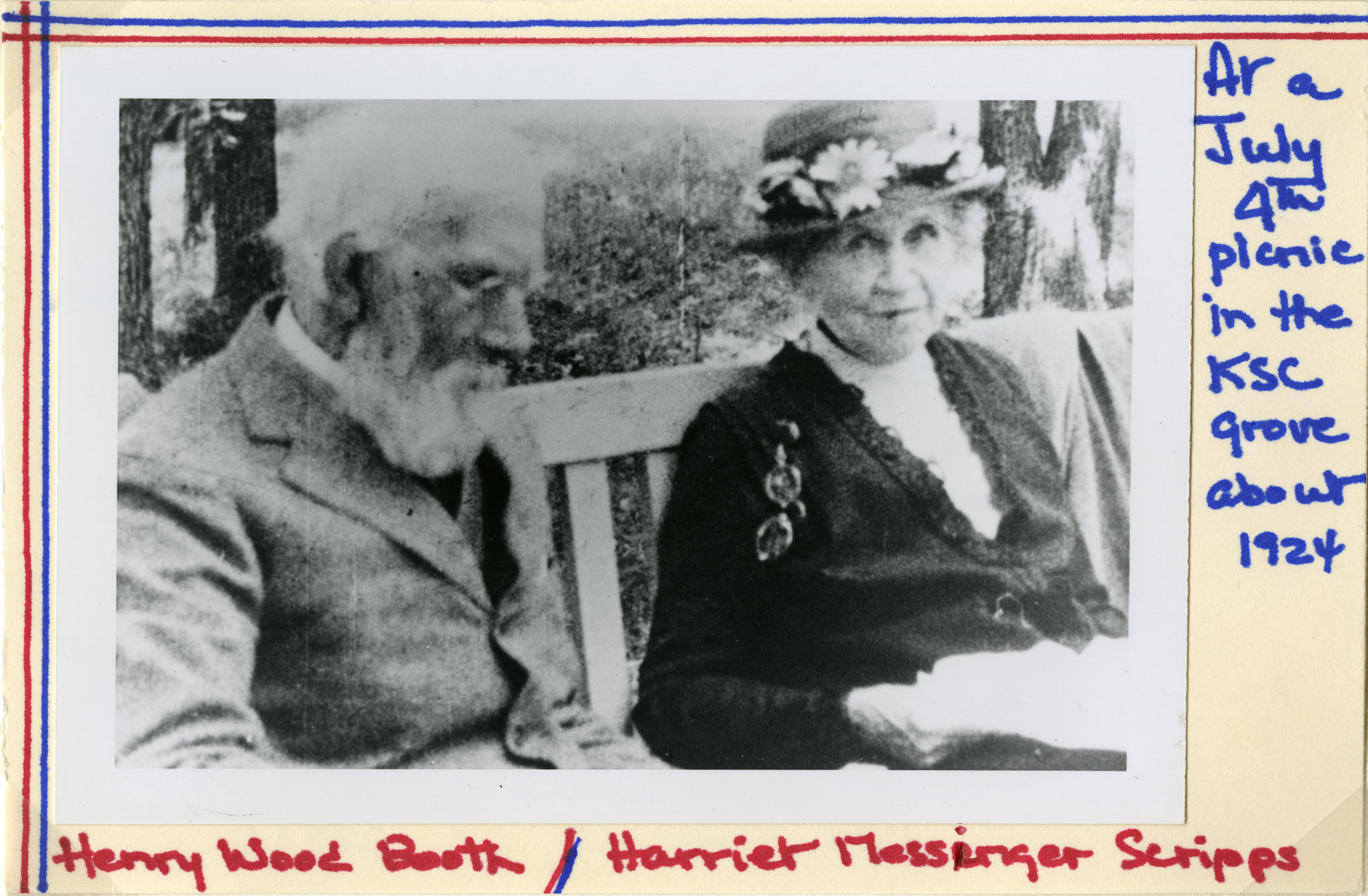
Henry Wood Booth and Harriet Messinger Scripps at a Fourth of July picnic on Kingswood School Grove, 1924. Cranbrook Archives.
In the earliest days of Cranbrook, Fourth of July picnics were held in the shade of a big oak tree on the site of the present Japanese Garden near Kingswood School. In his history, Henry Wood Booth reports that in 1910, George decided a well was needed so that drinking water would not need to be carried down from the house. After much digging, there was no water, and the new well remained dry. The family would need to come back to the project another day.
Later the same evening, Cranbrook Road was flooded with mud and water. The well, having burst through the last layer of mud, was shooting eight feet into the air! A fountain was placed there a few months later and it flowed for fifty or more years until the screen was clogged. In 1963, a new well was drilled nearby.
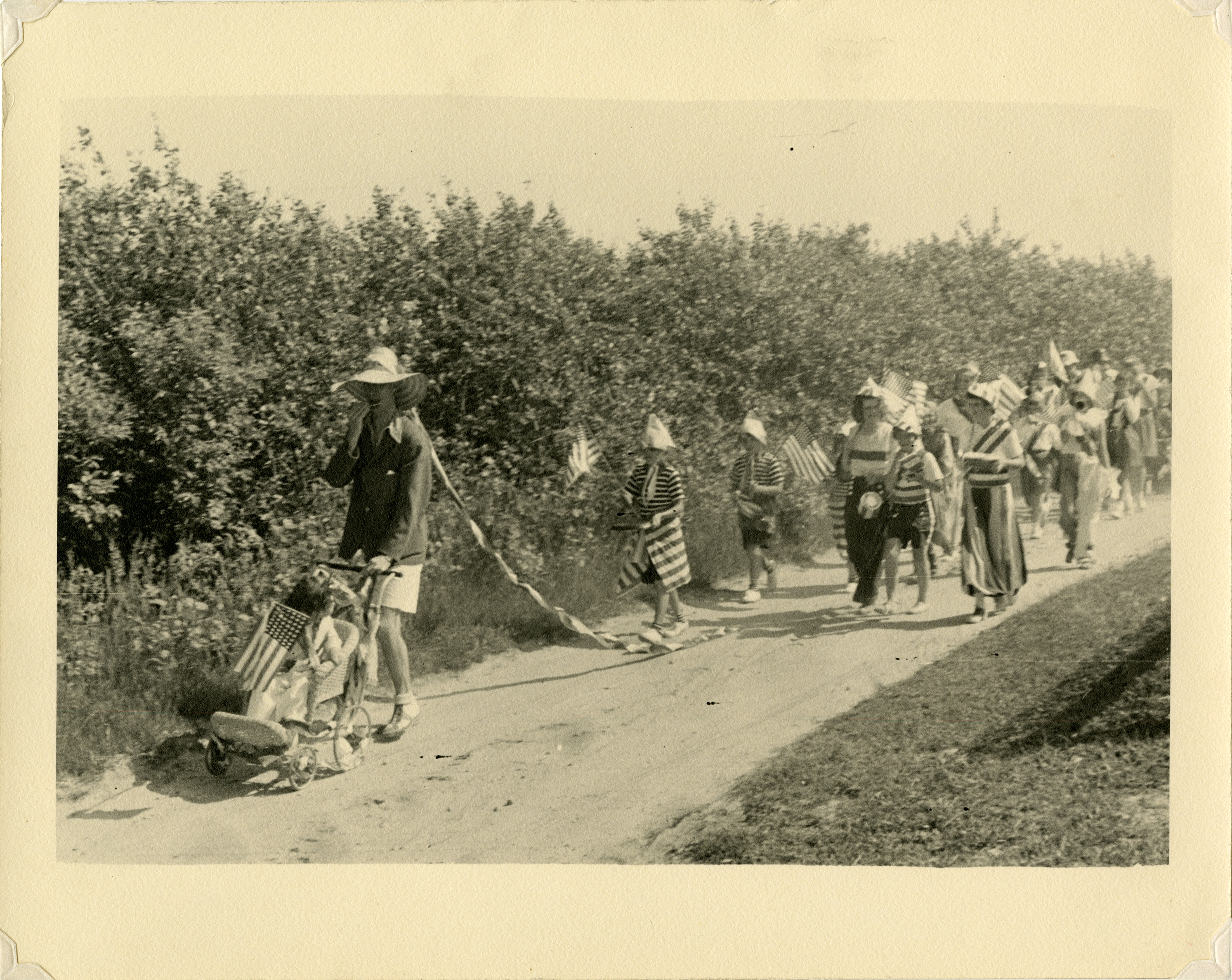
A Fourth of July Parade, Cuttyhunk Island, Massachusetts, 1935. Cranbrook Archives.
The family didn’t always celebrate the Fourth so close to home. Here’s a parade planned by Henry Scripps Booth in 1935 while vacationing on Cuttyhunk Island, south of New Bedford, Massachusetts, on Buzzard’s Bay. Daughter Cynthia Booth is in the carriage pushed by Henry, and sons Stephen and David are in the parade.
Happy Fourth of July, everyone!
—Laura MacNewman, Associate Archivist, Cranbrook Center for Collections and Research
As Michigan emerges from our lockdown and we slowly begin driving to more places and contemplating summer road trips, I thought we’d look back to a time before asphalt, air conditioning, and safety features.
Ellen Scripps Booth, Jean McLaughlin Booth and Henry Scripps Booth on Lahser Road with the 1908 Pierce-Arrow in the ditch, 1911. Courtesy Cranbrook Archives.
Here, we see Ellen Scripps Booth, daughter-in-law Jean McLaughlin Booth, and young Henry stranded somewhere along Lahser Road. I love the ladies’ wide hats and wraps, intended to keep their hair in and dust out. Henry looks particularly pleased with the situation (sort of like me when my own mom got a speeding ticket—she didn’t appreciate my backseat smirking, either).
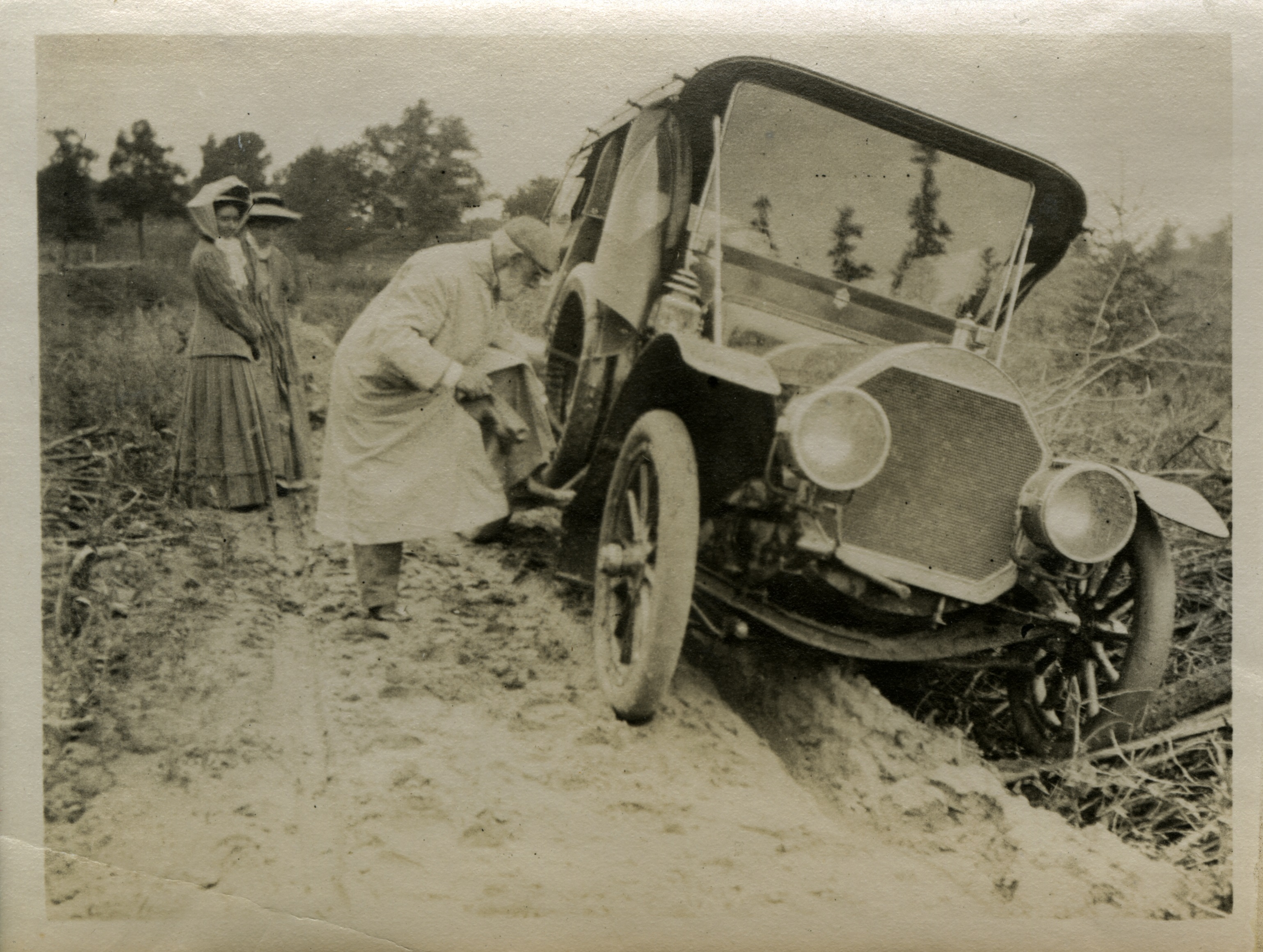
Instead of AAA, the family turned to their own skills. Here’s Henry Wood Booth, Ellen’s father-in-law, addressing the situation:
Henry Wood Booth works on the Pierce-Arrow on Lahser Road, 1911. Courtesy Cranbrook Archives.
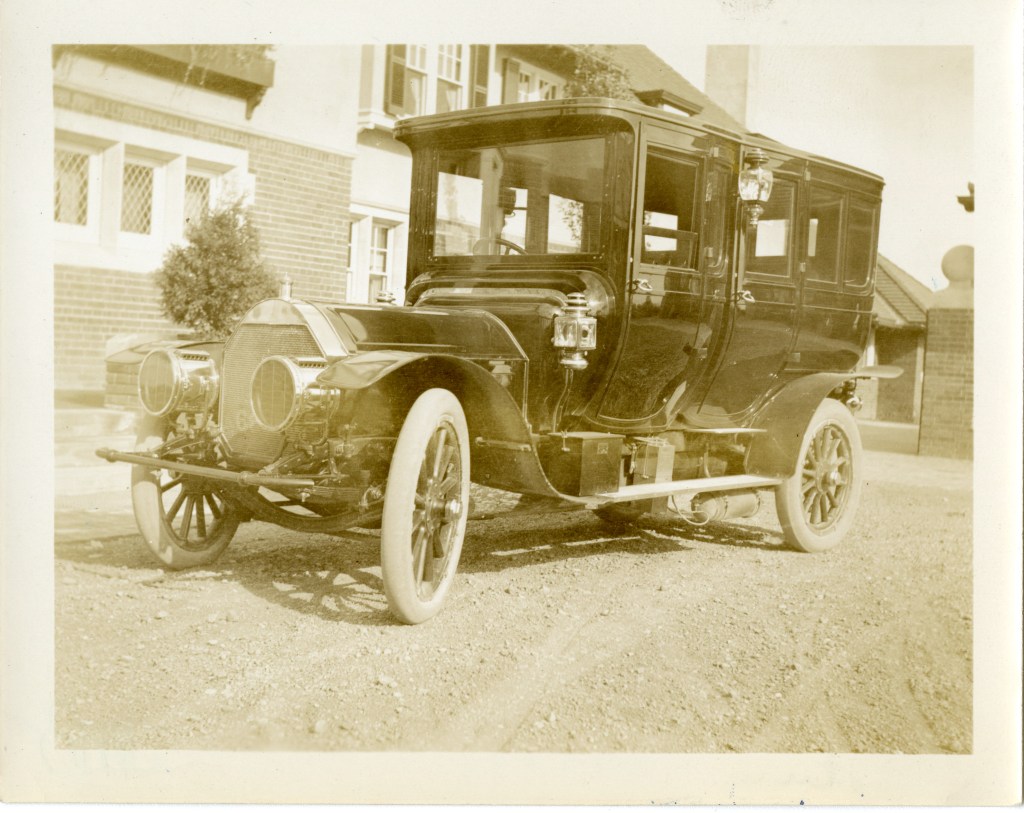
The Booth family’s Pierce-Arrow Limousine was one of several cars they used to move about here in Michigan and in Europe (where they traveled with the Pierce-Arrow and chauffeur). Purchased for $7,750 in July 1908 ($215,984.08 in 2020), the seven-seater, 6-cylinder touring car came with two bodies: a closed limousine body for winter use and a sports-touring body for summer. As Henry Scripps Booth later wrote:
The original garage at Cranbrook House had a traveling crane in it so the Pierce-Arrow’s winter and summer bodies could be conveniently changed with the seasons. The crane spanned the depth of the garage, having an iron track bolted to the east and west walls on which the crane with a hand operated hoist could be pulled to the spot where the two respective bodies could be removed or hoisted into place.
The Pierce-Arrow with its winter body in front of Cranbrook House, 1908. James Scripps Booth photographer, Copyright Cranbrook Archives.
The Pierce-Arrow with its summer body in front of Cranbrook House, 1908. James Scripps Booth photographer, Copyright Cranbrook Archives.
The accident on Lahser Road wasn’t the first time Ellen had been betrayed by poor road conditions. In 1908, she wrote in her diary of a similar event that took place as the family traveled from Grand Rapids to Lake Michigan:
“Wed. Aug. 12. We decided to take the auto as far as Holland on the way to Ottawa Beach but I wish we hadn’t for it took us five hours to go the 25 miles—We got off the road and one place slid into a ditch. It took an hour & a half to get a team to pull us out. We later frightened a horse and it ran down this deep ditch and horse, top-buggy and all just lay right down flat. The old couple in it were not hurt at all.”
If you want to learn more about the history and social impact of cars, register for our free virtual Bauder Lecturethis Sunday, June 28, 2020, at 3:00pm EST. Brendan Cormier, Senior Design Curator at the Victoria and Albert Museum in London, will be speaking about his recent exhibition and publication, Cars: Accelerating the Modern World. Center for Collections and Research Director Greg Wittkopp will deliver an introduction about Cranbrook and cars, featuring more treasures from Cranbrook Archives relating to our place in automobile history.
—Kevin Adkisson, Associate Curator, Cranbrook Center for Collections and Research
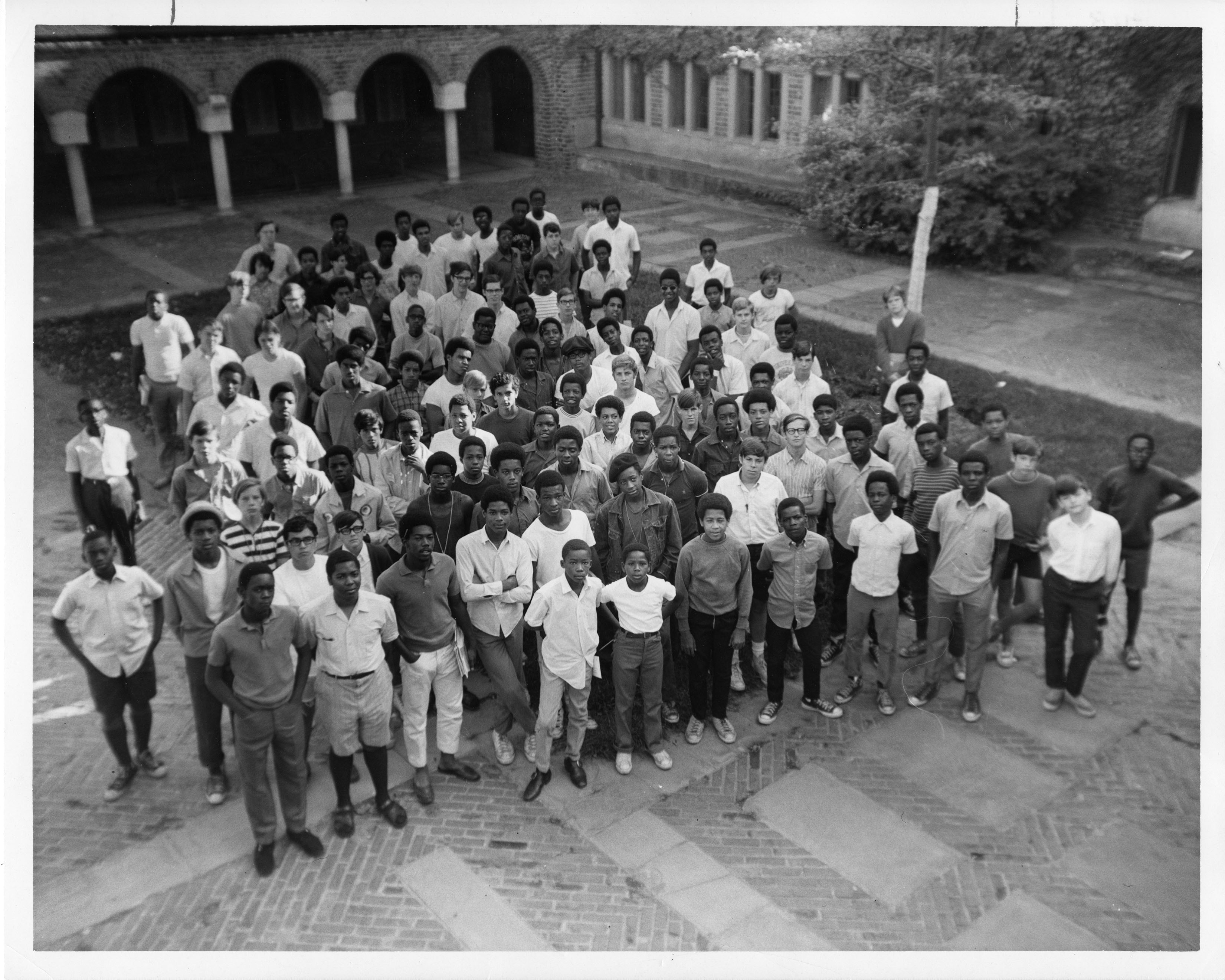
In commemoration of this significant day, Juneteenth, I thought we’d look back at one of many compelling stories in Cranbrook’s history. In the summer of 1970, Horizons-Upward Bound (HUB) offered four new electives that reflected the experimental nature of a project in its sixth year of operation. These electives allowed for innovation and creative thought around topics of particular relevancy to HUB students, investigating issues that still resonate fifty years later.
1969 HUB student photo used on the inside cover of the 1970-1971 annual report. Courtesy of Cranbrook Archives.
Black Creative Writing, taught by Highland Park Community College English instructor Stephen D. Chennault, involved readings, examinations of concepts, and self-directed writing. Students surveyed a Langston Hughes edited short story collection and works by the Black Arts Movement poet, Don L. Lee (later known as Haki Madhubuti). They also explored Black awareness, the role of the Black professional writer, and created skits centered on Black life, in what Chennault describes as a “careful observation of their niche in today’s America.”
The Black Contributions course was co-taught by Wayne State University interns, Ervin Brinker and Fred Massey, and grew out of the Black History course of the two previous summers. Refocused with a more contemporary slant, students studied organizations such as the Black Panther Party, the Student Non-Violent Coordination Committee, and the Southern Christian Leadership Conference. Reporting on the course, Brinker and Massey observed that “both instructors and students were sensitized to the realization that solutions to racial problems are imbedded in institutional living patterns of long standing, protected by mazes of barrier that must be recognized and understood if they are to be nullified.”
George W. Crockett Jr., 1968. Courtesy of Walter P. Reuther Library.
Law was team taught by Detroit attorney Michael Brady and University of Wisconsin law student Norman Prance. Half of class time focused on criminal law, which included examination of Yale Sociology Professor Albert J. Reiss’ 1967 study of police brutality and discussion of the Wayne County Juvenile Court. The subject culminated in a field trip to the Detroit Recorders Courtroom of Judge George Crockett Jr., a civil rights advocate known for confronting the practice of race-based sentencing.
Ben Snyder and Horizons scholarship students, 1968. Courtesy of Cranbrook Archives.
In the course, Power, developed by HUB founder and director Ben M. Snyder, students explored the idea of power through a combination of contemporary theory and current realities. Stemming from two works: Adolf Berle’s 1969 Power and Nathan Wright’s 1968 Black Power and Urban Unrest, the course addressed complicated regional situations, such as the redistricting of Detroit schools. When replying to a question regarding the value of the course to his future, one student remarked, “As long as I am more aware of the American way of working power, it should make me more alert.”
Cover illustration by David McMurray for The HUB 101 Literary Magazine, 4 (Summer 1970). Courtesy of Cranbrook Archives.
A tradition since 1967, the Literary Magazine, a sampling of writing and art produced by HUB students, is perhaps the most important summation of the student experience. Against the backdrop of the civil rights movement, national Vietnam War protests, and the beginnings of an economic downturn that would hit the Detroit metro area hard, the Summer 1970 issue reflects powerful emotions. It’s clear to see that these four thought-provoking electives left a profound effect on students’ views of American society and their role in it. With titles like Discrimination, Revolution, Black Power, Choice of Colors, The Man, The Militant, and Pride, the poignancy of their voices is striking and remarkably germane to events, both then and today.
–Deborah Rice, Head Archivist, Cranbrook Archives Cranbrook Center for Collections and Research












 Cranbrook Kitchen Sink