Evolution of a Rink

Sixty years ago Cranbrook School headmaster, Harry Hoey, spoke to a group bundled in their warmest winter clothes at the formal dedication of the new outside skating rink at Cranbrook. The rink was unveiled on January 12th, 1957, at an estimated cost of $104,000. The new “artificial” rink, built on the site of the original natural ice surface, was constructed because there was a constant risk that the natural ice would not sustain a hockey season due to unreliable weather.

Hockey player on the “natural” ice rink, 1940. Photographer Richard G. Askew. Copyright Cranbrook Archives.

The new rink was built to hockey specifications (85 x 190 ft.) and was refrigerated by two over-sized compressors designed to operate in adverse weather conditions. Artificial rinks were a relatively new phenomenon in the 1950s and Cranbrook researched the project for several years before proceeding. The planning team looked at rinks around the country, including Dartmouth, Cornell, and Williams College.
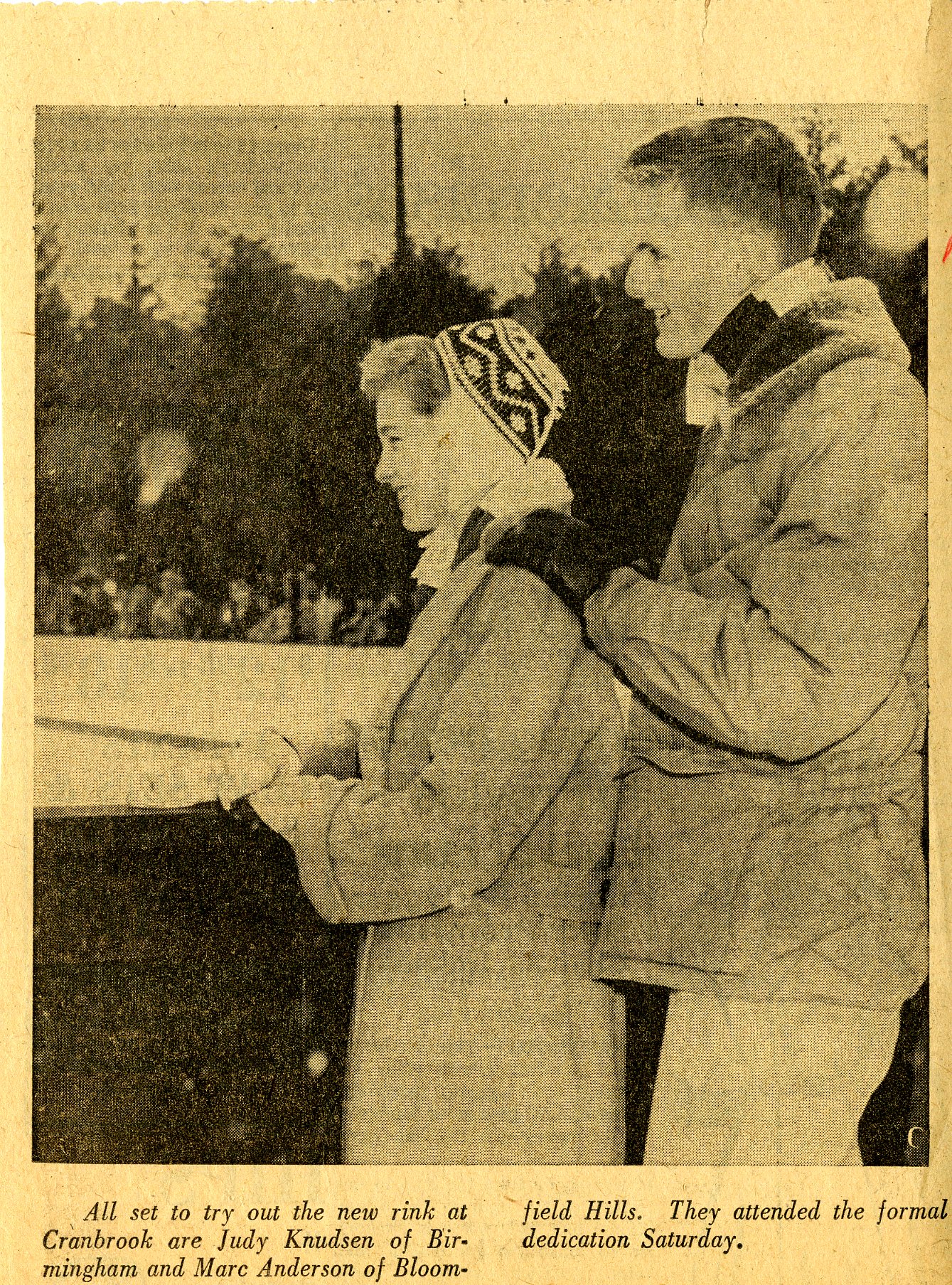
Skaters at the artificial rink dedication. The Pontiac Press, 14 Jan 1957.

The rink was open six months out of the year and accommodated Cranbrook School ice hockey teams and students, as well as the outlying communities for day and night skating. From 1957-1982 the Cranbrook Skating Club oversaw all operations of the rink. During this time the club held Board of Directors meetings, generated correspondence for the raising of funds for daily operations, and supervised various program schedules, benefits, and employees of the skating rink.

By the 1970s the rink was showing wear and the Varsity, Junior Varsity, and middle school teams were forced to buy ice time at neighboring rinks for practice and games. A committee was formed and students, faculty, and friends staged a skate-a-thon and worked with then-Cranbrook president, Arthur Kiendl, to raise money.

The original plan was to build a new enclosed facility for winter skating and summer tennis, but the price was too high, so committee members and Cranbrook administrators decided to complete the work in phases. The first step – cement work for the rink surface and spectators’ section, new boards, and new piping – was completed with a gift by Grace Booth Wallace and her family in 1978. The final phases of the project – which included total enclosure of the arena – were completed in 1979.
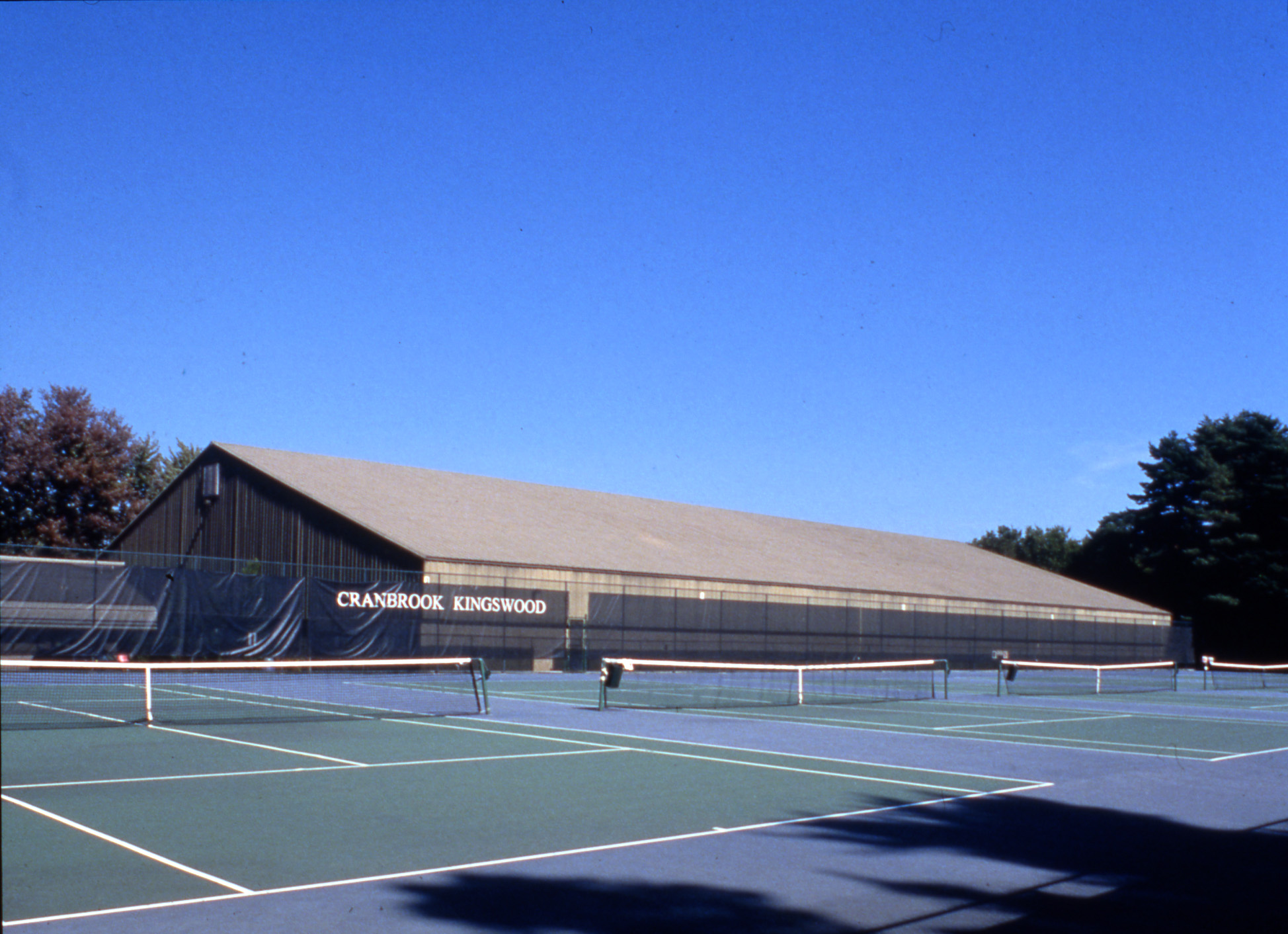
A view of Wallace Ice Arena with the tennis courts in the foreground. Photographer Balthazar Korab, Oct 2000.

Today Cranbrook athletes, students, faculty, and the public enjoy the state-of-the art Wallace Ice Arena.

Gina Tecos, Archivist
Annual Images

James Scripps Booth (JSB), eldest son of George Gough and Ellen Scripps Booth,  attended St. Luke’s School in Wayne, Pennsylvania. According to the Tredyffrin Easttown Historical Society, St. Luke’s School operated from 1863-1927. It was in its Wayne, Pennsylvania location from 1902 until its closing. In 1907, JSB was a student there and drew pictures for the school’s annual.

Cranbrook Archives retains the original drawings of the pages James contributed, as well as copies of pages from the annual which feature JSB, his work, or his friends.

For more on James Scripps Booth, see some of our previous blog posts:

https://cranbrookkitchensink.wordpress.com/2015/05/29/i-have-a-crush-on-james-scripps-booth/

https://cranbrookkitchensink.wordpress.com/2017/09/29/tranquil-still-room/

https://cranbrookkitchensink.wordpress.com/2013/03/21/cranbrook-and-the-car-part-1-the-aristocrat-of-small-cars/

Leslie S. Mio, Associate Registrar

The Devil Made Him Do It

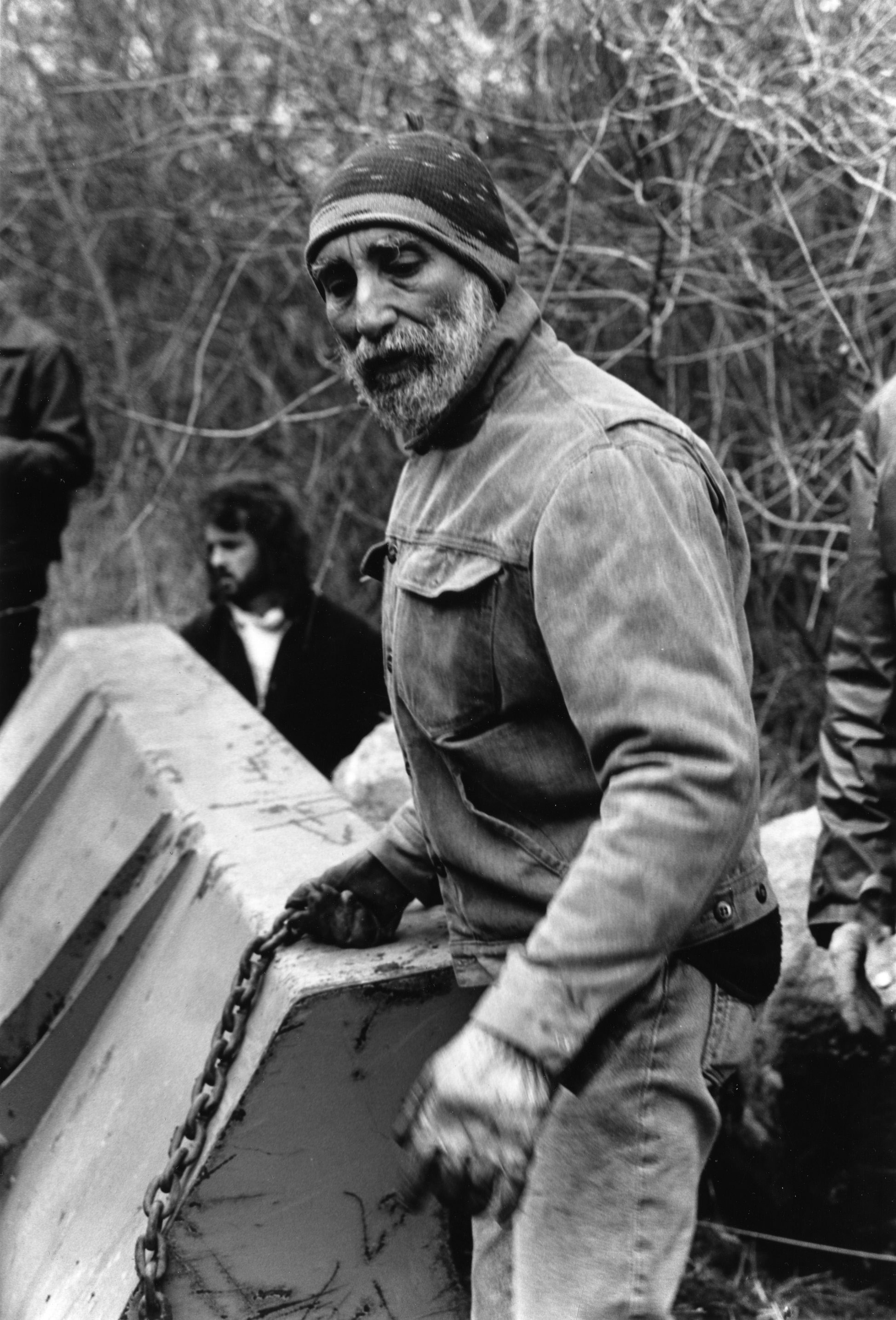
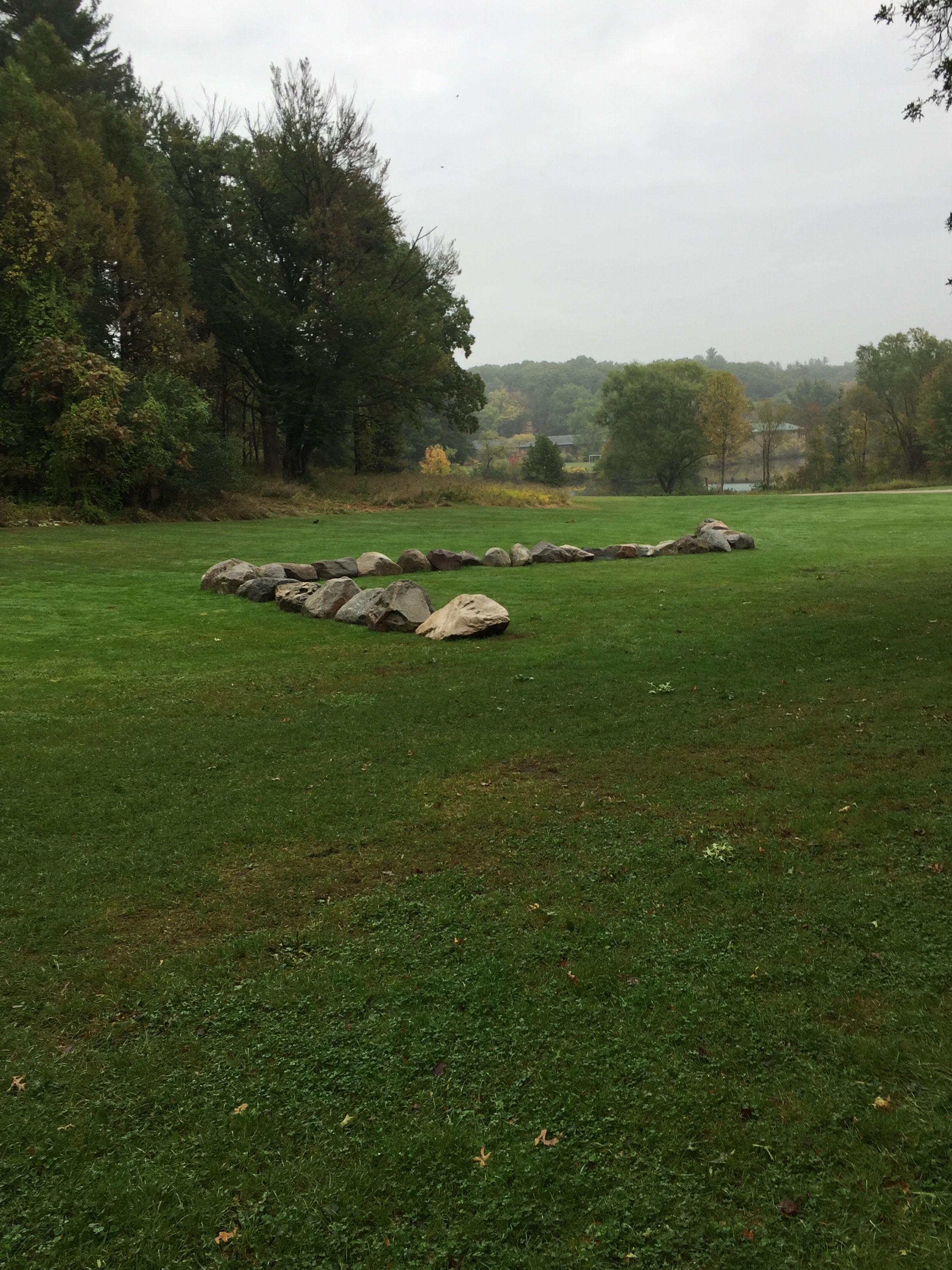
In a grassy meadow (once called “Frisbee Valley”) at the bottom of Suicide Hill is a line of boulders – a sculpture colloquially known as Snake Rock. Actually titled “Lucifer Landing (Real Snake in Imaginary Garden)” or Lucifer Landing for short, the sculpture was designed by American artist Richard Nonas using thirty-nine boulders which zigzag in a serpentine line. One could describe the boulder with the sharp-angled end as resembling the head of a snake, while the rest of the boulders (relatively the same height as each other) taper to the tail section, which appear like rattles. While some think the boulders, which weigh a collective seventy tons!, were found on Cranbrook’s grounds, they were actually acquired in Clarkston, Michigan and represent a cross-section of the type of rocks deposited by the glaciers in Oakland County.

Richard Nonas, 1989. Courtesy Cranbrook Archives, Jane Knirr photographer.

Nonas was invited by Cranbrook Academy of Art’s Head of Sculpture, Michael Hall, to join other major artists like Alice Aycock, Mark DiSuvero, Dennis Oppenheim, and Robert Stackhouse in exhibiting temporary sculpture installations across campus. Funded by the Academy of Art Women’s Committee and Gilbert and Lila Silverman, Lucifer Landing was installed in 1989 – the first sculpture to be placed on campus since the 1970s. Twenty Academy of Art students helped put the boulders in place.

Trained as an archaeologist, Nonas was known for sitting abstract works in wood, stone, or metal directly on the ground. He said “it amused me to place something at Cranbrook that [Eliel] Saarinen might have seen as a child in Finland. There are prehistoric stone monuments near his boyhood home.” While working on the sculpture, Nonas developed a great respect for Cranbrook’s sense of place, and wanted to construct a small form that changed as you walked by and around it – a “sculpture that activates its space, that confuses you a little, keeps you involved in it as you walk past it.” A form that looked almost natural but really couldn’t be.

Lucifer Landing, October 2017. Photograph by the author.

The sculpture’s title suggests the relationship between man and not-man, man and nature, and nature as it was before man. Nonas described how Lucifer, the rebel angel who was expelled from heaven, came to Cranbrook and left an intrusive mark in the Cranbrook landscape, creating an “itch he [Saarinen] couldn’t scratch.”

NOTE: For an excellent article “A Mark of Place: Lucifer Landing Past, Present and Future” on the mistaken dismantling of the sculpture in February 1999, see The Crane-Clarion’s June 1999 issue. Cranbrook Kingswood senior and associate editor Erica Friedman discussed the Cranbrook landscape and how we must face the “problem of destruction passing for progress” – a topic many Americans, including those at Cranbrook, continue to face today.

Leslie S. Edwards, Head Archivist

Hats in the Alhambra

After a long illness in 1886, Ellen Scripps Booth’s father James Edmund Scripps (1835-1906) retired from his work life in the newspaper business (he had founded Detroit’s The Evening News in 1873). James spent two years recuperating and traveling in England and continental Europe with his wife Harriet and their children. The family visited Scripps cousins and traveled with some of his twelve siblings and their children. James, who had become interested in architecture (particularly church architecture), spent many hours sketching at the locations they visited.

CEC4406

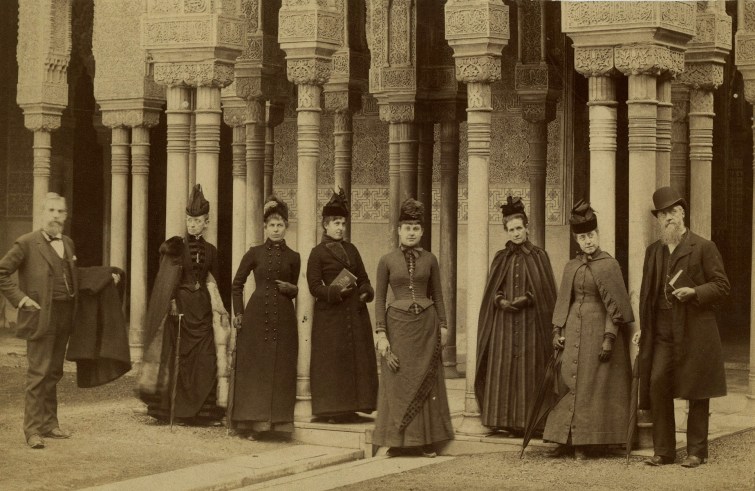
Scripps family members at the Courtyard of the Lions at Alhambra, Granada, Spain, November 1888.  From left: William Armiger Scripps, Ellen Browning Scripps, Eliza Virginia Scripps, Grace Locke Scripps, Florence May Scripps, Harriet Messinger Scripps, Anna Virginia Scripps, James Edmund Scripps. Courtesy Cranbrook Archives.

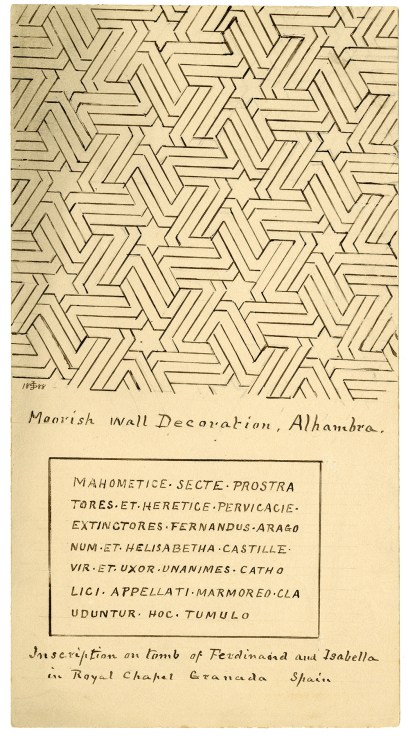
James Edmund Scripps sketched exterior wall decoration at Alhambra, below. Notice how closely it matches the wall in the photograph.

Moorish darwing043

In the picture at the Alhambra, take a look at James’s sister second from the left: Ellen Browning Scripps. Ellen was a publisher for The Evening News and wrote a daily column, nicknamed “Miss Ellen’s Miscellany” that rehashed local and national news in a conversational tone. She even sent dispatches back to Detroit from Europe. Shortly after their trip to Europe and well-hatted visit to the Alhambra, the Scripps siblings had a bit of a falling out: she and another brother headed to California, where she eventually founded many important educational and philanthropic organizations in the San Diego area.

If you want to hear more about Ellen Browning Scripps and the Scripps siblings, the Cranbrook Center for Collections and Research is hosting a lecture and book signing with Molly McClain on Sunday, November 12thEllen Browning Scripps: New Money and American Philanthropy  is a new book by Dr. McClain, Professor of History at the University of San Diego. To learn more about the lecture and to purchase tickets, click here. Books are also available to purchase through the Center.

–Cranbrook Center for Collections and Research


Cranbrook Celebrates Halloween

Edna Vogel: Cranbrook’s Other Wright Weaver

Researching in the Archives before a big tour, I came across an interesting person whom I earmarked to come back and examine further. I already knew Loja Saarinen wove textiles for Frank Lloyd Wright, but Edna Vogel’s story of weaving for Wright intrigued me; it turned out there was a bit more to learn about Edna Vogel.

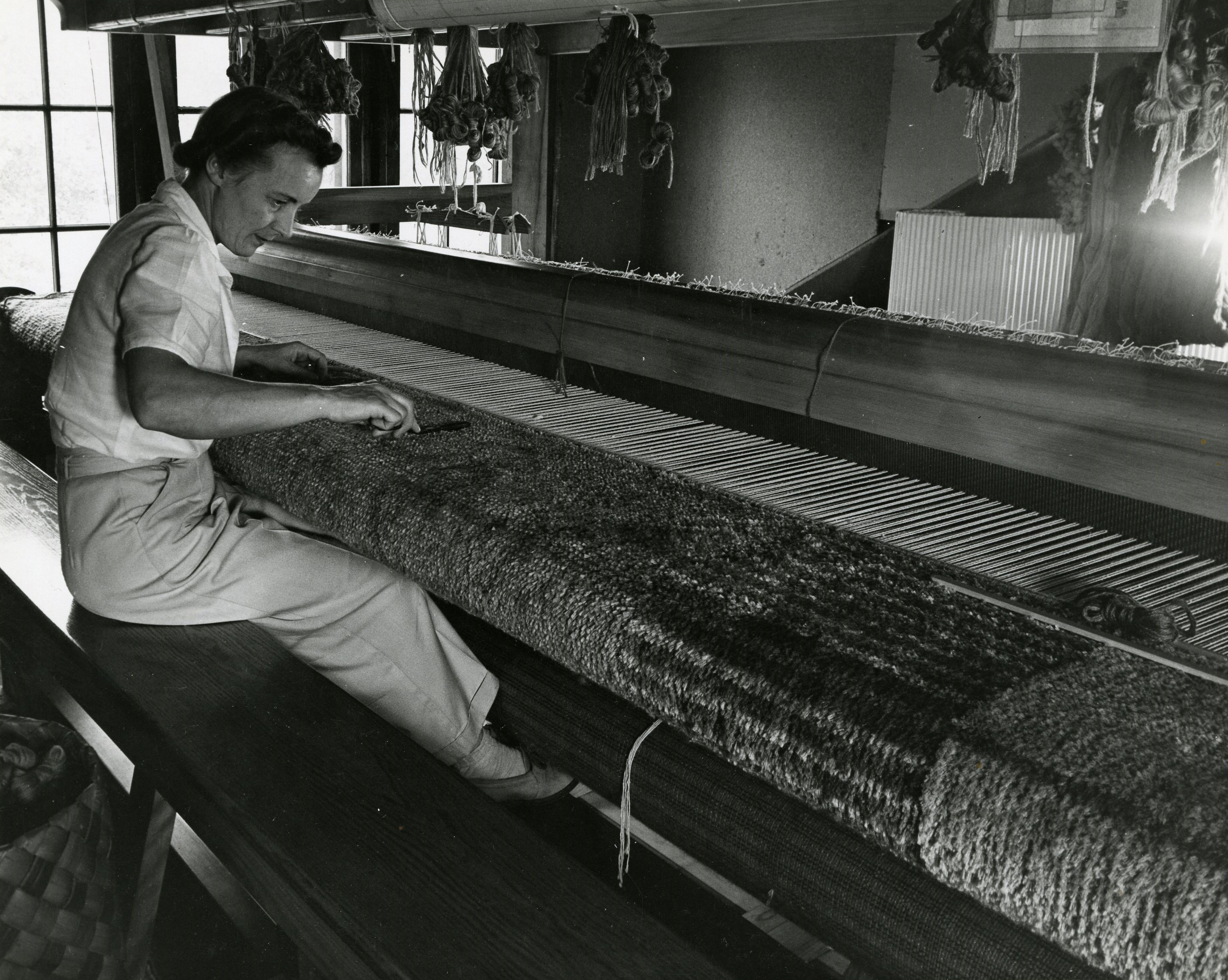
Vogel002

Edna Vogel in her weaving studio, July 1942. Joe Munroe, photographer. Courtesy of Cranbrook Archives.

Edna Vogel (1901-1953) grew up in St. Louis and studied at a teacher’s college and then Washington University in St. Louis. She wasn’t in love with teaching elementary school, but she did like making costumes, so in the early 1930s she went to New York to study dress design. Not finding the cloth she wanted in stores led her to discover an interest in weaving, and weaving led her to Cranbrook for summer courses in 1939.

Vogel studied at Cranbrook Academy of Art for four summers and two regular academic years, earning her MFA in May 1943. Like so many Academy students, Vogel bounced between disciplines, studying weaving with Marianne Strengell, ceramics with Maija Grotell, and working in the metals shop. She spent most of her time in the ceramics studio, with Grotell commenting in 1941 that Vogel had a “very fine understanding for color and form” and that “her technical research and discoveries are exceedingly valuable.”

Vogel Detail

Ceramics and place-mat by Edna Vogel, made as a student at Cranbrook. Detail of a photograph, June 12, 1941. Courtesy of Cranbrook Archives.

In the early 1940s, Vogel moved into the carriage house of Bloomfield Hills socialite Kate Thompson Bromley, who kept detailed diaries that include information on Vogel’s work and travels. 

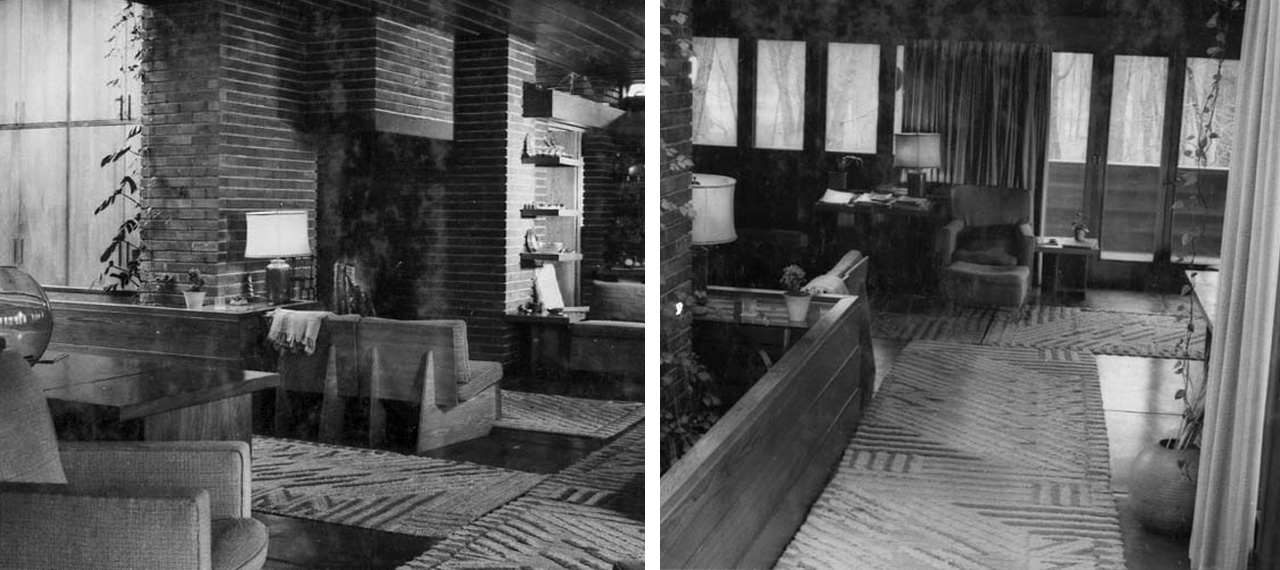
Vogel worked in the carriage house with two assistants between three looms (small, medium, and very large), she began weaving placemats, pillows, fabrics, and rugs. The largest rug Vogel wove was for architect Albert Kahn, in a Swedish style, and she wove others for Kahn’s family. She also wove the rugs for Frank Lloyd Wright’s 1941 Gregor Affleck House in Bloomfield Hills. Wright instructed Affleck to use long, strip-like rugs for his living room in order to leave much of the concrete floor exposed. Affleck, who may have met Vogel through Grotell or Bromley, commissioned rugs from her sometime in the early 1940s.

Thrilled with receiving the commission, Edna Vogel set off in her car towards Wisconsin and Wright’s estate, Taliesin. Approaching Taliesin, she became nervous that the famous Wright would not want to see her without an appointment. She ended up knocking on the wrong door of the house, introduced herself to an apprentice, and, to her surprise, being taken into a meeting with Wright. He seemed charmed—with both her and her ideas for the Affleck House rugs. He was so impressed by Vogel that he invited her to come and work at Taliesin as both weaver and ceramicist.

She stayed for a long weekend, but as remembered in Mrs. Bromley’s diaries, Vogel’s chief complaint with Wright’s work centered on his interest in providing functional architecture but not always functional furnishings. Wright did not, Bromley wrote, “aim to make a house and furniture one unit as at Cranbrook,” and so Vogel decided to return to Michigan and remain at the Academy. She completed the rugs for the Affleck House, and at a visit to the house later, Wright’s wife Olgivanna commented that the rugs were the “finest she had ever seen.”

affleck

Edna Vogel’s rugs for the Gregor Affleck House, c. 1941-45. Courtesy of Lawrence Technological University.

At the end of the 1940s, after exhibiting ceramics internationally and producing textiles for homes, Vogel moved to New York. She wanted a place to find new inspiration and focus on her weaving. In South Salem, about thirty-miles north of New York City, she bought a former school house with a first-floor residence and an open studio large enough for her 12-foot loom on the second floor. She produced rugs of various sizes that were noted for their painterly, subtle uses of color, and she maintained an extensive collection of yarns from around the world. Tragically, Vogel died of smoke inhalation in 1953 when a chimney fire spread to her yarn storage.

Vogel001

Rug by Edna Vogel, displayed at Cranbrook. Photograph, July 30, 1942. Courtesy of Cranbrook Archives.

We have just a few images of Edna Vogel’s works in our archives and I found only a handful more in periodicals in the Art Academy Library. If you know more about her, or where her work lives on, let us know in the comments or at center@cranbrook.edu.

– Kevin Adkisson, Collections Fellow, Cranbrook Center for Collections and Research

The Littlest Rebel

In March 1936, Henry Scripps Booth traveled to California to meet up with his parents who had been wintering out west. Henry spent three weeks at The Desert Inn in Palm Springs where he went for walks, painted, and wrote many letters home to his wife, Carolyn. The following letter from him describes the famous people he saw while there.

“Desert Inn pepped up yesterday. There were three hundred fifty extra for lunch out-of-doors . . . Monte Montaigne (I believe that’s his name) entertained the people with trick roping acts and riding his trick horse, but I knew nothing about that until it was all over. I did see the horse in his private trailer parked in the grounds, however.

“But the guest of guests is none other than little Miss Shirley Temple who has come here with her mother and a mother’s friend to spend a couple of weeks.”

IMG_6919

Letterhead, March 1936. Henry Scripps Booth and Carolyn Farr Booth Papers, Courtesy Cranbrook Archives.

Temple and her family were frequent visitors to The Desert Inn, often around the Easter holiday. In 1936, the Temples stayed there after Shirley had completed filming “Captain January” and “Poor Little Rich Girl.”

“The new King of bally old England could hardly cause the other guests to take more notice. A waitress called my attention to her last night at dinner, sitting at right angles to me only two tables away. Everybody was craning his neck to have a look at her, and those who left the room first all sat by the door so they could see her make her exit. When she came out and walked over by the office, most everyone suddenly had business over there too. Monte Montaigne and his wife and baby were there, and as the Temples talked to them, the crowd became fictitiously interested in the baby also. It is the same story where ever Shirley is.

2

Henry Scripps Booth, photographer. Courtesy Cranbrook Archives

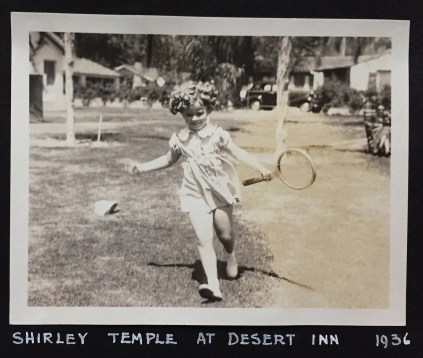
“This morning she was out trying to bat tennis balls one of her bodyguards was batting to her. A few other children were in on the play. The gallery consisted of at least six people nearby and a lot of others (like Myself) in the distance. Later when she was throwing a ball to a dog, people were talking movies and generally going ga-ga over her. When I came back from the pool where I had been painting this afternoon, I did see her without spectators, but of course with the guard who in reality is her playmate, and another guard in uniform. The two of them had a lot of dried peas and were shooting them with a sling-shot just like the Littlest Rebel.

3

Henry Scripps Booth, photographer. Courtesy Cranbrook Archives

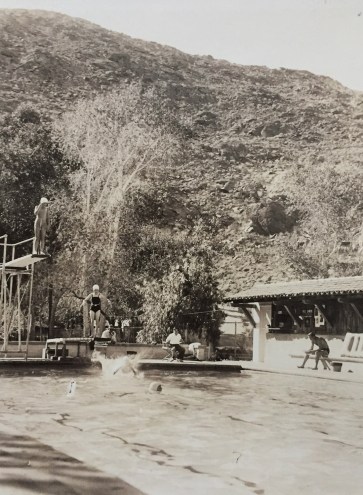
“She is not pretty, but certainly is cute. Her hair is curls all over of sort of a deep taffey [sic] color. She is very blond with pink cheeks. She screws up her face when she talks, has a twinkle in her dark eyes, and sort of minces around in her usual movie manner. She is very well behaved, sitting at the table and eating her dinner as good little girls should, and generally taking the attention she gets with good grace. Both nights she has taken a doll to dinner; last night a girl doll, tonight an Indian chief with a feathered headdress. She has a pink coat more or less like Cynthia’s [Henry’s daughter], but short as the French would have it so her bare legs are seen pretty much all the way up. She played around today in sort of drab slacks with a jacket to match. Their cottage is by the pool so I will see a good deal of her.”

1

The pool at The Desert Inn, 1936. Henry Scripps Booth, photographer. Courtesy Cranbrook Archives

NOTE: In December 1937, Nellie Coffman, owner of The Desert Inn, dedicated the bungalow to Shirley Temple. Held in front of family, hotel visitors, and the press, the ceremony featured nine year old Shirley who christened the bungalow not with a bottle of champagne, but with a bottle of milk.

Leslie S. Edwards, Head Archivist

The Art and Science of Numbers

“La science du nombre devient la clef de toute culture scientifique,” prefaces an article by then-director, Robert T. Hatt, in the May 1966 Cranbrook Institute of Science newsletter. Roughly translated – the science of numbers becomes the key to any scientific culture – an idea promoted through a long-term exhibition at the Institute, titled Mathematics Emporium.

Sponsored by International Business Machines Corporation (IBM), the exhibition was a replacement for the World of Numbers, which was a mathematics-focused exhibition on display at the Institute from 1961-1966. The goal of the Mathematics Emporium was to discover the character of mathematics or as Dr. Hatt explained, “what mathematics is all about.”

Invitation to preview the Mathematics Emporium exhibition, Apr 1966.

The exhibition was created by well-known designer, Gordon Ashby, who previously worked with Charles and Ray Eames.  During Ashby’s tenure with the Eames Office, he worked on the Mathematica exhibition (also sponsored by IBM) for the California Museum of Science and Industry in Los Angeles (now the California Science Center) and later for the IBM Pavilion at the New York World’s Fair (1964/1965). For the Cranbrook exhibition, Ashby worked in consultation with several mathematics teachers in the San Francisco Bay Area to design displays about geometry, calculus, the properties of space, the giving of form to algebraic equations, and the measurement of motion and change.

Letter from Ashby to Hatt, Feb 1966.

Ashby’s goal with the Mathematics Emporium was to depict mathematical subjects in an imaginative way to stimulate the curiosity of visitors and encourage further investigation. The exhibition was enclosed in an 18-foot modular showcase that contained a graphic panel with sketches or diagrams, as well as a collection of thirteen small displays. Ashby said he hoped to create an exhibition “that would make mathematics ‘look-at-able’ and bear repeated visits.”

Mathematics Emporium exhibition. Photograph by Harvey Croze, Apr 1966. Copyright Cranbrook Archives.

The exhibition showcase was trimmed in gold-leaf and included photographs, mathematical limericks, and quotes by famous mathematicians. Within each display there were thought-provoking questions, such as “what has a can of baking powder to do with calculus?” and “which mathematical science sees a coffee cup and a doughnut as alike?” The Mathematics Emporium was very popular with visitors, and it remained a permanent exhibition in the Institute’s collections for more than 14 years.

Gina Tecos, Archivist
Tranquil Still Room

“My father got me started the other day decorating and coloring a very elaborate plaster ceiling and nobody knows when I’ll get it finished.” So wrote James Scripps Booth in a letter to a favorite artist’s model Helen Knudson. The elaborate ceiling he referenced is the ceiling of the Still Room at Cranbrook House:CECT106det16George G. Booth created the Still Room as a part of his office suites in 1918. It was as a place to take a noonday rest. In old English country houses, the Still Room was a place where medicines were prepared, herbs and flowers were infused in water or oils, and where home-brewed beers and wines were made. As Henry Scripps Booth recalled in another letter, “We started applying the term to the small room at the south end of the wing although Mr. Booth had no intention of making whiskey, beer or wine, but on using it as a quiet place for reading, conversation and taking undisturbed naps.”

Commissioned by Booth, Ulysses Ricci and Anthony DiLorenzo designed the ceiling for the Still Room in 1919. The ceiling depicts classical Pompeiian figures, animals, and motifs of swags, festoons, masks, floral and foliage. The ceiling consists of four arched sections, a central medallion, and a tympanum* piece on each wall.

James Scripps Booth described his painting method for the ceiling: “I have to lie down in a steamer chair that is rigged up high on a scaffold, when I work and there is such a lot of detail design it keeps me guessing…” James painted the ceiling in blues, pinks, greens, yellows, purples, and browns against an off-white background.

Words can not describe the beauty of the ceiling. As they say, a picture is worth 1,000 words.

This slideshow requires JavaScript.

Leslie S. Mio, Associate Registrar, Cranbrook Center for Collections and Research

*tympanum is a semi-circular or triangular decorative wall surface over an entrance, door or window

Operation Mercy and an Academy of Art Sculptor

In January 1957, members of the Academy of Art’s Student Council came across an article in Newsweek magazine about the plight of Hungarian refugees to the United States following the 1956 Hungarian revolt against Soviet domination. Moved by the story of the artist featured in the article, the students decided to act and conceived and executed a plan to finance a semester of study at the Academy for one of the artist refugees. During the weekend of January 19-20th, Academy students held a sale of their own artwork, and supplemented by their own meager cash funds, raised $2,600 for a fund administered entirely by the Student Council. The Academy of Art added enough funds to present an artist with a scholarship for one year of study.

Members of the student council wrote to various organizations including the American Hungarian Federation and the Central Department of Church World Service in order to identify an artist who might qualify for the scholarship. Under the provisions of the 1953 Refugee Relief Act, from November 1956-June 1957, the U.S. government processed over 31,000 refugees at Camp Kilmer in New Jersey through a program called “Operation Mercy.” Most refugees stayed an average of twelve days before a resettlement location was found for them.

detnews1955046

Detroit News, 18 May 1958, Courtesy Cranbrook Archives

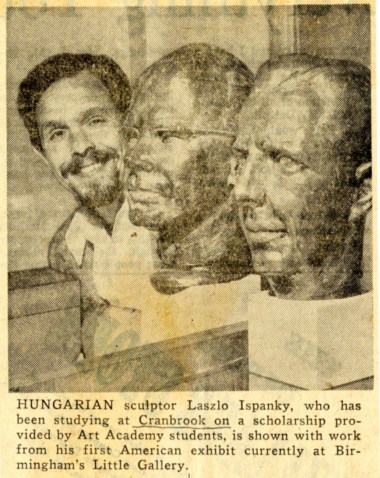
The artist sent to Cranbrook was Laszlo Ispanky (1919-2010), a 38-year old sculptor whose interest in art started at a young age. His father owned a restaurant in Budapest near a large sand mine, which soon became Ispanky’s canvas. His sand art was recognized by a man who suggested that he become a sculptor, so Ispanky eventually graduated from the Hungarian Fine Art Academy. In November 1956, during the Hungarian revolt, Ispanky and a friend escaped to Vienna where they sought asylum in the United States.


CAM1984_45

“Two Sisters,” Laszlo Ispanky, c. 1958, bronze, 17 1/2 x 9 x 6 inches, CAM 1984.45, Gift of Peggy de Salle. Image courtesy Cranbrook Art Museum.

Ispanky had been unable to work creatively under Communist rule. He once commented “In a Communist country, you have to be a Communist to be supported as an artist.” Described as a “romantic European,” Ispanky was grateful for the total freedom he was allowed at Cranbrook – “the most fantastic thing . . . a huge studio, and you do whatever you want.” While at Cranbrook, Ispanky sculpted over 32 works in terra cotta, bronze and plaster and was given the nickname “Speedy Gonzalez” by his fellow students.


Lazlo Letter001

Correspondence from Ispanky to Cranbrook Academy of Art, 1957. Courtesy Cranbrook Archives.

While he did not receive a degree at Cranbrook, Ispanky was eternally grateful for the chance to study here. In his letter, he expresses his heartfelt sentiments and poetic nature. “My thanks to you for reaching out to me with something that is inherent in the sacred name of freedom and for lending me hope. It feels good! I have waited with anxiety to hold the clay with which to give birth to the flowers blooming in my heart – to the hidden music which lives within me; to turn the material into form and into a million statements.”

After Cranbrook, Ispanky moved to New Jersey where he lived his life as a successful sculptor, specializing in the portraiture that he developed while at Cranbrook.

– Leslie S. Edwards, Head Archivist

Create a website or blog at WordPress.com