“La science du nombre devient la clef de toute culture scientifique,” prefaces an article by then-director, Robert T. Hatt, in the May 1966 Cranbrook Institute of Science newsletter. Roughly translated – the science of numbers becomes the key to any scientific culture – an idea promoted through a long-term exhibition at the Institute, titled Mathematics Emporium.
Sponsored by International Business Machines Corporation (IBM), the exhibition was a replacement for the World of Numbers, which was a mathematics-focused exhibition on display at the Institute from 1961-1966. The goal of the Mathematics Emporium was to discover the character of mathematics or as Dr. Hatt explained, “what mathematics is all about.”

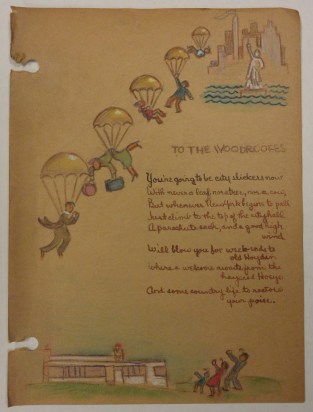
Invitation to preview the Mathematics Emporium exhibition, Apr 1966.
The exhibition was created by well-known designer, Gordon Ashby, who previously worked with Charles and Ray Eames. During Ashby’s tenure with the Eames Office, he worked on the Mathematica exhibition (also sponsored by IBM) for the California Museum of Science and Industry in Los Angeles (now the California Science Center) and later for the IBM Pavilion at the New York World’s Fair (1964/1965). For the Cranbrook exhibition, Ashby worked in consultation with several mathematics teachers in the San Francisco Bay Area to design displays about geometry, calculus, the properties of space, the giving of form to algebraic equations, and the measurement of motion and change.

Letter from Ashby to Hatt, Feb 1966.
Ashby’s goal with the Mathematics Emporium was to depict mathematical subjects in an imaginative way to stimulate the curiosity of visitors and encourage further investigation. The exhibition was enclosed in an 18-foot modular showcase that contained a graphic panel with sketches or diagrams, as well as a collection of thirteen small displays. Ashby said he hoped to create an exhibition “that would make mathematics ‘look-at-able’ and bear repeated visits.”

Mathematics Emporium exhibition. Photograph by Harvey Croze, Apr 1966. Copyright Cranbrook Archives.
The exhibition showcase was trimmed in gold-leaf and included photographs, mathematical limericks, and quotes by famous mathematicians. Within each display there were thought-provoking questions, such as “what has a can of baking powder to do with calculus?” and “which mathematical science sees a coffee cup and a doughnut as alike?” The Mathematics Emporium was very popular with visitors, and it remained a permanent exhibition in the Institute’s collections for more than 14 years.
– Gina Tecos, Archivist
 George G. Booth created the Still Room as a part of his office suites in 1918. It was as a place to take a noonday rest. In old English country houses, the Still Room was a place where medicines were prepared, herbs and flowers were infused in water or oils, and where home-brewed beers and wines were made. As Henry Scripps Booth recalled in another letter, “We started applying the term to the small room at the south end of the wing although Mr. Booth had no intention of making whiskey, beer or wine, but on using it as a quiet place for reading, conversation and taking undisturbed naps.”


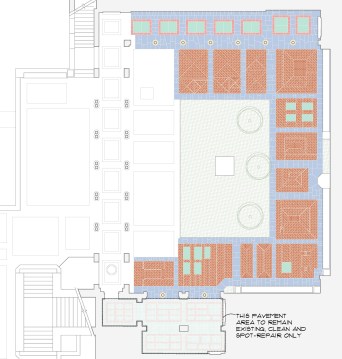
 Once the demolition was complete, the contractor replaced the underground storm drain, which was originally clay piping, with new PVC piping. Clay piping is brittle and therefore susceptible to intruding tree roots which lead to leaks and clogs. The PVC piping will last much longer and minimize maintenance work. Once the PVC piping was installed, soil was filled in and compacted and the trenches were capped with concrete.
  The next activity was demolishing the concrete bridge. All the existing limestone newel posts and railings were in good condition, so they were set aside to be reinstalled. The masonry wall, below the bridge, was also disassembled because many of the bricks were extremely fragile and showed
  After a summer of careful work, the masonry wall and arches have been rebuilt to their original beauty.
 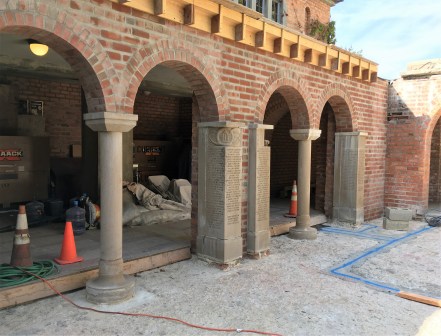 The concrete bridge has been layered with waterproofing, reinforcing, and heating pipes, and is ready to be poured back with concrete. The flat paving areas are being prepared for their final layer of brick and stone.
  Look forward to a final update here on the Blog once the project is complete! As always, many thanks to the contractors who are working hard on this beautiful restoration.