Remembering Svea Kline: Artist and Teacher

As we continue to celebrate the women of Cranbrook during Women’s History Month, our Friday post is dedicated to sculptor and teacher, Svea Kline (1902-1989). Born in Karlskrona, Sweden, Kline came to Chicago in 1928 with her twin sister. Following her mother’s advice to find a “practical profession,” Kline studied physiotherapy at Northwestern University for two years and practiced with a physician. She also took art classes at the Art Institute of Chicago during this time.

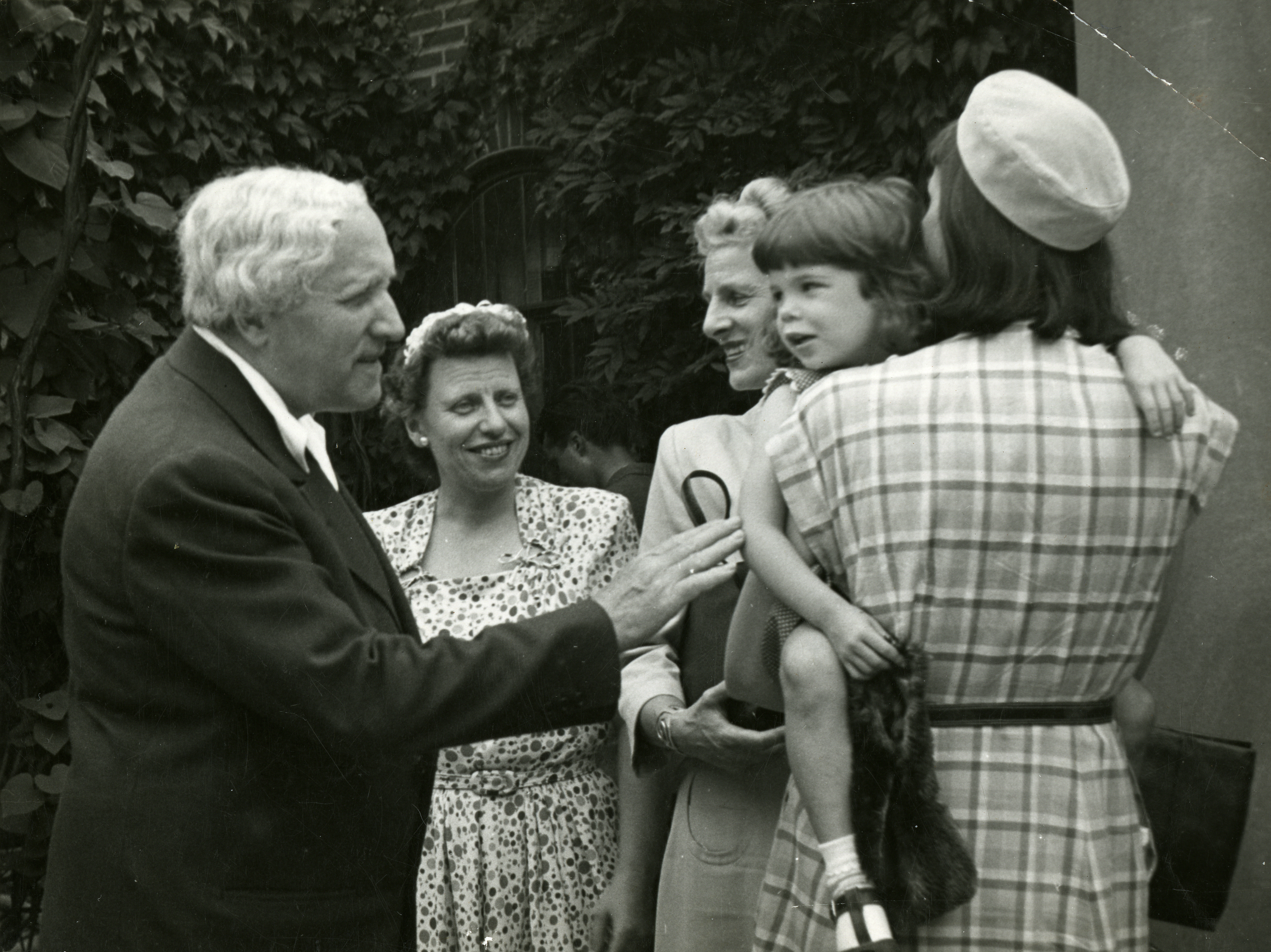
In 1940, Kline came to Cranbrook Academy of Art to attend the summer session, which she also did the following year. In 1942 she received a scholarship award that provided her residence at the Academy during the academic year during which she won first prize in a student competition. From 1942-46 she studied sculpture with Carl Milles and ceramics with Maija Grotell. She became a lifelong friend of Milles, and often lectured about the sculptor and his work.
1990-21190

Carl Milles, Svea Kline, Mabel Deardon, and Mary Woolf (holding Dinah Mitchell) in Millesgarden, ca 1944. Cranbrook Archives.

In 1943, Kline started the Sculpture Department at the Flint Institute of Arts, and began teaching there part-time. From 1950 she taught there full-time and also at the Saginaw Museum of Art. Kline also taught at what was then the Bloomfield Art Association and Haystack School for the Arts in Maine, worked as Milles’ assistant from 1949-50, and was one of the founders of the Sculptors Guild of Michigan. Founded in 1952 as the Terra Cotta Sculptors, the group “provided an umbrella for women to prove their validity as artists to the community and to provide support and inspiration to each other.” (Men were invited to join in 1977.)
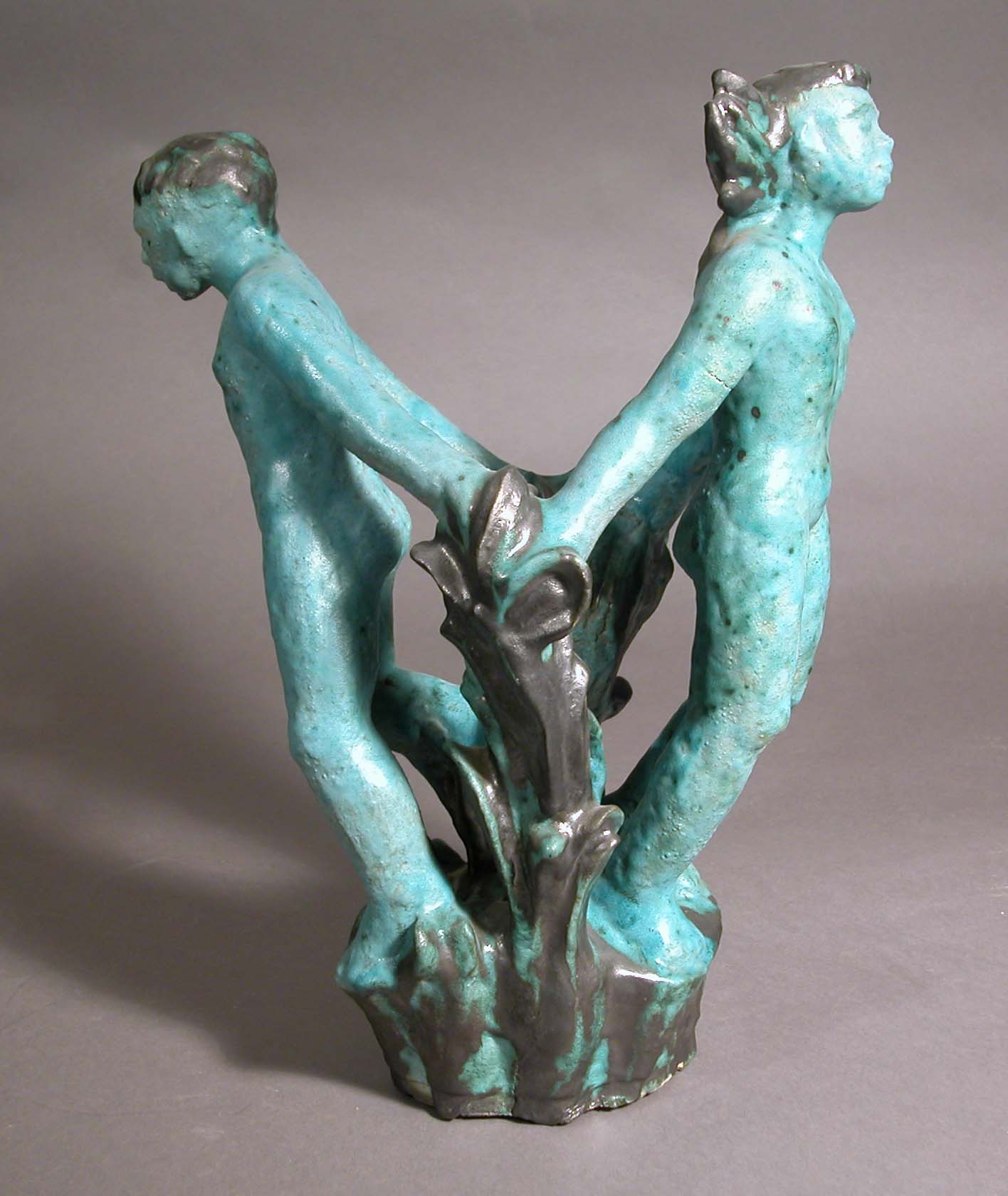
S1944_35

Fountain Piece, 1944. Cranbrook Art Museum.

As a sculptor, Kline worked in metal, bronze, wood, ceramic and glass. Her innovative work with glass was considered “ahead of her time.” She molded glass, fused glass, painted on glass, and embedded pieces of colored glass into a background layer of glass—a process she called “gemaux.” In Michigan her works are displayed at the Berkley Public Library, Flint Public Library, Genesee Merchants Bank and Trust, Detroit Broach Company, Koebel Diamond Tool Company, Michigan Credit Union League, and the First Baptist Church of Royal Oak.

In a December 1983 interview in the Birmingham Eccentric, Kline fondly remembered her days at Cranbrook. “I thought it was just heaven on earth—so well-kept, so many interesting people from all over the world. There was a marvelous spirit.” She also recalled with pleasure the great artists with whom she was associated—Eliel Saarinen, Carl Milles, Maija Grotell, and Harry Bertoia. Coincidentally, we have an image (displayed below) of Kline wearing a brooch designed by Harry Bertoia. In honor of the Cranbrook Art Museum’s exhibition of Harry Bertoia’s jewelry (which opens tonight), we are featuring a photograph of Kline wearing a Bertoia brooch.

AA-87

Svea Kline, Marguerite Kimball, Lillian Holm, and Joy Griffin West at the opening night of the student exhibition, May 1944. Cranbrook Archives.

Gina Tecos, Archivist

Amelia Earhart at Cranbrook?

Although there is no documentation that Amelia Earhart ever visited Cranbrook, records of one of her visits to Michigan are housed in the Cranbrook Archives. The photographs and telegram illustrated here are from the Gliders, Inc. Records and help tell not only the story of Amelia Earhart, but also that of glider aviation in Oakland County, Michigan.

Telegram

Telegram, 12 Feb 1929. Gliders, Inc. Records, Cranbrook Archives.

The first glider plane was designed in 1852, but it was not until September 1928 that Gliders, Inc. became the first company in the United States that exclusively manufactured motorless aircraft. Gliders, Inc. was founded by William E. Scripps, the younger brother of Cranbrook’s Ellen Scripps Booth. The factory, located in Lake Orion, Michigan, produced first and second class gliders, and the “Detroit Gull” became the glider of choice for many gliding clubs across the country. Gliders, Inc. was also called upon to do much of the early glider pilot training – over 800 men and women in 1929.

Group at Willow Run

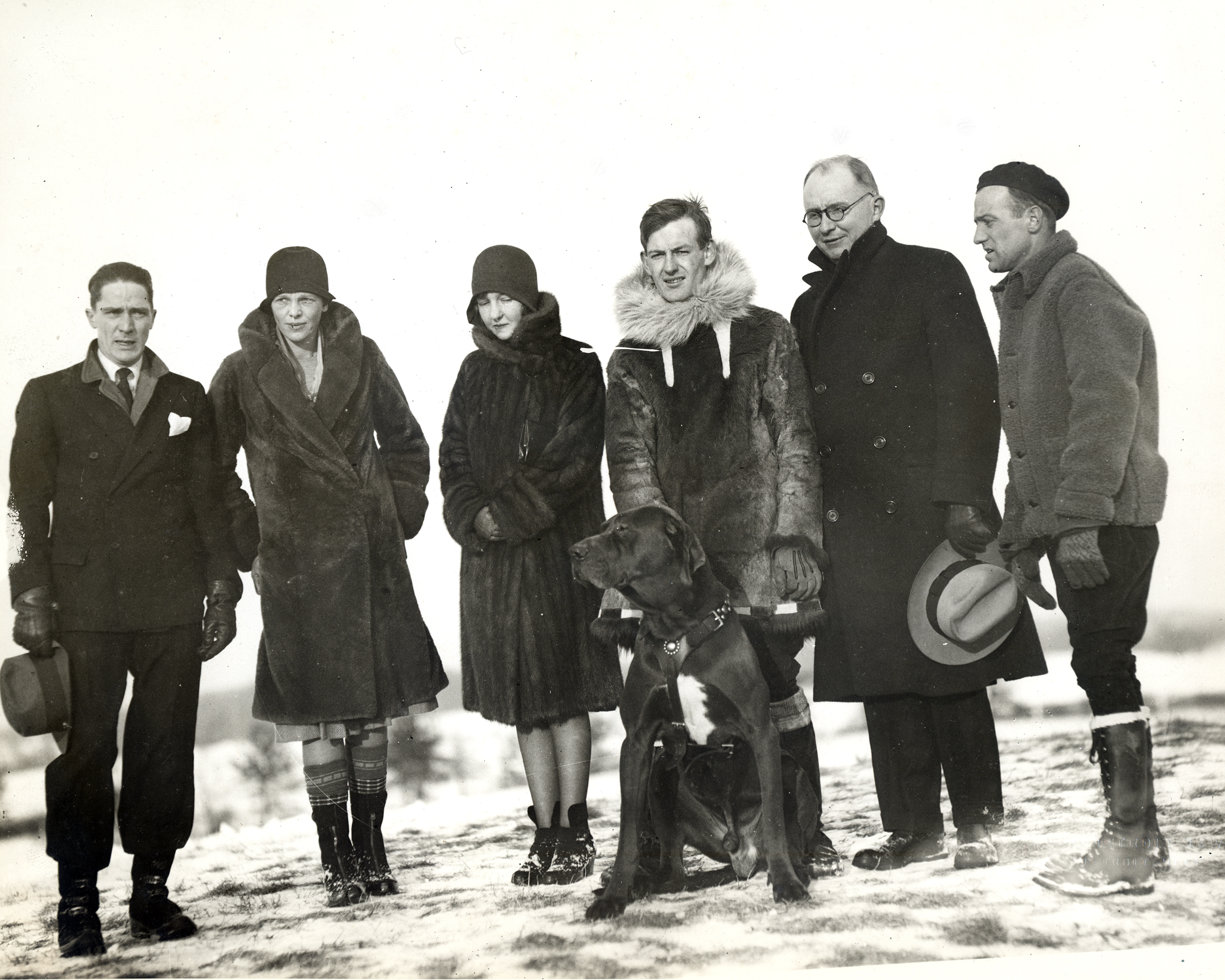
Major Reed Landis, Amelia Earhart, Nina Downing Scripps, William Scripps, Don Walker, and Frank Blunk at Willow Run, Feb 1929. Photo by Detroit News. Cranbrook Archives.

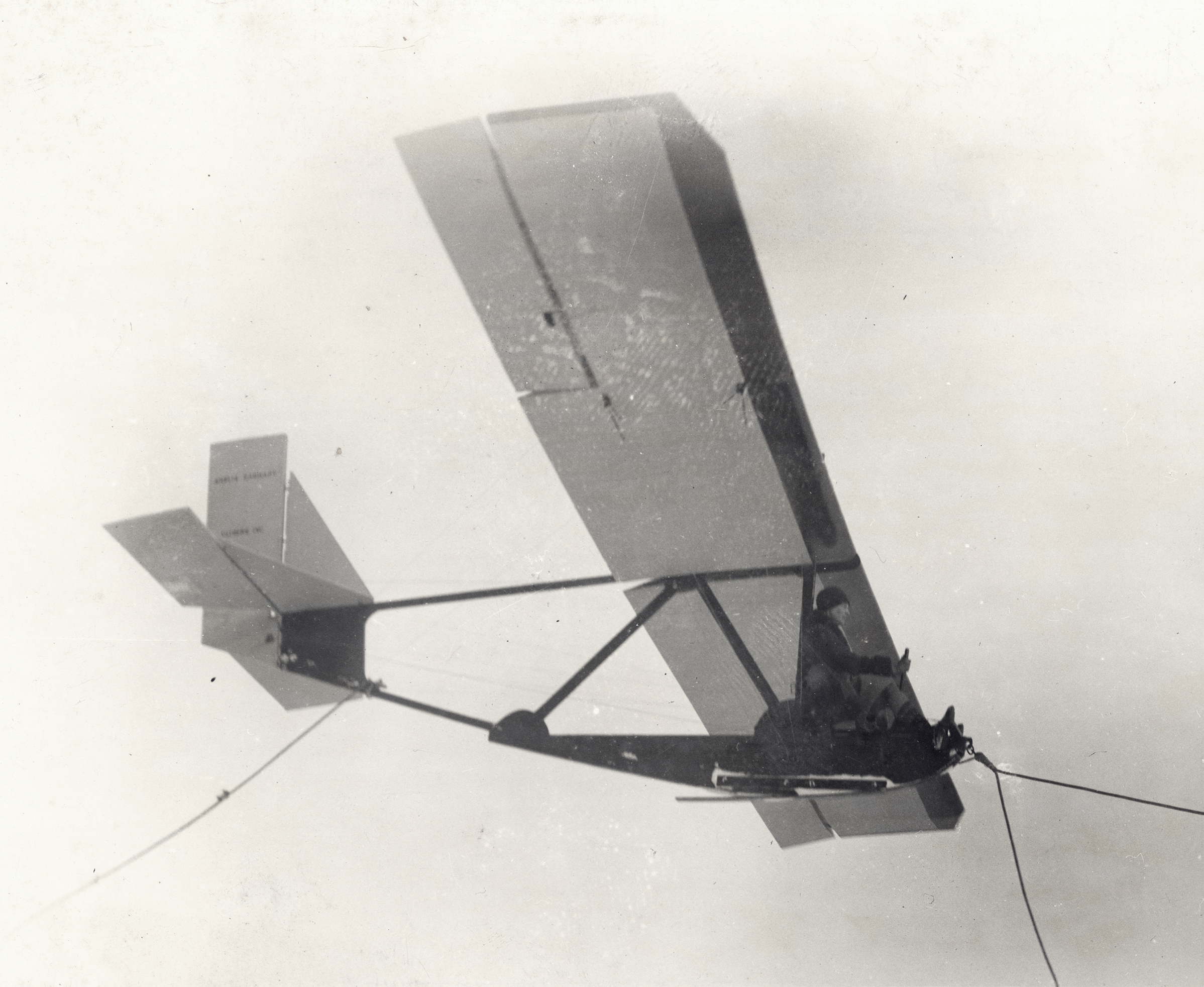
In December 1928, Scripps invited Amelia Earhart to his estate, then known as Wildwoods. Earhart accepted and in February 1929, took her first glider ride at the “Scripps Field” in a Gliders, Inc. Primary Training Glider.

Primary Training Glider

Amelia Earhart flying the primary training glider, Feb 1929. Photo by Detroit News. Cranbrook Archives.

Additional female aviation facts:

In November of 1929, Earhart and 25 other women gathered at Curtiss Airport in New York to establish The Ninety-Nines, Inc. – an aviation organization for any woman who held a pilot’s license. Earhart was the first president.

Maxine Dunlap of San Francisco was the first woman to earn a glider license in 1929. Hers was a third-class glider license. Anne Lindbergh followed in 1930 with a flight that earned her third-class, second-class, and first-class licenses. She was the first woman in the US to earn a first-class glider license. Check back next week for a post about Lindbergh’s connection to Cranbrook, and yes, she DID visit here!

Leslie S. Edwards, Head Archivist

The Amelia Elizabeth White Gift

In honor of Women’s History Month, we like to try to tell the stories of women that might otherwise go unnoticed. Thousands of women have stepped foot on the Cranbrook campus, or have been involved with Cranbrook in some way. One such woman was Amelia Elizabeth White (1878 – 1972), philanthropist, passionate champion for the rights of the Pueblo, and a collector and promoter of Native American Art. In 1937, she donated a very large collection of Native American art and artifacts to Cranbrook Institute of Science, where they remain today.

From the 1938 Cranbrook Institute of Science Annual Report.

From the 1938 Cranbrook Institute of Science Annual Report.

Born into an upper class family in New York City, White was educated at Bryn Mawr and traveled widely before she and her sister Martha served as volunteer nurses with the Red Cross in World War I. After the war, White, who had first traveled to New Mexico in 1913 to visit a friend, arrived in Santa Fe where she purchased a tract of land just south of the city. She soon built a home called “El Delirio” or “The Madness” (designed by William Penhallow Henderson) which quickly became a popular gathering place for writers, artists and intellectuals. By 1923, White had opened an art gallery called “Ishauu” in Manhattan ( run by Dolly Sloan), in order to promote southwestern Native American Art.

White was a member of the Eastern Association on Indian Affairs (EAIA) initially composed of men and women residing in and around the city of New York who shared an interest in the life and crafts of the Pueblo. She was instrumental in the organization of The Exposition of Indian Tribal Arts in 1931 and served as chairman of the Executive Committee. Along with other patron-philanthropists including Mary Cabot Wheelwright and Abby Rockefeller, White’s goal was to show Native American art as a traditional art form. The exposition included more than 600 pieces of pottery, jewelry, textiles, sculpture, paintings, beadwork, and basketry, many of which were from White’s personal collection.

Navajo necklace

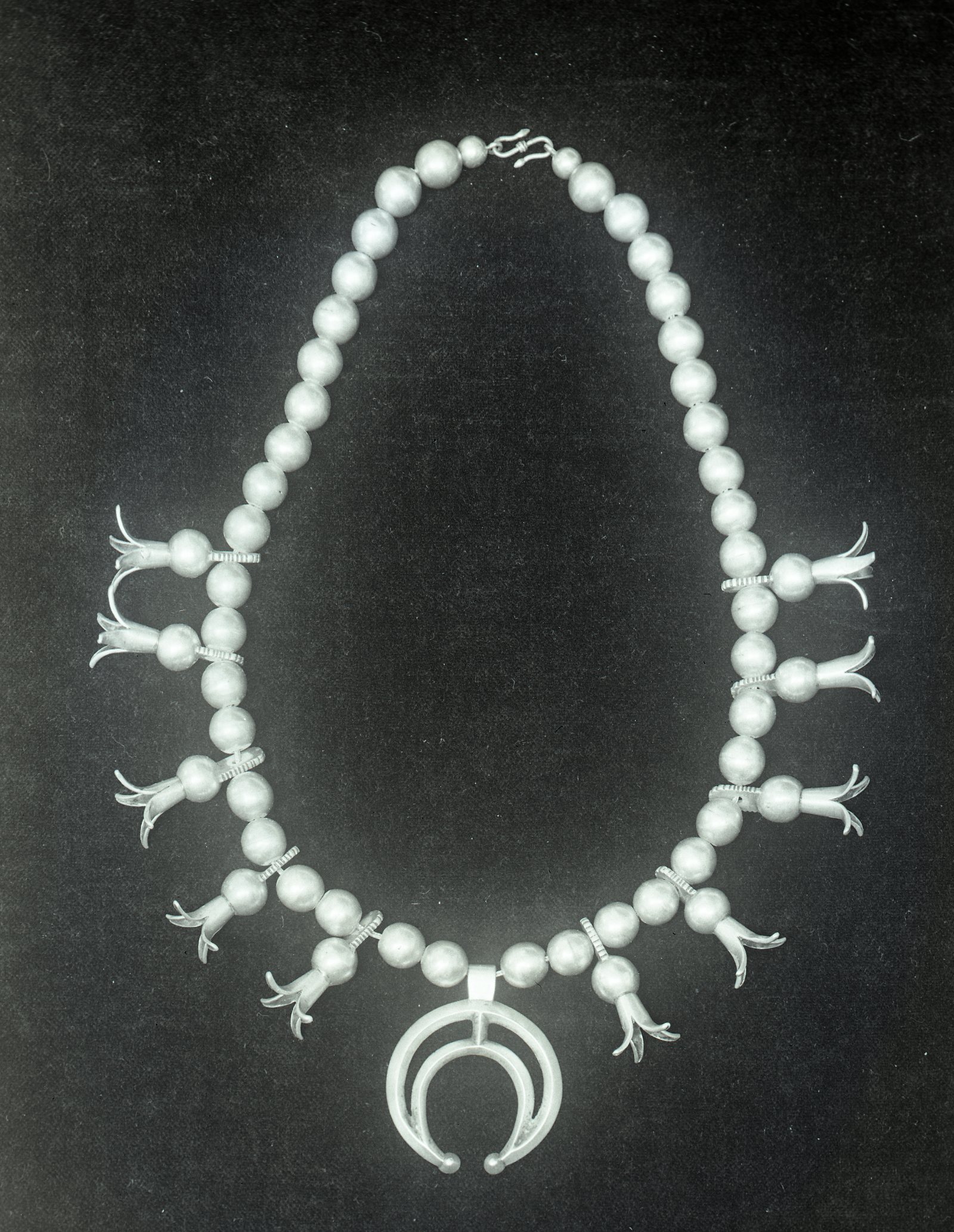
Navajo necklace. Image courtesy Cranbrook Archives.

To continue her wish to “have the American Indian take his place in the museums for American art in this country,” White dispersed her collection of art and artifacts to numerous museums across the country including Cranbrook Institute of Science, Cleveland Museum of Art, the National Anthropological Archives at the Smithsonian, the New Mexico History Museum, and the Detroit Institute of Arts. White’s collection, which she donated in 1937, was the largest single accession of the Institute other than our founders, George and Ellen Booth. The donation included textiles, pottery, jewelry and artifacts from the Pueblo, Navajo, Kiowa and Alaskan Inuit.

Navajo wedding belt

Navajo wedding belt. Image courtesy Cranbrook Archives.

A fascinating woman in her own right, White’s contributions to the Institute’s anthropological collection has been nearly forgotten. In his letter to White on December 16th 1937, then Institute of Science Director, Robert T. Hatt, expresses his gratitude for the donation: “I hasten to assure you that no finer thing has ever happened to this organization than the bestowal which you have made.”

Leslie S. Edwards, Head Archivist and Gina Tecos, Archivist
Confessions of a Book Nerd

I have a confession to make. The smell of library books, an afternoon at an independent book store, re-reading a favorite novel – these are my ultimate indulgences. I could spend hours reading book blogs, listening to author interviews, or pouring over book-related tchotchkes on Etsy. I am a book nerd. My (nearly) one year as an Archivist at Cranbrook has been heaven. I discover something new every time I have the opportunity to walk into George Booth’s personal library at Cranbrook House. I find profound satisfaction in creating a catalog record for a new book or discussing MARC records with colleagues.

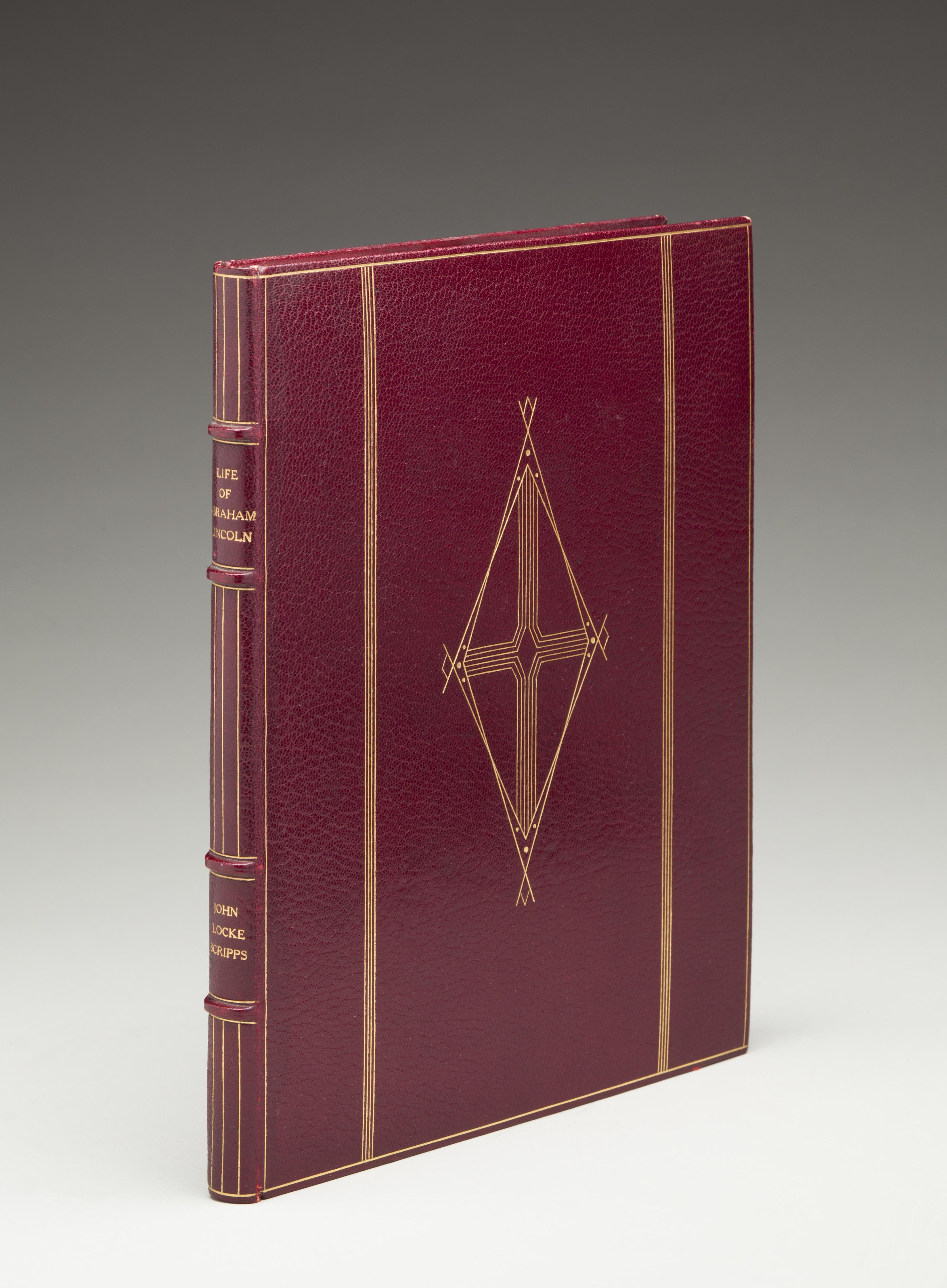
One of my favorite collections at Cranbrook is the Cranbrook Press and Photo Department Records. While working on a Cranbrook Press request recently, I came across the work of the bookbinder, Jean Eschmann (1896-1961), hired by George Booth in 1929. Eschmann was hired to set up the bookbinding workshop in the Arts and Crafts Studios at Cranbrook, where he remained until 1933 when desperate financial times forced the closure of the studio.

Jean Eschmann binding, Cranbrook Archives

English Fairy Tales, tooled leather. ca 1931. Cranbrook Archives.

Educated in Zurich, Eschmann traveled and studied in Austria, France and Switzerland. He came to the United States with his family in 1919. He was a member of the Society of Arts and Crafts in Boston and studied with Mary C. Sears. In 1929 George Booth hired Eschmann to create handmade bindings for the Art library and for his own personal library. Eschmann also taught bookbinding and hand-tooling classes to the community.

211044-145

The First Published Life of Abraham Lincoln, tooled leather. ca 1931. Cranbrook Archives.

Eschmann’s work has been exhibited at various museums in the United States, as well as at the Book Workers Guild in New York. His bindings were included at the World Fair in Paris in 1937 and at the Golden Gate Exposition in San Francisco in 1939. In 1945 Eschmann received the emblem for Meritorious Service from the Civilian Awards Committee of the Surgeon General’s Office for his work in restoring thousands of rare books at the Army Medical Library during World War II.

Evidence of Eschmann’s beautiful leather and tooling work can be seen in several examples in the rare book collections here in the Archives, and also in the Academy of Art library. I hope you enjoy the examples in this post. They definitely make this book nerd swoon!

Gina Tecos, Archivist

The Case of the Bogdani

The other night I saw the most interesting show on PBS called “Fake or Forgery.” An investigative journalist and two noted art sleuths joined forces with cutting edge scientists to discover the truth behind a painting the owner thought to be a Degas. They thoroughly searched the provenance of the painting, and used scientific methods like X-ray fluorescence (XRF) to determine if the pigments used in the painting were compatible with Degas’ known palette. It made me think of the many works of art across the Cranbrook campus that could benefit from in-depth scientific research like this. And, it prompted me to relay the story of a discovery the archives staff made several years ago.

The painting we fondly refer to as “The Bogdani” was originally purchased by George Booth for Kingswood School for Girls, where it hung in the Domestic Science Dining Room. Purportedly painted by noted Hungarian Jakob Bogdani (1658-1724), the still life was found in a storage room badly in need of cleaning and restoration.

The painting was conserved by Ken Katz of Conservation & Museum Services in Detroit. During the several months of conservation, we were able to visit the studio in order to see the work in process, and the results were amazing.

during

During conservation.

As I looked closely at the work, my heart almost stopped beating. Bogdani’s signature was gone, and in its place was another name! My first thought was how hard I had lobbied to get the painting conserved and now it was a forgery!  However, after doing additional research, I discovered that the artist, Tobias Stranover (1684-1731) was actually Bogdani’s son-in-law and former student. Phew! Although this meant the still life was painted around 1810 instead of 1790, at least we still had an original painted by an artist who, with his father-in-law, provided the finest exotic bird and animal paintings in England. The painting currently hangs in the reading room of Cranbrook Archives.

Before conservation.

Before conservation.

after

After conservation, details in the painting can be seen can be seen more clearly, and the brilliance of the colors pop.


Leslie S. Edwards, Head Archivist


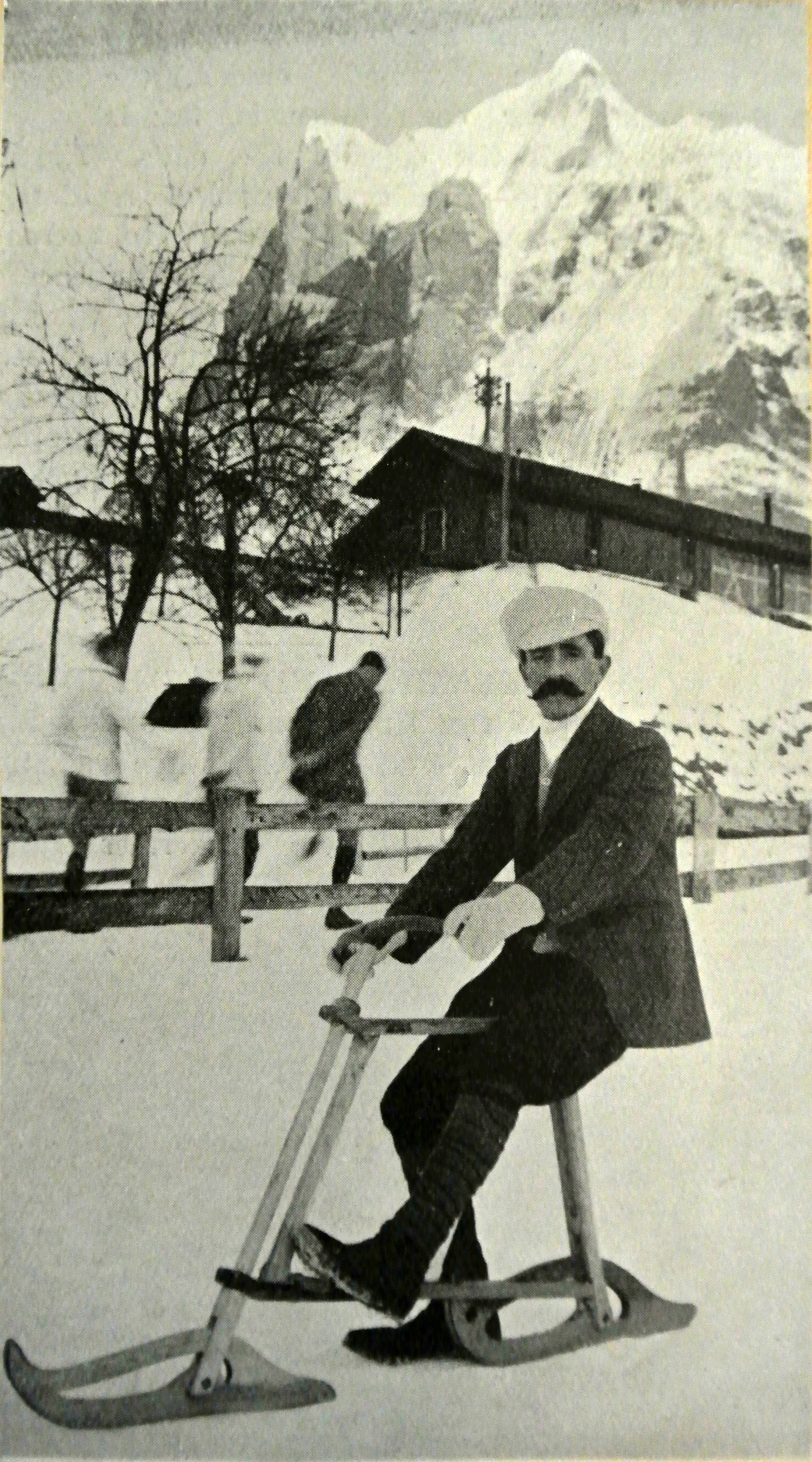
Early Bicycle Sled?

Courtesy Cranbrook Archives

Courtesy Cranbrook Archives

This gentleman caught my eye as a colleague was browsing through a George G. Booth (GGB) scrapbook containing clippings of illustrations from magazines. The scrapbook was GGB’s “Dream Book” of art and architecture examples on which to model his new home at Cranbrook, and is part of his papers.

Amidst illustrations of terraces, statues and waterfalls was this Alpine dandy. Why is his picture there, and what is that contraption he’s sitting on? A search on the Internet revealed no information on this early 20th century, bladed “vehicle” for seated conveyance. If anyone out there knows more about it, I’d be delighted to know!

–Cheri Gay, Archivist

Good news! One of the Archives’ volunteers, Lois Harsh, spent a cold afternoon diligently searching the Internet and found this web site, www.ski-bike.org that identifies several versions of the ski bike. This particular version is from around 1914. Thanks, Lois!


A Man of Many Words

At Cranbrook, the legacy of Samuel Simspon Marquis is clearly visible. A trusted advisor to George Booth, Dr. Marquis oversaw the completion of Christ Church Cranbrook and became the first Rector when the parish was officially established in 1927. He was also instrumental in the founding of the Cranbrook School for Boys and was a Trustee of the school from 1926-1939. On 23 May 1940, Marquis Hall was dedicated in his honor.

Prior to his arrival at Cranbrook, Dr. Marquis was invited by Henry Ford to head the Sociological Department at Ford Motor Company. Marquis remained in this position for five years and accompanied Ford on the ill-fated “Peace Ship” to Europe in 1915. In 1923 Marquis published Henry Ford: An Interpretation, one of the first works written by an employee close to Ford. Marquis’ work with Ford is well-documented in our collection here at Cranbrook and at the Benson Ford Research Center.

When the Fairies Go To Church

Unpublished poem by Samuel S. Marquis, Samuel Simpson Marquis Papers, Cranbrook Archives.

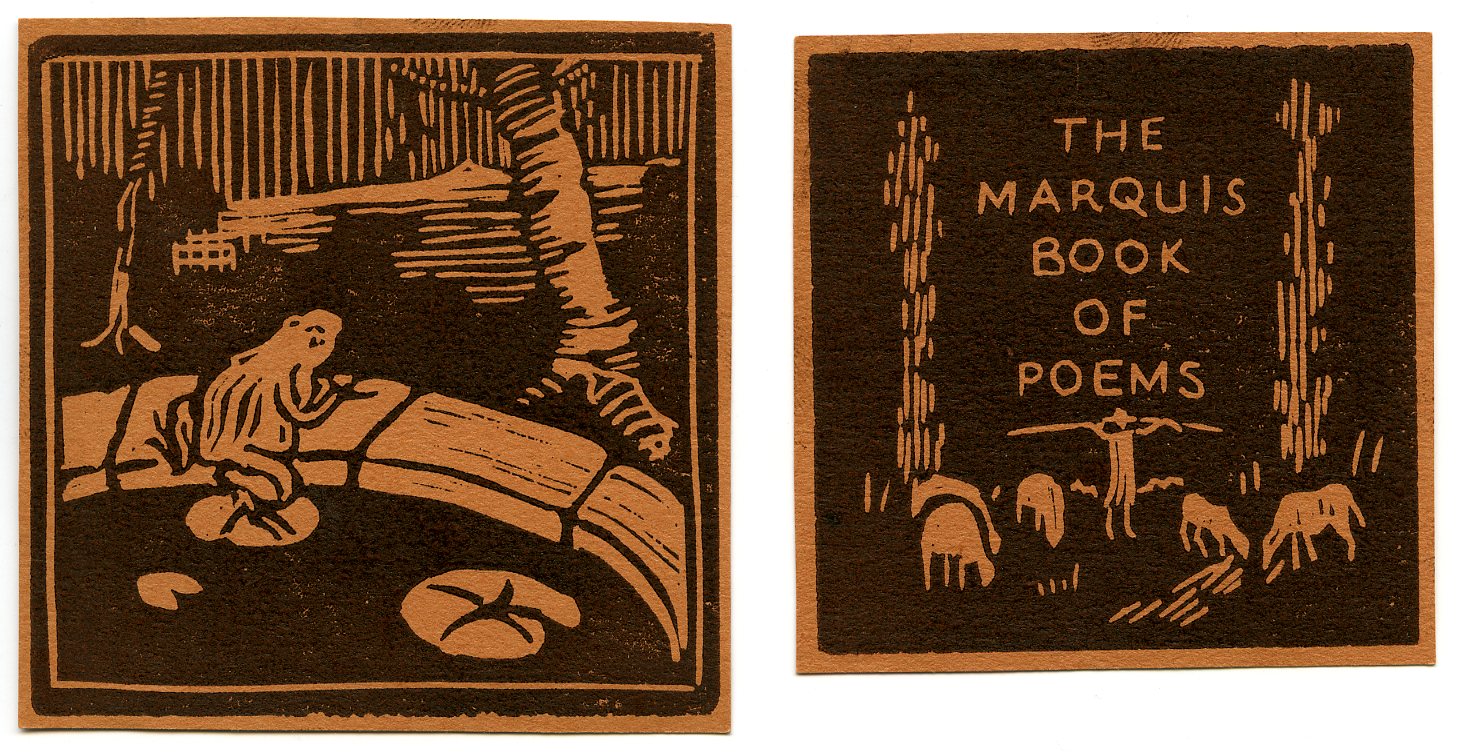
While doing research here at Cranbrook, I discovered that Marquis was also a prolific writer. He wrote not only about religious topics, but about history, the political climate of the day, and even poetry. Below are samples of the book plates for the unpublished Marquis Book of Poems. Enjoy!

Marquis Book of Poetry

Cover and interior plates from The Marquis Book of Poems, Samuel Simpson Marquis Papers, Cranbrook Archives.

Gina Tecos, Archivist
Naturalist & Photographer Walter E. Hastings

Often times in collections we discover materials that are unexpected, rare, or just plain fabulous.  The following images are all of the above.  Several years ago, when processing a set of negatives from the Institute of Science, I was pleasantly surprised to discover a set of photographic images of Native Americans, primarily Odawa/Ottawa from Leelanau County in northern Michigan.  They were taken by Walter E. Hastings (1887-1965) between 1928-1933.  Hastings was a naturalist, photographer, and lecturer, and was Michigan’s first conservation film-maker.

Capture

From “He Knows All About Michigan’s Birds,” Detroit Free Press, 12 March 1922

Hastings’s interest in nature began as a child when his mother put together a collection of stones, shells, and Native American artifacts for him with the hope that he might become a naturalist. Clearly, it worked!  His interest in photography began in 1918 when he received an inexpensive camera for Christmas from his boy scout troop. From 1921-1932, Hastings worked for the University of Michigan Museum as the “Custodian of Birds’ Eggs.”  In that capacity, he served as a collections manager, enlarging and arranging the collection, and took numerous photographs which documented the nesting habits of Michigan birds.  Employed as the photographer for the Michigan Department of Conservation from 1926-1951, Hastings was a pioneer of wildlife and conservation photography.

CISC3261

Johnny Willow Bird, age 3 yrs.  Taken at St. Ignace, Michigan, Oct 1933.  Courtesy Cranbrook Archives.


CISC0078

Native American Campsite, Horton’s Bay, Michigan, Jul 1933.  Courtesy Cranbrook Archives.


The Institute of Science has several Odawa/Ottawa and Chippewa objects, collected and donated by Hastings, from the same geographical region where the photographs were taken. It is likely that the photographs were donated to the Institute of Science along with the artifacts. The Institute of Science photograph collection was later transferred to Cranbrook Archives. The Walter E. Hastings collection is located at the Archives of Michigan (MS 88-27).

~ Leslie S. Edwards, Head Archivist

It’s all in the details: Cranbrook’s Homestead Property

In 1914 George Gough Booth commissioned the Coats & Burchard Company to complete an appraisal of the “Homestead Property” which included a full inventory of Cranbrook House and its outbuildings. This was not uncommon, and Booth continued the practice several times during his life as the Cranbrook campus and its buildings grew and changed.

Blog_1.26_image1

Selection of Cranbrook House flooring materials. Courtesy Cranbrook Archives.

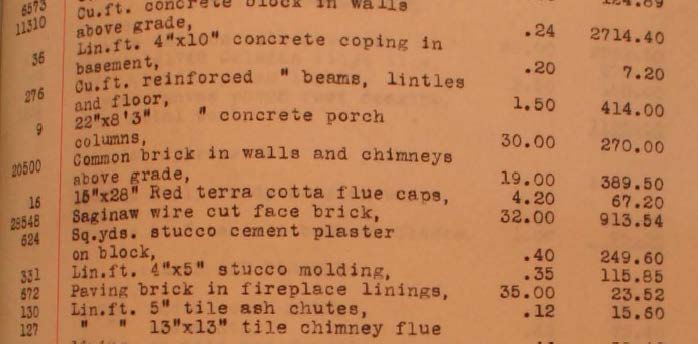
Since Cranbrook House was constructed in 1908, the 1914 appraisal ledger is the first in our collection, and is markedly different from the subsequent ones. The biggest difference is that in addition to the furnishings and artwork, all building materials, down to every last detail including number of bricks used, cubic feet for flooring, and even all of the hardware was judiciously and meticulously cataloged.

Blog_1.26_image2

Selection of “Bill of Materials” for Cranbrook House. Courtesy Cranbrook Archives.

This ledger and the others (which were taken in 1921, 1933, 1937, and in 1944) have been immensely helpful in historic research of the home and properties. They can be used to help locate objects in their original location in the house, and often point to the year they were purchased and even original purchase invoices. Using this ledger in conjunction with the original drawings and blueprints have been assisted campus architects and project managers with restoration projects on campus as well as projects which determine the structural integrity of buildings for building use and preservation.

Stefanie Kae Dlugosz, Collections Fellow, Center for Collections and Research

Photo Friday: The Art of Richard Thomas

While researching an archival query this past week I discovered yet more hidden gems in our collection—the work of metalsmith Richard Thomas (1917-1988). Thomas held several positions at Cranbrook, including Head of the Metalsmithing Department, Dean of Students, Registrar, and Administrative Assistant to the President. The Archives has a small collection which documents many of Thomas’ private commissions.

One of the key works he created for Cranbrook was the Ceremonial Mace (1978) at the request of the Cranbrook Educational Community. Traditionally, the Christian processional cross had been carried at Cranbrook and Kingswood Upper School graduation ceremonies, but by the 1970s, upper school students objected to the fact that the cross did not accurately reflect the religious beliefs of the diverse student body. In 1973 and 1974, Kingswood head, Wilfred Hemmer, moved the cross from the front of the processional to the rear, then in 1975 agreed to remove it from the ceremony altogether.

Cranbrook Mace

Photo courtesy Cranbrook Art Museum.

After Hemmer’s resignation in early 1976, acting head Christopher Corkery reinstated the processional cross and a student protest ensued. Letters to the editor were written to both upper school newspapers and four Kingswood seniors refused to attend the Kingswood commencement. By May, ten percent of the student body threatened to boycott the ceremony.

Thomas’ design of the Cranbrook Mace incorporates symbols of four major religions: the Christian cross, the Star of David, the Crescent of Islam, and the symbol of Yin and Yang which represents the Eastern philosophies of China, Japan, India and Indonesia. The seals of the Cranbrook institutions are also a part of the design of the mace, which is made of rosewood, ivory, steel, sterling silver and gold.  The Cranbrook Mace is still used in graduation ceremonies to this day.

Richard Thomas sketch

Sketch from the Richard Thomas Papers, Cranbrook Archives.

In 1981, Thomas was awarded the Cranbrook’s Founders Medal. His design and fabrication of liturgical objects can be seen in more than ninety churches, synagogues, and temples across the country. He designed the Cranbrook Foundation’s silver punch bowl, the Saarinen Medal, and the commemorative medal for the Academy of Art’s fiftieth anniversary.

Gina Tecos, Archivist and Leslie S. Edwards, Head Archivist

Create a website or blog at WordPress.com