Eric Perry photographs work from Megha Gupta (CAA Ceramics 2023) alongside collections from the Frank Lloyd Wright-designed Smith House and eggs from Cranbrook Institute of Science.
If you walked into Cranbrook House, Saarinen House, or Smith House this week, you might have noticed some surprising guests have arrived at the table. Your Center for Collections and Research team have been busy installing Brought to the Table, the fifth intervention of new work by Cranbrook Academy of Art students and Artists-in-Residence in our three historic homes.
This year’s virtual exhibition is a Cranbrook-wide collaboration that brings site-specific work from across the Academy’s eleven departments into conversation with objects from Cranbrook’s Cultural Properties, Art Museum, and Institute of Science collections.
Kiwi Nguyen (CAA Metals 2023), Iris Eichenberg (Metals Artist-in-Residence), and Kevin Adkisson (Center Curator) strategize in the Saarinen House studio.
Brought to the Table engages with the long tradition of functional art at Cranbrook and pairs new works of art with objects from the Cranbrook collections made for dining tables, coffee tables, desks, or side tables. Before the exhibition kicks off at the Virtual Opening and Lecture on March 27th, I’d like to give you a sneak peek at the exhibition process.
This was my first experience curating contemporary art and I was grateful to learn from my capable co-curators, Metalsmithing Artist-in-Residence (AIR) Iris Eichenberg and Center Curator Kevin Adkisson.
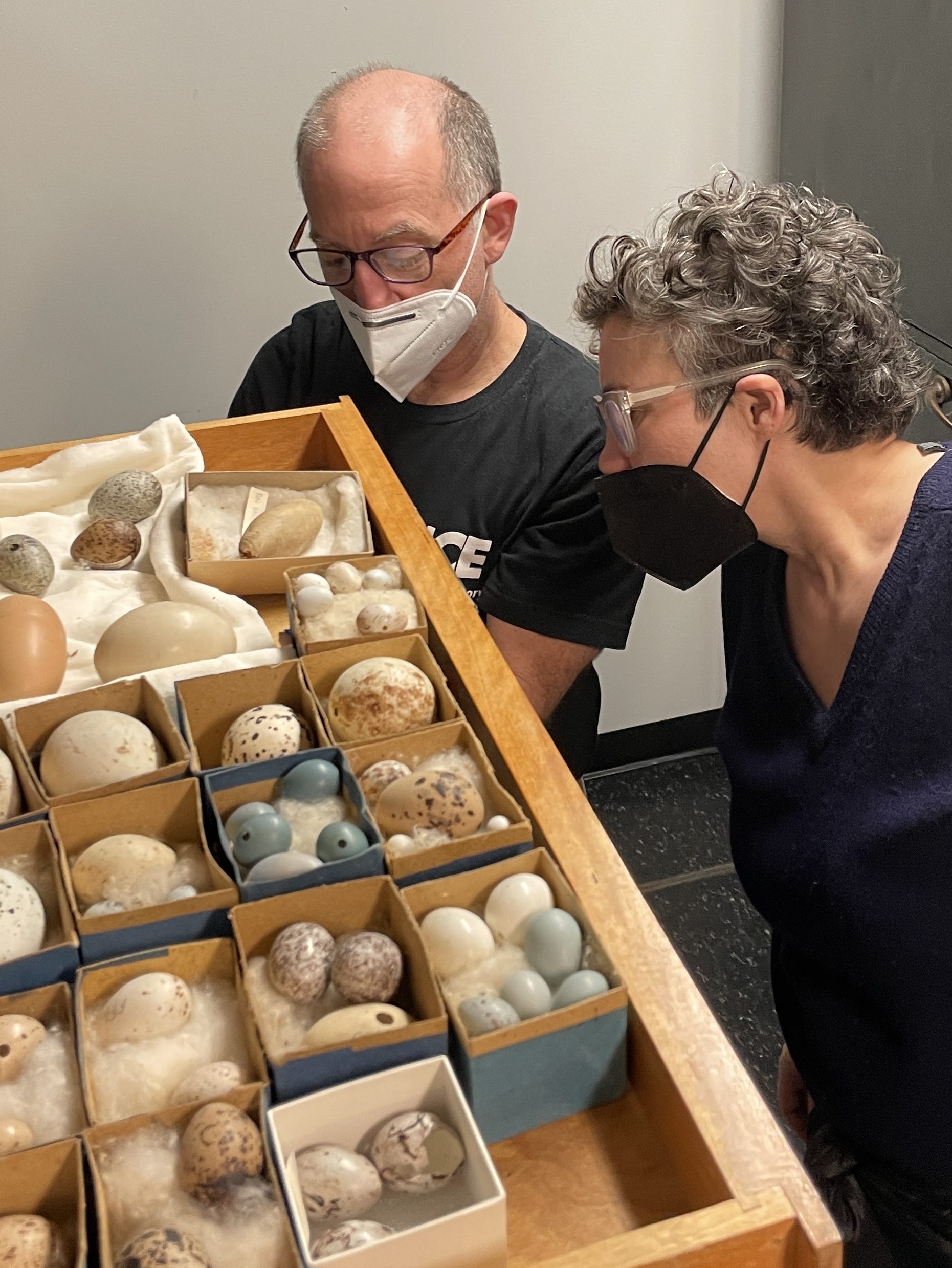
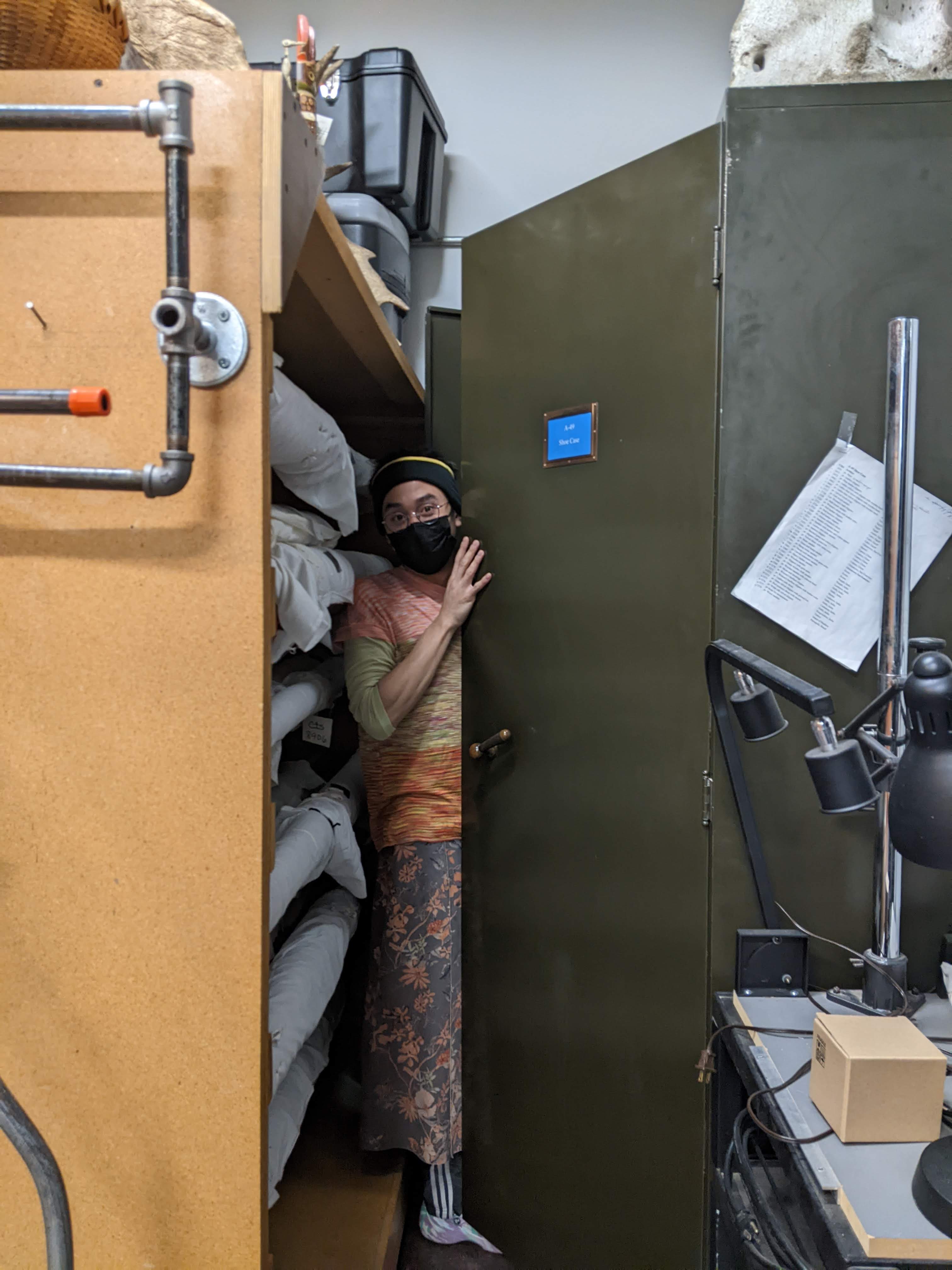
Cameron Wood (Cranbrook Institute of Science Curator for Collections) and Iris Eichenberg (Metalsmithing AIR) examine eggs from the Institute’s oological collection.Kiwi Nguyen (CAA Metalsmithing 2023) on the hunt for objects for our exhibition in the vault of Cranbrook Institute of Science.
From planning with Kevin and Iris; coordinating with our wonderful Academy artists; selecting objects with colleagues at the Institute of Science and Art Museum; installing with the help of students; and assisting with photography, this exhibition took me all over the Cranbrook campus.
The clerestory windows designed by G. Owen Bonawit in the nave of Christ Church seem to be one of the least described elements of the church’s artwork. The work was negotiated and subcontracted through architect Oscar H. Murray at Bertram Grosvenor Goodhue Associates rather than commissioned directly through George G. Booth. Consequently, there are few documentary vestiges of the artist’s process in our records.
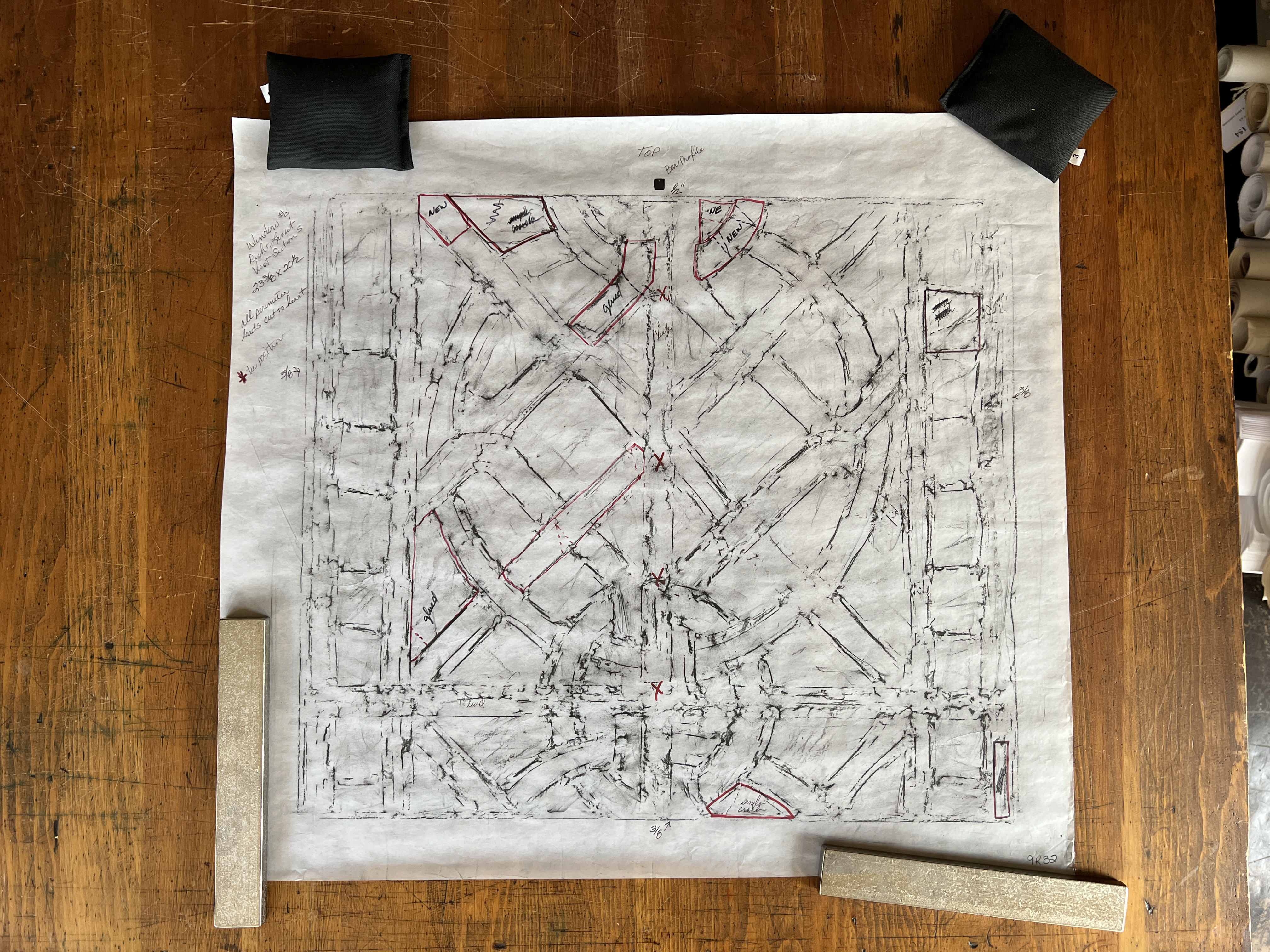
The windows can be studied through other materials held by the Archives, including architectural drawings, photographs, and the records of a window restoration project which commenced in 1993. In 1995, the Thompson Art Glass company made rubbings of the window for the purposes of identifying their care and preservation needs.
Window rubbings by Thompson Art Glass made June 19, 1995. Courtesy of Cranbrook Archives.
There are seventeen grisaille clerestory windows in the nave and chancel at Christ Church, which were analyzed as part of this stained-glass restoration project. They are made of clear antique glass upon which minute floral detail is painted and accentuated by the addition of small amounts of colored glass. In the chancel, there are two lancets and tracery of nine panels supported by T-bars including one ventilator panel. In the nave, they are comprised of three lancets and tracery with eight panels, with ventilator panels making up the bottom row.
Detail from Architectural drawing of Christ Church Cranbrook, North Elevation. April 30, 1925. Drawn by J.E.M./Oscar H. Murray, Bertram Grosvenor Goodhue Architects. [AD.10.33]. Courtesy of Cranbrook Archives.
Grisaille, literally meaning ‘to grey,’ is a type of stained glass that is mostly monochromatic, with a silver or grey tone being painted onto the finished glass. The purpose of the plainness of grisaille is twofold: they let more light into the space both literally and metaphorically in that they were intended to limit distraction from meditation.
The grisaille stained glass style is thought to have originated in French Cistercian abbeys after a prohibition on colored glass issued by St. Bernard of Clairvaux in 1134 in accordance with their charism of simplicity. St. Bernard, the master of paradox, also banned the use of figurative decoration according to the First Commandment of no graven images. Under his guidance, the Cistercians seek the face of God, a theological anomaly that produces an exquisite spiritual discipline and religious practice through which the monk contemplates holiness by virtue of continually recognizing the poverty of their thoughts and feelings when weighed down by seeking to satisfy worldly desire. The style often employs natural or geometric patterns, much like a labyrinth.
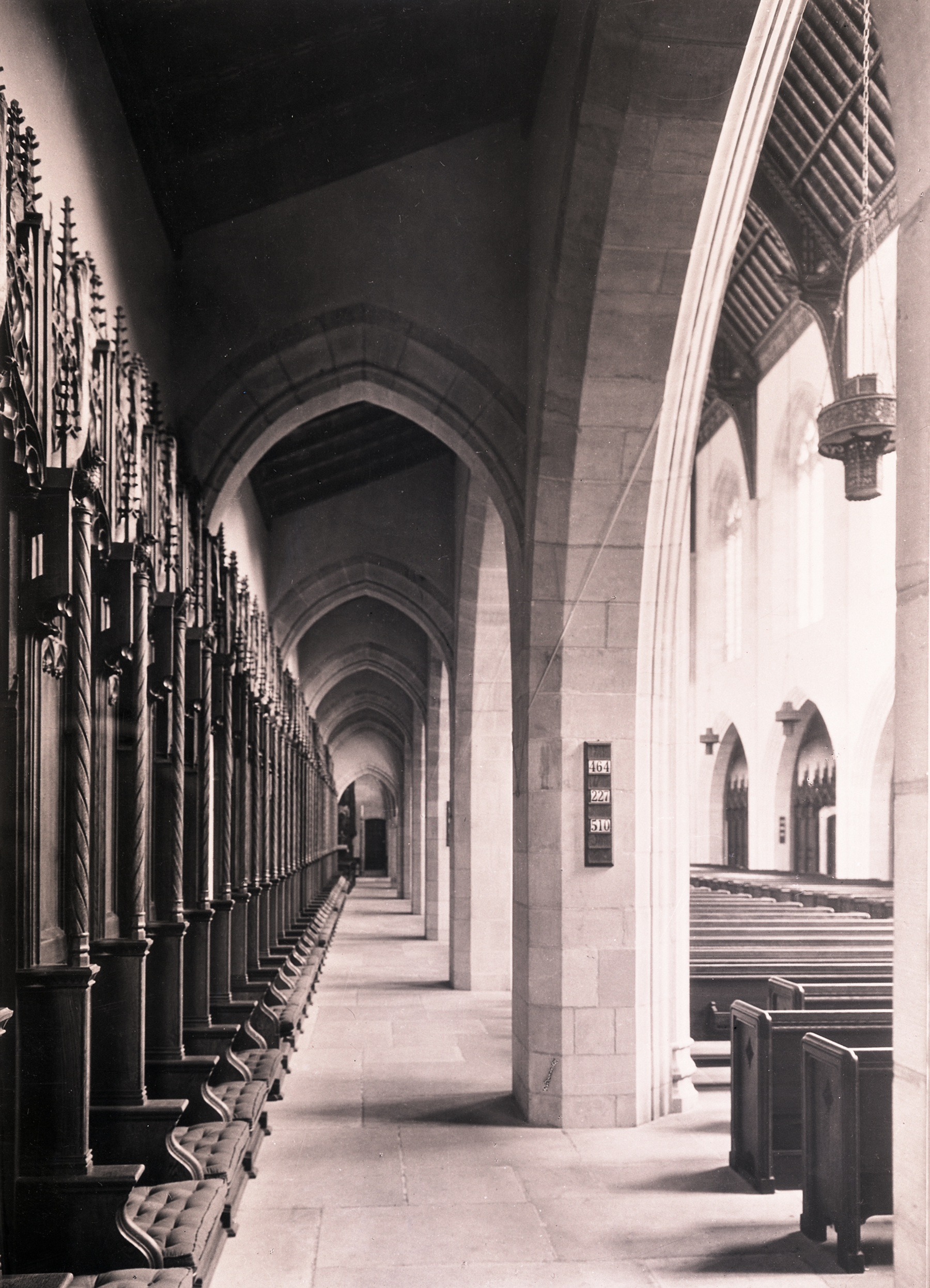
The windows can best be observed by sitting in the aisle stalls of the nave, which are in themselves an unusual feature otherwise only found in Oxford college chapels. The walls of the nave were originally intended to display memorials and artwork, but the latter idea was revised due to the objection that it would bring a museum feel to a house of worship.
Aisle stalls in left side of sanctuary. June 23, 1946. Photographer, Harvey Croze. Courtesy of Cranbrook Archives.
Added in 1930, the aisle stalls offer a fine perspective from which to observe the grisaille, and Bonawit’s elegant craftmanship brings with it a history of monastic inspired light. Since a life without beauty is only half lived, the artistic eclecticism of Christ Church offers all those who enter the opportunity to embrace the other half both in its resplendency and in its simplicity.
– Laura MacNewman, Associate Archivist, Cranbrook Center for Collections and Research
In 2021, the home of Loja Saarinen at Cranbrook Academy of Art, which she shared with her husband Eliel, was designated as a site in the Historic Artists’ Homes & Studios program. As the team at the Center were going through the process of researching Loja, the too-often-overlooked designer of textiles, gardens, and clothing, we were constantly reminded that the rugs created by Loja and her professional weaving studio, Studio Loja Saarinen, were poorly documented in our records.
Studio Loja Saarinen made rugs, window treatments, wall hangings, upholstery fabrics, and more at Cranbrook between 1928 and 1942. Many of the Studio’s largest rugs were made for Kingswood School for Girls between 1930 and 1932. Because of the fragility of the rugs, and through natural wear-and-tear, almost all of the original Studio Loja Saarinen rugs were put in storage at Cranbrook Art Museum in the 1970s and 1980s.
Loja Saarinen, circa 1934. Courtesy Cranbrook Archives.
We have excellent archival records about the operation of the studio, including records of yarn orders and charts of the time spent weaving rugs (it was a lot!). But the rugs are very large, and often, we only had black-and-white photographs of the rugs on the floor in the 1930s. Color photographs were limited to poorly distorted slides, or photographs of portions of the rugs taken on early digital cameras while the rugs were half-rolled-up in storage.
We had almost no ‘born digital’ high-resolution photographs of Loja’s work–these are the best kind of photographs for sharing her work in slides, online, or in print. The lack of excellent, high quality images limited not only how we at Cranbrook understood and shared Loja’s legacy, but also made it difficult for students or scholars researching Loja Saarinen to get a complete sense of her artistic output.
This winter, as the Center prepares for our next fundraiser, A House Party at Cranbrook Celebrating Loja Saarinen on May 21, 2022, it has become mission-critical to get better documentation of Studio Loja Saarinen’s rugs.
Enter in our latest project!
Jim Haefner and his assistant set up the camera in Cranbrook Art Museum’s Vault. Photographer Kevin Adkisson, Courtesy of Cranbrook Center for Collections and Research.Jim Haefner checking his image of Kingswood School Rug No. 31, Reception Hall Rug, Auditorium Lobby Rug. Photographer Leslie Mio, Courtesy of Cranbrook Center for Collections and Research.Kingswood School Rug No. 31, Reception Hall Rug, Auditorium Lobby Rug. Photographer Kevin Adkisson, Courtesy of Cranbrook Center for Collections and Research.
On January 7, 2022, photographer James Haefner and his assistant Erik Henderson, with the help of Center Curator Kevin Adkisson, Center Associate Registrar Leslie Mio, Cranbrook Art Museum Registrar Corey Gross, Cranbrook Art Museum Head Preparator Jon Geiger, and Jon’s installation crew embarked on a very ambitious project: documenting all the Studio Loja Saarinen rugs in the Cranbrook collections.
First, we had to take the several-hundred-pound rugs down from racks where they are stored, rolled. Then, we covered the floor in clean plastic drop cloths. With a camera bolted via a vise-grip to the ceiling of the Cranbrook Art Museum Collections Wing, and controlled via computer from a remote workstation, we unrolled, photographed, and rerolled over forty works of Studio Loja Saarinen’s functional art.
Kingswood School Rug No. 3, 1928-1929; Studio Loja Saarinen (maker), Loja Saarinen (designer); Linen warp, wool weft; 66½ x 49 inches (168.9 x 124.5 centimeters); Cultural Properties Collection, Kingswood School for Girls. Photographer James Haefner.Curator Kevin Adkisson and his attention to detail. Photographer Leslie Mio, Courtesy of Cranbrook Center for Collections and Research.Maker’s label on Kingswood School Rug No. 3, 1928-1929; Studio Loja Saarinen (maker), Loja Saarinen (designer); Linen warp, wool weft; 66½ x 49 inches (168.9 x 124.5 centimeters); Cultural Properties Collection, Kingswood School for Girls.
No detail went undocumented, from weaver’s signatures knotted into the face of a rug, to maker’s labels written and sewn on by Loja herself.
Below is just a fraction of the forty-plus pieces photographed:
Kingswood School Rug No. 31, Reception Hall Rug, Auditorium Lobby Rug, 1931; Studio Loja Saarinen (maker), Loja Saarinen (designer); Wool pile, wool weft, linen warp; 312 x 144 inches (792.5 x 365.8 centimeters); Cultural Properties Collection, Kingswood School for Girls. Photographer James Haefner.Detail of Kingswood School Rug Number 28, Library Rug, 1931; Studio Loja Saarinen (maker), Maja Andersson Wirde (designer); Wool pile, wool weft, linen warp; 243½ x 96 inches (618.5 x 243.8 centimeters); Cultural Properties Collection, Kingswood School for Girls. Photographer James Haefner.Detail of Kingswood School Blue Rug for Reception Room I, 1931; Studio Loja Saarinen (maker), Maja Andersson Wirde (designer); Wool pile, wool weft, linen warp; 183 x 142½ inches (464.8 x 362 centimeters); Cultural Properties Collection, Kingswood School for Girls. Photographer James Haefner.Rug with Animal Motif, 1932; Studio Loja Saarinen (maker), Maja Andersson Wirde (designer); Linen warp, wool weft, wool file; plain weave with four picks of weft between each row of knots; 151½ x 108 inches (384.8 x 274.3 centimeters); Collection of Cranbrook Art Museum. Photographer James Haefner.Detail of Kingswood School Rug No 29 – Rooftops, 1931; Studio Loja Saarinen (maker), Maja Andersson Wirde (designer); Wool pile, wool weft, linen warp; 85 x 137½ inches (215.9 x 349.3 centimeters); Cultural Properties Collection, Kingswood School for Girls. Photographer James Haefner.Rug, 1932; Studio Loja Saarinen (maker), Maja Andersson Wirde (designer); Wool and linen; 119 x 98 inches (302.3 x 248.9 centimeters) including fringe; Collection of Cranbrook Art Museum. Photographer James Haefner.Detail of Rug with Tree Motif, 1930; Studio Loja Saarinen (maker), Maja Andersson Wirde (designer), Lillian Holm (weaver), Lilly Bjerken (weaver); Wool and linen; 131 x 54½ inches (332.7 x 138.4 centimeters); Collection of Cranbrook Art Museum. Photographer James Haefner.Detail of Studio Loja Saarinen Rug No. 2, 1929; Studio Loja Saarinen (maker), Loja Saarinen (designer/weaver), Eliel Saarinen (designer), Walborg Nordquist Smalley (weaver); Cotton warp; wool pile; plain weave with ten picks of weft between each row of knots; 110½ x 39 inches (280.7 x 99.1 centimeters); Collection of Cranbrook Art Museum. Photographer James Haefner.Tree of Life Tapestry, circa 1933; Loja Saarinen (designer/weaver); Linen and wool; 60½ x 54 inches (153.7 x 137.2 centimeters); Collection of Cranbrook Art Museum. Photographer James Haefner.
It was a joy to unroll and see these pieces up close after knowing many of them for years through black-and-white images. While even these photographs do not do justice to seeing their beauty in person, having such high-resolution photography of Studio Loja Saarinen’s rugs means that future scholars and fans of Loja Saarinen will be able to have a richer understanding of her, and Cranbrook’s, remarkable legacy.
For even more Loja Saarinen, join the Center in person or online on May 21, 2022 for A House Party at Cranbrook Celebrating Loja Saarinen. We’ll be premiering a new, thirty-minute documentary about Loja, produced by the Center, at the event–you don’t want to miss it!
– Leslie S. Mio, Associate Registrar, and Kevin Adkisson, Curator, Cranbrook Center for Collections and Research
In Part I of this post, we explored Cranbrook’s love of the book, from its origins with founders George and Ellen Booth, to the existing special collections at the Archives and Academy of Art. I invite you now to learn of the many rare, valuable, and historical tomes whose existence may be unknown to most or simply overlooked in collections at the Schools, Institute of Science, and two historic homes cared for by the Center for Collections and Research: Saarinen House and Smith House.
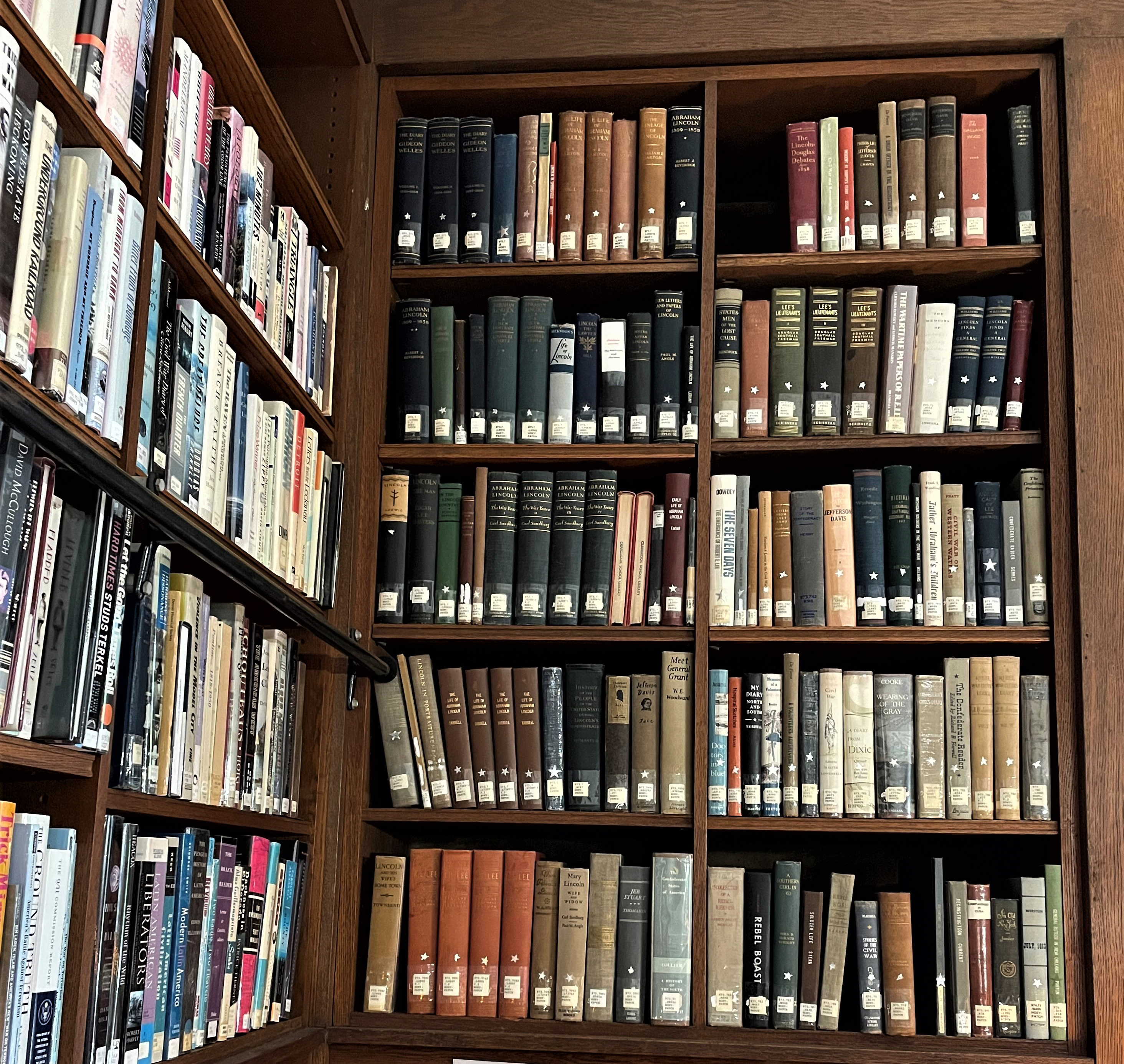
Hoey Patch Collection at the Cranbrook School Library. Courtesy of Kate Covintree, Cranbrook Kingswood Upper Schools.
Like the Academy of Art, although not at all on the same scale, books from George and Ellen’s Cranbrook House Library were dispersed to the Cranbrook Schools Libraries, now comprised of five separate spaces. Following the Booth’s example, Cranbrook School Headmaster Harry D. Hoey (1950-1964) and Latin teacher George Patch (1928-1944, Emeritus 1944-1950) donated 120 books from their personal libraries to the School’s library in the 1950s, forming one of several special collections. Known as the Hoey Patch Collection, all of the volumes focus on an aspect of Abraham Lincoln or the American Civil War.
He Knew Lincoln, a fictionalized account written by Ida Tarbell, a progressive journalist, and published in 1907. The book’s custodial history is documented with correspondence from the author, written directly on the inside of the book. Courtesy of Kate Covintree, Cranbrook Kingswood Upper Schools.
Highlights include a First edition of The Life of Abraham Lincoln, the first full-scale biography of the President. Written by newspaper editor J.G. Holland, it was published shortly after Lincoln’s assassination in 1865. Also included is a first edition, two-volume set of the Personal Memoirs of U.S. Grant. Ulysses S. Grant penned his autobiography shortly before his death in 1885 as a means of financial support for his family. It was published with the support of his friend Mark Twain by the Charles L. Webster Company (owned by Twain’s nephew).
Are you enjoying the snow this winter? Or do you need something to brighten your February mood? Have you considered fake flowers?
This week, as the country was pummeled by winter storms, I was busy in Cranbrook Archives researching for my History of American Architecture: Eero Saarinen and His Circle lecture series. One important member of Eero’s circle of designers? Ruth Adler Schnee.
Ruth, a 1946 graduate of Cranbrook Academy of Art’s Design Department, was known for her printed textiles, interior designs, and the store she operated with her husband, Edward, in Detroit from 1948 to the 1977. In Cranbrook Archives, we have the Edward and Ruth Adler Schnee Papers, which includes a wide variety of designs, notes, samples, and PR materials.
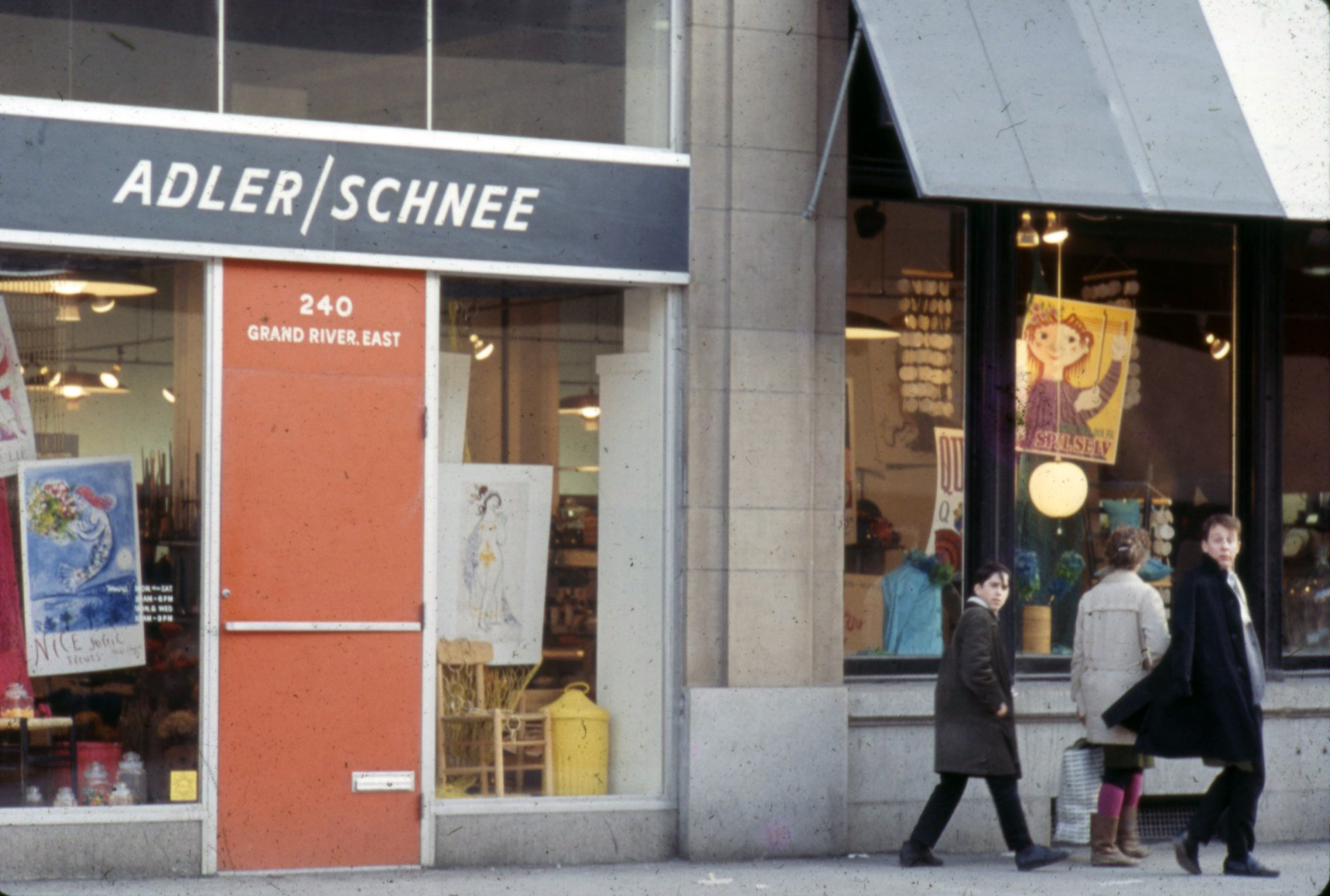
Adler/Schnee, Inc. on Harmonie Park. The design store was located at 240 Grand River East in Detroit between 1964 and 1977. Photograph February 1965. Copyright Cranbrook Archives.
As I looked for materials related to Ruth’s work on the General Motors Technical Center—the subject of my lecture Monday—I came across this charming fold-out advertisement from the winter of 1966. Although it has nothing to do with my upcoming talk, it certainly brightened my mood, and I wanted to share it with you! The outside reads:
Sometimes it’s June in January…but at A/S it’s Bloomin’ February
The ad copy gets even better inside. Underneath a bright-pink line drawing of Scandinavian, Japanese, Danish, and Mexican home goods surrounded by Ferry-Morse seeds, a cat, birds, and flowers, it reads:
Stamp out snow with fake and fabulous flowers!
Put posies on everything—put posies in everything.
Color runs riot at Adler/Schnee Flower Fiesta
With kooky dried flowers ala Dr. Seuss; passionate pillows, dizzy dinnerware, palpitating papergoods, terrific totes and much marvelous more—all bursting with scintillating springtime.
Kick winter gloom and check Adler/Schnee, where even Harmonie Park itself is coming up new and exciting.
This pamphlet made me smile, and gets first prize in the alliterative Olympics. Based on other handwritten records in the Archives, it is possible Ruth herself wrote this little ditty (she wrote and designed much of the firm’s PR materials). Again based off other mailers, it seems likely the Schnees mailed out between 5,000 and 15,000 of these large fold-out advertisements.
“My darling, You are wonderful! I start with that because now again you have covered yourself with a light that sets you off from every other person I have ever known!” (Carl to Annetta, August 25, 1928).
The love letters of Carl and Annetta Wonnberger are among the most beautiful expressions of love, longing, and devotion I have ever read. With Valentine’s Day coming soon, it’s a perfect time to share with you some of their words that convey something of life’s highest mystery as it can manifest between two people.
Carl and Annetta Wonnberger. September 7, 1929. Courtesy of Cranbrook Archives.
Carl George Wonnberger (1901-1980) and Annetta Bouton Wonnberger (1909-1997) arrived at Cranbrook in 1929. Carl taught English at Cranbrook School until 1967, and they both founded the Cranbrook Theatre School in 1942. Their life is a love story of manifold paths. Their letters provide us with an intimate glimpse into the couple’s hearts in the two years preceding their marriage and the beginning of their life together at Cranbrook.
Annetta first met Carl in the Spring of 1926, when she visited the Storm King School, New York, to take the college entrance exam, which she failed. Carl, a teacher there, was the administrator. Annetta attended Drew Seminary as a post-graduate student and retook the exam in the spring of 1927, and that is when they connected. If sparks didn’t fly at their first meeting, they did at the second, as shortly after, on June 23rd, Carl asked Annetta to marry him.
Writing in July 1927, Annetta recalled that early evening in June—their walk in the woods, the perfect quiet except for the frogs and locusts around Black Rock, the ride back and the thunder shower. Annetta’s candid style of writing offers us quite a vivid sense of her character as well as a discernible process of maturation over the two years:
Carl, ever since I was a small child I have lived in a sort of fairyland of dreams and ideals. It was only natural, of course, that the people whom I met in real life differed from the creatures of star-dust and moon-mist fashioned by my fancy. And it has always been hard to realize the truth. But you, dear, there is no disillusionment about you. You are all I have ever dreamed the man I would love would be – and more. I only hope that I may be able to follow the road you’ve shown me, and reach the goal you’ve set.”
Letter from Annetta to Carl, November 30, 1927.
From 1927-1929, Annetta attended Smith College in Massachusetts, while Carl remained a teacher at Storm King in New York. They would meet up periodically, but the rest of the time was spent in yearning, which is recorded in their letters (sometimes more than one a day!).
Letter from Annetta Bouton to Carl Wonnberger, January 7, 1928. Courtesy of Cranbrook Archives
Across Cranbrook’s campus are eleven different spaces, including the Archives, that house book collections – some 110,000 physical items. Several of these spaces are typical school or academic research libraries, where students, faculty, and staff can check out the majority of these books. As a library and information science professional, I champion the importance of these lending libraries and the egalitarian access to information they provide.
In this post, however, I’d like to focus on Cranbrook’s non-circulating book collections – those rare, historic, or valuable tomes that, in many cases, hide in plain sight in public areas. With help from colleagues at the Academy of Art, Schools, Institute of Science, and Center for Collections and Research, I’ll highlight some of these gems that promise to delight the bibliophile, art appreciator, historian, or simply the Cranbrook curious.
Cranbrook’s special book collections are carefully preserved as both informational and evidential artifacts, and many are housed within cultural heritage areas. Valued not only for research purposes, they also serve as historical objects which help individually or collectively to tell the Cranbrook story.
South end view of the newly completed Cranbrook House Library, 1920. John Wallace Gillies, photographer. Courtesy of Cranbrook Archives.
The origin of book collecting at Cranbrook actually predates any of the current collection spaces and begins with Cranbrook founders George and Ellen Booth. George, in particular, was an enthusiastic collector, and started acquiring volumes in 1900, commissioning purchases of William Morris works and other fine books in London. As George explained, “I am not a millionaire and cannot pay the big prices now prevailing in New York.” His strategy allowed him to accumulate 1,000 books by 1916, effectively seeding the Cranbrook House Library Collection when construction of the library wing was completed four years later.
As many begin their annual celebration, some may be dreaming of a white Christmas. Take heart, perhaps, from the photograph below, providing evidence that there was no snow on December 24, 1954 either.
A view of Christ Church Cranbrook on Christmas Eve, 1954. Harvey Croze, photographer. Courtesy of Cranbrook Archives.
But, just as there were nearly seventy years ago, there are plenty of sparkling lights to keep the season merry and bright.
The holiday season is upon us once again, and hopefully you and yours had a wonderful and safe Thanksgiving celebration.
Holiday gatherings were important to Cranbrook founders’ son, Henry Scripps Booth and his wife Carolyn, as evidenced by this card given to Henry by Carolyn in 1971. Although one of few Thanksgiving cards, it is an example of the many greeting cards included in the Henry Scripps and Carolyn Farr Booth Papers. Among those the couple gave to each other are cards which send greetings to family and friends from their home, Thornlea.
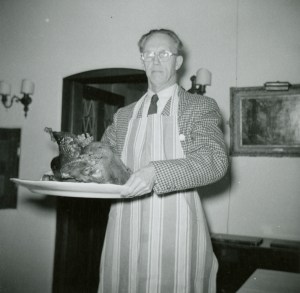
As we look forward to the holidays ahead, I leave you with the photo below, showing patriarch Henry Booth at his home, Thornlea, bringing in the turkey for what surely was a fabulous Christmas feast!
Henry Scripps Booth at Thornlea House, December 25, 1956. Courtesy of Cranbrook Archives.
Similar items from the Archives will be on display during the Center’s upcoming Behind-The-Scenes-Tour, The Treasures of Thornlea House, taking place next week. As of this writing, a few tickets are still available for Thursday, December 2nd – we hope you can join us!
—Deborah Rice, Head Archivist, Cranbrook Center for Collections and Research
‘A smooth sea never made a skilled mariner,’ says the English proverb. This lovely little saying is quite apt for a story that I discovered in the papers of Henry Scripps and Carolyn Farr Booth.
In a folder of correspondence, I came across two letters to Henry Booth from a man named Brad Storm, a Bloomfield teenager who had sailed around the world solo in a boat, a journey which took him four years to complete. While there is little documentation on the story, it’s possible to piece together an inspiring tale of challenge, adventure, tenacity, and discovery.
An article in The Detroit News on October 24, 1983 (p. 3) tells us that Storm had planned the trip since he was 13. After working jobs and saving throughout his high school years, he bought a 27-foot cruising sloop named Dream Weaver. The initial voyage started disastrously in a shipwreck only three days after setting sail, on Friday, October 13th, 1979. Storm, determined and wiser, set sail again and successfully voyaged through Pacific Islands, Oceana, Australia (where he stayed for a year), the Indian Ocean, Mauritius, South Africa, the Caribbean, and home via the Panama Canal.
In the article, Storm describes the marvels and the struggles of his voyage, and recounts that his only companionship was a supply of classic books. As he deliberates his future voyages, he is certain of one revision: “Man wasn’t meant to sail alone. I’ll always go with a crew now so there’s someone to share the experience with.”
From Booth’s diary and History for 1983, I learned that upon reading about Storm’s journey in the newspaper, Booth phoned him up and invited him to visit Cranbrook. A couple of days later, Storm came to talk about his experience to Dr. Jeffrey Welch’s English class at Cranbrook School. He also spent time with Alice and Warren Booth (third child and second son of George and Ellen).
The first letter to Booth is dated December 1983, and Storm had sailed again in search of a place to settle and look to the future. He was writing from the coast of New Zealand to thank Booth for a poem, Inspired by a Chap Named Storm, that he had sent to Storm’s parents. Storm was considering how he could help and inspire others from the lessons he had learned through his experience and said that it was meaningful to him to receive Booth’s poem.
Inspired by a Chap Named Storm, a poem by Henry Scripps Booth. November 2, 1983. Courtesy of Cranbrook Archives.
The second letter describes how Storm had arrived in Honolulu in June 1984 and planned to stay there to write about his journey and to pursue higher education. He writes,
“I’ve spent so much time at sea alone it’s terrific with friends all around me and other things I’ve denied myself for so long. Just walking to the shop and buying a pint of milk is still a pleasure. The sea showed me not to take things for granted so I’m not and enjoying life immensely… Writing is a very strange and new voyage to me with an unknown end, but I’m enjoying the challenge it’s bringing me. A lot of new challenges in a new life, I wake every morning enjoying the anticipation of the new day.”
Letter from Brad Storm to Henry Scripps Booth, July 2, 1984
Like Booth, I felt inspired by this chap named Storm, whose persistence in following his dream led to a great discovery. In searching the world for life, he discovered his relationship to it, giving him a most wonderful gift—the gift of taking pleasure in simple things.
–Laura MacNewman, Associate Archivist, Cranbrook Center for Collections and Research



![Window rubbing by Thompson Art Glass, June 19, 1995. [CCC4.] Window #9 [3 and 4 of 5].](https://cranbrookkitchensink.com/wp-content/uploads/2022/03/ccc4_3and4.jpg)










 Cranbrook Kitchen Sink