July 5th, 2025, marks one hundred years since the groundbreaking for Christ Church Cranbrook. As we mark this milestone in Cranbrook’s history, I believe it is important to reflect on George Gough Booth’s long discernment of this generous gift to the community.
From the beginning, there were always places of worship at Cranbrook. The story that leads us through these spaces to the establishment of Christ Church Cranbrook is especially meaningful to me.
Rev. Dr. S. S. Marquis, D.D. with the first spade of earth, July 5, 1925. Courtesy of Cranbrook Archives, Cranbrook Center for Collections and Research.
After George and Ellen Booth purchased ‘The Farm’ in January 1904, his father, Henry Wood Booth, was the first family member to live on the country estate. The elder Booth stayed for the month of May with Frank Brose, the farmer, and his family. On May 15, 1904, the first worship service at Cranbrook took place under a tent, on the site upon which the Altar of Atonement now sits, with Henry as lay preacher. He continued in this ministry, also offering Sunday School, at the same spot until 1909. This was the first act of service offered to the Bloomfield Hills community at Cranbrook.
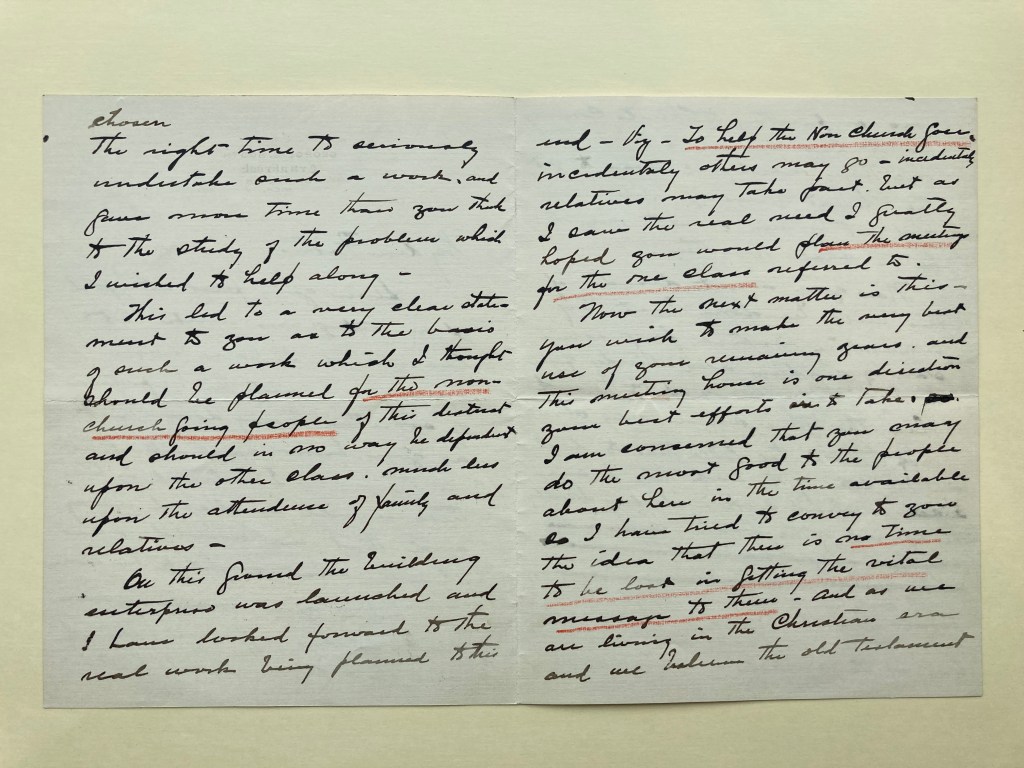
Letter from George Gough Booth to Henry Wood Booth, August 24, 1918. Courtesy of Cranbrook Archives, Cranbrook Center for Collections and Research.
In 1914, George and Ellen considered building a chapel at the site on which the Kingswood flagpole now sits, but the project was rejected, most likely due to the outbreak of World War I. As the war ended, a permanent place of worship and Sunday School was established with the building of the Meeting House.
The letter, above, preserves the dignity with which George writes of the Meeting House “building enterprise” to honor and give freedom to his father’s calling to share the Christ message with the non-church goers in the district. From this letter, we can learn and understand why George built the Meeting House for worship and Bible study through his father’s ministry.
Decoration of the Meeting House by Katherine McEwen, 1918. Laura MacNewman, photographer.
In the letter from George to his father, we also learn that he is prudent in observing the religious character of Bloomfield residents. During the years in which the Meeting House was used for religious services (1918-1926), Mr. Booth would reflect on the visiting clergy and service attendees (both of which came from diverse denominations), from which he would eventually discern the denomination of “Cranbrook church.”
This week Cranbrook Archives launched Sixty Years of Horizons-Upward Bound, 1965-2025, a virtual exhibition of HUB’s history, told primarily through photographs. While the HUB program celebrates its sixtieth anniversary this year, we’ve partnered with Amy Snyder, daughter of HUB’s founder, Ben Snyder, to select images from each decade. Those from HUB’s first five years are now available, with new images from subsequent decades slated to be revealed on a monthly basis as the HUB digitization project continues.
Aerial view of HUB summer of 1970. Henry A. Leung, photographer. Courtesy of Cranbrook Archives.
A Collaborative Effort
Creating captions for the exhibition coincided with efforts to describe each of the 2,200 images scanned so far. While some photographs included detailed annotations, describing persons and subjects, many did not, requiring additional research.
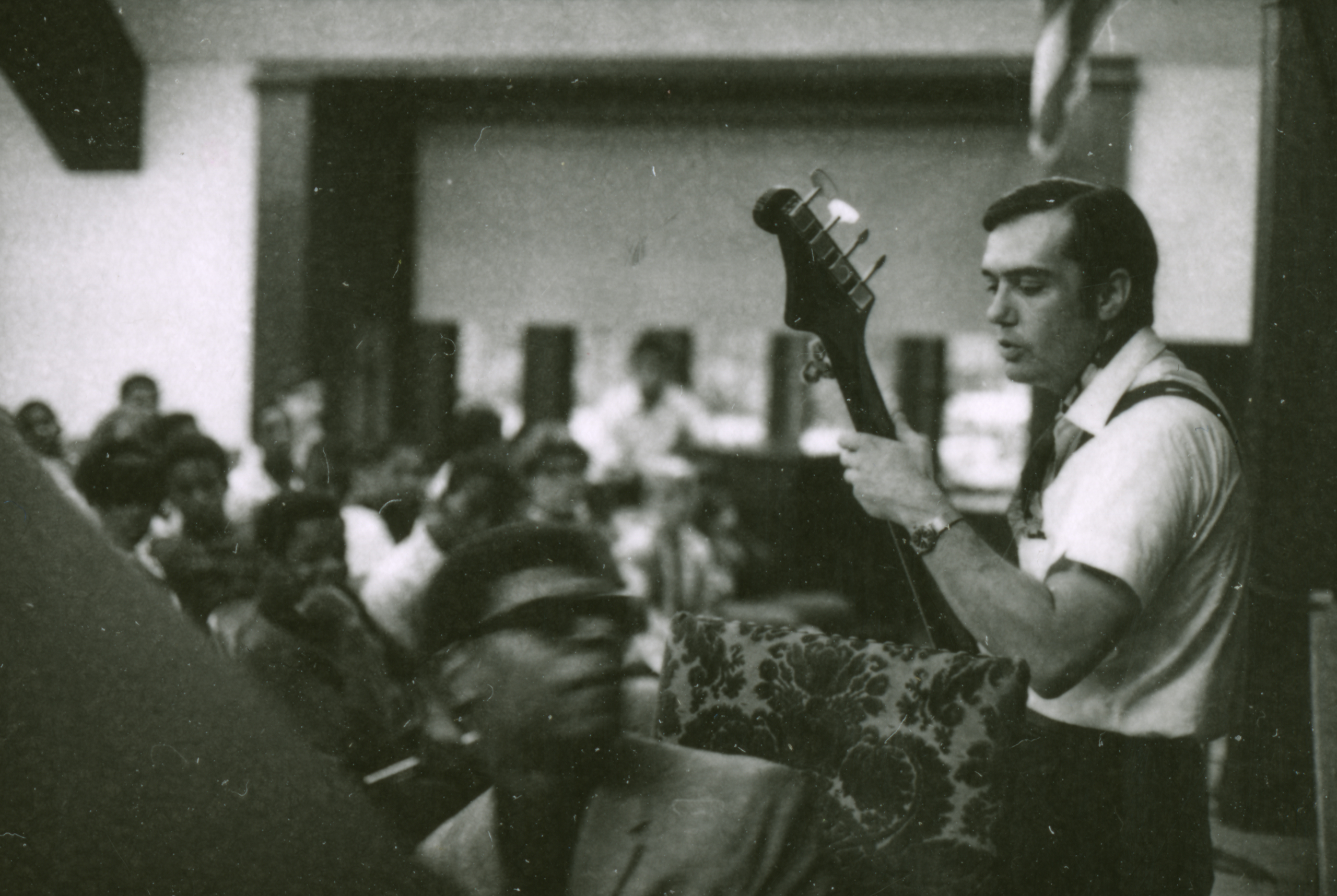
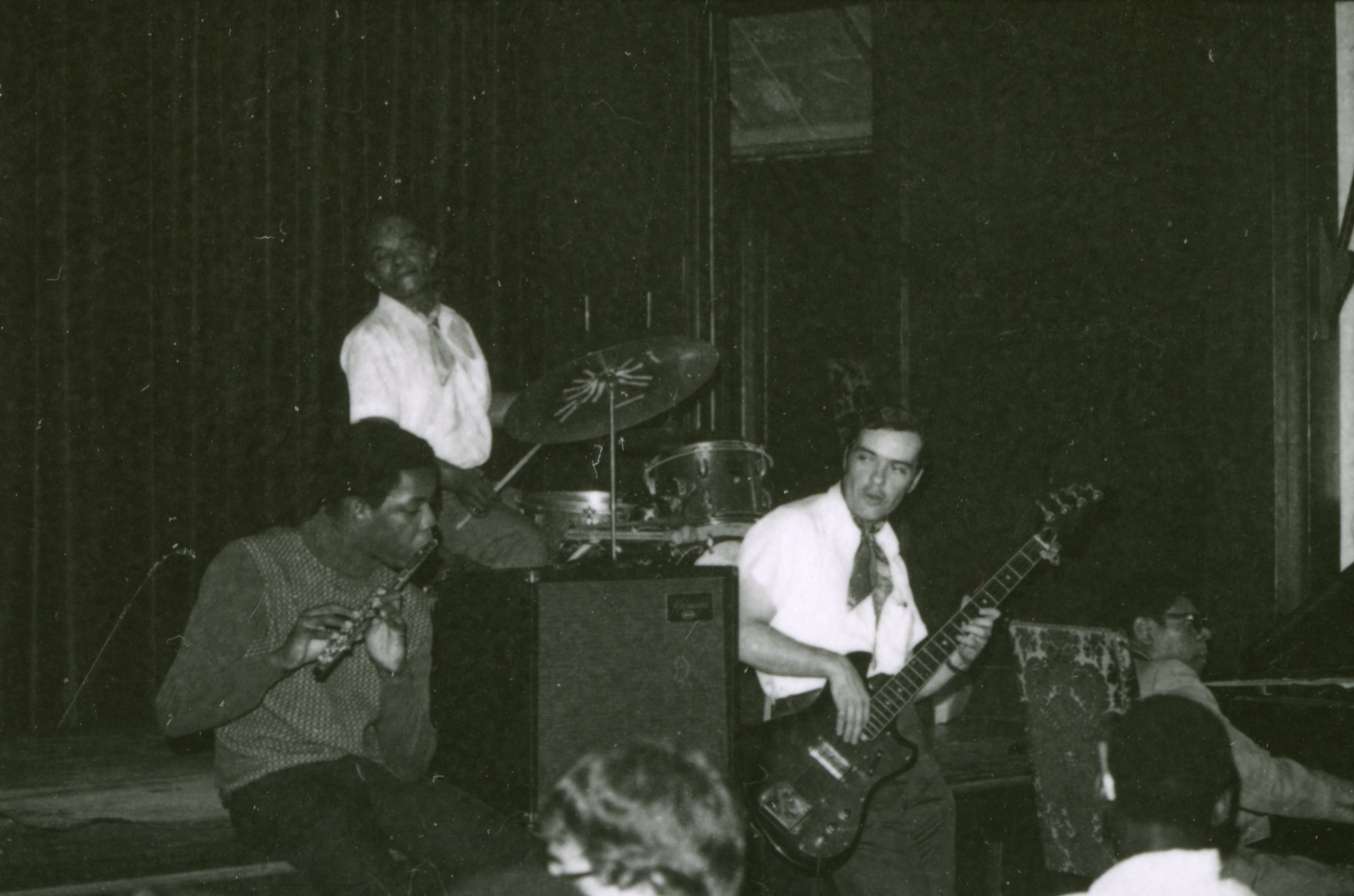
Images not yet identified or depicting unnamed activities have been fun and challenging. Cross-referencing photos with documents like class brochures, annual reports, and school rosters have helped with developing fuller descriptions. For instance, HUB’s annual reports detail various guests and artists that were invited to campus to inspire and entertain HUB students. But, they do not tell the full story. The following photographs feature an unnamed event and band that we hope to learn more about!
Guest band playing for HUB students in assembly hall, Summer 1969. Jack Kausch Photography. Courtesy of Cranbrook Archives.
Andre Boddie (HUB ’70) playing flute with band in assembly hall, Summer 1969. Jack Kausch Photography. Courtesy of Cranbrook Archives.
In addition to my research, HUB alumni have shared information in meetings, emails, and in-person visits, to help describe photographs.
For our studio sessions with Barry Roberts (HUB ’77), we prepared a workspace with enlarged photocopies of group images to annotate and class brochures and annual reports to cross-reference. It’s been a joy to witness how eyes light-up when alumni like Roberts remember people and places depicted in images. We are grateful for the stories they share because they essentially enrich the HUB collection with personal narrative.
Barry Roberts (HUB ’77) identifying HUB images at Thornlea Studio, February 19, 2025. Courtesy of Cranbrook Archives.
More From the 1960s
I have really enjoyed reviewing the program’s visual history. Since only a small number of images from the 1960s are featured in the exhibition, I thought I would share some others that really spoke to me.
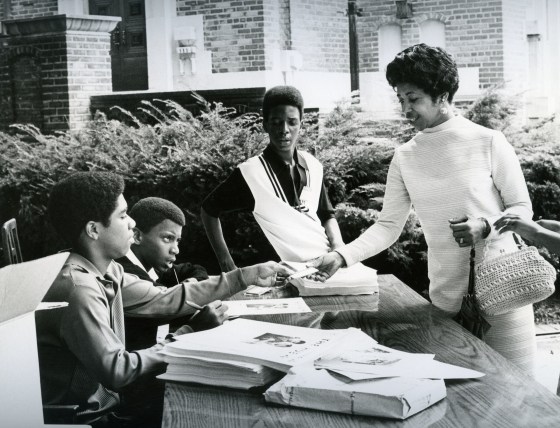
It’s been exciting to finally see photographs for events and activities described in reports, like Theme Day, SoulFest, and other academic and extra-curricular subjects.
HUB students at the Theme Day registration table hand out issues of the student newsletter, The HUB, August 17, 1969. Courtesy of Cranbrook Archives.
Families of HUB students visiting Cranbrook’s campus for Theme Day, August 17, 1969. Courtesy of Cranbrook Archives.
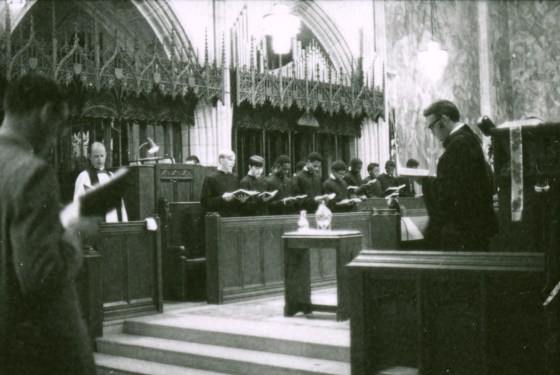
HUB students in choir at Christ Church Cranbrook on Theme Day, August 17, 1969. Courtesy of Cranbrook Archives.
It’s also been interesting to see how HUB students engaged with various spaces across Cranbrook’s campus.
HUB students with Paul Manship’s Armillary Sphere sculpture in Cranbrook School quadrangle , Summer 1969.
HUB student in the reading room of Cranbrook School Library , 1969. Courtesy of Cranbrook Archives.
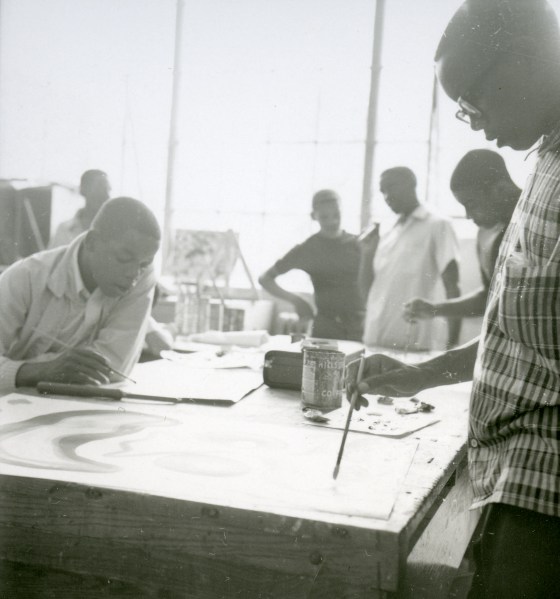
HUB students in design class, Andre Boddie (HUB ’70) on left, 1966. Courtesy of Cranbrook Archives.
I especially enjoyed a small collection of images featuring art work and displays of writing, which were exhibited during Theme Day in 1969. William Washington, English teacher and Theme Day facilitator at the time, described the event’s focus as students and staff answering the question, “Where Is Love?” (HUB Annual Report, 1969). The following image features students’ responses to this prompt with creative writings entitled “What is this love that we now seek? Love is the language that every man speaks.”
Theme Day display featuring students from Sections 7 and 9 of Gregory S. Mims and Philip Young’s English course, August 17, 1969. Courtesy of Cranbrook Archives.
This fall, all of the images digitized in year two of the digitization project will be available online, but in the meantime check back each month to see those featured in the virtual exhibition!
—Courtney Richardson, Project Archivist, Cranbrook Center for Collections and Research
HUB digitization is funded by a NHPRC Archival Projects Grant for projects that ensure online public discovery and use of historical records collections. The NHPRC was established by Congress in 1934 as a statutory body affiliated with the National Archives and Records Administration and chaired by the Archivist of the United States.
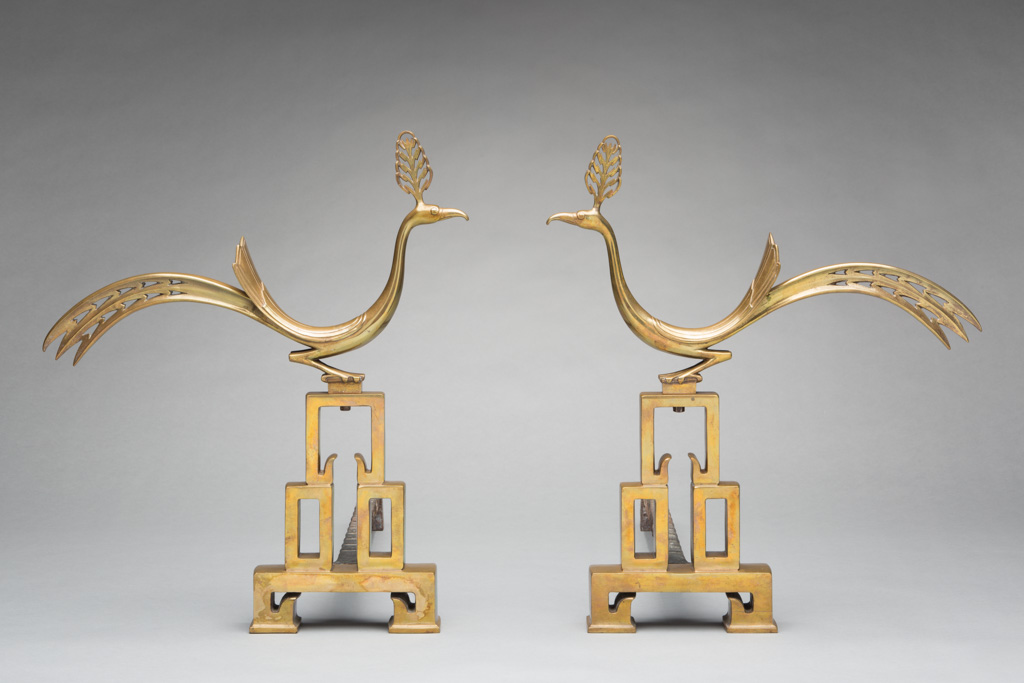
While researching the step-backed Peacock Andirons at Saarinen House last spring, I enthusiastically mustered a muster of peacocks from across Cranbrook’s campus with the generous help of my colleagues.
“Muster” is the official label for a group of peacocks.
Unlike a gaggle of geese, a muster of peacocks lacks both onomatopoeia and alliteration and implies a level of formality and regimental order in direct conflict with the species’ behavior! That is…judging by the peacocks I’ve witnessed at historic homes and castles throughout Europe, including a visit to Scone Castle in Scotland where an earlier visitor captured these free-spirited troops. Whether iridescent blue or albino, their graceful necks and distinctive crests rise to magnificence when tail feathers are splayed to attract a peahen mate or intimidate predators.
Throughout the ages, blue aka Indian peafowl have symbolized beauty and prosperity and served as sources of artistic inspiration. A favored theme at Cranbrook, the peacock’s dramatic curvilinear lines are represented at each institution across the campus.
One can discover…
WORKS IN METAL:
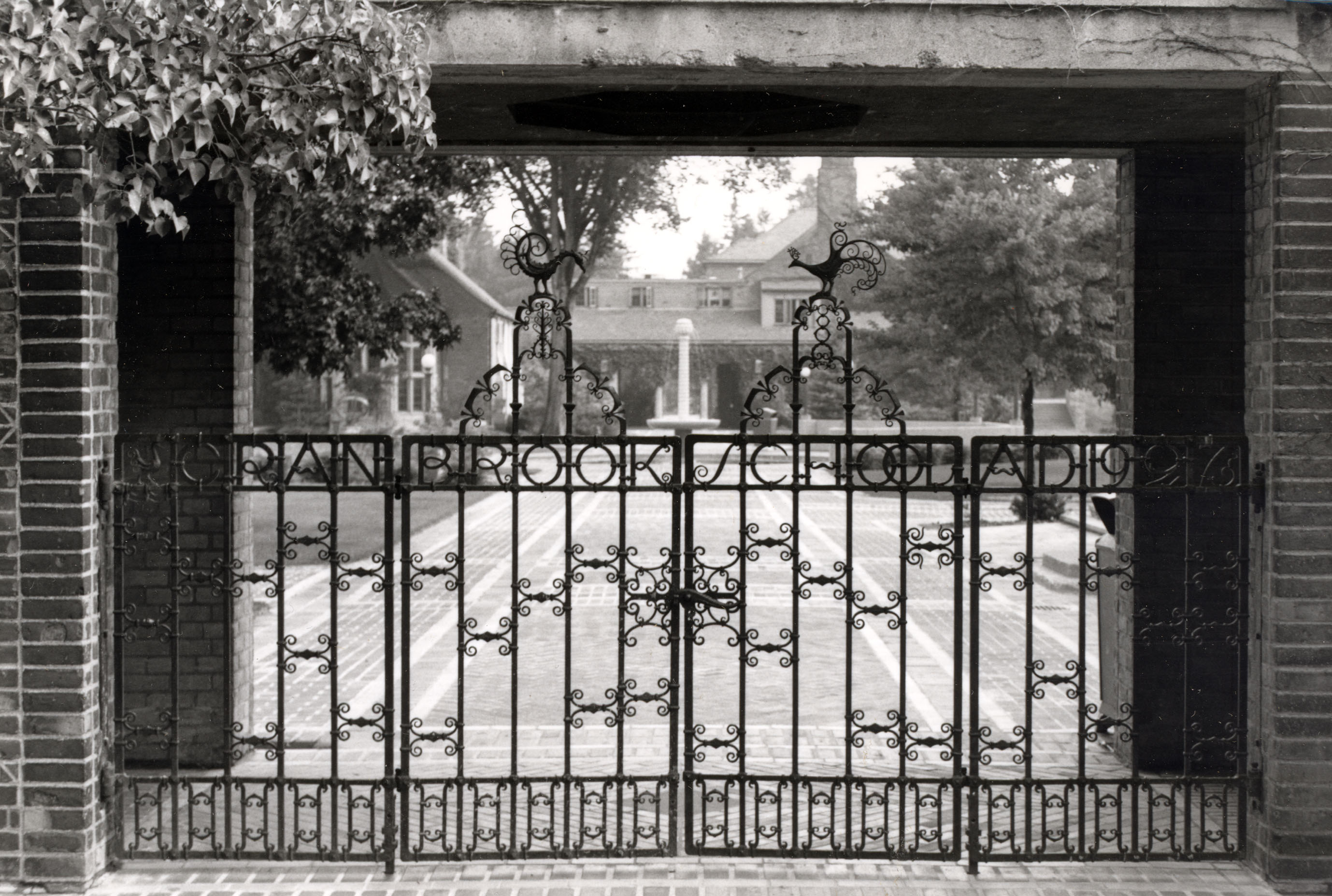
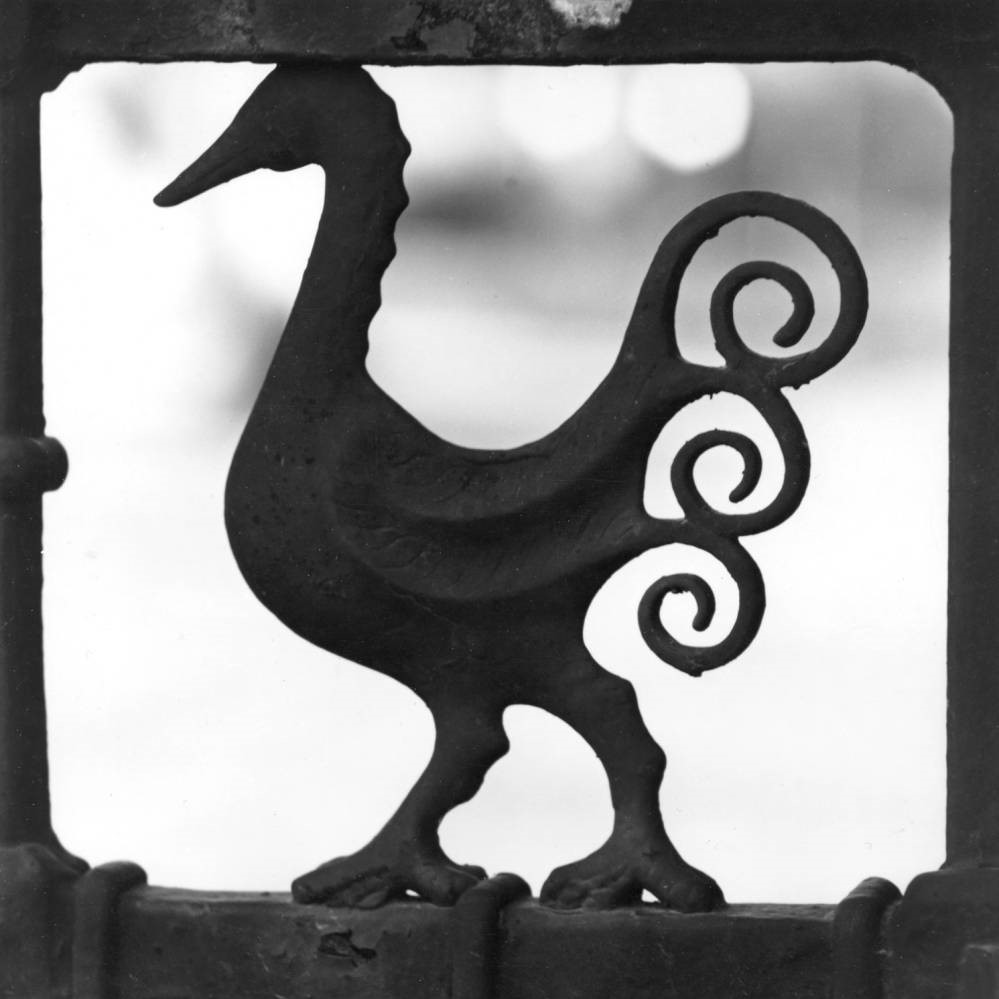
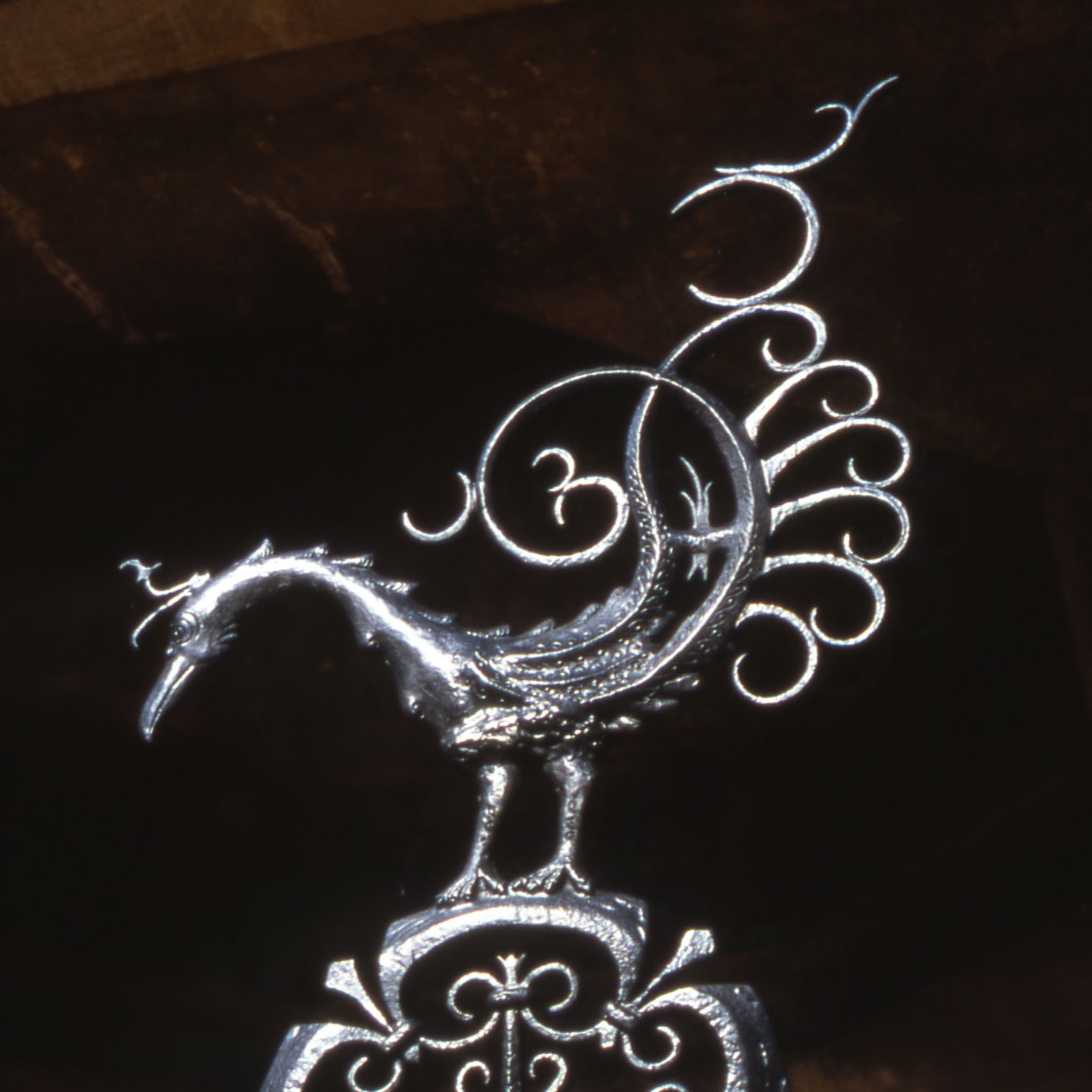
• The famed Peacock Gates designed by Finnish-American architect Eliel Saarinen and fabricated in wrought and cast iron by Oscar Bruno Bach, 1927, marking the former Lone Pine Road entrance to Cranbrook School for Boys:
Peacock Gates at Cranbrook School circa 1980. Jeffrey Welch, photographer. Courtesy Cranbrook Archives.
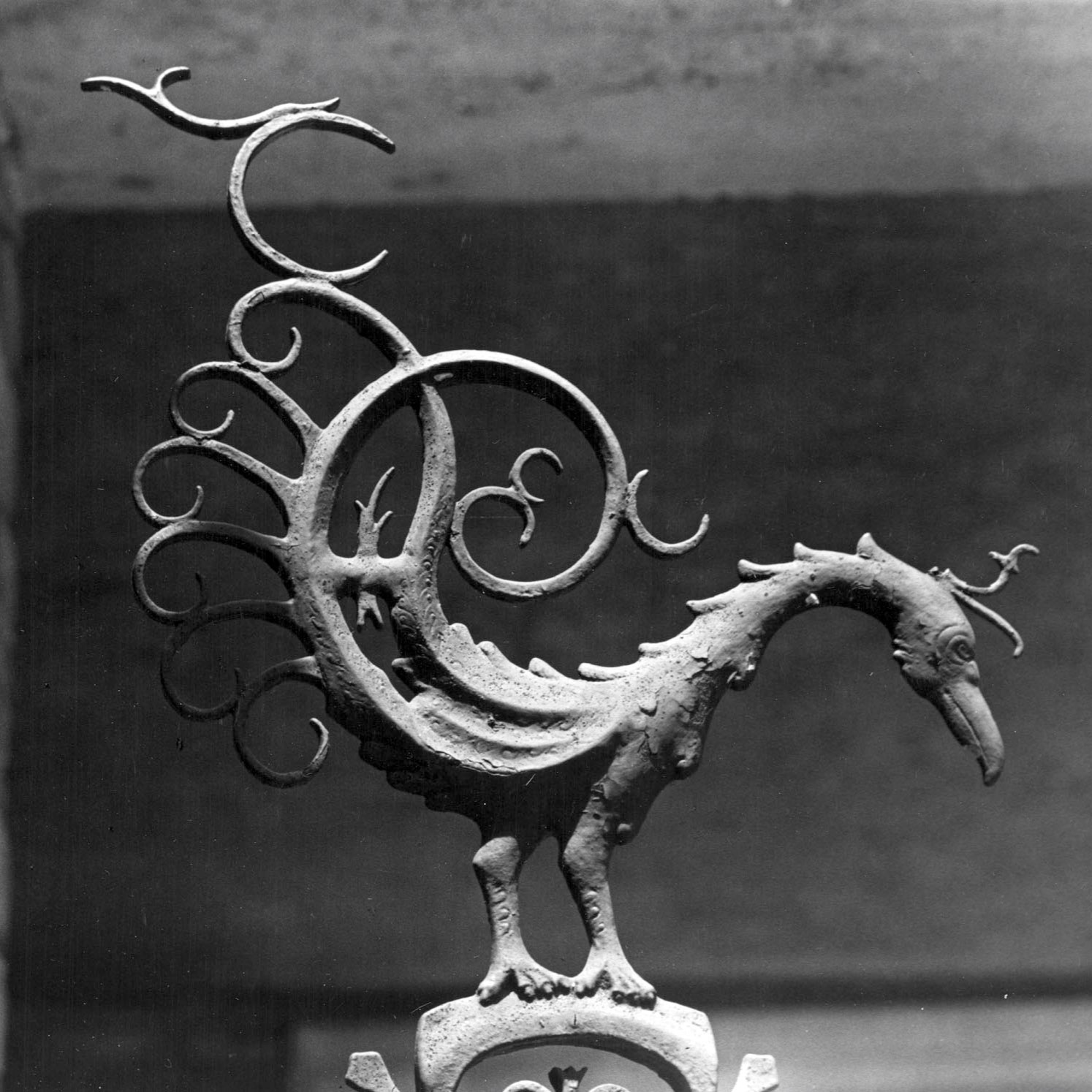
Details of the peacocks in cast iron:
Detail of Cranbrook School Peacock Gate, circa 1935. Courtesy Cranbrook Archives.
Detail of Cranbrook School Peacock Gate, circa 1935. Courtesy Cranbrook Archives.
Detail of Cranbrook School Peacock Gate, 2001. Balthazar Korab, photographer. Copyright Balthazar Korab | Cranbrook Archives.
• Eliel Saarinen’s cast bronze Peacock Andirons, 1928-29, on view at Saarinen House. Collection of Cranbrook Art Museum. Produced by Sterling Bronze Company, New York, between 1928 and 1929, these cast bronze andirons were paid for by the Cranbrook Foundation and entered in the 1928-1930 Arts & Crafts Building ledger on pages 40-41—Date: 1-7-30; No.: 515; Name: Sterling Bronze Co; Remarks: 1 pair/ Andirons for Saarinen Res[idence]; Amount: $152.50 (the equivalent of $2,704 in 2024):
Robert Hensleigh, photographer. Courtesy Cranbrook Art Museum.
Classical music, wandering musicians, ballet, cabaret, white paper lanterns, illuminated boats on the lake, Hawaiian torches, Italian tree lights, champagne, dinner, and dancing on a night with a fair-sized moon—these were some of the possibilities that Henry Scripps Booth recorded in December 1964 notes for a music gala called Night of Delight, a fundraiser for the Cranbrook Music Guild of which he was a founding member.
Patrons in line to attend Cranbrook Music Guild concert and ballet performance, July 10, 1960. Harvey Croze, photographer. Courtesy of Cranbrook Archives.
The Guild is one of the most eminent accomplishments in Cranbrook’s legacy of music and it endures to this day (the Archives holds records for the organization through 2007). Born of the inspiration of Christ Church Cranbrook Music Director, Maurice Garabrandt, and Betty (Mrs. Benjamin) Brewster, the Guild was established in 1951 to utilize Cranbrook’s setting as a wonderful place to appreciate music.
During the first decade alone, the Guild sponsored performances by distinguished artists, including violinists Zino Francescatti and Mischa Mischakoff, pianists such as Mischa Kottler, Phillipe Entremont, Jean Casadesus, and Leon Fleischer, cellist George Miquelle, the Severo ballet, jazz musicians such as Dave Brubeck and Don Shirley, classical guitarist Richard Dyer-Bennet, and soprano Eileen Farrell.
Program for Jean Casadesus performance, November 16, 1960. Courtesy of Cranbrook Archives.
The objectives of the Guild were not only to provide high quality programming, support the creation of new music, and the development of high caliber performers, but also to share knowledge about the appreciation of music through lectures, demonstrations, recitals, and exhibitions. The programs for the concerts thus shared brief contextual comments on the history of the piece and the composer.
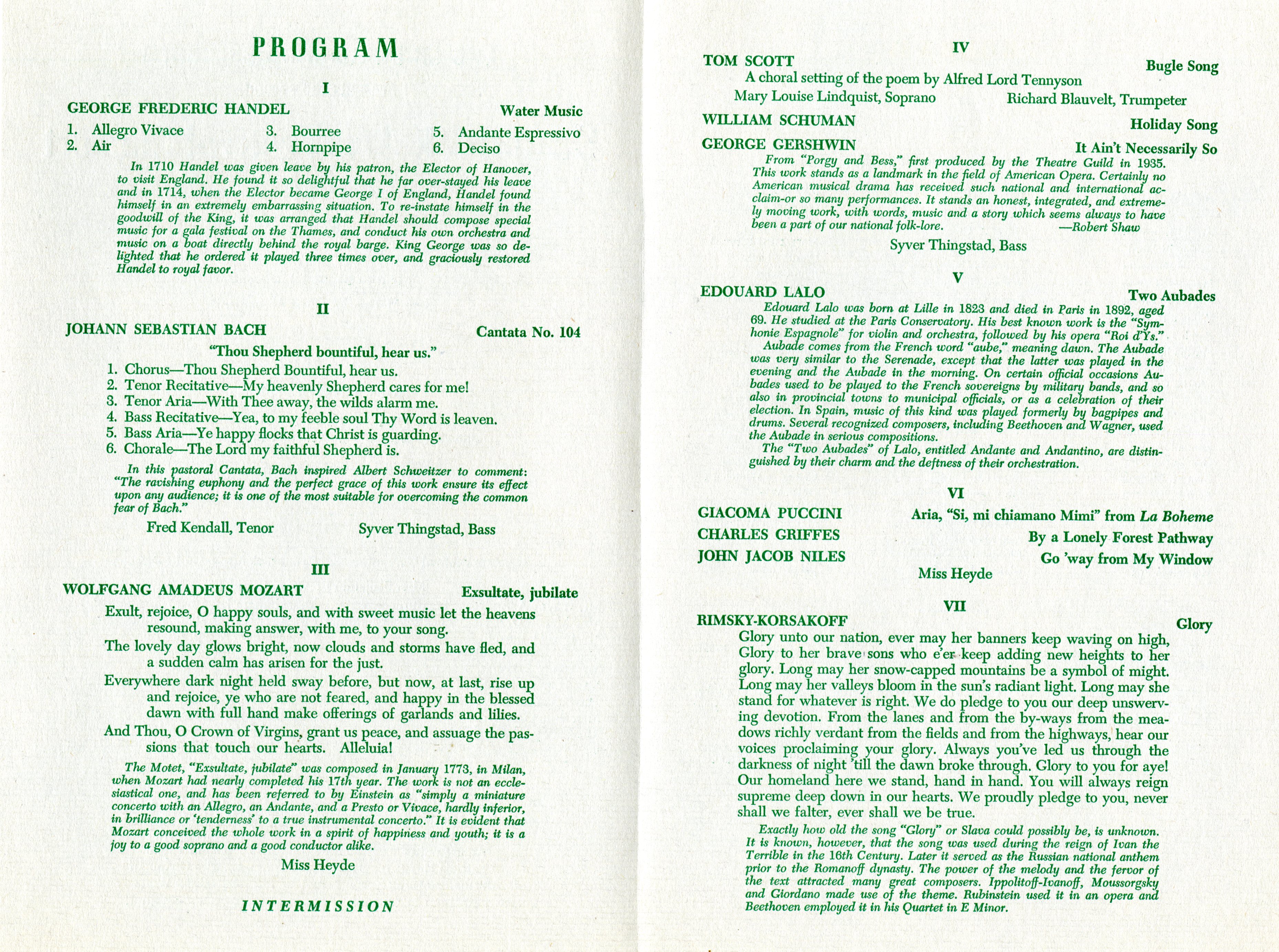
In the program for the Second Cranbrook Arts Festival Concert, which was performed at the Greek Theatre on June 1, 1952, I noticed a comment that is playfully instructive but also particularly salient to later developments in the Guild programming. The second concert program included Johann Sebastian Bach’s Cantata 104, “Thou Bountiful Shepherd, Hear Us,” and it was noted that it had inspired Albert Schweitzer to comment:
“The ravishing euphony and the perfect grace of this work ensure its effect upon any audience; it is one of the most suitable for overcoming the common fear of Bach.”
Program for Second Cranbrook Arts Festival Concert, June 1, 1952. Courtesy of Cranbrook Archives.
The Cantata must have worked its magic, because in 1966, the idea of a Bach at Cranbrook festival was introduced. It would be a satellite festival chaired by James L. Schneider and hosted by Christ Church Cranbrook with the aim to perform Bach’s music as he intended—with a small chorus and orchestra in a church setting. At a special meeting on February 23, 1966, the Cranbrook Music Guild agreed to sponsor the Bach at Cranbrook festival.
At a regular meeting a few days later, Henry expressed concern regarding the conflict of dates. The Bach festival was set for May 14 and his Night of Delight was being planned for the 21st. The Board responded that it was impossible to sponsor two big events that would appeal to same group of people, and that there was no choice but to sponsor the Bach festival, to which they had already committed, and postpone the gala to another year.
Program cover from the first Bach at Cranbrook festival, May 14, 1966. Courtesy of Cranbrook Archives.
Thus, the first Bach at Cranbrook festival took place on May 14, 1966 at Christ Church with 25 members of the Detroit Symphony Orchestra and the 40-voice Kenneth Jewell Chorale. It was a stellar success with an audience of over 1,200 people. The following year, the festival grew into a two-day, three-day concert event. After being renamed the Cranbrook Festival with a broader scope of classical and baroque composers, the festival was dissolved in 1979.
A scene from the Bach at Cranbrook festival, May 14, 1966. Harvey Croze, photographer. Courtesy of Cranbrook Archives.
The gala, Night of Delight, would never take place beyond Henry’s musings. For those with a romantic imagination, his words invite one to feel the warm summer evening, the fragrance of fresh flowers, strains of music across the courtyard filled with joyful chatter, elegance, and conviviality beneath the light of the moon. If your senses require something more tangible, fear not, for the Center for Collections and Research is celebrating the legacy of music at Cranbrook at our House Party on May 18th. Join us for live music, dinner, dancing, paper lanterns, and even a fair-sized moon! It will truly be a Night of Delight!
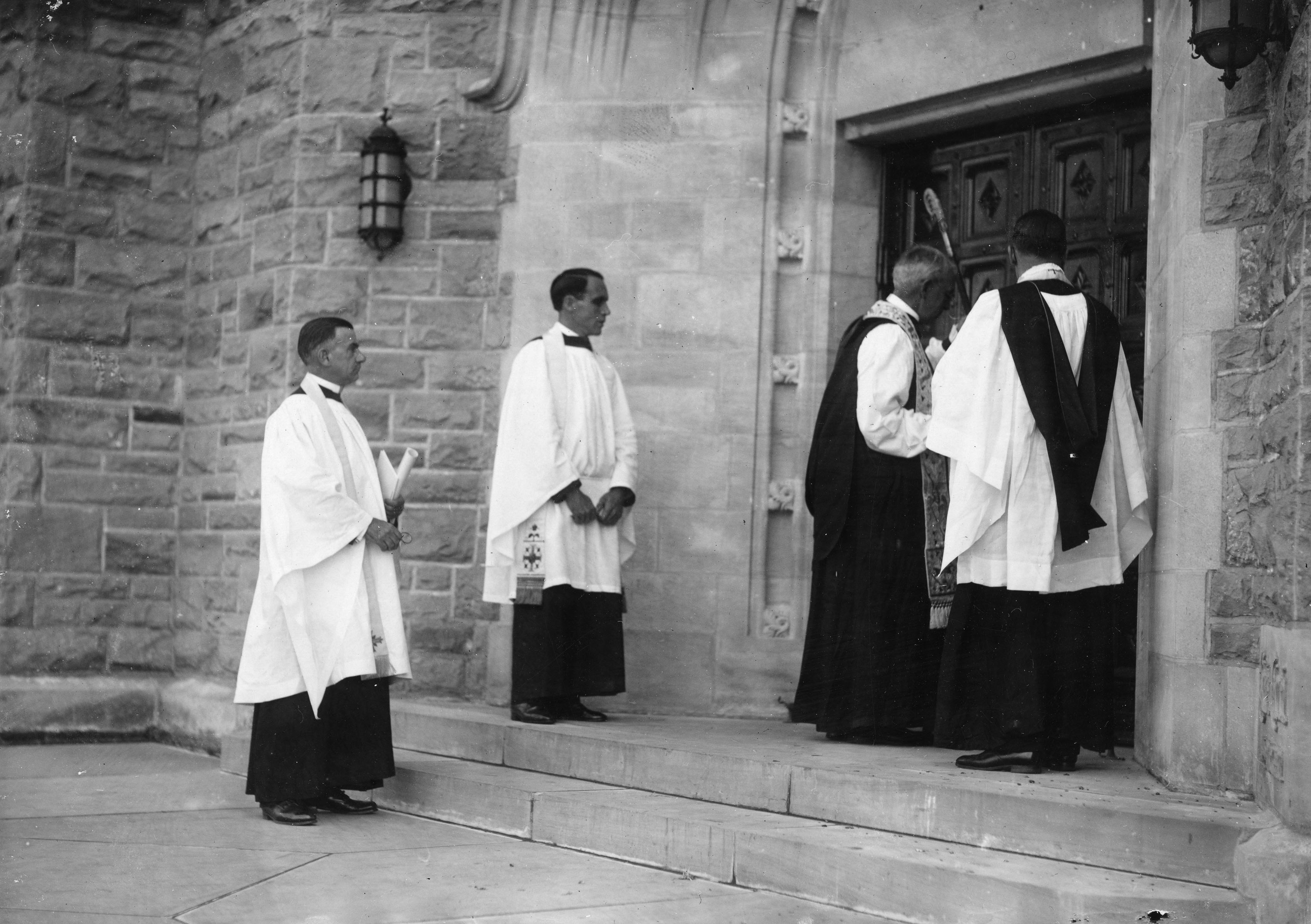
Consecration of Christ Church Cranbrook, September 29, 1928. Archdeacon Ramsey knocks on the door of the church, accompanied by Mr. Kinder, Bishop Page, Mr. Forsyth.
Today marks ninety-five years since the consecration of Christ Church Cranbrook!
Consecration Service Program for Consecration of Christ Church Cranbrook, September 29, 1928.
Planning for the church began in earnest in 1923, with the cornerstone being laid in 1925. After three years of construction, and countless hours of labor from masons, artisans, and clergy, the church was ready to be consecrated.
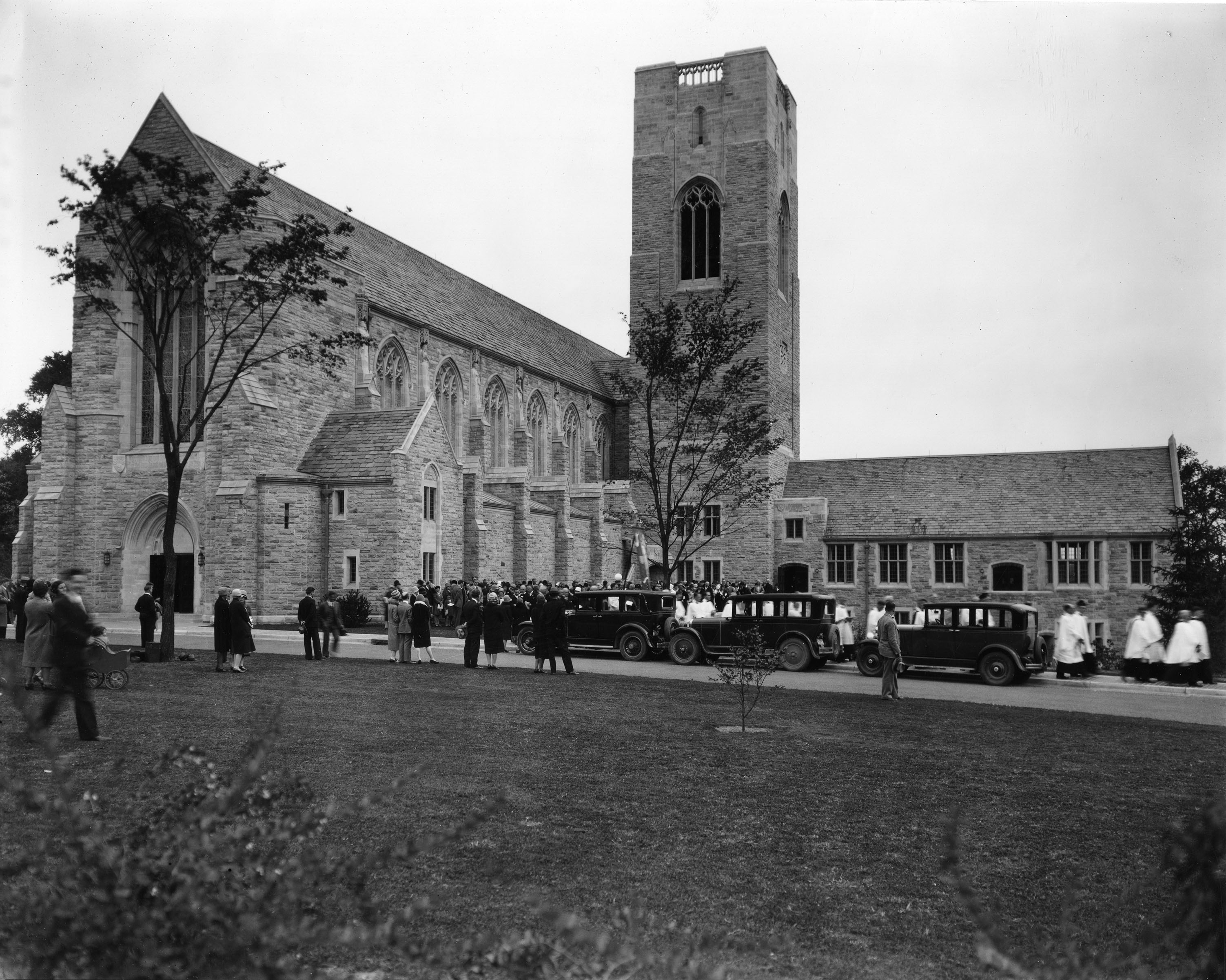
Christ Church Cranbrook Consecration–Parish House Recessional, September 29, 1928.
The consecration was led by Charles L. Ramsay, Archdeacon of the Episcopal Diocese of Michigan, declared the church sacred and ready for services. While the architecture was complete in 1928, it would be several more years before the last pieces of art were installed.
Consecration of Christ Church Cranbrook Recessional, September 29, 1928.
—Kevin Adkisson, Curator, and Laura MacNewman, Associate Archivist, Cranbrook Center for Collections and Research
In addition to working as an Associate Archivist at Cranbrook, I am also a fledgling volunteer docent at Christ Church Cranbrook. Recently, I gave a tour of the Chancel to test my skills with my teachers. As I prepared, I found there was very little written about the history of the pipe organ at the church. So, where to turn for more information? Cranbrook Archives, of course.
In August of 1925, George Booth and Oscar Murray (of Bertram G. Goodhue Associates, the church architect), started in earnest to finalize their thoughts and feelings about the choice of organ for the church. While the organ itself was installed in January 1928, plans for its ducts and conduits had to be decided early, before the concrete floors were poured.
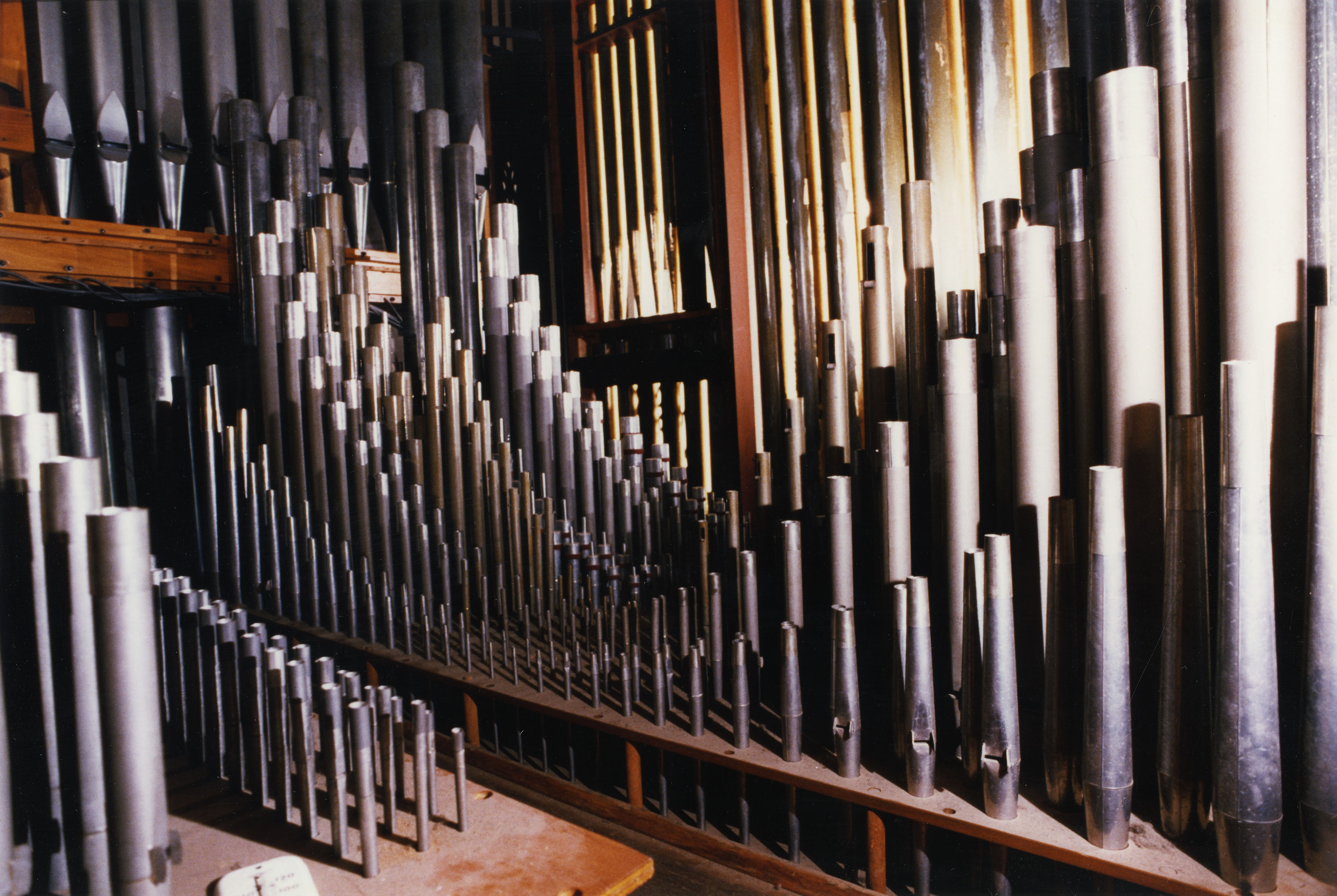
Christ Church Cranbrook organ pipes prior to the 1997 restoration. Jack Kausch, photographer. Courtesy of Cranbrook Archives.
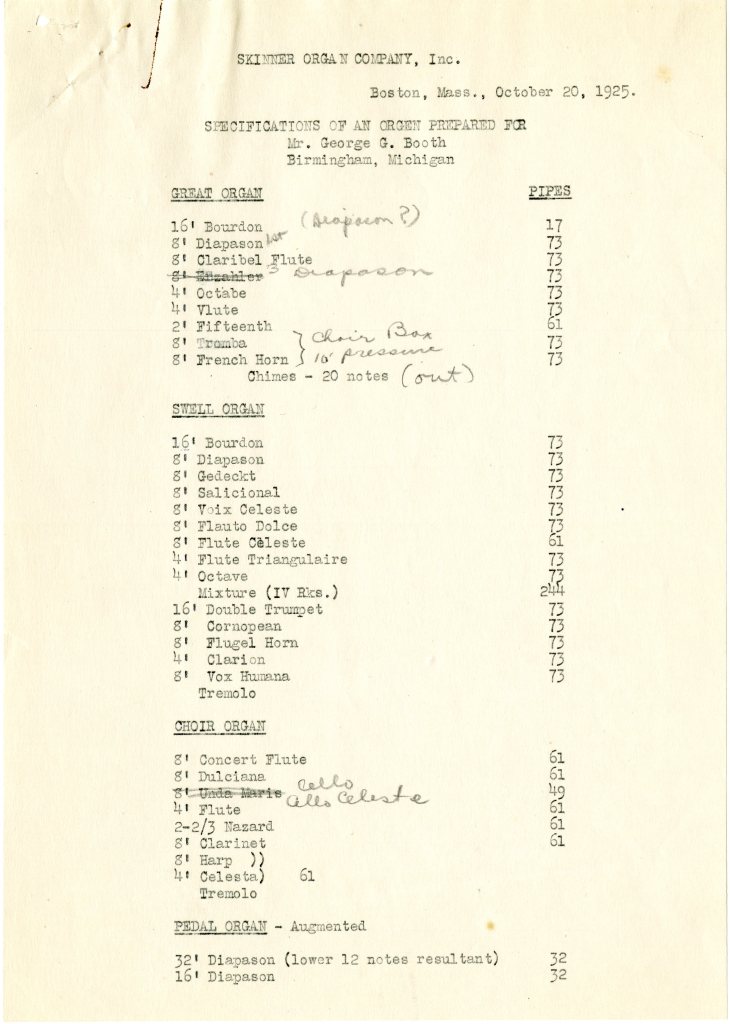
The correspondence suggests that the E.M. Skinner Organ Company was the only company considered. The Boston-based firm was considered America’s finest and most technologically advanced organ builder. Skinner’s specifications for the organ, console, and bench were submitted in October 1925.
George Booth inquired of his colleague Cyril Player to provide comments on the specifications, and Player begins his commentary saying,
“I think I would emphasize gently to them that you want gravity, dignity and softness—the three prime essentials of any church organ, large or small… [gravity] is secured by an adequate and properly-balanced pedal department; dignity by volume of foundation tone in the basic divisions of the instrument; and softness and refinement by skillful voicing with a copious wind stream at a moderate pressure.”
Cyril Player to George G. Booth, November 1925
In passing along the comments to Murray, Booth remarks that, “the desired qualities, viz; gravity, dignity and softness; seems to me peculiarly to express my own feelings and desire.”
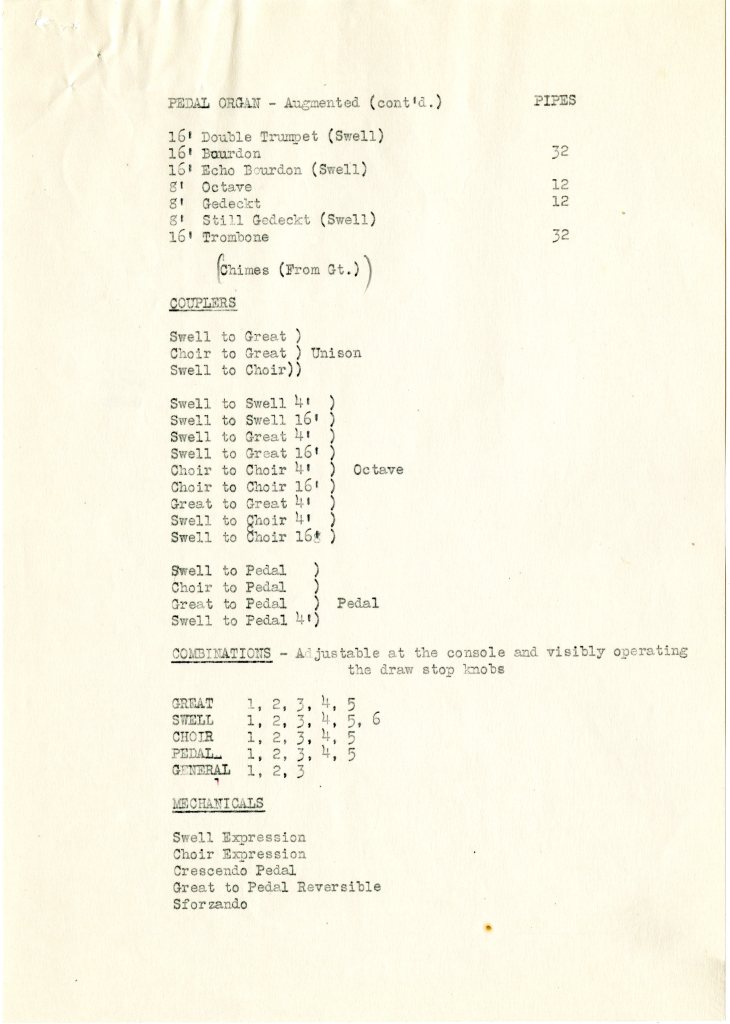
Skinner Organ Company Specifications for Christ Church Cranbrook Organ, October 1925. Courtesy of Cranbrook Archives.
William Zeuch of Skinner Organ Company revised the specifications following some of Player’s suggestions, while some revisions were the suggestion of Henry Willis, the great English organ builder who was a consultant to the firm. The contract for the organ (including the Great, Swell, Choir, and Pedal pipe divisions) was duly signed in December 1925 and work proceeded.
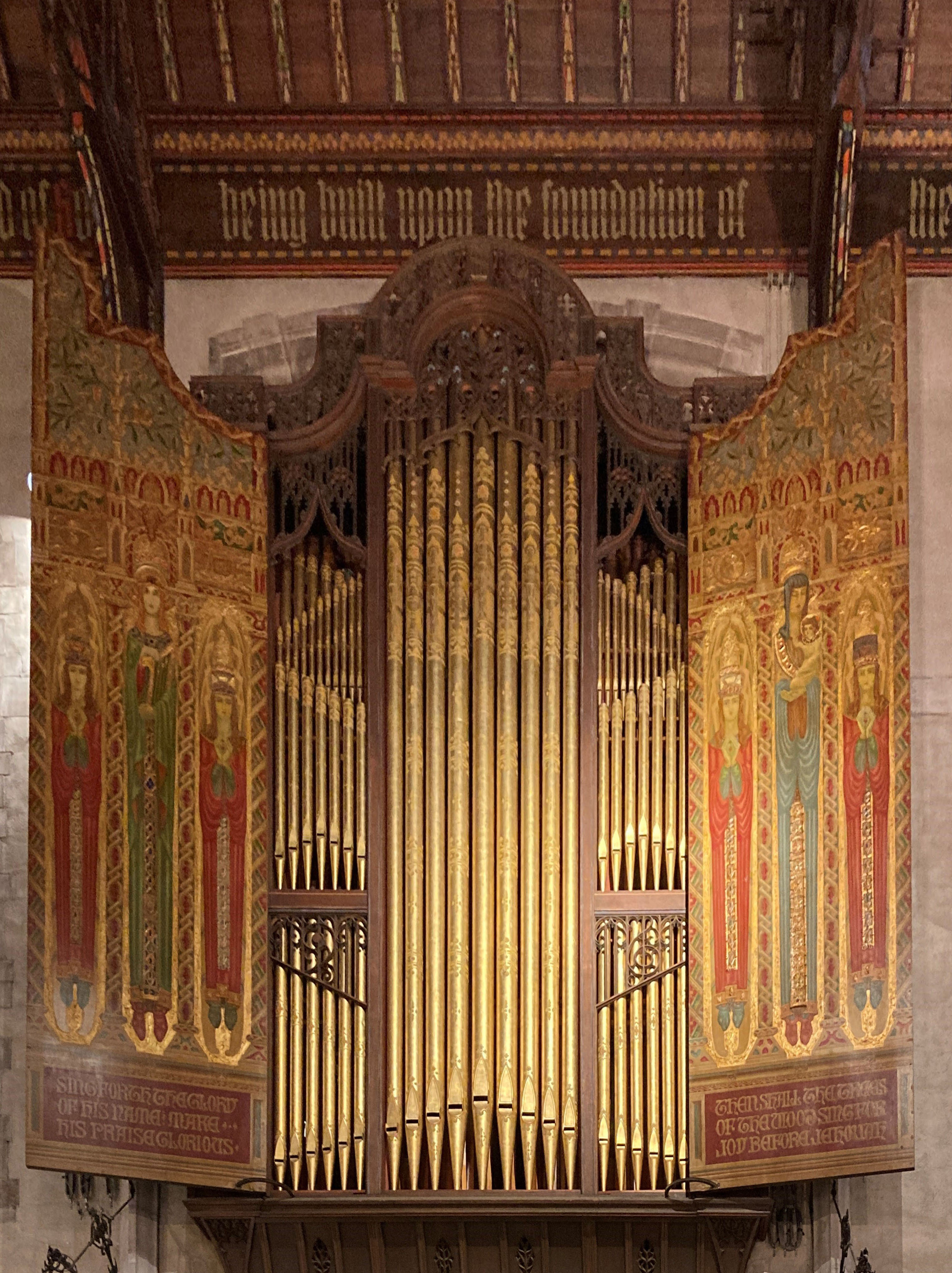
At the same time, a separate contract was made with Alfred Floegel to decorate the organ case doors. Booth wished to confine the oak finish to the exterior of the doors while having the rest richly decorated with color. Booth imagined the opening of the organ doors to represent the opening of the mind. He also envisioned the organ case to read as a triptych (a picture or altarpiece on three hinged panels) when open.
Organ case doors, woodwork by Irving and Casson, decoration by Alfred Floegel. Gift of James Scripps Booth. Laura MacNewman, photographer.
In July 1927, work on the organ console began. The console is where the organist sits to play the instrument, distinguished by its multiple hand keyboards (called manuals), pedalboard, and other controls. Rev. Dr. Marquis requested a change from a 3-manual (Great, Swell, and Choir pipe divisions) to a 4-manual, by adding the Solo division. Zeuch responded positively as it was not too late to build a 4-manual console; however, having already instructed the architect to reduce the dimensions of the organ chamber, which had been too large and would have interfered with the proper effect of the sound in the church, the architect would now need to find space for the Solo division. Room was found above the Sacristy.
George G. Booth didn’t just commission renowned architects in building Cranbrook, he also engaged well-respected landscape designers. Architecture and nature were equally considered. Booth’s own 1904 topographical map demonstrates his grandiose vision for reshaping what was then farmland. It is not surprising, therefore, that Cranbrook has a connection to the American “father of landscape architecture,” Frederick Law Olmsted.
Leading up to and following the Center’s most recent Bauder lecture, Experiencing Olmsted: The Enduring Legacy of Frederick Law Olmsted’s North American Landscapes, Olmsted-related materials in the Archives were revisited and new associations were made.
Photograph album page, circa 1930. Judson Bradway Office, photographer. Courtesy of Cranbrook Archives.View of Christ Church Cranbrook from Cranbrook Road Pond, circa 1925-1940. Samuel Marquis, photographer. Courtesy of Cranbrook Archives.
It was Frederick Law Olmsted’s successor firm, the Olmsted Brothers, led by his sons, that worked on the landscape of Christ Church Cranbrook from 1926-1928. Simultaneous to the construction of the church by the architecture firm Bertram G. Goodhue Associates, the Olmsteds created plans for the surrounding land between Lone Pine, Cranbrook, and Church Roads.
Artistic rendering of Christ Church Cranbrook Rectory, 1924. Bertram G. Goodhue Associates. Courtesy of Cranbrook Archives.
A few pieces of correspondence in the George Gough Booth Papers shed light on the close relationship between Booth, the chief architectOscar H. Murray, and the Olmsted Brothers. But there are many more letters from Job 7754 (aka Christ Church Cranbrook) in the Frederick Law Olmsted Papers and Olmsted Associates Records held by the Manuscript Division of the Library of Congress in Washington, D.C., all of which can be read online.
Letter from Oscar H. Murray to George G. Booth relating a response from Olmsted Brothers, December 7, 1927. Courtesy of Cranbrook Archives.
The Archives also holds two reproductions of Olmsted Brothers plans: the second and the tenth drawing revisions submitted in 1927 and 1928, respectively. In these, plants are clearly numbered, but the Archives does not hold the accompanying keys. At the suggestion of Bauder lecturer, Charles Birnbaum, President, CEO, and Founder of The Cultural Landscape Foundation in Washington, D.C., I reached out to the Frederick Law Olmsted National Historic Site in Brookline, Massachusetts. They graciously shared scanned copies of both planting plans, for our reference.
Christ Church Cranbrook Planting Plan, March 11, 1927, revised October 1927. Blueprint for Revised Plan Number 2. Olmsted Brothers. Courtesy of Cranbrook Archives.
We now know, for example, that the large evergreens that George Booth mentions in a letter to Oscar Murray likely refer to the Austrian Pine (10 and 82), Douglas Fir (83), and White Pine (90) enumerated in a November 4, 1927 plant list for Plan No. 2. And, we can see where on the blueprint those trees were proposed to be planted!
Excerpt from page two of George Booth’s letter to Oscar Murray, November 23, 1927. Courtesy of Cranbrook Archives.
Many more discoveries are sure to come, now that we have a more complete picture of the original landscape design for Christ Church Cranbrook. I know that next time I drive or walk by the church, I will be taking a closer look at the vegetation.
—Deborah Rice, Head Archivist, Cranbrook Center for Collections and Research
Editor’s note: To view the five drawings in the Olmsted Archives at Brookline, including originals of the Cranbrook copies, and eight scrapbook pages that include Goodhue Associates renderings, visit their Flickr albums.
When I was asked to gather archival materials related to Cranbrook in Kent, England, a short series of correspondence in the Henry Scripps and Carolyn Farr Booth Papers particularly caught my notice. Written to Henry Scripps Booth, the letters discuss a stone from St. Dunstan’s Church in Cranbrook, Kent, and its overseas delivery to Christ Church Cranbrook. I became quite curious about it.
Carved coign from St. Dunstan’s Church, Cranbrook, Kent, at Christ Church Cranbrook. Laura MacNewman, photographer. Courtesy of Cranbrook Archives.
One handwritten letter in the correspondence was rather difficult to decipher, but once I got the pattern of it, it helped me begin to comprehend the story.
In July 1930, St. Dunstan’s Vicar, Rev. Swingler, acknowledged a request from Booth for a fragment of the church which could be placed in the chapel of the same name at Christ Church Cranbrook.
It was July 1931 before Rev. Swingler wrote again to inform Booth that the stone was ready for dispatch. He explained that the Church Council had welcomed the idea and directed the Fabric Committee to select a stone, which they had, but that the Secretary had forgotten to inform Booth until then, a year later, and it was already on its way!
Letter from Rev. Swingler to Henry Scripps Booth, July 22, 1931. Courtesy of Cranbrook Archives.Letter from Rev. Swingler to Henry Scripps Booth, July 22, 1931. Courtesy of Cranbrook Archives.Letter from Rev. Swingler to Henry Scripps Booth, July 22, 1931. Courtesy of Cranbrook Archives.
The forgetfulness of the Secretary and finding appropriate shipping arrangements for such an unusual commodity had caused quite a delay, to which Rev. Swingler writes,
“I am sorry that the matter has not been dealt with more speedily but old Cranbrook has hardly yet learned modern methods of business, as perhaps you know.”
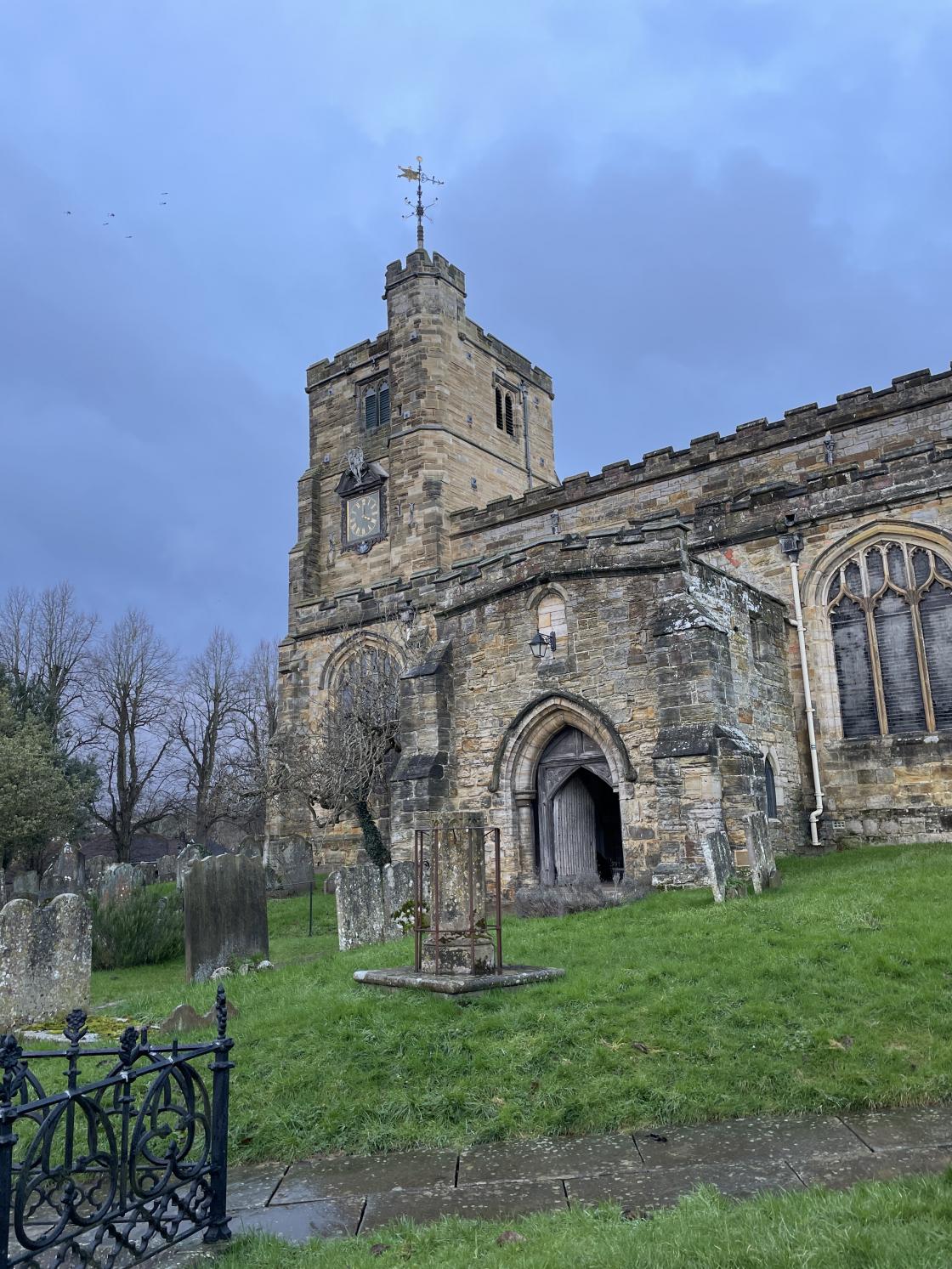
St. Dunstan’s Church, Cranbrook, Kent. Kevin Adkisson, photographer. Courtesy of the Center for Collections and Research.
He goes on to describe the provenance of the stone, at least as far as he could tell. A fifteenth century carved coign (an architectural term for a “projected corner”), it once formed part of the string course (a projected band of stone) which runs at the base of the battlements of the church nave. The course includes a series of grotesque heads, some of which were pierced for waterspouts. A grotesque, common in medieval church architecture, is a decoratively carved stone used to ward off evil spirits and to signify the sanctuary and safety of the church. On inspecting an historic photograph of the church, I could identify similar stones at the top of the drainpipes and around the tower battlements.
St. Dunstan’s Church, Cranbrook, Kent, July 1901, with grotesques in situ. Courtesy of Cranbrook Archives.
Rev. Swingler had first seen it laying in the churchyard and surmised that it had not been replaced during past repairs. He doesn’t mention why they selected that particular stone, but one could conjecture that it was because it was no longer part of the fabric of the church building and hence was available to be gifted to Christ Church. He notes that it is probably of Hartley stone, which was quarried in the Parish.
Henry Scripps Booth contributed great efforts to building relationships between the old and new Cranbrooks by establishing and maintaining connections between the two churches. The grotesque that arrived at Christ Church more than 90 years ago is an artifact that tells just one story of his efforts. From St. Dunstan’s of old Cranbrook, known as the “Cathedral of the Weald,” to St. Dunstan’s of Christ Church Cranbrook, the carved coign continues to herald sanctuary and give confidence to those who enter.
–Laura MacNewman Associate Archivist, Cranbrook Center for Collections and Research
The clerestory windows designed by G. Owen Bonawit in the nave of Christ Church seem to be one of the least described elements of the church’s artwork. The work was negotiated and subcontracted through architect Oscar H. Murray at Bertram Grosvenor Goodhue Associates rather than commissioned directly through George G. Booth. Consequently, there are few documentary vestiges of the artist’s process in our records.
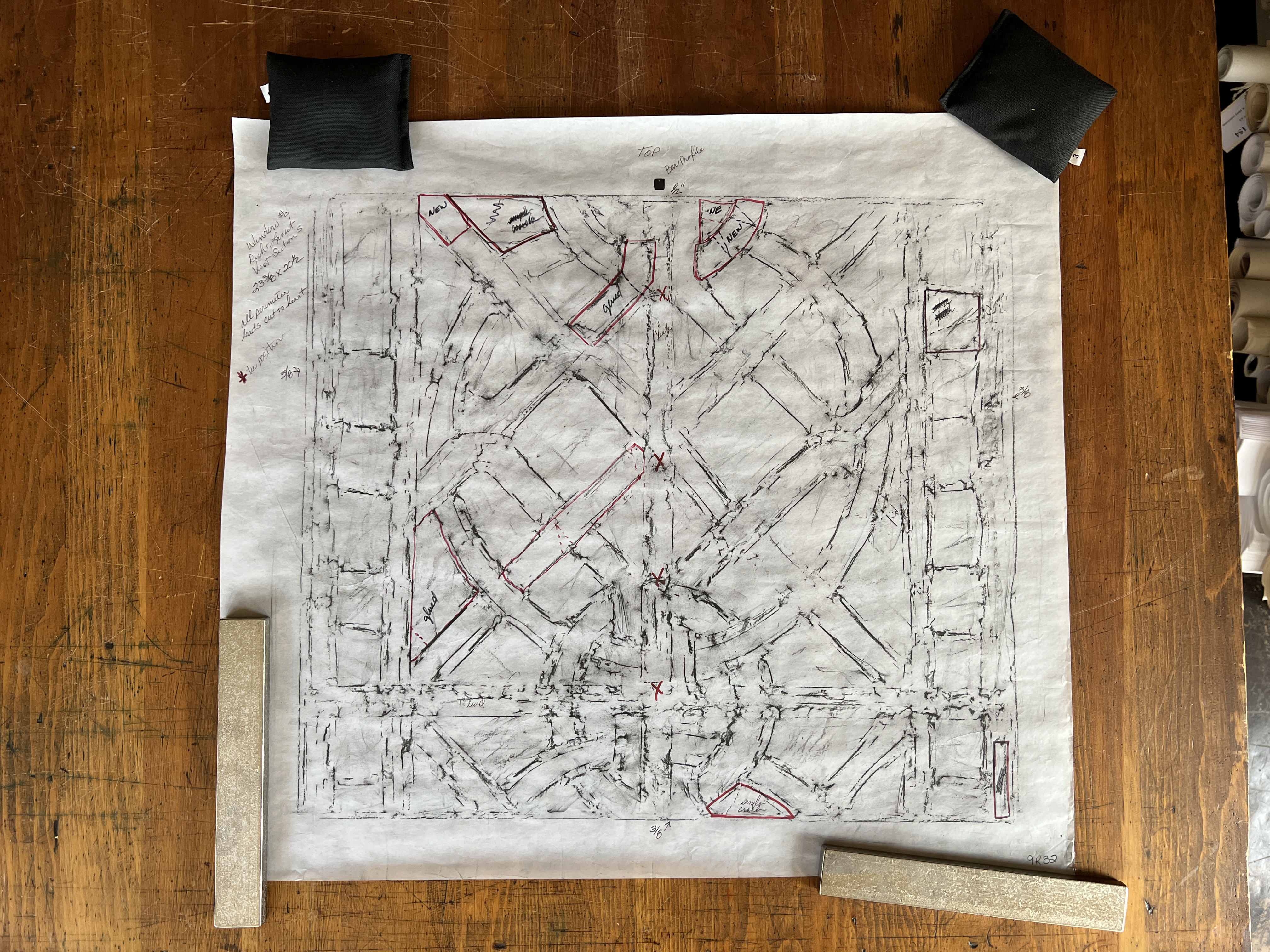
The windows can be studied through other materials held by the Archives, including architectural drawings, photographs, and the records of a window restoration project which commenced in 1993. In 1995, the Thompson Art Glass company made rubbings of the window for the purposes of identifying their care and preservation needs.
Window rubbings by Thompson Art Glass made June 19, 1995. Courtesy of Cranbrook Archives.
There are seventeen grisaille clerestory windows in the nave and chancel at Christ Church, which were analyzed as part of this stained-glass restoration project. They are made of clear antique glass upon which minute floral detail is painted and accentuated by the addition of small amounts of colored glass. In the chancel, there are two lancets and tracery of nine panels supported by T-bars including one ventilator panel. In the nave, they are comprised of three lancets and tracery with eight panels, with ventilator panels making up the bottom row.
Detail from Architectural drawing of Christ Church Cranbrook, North Elevation. April 30, 1925. Drawn by J.E.M./Oscar H. Murray, Bertram Grosvenor Goodhue Architects. [AD.10.33]. Courtesy of Cranbrook Archives.
Grisaille, literally meaning ‘to grey,’ is a type of stained glass that is mostly monochromatic, with a silver or grey tone being painted onto the finished glass. The purpose of the plainness of grisaille is twofold: they let more light into the space both literally and metaphorically in that they were intended to limit distraction from meditation.
The grisaille stained glass style is thought to have originated in French Cistercian abbeys after a prohibition on colored glass issued by St. Bernard of Clairvaux in 1134 in accordance with their charism of simplicity. St. Bernard, the master of paradox, also banned the use of figurative decoration according to the First Commandment of no graven images. Under his guidance, the Cistercians seek the face of God, a theological anomaly that produces an exquisite spiritual discipline and religious practice through which the monk contemplates holiness by virtue of continually recognizing the poverty of their thoughts and feelings when weighed down by seeking to satisfy worldly desire. The style often employs natural or geometric patterns, much like a labyrinth.
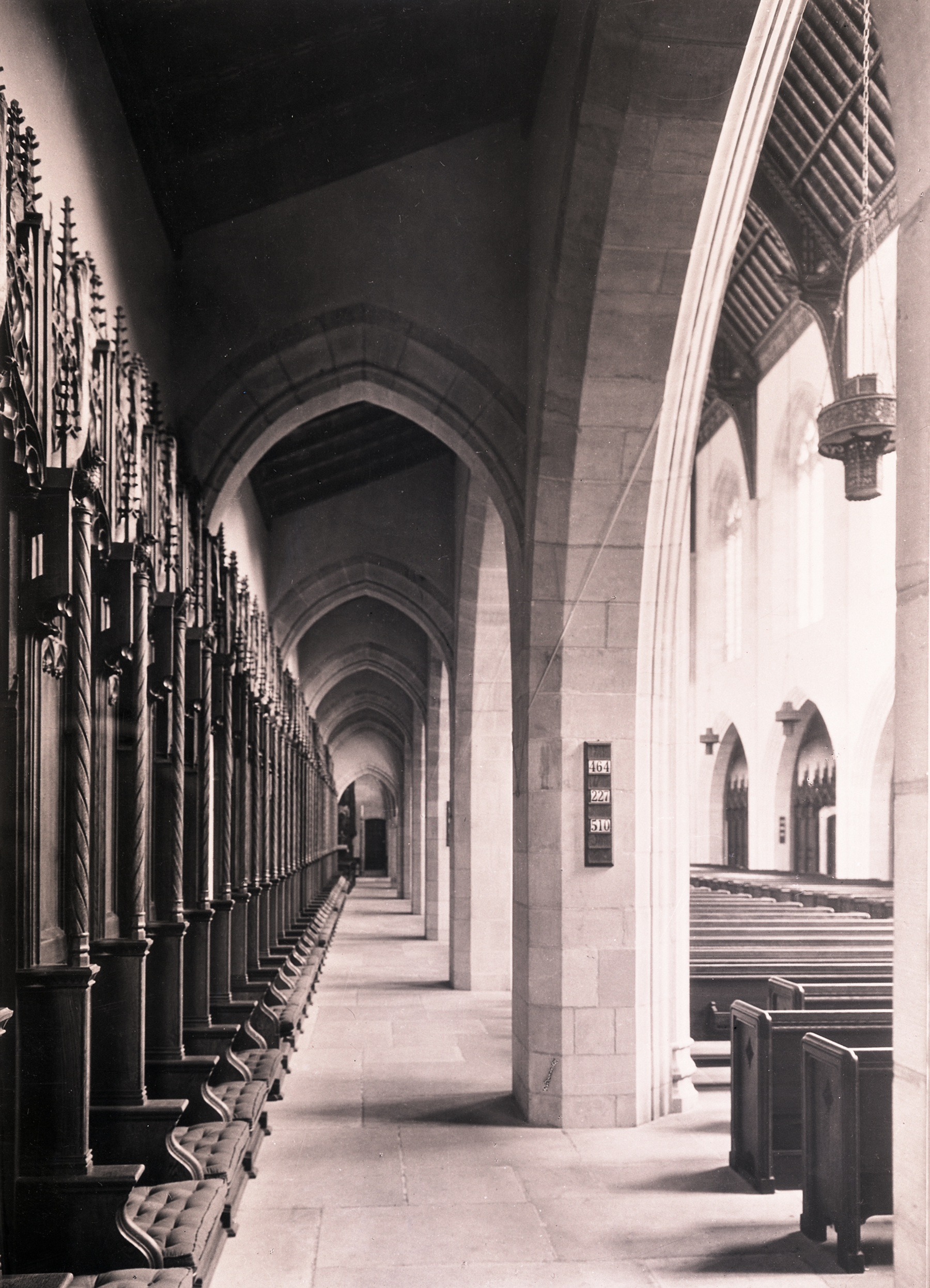
The windows can best be observed by sitting in the aisle stalls of the nave, which are in themselves an unusual feature otherwise only found in Oxford college chapels. The walls of the nave were originally intended to display memorials and artwork, but the latter idea was revised due to the objection that it would bring a museum feel to a house of worship.
Aisle stalls in left side of sanctuary. June 23, 1946. Photographer, Harvey Croze. Courtesy of Cranbrook Archives.
Added in 1930, the aisle stalls offer a fine perspective from which to observe the grisaille, and Bonawit’s elegant craftmanship brings with it a history of monastic inspired light. Since a life without beauty is only half lived, the artistic eclecticism of Christ Church offers all those who enter the opportunity to embrace the other half both in its resplendency and in its simplicity.
– Laura MacNewman, Associate Archivist, Cranbrook Center for Collections and Research
Across Cranbrook’s campus are eleven different spaces, including the Archives, that house book collections – some 110,000 physical items. Several of these spaces are typical school or academic research libraries, where students, faculty, and staff can check out the majority of these books. As a library and information science professional, I champion the importance of these lending libraries and the egalitarian access to information they provide.
In this post, however, I’d like to focus on Cranbrook’s non-circulating book collections – those rare, historic, or valuable tomes that, in many cases, hide in plain sight in public areas. With help from colleagues at the Academy of Art, Schools, Institute of Science, and Center for Collections and Research, I’ll highlight some of these gems that promise to delight the bibliophile, art appreciator, historian, or simply the Cranbrook curious.
Cranbrook’s special book collections are carefully preserved as both informational and evidential artifacts, and many are housed within cultural heritage areas. Valued not only for research purposes, they also serve as historical objects which help individually or collectively to tell the Cranbrook story.
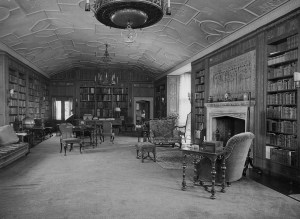
South end view of the newly completed Cranbrook House Library, 1920. John Wallace Gillies, photographer. Courtesy of Cranbrook Archives.
The origin of book collecting at Cranbrook actually predates any of the current collection spaces and begins with Cranbrook founders George and Ellen Booth. George, in particular, was an enthusiastic collector, and started acquiring volumes in 1900, commissioning purchases of William Morris works and other fine books in London. As George explained, “I am not a millionaire and cannot pay the big prices now prevailing in New York.” His strategy allowed him to accumulate 1,000 books by 1916, effectively seeding the Cranbrook House Library Collection when construction of the library wing was completed four years later.




















![Window rubbing by Thompson Art Glass, June 19, 1995. [CCC4.] Window #9 [3 and 4 of 5].](https://cranbrookkitchensink.com/wp-content/uploads/2022/03/ccc4_3and4.jpg)

 Cranbrook Kitchen Sink