The Elves and the Saarinen Home

Cranbrook Center for Collections and Research “elves,” with help from the Cranbrook Archives and Cranbrook Art Museum, have worked their magic to bring out treasures designed for this summer’s reinvigorated and expanded tours of the landmark Saarinen House. This three-month installation entitled Saarinen Home: Living and Working with Cranbrook’s First Family of Design, expands on the life and work of the remarkable Saarinen family, displaying items used in their home, at Cranbrook, and for projects around the country.

SaarienHomeBlog1

Selecting sliver, glass, and ceramic items for the exhibition.

The exhibition kicks off with an Open House from 1-4pm this Sunday, April 30th, during the Art Academy’s OPEN(STUDIOS). It will also be open for four nights of special programming – “Finnish Fridays” – the first of which is May 5th. Normal tours of the exhibit are Friday, Saturday, and Sunday, May through July. For all the details, check out the Cranbrook Center for Collections and Research website.

SaarinenHomeBlog3

Preparing the space to display weavings by Studio Loja Saarinen.

Leslie Mio, Assistant Registrar

Photo Friday: Documenting Exhibitions Across Campus

As many of you know, Cranbrook Archives is located in the lower level of Cranbrook Art Museum (CAM). At various times throughout the year, museum registrars and preparators install and de-install the exhibitions presented in the galleries at CAM. Over the past few weeks this process of de-installing exhibitions in the lower galleries started, in preparation for new exhibitions to take over these spaces.

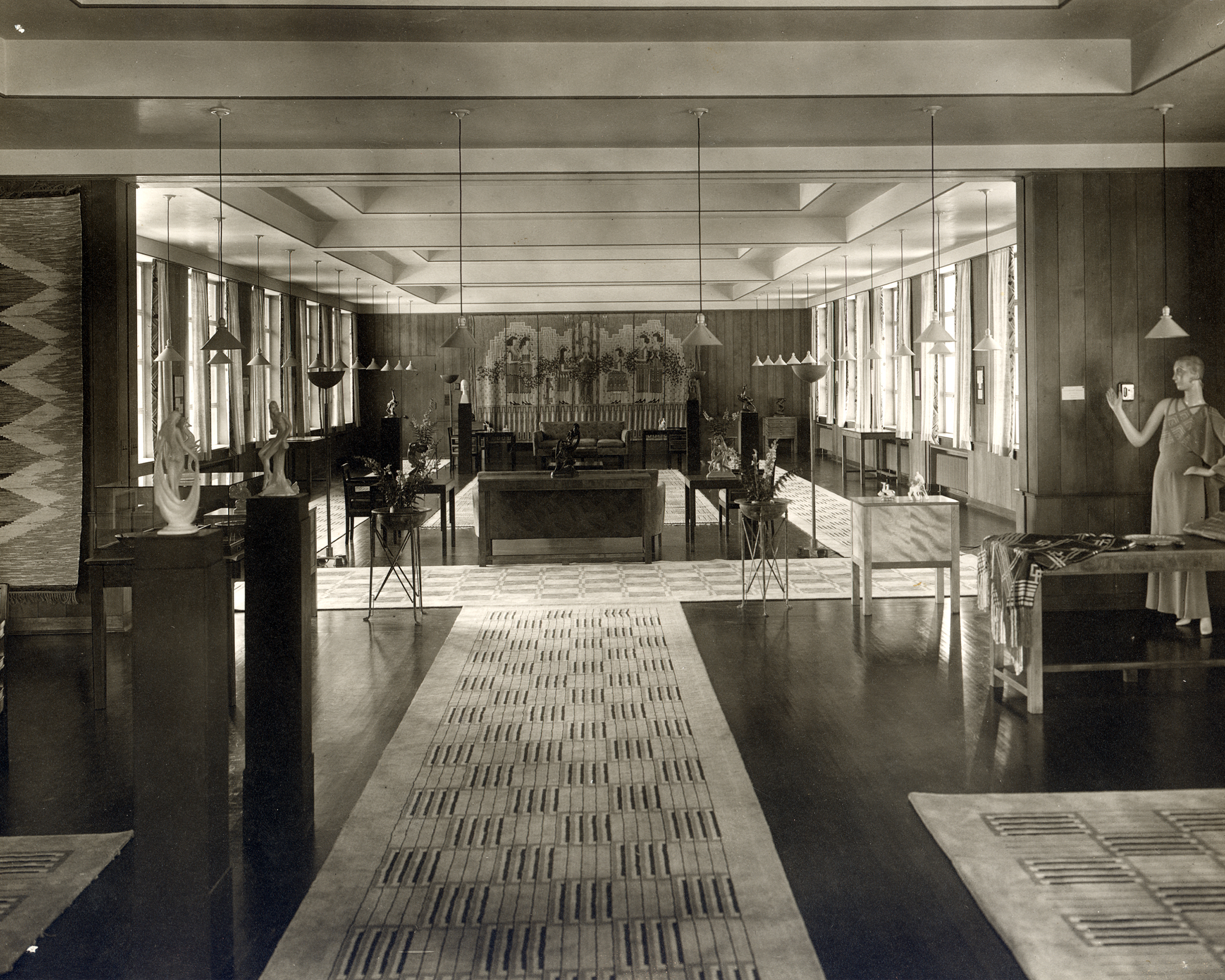
The first exhibition held at Kingswood School in what is now the weaving studio. Primarily designs for Kingswood School, but includes costume designs by Pipsan Saarinen Swanson. Photographer, George W. Hance, 1932

I am always in awe of the work that goes into changing these spaces to support new ideas and work – from the vision and physical work of the preparator and staff to the tracking, un-packing, and condition reporting that is completed by the registrars – it is impressive! In our collections at the Archives, we have correspondence, exhibition files, posters, publications, and photographs to document more than 85 years of exhibitions not only from CAM, but also from Cranbrook Kingswood Schools, the Institute of Science, and exhibitions that faculty and students have participated in across the country.

Gina Tecos, Archivist

Stay Tuned…

Apologies for our tardiness! Due to the widespread power outage in Southeast Michigan, the blog will be delayed by a few days.

Postcard of the Mannleinlaufen (a mechanical clock that commemorates the Golden Bull of 1356) at the Frauenkirche (Church of Our Lady) in Nuremberg, 1921. Courtesy, Cranbrook Archives, The Virginia Kingswood Booth Vogel Papers.


Advertising Your Business (Before Facebook)

Cranbrook Archives has an interesting selection of trade catalogs from the early 1930s to the 1990s. While the purpose of these publications was to promote and display a manufacturer’s products, I’m struck by the art and design work that went into creating them. As secondary resources, there is so much to learn about the decisions Cranbrook was making at the time these catalogs were in use. They are also important artifacts of American business and manufacturing.

We have several collections that contain trade catalogs here at the Archives. These publications represent building and landscape products for use in construction projects on campus, tennis courts, art supplies, household items, furniture, and farming equipment – to name a few. Check out a few of the catalogs from the Cranbrook Architectural Office Records below.

Russell-Built Museum Cases literature, ca 1939.

Russell-Built museum case literature, ca 1939.

The Allis-Chalmers company explains why mechanization is the key to multiplying your efforts on the farm, ca 1942.

The Allis-Chalmers company explains why mechanization is the key to multiplying your efforts on the farm, ca 1942.

Zonolite plaster by Vermiculite purports to be insulating, crack-resistant, and fire-safe, ca 1951.

Zonolite plaster by Vermiculite purports to be insulating, crack-resistant, and fire-safe, ca 1951.

If you’re interested in looking at more trade literature, check out the collections at the Smithsonian, the Henry Ford, and the University of California at Santa Barbara.

Gina Tecos, Archivist


Manship’s Memorable Memorial Medal

As the Assistant Registrar for Cranbrook Educational Community, it is my job to keep track of the objects in the collections of the Art Museum and the Cultural Properties across the campus.  Though not trained as a Museum Registrar, George Booth had a similar goal: he fastidiously kept his many collections and cultural properties around his home and the various school buildings inventoried or appraised.

The inventory, “Cranbrook Museum Art collection: 400 thru,” led me to a wonderful collection of coins and medals.  Some were ancient, some were more contemporary, but one in particular stood out: a memorial medal for soldiers who died during the First World War.  What was the story behind this medal?  Since none of the Booth children died during the war, I wondered why George Booth would have one of these medals in his collection.

During World War I, many prominent Americans spoke out against the war in Europe, including Henry Ford and Reverend Samuel Marquis (who in 1927 became the first rector of Christ Church Cranbrook).  As the editor of The Detroit News, George Booth oversaw “the leading newspaper in the country to give open and courageous expression to criticism.”  The News editorial staff had “sincerity of purpose and courage to voice temporarily unpopular principles.”  The United States entered the war in 1917 but The Detroit News continued its criticism. That criticism, however, was focused on governments and policies, not at the soldiers who put their lives on the line.

Indeed, Booth was very supportive of the fighting men who went off to war and of the families of those who did not return. He, architect Albert Kahn, and Clyde Burroughs (Director of the Detroit Museum of Art) established the Welcome Home Committee of Detroit – similar committees were formed in other major U.S. cities. The committee made sure all soldiers who returned from the front received the thanks of the nation and distributed rings and certificates of service to them upon their return.

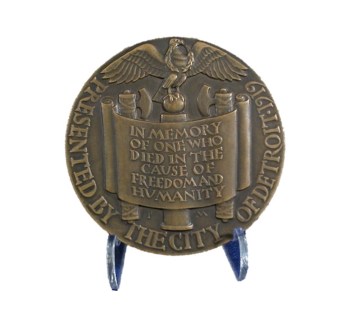
The Committee’s recognition did not end with the men who returned.  It also distributed the memorial medal to the families of the war dead from Detroit. This medal, designed by sculptor Paul Manship and forged by Medallic Art Company in New York, was given as “a token of sympathy and gratitude to the nearest kin of those who gave their lives in the country’s service” during the Great War.
memorialmedal-1

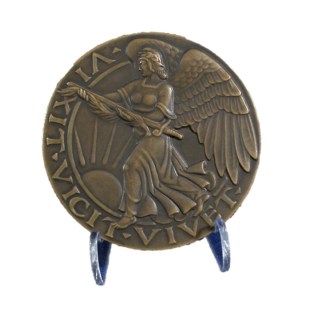
Detroit Soldiers Memorial Medal, 1919 (obverse). Image Courtesy of Cranbrook Art Museum.

The front of the medal bears a winged female figure representing Victory striding forward while holding a sword wrapped in a palm leaf (sword of war and palm of peace) with a radiant sun in the background. The text around Victory reads, “VIXIT VIVIT VIVET” [lived, lives, will live].
memorialmedal-2

Detroit Soldiers Memorial Medal, 1919 (reverse). Image Courtesy of Cranbrook Art Museum.

The back of the medal reads, “Presented by the City of Detroit 1919.” At center is a scroll inscribed, “In Memory Of One Who Died in the Cause of Freedom and Humanity.”  Above, an eagle holding a laurel wreath is perched atop the end of a cannon and ball.

The Burton Historical Collection at the Detroit Public Library has a great image of a large crowd at Campus Martius for a memorial service to honor WWI soldiers.  I suspect that one of the men on the dais is George G. Booth, there to honor the Detroit war dead and their families.

For more on George Booth and his opinions on the war in Europe, see the George Gough Booth Papers and for more on Manship’s work at Cranbrook, check out Cranbrook Archives Digital Collections and Cranbrook Art Museum.

– Leslie S. Mio, Assistant Registrar

We’d like to welcome the newest collections fellow to our team, Kevin Adkisson. Kevin received his undergraduate degree in Architecture from Yale University and a Master of Arts degree from the Winterthur Program in American Material Culture.  He has had a number of interesting internships and job experiences along the way, including one at the Royal Institute of British Architects in London, the Yale University Art Gallery, and at Robert A. M. Stern Architects in New York.

Kevin spent his first two weeks touring the buildings and outdoor spaces on campus with his colleagues. He brings vitality and enthusiasm to our team and we are looking forward to seeing what projects he sinks his teeth into while here. Oh, and he will definitely be contributing to the blog in the VERY near future! Welcome, Kevin!


Automobiles and Art?

Did you know that Ford Motor Company supported and encouraged the artistic activities of its employees, sponsored traveling art exhibitions, and published contemporary American art in its company magazines? I had no idea until I found a couple of copies of Ford Times magazine and a Lincoln-Mercury Times in one of our collections.

“Fish,” Big Spring, Michigan. Lincoln-Mercury Times, May-June 1956. Painting by Bill Moss. Moss was a graduate of the Academy of Art and painted over 300 works for Ford Times from 1949-1958.

“Fish,” Big Spring, Michigan. Lincoln-Mercury Times, May-June 1956. Painting by Bill Moss. Moss was a graduate of the Academy of Art and painted over 300 works for Ford Times from 1949-1958.

Much of the auto company’s support and use of artworks began under Arthur Townsend Lougee, who served as the Executive Editor and Art Director of Ford Times magazine, as well as the Lincoln-Mercury Times, from 1946-1961. During his tenure, Lougee commissioned thousands of articles on America and Americana, which were illustrated with watercolors by regional Ford artists who, for the most part, painted local motifs. Ford’s policy was to leave the subject matter up to the discretion of the artist.

steele-ban

“Lake Superior’s Eastern Shore.” Lincoln-Mercury Times, May-June 1956. Painting by Robert Bannister

A small company magazine at 4 x 6 inches, each issue of the monthly Ford Times consisted of several stories about vacation destination spots and those of historical interest, as well as promotional information about contemporary Ford products. Watercolor paintings first appeared as cover art in the June 1946 issue, and on the interior in September 1947.

steele-snw

“Fruita,” Bryce Canyon National Park. Ford Times, Sep 1959. Painting by V. Douglas Snow.

Lougee also assembled the Ford Times Collection of American Art, a collection of over 7,000 of the paintings commissioned for the Ford publications. Nearly 700 American painters were represented in the collection. The Ford Times art exhibition program was established in 1954 and made available to schools and universities, libraries, and art organizations across the country. Exhibitions included American Byways (1953), Artists and Fishermen (1955), Faculty Artists (1962), Variety No. 8 (1962), and Travel in Mexico (1969). Under the auspices of the United States Information Agency, international exhibitions traveled to countries in Asia, Africa, Europe, and the Middle East as a way of promoting good will and friendship among nations.

steele

Lincoln-Mercury Times, May-June 1956

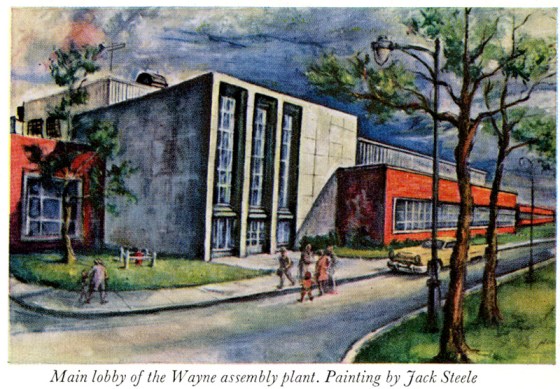
Thanks to the collection of Jack Keijo Steele, a Cranbrook Academy of Art alum, clay modeler in the Ford Styling Office, and lifelong painter, we are able to tell this interesting story of Ford’s contributions to art in this country.

Leslie S. Edwards, Head Archivist


Photo Friday: Coming to Light

The Institute of Science photograph collection (1929-1995) is a treasure trove of fascinating images, taken by various Institute of Science staff during the course of their field research. Many of them document places that have become popular northern Michigan summer vacation destinations.

Thunder Bay Island Lighthouse, Jul 1929. W. Bryant Tyrrell, photographer. Courtesy Cranbrook Archives.

Thunder Bay Island Lighthouse, Jul 1929. W. Bryant Tyrrell, photographer. Courtesy Cranbrook Archives.

This photo was taken by naturalist W. Bryant Tyrrell who was employed by the Cranbrook Foundation in 1929 as the director of the first natural history museum, then housed in what is now known as the Academy of Art Administration building. Tyrrell worked with Brookside School students, taking them on nature walks around campus and teaching them how to build bird houses. He also taught general nature study to Cranbrook School students. Tyrrell’s field work, primarily in Michigan, led to the formation of several Institute of Science collections from which he was able to prepare exhibitions.

The W. Bryant Tyrrell Photograph Collection can be found at the Washington D.C. Community Archives. For a history of the Thunder Bay Lighthouse, see: http://www.terrypepper.com/lights/huron/thunder/

Leslie S. Edwards, Head Archivist

Skridskoprinsessan at Cranbrook

Archives staff works very closely with the Capital Projects department here on campus and we recently received an email from Project Manager, Craig Hoernschemeyer, about a possible Cranbrook connection with a poster he came across. The poster is of Norwegian Olympic ice skating champion, Sonja Henie, who won the gold medal in 1928, 1932 and 1936 and was also a film star in the late 1930s-1940s. Craig wondered if perhaps Henie could have been sculptor Carl Milles’ muse for the “Ice Princess”.

Film poster featuring Sonja Henie. Skriskoprinsessan is the Norwegian word for Ice Princess.

Film poster featuring Sonja Henie. Skridskoprinsessan is the Swedish word for Ice Princess.

The first Ice Princess bronze was cast in 1949, making it a relatively late Milles sculpture. Stockholm’s Millesgarden attributes the design to a 1948 visit to Rockefeller Center in New York City. As the story goes, Milles was so fascinated with the skaters he saw at the Rockefeller ice rink, he designed the Ice Princess to match their fluidity and movement.

The Ice Princess in the Fisher Cummings Courtyard at the Girl's Middle School. Photographer, Hoernschemeyer.

The Ice Princess in the Fisher Cummings Courtyard at the Cranbrook Kingswood Girl’s Middle School. Photographer, Craig Hoernschemeyer.

There are more than 100 Milles sculptures across Cranbrook Educational Community’s campus. The Ice Princess was cast at the Herman Bergman AB foundry in 2012 and was installed in 2013 in the Fisher Cummings Courtyard at the Cranbrook Kingswood Girl’s Middle School.

Rockefeller Center? Sonja Henie? What do you think?

Gina Tecos, Archivist


Photo Friday: Archival Preservation

Since it is Preservation Week, today’s Photo Friday features an image from one of the collections we have been working to stabilize. For the past few weeks my colleague, Belinda Krencicki, and I have photographed and captured metadata for the watercolor paintings, pen and pencil drawings, and pastels in the James Scripps Booth and John McLaughlin Booth Papers. This information will be used to catalog the items in our Collections Management system. In addition to documenting the works, we re-housed all of the items–placing them in archival folders and interleaving each work to protect it.

Pencil and pastel sketch of the exterior of the Detroit News building, James Scripps Booth, 1917.

Pencil and pastel sketch of the exterior of the Detroit News building, James Scripps Booth, 1917.

The artwork ranges from pastel landscapes, to portrait studies, to automobile racing. The image above is one of my favorites – a sketch of the Detroit News building. I hope you enjoy it too!

Gina Tecos, Archivist

Create a website or blog at WordPress.com