Clifford West Papers Come to Cranbrook

Cranbrook Archives is excited to announce the acquisition of the Clifford B. West and Joy Griffin West Papers. Since the boxes arrived this past summer, I have been inventorying their contents in preparation for making them accessible to the public for research. Completing this work involves continually unravelling the many interesting facets of Clifford and Joy’s stories to be brought to light through the collection. Among many other things, are their experiences at Cranbrook in the mid-twentieth century.

Joy Griffin and Clifford West in front of Carl Milles’ sculpture on the north wall of the Academy of Art library, 1941. Harvey Croze, photographer. Courtesy of Cranbrook Archives.

Clifford and Joy attended the Academy of Art at the tail end of its golden age, meeting and marrying in 1941. At that time, Carl Milles, Eliel Saarinen, Loja Saarinen, and Eero Saarinen taught and worked on campus. Clifford earned his MFA in painting under Zoltan Sepeshy and Joy took ceramics classes from Maija Grotell. Fellow students included Lily Swann Saarinen and Harry Bertoia, among others.

Bertoia and West: Three Decades

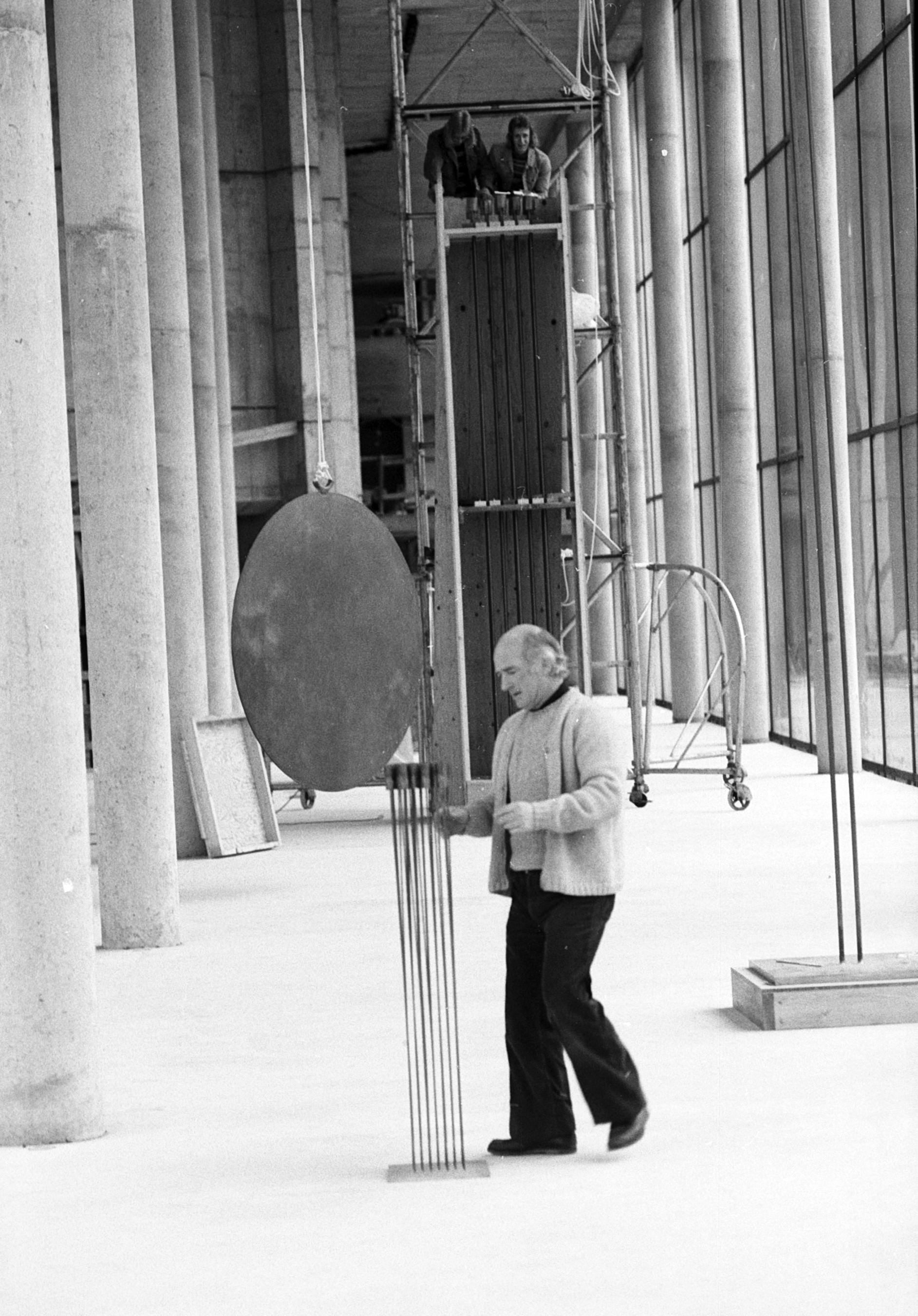
It was with Harry Bertoia, sculptor and designer, that Clifford enjoyed a lifelong friendship, serving as best man at his 1943 wedding to Brigitta Valentiner (fellow Academy student and daughter of Wilhelm Valentiner, Director of the Detroit Institute of Arts). While living in different parts of the country after graduation (or different countries all together), the two artists maintained close ties, both personally and professionally, evidenced by correspondence and other materials found in the Wests’ papers. Of particular note is the original 16mm film Clifford made in 1965, titled Harry Bertoia’s Sculpture, featuring a soundtrack by Bertoia.

Harry Bertoia in his studio, circa 1976. Clifford West, photographer. Courtesy of Cranbrook Archives.

Another fascinating connection is Clifford’s involvement with a few 1976-1977 exhibitions of Bertoia’s sculptures in Norway. Bertoia’s work, including his sound sculptures, had been introduced to the Norwegian art scene in the late 1960s through Bente Torjusen, an educator at the Munch Museum who assisted Clifford on his 1968 film about artist Edvard Munch and later became his third wife. An accomplished filmmaker and photographer by the late 1970s, Clifford photographed the Bertoia exhibitions and designed the accompanying catalogs. In true Cranbrook fashion, Clifford’s artistic talents were not limited to just one medium.

Poster for The Sculpture of Harry Bertoia exhibition at the Grieg Music Festival, Bergen, Norway, 1976. Clifford West, photographer and designer. Courtesy of Cranbrook Archives.

The exhibitions would be the last collaborations between Clifford West and Harry Bertoia, as Bertoia would succumb to lung cancer one year later. Fifty years on, Cranbrook Art Museum will celebrate Harry Bertoia in an upcoming exhibition, opening summer of 2027. Bertoia’s work was last featured at Cranbrook in the 2015 exhibition, Bent, Cast, and Forged: The Jewelry of Harry Bertoia, which marked the centennial of his birth and the first exhibition devoted to his jewelry designs (see the full catalog here).

I look forward to uncovering and sharing more about Clifford and Joy’s remarkable lives. Stay tuned!

Deborah Rice, Head Archivist, Cranbrook Center for Collections and Research

Related announcement from the Harry Bertoia Foundation:

The Harry Bertoia Catalogue Raisonné is announcing a call for works from the Cranbrook community to more fully develop the publication’s coverage of the artist’s early jewelry practice, a currently under-described area of the artist’s oeuvre.

Present owners of jewelry believed to be by Bertoia are invited to contact the Harry Bertoia Foundation and Harry Bertoia Catalogue Raisonné by sending an email to: catalogue@harrybertoia.org, and submitting an owner questionnaire, available on our website. Museums, art galleries, and other institutions that are in possession of works by the artist are also invited to submit relevant data and photographic documentation. All information will be treated with discretion and held in strictest confidence.

Harry Belafonte Visits Cranbrook

Following on the heels of Leonard Bernstein, Don Shirley, and Dave Brubeck, yet another famous musician came to Cranbrook: Harry Belafonte. While his trip to campus, unfortunately, did not involve a performance, it is well-recorded in the Archives: in news items, photographs, and a Society page headline in the Wednesday, November 23, 1960, Birmingham Eccentric.

Being a relatively new recording star on the RCA record label, the 1960 visit included Belafonte’s third Detroit performance. After his debut in 1956 in a show called “Sing, Man, Sing!” Belefonte played the newly converted live venue, the Grand Riviera Theater the following year in support of his record album, “An Evening With Belafonte.”

Portrait of Harry Belafonte, singer and actor. Courtesy of E. Azalia Hackley Collection, Detroit Public Library.

At this point, the actor and singer was pretty much a household name, having starred in the 1954 film Carmen Jones, and riding the wave of his 1956 breakthrough hit album, Calypso, the first million-selling LP by a single artist. Who doesn’t know the song “Day-O (The Banana Boat Song)?”

When Belafonte returned to the Riviera in 1960, his show was again billed as “An Evening With Belafonte” but now featuring an opening performance by South African singer Miriam Makeba, sponsored by the Junior Women’s Association for the Detroit Symphony Orchestra. And this time, in the audience were Henry Scripps Booth (son of Cranbrook founders George and Ellen Booth), his wife Carolyn, and their son Stephen with his wife Betty.

It’s not surprising that Henry (known to family and friends as Harry) was in attendance. An avid music aficionado, he was a charter member of the Cranbrook Music Guild, founded in 1951, and had been floating the idea of a creative music center on Cranbrook campus for at least that long. In fact, earlier in 1960, he had even proposed in a letter to Eero Saarinen the building of a music shell on the west lawn of Cranbrook House. Alas, the music center (and Saarinen music shell) never came to be.

In any case, Henry must have been visibly enjoying Belafonte’s concert. According to another Eccentric columnist, “Cheers went up at Harry Booth’s impromptu performance. Mr. Belafonte took his mike down to Mr. Booth’s ringside seat and induced him to give forth on a chorus of ‘Matilda‘ (it was all unrehearsed – we checked).”

A few days later, Belafonte made the trip from Detroit, at Henry’s invitation, to dine at the Booth’s home, Thornlea, with the family. Afterwards, he was given a brief tour of Cranbrook where he stopped at the Academy of Art to meet students and view work in their studios.

Join the Center on May 18 to help us celebrate the legacy of music at Cranbrook—dine at Thornlea and enjoy musical stylings from the era of Harry Belafonte’s visit. Head to our website to learn more and purchase your tickets to A House Party at Cranbrook!

Deborah Rice, Head Archivist, Cranbrook Center for Collections and Research

“Crime, it seems, sometimes does pay”

Actor Edward G. Robinson is often remembered for playing gangsters and wise guys, or, my person favorite role, as Dathan in Cecil B. DeMille’s epic film The Ten Commandments (1956). What most people do not know is that Robinson was an art collector.

Edward G. Robinson as a gangster in Little Caesar (1931). Unknown author, Public domain, via Wikimedia Commons.

That is not exactly true. According to Robinson, at the time of the exhibition Forty Paintings from the Edward G. Robinson Collection at the Museum of Modern Art in 1953, “I am not a collector. I’m just an innocent bystander who has been taken over by a collection . . . I am just a lover of paintings. I do what I do for the sheer joy of it!”

Robinson continues, “If I hadn’t become a movie gangster, it is highly probable that not one of my paintings would have had the chance to collect me. Here is a paradox: Turn killer and you have the means to satisfy your thirst for beauty . . . Crime, it seems, sometimes does pay.”

Edward G. Robinson’s home. View of living room, October 3, 1944. Dorothy Liebes papers, circa 1850-1973. Archives of American Art, Smithsonian Institution.

Unfortunately, in February 1957, Robison was forced to sell his art collection as part of the divorce settlement with his first wife Gladys Lloyd Cassell Robinson. Immediately after, he began to collect again. This second collection would be even bigger than the first.

Unlike film moguls or actors who pay experts to place a couple of easily recognizable masterpieces above their fireplaces, Robinson selected his artworks himself. He bought on instinct and impulse, guided by what he loved. As he said, “You don’t collect paintings – they collect you.”

You may say, this is all very interesting, but what is the Cranbrook connection?

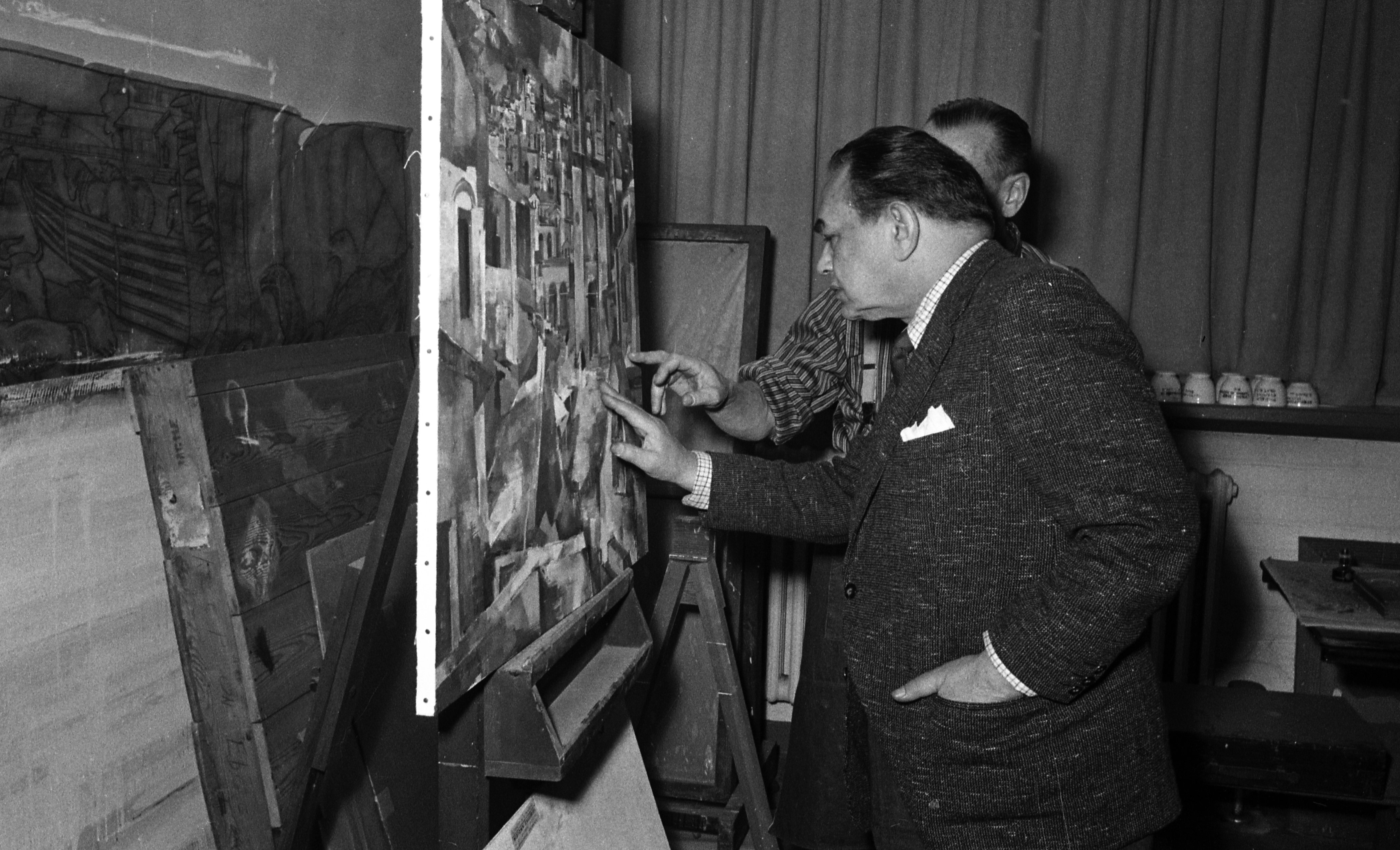
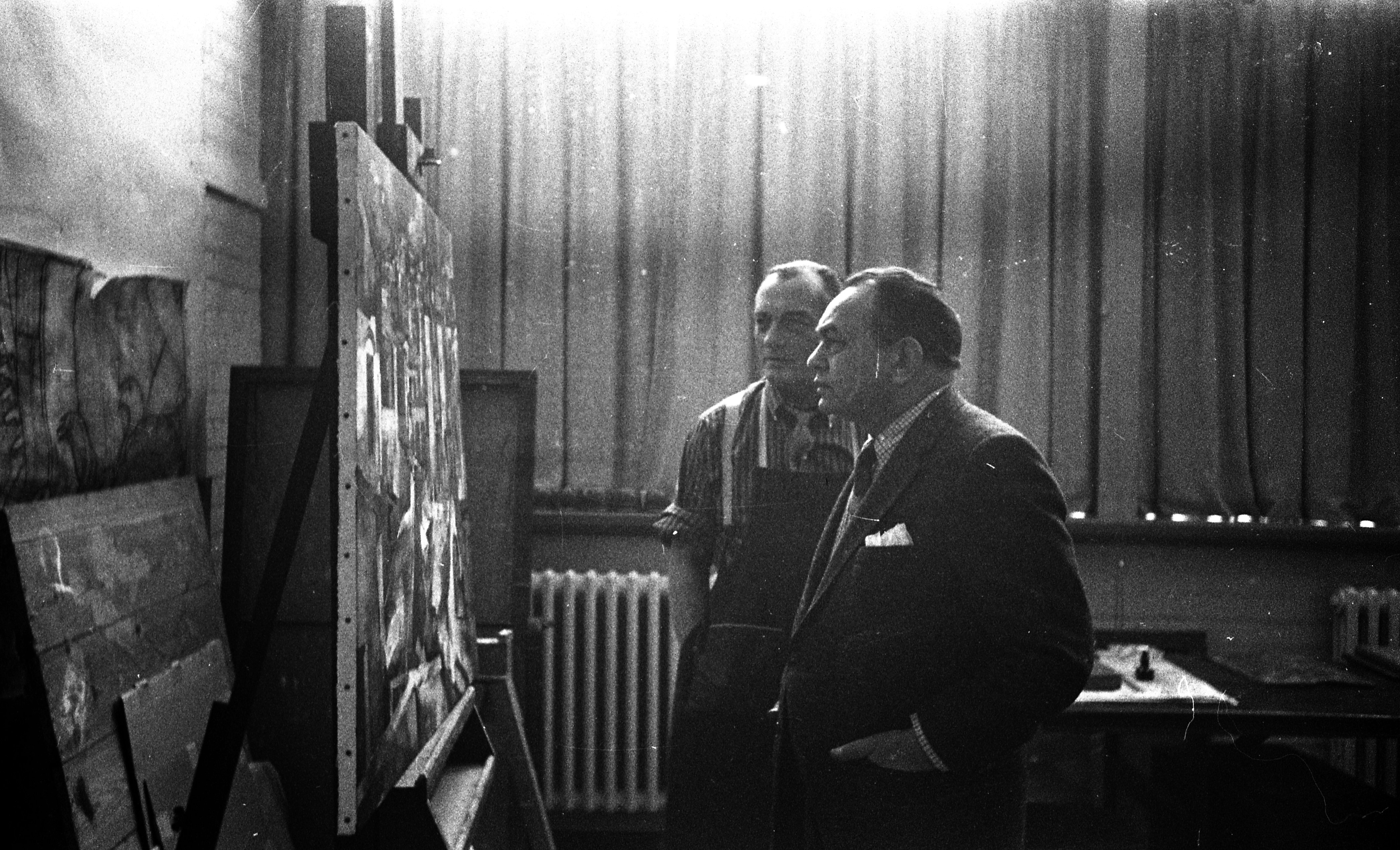
In December 1957, Robinson was in a play “Middle of the Night” at Cass Theatre in Detroit. According to the Sunday, December 15, 1957, Detroit Free Press, “A distinguished art lover, Edward G. Robinson, the actor, dropped in at Cranbrook Academy of Art Tuesday to chat with an old friend, Zolton (sic) Sepeshy, director of the Academy.”

Cranbrook Archives holds the “proof” of this visit, by way of wonderful images from our campus photographer, Harvey Croze.

I did some digging, and Robinson’s personal archives at Boston University have no mention of Cranbrook or Sepeshy. I also could not confirm if Robinson had any of Sepeshy’s art in his collection; none appear in the 1953 exhibition or in the coffee table book about his second collection, Edward G. Robinson’s World of Art (1971).

I imagine it was simply his love of art that brought Robinson out to Cranbrook in 1957, the same reason so many of us are drawn to campus today.

Leslie S. Mio, Associate Registrar, Cranbrook Center for Collections and Research

Mail Matters: Another Michigan Mural

On the eve of World War II, while Americans continued to suffer from the economic fallout of the Great Depression, the United States Treasury Department’s “Section of Fine Arts” commissioned Zoltan Sepeshy, the Head of the Painting Department at Cranbrook Academy of Art, to paint a mural for a new post office in downtown Caro. At the same time, one of his star students, David Fredenthal, was commissioned to paint a mural for the new post office in Lincoln Park. (Having trouble placing Caro, if not also Lincoln Park, on a map of Michigan? For your first geography lesson, place your right hand, palm side up, next to you. Caro is located in the middle of your thumb, while Lincoln Park is closer to your wrist.)

Separate and distinct from the more extensive and influential WPA or Works Progress Administration’s “Federal Arts Project,” which essentially was a work-relief program for artists, the purpose of the Treasury Department’s “Section” program, as it came to be known, was “to secure for the Government the best art which this country is capable of producing, with merit as the only test.” Sepeshy and Fredenthal, with their recently minted Cranbrook credentials, fit the bill. Fredenthal even had some mural experience, having recently painted an octopus mural for the Academy’s now infamous Crandemonium Ball in 1936.

Octopus mural by David Fredenthal for Crandemonium Ball, March 1936. Cranbrook Archives.

Meanwhile, Jimmy Southers, Lincoln Park’s postal superintendent, was more than a little perplexed and worried about the mural David Fredenthal was to paint for his post office. The week of September 25, 1939, Southers received a letter from Washington notifying him that Fredenthal, who the government described as a “sensational young artist” from Cranbrook Academy of Art, had been named to paint the mural—a fresco no less. Southers, who more than likely had not paid a visit to the seven-year-old Academy in Bloomfield Hills, not only had no idea what a fresco painting was but was intimidated by the government’s suggestion that he was to confer with the artist about the subject matter. His big idea? He thought a mural showing all of Lincoln Park’s postal superintendents (no doubt with him in a position of prominence) would do just fine.

Fortunately for Southers, geography intervened. Pulling out his own map of Michigan, Sepeshy did some calculations (which I just repeated using Google Maps). Realizing that Caro was some seventy-two miles from his studio in Bloomfield Hills while Lincoln Park was just twenty-six, the Hungarian painter decided to pull rank. He had the commissions switched and assigned the Caro project to his student while he decided to paint the mural in Lincoln Park, a few miles south of Dearborn.

Continue reading

A Michigan Mural

Metro Detroiters, out-of-town visitors, and architectural aficionados worldwide have long admired the Penobscot Building in Detroit’s Financial District. Like its close neighbor, the Guardian Building, and the Fisher Building further north in Midtown, it is one of the city’s finest examples of art deco architecture and one of the iconic structures that still make up Detroit’s skyline today. Designed by Wirt C. Rowland of Smith, Hinchman, & Grylls, when its 47 stories were built in 1928, it was the tallest building in the city and the fourth tallest in the nation.

The Penobscot, on the National Register of Historic Places, is perhaps best known architecturally for its tiered upper seventeen floors and the exterior ornament by sculptor Corrado Parducci, whose work can be seen on many other Detroit buildings. It’s also known to locals for the red-lit globe at the top (originally designed as an aviation beacon), the legendary Caucus Club (Barbara Streisand reportedly launched her singing career here), or the famed roof observation deck which offered an excellent panorama of the city.

But, what about the interior of the Penobscot? Well it just so happens there’s a Cranbrook connection!

penob-1

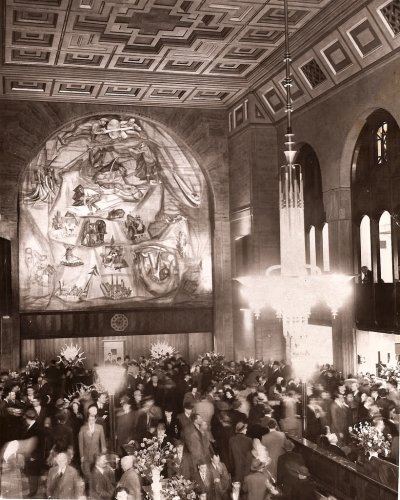
The original bank lobby. Courtesy Detroit Free Press Archives.

The Guardian Detroit Group was the first tenant of the two-story bank hall at 635 Griswold St. before they had their own skyscraper commissioned just a block away. A later occupant, Detroit City Bank, opened in the same space in February 1949. When they did, adorning one wall was a mural painted by Cranbrook Academy of Art graduate and Head of Kingswood School Art Department (1940-1956), Clifford B. West. Known as the “Mural of Michigan” the twenty-six-foot painting depicts scenes representing state commerce and industry. West, who studied under Zoltan Sepeshy, and with fellow muralist David Fredenthal, had already completed a bank mural in Alamosa, Colorado, as well as Detroit-area murals in the Rackham Building, Stockholm Restaurant, and Fox & Hounds Restaurant.

Following a meticulous process that involved a series of sketches at different scales, cartoons plotted to a numbered grid and traced on the wall, and painting in two steps (large blocks of color followed by detail work), the scenes were applied in casein tempera on canvas cemented to the wall. Joining in this process was West’s wife and fellow artist, Joy Griffin West, and several academy students. Fortuitously, each stage of work was captured in a series of photographs by Cranbrook photographer, Harvey Croze.

This slideshow requires JavaScript.

Upon completion of the mural, West mounted an exhibit at Cranbrook Art Museum titled, Progress of a Mural in April 1949, detailing his process for the Penobscot mural, and featuring many of the preliminary sketches and cartoons.

It’s largely unknown whether the Penobscot mural exists today, since a drop ceiling was installed many years ago, completely obscuring West’s creation.

Deborah Rice, Head Archivist

From Drawing to Driftwood: The Artwork of Wallace MacMahon Mitchell

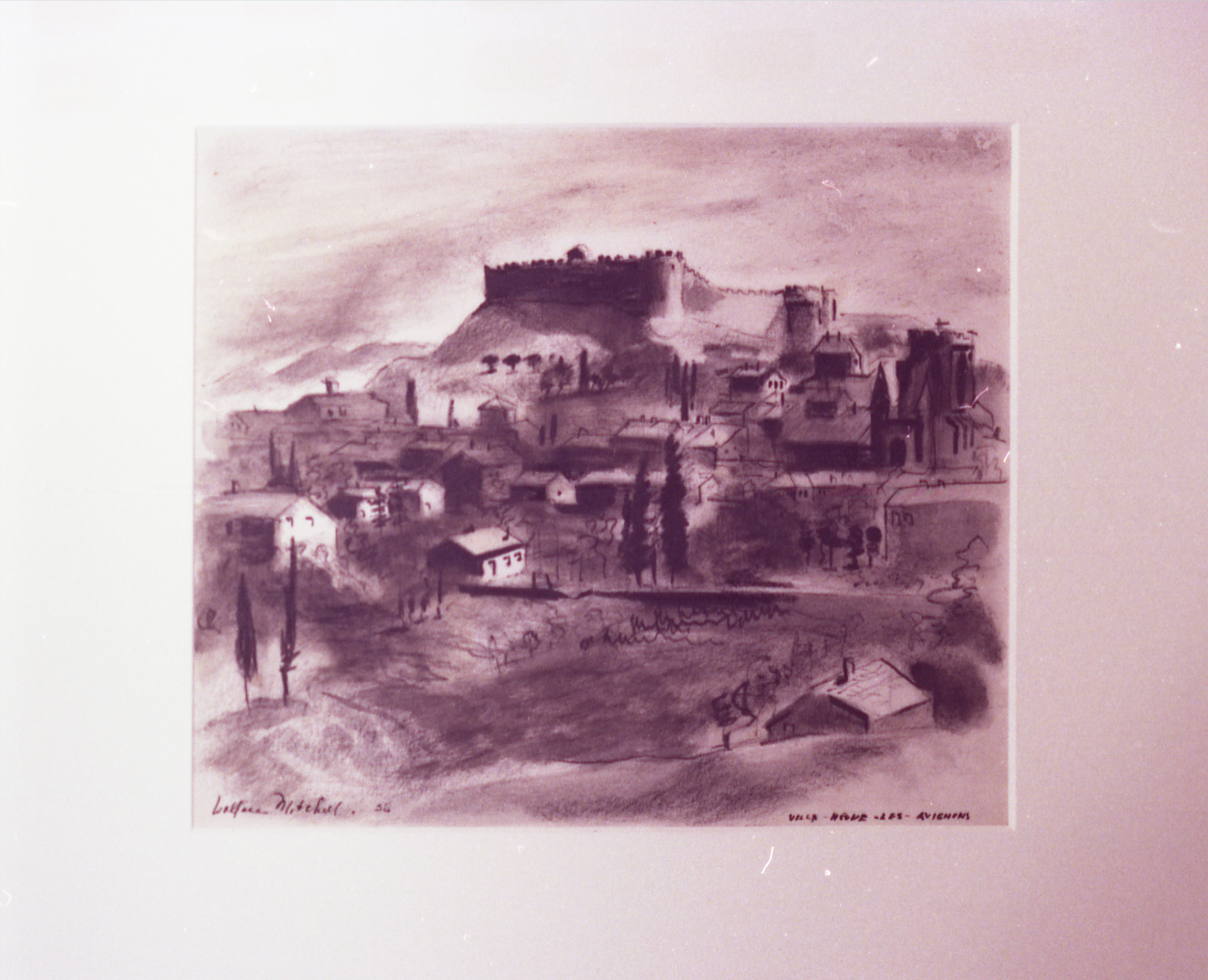
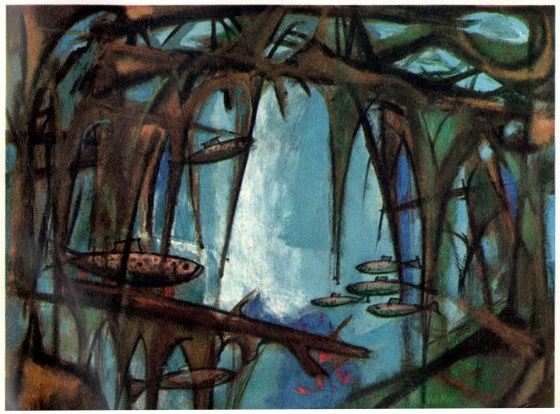
During the Archive’s Reading Room relocation at Cranbrook Art Museum, we have been digitizing negatives for preservation and access. This has enabled a new collection for CONTENTdm which highlights the artwork of Wallace MacMahon Mitchell (1911-1977). There are thirty images so far, with more being added soon. Five of Mitchell’s paintings can also be viewed during tours through Saarinen House: Presidents/Residents, 1946-1994.

WM318b

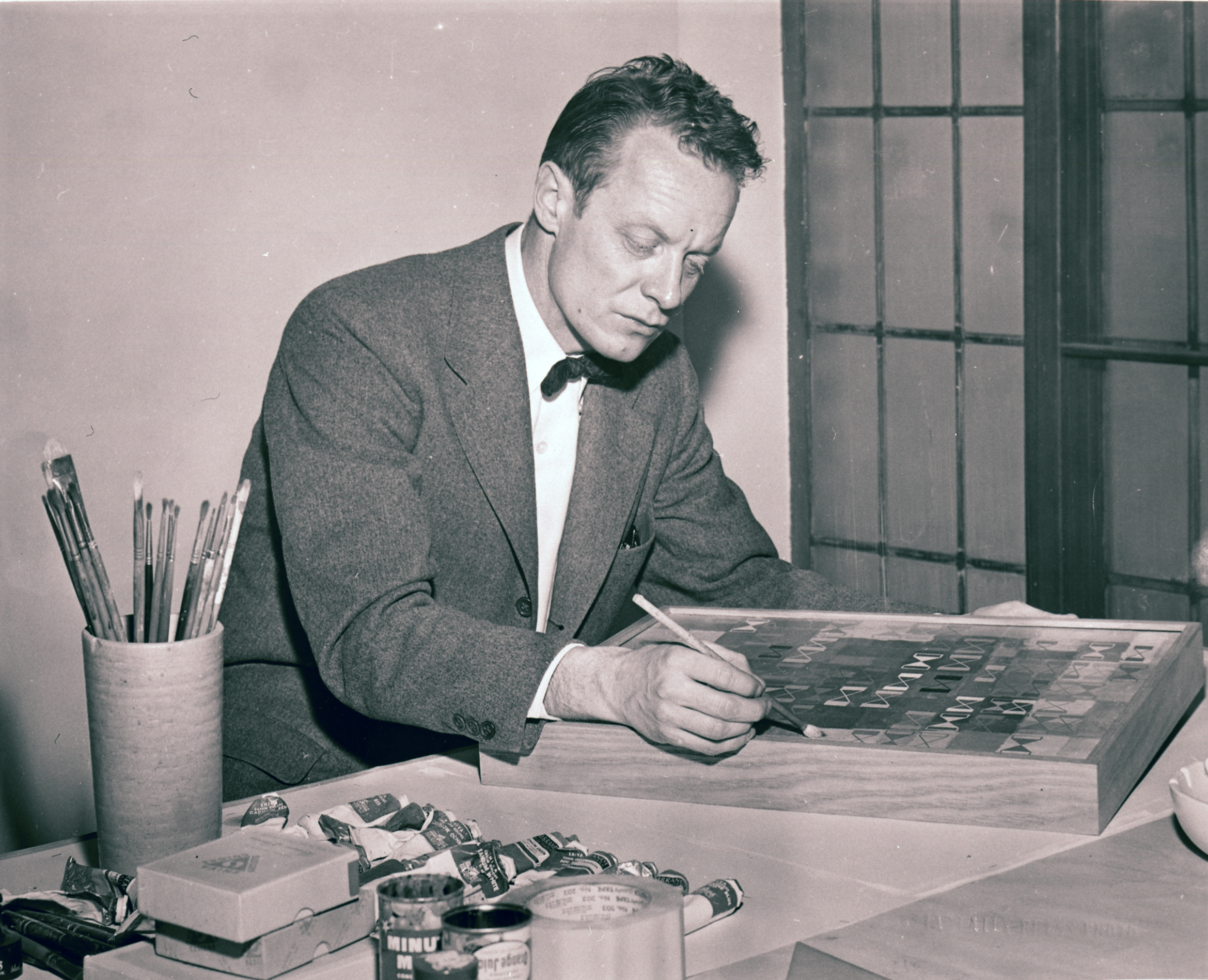
Wally Mitchell in his studio, early 1940s. Courtesy Cranbrook Archives.

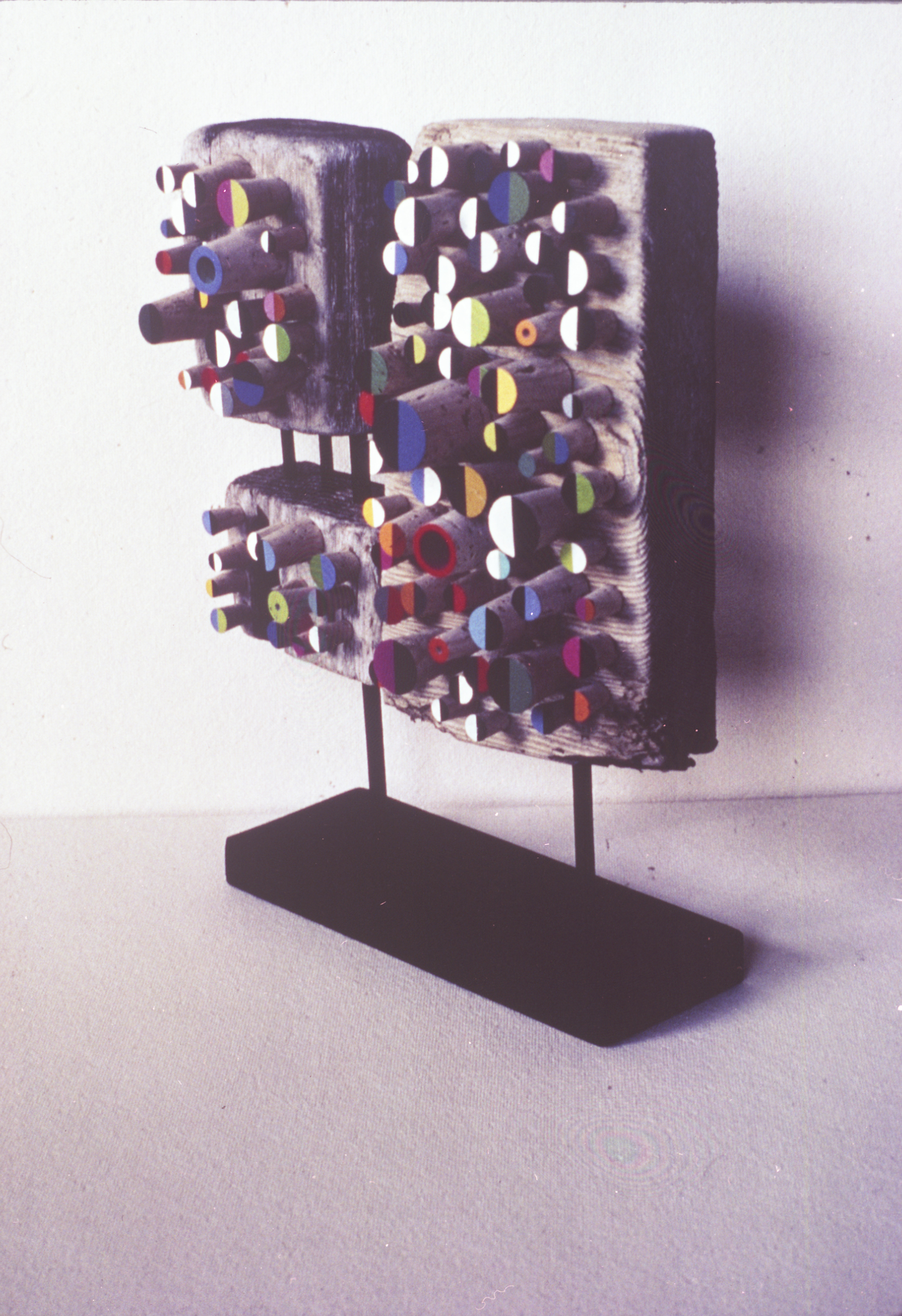
The collection features images of the rich diversity of Mitchell’s artwork, from his early drawings and still life paintings to his later geometric abstract works and painting-constructions. Mitchell’s later works include many driftwood sculptures and Plexiglas paintings.

WM78

Driftwood in Three Sections, 1965. Estate of Wallace MacMahon Mitchell/Courtesy Cranbrook Archives.

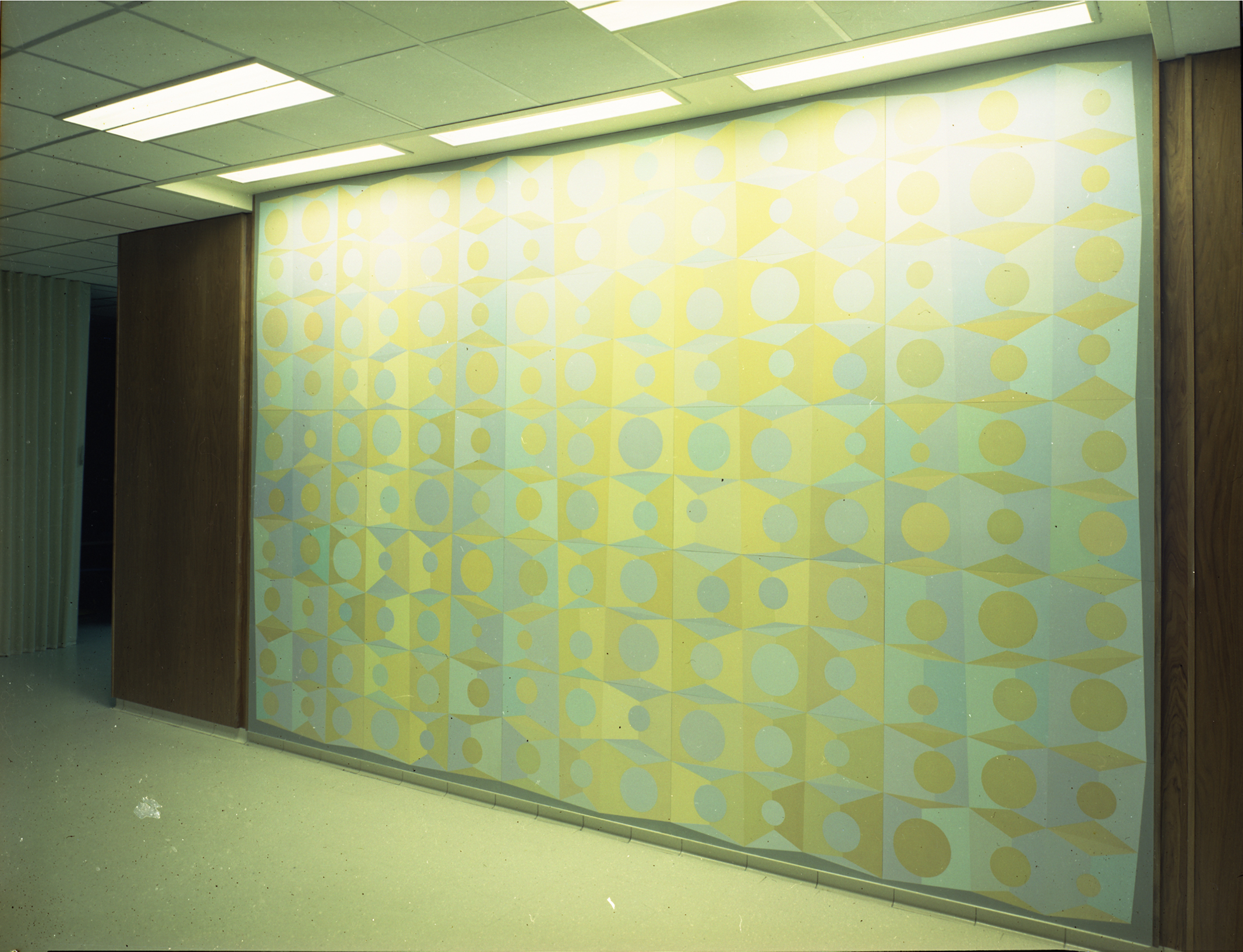
In 1946, two of his paintings were included in the European Exhibition of the Guggenheim-funded Museum of Non-Objective Painting. These two pieces, with two other paintings added in 1948, are now in the Solomon R. Guggenheim Museum. Between 1950 and 1962, Mitchell’s work was frequently exhibited at the Bertha Schaefer Gallery in New York. He was also commissioned to design murals, such as one installed at the University of Kentucky in 1962, based on his painting Turnabout Number One from 1952.

WM199a

University of Kentucky Mural, installed in 1962 based on a painting ‘Turnabout Number One’ from 1952. Estate of Wallace MacMahon Mitchell/Courtesy Cranbrook Archives.

Mitchell’s archival collection will be available for research again when the Archives Reading Room reopens in July. Mitchell’s collection contains professional papers relating to his studentship and work as an instructor and administrator at Cranbrook. It also includes interviews and correspondence related to Joan Bence’s 1983 publication, The Art of Wallace Mitchell. There are also audio-visual materials including negatives, transparencies, slides and photographs.

WM334-3

Villa-Neuve-Les-Avignons, 1938. Estate of Wallace MacMahon Mitchell/Courtesy Cranbrook Archives.

Mitchell was born in Detroit in 1911. After receiving his BA from Northwestern University in Chicago, Ill. in 1934, he studied with Zoltan Sepeshy for a year (1934-1935). He then toured Europe before returning to Cranbrook in 1936 as a painting instructor. His career at Cranbrook spanned 1936-1977, during which time he taught Arts and Crafts at Cranbrook School (1944-1947) while he was painting instructor (1936-1956), he was Registrar for the Academy of Art (1944-1956), Director of the Cranbrook Art Museum (1956-1970), and President of the Cranbrook Academy of Art (1970-1977). A retrospective exhibition of his work planned for his retirement at the end of the 1976/1977 academic year became a memorial exhibition following his death in January 1977.

-Laura MacNewman, Associate Archivist

Sources:

Wallace McMahon Mitchell Papers (1990-21)

Chad Alligood, What to Paint and Why: Modern Painters at Cranbrook, 1936-1974 (Bloomfield Hills, MI: Cranbrook Art Museum, 2013)

Joan Beehler Bence, The Art of Wallace Mitchell – Cranbrook’s Op Art Master Colorist (Unpublished, 1983, 1996)

Wallace MacMahon Mitchell, 1911-1977: a memorial exhibition of paintings and painting-constructions, 1936-1976 (Bloomfield Hills, MI: Cranbrook Academy of Art, 1977)

Automobiles and Art?

Did you know that Ford Motor Company supported and encouraged the artistic activities of its employees, sponsored traveling art exhibitions, and published contemporary American art in its company magazines? I had no idea until I found a couple of copies of Ford Times magazine and a Lincoln-Mercury Times in one of our collections.

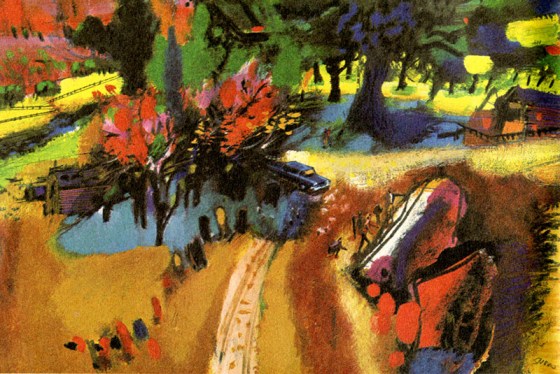
“Fish,” Big Spring, Michigan. Lincoln-Mercury Times, May-June 1956. Painting by Bill Moss. Moss was a graduate of the Academy of Art and painted over 300 works for Ford Times from 1949-1958.

“Fish,” Big Spring, Michigan. Lincoln-Mercury Times, May-June 1956. Painting by Bill Moss. Moss was a graduate of the Academy of Art and painted over 300 works for Ford Times from 1949-1958.

Much of the auto company’s support and use of artworks began under Arthur Townsend Lougee, who served as the Executive Editor and Art Director of Ford Times magazine, as well as the Lincoln-Mercury Times, from 1946-1961. During his tenure, Lougee commissioned thousands of articles on America and Americana, which were illustrated with watercolors by regional Ford artists who, for the most part, painted local motifs. Ford’s policy was to leave the subject matter up to the discretion of the artist.

steele-ban

“Lake Superior’s Eastern Shore.” Lincoln-Mercury Times, May-June 1956. Painting by Robert Bannister

A small company magazine at 4 x 6 inches, each issue of the monthly Ford Times consisted of several stories about vacation destination spots and those of historical interest, as well as promotional information about contemporary Ford products. Watercolor paintings first appeared as cover art in the June 1946 issue, and on the interior in September 1947.

steele-snw

“Fruita,” Bryce Canyon National Park. Ford Times, Sep 1959. Painting by V. Douglas Snow.

Lougee also assembled the Ford Times Collection of American Art, a collection of over 7,000 of the paintings commissioned for the Ford publications. Nearly 700 American painters were represented in the collection. The Ford Times art exhibition program was established in 1954 and made available to schools and universities, libraries, and art organizations across the country. Exhibitions included American Byways (1953), Artists and Fishermen (1955), Faculty Artists (1962), Variety No. 8 (1962), and Travel in Mexico (1969). Under the auspices of the United States Information Agency, international exhibitions traveled to countries in Asia, Africa, Europe, and the Middle East as a way of promoting good will and friendship among nations.

steele

Lincoln-Mercury Times, May-June 1956

Thanks to the collection of Jack Keijo Steele, a Cranbrook Academy of Art alum, clay modeler in the Ford Styling Office, and lifelong painter, we are able to tell this interesting story of Ford’s contributions to art in this country.

Leslie S. Edwards, Head Archivist


Nunsense

Over the past few years, I have listened to researchers in the Archives and visitors to the museum describe works of art as divine or heavenly, but I don’t remember those words used to describe the artist. Until now. Did you know that during the 1950s-1960s there were several artists who studied at the Academy of Art who were also members of a divine order? Admittedly, I have not had much interaction with nuns in my lifetime, but I have a keen fascination (cue: “The hills are alive with the sound of music..”).

Sister Mary James Ann Walsh, BVM (Order of the Blessed Virgin Mary) was one of several nuns to study at the Academy where she received her MFA in painting in 1955. In 1953, Sister Mary was the First Prize Winner of the 9th Annual Iowa Water Color Show for her piece, “Ecce Homo.” That painting is now part of the Sioux City Art Center’s permanent collection. In addition to her Cranbrook degree, Sister Mary studied at the State University of Iowa and the University of Colorado. In 1959 she became head of the Clark College department of Art in Dubuque, Iowa.

Sisters at work in the metal shop, 1954. Courtesy Cranbrook Archives.

Sisters at work in the metal shop, 1954. Courtesy Cranbrook Archives.

The photo above shows Sister Mary Grace Esther Mehren, BVM, and Sister Mary Barbara Cerny at work in the metal shop in 1954. We are still looking for information about Sister Mary Barbara, but according to the Chicago Tribune (15 Jun 1958), Sister Mary Grace Esther was appointed to oversee construction of an eleven-story Scholasticate on the campus of Mundelein College. The building houses lecture halls, classrooms, a dining hall, and a chapel.

Another CAA alum (Metalsmithing ’49), Sister Helene O’Connor, O.P. (Dominican Order of Preachers), founded Studio Angelico in 1935, at Siena Heights University in Adrian, Michigan. Studio Angelico, the art department at Siena Heights, was named for the 15th century Dominican painter, Fra Angelico. Sister Helene chaired the art department, taught classes, and directed community workshops. An accomplished sculptor, ceramicist, weaver, and muralist – her work has been exhibited at the Portland Museum of Art, the Detroit Institute of Arts and the Metropolitan Museum of Art.

Sister Marie Gertrude's, "Mother Hen," Bay City Times, 27 Sep 1964.

Sister Marie Gertrude’s, “Mother Hen,” Bay City Times, 27 Sep 1964.

Also of the Dominican order, Sister Marie Gertrude Lohman, O.P., received her MFA in Sculpture from the Academy in 1966. Several of Sister Marie Gertrude’s sculptures display in Illinois, including a statue of St. Catherine of Siena at the Queen of Heaven Cemetery in Chicago and a statue of St. Albert the Great in the student courtyard at St. Rose Priory. Sister Marie Gertrude studied in Schifanoia, Italy, and her work has been exhibited in Chicago and Dubuque. In 1964, her work, “Mother Hen,” was displayed at the Studio 23 space at the Arts Center in Bay City, MI.

This research has only deepened my fascination of the divine sisterhood. I wonder what drew the sisters to Cranbrook? There were several other nun-students at CAA – I look forward to learning more about their contributions to Cranbrook and the art world.

Gina Tecos, Archivist

Out From the Shadows #1: Myrtle Hall

While most everyone equates the names Saarinen, Knoll, and Eames with Cranbrook, there are hundreds, if not thousands, of people who have contributed to the community whose stories have never been told. We archivists thought it would be interesting to tell some of their stories here.

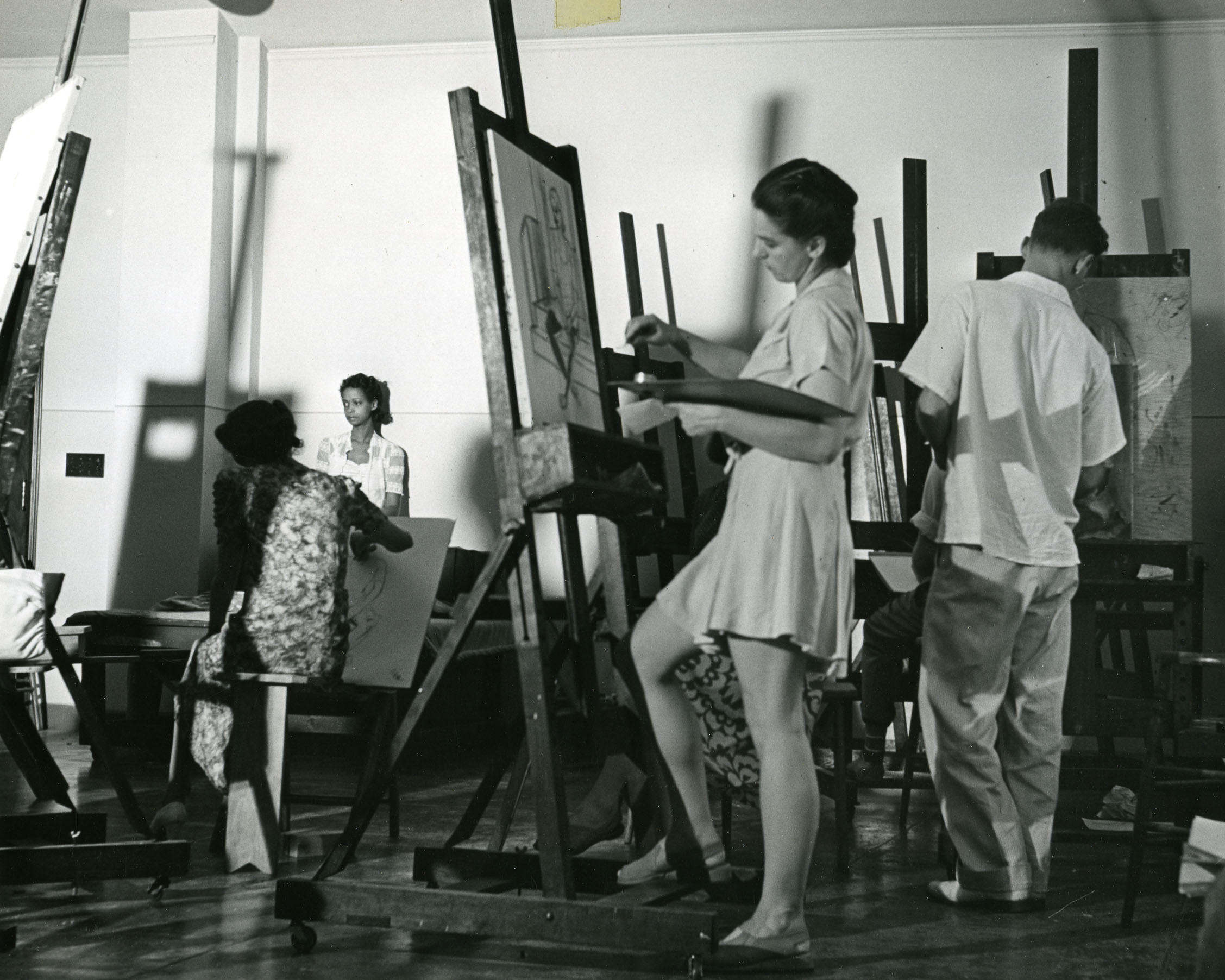
The first is Myrtle Hall. She was not an alumna, faculty, or staff at any of the Cranbrook institutions, however, she did work at the Academy of Art as a model for drawing and painting students in the late 1930s and early 1940s. Not much is known about the models – there are no employee files for them, and their names are not listed in reports or meeting minutes. Fortunately however, I did uncover evidence that a line-item, established in the budget for the Academy of Art’s 1934-1935 academic year, specifically provided funding for the life models for the drawing and painting classes (taught by Wally Mitchell.) Models worked twenty-one hours per week.

Painting and drawing class, summer 1940.

Painting and drawing class, summer 1940.

By her own admission, Myrtle was the “first black model at Cranbrook” and for that matter, the first black model in the Detroit area including at the Meinzinger School of Art. In addition to modeling, Myrtle was also an artist herself and a member of Detroit’s Pen and Palette Club, which was formed in 1925 by the Detroit Urban League to help young artists exhibit their works. In 1935, Myrtle received an award for one of her paintings at the club’s Ninth Annual Exhibition. She also studied for a time at the Society of Arts and Crafts, exhibited at the Detroit Artists Market, and was one of the founding members of the Extended Arts Gallery (1958). During the 1940s, Myrtle abandoned painting and became an accomplished ceramicist. She had her own pottery studio (which she designed herself) on Erskine Street in Detroit. The studio was filled with antiques, paintings and sculpture by Michigan artists, as well as her own ceramics and of course her kiln and glazes. In a 1963 interview, she stated “I can’t stand things that are useless” and her oven-to-table casseroles, salad bowls, drinking mugs, and lamp bases reflected just that.

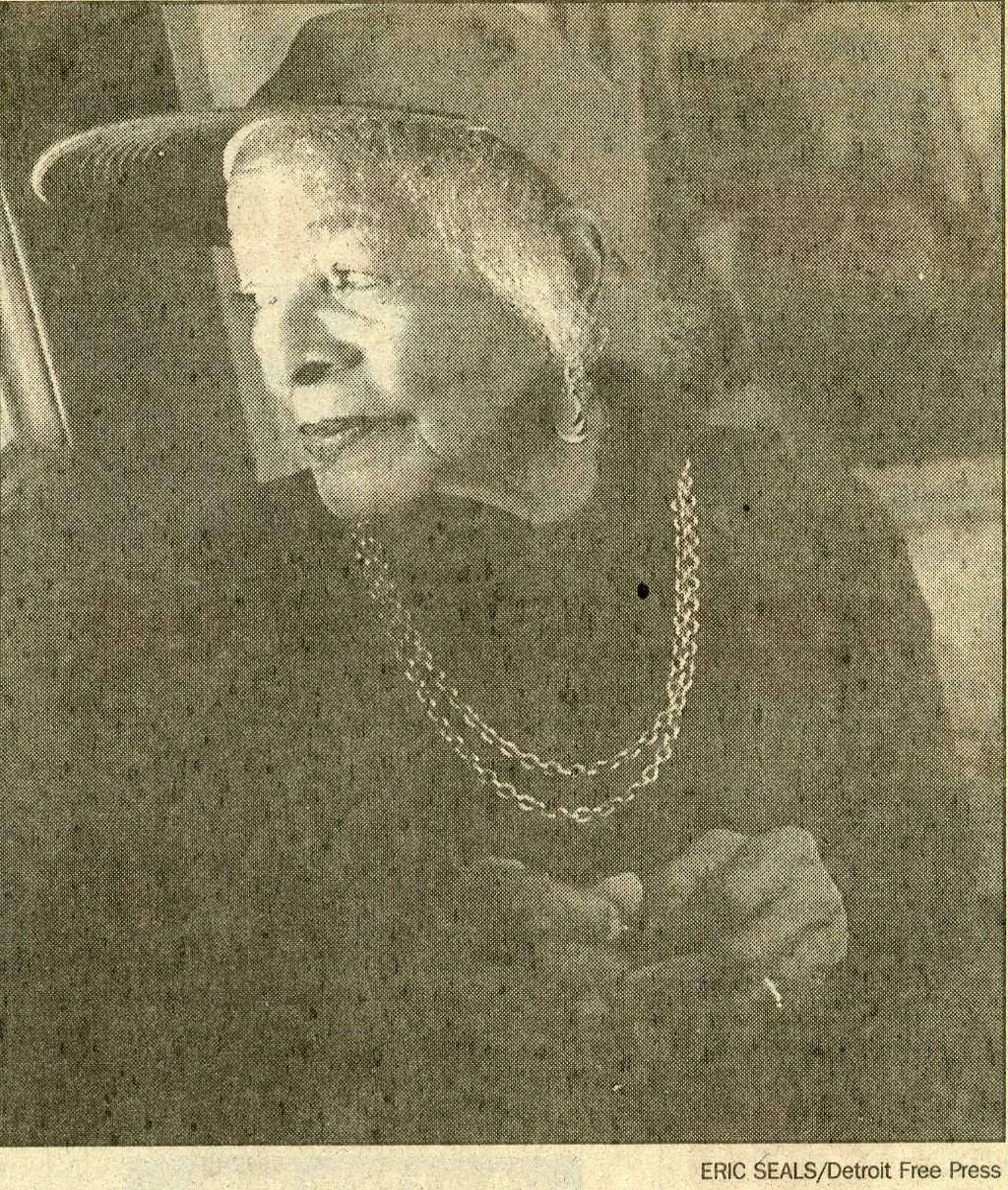
Myrtle Hall, Detroit Free Press, Mar 1994.

Myrtle Hall, Detroit Free Press, Mar 1994.

A 1994 article in the Detroit Free Press also tells the story of Myrtle Hall as a quiet but effective activist. She stood up for civil rights when she saw injustice, and was instrumental in affecting a change in Meinzinger Art School’s discrimination of African American students after World War II. Myrtle Hall is quoted as saying “I didn’t just model, I noticed things.”

Leslie S. Edwards, Head Archivist

Editor’s Note: We do not have any biographical information on Myrtle, but if you know anything about her, please let us know!

The Case of the Bogdani

The other night I saw the most interesting show on PBS called “Fake or Forgery.” An investigative journalist and two noted art sleuths joined forces with cutting edge scientists to discover the truth behind a painting the owner thought to be a Degas. They thoroughly searched the provenance of the painting, and used scientific methods like X-ray fluorescence (XRF) to determine if the pigments used in the painting were compatible with Degas’ known palette. It made me think of the many works of art across the Cranbrook campus that could benefit from in-depth scientific research like this. And, it prompted me to relay the story of a discovery the archives staff made several years ago.

The painting we fondly refer to as “The Bogdani” was originally purchased by George Booth for Kingswood School for Girls, where it hung in the Domestic Science Dining Room. Purportedly painted by noted Hungarian Jakob Bogdani (1658-1724), the still life was found in a storage room badly in need of cleaning and restoration.

The painting was conserved by Ken Katz of Conservation & Museum Services in Detroit. During the several months of conservation, we were able to visit the studio in order to see the work in process, and the results were amazing.

during

During conservation.

As I looked closely at the work, my heart almost stopped beating. Bogdani’s signature was gone, and in its place was another name! My first thought was how hard I had lobbied to get the painting conserved and now it was a forgery!  However, after doing additional research, I discovered that the artist, Tobias Stranover (1684-1731) was actually Bogdani’s son-in-law and former student. Phew! Although this meant the still life was painted around 1810 instead of 1790, at least we still had an original painted by an artist who, with his father-in-law, provided the finest exotic bird and animal paintings in England. The painting currently hangs in the reading room of Cranbrook Archives.

Before conservation.

Before conservation.

after

After conservation, details in the painting can be seen can be seen more clearly, and the brilliance of the colors pop.


Leslie S. Edwards, Head Archivist


Create a website or blog at WordPress.com